Cambridge IGCSE English - Literature 0486 — 2018 May/June Paper 3 · Variant 1
0486/31/M/J/18 · 25 marks · ≈28 min
The question paper and its mark scheme, free to read here and free to download. This is Cambridge’s own paper, exactly as it was sat.
Question paper12 pages

Mark scheme4 pages
Answers below. Sit the paper first if you are practising.
Paper as text
Question paper, page 1
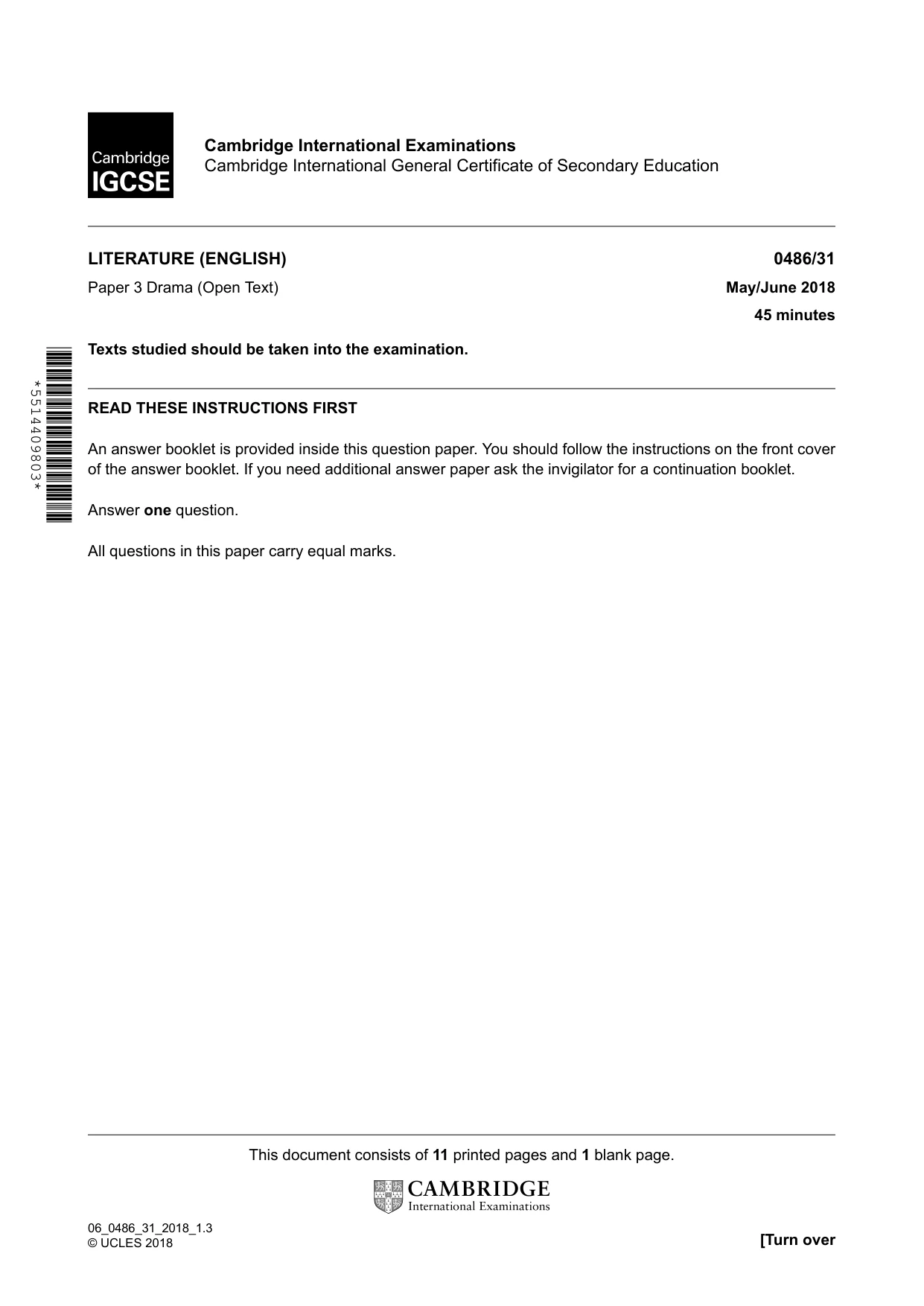
Cambridge International Examinations Cambridge International General Certificate of Secondary Education 0486/31 LITERATURE (ENGLISH) May/June 2018 Paper 3 Drama (Open Text) 45 minutes Texts studied should be taken into the examination. READ THESE INSTRUCTIONS FIRST An answer booklet is provided inside this question paper. You should follow the instructions on the front cover of the answer booklet. If you need additional answer paper ask the invigilator for a continuation booklet. Answer one question. All questions in this paper carry equal marks. This document consists of 11 printed pages and 1 blank page. [Turn over 06_0486_31_2018_1.3 © UCLES 2018 *5514409803*
Question paper, page 2
J LAWRENCE & R E LEE: Inherit the Wind Remember to support your ideas with details from the writing. Either 1 Read this passage carefully, and then answer the question that follows it: Tell me, do you have any children, Mr Sillers? Brady: Content removed due to copyright restrictions 06_0486_31_2018_1.3 © UCLES 2018 2
Question paper, page 3
Content removed due to copyright restrictions All I want is to prevent the clock-stoppers from dumping a load of medieval nonsense into the United States Constitution. Drummond: [from Act 1 Scene 2] How do the writers make this moment in the play both serious and entertaining? Or 2 How do the writers memorably portray the strength of religious belief in Hillsboro? [Turn over 06_0486_31_2018_1.3 © UCLES 2018 3
Question paper, page 4
ARTHUR MILLER: A View from the Bridge Remember to support your ideas with details from the writing. Either 3 Read this passage carefully, and then answer the question that follows it: She’s got other boarders up there? Eddie: Content removed due to copyright restrictions 06_0486_31_2018_1.3 © UCLES 2018 4
Question paper, page 5
Content removed due to copyright restrictions [SECOND OFFICER sweeps past and, glancing about, goes into the kitchen.] [from Act 2] In what ways does Miller make this such a gripping moment in the play? Or 4 What does Miller’s portrayal of Marco add to the dramatic impact of the play? [Turn over 06_0486_31_2018_1.3 © UCLES 2018 5
Question paper, page 6
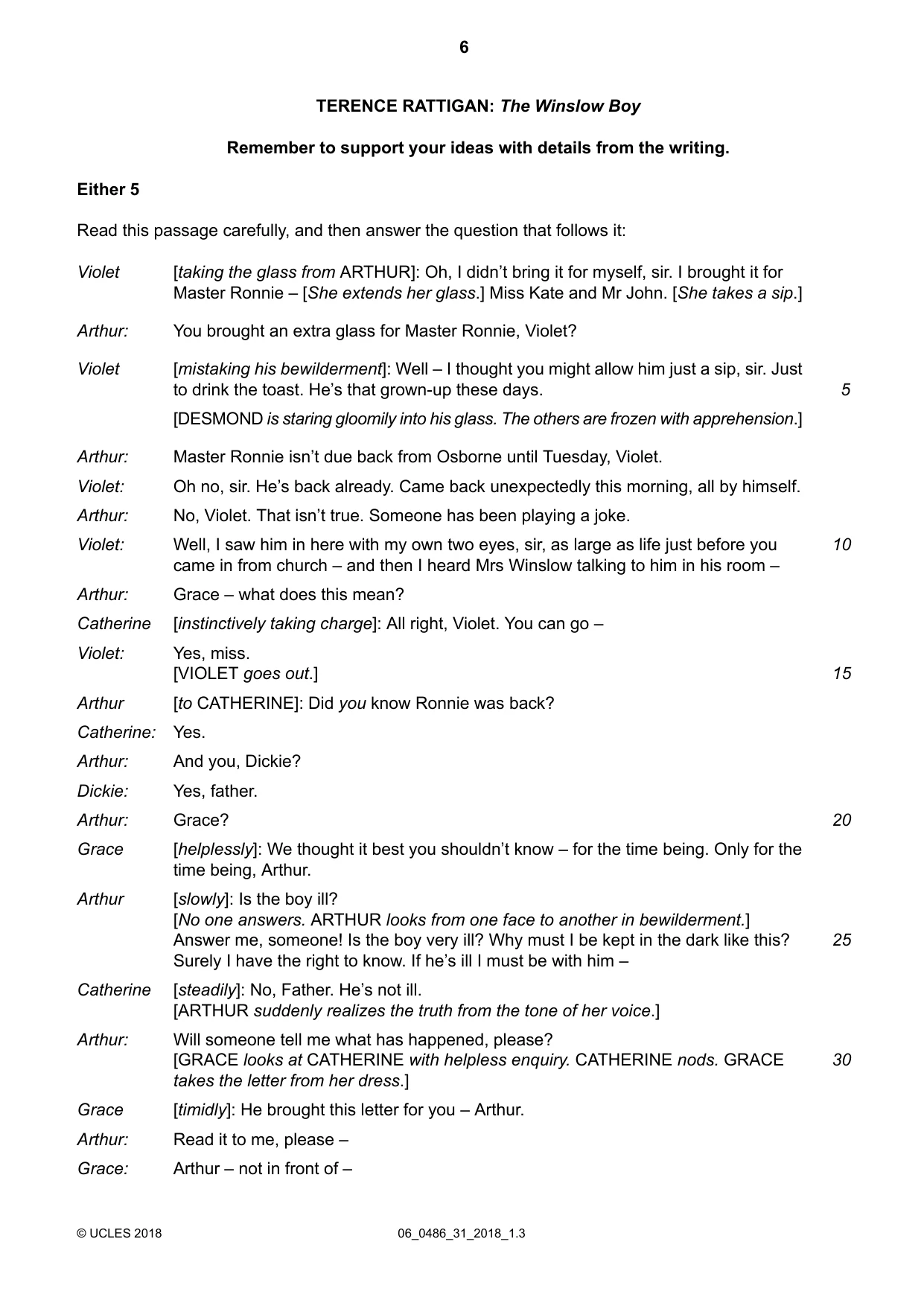
30 25 20 15 10 5 TERENCE RATTIGAN: The Winslow Boy Remember to support your ideas with details from the writing. Either 5 Read this passage carefully, and then answer the question that follows it: [taking the glass from ARTHUR]: Oh, I didn’t bring it for myself, sir. I brought it for Master Ronnie – [She extends her glass.] Miss Kate and Mr John. [She takes a sip.] Violet You brought an extra glass for Master Ronnie, Violet? Arthur: [mistaking his bewilderment]: Well – I thought you might allow him just a sip, sir. Just to drink the toast. He’s that grown-up these days. Violet [DESMOND is staring gloomily into his glass. The others are frozen with apprehension.] Master Ronnie isn’t due back from Osborne until Tuesday, Violet. Arthur: Oh no, sir. He’s back already. Came back unexpectedly this morning, all by himself. Violet: No, Violet. That isn’t true. Someone has been playing a joke. Arthur: Well, I saw him in here with my own two eyes, sir, as large as life just before you came in from church – and then I heard Mrs Winslow talking to him in his room – Violet: Grace – what does this mean? Arthur: [instinctively taking charge]: All right, Violet. You can go – Catherine Yes, miss. [VIOLET goes out.] Violet: [to CATHERINE]: Did you know Ronnie was back? Arthur Yes. Catherine: And you, Dickie? Arthur: Yes, father. Dickie: Grace? Arthur: [helplessly]: We thought it best you shouldn’t know – for the time being. Only for the time being, Arthur. Grace [slowly]: Is the boy ill? [No one answers. ARTHUR looks from one face to another in bewilderment.] Answer me, someone! Is the boy very ill? Why must I be kept in the dark like this? Surely I have the right to know. If he’s ill I must be with him – Arthur [steadily]: No, Father. He’s not ill. [ARTHUR suddenly realizes the truth from the tone of her voice.] Catherine Will someone tell me what has happened, please? [GRACE looks at CATHERINE with helpless enquiry. CATHERINE nods. GRACE takes the letter from her dress.] Arthur: [timidly]: He brought this letter for you – Arthur. Grace Read it to me, please – Arthur: Arthur – not in front of – Grace: 06_0486_31_2018_1.3 © UCLES 2018 6
Question paper, page 7
45 40 35 Read it to me, please. [GRACE again looks at CATHERINE for advice, and again receives a nod. ARTHUR is sitting with his head bowed. GRACE begins to read.] Arthur: ‘Confidential. I am commanded by My Lords Commissioners of the Admiralty to inform you that they have received a communication from the Commanding Officer of the Grace: Royal Naval College at Osborne, reporting the theft of a five shilling postal order at the College on the 7th instant, which was afterwards cashed at the post office. Investigation of the circumstances of the case leaves no other conclusion possible than that the postal order was taken by your son, Cadet Ronald Arthur Winslow. My Lords deeply regret that they must therefore request you to withdraw your son from the College.’ It’s signed by someone – I can’t quite read his name – [She turns away quickly to hide her tears. CATHERINE puts a comforting hand on her shoulder. ARTHUR has not changed his attitude. There is a pause. The gong sounds in the hall outside.] [from Act 1] How does Rattigan make this such a tense moment in the play? Or 6 In what ways does Rattigan’s portrayal of Dickie Winslow contribute to your enjoyment of the play? [Turn over 06_0486_31_2018_1.3 © UCLES 2018 7
Question paper, page 8
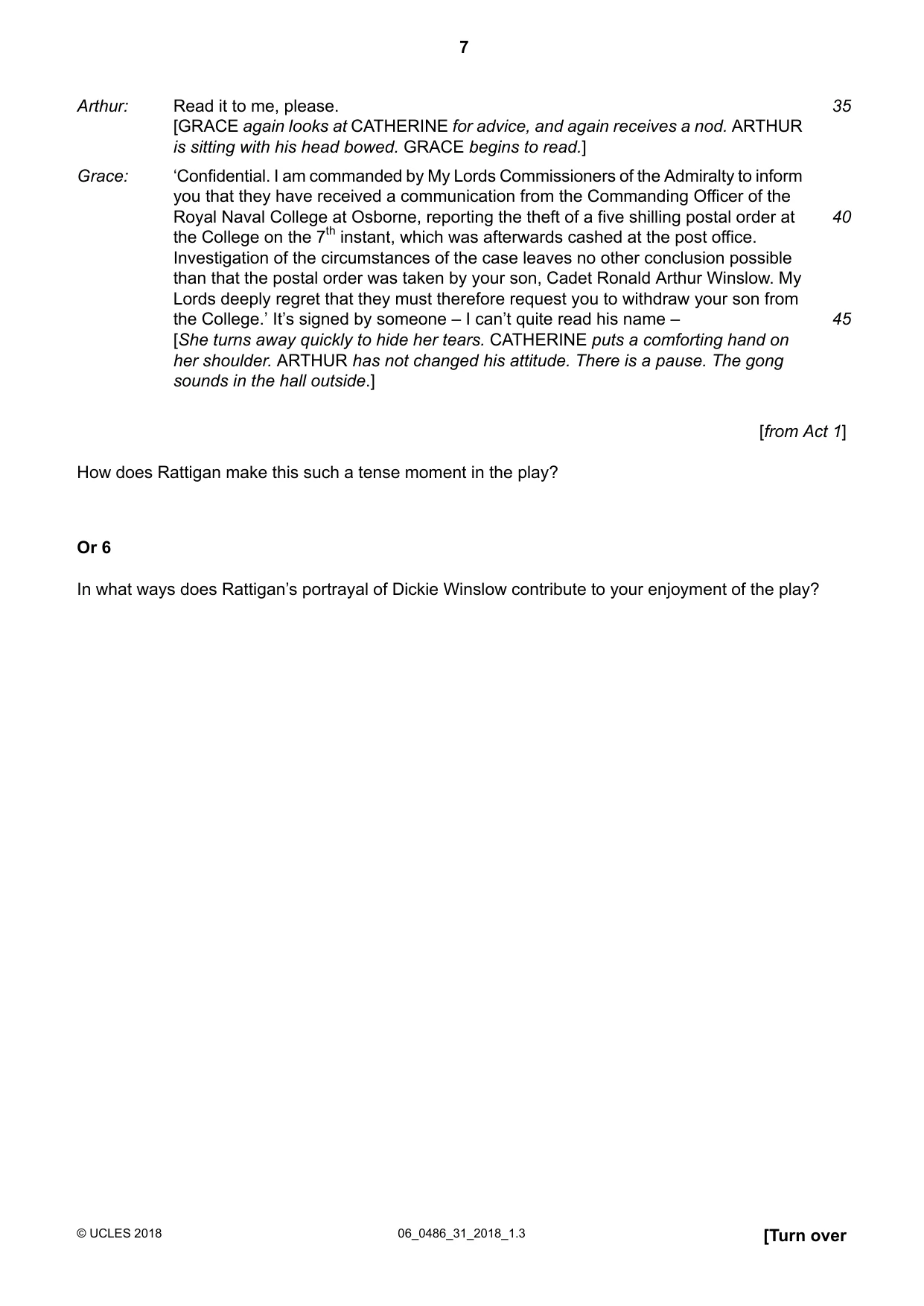
40 35 30 25 20 15 10 5 WILLIAM SHAKESPEARE: Henry V Remember to support your ideas with details from the writing. Either 7 Read this passage carefully, and then answer the question that follows it: Call in the messengers sent from the Dauphin. King: [Exeunt some Attendants.] Now are we well resolv’d; and, by God’s help And yours, the noble sinews of our power, France being ours, we’ll bend it to our awe, Or break it all to pieces; or there we’ll sit, Ruling in large and ample empery O’er France and all her almost kingly dukedoms, Or lay these bones in an unworthy urn, Tombless, with no remembrance over them. Either our history shall with full mouth Speak freely of our acts, or else our grave, Like Turkish mute, shall have a tongueless mouth, Not worshipp’d with a waxen epitaph. [Enter AMBASSADORS OF FRANCE.] Now are we well prepar’d to know the pleasure Of our fair cousin Dauphin; for we hear Your greeting is from him, not from the King. May’t please your Majesty to give us leave Freely to render what we have in charge; Or shall we sparingly show you far off The Dauphin’s meaning and our embassy? 1 Ambassador: We are no tyrant, but a Christian king, Unto whose grace our passion is as subject As are our wretches fett’red in our prisons; Therefore with frank and with uncurbed plainness Tell us the Dauphin’s mind. King: Thus then, in few. Your Highness, lately sending into France, Did claim some certain dukedoms in the right Of your great predecessor, King Edward the Third. In answer of which claim, the Prince our master Says that you savour too much of your youth, And bids you be advis’d there’s nought in France That can be with a nimble galliard won; You cannot revel into dukedoms there. He therefore sends you, meeter for your spirit, This tun of treasure; and, in lieu of this, Desires you let the dukedoms that you claim Hear no more of you. This the Dauphin speaks. 1 Ambassador: [from Act 1 Scene 2] 06_0486_31_2018_1.3 © UCLES 2018 8
Question paper, page 9
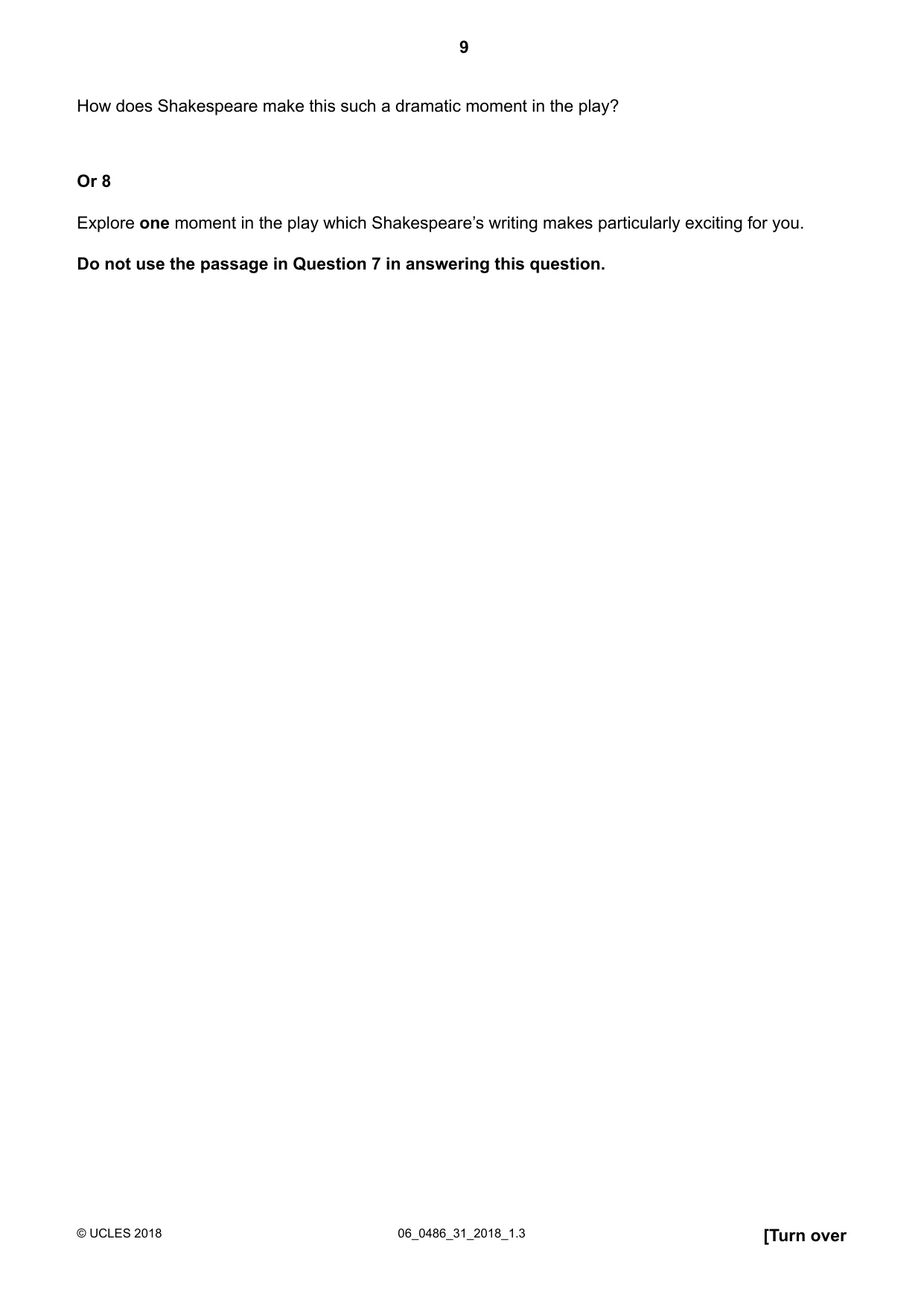
How does Shakespeare make this such a dramatic moment in the play? Or 8 Explore one moment in the play which Shakespeare’s writing makes particularly exciting for you. Do not use the passage in Question 7 in answering this question. [Turn over 06_0486_31_2018_1.3 © UCLES 2018 9
Question paper, page 10
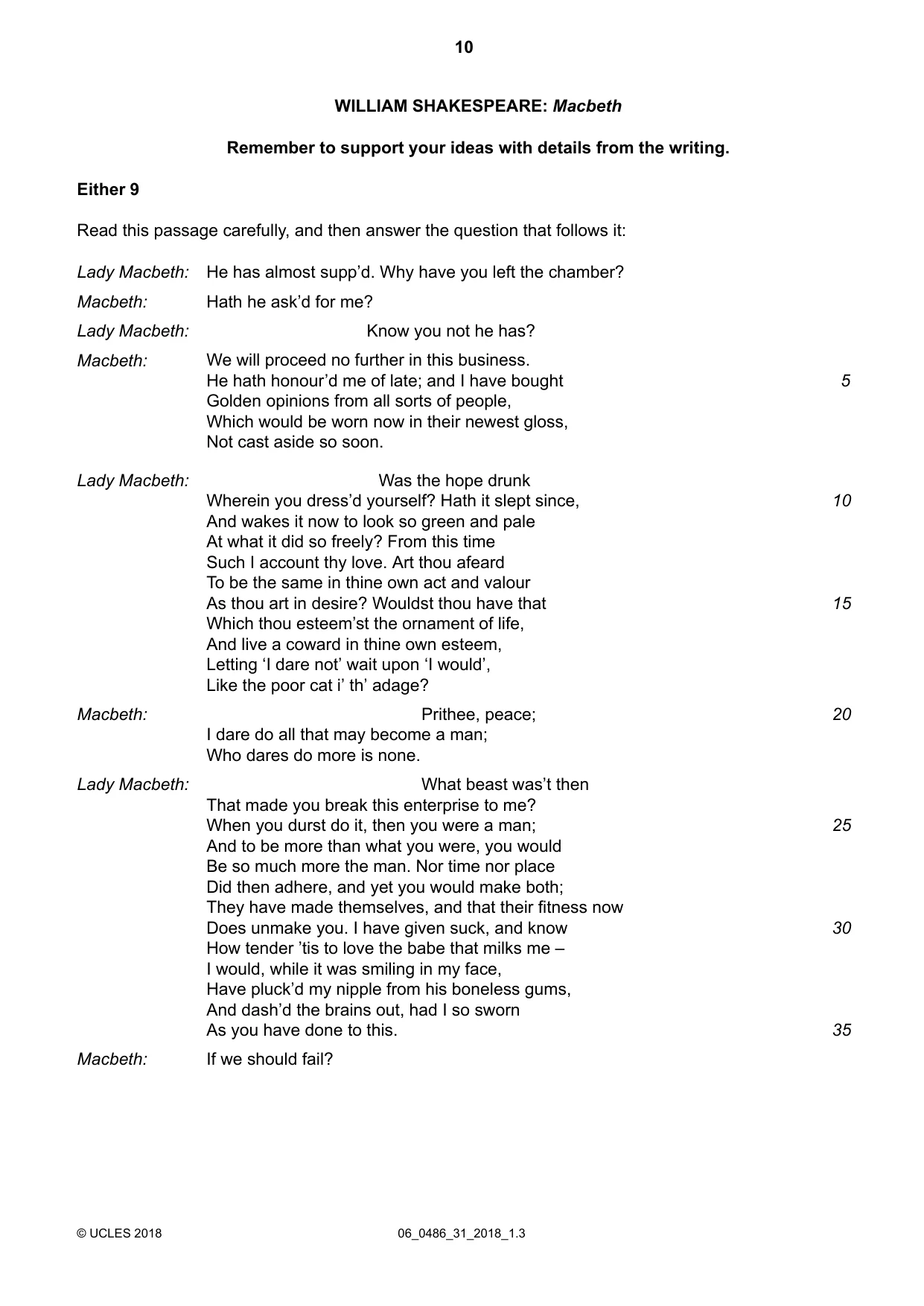
35 30 25 20 15 10 5 WILLIAM SHAKESPEARE: Macbeth Remember to support your ideas with details from the writing. Either 9 Read this passage carefully, and then answer the question that follows it: He has almost supp’d. Why have you left the chamber? Lady Macbeth: Hath he ask’d for me? Macbeth: Know you not he has? Lady Macbeth: We will proceed no further in this business. He hath honour’d me of late; and I have bought Golden opinions from all sorts of people, Which would be worn now in their newest gloss, Not cast aside so soon. Macbeth: Was the hope drunk Wherein you dress’d yourself? Hath it slept since, And wakes it now to look so green and pale At what it did so freely? From this time Such I account thy love. Art thou afeard To be the same in thine own act and valour As thou art in desire? Wouldst thou have that Which thou esteem’st the ornament of life, And live a coward in thine own esteem, Letting ‘I dare not’ wait upon ‘I would’, Like the poor cat i’ th’ adage? Lady Macbeth: Prithee, peace; I dare do all that may become a man; Who dares do more is none. Macbeth: What beast was’t then That made you break this enterprise to me? When you durst do it, then you were a man; And to be more than what you were, you would Be so much more the man. Nor time nor place Did then adhere, and yet you would make both; They have made themselves, and that their fitness now Does unmake you. I have given suck, and know How tender ’tis to love the babe that milks me – I would, while it was smiling in my face, Have pluck’d my nipple from his boneless gums, And dash’d the brains out, had I so sworn As you have done to this. Lady Macbeth: If we should fail? Macbeth: 06_0486_31_2018_1.3 © UCLES 2018 10
Question paper, page 11
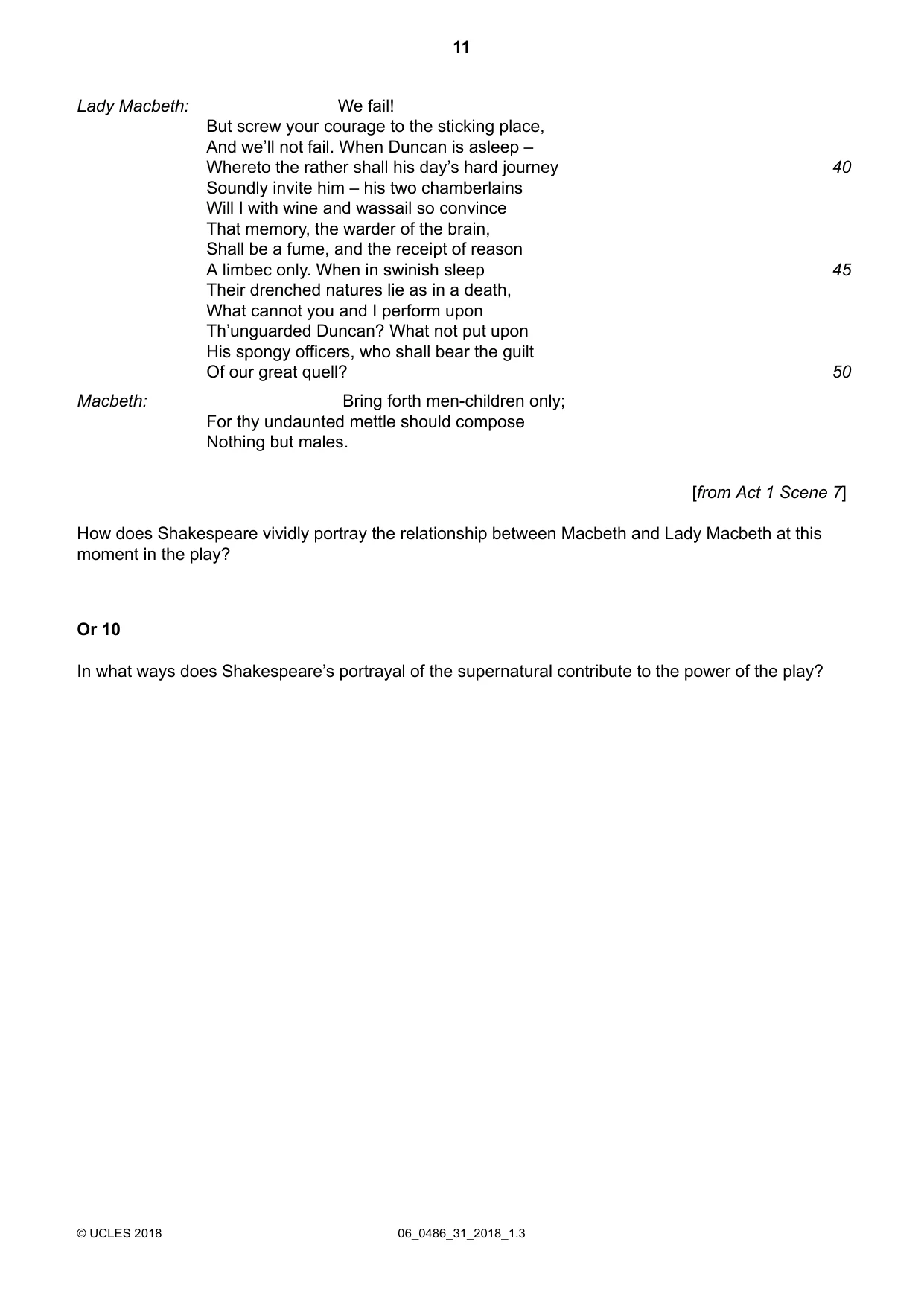
50 45 40 We fail! But screw your courage to the sticking place, And we’ll not fail. When Duncan is asleep – Whereto the rather shall his day’s hard journey Soundly invite him – his two chamberlains Will I with wine and wassail so convince That memory, the warder of the brain, Shall be a fume, and the receipt of reason A limbec only. When in swinish sleep Their drenched natures lie as in a death, What cannot you and I perform upon Th’unguarded Duncan? What not put upon His spongy officers, who shall bear the guilt Of our great quell? Lady Macbeth: Bring forth men-children only; For thy undaunted mettle should compose Nothing but males. Macbeth: [from Act 1 Scene 7] How does Shakespeare vividly portray the relationship between Macbeth and Lady Macbeth at this moment in the play? Or 10 In what ways does Shakespeare’s portrayal of the supernatural contribute to the power of the play? 06_0486_31_2018_1.3 © UCLES 2018 11
Question paper, page 12
BLANK PAGE Permission to reproduce items where third-party owned material protected by copyright is included has been sought and cleared where possible. Every reasonable effort has been made by the publisher (UCLES) to trace copyright holders, but if any items requiring clearance have unwittingly been included, the publisher will be pleased to make amends at the earliest possible opportunity. To avoid the issue of disclosure of answer-related information to candidates, all copyright acknowledgements are reproduced online in the Cambridge International Examinations Copyright Acknowledgements Booklet. This is produced for each series of examinations and is freely available to download at www.cie.org.uk after the live examination series. Cambridge International Examinations is part of the Cambridge Assessment Group. Cambridge Assessment is the brand name of University of Cambridge Local Examinations Syndicate (UCLES), which is itself a department of the University of Cambridge. 06_0486_31_2018_1.3 © UCLES 2018 12
Mark scheme, page 1
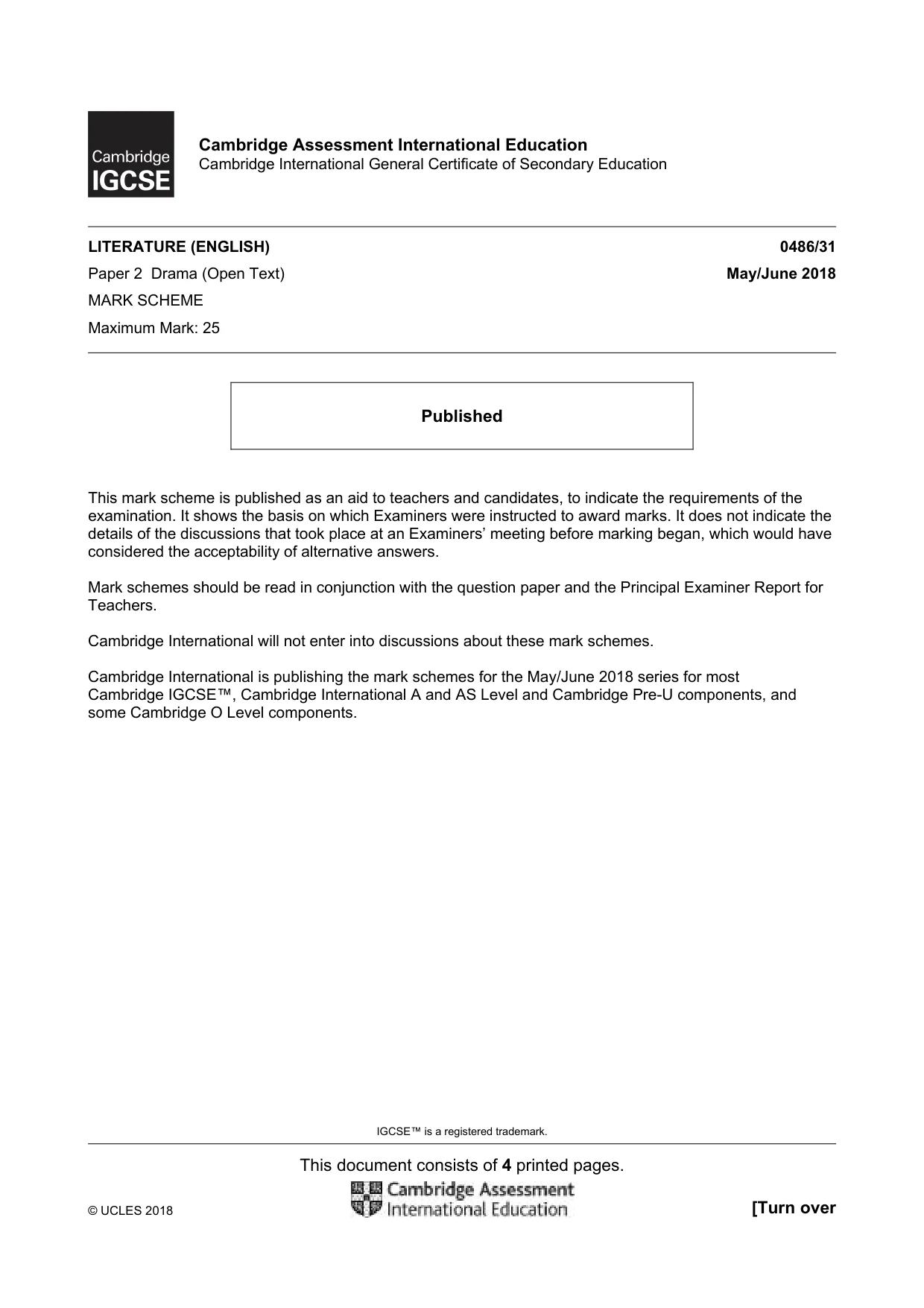
IGCSE™ is a registered trademark. This document consists of 4 printed pages. © UCLES 2018 [Turn over Cambridge Assessment International Education Cambridge International General Certificate of Secondary Education LITERATURE (ENGLISH) 0486/31 Paper 2 Drama (Open Text) May/June 2018 MARK SCHEME Maximum Mark: 25 Published This mark scheme is published as an aid to teachers and candidates, to indicate the requirements of the examination. It shows the basis on which Examiners were instructed to award marks. It does not indicate the details of the discussions that took place at an Examiners’ meeting before marking began, which would have considered the acceptability of alternative answers. Mark schemes should be read in conjunction with the question paper and the Principal Examiner Report for Teachers. Cambridge International will not enter into discussions about these mark schemes. Cambridge International is publishing the mark schemes for the May/June 2018 series for most Cambridge IGCSE™, Cambridge International A and AS Level and Cambridge Pre-U components, and some Cambridge O Level components.
Mark scheme, page 2
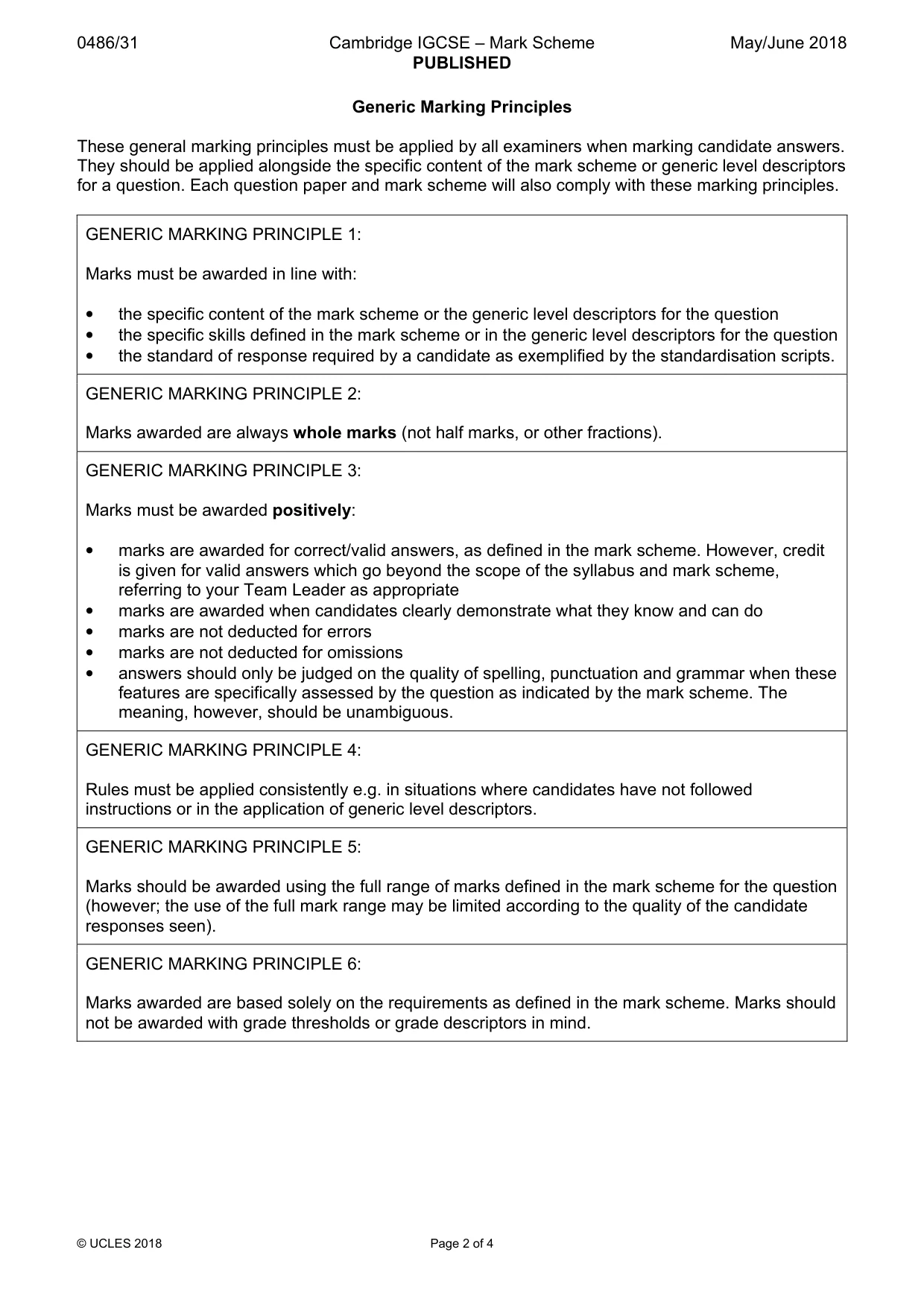
0486/31 Cambridge IGCSE – Mark Scheme PUBLISHED May/June 2018 © UCLES 2018 Page 2 of 4 Generic Marking Principles These general marking principles must be applied by all examiners when marking candidate answers. They should be applied alongside the specific content of the mark scheme or generic level descriptors for a question. Each question paper and mark scheme will also comply with these marking principles. GENERIC MARKING PRINCIPLE 1: Marks must be awarded in line with: • the specific content of the mark scheme or the generic level descriptors for the question • the specific skills defined in the mark scheme or in the generic level descriptors for the question • the standard of response required by a candidate as exemplified by the standardisation scripts. GENERIC MARKING PRINCIPLE 2: Marks awarded are always whole marks (not half marks, or other fractions). GENERIC MARKING PRINCIPLE 3: Marks must be awarded positively: • marks are awarded for correct/valid answers, as defined in the mark scheme. However, credit is given for valid answers which go beyond the scope of the syllabus and mark scheme, referring to your Team Leader as appropriate • marks are awarded when candidates clearly demonstrate what they know and can do • marks are not deducted for errors • marks are not deducted for omissions • answers should only be judged on the quality of spelling, punctuation and grammar when these features are specifically assessed by the question as indicated by the mark scheme. The meaning, however, should be unambiguous. GENERIC MARKING PRINCIPLE 4: Rules must be applied consistently e.g. in situations where candidates have not followed instructions or in the application of generic level descriptors. GENERIC MARKING PRINCIPLE 5: Marks should be awarded using the full range of marks defined in the mark scheme for the question (however; the use of the full mark range may be limited according to the quality of the candidate responses seen). GENERIC MARKING PRINCIPLE 6: Marks awarded are based solely on the requirements as defined in the mark scheme. Marks should not be awarded with grade thresholds or grade descriptors in mind.
Mark scheme, page 3
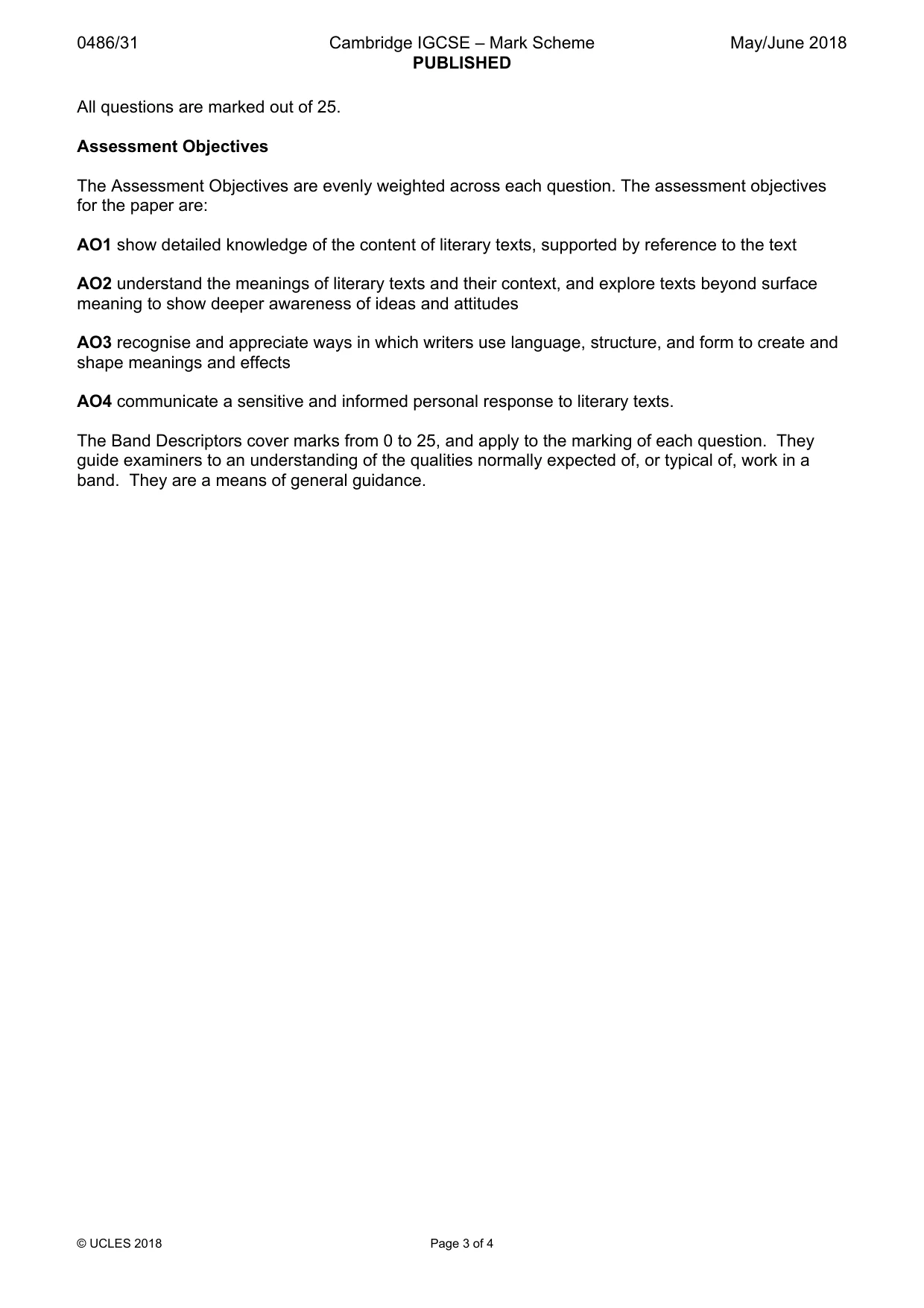
0486/31 Cambridge IGCSE – Mark Scheme PUBLISHED May/June 2018 © UCLES 2018 Page 3 of 4 All questions are marked out of 25. Assessment Objectives The Assessment Objectives are evenly weighted across each question. The assessment objectives for the paper are: AO1 show detailed knowledge of the content of literary texts, supported by reference to the text AO2 understand the meanings of literary texts and their context, and explore texts beyond surface meaning to show deeper awareness of ideas and attitudes AO3 recognise and appreciate ways in which writers use language, structure, and form to create and shape meanings and effects AO4 communicate a sensitive and informed personal response to literary texts. The Band Descriptors cover marks from 0 to 25, and apply to the marking of each question. They guide examiners to an understanding of the qualities normally expected of, or typical of, work in a band. They are a means of general guidance.
Mark scheme, page 4
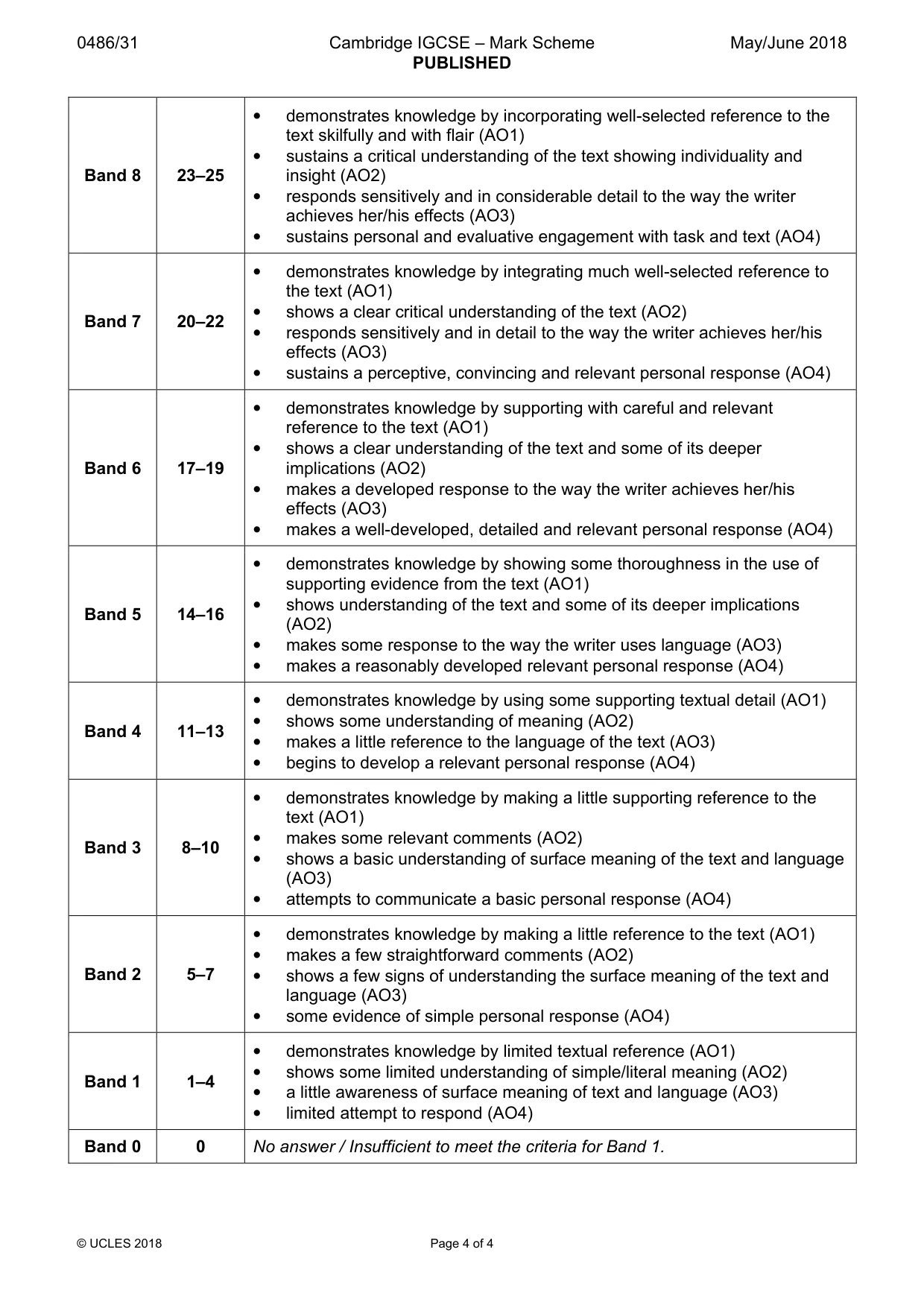
0486/31 Cambridge IGCSE – Mark Scheme PUBLISHED May/June 2018 © UCLES 2018 Page 4 of 4 Band 8 23–25 • demonstrates knowledge by incorporating well-selected reference to the text skilfully and with flair (AO1) • sustains a critical understanding of the text showing individuality and insight (AO2) • responds sensitively and in considerable detail to the way the writer achieves her/his effects (AO3) • sustains personal and evaluative engagement with task and text (AO4) Band 7 20–22 • demonstrates knowledge by integrating much well-selected reference to the text (AO1) • shows a clear critical understanding of the text (AO2) • responds sensitively and in detail to the way the writer achieves her/his effects (AO3) • sustains a perceptive, convincing and relevant personal response (AO4) Band 6 17–19 • demonstrates knowledge by supporting with careful and relevant reference to the text (AO1) • shows a clear understanding of the text and some of its deeper implications (AO2) • makes a developed response to the way the writer achieves her/his effects (AO3) • makes a well-developed, detailed and relevant personal response (AO4) Band 5 14–16 • demonstrates knowledge by showing some thoroughness in the use of supporting evidence from the text (AO1) • shows understanding of the text and some of its deeper implications (AO2) • makes some response to the way the writer uses language (AO3) • makes a reasonably developed relevant personal response (AO4) Band 4 11–13 • demonstrates knowledge by using some supporting textual detail (AO1) • shows some understanding of meaning (AO2) • makes a little reference to the language of the text (AO3) • begins to develop a relevant personal response (AO4) Band 3 8–10 • demonstrates knowledge by making a little supporting reference to the text (AO1) • makes some relevant comments (AO2) • shows a basic understanding of surface meaning of the text and language (AO3) • attempts to communicate a basic personal response (AO4) Band 2 5–7 • demonstrates knowledge by making a little reference to the text (AO1) • makes a few straightforward comments (AO2) • shows a few signs of understanding the surface meaning of the text and language (AO3) • some evidence of simple personal response (AO4) Band 1 1–4 • demonstrates knowledge by limited textual reference (AO1) • shows some limited understanding of simple/literal meaning (AO2) • a little awareness of surface meaning of text and language (AO3) • limited attempt to respond (AO4) Band 0 0 No answer / Insufficient to meet the criteria for Band 1.
What you needed in this session
Cambridge’s own grade thresholds for 2018 May/June, Paper 3 · Variant 1. A higher threshold means an easier paper — the bar moves with how the cohort did.