Cambridge IGCSE English - Literature 0486 — 2017 Oct/Nov Paper 3 · Variant 2
0486/32/O/N/17 · 25 marks · ≈28 min
The question paper and its mark scheme, free to read here and free to download. This is Cambridge’s own paper, exactly as it was sat.
Question paper12 pages

Mark scheme3 pages
Answers below. Sit the paper first if you are practising.
Paper as text
Question paper, page 1
This document consists of 11 printed pages, 1 blank page and 1 Insert. DC (LEG) 155064/1 © UCLES 2017 [Turn over Cambridge International Examinations Cambridge International General Certificate of Secondary Education * 4 5 0 8 1 2 3 8 0 2 * LITERATURE (ENGLISH) 0486/32 Paper 3 Drama (Open Text) October/November 2017 45 minutes Texts studied should be taken into the examination. READ THESE INSTRUCTIONS FIRST An answer booklet is provided inside this question paper. You should follow the instructions on the front cover of the answer booklet. If you need additional answer paper ask the invigilator for a continuation booklet. Answer one question. All questions in this paper carry equal marks.
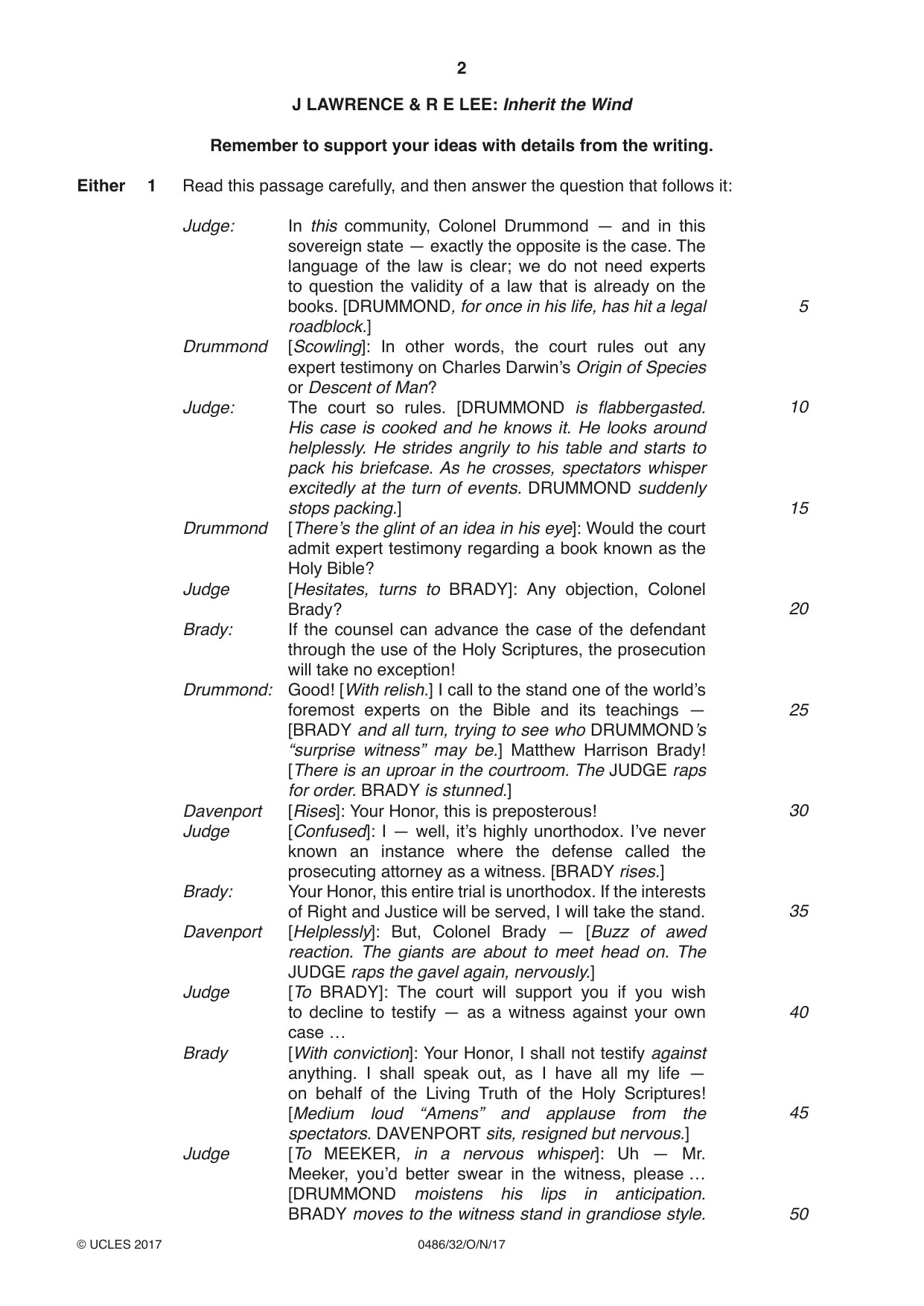
Question paper, page 2
2 0486/32/O/N/17 © UCLES 2017 J LAWRENCE & R E LEE: Inherit the Wind Remember to support your ideas with details from the writing. Either 1 Read this passage carefully, and then answer the question that follows it: Judge: In this community, Colonel Drummond — and in this sovereign state — exactly the opposite is the case. The language of the law is clear; we do not need experts to question the validity of a law that is already on the books. [DRUMMOND, for once in his life, has hit a legal roadblock.] Drummond [Scowling]: In other words, the court rules out any expert testimony on Charles Darwin’s Origin of Species or Descent of Man? Judge: The court so rules. [DRUMMOND is flabbergasted. His case is cooked and he knows it. He looks around helplessly. He strides angrily to his table and starts to pack his briefcase. As he crosses, spectators whisper excitedly at the turn of events. DRUMMOND suddenly stops packing.] Drummond [There’s the glint of an idea in his eye]: Would the court admit expert testimony regarding a book known as the Holy Bible? Judge [Hesitates, turns to BRADY]: Any objection, Colonel Brady? Brady: If the counsel can advance the case of the defendant through the use of the Holy Scriptures, the prosecution will take no exception! Drummond: Good! [With relish.] I call to the stand one of the world’s foremost experts on the Bible and its teachings — [BRADY and all turn, trying to see who DRUMMOND’s “surprise witness” may be.] Matthew Harrison Brady! [There is an uproar in the courtroom. The JUDGE raps for order. BRADY is stunned.] Davenport [Rises]: Your Honor, this is preposterous! Judge [Confused]: I — well, it’s highly unorthodox. I’ve never known an instance where the defense called the prosecuting attorney as a witness. [BRADY rises.] Brady: Your Honor, this entire trial is unorthodox. If the interests of Right and Justice will be served, I will take the stand. Davenport [Helplessly]: But, Colonel Brady — [Buzz of awed reaction. The giants are about to meet head on. The JUDGE raps the gavel again, nervously.] Judge [To BRADY]: The court will support you if you wish to decline to testify — as a witness against your own case … Brady [With conviction]: Your Honor, I shall not testify against anything. I shall speak out, as I have all my life — on behalf of the Living Truth of the Holy Scriptures! [Medium loud “Amens” and applause from the spectators. DAVENPORT sits, resigned but nervous.] Judge [To MEEKER, in a nervous whisper]: Uh — Mr. Meeker, you’d better swear in the witness, please … [DRUMMOND moistens his lips in anticipation. BRADY moves to the witness stand in grandiose style. 5 10 15 20 25 30 35 40 45 50
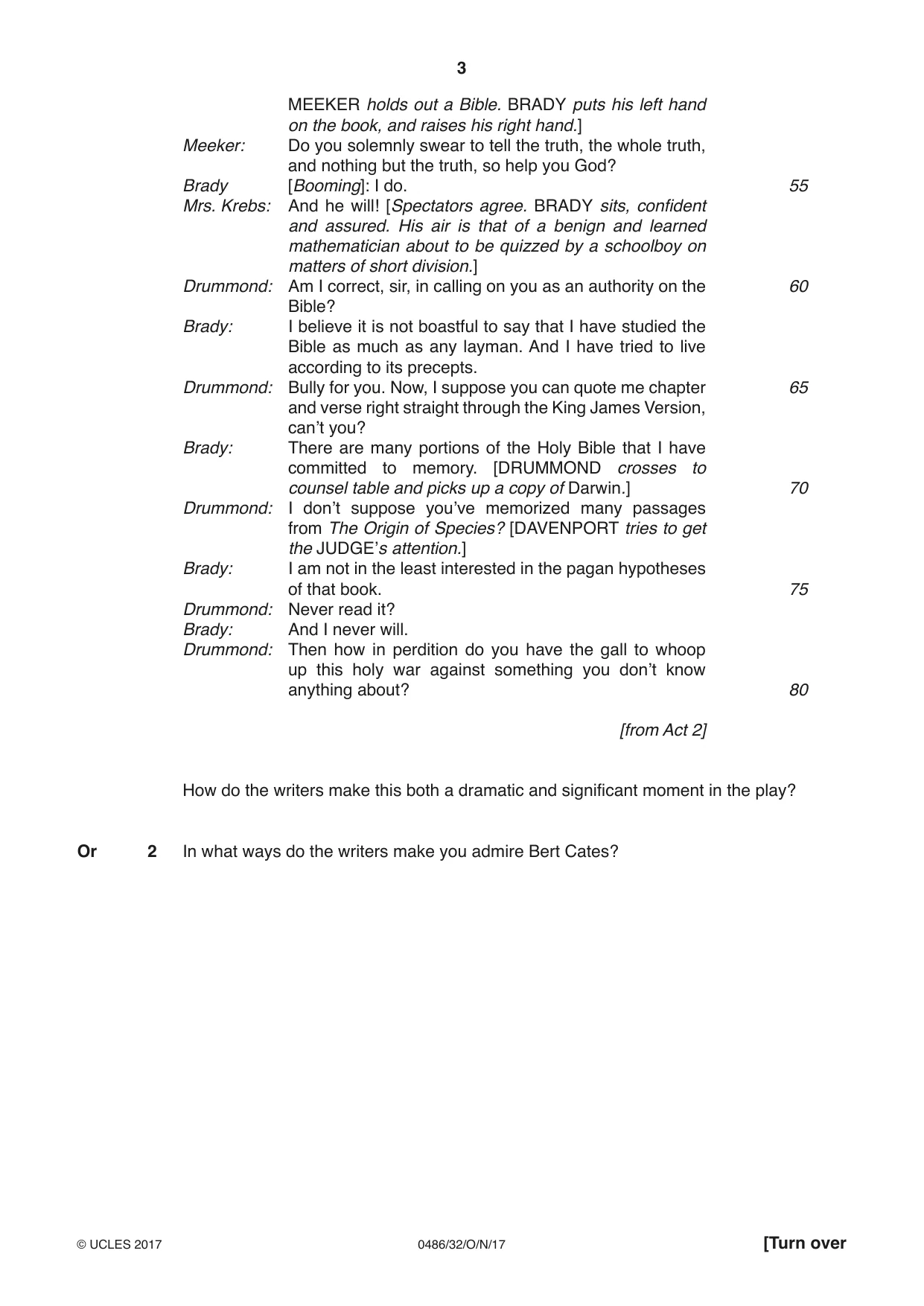
Question paper, page 3
3 0486/32/O/N/17 © UCLES 2017 [Turn over MEEKER holds out a Bible. BRADY puts his left hand on the book, and raises his right hand.] Meeker: Do you solemnly swear to tell the truth, the whole truth, and nothing but the truth, so help you God? Brady [Booming]: I do. Mrs. Krebs: And he will! [Spectators agree. BRADY sits, confident and assured. His air is that of a benign and learned mathematician about to be quizzed by a schoolboy on matters of short division.] Drummond: Am I correct, sir, in calling on you as an authority on the Bible? Brady: I believe it is not boastful to say that I have studied the Bible as much as any layman. And I have tried to live according to its precepts. Drummond: Bully for you. Now, I suppose you can quote me chapter and verse right straight through the King James Version, can’t you? Brady: There are many portions of the Holy Bible that I have committed to memory. [DRUMMOND crosses to counsel table and picks up a copy of Darwin.] Drummond: I don’t suppose you’ve memorized many passages from The Origin of Species? [DAVENPORT tries to get the JUDGE’s attention.] Brady: I am not in the least interested in the pagan hypotheses of that book. Drummond: Never read it? Brady: And I never will. Drummond: Then how in perdition do you have the gall to whoop up this holy war against something you don’t know anything about? [from Act 2] How do the writers make this both a dramatic and significant moment in the play? Or 2 In what ways do the writers make you admire Bert Cates? 55 60 65 70 75 80
Question paper, page 4
4 0486/32/O/N/17 © UCLES 2017 ARTHUR MILLER: A View from the Bridge Remember to support your ideas with details from the writing. Either 3 Read this passage carefully, and then answer the question that follows it: Alfieri: On December twenty-seventh I saw him next. I normally go Content removed due to copyright restrictions
Question paper, page 5
5 0486/32/O/N/17 © UCLES 2017 [Turn over Content removed due to copyright restrictions Light is out on ALFIERI. EDDIE has at the same time appeared beside the phone.] [from Act 2] Explore how Miller makes this such a powerful moment in the play. Or 4 How does Miller make the relationship between Beatrice and Catherine such a memorable part of the play?
Question paper, page 6
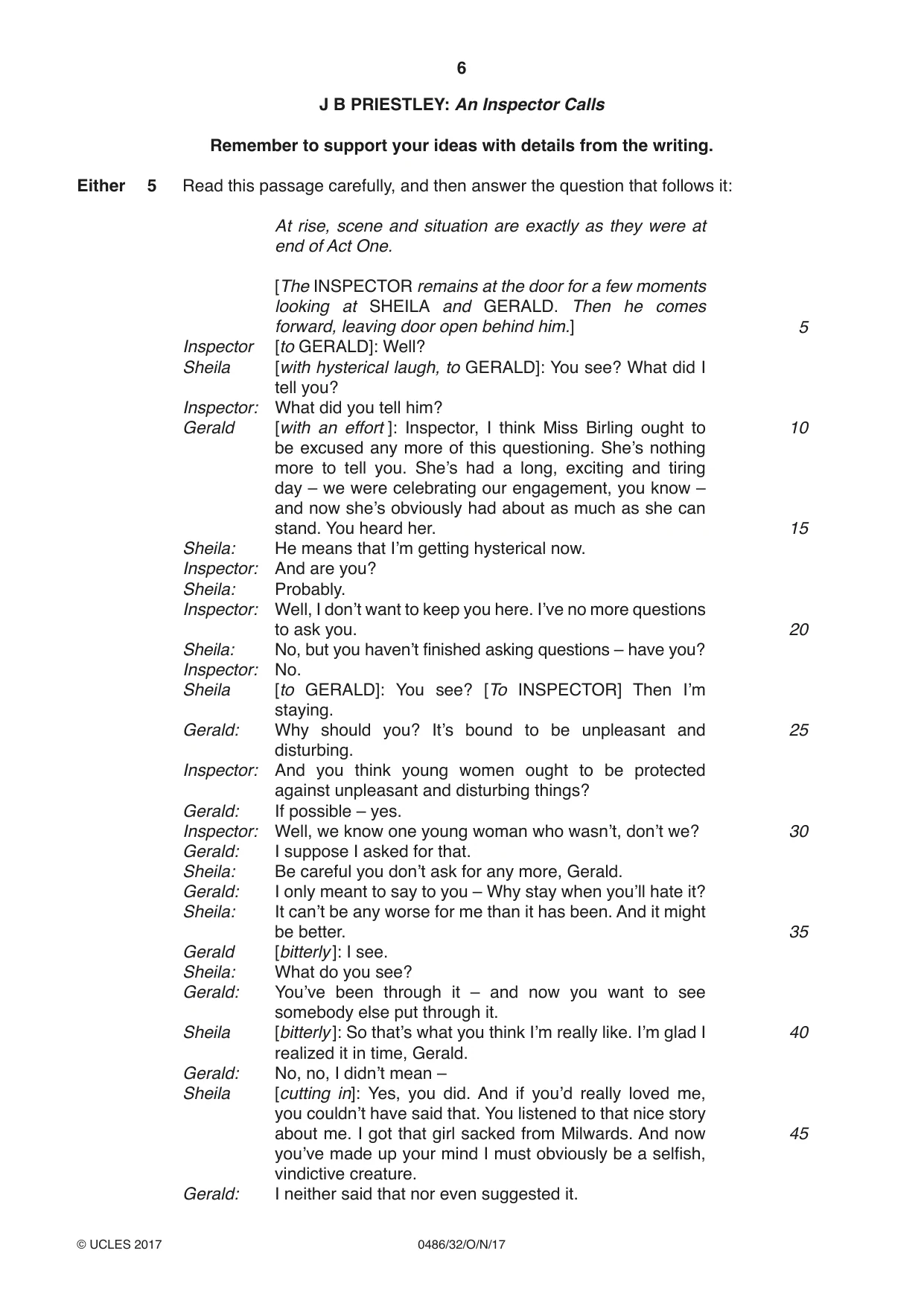
6 0486/32/O/N/17 © UCLES 2017 J B PRIESTLEY: An Inspector Calls Remember to support your ideas with details from the writing. Either 5 Read this passage carefully, and then answer the question that follows it: At rise, scene and situation are exactly as they were at end of Act One. [The INSPECTOR remains at the door for a few moments looking at SHEILA and GERALD. Then he comes forward, leaving door open behind him.] Inspector [to GERALD]: Well? Sheila [with hysterical laugh, to GERALD]: You see? What did I tell you? Inspector: What did you tell him? Gerald [with an effort ]: Inspector, I think Miss Birling ought to be excused any more of this questioning. She’s nothing more to tell you. She’s had a long, exciting and tiring day – we were celebrating our engagement, you know – and now she’s obviously had about as much as she can stand. You heard her. Sheila: He means that I’m getting hysterical now. Inspector: And are you? Sheila: Probably. Inspector: Well, I don’t want to keep you here. I’ve no more questions to ask you. Sheila: No, but you haven’t finished asking questions – have you? Inspector: No. Sheila [to GERALD]: You see? [To INSPECTOR] Then I’m staying. Gerald: Why should you? It’s bound to be unpleasant and disturbing. Inspector: And you think young women ought to be protected against unpleasant and disturbing things? Gerald: If possible – yes. Inspector: Well, we know one young woman who wasn’t, don’t we? Gerald: I suppose I asked for that. Sheila: Be careful you don’t ask for any more, Gerald. Gerald: I only meant to say to you – Why stay when you’ll hate it? Sheila: It can’t be any worse for me than it has been. And it might be better. Gerald [bitterly ]: I see. Sheila: What do you see? Gerald: You’ve been through it – and now you want to see somebody else put through it. Sheila [bitterly ]: So that’s what you think I’m really like. I’m glad I realized it in time, Gerald. Gerald: No, no, I didn’t mean – Sheila [cutting in]: Yes, you did. And if you’d really loved me, you couldn’t have said that. You listened to that nice story about me. I got that girl sacked from Milwards. And now you’ve made up your mind I must obviously be a selfish, vindictive creature. Gerald: I neither said that nor even suggested it. 5 10 15 20 25 30 35 40 45
Question paper, page 7
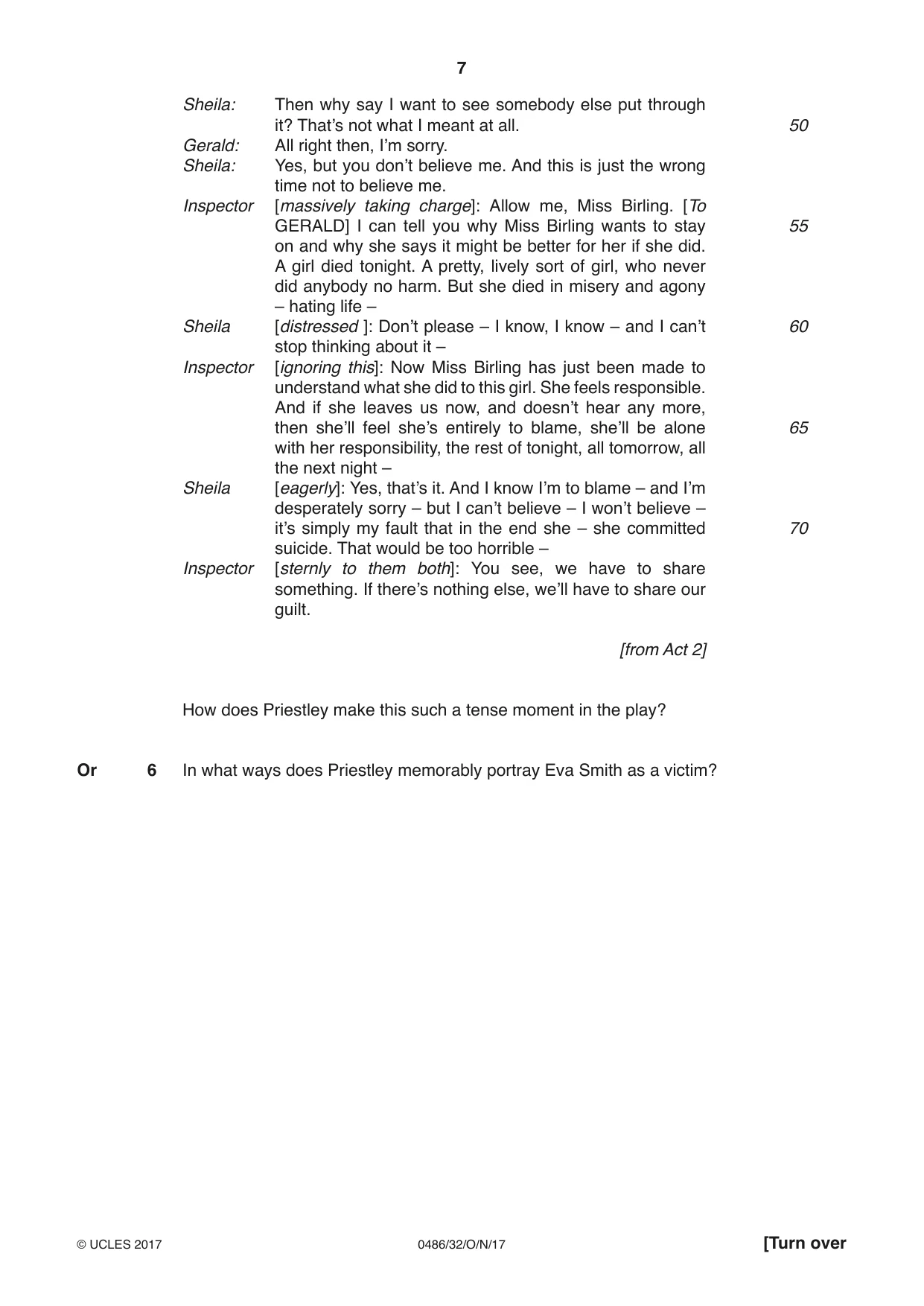
7 0486/32/O/N/17 © UCLES 2017 [Turn over Sheila: Then why say I want to see somebody else put through it? That’s not what I meant at all. Gerald: All right then, I’m sorry. Sheila: Yes, but you don’t believe me. And this is just the wrong time not to believe me. Inspector [massively taking charge]: Allow me, Miss Birling. [To GERALD] I can tell you why Miss Birling wants to stay on and why she says it might be better for her if she did. A girl died tonight. A pretty, lively sort of girl, who never did anybody no harm. But she died in misery and agony – hating life – Sheila [distressed ]: Don’t please – I know, I know – and I can’t stop thinking about it – Inspector [ignoring this]: Now Miss Birling has just been made to understand what she did to this girl. She feels responsible. And if she leaves us now, and doesn’t hear any more, then she’ll feel she’s entirely to blame, she’ll be alone with her responsibility, the rest of tonight, all tomorrow, all the next night – Sheila [eagerly]: Yes, that’s it. And I know I’m to blame – and I’m desperately sorry – but I can’t believe – I won’t believe – it’s simply my fault that in the end she – she committed suicide. That would be too horrible – Inspector [sternly to them both]: You see, we have to share something. If there’s nothing else, we’ll have to share our guilt. [from Act 2] How does Priestley make this such a tense moment in the play? Or 6 In what ways does Priestley memorably portray Eva Smith as a victim? 50 55 60 65 70
Question paper, page 8
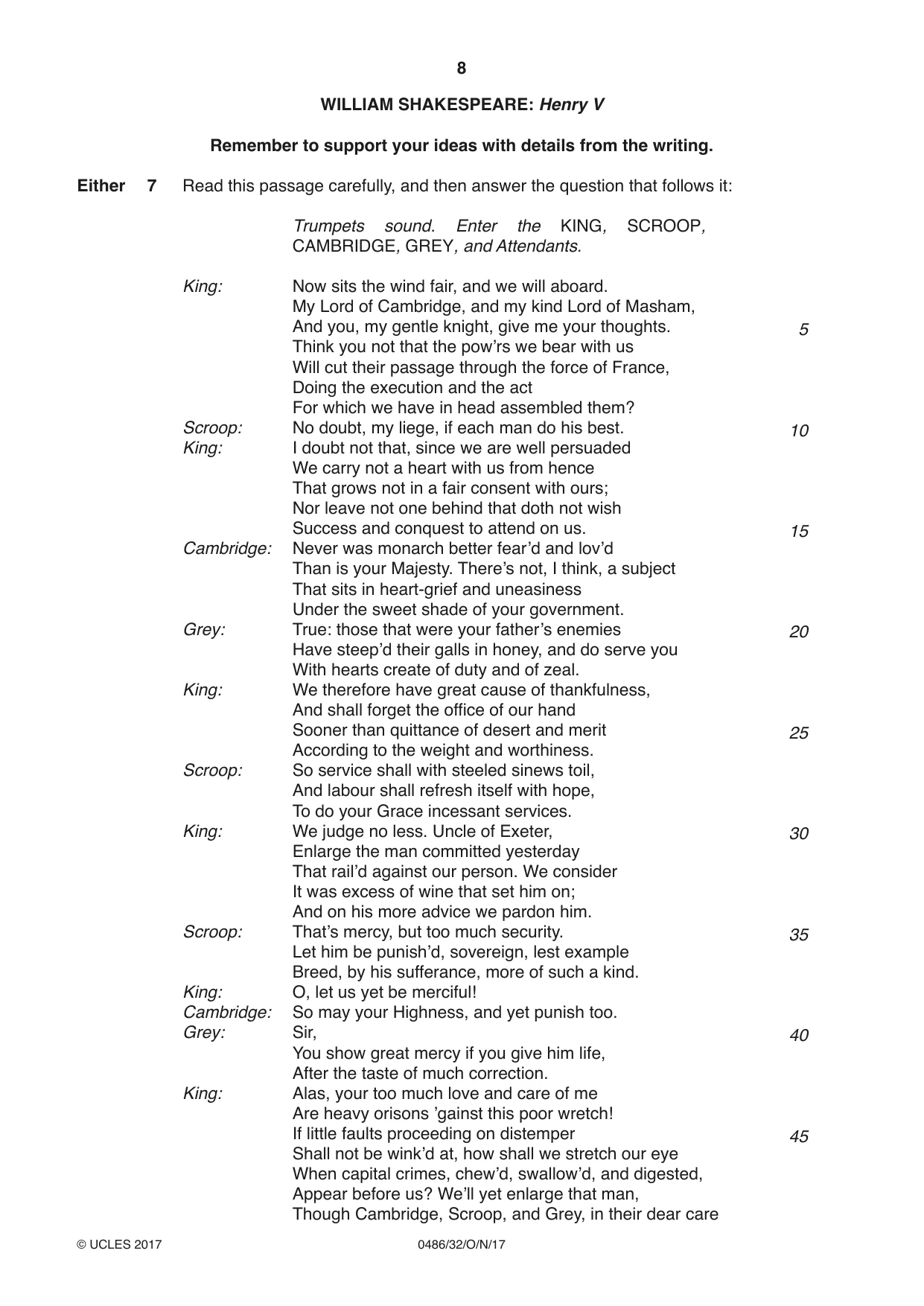
8 0486/32/O/N/17 © UCLES 2017 WILLIAM SHAKESPEARE: Henry V Remember to support your ideas with details from the writing. Either 7 Read this passage carefully, and then answer the question that follows it: Trumpets sound. Enter the KING, SCROOP, CAMBRIDGE, GREY, and Attendants. King: Now sits the wind fair, and we will aboard. My Lord of Cambridge, and my kind Lord of Masham, And you, my gentle knight, give me your thoughts. Think you not that the pow’rs we bear with us Will cut their passage through the force of France, Doing the execution and the act For which we have in head assembled them? Scroop: No doubt, my liege, if each man do his best. King: I doubt not that, since we are well persuaded We carry not a heart with us from hence That grows not in a fair consent with ours; Nor leave not one behind that doth not wish Success and conquest to attend on us. Cambridge: Never was monarch better fear’d and lov’d Than is your Majesty. There’s not, I think, a subject That sits in heart-grief and uneasiness Under the sweet shade of your government. Grey: True: those that were your father’s enemies Have steep’d their galls in honey, and do serve you With hearts create of duty and of zeal. King: We therefore have great cause of thankfulness, And shall forget the office of our hand Sooner than quittance of desert and merit According to the weight and worthiness. Scroop: So service shall with steeled sinews toil, And labour shall refresh itself with hope, To do your Grace incessant services. King: We judge no less. Uncle of Exeter, Enlarge the man committed yesterday That rail’d against our person. We consider It was excess of wine that set him on; And on his more advice we pardon him. Scroop: That’s mercy, but too much security. Let him be punish’d, sovereign, lest example Breed, by his sufferance, more of such a kind. King: O, let us yet be merciful! Cambridge: So may your Highness, and yet punish too. Grey: Sir, You show great mercy if you give him life, After the taste of much correction. King: Alas, your too much love and care of me Are heavy orisons ’gainst this poor wretch! If little faults proceeding on distemper Shall not be wink’d at, how shall we stretch our eye When capital crimes, chew’d, swallow’d, and digested, Appear before us? We’ll yet enlarge that man, Though Cambridge, Scroop, and Grey, in their dear care 5 10 15 20 25 30 35 40 45
Question paper, page 9
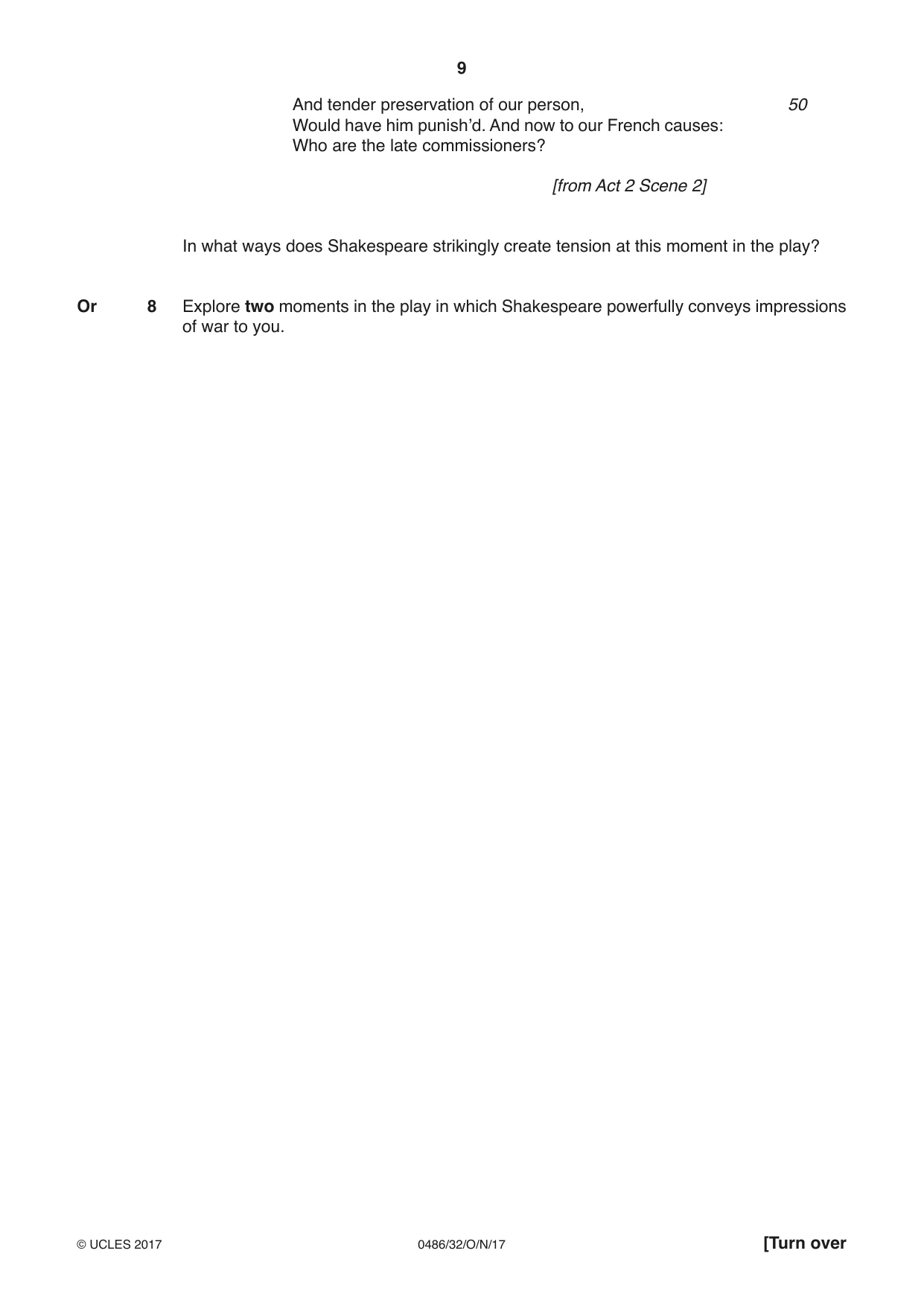
9 0486/32/O/N/17 © UCLES 2017 [Turn over And tender preservation of our person, Would have him punish’d. And now to our French causes: Who are the late commissioners? [from Act 2 Scene 2] In what ways does Shakespeare strikingly create tension at this moment in the play? Or 8 Explore two moments in the play in which Shakespeare powerfully conveys impressions of war to you. 50
Question paper, page 10
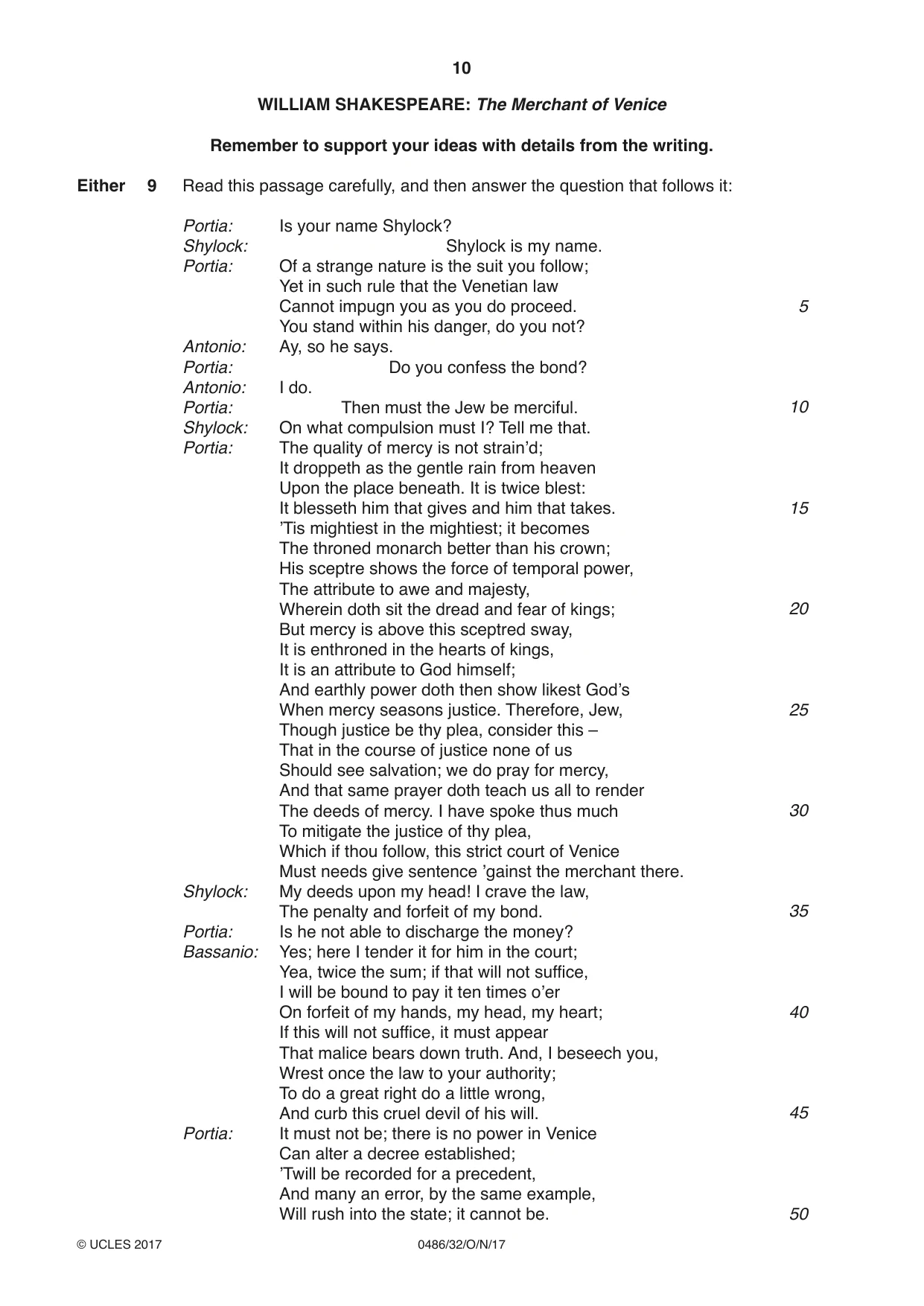
10 0486/32/O/N/17 © UCLES 2017 WILLIAM SHAKESPEARE: The Merchant of Venice Remember to support your ideas with details from the writing. Either 9 Read this passage carefully, and then answer the question that follows it: Portia: Is your name Shylock? Shylock: Shylock is my name. Portia: Of a strange nature is the suit you follow; Yet in such rule that the Venetian law Cannot impugn you as you do proceed. You stand within his danger, do you not? Antonio: Ay, so he says. Portia: Do you confess the bond? Antonio: I do. Portia: Then must the Jew be merciful. Shylock: On what compulsion must I? Tell me that. Portia: The quality of mercy is not strain’d; It droppeth as the gentle rain from heaven Upon the place beneath. It is twice blest: It blesseth him that gives and him that takes. ’Tis mightiest in the mightiest; it becomes The throned monarch better than his crown; His sceptre shows the force of temporal power, The attribute to awe and majesty, Wherein doth sit the dread and fear of kings; But mercy is above this sceptred sway, It is enthroned in the hearts of kings, It is an attribute to God himself; And earthly power doth then show likest God’s When mercy seasons justice. Therefore, Jew, Though justice be thy plea, consider this – That in the course of justice none of us Should see salvation; we do pray for mercy, And that same prayer doth teach us all to render The deeds of mercy. I have spoke thus much To mitigate the justice of thy plea, Which if thou follow, this strict court of Venice Must needs give sentence ’gainst the merchant there. Shylock: My deeds upon my head! I crave the law, The penalty and forfeit of my bond. Portia: Is he not able to discharge the money? Bassanio: Yes; here I tender it for him in the court; Yea, twice the sum; if that will not suffice, I will be bound to pay it ten times o’er On forfeit of my hands, my head, my heart; If this will not suffice, it must appear That malice bears down truth. And, I beseech you, Wrest once the law to your authority; To do a great right do a little wrong, And curb this cruel devil of his will. Portia: It must not be; there is no power in Venice Can alter a decree established; ’Twill be recorded for a precedent, And many an error, by the same example, Will rush into the state; it cannot be. 5 10 15 20 25 30 35 40 45 50
Question paper, page 11
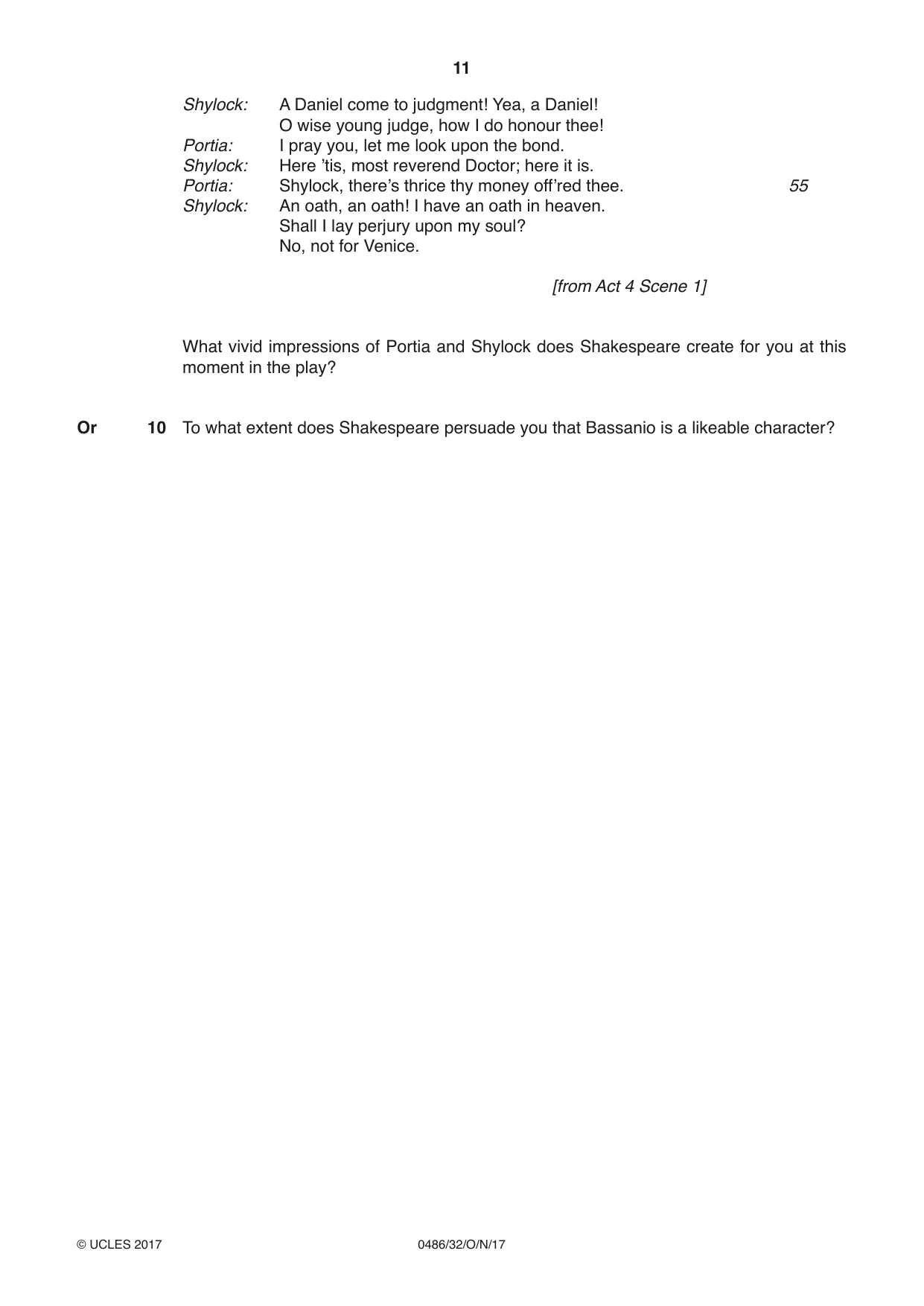
11 0486/32/O/N/17 © UCLES 2017 Shylock: A Daniel come to judgment! Yea, a Daniel! O wise young judge, how I do honour thee! Portia: I pray you, let me look upon the bond. Shylock: Here ’tis, most reverend Doctor; here it is. Portia: Shylock, there’s thrice thy money off’red thee. Shylock: An oath, an oath! I have an oath in heaven. Shall I lay perjury upon my soul? No, not for Venice. [from Act 4 Scene 1] What vivid impressions of Portia and Shylock does Shakespeare create for you at this moment in the play? Or 10 To what extent does Shakespeare persuade you that Bassanio is a likeable character? 55
Question paper, page 12
12 0486/32/O/N/17 © UCLES 2017 BLANK PAGE Permission to reproduce items where third-party owned material protected by copyright is included has been sought and cleared where possible. Every reasonable effort has been made by the publisher (UCLES) to trace copyright holders, but if any items requiring clearance have unwittingly been included, the publisher will be pleased to make amends at the earliest possible opportunity. To avoid the issue of disclosure of answer-related information to candidates, all copyright acknowledgements are reproduced online in the Cambridge International Examinations Copyright Acknowledgements Booklet. This is produced for each series of examinations and is freely available to download at www.cie.org.uk after the live examination series. Cambridge International Examinations is part of the Cambridge Assessment Group. Cambridge Assessment is the brand name of University of Cambridge Local Examinations Syndicate (UCLES), which is itself a department of the University of Cambridge.
Mark scheme, page 1
® IGCSE is a registered trademark. This syllabus is approved for use in England, Wales and Northern Ireland as a Cambridge International Level 1/Level 2 Certificate. This document consists of 3 printed pages. © UCLES 2017 [Turn over Cambridge Assessment International Education Cambridge International General Certificate of Secondary Education LITERATURE (ENGLISH) 0486/32 Paper 3 Drama (Open Text) October/November 2017 MARK SCHEME Maximum Mark: 25 Published This mark scheme is published as an aid to teachers and candidates, to indicate the requirements of the examination. It shows the basis on which Examiners were instructed to award marks. It does not indicate the details of the discussions that took place at an Examiners’ meeting before marking began, which would have considered the acceptability of alternative answers. Mark schemes should be read in conjunction with the question paper and the Principal Examiner Report for Teachers. Cambridge International will not enter into discussions about these mark schemes. Cambridge International is publishing the mark schemes for the October/November 2017 series for most Cambridge IGCSE®, Cambridge International A and AS Level components and some Cambridge O Level components.
Mark scheme, page 2
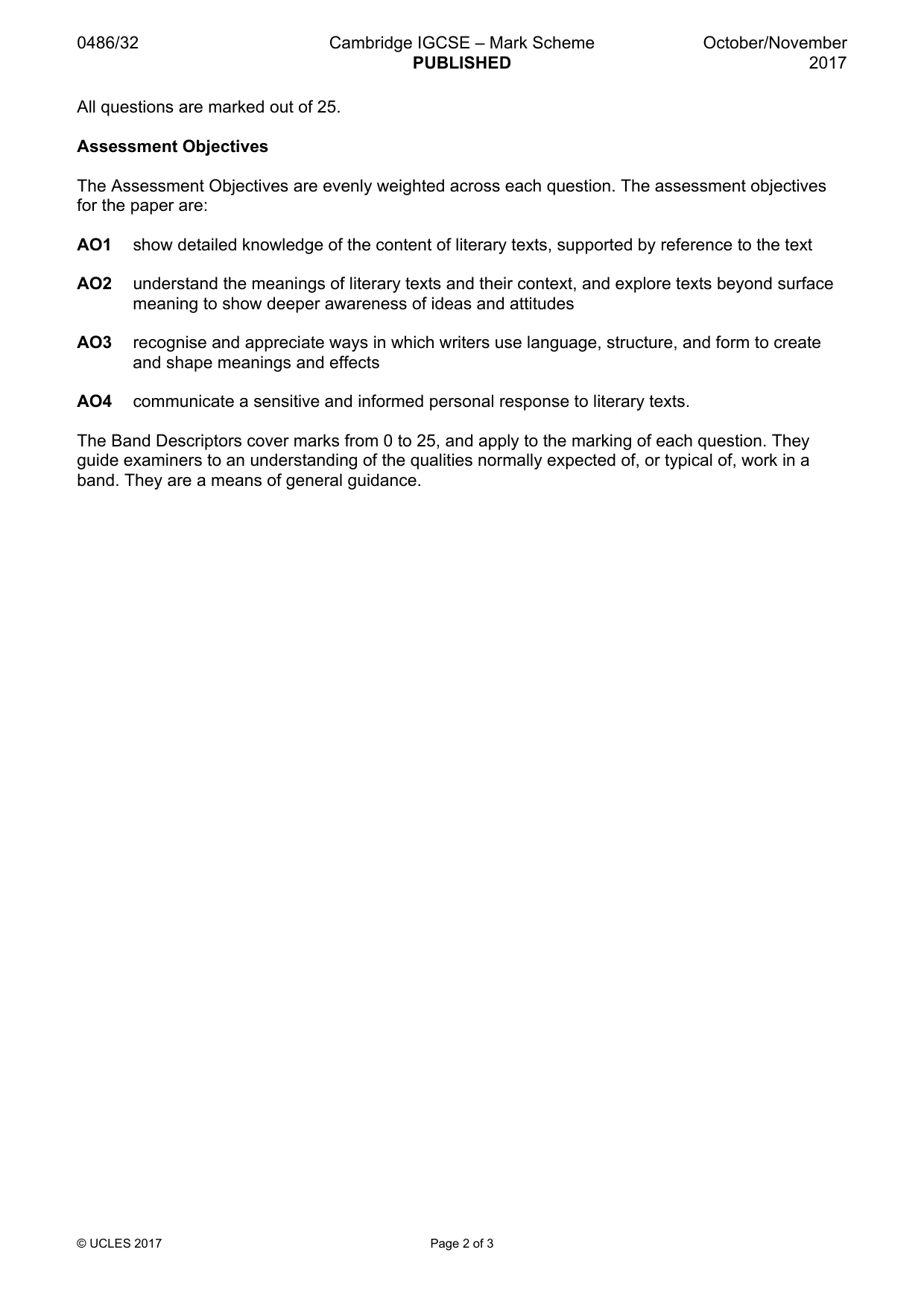
0486/32 Cambridge IGCSE – Mark Scheme PUBLISHED October/November 2017 © UCLES 2017 Page 2 of 3 All questions are marked out of 25. Assessment Objectives The Assessment Objectives are evenly weighted across each question. The assessment objectives for the paper are: AO1 show detailed knowledge of the content of literary texts, supported by reference to the text AO2 understand the meanings of literary texts and their context, and explore texts beyond surface meaning to show deeper awareness of ideas and attitudes AO3 recognise and appreciate ways in which writers use language, structure, and form to create and shape meanings and effects AO4 communicate a sensitive and informed personal response to literary texts. The Band Descriptors cover marks from 0 to 25, and apply to the marking of each question. They guide examiners to an understanding of the qualities normally expected of, or typical of, work in a band. They are a means of general guidance.
Mark scheme, page 3
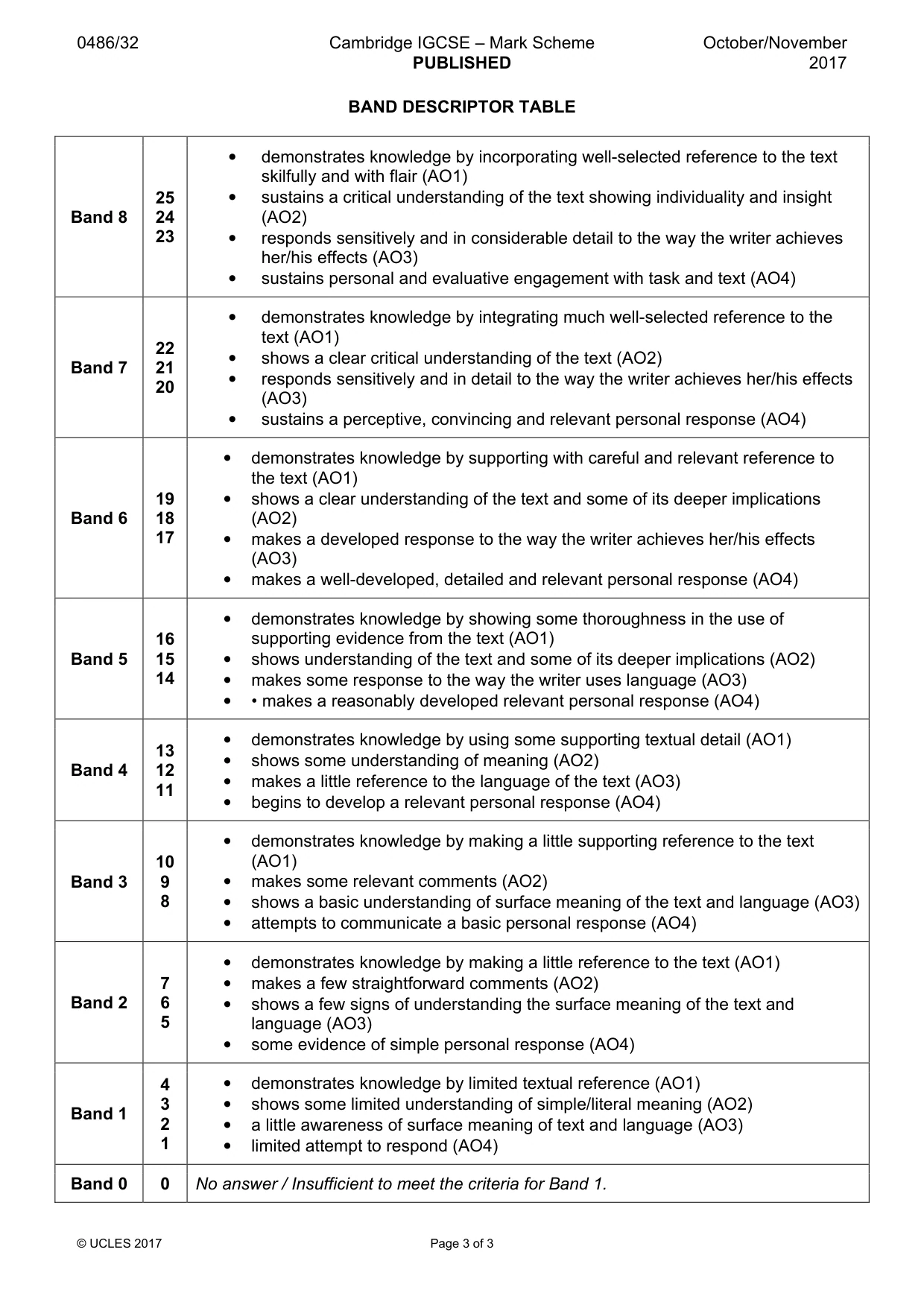
0486/32 Cambridge IGCSE – Mark Scheme PUBLISHED October/November 2017 © UCLES 2017 Page 3 of 3 BAND DESCRIPTOR TABLE Band 8 25 24 23 • demonstrates knowledge by incorporating well-selected reference to the text skilfully and with flair (AO1) • sustains a critical understanding of the text showing individuality and insight (AO2) • responds sensitively and in considerable detail to the way the writer achieves her/his effects (AO3) • sustains personal and evaluative engagement with task and text (AO4) Band 7 22 21 20 • demonstrates knowledge by integrating much well-selected reference to the text (AO1) • shows a clear critical understanding of the text (AO2) • responds sensitively and in detail to the way the writer achieves her/his effects (AO3) • sustains a perceptive, convincing and relevant personal response (AO4) Band 6 19 18 17 • demonstrates knowledge by supporting with careful and relevant reference to the text (AO1) • shows a clear understanding of the text and some of its deeper implications (AO2) • makes a developed response to the way the writer achieves her/his effects (AO3) • makes a well-developed, detailed and relevant personal response (AO4) Band 5 16 15 14 • demonstrates knowledge by showing some thoroughness in the use of supporting evidence from the text (AO1) • shows understanding of the text and some of its deeper implications (AO2) • makes some response to the way the writer uses language (AO3) • • makes a reasonably developed relevant personal response (AO4) Band 4 13 12 11 • demonstrates knowledge by using some supporting textual detail (AO1) • shows some understanding of meaning (AO2) • makes a little reference to the language of the text (AO3) • begins to develop a relevant personal response (AO4) Band 3 10 9 8 • demonstrates knowledge by making a little supporting reference to the text (AO1) • makes some relevant comments (AO2) • shows a basic understanding of surface meaning of the text and language (AO3) • attempts to communicate a basic personal response (AO4) Band 2 7 6 5 • demonstrates knowledge by making a little reference to the text (AO1) • makes a few straightforward comments (AO2) • shows a few signs of understanding the surface meaning of the text and language (AO3) • some evidence of simple personal response (AO4) Band 1 4 3 2 1 • demonstrates knowledge by limited textual reference (AO1) • shows some limited understanding of simple/literal meaning (AO2) • a little awareness of surface meaning of text and language (AO3) • limited attempt to respond (AO4) Band 0 0 No answer / Insufficient to meet the criteria for Band 1.
What you needed in this session
Cambridge’s own grade thresholds for 2017 Oct/Nov, Paper 3 · Variant 2. A higher threshold means an easier paper — the bar moves with how the cohort did.