Cambridge IGCSE English - Literature 0486 — 2017 Oct/Nov Paper 3 · Variant 1
0486/31/O/N/17 · 25 marks · ≈28 min
The question paper and its mark scheme, free to read here and free to download. This is Cambridge’s own paper, exactly as it was sat.
Question paper12 pages

Mark scheme3 pages
Answers below. Sit the paper first if you are practising.
Paper as text
Question paper, page 1
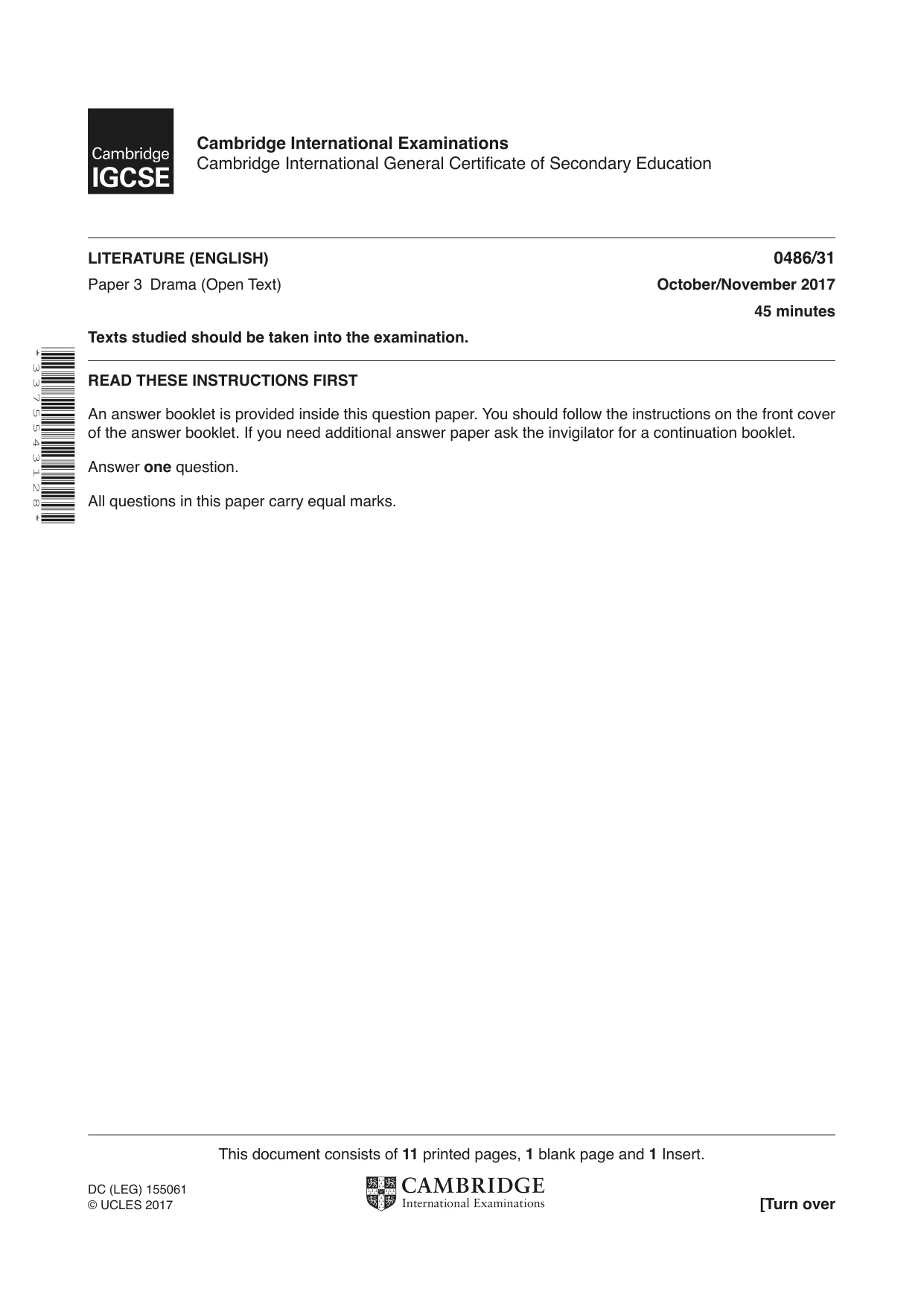
This document consists of 11 printed pages, 1 blank page and 1 Insert. DC (LEG) 155061 © UCLES 2017 [Turn over Cambridge International Examinations Cambridge International General Certificate of Secondary Education * 3 3 7 5 5 4 3 1 2 8 * LITERATURE (ENGLISH) 0486/31 Paper 3 Drama (Open Text) October/November 2017 45 minutes Texts studied should be taken into the examination. READ THESE INSTRUCTIONS FIRST An answer booklet is provided inside this question paper. You should follow the instructions on the front cover of the answer booklet. If you need additional answer paper ask the invigilator for a continuation booklet. Answer one question. All questions in this paper carry equal marks.
Question paper, page 2
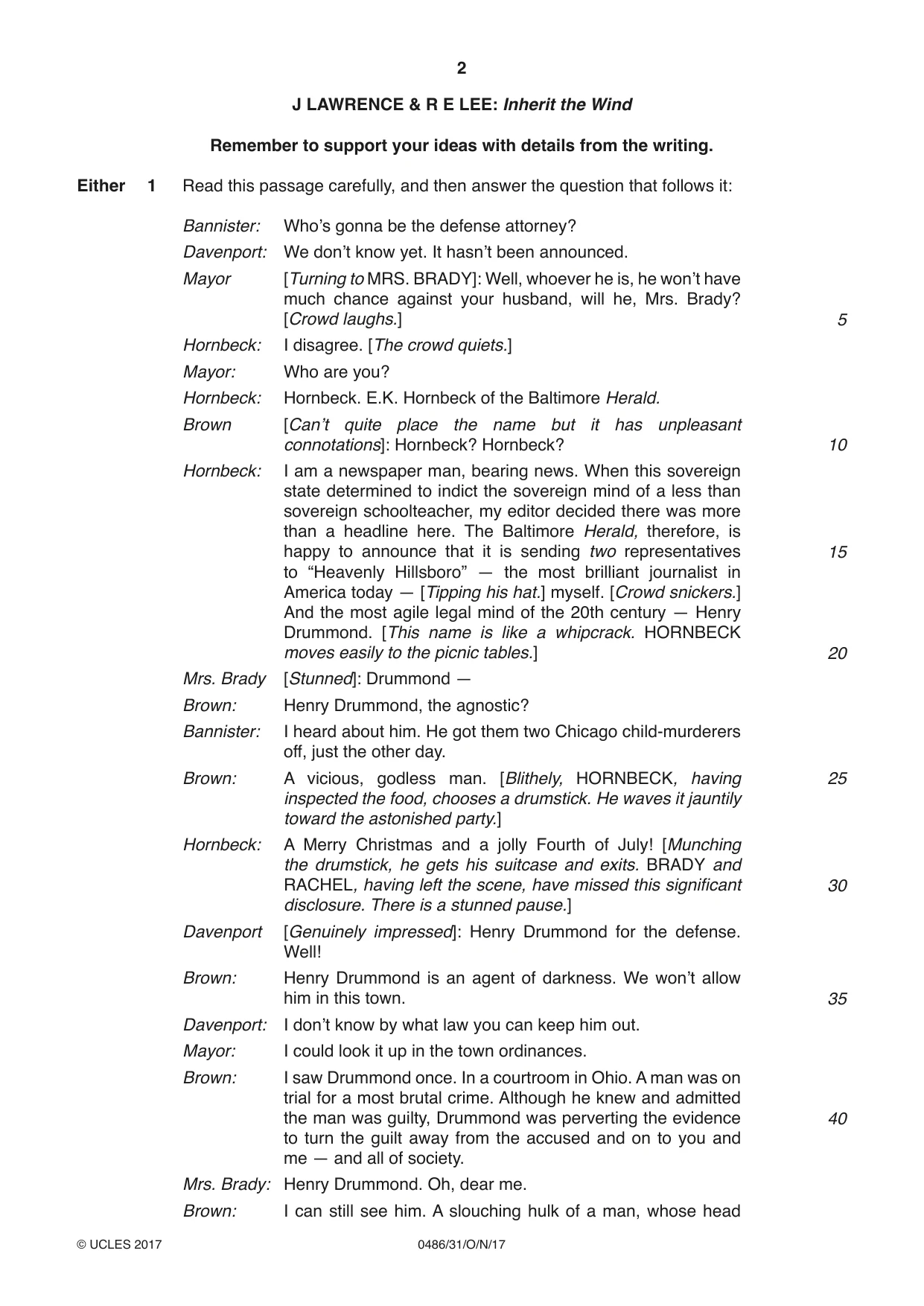
2 0486/31/O/N/17 © UCLES 2017 J LAWRENCE & R E LEE: Inherit the Wind Remember to support your ideas with details from the writing. Either 1 Read this passage carefully, and then answer the question that follows it: Bannister: Who’s gonna be the defense attorney? Davenport: We don’t know yet. It hasn’t been announced. Mayor [Turning to MRS. BRADY]: Well, whoever he is, he won’t have much chance against your husband, will he, Mrs. Brady? [Crowd laughs.] Hornbeck: I disagree. [The crowd quiets.] Mayor: Who are you? Hornbeck: Hornbeck. E.K. Hornbeck of the Baltimore Herald. Brown [Can’t quite place the name but it has unpleasant connotations]: Hornbeck? Hornbeck? Hornbeck: I am a newspaper man, bearing news. When this sovereign state determined to indict the sovereign mind of a less than sovereign schoolteacher, my editor decided there was more than a headline here. The Baltimore Herald, therefore, is happy to announce that it is sending two representatives to “Heavenly Hillsboro” — the most brilliant journalist in America today — [Tipping his hat.] myself. [Crowd snickers.] And the most agile legal mind of the 20th century — Henry Drummond. [This name is like a whipcrack. HORNBECK moves easily to the picnic tables.] Mrs. Brady [Stunned]: Drummond — Brown: Henry Drummond, the agnostic? Bannister: I heard about him. He got them two Chicago child-murderers off, just the other day. Brown: A vicious, godless man. [Blithely, HORNBECK, having inspected the food, chooses a drumstick. He waves it jauntily toward the astonished party.] Hornbeck: A Merry Christmas and a jolly Fourth of July! [Munching the drumstick, he gets his suitcase and exits. BRADY and RACHEL, having left the scene, have missed this significant disclosure. There is a stunned pause.] Davenport [Genuinely impressed]: Henry Drummond for the defense. Well! Brown: Henry Drummond is an agent of darkness. We won’t allow him in this town. Davenport: I don’t know by what law you can keep him out. Mayor: I could look it up in the town ordinances. Brown: I saw Drummond once. In a courtroom in Ohio. A man was on trial for a most brutal crime. Although he knew and admitted the man was guilty, Drummond was perverting the evidence to turn the guilt away from the accused and on to you and me — and all of society. Mrs. Brady: Henry Drummond. Oh, dear me. Brown: I can still see him. A slouching hulk of a man, whose head 5 10 15 20 25 30 35 40
Question paper, page 3
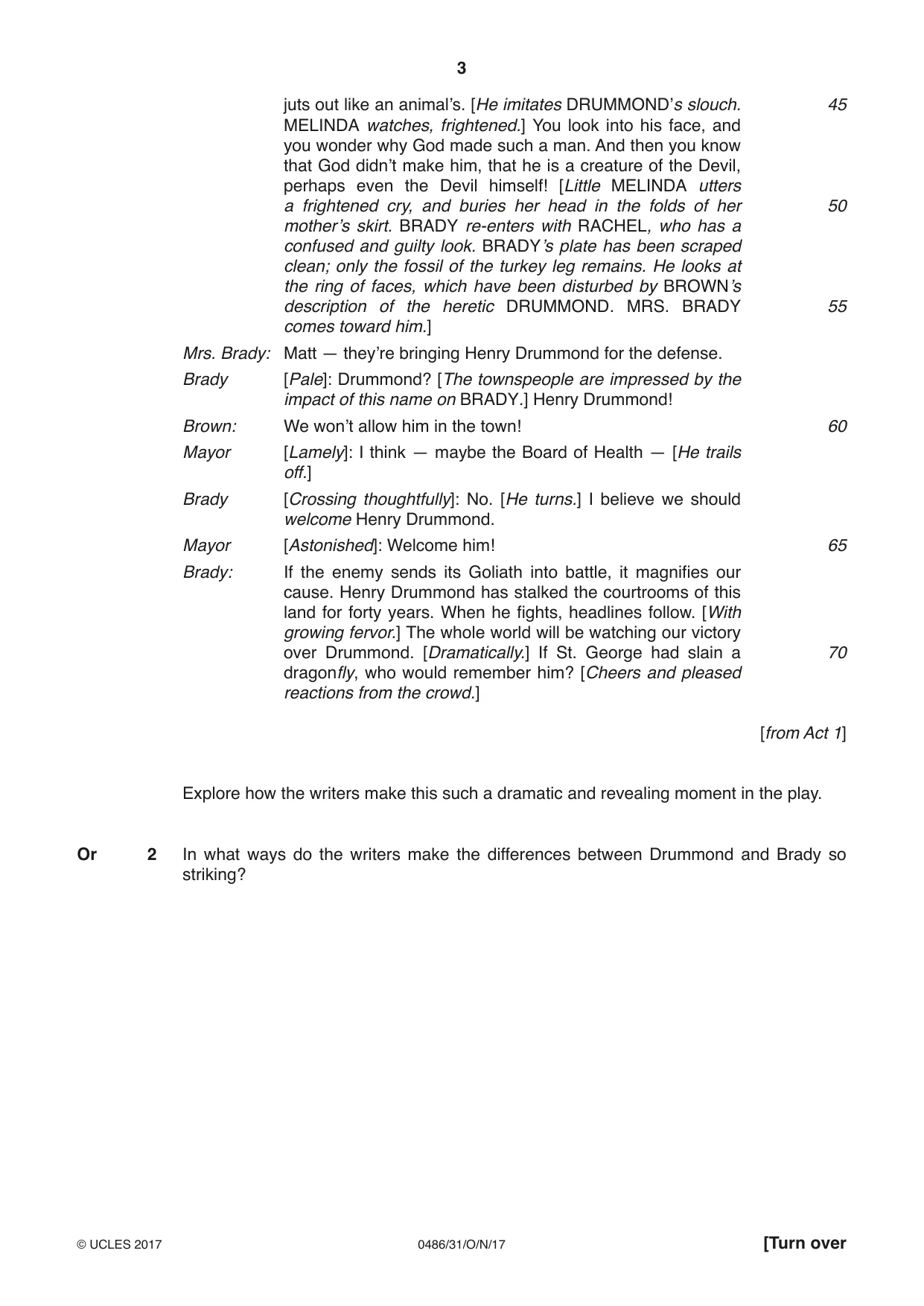
3 0486/31/O/N/17 © UCLES 2017 [Turn over juts out like an animal’s. [He imitates DRUMMOND’s slouch. MELINDA watches, frightened.] You look into his face, and you wonder why God made such a man. And then you know that God didn’t make him, that he is a creature of the Devil, perhaps even the Devil himself! [Little MELINDA utters a frightened cry, and buries her head in the folds of her mother’s skirt. BRADY re-enters with RACHEL, who has a confused and guilty look. BRADY’s plate has been scraped clean; only the fossil of the turkey leg remains. He looks at the ring of faces, which have been disturbed by BROWN’s description of the heretic DRUMMOND. MRS. BRADY comes toward him.] Mrs. Brady: Matt — they’re bringing Henry Drummond for the defense. Brady [Pale]: Drummond? [The townspeople are impressed by the impact of this name on BRADY.] Henry Drummond! Brown: We won’t allow him in the town! Mayor [Lamely]: I think — maybe the Board of Health — [He trails off.] Brady [Crossing thoughtfully]: No. [He turns.] I believe we should welcome Henry Drummond. Mayor [Astonished]: Welcome him! Brady: If the enemy sends its Goliath into battle, it magnifies our cause. Henry Drummond has stalked the courtrooms of this land for forty years. When he fights, headlines follow. [With growing fervor.] The whole world will be watching our victory over Drummond. [Dramatically.] If St. George had slain a dragonfly, who would remember him? [Cheers and pleased reactions from the crowd.] [from Act 1] Explore how the writers make this such a dramatic and revealing moment in the play. Or 2 In what ways do the writers make the differences between Drummond and Brady so striking? 45 50 55 60 65 70
Question paper, page 4
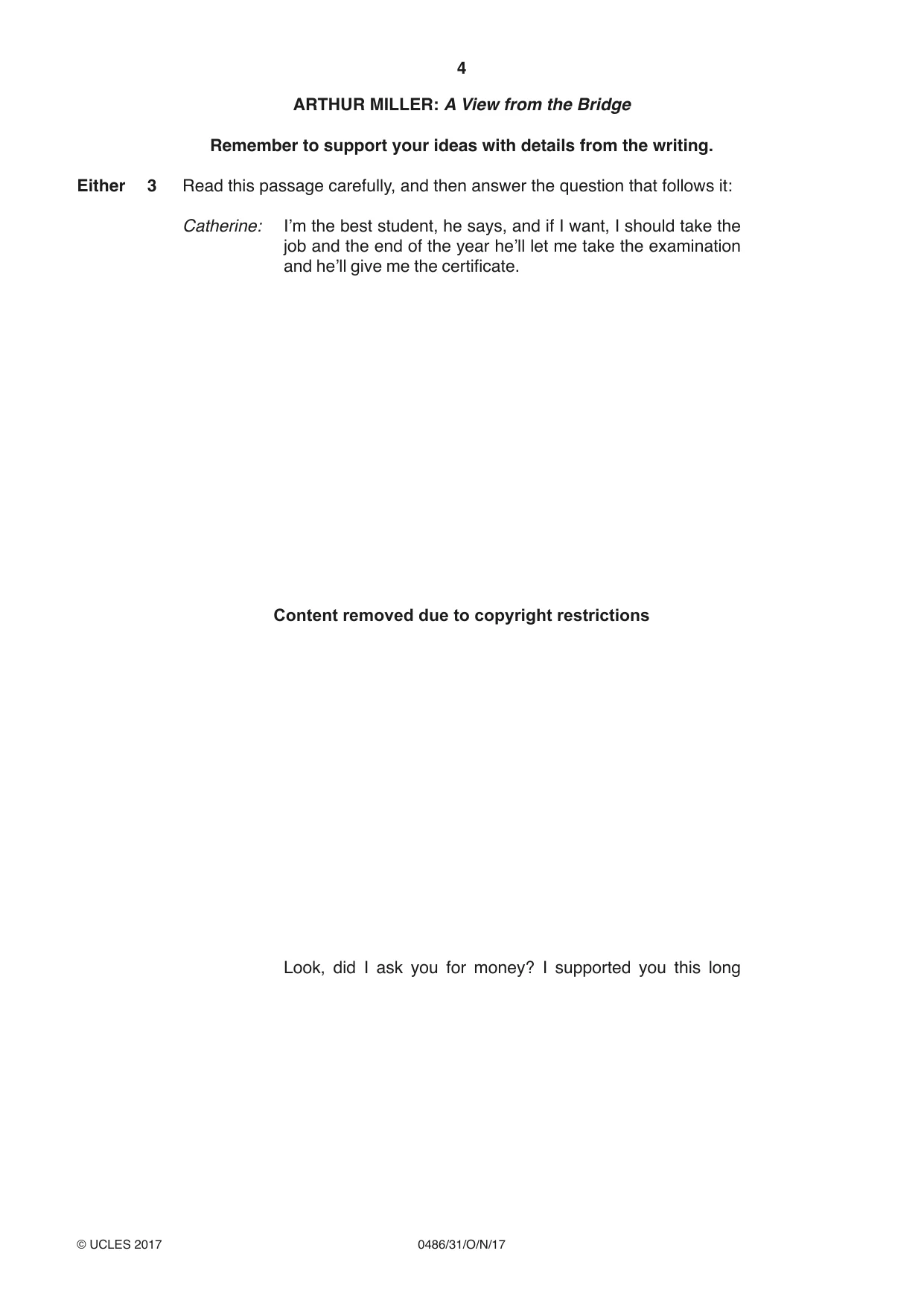
4 0486/31/O/N/17 © UCLES 2017 ARTHUR MILLER: A View from the Bridge Remember to support your ideas with details from the writing. Either 3 Read this passage carefully, and then answer the question that follows it: Catherine: I’m the best student, he says, and if I want, I should take the job and the end of the year he’ll let me take the examination and he’ll give me the certificate. So I’ll save practically a year! Content removed due to copyright restrictions Look, did I ask you for money? I supported you this long
Question paper, page 5
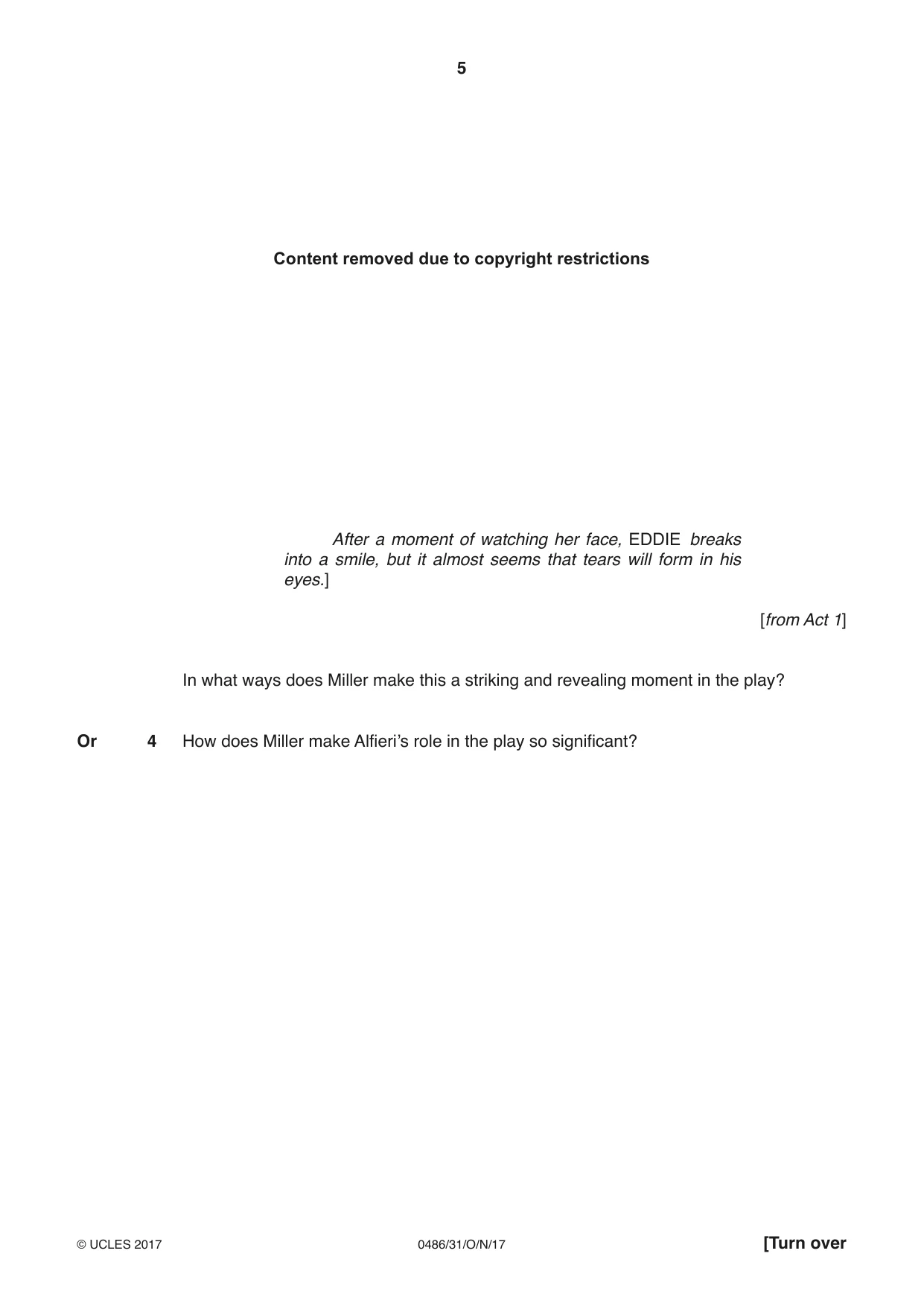
5 0486/31/O/N/17 © UCLES 2017 [Turn over Content removed due to copyright restrictions table. After a moment of watching her face, EDDIE breaks into a smile, but it almost seems that tears will form in his eyes.] [from Act 1] In what ways does Miller make this a striking and revealing moment in the play? Or 4 How does Miller make Alfieri’s role in the play so significant?
Question paper, page 6
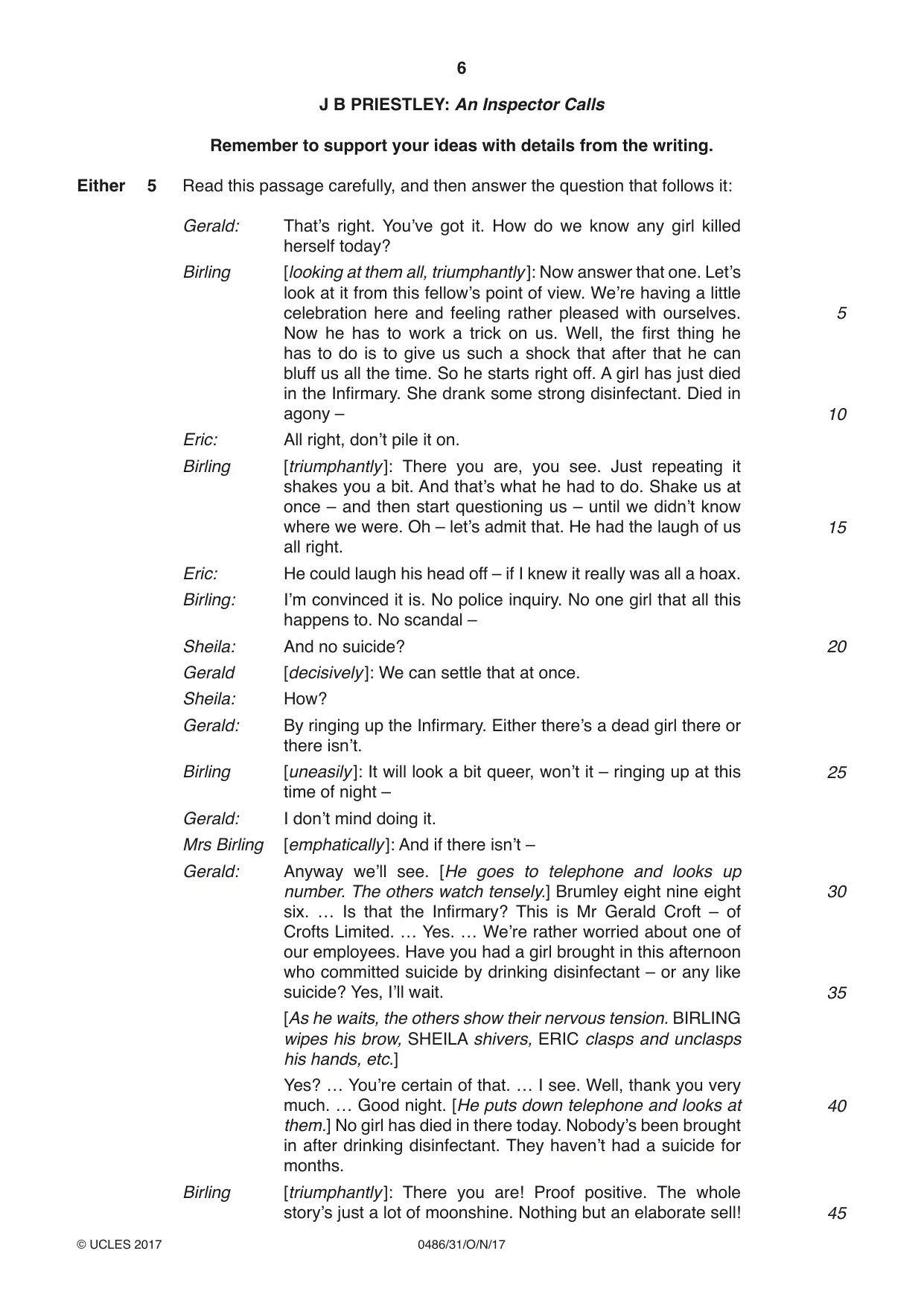
6 0486/31/O/N/17 © UCLES 2017 J B PRIESTLEY: An Inspector Calls Remember to support your ideas with details from the writing. Either 5 Read this passage carefully, and then answer the question that follows it: Gerald: That’s right. You’ve got it. How do we know any girl killed herself today? Birling [looking at them all, triumphantly ]: Now answer that one. Let’s look at it from this fellow’s point of view. We’re having a little celebration here and feeling rather pleased with ourselves. Now he has to work a trick on us. Well, the first thing he has to do is to give us such a shock that after that he can bluff us all the time. So he starts right off. A girl has just died in the Infirmary. She drank some strong disinfectant. Died in agony – Eric: All right, don’t pile it on. Birling [triumphantly ]: There you are, you see. Just repeating it shakes you a bit. And that’s what he had to do. Shake us at once – and then start questioning us – until we didn’t know where we were. Oh – let’s admit that. He had the laugh of us all right. Eric: He could laugh his head off – if I knew it really was all a hoax. Birling: I’m convinced it is. No police inquiry. No one girl that all this happens to. No scandal – Sheila: And no suicide? Gerald [decisively ]: We can settle that at once. Sheila: How? Gerald: By ringing up the Infirmary. Either there’s a dead girl there or there isn’t. Birling [uneasily ]: It will look a bit queer, won’t it – ringing up at this time of night – Gerald: I don’t mind doing it. Mrs Birling [emphatically ]: And if there isn’t – Gerald: Anyway we’ll see. [He goes to telephone and looks up number. The others watch tensely.] Brumley eight nine eight six. … Is that the Infirmary? This is Mr Gerald Croft – of Crofts Limited. … Yes. … We’re rather worried about one of our employees. Have you had a girl brought in this afternoon who committed suicide by drinking disinfectant – or any like suicide? Yes, I’ll wait. [As he waits, the others show their nervous tension. BIRLING wipes his brow, SHEILA shivers, ERIC clasps and unclasps his hands, etc.] Yes? … You’re certain of that. … I see. Well, thank you very much. … Good night. [He puts down telephone and looks at them.] No girl has died in there today. Nobody’s been brought in after drinking disinfectant. They haven’t had a suicide for months. Birling [triumphantly ]: There you are! Proof positive. The whole story’s just a lot of moonshine. Nothing but an elaborate sell! 5 10 15 20 25 30 35 40 45
Question paper, page 7
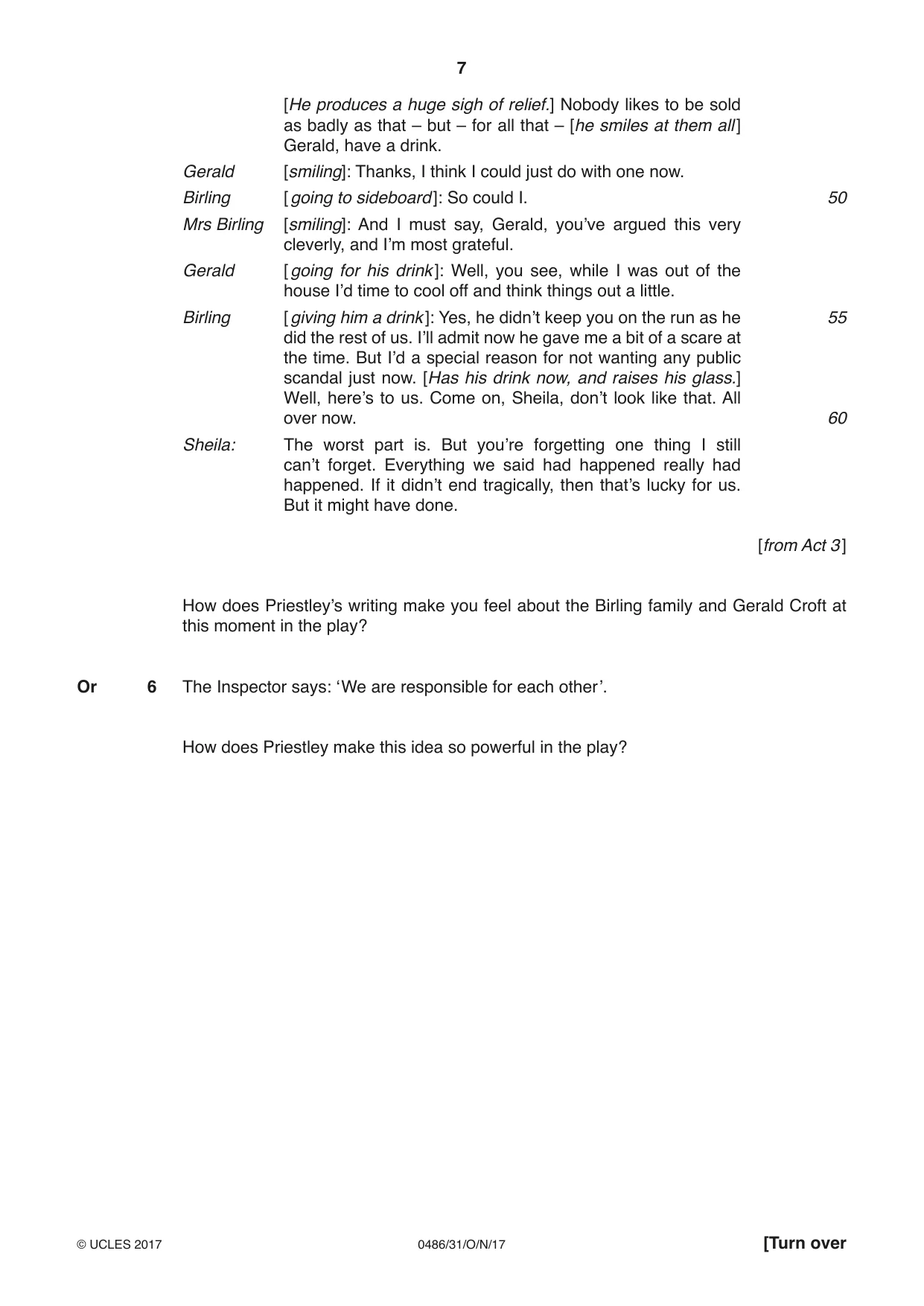
7 0486/31/O/N/17 © UCLES 2017 [Turn over [He produces a huge sigh of relief.] Nobody likes to be sold as badly as that – but – for all that – [he smiles at them all ] Gerald, have a drink. Gerald [smiling]: Thanks, I think I could just do with one now. Birling [ going to sideboard ]: So could I. Mrs Birling [smiling]: And I must say, Gerald, you’ve argued this very cleverly, and I’m most grateful. Gerald [ going for his drink ]: Well, you see, while I was out of the house I’d time to cool off and think things out a little. Birling [ giving him a drink ]: Yes, he didn’t keep you on the run as he did the rest of us. I’ll admit now he gave me a bit of a scare at the time. But I’d a special reason for not wanting any public scandal just now. [Has his drink now, and raises his glass.] Well, here’s to us. Come on, Sheila, don’t look like that. All over now. Sheila: The worst part is. But you’re forgetting one thing I still can’t forget. Everything we said had happened really had happened. If it didn’t end tragically, then that’s lucky for us. But it might have done. [from Act 3 ] How does Priestley’s writing make you feel about the Birling family and Gerald Croft at this moment in the play? Or 6 The Inspector says: ‘ We are responsible for each other ’. How does Priestley make this idea so powerful in the play? 50 55 60
Question paper, page 8
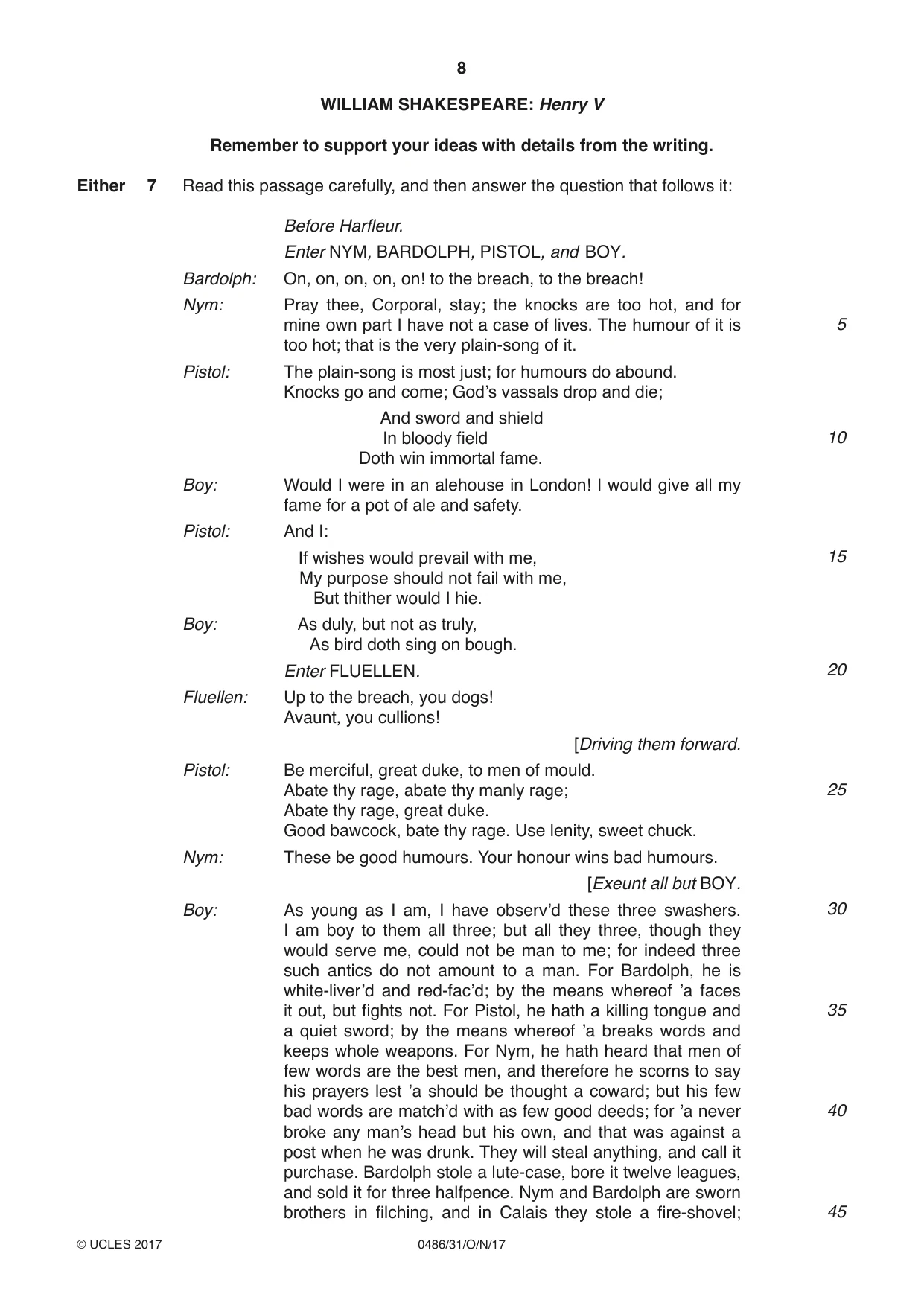
8 0486/31/O/N/17 © UCLES 2017 WILLIAM SHAKESPEARE: Henry V Remember to support your ideas with details from the writing. Either 7 Read this passage carefully, and then answer the question that follows it: Before Harfleur. Enter NYM, BARDOLPH, PISTOL, and BOY. Bardolph: On, on, on, on, on! to the breach, to the breach! Nym: Pray thee, Corporal, stay; the knocks are too hot, and for mine own part I have not a case of lives. The humour of it is too hot; that is the very plain-song of it. Pistol: The plain-song is most just; for humours do abound. Knocks go and come; God’s vassals drop and die; And sword and shield In bloody field Doth win immortal fame. Boy: Would I were in an alehouse in London! I would give all my fame for a pot of ale and safety. Pistol: And I: If wishes would prevail with me, My purpose should not fail with me, But thither would I hie. Boy: As duly, but not as truly, As bird doth sing on bough. Enter FLUELLEN. Fluellen: Up to the breach, you dogs! Avaunt, you cullions! [Driving them forward. Pistol: Be merciful, great duke, to men of mould. Abate thy rage, abate thy manly rage; Abate thy rage, great duke. Good bawcock, bate thy rage. Use lenity, sweet chuck. Nym: These be good humours. Your honour wins bad humours. [Exeunt all but BOY. Boy: As young as I am, I have observ’d these three swashers. I am boy to them all three; but all they three, though they would serve me, could not be man to me; for indeed three such antics do not amount to a man. For Bardolph, he is white-liver’d and red-fac’d; by the means whereof ’a faces it out, but fights not. For Pistol, he hath a killing tongue and a quiet sword; by the means whereof ’a breaks words and keeps whole weapons. For Nym, he hath heard that men of few words are the best men, and therefore he scorns to say his prayers lest ’a should be thought a coward; but his few bad words are match’d with as few good deeds; for ’a never broke any man’s head but his own, and that was against a post when he was drunk. They will steal anything, and call it purchase. Bardolph stole a lute-case, bore it twelve leagues, and sold it for three halfpence. Nym and Bardolph are sworn brothers in filching, and in Calais they stole a fire-shovel; 5 10 15 20 25 30 35 40 45
Question paper, page 9
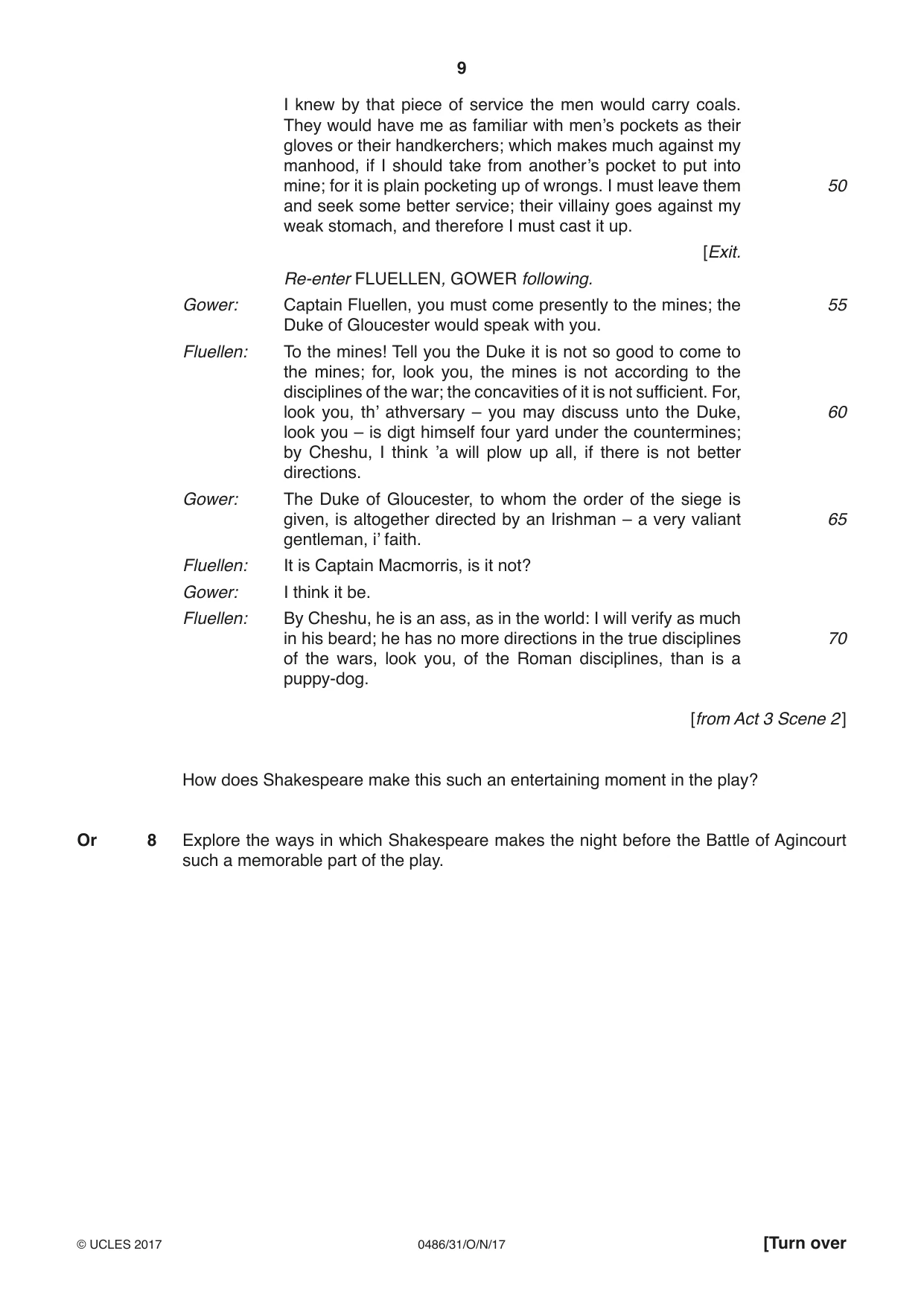
9 0486/31/O/N/17 © UCLES 2017 [Turn over I knew by that piece of service the men would carry coals. They would have me as familiar with men’s pockets as their gloves or their handkerchers; which makes much against my manhood, if I should take from another’s pocket to put into mine; for it is plain pocketing up of wrongs. I must leave them and seek some better service; their villainy goes against my weak stomach, and therefore I must cast it up. [Exit. Re-enter FLUELLEN, GOWER following. Gower: Captain Fluellen, you must come presently to the mines; the Duke of Gloucester would speak with you. Fluellen: To the mines! Tell you the Duke it is not so good to come to the mines; for, look you, the mines is not according to the disciplines of the war; the concavities of it is not sufficient. For, look you, th’ athversary – you may discuss unto the Duke, look you – is digt himself four yard under the countermines; by Cheshu, I think ’a will plow up all, if there is not better directions. Gower: The Duke of Gloucester, to whom the order of the siege is given, is altogether directed by an Irishman – a very valiant gentleman, i’ faith. Fluellen: It is Captain Macmorris, is it not? Gower: I think it be. Fluellen: By Cheshu, he is an ass, as in the world: I will verify as much in his beard; he has no more directions in the true disciplines of the wars, look you, of the Roman disciplines, than is a puppy-dog. [from Act 3 Scene 2 ] How does Shakespeare make this such an entertaining moment in the play? Or 8 Explore the ways in which Shakespeare makes the night before the Battle of Agincourt such a memorable part of the play. 50 55 60 65 70
Question paper, page 10
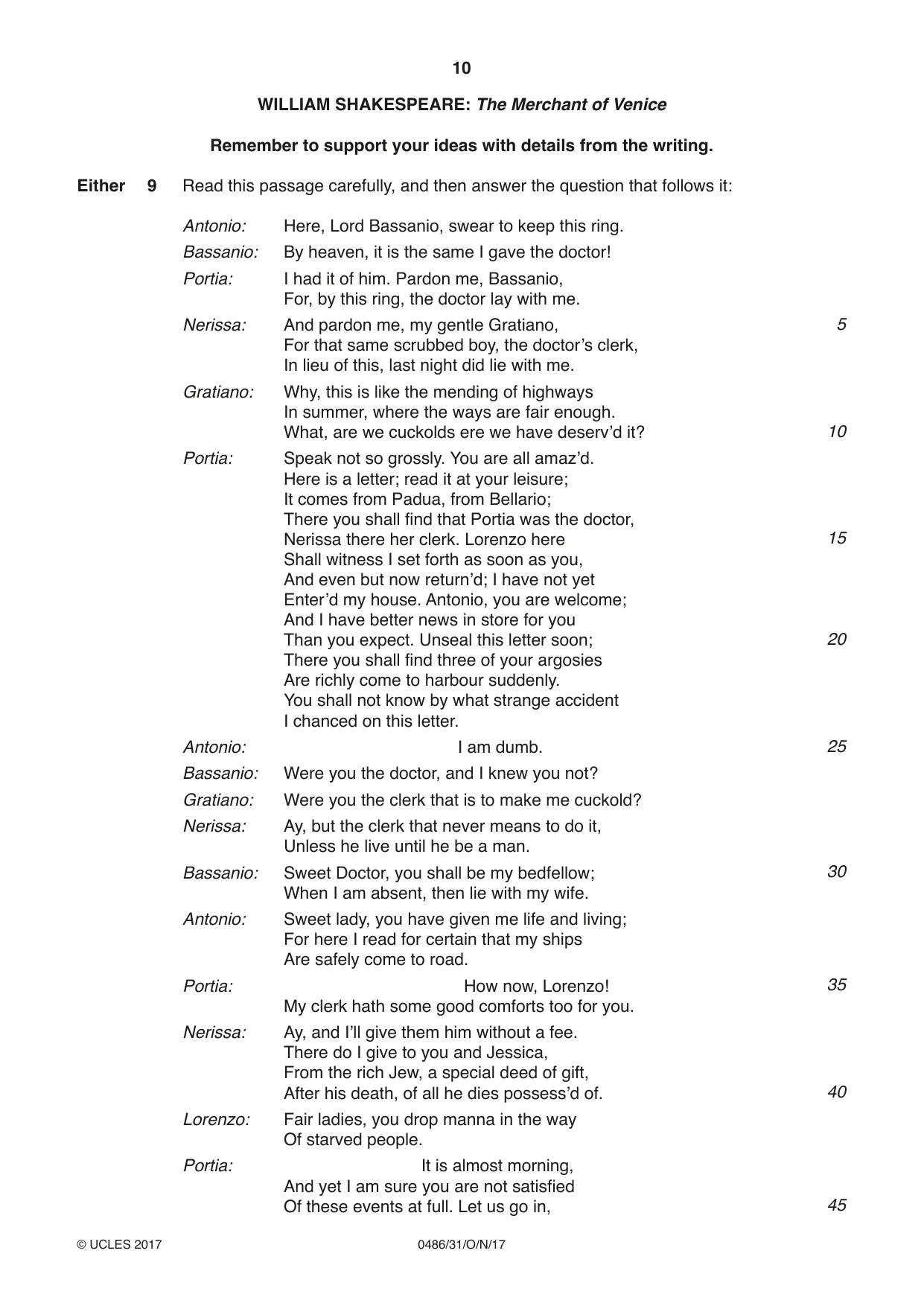
10 0486/31/O/N/17 © UCLES 2017 WILLIAM SHAKESPEARE: The Merchant of Venice Remember to support your ideas with details from the writing. Either 9 Read this passage carefully, and then answer the question that follows it: Antonio: Here, Lord Bassanio, swear to keep this ring. Bassanio: By heaven, it is the same I gave the doctor! Portia: I had it of him. Pardon me, Bassanio, For, by this ring, the doctor lay with me. Nerissa: And pardon me, my gentle Gratiano, For that same scrubbed boy, the doctor’s clerk, In lieu of this, last night did lie with me. Gratiano: Why, this is like the mending of highways In summer, where the ways are fair enough. What, are we cuckolds ere we have deserv’d it? Portia: Speak not so grossly. You are all amaz’d. Here is a letter; read it at your leisure; It comes from Padua, from Bellario; There you shall find that Portia was the doctor, Nerissa there her clerk. Lorenzo here Shall witness I set forth as soon as you, And even but now return’d; I have not yet Enter’d my house. Antonio, you are welcome; And I have better news in store for you Than you expect. Unseal this letter soon; There you shall find three of your argosies Are richly come to harbour suddenly. You shall not know by what strange accident I chanced on this letter. Antonio: I am dumb. Bassanio: Were you the doctor, and I knew you not? Gratiano: Were you the clerk that is to make me cuckold? Nerissa: Ay, but the clerk that never means to do it, Unless he live until he be a man. Bassanio: Sweet Doctor, you shall be my bedfellow; When I am absent, then lie with my wife. Antonio: Sweet lady, you have given me life and living; For here I read for certain that my ships Are safely come to road. Portia: How now, Lorenzo! My clerk hath some good comforts too for you. Nerissa: Ay, and I’ll give them him without a fee. There do I give to you and Jessica, From the rich Jew, a special deed of gift, After his death, of all he dies possess’d of. Lorenzo: Fair ladies, you drop manna in the way Of starved people. Portia: It is almost morning, And yet I am sure you are not satisfied Of these events at full. Let us go in, 5 10 15 20 25 30 35 40 45
Question paper, page 11
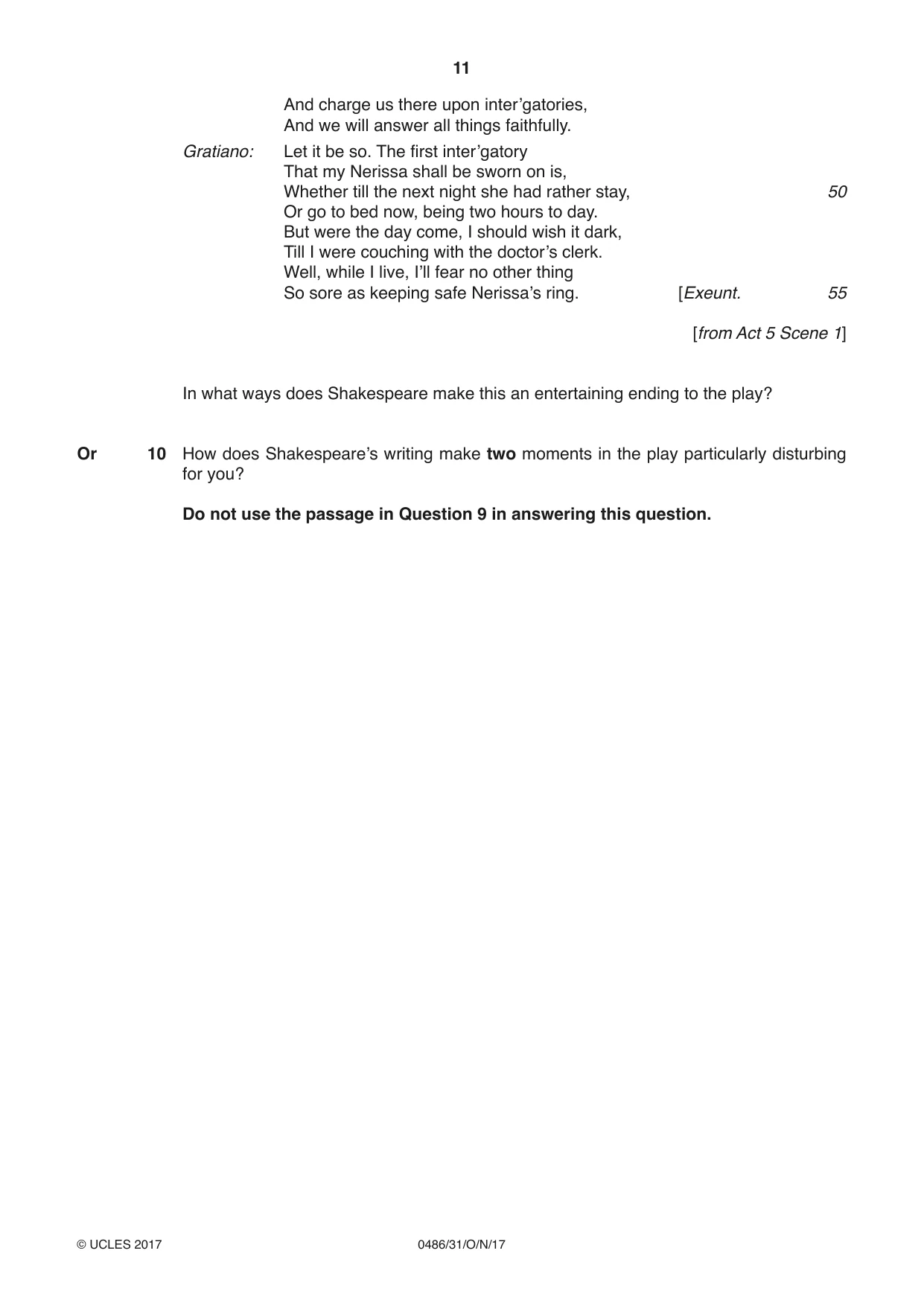
11 0486/31/O/N/17 © UCLES 2017 And charge us there upon inter’gatories, And we will answer all things faithfully. Gratiano: Let it be so. The first inter’gatory That my Nerissa shall be sworn on is, Whether till the next night she had rather stay, Or go to bed now, being two hours to day. But were the day come, I should wish it dark, Till I were couching with the doctor’s clerk. Well, while I live, I’ll fear no other thing So sore as keeping safe Nerissa’s ring. [Exeunt. [from Act 5 Scene 1] In what ways does Shakespeare make this an entertaining ending to the play? Or 10 How does Shakespeare’s writing make two moments in the play particularly disturbing for you? Do not use the passage in Question 9 in answering this question. 50 55
Question paper, page 12
12 0486/31/O/N/17 © UCLES 2017 BLANK PAGE Permission to reproduce items where third-party owned material protected by copyright is included has been sought and cleared where possible. Every reasonable effort has been made by the publisher (UCLES) to trace copyright holders, but if any items requiring clearance have unwittingly been included, the publisher will be pleased to make amends at the earliest possible opportunity. To avoid the issue of disclosure of answer-related information to candidates, all copyright acknowledgements are reproduced online in the Cambridge International Examinations Copyright Acknowledgements Booklet. This is produced for each series of examinations and is freely available to download at www.cie.org.uk after the live examination series. Cambridge International Examinations is part of the Cambridge Assessment Group. Cambridge Assessment is the brand name of University of Cambridge Local Examinations Syndicate (UCLES), which is itself a department of the University of Cambridge.
Mark scheme, page 1
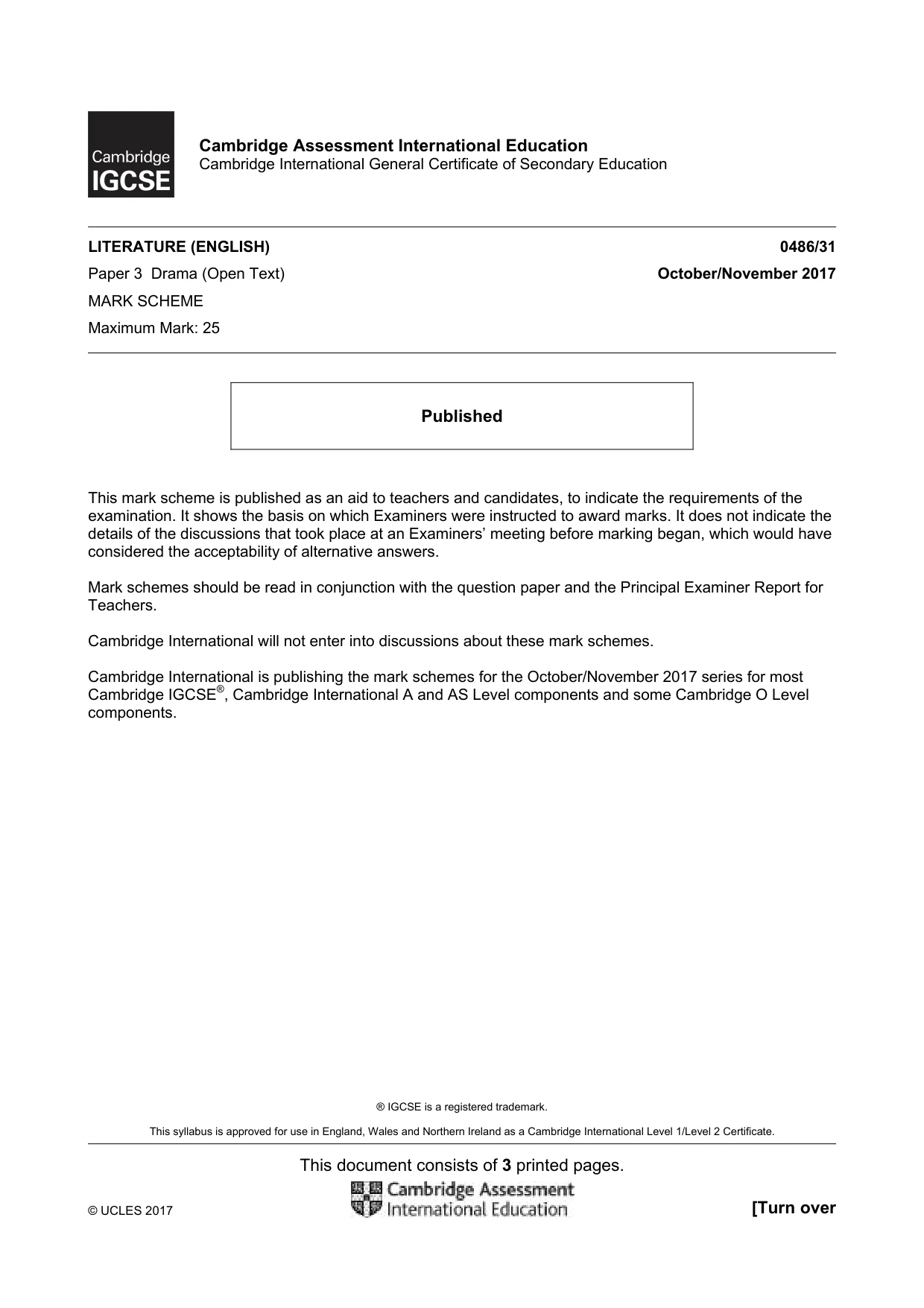
® IGCSE is a registered trademark. This syllabus is approved for use in England, Wales and Northern Ireland as a Cambridge International Level 1/Level 2 Certificate. This document consists of 3 printed pages. © UCLES 2017 [Turn over Cambridge Assessment International Education Cambridge International General Certificate of Secondary Education LITERATURE (ENGLISH) 0486/31 Paper 3 Drama (Open Text) October/November 2017 MARK SCHEME Maximum Mark: 25 Published This mark scheme is published as an aid to teachers and candidates, to indicate the requirements of the examination. It shows the basis on which Examiners were instructed to award marks. It does not indicate the details of the discussions that took place at an Examiners’ meeting before marking began, which would have considered the acceptability of alternative answers. Mark schemes should be read in conjunction with the question paper and the Principal Examiner Report for Teachers. Cambridge International will not enter into discussions about these mark schemes. Cambridge International is publishing the mark schemes for the October/November 2017 series for most Cambridge IGCSE®, Cambridge International A and AS Level components and some Cambridge O Level components.
Mark scheme, page 2
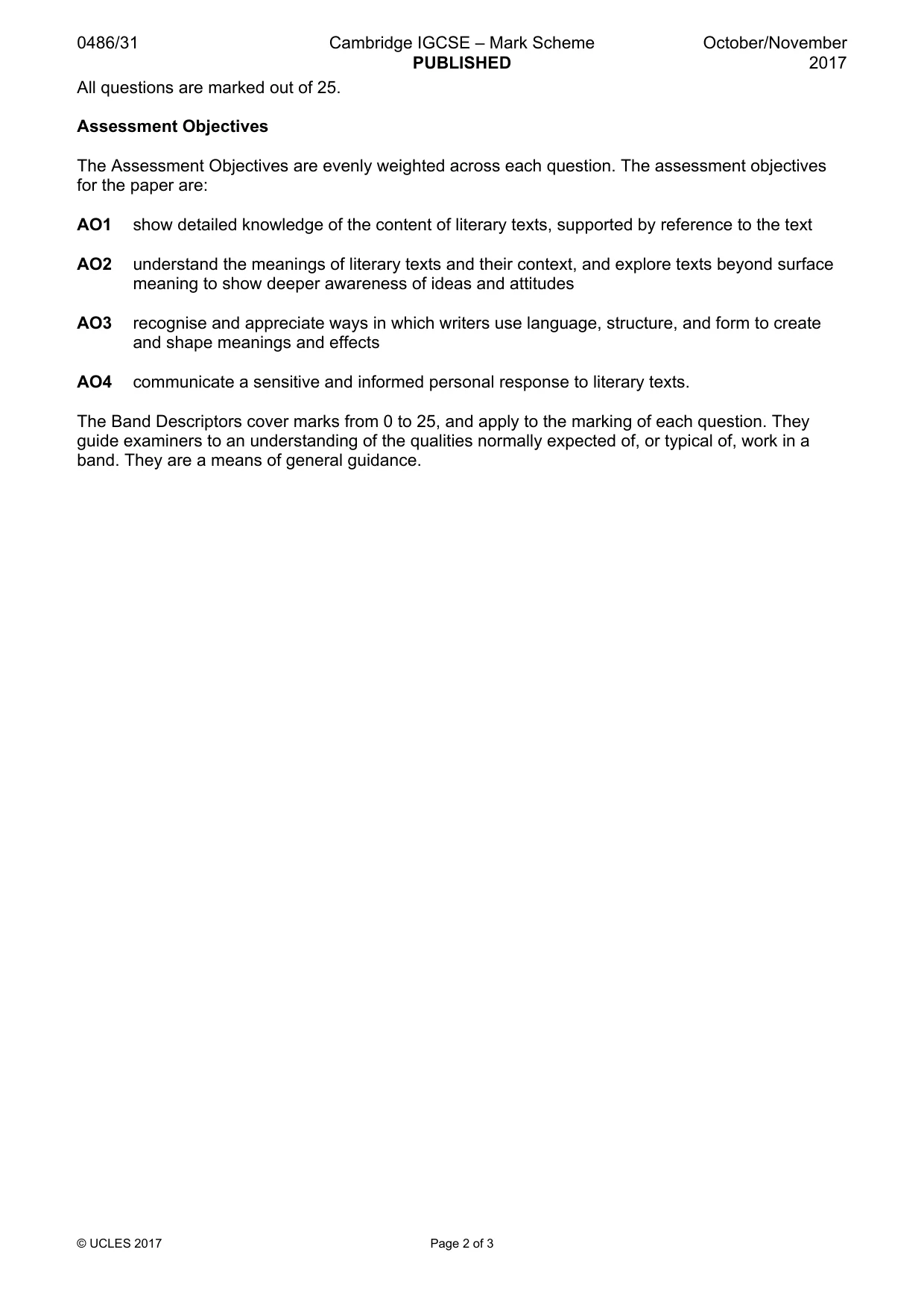
0486/31 Cambridge IGCSE – Mark Scheme PUBLISHED October/November 2017 © UCLES 2017 Page 2 of 3 All questions are marked out of 25. Assessment Objectives The Assessment Objectives are evenly weighted across each question. The assessment objectives for the paper are: AO1 show detailed knowledge of the content of literary texts, supported by reference to the text AO2 understand the meanings of literary texts and their context, and explore texts beyond surface meaning to show deeper awareness of ideas and attitudes AO3 recognise and appreciate ways in which writers use language, structure, and form to create and shape meanings and effects AO4 communicate a sensitive and informed personal response to literary texts. The Band Descriptors cover marks from 0 to 25, and apply to the marking of each question. They guide examiners to an understanding of the qualities normally expected of, or typical of, work in a band. They are a means of general guidance.
Mark scheme, page 3
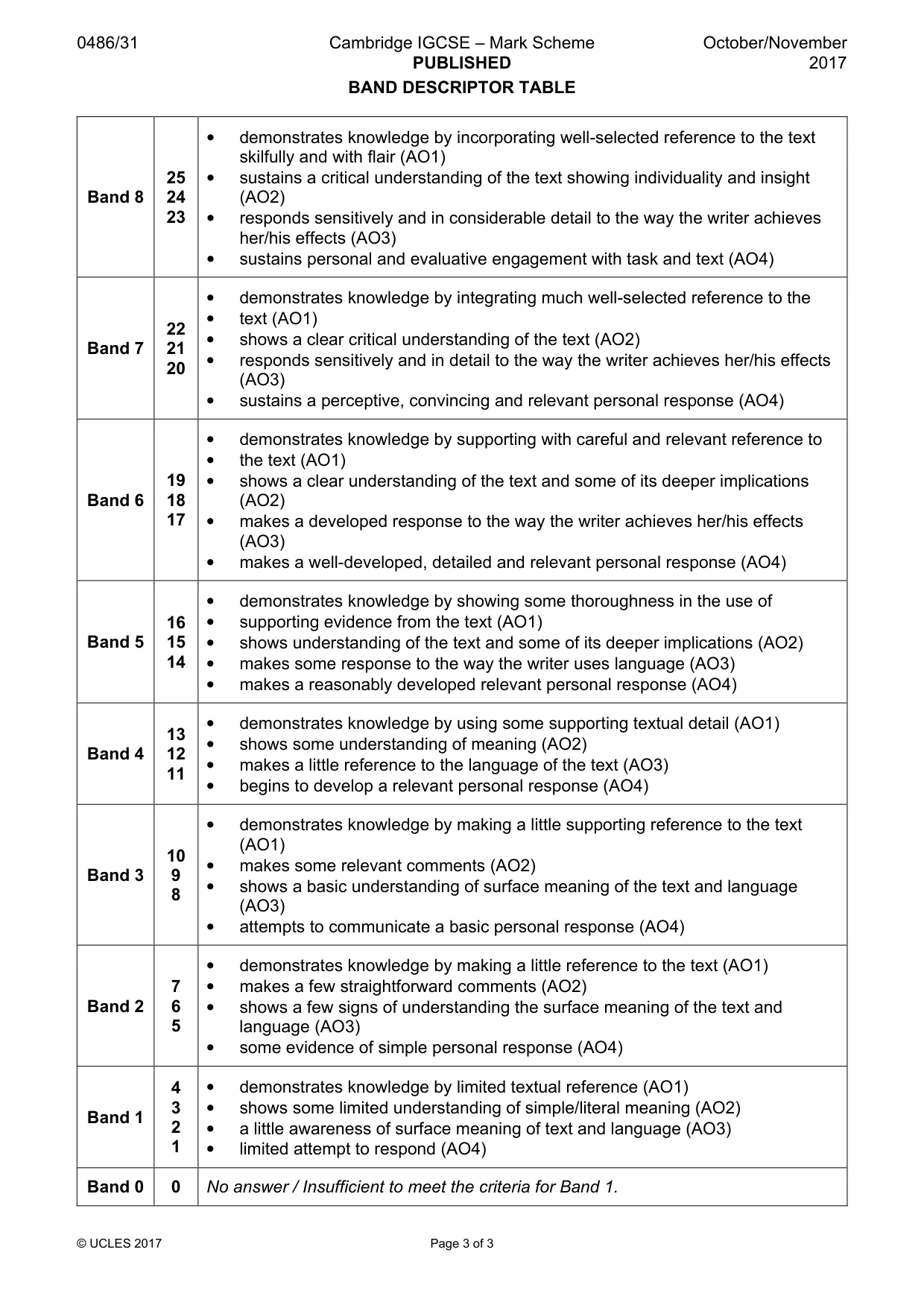
0486/31 Cambridge IGCSE – Mark Scheme PUBLISHED October/November 2017 © UCLES 2017 Page 3 of 3 BAND DESCRIPTOR TABLE Band 8 25 24 23 • demonstrates knowledge by incorporating well-selected reference to the text skilfully and with flair (AO1) • sustains a critical understanding of the text showing individuality and insight (AO2) • responds sensitively and in considerable detail to the way the writer achieves her/his effects (AO3) • sustains personal and evaluative engagement with task and text (AO4) Band 7 22 21 20 • demonstrates knowledge by integrating much well-selected reference to the • text (AO1) • shows a clear critical understanding of the text (AO2) • responds sensitively and in detail to the way the writer achieves her/his effects (AO3) • sustains a perceptive, convincing and relevant personal response (AO4) Band 6 19 18 17 • demonstrates knowledge by supporting with careful and relevant reference to • the text (AO1) • shows a clear understanding of the text and some of its deeper implications (AO2) • makes a developed response to the way the writer achieves her/his effects (AO3) • makes a well-developed, detailed and relevant personal response (AO4) Band 5 16 15 14 • demonstrates knowledge by showing some thoroughness in the use of • supporting evidence from the text (AO1) • shows understanding of the text and some of its deeper implications (AO2) • makes some response to the way the writer uses language (AO3) • makes a reasonably developed relevant personal response (AO4) Band 4 13 12 11 • demonstrates knowledge by using some supporting textual detail (AO1) • shows some understanding of meaning (AO2) • makes a little reference to the language of the text (AO3) • begins to develop a relevant personal response (AO4) Band 3 10 9 8 • demonstrates knowledge by making a little supporting reference to the text (AO1) • makes some relevant comments (AO2) • shows a basic understanding of surface meaning of the text and language (AO3) • attempts to communicate a basic personal response (AO4) Band 2 7 6 5 • demonstrates knowledge by making a little reference to the text (AO1) • makes a few straightforward comments (AO2) • shows a few signs of understanding the surface meaning of the text and language (AO3) • some evidence of simple personal response (AO4) Band 1 4 3 2 1 • demonstrates knowledge by limited textual reference (AO1) • shows some limited understanding of simple/literal meaning (AO2) • a little awareness of surface meaning of text and language (AO3) • limited attempt to respond (AO4) Band 0 0 No answer / Insufficient to meet the criteria for Band 1.
What you needed in this session
Cambridge’s own grade thresholds for 2017 Oct/Nov, Paper 3 · Variant 1. A higher threshold means an easier paper — the bar moves with how the cohort did.