Cambridge IGCSE English - Literature 0486 — 2017 Oct/Nov Paper 3 · Variant 3
0486/33/O/N/17 · 25 marks · ≈28 min
The question paper and its mark scheme, free to read here and free to download. This is Cambridge’s own paper, exactly as it was sat.
Question paper12 pages

Mark scheme3 pages
Answers below. Sit the paper first if you are practising.
Paper as text
Question paper, page 1
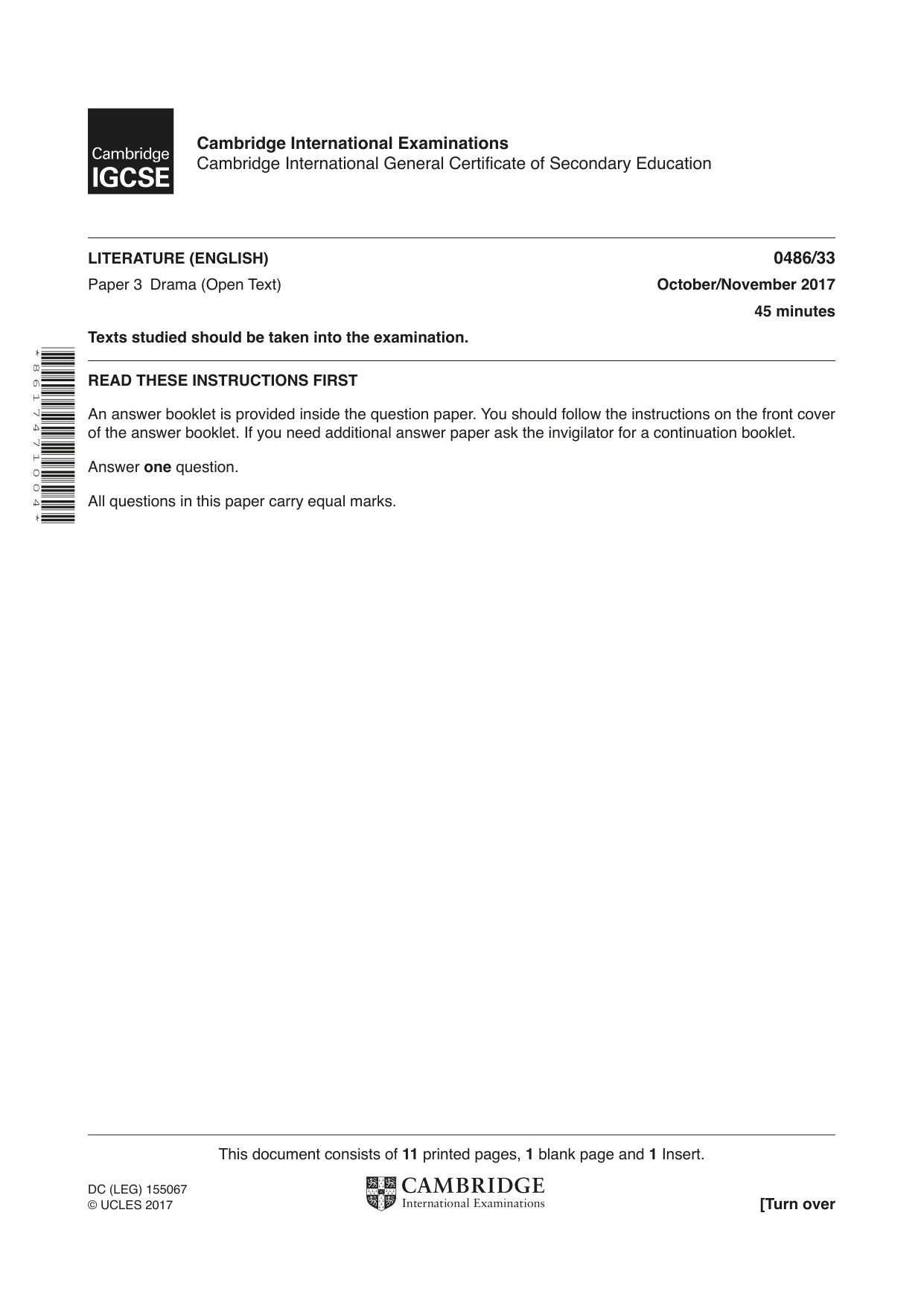
This document consists of 11 printed pages, 1 blank page and 1 Insert. DC (LEG) 155067 © UCLES 2017 [Turn over Cambridge International Examinations Cambridge International General Certificate of Secondary Education * 8 6 1 7 4 7 1 0 0 4 * LITERATURE (ENGLISH) 0486/33 Paper 3 Drama (Open Text) October/November 2017 45 minutes Texts studied should be taken into the examination. READ THESE INSTRUCTIONS FIRST An answer booklet is provided inside the question paper. You should follow the instructions on the front cover of the answer booklet. If you need additional answer paper ask the invigilator for a continuation booklet. Answer one question. All questions in this paper carry equal marks.
Question paper, page 2
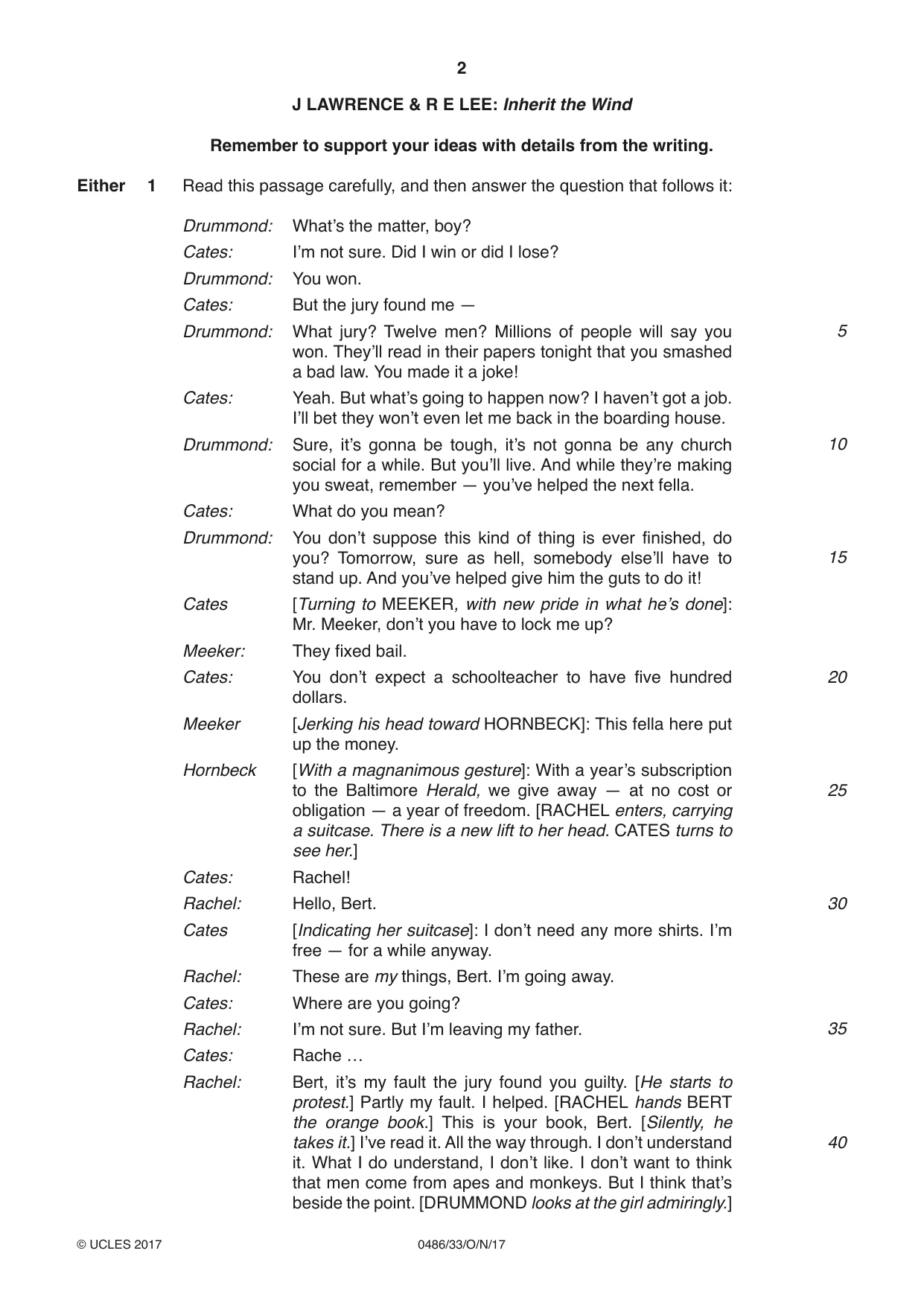
2 0486/33/O/N/17 © UCLES 2017 J LAWRENCE & R E LEE: Inherit the Wind Remember to support your ideas with details from the writing. Either 1 Read this passage carefully, and then answer the question that follows it: Drummond: What’s the matter, boy? Cates: I’m not sure. Did I win or did I lose? Drummond: You won. Cates: But the jury found me — Drummond: What jury? Twelve men? Millions of people will say you won. They’ll read in their papers tonight that you smashed a bad law. You made it a joke! Cates: Yeah. But what’s going to happen now? I haven’t got a job. I’ll bet they won’t even let me back in the boarding house. Drummond: Sure, it’s gonna be tough, it’s not gonna be any church social for a while. But you’ll live. And while they’re making you sweat, remember — you’ve helped the next fella. Cates: What do you mean? Drummond: You don’t suppose this kind of thing is ever finished, do you? Tomorrow, sure as hell, somebody else’ll have to stand up. And you’ve helped give him the guts to do it! Cates [Turning to MEEKER, with new pride in what he’s done]: Mr. Meeker, don’t you have to lock me up? Meeker: They fixed bail. Cates: You don’t expect a schoolteacher to have five hundred dollars. Meeker [Jerking his head toward HORNBECK]: This fella here put up the money. Hornbeck [With a magnanimous gesture]: With a year’s subscription to the Baltimore Herald, we give away — at no cost or obligation — a year of freedom. [RACHEL enters, carrying a suitcase. There is a new lift to her head. CATES turns to see her.] Cates: Rachel! Rachel: Hello, Bert. Cates [Indicating her suitcase]: I don’t need any more shirts. I’m free — for a while anyway. Rachel: These are my things, Bert. I’m going away. Cates: Where are you going? Rachel: I’m not sure. But I’m leaving my father. Cates: Rache … Rachel: Bert, it’s my fault the jury found you guilty. [He starts to protest.] Partly my fault. I helped. [RACHEL hands BERT the orange book.] This is your book, Bert. [Silently, he takes it.] I’ve read it. All the way through. I don’t understand it. What I do understand, I don’t like. I don’t want to think that men come from apes and monkeys. But I think that’s beside the point. [DRUMMOND looks at the girl admiringly.] 5 10 15 20 25 30 35 40
Question paper, page 3
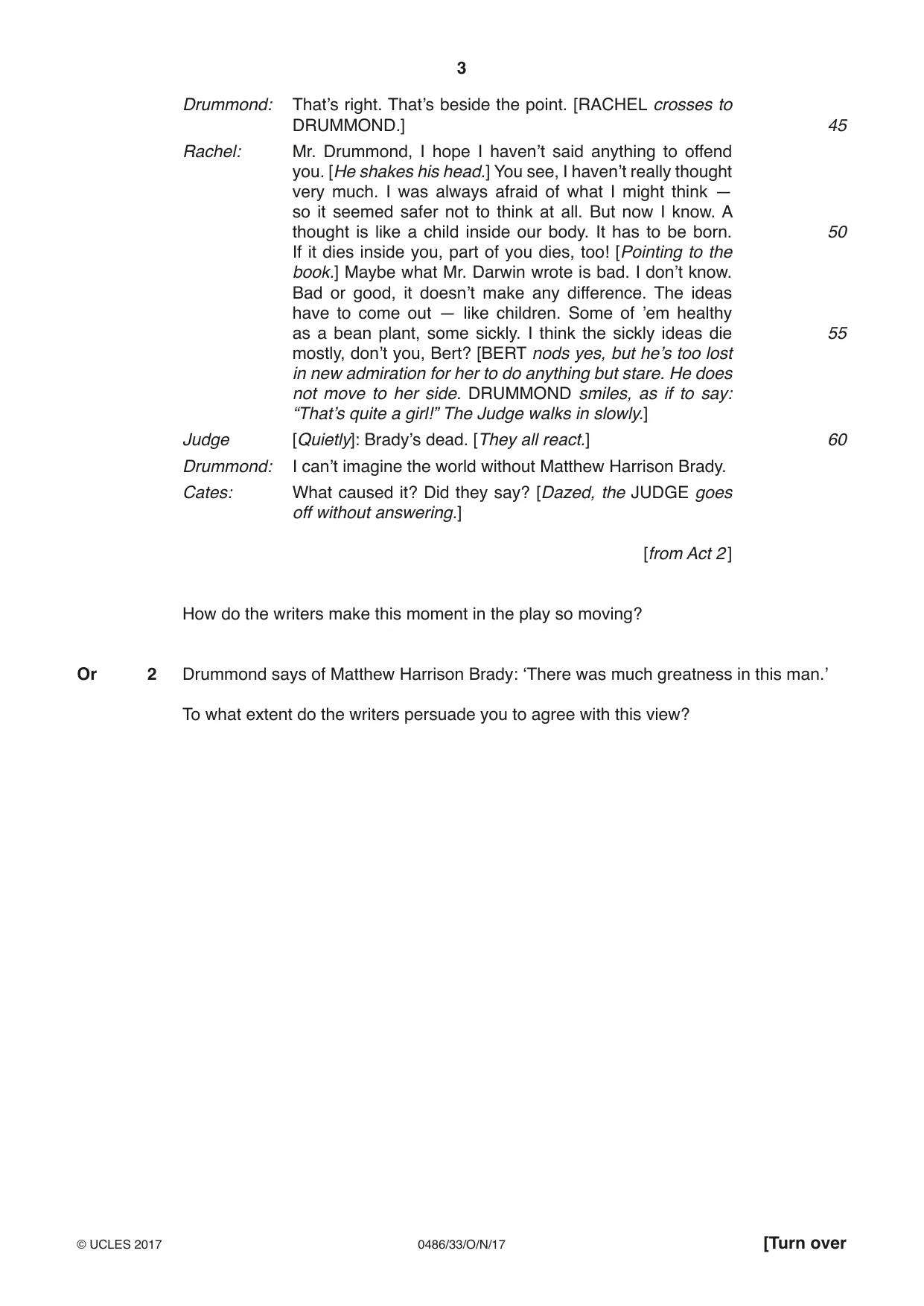
3 0486/33/O/N/17 © UCLES 2017 [Turn over Drummond: That’s right. That’s beside the point. [RACHEL crosses to DRUMMOND.] Rachel: Mr. Drummond, I hope I haven’t said anything to offend you. [He shakes his head.] You see, I haven’t really thought very much. I was always afraid of what I might think — so it seemed safer not to think at all. But now I know. A thought is like a child inside our body. It has to be born. If it dies inside you, part of you dies, too! [Pointing to the book.] Maybe what Mr. Darwin wrote is bad. I don’t know. Bad or good, it doesn’t make any difference. The ideas have to come out — like children. Some of ’em healthy as a bean plant, some sickly. I think the sickly ideas die mostly, don’t you, Bert? [BERT nods yes, but he’s too lost in new admiration for her to do anything but stare. He does not move to her side. DRUMMOND smiles, as if to say: “That’s quite a girl!” The Judge walks in slowly.] Judge [Quietly]: Brady’s dead. [They all react.] Drummond: I can’t imagine the world without Matthew Harrison Brady. Cates: What caused it? Did they say? [Dazed, the JUDGE goes off without answering.] [from Act 2 ] How do the writers make this moment in the play so moving? Or 2 Drummond says of Matthew Harrison Brady: ‘There was much greatness in this man.’ To what extent do the writers persuade you to agree with this view? 45 50 55 60
Question paper, page 4
4 0486/33/O/N/17 © UCLES 2017 ARTHUR MILLER: A View from the Bridge Remember to support your ideas with details from the writing. Either 3 Read this passage carefully, and then answer the question that follows it: Marco: Oh, no, she saves. I send everything. My wife is very Content removed due to copyright restrictions
Question paper, page 5
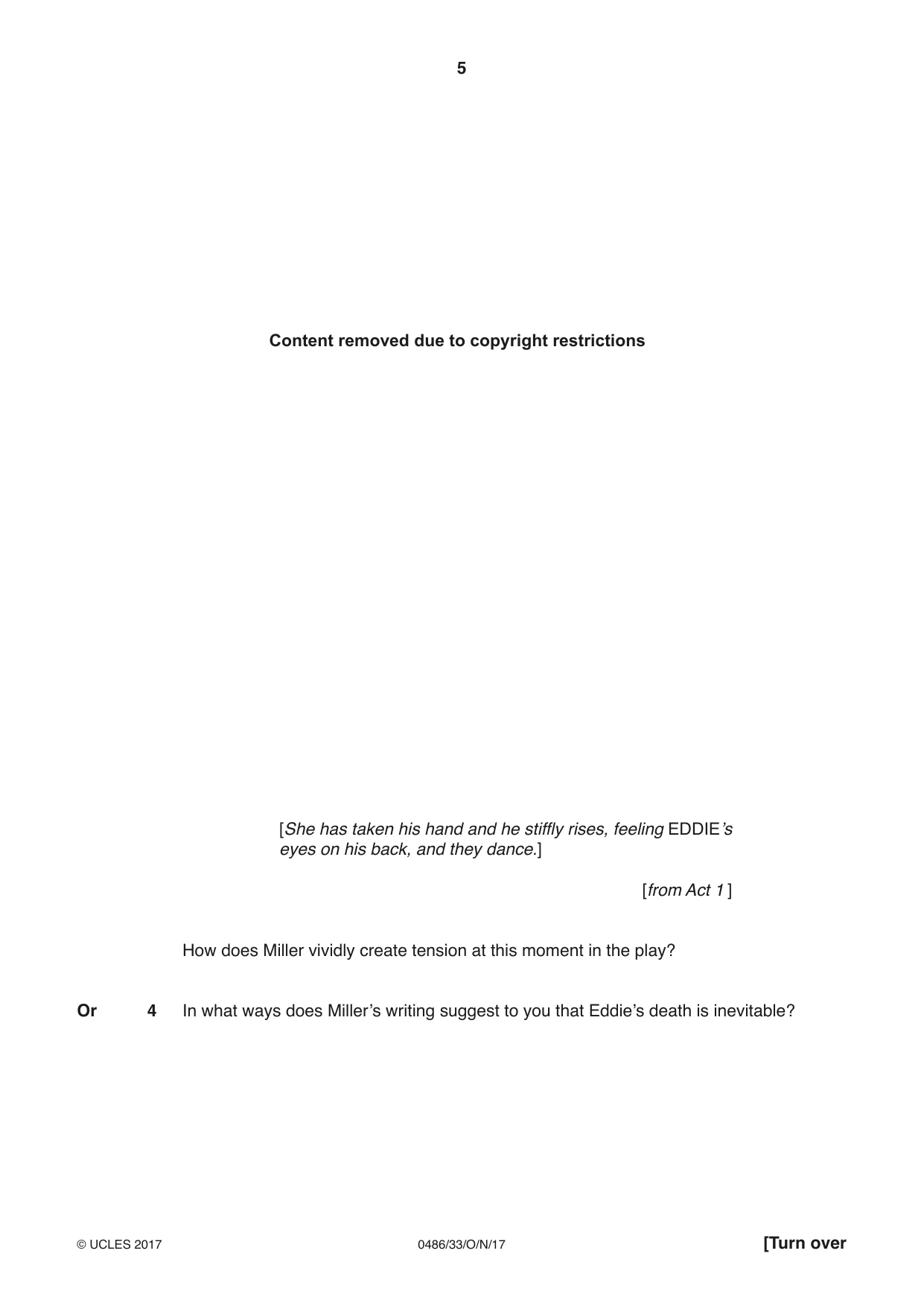
5 0486/33/O/N/17 © UCLES 2017 [Turn over Content removed due to copyright restrictions [She has taken his hand and he stiffly rises, feeling EDDIE’s eyes on his back, and they dance.] [from Act 1 ] How does Miller vividly create tension at this moment in the play? Or 4 In what ways does Miller’s writing suggest to you that Eddie’s death is inevitable?
Question paper, page 6
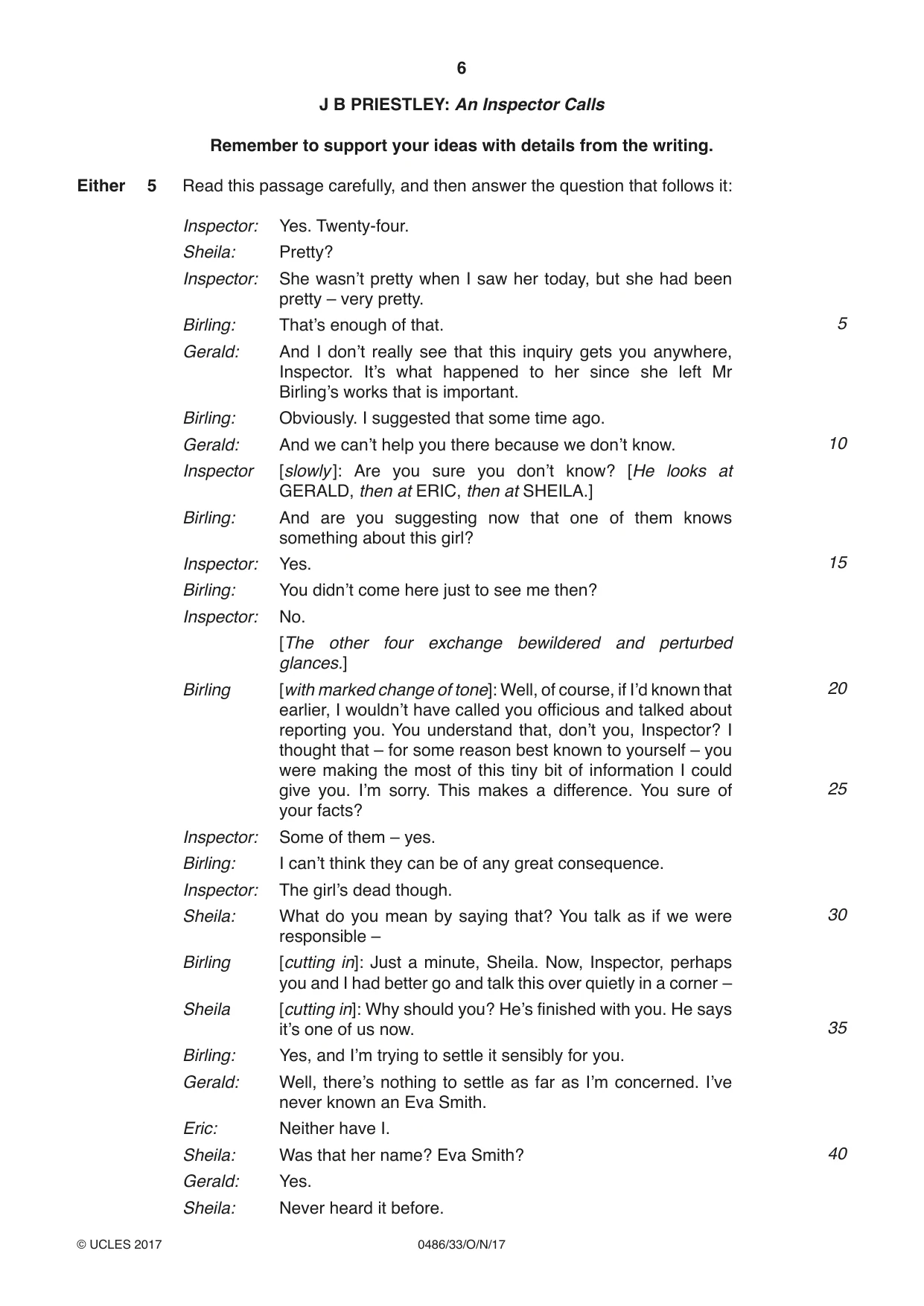
6 0486/33/O/N/17 © UCLES 2017 J B PRIESTLEY: An Inspector Calls Remember to support your ideas with details from the writing. Either 5 Read this passage carefully, and then answer the question that follows it: Inspector: Yes. Twenty-four. Sheila: Pretty? Inspector: She wasn’t pretty when I saw her today, but she had been pretty – very pretty. Birling: That’s enough of that. Gerald: And I don’t really see that this inquiry gets you anywhere, Inspector. It’s what happened to her since she left Mr Birling’s works that is important. Birling: Obviously. I suggested that some time ago. Gerald: And we can’t help you there because we don’t know. Inspector [slowly ]: Are you sure you don’t know? [He looks at GERALD, then at ERIC, then at SHEILA.] Birling: And are you suggesting now that one of them knows something about this girl? Inspector: Yes. Birling: You didn’t come here just to see me then? Inspector: No. [The other four exchange bewildered and perturbed glances.] Birling [with marked change of tone]: Well, of course, if I’d known that earlier, I wouldn’t have called you officious and talked about reporting you. You understand that, don’t you, Inspector? I thought that – for some reason best known to yourself – you were making the most of this tiny bit of information I could give you. I’m sorry. This makes a difference. You sure of your facts? Inspector: Some of them – yes. Birling: I can’t think they can be of any great consequence. Inspector: The girl’s dead though. Sheila: What do you mean by saying that? You talk as if we were responsible – Birling [cutting in]: Just a minute, Sheila. Now, Inspector, perhaps you and I had better go and talk this over quietly in a corner – Sheila [cutting in]: Why should you? He’s finished with you. He says it’s one of us now. Birling: Yes, and I’m trying to settle it sensibly for you. Gerald: Well, there’s nothing to settle as far as I’m concerned. I’ve never known an Eva Smith. Eric: Neither have I. Sheila: Was that her name? Eva Smith? Gerald: Yes. Sheila: Never heard it before. 5 10 15 20 25 30 35 40
Question paper, page 7
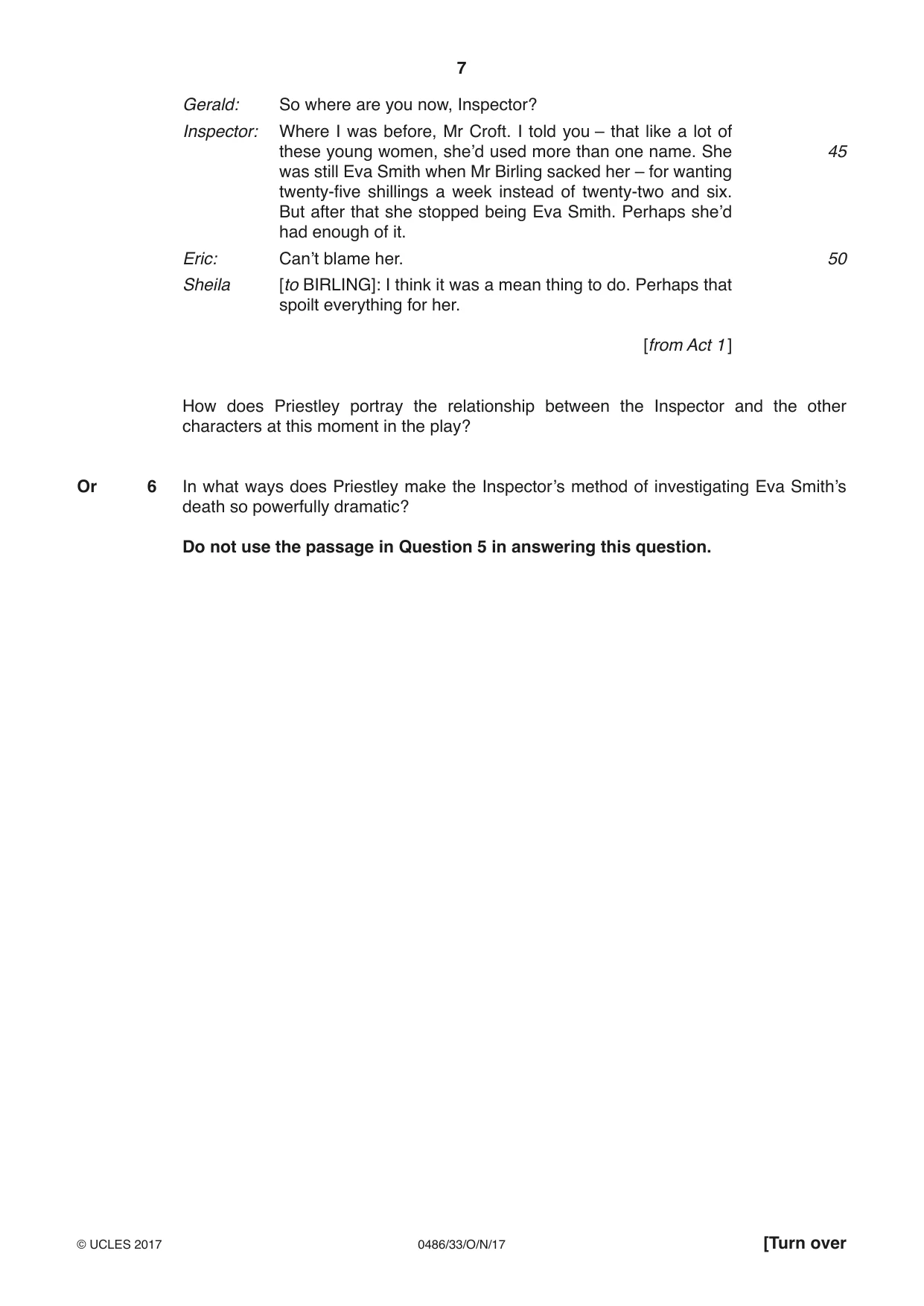
7 0486/33/O/N/17 © UCLES 2017 [Turn over Gerald: So where are you now, Inspector? Inspector: Where I was before, Mr Croft. I told you – that like a lot of these young women, she’d used more than one name. She was still Eva Smith when Mr Birling sacked her – for wanting twenty-five shillings a week instead of twenty-two and six. But after that she stopped being Eva Smith. Perhaps she’d had enough of it. Eric: Can’t blame her. Sheila [to BIRLING]: I think it was a mean thing to do. Perhaps that spoilt everything for her. [from Act 1 ] How does Priestley portray the relationship between the Inspector and the other characters at this moment in the play? Or 6 In what ways does Priestley make the Inspector’s method of investigating Eva Smith’s death so powerfully dramatic? Do not use the passage in Question 5 in answering this question. 45 50
Question paper, page 8
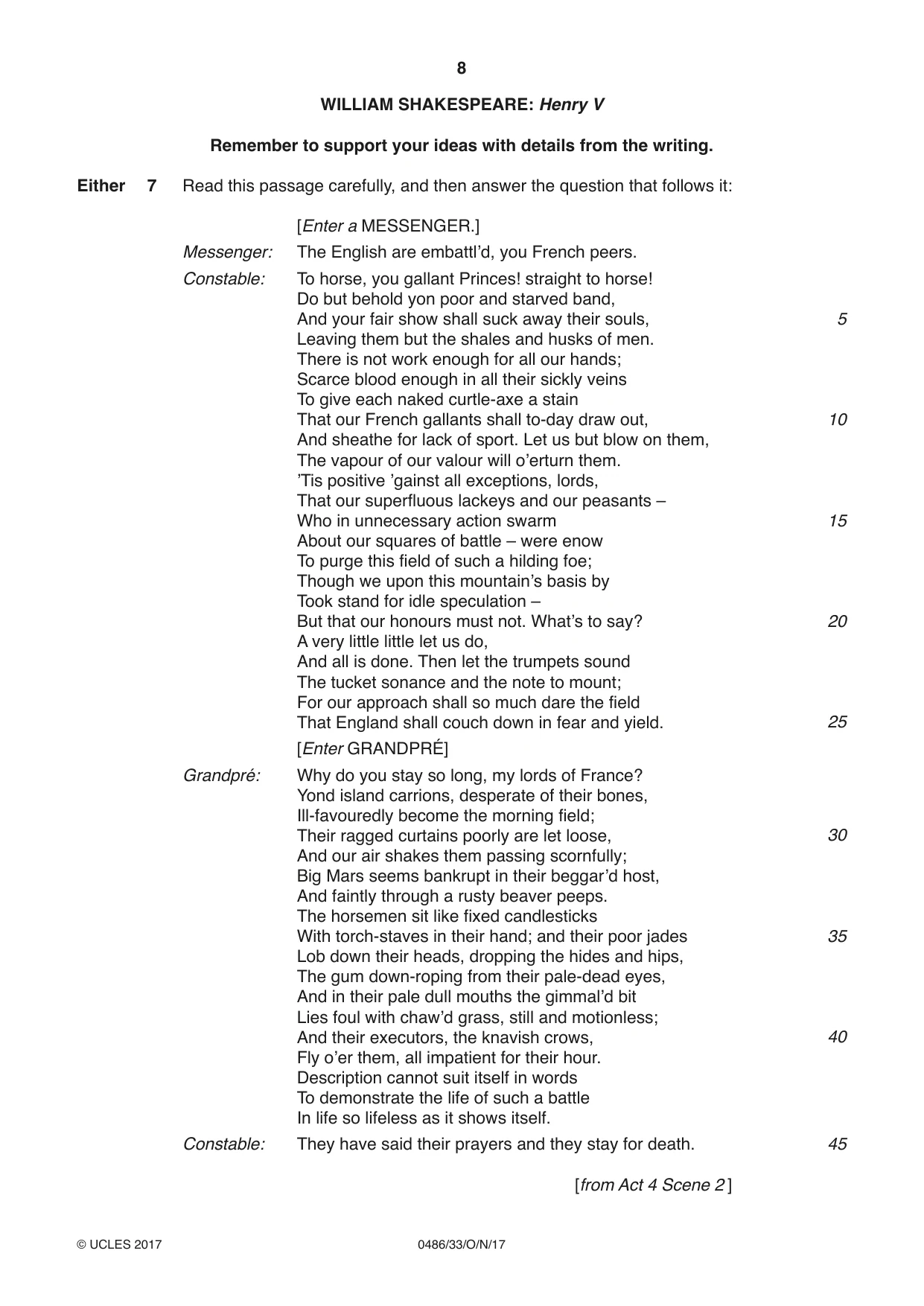
8 0486/33/O/N/17 © UCLES 2017 WILLIAM SHAKESPEARE: Henry V Remember to support your ideas with details from the writing. Either 7 Read this passage carefully, and then answer the question that follows it: [Enter a MESSENGER.] Messenger: The English are embattl’d, you French peers. Constable: To horse, you gallant Princes! straight to horse! Do but behold yon poor and starved band, And your fair show shall suck away their souls, Leaving them but the shales and husks of men. There is not work enough for all our hands; Scarce blood enough in all their sickly veins To give each naked curtle-axe a stain That our French gallants shall to-day draw out, And sheathe for lack of sport. Let us but blow on them, The vapour of our valour will o’erturn them. ’Tis positive ’gainst all exceptions, lords, That our superfluous lackeys and our peasants – Who in unnecessary action swarm About our squares of battle – were enow To purge this field of such a hilding foe; Though we upon this mountain’s basis by Took stand for idle speculation – But that our honours must not. What’s to say? A very little little let us do, And all is done. Then let the trumpets sound The tucket sonance and the note to mount; For our approach shall so much dare the field That England shall couch down in fear and yield. [Enter GRANDPRÉ] Grandpré: Why do you stay so long, my lords of France? Yond island carrions, desperate of their bones, Ill-favouredly become the morning field; Their ragged curtains poorly are let loose, And our air shakes them passing scornfully; Big Mars seems bankrupt in their beggar’d host, And faintly through a rusty beaver peeps. The horsemen sit like fixed candlesticks With torch-staves in their hand; and their poor jades Lob down their heads, dropping the hides and hips, The gum down-roping from their pale-dead eyes, And in their pale dull mouths the gimmal’d bit Lies foul with chaw’d grass, still and motionless; And their executors, the knavish crows, Fly o’er them, all impatient for their hour. Description cannot suit itself in words To demonstrate the life of such a battle In life so lifeless as it shows itself. Constable: They have said their prayers and they stay for death. [from Act 4 Scene 2 ] 5 10 15 20 25 30 35 40 45
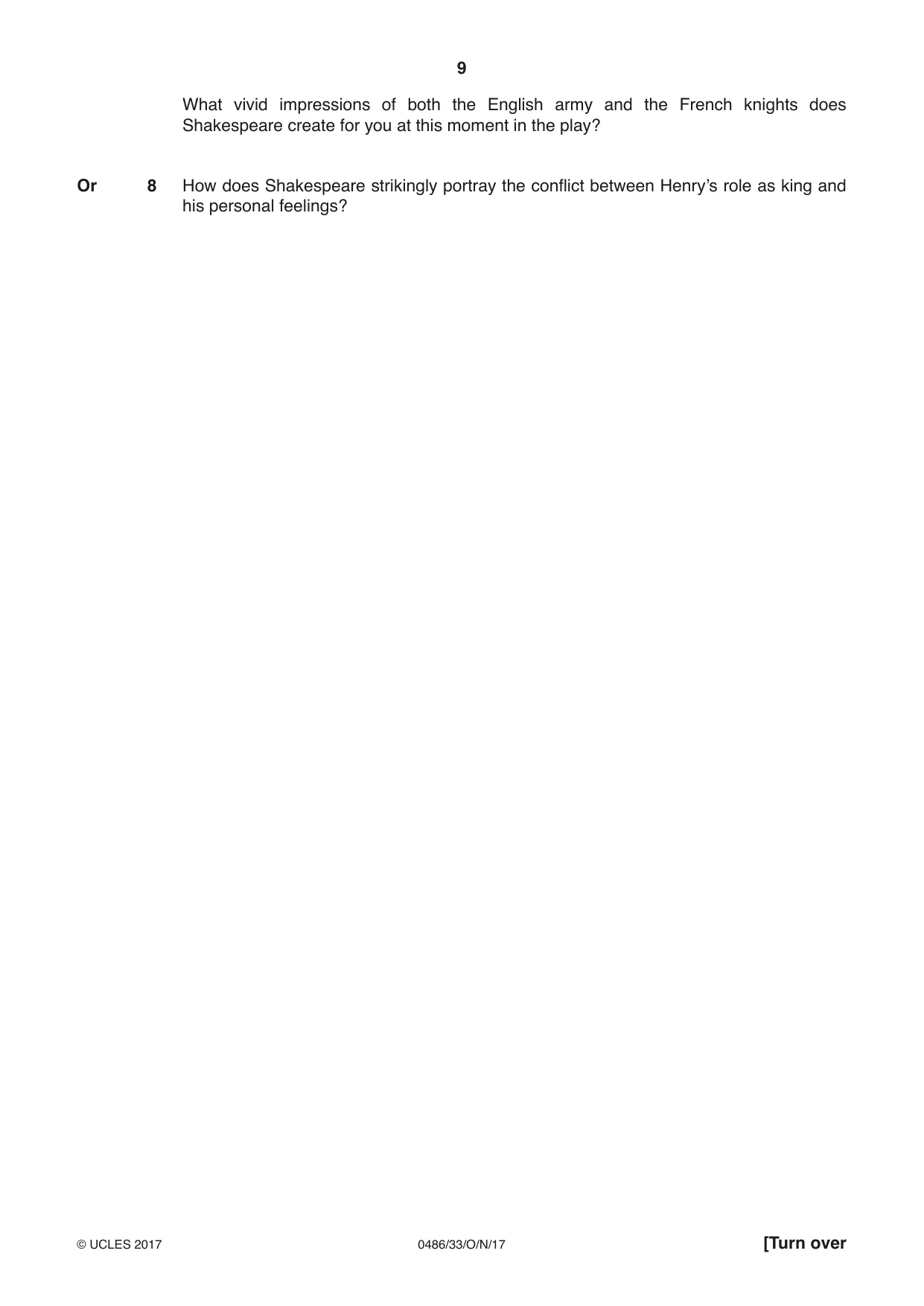
Question paper, page 9
9 0486/33/O/N/17 © UCLES 2017 [Turn over What vivid impressions of both the English army and the French knights does Shakespeare create for you at this moment in the play? Or 8 How does Shakespeare strikingly portray the conflict between Henry’s role as king and his personal feelings?
Question paper, page 10
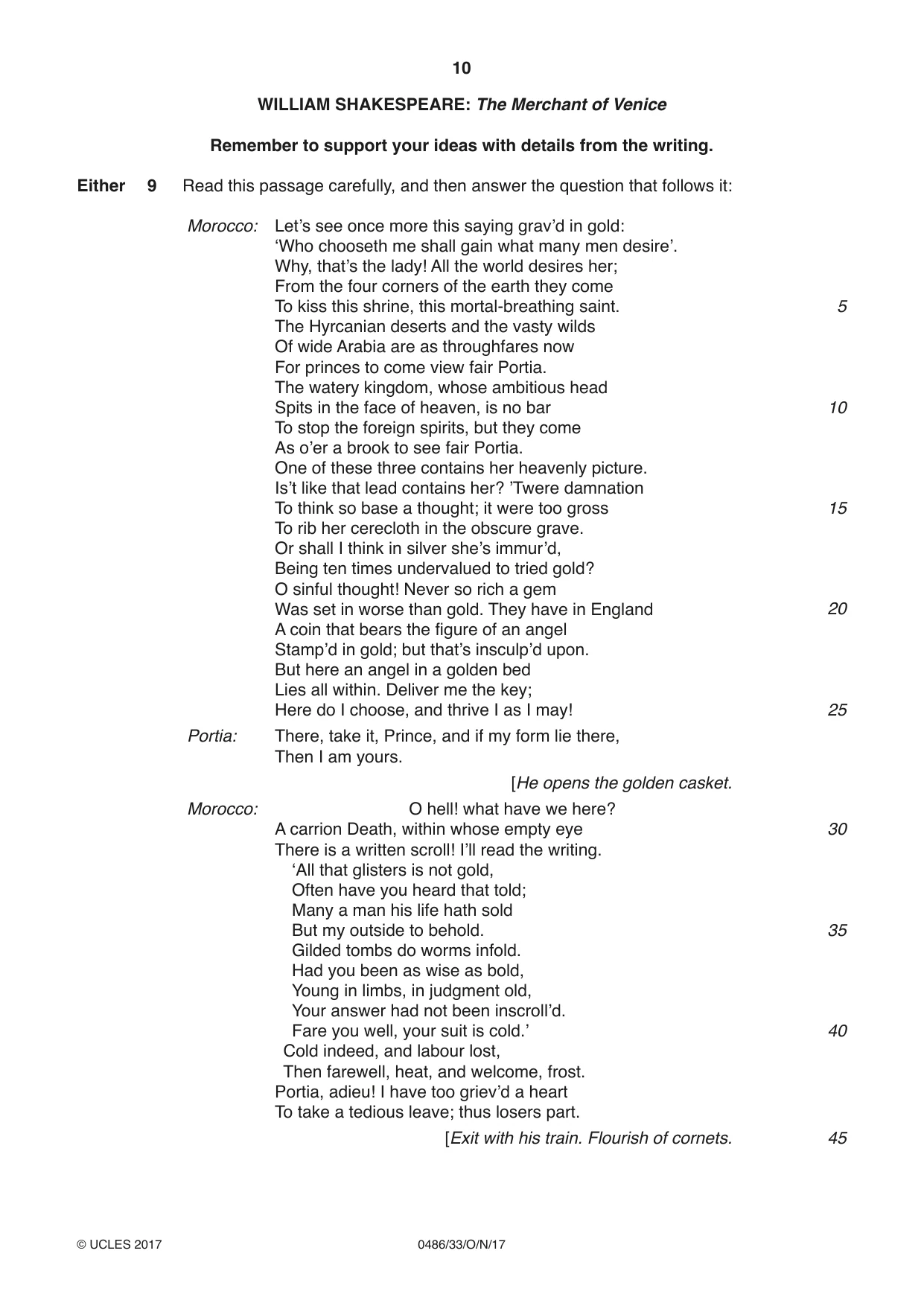
10 0486/33/O/N/17 © UCLES 2017 WILLIAM SHAKESPEARE: The Merchant of Venice Remember to support your ideas with details from the writing. Either 9 Read this passage carefully, and then answer the question that follows it: Morocco: Let’s see once more this saying grav’d in gold: ‘Who chooseth me shall gain what many men desire’. Why, that’s the lady! All the world desires her; From the four corners of the earth they come To kiss this shrine, this mortal-breathing saint. The Hyrcanian deserts and the vasty wilds Of wide Arabia are as throughfares now For princes to come view fair Portia. The watery kingdom, whose ambitious head Spits in the face of heaven, is no bar To stop the foreign spirits, but they come As o’er a brook to see fair Portia. One of these three contains her heavenly picture. Is’t like that lead contains her? ’Twere damnation To think so base a thought; it were too gross To rib her cerecloth in the obscure grave. Or shall I think in silver she’s immur’d, Being ten times undervalued to tried gold? O sinful thought! Never so rich a gem Was set in worse than gold. They have in England A coin that bears the figure of an angel Stamp’d in gold; but that’s insculp’d upon. But here an angel in a golden bed Lies all within. Deliver me the key; Here do I choose, and thrive I as I may! Portia: There, take it, Prince, and if my form lie there, Then I am yours. [He opens the golden casket. Morocco: O hell! what have we here? A carrion Death, within whose empty eye There is a written scroll! I’ll read the writing. ‘All that glisters is not gold, Often have you heard that told; Many a man his life hath sold But my outside to behold. Gilded tombs do worms infold. Had you been as wise as bold, Young in limbs, in judgment old, Your answer had not been inscroll’d. Fare you well, your suit is cold.’ Cold indeed, and labour lost, Then farewell, heat, and welcome, frost. Portia, adieu! I have too griev’d a heart To take a tedious leave; thus losers part. [Exit with his train. Flourish of cornets. 5 10 15 20 25 30 35 40 45
Question paper, page 11
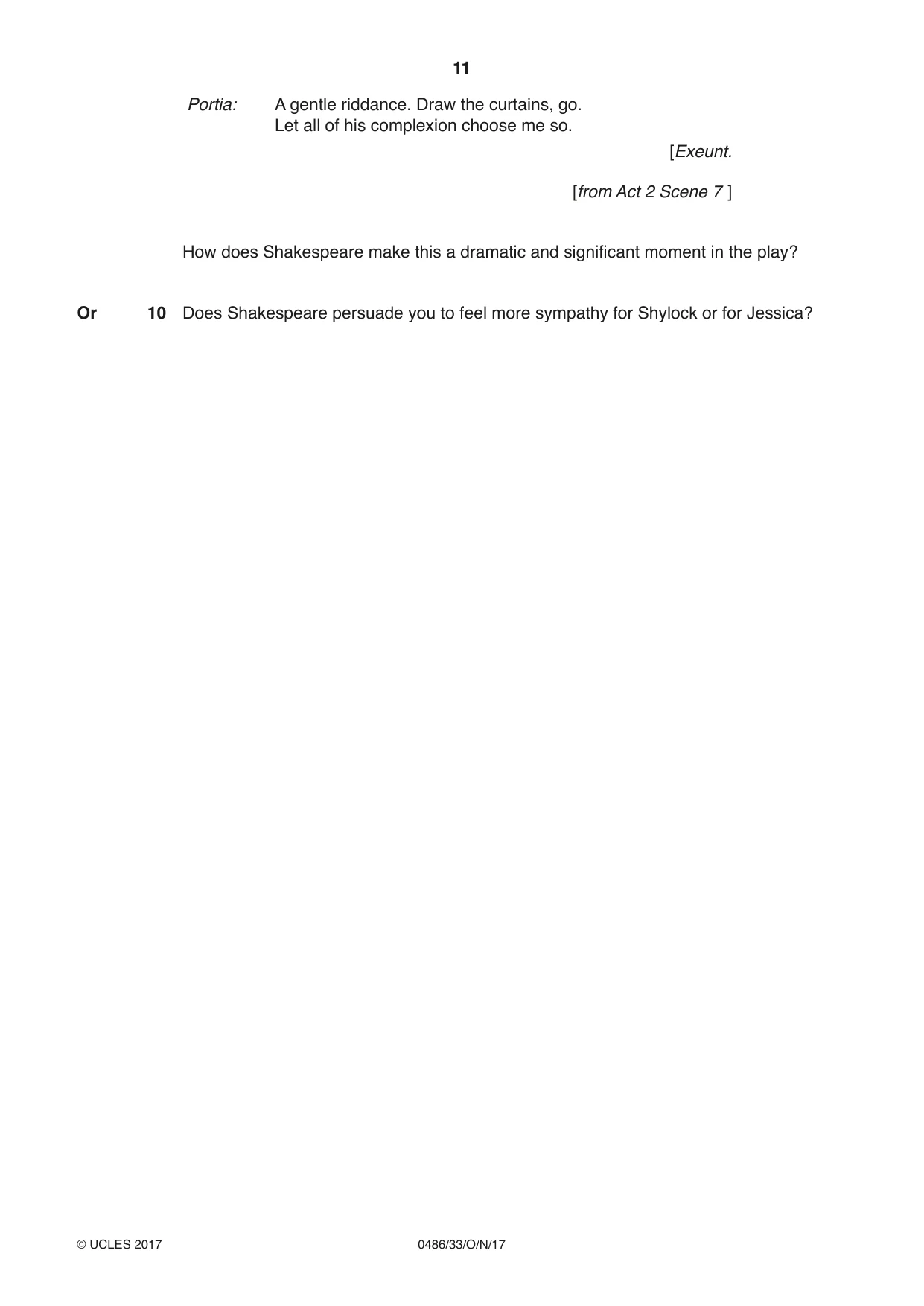
11 0486/33/O/N/17 © UCLES 2017 Portia: A gentle riddance. Draw the curtains, go. Let all of his complexion choose me so. [Exeunt. [from Act 2 Scene 7 ] How does Shakespeare make this a dramatic and significant moment in the play? Or 10 Does Shakespeare persuade you to feel more sympathy for Shylock or for Jessica?
Question paper, page 12
12 0486/33/O/N/17 © UCLES 2017 BLANK PAGE Permission to reproduce items where third-party owned material protected by copyright is included has been sought and cleared where possible. Every reasonable effort has been made by the publisher (UCLES) to trace copyright holders, but if any items requiring clearance have unwittingly been included, the publisher will be pleased to make amends at the earliest possible opportunity. To avoid the issue of disclosure of answer-related information to candidates, all copyright acknowledgements are reproduced online in the Cambridge International Examinations Copyright Acknowledgements Booklet. This is produced for each series of examinations and is freely available to download at www.cie.org.uk after the live examination series. Cambridge International Examinations is part of the Cambridge Assessment Group. Cambridge Assessment is the brand name of University of Cambridge Local Examinations Syndicate (UCLES), which is itself a department of the University of Cambridge.
Mark scheme, page 1
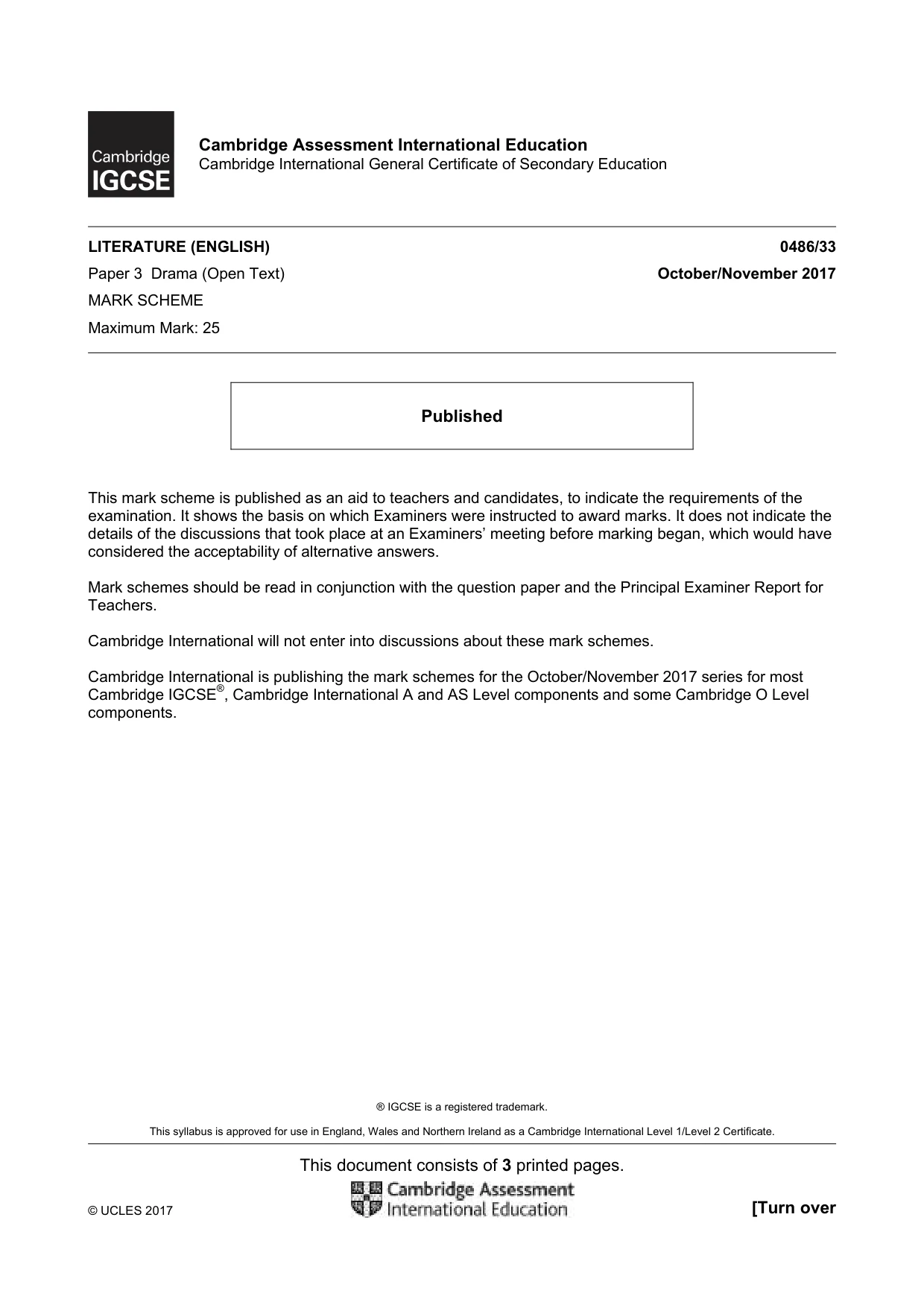
® IGCSE is a registered trademark. This syllabus is approved for use in England, Wales and Northern Ireland as a Cambridge International Level 1/Level 2 Certificate. This document consists of 3 printed pages. © UCLES 2017 [Turn over Cambridge Assessment International Education Cambridge International General Certificate of Secondary Education LITERATURE (ENGLISH) 0486/33 Paper 3 Drama (Open Text) October/November 2017 MARK SCHEME Maximum Mark: 25 Published This mark scheme is published as an aid to teachers and candidates, to indicate the requirements of the examination. It shows the basis on which Examiners were instructed to award marks. It does not indicate the details of the discussions that took place at an Examiners’ meeting before marking began, which would have considered the acceptability of alternative answers. Mark schemes should be read in conjunction with the question paper and the Principal Examiner Report for Teachers. Cambridge International will not enter into discussions about these mark schemes. Cambridge International is publishing the mark schemes for the October/November 2017 series for most Cambridge IGCSE®, Cambridge International A and AS Level components and some Cambridge O Level components.
Mark scheme, page 2
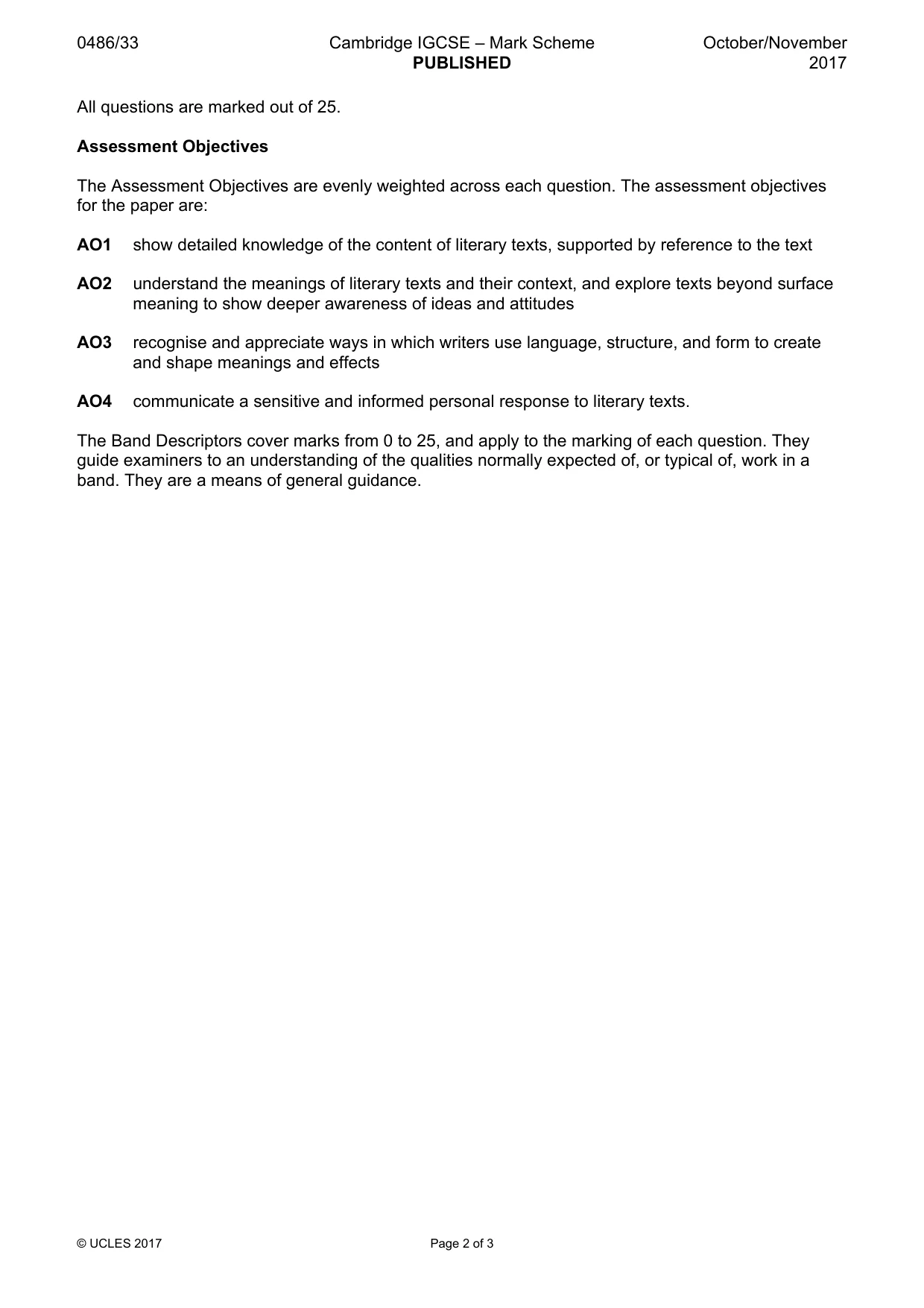
0486/33 Cambridge IGCSE – Mark Scheme PUBLISHED October/November 2017 © UCLES 2017 Page 2 of 3 All questions are marked out of 25. Assessment Objectives The Assessment Objectives are evenly weighted across each question. The assessment objectives for the paper are: AO1 show detailed knowledge of the content of literary texts, supported by reference to the text AO2 understand the meanings of literary texts and their context, and explore texts beyond surface meaning to show deeper awareness of ideas and attitudes AO3 recognise and appreciate ways in which writers use language, structure, and form to create and shape meanings and effects AO4 communicate a sensitive and informed personal response to literary texts. The Band Descriptors cover marks from 0 to 25, and apply to the marking of each question. They guide examiners to an understanding of the qualities normally expected of, or typical of, work in a band. They are a means of general guidance.
Mark scheme, page 3
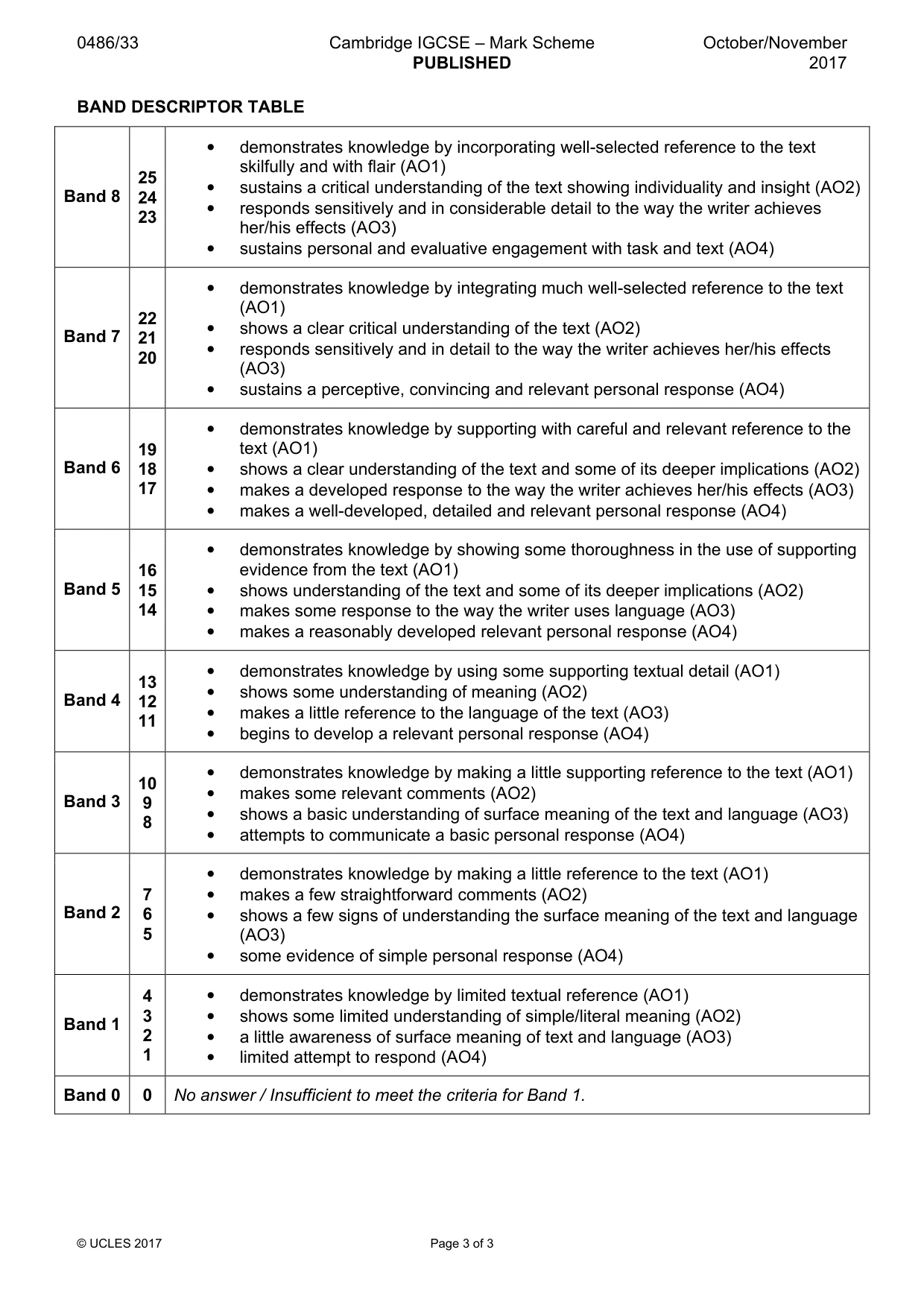
0486/33 Cambridge IGCSE – Mark Scheme PUBLISHED October/November 2017 © UCLES 2017 Page 3 of 3 BAND DESCRIPTOR TABLE Band 8 25 24 23 • demonstrates knowledge by incorporating well-selected reference to the text skilfully and with flair (AO1) • sustains a critical understanding of the text showing individuality and insight (AO2) • responds sensitively and in considerable detail to the way the writer achieves her/his effects (AO3) • sustains personal and evaluative engagement with task and text (AO4) Band 7 22 21 20 • demonstrates knowledge by integrating much well-selected reference to the text (AO1) • shows a clear critical understanding of the text (AO2) • responds sensitively and in detail to the way the writer achieves her/his effects (AO3) • sustains a perceptive, convincing and relevant personal response (AO4) Band 6 19 18 17 • demonstrates knowledge by supporting with careful and relevant reference to the text (AO1) • shows a clear understanding of the text and some of its deeper implications (AO2) • makes a developed response to the way the writer achieves her/his effects (AO3) • makes a well-developed, detailed and relevant personal response (AO4) Band 5 16 15 14 • demonstrates knowledge by showing some thoroughness in the use of supporting evidence from the text (AO1) • shows understanding of the text and some of its deeper implications (AO2) • makes some response to the way the writer uses language (AO3) • makes a reasonably developed relevant personal response (AO4) Band 4 13 12 11 • demonstrates knowledge by using some supporting textual detail (AO1) • shows some understanding of meaning (AO2) • makes a little reference to the language of the text (AO3) • begins to develop a relevant personal response (AO4) Band 3 10 9 8 • demonstrates knowledge by making a little supporting reference to the text (AO1) • makes some relevant comments (AO2) • shows a basic understanding of surface meaning of the text and language (AO3) • attempts to communicate a basic personal response (AO4) Band 2 7 6 5 • demonstrates knowledge by making a little reference to the text (AO1) • makes a few straightforward comments (AO2) • shows a few signs of understanding the surface meaning of the text and language (AO3) • some evidence of simple personal response (AO4) Band 1 4 3 2 1 • demonstrates knowledge by limited textual reference (AO1) • shows some limited understanding of simple/literal meaning (AO2) • a little awareness of surface meaning of text and language (AO3) • limited attempt to respond (AO4) Band 0 0 No answer / Insufficient to meet the criteria for Band 1.
What you needed in this session
Cambridge’s own grade thresholds for 2017 Oct/Nov, Paper 3 · Variant 3. A higher threshold means an easier paper — the bar moves with how the cohort did.