Cambridge IGCSE English - Literature 0486 — 2015 Oct/Nov Paper 4 · Variant 1
0486/41/O/N/15 · 25 marks · ≈28 min
The question paper and its mark scheme, free to read here and free to download. This is Cambridge’s own paper, exactly as it was sat.
Question paper8 pages


Mark scheme3 pages
Answers below. Sit the paper first if you are practising.
Paper as text
Question paper, page 1
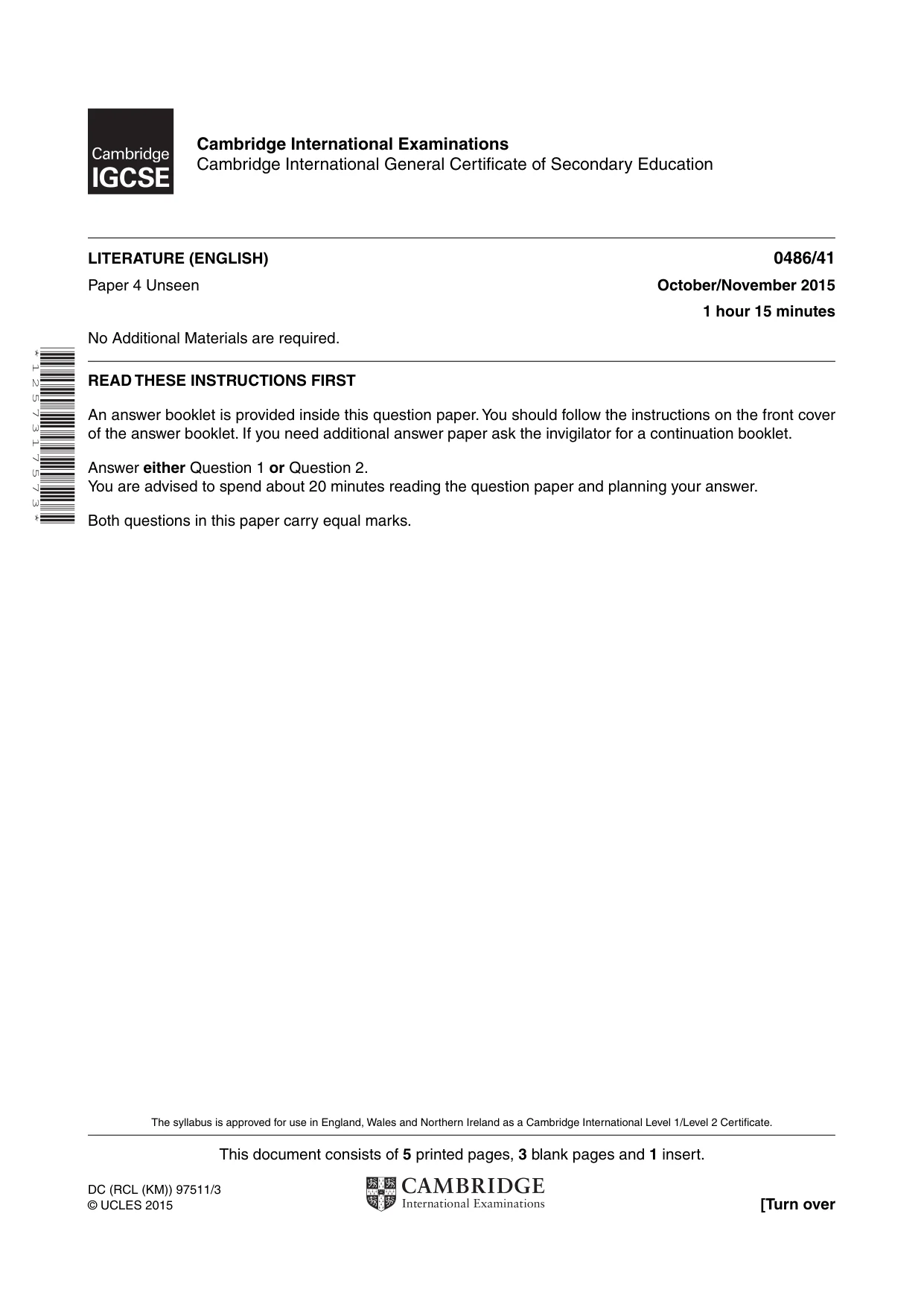
This document consists of 5 printed pages, 3 blank pages and 1 insert. DC (RCL (KM)) 97511/3 © UCLES 2015 [Turn over Cambridge International Examinations Cambridge International General Certificate of Secondary Education * 1 2 5 7 3 1 7 5 7 3 * LITERATURE (ENGLISH) 0486/41 Paper 4 Unseen October/November 2015 1 hour 15 minutes No Additional Materials are required. READ THESE INSTRUCTIONS FIRST An answer booklet is provided inside this question paper. You should follow the instructions on the front cover of the answer booklet. If you need additional answer paper ask the invigilator for a continuation booklet. Answer either Question 1 or Question 2. You are advised to spend about 20 minutes reading the question paper and planning your answer. Both questions in this paper carry equal marks. The syllabus is approved for use in England, Wales and Northern Ireland as a Cambridge International Level 1/Level 2 Certificate.
Question paper, page 2
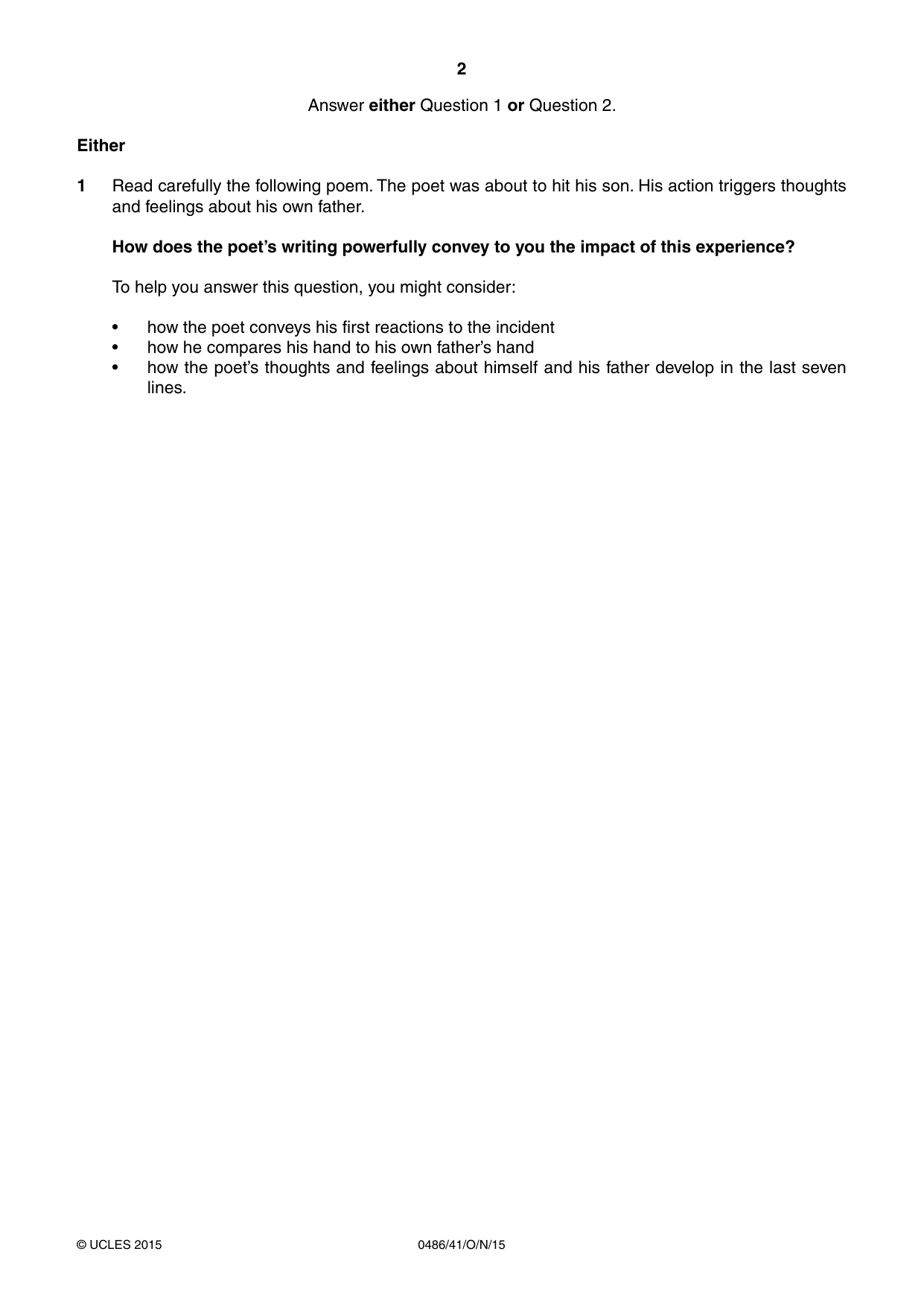
2 0486/41/O/N/15 © UCLES 2015 Answer either Question 1 or Question 2. Either 1 Read carefully the following poem. The poet was about to hit his son. His action triggers thoughts and feelings about his own father. How does the poet’s writing powerfully convey to you the impact of this experience? To help you answer this question, you might consider: • how the poet conveys his first reactions to the incident • how he compares his hand to his own father’s hand • how the poet’s thoughts and feelings about himself and his father develop in the last seven lines.
Question paper, page 3
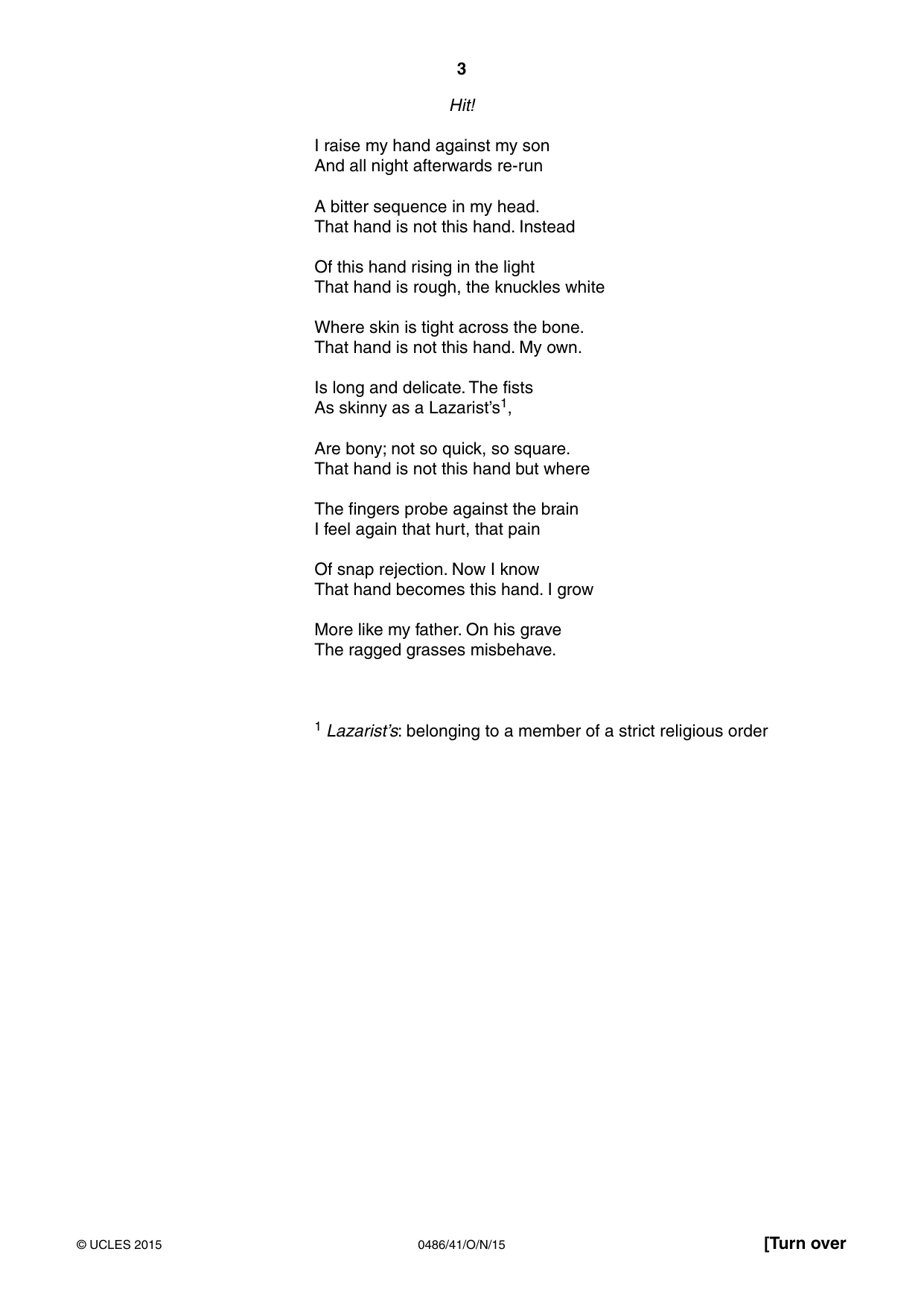
3 0486/41/O/N/15 © UCLES 2015 [Turn over Hit! I raise my hand against my son And all night afterwards re-run A bitter sequence in my head. That hand is not this hand. Instead Of this hand rising in the light That hand is rough, the knuckles white Where skin is tight across the bone. That hand is not this hand. My own. Is long and delicate. The fists As skinny as a Lazarist’s1, Are bony; not so quick, so square. That hand is not this hand but where The fingers probe against the brain I feel again that hurt, that pain Of snap rejection. Now I know That hand becomes this hand. I grow More like my father. On his grave The ragged grasses misbehave. 1 Lazarist’s: belonging to a member of a strict religious order
Question paper, page 4
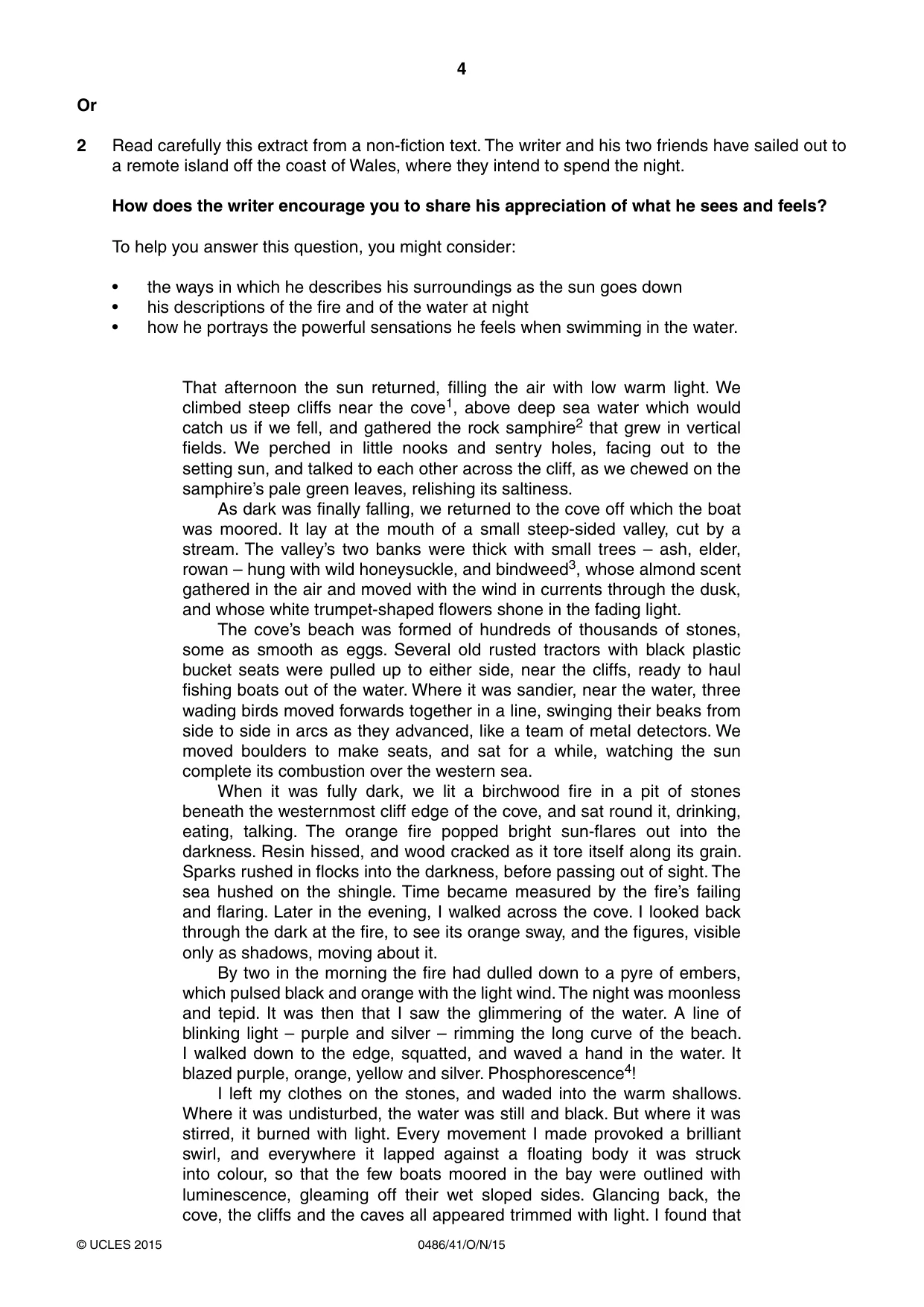
4 0486/41/O/N/15 © UCLES 2015 Or 2 Read carefully this extract from a non-fiction text. The writer and his two friends have sailed out to a remote island off the coast of Wales, where they intend to spend the night. How does the writer encourage you to share his appreciation of what he sees and feels? To help you answer this question, you might consider: • the ways in which he describes his surroundings as the sun goes down • his descriptions of the fire and of the water at night • how he portrays the powerful sensations he feels when swimming in the water. That afternoon the sun returned, filling the air with low warm light. We climbed steep cliffs near the cove1, above deep sea water which would catch us if we fell, and gathered the rock samphire2 that grew in vertical fields. We perched in little nooks and sentry holes, facing out to the setting sun, and talked to each other across the cliff, as we chewed on the samphire’s pale green leaves, relishing its saltiness. As dark was finally falling, we returned to the cove off which the boat was moored. It lay at the mouth of a small steep-sided valley, cut by a stream. The valley’s two banks were thick with small trees – ash, elder, rowan – hung with wild honeysuckle, and bindweed3, whose almond scent gathered in the air and moved with the wind in currents through the dusk, and whose white trumpet-shaped flowers shone in the fading light. The cove’s beach was formed of hundreds of thousands of stones, some as smooth as eggs. Several old rusted tractors with black plastic bucket seats were pulled up to either side, near the cliffs, ready to haul fishing boats out of the water. Where it was sandier, near the water, three wading birds moved forwards together in a line, swinging their beaks from side to side in arcs as they advanced, like a team of metal detectors. We moved boulders to make seats, and sat for a while, watching the sun complete its combustion over the western sea. When it was fully dark, we lit a birchwood fire in a pit of stones beneath the westernmost cliff edge of the cove, and sat round it, drinking, eating, talking. The orange fire popped bright sun-flares out into the darkness. Resin hissed, and wood cracked as it tore itself along its grain. Sparks rushed in flocks into the darkness, before passing out of sight. The sea hushed on the shingle. Time became measured by the fire’s failing and flaring. Later in the evening, I walked across the cove. I looked back through the dark at the fire, to see its orange sway, and the figures, visible only as shadows, moving about it. By two in the morning the fire had dulled down to a pyre of embers, which pulsed black and orange with the light wind. The night was moonless and tepid. It was then that I saw the glimmering of the water. A line of blinking light – purple and silver – rimming the long curve of the beach. I walked down to the edge, squatted, and waved a hand in the water. It blazed purple, orange, yellow and silver. Phosphorescence4! I left my clothes on the stones, and waded into the warm shallows. Where it was undisturbed, the water was still and black. But where it was stirred, it burned with light. Every movement I made provoked a brilliant swirl, and everywhere it lapped against a floating body it was struck into colour, so that the few boats moored in the bay were outlined with luminescence, gleaming off their wet sloped sides. Glancing back, the cove, the cliffs and the caves all appeared trimmed with light. I found that
Question paper, page 5
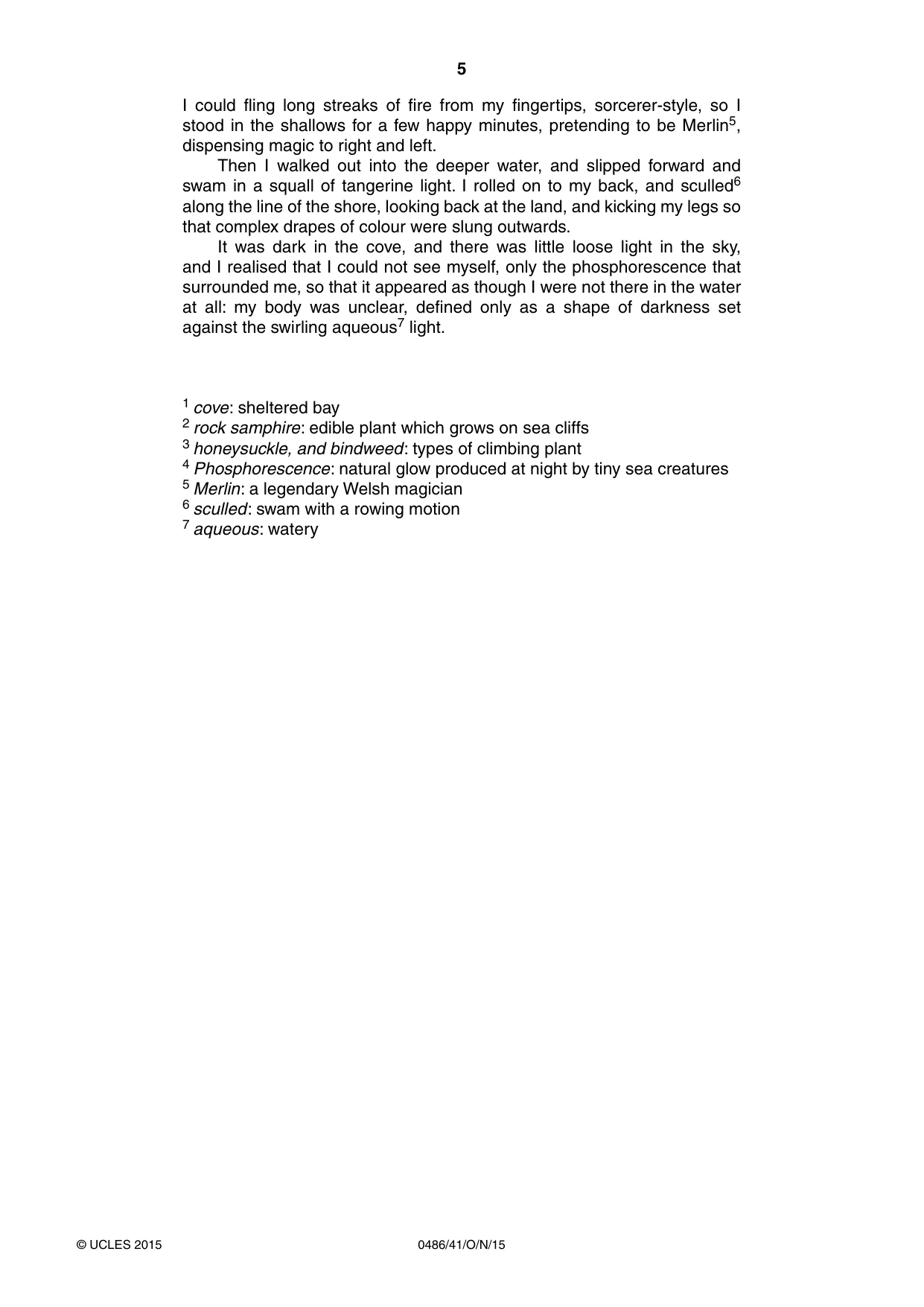
5 0486/41/O/N/15 © UCLES 2015 I could fling long streaks of fire from my fingertips, sorcerer-style, so I stood in the shallows for a few happy minutes, pretending to be Merlin5, dispensing magic to right and left. Then I walked out into the deeper water, and slipped forward and swam in a squall of tangerine light. I rolled on to my back, and sculled6 along the line of the shore, looking back at the land, and kicking my legs so that complex drapes of colour were slung outwards. It was dark in the cove, and there was little loose light in the sky, and I realised that I could not see myself, only the phosphorescence that surrounded me, so that it appeared as though I were not there in the water at all: my body was unclear, defined only as a shape of darkness set against the swirling aqueous7 light. 1 cove : sheltered bay 2 rock samphire : edible plant which grows on sea cliffs 3 honeysuckle, and bindweed : types of climbing plant 4 Phosphorescence : natural glow produced at night by tiny sea creatures 5 Merlin : a legendary Welsh magician 6 sculled : swam with a rowing motion 7 aqueous : watery
Question paper, page 6
6 0486/41/O/N/15 © UCLES 2015 BLANK PAGE
Question paper, page 7
7 0486/41/O/N/15 © UCLES 2015 BLANK PAGE
Question paper, page 8
8 0486/41/O/N/15 © UCLES 2015 Permission to reproduce items where third-party owned material protected by copyright is included has been sought and cleared where possible. Every reasonable effort has been made by the publisher (UCLES) to trace copyright holders, but if any items requiring clearance have unwittingly been included, the publisher will be pleased to make amends at the earliest possible opportunity. To avoid the issue of disclosure of answer-related information to candidates, all copyright acknowledgements are reproduced online in the Cambridge International Examinations Copyright Acknowledgements Booklet. This is produced for each series of examinations and is freely available to download at www.cie.org.uk after the live examination series. Cambridge International Examinations is part of the Cambridge Assessment Group. Cambridge Assessment is the brand name of University of Cambridge Local Examinations Syndicate (UCLES), which is itself a department of the University of Cambridge. BLANK PAGE
Mark scheme, page 1
® IGCSE is the registered trademark of Cambridge International Examinations. CAMBRIDGE INTERNATIONAL EXAMINATIONS Cambridge International General Certificate of Secondary Education MARK SCHEME for the October/November 2015 series 0486 LITERATURE (ENGLISH) 0486/41 Paper 4 (Unseen), maximum raw mark 25 This mark scheme is published as an aid to teachers and candidates, to indicate the requirements of the examination. It shows the basis on which Examiners were instructed to award marks. It does not indicate the details of the discussions that took place at an Examiners’ meeting before marking began, which would have considered the acceptability of alternative answers. Mark schemes should be read in conjunction with the question paper and the Principal Examiner Report for Teachers. Cambridge will not enter into discussions about these mark schemes. Cambridge is publishing the mark schemes for the October/November 2015 series for most Cambridge IGCSE®, Cambridge International A and AS Level components and some Cambridge O Level components.
Mark scheme, page 2
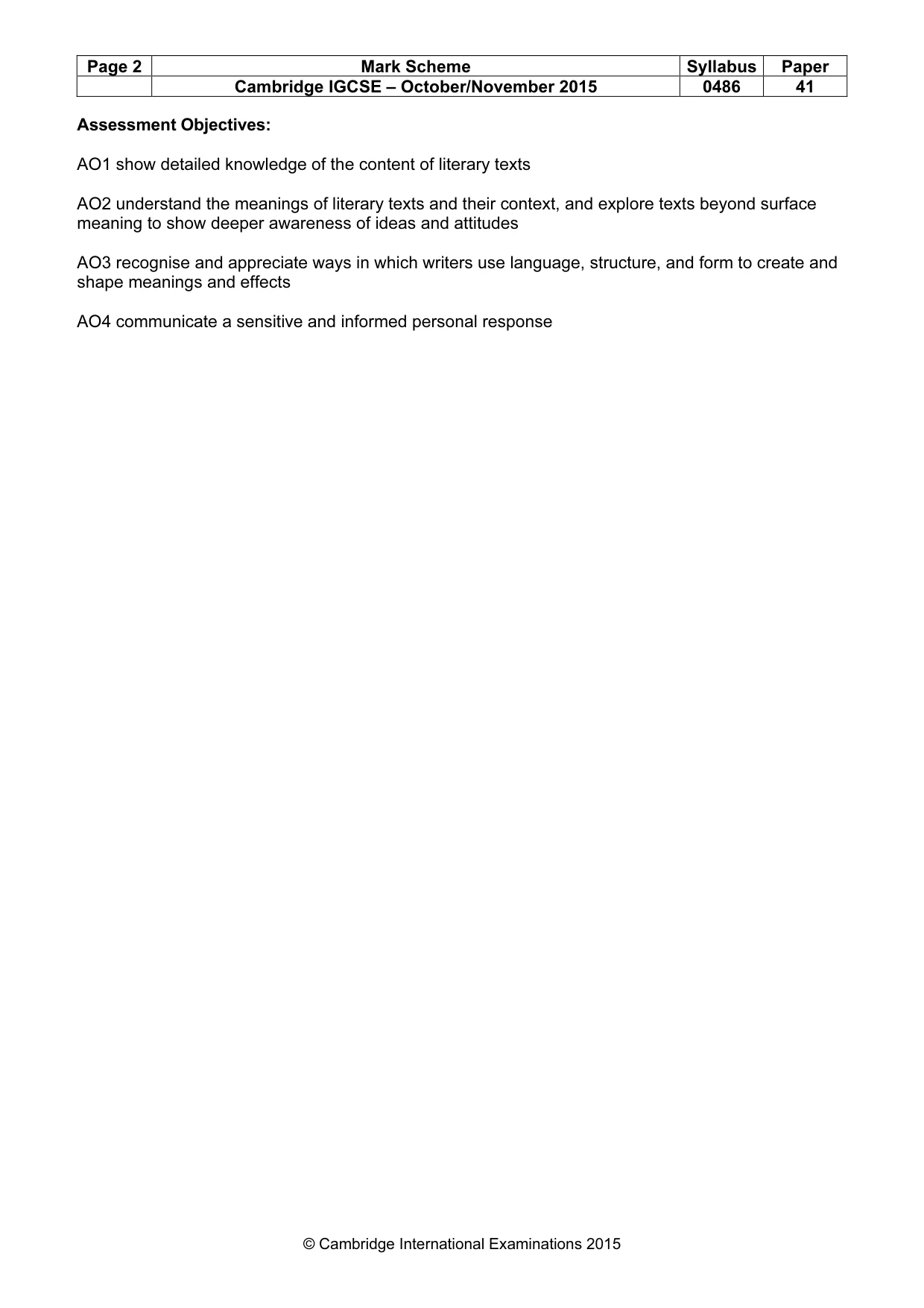
Page 2 Mark Scheme Syllabus Paper Cambridge IGCSE – October/November 2015 0486 41 © Cambridge International Examinations 2015 Assessment Objectives: AO1 show detailed knowledge of the content of literary texts AO2 understand the meanings of literary texts and their context, and explore texts beyond surface meaning to show deeper awareness of ideas and attitudes AO3 recognise and appreciate ways in which writers use language, structure, and form to create and shape meanings and effects AO4 communicate a sensitive and informed personal response
Mark scheme, page 3
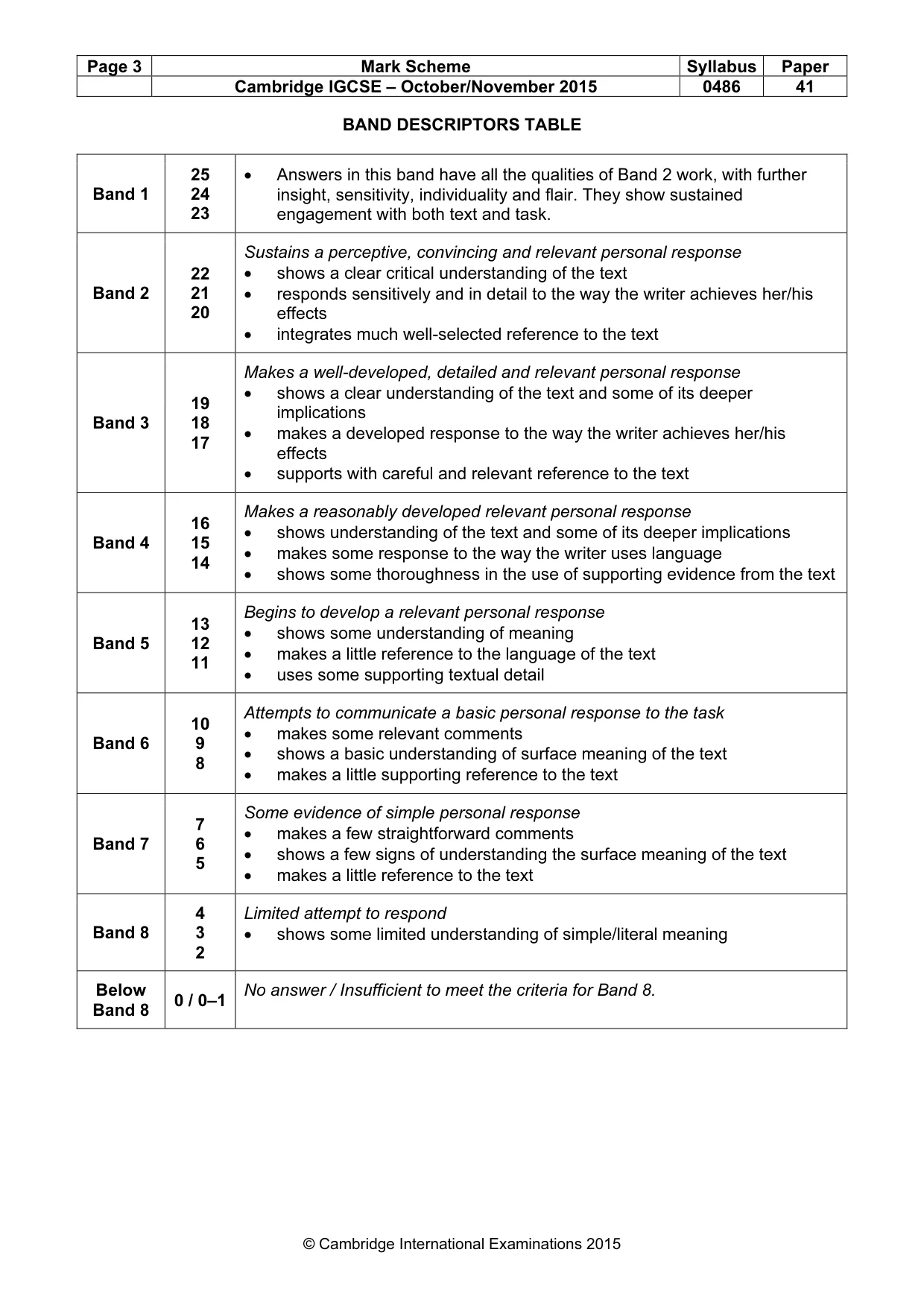
Page 3 Mark Scheme Syllabus Paper Cambridge IGCSE – October/November 2015 0486 41 © Cambridge International Examinations 2015 BAND DESCRIPTORS TABLE Band 1 25 24 23 • Answers in this band have all the qualities of Band 2 work, with further insight, sensitivity, individuality and flair. They show sustained engagement with both text and task. Band 2 22 21 20 Sustains a perceptive, convincing and relevant personal response • shows a clear critical understanding of the text • responds sensitively and in detail to the way the writer achieves her/his effects • integrates much well-selected reference to the text Band 3 19 18 17 Makes a well-developed, detailed and relevant personal response • shows a clear understanding of the text and some of its deeper implications • makes a developed response to the way the writer achieves her/his effects • supports with careful and relevant reference to the text Band 4 16 15 14 Makes a reasonably developed relevant personal response • shows understanding of the text and some of its deeper implications • makes some response to the way the writer uses language • shows some thoroughness in the use of supporting evidence from the text Band 5 13 12 11 Begins to develop a relevant personal response • shows some understanding of meaning • makes a little reference to the language of the text • uses some supporting textual detail Band 6 10 9 8 Attempts to communicate a basic personal response to the task • makes some relevant comments • shows a basic understanding of surface meaning of the text • makes a little supporting reference to the text Band 7 7 6 5 Some evidence of simple personal response • makes a few straightforward comments • shows a few signs of understanding the surface meaning of the text • makes a little reference to the text Band 8 4 3 2 Limited attempt to respond • shows some limited understanding of simple/literal meaning Below Band 8 0 / 0–1 No answer / Insufficient to meet the criteria for Band 8.
What you needed in this session
Cambridge’s own grade thresholds for 2015 Oct/Nov, Paper 4 · Variant 1. A higher threshold means an easier paper — the bar moves with how the cohort did.