Cambridge IGCSE English - Literature 0486 — 2015 Oct/Nov Paper 4 · Variant 2
0486/42/O/N/15 · 25 marks · ≈28 min
The question paper and its mark scheme, free to read here and free to download. This is Cambridge’s own paper, exactly as it was sat.
Question paper8 pages


Mark scheme3 pages
Answers below. Sit the paper first if you are practising.
Paper as text
Question paper, page 1
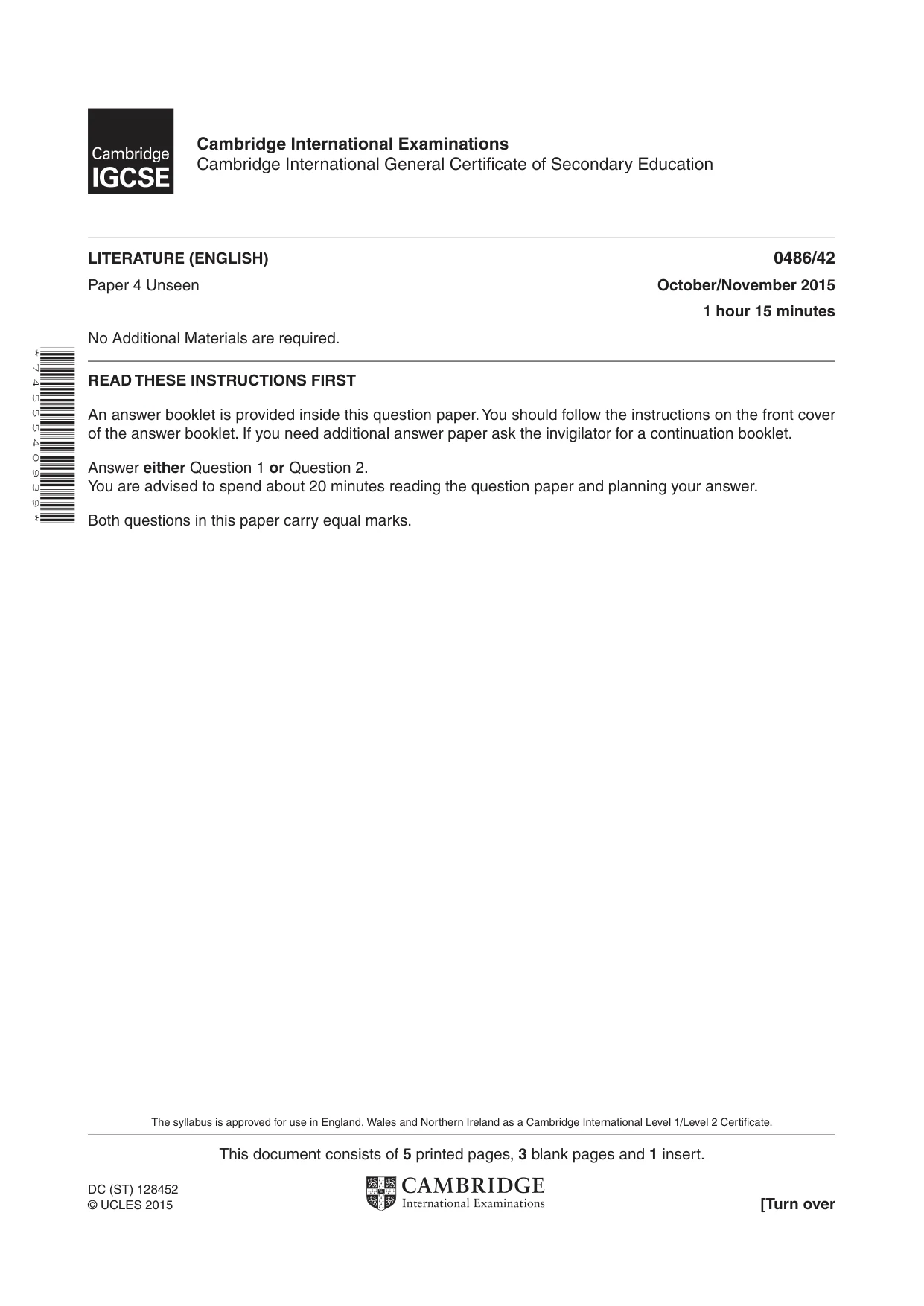
This document consists of 5 printed pages, 3 blank pages and 1 insert. DC (ST) 128452 © UCLES 2015 [Turn over Cambridge International Examinations Cambridge International General Certificate of Secondary Education * 7 4 5 5 5 4 0 9 3 9 * LITERATURE (ENGLISH) 0486/42 Paper 4 Unseen October/November 2015 1 hour 15 minutes No Additional Materials are required. READ THESE INSTRUCTIONS FIRST An answer booklet is provided inside this question paper. You should follow the instructions on the front cover of the answer booklet. If you need additional answer paper ask the invigilator for a continuation booklet. Answer either Question 1 or Question 2. You are advised to spend about 20 minutes reading the question paper and planning your answer. Both questions in this paper carry equal marks. The syllabus is approved for use in England, Wales and Northern Ireland as a Cambridge International Level 1/Level 2 Certificate.
Question paper, page 2
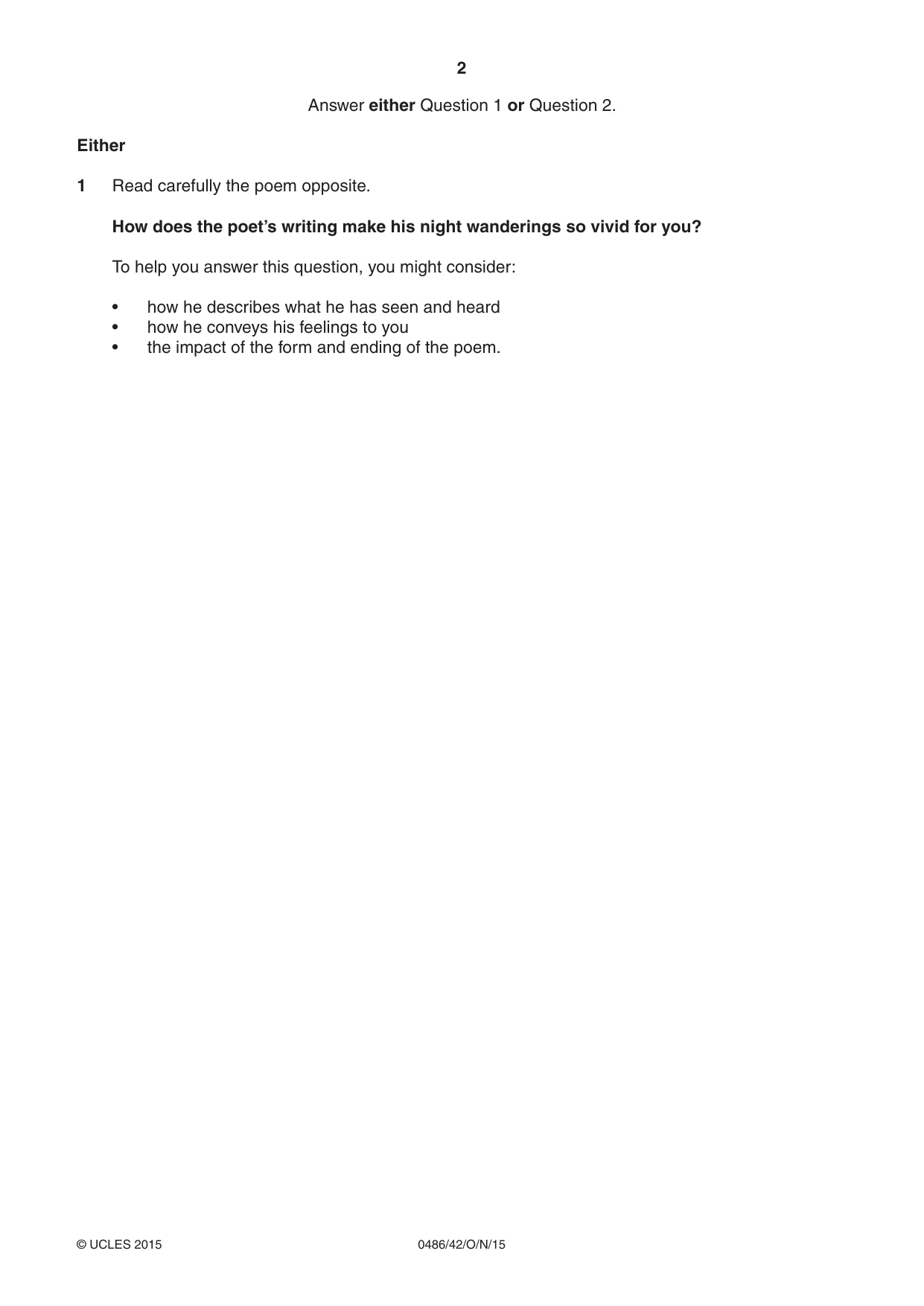
2 0486/42/O/N/15 © UCLES 2015 Answer either Question 1 or Question 2. Either 1 Read carefully the poem opposite. How does the poet’s writing make his night wanderings so vivid for you? To help you answer this question, you might consider: • how he describes what he has seen and heard • how he conveys his feelings to you • the impact of the form and ending of the poem.
Question paper, page 3
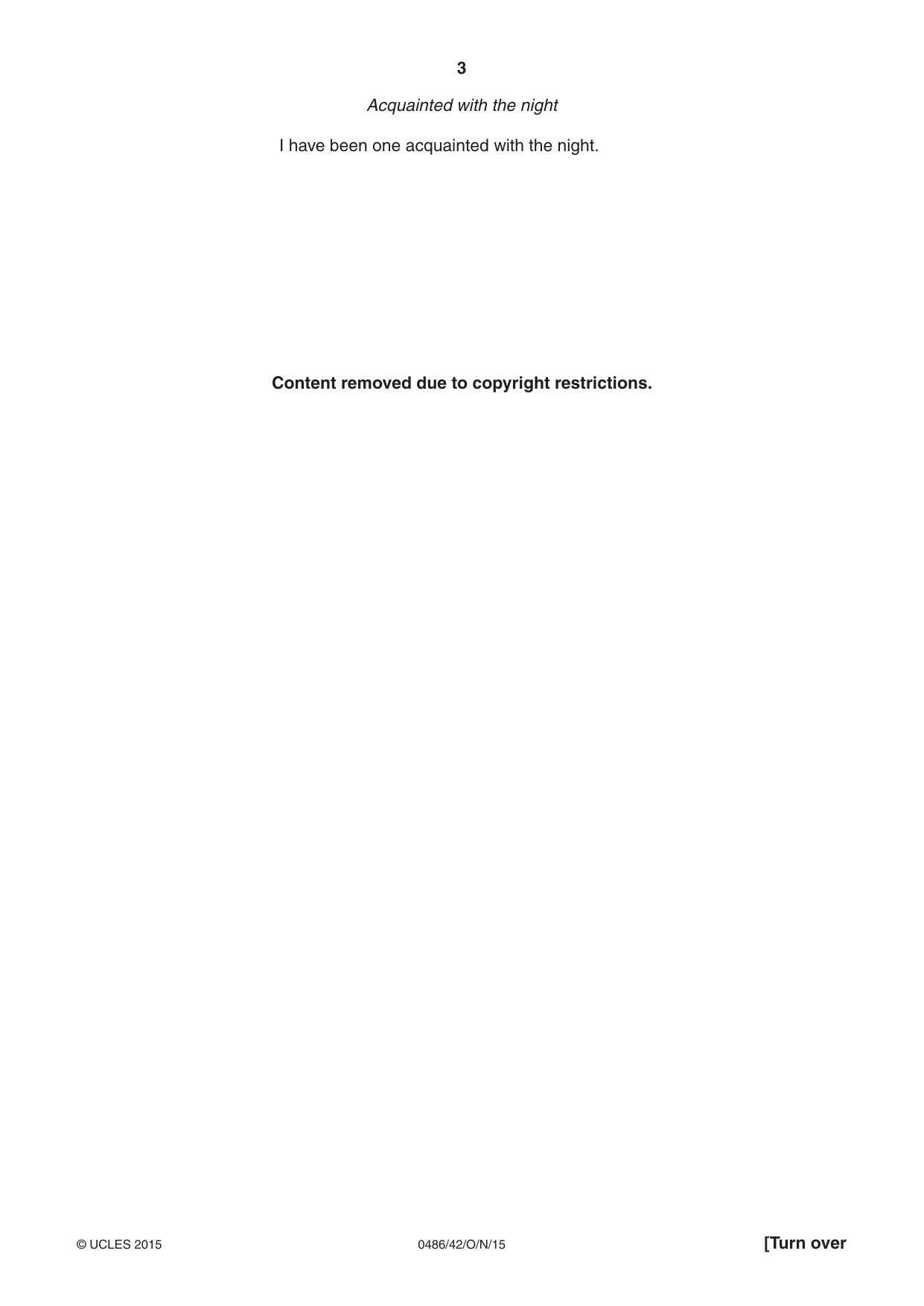
3 0486/42/O/N/15 © UCLES 2015 [Turn over Acquainted with the night I have been one acquainted with the night. Content removed due to copyright restrictions.
Question paper, page 4
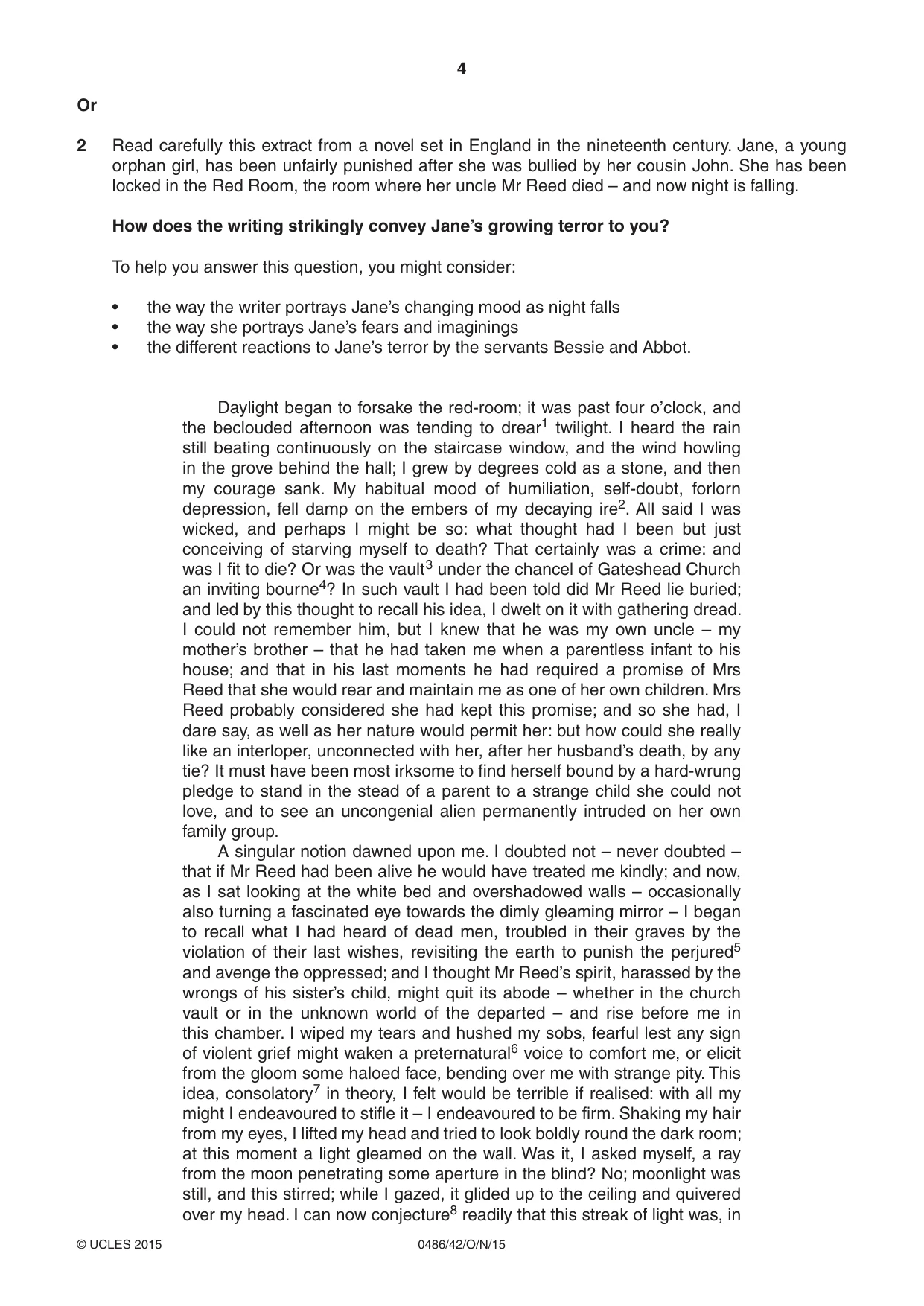
4 0486/42/O/N/15 © UCLES 2015 Or 2 Read carefully this extract from a novel set in England in the nineteenth century. Jane, a young orphan girl, has been unfairly punished after she was bullied by her cousin John. She has been locked in the Red Room, the room where her uncle Mr Reed died – and now night is falling. How does the writing strikingly convey Jane’s growing terror to you? To help you answer this question, you might consider: • the way the writer portrays Jane’s changing mood as night falls • the way she portrays Jane’s fears and imaginings • the different reactions to Jane’s terror by the servants Bessie and Abbot. Daylight began to forsake the red-room; it was past four o’clock, and the beclouded afternoon was tending to drear1 twilight. I heard the rain still beating continuously on the staircase window, and the wind howling in the grove behind the hall; I grew by degrees cold as a stone, and then my courage sank. My habitual mood of humiliation, self-doubt, forlorn depression, fell damp on the embers of my decaying ire2. All said I was wicked, and perhaps I might be so: what thought had I been but just conceiving of starving myself to death? That certainly was a crime: and was I fit to die? Or was the vault 3 under the chancel of Gateshead Church an inviting bourne4? In such vault I had been told did Mr Reed lie buried; and led by this thought to recall his idea, I dwelt on it with gathering dread. I could not remember him, but I knew that he was my own uncle – my mother’s brother – that he had taken me when a parentless infant to his house; and that in his last moments he had required a promise of Mrs Reed that she would rear and maintain me as one of her own children. Mrs Reed probably considered she had kept this promise; and so she had, I dare say, as well as her nature would permit her: but how could she really like an interloper, unconnected with her, after her husband’s death, by any tie? It must have been most irksome to find herself bound by a hard-wrung pledge to stand in the stead of a parent to a strange child she could not love, and to see an uncongenial alien permanently intruded on her own family group. A singular notion dawned upon me. I doubted not – never doubted – that if Mr Reed had been alive he would have treated me kindly; and now, as I sat looking at the white bed and overshadowed walls – occasionally also turning a fascinated eye towards the dimly gleaming mirror – I began to recall what I had heard of dead men, troubled in their graves by the violation of their last wishes, revisiting the earth to punish the perjured5 and avenge the oppressed; and I thought Mr Reed’s spirit, harassed by the wrongs of his sister’s child, might quit its abode – whether in the church vault or in the unknown world of the departed – and rise before me in this chamber. I wiped my tears and hushed my sobs, fearful lest any sign of violent grief might waken a preternatural6 voice to comfort me, or elicit from the gloom some haloed face, bending over me with strange pity. This idea, consolatory7 in theory, I felt would be terrible if realised: with all my might I endeavoured to stifle it – I endeavoured to be firm. Shaking my hair from my eyes, I lifted my head and tried to look boldly round the dark room; at this moment a light gleamed on the wall. Was it, I asked myself, a ray from the moon penetrating some aperture in the blind? No; moonlight was still, and this stirred; while I gazed, it glided up to the ceiling and quivered over my head. I can now conjecture8 readily that this streak of light was, in
Question paper, page 5
5 0486/42/O/N/15 © UCLES 2015 all likelihood, a gleam from a lantern carried by some one across the lawn; but then, prepared as my mind was for horror, shaken as my nerves were by agitation, I thought the swift-darting beam was a herald of some coming vision from another world. My heart beat thick, my head grew hot; a sound filled my ears, which I deemed the rushing of wings; something seemed near me; I was oppressed, suffocated: endurance broke down; I rushed to the door and shook the lock in desperate effort. Steps came running along the outer passage; the key turned, Bessie and Abbot entered. ‘Miss Eyre, are you ill?’ said Bessie. ‘What a dreadful noise! It went quite through me!’ exclaimed Abbot. ‘Take me out! Let me go into the nursery!’ was my cry. ‘What for? Are you hurt? Have you seen something?’ again demanded Bessie. ‘Oh! I saw a light, and I thought a ghost would come.’ I had now got hold of Bessie’s hand, and she did not snatch it from me. ‘She has screamed out on purpose,’ declared Abbot, in some disgust. ‘And what a scream! If she had been in great pain one would have excused it, but she only wanted to bring us all here; I know her naughty tricks.’ 1 drear : gloomy 2 ire : anger 3 vault : underground tomb 4 bourne: destination 5 the perjured : people who break promises 6 preternatural : supernatural, extraordinary 7 consolatory : bringing comfort and help 8 conjecture : guess
Question paper, page 6
6 0486/42/O/N/15 © UCLES 2015 BLANK PAGE
Question paper, page 7
7 0486/42/O/N/15 © UCLES 2015 BLANK PAGE
Question paper, page 8
8 0486/42/O/N/15 © UCLES 2015 Permission to reproduce items where third-party owned material protected by copyright is included has been sought and cleared where possible. Every reasonable effort has been made by the publisher (UCLES) to trace copyright holders, but if any items requiring clearance have unwittingly been included, the publisher will be pleased to make amends at the earliest possible opportunity. To avoid the issue of disclosure of answer-related information to candidates, all copyright acknowledgements are reproduced online in the Cambridge International Examinations Copyright Acknowledgements Booklet. This is produced for each series of examinations and is freely available to download at www.cie.org.uk after the live examination series. Cambridge International Examinations is part of the Cambridge Assessment Group. Cambridge Assessment is the brand name of University of Cambridge Local Examinations Syndicate (UCLES), which is itself a department of the University of Cambridge. BLANK PAGE
Mark scheme, page 1
® IGCSE is the registered trademark of Cambridge International Examinations. CAMBRIDGE INTERNATIONAL EXAMINATIONS Cambridge International General Certificate of Secondary Education MARK SCHEME for the October/November 2015 series 0486 LITERATURE (ENGLISH) 0486/42 Paper 4 (unseen), maximum raw mark 25 This mark scheme is published as an aid to teachers and candidates, to indicate the requirements of the examination. It shows the basis on which Examiners were instructed to award marks. It does not indicate the details of the discussions that took place at an Examiners’ meeting before marking began, which would have considered the acceptability of alternative answers. Mark schemes should be read in conjunction with the question paper and the Principal Examiner Report for Teachers. Cambridge will not enter into discussions about these mark schemes. Cambridge is publishing the mark schemes for the October/November 2015 series for most Cambridge IGCSE®, Cambridge International A and AS Level components and some Cambridge O Level components.
Mark scheme, page 2
Page 2 Mark Scheme Syllabus Paper Cambridge IGCSE – October/November 2015 0486 42 © Cambridge International Examinations 2015 Assessment Objectives: AO1 show detailed knowledge of the content of literary texts AO2 understand the meanings of literary texts and their context, and explore texts beyond surface meaning to show deeper awareness of ideas and attitudes AO3 recognise and appreciate ways in which writers use language, structure, and form to create and shape meanings and effects AO4 communicate a sensitive and informed personal response
Mark scheme, page 3
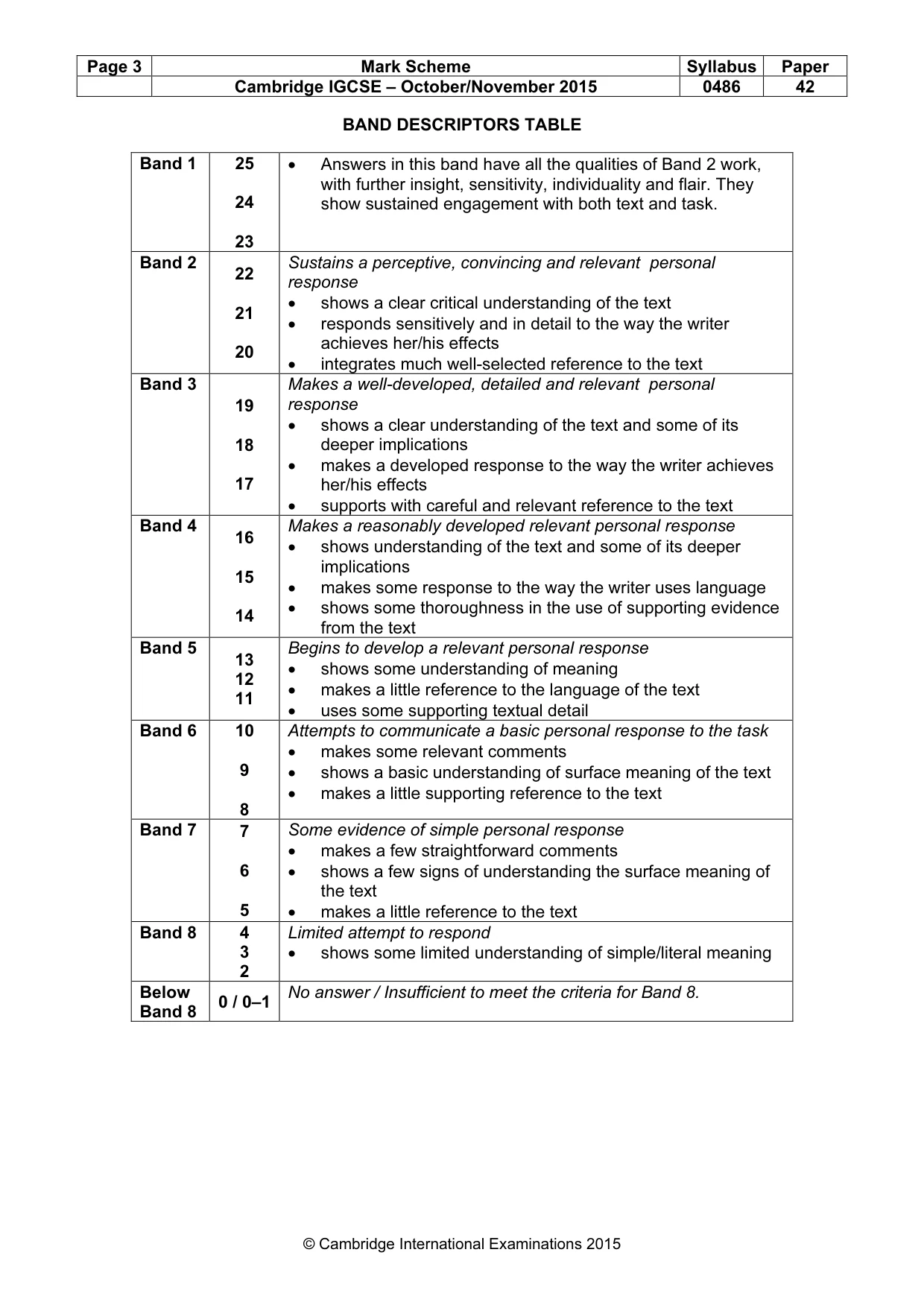
Page 3 Mark Scheme Syllabus Paper Cambridge IGCSE – October/November 2015 0486 42 © Cambridge International Examinations 2015 BAND DESCRIPTORS TABLE Band 1 25 24 23 • Answers in this band have all the qualities of Band 2 work, with further insight, sensitivity, individuality and flair. They show sustained engagement with both text and task. Band 2 22 21 20 Sustains a perceptive, convincing and relevant personal response • shows a clear critical understanding of the text • responds sensitively and in detail to the way the writer achieves her/his effects • integrates much well-selected reference to the text Band 3 19 18 17 Makes a well-developed, detailed and relevant personal response • shows a clear understanding of the text and some of its deeper implications • makes a developed response to the way the writer achieves her/his effects • supports with careful and relevant reference to the text Band 4 16 15 14 Makes a reasonably developed relevant personal response • shows understanding of the text and some of its deeper implications • makes some response to the way the writer uses language • shows some thoroughness in the use of supporting evidence from the text Band 5 13 12 11 Begins to develop a relevant personal response • shows some understanding of meaning • makes a little reference to the language of the text • uses some supporting textual detail Band 6 10 9 8 Attempts to communicate a basic personal response to the task • makes some relevant comments • shows a basic understanding of surface meaning of the text • makes a little supporting reference to the text Band 7 7 6 5 Some evidence of simple personal response • makes a few straightforward comments • shows a few signs of understanding the surface meaning of the text • makes a little reference to the text Band 8 4 3 2 Limited attempt to respond • shows some limited understanding of simple/literal meaning Below Band 8 0 / 0–1 No answer / Insufficient to meet the criteria for Band 8.
What you needed in this session
Cambridge’s own grade thresholds for 2015 Oct/Nov, Paper 4 · Variant 2. A higher threshold means an easier paper — the bar moves with how the cohort did.