Cambridge IGCSE English - Literature 0486 — 2014 Oct/Nov Paper 3 · Variant 3
0486/33/O/N/14 · 25 marks · ≈28 min
The question paper and its mark scheme, free to read here and free to download. This is Cambridge’s own paper, exactly as it was sat.
Question paper8 pages



Mark scheme3 pages
Answers below. Sit the paper first if you are practising.
Paper as text
Question paper, page 1
This document consists of 5 printed pages, 3 blank pages and 1 insert. DC (RCL (KM)) 83365/5 © UCLES 2014 [Turn over Cambridge International Examinations Cambridge International General Certificate of Secondary Education * 8 7 9 4 0 7 4 0 4 4 * LITERATURE (ENGLISH) 0486/33 Paper 3 Unseen October/November 2014 1 hour 15 minutes No Additional Materials are required. READ THESE INSTRUCTIONS FIRST An answer booklet is provided inside this question paper. You should follow the instructions on the front cover of the answer booklet. If you need additional answer paper ask the invigilator for a continuation booklet. Answer either Question 1 or Question 2. You are advised to spend about 20 minutes reading the question paper and planning your answer. Both questions in this paper carry equal marks.
Question paper, page 2
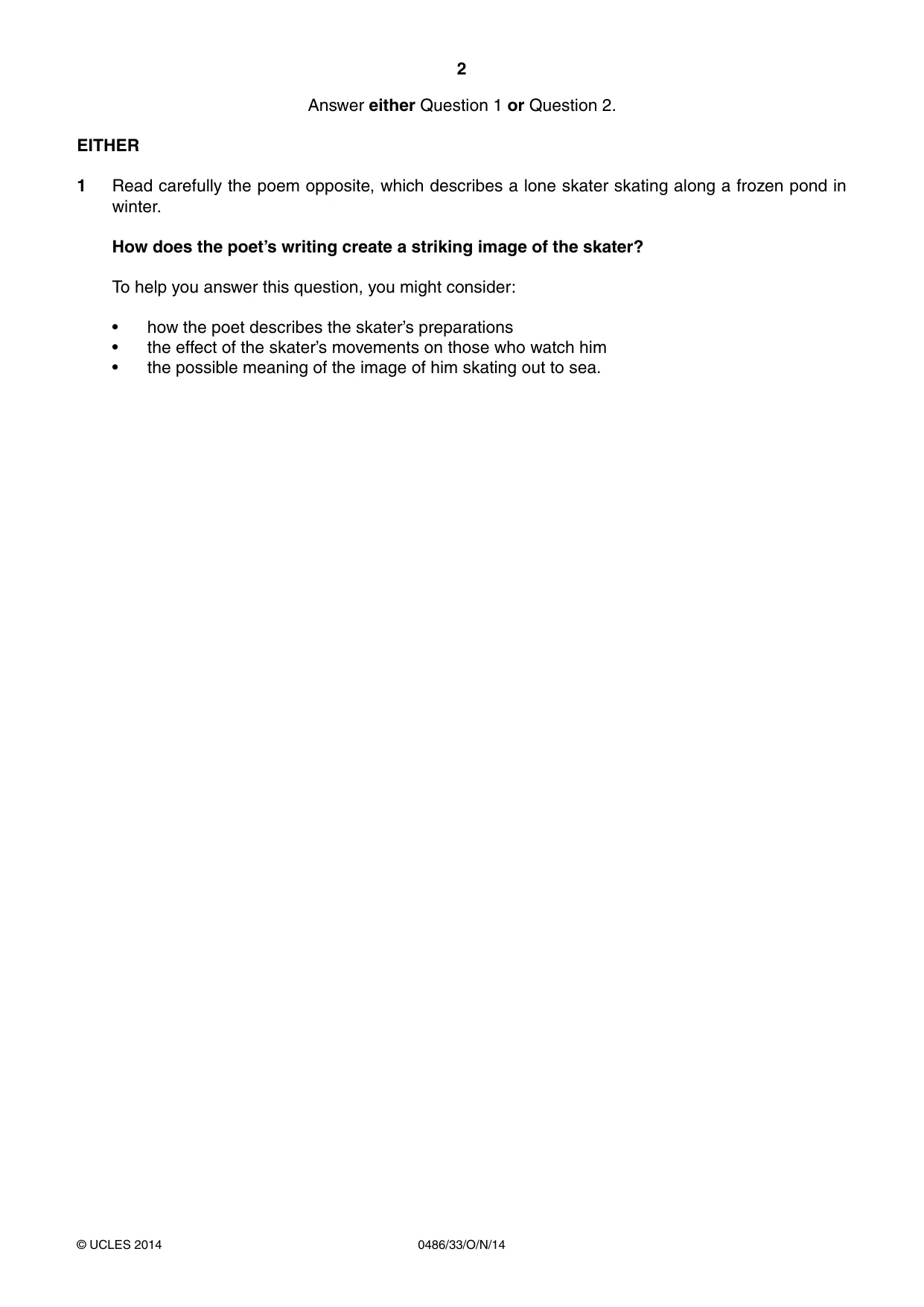
2 0486/33/O/N/14 © UCLES 2014 Answer either Question 1 or Question 2. EITHER 1 Read carefully the poem opposite, which describes a lone skater skating along a frozen pond in winter. How does the poet’s writing create a striking image of the skater? To help you answer this question, you might consider: • how the poet describes the skater’s preparations • the effect of the skater’s movements on those who watch him • the possible meaning of the image of him skating out to sea.
Question paper, page 3
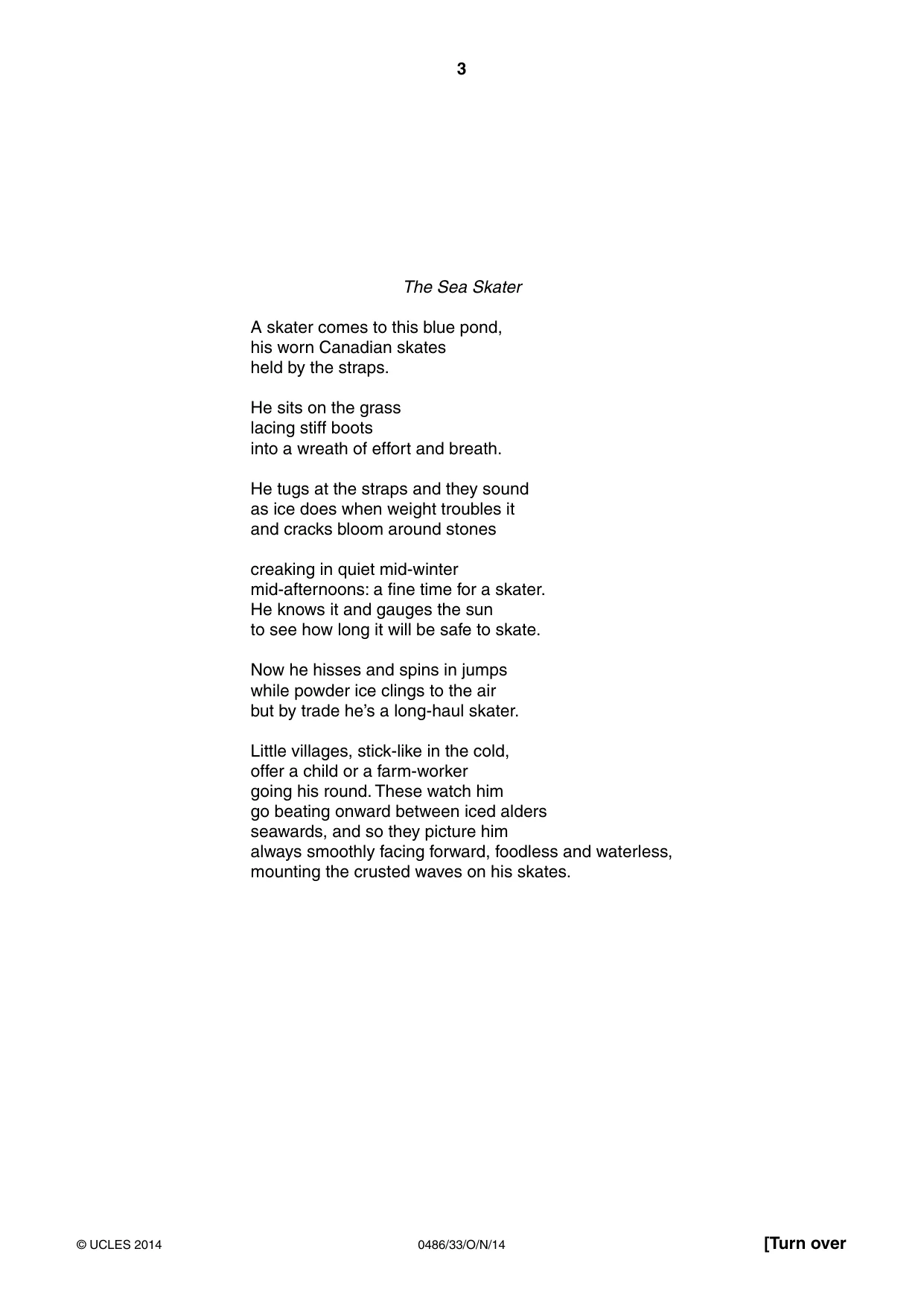
3 0486/33/O/N/14 © UCLES 2014 [Turn over The Sea Skater A skater comes to this blue pond, his worn Canadian skates held by the straps. He sits on the grass lacing stiff boots into a wreath of effort and breath. He tugs at the straps and they sound as ice does when weight troubles it and cracks bloom around stones creaking in quiet mid-winter mid-afternoons: a fine time for a skater. He knows it and gauges the sun to see how long it will be safe to skate. Now he hisses and spins in jumps while powder ice clings to the air but by trade he’s a long-haul skater. Little villages, stick-like in the cold, offer a child or a farm-worker going his round. These watch him go beating onward between iced alders seawards, and so they picture him always smoothly facing forward, foodless and waterless, mounting the crusted waves on his skates.
Question paper, page 4
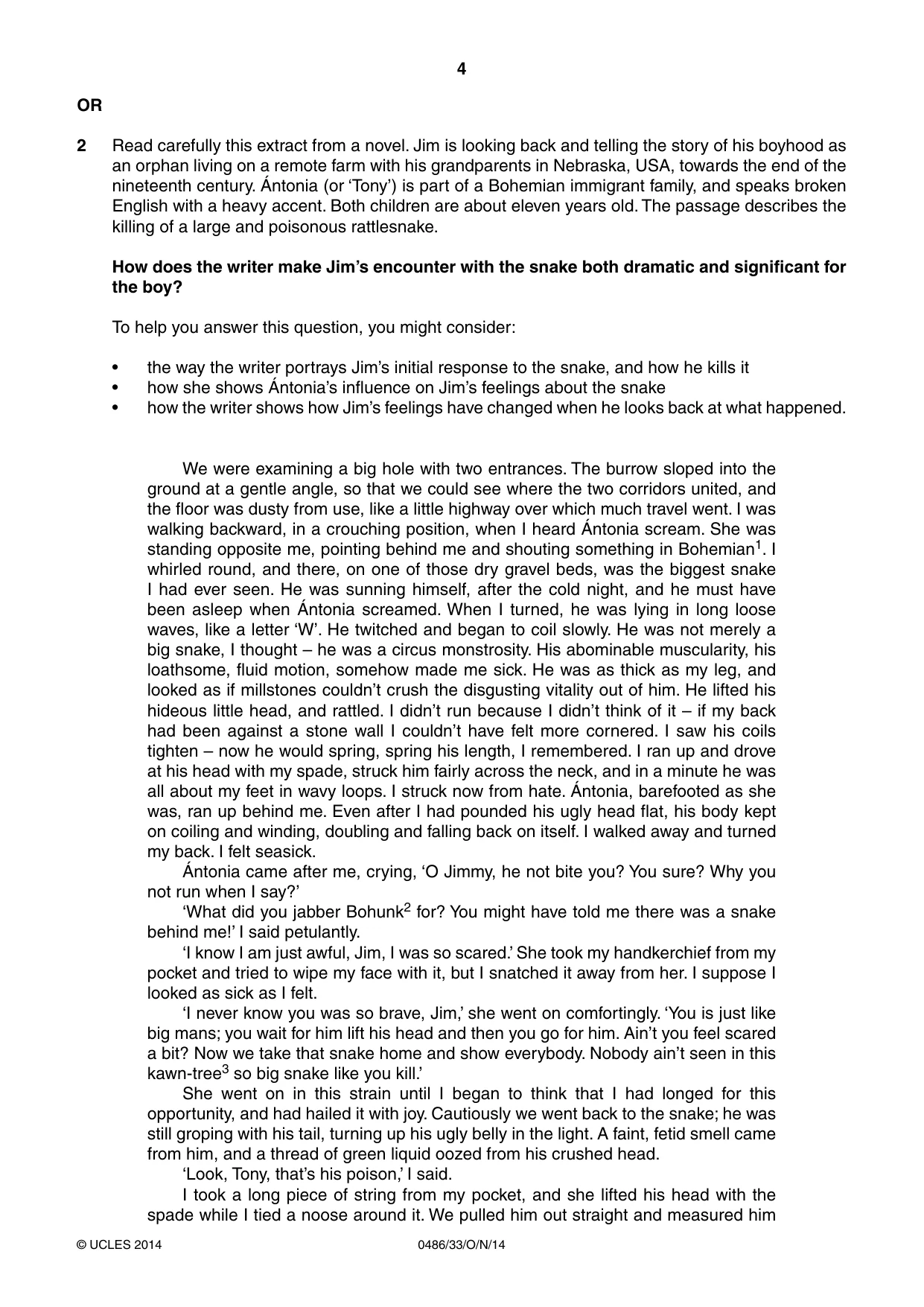
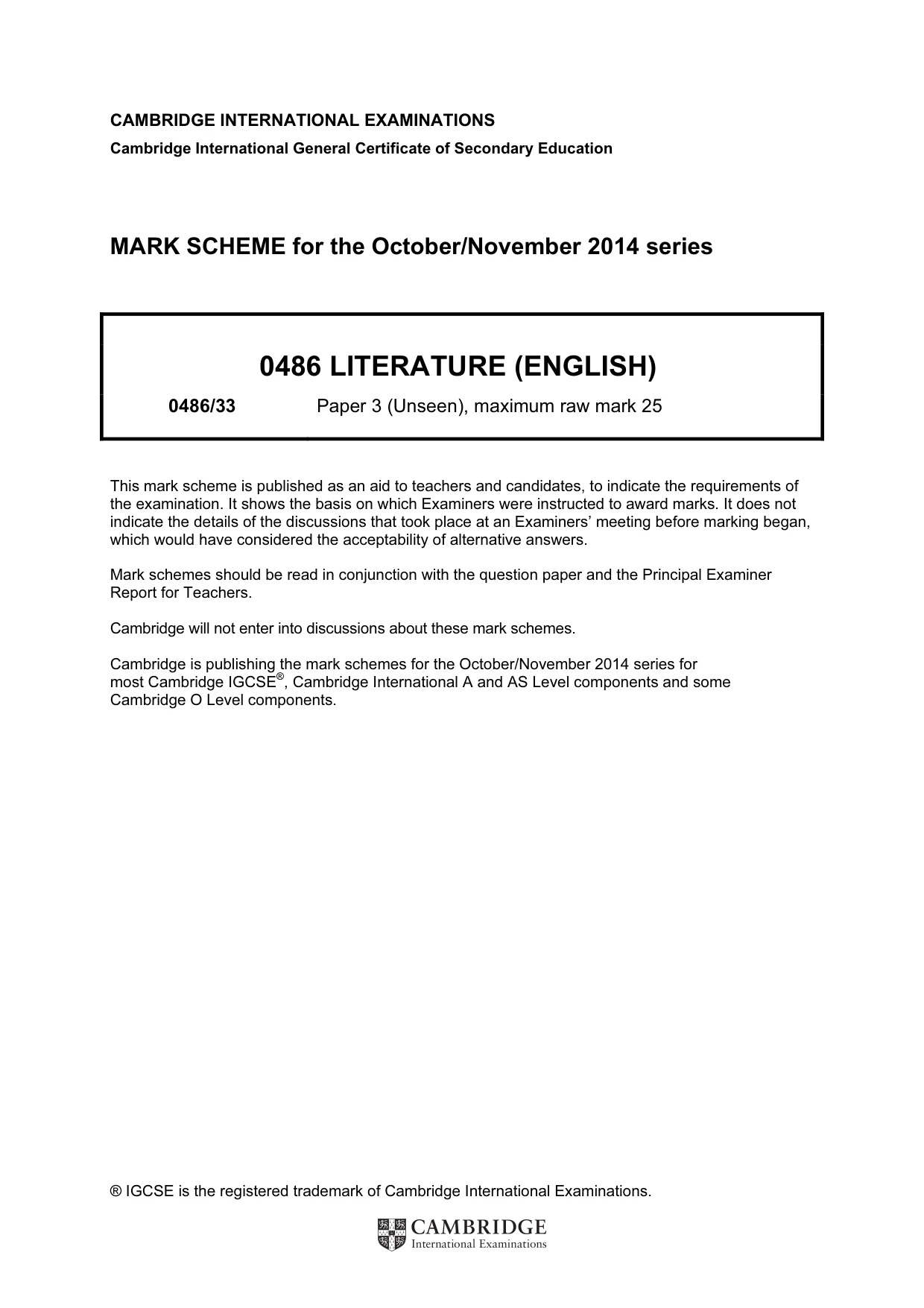
4 0486/33/O/N/14 © UCLES 2014 OR 2 Read carefully this extract from a novel. Jim is looking back and telling the story of his boyhood as an orphan living on a remote farm with his grandparents in Nebraska, USA, towards the end of the nineteenth century. Ántonia (or ‘Tony’) is part of a Bohemian immigrant family, and speaks broken English with a heavy accent. Both children are about eleven years old. The passage describes the killing of a large and poisonous rattlesnake. How does the writer make Jim’s encounter with the snake both dramatic and significant for the boy? To help you answer this question, you might consider: • the way the writer portrays Jim’s initial response to the snake, and how he kills it • how she shows Ántonia’s influence on Jim’s feelings about the snake • how the writer shows how Jim’s feelings have changed when he looks back at what happened. We were examining a big hole with two entrances. The burrow sloped into the ground at a gentle angle, so that we could see where the two corridors united, and the floor was dusty from use, like a little highway over which much travel went. I was walking backward, in a crouching position, when I heard Ántonia scream. She was standing opposite me, pointing behind me and shouting something in Bohemian1. I whirled round, and there, on one of those dry gravel beds, was the biggest snake I had ever seen. He was sunning himself, after the cold night, and he must have been asleep when Ántonia screamed. When I turned, he was lying in long loose waves, like a letter ‘W’. He twitched and began to coil slowly. He was not merely a big snake, I thought – he was a circus monstrosity. His abominable muscularity, his loathsome, fluid motion, somehow made me sick. He was as thick as my leg, and looked as if millstones couldn’t crush the disgusting vitality out of him. He lifted his hideous little head, and rattled. I didn’t run because I didn’t think of it – if my back had been against a stone wall I couldn’t have felt more cornered. I saw his coils tighten – now he would spring, spring his length, I remembered. I ran up and drove at his head with my spade, struck him fairly across the neck, and in a minute he was all about my feet in wavy loops. I struck now from hate. Ántonia, barefooted as she was, ran up behind me. Even after I had pounded his ugly head flat, his body kept on coiling and winding, doubling and falling back on itself. I walked away and turned my back. I felt seasick. Ántonia came after me, crying, ‘O Jimmy, he not bite you? You sure? Why you not run when I say?’ ‘What did you jabber Bohunk2 for? You might have told me there was a snake behind me!’ I said petulantly. ‘I know I am just awful, Jim, I was so scared.’ She took my handkerchief from my pocket and tried to wipe my face with it, but I snatched it away from her. I suppose I looked as sick as I felt. ‘I never know you was so brave, Jim,’ she went on comfortingly. ‘You is just like big mans; you wait for him lift his head and then you go for him. Ain’t you feel scared a bit? Now we take that snake home and show everybody. Nobody ain’t seen in this kawn-tree3 so big snake like you kill.’ She went on in this strain until I began to think that I had longed for this opportunity, and had hailed it with joy. Cautiously we went back to the snake; he was still groping with his tail, turning up his ugly belly in the light. A faint, fetid smell came from him, and a thread of green liquid oozed from his crushed head. ‘Look, Tony, that’s his poison,’ I said. I took a long piece of string from my pocket, and she lifted his head with the spade while I tied a noose around it. We pulled him out straight and measured him
Question paper, page 5
5 0486/33/O/N/14 © UCLES 2014 by my riding-quirt4; he was about five and a half feet long. He had twelve rattles, but they were broken off before they began to taper, so I insisted that he must once have had twenty-four. I explained to Ántonia how this meant that he was twenty- four years old, that he must have been there when white men first came, left on from buffalo and Indian times5. As I turned him over, I began to feel proud of him, to have a kind of respect for his age and size. He seemed like the ancient, eldest Evil. Certainly his kind have left horrible unconscious memories in all warm-blooded life. When we dragged him down into the draw6, Dude7 sprang off to the end of his tether and shivered all over – wouldn’t let us come near him. We decided that Ántonia should ride Dude home, and I would walk. As she rode along slowly, her bare legs swinging against the pony’s sides, she kept shouting back to me about how astonished everybody would be. I followed with the spade over my shoulder, dragging my snake. Her exultation was contagious. The great land had never looked to me so big and free. If the red grass were full of rattlers, I was equal to them all. Nevertheless, I stole furtive glances behind me now and then to see that no avenging mate, older and bigger than my quarry, was racing up from the rear. We hung him up to the windmill, and when I went down to the kitchen, I found Ántonia standing in the middle of the floor, telling the story with a great deal of colour. Subsequent experiences with rattlesnakes taught me that my first encounter was fortunate in circumstance. My big rattler was old, and had led too easy a life; there was not much fight in him. He had probably lived there for years, with a fat prairie-dog8 for breakfast whenever he felt like it, a sheltered home, even an owl- feather bed, perhaps, and he had forgot that the world doesn’t owe rattlers a living. A snake of his size, in fighting trim, would be more than any boy could handle. So in reality it was a mock adventure; the game was fixed for me by chance, as it probably was for many a dragon-slayer. I had been adequately armed; the snake was old and lazy; and I had Ántonia beside me, to appreciate and admire. That snake hung on our corral9 fence for several days; some of the neighbours came to see it and agreed that it was the biggest rattler ever killed in those parts. This was enough for Ántonia. She liked me better from that time on, and she never took a supercilious10 air with me again. I had killed a big snake – I was now a big fellow. 1Bohemian: from Bohemia, now part of the Czech Republic 2Bohunk (slang): in Bohemian language (in Czech) 3kawn-tree: ‘country’ (in Ántonia’s heavily accented English) 4riding-quirt: a leather whip 5Indian times: when Nebraska was still largely populated by native Americans 6the draw: a dry stream bed 7Dude: the name of Jim’s horse 8prairie-dog: a large rodent 9corral: enclosure for keeping livestock 10supercilious: superior
Question paper, page 6
6 0486/33/O/N/14 © UCLES 2014 BLANK PAGE
Question paper, page 7
7 0486/33/O/N/14 © UCLES 2014 BLANK PAGE
Question paper, page 8
8 0486/33/O/N/14 © UCLES 2014 BLANK PAGE Copyright Acknowledgements: Question 1 © Helen Dunmore; Short Days, Long Nights; New & Selected Poems; Bloodaxe Books Ltd; 1991. Permission to reproduce items where third-party owned material protected by copyright is included has been sought and cleared where possible. Every reasonable effort has been made by the publisher (UCLES) to trace copyright holders, but if any items requiring clearance have unwittingly been included, the publisher will be pleased to make amends at the earliest possible opportunity. Cambridge International Examinations is part of the Cambridge Assessment Group. Cambridge Assessment is the brand name of University of Cambridge Local Examinations Syndicate (UCLES), which is itself a department of the University of Cambridge.
Mark scheme, page 1
® IGCSE is the registered trademark of Cambridge International Examinations. CAMBRIDGE INTERNATIONAL EXAMINATIONS Cambridge International General Certificate of Secondary Education MARK SCHEME for the October/November 2014 series 0486 LITERATURE (ENGLISH) 0486/33 Paper 3 (Unseen), maximum raw mark 25 This mark scheme is published as an aid to teachers and candidates, to indicate the requirements of the examination. It shows the basis on which Examiners were instructed to award marks. It does not indicate the details of the discussions that took place at an Examiners’ meeting before marking began, which would have considered the acceptability of alternative answers. Mark schemes should be read in conjunction with the question paper and the Principal Examiner Report for Teachers. Cambridge will not enter into discussions about these mark schemes. Cambridge is publishing the mark schemes for the October/November 2014 series for most Cambridge IGCSE®, Cambridge International A and AS Level components and some Cambridge O Level components.
Mark scheme, page 2
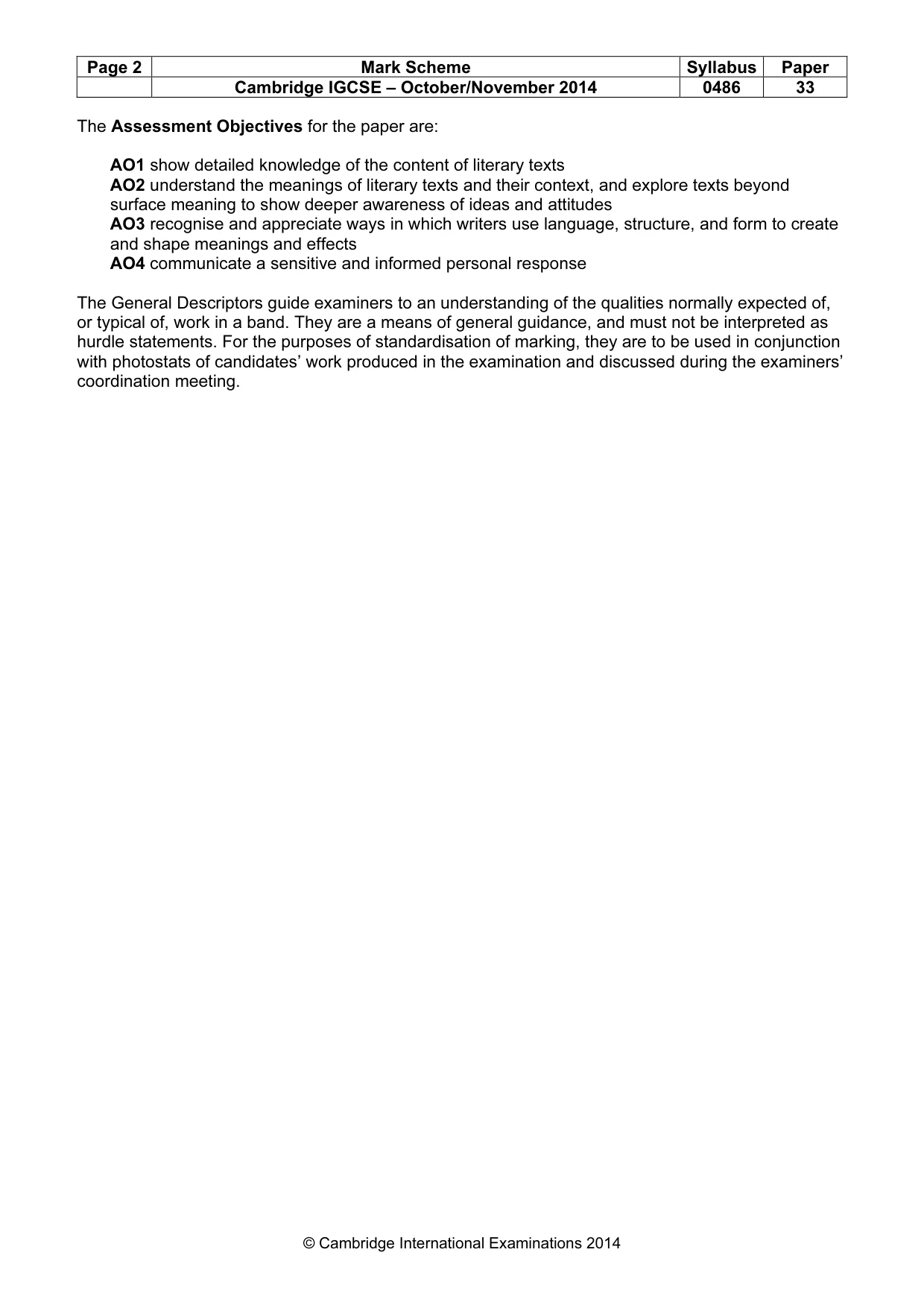
Page 2 Mark Scheme Syllabus Paper Cambridge IGCSE – October/November 2014 0486 33 © Cambridge International Examinations 2014 The Assessment Objectives for the paper are: AO1 show detailed knowledge of the content of literary texts AO2 understand the meanings of literary texts and their context, and explore texts beyond surface meaning to show deeper awareness of ideas and attitudes AO3 recognise and appreciate ways in which writers use language, structure, and form to create and shape meanings and effects AO4 communicate a sensitive and informed personal response The General Descriptors guide examiners to an understanding of the qualities normally expected of, or typical of, work in a band. They are a means of general guidance, and must not be interpreted as hurdle statements. For the purposes of standardisation of marking, they are to be used in conjunction with photostats of candidates’ work produced in the examination and discussed during the examiners’ coordination meeting.
Mark scheme, page 3
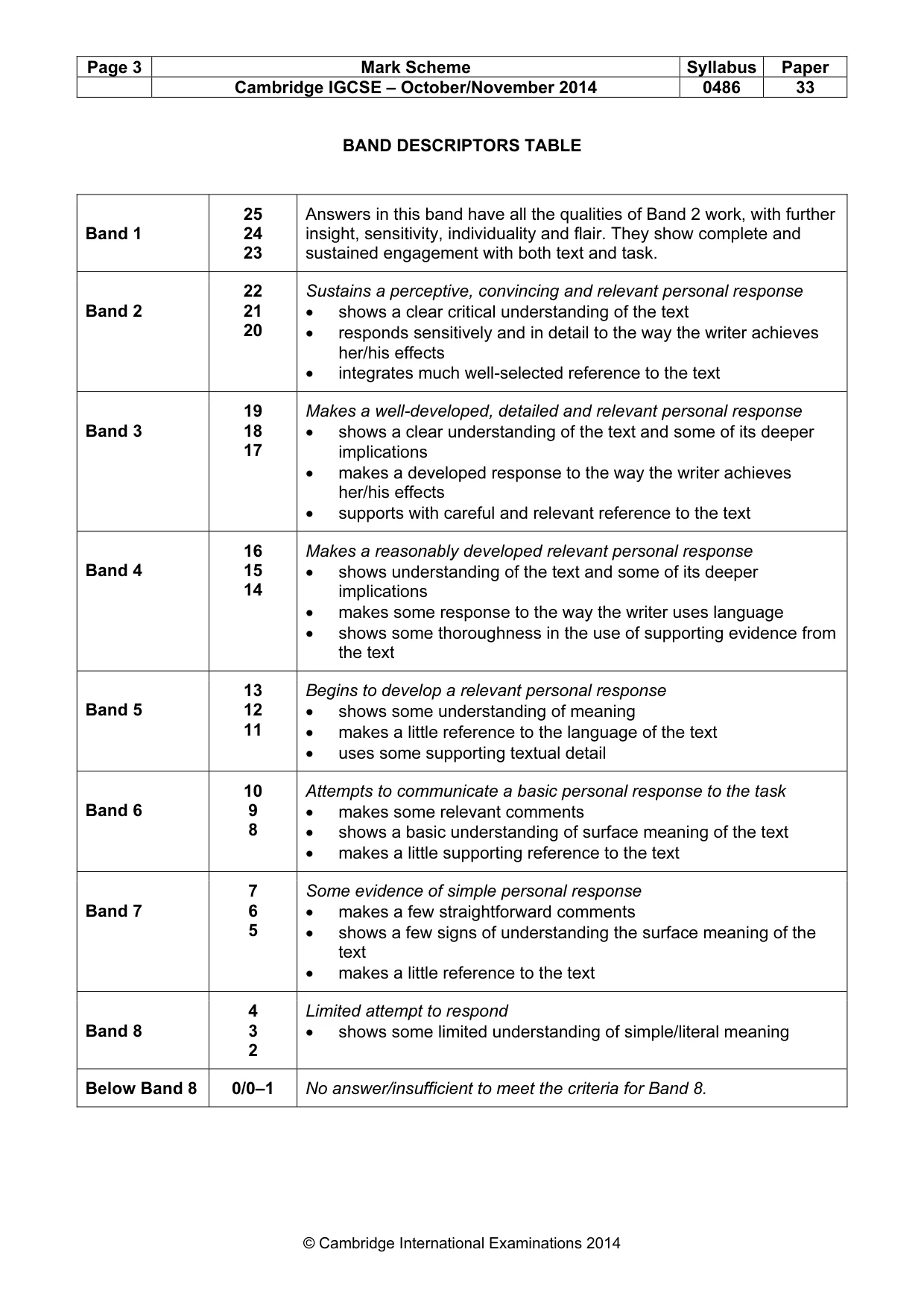
Page 3 Mark Scheme Syllabus Paper Cambridge IGCSE – October/November 2014 0486 33 © Cambridge International Examinations 2014 BAND DESCRIPTORS TABLE Band 1 25 24 23 Answers in this band have all the qualities of Band 2 work, with further insight, sensitivity, individuality and flair. They show complete and sustained engagement with both text and task. Band 2 22 21 20 Sustains a perceptive, convincing and relevant personal response • shows a clear critical understanding of the text • responds sensitively and in detail to the way the writer achieves her/his effects • integrates much well-selected reference to the text Band 3 19 18 17 Makes a well-developed, detailed and relevant personal response • shows a clear understanding of the text and some of its deeper implications • makes a developed response to the way the writer achieves her/his effects • supports with careful and relevant reference to the text Band 4 16 15 14 Makes a reasonably developed relevant personal response • shows understanding of the text and some of its deeper implications • makes some response to the way the writer uses language • shows some thoroughness in the use of supporting evidence from the text Band 5 13 12 11 Begins to develop a relevant personal response • shows some understanding of meaning • makes a little reference to the language of the text • uses some supporting textual detail Band 6 10 9 8 Attempts to communicate a basic personal response to the task • makes some relevant comments • shows a basic understanding of surface meaning of the text • makes a little supporting reference to the text Band 7 7 6 5 Some evidence of simple personal response • makes a few straightforward comments • shows a few signs of understanding the surface meaning of the text • makes a little reference to the text Band 8 4 3 2 Limited attempt to respond • shows some limited understanding of simple/literal meaning Below Band 8 0/0–1 No answer/insufficient to meet the criteria for Band 8.
What you needed in this session
Cambridge’s own grade thresholds for 2014 Oct/Nov, Paper 3 · Variant 3. A higher threshold means an easier paper — the bar moves with how the cohort did.