Cambridge IGCSE English - Literature 0486 — 2017 May/June Paper 3 · Variant 3
0486/33/M/J/17 · 25 marks · ≈28 min
The question paper and its mark scheme, free to read here and free to download. This is Cambridge’s own paper, exactly as it was sat.
Question paper12 pages

Mark scheme3 pages
Answers below. Sit the paper first if you are practising.
Paper as text
Question paper, page 1
Cambridge International Examinations Cambridge International General Certificate of Secondary Education 0486/33 LITERATURE (ENGLISH) May/June 2017 Paper 3 Drama (Open Text) 45 minutes Texts studied should be taken into the examination. READ THESE INSTRUCTIONS FIRST An answer booklet is provided inside this question paper. You should follow the instructions on the front cover of the answer booklet. If you need additional answer paper ask the invigilator for a continuation booklet. Answer one question. All questions in this paper carry equal marks. This document consists of 11 printed pages and 1 blank page. [Turn over 06_0486_33_2017_1.8 © UCLES 2017 *8972010446*
Question paper, page 2
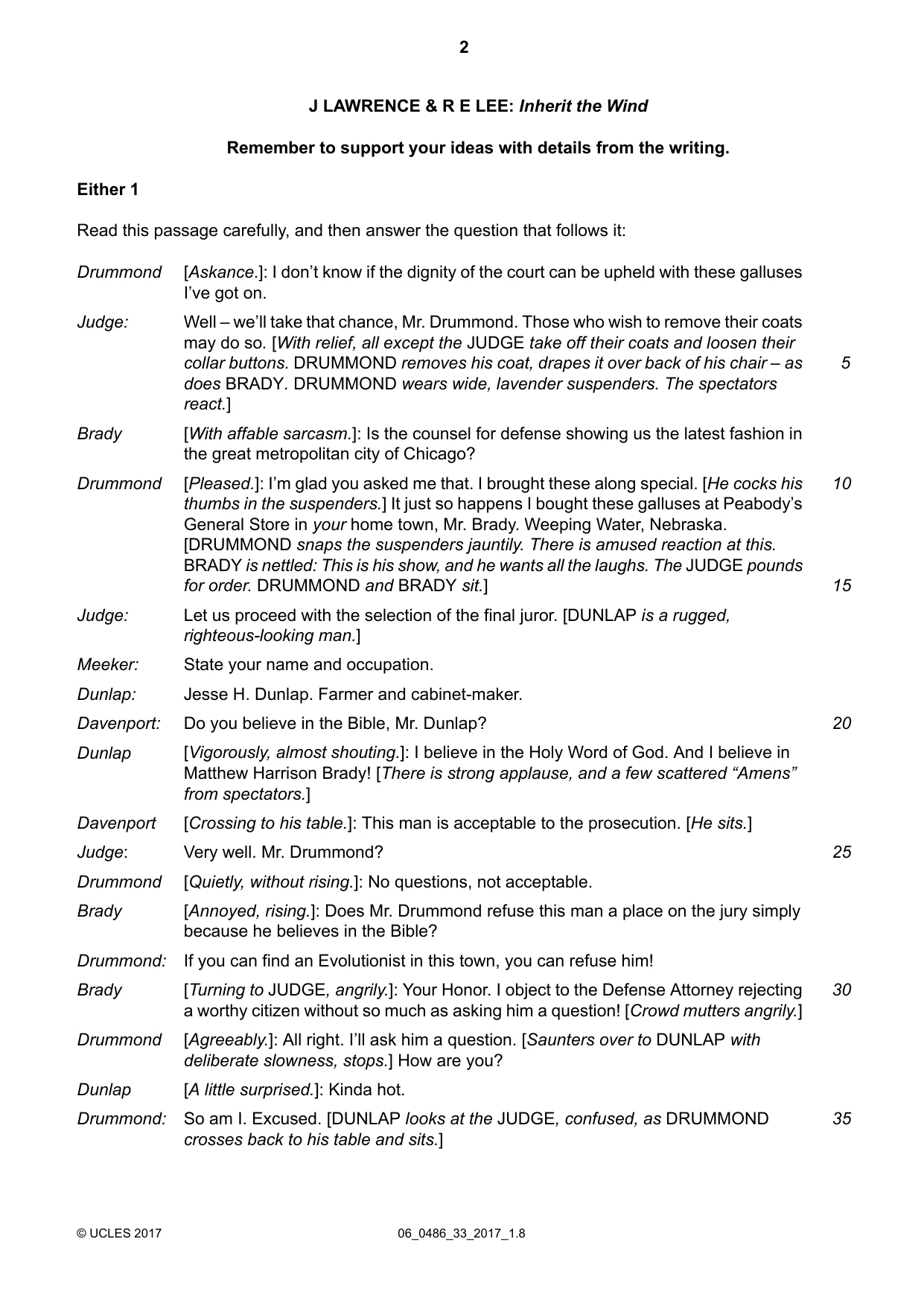
35 30 25 20 15 10 5 J LAWRENCE & R E LEE: Inherit the Wind Remember to support your ideas with details from the writing. Either 1 Read this passage carefully, and then answer the question that follows it: [Askance.]: I don’t know if the dignity of the court can be upheld with these galluses I’ve got on. Drummond Well – we’ll take that chance, Mr. Drummond. Those who wish to remove their coats may do so. [With relief, all except the JUDGE take off their coats and loosen their Judge: collar buttons. DRUMMOND removes his coat, drapes it over back of his chair – as does BRADY. DRUMMOND wears wide, lavender suspenders. The spectators react.] [With affable sarcasm.]: Is the counsel for defense showing us the latest fashion in the great metropolitan city of Chicago? Brady [Pleased.]: I’m glad you asked me that. I brought these along special. [He cocks his thumbs in the suspenders.] It just so happens I bought these galluses at Peabody’s Drummond General Store in your home town, Mr. Brady. Weeping Water, Nebraska. [DRUMMOND snaps the suspenders jauntily. There is amused reaction at this. BRADY is nettled: This is his show, and he wants all the laughs. The JUDGE pounds for order. DRUMMOND and BRADY sit.] Let us proceed with the selection of the final juror. [DUNLAP is a rugged, righteous-looking man.] Judge: State your name and occupation. Meeker: Jesse H. Dunlap. Farmer and cabinet-maker. Dunlap: Do you believe in the Bible, Mr. Dunlap? Davenport: [Vigorously, almost shouting.]: I believe in the Holy Word of God. And I believe in Matthew Harrison Brady! [There is strong applause, and a few scattered “Amens” from spectators.] Dunlap [Crossing to his table.]: This man is acceptable to the prosecution. [He sits.] Davenport Very well. Mr. Drummond? Judge: [Quietly, without rising.]: No questions, not acceptable. Drummond [Annoyed, rising.]: Does Mr. Drummond refuse this man a place on the jury simply because he believes in the Bible? Brady If you can find an Evolutionist in this town, you can refuse him! Drummond: [Turning to JUDGE, angrily.]: Your Honor. I object to the Defense Attorney rejecting a worthy citizen without so much as asking him a question! [Crowd mutters angrily.] Brady [Agreeably.]: All right. I’ll ask him a question. [Saunters over to DUNLAP with deliberate slowness, stops.] How are you? Drummond [A little surprised.]: Kinda hot. Dunlap So am I. Excused. [DUNLAP looks at the JUDGE, confused, as DRUMMOND crosses back to his table and sits.] Drummond: 06_0486_33_2017_1.8 © UCLES 2017 2
Question paper, page 3
55 50 45 40 You are excused from jury duty, Mr. Dunlap. You may step down. [MEEKER waves DUNLAP back and he joins the spectators, a little miffed.] Judge: [Rising piously.]: I object to the note of levity which the counsel for the defense is introducing into these proceedings. Brady The bench agrees with you in spirit, Colonel Brady. Judge: [Rising angrily.]: And I object to all this damned “Colonel” talk. I am not familiar with Mr. Brady’s military record. Drummond Well – he was made an Honorary Colonel in our State Militia. The day he arrived in Hillsboro. Judge: The use of this title prejudices the case of my client: it calls up a picture of the prosecution, astride a white horse, ablaze in the uniform of a militia colonel, with all the forces of right and righteousness marshalled behind him. Drummond: Well, what are we to do? Judge: Break him. Make him a Private. [Sits.] I have no serious objection to the honorary title of “Private Brady”. [There is a buzz of reaction. The JUDGE gestures for the MAYOR to come over for a hurried, whispered conference.] Drummond: [After some whispering.]: Well, we can’t take it back – ! [There is another whispered exchange. Then the MAYOR steps gingerly toward DRUMMOND.] By – by the Mayor authority of – well, I’m sure the Governor won’t have any objection – I hereby appoint you, Mr. Drummond, a temporary Honorary Colonel in the State Militia. [Rises, shaking his head, with mock humility.]: Gentlemen, I don’t know what to say. It is not often in a man’s life that he attains the exalted rank of “Temporary Honorary Colonel.” Drummond [From Act 1] Explore how the writers make this an entertaining moment in the play. Or 2 How do the writers make ‘the right to think’ so memorable and significant in the play? [Turn over 06_0486_33_2017_1.8 © UCLES 2017 3
Question paper, page 4
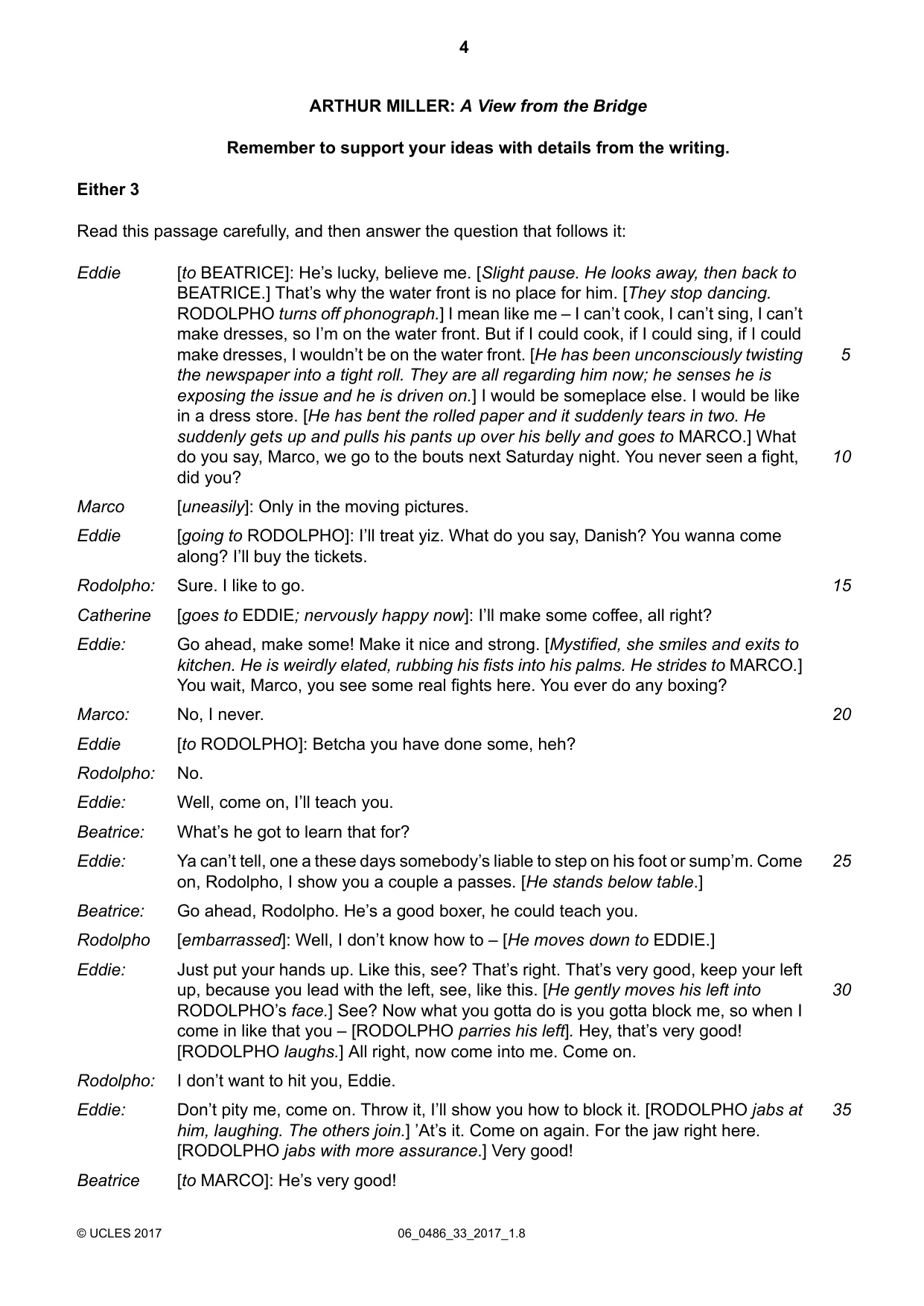
35 30 25 20 15 10 5 ARTHUR MILLER: A View from the Bridge Remember to support your ideas with details from the writing. Either 3 Read this passage carefully, and then answer the question that follows it: [to BEATRICE]: He’s lucky, believe me. [Slight pause. He looks away, then back to BEATRICE.] That’s why the water front is no place for him. [They stop dancing. Eddie RODOLPHO turns off phonograph.] I mean like me – I can’t cook, I can’t sing, I can’t make dresses, so I’m on the water front. But if I could cook, if I could sing, if I could make dresses, I wouldn’t be on the water front. [He has been unconsciously twisting the newspaper into a tight roll. They are all regarding him now; he senses he is exposing the issue and he is driven on.] I would be someplace else. I would be like in a dress store. [He has bent the rolled paper and it suddenly tears in two. He suddenly gets up and pulls his pants up over his belly and goes to MARCO.] What do you say, Marco, we go to the bouts next Saturday night. You never seen a fight, did you? [uneasily]: Only in the moving pictures. Marco [going to RODOLPHO]: I’ll treat yiz. What do you say, Danish? You wanna come along? I’ll buy the tickets. Eddie Sure. I like to go. Rodolpho: [goes to EDDIE; nervously happy now]: I’ll make some coffee, all right? Catherine Go ahead, make some! Make it nice and strong. [Mystified, she smiles and exits to kitchen. He is weirdly elated, rubbing his fists into his palms. He strides to MARCO.] You wait, Marco, you see some real fights here. You ever do any boxing? Eddie: No, I never. Marco: [to RODOLPHO]: Betcha you have done some, heh? Eddie No. Rodolpho: Well, come on, I’ll teach you. Eddie: What’s he got to learn that for? Beatrice: Ya can’t tell, one a these days somebody’s liable to step on his foot or sump’m. Come on, Rodolpho, I show you a couple a passes. [He stands below table.] Eddie: Go ahead, Rodolpho. He’s a good boxer, he could teach you. Beatrice: [embarrassed]: Well, I don’t know how to – [He moves down to EDDIE.] Rodolpho Just put your hands up. Like this, see? That’s right. That’s very good, keep your left up, because you lead with the left, see, like this. [He gently moves his left into Eddie: RODOLPHO’s face.] See? Now what you gotta do is you gotta block me, so when I come in like that you – [RODOLPHO parries his left]. Hey, that’s very good! [RODOLPHO laughs.] All right, now come into me. Come on. I don’t want to hit you, Eddie. Rodolpho: Don’t pity me, come on. Throw it, I’ll show you how to block it. [RODOLPHO jabs at him, laughing. The others join.] ’At’s it. Come on again. For the jaw right here. [RODOLPHO jabs with more assurance.] Very good! Eddie: [to MARCO]: He’s very good! Beatrice 06_0486_33_2017_1.8 © UCLES 2017 4
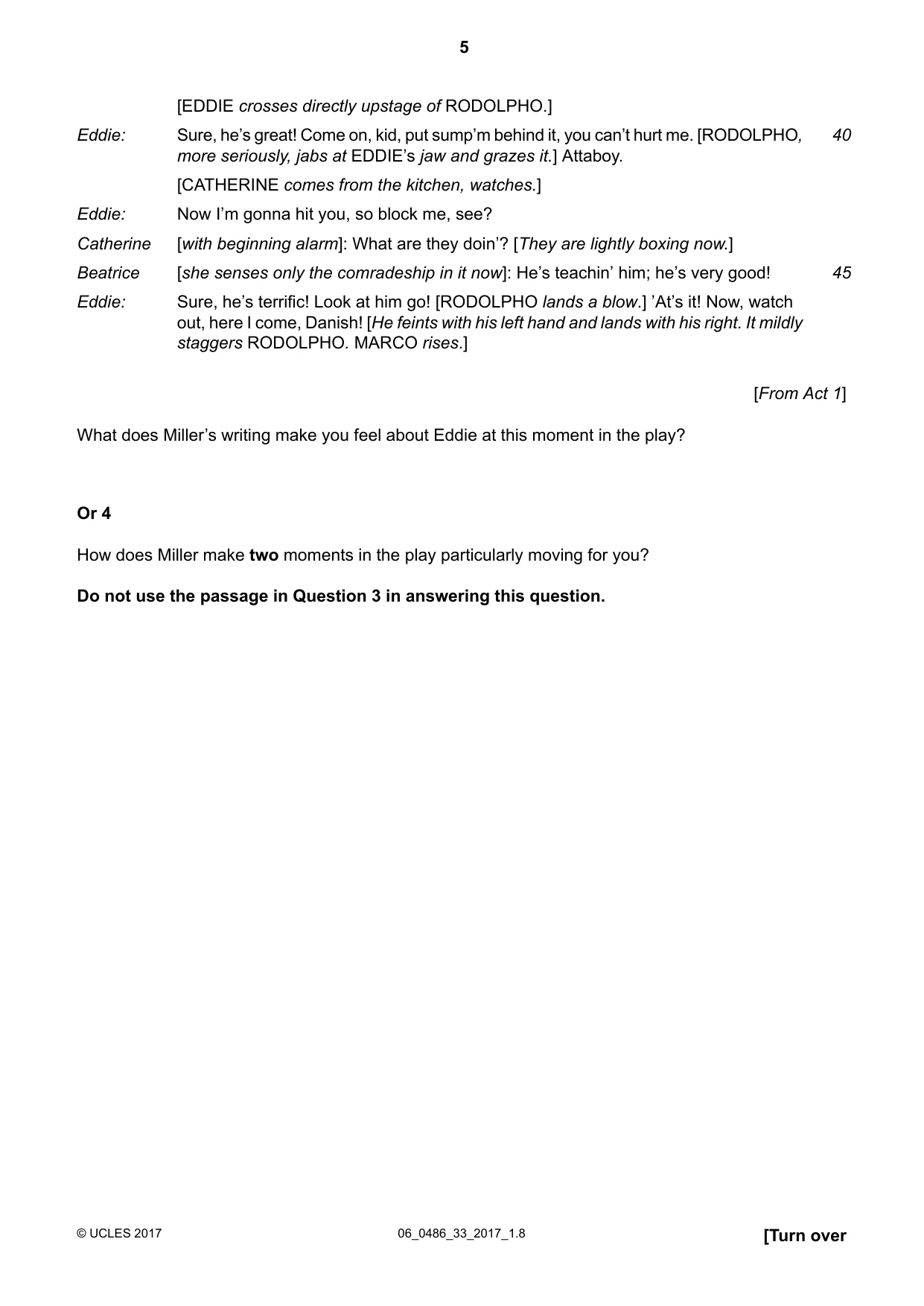
Question paper, page 5
45 40 [EDDIE crosses directly upstage of RODOLPHO.] Sure, he’s great! Come on, kid, put sump’m behind it, you can’t hurt me. [RODOLPHO, more seriously, jabs at EDDIE’s jaw and grazes it.] Attaboy. Eddie: [CATHERINE comes from the kitchen, watches.] Now I’m gonna hit you, so block me, see? Eddie: [with beginning alarm]: What are they doin’? [They are lightly boxing now.] Catherine [she senses only the comradeship in it now]: He’s teachin’ him; he’s very good! Beatrice Sure, he’s terrific! Look at him go! [RODOLPHO lands a blow.] ’At’s it! Now, watch out, here I come, Danish! [He feints with his left hand and lands with his right. It mildly staggers RODOLPHO. MARCO rises.] Eddie: [From Act 1] What does Miller’s writing make you feel about Eddie at this moment in the play? Or 4 How does Miller make two moments in the play particularly moving for you? Do not use the passage in Question 3 in answering this question. [Turn over 06_0486_33_2017_1.8 © UCLES 2017 5
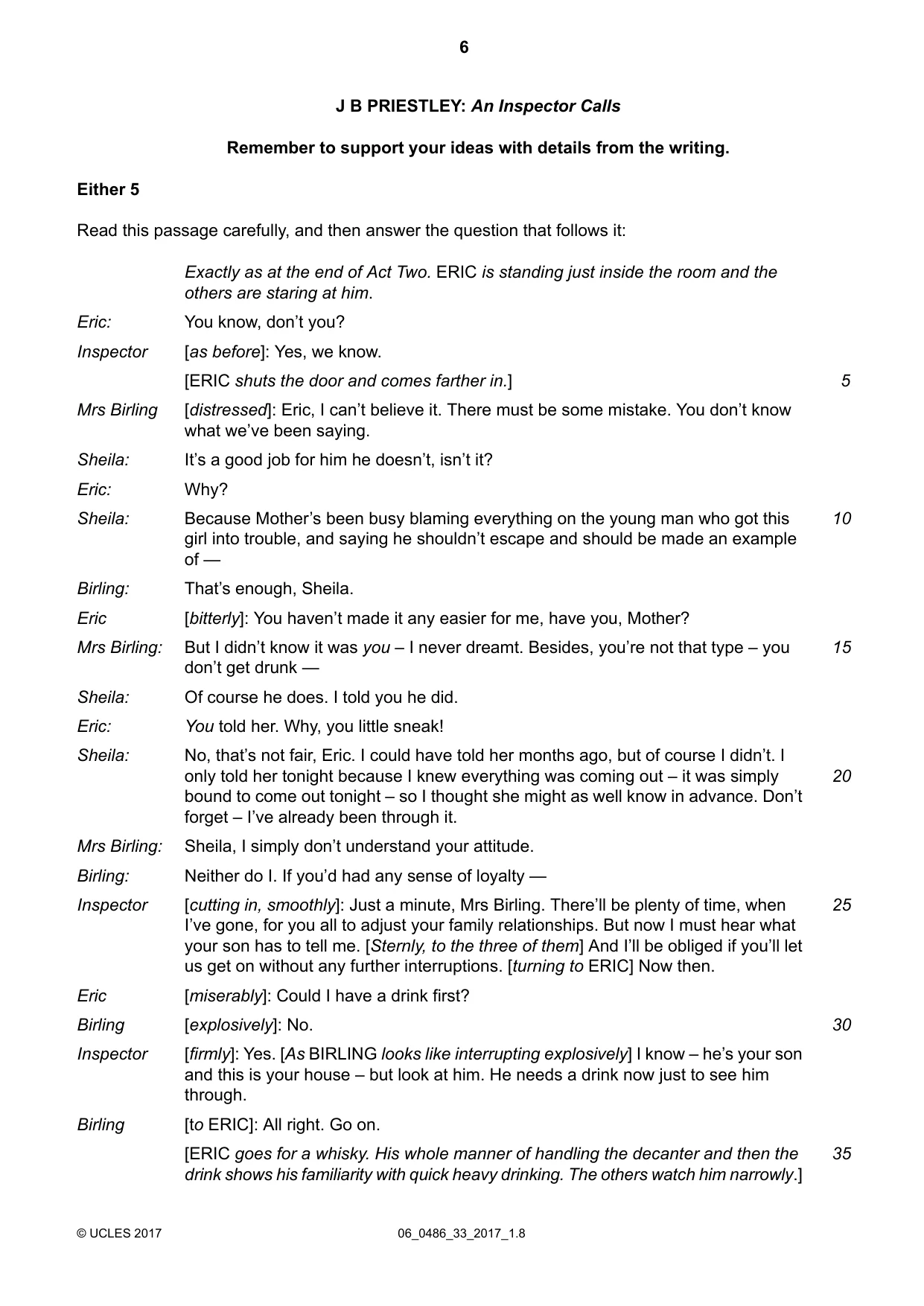
Question paper, page 6
35 30 25 20 15 10 5 J B PRIESTLEY: An Inspector Calls Remember to support your ideas with details from the writing. Either 5 Read this passage carefully, and then answer the question that follows it: Exactly as at the end of Act Two. ERIC is standing just inside the room and the others are staring at him. You know, don’t you? Eric: [as before]: Yes, we know. Inspector [ERIC shuts the door and comes farther in.] [distressed]: Eric, I can’t believe it. There must be some mistake. You don’t know what we’ve been saying. Mrs Birling It’s a good job for him he doesn’t, isn’t it? Sheila: Why? Eric: Because Mother’s been busy blaming everything on the young man who got this girl into trouble, and saying he shouldn’t escape and should be made an example of — Sheila: That’s enough, Sheila. Birling: [bitterly]: You haven’t made it any easier for me, have you, Mother? Eric But I didn’t know it was you – I never dreamt. Besides, you’re not that type – you don’t get drunk — Mrs Birling: Of course he does. I told you he did. Sheila: You told her. Why, you little sneak! Eric: No, that’s not fair, Eric. I could have told her months ago, but of course I didn’t. I only told her tonight because I knew everything was coming out – it was simply Sheila: bound to come out tonight – so I thought she might as well know in advance. Don’t forget – I’ve already been through it. Sheila, I simply don’t understand your attitude. Mrs Birling: Neither do I. If you’d had any sense of loyalty — Birling: [cutting in, smoothly]: Just a minute, Mrs Birling. There’ll be plenty of time, when I’ve gone, for you all to adjust your family relationships. But now I must hear what Inspector your son has to tell me. [Sternly, to the three of them] And I’ll be obliged if you’ll let us get on without any further interruptions. [turning to ERIC] Now then. [miserably]: Could I have a drink first? Eric [explosively]: No. Birling [firmly]: Yes. [As BIRLING looks like interrupting explosively] I know – he’s your son and this is your house – but look at him. He needs a drink now just to see him through. Inspector [to ERIC]: All right. Go on. Birling [ERIC goes for a whisky. His whole manner of handling the decanter and then the drink shows his familiarity with quick heavy drinking. The others watch him narrowly.] 06_0486_33_2017_1.8 © UCLES 2017 6
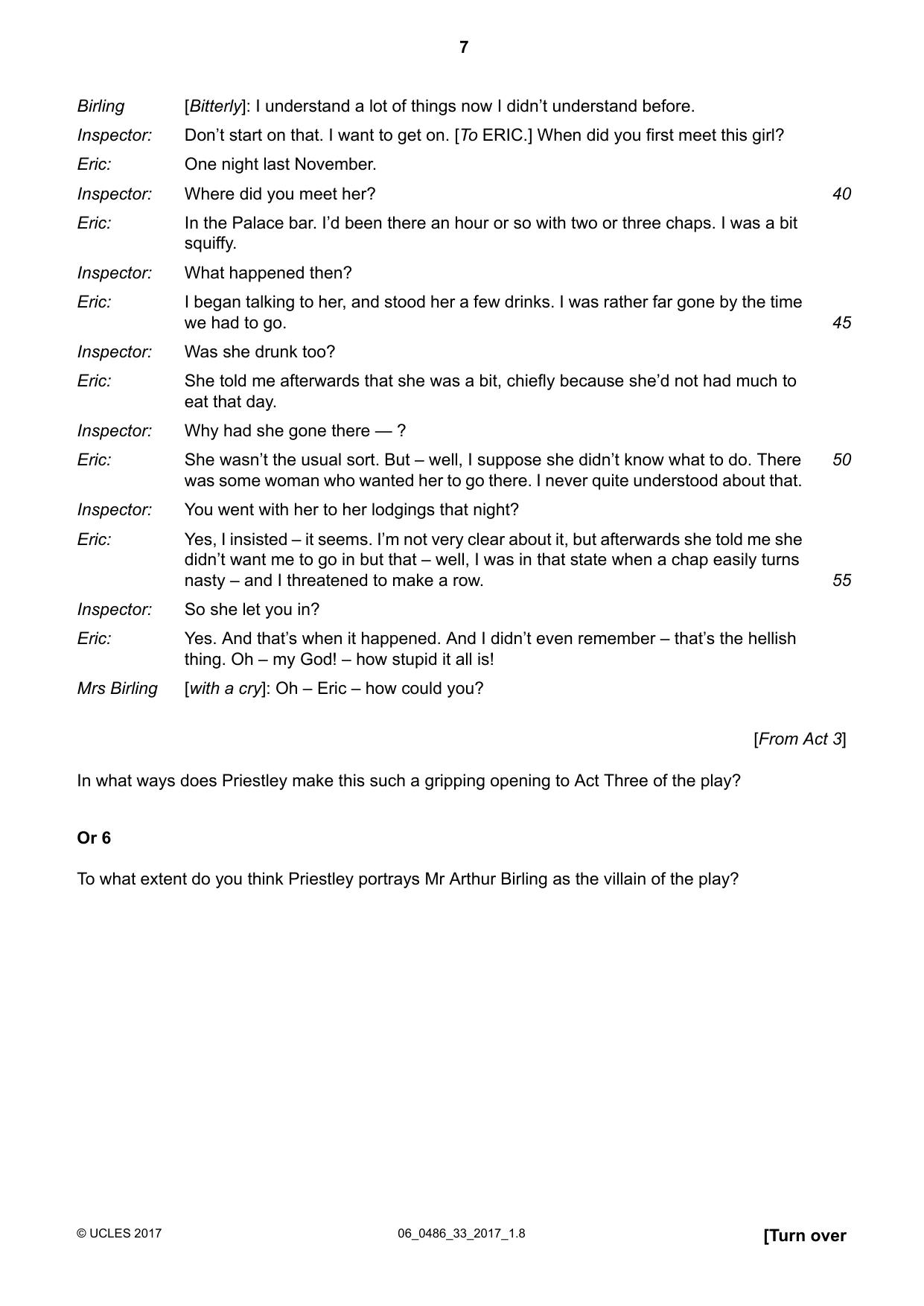
Question paper, page 7
55 50 45 40 [Bitterly]: I understand a lot of things now I didn’t understand before. Birling Don’t start on that. I want to get on. [To ERIC.] When did you first meet this girl? Inspector: One night last November. Eric: Where did you meet her? Inspector: In the Palace bar. I’d been there an hour or so with two or three chaps. I was a bit squiffy. Eric: What happened then? Inspector: I began talking to her, and stood her a few drinks. I was rather far gone by the time we had to go. Eric: Was she drunk too? Inspector: She told me afterwards that she was a bit, chiefly because she’d not had much to eat that day. Eric: Why had she gone there — ? Inspector: She wasn’t the usual sort. But – well, I suppose she didn’t know what to do. There was some woman who wanted her to go there. I never quite understood about that. Eric: You went with her to her lodgings that night? Inspector: Yes, I insisted – it seems. I’m not very clear about it, but afterwards she told me she didn’t want me to go in but that – well, I was in that state when a chap easily turns nasty – and I threatened to make a row. Eric: So she let you in? Inspector: Yes. And that’s when it happened. And I didn’t even remember – that’s the hellish thing. Oh – my God! – how stupid it all is! Eric: [with a cry]: Oh – Eric – how could you? Mrs Birling [From Act 3] In what ways does Priestley make this such a gripping opening to Act Three of the play? Or 6 To what extent do you think Priestley portrays Mr Arthur Birling as the villain of the play? [Turn over 06_0486_33_2017_1.8 © UCLES 2017 7
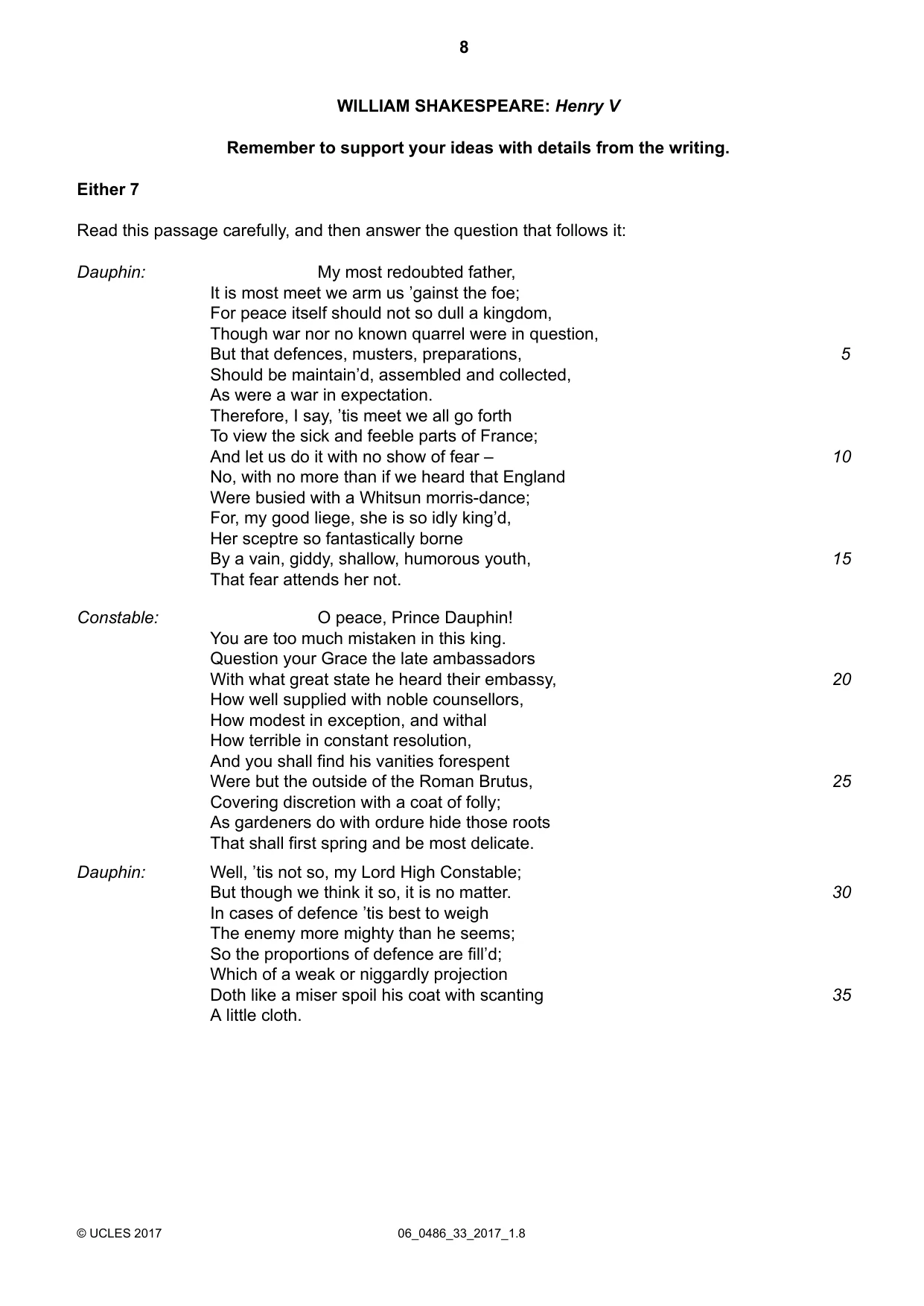
Question paper, page 8
35 30 25 20 15 10 5 WILLIAM SHAKESPEARE: Henry V Remember to support your ideas with details from the writing. Either 7 Read this passage carefully, and then answer the question that follows it: My most redoubted father, It is most meet we arm us ’gainst the foe; For peace itself should not so dull a kingdom, Though war nor no known quarrel were in question, But that defences, musters, preparations, Should be maintain’d, assembled and collected, As were a war in expectation. Therefore, I say, ’tis meet we all go forth To view the sick and feeble parts of France; And let us do it with no show of fear – No, with no more than if we heard that England Were busied with a Whitsun morris-dance; For, my good liege, she is so idly king’d, Her sceptre so fantastically borne By a vain, giddy, shallow, humorous youth, That fear attends her not. Dauphin: O peace, Prince Dauphin! You are too much mistaken in this king. Question your Grace the late ambassadors With what great state he heard their embassy, How well supplied with noble counsellors, How modest in exception, and withal How terrible in constant resolution, And you shall find his vanities forespent Were but the outside of the Roman Brutus, Covering discretion with a coat of folly; As gardeners do with ordure hide those roots That shall first spring and be most delicate. Constable: Well, ’tis not so, my Lord High Constable; But though we think it so, it is no matter. In cases of defence ’tis best to weigh The enemy more mighty than he seems; So the proportions of defence are fill’d; Which of a weak or niggardly projection Doth like a miser spoil his coat with scanting A little cloth. Dauphin: 06_0486_33_2017_1.8 © UCLES 2017 8
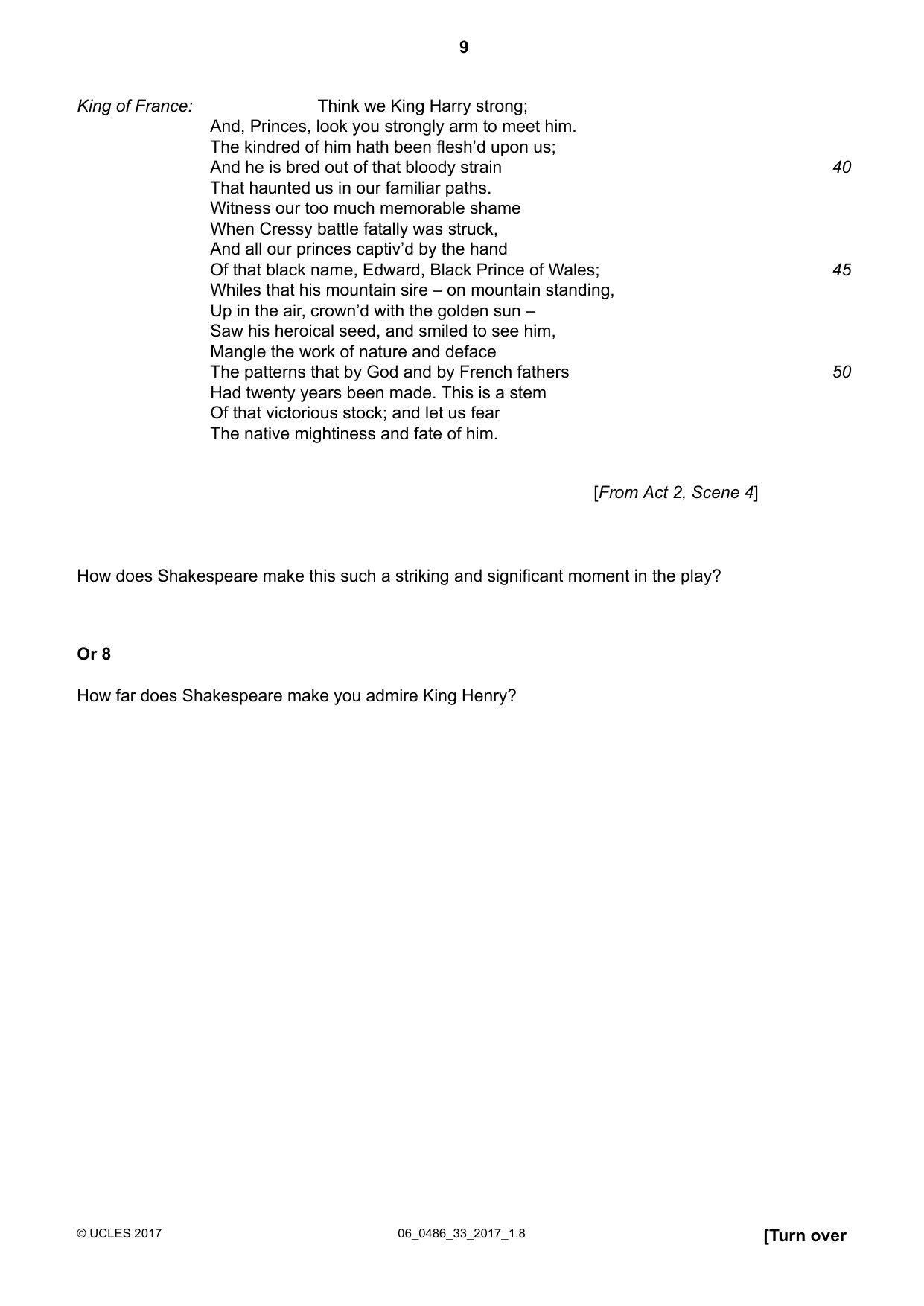
Question paper, page 9
50 45 40 Think we King Harry strong; And, Princes, look you strongly arm to meet him. The kindred of him hath been flesh’d upon us; And he is bred out of that bloody strain That haunted us in our familiar paths. Witness our too much memorable shame When Cressy battle fatally was struck, And all our princes captiv’d by the hand Of that black name, Edward, Black Prince of Wales; Whiles that his mountain sire – on mountain standing, Up in the air, crown’d with the golden sun – Saw his heroical seed, and smiled to see him, Mangle the work of nature and deface The patterns that by God and by French fathers Had twenty years been made. This is a stem Of that victorious stock; and let us fear The native mightiness and fate of him. King of France: [From Act 2, Scene 4] How does Shakespeare make this such a striking and significant moment in the play? Or 8 How far does Shakespeare make you admire King Henry? [Turn over 06_0486_33_2017_1.8 © UCLES 2017 9
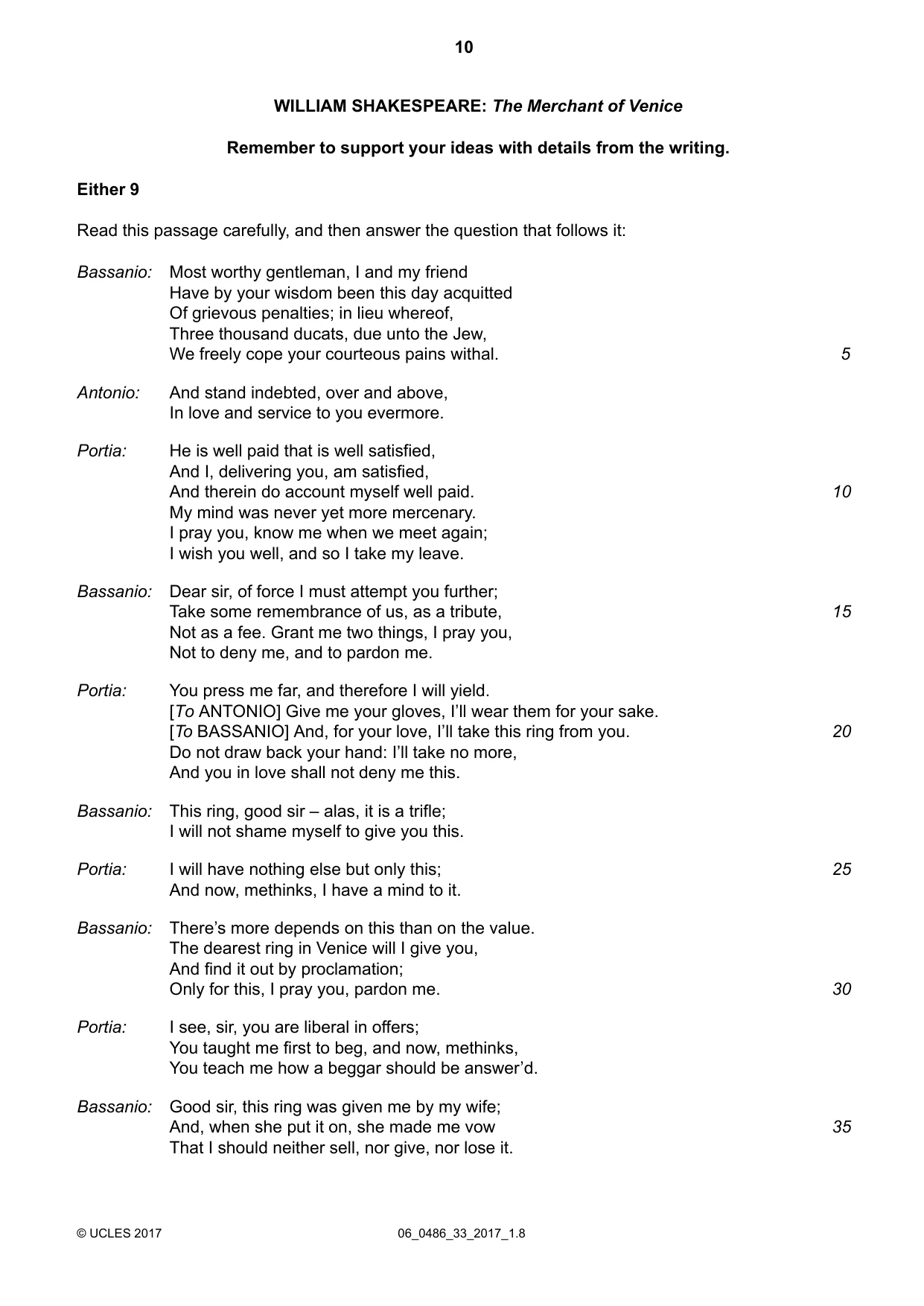
Question paper, page 10
35 30 25 20 15 10 5 WILLIAM SHAKESPEARE: The Merchant of Venice Remember to support your ideas with details from the writing. Either 9 Read this passage carefully, and then answer the question that follows it: Most worthy gentleman, I and my friend Have by your wisdom been this day acquitted Of grievous penalties; in lieu whereof, Three thousand ducats, due unto the Jew, We freely cope your courteous pains withal. Bassanio: And stand indebted, over and above, In love and service to you evermore. Antonio: He is well paid that is well satisfied, And I, delivering you, am satisfied, And therein do account myself well paid. My mind was never yet more mercenary. I pray you, know me when we meet again; I wish you well, and so I take my leave. Portia: Dear sir, of force I must attempt you further; Take some remembrance of us, as a tribute, Not as a fee. Grant me two things, I pray you, Not to deny me, and to pardon me. Bassanio: You press me far, and therefore I will yield. [To ANTONIO] Give me your gloves, I’ll wear them for your sake. [To BASSANIO] And, for your love, I’ll take this ring from you. Do not draw back your hand: I’ll take no more, And you in love shall not deny me this. Portia: This ring, good sir – alas, it is a trifle; I will not shame myself to give you this. Bassanio: I will have nothing else but only this; And now, methinks, I have a mind to it. Portia: There’s more depends on this than on the value. The dearest ring in Venice will I give you, And find it out by proclamation; Only for this, I pray you, pardon me. Bassanio: I see, sir, you are liberal in offers; You taught me first to beg, and now, methinks, You teach me how a beggar should be answer’d. Portia: Good sir, this ring was given me by my wife; And, when she put it on, she made me vow That I should neither sell, nor give, nor lose it. Bassanio: 06_0486_33_2017_1.8 © UCLES 2017 10
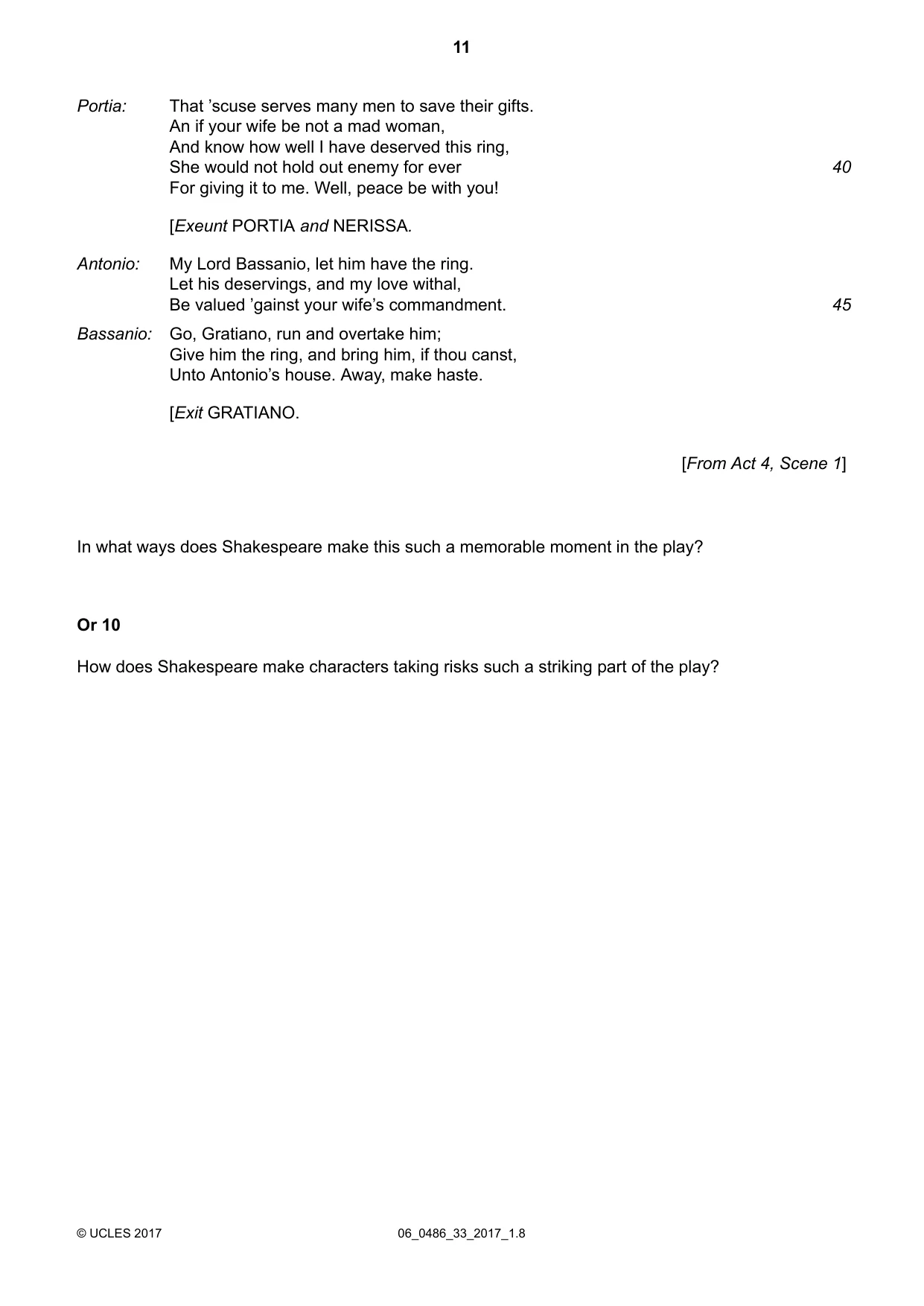
Question paper, page 11
45 40 That ’scuse serves many men to save their gifts. An if your wife be not a mad woman, And know how well I have deserved this ring, She would not hold out enemy for ever For giving it to me. Well, peace be with you! Portia: [Exeunt PORTIA and NERISSA. My Lord Bassanio, let him have the ring. Let his deservings, and my love withal, Be valued ’gainst your wife’s commandment. Antonio: Go, Gratiano, run and overtake him; Give him the ring, and bring him, if thou canst, Unto Antonio’s house. Away, make haste. Bassanio: [Exit GRATIANO. [From Act 4, Scene 1] In what ways does Shakespeare make this such a memorable moment in the play? Or 10 How does Shakespeare make characters taking risks such a striking part of the play? 06_0486_33_2017_1.8 © UCLES 2017 11
Question paper, page 12
BLANK PAGE Permission to reproduce items where third-party owned material protected by copyright is included has been sought and cleared where possible. Every reasonable effort has been made by the publisher (UCLES) to trace copyright holders, but if any items requiring clearance have unwittingly been included, the publisher will be pleased to make amends at the earliest possible opportunity. To avoid the issue of disclosure of answer-related information to candidates, all copyright acknowledgements are reproduced online in the Cambridge International Examinations Copyright Acknowledgements Booklet. This is produced for each series of examinations and is freely available to download at www.cie.org.uk after the live examination series. Cambridge International Examinations is part of the Cambridge Assessment Group. Cambridge Assessment is the brand name of University of Cambridge Local Examinations Syndicate (UCLES), which is itself a department of the University of Cambridge. 06_0486_33_2017_1.8 © UCLES 2017 12
Mark scheme, page 1
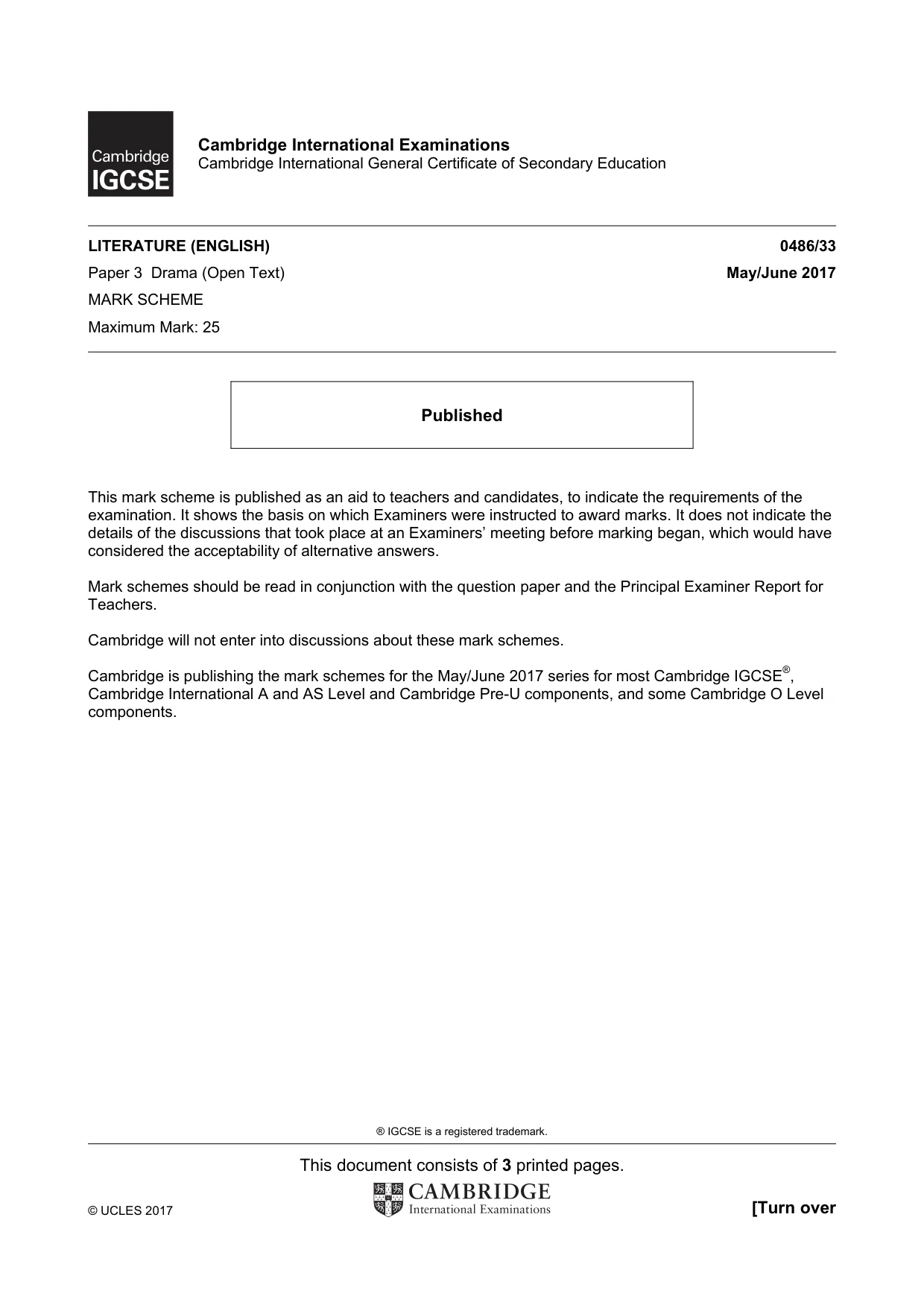
® IGCSE is a registered trademark. This document consists of 3 printed pages. © UCLES 2017 [Turn over Cambridge International Examinations Cambridge International General Certificate of Secondary Education LITERATURE (ENGLISH) 0486/33 Paper 3 Drama (Open Text) May/June 2017 MARK SCHEME Maximum Mark: 25 Published This mark scheme is published as an aid to teachers and candidates, to indicate the requirements of the examination. It shows the basis on which Examiners were instructed to award marks. It does not indicate the details of the discussions that took place at an Examiners’ meeting before marking began, which would have considered the acceptability of alternative answers. Mark schemes should be read in conjunction with the question paper and the Principal Examiner Report for Teachers. Cambridge will not enter into discussions about these mark schemes. Cambridge is publishing the mark schemes for the May/June 2017 series for most Cambridge IGCSE®, Cambridge International A and AS Level and Cambridge Pre-U components, and some Cambridge O Level components.
Mark scheme, page 2
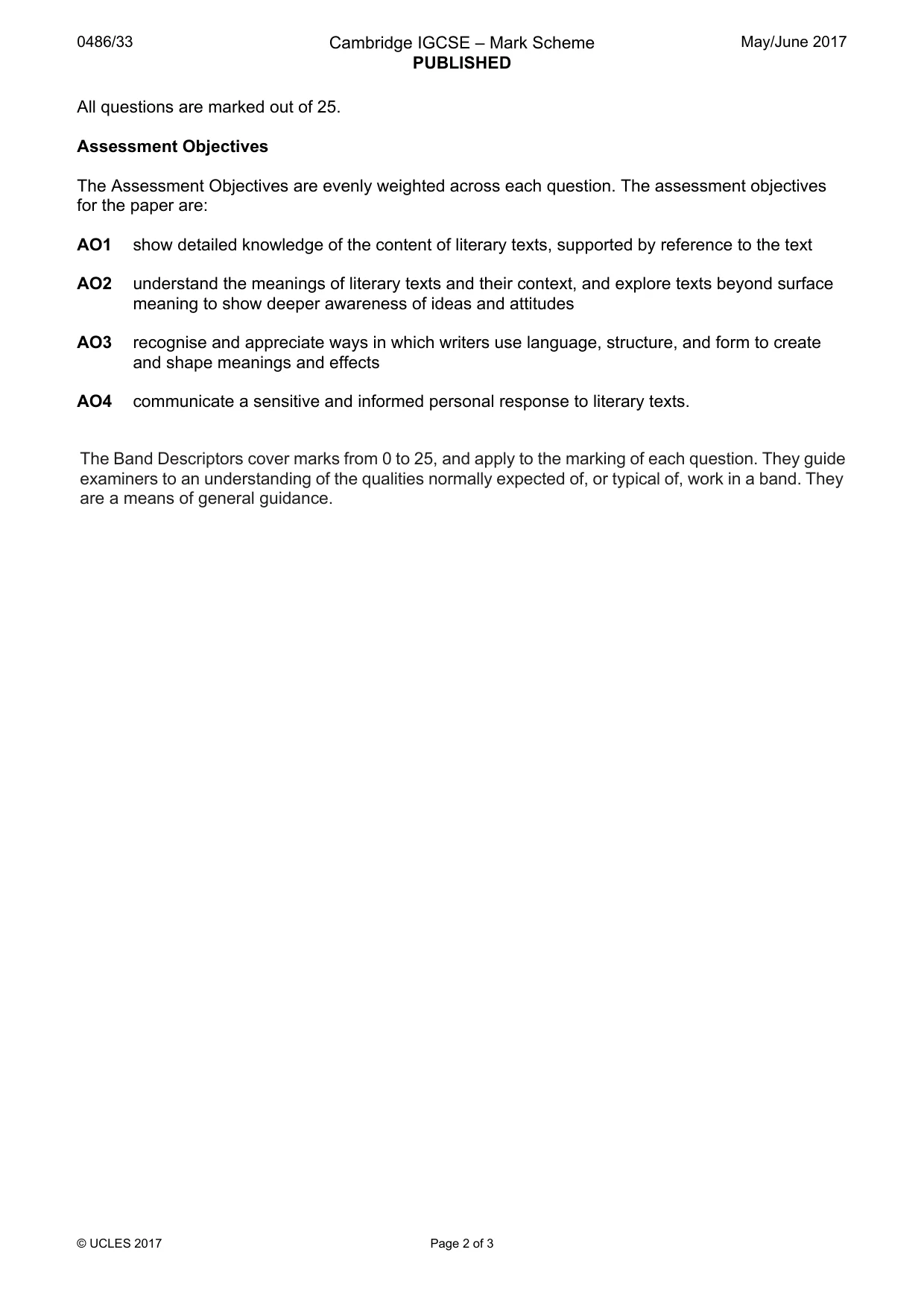
0486/33 Cambridge IGCSE – Mark Scheme PUBLISHED May/June 2017 © UCLES 2017 Page 2 of 3 All questions are marked out of 25. Assessment Objectives The Assessment Objectives are evenly weighted across each question. The assessment objectives for the paper are: AO1 show detailed knowledge of the content of literary texts, supported by reference to the text AO2 understand the meanings of literary texts and their context, and explore texts beyond surface meaning to show deeper awareness of ideas and attitudes AO3 recognise and appreciate ways in which writers use language, structure, and form to create and shape meanings and effects AO4 communicate a sensitive and informed personal response to literary texts. The Band Descriptors cover marks from 0 to 25, and apply to the marking of each question. They guide examiners to an understanding of the qualities normally expected of, or typical of, work in a band. They are a means of general guidance.
Mark scheme, page 3
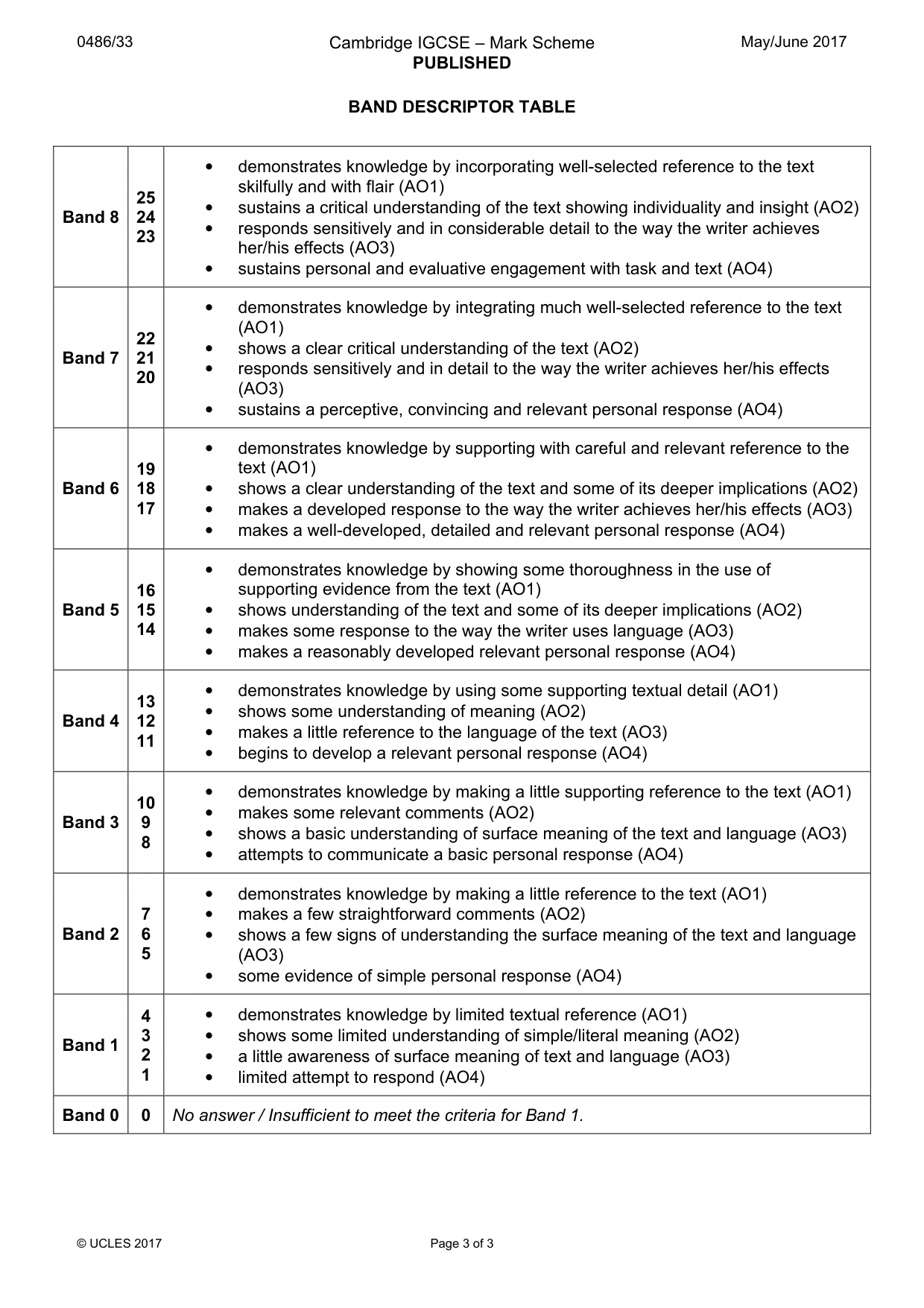
0486/33 Cambridge IGCSE – Mark Scheme PUBLISHED May/June 2017 © UCLES 2017 Page 3 of 3 BAND DESCRIPTOR TABLE Band 8 25 24 23 • demonstrates knowledge by incorporating well-selected reference to the text skilfully and with flair (AO1) • sustains a critical understanding of the text showing individuality and insight (AO2) • responds sensitively and in considerable detail to the way the writer achieves her/his effects (AO3) • sustains personal and evaluative engagement with task and text (AO4) Band 7 22 21 20 • demonstrates knowledge by integrating much well-selected reference to the text (AO1) • shows a clear critical understanding of the text (AO2) • responds sensitively and in detail to the way the writer achieves her/his effects (AO3) • sustains a perceptive, convincing and relevant personal response (AO4) Band 6 19 18 17 • demonstrates knowledge by supporting with careful and relevant reference to the text (AO1) • shows a clear understanding of the text and some of its deeper implications (AO2) • makes a developed response to the way the writer achieves her/his effects (AO3) • makes a well-developed, detailed and relevant personal response (AO4) Band 5 16 15 14 • demonstrates knowledge by showing some thoroughness in the use of supporting evidence from the text (AO1) • shows understanding of the text and some of its deeper implications (AO2) • makes some response to the way the writer uses language (AO3) • makes a reasonably developed relevant personal response (AO4) Band 4 13 12 11 • demonstrates knowledge by using some supporting textual detail (AO1) • shows some understanding of meaning (AO2) • makes a little reference to the language of the text (AO3) • begins to develop a relevant personal response (AO4) Band 3 10 9 8 • demonstrates knowledge by making a little supporting reference to the text (AO1) • makes some relevant comments (AO2) • shows a basic understanding of surface meaning of the text and language (AO3) • attempts to communicate a basic personal response (AO4) Band 2 7 6 5 • demonstrates knowledge by making a little reference to the text (AO1) • makes a few straightforward comments (AO2) • shows a few signs of understanding the surface meaning of the text and language (AO3) • some evidence of simple personal response (AO4) Band 1 4 3 2 1 • demonstrates knowledge by limited textual reference (AO1) • shows some limited understanding of simple/literal meaning (AO2) • a little awareness of surface meaning of text and language (AO3) • limited attempt to respond (AO4) Band 0 0 No answer / Insufficient to meet the criteria for Band 1.
What you needed in this session
Cambridge’s own grade thresholds for 2017 May/June, Paper 3 · Variant 3. A higher threshold means an easier paper — the bar moves with how the cohort did.