Cambridge IGCSE English - Literature 0486 — 2019 May/June Paper 3 · Variant 3
0486/33/M/J/19 · 25 marks · ≈28 min
The question paper and its mark scheme, free to read here and free to download. This is Cambridge’s own paper, exactly as it was sat.
Question paper12 pages
Mark scheme4 pages
Answers below. Sit the paper first if you are practising.
Paper as text
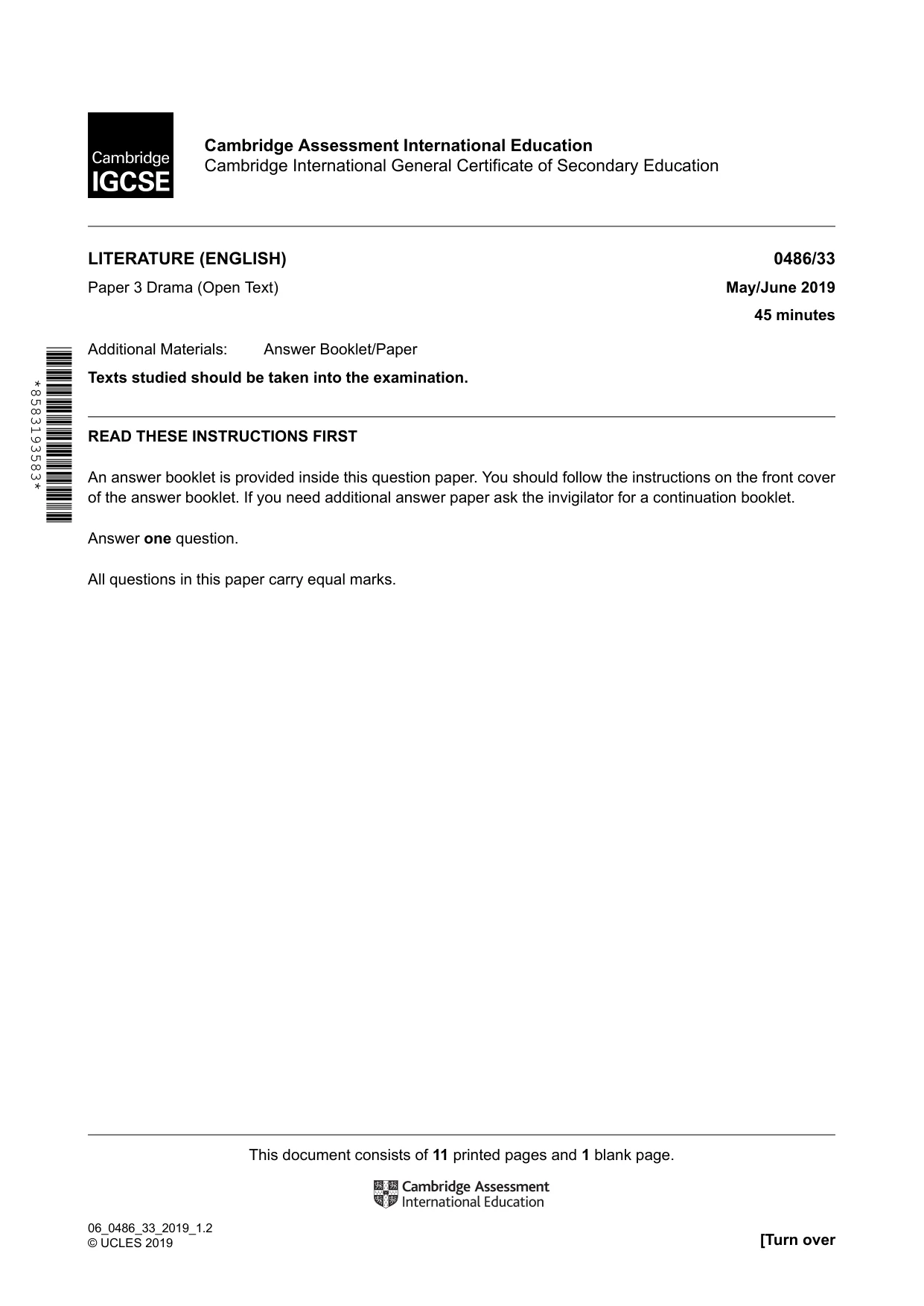
Question paper, page 1
Cambridge Assessment International Education Cambridge International General Certificate of Secondary Education 0486/33 LITERATURE (ENGLISH) May/June 2019 Paper 3 Drama (Open Text) 45 minutes Additional Materials: Answer Booklet/Paper Texts studied should be taken into the examination. READ THESE INSTRUCTIONS FIRST An answer booklet is provided inside this question paper. You should follow the instructions on the front cover of the answer booklet. If you need additional answer paper ask the invigilator for a continuation booklet. Answer one question. All questions in this paper carry equal marks. This document consists of 11 printed pages and 1 blank page. [Turn over 06_0486_33_2019_1.2 © UCLES 2019 *8583193583*
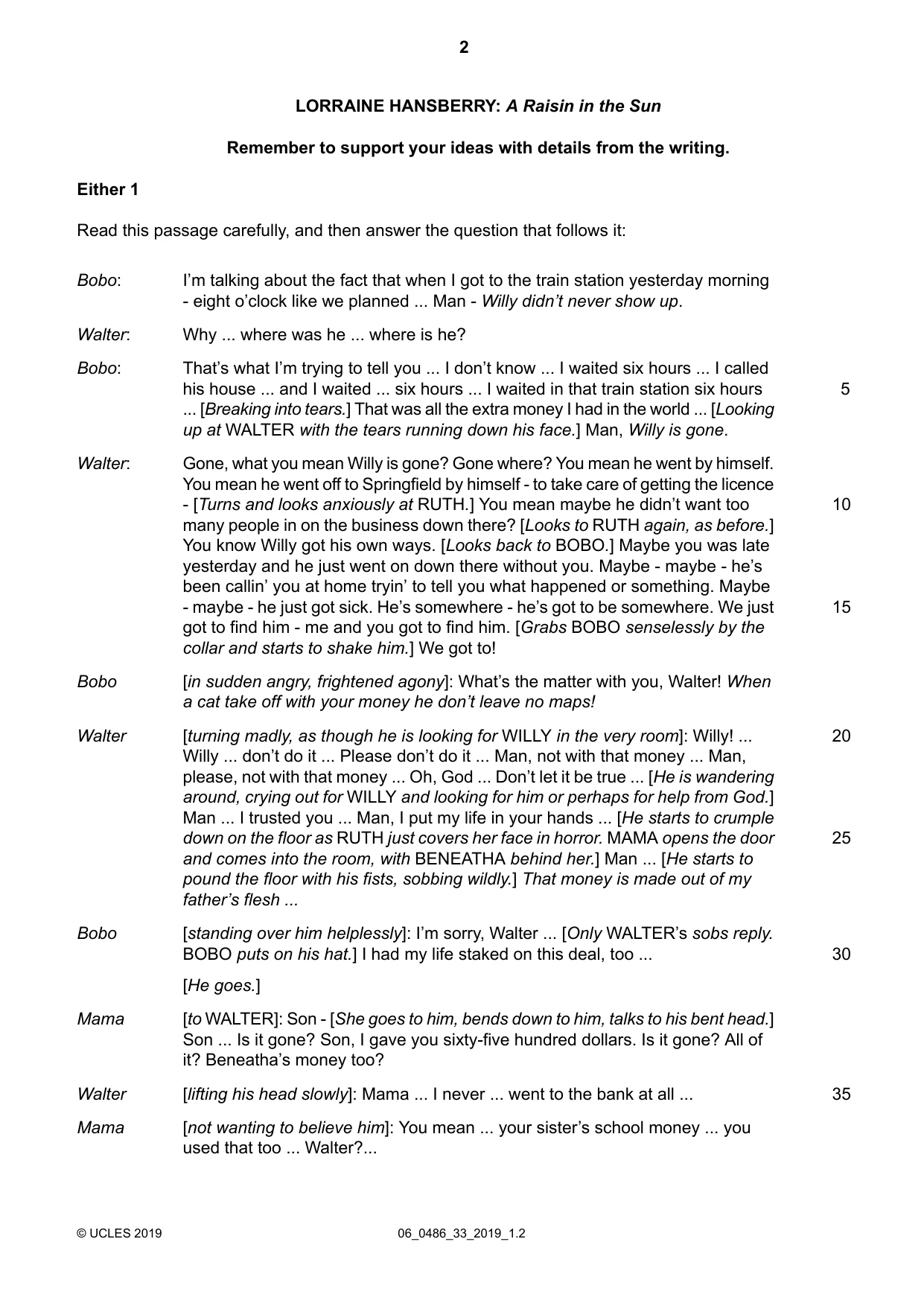
Question paper, page 2
35 30 25 20 15 10 5 LORRAINE HANSBERRY: A Raisin in the Sun Remember to support your ideas with details from the writing. Either 1 Read this passage carefully, and then answer the question that follows it: I’m talking about the fact that when I got to the train station yesterday morning - eight o’clock like we planned ... Man - Willy didn’t never show up. Bobo: Why ... where was he ... where is he? Walter: That’s what I’m trying to tell you ... I don’t know ... I waited six hours ... I called his house ... and I waited ... six hours ... I waited in that train station six hours ... [Breaking into tears.] That was all the extra money I had in the world ... [Looking up at WALTER with the tears running down his face.] Man, Willy is gone. Bobo: Gone, what you mean Willy is gone? Gone where? You mean he went by himself. You mean he went off to Springfield by himself - to take care of getting the licence - [Turns and looks anxiously at RUTH.] You mean maybe he didn’t want too many people in on the business down there? [Looks to RUTH again, as before.] You know Willy got his own ways. [Looks back to BOBO.] Maybe you was late yesterday and he just went on down there without you. Maybe - maybe - he’s been callin’ you at home tryin’ to tell you what happened or something. Maybe - maybe - he just got sick. He’s somewhere - he’s got to be somewhere. We just got to find him - me and you got to find him. [Grabs BOBO senselessly by the collar and starts to shake him.] We got to! Walter: [in sudden angry, frightened agony]: What’s the matter with you, Walter! When a cat take off with your money he don’t leave no maps! Bobo [turning madly, as though he is looking for WILLY in the very room]: Willy! ... Willy ... don’t do it ... Please don’t do it ... Man, not with that money ... Man, please, not with that money ... Oh, God ... Don’t let it be true ... [He is wandering around, crying out for WILLY and looking for him or perhaps for help from God.] Man ... I trusted you ... Man, I put my life in your hands ... [He starts to crumple down on the floor as RUTH just covers her face in horror. MAMA opens the door and comes into the room, with BENEATHA behind her.] Man ... [He starts to pound the floor with his fists, sobbing wildly.] That money is made out of my father’s flesh ... Walter [standing over him helplessly]: I’m sorry, Walter ... [Only WALTER’s sobs reply. BOBO puts on his hat.] I had my life staked on this deal, too ... [He goes.] Bobo [to WALTER]: Son - [She goes to him, bends down to him, talks to his bent head.] Son ... Is it gone? Son, I gave you sixty-five hundred dollars. Is it gone? All of it? Beneatha’s money too? Mama [lifting his head slowly]: Mama ... I never ... went to the bank at all ... Walter [not wanting to believe him]: You mean ... your sister’s school money ... you used that too ... Walter?... Mama 06_0486_33_2019_1.2 © UCLES 2019 2
Question paper, page 3
55 50 45 40 Yesss! ... All of it ... It’s all gone ... [There is total silence. RUTH stands with her face covered with her hands; BENEATHA leans forlornly against a wall, fingering a piece of red ribbon from the mother’s gift. MAMA stops and looks at her son without recognition and then, quite without thinking about it, starts to beat him senselessly in the face. BENEATHA goes to them and stops it.] Walter: Mama! [MAMA stops and looks at both her children and rises slowly and wanders vaguely, aimlessly away from them.] Beneatha: I seen ... him ... night after night ... come in ... and look at that rug ... and then look at me ... the red showing in his eyes ... the veins moving his head ... I seen him grow thin and old before he was forty ... working and working and working like somebody’s old horse ... killing himself ... and you - you give it all away in a day ... Mama: Mama - Beneatha: Oh, God ... [She looks up to Him.] Look down here - and show me the strength. Mama: Mama - Beneatha: [folding over]: Strength ... Mama [plaintively]: Mama ... Beneatha Strength! Curtain Mama: [from Act 2 Scene 3] In what ways does Hansberry make this moment in the play so shocking? Or 2 How far does Hansberry’s portrayal of Mama lead you to admire her? Do not use the passage printed in Question 1 when answering this question. [Turn over 06_0486_33_2019_1.2 © UCLES 2019 3
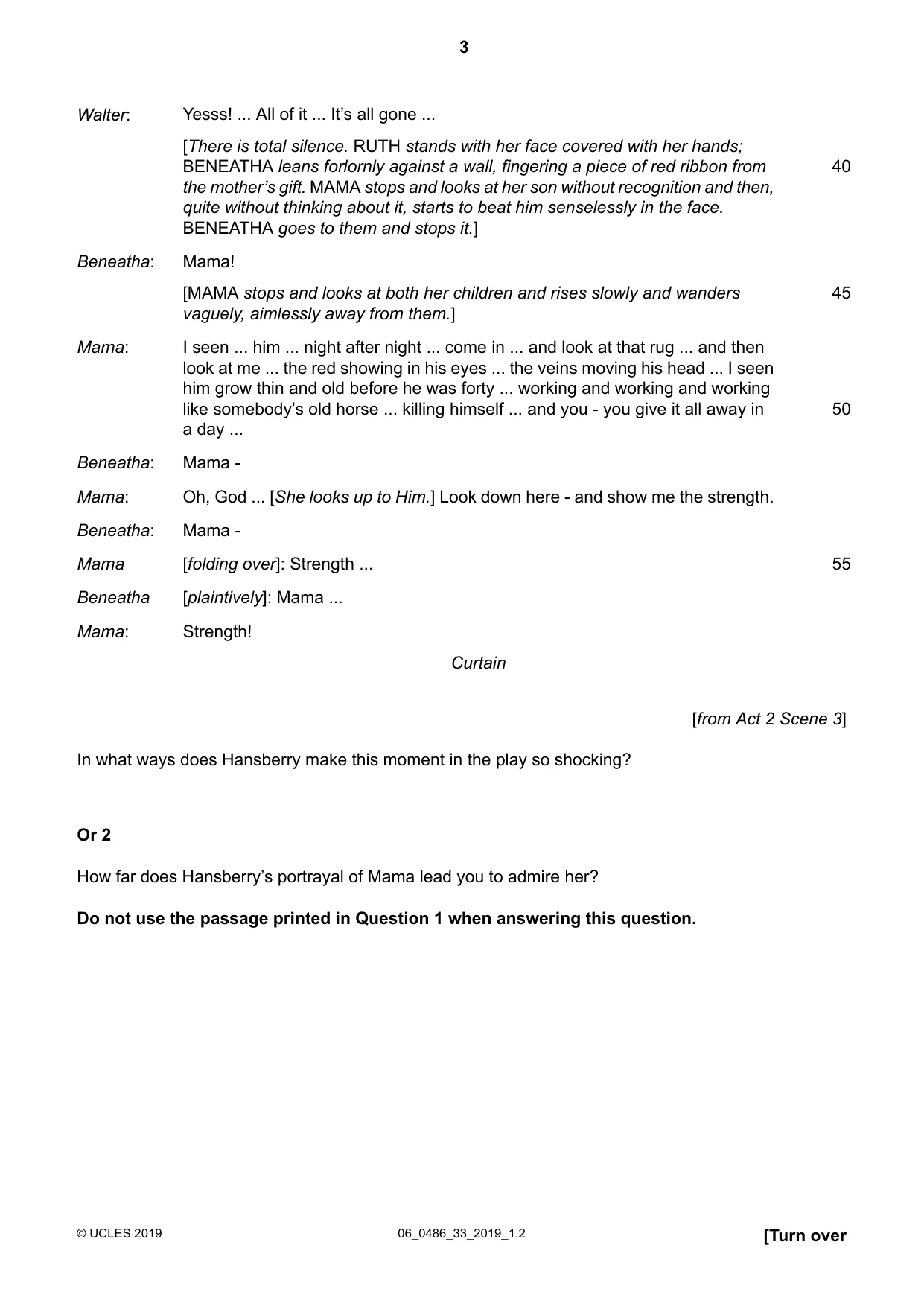
Question paper, page 4
ARTHUR MILLER: A View from the Bridge Remember to support your ideas with details from the writing. Either 3 Read this passage carefully, and then answer the question that follows it: You gotta push a taxi? Beatrice: 06_0486_33_2019_1.2 © UCLES 2019 4 Content removed due to copyright restrictions.
Question paper, page 5
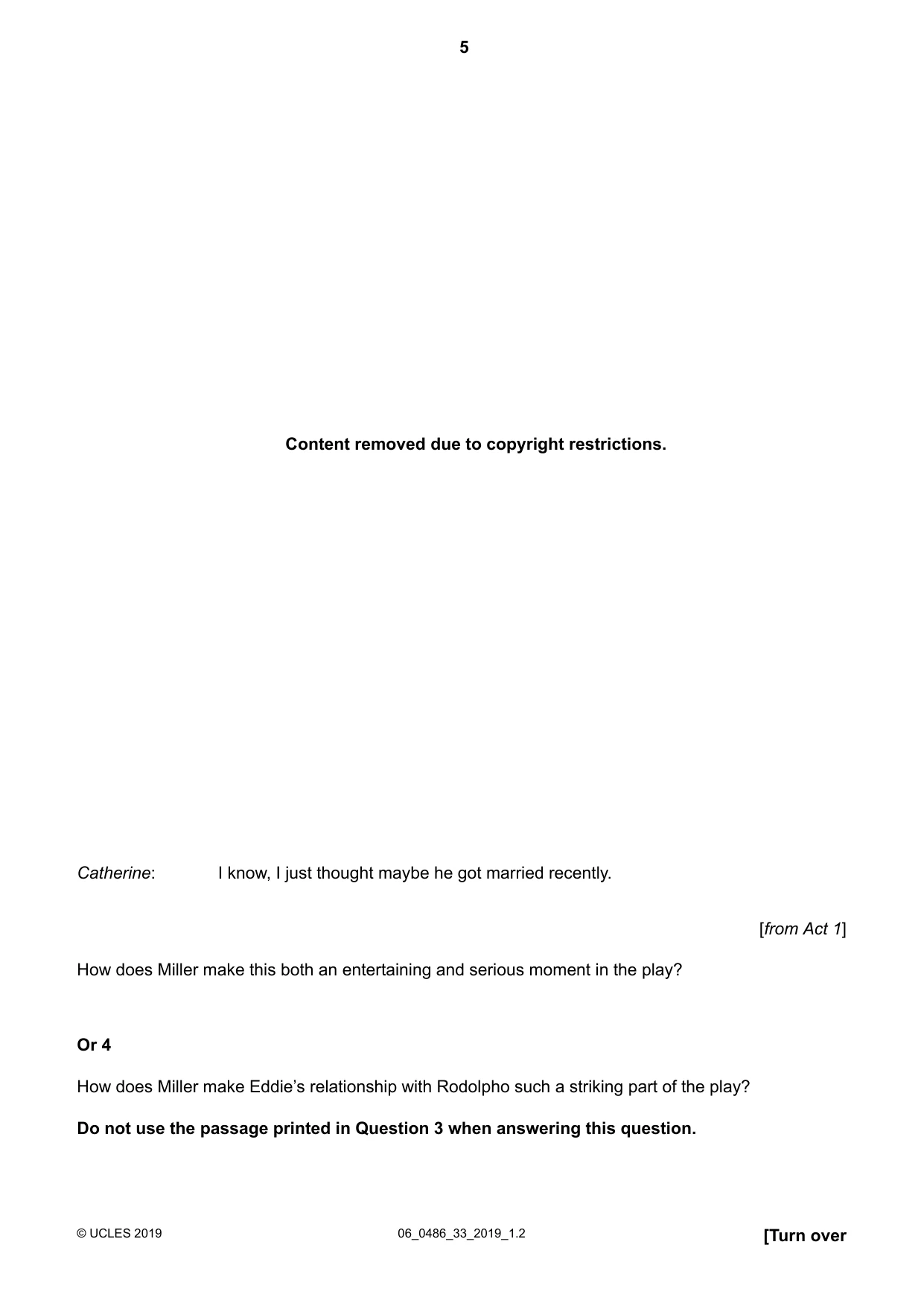
I know, I just thought maybe he got married recently. Catherine: [from Act 1] How does Miller make this both an entertaining and serious moment in the play? Or 4 How does Miller make Eddie’s relationship with Rodolpho such a striking part of the play? Do not use the passage printed in Question 3 when answering this question. [Turn over 06_0486_33_2019_1.2 © UCLES 2019 5 Content removed due to copyright restrictions.
Question paper, page 6
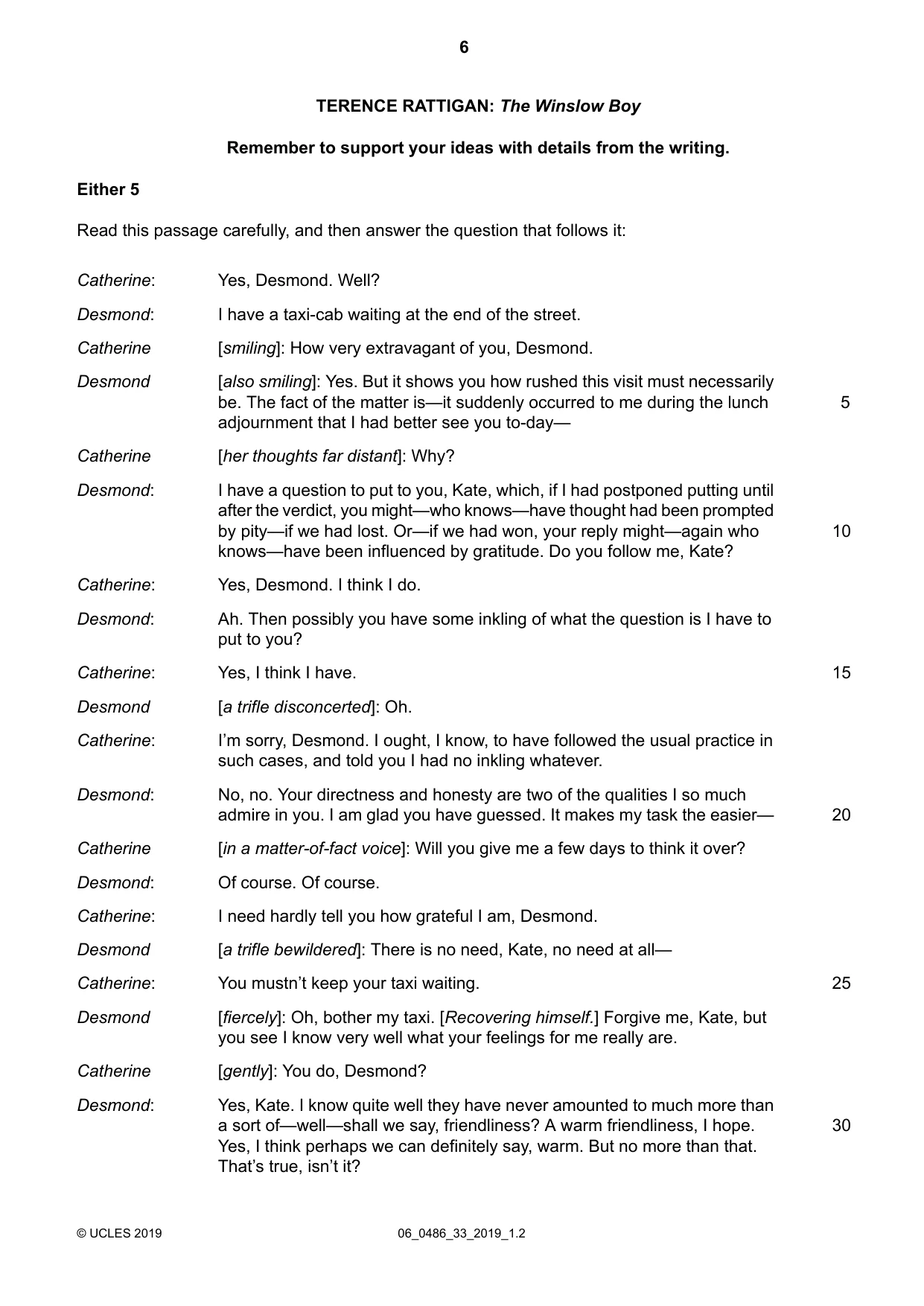
30 25 20 15 10 5 TERENCE RATTIGAN: The Winslow Boy Remember to support your ideas with details from the writing. Either 5 Read this passage carefully, and then answer the question that follows it: Yes, Desmond. Well? Catherine: I have a taxi-cab waiting at the end of the street. Desmond: [smiling]: How very extravagant of you, Desmond. Catherine [also smiling]: Yes. But it shows you how rushed this visit must necessarily be. The fact of the matter is—it suddenly occurred to me during the lunch adjournment that I had better see you to-day— Desmond [her thoughts far distant]: Why? Catherine I have a question to put to you, Kate, which, if I had postponed putting until after the verdict, you might—who knows—have thought had been prompted by pity—if we had lost. Or—if we had won, your reply might—again who knows—have been influenced by gratitude. Do you follow me, Kate? Desmond: Yes, Desmond. I think I do. Catherine: Ah. Then possibly you have some inkling of what the question is I have to put to you? Desmond: Yes, I think I have. Catherine: [a trifle disconcerted]: Oh. Desmond I’m sorry, Desmond. I ought, I know, to have followed the usual practice in such cases, and told you I had no inkling whatever. Catherine: No, no. Your directness and honesty are two of the qualities I so much admire in you. I am glad you have guessed. It makes my task the easier— Desmond: [in a matter-of-fact voice]: Will you give me a few days to think it over? Catherine Of course. Of course. Desmond: I need hardly tell you how grateful I am, Desmond. Catherine: [a trifle bewildered]: There is no need, Kate, no need at all— Desmond You mustn’t keep your taxi waiting. Catherine: [fiercely]: Oh, bother my taxi. [Recovering himself.] Forgive me, Kate, but you see I know very well what your feelings for me really are. Desmond [gently]: You do, Desmond? Catherine Yes, Kate. I know quite well they have never amounted to much more than a sort of—well—shall we say, friendliness? A warm friendliness, I hope. Yes, I think perhaps we can definitely say, warm. But no more than that. That’s true, isn’t it? Desmond: 06_0486_33_2019_1.2 © UCLES 2019 6
Question paper, page 7
45 40 35 [quietly]: Yes, Desmond. Catherine I know, I know. Of course, the thing is that even if I proved the most devoted and adoring husband that ever lived—which, I may say, if you give me the chance, I intend to be—your feelings for me would never—could never—amount to more than that. When I was younger it might, perhaps, have been a different story. When I played cricket for England— [DESMOND notices the faintest expression of pity that has crossed CATHERINE’s face.] [Apologetically.] And of course, perhaps even that would not have made so much difference. Perhaps you feel I cling too much to my past athletic prowess. I feel it myself, sometimes—but the truth is I have not much else to cling to save that and my love for you. The athletic prowess is fading, I’m afraid, with the years and the stiffening of the muscles—but my love for you will never fade. Desmond: [smiling]:That’s very charmingly said, Desmond. Catherine [from Act 2 Scene 2] In what ways does Rattigan make this moment in the play so moving? Or 6 How does Rattigan’s portrayal of the relationship between John Watherstone and Catherine Winslow contribute to the dramatic impact of the play? [Turn over 06_0486_33_2019_1.2 © UCLES 2019 7
Question paper, page 8
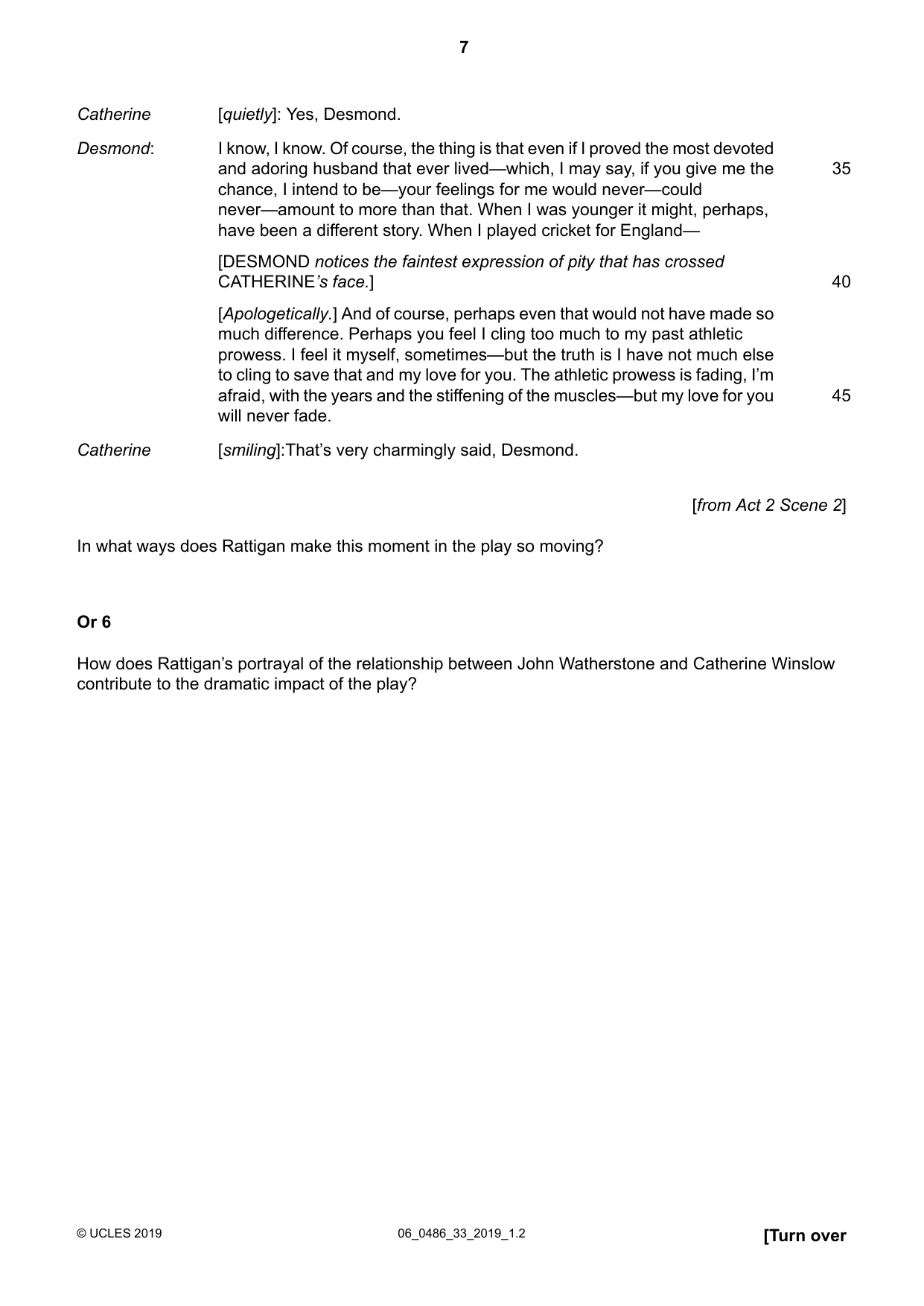
30 25 20 15 10 5 WILLIAM SHAKESPEARE: Macbeth Remember to support your ideas with details from the writing. Either 7 Read this passage carefully, and then answer the question that follows it: Sirrah, your father’s dead; And what will you do now? How will you live? Lady Macduff: As birds do, mother. Son: What, with worms and flies? Lady Macduff: With what I get, I mean; and so do they. Son: Poor bird! thou’dst never fear the net nor lime, The pitfall nor the gin. Lady Macduff: Why should I, mother? Poor birds they are not set for. My father is not dead, for all your saying. Son: Yes, he is dead. How wilt thou do for a father? Lady Macduff: Nay, how will you do for a husband? Son: Why, I can buy me twenty at any market. Lady Macduff: Then you’ll buy’em to sell again. Son: Thou speak’st with all thy wit; and yet, i’ faith, With wit enough for thee. Lady Macduff: Was my father a traitor, mother? Son: Ay, that he was. Lady Macduff: What is a traitor? Son: Why, one that swears and lies. Lady Macduff: And be all traitors that do so? Son: Every one that does so is a traitor, and must be hang’d. Lady Macduff: And must they all be hang’d that swear and lie? Son: Every one. Lady Macduff: Who must hang them? Son: Why, the honest men. Lady Macduff: Then the liars and swearers are fools; for there are liars and swearers enow to beat the honest men and hang up them. Son: Now, God help thee, poor monkey! But how wilt thou do for a father? Lady Macduff: If he were dead, you’d weep for him; if you would not, it were a good sign that I should quickly have a new father. Son: 06_0486_33_2019_1.2 © UCLES 2019 8
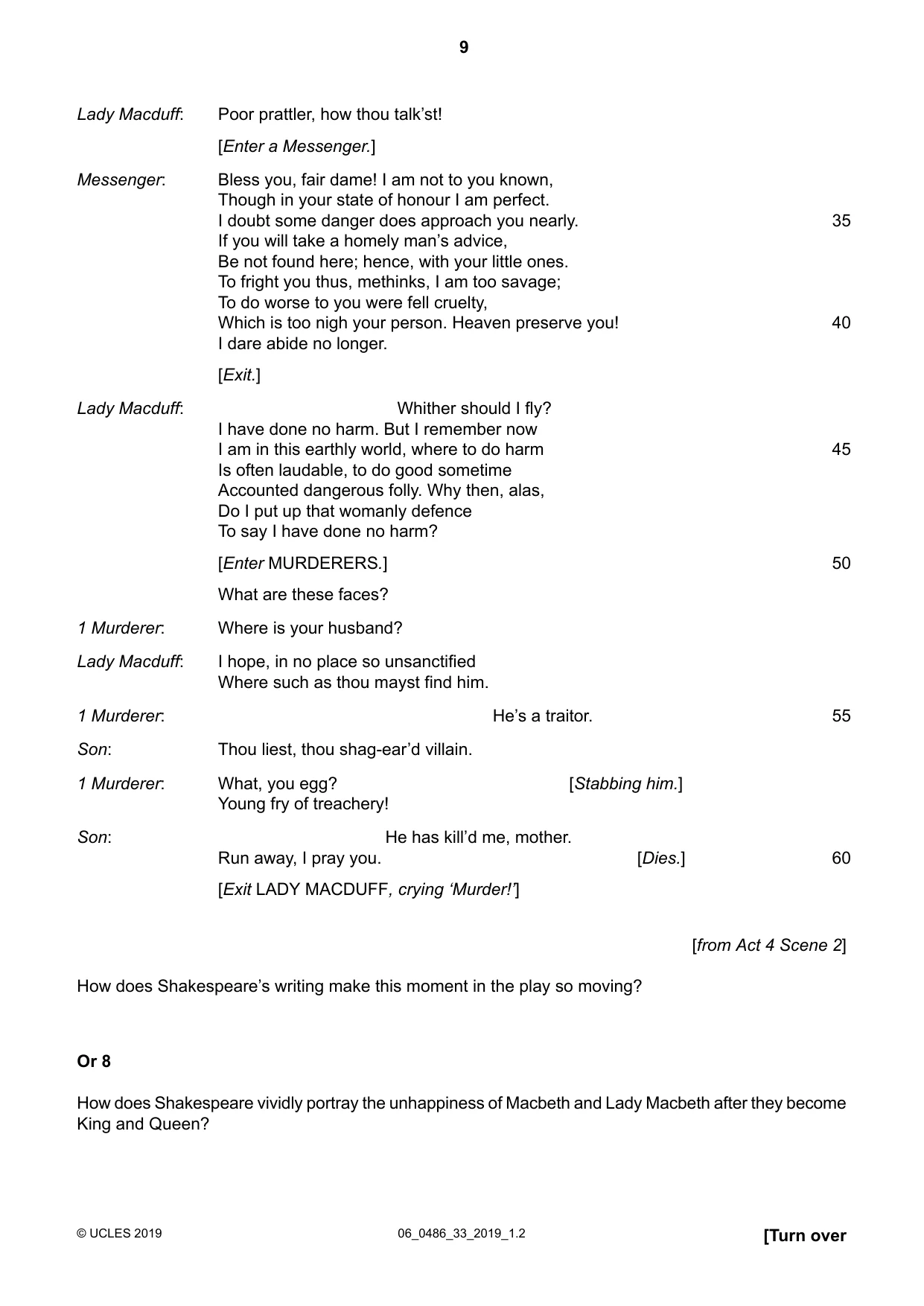
Question paper, page 9
60 55 50 45 40 35 Poor prattler, how thou talk’st! [Enter a Messenger.] Lady Macduff: Bless you, fair dame! I am not to you known, Though in your state of honour I am perfect. I doubt some danger does approach you nearly. If you will take a homely man’s advice, Be not found here; hence, with your little ones. To fright you thus, methinks, I am too savage; To do worse to you were fell cruelty, Which is too nigh your person. Heaven preserve you! I dare abide no longer. [Exit.] Messenger: Whither should I fly? I have done no harm. But I remember now I am in this earthly world, where to do harm Is often laudable, to do good sometime Accounted dangerous folly. Why then, alas, Do I put up that womanly defence To say I have done no harm? [Enter MURDERERS.] What are these faces? Lady Macduff: Where is your husband? 1 Murderer: I hope, in no place so unsanctified Where such as thou mayst find him. Lady Macduff: He’s a traitor. 1 Murderer: Thou liest, thou shag-ear’d villain. Son: What, you egg? [Stabbing him.] Young fry of treachery! 1 Murderer: He has kill’d me, mother. Run away, I pray you. [Dies.] [Exit LADY MACDUFF, crying ‘Murder!’] Son: [from Act 4 Scene 2] How does Shakespeare’s writing make this moment in the play so moving? Or 8 How does Shakespeare vividly portray the unhappiness of Macbeth and Lady Macbeth after they become King and Queen? [Turn over 06_0486_33_2019_1.2 © UCLES 2019 9
Question paper, page 10
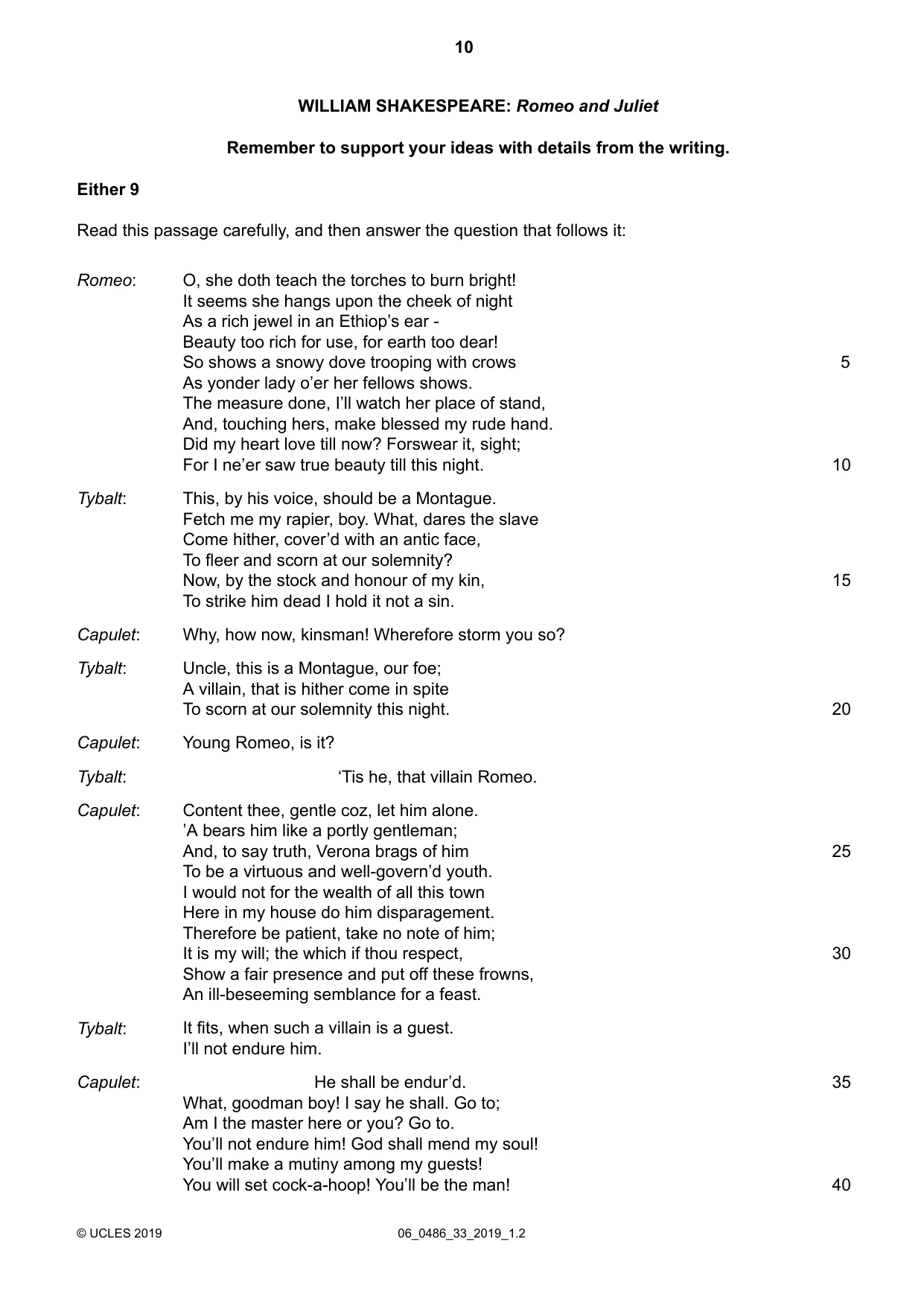
40 35 30 25 20 15 10 5 WILLIAM SHAKESPEARE: Romeo and Juliet Remember to support your ideas with details from the writing. Either 9 Read this passage carefully, and then answer the question that follows it: O, she doth teach the torches to burn bright! It seems she hangs upon the cheek of night As a rich jewel in an Ethiop’s ear - Beauty too rich for use, for earth too dear! So shows a snowy dove trooping with crows As yonder lady o’er her fellows shows. The measure done, I’ll watch her place of stand, And, touching hers, make blessed my rude hand. Did my heart love till now? Forswear it, sight; For I ne’er saw true beauty till this night. Romeo: This, by his voice, should be a Montague. Fetch me my rapier, boy. What, dares the slave Come hither, cover’d with an antic face, To fleer and scorn at our solemnity? Now, by the stock and honour of my kin, To strike him dead I hold it not a sin. Tybalt: Why, how now, kinsman! Wherefore storm you so? Capulet: Uncle, this is a Montague, our foe; A villain, that is hither come in spite To scorn at our solemnity this night. Tybalt: Young Romeo, is it? Capulet: ‘Tis he, that villain Romeo. Tybalt: Content thee, gentle coz, let him alone. ’A bears him like a portly gentleman; And, to say truth, Verona brags of him To be a virtuous and well-govern’d youth. I would not for the wealth of all this town Here in my house do him disparagement. Therefore be patient, take no note of him; It is my will; the which if thou respect, Show a fair presence and put off these frowns, An ill-beseeming semblance for a feast. Capulet: It fits, when such a villain is a guest. I’ll not endure him. Tybalt: He shall be endur’d. What, goodman boy! I say he shall. Go to; Am I the master here or you? Go to. You’ll not endure him! God shall mend my soul! You’ll make a mutiny among my guests! You will set cock-a-hoop! You’ll be the man! Capulet: 06_0486_33_2019_1.2 © UCLES 2019 10
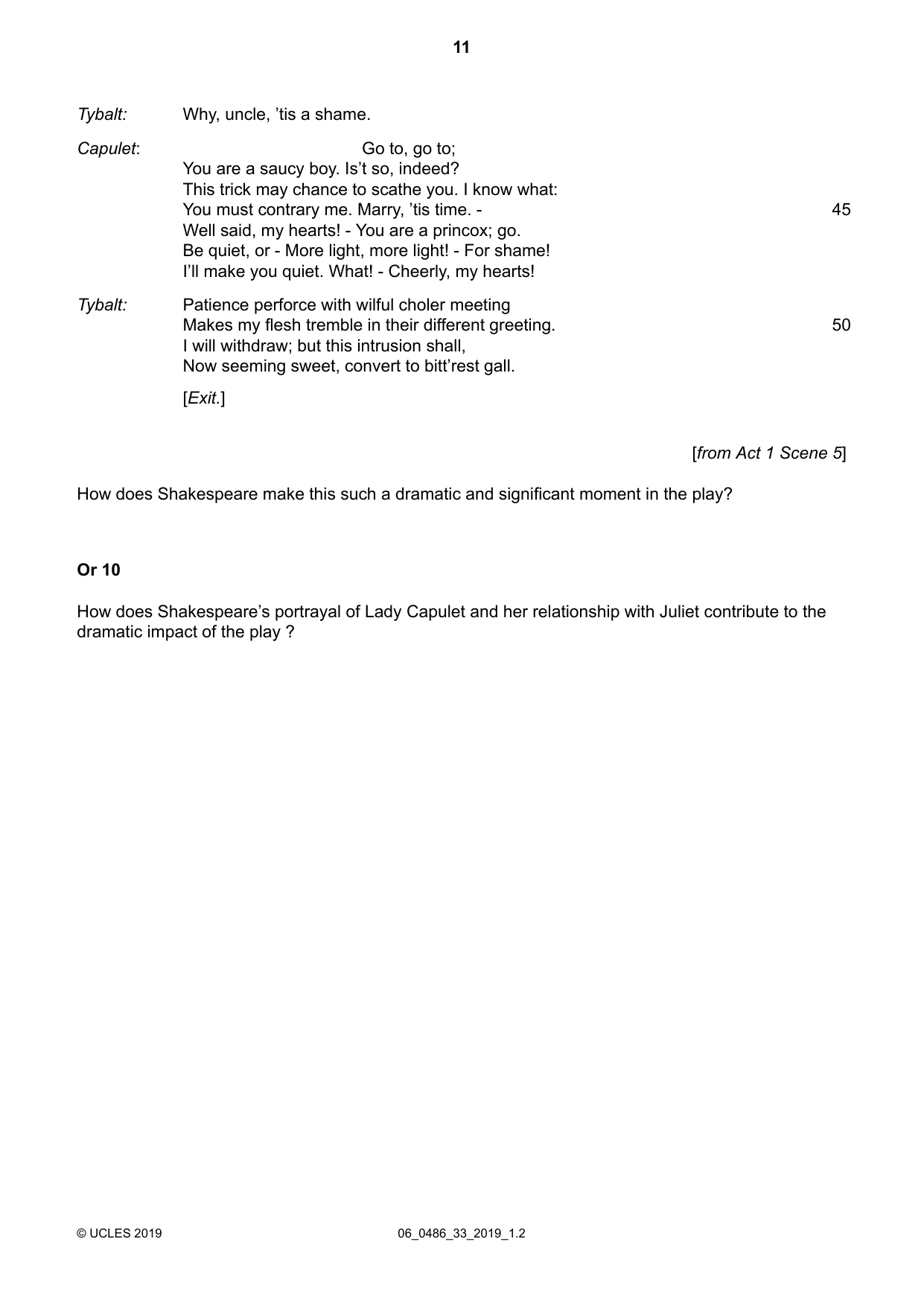
Question paper, page 11
50 45 Why, uncle, ’tis a shame. Tybalt: Go to, go to; You are a saucy boy. Is’t so, indeed? This trick may chance to scathe you. I know what: You must contrary me. Marry, ’tis time. - Well said, my hearts! - You are a princox; go. Be quiet, or - More light, more light! - For shame! I’ll make you quiet. What! - Cheerly, my hearts! Capulet: Patience perforce with wilful choler meeting Makes my flesh tremble in their different greeting. I will withdraw; but this intrusion shall, Now seeming sweet, convert to bitt’rest gall. [Exit.] Tybalt: [from Act 1 Scene 5] How does Shakespeare make this such a dramatic and significant moment in the play? Or 10 How does Shakespeare’s portrayal of Lady Capulet and her relationship with Juliet contribute to the dramatic impact of the play ? 06_0486_33_2019_1.2 © UCLES 2019 11
Question paper, page 12
BLANK PAGE Permission to reproduce items where third-party owned material protected by copyright is included has been sought and cleared where possible. Every reasonable effort has been made by the publisher (UCLES) to trace copyright holders, but if any items requiring clearance have unwittingly been included, the publisher will be pleased to make amends at the earliest possible opportunity. To avoid the issue of disclosure of answer-related information to candidates, all copyright acknowledgements are reproduced online in the Cambridge Assessment International Education Copyright Acknowledgements Booklet. This is produced for each series of examinations and is freely available to download at www.cambridgeinternational.org after the live examination series. Cambridge Assessment International Education is part of the Cambridge Assessment Group. Cambridge Assessment is the brand name of the University of Cambridge Local Examinations Syndicate (UCLES), which itself is a department of the University of Cambridge. 06_0486_33_2019_1.2 © UCLES 2019 12
Mark scheme, page 1
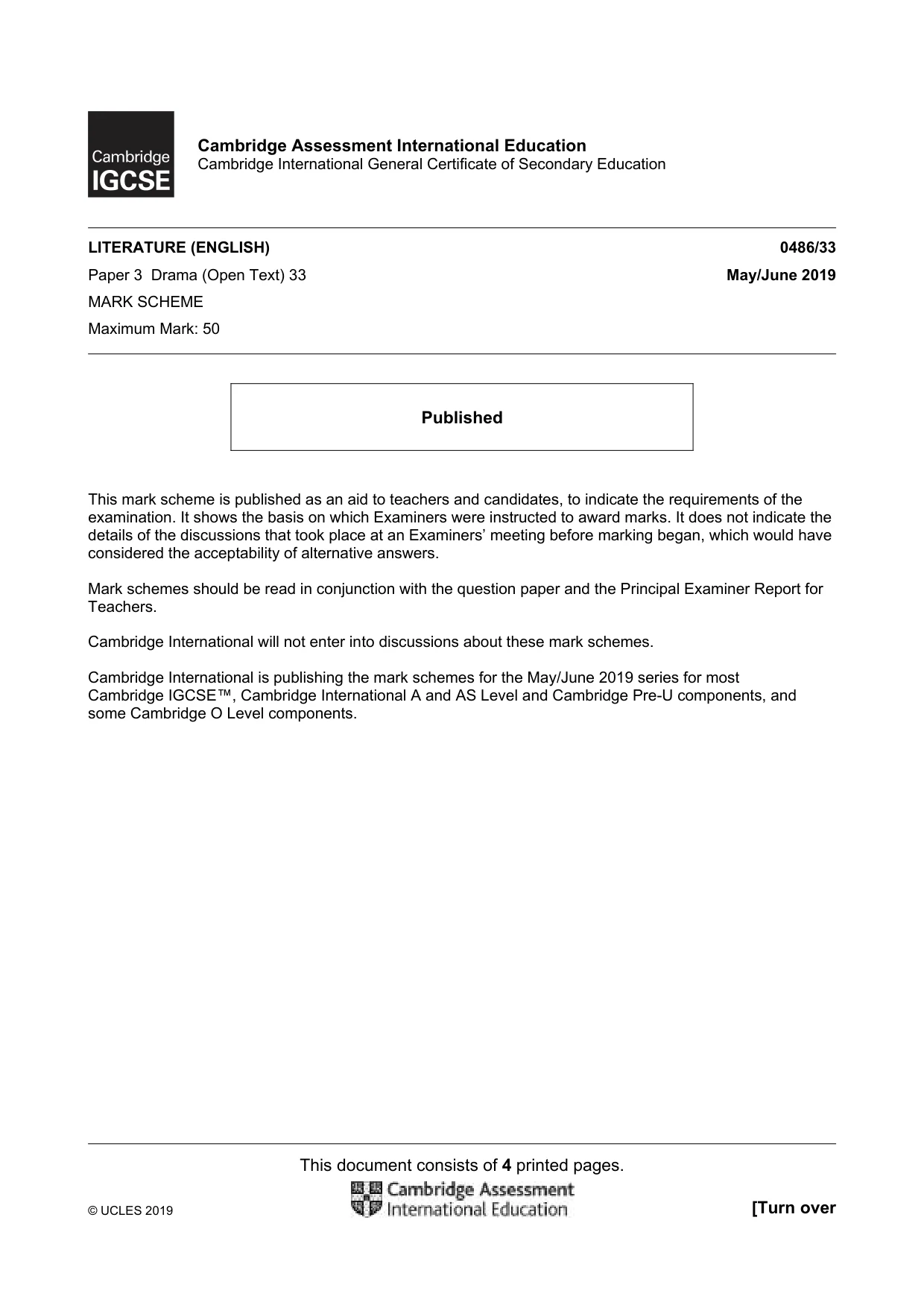
This document consists of 4 printed pages. © UCLES 2019 [Turn over Cambridge Assessment International Education Cambridge International General Certificate of Secondary Education LITERATURE (ENGLISH) 0486/33 Paper 3 Drama (Open Text) 33 May/June 2019 MARK SCHEME Maximum Mark: 50 Published This mark scheme is published as an aid to teachers and candidates, to indicate the requirements of the examination. It shows the basis on which Examiners were instructed to award marks. It does not indicate the details of the discussions that took place at an Examiners’ meeting before marking began, which would have considered the acceptability of alternative answers. Mark schemes should be read in conjunction with the question paper and the Principal Examiner Report for Teachers. Cambridge International will not enter into discussions about these mark schemes. Cambridge International is publishing the mark schemes for the May/June 2019 series for most Cambridge IGCSE™, Cambridge International A and AS Level and Cambridge Pre-U components, and some Cambridge O Level components.
Mark scheme, page 2
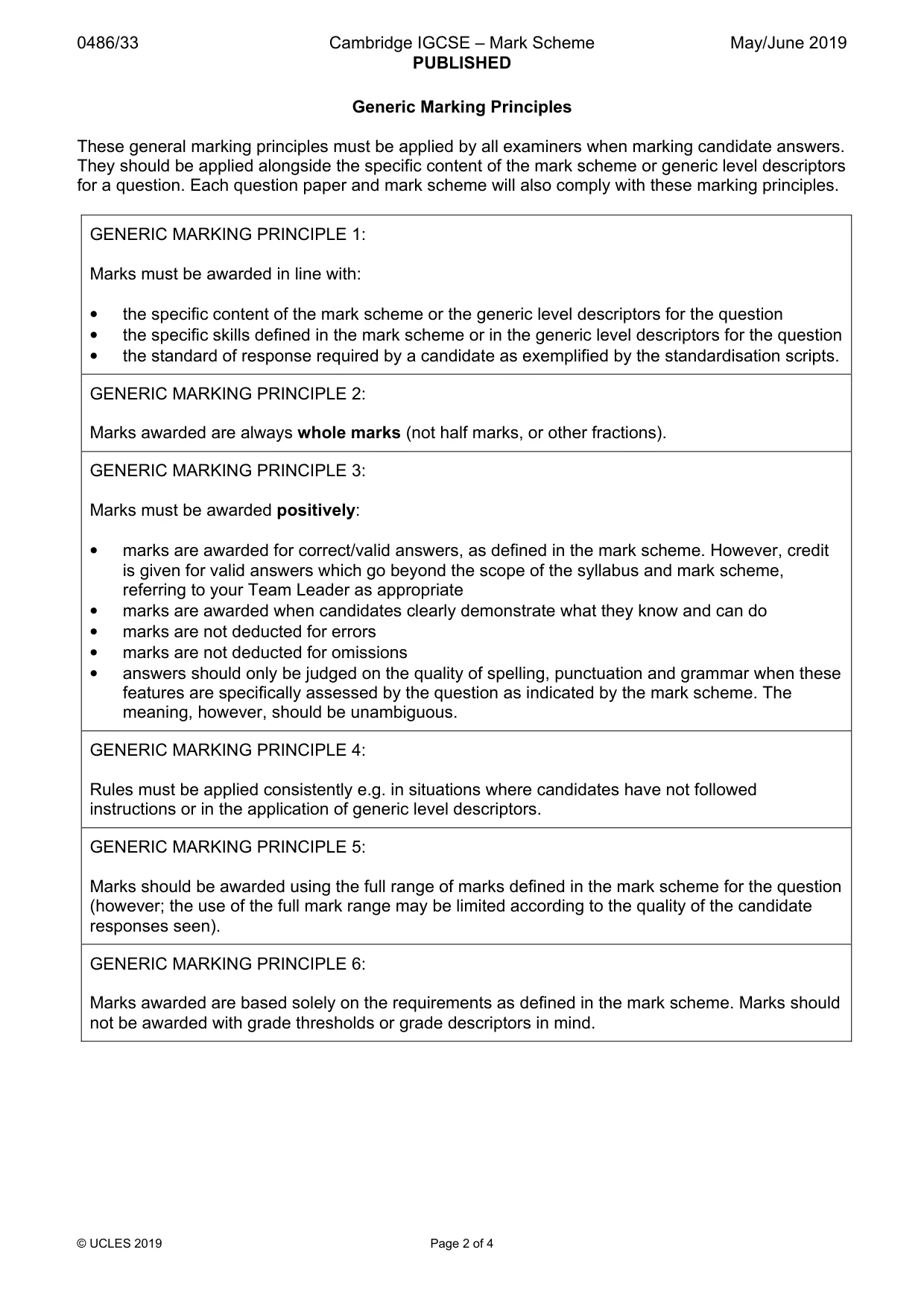
0486/33 Cambridge IGCSE – Mark Scheme PUBLISHED May/June 2019 © UCLES 2019 Page 2 of 4 Generic Marking Principles These general marking principles must be applied by all examiners when marking candidate answers. They should be applied alongside the specific content of the mark scheme or generic level descriptors for a question. Each question paper and mark scheme will also comply with these marking principles. GENERIC MARKING PRINCIPLE 1: Marks must be awarded in line with: • the specific content of the mark scheme or the generic level descriptors for the question • the specific skills defined in the mark scheme or in the generic level descriptors for the question • the standard of response required by a candidate as exemplified by the standardisation scripts. GENERIC MARKING PRINCIPLE 2: Marks awarded are always whole marks (not half marks, or other fractions). GENERIC MARKING PRINCIPLE 3: Marks must be awarded positively: • marks are awarded for correct/valid answers, as defined in the mark scheme. However, credit is given for valid answers which go beyond the scope of the syllabus and mark scheme, referring to your Team Leader as appropriate • marks are awarded when candidates clearly demonstrate what they know and can do • marks are not deducted for errors • marks are not deducted for omissions • answers should only be judged on the quality of spelling, punctuation and grammar when these features are specifically assessed by the question as indicated by the mark scheme. The meaning, however, should be unambiguous. GENERIC MARKING PRINCIPLE 4: Rules must be applied consistently e.g. in situations where candidates have not followed instructions or in the application of generic level descriptors. GENERIC MARKING PRINCIPLE 5: Marks should be awarded using the full range of marks defined in the mark scheme for the question (however; the use of the full mark range may be limited according to the quality of the candidate responses seen). GENERIC MARKING PRINCIPLE 6: Marks awarded are based solely on the requirements as defined in the mark scheme. Marks should not be awarded with grade thresholds or grade descriptors in mind.
Mark scheme, page 3
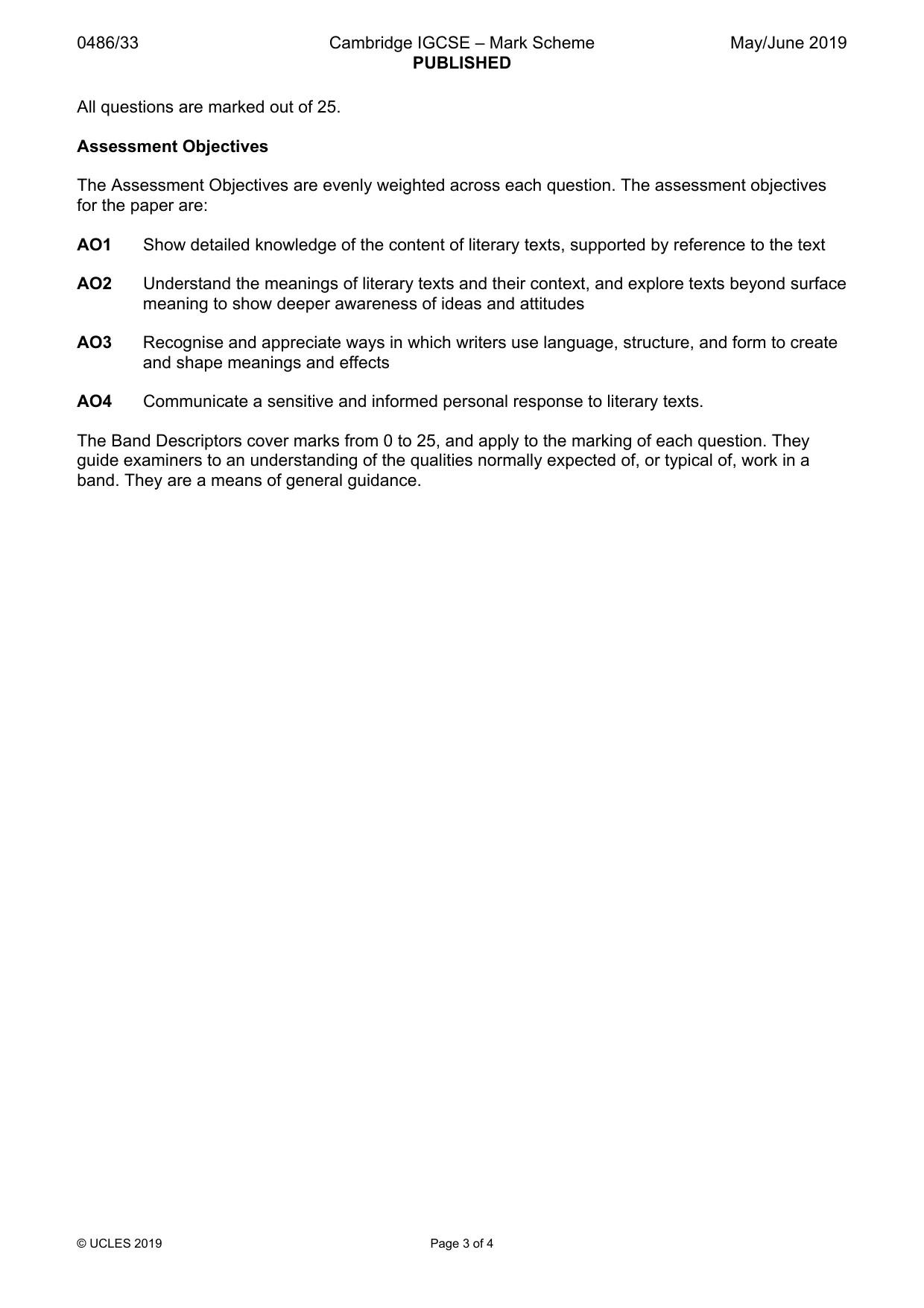
0486/33 Cambridge IGCSE – Mark Scheme PUBLISHED May/June 2019 © UCLES 2019 Page 3 of 4 All questions are marked out of 25. Assessment Objectives The Assessment Objectives are evenly weighted across each question. The assessment objectives for the paper are: AO1 Show detailed knowledge of the content of literary texts, supported by reference to the text AO2 Understand the meanings of literary texts and their context, and explore texts beyond surface meaning to show deeper awareness of ideas and attitudes AO3 Recognise and appreciate ways in which writers use language, structure, and form to create and shape meanings and effects AO4 Communicate a sensitive and informed personal response to literary texts. The Band Descriptors cover marks from 0 to 25, and apply to the marking of each question. They guide examiners to an understanding of the qualities normally expected of, or typical of, work in a band. They are a means of general guidance.
Mark scheme, page 4
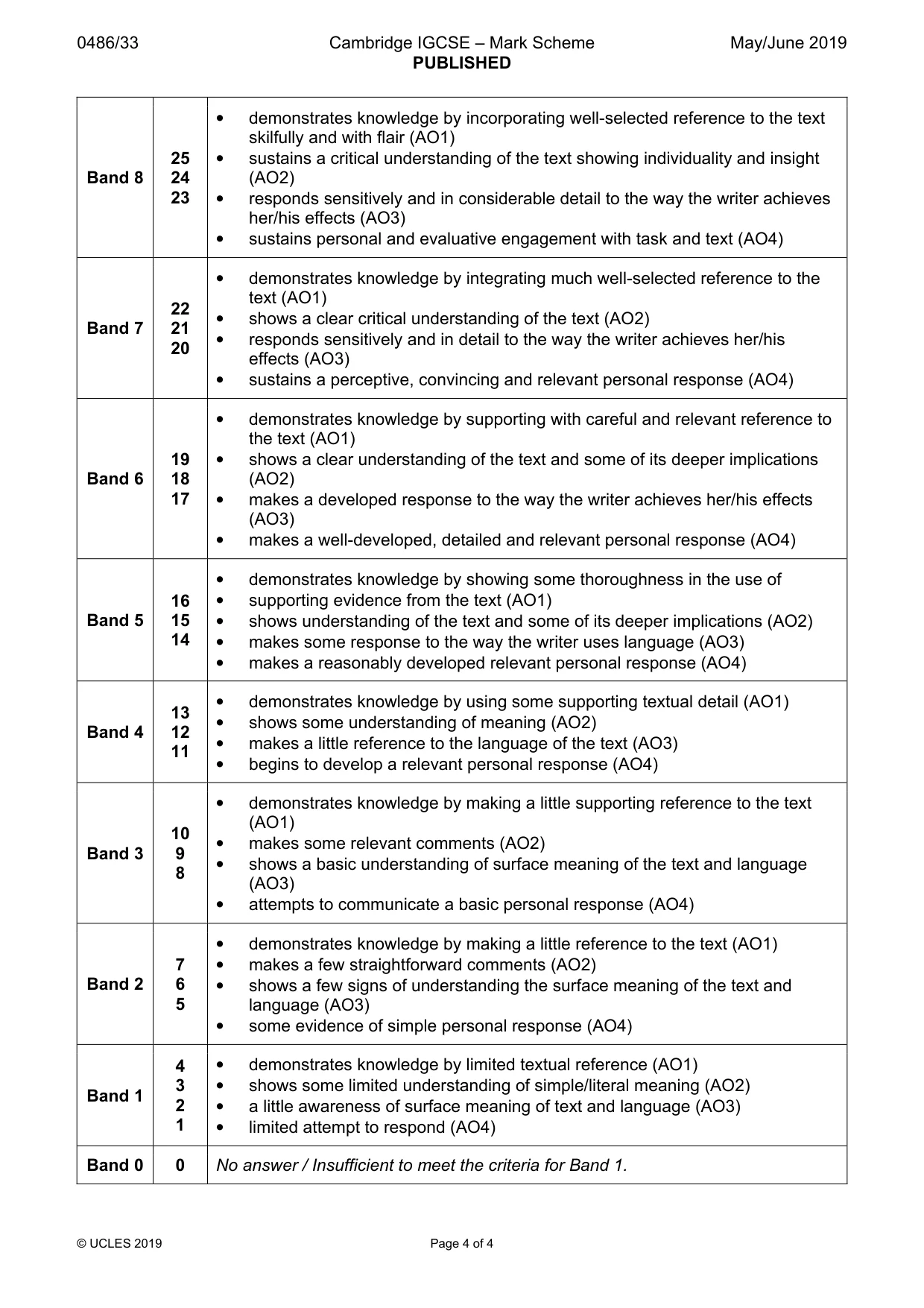
0486/33 Cambridge IGCSE – Mark Scheme PUBLISHED May/June 2019 © UCLES 2019 Page 4 of 4 Band 8 25 24 23 • demonstrates knowledge by incorporating well-selected reference to the text skilfully and with flair (AO1) • sustains a critical understanding of the text showing individuality and insight (AO2) • responds sensitively and in considerable detail to the way the writer achieves her/his effects (AO3) • sustains personal and evaluative engagement with task and text (AO4) Band 7 22 21 20 • demonstrates knowledge by integrating much well-selected reference to the text (AO1) • shows a clear critical understanding of the text (AO2) • responds sensitively and in detail to the way the writer achieves her/his effects (AO3) • sustains a perceptive, convincing and relevant personal response (AO4) Band 6 19 18 17 • demonstrates knowledge by supporting with careful and relevant reference to the text (AO1) • shows a clear understanding of the text and some of its deeper implications (AO2) • makes a developed response to the way the writer achieves her/his effects (AO3) • makes a well-developed, detailed and relevant personal response (AO4) Band 5 16 15 14 • demonstrates knowledge by showing some thoroughness in the use of • supporting evidence from the text (AO1) • shows understanding of the text and some of its deeper implications (AO2) • makes some response to the way the writer uses language (AO3) • makes a reasonably developed relevant personal response (AO4) Band 4 13 12 11 • demonstrates knowledge by using some supporting textual detail (AO1) • shows some understanding of meaning (AO2) • makes a little reference to the language of the text (AO3) • begins to develop a relevant personal response (AO4) Band 3 10 9 8 • demonstrates knowledge by making a little supporting reference to the text (AO1) • makes some relevant comments (AO2) • shows a basic understanding of surface meaning of the text and language (AO3) • attempts to communicate a basic personal response (AO4) Band 2 7 6 5 • demonstrates knowledge by making a little reference to the text (AO1) • makes a few straightforward comments (AO2) • shows a few signs of understanding the surface meaning of the text and language (AO3) • some evidence of simple personal response (AO4) Band 1 4 3 2 1 • demonstrates knowledge by limited textual reference (AO1) • shows some limited understanding of simple/literal meaning (AO2) • a little awareness of surface meaning of text and language (AO3) • limited attempt to respond (AO4) Band 0 0 No answer / Insufficient to meet the criteria for Band 1.
What you needed in this session
Cambridge’s own grade thresholds for 2019 May/June, Paper 3 · Variant 3. A higher threshold means an easier paper — the bar moves with how the cohort did.