Cambridge IGCSE English - Literature 0486 — 2014 Oct/Nov Paper 3 · Variant 2
0486/32/O/N/14 · 25 marks · ≈28 min
The question paper and its mark scheme, free to read here and free to download. This is Cambridge’s own paper, exactly as it was sat.
Question paper8 pages




Mark scheme3 pages
Answers below. Sit the paper first if you are practising.
Paper as text
Question paper, page 1
This document consists of 4 printed pages and 4 blank pages and 1 insert. DC (LEG) 108720 © UCLES 2014 [Turn over Cambridge International Examinations Cambridge International General Certificate of Secondary Education * 4 4 5 0 2 2 1 7 6 7 * LITERATURE (ENGLISH) 0486/32 Paper 3 Unseen October/November 2014 1 hour 15 minutes No Additional Materials are required. READ THESE INSTRUCTIONS FIRST An answer booklet is provided inside this question paper. You should follow the instructions on the front cover of the answer booklet. If you need additional answer paper ask the invigilator for a continuation booklet. Answer either Question 1 or Question 2. You are advised to spend about 20 minutes reading the question paper and planning your answer. Both questions in this paper carry equal marks.
Question paper, page 2
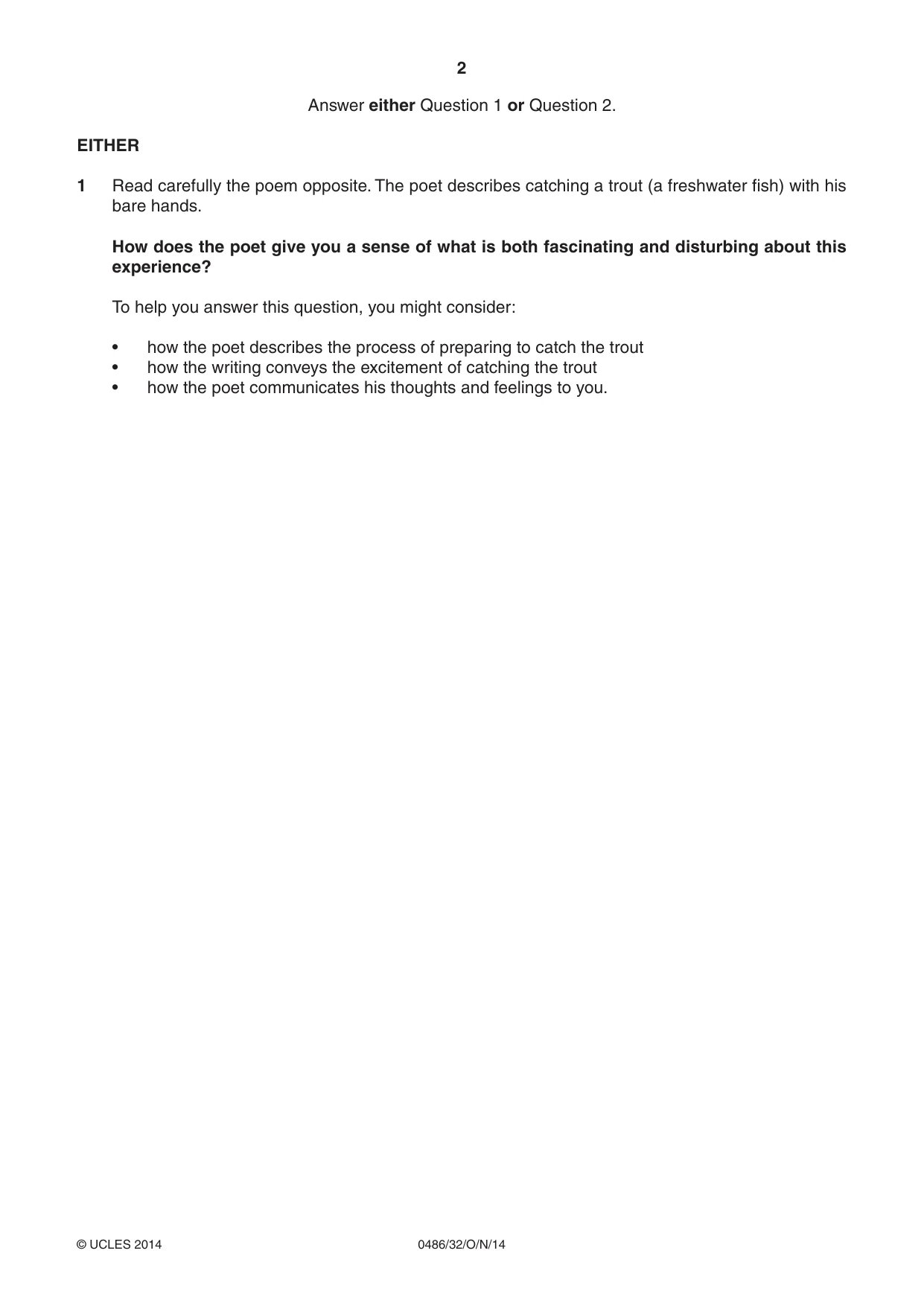
2 0486/32/O/N/14 © UCLES 2014 Answer either Question 1 or Question 2. EITHER 1 Read carefully the poem opposite. The poet describes catching a trout (a freshwater fish) with his bare hands. How does the poet give you a sense of what is both fascinating and disturbing about this experience? To help you answer this question, you might consider: • how the poet describes the process of preparing to catch the trout • how the writing conveys the excitement of catching the trout • how the poet communicates his thoughts and feelings to you.
Question paper, page 3
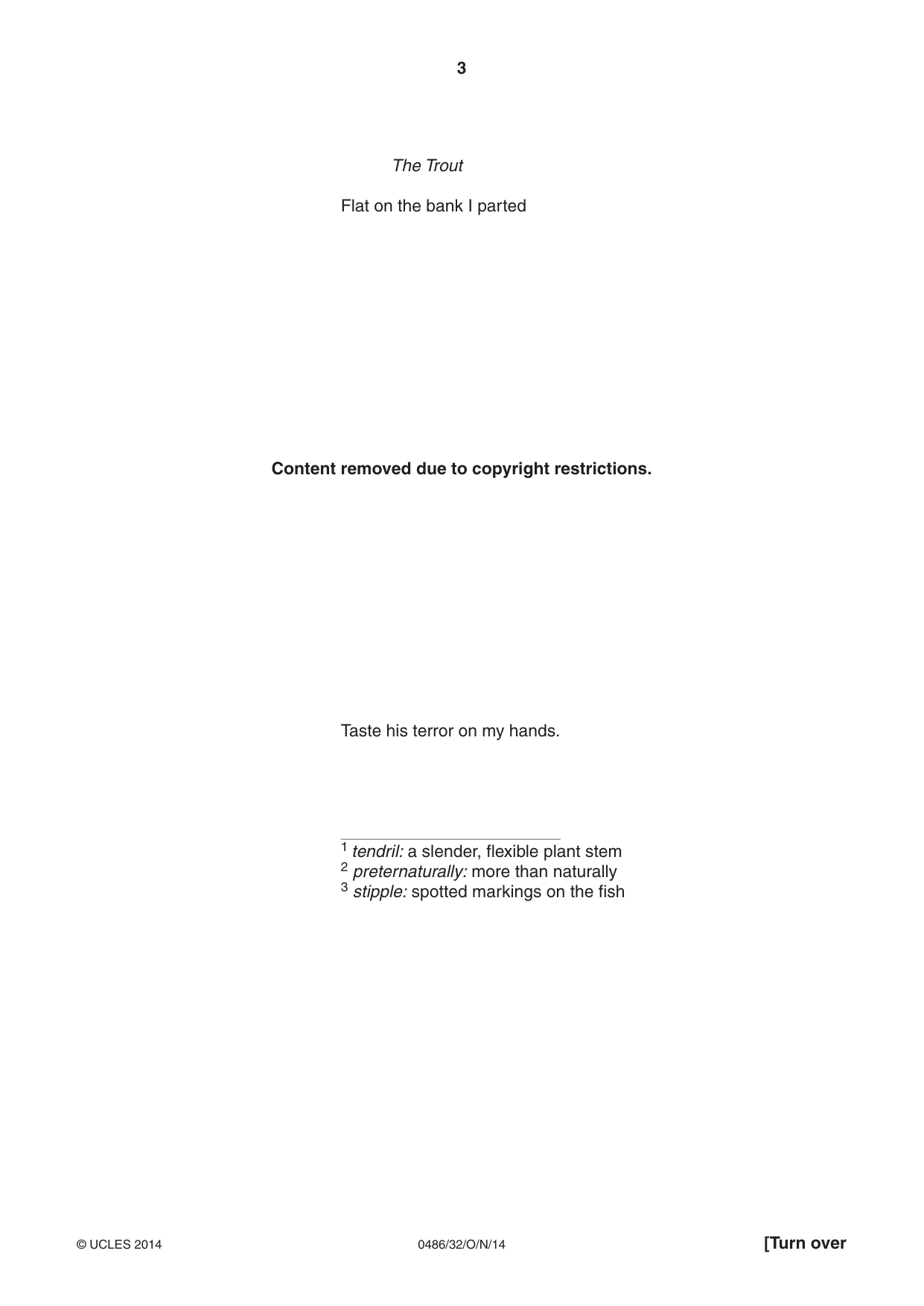
3 0486/32/O/N/14 © UCLES 2014 [Turn over The Trout Flat on the bank I parted Content removed due to copyright restrictions. Taste his terror on my hands. 1 tendril: a slender, flexible plant stem 2 preternaturally: more than naturally 3 stipple: spotted markings on the fish
Question paper, page 4
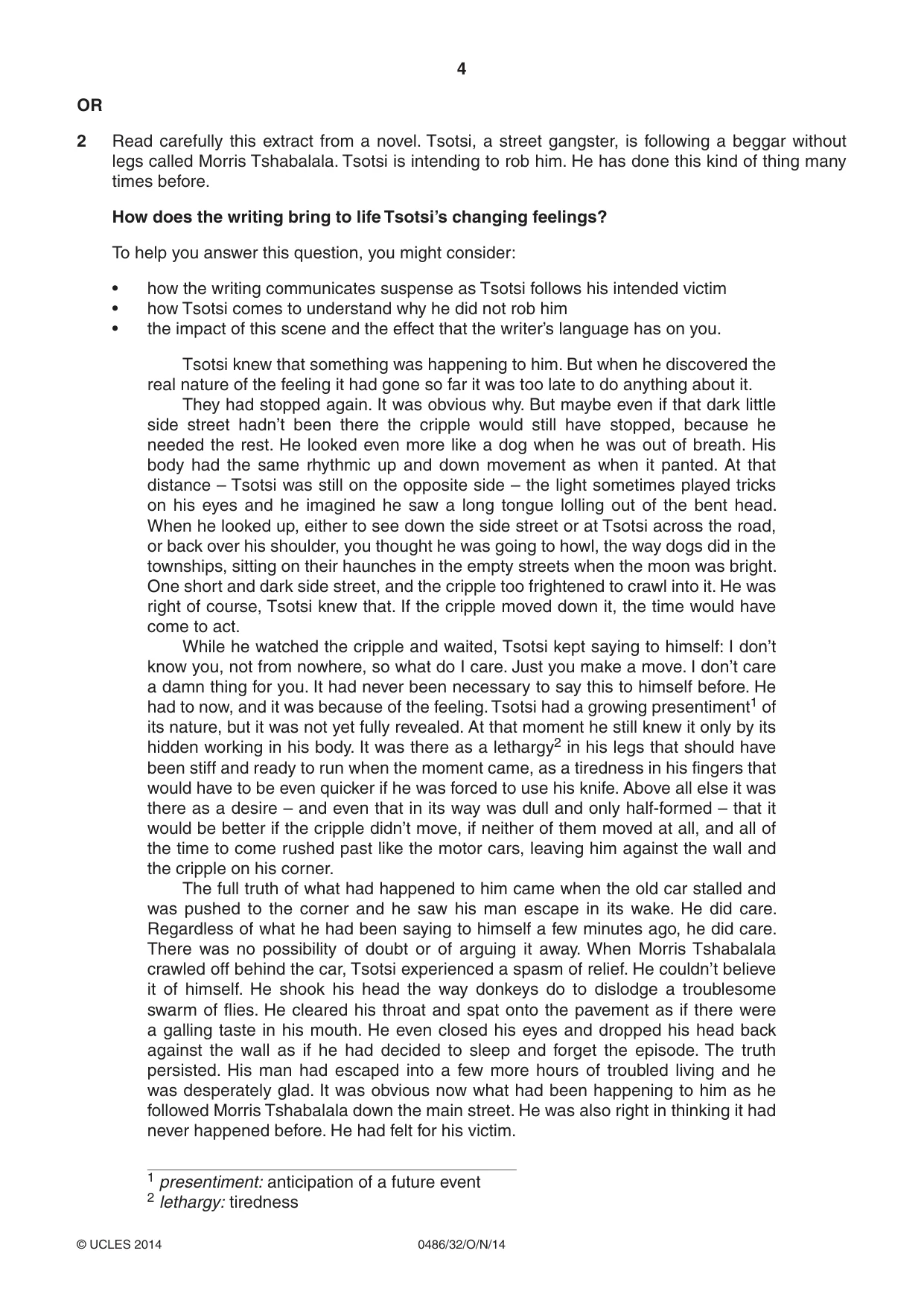
4 0486/32/O/N/14 © UCLES 2014 OR 2 Read carefully this extract from a novel. Tsotsi, a street gangster, is following a beggar without legs called Morris Tshabalala. Tsotsi is intending to rob him. He has done this kind of thing many times before. How does the writing bring to life Tsotsi’s changing feelings? To help you answer this question, you might consider: • how the writing communicates suspense as Tsotsi follows his intended victim • how Tsotsi comes to understand why he did not rob him • the impact of this scene and the effect that the writer’s language has on you. Tsotsi knew that something was happening to him. But when he discovered the real nature of the feeling it had gone so far it was too late to do anything about it. They had stopped again. It was obvious why. But maybe even if that dark little side street hadn’t been there the cripple would still have stopped, because he needed the rest. He looked even more like a dog when he was out of breath. His body had the same rhythmic up and down movement as when it panted. At that distance – Tsotsi was still on the opposite side – the light sometimes played tricks on his eyes and he imagined he saw a long tongue lolling out of the bent head. When he looked up, either to see down the side street or at Tsotsi across the road, or back over his shoulder, you thought he was going to howl, the way dogs did in the townships, sitting on their haunches in the empty streets when the moon was bright. One short and dark side street, and the cripple too frightened to crawl into it. He was right of course, Tsotsi knew that. If the cripple moved down it, the time would have come to act. While he watched the cripple and waited, Tsotsi kept saying to himself: I don’t know you, not from nowhere, so what do I care. Just you make a move. I don’t care a damn thing for you. It had never been necessary to say this to himself before. He had to now, and it was because of the feeling. Tsotsi had a growing presentiment1 of its nature, but it was not yet fully revealed. At that moment he still knew it only by its hidden working in his body. It was there as a lethargy2 in his legs that should have been stiff and ready to run when the moment came, as a tiredness in his fingers that would have to be even quicker if he was forced to use his knife. Above all else it was there as a desire – and even that in its way was dull and only half-formed – that it would be better if the cripple didn’t move, if neither of them moved at all, and all of the time to come rushed past like the motor cars, leaving him against the wall and the cripple on his corner. The full truth of what had happened to him came when the old car stalled and was pushed to the corner and he saw his man escape in its wake. He did care. Regardless of what he had been saying to himself a few minutes ago, he did care. There was no possibility of doubt or of arguing it away. When Morris Tshabalala crawled off behind the car, Tsotsi experienced a spasm of relief. He couldn’t believe it of himself. He shook his head the way donkeys do to dislodge a troublesome swarm of flies. He cleared his throat and spat onto the pavement as if there were a galling taste in his mouth. He even closed his eyes and dropped his head back against the wall as if he had decided to sleep and forget the episode. The truth persisted. His man had escaped into a few more hours of troubled living and he was desperately glad. It was obvious now what had been happening to him as he followed Morris Tshabalala down the main street. He was also right in thinking it had never happened before. He had felt for his victim. 1 presentiment: anticipation of a future event 2 lethargy: tiredness
Question paper, page 5
5 0486/32/O/N/14 © UCLES 2014 BLANK PAGE
Question paper, page 6
6 0486/32/O/N/14 © UCLES 2014 BLANK PAGE
Question paper, page 7
7 0486/32/O/N/14 © UCLES 2014 BLANK PAGE
Question paper, page 8
8 0486/32/O/N/14 © UCLES 2014 Copyright Acknowledgements: Question 1 © John Montague; The Trout in ed. N Astley; Staying Alive; Bloodaxe Books; 1995. Question 2 © Athol Fugard; Tsotsi; Canongate Books Ltd; 2009. Permission to reproduce items where third-party owned material protected by copyright is included has been sought and cleared where possible. Every reasonable effort has been made by the publisher (UCLES) to trace copyright holders, but if any items requiring clearance have unwittingly been included, the publisher will be pleased to make amends at the earliest possible opportunity. Cambridge International Examinations is part of the Cambridge Assessment Group. Cambridge Assessment is the brand name of University of Cambridge Local Examinations Syndicate (UCLES), which is itself a department of the University of Cambridge. BLANK PAGE
Mark scheme, page 1
® IGCSE is the registered trademark of Cambridge International Examinations. CAMBRIDGE INTERNATIONAL EXAMINATIONS Cambridge International General Certificate of Secondary Education MARK SCHEME for the October/November 2014 series 0486 LITERATURE (ENGLISH) 0486/32 Paper 3 (Unseen), maximum raw mark 25 This mark scheme is published as an aid to teachers and candidates, to indicate the requirements of the examination. It shows the basis on which Examiners were instructed to award marks. It does not indicate the details of the discussions that took place at an Examiners’ meeting before marking began, which would have considered the acceptability of alternative answers. Mark schemes should be read in conjunction with the question paper and the Principal Examiner Report for Teachers. Cambridge will not enter into discussions about these mark schemes. Cambridge is publishing the mark schemes for the October/November 2014 series for most Cambridge IGCSE®, Cambridge International A and AS Level components and some Cambridge O Level components.
Mark scheme, page 2
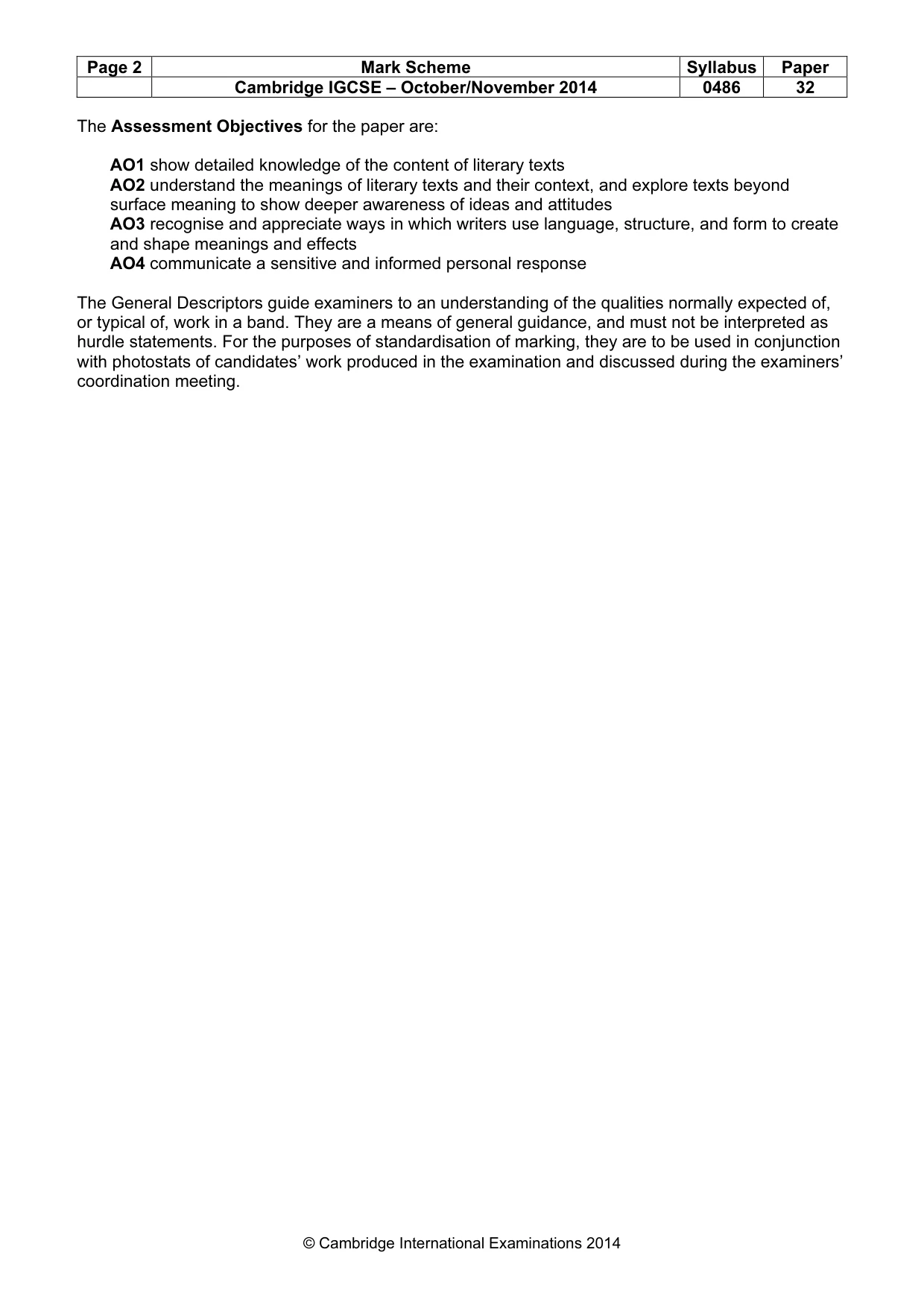
Page 2 Mark Scheme Syllabus Paper Cambridge IGCSE – October/November 2014 0486 32 © Cambridge International Examinations 2014 The Assessment Objectives for the paper are: AO1 show detailed knowledge of the content of literary texts AO2 understand the meanings of literary texts and their context, and explore texts beyond surface meaning to show deeper awareness of ideas and attitudes AO3 recognise and appreciate ways in which writers use language, structure, and form to create and shape meanings and effects AO4 communicate a sensitive and informed personal response The General Descriptors guide examiners to an understanding of the qualities normally expected of, or typical of, work in a band. They are a means of general guidance, and must not be interpreted as hurdle statements. For the purposes of standardisation of marking, they are to be used in conjunction with photostats of candidates’ work produced in the examination and discussed during the examiners’ coordination meeting.
Mark scheme, page 3
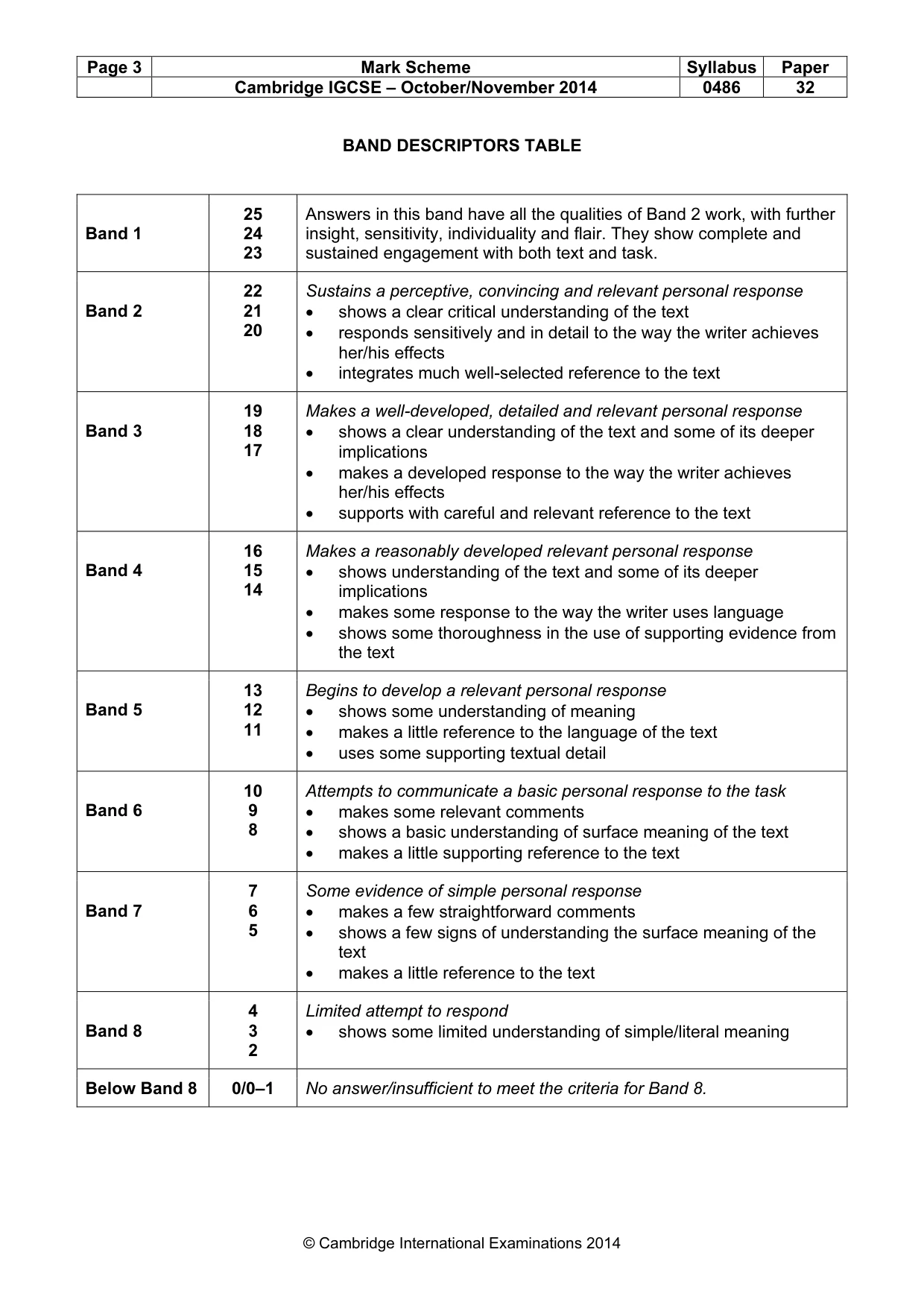
Page 3 Mark Scheme Syllabus Paper Cambridge IGCSE – October/November 2014 0486 32 © Cambridge International Examinations 2014 BAND DESCRIPTORS TABLE Band 1 25 24 23 Answers in this band have all the qualities of Band 2 work, with further insight, sensitivity, individuality and flair. They show complete and sustained engagement with both text and task. Band 2 22 21 20 Sustains a perceptive, convincing and relevant personal response • shows a clear critical understanding of the text • responds sensitively and in detail to the way the writer achieves her/his effects • integrates much well-selected reference to the text Band 3 19 18 17 Makes a well-developed, detailed and relevant personal response • shows a clear understanding of the text and some of its deeper implications • makes a developed response to the way the writer achieves her/his effects • supports with careful and relevant reference to the text Band 4 16 15 14 Makes a reasonably developed relevant personal response • shows understanding of the text and some of its deeper implications • makes some response to the way the writer uses language • shows some thoroughness in the use of supporting evidence from the text Band 5 13 12 11 Begins to develop a relevant personal response • shows some understanding of meaning • makes a little reference to the language of the text • uses some supporting textual detail Band 6 10 9 8 Attempts to communicate a basic personal response to the task • makes some relevant comments • shows a basic understanding of surface meaning of the text • makes a little supporting reference to the text Band 7 7 6 5 Some evidence of simple personal response • makes a few straightforward comments • shows a few signs of understanding the surface meaning of the text • makes a little reference to the text Band 8 4 3 2 Limited attempt to respond • shows some limited understanding of simple/literal meaning Below Band 8 0/0–1 No answer/insufficient to meet the criteria for Band 8.
What you needed in this session
Cambridge’s own grade thresholds for 2014 Oct/Nov, Paper 3 · Variant 2. A higher threshold means an easier paper — the bar moves with how the cohort did.