Cambridge IGCSE English - Literature 0486 — 2014 Oct/Nov Paper 3 · Variant 1
0486/31/O/N/14 · 25 marks · ≈28 min
The question paper and its mark scheme, free to read here and free to download. This is Cambridge’s own paper, exactly as it was sat.
Question paper8 pages


Mark scheme3 pages
Answers below. Sit the paper first if you are practising.
Paper as text
Question paper, page 1
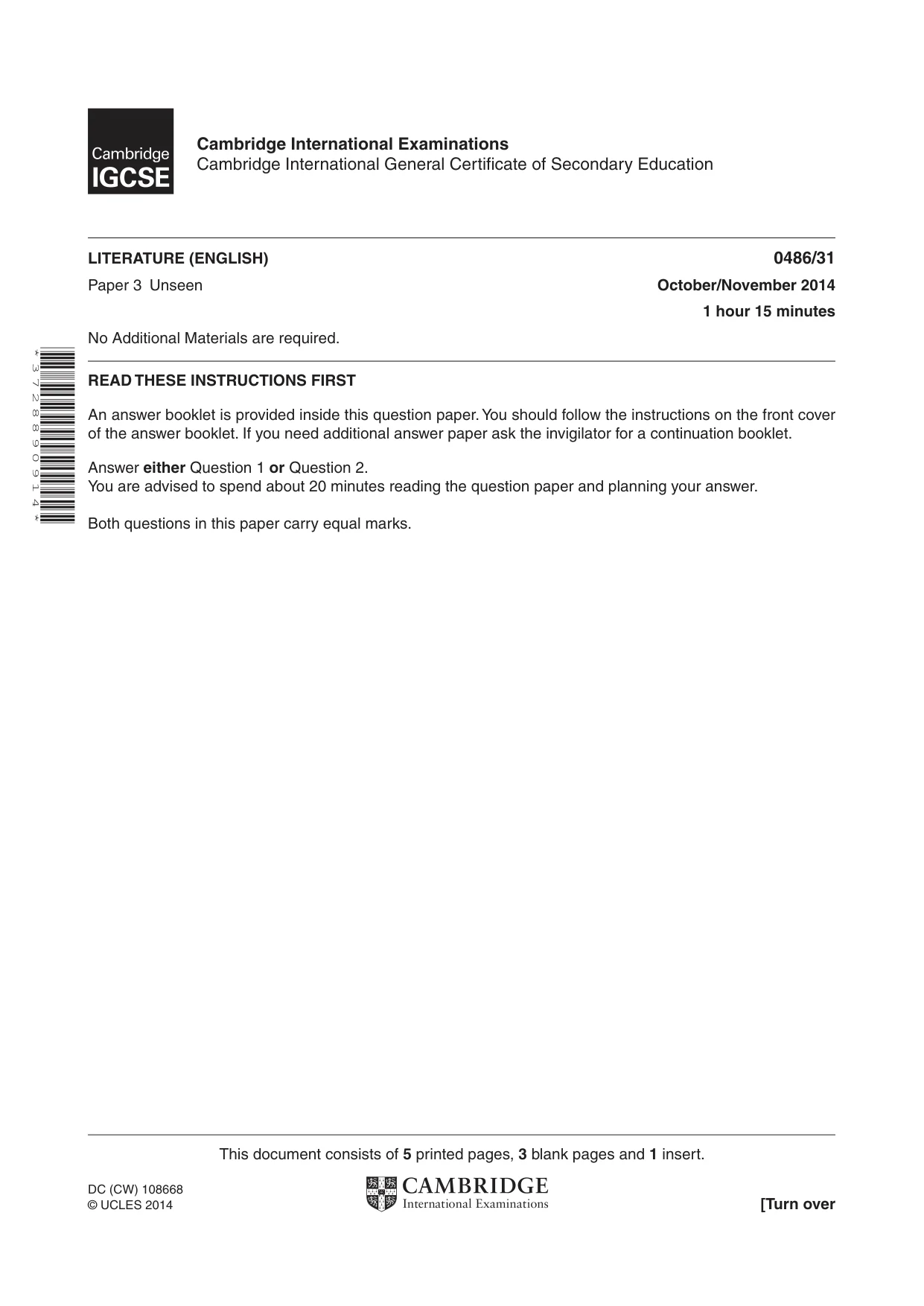
This document consists of 5 printed pages, 3 blank pages and 1 insert. DC (CW) 108668 © UCLES 2014 [Turn over Cambridge International Examinations Cambridge International General Certificate of Secondary Education * 3 7 2 8 8 9 0 9 1 4 * LITERATURE (ENGLISH) 0486/31 Paper 3 Unseen October/November 2014 1 hour 15 minutes No Additional Materials are required. READ THESE INSTRUCTIONS FIRST An answer booklet is provided inside this question paper. You should follow the instructions on the front cover of the answer booklet. If you need additional answer paper ask the invigilator for a continuation booklet. Answer either Question 1 or Question 2. You are advised to spend about 20 minutes reading the question paper and planning your answer. Both questions in this paper carry equal marks.
Question paper, page 2
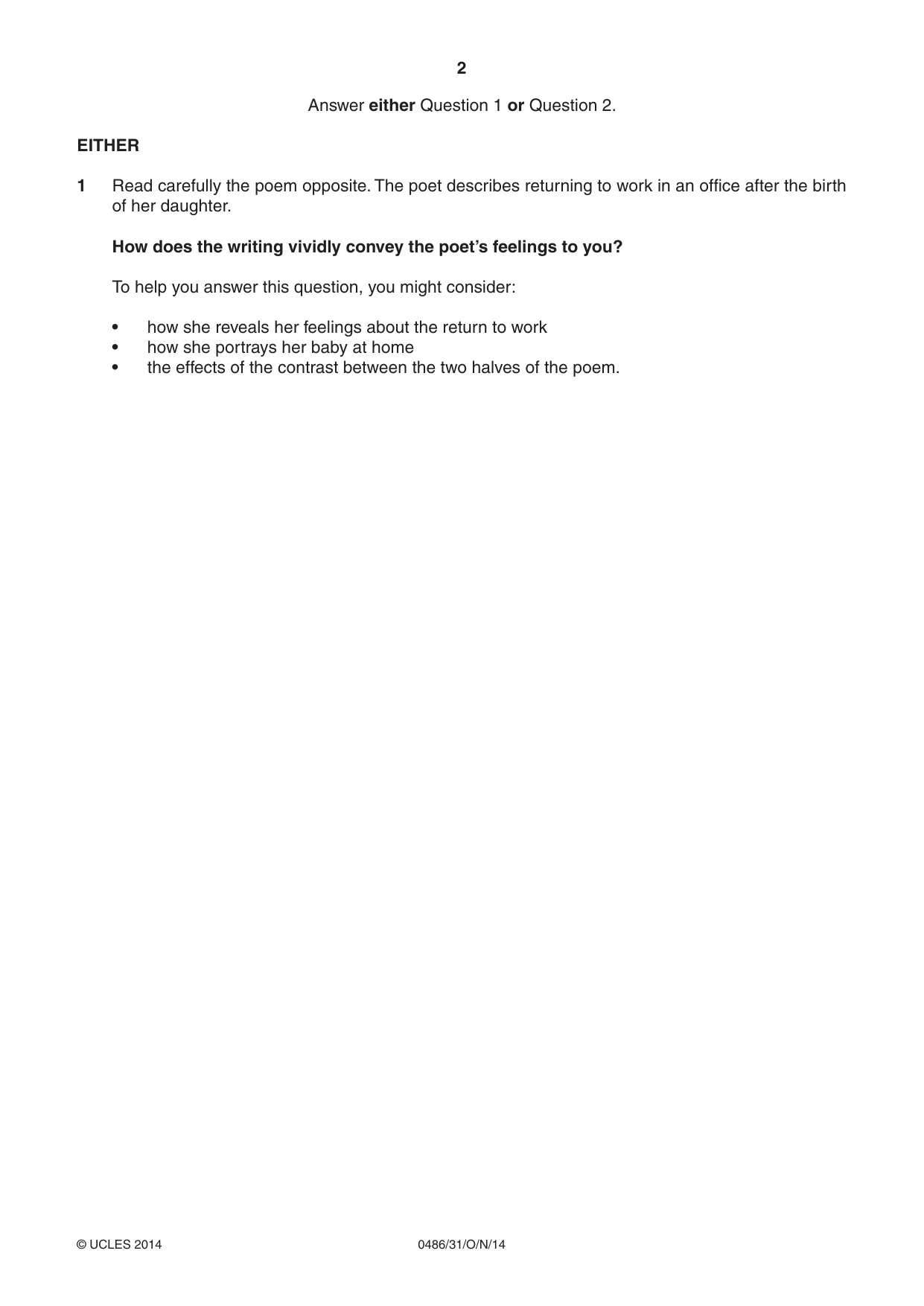
2 0486/31/O/N/14 © UCLES 2014 Answer either Question 1 or Question 2. EITHER 1 Read carefully the poem opposite. The poet describes returning to work in an office after the birth of her daughter. How does the writing vividly convey the poet’s feelings to you? To help you answer this question, you might consider: • how she reveals her feelings about the return to work • how she portrays her baby at home • the effects of the contrast between the two halves of the poem.
Question paper, page 3
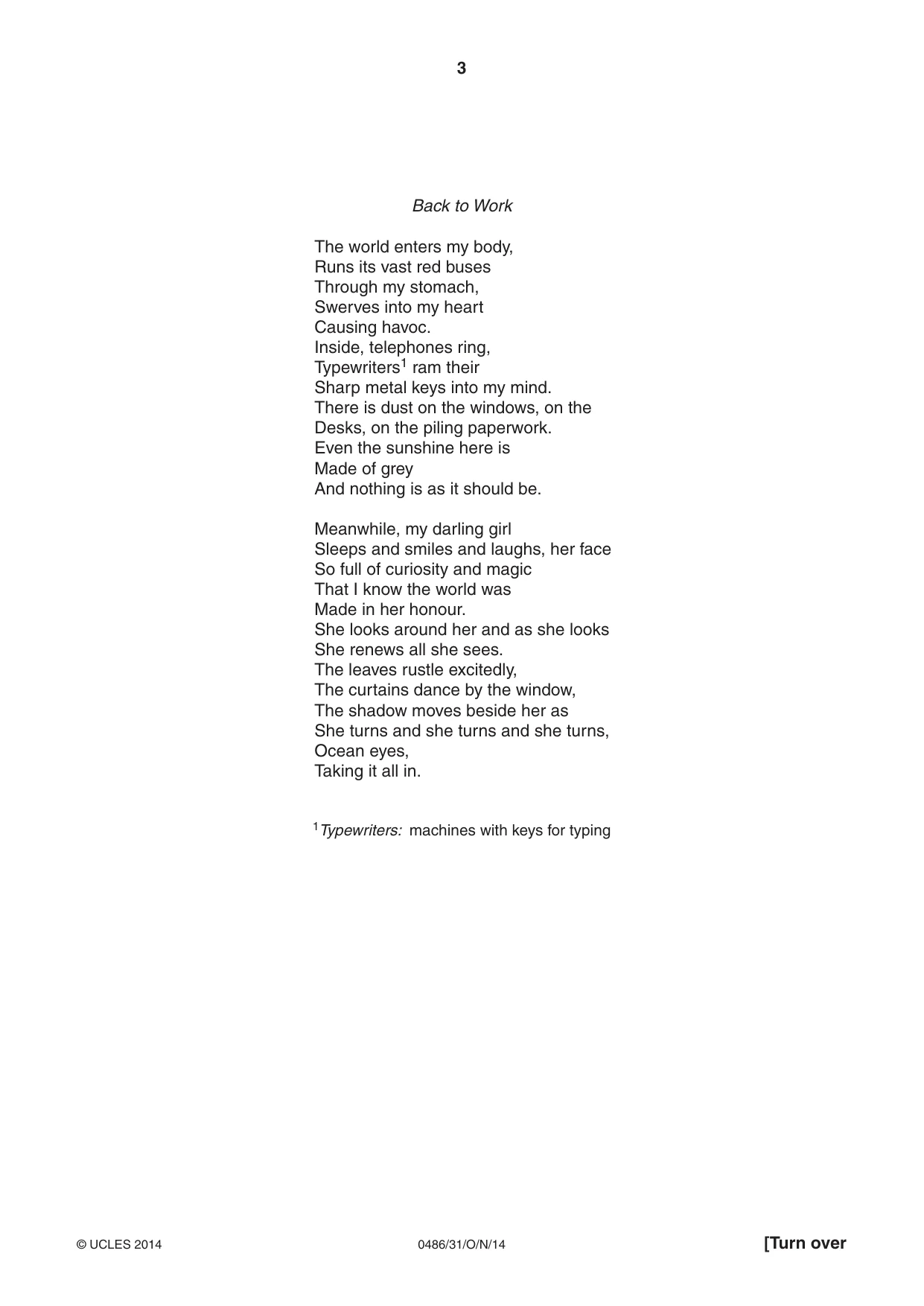
3 0486/31/O/N/14 © UCLES 2014 [Turn over Back to Work The world enters my body, Runs its vast red buses Through my stomach, Swerves into my heart Causing havoc. Inside, telephones ring, Typewriters1 ram their Sharp metal keys into my mind. There is dust on the windows, on the Desks, on the piling paperwork. Even the sunshine here is Made of grey And nothing is as it should be. Meanwhile, my darling girl Sleeps and smiles and laughs, her face So full of curiosity and magic That I know the world was Made in her honour. She looks around her and as she looks She renews all she sees. The leaves rustle excitedly, The curtains dance by the window, The shadow moves beside her as She turns and she turns and she turns, Ocean eyes, Taking it all in. 1Typewriters: machines with keys for typing
Question paper, page 4
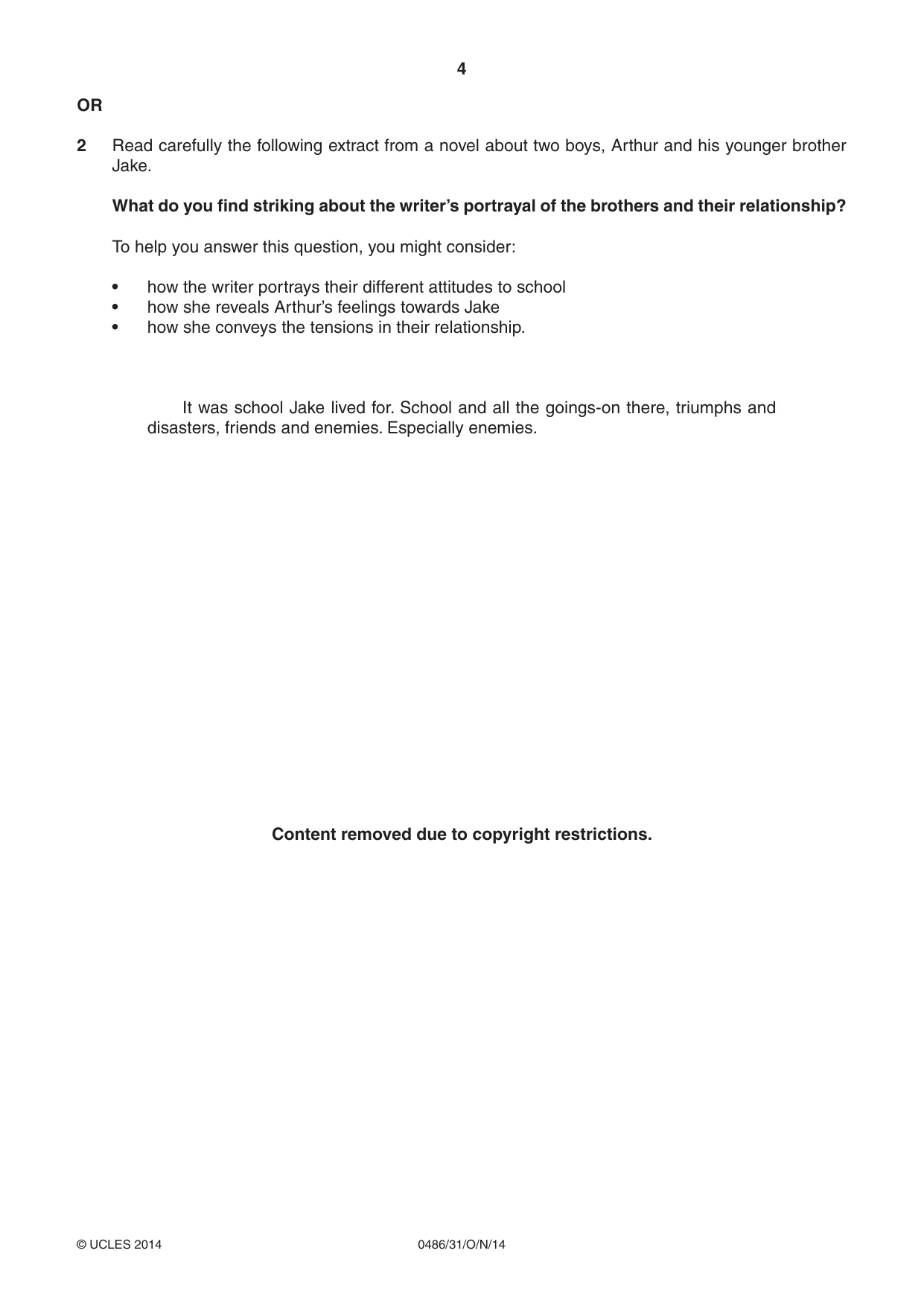
4 0486/31/O/N/14 © UCLES 2014 OR 2 Read carefully the following extract from a novel about two boys, Arthur and his younger brother Jake. What do you find striking about the writer’s portrayal of the brothers and their relationship? To help you answer this question, you might consider: • how the writer portrays their different attitudes to school • how she reveals Arthur’s feelings towards Jake • how she conveys the tensions in their relationship. It was school Jake lived for. School and all the goings-on there, triumphs and disasters, friends and enemies. Especially enemies. Content removed due to copyright restrictions.
Question paper, page 5
5 0486/31/O/N/14 © UCLES 2014 It was impossible, of course. Jake was right about that. To tell on someone was the one unforgivable sin. 1Struan: the town where the boys live. Content removed due to copyright restrictions.
Question paper, page 6
6 0486/31/O/N/14 © UCLES 2014 BLANK PAGE
Question paper, page 7
7 0486/31/O/N/14 © UCLES 2014 BLANK PAGE
Question paper, page 8
8 0486/31/O/N/14 © UCLES 2014 Copyright Acknowledgements: Question 1 © Sally Emerson; Back to Work, in ed. Goodwin; 101 Poems to Keep You Sane; Reproduced by permission of HarperCollins Publishers; 2001. Question 2 © Mary Lawson; The Other Side of the Bridge; Published by Chatto & Windus. Reprinted by permission of The Random House Group Ltd; 2006. Permission to reproduce items where third-party owned material protected by copyright is included has been sought and cleared where possible. Every reasonable effort has been made by the publisher (UCLES) to trace copyright holders, but if any items requiring clearance have unwittingly been included, the publisher will be pleased to make amends at the earliest possible opportunity. Cambridge International Examinations is part of the Cambridge Assessment Group. Cambridge Assessment is the brand name of University of Cambridge Local Examinations Syndicate (UCLES), which is itself a department of the University of Cambridge. BLANK PAGE
Mark scheme, page 1
® IGCSE is the registered trademark of Cambridge International Examinations. CAMBRIDGE INTERNATIONAL EXAMINATIONS Cambridge International General Certificate of Secondary Education MARK SCHEME for the October/November 2014 series 0486 LITERATURE (ENGLISH) 0486/31 Paper 3 (Unseen), maximum raw mark 25 This mark scheme is published as an aid to teachers and candidates, to indicate the requirements of the examination. It shows the basis on which Examiners were instructed to award marks. It does not indicate the details of the discussions that took place at an Examiners’ meeting before marking began, which would have considered the acceptability of alternative answers. Mark schemes should be read in conjunction with the question paper and the Principal Examiner Report for Teachers. Cambridge will not enter into discussions about these mark schemes. Cambridge is publishing the mark schemes for the October/November 2014 series for most Cambridge IGCSE®, Cambridge International A and AS Level components and some Cambridge O Level components.
Mark scheme, page 2
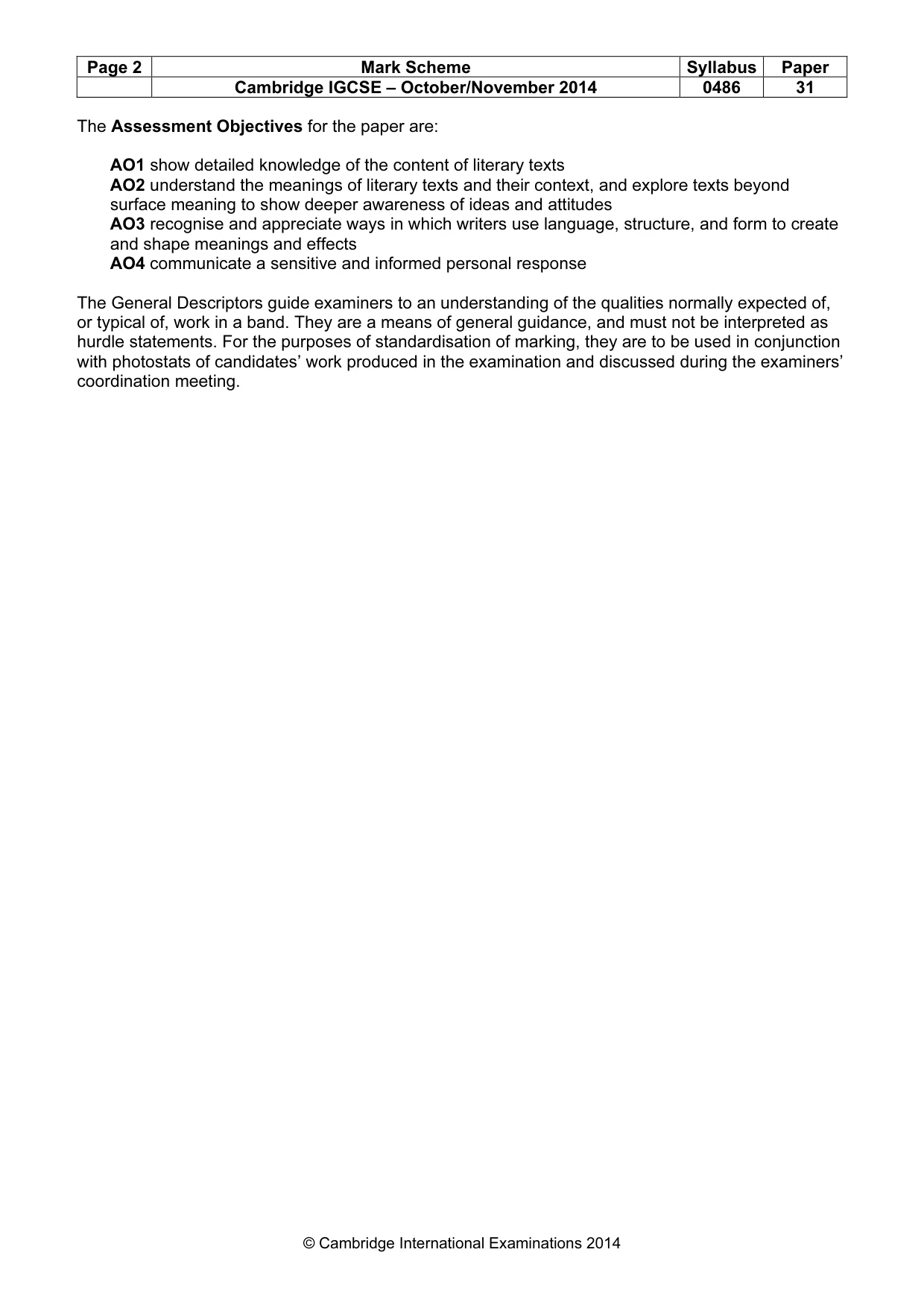
Page 2 Mark Scheme Syllabus Paper Cambridge IGCSE – October/November 2014 0486 31 © Cambridge International Examinations 2014 The Assessment Objectives for the paper are: AO1 show detailed knowledge of the content of literary texts AO2 understand the meanings of literary texts and their context, and explore texts beyond surface meaning to show deeper awareness of ideas and attitudes AO3 recognise and appreciate ways in which writers use language, structure, and form to create and shape meanings and effects AO4 communicate a sensitive and informed personal response The General Descriptors guide examiners to an understanding of the qualities normally expected of, or typical of, work in a band. They are a means of general guidance, and must not be interpreted as hurdle statements. For the purposes of standardisation of marking, they are to be used in conjunction with photostats of candidates’ work produced in the examination and discussed during the examiners’ coordination meeting.
Mark scheme, page 3
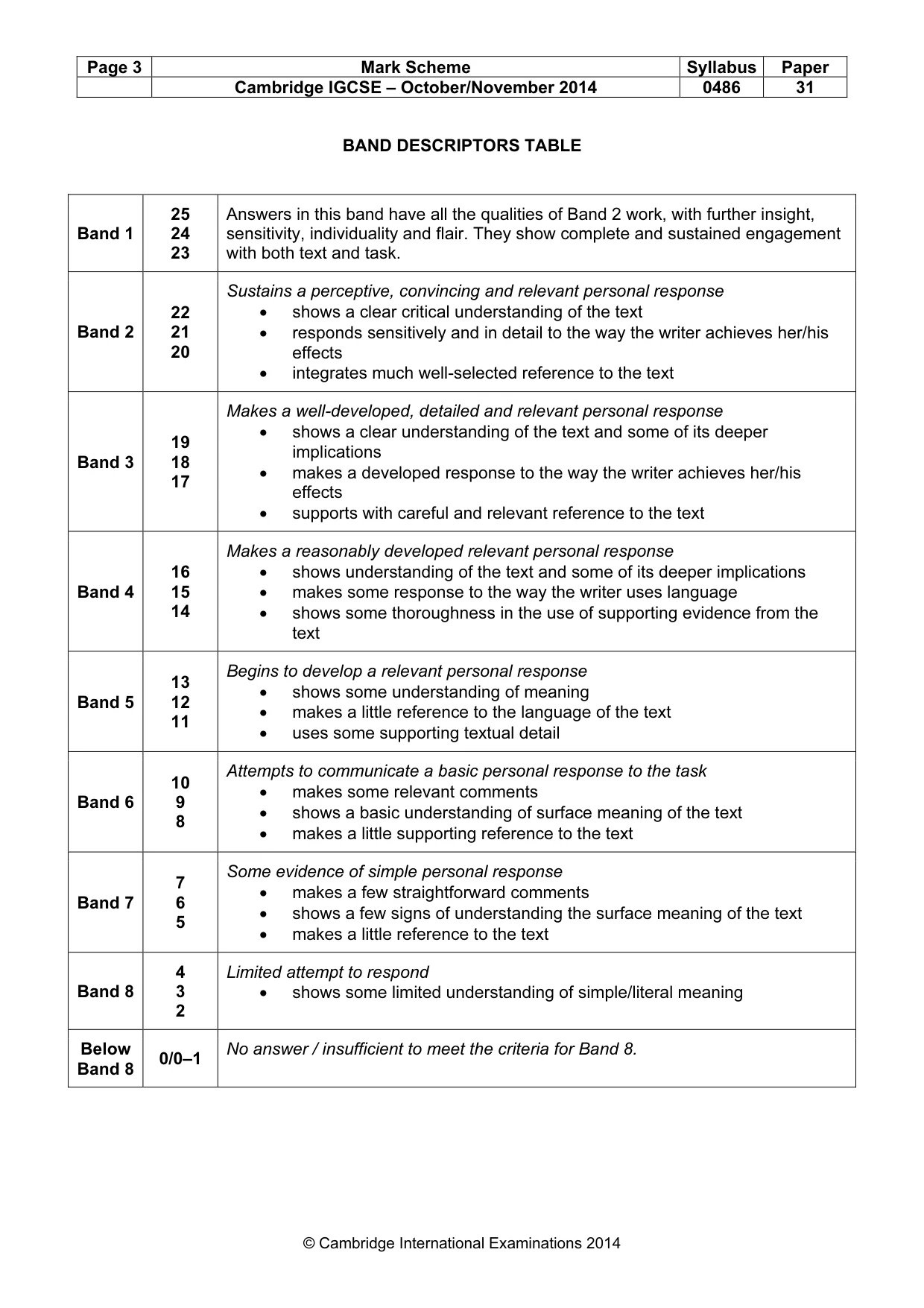
Page 3 Mark Scheme Syllabus Paper Cambridge IGCSE – October/November 2014 0486 31 © Cambridge International Examinations 2014 BAND DESCRIPTORS TABLE Band 1 25 24 23 Answers in this band have all the qualities of Band 2 work, with further insight, sensitivity, individuality and flair. They show complete and sustained engagement with both text and task. Band 2 22 21 20 Sustains a perceptive, convincing and relevant personal response • shows a clear critical understanding of the text • responds sensitively and in detail to the way the writer achieves her/his effects • integrates much well-selected reference to the text Band 3 19 18 17 Makes a well-developed, detailed and relevant personal response • shows a clear understanding of the text and some of its deeper implications • makes a developed response to the way the writer achieves her/his effects • supports with careful and relevant reference to the text Band 4 16 15 14 Makes a reasonably developed relevant personal response • shows understanding of the text and some of its deeper implications • makes some response to the way the writer uses language • shows some thoroughness in the use of supporting evidence from the text Band 5 13 12 11 Begins to develop a relevant personal response • shows some understanding of meaning • makes a little reference to the language of the text • uses some supporting textual detail Band 6 10 9 8 Attempts to communicate a basic personal response to the task • makes some relevant comments • shows a basic understanding of surface meaning of the text • makes a little supporting reference to the text Band 7 7 6 5 Some evidence of simple personal response • makes a few straightforward comments • shows a few signs of understanding the surface meaning of the text • makes a little reference to the text Band 8 4 3 2 Limited attempt to respond • shows some limited understanding of simple/literal meaning Below Band 8 0/0–1 No answer / insufficient to meet the criteria for Band 8.
What you needed in this session
Cambridge’s own grade thresholds for 2014 Oct/Nov, Paper 3 · Variant 1. A higher threshold means an easier paper — the bar moves with how the cohort did.