Cambridge IGCSE English - Literature 0486 — 2019 Oct/Nov Paper 3 · Variant 1
0486/31/O/N/19 · 25 marks · ≈28 min
The question paper and its mark scheme, free to read here and free to download. This is Cambridge’s own paper, exactly as it was sat.
Question paper12 pages


Mark scheme4 pages
Answers below. Sit the paper first if you are practising.
Paper as text
Question paper, page 1
This document consists of 11 printed pages, 1 blank page and 1 Insert. DC (CJ) 183970 © UCLES 2019 [Turn over Cambridge Assessment International Education Cambridge International General Certificate of Secondary Education * 7 9 5 2 4 5 4 4 5 9 * LITERATURE (ENGLISH) 0486/31 Paper 3 Drama (Open Text) October/November 2019 45 minutes Texts studied should be taken into the examination. READ THESE INSTRUCTIONS FIRST An answer booklet is provided inside this question paper. You should follow the instructions on the front cover of the answer booklet. If you need additional answer paper ask the invigilator for a continuation booklet. Answer one question. All questions in this paper carry equal marks.
Question paper, page 2
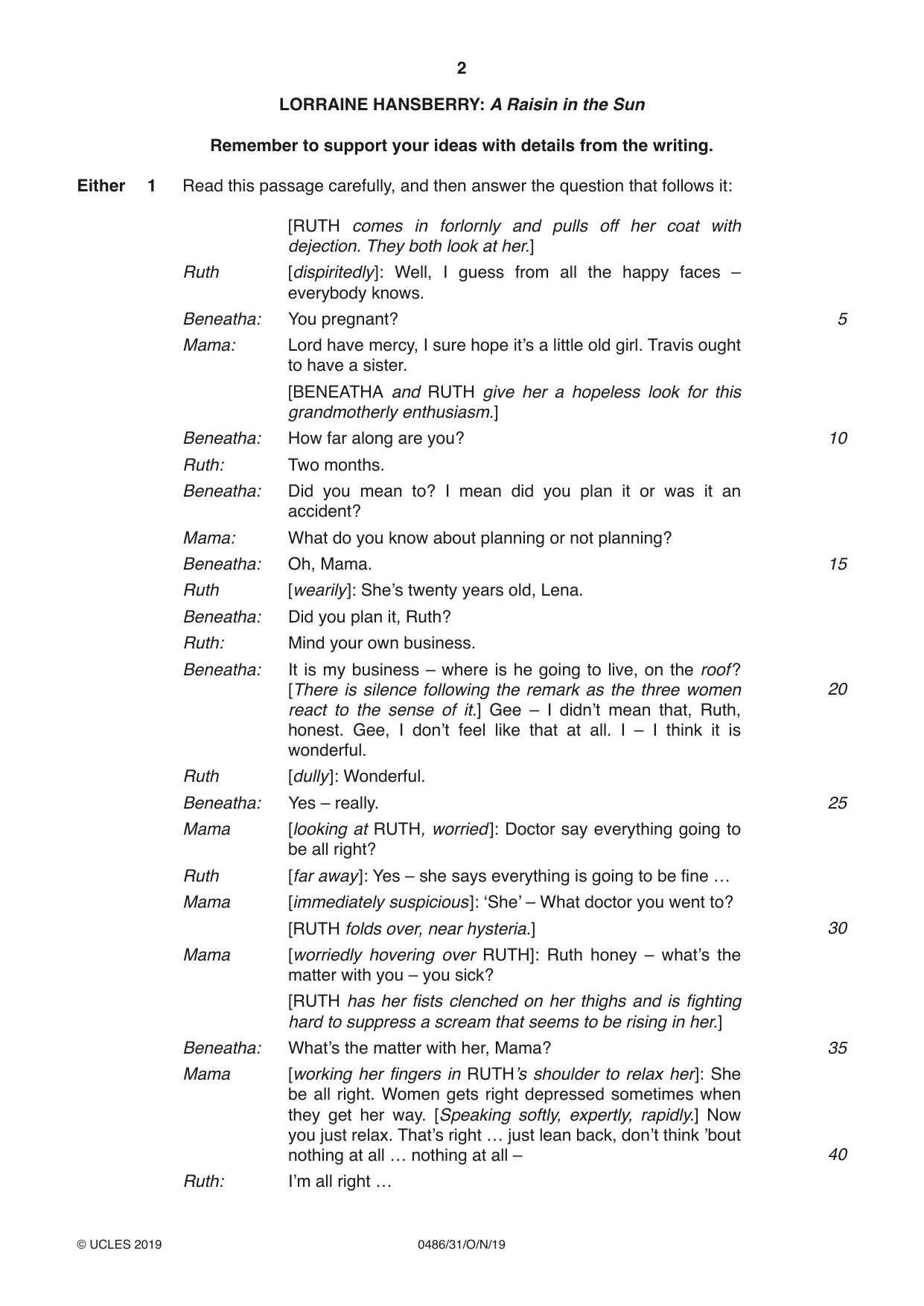
2 0486/31/O/N/19 © UCLES 2019 LORRAINE HANSBERRY: A Raisin in the Sun Remember to support your ideas with details from the writing. Either 1 Read this passage carefully, and then answer the question that follows it: [RUTH comes in forlornly and pulls off her coat with dejection. They both look at her.] Ruth [dispiritedly]: Well, I guess from all the happy faces – everybody knows. Beneatha: You pregnant? Mama: Lord have mercy, I sure hope it’s a little old girl. Travis ought to have a sister. [BENEATHA and RUTH give her a hopeless look for this grandmotherly enthusiasm.] Beneatha: How far along are you? Ruth: Two months. Beneatha: Did you mean to? I mean did you plan it or was it an accident? Mama: What do you know about planning or not planning? Beneatha: Oh, Mama. Ruth [wearily]: She’s twenty years old, Lena. Beneatha: Did you plan it, Ruth? Ruth: Mind your own business. Beneatha: It is my business – where is he going to live, on the roof? [There is silence following the remark as the three women react to the sense of it.] Gee – I didn’t mean that, Ruth, honest. Gee, I don’t feel like that at all. I – I think it is wonderful. Ruth [dully]: Wonderful. Beneatha: Yes – really. Mama [looking at RUTH, worried]: Doctor say everything going to be all right? Ruth [far away]: Yes – she says everything is going to be fine … Mama [immediately suspicious]: ‘She’ – What doctor you went to? [RUTH folds over, near hysteria.] Mama [worriedly hovering over RUTH]: Ruth honey – what’s the matter with you – you sick? [RUTH has her fists clenched on her thighs and is fighting hard to suppress a scream that seems to be rising in her.] Beneatha: What’s the matter with her, Mama? Mama [working her fingers in RUTH’s shoulder to relax her]: She be all right. Women gets right depressed sometimes when they get her way. [Speaking softly, expertly, rapidly.] Now you just relax. That’s right … just lean back, don’t think ’bout nothing at all … nothing at all – Ruth: I’m all right … 5 10 15 20 25 30 35 40
Question paper, page 3
3 0486/31/O/N/19 © UCLES 2019 [Turn over [The glassy-eyed look melts and then she collapses into a fit of heavy sobbing. The bell rings.] Beneatha: Oh, my God – that must be Asagai. Mama [to RUTH]: Come on now, honey. You need to lie down and rest awhile … then have some nice hot food. [They go out, RUTH’s weight on her mother-in-law. BENEATHA, herself profoundly disturbed, opens the door to admit a rather dramatic-looking young man with a large parcel.] Asagai: Hello, Alaiyo – Beneatha [holding the door open and regarding him with pleasure]: Hello … [Long pause.] Well – come in. And please excuse everything. My mother was very upset about my letting anyone come here with the place like this. Asagai [coming into the room]: You look disturbed too … Is something wrong? Beneatha [still at the door, absently]: Yes … we’ve all got acute ghetto- itus. [She smiles and comes towards him, finding a cigarette and sitting.] So – sit down! How was Canada? [from Act 1, Scene 2] In what ways does Hansberry make this such an upsetting moment in the play? Or 2 How does Hansberry make the differences between Joseph Asagai and George Murchison so fascinating? 45 50 55 60
Question paper, page 4
4 0486/31/O/N/19 © UCLES 2019 ARTHUR MILLER: A View from the Bridge Remember to support your ideas with details from the writing. Either 3 Read this passage carefully, and then answer the question that follows it: Alfieri: He was as good a man as he had to be in a life that was hard and even. Content removed due to copyright restrictions.
Question paper, page 5
5 0486/31/O/N/19 © UCLES 2019 [Turn over Rodolpho [smiling at the smallness of his town]: In our town there are no piers, only the beach, and little fishing boats. [from Act 1] In what ways does Miller make this moment in the play so memorable? Or 4 What do you find moving about Miller’s portrayal of the relationship between Eddie and Beatrice? Content removed due to copyright restrictions.
Question paper, page 6
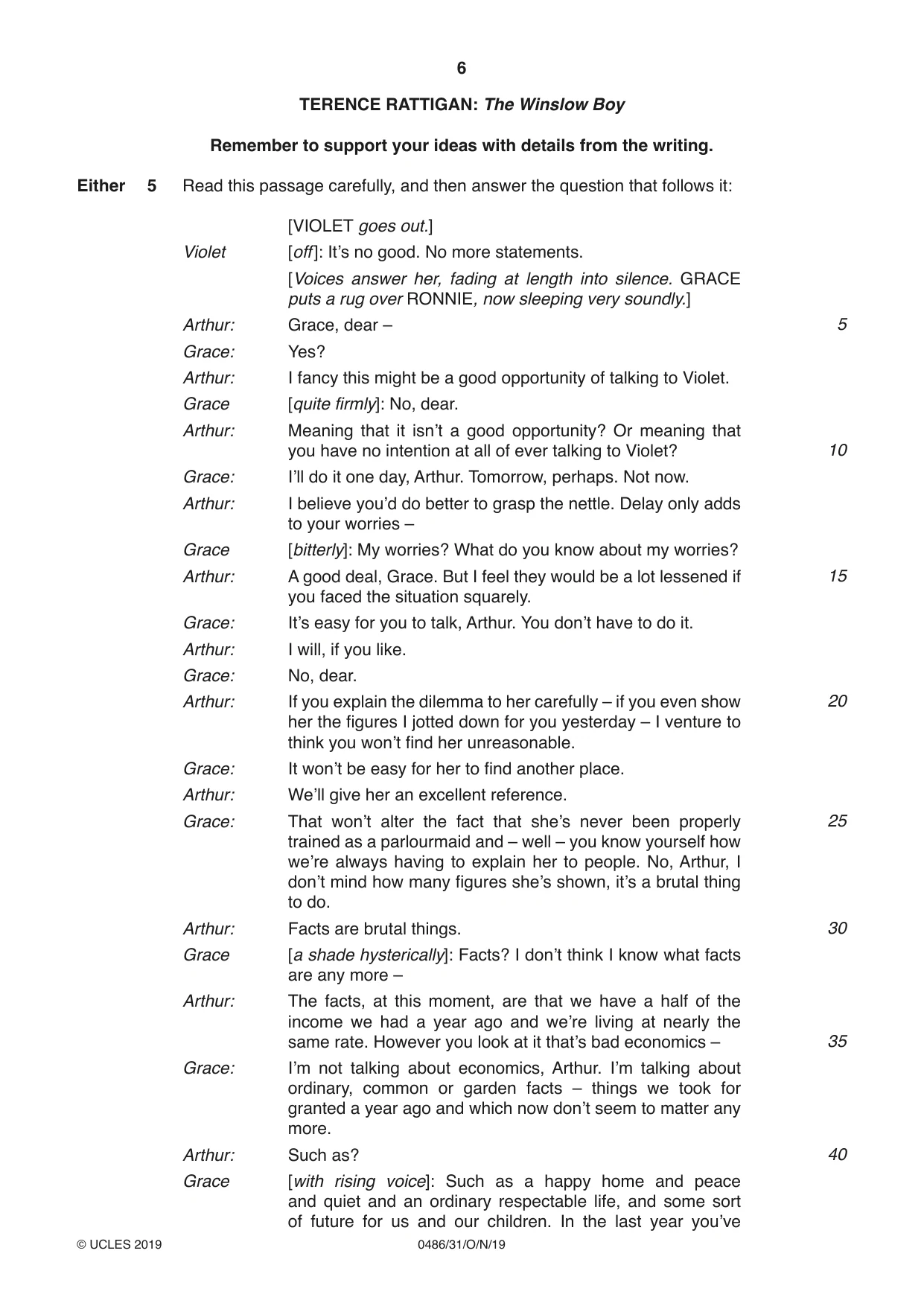
6 0486/31/O/N/19 © UCLES 2019 TERENCE RATTIGAN: The Winslow Boy Remember to support your ideas with details from the writing. Either 5 Read this passage carefully, and then answer the question that follows it: [VIOLET goes out.] Violet [off ]: It’s no good. No more statements. [Voices answer her, fading at length into silence. GRACE puts a rug over RONNIE, now sleeping very soundly.] Arthur: Grace, dear – Grace: Yes? Arthur: I fancy this might be a good opportunity of talking to Violet. Grace [quite firmly]: No, dear. Arthur: Meaning that it isn’t a good opportunity? Or meaning that you have no intention at all of ever talking to Violet? Grace: I’ll do it one day, Arthur. Tomorrow, perhaps. Not now. Arthur: I believe you’d do better to grasp the nettle. Delay only adds to your worries – Grace [bitterly]: My worries? What do you know about my worries? Arthur: A good deal, Grace. But I feel they would be a lot lessened if you faced the situation squarely. Grace: It’s easy for you to talk, Arthur. You don’t have to do it. Arthur: I will, if you like. Grace: No, dear. Arthur: If you explain the dilemma to her carefully – if you even show her the figures I jotted down for you yesterday – I venture to think you won’t find her unreasonable. Grace: It won’t be easy for her to find another place. Arthur: We’ll give her an excellent reference. Grace: That won’t alter the fact that she’s never been properly trained as a parlourmaid and – well – you know yourself how we’re always having to explain her to people. No, Arthur, I don’t mind how many figures she’s shown, it’s a brutal thing to do. Arthur: Facts are brutal things. Grace [a shade hysterically]: Facts? I don’t think I know what facts are any more – Arthur: The facts, at this moment, are that we have a half of the income we had a year ago and we’re living at nearly the same rate. However you look at it that’s bad economics – Grace: I’m not talking about economics, Arthur. I’m talking about ordinary, common or garden facts – things we took for granted a year ago and which now don’t seem to matter any more. Arthur: Such as? Grace [with rising voice]: Such as a happy home and peace and quiet and an ordinary respectable life, and some sort of future for us and our children. In the last year you’ve 5 10 15 20 25 30 35 40
Question paper, page 7
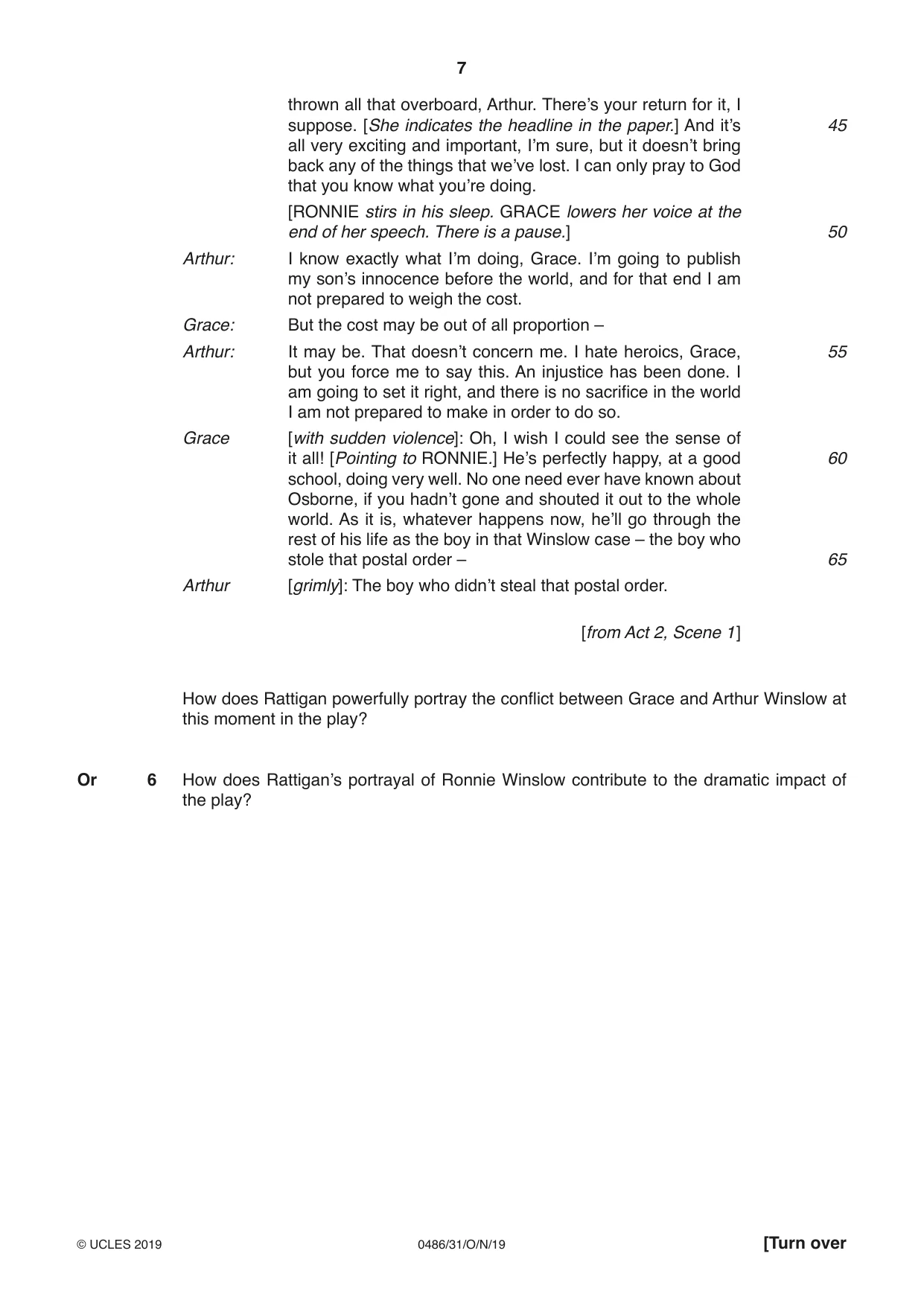
7 0486/31/O/N/19 © UCLES 2019 [Turn over thrown all that overboard, Arthur. There’s your return for it, I suppose. [She indicates the headline in the paper.] And it’s all very exciting and important, I’m sure, but it doesn’t bring back any of the things that we’ve lost. I can only pray to God that you know what you’re doing. [RONNIE stirs in his sleep. GRACE lowers her voice at the end of her speech. There is a pause.] Arthur: I know exactly what I’m doing, Grace. I’m going to publish my son’s innocence before the world, and for that end I am not prepared to weigh the cost. Grace: But the cost may be out of all proportion – Arthur: It may be. That doesn’t concern me. I hate heroics, Grace, but you force me to say this. An injustice has been done. I am going to set it right, and there is no sacrifice in the world I am not prepared to make in order to do so. Grace [with sudden violence]: Oh, I wish I could see the sense of it all! [Pointing to RONNIE.] He’s perfectly happy, at a good school, doing very well. No one need ever have known about Osborne, if you hadn’t gone and shouted it out to the whole world. As it is, whatever happens now, he’ll go through the rest of his life as the boy in that Winslow case – the boy who stole that postal order – Arthur [grimly]: The boy who didn’t steal that postal order. [from Act 2, Scene 1] How does Rattigan powerfully portray the conflict between Grace and Arthur Winslow at this moment in the play? Or 6 How does Rattigan’s portrayal of Ronnie Winslow contribute to the dramatic impact of the play? 45 50 55 60 65
Question paper, page 8
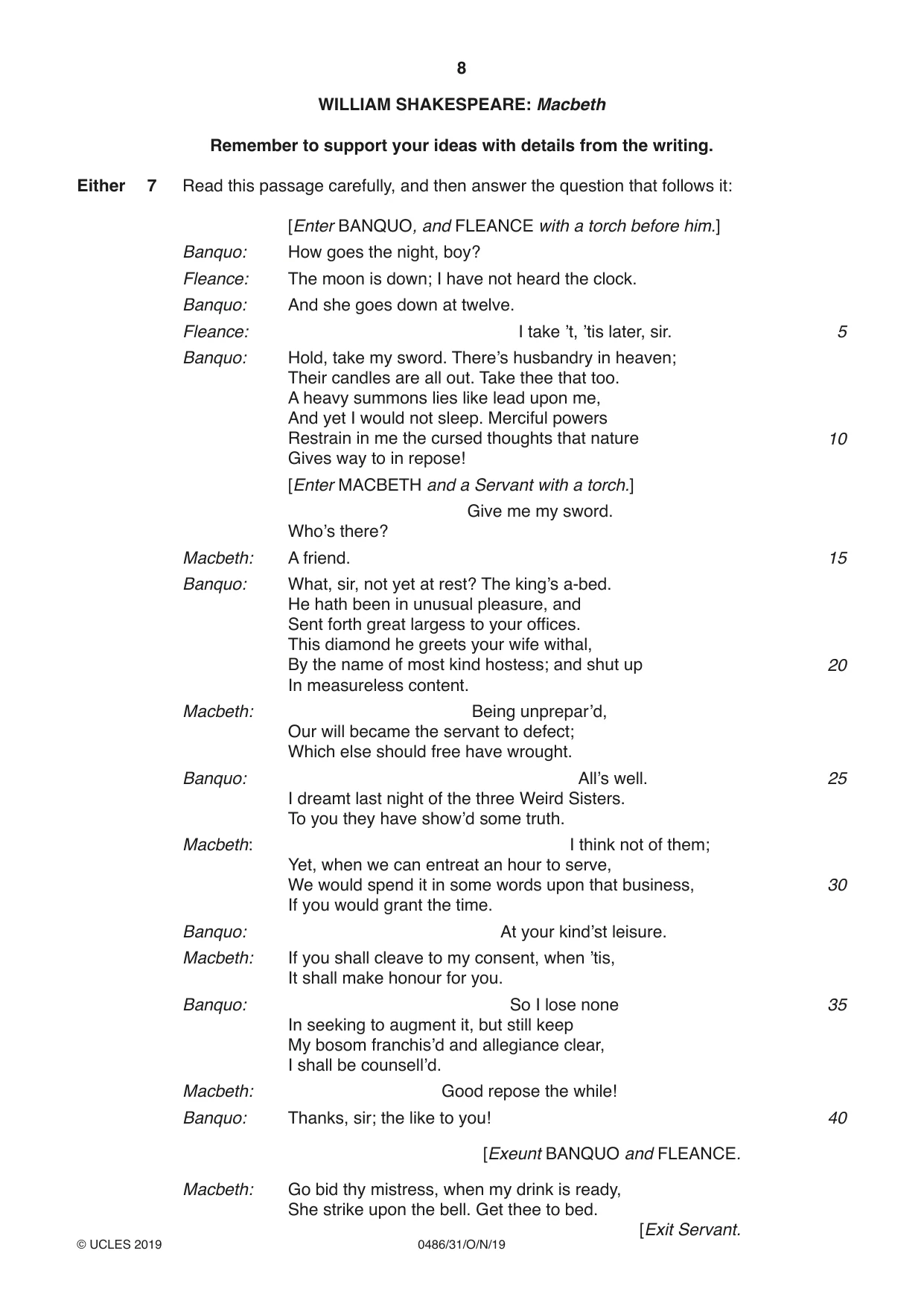
8 0486/31/O/N/19 © UCLES 2019 WILLIAM SHAKESPEARE: Macbeth Remember to support your ideas with details from the writing. Either 7 Read this passage carefully, and then answer the question that follows it: [Enter BANQUO, and FLEANCE with a torch before him.] Banquo: How goes the night, boy? Fleance: The moon is down; I have not heard the clock. Banquo: And she goes down at twelve. Fleance: I take ’t, ’tis later, sir. Banquo: Hold, take my sword. There’s husbandry in heaven; Their candles are all out. Take thee that too. A heavy summons lies like lead upon me, And yet I would not sleep. Merciful powers Restrain in me the cursed thoughts that nature Gives way to in repose! [Enter MACBETH and a Servant with a torch.] Give me my sword. Who’s there? Macbeth: A friend. Banquo: What, sir, not yet at rest? The king’s a-bed. He hath been in unusual pleasure, and Sent forth great largess to your offices. This diamond he greets your wife withal, By the name of most kind hostess; and shut up In measureless content. Macbeth: Being unprepar’d, Our will became the servant to defect; Which else should free have wrought. Banquo: All’s well. I dreamt last night of the three Weird Sisters. To you they have show’d some truth. Macbeth: I think not of them; Yet, when we can entreat an hour to serve, We would spend it in some words upon that business, If you would grant the time. Banquo: At your kind’st leisure. Macbeth: If you shall cleave to my consent, when ’tis, It shall make honour for you. Banquo: So I lose none In seeking to augment it, but still keep My bosom franchis’d and allegiance clear, I shall be counsell’d. Macbeth: Good repose the while! Banquo: Thanks, sir; the like to you! [Exeunt BANQUO and FLEANCE. Macbeth: Go bid thy mistress, when my drink is ready, She strike upon the bell. Get thee to bed. [Exit Servant. 5 10 15 20 25 30 35 40
Question paper, page 9
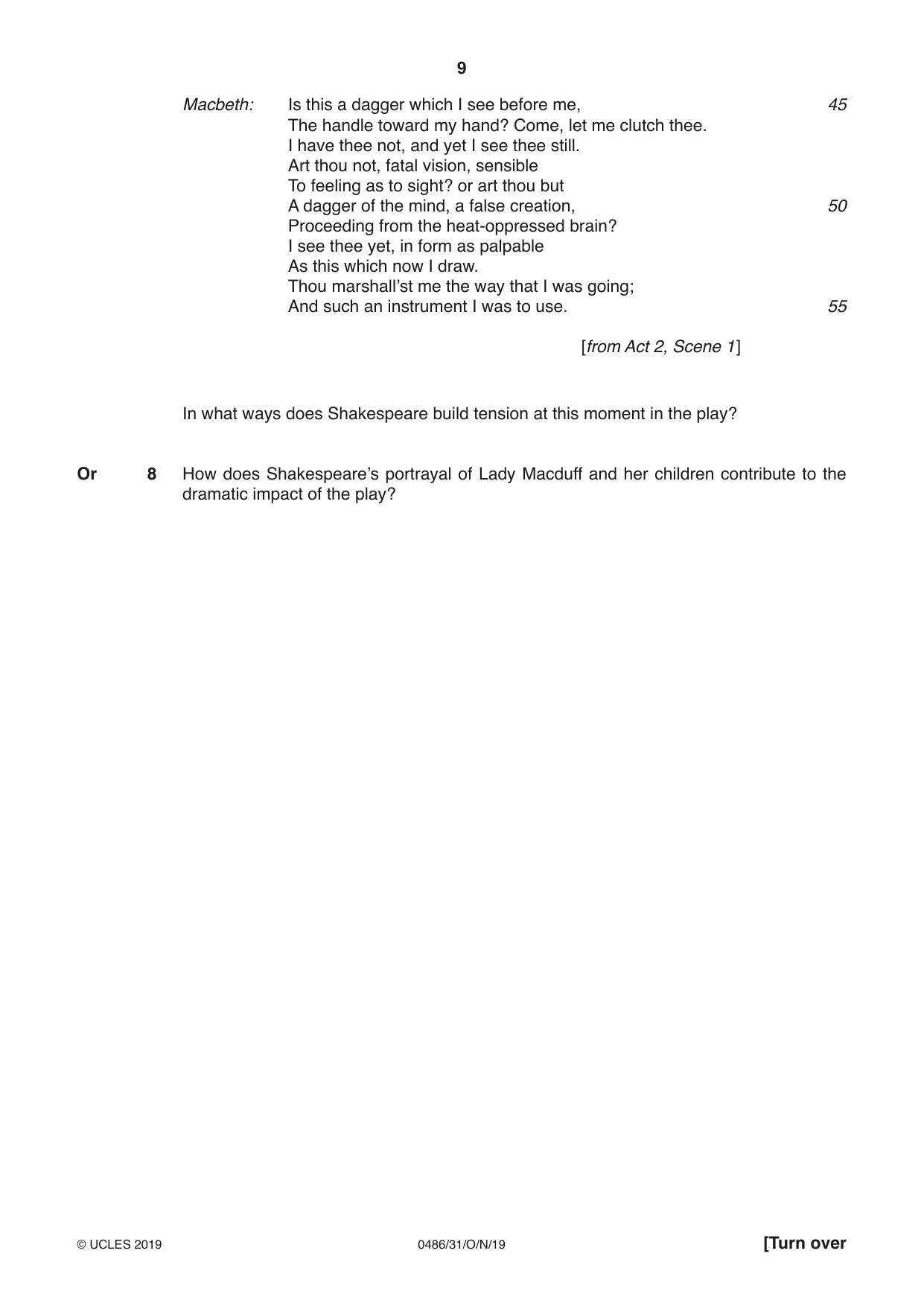
9 0486/31/O/N/19 © UCLES 2019 [Turn over Macbeth: Is this a dagger which I see before me, The handle toward my hand? Come, let me clutch thee. I have thee not, and yet I see thee still. Art thou not, fatal vision, sensible To feeling as to sight? or art thou but A dagger of the mind, a false creation, Proceeding from the heat-oppressed brain? I see thee yet, in form as palpable As this which now I draw. Thou marshall’st me the way that I was going; And such an instrument I was to use. [from Act 2, Scene 1] In what ways does Shakespeare build tension at this moment in the play? Or 8 How does Shakespeare’s portrayal of Lady Macduff and her children contribute to the dramatic impact of the play? 45 50 55
Question paper, page 10
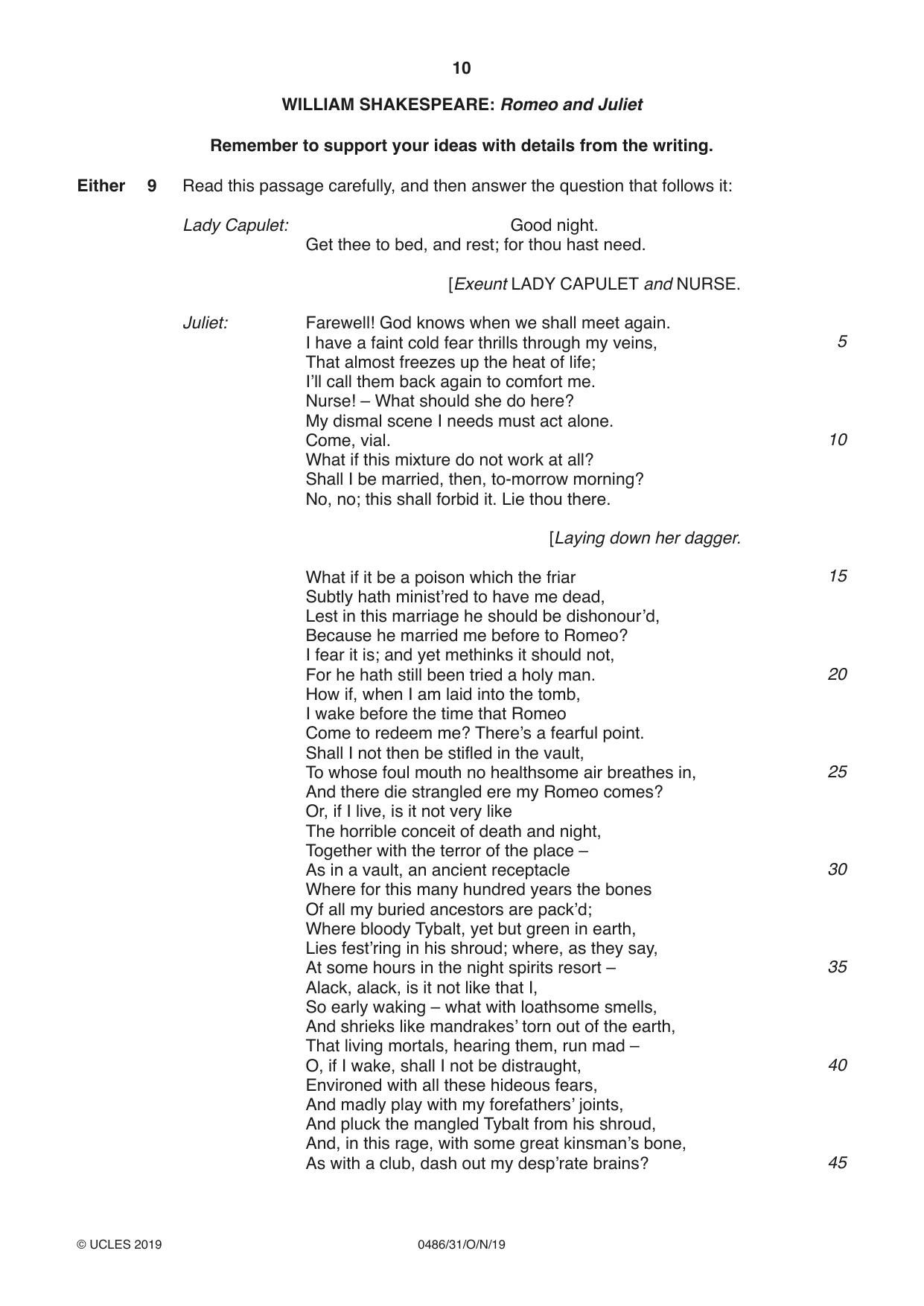
10 0486/31/O/N/19 © UCLES 2019 WILLIAM SHAKESPEARE: Romeo and Juliet Remember to support your ideas with details from the writing. Either 9 Read this passage carefully, and then answer the question that follows it: Lady Capulet: Good night. Get thee to bed, and rest; for thou hast need. [Exeunt LADY CAPULET and NURSE. Juliet: Farewell! God knows when we shall meet again. I have a faint cold fear thrills through my veins, That almost freezes up the heat of life; I’ll call them back again to comfort me. Nurse! – What should she do here? My dismal scene I needs must act alone. Come, vial. What if this mixture do not work at all? Shall I be married, then, to-morrow morning? No, no; this shall forbid it. Lie thou there. [Laying down her dagger. What if it be a poison which the friar Subtly hath minist’red to have me dead, Lest in this marriage he should be dishonour’d, Because he married me before to Romeo? I fear it is; and yet methinks it should not, For he hath still been tried a holy man. How if, when I am laid into the tomb, I wake before the time that Romeo Come to redeem me? There’s a fearful point. Shall I not then be stifled in the vault, To whose foul mouth no healthsome air breathes in, And there die strangled ere my Romeo comes? Or, if I live, is it not very like The horrible conceit of death and night, Together with the terror of the place – As in a vault, an ancient receptacle Where for this many hundred years the bones Of all my buried ancestors are pack’d; Where bloody Tybalt, yet but green in earth, Lies fest’ring in his shroud; where, as they say, At some hours in the night spirits resort – Alack, alack, is it not like that I, So early waking – what with loathsome smells, And shrieks like mandrakes’ torn out of the earth, That living mortals, hearing them, run mad – O, if I wake, shall I not be distraught, Environed with all these hideous fears, And madly play with my forefathers’ joints, And pluck the mangled Tybalt from his shroud, And, in this rage, with some great kinsman’s bone, As with a club, dash out my desp’rate brains? 5 10 15 20 25 30 35 40 45
Question paper, page 11
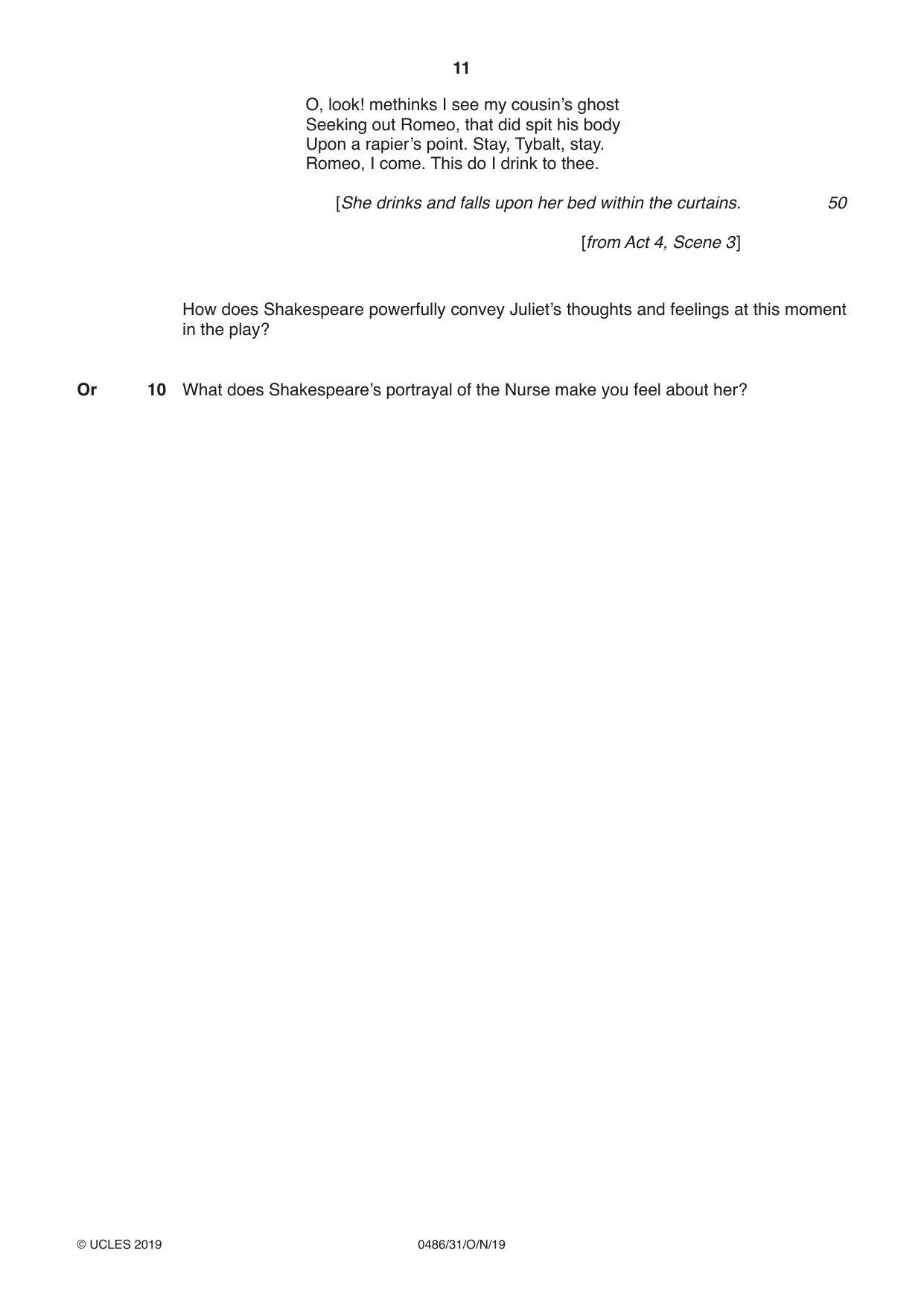
11 0486/31/O/N/19 © UCLES 2019 O, look! methinks I see my cousin’s ghost Seeking out Romeo, that did spit his body Upon a rapier’s point. Stay, Tybalt, stay. Romeo, I come. This do I drink to thee. [She drinks and falls upon her bed within the curtains. [from Act 4, Scene 3] How does Shakespeare powerfully convey Juliet’s thoughts and feelings at this moment in the play? Or 10 What does Shakespeare’s portrayal of the Nurse make you feel about her? 50
Question paper, page 12
12 0486/31/O/N/19 © UCLES 2019 Permission to reproduce items where third-party owned material protected by copyright is included has been sought and cleared where possible. Every reasonable effort has been made by the publisher (UCLES) to trace copyright holders, but if any items requiring clearance have unwittingly been included, the publisher will be pleased to make amends at the earliest possible opportunity. To avoid the issue of disclosure of answer-related information to candidates, all copyright acknowledgements are reproduced online in the Cambridge Assessment International Education Copyright Acknowledgements Booklet. This is produced for each series of examinations and is freely available to download at www.cambridgeinternational.org after the live examination series. Cambridge Assessment International Education is part of the Cambridge Assessment Group. Cambridge Assessment is the brand name of the University of Cambridge Local Examinations Syndicate (UCLES), which itself is a department of the University of Cambridge. BLANK PAGE
Mark scheme, page 1
This document consists of 4 printed pages. © UCLES 2019 [Turn over Cambridge Assessment International Education Cambridge International General Certificate of Secondary Education LITERATURE (ENGLISH) 0486/31 Paper 3 Drama (Open Text) October/November 2019 MARK SCHEME Maximum Mark: 25 Published This mark scheme is published as an aid to teachers and candidates, to indicate the requirements of the examination. It shows the basis on which Examiners were instructed to award marks. It does not indicate the details of the discussions that took place at an Examiners’ meeting before marking began, which would have considered the acceptability of alternative answers. Mark schemes should be read in conjunction with the question paper and the Principal Examiner Report for Teachers. Cambridge International will not enter into discussions about these mark schemes. Cambridge International is publishing the mark schemes for the October/November 2019 series for most Cambridge IGCSE™, Cambridge International A and AS Level components and some Cambridge O Level components.
Mark scheme, page 2
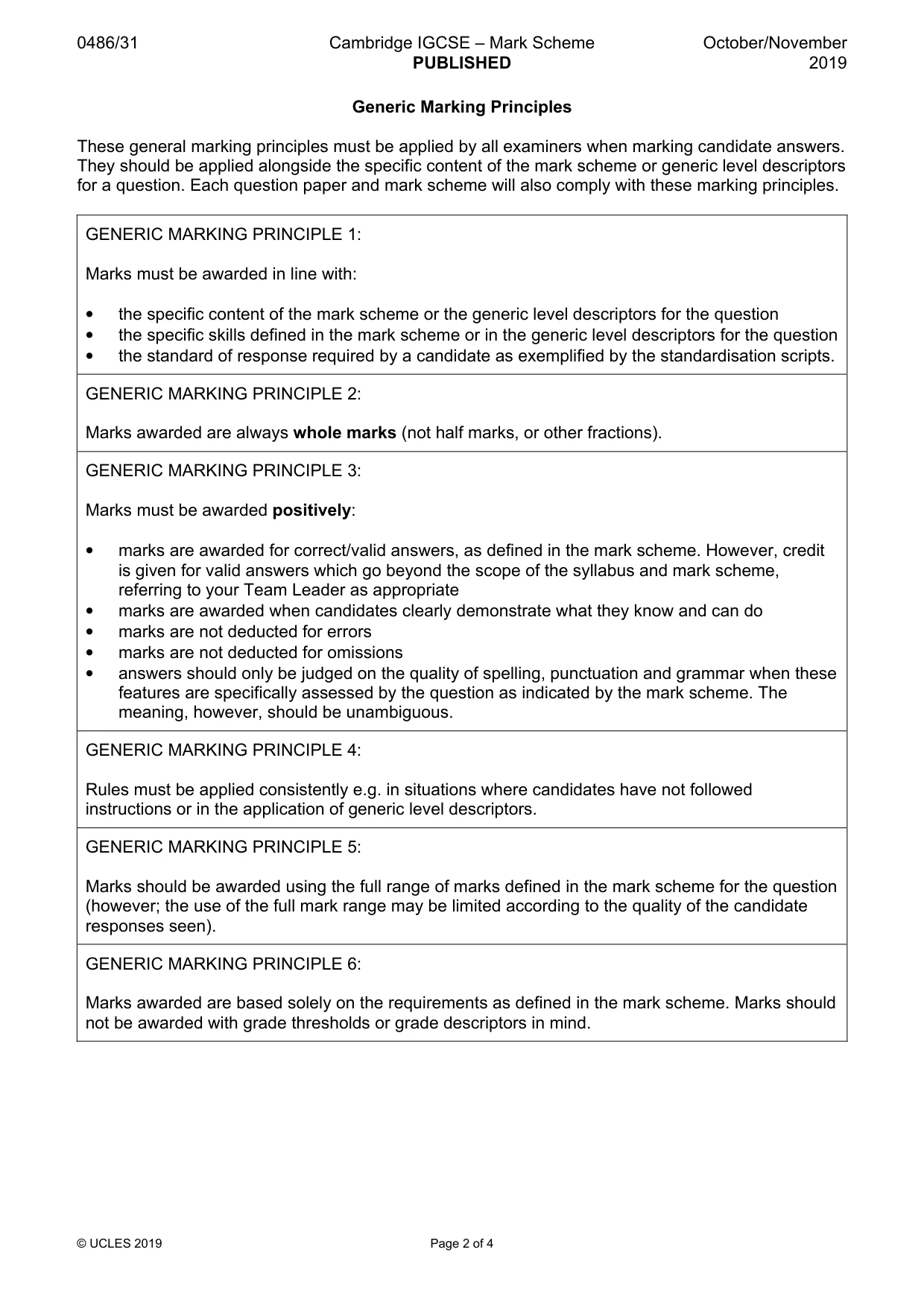
0486/31 Cambridge IGCSE – Mark Scheme PUBLISHED October/November 2019 © UCLES 2019 Page 2 of 4 Generic Marking Principles These general marking principles must be applied by all examiners when marking candidate answers. They should be applied alongside the specific content of the mark scheme or generic level descriptors for a question. Each question paper and mark scheme will also comply with these marking principles. GENERIC MARKING PRINCIPLE 1: Marks must be awarded in line with: • the specific content of the mark scheme or the generic level descriptors for the question • the specific skills defined in the mark scheme or in the generic level descriptors for the question • the standard of response required by a candidate as exemplified by the standardisation scripts. GENERIC MARKING PRINCIPLE 2: Marks awarded are always whole marks (not half marks, or other fractions). GENERIC MARKING PRINCIPLE 3: Marks must be awarded positively: • marks are awarded for correct/valid answers, as defined in the mark scheme. However, credit is given for valid answers which go beyond the scope of the syllabus and mark scheme, referring to your Team Leader as appropriate • marks are awarded when candidates clearly demonstrate what they know and can do • marks are not deducted for errors • marks are not deducted for omissions • answers should only be judged on the quality of spelling, punctuation and grammar when these features are specifically assessed by the question as indicated by the mark scheme. The meaning, however, should be unambiguous. GENERIC MARKING PRINCIPLE 4: Rules must be applied consistently e.g. in situations where candidates have not followed instructions or in the application of generic level descriptors. GENERIC MARKING PRINCIPLE 5: Marks should be awarded using the full range of marks defined in the mark scheme for the question (however; the use of the full mark range may be limited according to the quality of the candidate responses seen). GENERIC MARKING PRINCIPLE 6: Marks awarded are based solely on the requirements as defined in the mark scheme. Marks should not be awarded with grade thresholds or grade descriptors in mind.
Mark scheme, page 3
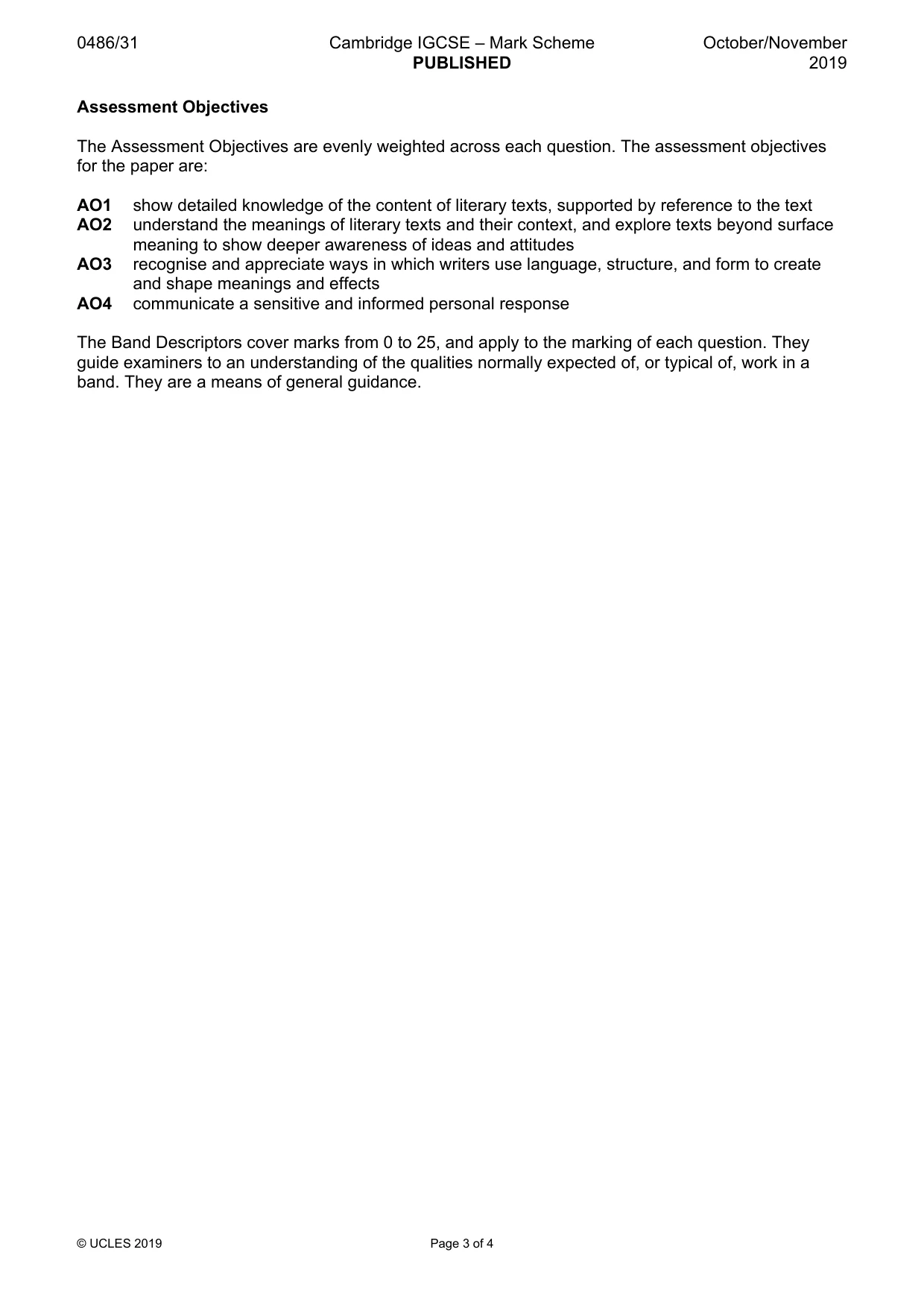
0486/31 Cambridge IGCSE – Mark Scheme PUBLISHED October/November 2019 © UCLES 2019 Page 3 of 4 Assessment Objectives The Assessment Objectives are evenly weighted across each question. The assessment objectives for the paper are: AO1 show detailed knowledge of the content of literary texts, supported by reference to the text AO2 understand the meanings of literary texts and their context, and explore texts beyond surface meaning to show deeper awareness of ideas and attitudes AO3 recognise and appreciate ways in which writers use language, structure, and form to create and shape meanings and effects AO4 communicate a sensitive and informed personal response The Band Descriptors cover marks from 0 to 25, and apply to the marking of each question. They guide examiners to an understanding of the qualities normally expected of, or typical of, work in a band. They are a means of general guidance.
Mark scheme, page 4
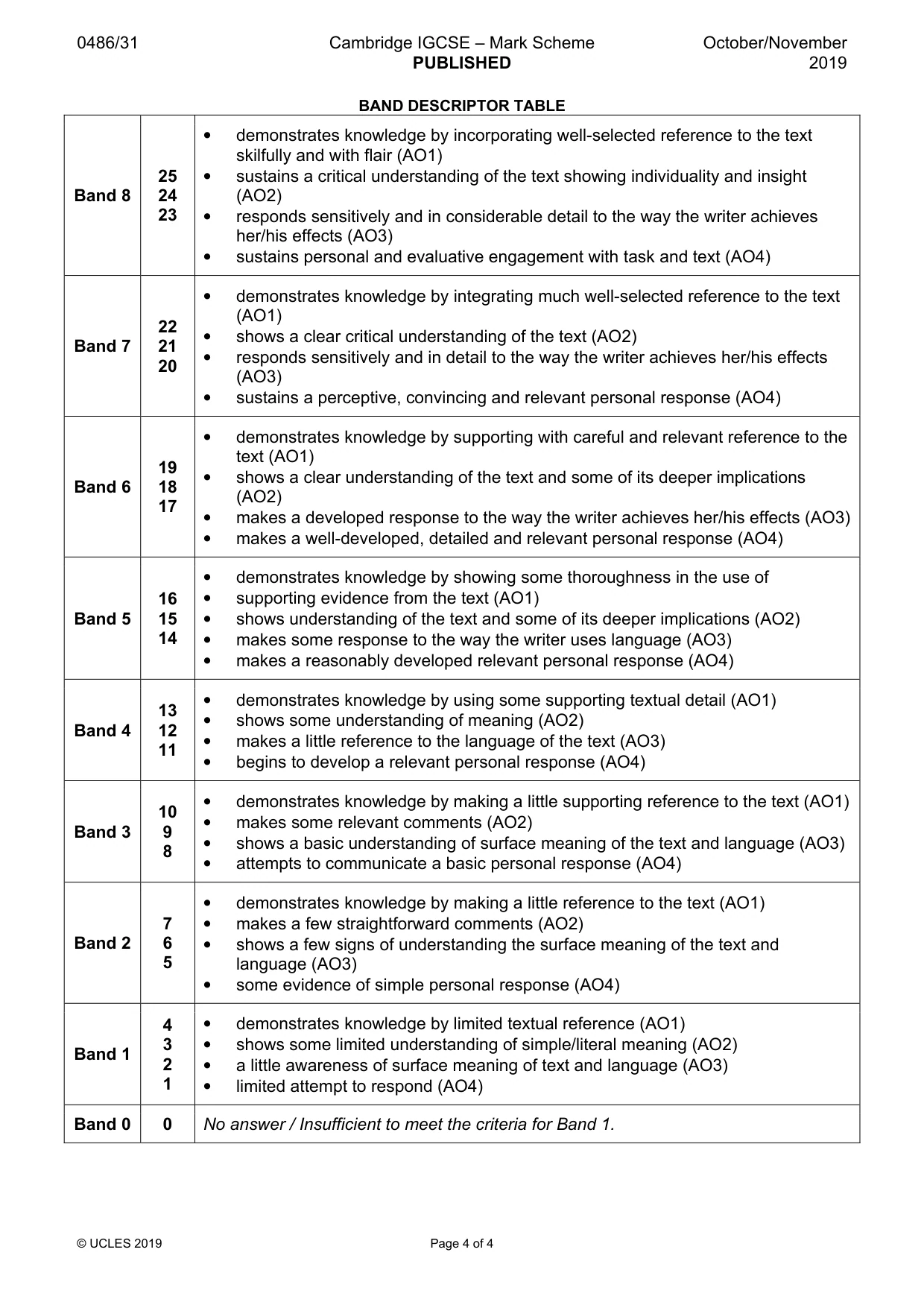
0486/31 Cambridge IGCSE – Mark Scheme PUBLISHED October/November 2019 © UCLES 2019 Page 4 of 4 BAND DESCRIPTOR TABLE Band 8 25 24 23 • demonstrates knowledge by incorporating well-selected reference to the text skilfully and with flair (AO1) • sustains a critical understanding of the text showing individuality and insight (AO2) • responds sensitively and in considerable detail to the way the writer achieves her/his effects (AO3) • sustains personal and evaluative engagement with task and text (AO4) Band 7 22 21 20 • demonstrates knowledge by integrating much well-selected reference to the text (AO1) • shows a clear critical understanding of the text (AO2) • responds sensitively and in detail to the way the writer achieves her/his effects (AO3) • sustains a perceptive, convincing and relevant personal response (AO4) Band 6 19 18 17 • demonstrates knowledge by supporting with careful and relevant reference to the text (AO1) • shows a clear understanding of the text and some of its deeper implications (AO2) • makes a developed response to the way the writer achieves her/his effects (AO3) • makes a well-developed, detailed and relevant personal response (AO4) Band 5 16 15 14 • demonstrates knowledge by showing some thoroughness in the use of • supporting evidence from the text (AO1) • shows understanding of the text and some of its deeper implications (AO2) • makes some response to the way the writer uses language (AO3) • makes a reasonably developed relevant personal response (AO4) Band 4 13 12 11 • demonstrates knowledge by using some supporting textual detail (AO1) • shows some understanding of meaning (AO2) • makes a little reference to the language of the text (AO3) • begins to develop a relevant personal response (AO4) Band 3 10 9 8 • demonstrates knowledge by making a little supporting reference to the text (AO1) • makes some relevant comments (AO2) • shows a basic understanding of surface meaning of the text and language (AO3) • attempts to communicate a basic personal response (AO4) Band 2 7 6 5 • demonstrates knowledge by making a little reference to the text (AO1) • makes a few straightforward comments (AO2) • shows a few signs of understanding the surface meaning of the text and language (AO3) • some evidence of simple personal response (AO4) Band 1 4 3 2 1 • demonstrates knowledge by limited textual reference (AO1) • shows some limited understanding of simple/literal meaning (AO2) • a little awareness of surface meaning of text and language (AO3) • limited attempt to respond (AO4) Band 0 0 No answer / Insufficient to meet the criteria for Band 1.
What you needed in this session
Cambridge’s own grade thresholds for 2019 Oct/Nov, Paper 3 · Variant 1. A higher threshold means an easier paper — the bar moves with how the cohort did.