Cambridge IGCSE English - Literature 0486 — 2018 Oct/Nov Paper 3 · Variant 1
0486/31/O/N/18 · 25 marks · ≈28 min
The question paper and its mark scheme, free to read here and free to download. This is Cambridge’s own paper, exactly as it was sat.
Question paper12 pages


Mark scheme4 pages
Answers below. Sit the paper first if you are practising.
Paper as text
Question paper, page 1
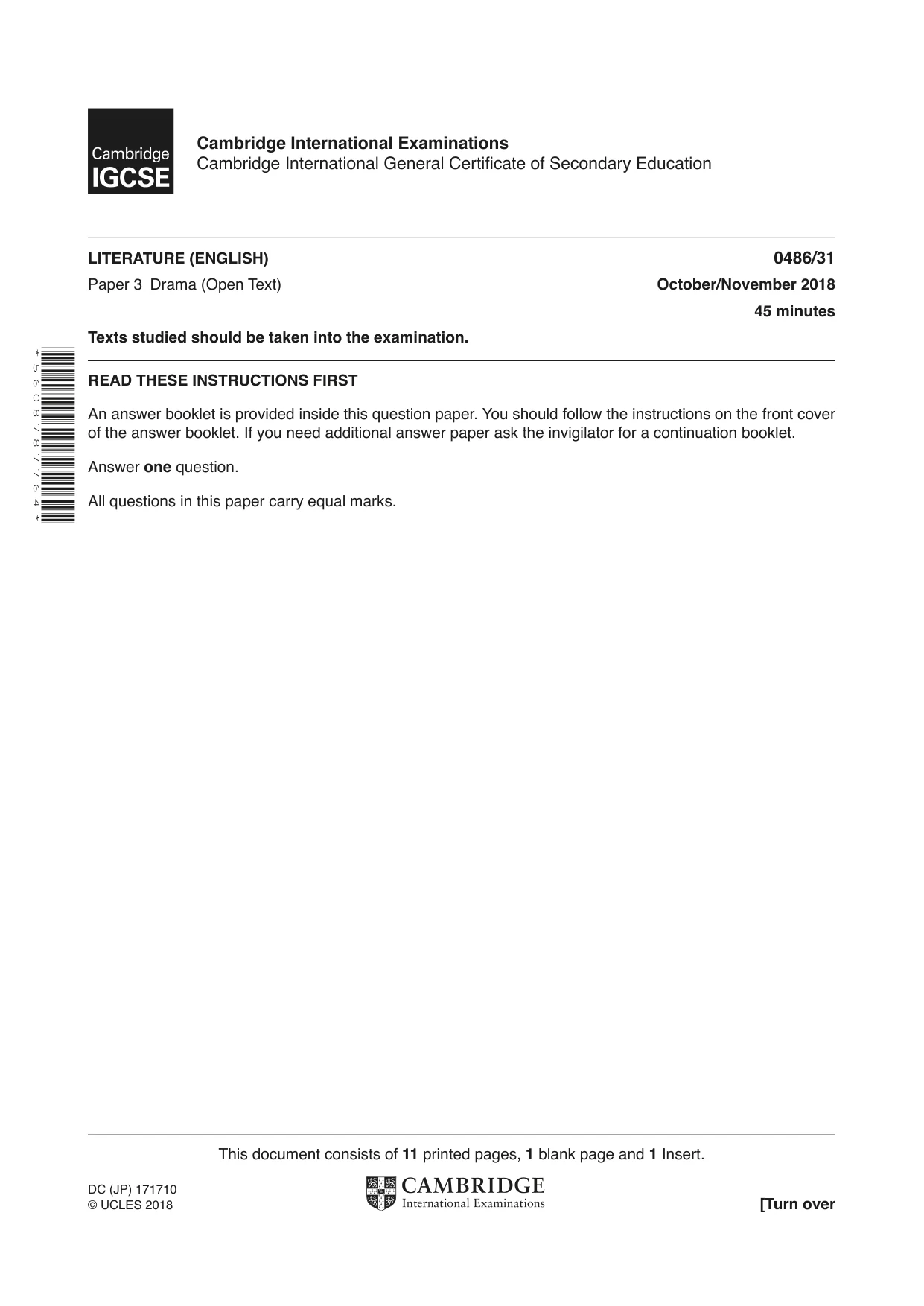
This document consists of 11 printed pages, 1 blank page and 1 Insert. DC (JP) 171710 © UCLES 2018 [Turn over Cambridge International Examinations Cambridge International General Certificate of Secondary Education * 5 6 0 8 7 8 7 7 6 4 * LITERATURE (ENGLISH) 0486/31 Paper 3 Drama (Open Text) October/November 2018 45 minutes Texts studied should be taken into the examination. READ THESE INSTRUCTIONS FIRST An answer booklet is provided inside this question paper. You should follow the instructions on the front cover of the answer booklet. If you need additional answer paper ask the invigilator for a continuation booklet. Answer one question. All questions in this paper carry equal marks.
Question paper, page 2
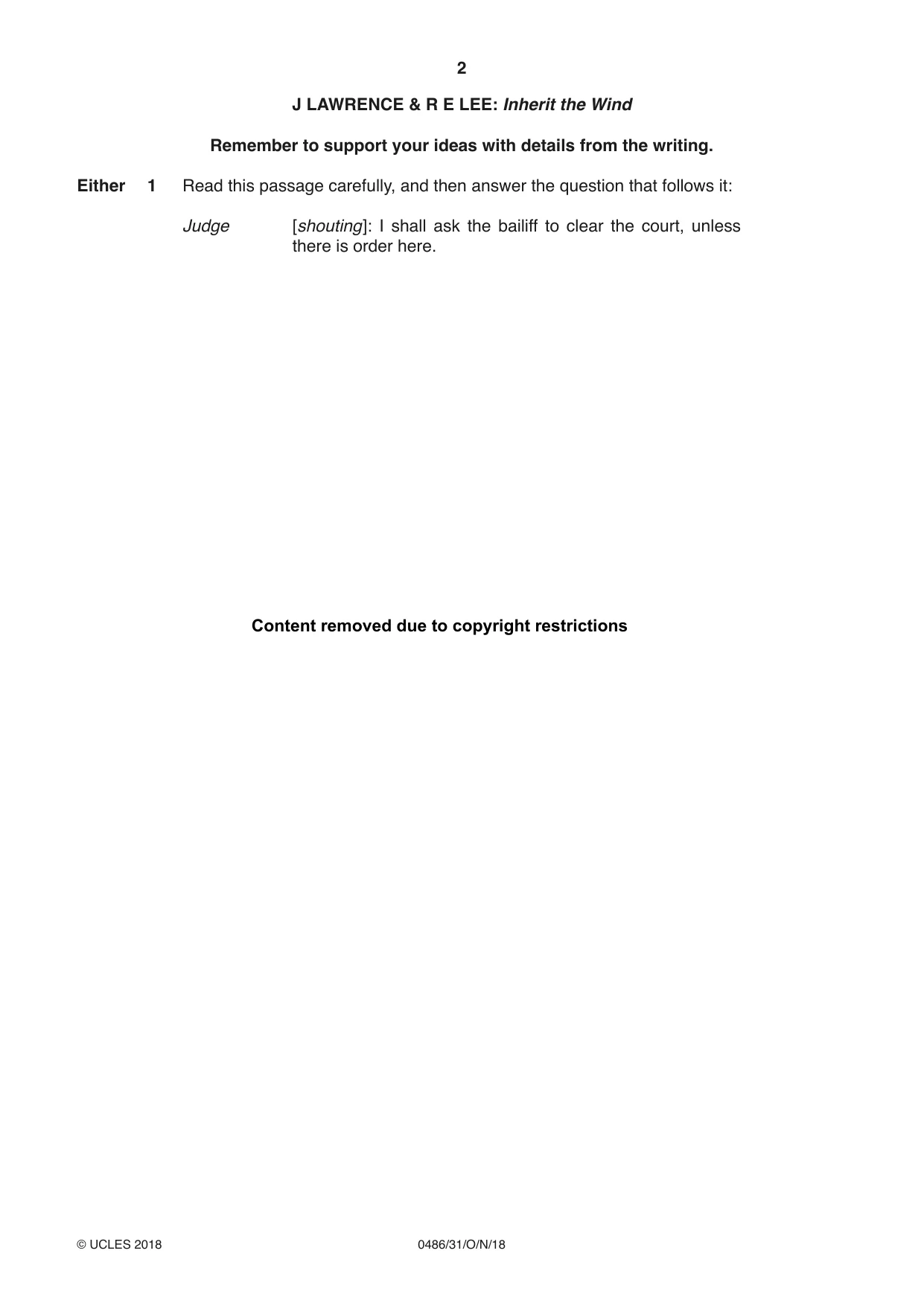
2 0486/31/O/N/18 © UCLES 2018 J LAWRENCE & R E LEE: Inherit the Wind Remember to support your ideas with details from the writing. Either 1 Read this passage carefully, and then answer the question that follows it: Judge [shouting]: I shall ask the bailiff to clear the court, unless there is order here. Content removed due to copyright restrictions
Question paper, page 3
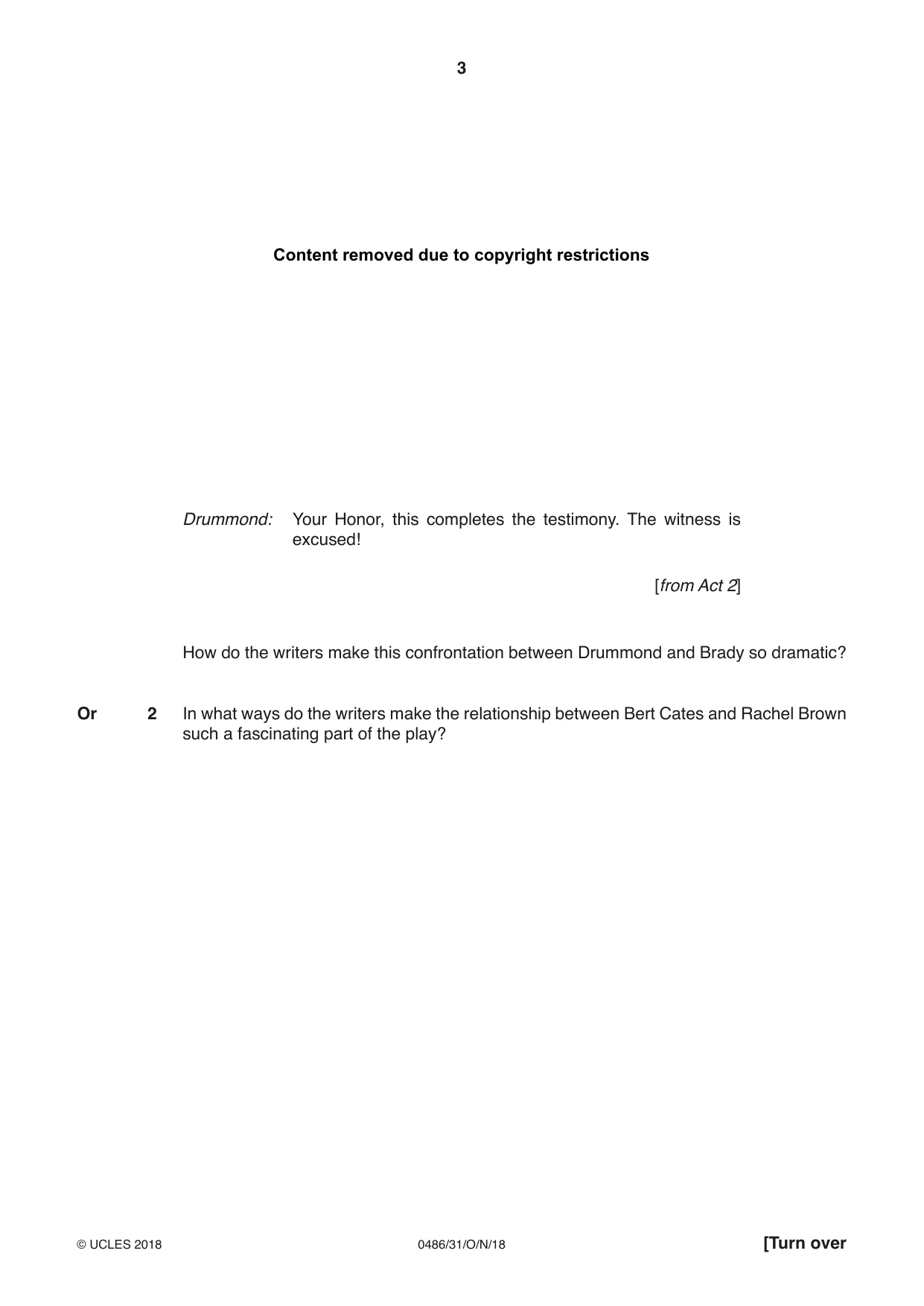
3 0486/31/O/N/18 © UCLES 2018 [Turn over Drummond: Your Honor, this completes the testimony. The witness is excused! [from Act 2] How do the writers make this confrontation between Drummond and Brady so dramatic? Or 2 In what ways do the writers make the relationship between Bert Cates and Rachel Brown such a fascinating part of the play? Content removed due to copyright restrictions
Question paper, page 4
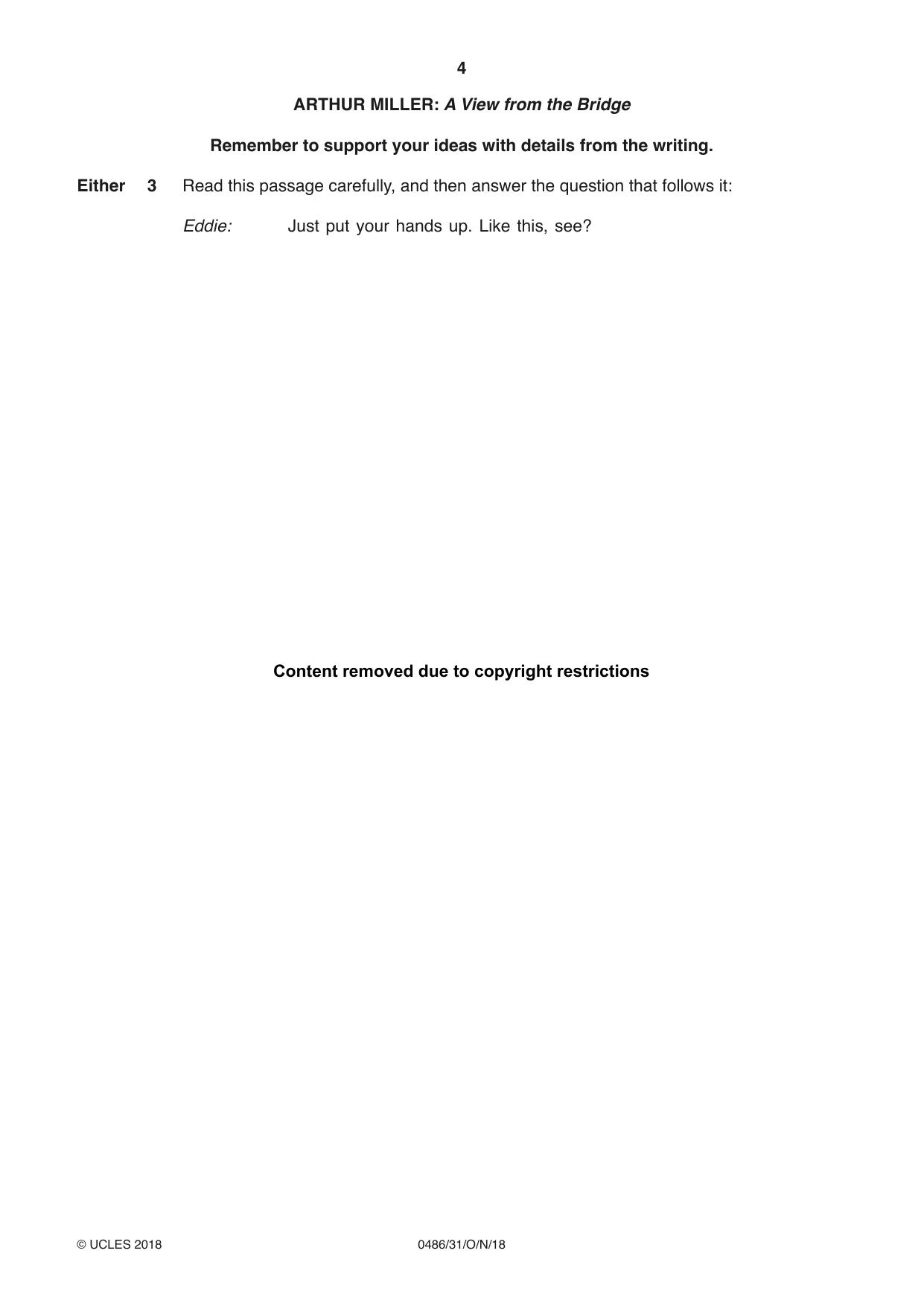
4 0486/31/O/N/18 © UCLES 2018 ARTHUR MILLER: A View from the Bridge Remember to support your ideas with details from the writing. Either 3 Read this passage carefully, and then answer the question that follows it: Eddie: Just put your hands up. Like this, see? Content removed due to copyright restrictions
Question paper, page 5
5 0486/31/O/N/18 © UCLES 2018 [Turn over and EDDIE’s grin vanishes as he absorbs his look.] CURTAIN [from Act 1] How does Miller make this such a dramatic ending to Act One? Or 4 How does Miller make Eddie’s feelings for Catherine such a disturbing part of the play? Content removed due to copyright restrictions
Question paper, page 6
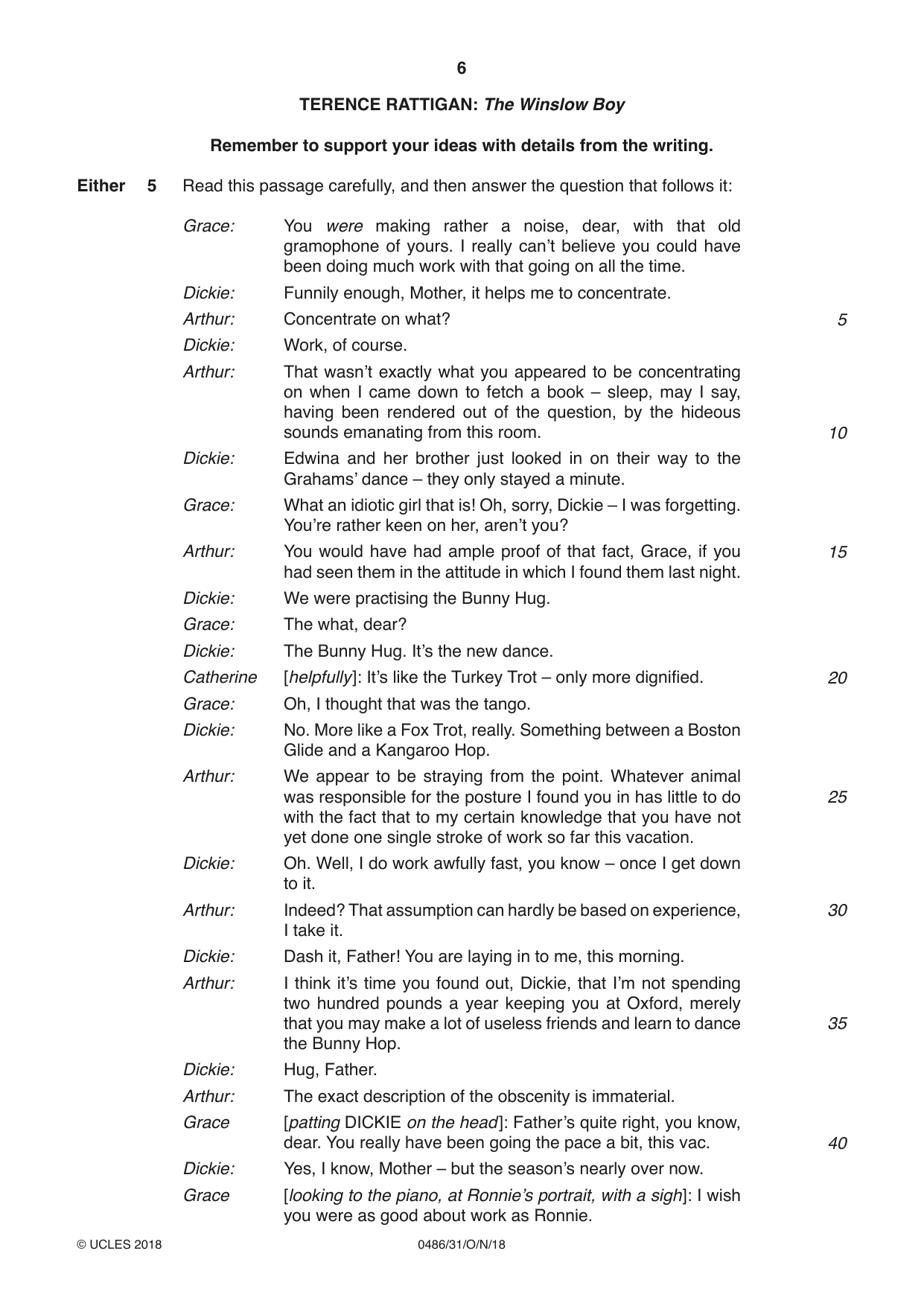
6 0486/31/O/N/18 © UCLES 2018 TERENCE RATTIGAN: The Winslow Boy Remember to support your ideas with details from the writing. Either 5 Read this passage carefully, and then answer the question that follows it: Grace: You were making rather a noise, dear, with that old gramophone of yours. I really can’t believe you could have been doing much work with that going on all the time. Dickie: Funnily enough, Mother, it helps me to concentrate. Arthur: Concentrate on what? Dickie: Work, of course. Arthur: That wasn’t exactly what you appeared to be concentrating on when I came down to fetch a book – sleep, may I say, having been rendered out of the question, by the hideous sounds emanating from this room. Dickie: Edwina and her brother just looked in on their way to the Grahams’ dance – they only stayed a minute. Grace: What an idiotic girl that is! Oh, sorry, Dickie – I was forgetting. You’re rather keen on her, aren’t you? Arthur: You would have had ample proof of that fact, Grace, if you had seen them in the attitude in which I found them last night. Dickie: We were practising the Bunny Hug. Grace: The what, dear? Dickie: The Bunny Hug. It’s the new dance. Catherine [helpfully]: It’s like the Turkey Trot – only more dignified. Grace: Oh, I thought that was the tango. Dickie: No. More like a Fox Trot, really. Something between a Boston Glide and a Kangaroo Hop. Arthur: We appear to be straying from the point. Whatever animal was responsible for the posture I found you in has little to do with the fact that to my certain knowledge that you have not yet done one single stroke of work so far this vacation. Dickie: Oh. Well, I do work awfully fast, you know – once I get down to it. Arthur: Indeed? That assumption can hardly be based on experience, I take it. Dickie: Dash it, Father! You are laying in to me, this morning. Arthur: I think it’s time you found out, Dickie, that I’m not spending two hundred pounds a year keeping you at Oxford, merely that you may make a lot of useless friends and learn to dance the Bunny Hop. Dickie: Hug, Father. Arthur: The exact description of the obscenity is immaterial. Grace [patting DICKIE on the head]: Father’s quite right, you know, dear. You really have been going the pace a bit, this vac. Dickie: Yes, I know, Mother – but the season’s nearly over now. Grace [looking to the piano, at Ronnie’s portrait, with a sigh]: I wish you were as good about work as Ronnie. 5 10 15 20 25 30 35 40
Question paper, page 7
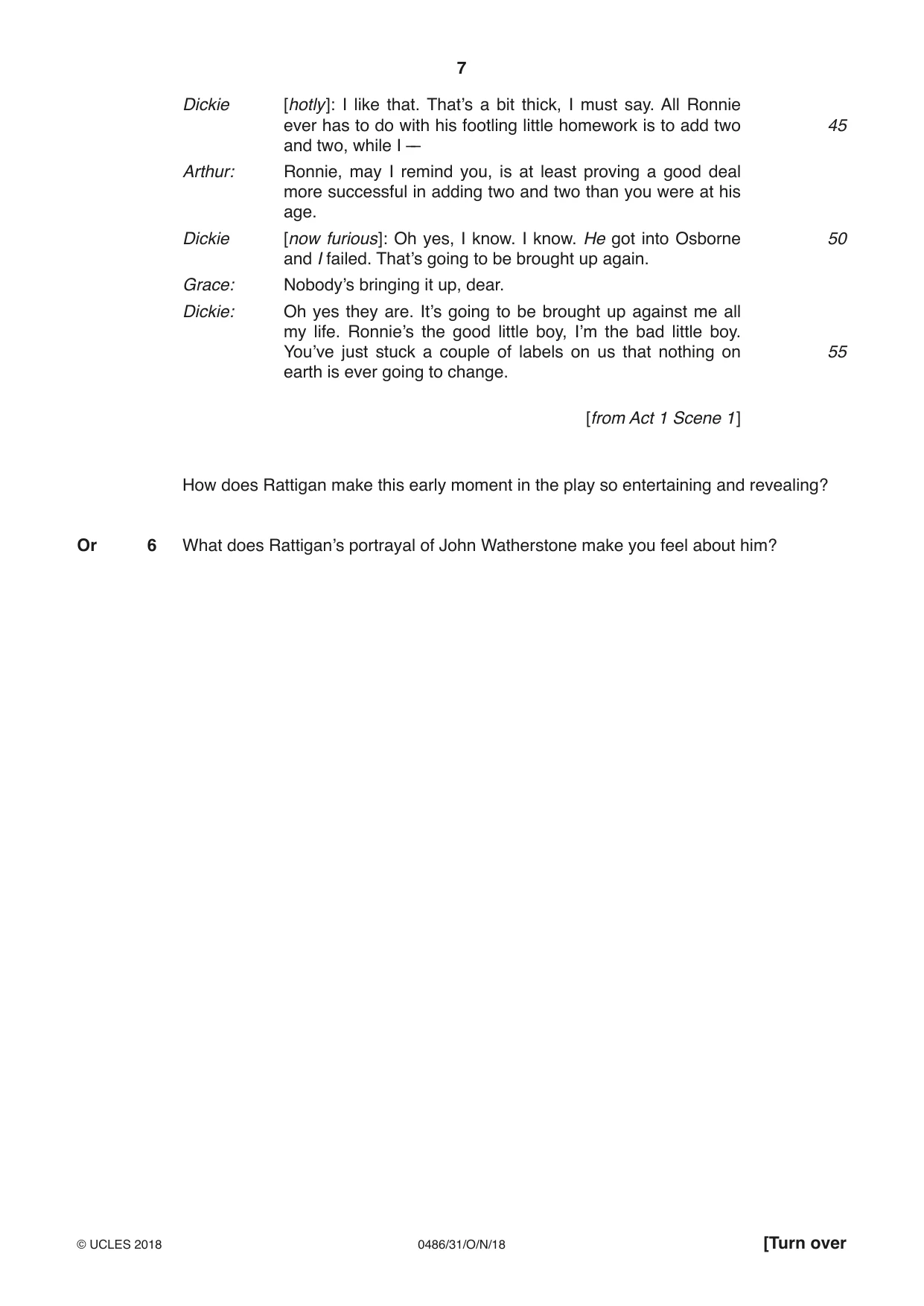
7 0486/31/O/N/18 © UCLES 2018 [Turn over Dickie [hotly]: I like that. That’s a bit thick, I must say. All Ronnie ever has to do with his footling little homework is to add two and two, while I –– Arthur: Ronnie, may I remind you, is at least proving a good deal more successful in adding two and two than you were at his age. Dickie [now furious]: Oh yes, I know. I know. He got into Osborne and I failed. That’s going to be brought up again. Grace: Nobody’s bringing it up, dear. Dickie: Oh yes they are. It’s going to be brought up against me all my life. Ronnie’s the good little boy, I’m the bad little boy. You’ve just stuck a couple of labels on us that nothing on earth is ever going to change. [from Act 1 Scene 1] How does Rattigan make this early moment in the play so entertaining and revealing? Or 6 What does Rattigan’s portrayal of John Watherstone make you feel about him? 45 50 55
Question paper, page 8
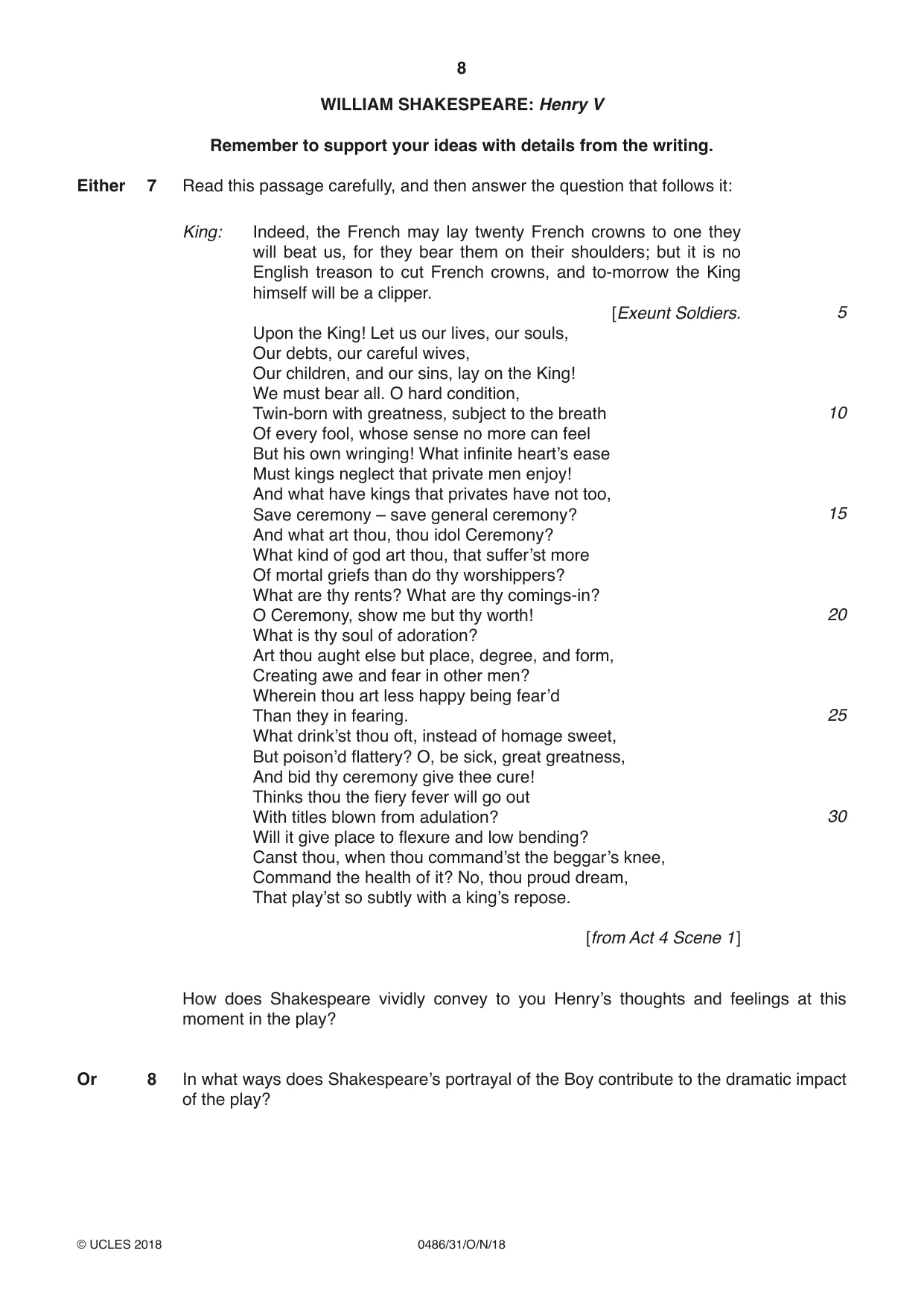
8 0486/31/O/N/18 © UCLES 2018 WILLIAM SHAKESPEARE: Henry V Remember to support your ideas with details from the writing. Either 7 Read this passage carefully, and then answer the question that follows it: King: Indeed, the French may lay twenty French crowns to one they will beat us, for they bear them on their shoulders; but it is no English treason to cut French crowns, and tomorrow the King himself will be a clipper. [Exeunt Soldiers. Upon the King! Let us our lives, our souls, Our debts, our careful wives, Our children, and our sins, lay on the King! We must bear all. O hard condition, Twinborn with greatness, subject to the breath Of every fool, whose sense no more can feel But his own wringing! What infinite heart’s ease Must kings neglect that private men enjoy! And what have kings that privates have not too, Save ceremony – save general ceremony? And what art thou, thou idol Ceremony? What kind of god art thou, that suffer’st more Of mortal griefs than do thy worshippers? What are thy rents? What are thy comingsin? O Ceremony, show me but thy worth! What is thy soul of adoration? Art thou aught else but place, degree, and form, Creating awe and fear in other men? Wherein thou art less happy being fear’d Than they in fearing. What drink’st thou oft, instead of homage sweet, But poison’d flattery? O, be sick, great greatness, And bid thy ceremony give thee cure! Thinks thou the fiery fever will go out With titles blown from adulation? Will it give place to flexure and low bending? Canst thou, when thou command’st the beggar’s knee, Command the health of it? No, thou proud dream, That play’st so subtly with a king’s repose. [from Act 4 Scene 1] How does Shakespeare vividly convey to you Henry’s thoughts and feelings at this moment in the play? Or 8 In what ways does Shakespeare’s portrayal of the Boy contribute to the dramatic impact of the play? 5 10 15 20 25 30
Question paper, page 9
9 0486/31/O/N/18 © UCLES 2018 [Turn over TURN OVER FOR QUESTION 9
Question paper, page 10
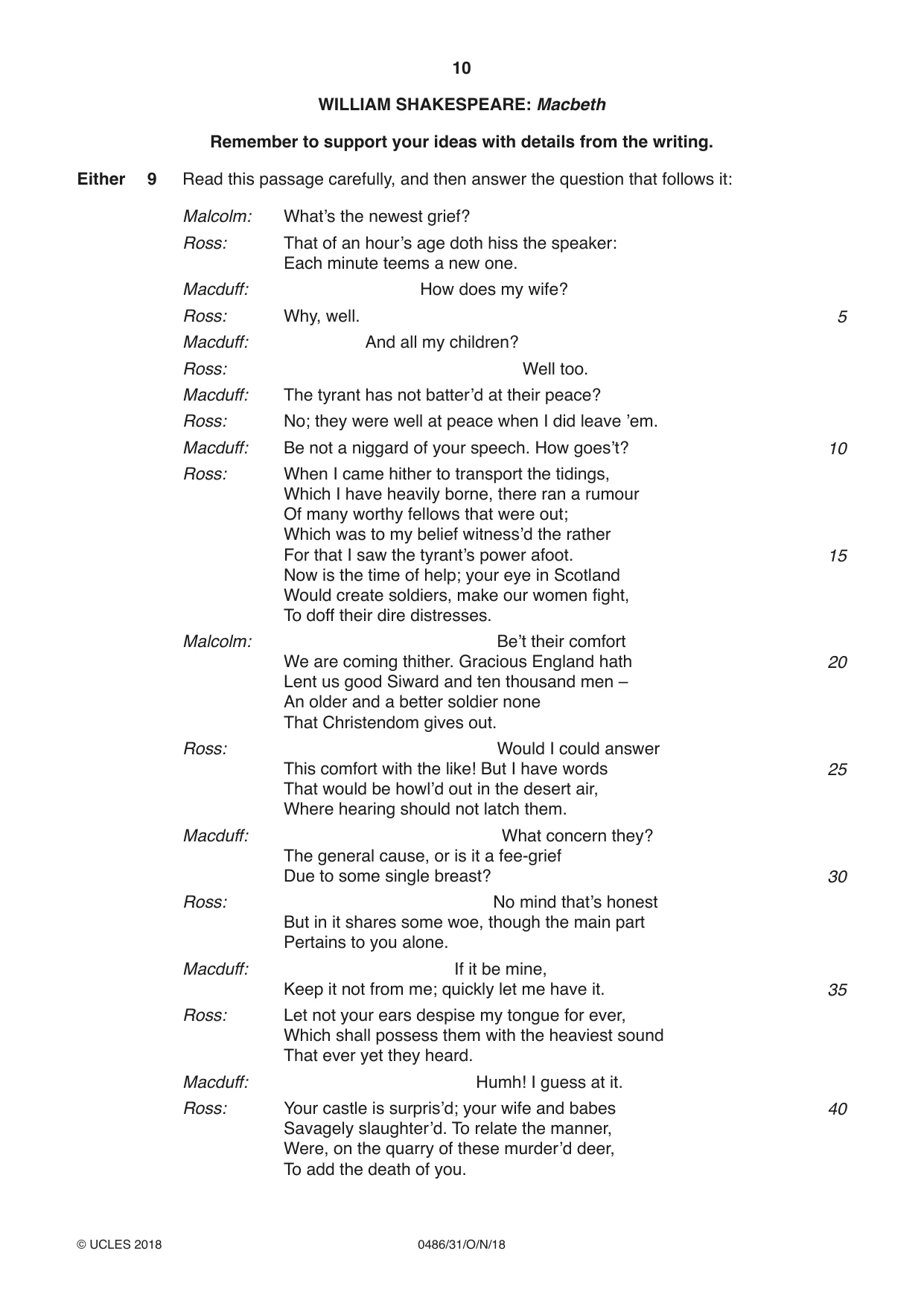
10 0486/31/O/N/18 © UCLES 2018 WILLIAM SHAKESPEARE: Macbeth Remember to support your ideas with details from the writing. Either 9 Read this passage carefully, and then answer the question that follows it: Malcolm: What’s the newest grief? Ross: That of an hour’s age doth hiss the speaker: Each minute teems a new one. Macduff: How does my wife? Ross: Why, well. Macduff: And all my children? Ross: Well too. Macduff: The tyrant has not batter’d at their peace? Ross: No; they were well at peace when I did leave ’em. Macduff: Be not a niggard of your speech. How goes’t? Ross: When I came hither to transport the tidings, Which I have heavily borne, there ran a rumour Of many worthy fellows that were out; Which was to my belief witness’d the rather For that I saw the tyrant’s power afoot. Now is the time of help; your eye in Scotland Would create soldiers, make our women fight, To doff their dire distresses. Malcolm: Be’t their comfort We are coming thither. Gracious England hath Lent us good Siward and ten thousand men – An older and a better soldier none That Christendom gives out. Ross: Would I could answer This comfort with the like! But I have words That would be howl’d out in the desert air, Where hearing should not latch them. Macduff: What concern they? The general cause, or is it a feegrief Due to some single breast? Ross: No mind that’s honest But in it shares some woe, though the main part Pertains to you alone. Macduff: If it be mine, Keep it not from me; quickly let me have it. Ross: Let not your ears despise my tongue for ever, Which shall possess them with the heaviest sound That ever yet they heard. Macduff: Humh! I guess at it. Ross: Your castle is surpris’d; your wife and babes Savagely slaughter’d. To relate the manner, Were, on the quarry of these murder’d deer, To add the death of you. 5 10 15 20 25 30 35 40
Question paper, page 11
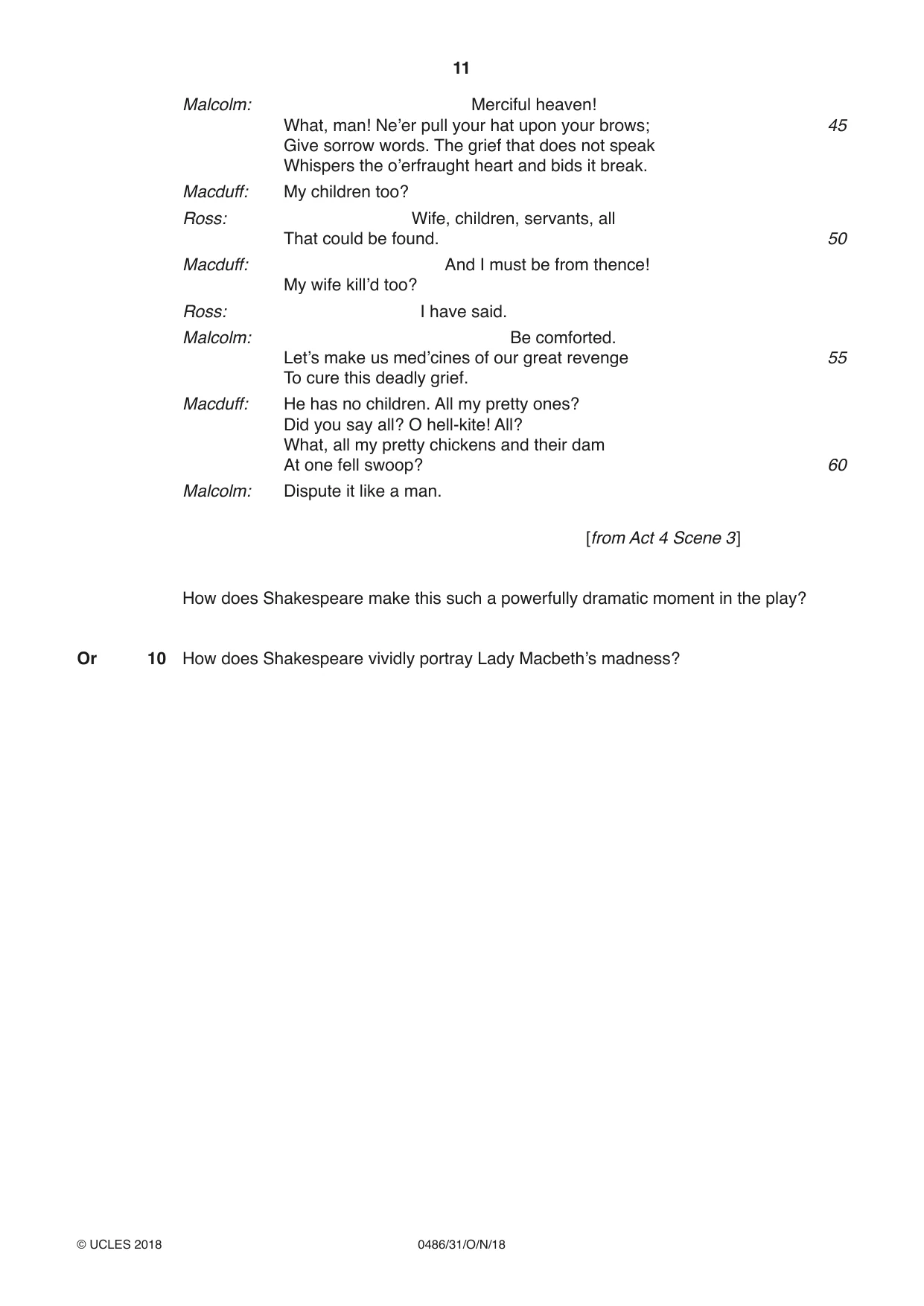
11 0486/31/O/N/18 © UCLES 2018 Malcolm: Merciful heaven! What, man! Ne’er pull your hat upon your brows; Give sorrow words. The grief that does not speak Whispers the o’erfraught heart and bids it break. Macduff: My children too? Ross: Wife, children, servants, all That could be found. Macduff: And I must be from thence! My wife kill’d too? Ross: I have said. Malcolm: Be comforted. Let’s make us med’cines of our great revenge To cure this deadly grief. Macduff: He has no children. All my pretty ones? Did you say all? O hellkite! All? What, all my pretty chickens and their dam At one fell swoop? Malcolm: Dispute it like a man. [from Act 4 Scene 3] How does Shakespeare make this such a powerfully dramatic moment in the play? Or 10 How does Shakespeare vividly portray Lady Macbeth’s madness? 45 50 55 60
Question paper, page 12
12 0486/31/O/N/18 © UCLES 2018 BLANK PAGE Permission to reproduce items where thirdparty owned material protected by copyright is included has been sought and cleared where possible. Every reasonable effort has been made by the publisher [UCLES] to trace copyright holders, but if any items requiring clearance have unwittingly been included, the publisher will be pleased to make amends at the earliest possible opportunity. To avoid the issue of disclosure of answerrelated information to candidates, all copyright acknowledgements are reproduced online in the Cambridge International Examinations Copyright Acknowledgements Booklet. This is produced for each series of examinations and is freely available to download at www.cie.org.uk after the live examination series. Cambridge International Examinations is part of the Cambridge Assessment Group. Cambridge Assessment is the brand name of University of Cambridge Local Examinations Syndicate [UCLES], which is itself a department of the University of Cambridge.
Mark scheme, page 1
This document consists of 4 printed pages. © UCLES 2018 [Turn over Cambridge Assessment International Education Cambridge International General Certificate of Secondary Education LITERATURE (ENGLISH) 0486/31 Paper 3 Drama (Open Text) October/November 2018 MARK SCHEME Maximum Mark: 25 Published This mark scheme is published as an aid to teachers and candidates, to indicate the requirements of the examination. It shows the basis on which Examiners were instructed to award marks. It does not indicate the details of the discussions that took place at an Examiners’ meeting before marking began, which would have considered the acceptability of alternative answers. Mark schemes should be read in conjunction with the question paper and the Principal Examiner Report for Teachers. Cambridge International will not enter into discussions about these mark schemes. Cambridge International is publishing the mark schemes for the October/November 2018 series for most Cambridge IGCSE™, Cambridge International A and AS Level components and some Cambridge O Level components.
Mark scheme, page 2
0486/31 Cambridge IGCSE – Mark Scheme PUBLISHED October/November 2018 © UCLES 2018 Page 2 of 4 Generic Marking Principles These general marking principles must be applied by all examiners when marking candidate answers. They should be applied alongside the specific content of the mark scheme or generic level descriptors for a question. Each question paper and mark scheme will also comply with these marking principles. GENERIC MARKING PRINCIPLE 1: Marks must be awarded in line with: • the specific content of the mark scheme or the generic level descriptors for the question • the specific skills defined in the mark scheme or in the generic level descriptors for the question • the standard of response required by a candidate as exemplified by the standardisation scripts. GENERIC MARKING PRINCIPLE 2: Marks awarded are always whole marks (not half marks, or other fractions). GENERIC MARKING PRINCIPLE 3: Marks must be awarded positively: • marks are awarded for correct/valid answers, as defined in the mark scheme. However, credit is given for valid answers which go beyond the scope of the syllabus and mark scheme, referring to your Team Leader as appropriate • marks are awarded when candidates clearly demonstrate what they know and can do • marks are not deducted for errors • marks are not deducted for omissions • answers should only be judged on the quality of spelling, punctuation and grammar when these features are specifically assessed by the question as indicated by the mark scheme. The meaning, however, should be unambiguous. GENERIC MARKING PRINCIPLE 4: Rules must be applied consistently e.g. in situations where candidates have not followed instructions or in the application of generic level descriptors. GENERIC MARKING PRINCIPLE 5: Marks should be awarded using the full range of marks defined in the mark scheme for the question (however; the use of the full mark range may be limited according to the quality of the candidate responses seen). GENERIC MARKING PRINCIPLE 6: Marks awarded are based solely on the requirements as defined in the mark scheme. Marks should not be awarded with grade thresholds or grade descriptors in mind.
Mark scheme, page 3
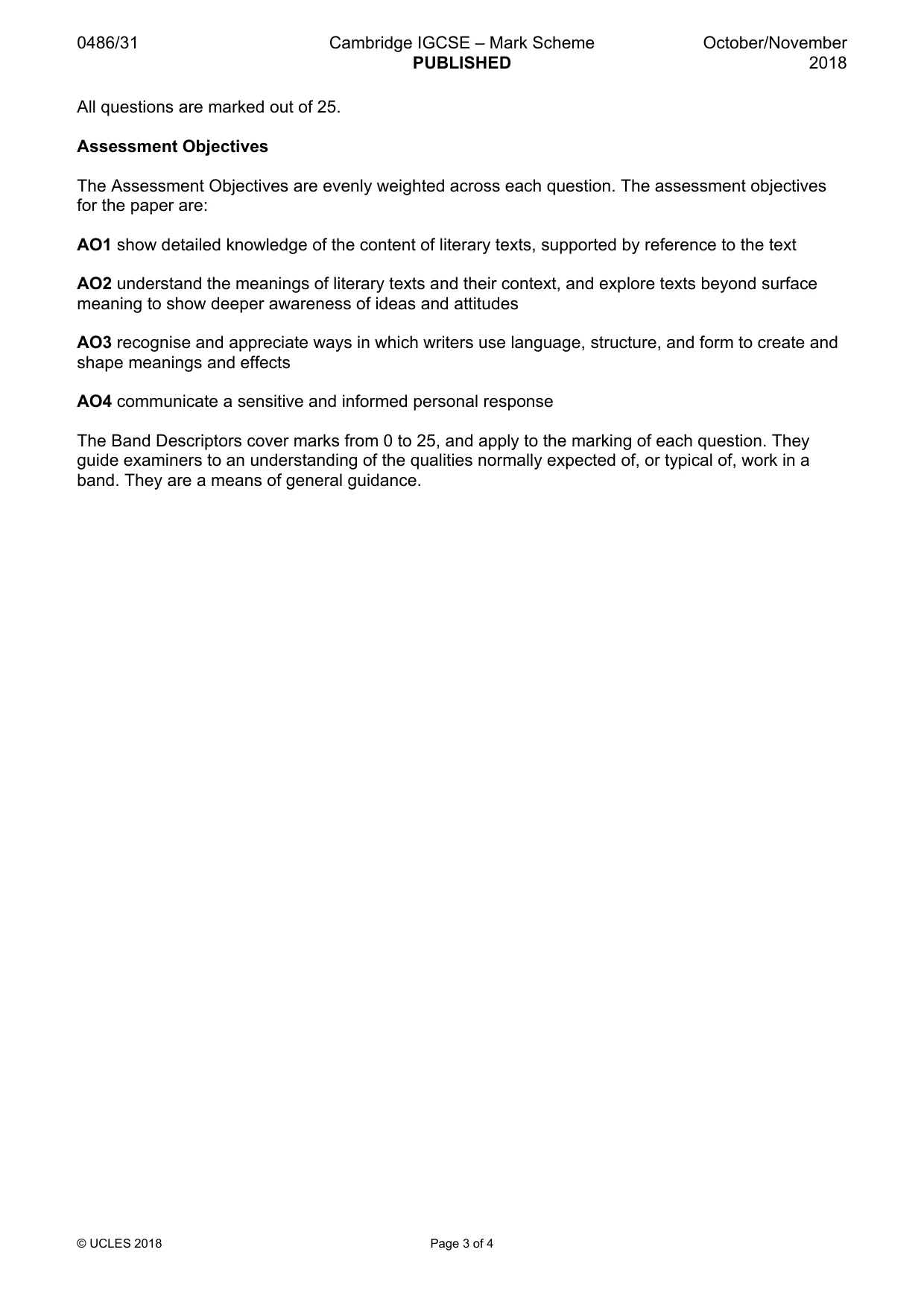
0486/31 Cambridge IGCSE – Mark Scheme PUBLISHED October/November 2018 © UCLES 2018 Page 3 of 4 All questions are marked out of 25. Assessment Objectives The Assessment Objectives are evenly weighted across each question. The assessment objectives for the paper are: AO1 show detailed knowledge of the content of literary texts, supported by reference to the text AO2 understand the meanings of literary texts and their context, and explore texts beyond surface meaning to show deeper awareness of ideas and attitudes AO3 recognise and appreciate ways in which writers use language, structure, and form to create and shape meanings and effects AO4 communicate a sensitive and informed personal response The Band Descriptors cover marks from 0 to 25, and apply to the marking of each question. They guide examiners to an understanding of the qualities normally expected of, or typical of, work in a band. They are a means of general guidance.
Mark scheme, page 4
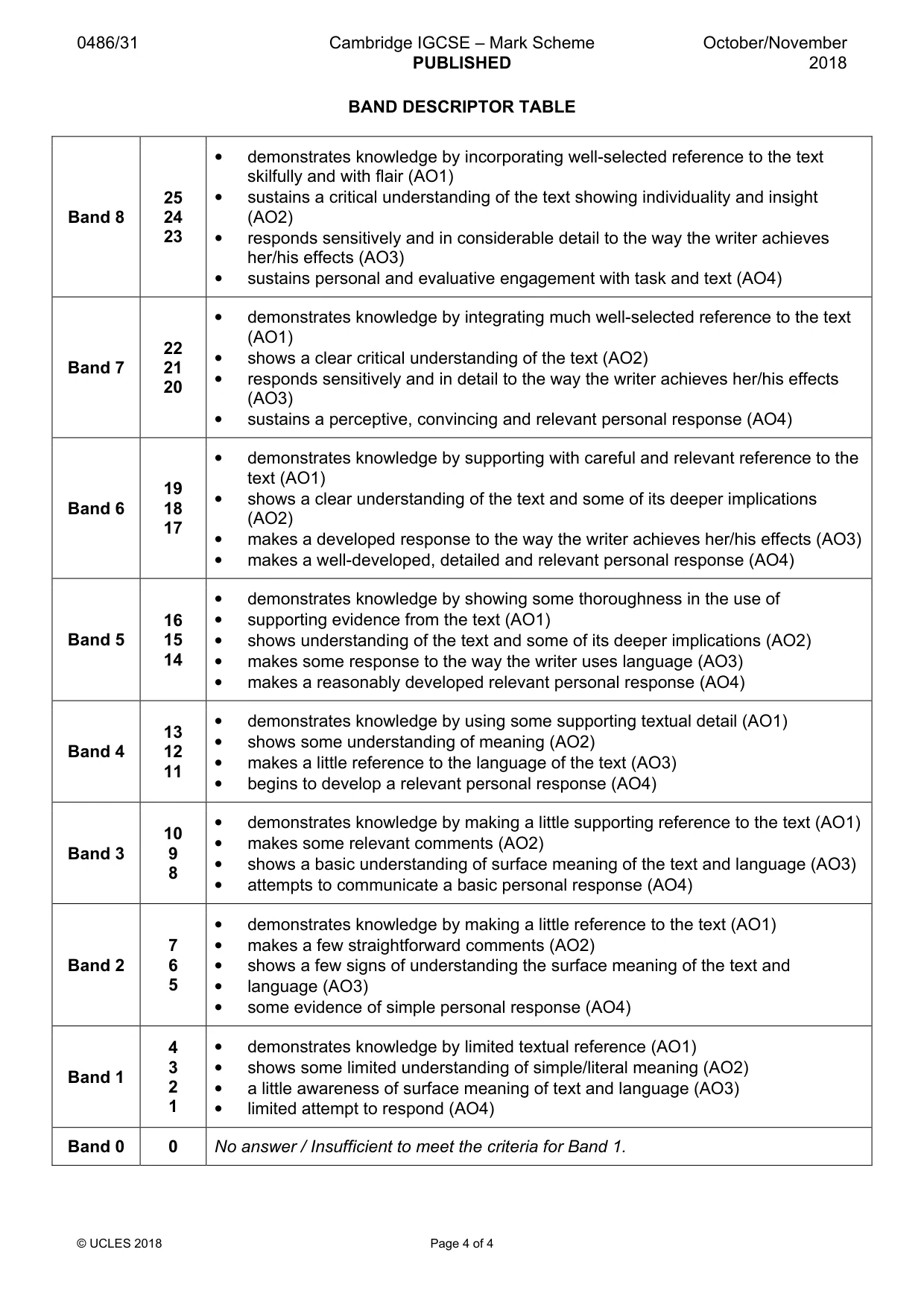
0486/31 Cambridge IGCSE – Mark Scheme PUBLISHED October/November 2018 © UCLES 2018 Page 4 of 4 BAND DESCRIPTOR TABLE Band 8 25 24 23 • demonstrates knowledge by incorporating well-selected reference to the text skilfully and with flair (AO1) • sustains a critical understanding of the text showing individuality and insight (AO2) • responds sensitively and in considerable detail to the way the writer achieves her/his effects (AO3) • sustains personal and evaluative engagement with task and text (AO4) Band 7 22 21 20 • demonstrates knowledge by integrating much well-selected reference to the text (AO1) • shows a clear critical understanding of the text (AO2) • responds sensitively and in detail to the way the writer achieves her/his effects (AO3) • sustains a perceptive, convincing and relevant personal response (AO4) Band 6 19 18 17 • demonstrates knowledge by supporting with careful and relevant reference to the text (AO1) • shows a clear understanding of the text and some of its deeper implications (AO2) • makes a developed response to the way the writer achieves her/his effects (AO3) • makes a well-developed, detailed and relevant personal response (AO4) Band 5 16 15 14 • demonstrates knowledge by showing some thoroughness in the use of • supporting evidence from the text (AO1) • shows understanding of the text and some of its deeper implications (AO2) • makes some response to the way the writer uses language (AO3) • makes a reasonably developed relevant personal response (AO4) Band 4 13 12 11 • demonstrates knowledge by using some supporting textual detail (AO1) • shows some understanding of meaning (AO2) • makes a little reference to the language of the text (AO3) • begins to develop a relevant personal response (AO4) Band 3 10 9 8 • demonstrates knowledge by making a little supporting reference to the text (AO1) • makes some relevant comments (AO2) • shows a basic understanding of surface meaning of the text and language (AO3) • attempts to communicate a basic personal response (AO4) Band 2 7 6 5 • demonstrates knowledge by making a little reference to the text (AO1) • makes a few straightforward comments (AO2) • shows a few signs of understanding the surface meaning of the text and • language (AO3) • some evidence of simple personal response (AO4) Band 1 4 3 2 1 • demonstrates knowledge by limited textual reference (AO1) • shows some limited understanding of simple/literal meaning (AO2) • a little awareness of surface meaning of text and language (AO3) • limited attempt to respond (AO4) Band 0 0 No answer / Insufficient to meet the criteria for Band 1.
What you needed in this session
Cambridge’s own grade thresholds for 2018 Oct/Nov, Paper 3 · Variant 1. A higher threshold means an easier paper — the bar moves with how the cohort did.