Cambridge IGCSE English - Literature 0486 — 2011 Oct/Nov Paper 3 · Variant 3
0486/33/O/N/11 · 25 marks · ≈28 min
The question paper and its mark scheme, free to read here and free to download. This is Cambridge’s own paper, exactly as it was sat.
Question paper8 pages


Mark scheme3 pages
Answers below. Sit the paper first if you are practising.
Paper as text
Question paper, page 1
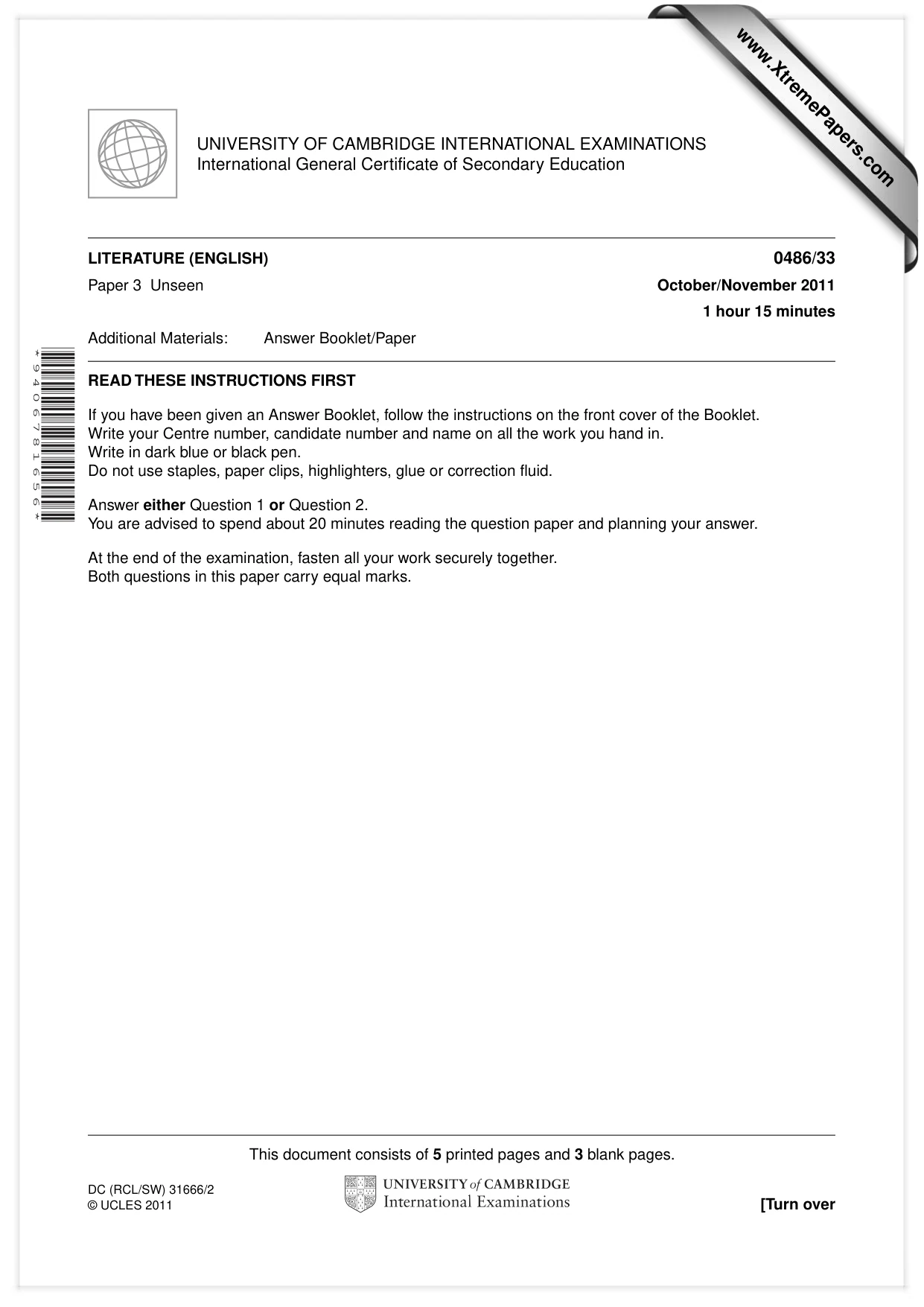
This document consists of 5 printed pages and 3 blank pages. DC (RCL/SW) 31666/2 © UCLES 2011 [Turn over UNIVERSITY OF CAMBRIDGE INTERNATIONAL EXAMINATIONS International General Certificate of Secondary Education LITERATURE (ENGLISH) 0486/33 Paper 3 Unseen October/November 2011 1 hour 15 minutes Additional Materials: Answer Booklet/Paper READ THESE INSTRUCTIONS FIRST If you have been given an Answer Booklet, follow the instructions on the front cover of the Booklet. Write your Centre number, candidate number and name on all the work you hand in. Write in dark blue or black pen. Do not use staples, paper clips, highlighters, glue or correction fluid. Answer either Question 1 or Question 2. You are advised to spend about 20 minutes reading the question paper and planning your answer. At the end of the examination, fasten all your work securely together. Both questions in this paper carry equal marks. * 9 4 0 6 7 8 1 6 5 6 * www.XtremePapers.com
Question paper, page 2
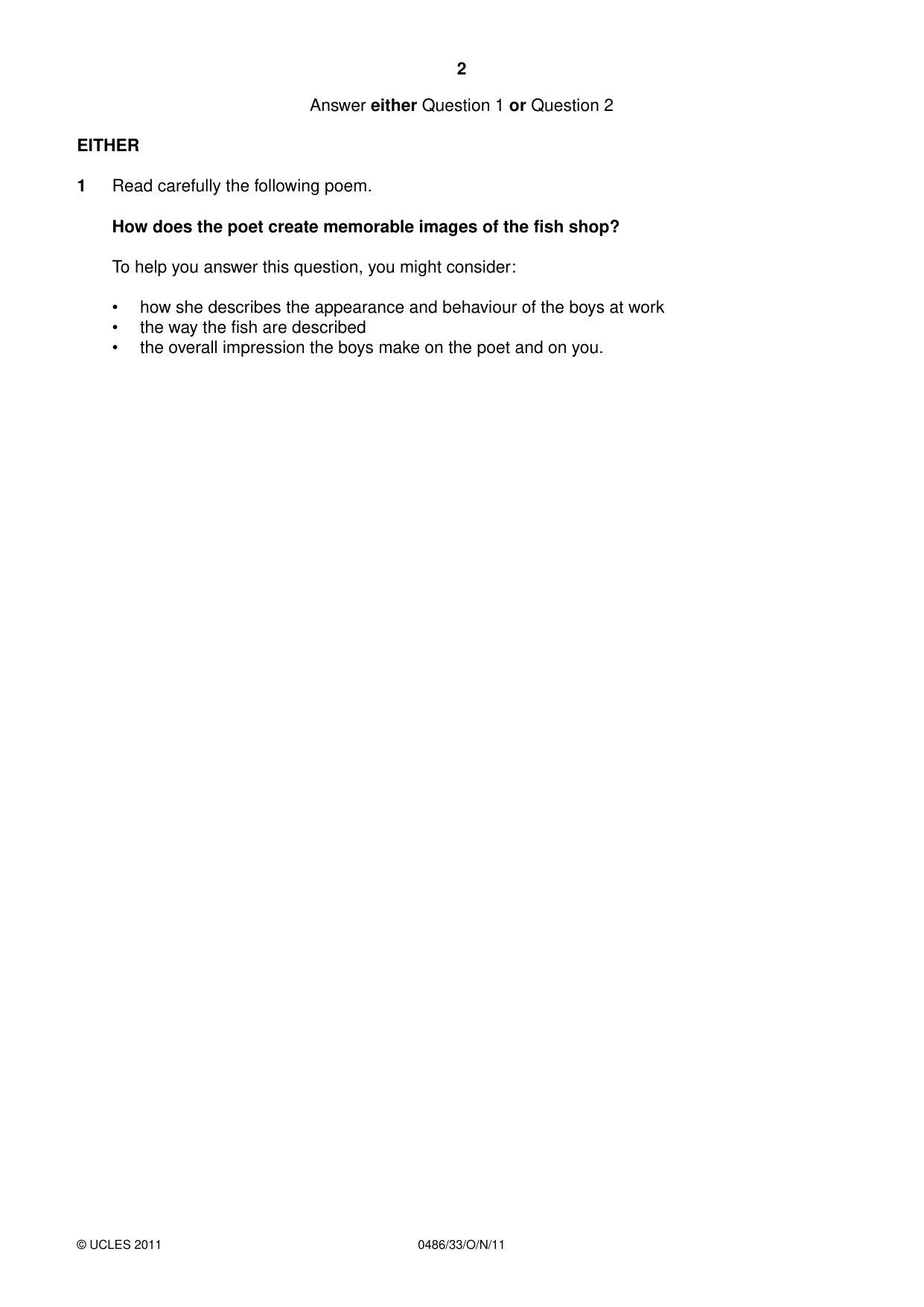
2 0486/33/O/N/11 © UCLES 2011 Answer either Question 1 or Question 2 EITHER 1 Read carefully the following poem. How does the poet create memorable images of the fish shop? To help you answer this question, you might consider: • how she describes the appearance and behaviour of the boys at work • the way the fish are described • the overall impression the boys make on the poet and on you.
Question paper, page 3
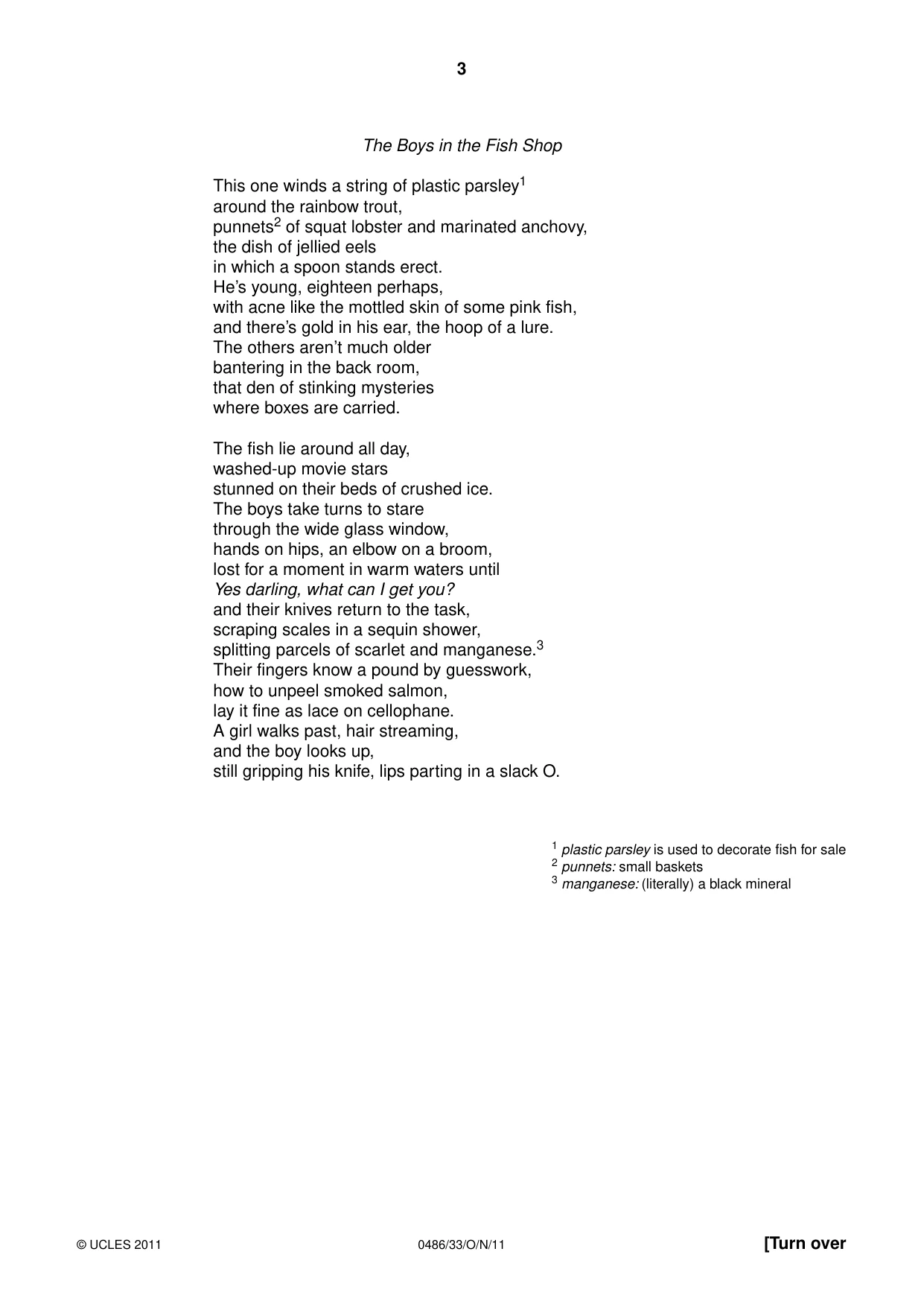
3 0486/33/O/N/11 © UCLES 2011 [Turn over The Boys in the Fish Shop This one winds a string of plastic parsley1 around the rainbow trout, punnets2 of squat lobster and marinated anchovy, the dish of jellied eels in which a spoon stands erect. He’s young, eighteen perhaps, with acne like the mottled skin of some pink fish, and there’s gold in his ear, the hoop of a lure. The others aren’t much older bantering in the back room, that den of stinking mysteries where boxes are carried. The fish lie around all day, washed-up movie stars stunned on their beds of crushed ice. The boys take turns to stare through the wide glass window, hands on hips, an elbow on a broom, lost for a moment in warm waters until Yes darling, what can I get you? and their knives return to the task, scraping scales in a sequin shower, splitting parcels of scarlet and manganese.3 Their fingers know a pound by guesswork, how to unpeel smoked salmon, lay it fine as lace on cellophane. A girl walks past, hair streaming, and the boy looks up, still gripping his knife, lips parting in a slack O. 1 plastic parsley is used to decorate fish for sale 2 punnets: small baskets 3 manganese: (literally) a black mineral
Question paper, page 4
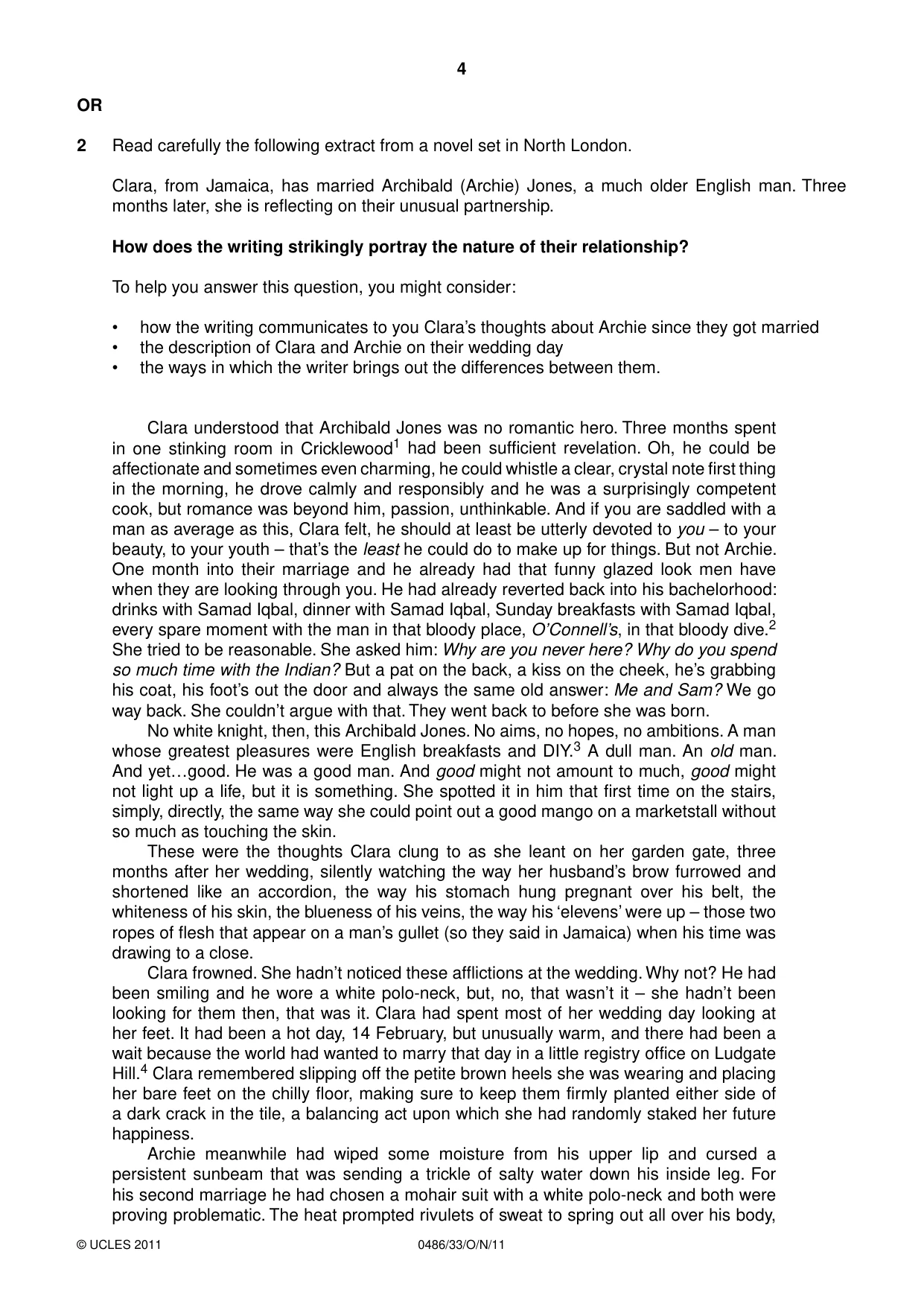
4 0486/33/O/N/11 © UCLES 2011 OR 2 Read carefully the following extract from a novel set in North London. Clara, from Jamaica, has married Archibald (Archie) Jones, a much older English man. Three months later, she is reflecting on their unusual partnership. How does the writing strikingly portray the nature of their relationship? To help you answer this question, you might consider: • how the writing communicates to you Clara’s thoughts about Archie since they got married • the description of Clara and Archie on their wedding day • the ways in which the writer brings out the differences between them. Clara understood that Archibald Jones was no romantic hero. Three months spent in one stinking room in Cricklewood1 had been sufficient revelation. Oh, he could be affectionate and sometimes even charming, he could whistle a clear, crystal note first thing in the morning, he drove calmly and responsibly and he was a surprisingly competent cook, but romance was beyond him, passion, unthinkable. And if you are saddled with a man as average as this, Clara felt, he should at least be utterly devoted to you – to your beauty, to your youth – that’s the least he could do to make up for things. But not Archie. One month into their marriage and he already had that funny glazed look men have when they are looking through you. He had already reverted back into his bachelorhood: drinks with Samad Iqbal, dinner with Samad Iqbal, Sunday breakfasts with Samad Iqbal, every spare moment with the man in that bloody place, O’Connell’s, in that bloody dive.2 She tried to be reasonable. She asked him: Why are you never here? Why do you spend so much time with the Indian? But a pat on the back, a kiss on the cheek, he’s grabbing his coat, his foot’s out the door and always the same old answer: Me and Sam? We go way back. She couldn’t argue with that. They went back to before she was born. No white knight, then, this Archibald Jones. No aims, no hopes, no ambitions. A man whose greatest pleasures were English breakfasts and DIY.3 A dull man. An old man. And yet…good. He was a good man. And good might not amount to much, good might not light up a life, but it is something. She spotted it in him that first time on the stairs, simply, directly, the same way she could point out a good mango on a marketstall without so much as touching the skin. These were the thoughts Clara clung to as she leant on her garden gate, three months after her wedding, silently watching the way her husband’s brow furrowed and shortened like an accordion, the way his stomach hung pregnant over his belt, the whiteness of his skin, the blueness of his veins, the way his ‘elevens’ were up – those two ropes of flesh that appear on a man’s gullet (so they said in Jamaica) when his time was drawing to a close. Clara frowned. She hadn’t noticed these afflictions at the wedding. Why not? He had been smiling and he wore a white polo-neck, but, no, that wasn’t it – she hadn’t been looking for them then, that was it. Clara had spent most of her wedding day looking at her feet. It had been a hot day, 14 February, but unusually warm, and there had been a wait because the world had wanted to marry that day in a little registry office on Ludgate Hill.4 Clara remembered slipping off the petite brown heels she was wearing and placing her bare feet on the chilly floor, making sure to keep them firmly planted either side of a dark crack in the tile, a balancing act upon which she had randomly staked her future happiness. Archie meanwhile had wiped some moisture from his upper lip and cursed a persistent sunbeam that was sending a trickle of salty water down his inside leg. For his second marriage he had chosen a mohair suit with a white polo-neck and both were proving problematic. The heat prompted rivulets of sweat to spring out all over his body,
Question paper, page 5
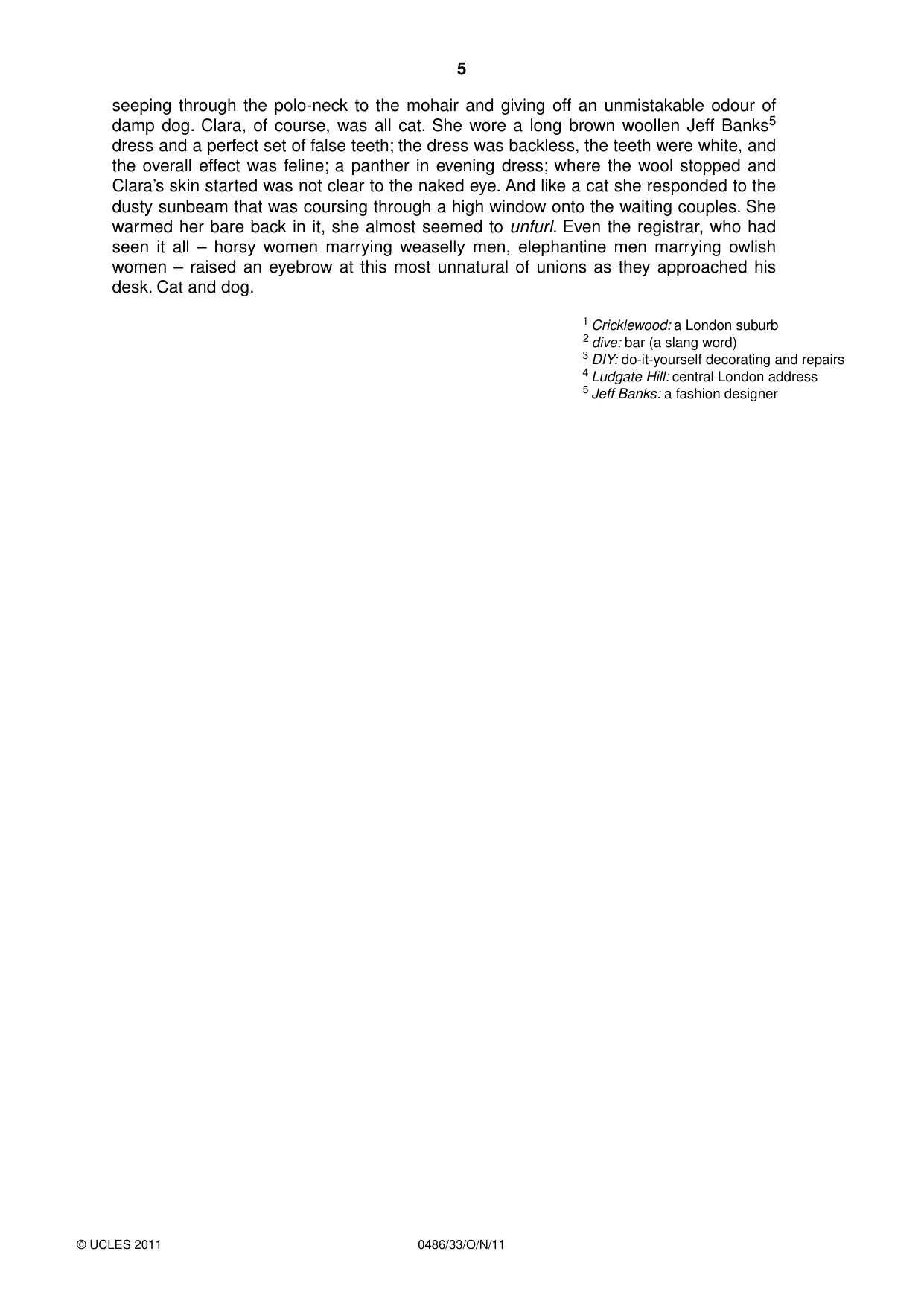
5 0486/33/O/N/11 © UCLES 2011 seeping through the polo-neck to the mohair and giving off an unmistakable odour of damp dog. Clara, of course, was all cat. She wore a long brown woollen Jeff Banks5 dress and a perfect set of false teeth; the dress was backless, the teeth were white, and the overall effect was feline; a panther in evening dress; where the wool stopped and Clara’s skin started was not clear to the naked eye. And like a cat she responded to the dusty sunbeam that was coursing through a high window onto the waiting couples. She warmed her bare back in it, she almost seemed to unfurl. Even the registrar, who had seen it all – horsy women marrying weaselly men, elephantine men marrying owlish women – raised an eyebrow at this most unnatural of unions as they approached his desk. Cat and dog. 1 Cricklewood: a London suburb 2 dive: bar (a slang word) 3 DIY: do-it-yourself decorating and repairs 4 Ludgate Hill: central London address 5 Jeff Banks: a fashion designer
Question paper, page 6
6 0486/33/O/N/11 © UCLES 2011 BLANK PAGE
Question paper, page 7
7 0486/33/O/N/11 © UCLES 2011 BLANK PAGE
Question paper, page 8
8 0486/33/O/N/11 © UCLES 2011 BLANK PAGE Copyright Acknowledgements: Question 1 © Kathryn Simmonds; ‘The Boys in the Fish Shop’ in Sunday at the Skin Launderette; Seren; 2008. Question 2 © Zadie Smith; White Teeth; Random House; 2000. Permission to reproduce items where third-party owned material protected by copyright is included has been sought and cleared where possible. Every reasonable effort has been made by the publisher (UCLES) to trace copyright holders, but if any items requiring clearance have unwittingly been included, the publisher will be pleased to make amends at the earliest possible opportunity. University of Cambridge International Examinations is part of the Cambridge Assessment Group. Cambridge Assessment is the brand name of University of Cambridge Local Examinations Syndicate (UCLES), which is itself a department of the University of Cambridge.
Mark scheme, page 1
UNIVERSITY OF CAMBRIDGE INTERNATIONAL EXAMINATIONS International General Certificate of Secondary Education MARK SCHEME for the October/November 2011 question paper for the guidance of teachers 0486 LITERATURE (ENGLISH) 0486/33 Paper 3 (Unseen), maximum raw mark 25 This mark scheme is published as an aid to teachers and candidates, to indicate the requirements of the examination. It shows the basis on which Examiners were instructed to award marks. It does not indicate the details of the discussions that took place at an Examiners’ meeting before marking began, which would have considered the acceptability of alternative answers. Mark schemes must be read in conjunction with the question papers and the report on the examination. • Cambridge will not enter into discussions or correspondence in connection with these mark schemes. Cambridge is publishing the mark schemes for the October/November 2011 question papers for most IGCSE, GCE Advanced Level and Advanced Subsidiary Level syllabuses and some Ordinary Level syllabuses. www.XtremePapers.com
Mark scheme, page 2
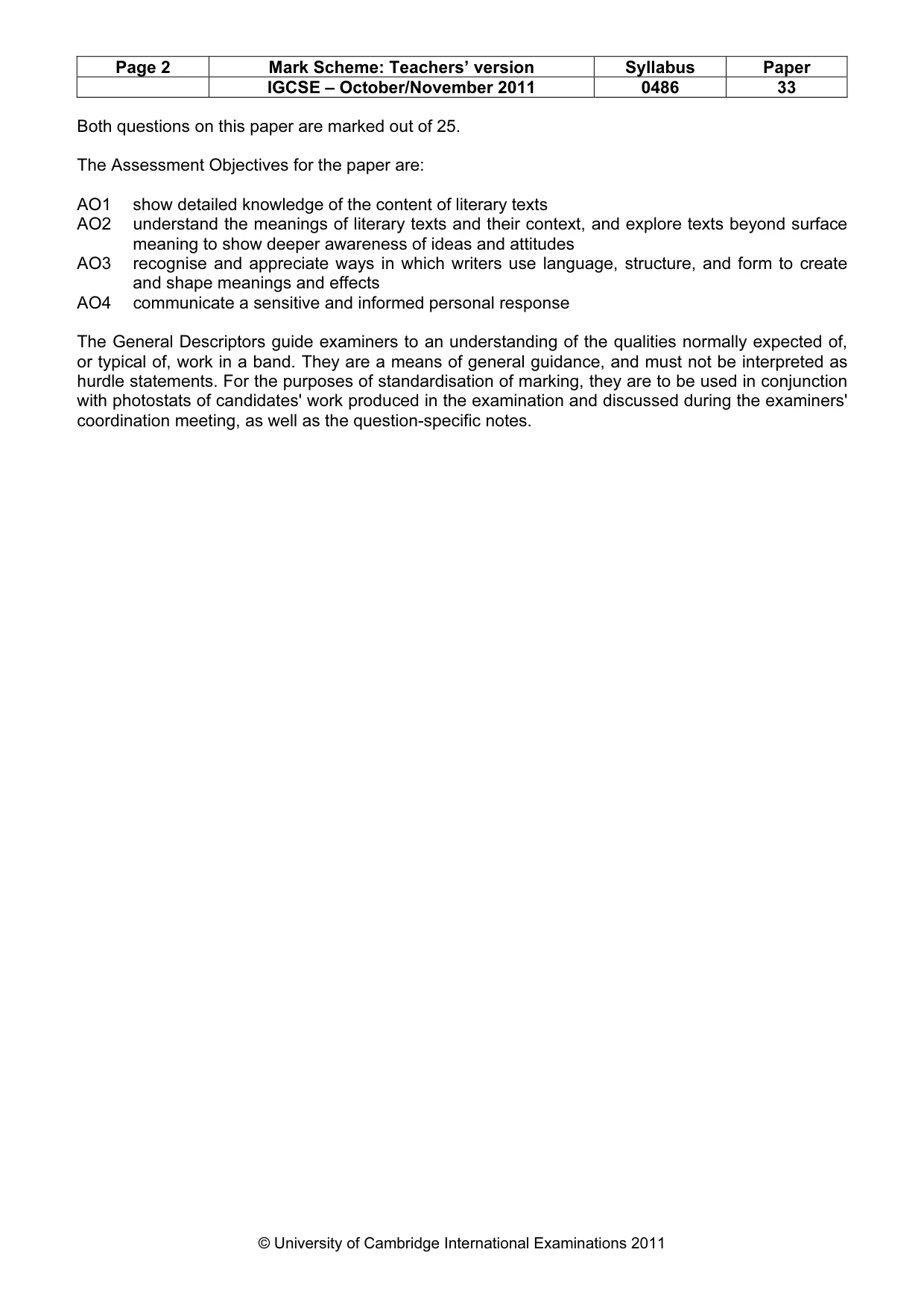
Page 2 Mark Scheme: Teachers’ version Syllabus Paper IGCSE – October/November 2011 0486 33 © University of Cambridge International Examinations 2011 Both questions on this paper are marked out of 25. The Assessment Objectives for the paper are: AO1 show detailed knowledge of the content of literary texts AO2 understand the meanings of literary texts and their context, and explore texts beyond surface meaning to show deeper awareness of ideas and attitudes AO3 recognise and appreciate ways in which writers use language, structure, and form to create and shape meanings and effects AO4 communicate a sensitive and informed personal response The General Descriptors guide examiners to an understanding of the qualities normally expected of, or typical of, work in a band. They are a means of general guidance, and must not be interpreted as hurdle statements. For the purposes of standardisation of marking, they are to be used in conjunction with photostats of candidates' work produced in the examination and discussed during the examiners' coordination meeting, as well as the question-specific notes.
Mark scheme, page 3
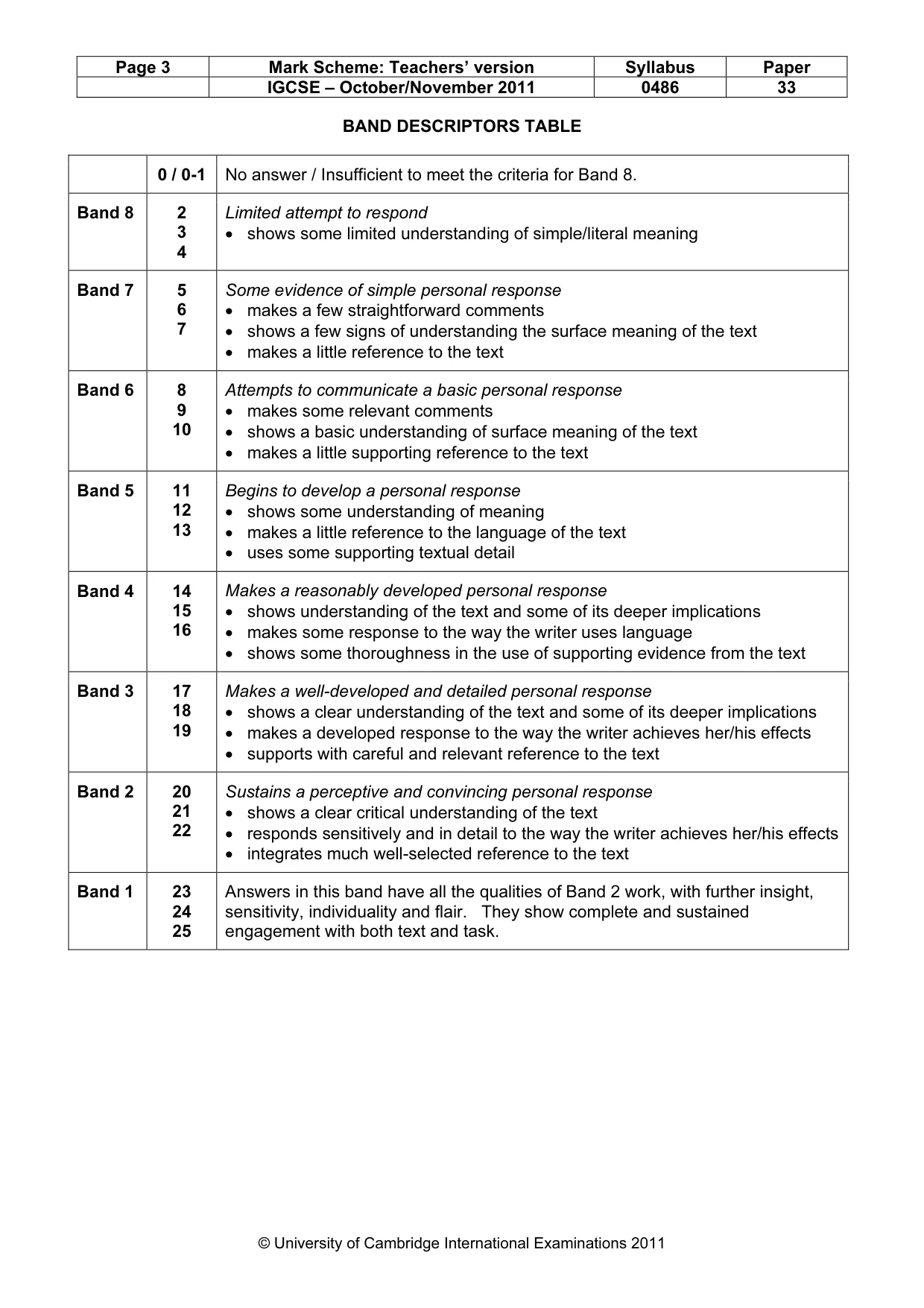
Page 3 Mark Scheme: Teachers’ version Syllabus Paper IGCSE – October/November 2011 0486 33 © University of Cambridge International Examinations 2011 BAND DESCRIPTORS TABLE 0 / 0-1 No answer / Insufficient to meet the criteria for Band 8. Band 8 2 3 4 Limited attempt to respond • shows some limited understanding of simple/literal meaning Band 7 5 6 7 Some evidence of simple personal response • makes a few straightforward comments • shows a few signs of understanding the surface meaning of the text • makes a little reference to the text Band 6 8 9 10 Attempts to communicate a basic personal response • makes some relevant comments • shows a basic understanding of surface meaning of the text • makes a little supporting reference to the text Band 5 11 12 13 Begins to develop a personal response • shows some understanding of meaning • makes a little reference to the language of the text • uses some supporting textual detail Band 4 14 15 16 Makes a reasonably developed personal response • shows understanding of the text and some of its deeper implications • makes some response to the way the writer uses language • shows some thoroughness in the use of supporting evidence from the text Band 3 17 18 19 Makes a well-developed and detailed personal response • shows a clear understanding of the text and some of its deeper implications • makes a developed response to the way the writer achieves her/his effects • supports with careful and relevant reference to the text Band 2 20 21 22 Sustains a perceptive and convincing personal response • shows a clear critical understanding of the text • responds sensitively and in detail to the way the writer achieves her/his effects • integrates much well-selected reference to the text Band 1 23 24 25 Answers in this band have all the qualities of Band 2 work, with further insight, sensitivity, individuality and flair. They show complete and sustained engagement with both text and task.
What you needed in this session
Cambridge’s own grade thresholds for 2011 Oct/Nov, Paper 3 · Variant 3. A higher threshold means an easier paper — the bar moves with how the cohort did.