Cambridge IGCSE English - Literature 0486 — 2011 Oct/Nov Paper 3 · Variant 1
0486/31/O/N/11 · 25 marks · ≈28 min
The question paper and its mark scheme, free to read here and free to download. This is Cambridge’s own paper, exactly as it was sat.
Question paper5 pages
Mark scheme3 pages
Answers below. Sit the paper first if you are practising.
Paper as text
Question paper, page 1
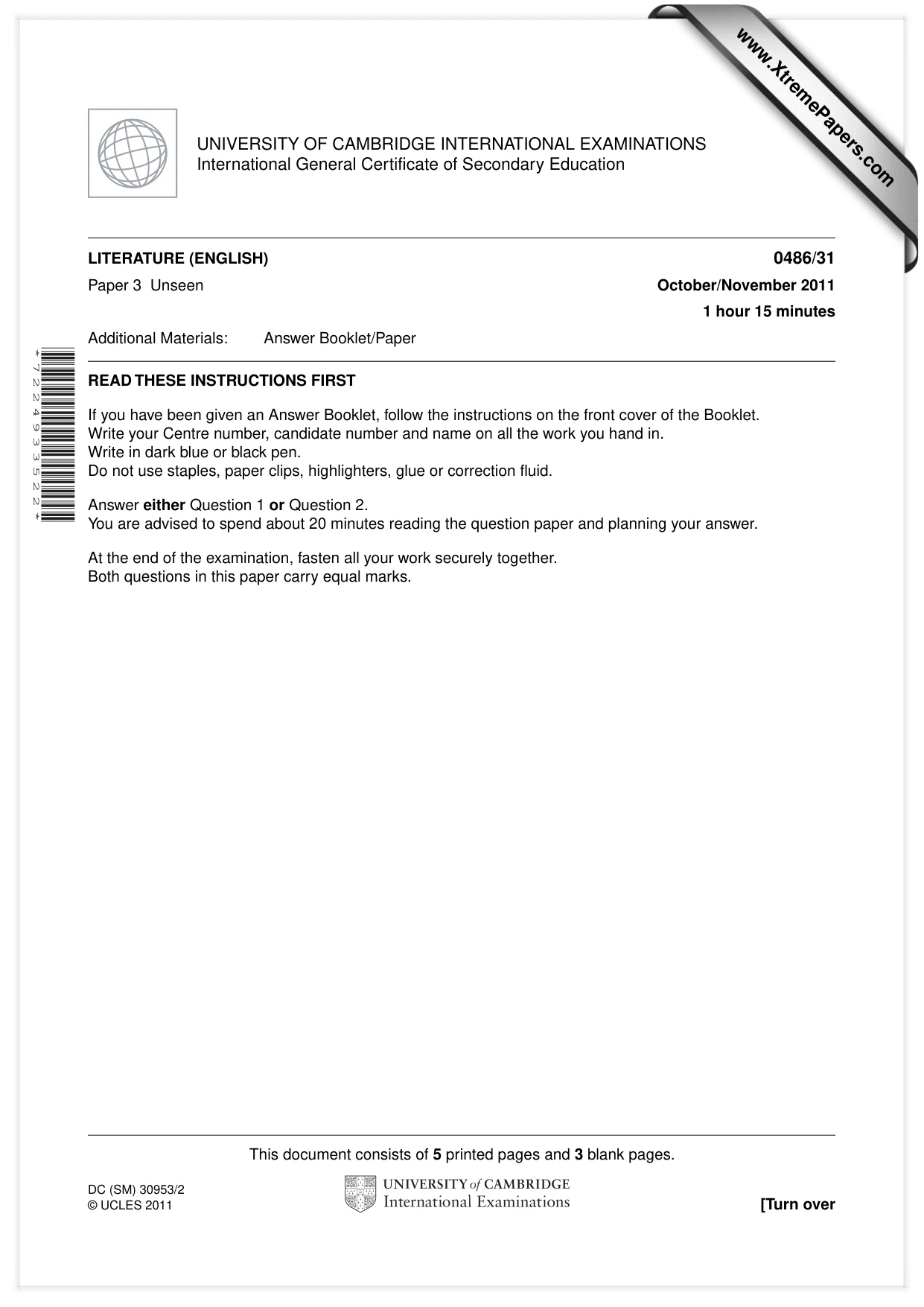
This document consists of 5 printed pages and 3 blank pages. DC (SM) 30953/2 © UCLES 2011 [Turn over UNIVERSITY OF CAMBRIDGE INTERNATIONAL EXAMINATIONS International General Certificate of Secondary Education * 7 2 2 4 9 3 3 5 2 2 * LITERATURE (ENGLISH) 0486/31 Paper 3 Unseen October/November 2011 1 hour 15 minutes Additional Materials: Answer Booklet/Paper READ THESE INSTRUCTIONS FIRST If you have been given an Answer Booklet, follow the instructions on the front cover of the Booklet. Write your Centre number, candidate number and name on all the work you hand in. Write in dark blue or black pen. Do not use staples, paper clips, highlighters, glue or correction fluid. Answer either Question 1 or Question 2. You are advised to spend about 20 minutes reading the question paper and planning your answer. At the end of the examination, fasten all your work securely together. Both questions in this paper carry equal marks. www.XtremePapers.com
Question paper, page 2
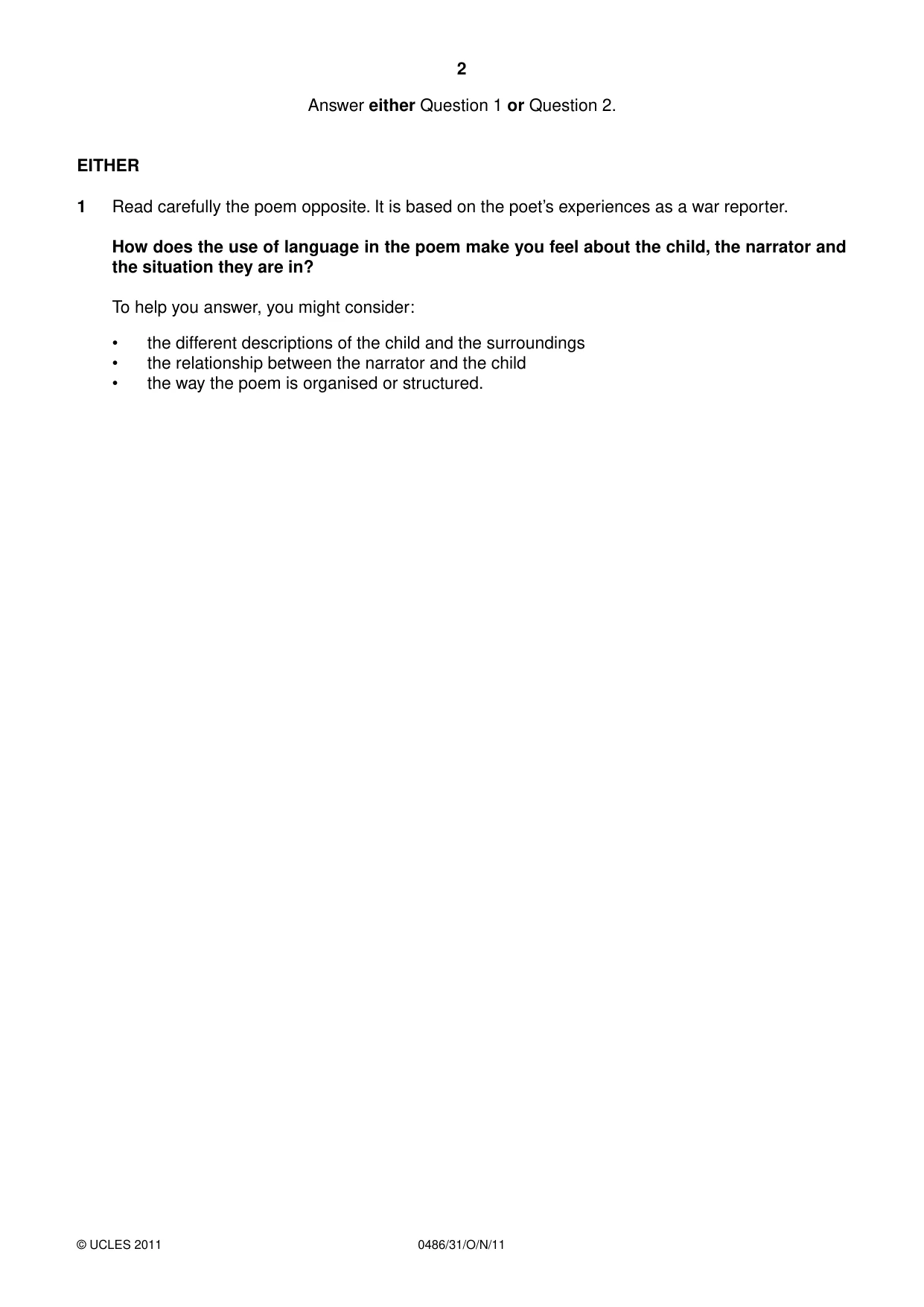
2 0486/31/O/N/11 © UCLES 2011 Answer either Question 1 or Question 2. EITHER 1 Read carefully the poem opposite. It is based on the poet’s experiences as a war reporter. How does the use of language in the poem make you feel about the child, the narrator and the situation they are in? To help you answer, you might consider: • the different descriptions of the child and the surroundings • the relationship between the narrator and the child • the way the poem is organised or structured.
Question paper, page 3
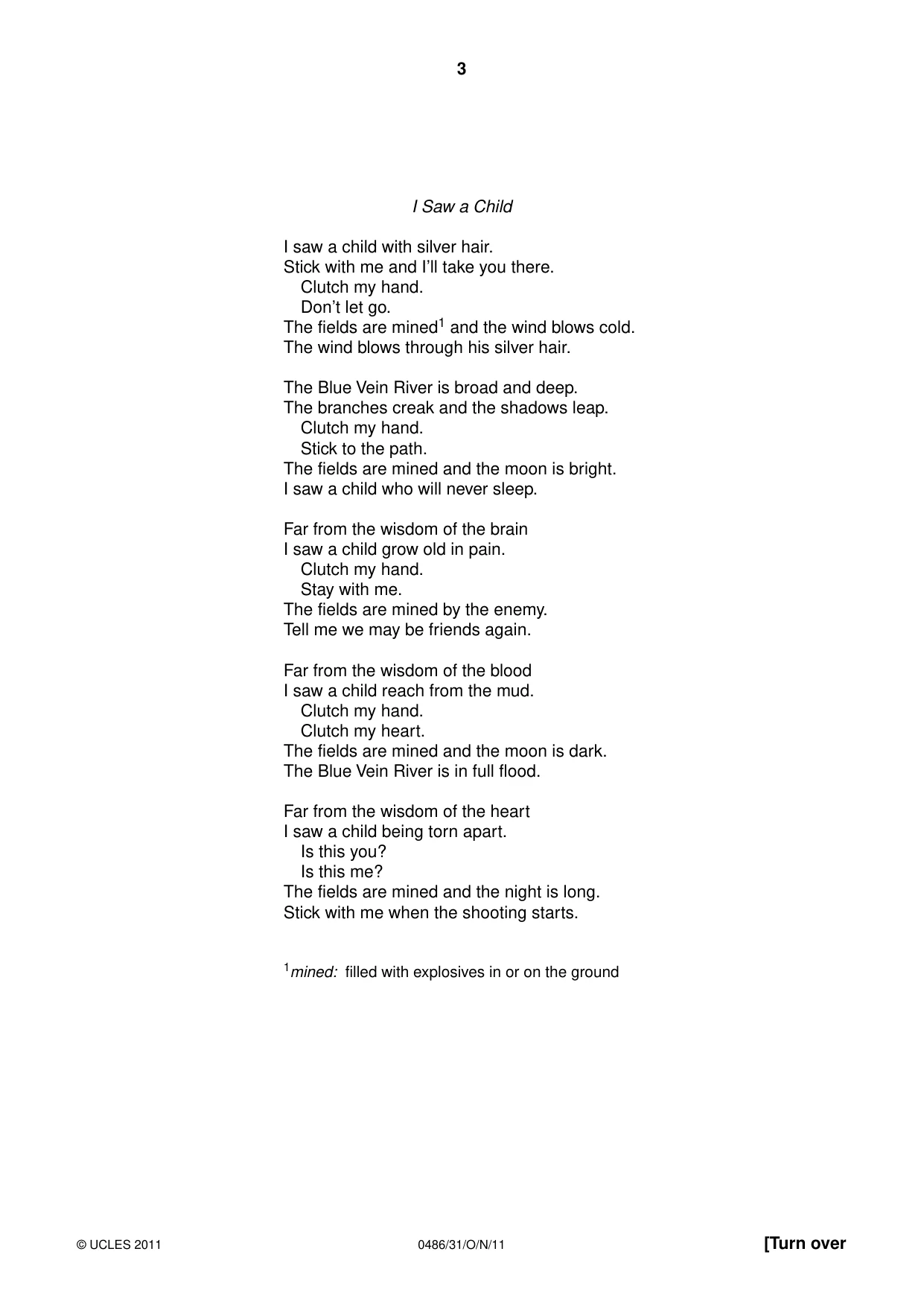
3 0486/31/O/N/11 © UCLES 2011 [Turn over I Saw a Child I saw a child with silver hair. Stick with me and I’ll take you there. Clutch my hand. Don’t let go. The fields are mined1 and the wind blows cold. The wind blows through his silver hair. The Blue Vein River is broad and deep. The branches creak and the shadows leap. Clutch my hand. Stick to the path. The fields are mined and the moon is bright. I saw a child who will never sleep. Far from the wisdom of the brain I saw a child grow old in pain. Clutch my hand. Stay with me. The fields are mined by the enemy. Tell me we may be friends again. Far from the wisdom of the blood I saw a child reach from the mud. Clutch my hand. Clutch my heart. The fields are mined and the moon is dark. The Blue Vein River is in full flood. Far from the wisdom of the heart I saw a child being torn apart. Is this you? Is this me? The fields are mined and the night is long. Stick with me when the shooting starts. 1mined: filled with explosives in or on the ground
Question paper, page 4
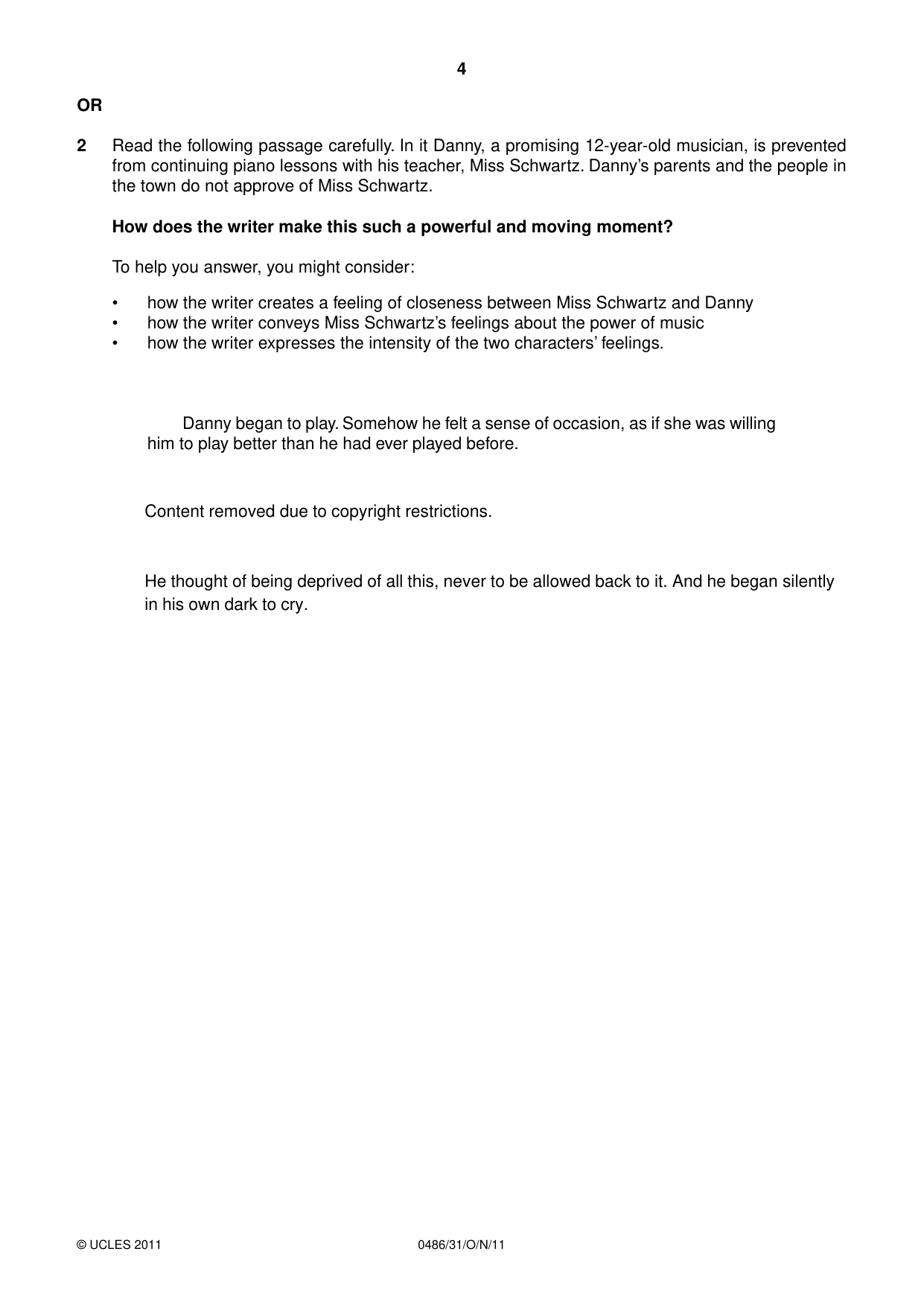
4 0486/31/O/N/11 © UCLES 2011 OR 2 Read the following passage carefully. In it Danny, a promising 12-year-old musician, is prevented from continuing piano lessons with his teacher, Miss Schwartz. Danny’s parents and the people in the town do not approve of Miss Schwartz. How does the writer make this such a powerful and moving moment? To help you answer, you might consider: • how the writer creates a feeling of closeness between Miss Schwartz and Danny • how the writer conveys Miss Schwartz’s feelings about the power of music • how the writer expresses the intensity of the two characters’ feelings. Danny began to play. Somehow he felt a sense of occasion, as if she was willing him to play better than he had ever played before. Content removed due to copyright restrictions. He thought of being deprived of all this, never to be allowed back to it. And he began silently in his own dark to cry.
Question paper, page 5
8 0486/31/O/N/11 © UCLES 2011 BLANK PAGE Copyright Acknowledgements: Question 1 © James Fenton; ‘I Saw a Child’, in Poems 2 ; Longman; 1995. Question 2 © Bernard MacLaverty; ‘My Dear Palestrina’; 1980. Permission to reproduce items where third-party owned material protected by copyright is included has been sought and cleared where possible. Every reasonable effort has been made by the publisher (UCLES) to trace copyright holders, but if any items requiring clearance have unwittingly been included, the publisher will be pleased to make amends at the earliest possible opportunity. University of Cambridge International Examinations is part of the Cambridge Assessment Group. Cambridge Assessment is the brand name of University of Cambridge Local Examinations Syndicate (UCLES), which is itself a department of the University of Cambridge.
Mark scheme, page 1
UNIVERSITY OF CAMBRIDGE INTERNATIONAL EXAMINATIONS International General Certificate of Secondary Education MARK SCHEME for the October/November 2011 question paper for the guidance of teachers 0486 LITERATURE (ENGLISH) 0486/31 Paper 3 (Unseen), maximum raw mark 25 This mark scheme is published as an aid to teachers and candidates, to indicate the requirements of the examination. It shows the basis on which Examiners were instructed to award marks. It does not indicate the details of the discussions that took place at an Examiners’ meeting before marking began, which would have considered the acceptability of alternative answers. Mark schemes must be read in conjunction with the question papers and the report on the examination. • Cambridge will not enter into discussions or correspondence in connection with these mark schemes. Cambridge is publishing the mark schemes for the October/November 2011 question papers for most IGCSE, GCE Advanced Level and Advanced Subsidiary Level syllabuses and some Ordinary Level syllabuses. www.XtremePapers.com
Mark scheme, page 2
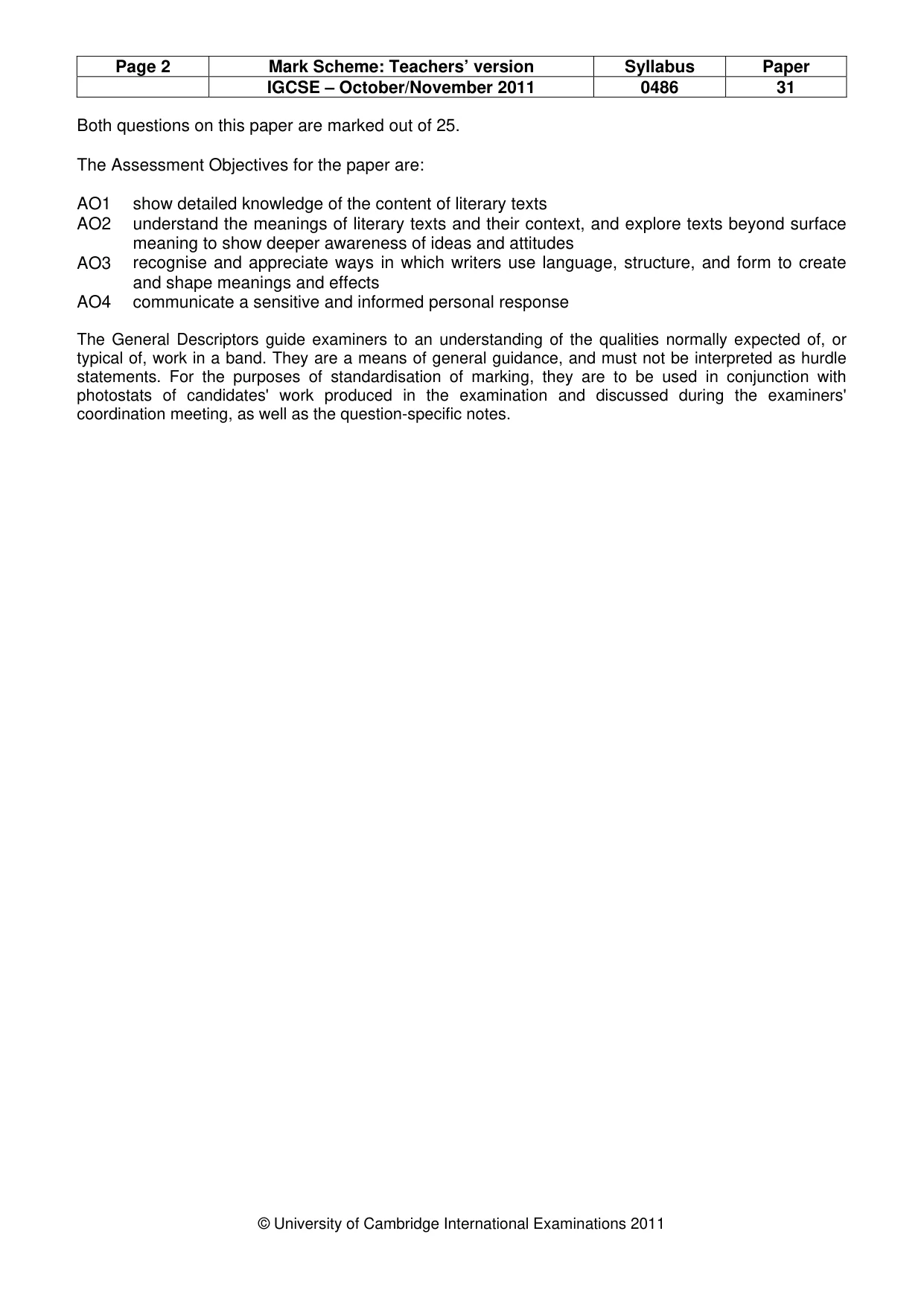
Page 2 Mark Scheme: Teachers’ version Syllabus Paper IGCSE – October/November 2011 0486 31 © University of Cambridge International Examinations 2011 Both questions on this paper are marked out of 25. The Assessment Objectives for the paper are: AO1 show detailed knowledge of the content of literary texts AO2 understand the meanings of literary texts and their context, and explore texts beyond surface meaning to show deeper awareness of ideas and attitudes AO3 recognise and appreciate ways in which writers use language, structure, and form to create and shape meanings and effects AO4 communicate a sensitive and informed personal response The General Descriptors guide examiners to an understanding of the qualities normally expected of, or typical of, work in a band. They are a means of general guidance, and must not be interpreted as hurdle statements. For the purposes of standardisation of marking, they are to be used in conjunction with photostats of candidates' work produced in the examination and discussed during the examiners' coordination meeting, as well as the question-specific notes.
Mark scheme, page 3
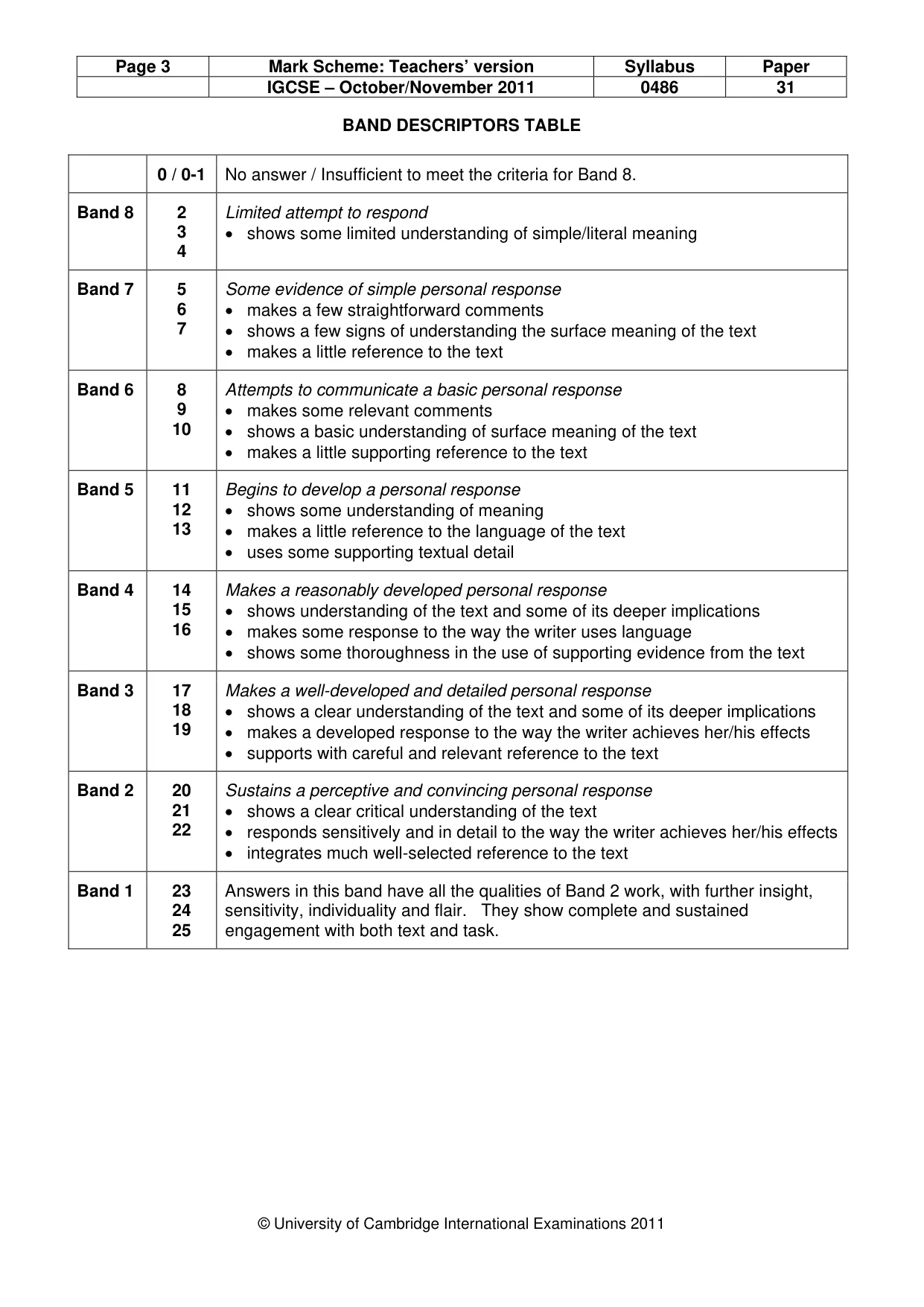
Page 3 Mark Scheme: Teachers’ version Syllabus Paper IGCSE – October/November 2011 0486 31 © University of Cambridge International Examinations 2011 BAND DESCRIPTORS TABLE 0 / 0-1 No answer / Insufficient to meet the criteria for Band 8. Band 8 2 3 4 Limited attempt to respond • shows some limited understanding of simple/literal meaning Band 7 5 6 7 Some evidence of simple personal response • makes a few straightforward comments • shows a few signs of understanding the surface meaning of the text • makes a little reference to the text Band 6 8 9 10 Attempts to communicate a basic personal response • makes some relevant comments • shows a basic understanding of surface meaning of the text • makes a little supporting reference to the text Band 5 11 12 13 Begins to develop a personal response • shows some understanding of meaning • makes a little reference to the language of the text • uses some supporting textual detail Band 4 14 15 16 Makes a reasonably developed personal response • shows understanding of the text and some of its deeper implications • makes some response to the way the writer uses language • shows some thoroughness in the use of supporting evidence from the text Band 3 17 18 19 Makes a well-developed and detailed personal response • shows a clear understanding of the text and some of its deeper implications • makes a developed response to the way the writer achieves her/his effects • supports with careful and relevant reference to the text Band 2 20 21 22 Sustains a perceptive and convincing personal response • shows a clear critical understanding of the text • responds sensitively and in detail to the way the writer achieves her/his effects • integrates much well-selected reference to the text Band 1 23 24 25 Answers in this band have all the qualities of Band 2 work, with further insight, sensitivity, individuality and flair. They show complete and sustained engagement with both text and task.
What you needed in this session
Cambridge’s own grade thresholds for 2011 Oct/Nov, Paper 3 · Variant 1. A higher threshold means an easier paper — the bar moves with how the cohort did.