Cambridge IGCSE English - Literature 0486 — 2011 Oct/Nov Paper 3 · Variant 2
0486/32/O/N/11 · 25 marks · ≈28 min
The question paper and its mark scheme, free to read here and free to download. This is Cambridge’s own paper, exactly as it was sat.
Question paper8 pages


Mark scheme3 pages
Answers below. Sit the paper first if you are practising.
Paper as text
Question paper, page 1
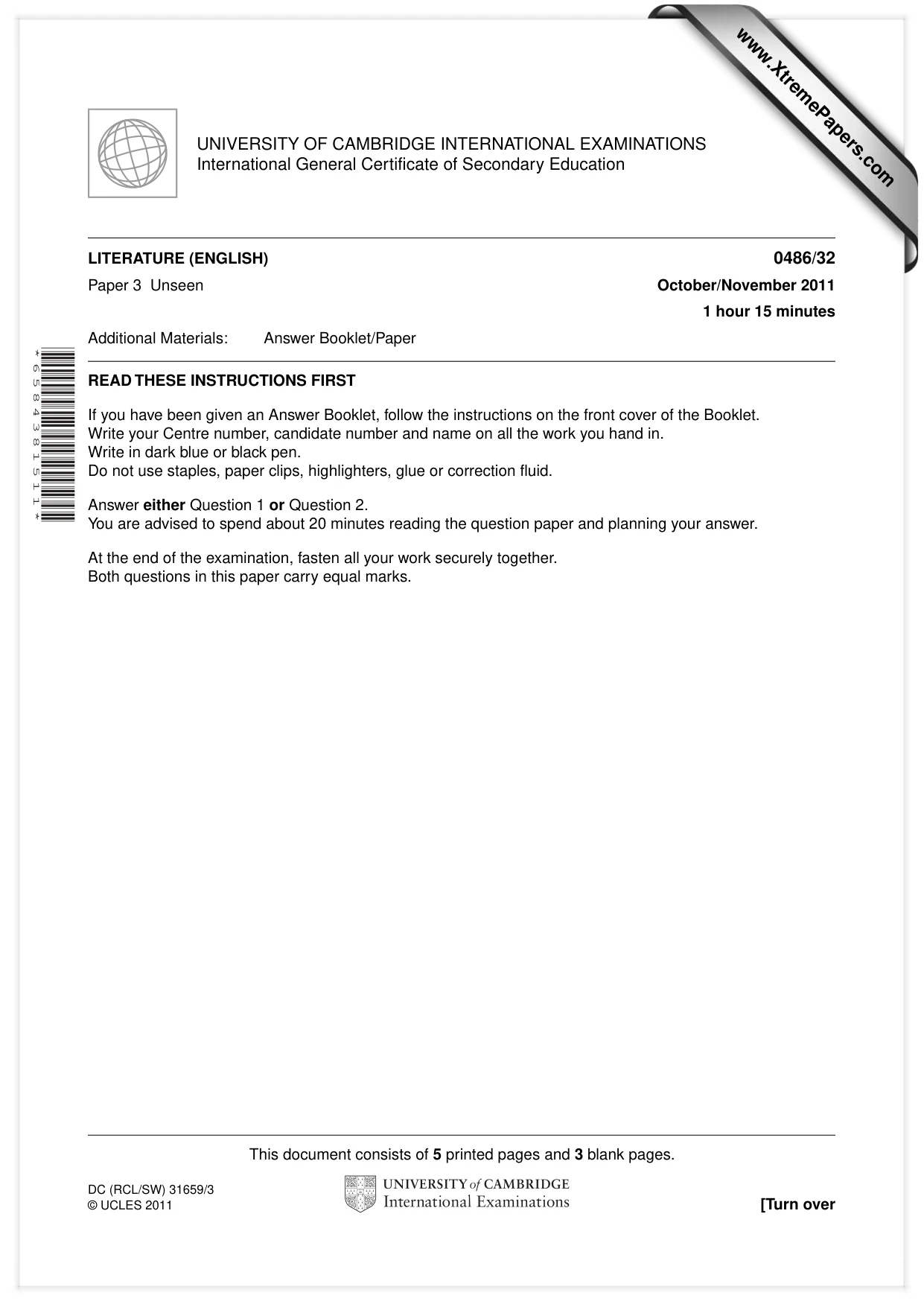
This document consists of 5 printed pages and 3 blank pages. DC (RCL/SW) 31659/3 © UCLES 2011 [Turn over UNIVERSITY OF CAMBRIDGE INTERNATIONAL EXAMINATIONS International General Certificate of Secondary Education * 6 5 8 4 3 8 1 5 1 1 * LITERATURE (ENGLISH) 0486/32 Paper 3 Unseen October/November 2011 1 hour 15 minutes Additional Materials: Answer Booklet/Paper READ THESE INSTRUCTIONS FIRST If you have been given an Answer Booklet, follow the instructions on the front cover of the Booklet. Write your Centre number, candidate number and name on all the work you hand in. Write in dark blue or black pen. Do not use staples, paper clips, highlighters, glue or correction fluid. Answer either Question 1 or Question 2. You are advised to spend about 20 minutes reading the question paper and planning your answer. At the end of the examination, fasten all your work securely together. Both questions in this paper carry equal marks. www.XtremePapers.com
Question paper, page 2
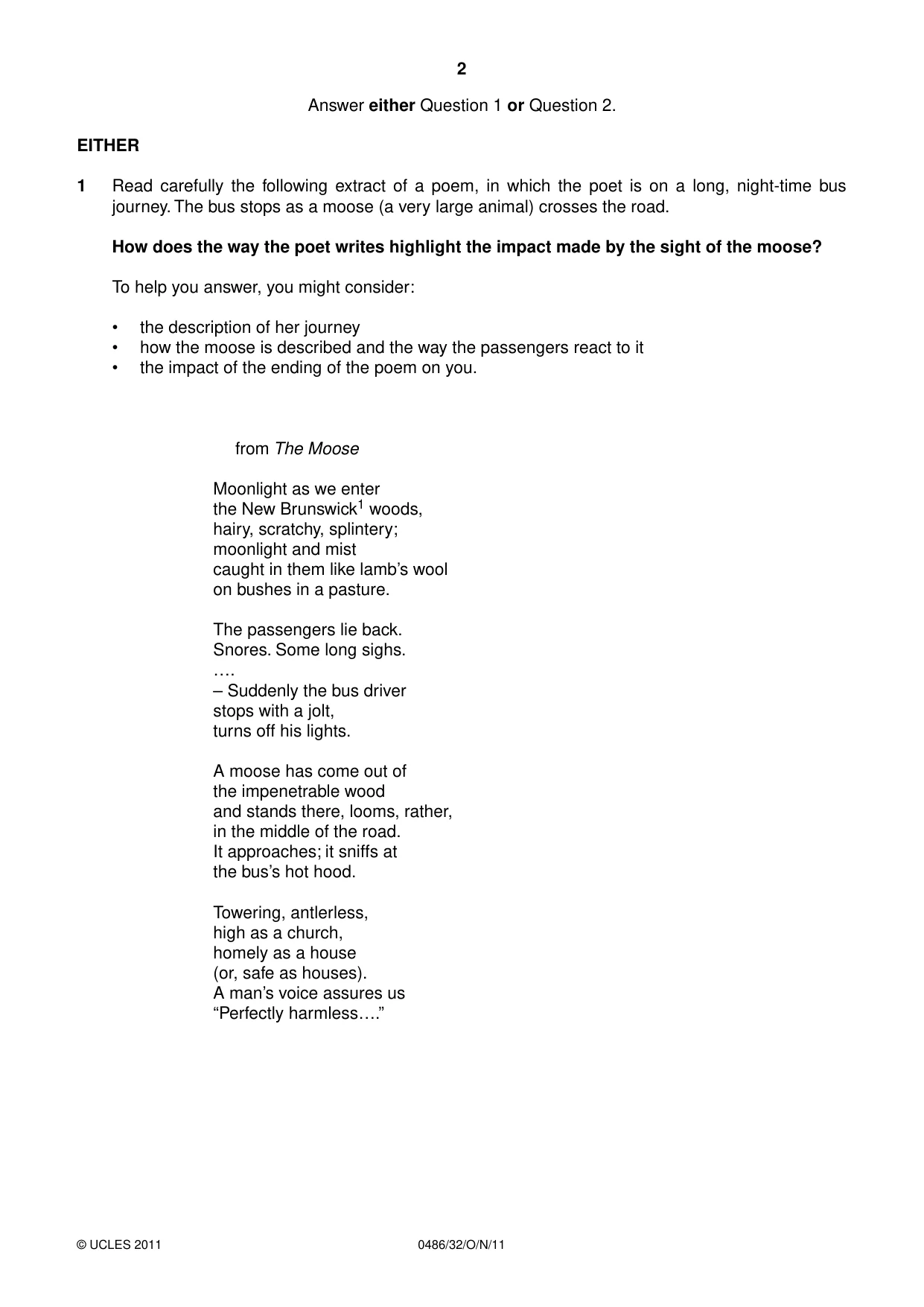
2 0486/32/O/N/11 © UCLES 2011 Answer either Question 1 or Question 2. EITHER 1 Read carefully the following extract of a poem, in which the poet is on a long, night-time bus journey. The bus stops as a moose (a very large animal) crosses the road. How does the way the poet writes highlight the impact made by the sight of the moose? To help you answer, you might consider: • the description of her journey • how the moose is described and the way the passengers react to it • the impact of the ending of the poem on you. from The Moose Moonlight as we enter the New Brunswick1 woods, hairy, scratchy, splintery; moonlight and mist caught in them like lamb’s wool on bushes in a pasture. The passengers lie back. Snores. Some long sighs. …. – Suddenly the bus driver stops with a jolt, turns off his lights. A moose has come out of the impenetrable wood and stands there, looms, rather, in the middle of the road. It approaches; it sniffs at the bus’s hot hood. Towering, antlerless, high as a church, homely as a house (or, safe as houses). A man’s voice assures us “Perfectly harmless….”
Question paper, page 3
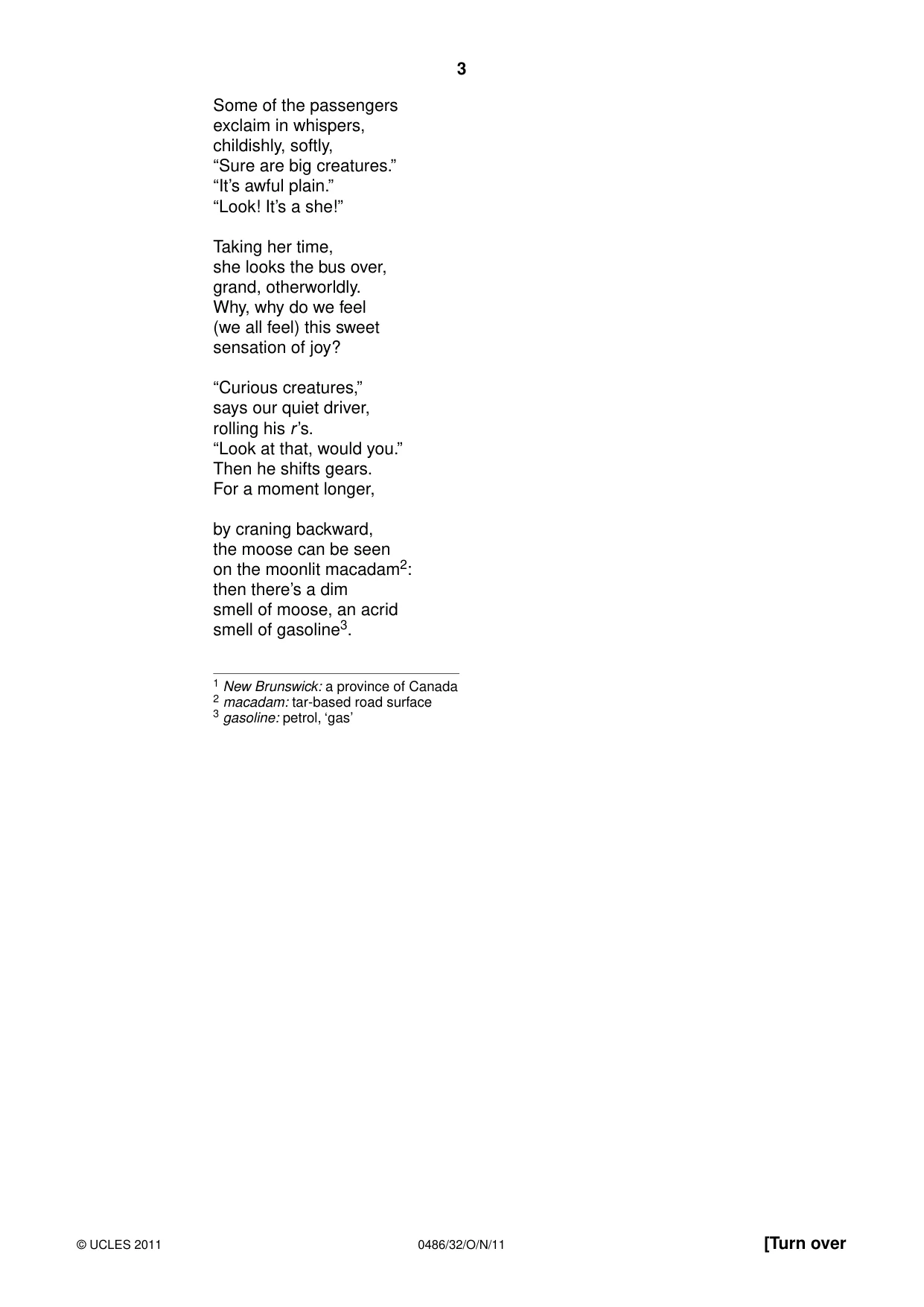
3 0486/32/O/N/11 © UCLES 2011 [Turn over Some of the passengers exclaim in whispers, childishly, softly, “Sure are big creatures.” “It’s awful plain.” “Look! It’s a she!” Taking her time, she looks the bus over, grand, otherworldly. Why, why do we feel (we all feel) this sweet sensation of joy? “Curious creatures,” says our quiet driver, rolling his r’s. “Look at that, would you.” Then he shifts gears. For a moment longer, by craning backward, the moose can be seen on the moonlit macadam2: then there’s a dim smell of moose, an acrid smell of gasoline3. 1 New Brunswick: a province of Canada 2 macadam: tar-based road surface 3 gasoline: petrol, ‘gas’
Question paper, page 4
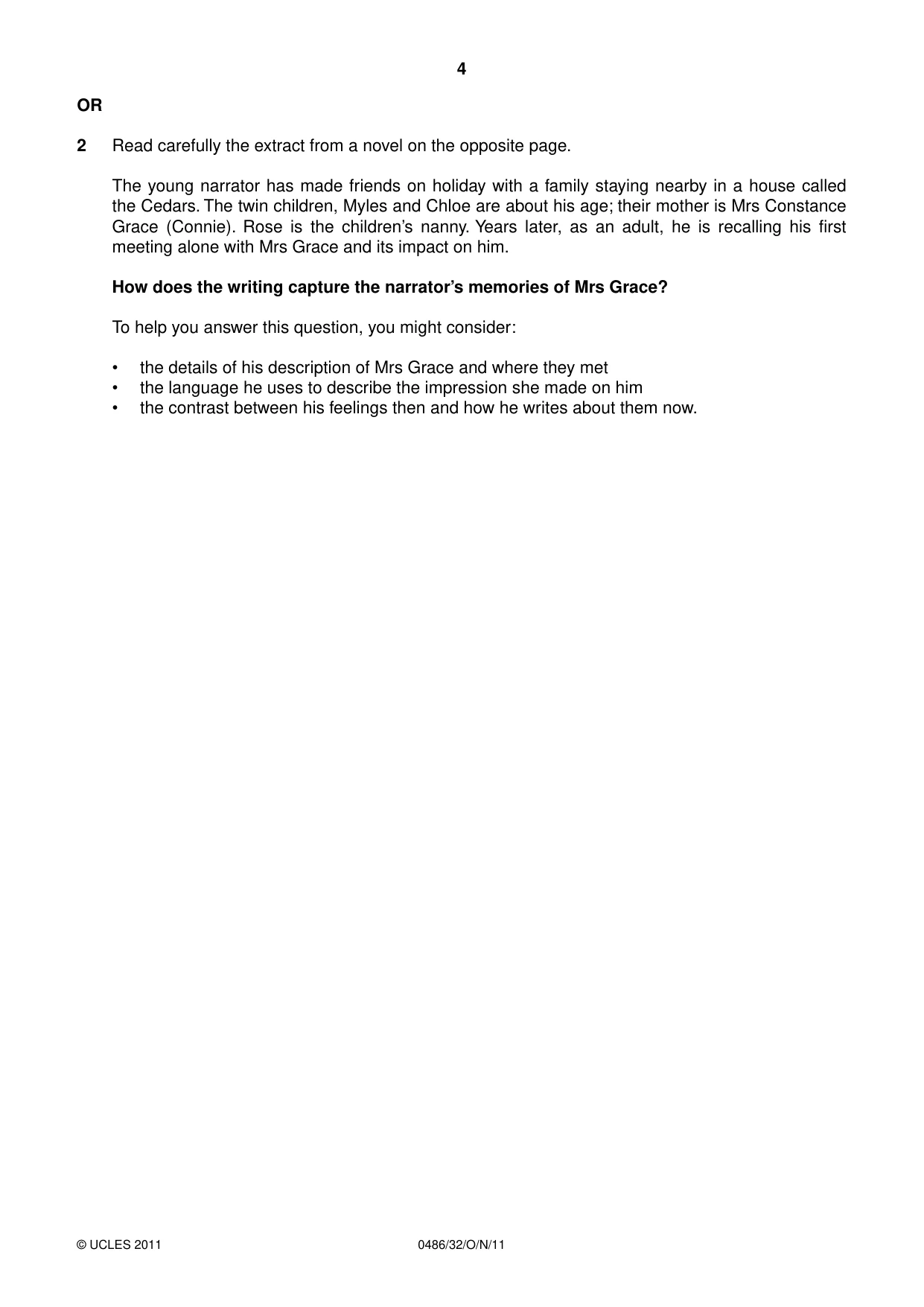
4 0486/32/O/N/11 © UCLES 2011 OR 2 Read carefully the extract from a novel on the opposite page. The young narrator has made friends on holiday with a family staying nearby in a house called the Cedars. The twin children, Myles and Chloe are about his age; their mother is Mrs Constance Grace (Connie). Rose is the children’s nanny. Years later, as an adult, he is recalling his first meeting alone with Mrs Grace and its impact on him. How does the writing capture the narrator’s memories of Mrs Grace? To help you answer this question, you might consider: • the details of his description of Mrs Grace and where they met • the language he uses to describe the impression she made on him • the contrast between his feelings then and how he writes about them now.
Question paper, page 5
5 0486/32/O/N/11 © UCLES 2011 I do not recall under what circumstances exactly I managed eventually to get inside the Cedars. I see myself after that initial encounter turning away frustratedly from the green gate with the twins watching me go, and then I see myself another day within the very sanctum1 itself, as if I had vaulted all obstacles to land up in the living room next to an angled, solid-seeming beam of brassy sunlight, with Mrs Grace in a loose-fitting, flowered dress, light-blue with a darker pattern of blue blossoms, turning from a table and smiling at me, deliberately vague, evidently not knowing who I was but knowing nevertheless that she should, which shows that this cannot have been the first time we had ever encountered each other face to face. Where was Chloe? Where was Myles? Why was I left alone with their mother? She asked if I would like something, a glass of lemonade, perhaps. ‘Or,’ she said in a tone of faint desperation, ‘an apple…?’ I shook my head. Her proximity, the mere fact of her thereness, filled me with excitement and a mysterious sort of sorrow. Who knows the pangs that pierce a small boy’s heart? She put her head on one side, puzzled, and amused, too, I could see, by the tongue-tied intensity of my presence before her. I must have seemed like a moth throbbing before a candle-flame, or like the flame itself, shivering in its own consuming heat. What was it she had been doing at the table? Arranging flowers in a vase – or is that too fanciful? There is a multi-coloured patch in my memory of the moment, a shimmer of variegated brightness where her hands hover. Let me linger here with her a little while, before Rose appears, and Myles and Chloe return from wherever they are and her goatish husband comes clattering on to the scene; she will be displaced soon enough from the throbbing centre of my attentions. How intensely that sunbeam glows. Where is it coming from? It has an almost churchly cast, as if, impossibly, it were slanting down from a rose window2 high above us. Beyond the smouldering sunlight there is the placid gloom of indoors on a summer afternoon, where my memory gropes in search of details, solid objects, the components of the past. Mrs Grace, Constance, Connie, is still smiling at me in that unfocused way, which, now that I consider it, is how she looked at everything, as if she were not absolutely persuaded of the world’s solidity and half expected it all at any moment to turn, in some outlandish and hilarious way, into something entirely different. I would have said then that she was beautiful, had there been anyone to whom I would have thought of saying such a thing, but I suppose she was not, really. She was rather stocky, and her hands were fat and reddish, there was a bump at the tip of her nose, and the two lank strands of blonde hair that her fingers kept pushing back behind her ears and that kept falling forward again were darker than the rest of her hair and had the slightly greasy hue of oiled oak. She walked at a languorous slouch, the muscles in her haunches quivering under the light stuff of her summer dresses. She smelled of sweat and cold cream and, faintly, of cooking fat. Just another woman, in other words, and another mother, at that. Yet to me she was in all her ordinariness as remote and remotely desirable as any painted pale lady with unicorn and book. 1 sanctum: holy place 2 rose window: stained-glass window in a church
Question paper, page 6
6 0486/32/O/N/11 © UCLES 2011 BLANK PAGE
Question paper, page 7
7 0486/32/O/N/11 © UCLES 2011 BLANK PAGE
Question paper, page 8
8 0486/32/O/N/11 © UCLES 2011 BLANK PAGE Copyright Acknowledgements: Question 1 © Elizabeth Bishop; ‘The Moose’ in The Complete Poems; Farrar, Straus and Giroux; 1983. Question 2 © John Banville; The Sea; Picador; 2005. Permission to reproduce items where third-party owned material protected by copyright is included has been sought and cleared where possible. Every reasonable effort has been made by the publisher (UCLES) to trace copyright holders, but if any items requiring clearance have unwittingly been included, the publisher will be pleased to make amends at the earliest possible opportunity. University of Cambridge International Examinations is part of the Cambridge Assessment Group. Cambridge Assessment is the brand name of University of Cambridge Local Examinations Syndicate (UCLES), which is itself a department of the University of Cambridge.
Mark scheme, page 1
UNIVERSITY OF CAMBRIDGE INTERNATIONAL EXAMINATIONS International General Certificate of Secondary Education MARK SCHEME for the October/November 2011 question paper for the guidance of teachers 0486 LITERATURE (ENGLISH) 0486/32 Paper 3 (Unseen), maximum raw mark 25 This mark scheme is published as an aid to teachers and candidates, to indicate the requirements of the examination. It shows the basis on which Examiners were instructed to award marks. It does not indicate the details of the discussions that took place at an Examiners’ meeting before marking began, which would have considered the acceptability of alternative answers. Mark schemes must be read in conjunction with the question papers and the report on the examination. • Cambridge will not enter into discussions or correspondence in connection with these mark schemes. Cambridge is publishing the mark schemes for the October/November 2011 question papers for most IGCSE, GCE Advanced Level and Advanced Subsidiary Level syllabuses and some Ordinary Level syllabuses. www.XtremePapers.com
Mark scheme, page 2
Page 2 Mark Scheme: Teachers’ version Syllabus Paper IGCSE – October/November 2011 0486 32 © University of Cambridge International Examinations 2011 Both questions on this paper are marked out of 25. The Assessment Objectives for the paper are: AO1 show detailed knowledge of the content of literary texts AO2 understand the meanings of literary texts and their context, and explore texts beyond surface meaning to show deeper awareness of ideas and attitudes AO3 recognise and appreciate ways in which writers use language, structure, and form to create and shape meanings and effects AO4 communicate a sensitive and informed personal response The General Descriptors guide examiners to an understanding of the qualities normally expected of, or typical of, work in a band. They are a means of general guidance, and must not be interpreted as hurdle statements. For the purposes of standardisation of marking, they are to be used in conjunction with photostats of candidates' work produced in the examination and discussed during the examiners' coordination meeting, as well as the question-specific notes.
Mark scheme, page 3
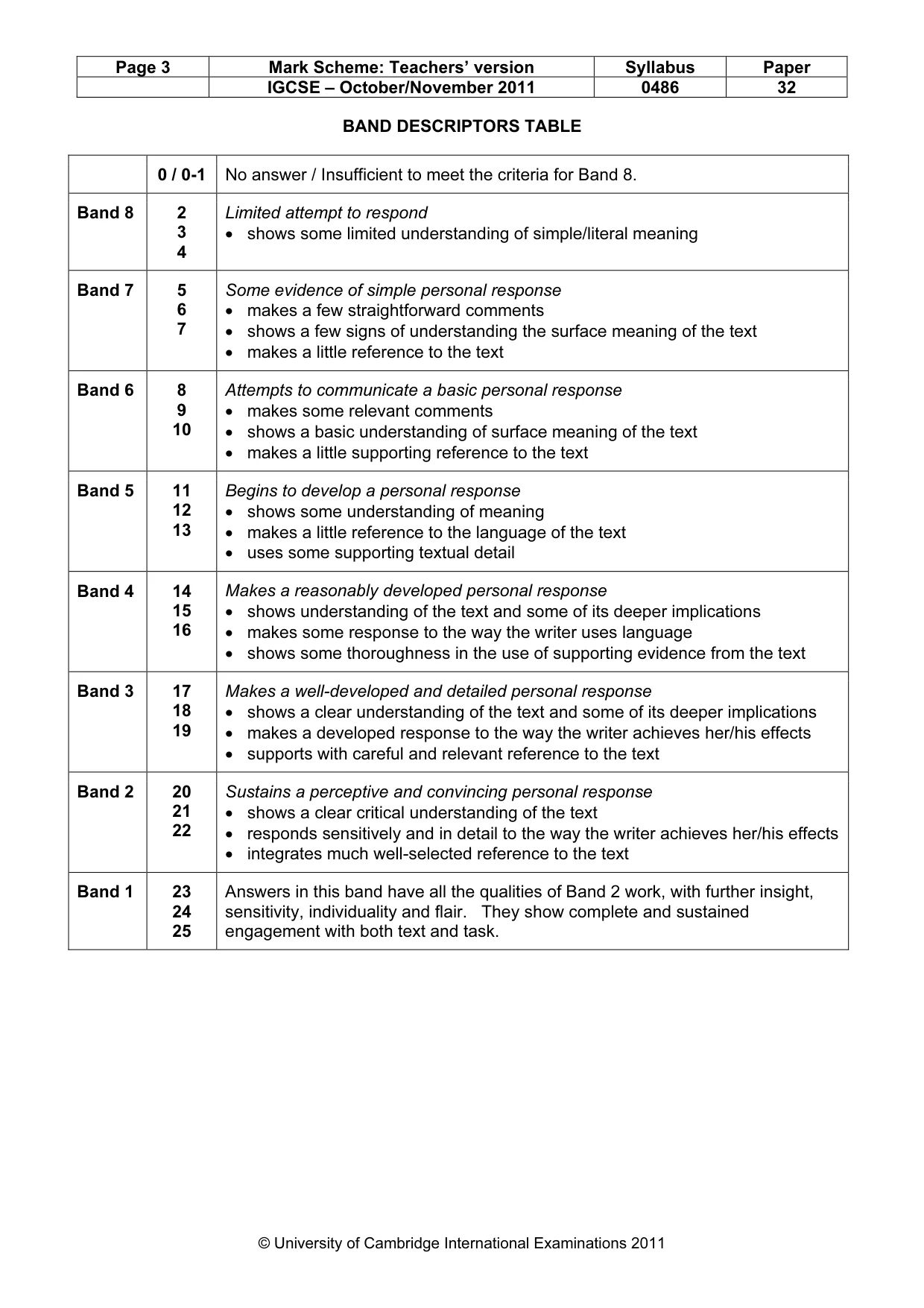
Page 3 Mark Scheme: Teachers’ version Syllabus Paper IGCSE – October/November 2011 0486 32 © University of Cambridge International Examinations 2011 BAND DESCRIPTORS TABLE 0 / 0-1 No answer / Insufficient to meet the criteria for Band 8. Band 8 2 3 4 Limited attempt to respond • shows some limited understanding of simple/literal meaning Band 7 5 6 7 Some evidence of simple personal response • makes a few straightforward comments • shows a few signs of understanding the surface meaning of the text • makes a little reference to the text Band 6 8 9 10 Attempts to communicate a basic personal response • makes some relevant comments • shows a basic understanding of surface meaning of the text • makes a little supporting reference to the text Band 5 11 12 13 Begins to develop a personal response • shows some understanding of meaning • makes a little reference to the language of the text • uses some supporting textual detail Band 4 14 15 16 Makes a reasonably developed personal response • shows understanding of the text and some of its deeper implications • makes some response to the way the writer uses language • shows some thoroughness in the use of supporting evidence from the text Band 3 17 18 19 Makes a well-developed and detailed personal response • shows a clear understanding of the text and some of its deeper implications • makes a developed response to the way the writer achieves her/his effects • supports with careful and relevant reference to the text Band 2 20 21 22 Sustains a perceptive and convincing personal response • shows a clear critical understanding of the text • responds sensitively and in detail to the way the writer achieves her/his effects • integrates much well-selected reference to the text Band 1 23 24 25 Answers in this band have all the qualities of Band 2 work, with further insight, sensitivity, individuality and flair. They show complete and sustained engagement with both text and task.
What you needed in this session
Cambridge’s own grade thresholds for 2011 Oct/Nov, Paper 3 · Variant 2. A higher threshold means an easier paper — the bar moves with how the cohort did.