Questions as text
Q1 · The government wishes to increase economic growth in its economy 0987/11 May/June 2020
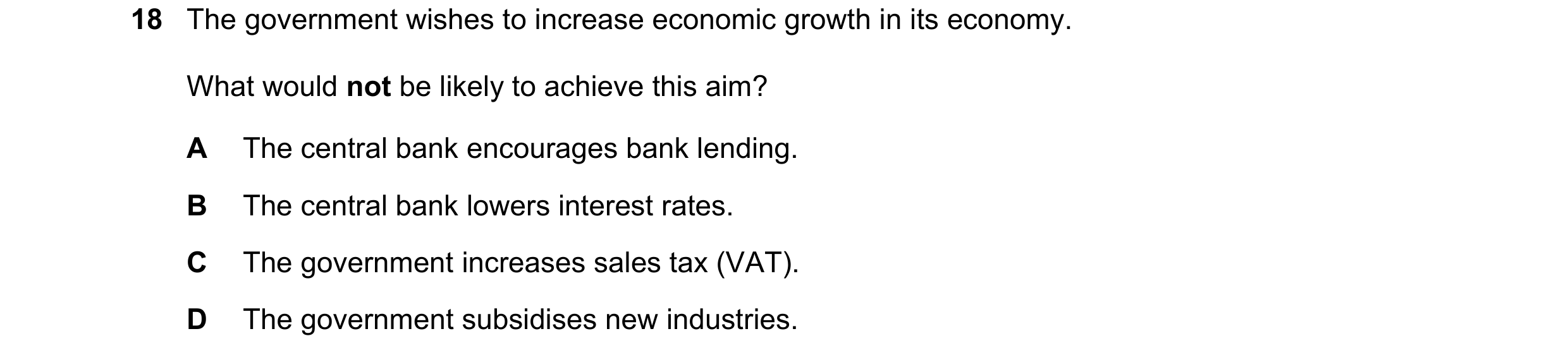
18 The government wishes to increase economic growth in its economy. What would not be likely to achieve this aim? A The central bank encourages bank lending. B The central bank lowers interest rates. C The government increases sales tax (VAT). D The government subsidises new industries.
1 marks
Answer: C
This question in 0987/11 May/June 2020
Q2 · What can a central bank increase in order to reduce consumer borrowing? 0987/12 Oct/Nov 2020
11 What can a central bank increase in order to reduce consumer borrowing? A commercial bank deposits B government spending C the exchange rate D the rate of interest
1 marks
Answer: D
This question in 0987/12 Oct/Nov 2020
Q3 · An economy is experiencing rising prices 0987/12 Oct/Nov 2020
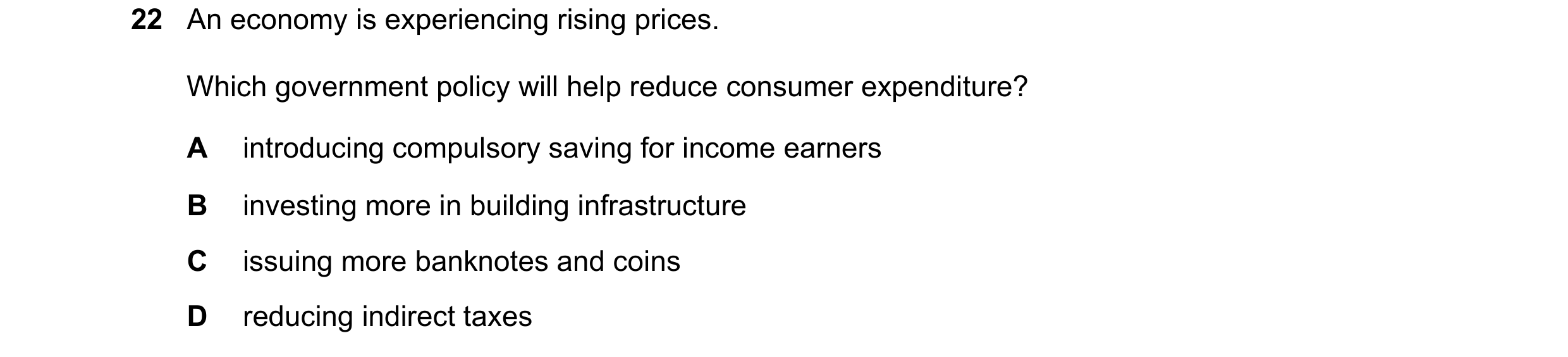
22 An economy is experiencing rising prices. Which government policy will help reduce consumer expenditure? A introducing compulsory saving for income earners B investing more in building infrastructure C issuing more banknotes and coins D reducing indirect taxes
1 marks
Answer: A
This question in 0987/12 Oct/Nov 2020
Q4 · Interest rates are sometimes raised to control inflation 0987/11 May/June 2021
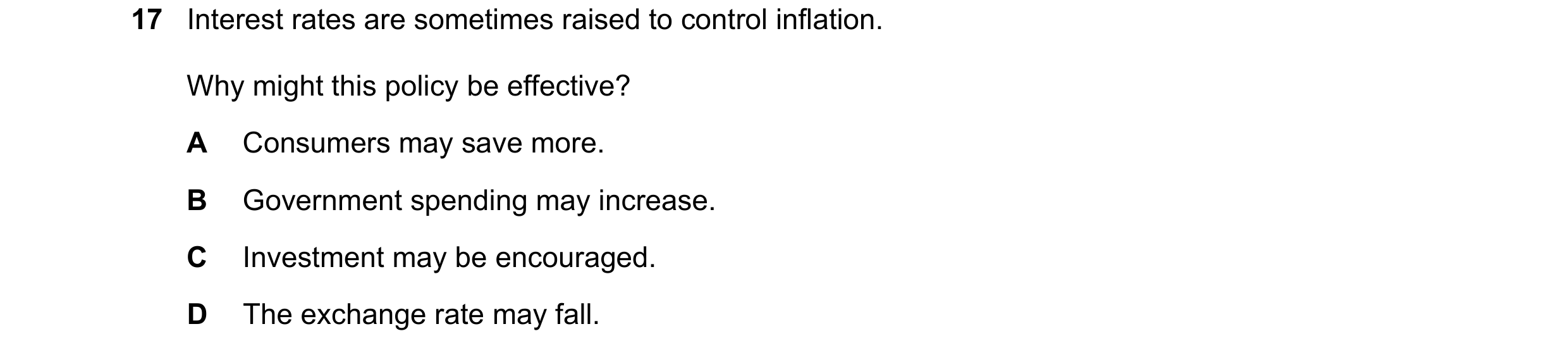
17 Interest rates are sometimes raised to control inflation. Why might this policy be effective? A Consumers may save more. B Government spending may increase. C Investment may be encouraged. D The exchange rate may fall.
1 marks
Answer: A
This question in 0987/11 May/June 2021
Q5 · A government uses expansionary monetary policy 0987/12 May/June 2021
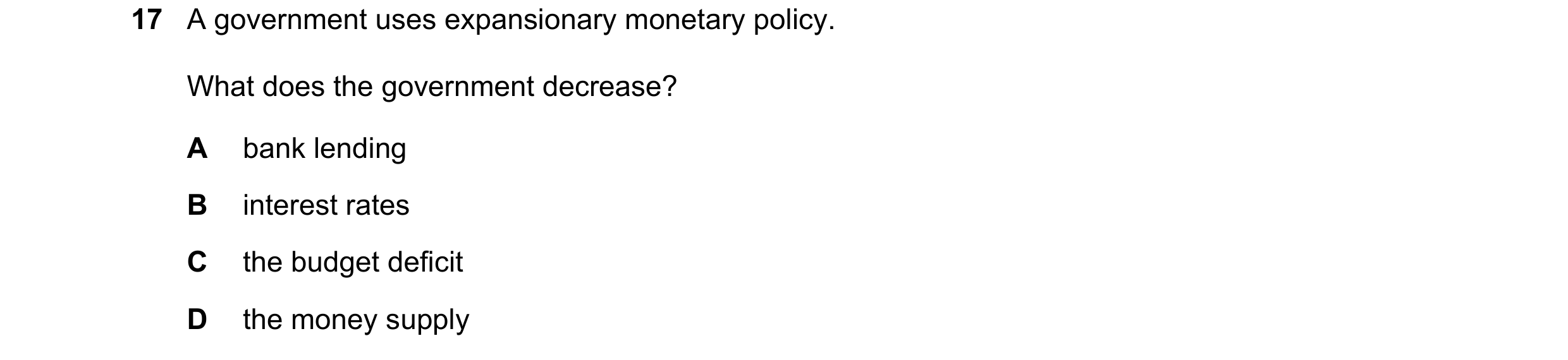
17 A government uses expansionary monetary policy. What does the government decrease? A bank lending B interest rates C the budget deficit D the money supply
1 marks
Answer: B
This question in 0987/12 May/June 2021
Q6 · Which combination of policy measures is most likely to increase the level of employment? 0987/12 Oct/Nov 2021
23 Which combination of policy measures is most likely to increase the level of employment? A decrease general taxation and decrease the rate of interest B decrease general taxation and increase the rate of interest C increase general taxation and decrease the rate of interest D increase general taxation and increase the rate of interest
1 marks
Answer: A
This question in 0987/12 Oct/Nov 2021
Q7 · Why would an increase in the interest rate potentially lead to lower inflation? 0987/11 May/June 2022
18 Why would an increase in the interest rate potentially lead to lower inflation? A Consumers will be more willing to save when interest rates are high. B Consumers will be more willing to spend when interest rates are high. C Producers will be more willing to borrow from banks when interest rates are high. D Producers will be more willing to invest when interest rates are high.
1 marks
Answer: A
This question in 0987/11 May/June 2022
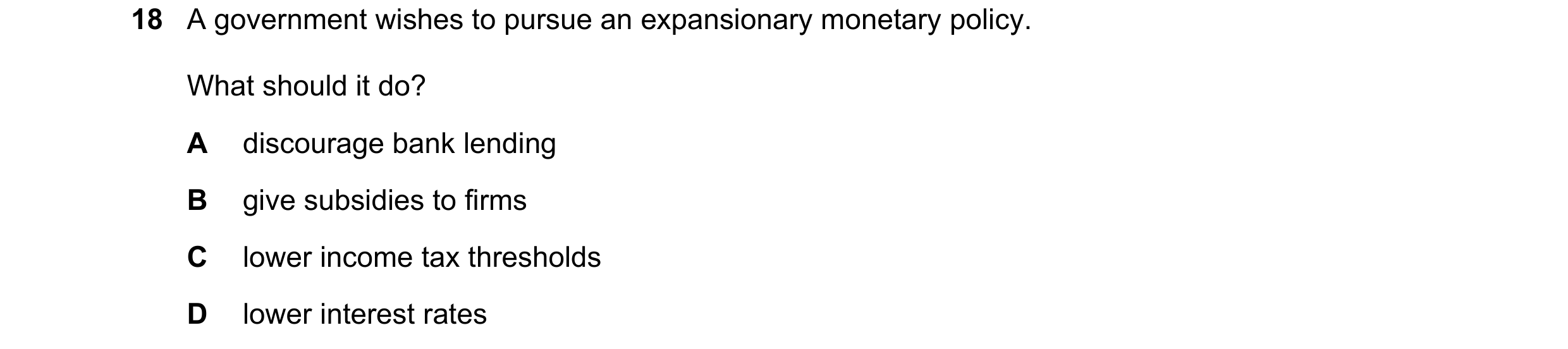
Q8 · A government wishes to pursue an expansionary monetary policy 0987/12 May/June 2022
18 A government wishes to pursue an expansionary monetary policy. What should it do? A discourage bank lending B give subsidies to firms C lower income tax thresholds D lower interest rates
1 marks
Answer: D
This question in 0987/12 May/June 2022
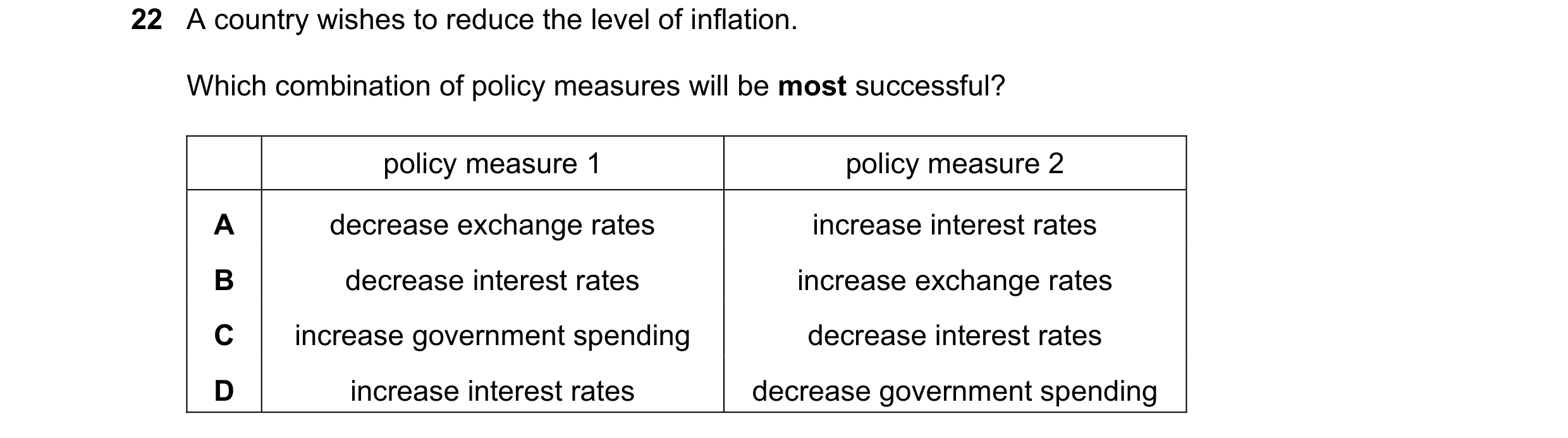
Q9 · A country wishes to reduce the level of inflation 0987/12 May/June 2022
22 A country wishes to reduce the level of inflation. Which combination of policy measures will be most successful? policy measure 1 policy measure 2 A decrease exchange rates increase interest rates B decrease interest rates increase exchange rates C increase government spending decrease interest rates D increase interest rates decrease government spending
1 marks
Answer: D
This question in 0987/12 May/June 2022
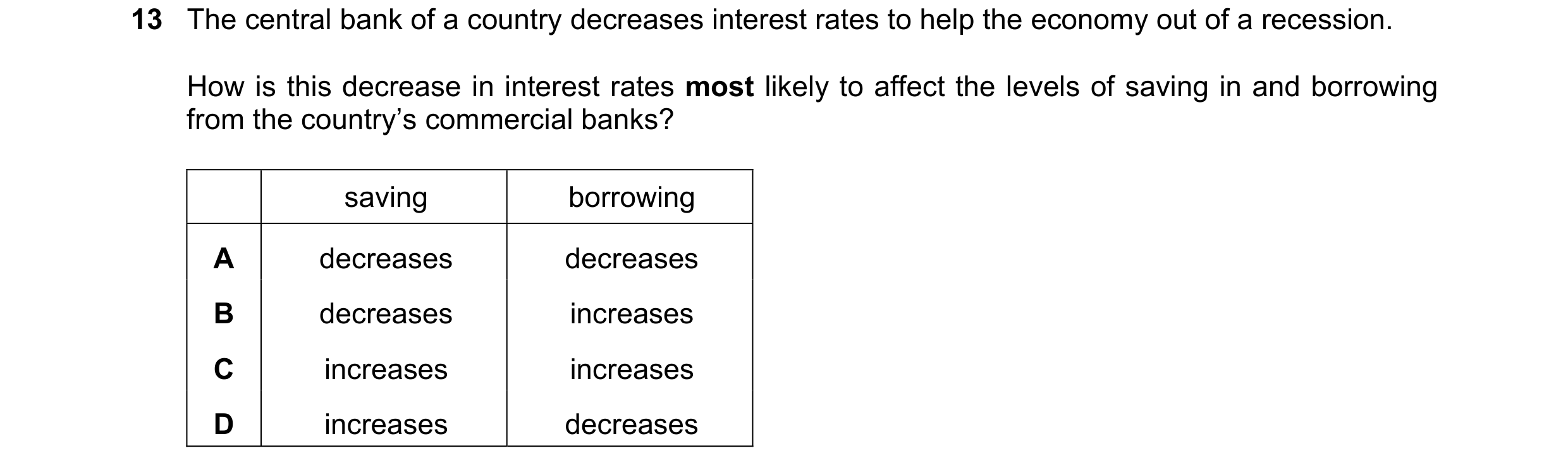
Q10 · The central bank of a country decreases interest rates to help the economy out of a… 0987/12 Oct/Nov 2022
13 The central bank of a country decreases interest rates to help the economy out of a recession. How is this decrease in interest rates most likely to affect the levels of saving in and borrowing from the country’s commercial banks? saving borrowing A decreases decreases B decreases increases C increases increases D increases decreases
1 marks
Answer: B
This question in 0987/12 Oct/Nov 2022
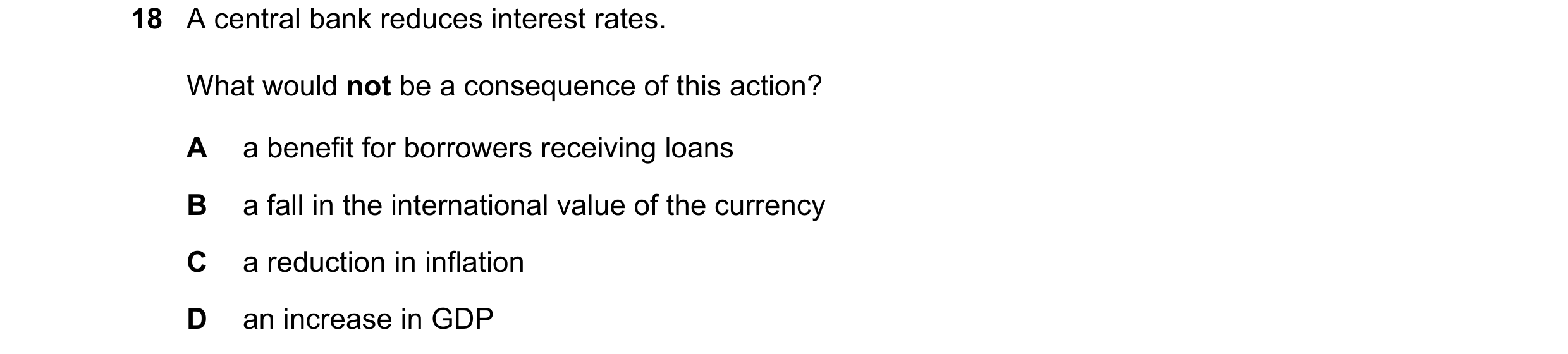
Q11 · A central bank reduces interest rates 0987/12 Oct/Nov 2022
18 A central bank reduces interest rates. What would not be a consequence of this action? A a benefit for borrowers receiving loans B a fall in the international value of the currency C a reduction in inflation D an increase in GDP
1 marks
Answer: C
This question in 0987/12 Oct/Nov 2022
Q12 · A country’s central bank raised the rate of interest from 1% to 4% per year 0987/11 May/June 2023
12 A country’s central bank raised the rate of interest from 1% to 4% per year. How would this change have affected the amount saved and the cost of borrowing by individuals? amount cost of saved borrowing A decreased decreased B decreased increased C increased decreased D increased increased
1 marks
Answer: D
This question in 0987/11 May/June 2023
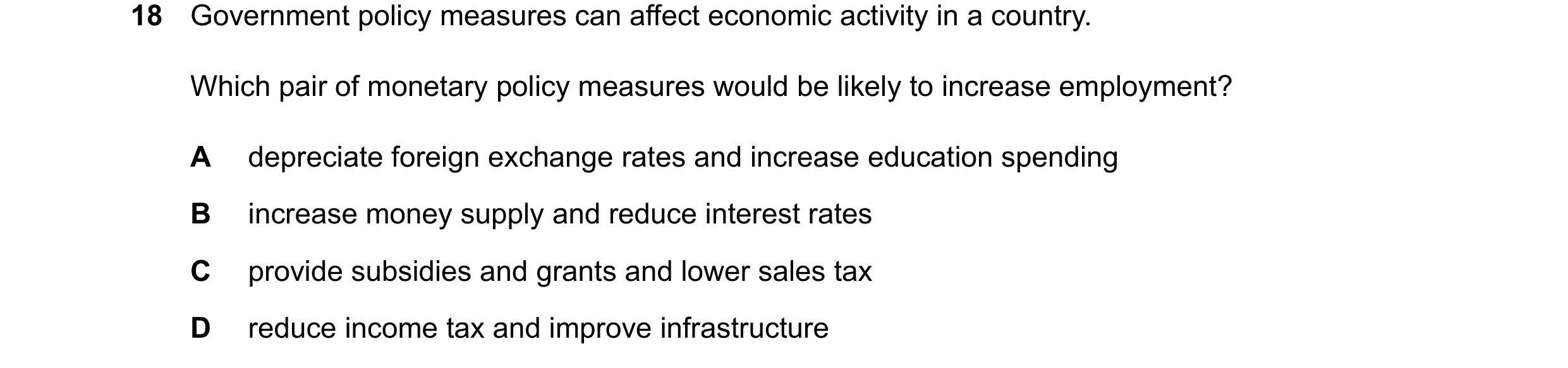
Q13 · Government policy measures can affect economic activity in a country 0987/11 May/June 2023
18 Government policy measures can affect economic activity in a country. Which pair of monetary policy measures would be likely to increase employment? A depreciate foreign exchange rates and increase education spending B increase money supply and reduce interest rates C provide subsidies and grants and lower sales tax D reduce income tax and improve infrastructure
1 marks
Answer: B
This question in 0987/11 May/June 2023
Q14 · What would be most likely to encourage saving? 0987/11 May/June 2023
19 What would be most likely to encourage saving? A a rise in the exchange rate B a rise in the goods and services tax rate C a rise in the income tax rate D a rise in the interest rate
1 marks
Answer: D
This question in 0987/11 May/June 2023
Q15 · What is likely to happen when the rate of interest increases? 0987/12 Oct/Nov 2023
19 What is likely to happen when the rate of interest increases? A consumer spending increases B firms buy fewer machines C people hold more cash D savers earn lower rewards
1 marks
Answer: B
This question in 0987/12 Oct/Nov 2023
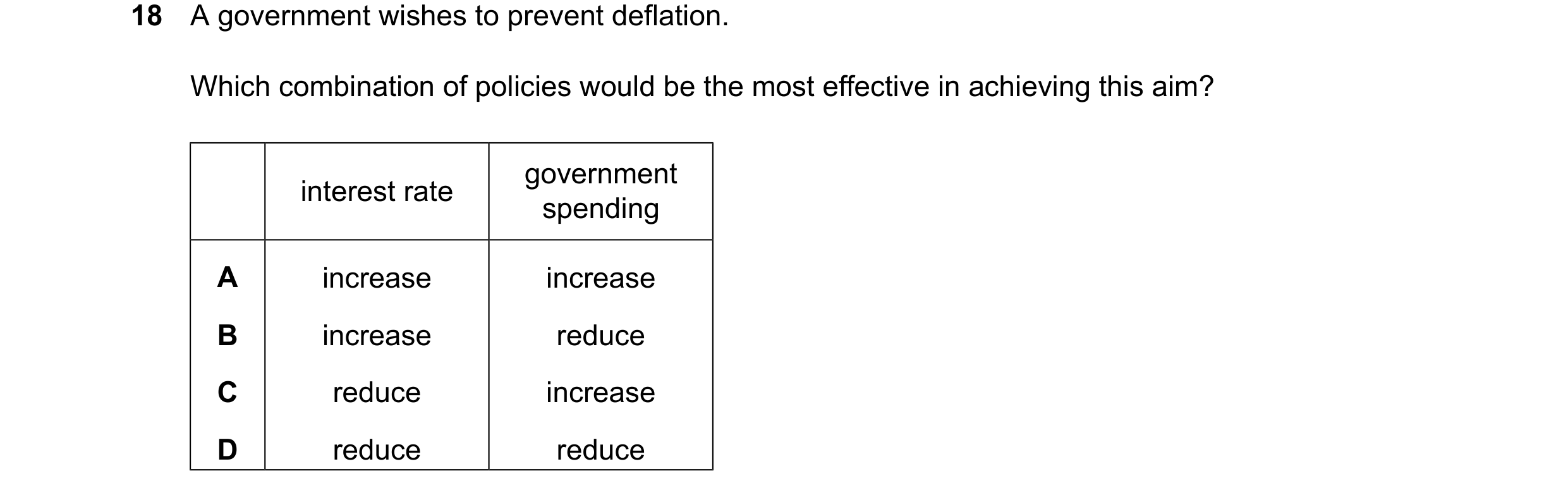
Q16 · A government wishes to prevent deflation 0987/12 May/June 2024
18 A government wishes to prevent deflation. Which combination of policies would be the most effective in achieving this aim? government interest rate spending A increase increase B increase reduce C reduce increase D reduce reduce
1 marks
Answer: C
This question in 0987/12 May/June 2024
Q17 · The table shows changes in economic policies for four countries, A, B, C and D 0987/12 Oct/Nov 2024
23 The table shows changes in economic policies for four countries, A, B, C and D. Which country is most likely to be following a policy of preventing deflation? government money supply taxation spending A decreasing decreasing decreasing B decreasing decreasing increasing C increasing increasing decreasing D increasing increasing increasing
1 marks
Answer: C
This question in 0987/12 Oct/Nov 2024
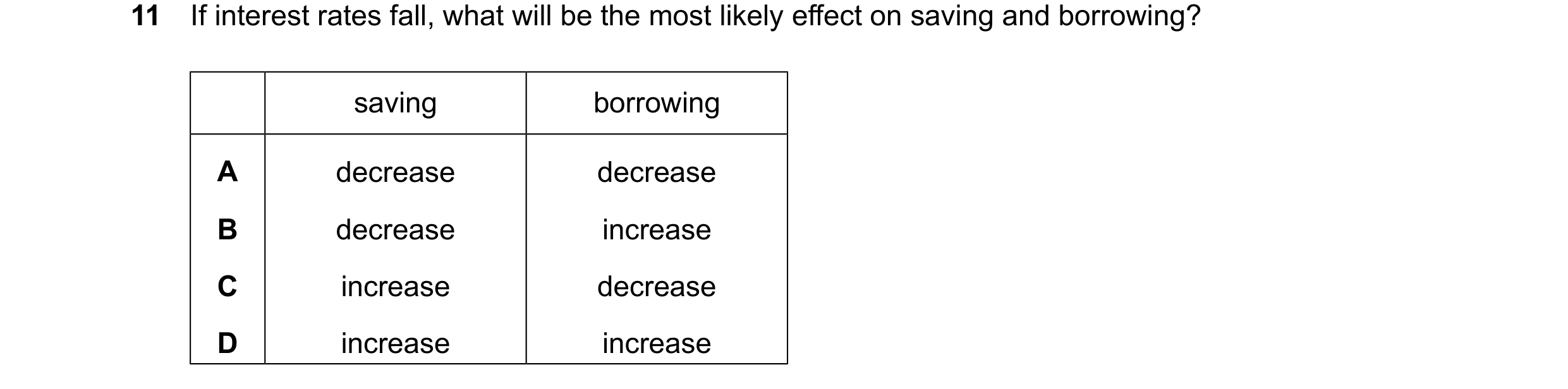
Q18 · If interest rates fall, what will be the most likely effect on saving and borrowing? 0987/11 May/June 2025
11 If interest rates fall, what will be the most likely effect on saving and borrowing? saving borrowing A decrease decrease B decrease increase C increase decrease D increase increase
1 marks
Answer: B
This question in 0987/11 May/June 2025
Q19 · Monetary policy often involves a change in which variables? 0987/11 May/June 2025
19 Monetary policy often involves a change in which variables? A government expenditure or taxes B interest rates or the money supply C labour market or trade union laws D tariffs or quotas
1 marks
Answer: B
This question in 0987/11 May/June 2025
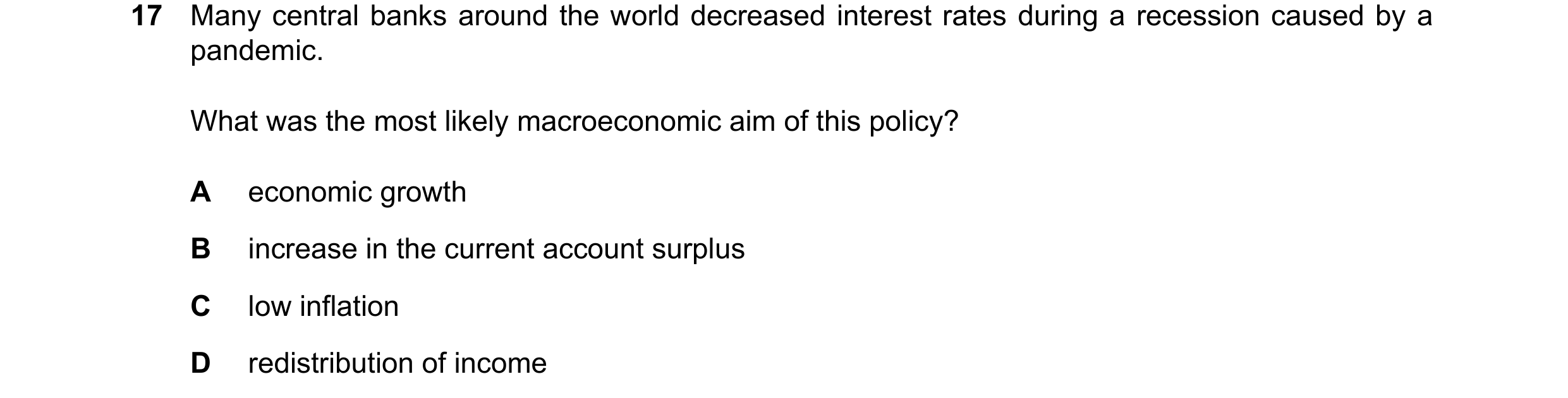
Q20 · Many central banks around the world decreased interest rates during a recession caused by… 0987/12 May/June 2025
17 Many central banks around the world decreased interest rates during a recession caused by a pandemic. What was the most likely macroeconomic aim of this policy? A economic growth B increase in the current account surplus C low inflation D redistribution of income
1 marks
Answer: A
This question in 0987/12 May/June 2025
Q21 · What is the most likely result of a fall in interest rates? 0987/12 Oct/Nov 2025
20 What is the most likely result of a fall in interest rates? A a fall in inflation B a fall in investment C a rise in consumer spending D a rise in saving
1 marks
Answer: C
This question in 0987/12 Oct/Nov 2025

 1 / 4
1 / 4
 2 / 4
2 / 4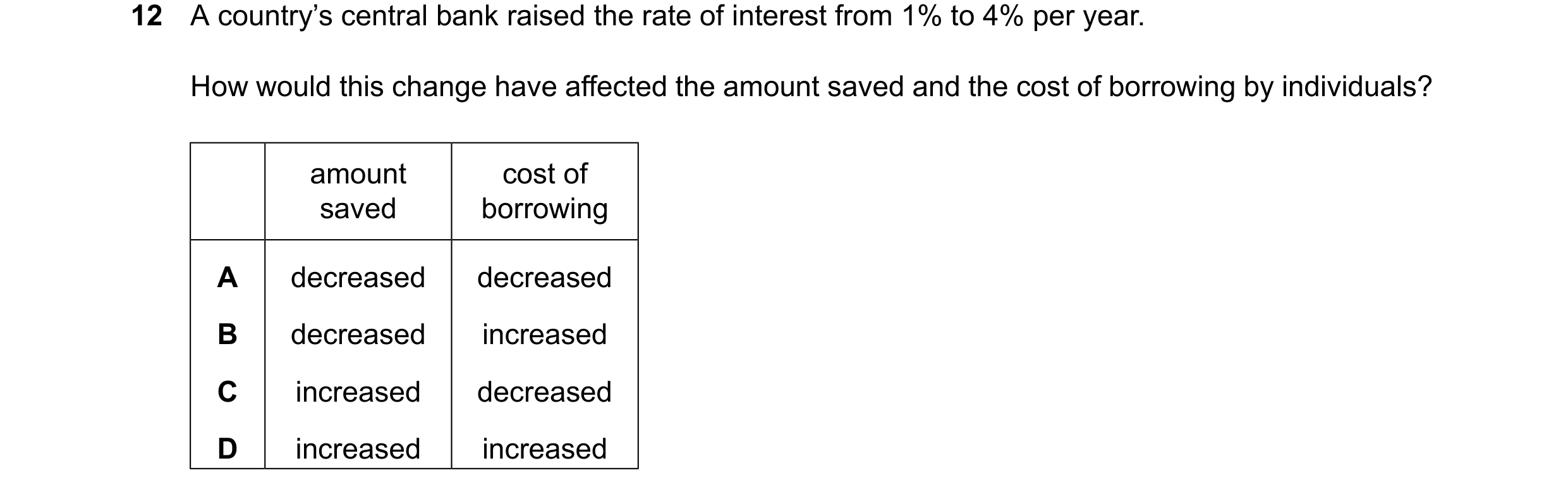


 3 / 4
3 / 4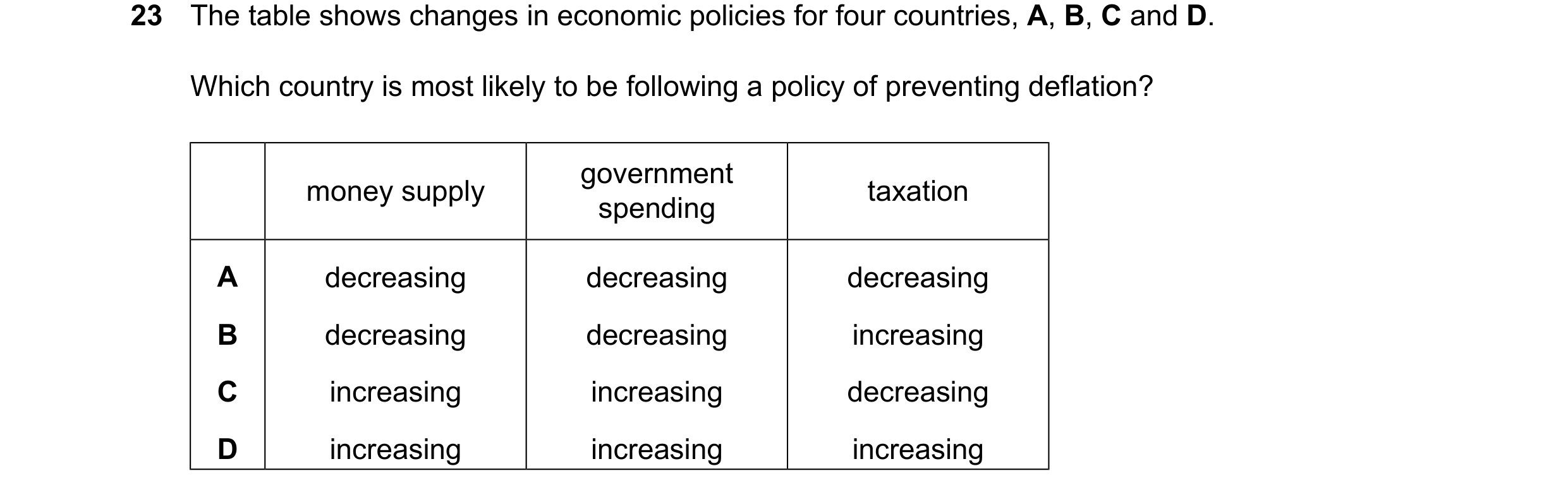

 4 / 4
4 / 4