Questions as text
Q1 · A number of countries are withdrawing high value banknotes 0987/22 May/June 2020
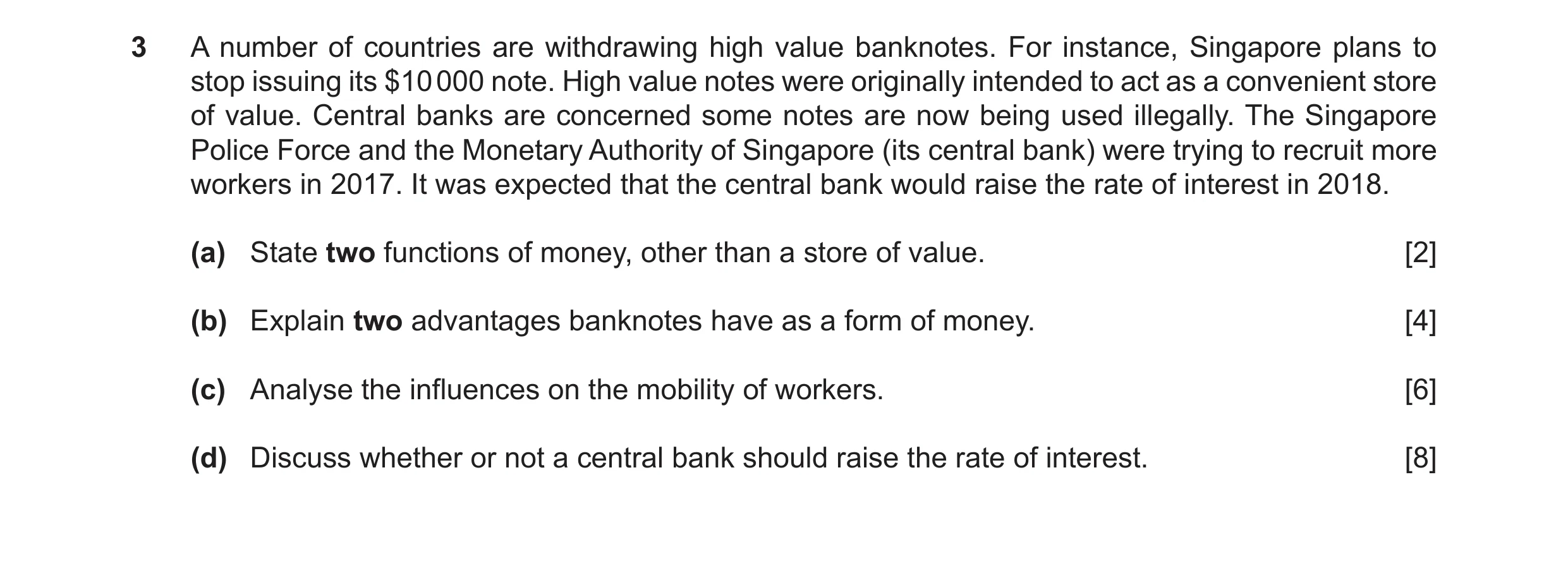
3 A number of countries are withdrawing high value banknotes. For instance, Singapore plans to stop issuing its $10 000 note. High value notes were originally intended to act as a convenient store of value. Central banks are concerned some notes are now being used illegally. The Singapore Police Force and the Monetary Authority of Singapore (its central bank) were trying to recruit more workers in 2017. It was expected that the central bank would raise the rate of interest in 2018. (a) State two functions of money, other than a store of value. [2] (b) Explain two advantages banknotes have as a form of money. [4] (c) Analyse the influences on the mobility of workers. [6] (d) Discuss whether or not a central bank should raise the rate of interest. [8]
20 marks
Mark scheme: 3(a) State two functions of money, other than a store of value. 2 One mark each for two from: medium of exchange, measure of value (unit of account) and standard of deferred payments. 3(b) Explain two advantages banknotes have as a form of money. 4 Logical explanation which might include: Generally acceptable (1) people are prepared to accept them in exchange for products and to settle debts (1). Portable (1) banknotes are light to carry around (1). Divisible (1) notes of different denominations (1). Recognisable (1) notes have distinct features on them known to the population (1). Limited in supply (1) the central bank prints a set number of notes (1). Homogeneous (1) all banknotes of the same value are identical (1). 3(c) Analyse the influences on the mobility of workers. 6 Coherent analysis which might include: Occupational mobility is influenced by education (1) the more qualifications workers have (1) the more choice of jobs they will have (1). Occupational mobility is influenced by training (1) the more skills workers have (1) the easier they will find it to switch jobs (1). Geographical mobility is influenced by the price/availability of housing (1) The cheaper/more available housing is (1) the easier will workers find it to work in other areas (1). Geographical mobility is influenced by family ties (1) people may be reluctant to move because children are at school/partners have job in a particular area (1). Mobility between countries will be influenced by immigration controls (1). 3(d) Discuss whether or not a central bank should raise the rate of interest. 8 In assessing each answer, use the table below. Level Description Marks 3 A reasoned discussion which accurately examines both 6–8 sides of the economic argument, making use of economic information and clear and logical analysis to evaluate economic issues and situations. One side of the argument may have more depth than the other but, overall, both sides of the argument are considered and developed. There is thoughtful evaluation of economic concepts, terminology, information and/or data appropriate to the question. The discussion may also point out the possible uncertainties of alternative decisions and outcomes. 2 A reasoned discussion which makes use of economic 3–5 information and clear analysis to evaluate economic issues and situations. The answer may lack some depth and development may be one-sided. There is relevant use of economic concepts, terminology, information and data appropriate to the question. 1 There is a simple attempt at using economic definitions 1–2 and terminology. Some reference may be made to economic theory, with occasional understanding. 0 A mark of zero should be awarded for no creditable 0 content. Why it should: • to reduce demand-pull inflation as a higher interest rate may encourage to spend less as it may discourage borrowing and encourage saving • to reduce borrowing if people and firms are building up unsustainable debt • to raise the exchange rate if there is downward pressure on a fixed exchange rate • to reduce a current account deficit if it is thought that lower spending will reduce imports and may discourage exports. Why it should not: • it may increase cyclical unemployment by reducing total (aggregate) demand • it may reduce the economic growth rate as it may discourage investment due to the higher cost of borrowing to purchase capital goods • it may raise the exchange rate and make exports less price competitive.
This question in 0987/22 May/June 2020
Q2 · Italy is home to the world’s oldest bank and some of the world’s oldest car producers 0987/22 Oct/Nov 2020
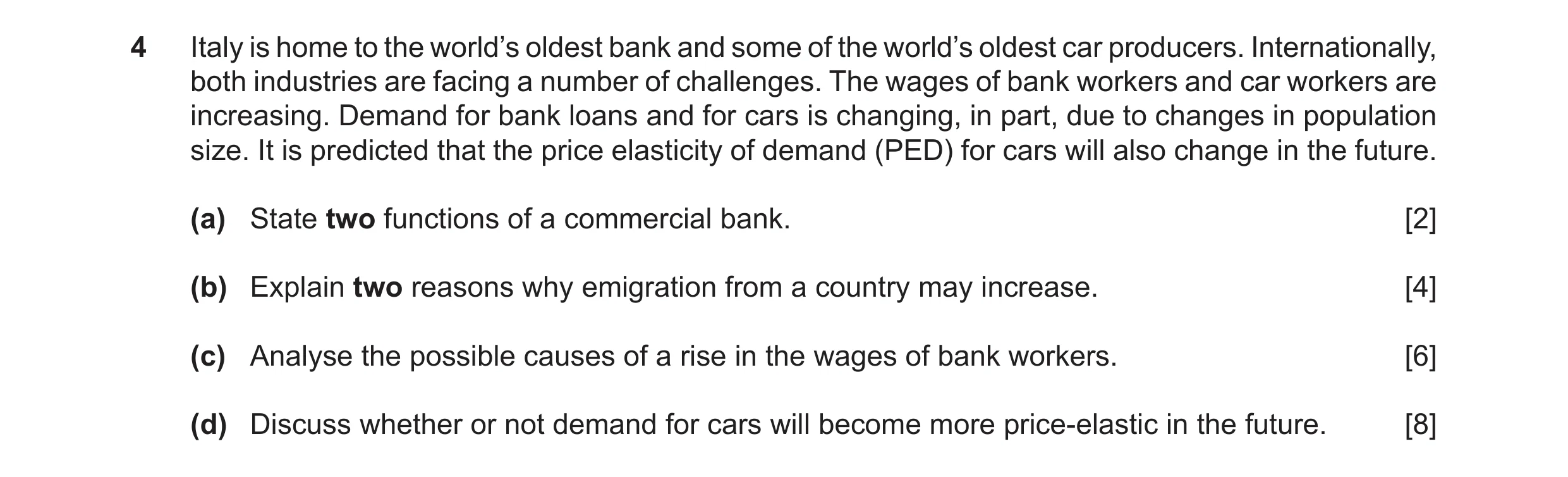
4 Italy is home to the world’s oldest bank and some of the world’s oldest car producers. Internationally, both industries are facing a number of challenges. The wages of bank workers and car workers are increasing. Demand for bank loans and for cars is changing, in part, due to changes in population size. It is predicted that the price elasticity of demand (PED) for cars will also change in the future. (a) State two functions of a commercial bank. [2] (b) Explain two reasons why emigration from a country may increase. [4] (c) Analyse the possible causes of a rise in the wages of bank workers. [6] (d) Discuss whether or not demand for cars will become more price-elastic in the future. [8]
20 marks
Mark scheme: 4(a) State two functions of a commercial bank. Two from: • lending • accepting deposits • allowing customers to make payments • looking after valuables • giving financial advice • providing insurance • exchanging foreign currency 2 Internet banking alone is too vague. 4(b) Explain two reasons why emigration from a country may increase. Logical explanation which might include: Rise in unemployment (1) people move abroad in search of jobs (1). Fall in income (1) seek higher wages abroad (1). Lower living standards (1) e.g. healthcare may be better abroad / less pollution (1). Relaxation on immigration controls (1) making it easier to move abroad (1). Greater social unrest / outbreak of war (1) seek greater security (1). High inflation at home (1) seek lower cost of living (1). 4 One mark for each of two reasons identified and one mark for each of two explanations. Reward answers that give an argument from the opposite perspective but do not double award. Accept ‘static approach’ e.g. unemployment. Question Answer Marks Guidance 4(c) Analyse the possible causes of a rise in the wages of bank workers. Coherent analysis which might include: Demand for bank workers may increase (1) due to higher demand for banking / this may result from more people opening bank accounts/using the services of banks (1) may also result from a rise in the productivity of workers (1) more banks competing for the services of bank workers / more competition for workers (1) higher wages paid to retain bank workers (1). Supply of bank workers may fall (1) qualifications may have been increased (1) skills may have increased / may need to be more skilled as working with more advanced technology (1). Bank workers may use trade union power (1) collective bargaining and/or industrial action (1). Banks may have earned large profits (1) may have rewarded workers with bonuses (1) bonuses / high pay may be used to motivate workers (1). A higher national minimum wage (1) forcing banks to pay some of their staff more (1). Bank workers may work longer hours / may work overtime (1). Bank workers may be more experienced (1) more productive / more skilled (1). Inflation / higher income tax (1) purchasing power will fall unless wages increased (1). 6 Question Answer Marks Guidance 4(d) Discuss whether or not demand for cars will become more price-elastic in the future. In assessing each answer, use the table opposite. Why it might: • may be closer substitutes. Price of public transport and /or quality of public transport may fall making them closer substitutes • may take up a larger proportion of income. Incomes may fall • price may rise. Demand becomes more price elastic as price rises • the number of firms producing certain types of cars may increase • time will give consumers more opportunity to search out lower prices. Why it might not: • may become more of a necessity. People may work further from where they live • may become easier to postpone purchase. If cars last longer, consumers may be able to delay buying replacements • people may have become used to driving – habit forming. May be reluctant not to own and drive a car • price of complements may rise, so that even if price of cars fall, people may not buy more cars. 8 Level Descriptors Mark 3 A reasoned discussion which accurately examines both sides of the economic argument, making use of economic information and clear and logical analysis to evaluate economic issues and situations. One side of the argument may have more depth than the other, but overall both sides of the argument are considered and developed. There is thoughtful evaluation of economic concepts, terminology, information and/or data appropriate to the question. The discussion may also point out the possible uncertainties of alternative decisions and outcomes. 6–8 2 A reasoned discussion which makes use of economic information and clear analysis to evaluate economic issues and situations. The answer may lack some depth and development or may be one-sided. There is relevant use of economic concepts, terminology, information and data appropriate to the question. 3–5 1 There is a simple attempt at using economic definitions and terminology. Some reference may be made to economic theory, with occasional understanding. 1–2 0 A mark of zero should be awarded for no creditable content. 0 Question Answer Marks Guidance 4(d) Example of an L2 answer: Demand for cars may become more price-elastic. People may be more willing to switch to substitutes. If bus transportation reduced market prices, people may use buses rather than buying cars when prices of cars rise. On the other hand, cars may be price-inelastic in the future. They may become more of a necessity if people find buses and trains inconvenient. Cars also show a better standard of living and many jobs require a car which makes having a car a necessity therefore it becomes price-inelastic. Principal Examiner comment: Reasonable on both sides. Reward answers that give an argument from the opposite perspective but do not double award.
This question in 0987/22 Oct/Nov 2020
Q3 · The money supply in Bangladesh increased every year from 2010 to 2018 0987/22 May/June 2021
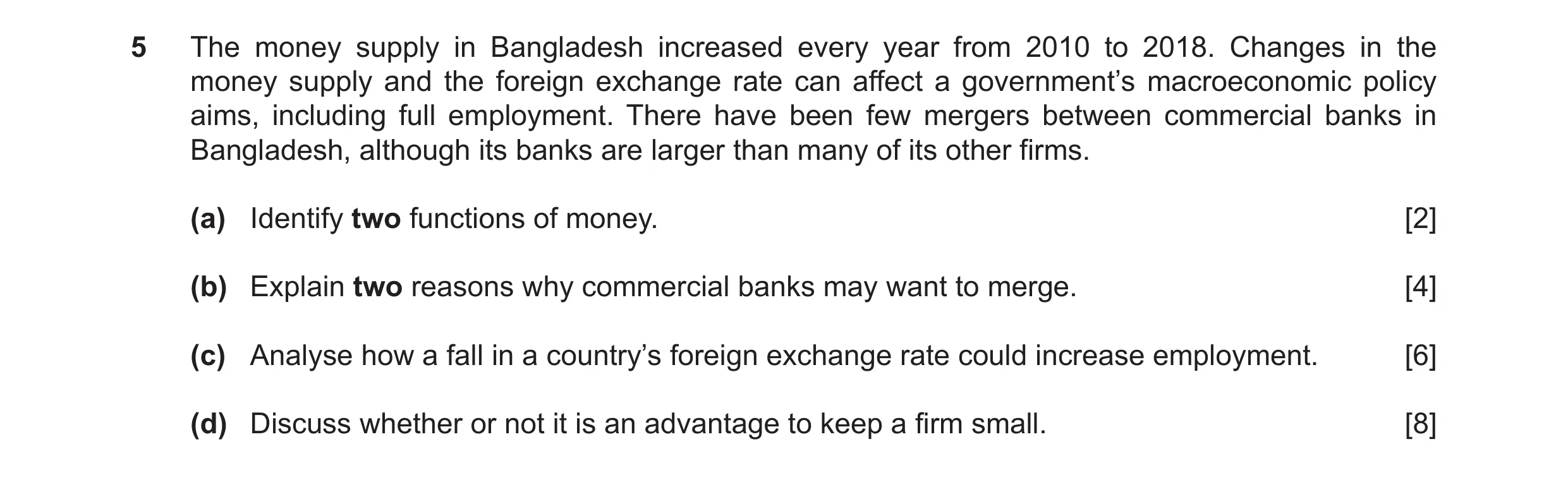
5 The money supply in Bangladesh increased every year from 2010 to 2018. Changes in the money supply and the foreign exchange rate can affect a government’s macroeconomic policy aims, including full employment. There have been few mergers between commercial banks in Bangladesh, although its banks are larger than many of its other firms. (a) Identify two functions of money. [2] (b) Explain two reasons why commercial banks may want to merge. [4] (c) Analyse how a fall in a country’s foreign exchange rate could increase employment. [6] (d) Discuss whether or not it is an advantage to keep a firm small. [8]
20 marks
Mark scheme: 5(a) Identify two functions of money. Two from: Medium of exchange, store of value, standard of deferred payments, unit of account / measure of value. 2 Note: a description of the function gets the mark e.g. money can be used to buy and sell products, may be used to trade. Nothing for characteristics of money, 5(b) Explain two reasons why commercial banks may want to merge. Logical explanation which might include: Greater market power/share (1) eliminating a competitor / providing a greater range of services (1). More opportunity to take advantage of economies of scale (1) lower costs of production / higher profit / example e.g. share ATMs (1). May enable the merged bank to operate in more than one country / become a multinational company (1) access to new market (1). Become better known (1) large banks may be more likely to have a brand image (1). May enable rationalisation (1) eliminate duplication / rase efficiency (1). Survival (1) may have been loss making / at risk of going out of business (1). 4 One mark each for each of two reasons identified and one mark each for each of two explanations. Nothing for increase revenue. Question Answer Marks Guidance 5(c) Analyse how a fall in a country’s foreign exchange rate could increase employment. Coherent analysis which might include: A fall in a country’s foreign exchange rate will lower the price of exports (1) raise the price of imports (1) make domestically produced products more price competitive (1) reduce demand for imports (1) increase demand for exports (1) increase total demand (1) raise firms’ revenue and/or profits (1) encourage firms to increase output (1) take on more workers (1). 6 Question Answer Marks Guidance 5(d) Discuss whether or not it is an advantage to keep a firm small. In assessing each answer, use the table opposite. Why it might: • flexible, less people to consult, more in touch with consumers • may be able to provide more personal attention • may receive government subsidies • may be able to concentrate on a niche market • may have good labour relations • may avoid diseconomies of scale Why it might not: • may not be able to take advantage of economies of scale • may be driven out of business by larger competitors • may be difficult to raise finance • risk of being taken over by a larger firm • may have difficulty recruiting highly skilled workers • may not have the resources to survive a fall in demand 8 Accept an answer based on the advantages that large firms have over small firms. Level Description Marks 3 A reasoned discussion which accurately examines both sides of the economic argument, making use of economic information and clear and logical analysis to evaluate economic issues and situations. One side of the argument may have more depth than the other, but overall both sides of the argument are considered and developed. There is thoughtful evaluation of economic concepts, terminology, information and/or data appropriate to the question. The discussion may also point out the possible uncertainties of alternative decisions and outcomes. 6–8 2 A reasoned discussion which makes use of economic information and clear analysis to evaluate economic issues and situations. The answer may lack some depth and development may be one-sided. There is relevant use of economic concepts, terminology, information and data appropriate to the question. 3–5 1 There is a simple attempt at using economic definitions and terminology. Some reference may be made to economic theory, with occasional understanding. 1–2 0 A mark of zero should be awarded for no creditable content. 0
This question in 0987/22 May/June 2021
Q4 · There was a significant increase in the money supply in Angola in 2019 0987/22 May/June 2022
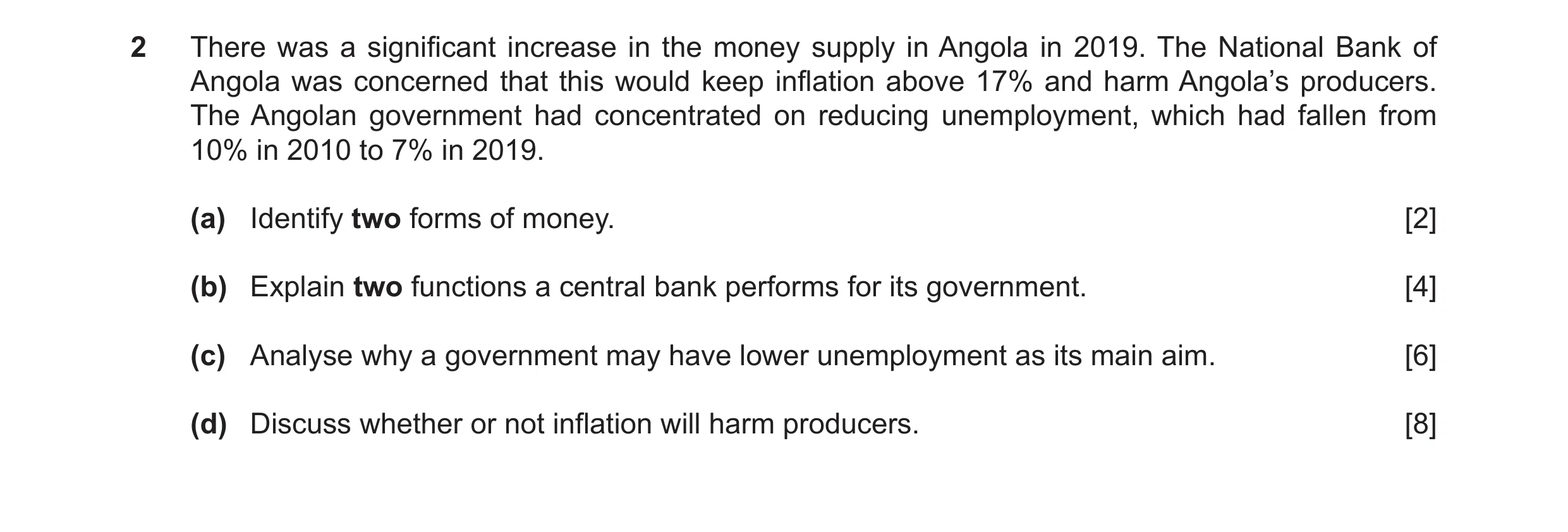
2 There was a significant increase in the money supply in Angola in 2019. The National Bank of Angola was concerned that this would keep inflation above 17% and harm Angola’s producers. The Angolan government had concentrated on reducing unemployment, which had fallen from 10% in 2010 to 7% in 2019. (a) Identify two forms of money. [2] (b) Explain two functions a central bank performs for its government. [4] (c) Analyse why a government may have lower unemployment as its main aim. [6] (d) Discuss whether or not inflation will harm producers. [8]
20 marks
Mark scheme: 2(a) Identify two forms of money. Two from: coins (1) bank notes / paper money (1) bank deposits / accounts (1) digital money (1). 2 Do not accept credit cards, debit cards or cheques. If more than two forms are given, consider the first three. Accept cash instead of coins and/or bank notes/paper money for 1 mark. Also accept commodity money, fiat money/legal tender and fiduciary money. Reward but do not expect identification of reserves at the central bank. Also accept examples of items that have been used as money e.g., salt, gold. Accept a currency as alternative to either coins or paper money. 2(b) Explain two functions a central bank performs for its government. Logical explanation which might include: The central bank acts as a banker for the government (1) it accepts tax payments to the government / provides facilities for the government to make payments / manages the national debt / lends to the government (1). It operates the government’s monetary policy (1) e.g. changing interest rates / to influence inflation (1). It holds reserves of foreign currency (1) to influence the foreign exchange rate (1). It manages the government’s debt (1) issuing government securities / paying interest on government securities (1). It issues bank notes (1) influencing the money supply (1). It may regulate commercial banks / banking system (1) to ensure they act responsibly (1). It acts as a lender of last resort (1) lending to commercial banks / to prevent banks going out of business / a financial collapse (1). 4 One mark for each of two functions identified and one mark for each explanation. Question Answer Marks Guidance 2(c) Analyse why a government may have lower unemployment as its main aim. Coherent analysis which might include: Unemployment may be at a high level (1) unemployment is an inefficient use of resources / waste of resources (1) not working at full capacity (1). Lower unemployment would increase output / economic growth (1) raise incomes / GDP per head (1) increase living standards (1) reduce poverty / more able to buy basic necessities (1) may reduce the crime rate (1) may increase exports (1). Lower unemployment will increase total demand / increase consumer spending / increase spending (1) increase tax revenue (1) lower government spending on unemployment benefits (1) increase the government’s ability to spend on (e.g. education) / reduce budget deficit / government spending on unemployment benefits involves an opportunity cost (1). Lower unemployment may reduce the chances of workers losing skills (1) being in work keeps workers up to date with e.g. advances in technology (1). 6 Accept an answer from the viewpoint of why unemployment may be harmful e.g., a government may want lower unemployment as unemployment reduces economic growth. Question Answer Marks Guidance 2(d) Discuss whether or not inflation will harm producers. In assessing each answer, use the table opposite. Why it might: may increase costs of production – cost-push inflation – reducing profit may reduce international competitiveness may cause menu costs may cause shoe leather costs may make it difficult to plan ahead. Why it might not: may be demand-pull inflation, increasing firms’ revenue may be low and stable may be lower than other countries’ inflation rates, increasing price competitiveness may enable them to reduce real wages may increase tax revenue, some of which may be spent on e.g. subsidies cost of debt may fall / may be cheaper to borrow (in real terms) some producers may be making products with inelastic demand. 8 Level Description Marks 3 A reasoned discussion which accurately examines both sides of the economic argument, making use of economic information and clear and logical analysis to evaluate economic issues and situations. One side of the argument may have more depth than the other, but overall, both sides of the argument are considered and developed. There is thoughtful evaluation of economic concepts, terminology, information and/or data appropriate to the question. The discussion may also point out the possible uncertainties of alternative decisions and outcomes. 68 Question Answer Marks Guidance 2(d) 2 A reasoned discussion which makes use of economic information and clear analysis to evaluate economic issues and situations. The answer may lack some depth and development may be one- sided. There is relevant use of economic concepts, terminology, information and data appropriate to the question. 35 1 There is a simple attempt at using economic definitions and terminology. Some reference may be made to economic theory, with occasional understanding. 12 0 A mark of zero should be awarded for no creditable content. 0
This question in 0987/22 May/June 2022
Q5 · Calculate how many dollars 6400 Nigerian naira would have bought in 2019 0987/22 Oct/Nov 2022
1 (a) Calculate how many dollars 6400 Nigerian naira would have bought in 2019. [1] (b) Identify two ways a bank could increase demand for its services. [2] (c) State why a merger between two commercial banks is a horizontal merger. [2] (d) Explain two reasons why a large US commercial bank may charge a high price for its services. [4] (e) Analyse how an increase in unemployment may affect the Nigerian government’s budget. [4] (f) Analyse the relationship between countries’ average years of schooling and birth rates. [5] (g) Discuss whether or not a subsidy, given to farmers by the Nigerian government, would reduce the deficit on the current account of its balance of payments. [6] (h) Discuss whether or not the US government should impose a minimum price on chocolate. [6]
30 marks
Mark scheme: Question Answer Marks Guidance 1(a) Calculate how many dollars 6400 Nigerian naira would 1 have bought in 2019. 16 (1). 1(b) Identify two ways a bank could increase demand for its 2 services. Open more branches (1) carry out an advertising campaign (1) improve online / mobile banking (1). 1(c) State why a merger between two commercial banks is a 2 horizontal merger. Same stage of production / both in the tertiary (service) sector / same sector (1) same industry / same product / same service (1) can increase market share (1). 1(d) Explain two reasons why a large US commercial bank 4 One mark for each of two reasons identified and one mark may charge a high price for its services. for each explanation. Logical explanation which might include: High spending on opening new branches / advertising campaigns / developing online banking (1) need to get back costs / make a profit / may experience diseconomies of scale (1). May offer high quality services (1) have high demand / customers willing to pay a high price (1). High degree of monopoly / market power / control 32% of market (1) customers may have brand loyalty / reluctant to switch banks / lack of substitutes / inelastic demand / can charge high prices to earn high profits/raise total revenue / be a price maker (1). High incomes in the US (1) many customers have the ability to pay a high price (1). Employ skilled / well educated workers (1) so may pay high wages / may have high costs of production (1). 1(e) Analyse how an increase in unemployment may affect 4 the Nigerian government’s budget. Coherent analysis which might include: Likely to increase a deficit / reduce a surplus / may result in a budget deficit (1). Tax revenue likely to fall / budget likely to fall (1) due to lower incomes (1) less income tax revenue (1) lower profits (1) less corporation tax revenue (1) lower spending (1) less indirect tax revenue (1) government may cut taxes to reduce unemployment (1). Government spending likely to rise (1) more spending on e.g. benefits / subsidies to the poor / law and order/ healthcare (1) may be more spending on measures to reduce unemployment / expansionary fiscal policy (1) may spend less on other areas e.g. education (1). 1(f) Analyse the relationship between countries’ average 5 No marks for just stating what the figures are e.g. Germany years of schooling and birth rates. has 15 years of schooling and a birth rate of approximately 8. US has 14 years of schooling and a birth rate of Coherent analysis which might include: approximately 12. Argentina has 11 years of schooling and Overview a birth rate of approximately 16 etc. Generally, an inverse relationship / the more years of schooling, the lower the birth rate / the fewer years of schooling, the higher the birth rate (1). Supporting evidence Up to 2 marks maximum for two pieces of relevant supporting evidence e.g.: • Germany has the highest years of schooling and lowest birth rate (1) • Chad has lowest years of schooling and highest birth rate (1) • US has more years of schooling than Argentina and so a lower birth rate (1) • the three countries with three highest years of schooling have the three lowest birth rates (1). Exception Nigeria / Eritrea (1) Nigeria has more years of schooling than Eritrea but a higher birth rate (1). Comments More years of schooling is likely to cause people to form partnerships / have children later / focus on careers / increase awareness of contraception/family planning / increase health / reduce size of families (1) increase cost of raising children / having more children may reduce the ability of families to keep their children in education for many years / exception may be result of other influences e.g. differences in fertility rates / differences in social attitudes (1). 1(g) Discuss whether or not a subsidy, given to farmers by 6 Apply this example to all questions with the command the Nigerian government, would reduce the deficit on word DISCUSS the current account of its balance of payments. (1g, 1h, 2d, 3d, 4d and 5d) Award up to 4 marks for logical reasons why it might, which Each point may be credited only once, on either side of an may include: argument, but separate development as to how/why the It should raise supply / increase output (1) equivalent to outcome may differ is rewarded. lower cost (1) lower price (1) increasing international competitiveness (1). Generic example mark There may be more funds available to invest (1) raise quality (1) increase exports / reduce imports (1). Tax revenue may decrease… 1 Award up to 4 marks for logical reasons why it might not, ...because of reason e.g. incomes may be 1 which may include: lower. It may increase inefficiency (1) as firms rely on the subsidy (1) may not pass on the benefit of the subsidy to consumers Tax revenue may increase because incomes 0 (1). may be higher i.e. reverse of a previous Nigeria may have a high inflation rate (1) which may offset argument. the cost advantage of the subsidy (1). There may an increase in incomes at home (1) which may Tax revenue may increase because of a 1 increase imports / divert exports to the home market (1). different reason i.e. not the reverse of a There may be a recession abroad / decrease in incomes of previous argument e.g. government spending trading partners (1) which reduces exports (1). on subsidies may stimulate the economy more Lower export prices will not raise export revenue if demand than spending on education. is inelastic (1). The exchange rate may rise (1) increasing export prices / lowering import prices (1). Farmers may import e.g. more machinery (1). There may be adverse weather conditions / disease (1) which reduces quality / quality may remain poor (1). There may be import restrictions / increase in import restrictions imposed by other countries (1). 1(h) Discuss whether or not the US government should 6 A minimum price diagram without explanation can get a impose a minimum price on chocolate. maximum of 2 marks. These marks may be the equivalent of a combination of two of higher price, demand extending, Award up to 4 marks for logical reasons why it should, supply extending or a surplus being created. which may include: It will raise price (1) reduce demand / demand contracts / quantity demand falls / consumption falls. (1) reduce obesity (1). Social cost of eating chocolate may exceed social benefit (1) due to external costs (1) example e.g. cost on health service / may reduce need for government spending on healthcare (1) overconsumption of chocolate (1) move market closer to where social benefit equals social cost (1) increase welfare (1). May raise health of the population / eating chocolate may be unhealthy (1) raise labour productivity (1). There may be information failure (1) some chocolate is a demerit good (1). Award up to 4 marks for logical reasons why it should not, which may include: Poor may not be able to afford chocolate (1) regressive measure (1). Not everyone overweight / some may consume chocolate in quantities that are not harmful (1) may cause demand to switch to other high sugar products / discriminate against other high sugar products (1). It will encourage supply to extend (1) a surplus may develop (1). There may be an illegal market in chocolate (1). There may be a cost to the government (1) it may have to pay to monitor that the price is being charged (1) lower tax revenue from chocolate (1) may be an increase in unemployment (1). 1(h) Demand may be inelastic (1) resulting in a relatively small fall in demand / chocolate may be addictive (1). It depends on how high the minimum price is (1) may have no effect if set below the market equilibrium (1).
This question in 0987/22 Oct/Nov 2022
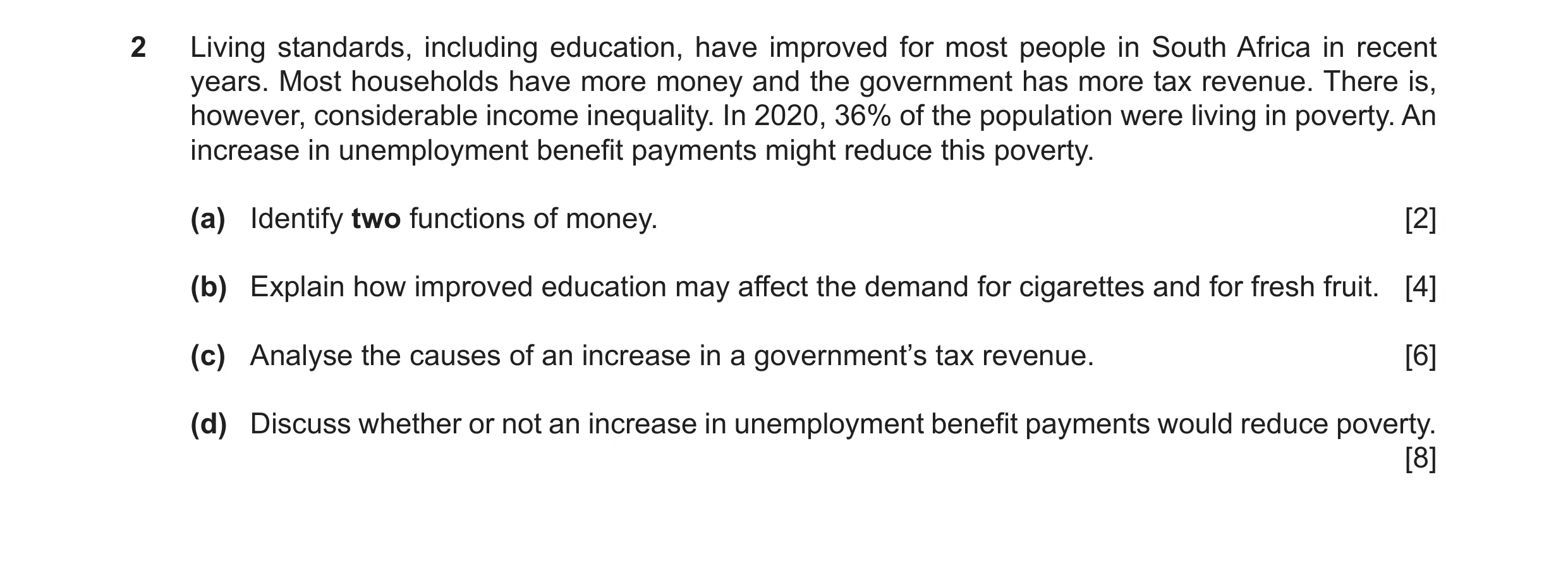
Q6 · Living standards, including education, have improved for most people in South Africa in… 0987/21 May/June 2023
2 Living standards, including education, have improved for most people in South Africa in recent years. Most households have more money and the government has more tax revenue. There is, however, considerable income inequality. In 2020, 36% of the population were living in poverty. An increase in unemployment benefit payments might reduce this poverty. (a) Identify two functions of money. [2] (b) Explain how improved education may affect the demand for cigarettes and for fresh fruit. [4] (c) Analyse the causes of an increase in a government’s tax revenue. [6] (d) Discuss whether or not an increase in unemployment benefit payments would reduce poverty. [8]
20 marks
Mark scheme: 2(a) Identify two functions of money. Two from: Medium of exchange Unit of account / measure of value Store of value Standard of deferred payments 2 Note: a description of the function, without the term, gets a mark e.g. money can be used to buy and sell products, may be used to trade. Nothing for characteristics of money. If more than two functions are given, consider the first three. 2(b) Explain how improved education may affect the demand for cigarettes and for fresh fruit. Logical explanation which might include: It may reduce demand for cigarettes (1) people may be better informed about harmful effects / cigarettes are a demerit good (1). It may increase demand for fresh fruit (1) people may be better informed about beneficial effects / fresh fruit is a merit good / may gain better paid jobs and so able to afford fresh food (1). 4 Only accept demand for cigarettes may increase if linked to higher income (resulting from improved education). One mark for each of two reasons identified and one for each of two explanations. Question Answer Marks Guidance 2(c) Analyse the causes of an increase in a government’s tax revenue. Coherent analysis which might include: Tax revenue is government income / part of government fiscal policy (1) which can be spent on government objectives e.g. education (1) Increase in employment (1) increase in income (1) More convenient (1) easier to pay (1) and collect the tax (1) higher income tax revenue (1) Increase in spending (1) higher indirect tax revenue (1) Increase in profits (1) higher corporation tax (1) Increase in population (1) more people to pay taxes (1) Change in tax rates (1) higher tax rates can increase revenue without a change in income / spending / profits (1) lower tax rates may reduce tax avoidance / evasion (1) increase incentives (1) Greater efficiency in tax collection (1) reduction in corruption / simpler forms (1) Wider tax base (1) more products / more people taxed (1) Increase in imports (1) higher revenue from tariffs (1). 6 Question Answer Marks Guidance 2(d) Discuss whether or not an increase in unemployment benefit payments would reduce poverty. In assessing each answer, use the table opposite. Why it might: raise incomes of those on low incomes may enable them to buy more basic necessities may reduce absolute poverty may increase total demand higher total demand may reduce unemployment Also enable them to seek education / become more employable Why it might not: may be a disincentive to find employment people may become dependent on benefits will not help all those on low incomes e.g. the retired and the sick may not reduce relative poverty some of the unemployed may not claim benefits opportunity cost – government could spend on e.g. education which might be more effective. Size of unemployment benefit may be small and may be less than inflation 8 Level Description Marks 3 A reasoned discussion which accurately examines both sides of the economic argument, making use of economic information and clear and logical analysis to evaluate economic issues and situations. One side of the argument may have more depth than the other, but overall, both sides of the argument are considered and developed. There is thoughtful evaluation of economic concepts, terminology, information and / or data appropriate to the question. The discussion may also point out the possible uncertainties of alternative decisions and outcomes. 6–8 2 A reasoned discussion which makes use of economic information and clear analysis to evaluate economic issues and situations. The answer may lack some depth and development may be one-sided. There is relevant use of economic concepts, terminology, information and data appropriate to the question. 3–5 1 There is a simple attempt at using economic definitions and terminology. Some reference may be made to economic theory, with occasional understanding. 1–2 0 A mark of zero should be awarded for no creditable content. 0
This question in 0987/21 May/June 2023
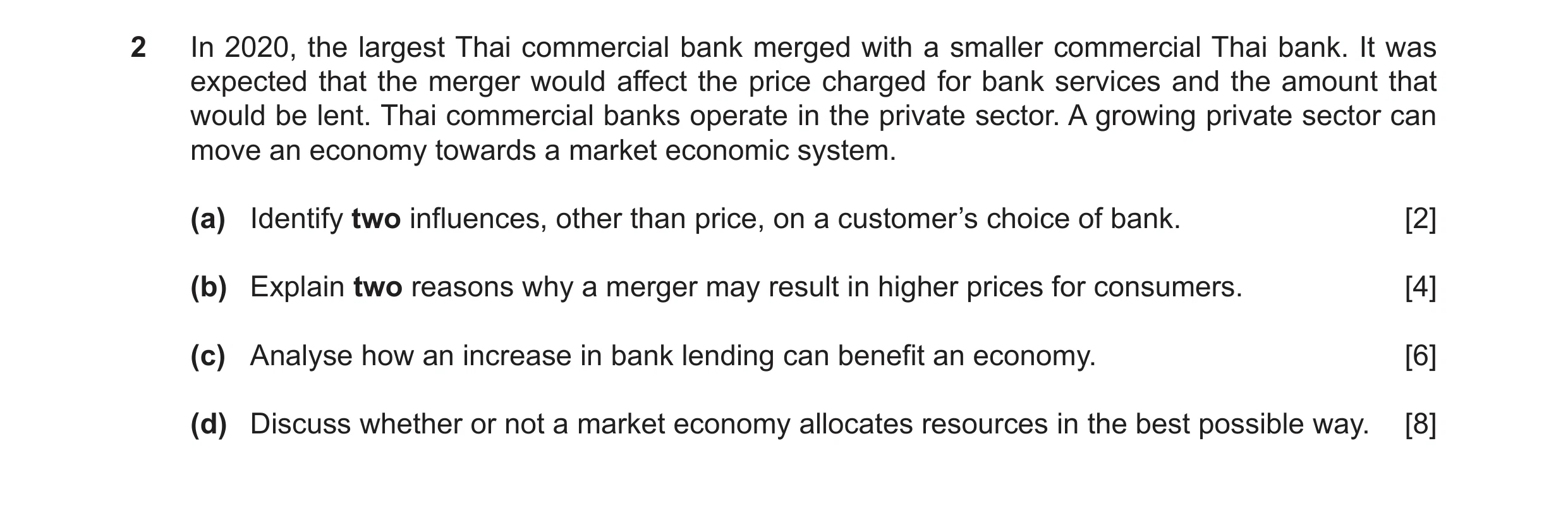
Q7 · In 2020, the largest Thai commercial bank merged with a smaller commercial Thai bank 0987/22 May/June 2023
2 In 2020, the largest Thai commercial bank merged with a smaller commercial Thai bank. It was expected that the merger would affect the price charged for bank services and the amount that would be lent. Thai commercial banks operate in the private sector. A growing private sector can move an economy towards a market economic system. (a) Identify two influences, other than price, on a customer’s choice of bank. [2] (b) Explain two reasons why a merger may result in higher prices for consumers. [4] (c) Analyse how an increase in bank lending can benefit an economy. [6] (d) Discuss whether or not a market economy allocates resources in the best possible way. [8]
20 marks
Mark scheme: 2(a) Identify two influences, other than price, on a customer’s choice of bank. Two from: services provided amount willing to lend size of bank online facilities location interest paid or charged where family banks advertising green investments community involvement reputation confidence in the bank / reliability / safety relationship with staff whether foreign currency can be exchanged 2 If more than two influences given, consider the first three. Not accepting brand loyalty. Accept whether the bank offers Islamic banking. Also accept interest on its own. 2(b) Explain two reasons why a merger may result in higher prices for consumers. Logical explanation which might include: More market power / less competition / monopoly power / may become a monopoly (1) can raise price as consumers will not be able to switch to other firms / demand may become more inelastic / can control price / become a price maker (1). May experience diseconomies of scale / example of a diseconomy of scale that may be experienced (1) raise prices due to higher (average) costs (1). Carrying out the merger may be expensive (1) price raised to cover the cost of e.g. retraining staff / making some staff redundant (1). 4 One mark each for each of two reasons identified and one mark each for each of two explanations. If more than two reasons given, consider the first three. Can accept higher cost if linked to diseconomies of scale or carrying out the merger. Not accepting the idea of higher costs because the firm will be larger (idea of higher total costs). Question Answer Marks Guidance 2(c) Analyse how an increase in bank lending can benefit an economy. Coherent analysis which might include: It could increase consumer expenditure (1) increase total demand (1) raise employment /reduce unemployment (1) reduce deflation (1). It could increase investment / increase spending on capital goods (1) benefit from advances in technology / innovation / better quality capital goods (1) increase productivity (1) raise the quality of products (1) lower price (1) increase exports (1) lower imports (1) improve the current account balance (1) cause economic growth / increase GDP / increase output / encourage firms to expand / new firms to set up (1). May enable the people to improve skills / to set up small business / buy basic necessities / reduce poverty (1). Lend to firms in financial difficulties (1) stop them going out of business (1). 6 Question Answer Marks Guidance 2(d) Discuss whether or not a market economy allocates resources in the best possible way. In assessing each answer, use the table opposite. Why it might: price moves to reflect changes in demand and supply resources move from products falling in demand towards those rising in demand profit incentive for firms to produce what consumers demand / consumer sovereignty competition results in efficiency which drives down costs and prices changes in wages move labour to those jobs most in demand Why it might not: merit goods are under-consumed so not enough resources are devoted to their production demerit goods are overconsumed so too many resources are devoted to their production no resources are devoted to public goods as there is no incentive to produce them there may be factor immobility monopolies may restrict output external costs and benefits will not be taken into account when deciding on the allocation of resources. 8 Level Description Marks 3 A reasoned discussion which accurately examines both sides of the economic argument, making use of economic information and clear and logical analysis to evaluate economic issues and situations. One side of the argument may have more depth than the other, but overall, both sides of the argument are considered and developed. There is thoughtful evaluation of economic concepts, terminology, information and/or data appropriate to the question. The discussion may also point out the possible uncertainties of alternative decisions and outcomes. 6–8 2 A reasoned discussion which makes use of economic information and clear analysis to evaluate economic issues and situations. The answer may lack some depth and development may be one-sided. There is relevant use of economic concepts, terminology, information and data appropriate to the question. 3–5 1 There is a simple attempt at using economic definitions and terminology. Some reference may be made to economic theory, with occasional understanding. 1–2 0 A mark of zero should be awarded for no creditable content. 0
This question in 0987/22 May/June 2023
Q8 · Calculate the price elasticity of demand for coffee 0987/21 May/June 2024
1 (a) Calculate the price elasticity of demand for coffee. [1] (b) Identify two rewards to factors of production in Nicaragua. [2] (c) Explain one way in which unemployment is measured. [2] (d) Explain two functions of money in Nicaragua. [4] (e) Analyse the relationship between the percentage of the labour force employed in agriculture and GDP per head. [4] (f) Analyse, using a demand and supply diagram, how a drought could affect the market for coffee. [5] (g) Discuss whether or not small firms benefit Nicaraguan consumers. [6] (h) Discuss whether or not Nicaragua should devote more of its resources to coffee production. [6]
30 marks
Mark scheme: 1(a) Calculate the price elasticity of demand for coffee. () 0.3 (1) 1(b) Identify two rewards to factors of production in Nicaragua. Wages (1) profits (1) 2 Only accept these answers if within the first three listed. 1(c) Explain one way in which unemployment is measured. Claimant count (1) based on workers claiming unemployment benefits (1). OR Labour force survey (1) asking people if they are out of work and looking for employment (1). 2 One mark for a way identified and one mark for an explanation. 1(d) Explain two functions of money in Nicaragua. Medium of exchange (1) used to buy and sell products / used to trade (1). Store of value (1) used to save / keeps its value over a period of time (1). 4 One mark each for each of two functions identified and one mark for each of two explanations. Only accept these answers if within the first three listed. Question Answer Mark Guidance 1(e) Analyse the relationship between the percentage of the labour force employed in agriculture and GDP per head. Coherent analysis which might include: Relationship: Inverse or negative relationship / move in opposite directions (1). Countries with a high percentage of their labour force employed in agriculture tend to have a low GDP per head (1). Supporting evidence: The four countries with the lowest % of the labour force employed in agriculture had the highest GDP per head (1). Specific reference to one or more countries e.g. Bahamas had the lowest % employed in agriculture and the highest GDP per head (1). Use of GDP per head data to show comparison between country with high employment in agriculture and one with low percentage employment in agriculture (1). Analysis of expected relationship: Wages may be low in agriculture (1) wages / value added tends to be higher in the secondary and / or tertiary sector (1). Exception: Nicaragua / Dominica (1) Nicaragua has the second highest % of labour force employed in agriculture but the lowest GDP per head / Dominica had the highest % of labour force employed in agriculture but the second to lowest GDP (1). Analysis of exception: Explanation of another influence on GDP per head (1). 4 Responses do not have to be in the format suggested but they should address the expected/normal relationship, offer supporting evidence of that, highlight any exceptions to that, and analyse the overall data. Note the four are: Bahamas Barbados Costa Rica Saint Lucia Question Answer Mark Guidance 1(f) Analyse, using a demand and supply diagram, how a drought could affect the market for coffee. Coherent analysis which might include: D&S diagram: Axes correctly labelled – price and quantity or p and q (1). Original demand and supply curves correctly labelled (1). New supply curve shifted to the left (1). Equilibriums – shown by lines P1 and Q1 and P2 and Q2 or equilibrium points marked as E1 and E2 (1). Written analysis: A drought will lead to a shortage / will increase costs of production (1). OR The lower supply will push up price / reduce quantity (traded) (1). 5 Question Answer Mark Guidance 1(g) Discuss whether or not small firms benefit Nicaraguan consumers. Award up to 4 marks for logical reasons why they might, which may include: know customers’ requirements (1) provide a personal service / see them often (1) may be flexible (1) may be many small firms / competitive markets (1) prices may be low (1) quality may be high (1) may offer wider choice collectively than a few large firms (1) may provide products for which there is only a low demand (1) niche market (1) makes goods more accessible in rural areas (1). Award up to 4 marks for logical reasons why it might not, which may include: may not be able to take advantage of economies of scale (1) examples (1) higher average cost of production (1) higher price (1) small firms may have lower profits (1) may limit investment / funds available (1) fail to raise quality (1) may limit choice (1) individual small firms may have a limited range of products (1) cannot provide all that consumers may want (1). 6 Apply this example to all questions with the command word DISCUSS 1(g), 1(h), 2(d), 3(d), 4(d) and 5(d) Each point may be credited only once, on either side of an argument, but separate development as to how/why the outcome may differ is rewarded. Generic example Mark Tax revenue may decrease… 1 ...because of reason e.g. incomes may be lower. 1 Tax revenue may increase because incomes may be higher i.e. reverse of a previous argument. 0 Tax revenue may increase because of a different reason i.e. not the reverse of a previous argument e.g. government spending on subsidies may stimulate the economy more than spending on education. 1 Only reward reference to quality or prices once. 1(h) Discuss whether or not Nicaragua should devote more of its resources to coffee production. Award up to 4 marks for logical reasons why it should, which may include: global demand for coffee is increasing (1) demand for coffee is price inelastic (1) revenue / profits may increase (1) more tax revenue for government (1) firms grow in size (1) greater specialisation / economies of scale may reduce average costs (1) raise quality (1) increase profits (1) more competitive (1) exports may increase (1) improve the current account of its balance of payments (1) lead to economic growth/higher standard of living (1) may lead to more job opportunities (1) less poverty / less government payments to unemployed (1) already twelfth biggest world producer (1) growth will give them more monopoly power (1) more power to raise price of coffee (1). Award up to 4 marks for logical reasons why it should not, which may include: other countries produce coffee (1) these may be more competitive (1) output may be affected by changes in weather (1) natural disasters (1) overproduction can exhaust land (1) leading to lower yields in future (1) opportunity cost (1) resources could be used to produce other products (1) example (1) coffee workers only receive low pay (1) world market for coffee may fall / demand is unpredictable (1) resulting in surplus capacity / wasted resources (1) become more dependent on other countries for imports of other (agricultural) products (1) firms may suffer from diseconomies of scale (1) reduce profits (1). 6 Do not expect, but reward reference to absolute or comparative advantage.
This question in 0987/21 May/June 2024
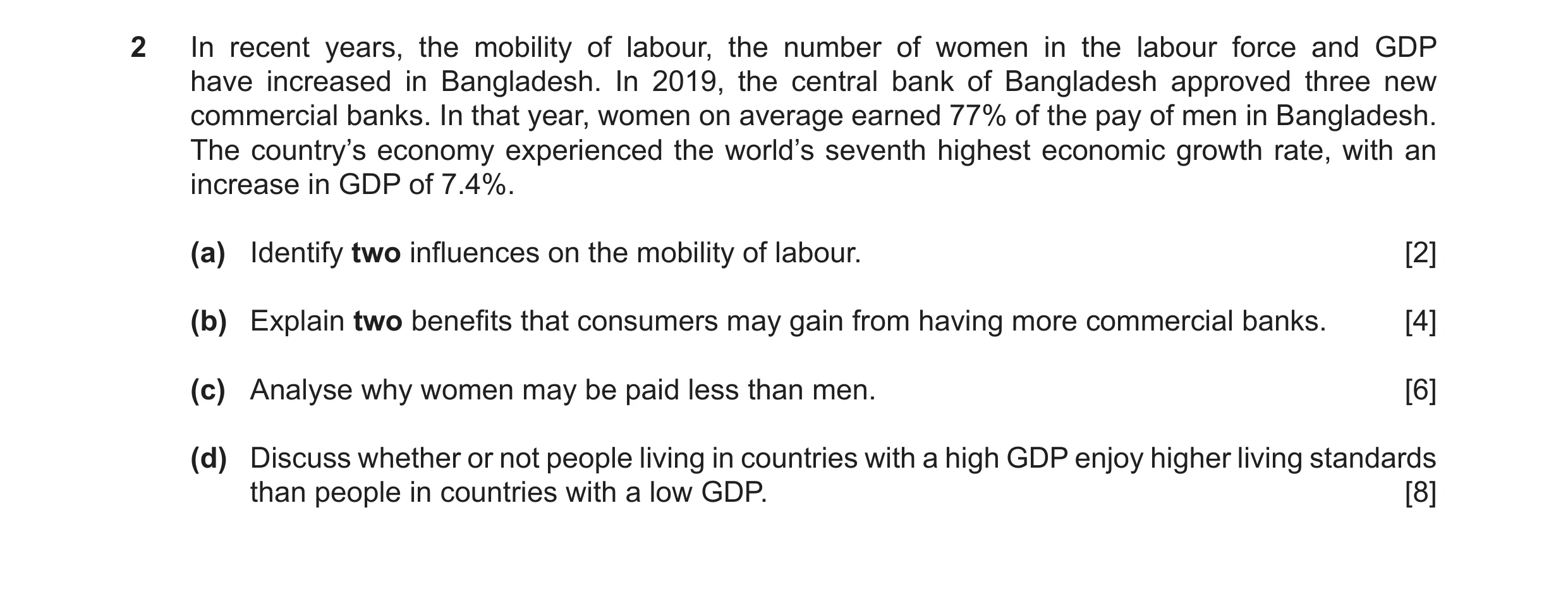
Q9 · In recent years, the mobility of labour, the number of women in the labour force and GDP… 0987/21 May/June 2024
2 In recent years, the mobility of labour, the number of women in the labour force and GDP have increased in Bangladesh. In 2019, the central bank of Bangladesh approved three new commercial banks. In that year, women on average earned 77% of the pay of men in Bangladesh. The country’s economy experienced the world’s seventh highest economic growth rate, with an increase in GDP of 7.4%. (a) Identify two influences on the mobility of labour. [2] (b) Explain two benefits that consumers may gain from having more commercial banks. [4] (c) Analyse why women may be paid less than men. [6] (d) Discuss whether or not people living in countries with a high GDP enjoy higher living standards than people in countries with a low GDP. [8]
20 marks
Mark scheme: 2(a) Identify two influences on the mobility of labour. Two from: age skills / training qualifications / level of education price / availability of housing cost of living /level of income family ties information on vacancies disabilities / access quality / cost of transport distance to place of work discrimination 2 Only accept these answers if within the first three influences mentioned. 2(b) Explain two benefits that consumers may gain from having more commercial banks. Logical explanation which might include: More choice / competition (1) greater range of services / better quality of services / lower bank charges (1). Lower interest rate charged on loans / higher interest paid on savings (1) due to higher competition (1). May be easier to obtain a loan (1) which may increase the products consumes can buy (1). May be more convenient (1) closer to home / less time travelling / more likely to be able to speak to a person (1). 4 One mark each for each of two benefits identified and one mark for each of two explanations. Question Answer Mark Guidance 2(c) Analyse why women may be paid less than men. Coherent analysis which might include: Women may be less skilled (1) have fewer qualifications (1) and so be less productive (1) if they have received less education / training (1) may have less bargaining strength than men (1). Fewer women may be in promoted posts (1) if they have taken time off to raise children / maternity leave / may have less experience (1). Women may be concentrated in low paying occupations / industries (1) example e.g. clothes manufacture (1) may only want part-time jobs (1) because of family commitments (1). Discrimination (1) some employers may underestimate / undervalue the productivity of women (1) there may be no law or an ineffective law against discrimination (1) example e.g. tv presenters / football (1). Lower demand / higher supply in some occupations (1) due to lower revenue / value of product (1). 6 Allow the counter argument on why men may be paid more than women. Question Answer Mark Guidance 2(d) Discuss whether or not people living in countries with a high GDP enjoy higher living standards than people in countries with a low GDP. In assessing each answer, use the table opposite. Why they might: may be able to afford better standard of housing may be able to afford better nutrition and healthcare which can increase life expectancy higher incomes enable more and greater quality of products to be purchased may be able to afford better education which may enable them to gain more interesting jobs with better working conditions. Why they might not: high GDP does not necessarily mean that GDP per head is high and so incomes could be low income may be unevenly distributed, and some people may be living in poverty may have a large informal sector so GDP under-records income countries with higher GDP may also have higher price levels people may work long hours and so enjoy little leisure and may be stressed there may be pollution and traffic congestion people’s wants for goods and services may grow at a faster rate than their income – the more people have, the more they may want. 8 See Guidance table at the end of the mark scheme.
This question in 0987/21 May/June 2024
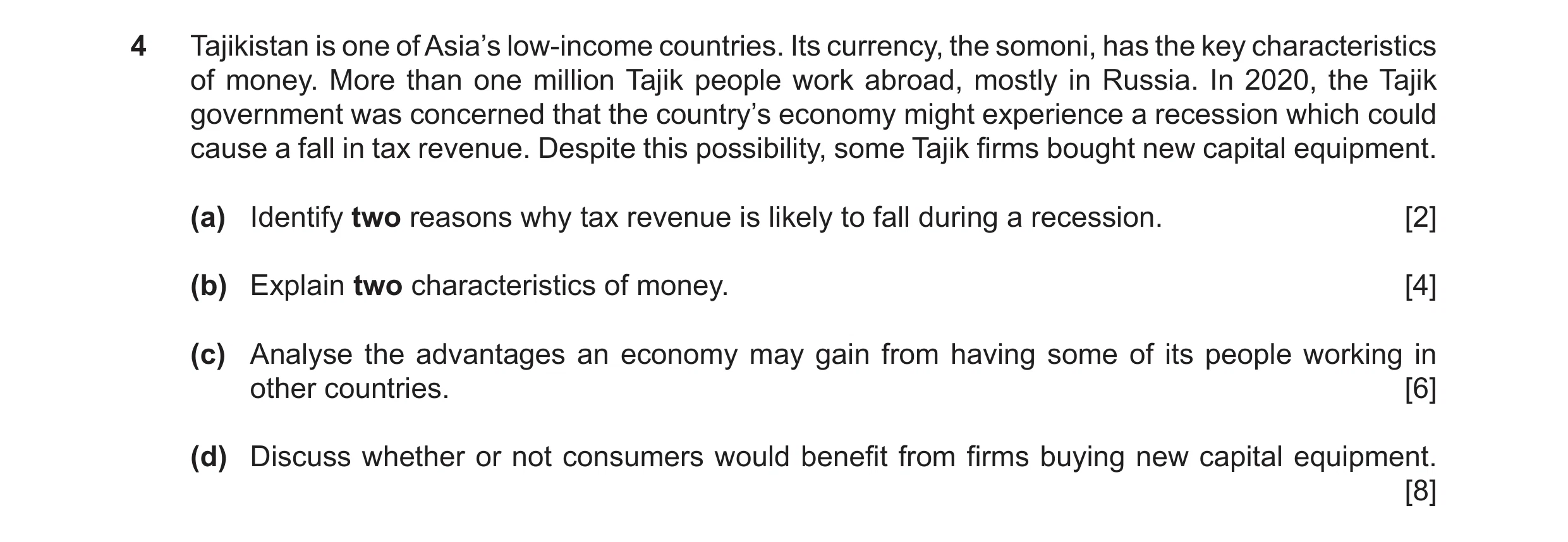
Q10 · Tajikistan is one of Asia’s low-income countries 0987/22 May/June 2024
4 Tajikistan is one of Asia’s low-income countries. Its currency, the somoni, has the key characteristics of money. More than one million Tajik people work abroad, mostly in Russia. In 2020, the Tajik government was concerned that the country’s economy might experience a recession which could cause a fall in tax revenue. Despite this possibility, some Tajik firms bought new capital equipment. (a) Identify two reasons why tax revenue is likely to fall during a recession. [2] (b) Explain two characteristics of money. [4] (c) Analyse the advantages an economy may gain from having some of its people working in other countries. [6] (d) Discuss whether or not consumers would benefit from firms buying new capital equipment. [8]
20 marks
Mark scheme: 4(a) Identify two reasons why tax revenue is likely to fall during a recession. Two from: lower spending / lower demand lower incomes / lower wages / higher unemployment / lower employment lower profits lower tax rates lower imports fewer tax payers lower output lower revenue 2 If more than 2 reasons are given, consider the first 3. 4(b) Explain two characteristics of money. Logical explanation which might include: Generally acceptable (1) people willing to accept it as a payment / reward / in settlement of a debt (1). Portable (1) easy to carry (1). Recognisable (1) easy to see it is the country’s currency (1). Durable (1) will last some time / can be saved (1). Limited in supply (1) so maintains value (1). Divisible (1) there should be units of different value (1). Homogeneous / uniform (1) people not preferring e.g. one note of a certain value other another note of the same value (1). 4 One mark each for each of two characteristics identified and one mark for each of two explanations. If more than 2 characteristics are given, consider the first 3. Accepting ‘breakable’ for ‘divisible’. Explanation marks e.g. maintain value or accept as a payment can be given without identification up to a maximum of 2 marks. Question Answer Marks Guidance 4(c) Analyse the advantages an economy may gain from having some of its people working in other countries. Coherent analysis which might include: The workers may send money home to (support) their families staying at home (1) reduce poverty / raise living standards (1). Will improve the current account position of the balance of payments / bring in foreign currency (1) secondary income (1). The workers may receive training (1) gain skills (1) ideas / knowledge / awareness of new technology (1) experience (1) higher productivity / efficiency (1) which they can bring back to the country (1) increase quality of output (1). Start their own firms in the country when they return (1) increase output / economic growth / increase GDP (1). May reduce unemployment (1) if lack of jobs at home (1) and so may reduce government spending on unemployment benefits / may reduce government spending on dependents (1). 6 No marks for general benefits of emigration. Question Answer Marks Guidance 4(d) Discuss whether or not consumers would benefit from firms buying new capital equipment. In assessing each answer, use the table opposite. Why they might: may embody new technology more innovation / new products may increase efficiency / lower costs of production may lower prices may reduce mistakes increase quality of output may increase output and so availability. Why they might not: may raise prices in the short run to cover the cost of the purchase may reduce quality / output in the short run as workers get used to the new capital equipment firms may switch from producing consumer to capital goods products may become more standardised. 8 Focus should be on consumers and not workers. Level Description Marks 3 A reasoned discussion which accurately examines both sides of the economic argument, making use of economic information and clear and logical analysis to evaluate economic issues and situations. One side of the argument may have more depth than the other, but overall both sides of the argument are considered and developed. There is thoughtful evaluation of economic concepts, terminology, information and/or data appropriate to the question. The discussion may also point out the possible uncertainties of alternative decisions and outcomes. 6–8 2 A reasoned discussion which makes use of economic information and clear analysis to evaluate economic issues and situations. The answer may lack some depth and development may be one-sided. There is relevant use of economic concepts, terminology, information and data appropriate to the question. 3–5 Question Answer Marks Guidance 4(d) Level Description Marks 1 There is a simple attempt at using economic definitions and terminology. Some reference may be made to economic theory, with occasional understanding. 1–2 0 A mark of zero should be awarded for no creditable content. 0
This question in 0987/22 May/June 2024
Question 11 0987/22 May/June 2025
1 (a) Calculate St. Kitts and Nevis’s government budget deficit in 2022. [1] (b) Identify two examples of the factor of production ‘land’ in St. Kitts and Nevis. [2] (c) Explain how tourism causes external costs in St. Kitts and Nevis. [2] (d) Explain two reasons why a foreign bank may open a branch in St. Kitts and Nevis. [4] (e) Draw a demand and supply diagram to show the effect of an increase in the productivity of onion farmers on the market for onions. [4] (f) Analyse the relationship between healthcare spending as a percentage of GDP and life expectancy. [5] (g) Discuss whether or not an increase in the size of its fishing industry would benefit St. Kitts and Nevis. [6] (h) Discuss whether or not deflation is likely to have harmed St. Kitts and Nevis. [6]
30 marks
Mark scheme: Question Answer Mark Guidance 1(a) Calculate St. Kitts and Nevis’s Government budget 1 Accept 18m. deficit in 2022. ($)18 000 000 / – ($)18 000 000. $18 m / – $18 m (1). 1(b) Identify two examples of the factor of production land in 2 If more than two examples given, consider the first three. St. Kitts and Nevis. Two from: beaches (1), (coral) reefs (1), marine life / fish (1) rainforests (1) and soil (1). 1(c) Explain how tourism causes external costs in St. Kitts 2 One mark for explanation of external costs. and Nevis. One mark for example based on tourism. • Social costs are greater than private costs / social costs include private costs and external costs / harmful effects on third parties / those not directly involved in producing or consuming the product (1). • Example of an external cost caused by tourism in St Kitts and Nevis e.g. pollution / environmental damage / death of wildlife / death of marine life / overcrowding (1). 1(d) Explain two reasons why a foreign bank may open a 4 One mark each for each of two reasons identified and one branch in St. Kitts and Nevis. mark each for each of two explanations. Logical explanation which might include: If more than two reasons given, consider the first three. • High incomes in the country (1) high demand for Most of the explanation points e.g. high profit could be banking services / high demand for loans / may save linked to any of the three identification points except high more / borrowers likely to be able to repay loans / high disposable income should be linked to absence of personal profit / high revenue (1). income tax. • Absence (low) of personal income tax (1) workers would be able to keep all of their income / more disposable Do not give two explanation marks for one identification. income / firms may be able to pay lower wages / increase workers’ motivation (1). Explanation marks here are dependent on the • Relatively high literacy rates (1) awareness of benefits identifications. of having a bank account / saving / skilled workers / high productivity (1). 1(e) Draw a demand and supply diagram to show the effect 4 of an increase in the productivity of onion farmers on the market for onions. D&S diagram: Axes correctly labelled – price and quantity or p and q (1). Original demand and supply curves correctly labelled (1). New supply curve shifted to the right (1). Equilibriums – shown by lines P1 and Q1 and P2 and Q2 or equilibrium points marked as E1 and E2 (1). 1(f) Analyse the relationship between healthcare spending 5 Responses do not have to be in the format suggested but as a percentage of GDP and life expectancy. they should address the expected/normal relationship, offer supporting evidence of that, highlight any exceptions to that, Expected relationship: and analyse the overall data. Direct / positive relationship (1). Generally, the higher healthcare spending, the higher the life expectancy (1). Supporting evidence should involve interpretation, not just description. Supporting evidence: E.g.: Haiti has the second lowest % healthcare spending and the shortest life expectancy (1) Canada spends a higher % on healthcare than Egypt and has a longer life expectancy / Canada spends the highest percentage on health care and has the second highest longest life expectancy / Canada and Sweden spend a high % on healthcare and have long life expectancy (1). Analysis of the supporting information: Higher spending on healthcare would be expected to raise the health of the population / provide better quality healthcare (1) increase awareness of need for healthy living / provide more check-ups / preventative medical care / reduce the death rate (1). Exception: Monaco (1) spends the lowest % on healthcare but has the longest life expectancy (1). Analysis of exception: 1.9% of a very high GDP can mean higher spending than e.g. 12.9% of a lower GDP / Monaco may have a high GDP (1). There are other influences on life expectancy e.g. nutrition / education/housing/war (1). 1(g) Discuss whether or not an increase in the size of its 6 Award one mark in total for higher / lower average costs, fishing industry would benefit St. Kitts and Nevis. one mark for lower / higher fish prices, one mark for higher / lower profits (1). Award up to 4 marks for logical reasons why it might, which may include: Higher / lower profits should be linked to the fishing industry. • may reduce imports of fish (1) reduce risk of supply-side shocks / imports being cut off (1) enable fish to be Apply this example to all questions with the command exported (1) may improve the current account word DISCUSS balance / improve the balance of payments (1) (1(g), 1(h), 2(d), 3(d), 4(d) and 5(d)) • may increase employment / increase job opportunities / reduce unemployment (1) raise incomes Each point may be credited only once, on either side of an (1) increase living standards (1) increase argument, but separate development as to how/why the GDP / increase output / cause economic growth (1) outcome may differ is rewarded. higher tax revenue (1) • may enable greater advantage to be taken of Generic example Mark economies of scale (1) example (1) lower average cost (1) lower fish prices (1) Tax revenue may decrease … 1 • (larger boats) may be more efficient / more productive (1) make the industry more profitable / increase profits ... because of reason e.g. incomes may be 1 from fishing (1). lower. Tax revenue may increase because incomes 0 may be higher i.e. reverse of a previous argument. Tax revenue may increase because of a different 1 reason i.e. not the reverse of a previous argument e.g. government spending on subsidies may stimulate the economy more than spending on education. 1(g) Award up to 4 marks for logical reasons why it might not, which may include: • opportunity cost (1) could use resources in other industries / government can spend more on e.g. education / increase budget deficit (1) • over-fishing (1) deplete fish stocks / lose marine life / deplete resources (1) raise fish prices in the long run (1) • may experience diseconomies of scale (1) example (1) higher average cost (1) reduce profit (1) • may cause external costs / environmental harm (1) may damage coral reefs / cause pollution (1) harm tourism (1) • may be a dangerous occupation (1) may be low-paid (1) low-skilled (1) may experience seasonal unemployment (1) • risk of over specialisation / too great a dependency on the industry (1) may be harmed by a fall in demand for fish / rise in competition from other countries (1). 1(h) Discuss whether or not deflation is likely to have 6 Award one mark for malign (bad) deflation is harmful harmed St. Kitts and Nevis. whereas benign (good) deflation is beneficial. Award up to 4 marks for logical reasons why it might, which Mark for higher employment and mark for higher GDP can may include: only be awarded if come from higher total supply. • may have increased real value of debt (1) may default (1) may have decreased investment (1) ‘save more’ may be credited on either side but only once. • may have resulted in a deflationary spiral (1) may have resulted from lower total demand (1) lower GDP / lower output / reduce economic growth / may cause a recession (1) lower employment / increased unemployment (1) lowered wages / income (1) • may reduce confidence (1) may discourage MNCs (1) • may reduce consumer expenditure / save more / create uncertainty (1) delay buying goods and services (until price is lower) (1). Award up to 4 marks for logical reasons why it might not, which may include: • may have increased purchasing power / real income / with the same income more goods and services can be purchased (1) (some) people may spend / consume more (1) • value of saving may have increased (1) increasing wealth (1) • may be the result of higher total supply (1) due to advances in technology / lower costs of production (1) higher output / economic growth (1) higher employment (1) • may have increased international competitiveness of its products / lower export prices (1) increased exports / export revenue (1) reduced imports / import expenditure (1) improve current account balance (1).
This question in 0987/22 May/June 2025
 1 / 4
1 / 4![Question 5: (a) Calculate how many dollars 6400 Nigerian naira would have bought in 2019. [1] (b) Identify two ways a bank could increase demand for it…](https://img.pastlit.com/crops/a5614d74-144c-4d2f-bdd5-0e16b74f222b/q1.webp)
 2 / 4
2 / 4![Question 8: (a) Calculate the price elasticity of demand for coffee. [1] (b) Identify two rewards to factors of production in Nicaragua. [2] (c) Explai…](https://img.pastlit.com/crops/6a1b772b-dfb5-4804-b6e6-be0a88fe339a/q1.webp)
 3 / 4
3 / 4![Question 11: (a) Calculate St. Kitts and Nevis’s government budget deficit in 2022. [1] (b) Identify two examples of the factor of production ‘land’ in …](https://img.pastlit.com/crops/7f3a3e23-0756-4085-9a60-51f9514dc33e/q1.webp) 4 / 4
4 / 4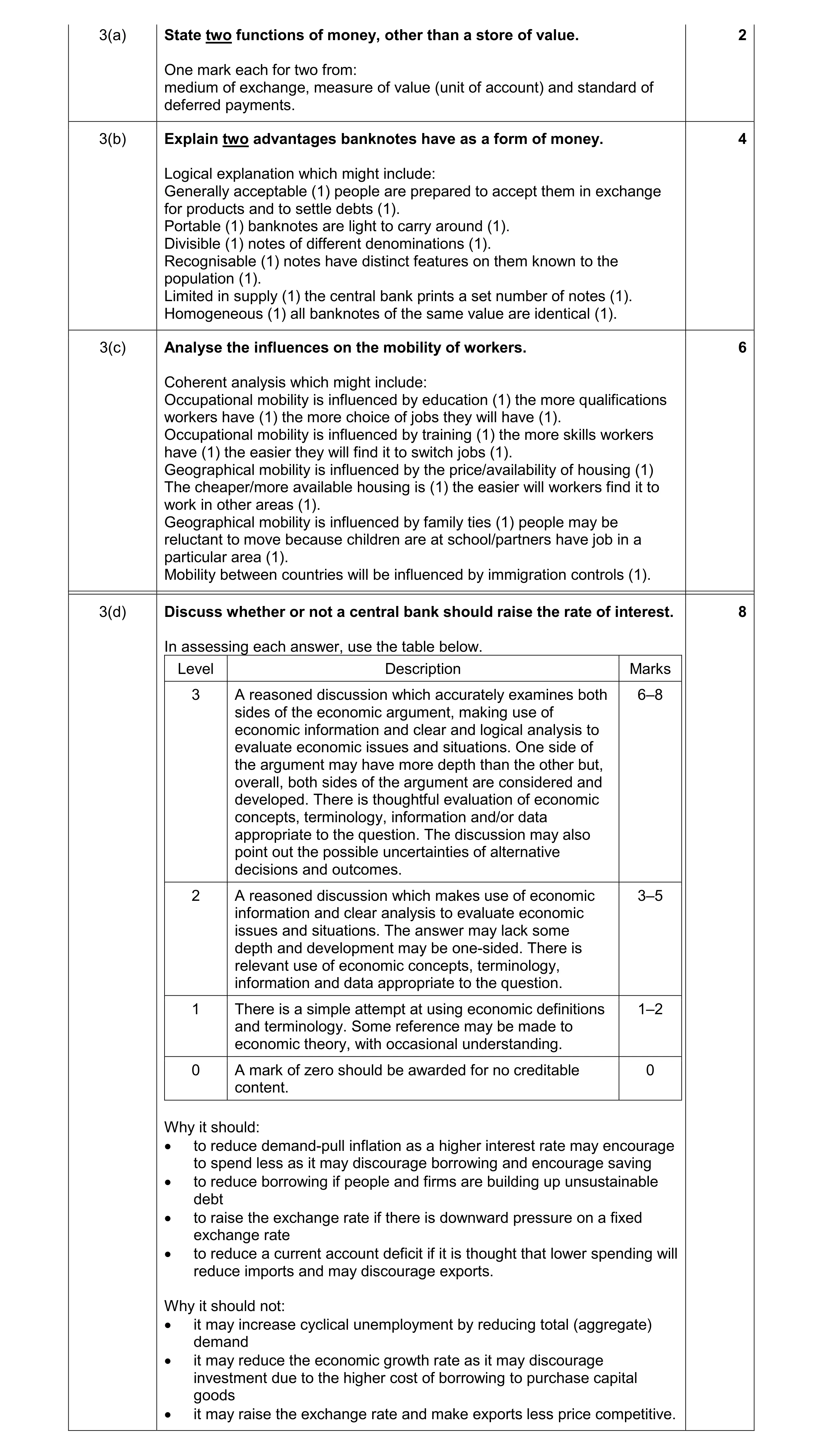 20
20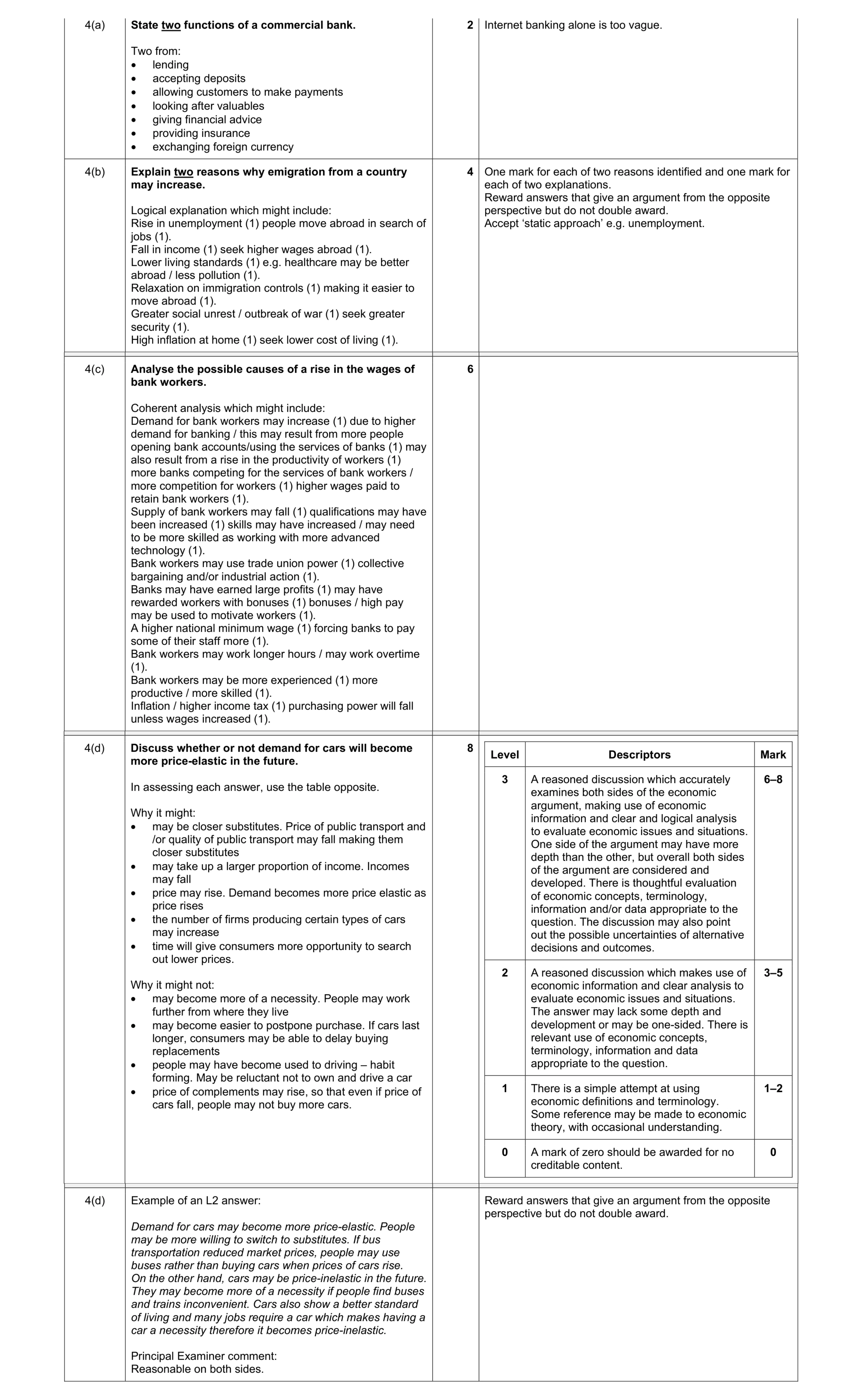 20
20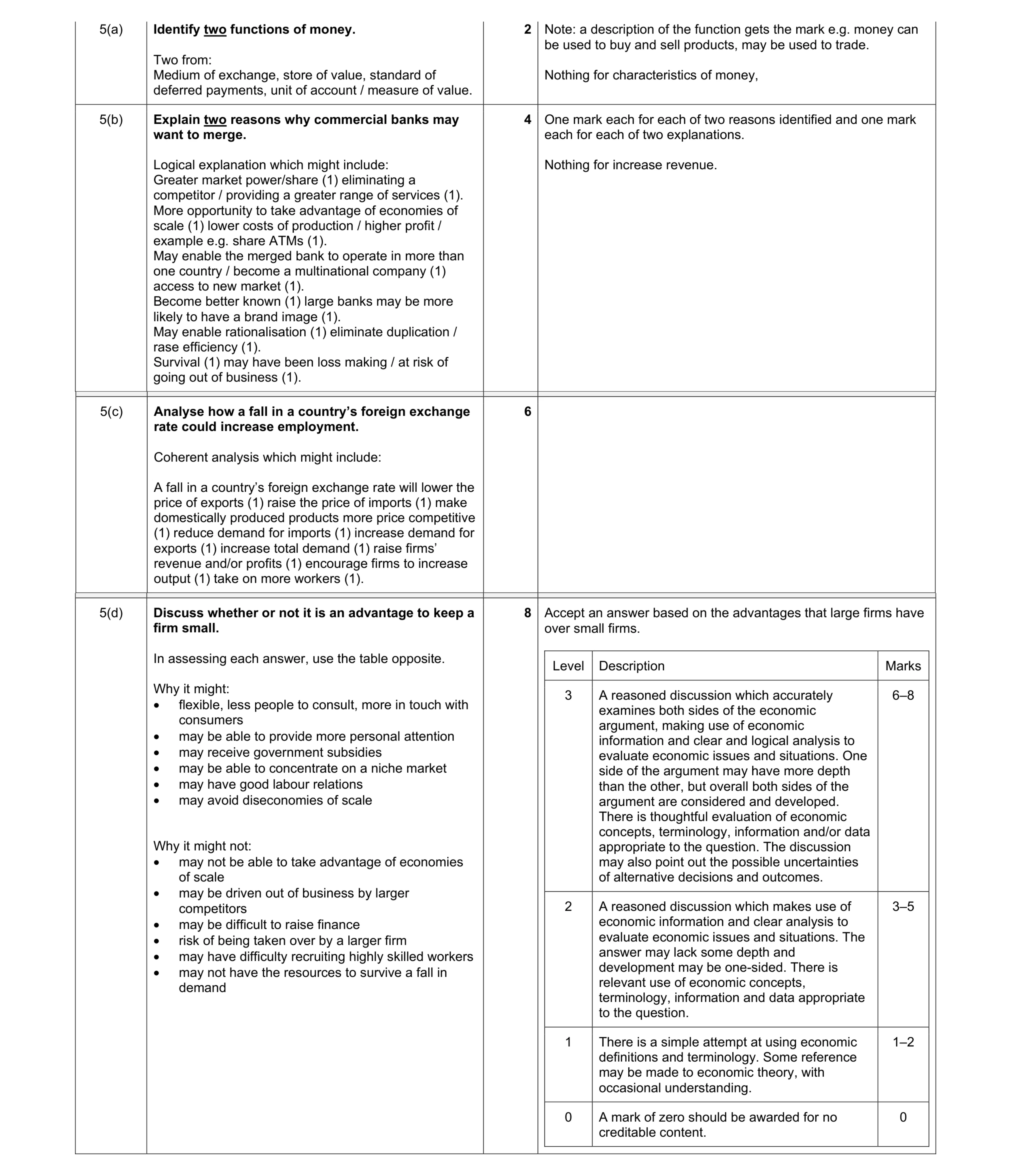 20
20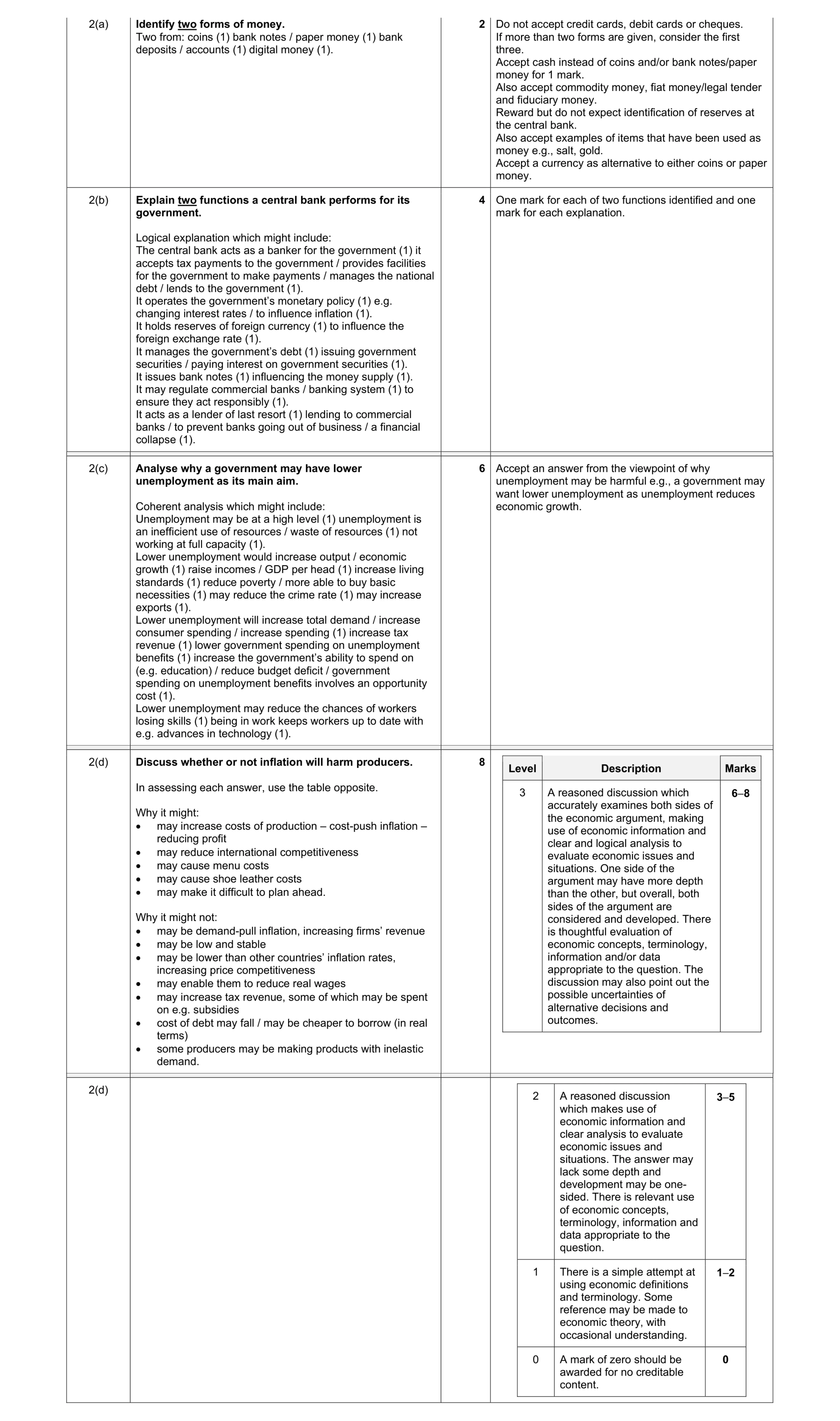 20
20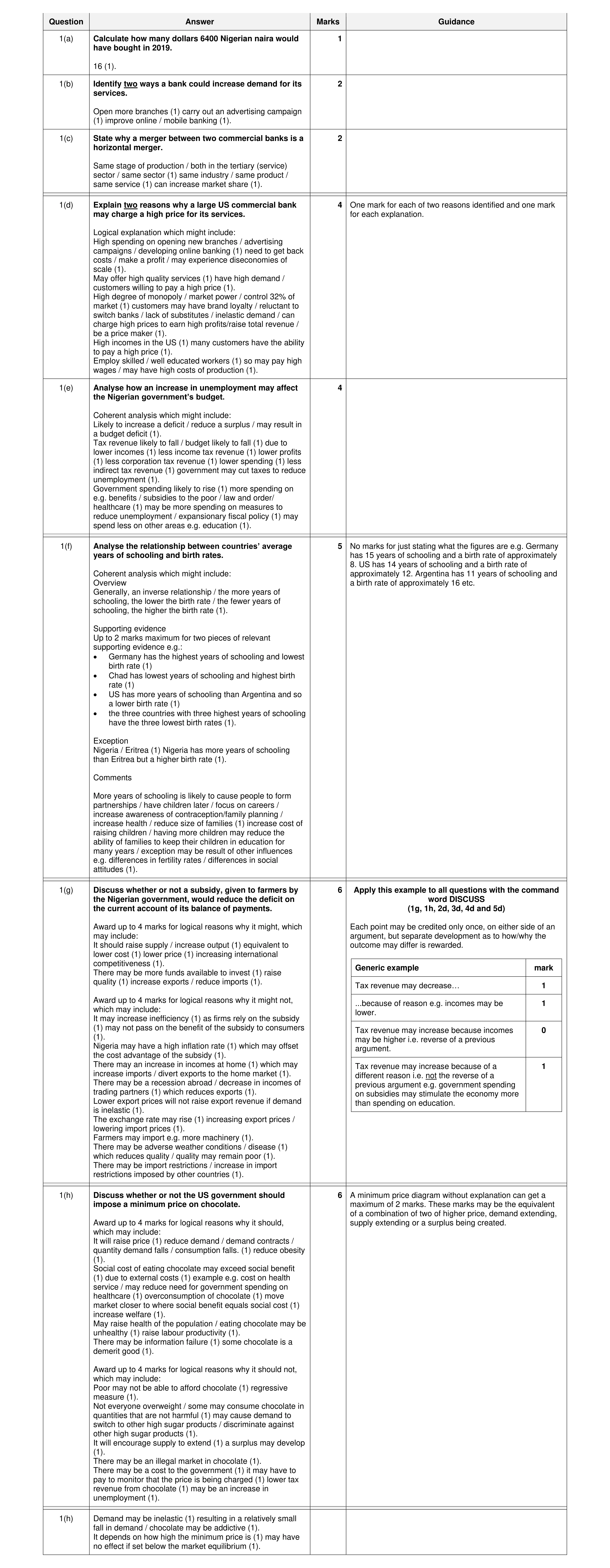 30
30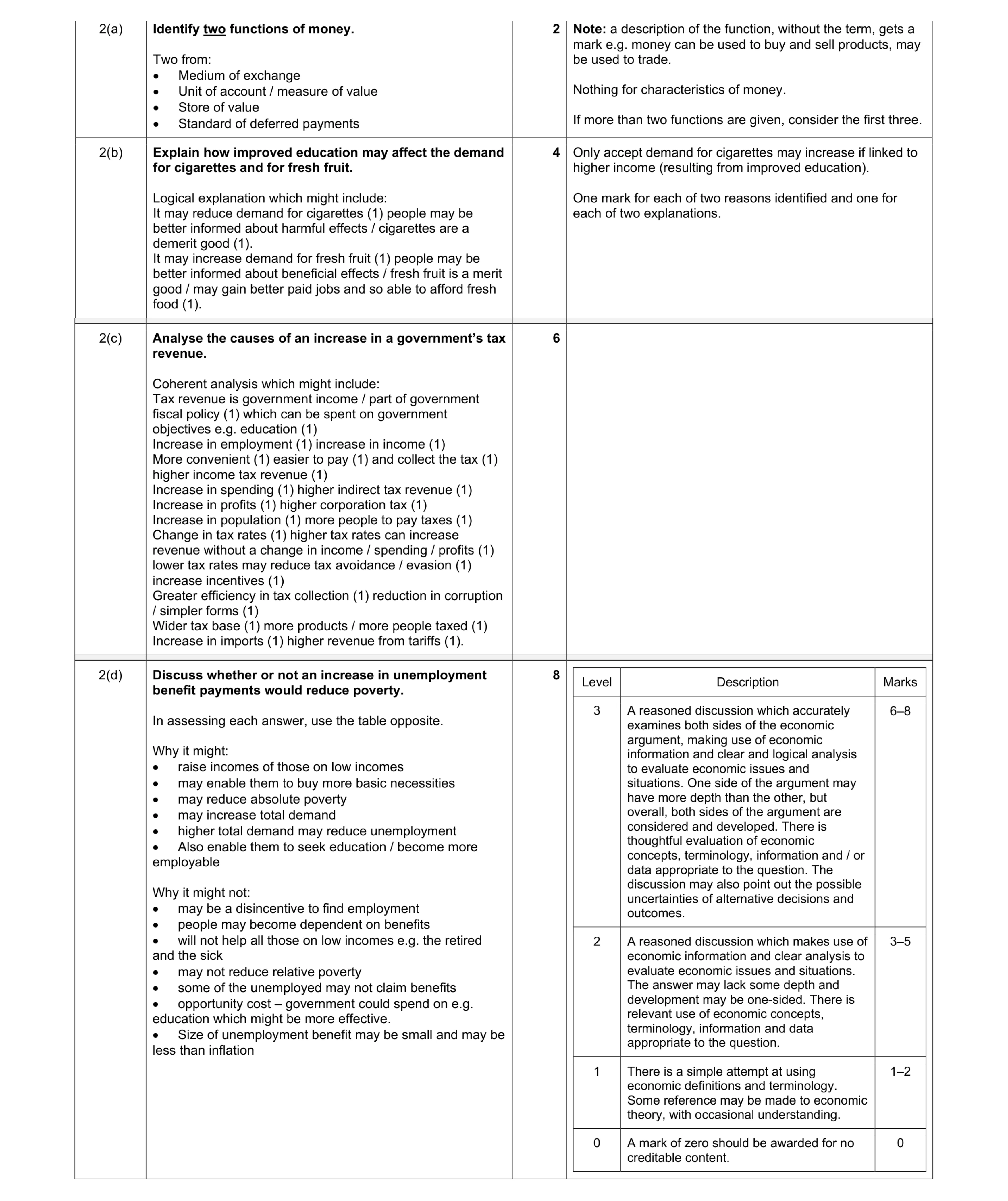 20
20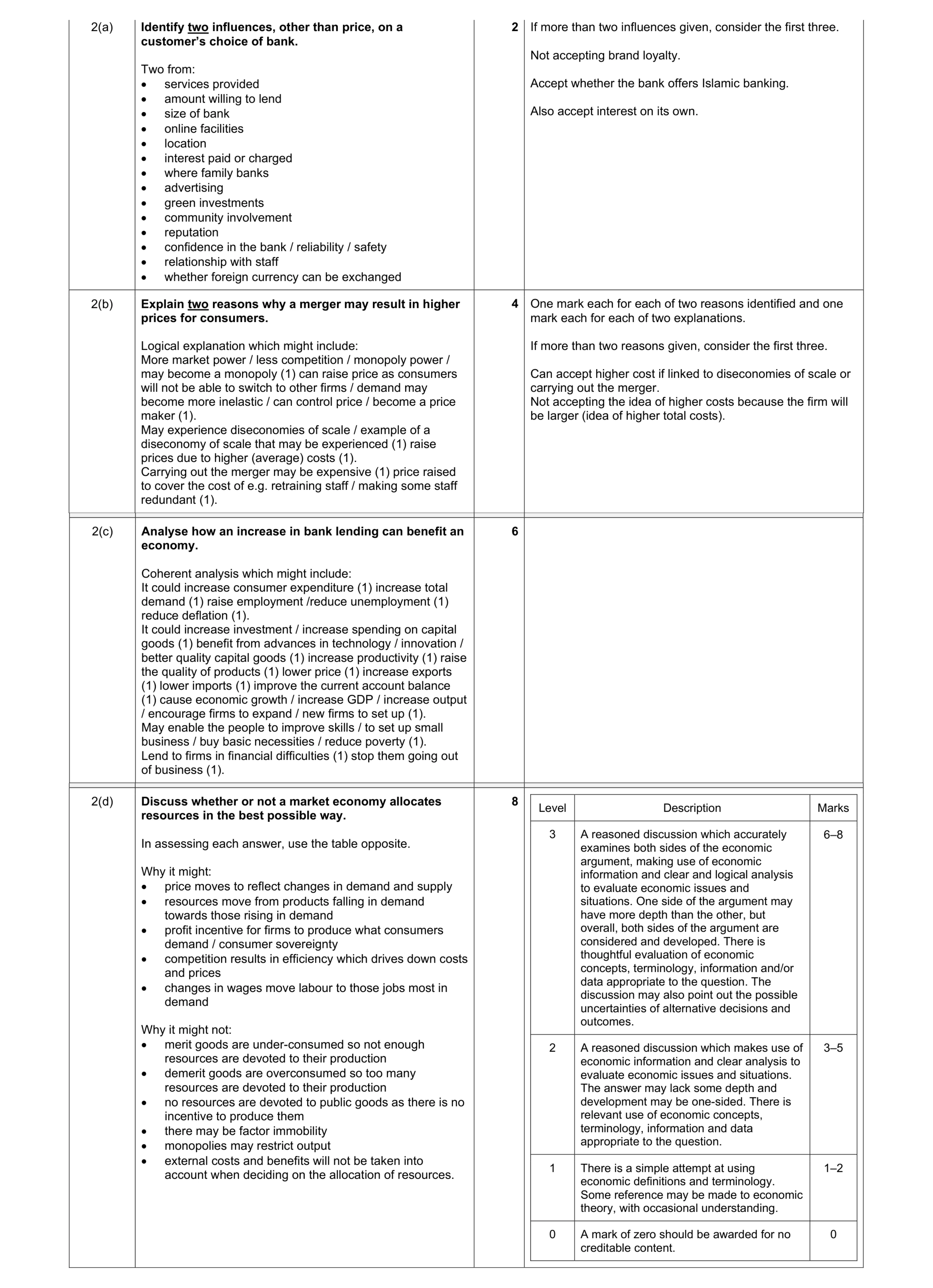 20
20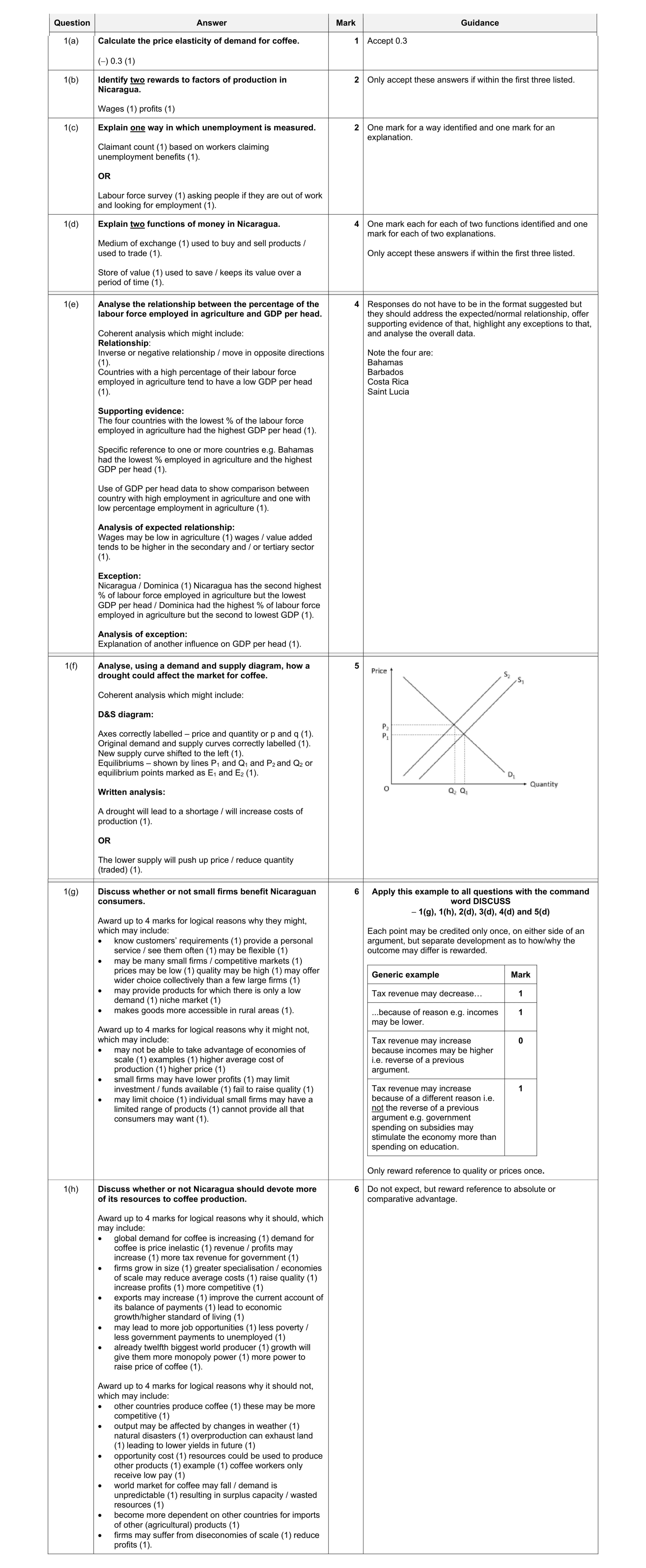 30
30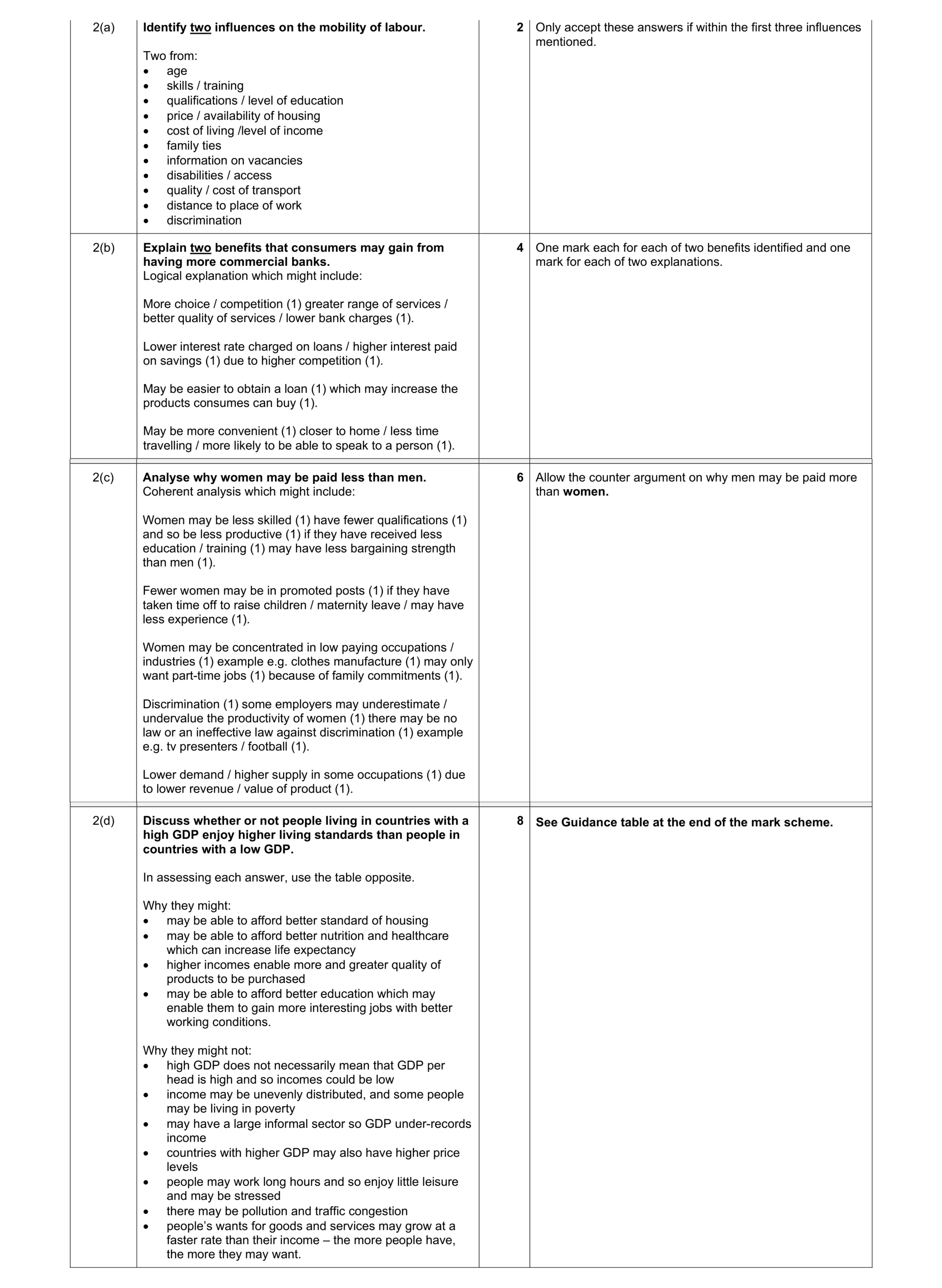 20
20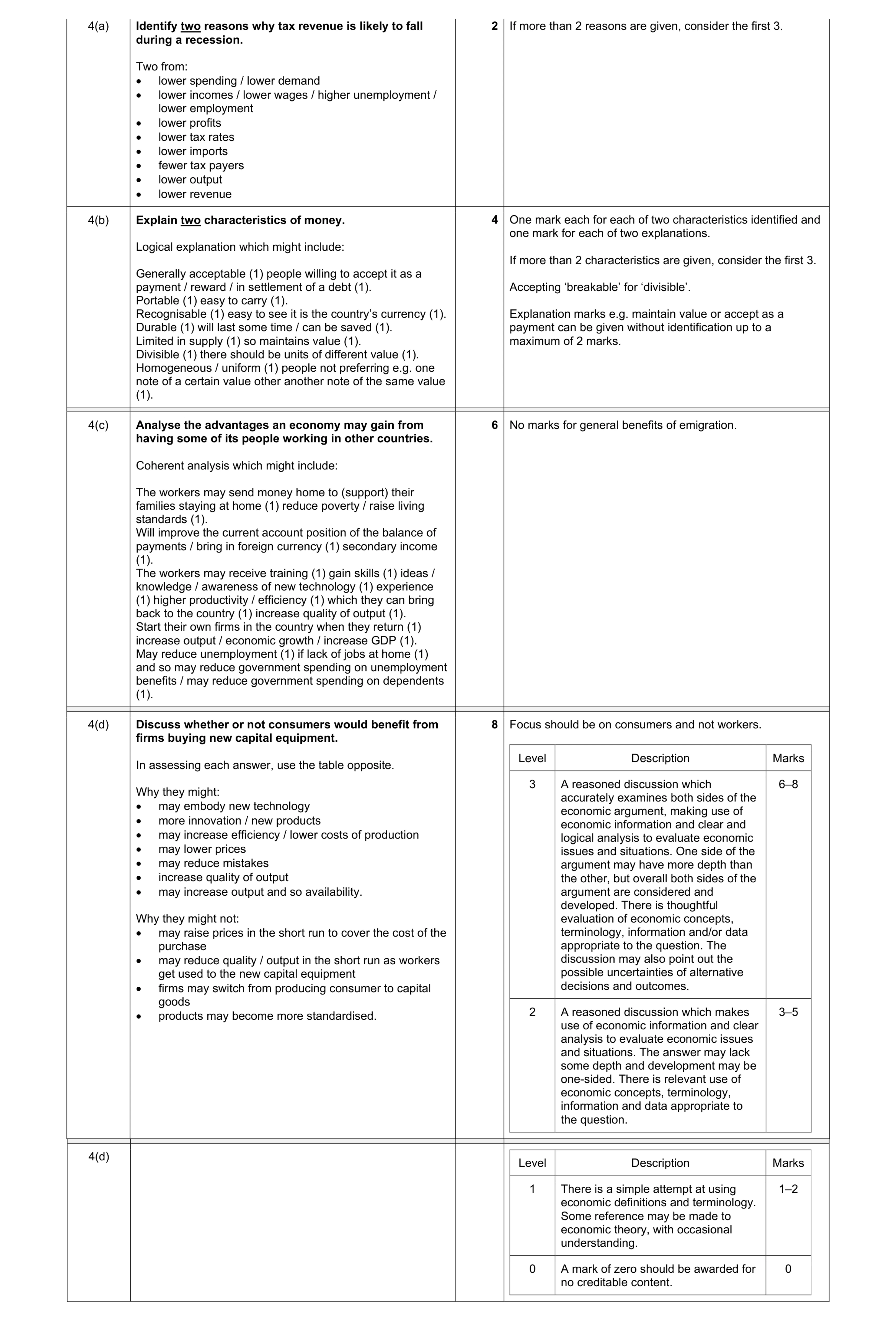 20
20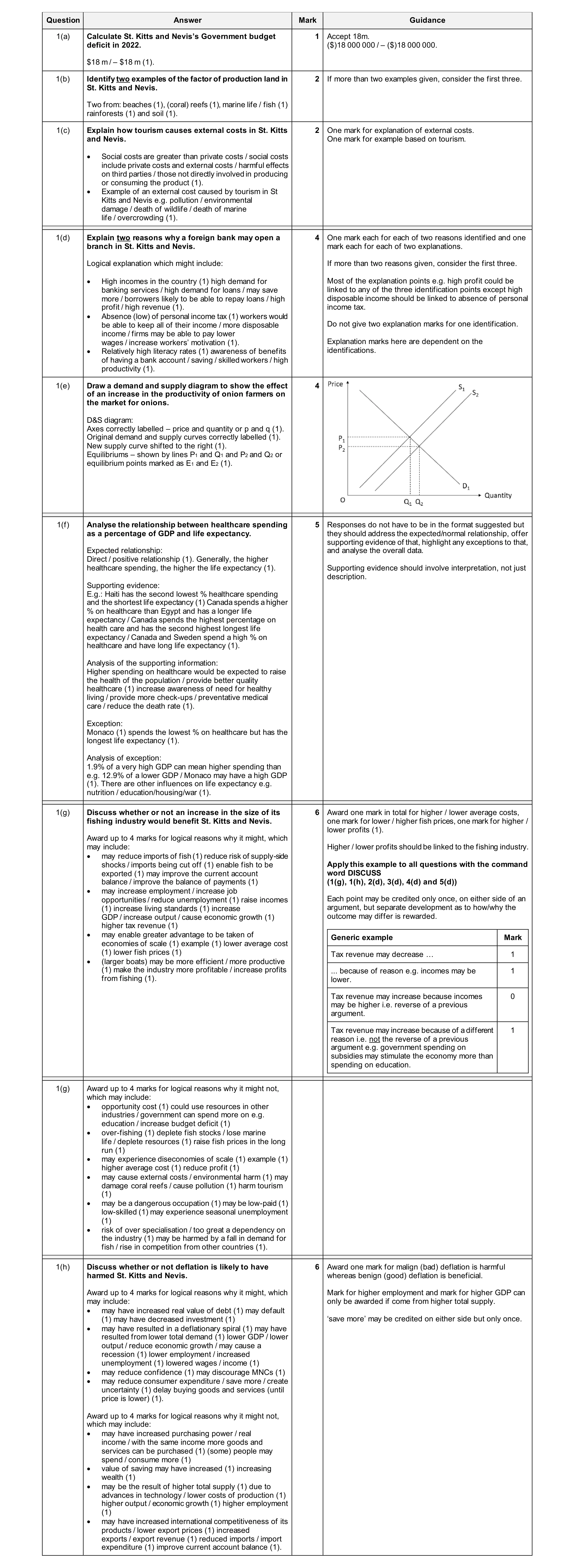 30
30