Questions as text
Q1 · Explain what is meant by the unemployment rate 0455/32 Oct/Nov 2010
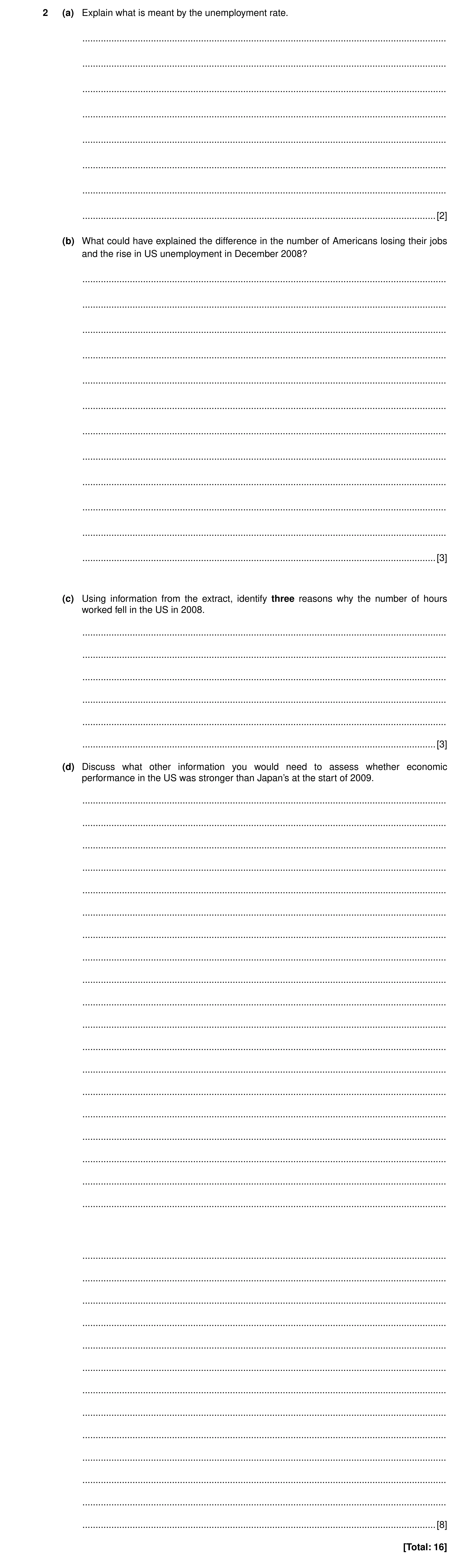
2 (a) Explain what is meant by the unemployment rate. … … … … … … … … [2] (b) What could have explained the difference in the number of Americans losing their jobs and the rise in US unemployment in December 2008? … … … … … … … … … … … … [3] (c) Using information from the extract, identify three reasons why the number of hours worked fell in the US in 2008. … … … … … … [3] (d) Discuss what other information you would need to assess whether economic performance in the US was stronger than Japan’s at the start of 2009. … … … … … … … … … … … … … … … … … … … … … … … … … … … … … … … … [8] [Total: 16]
16 marks
Mark scheme: 2 (a) Percentage of labour force/working population (1) without a job or those registered as unemployed (1). [2] (b) Up to 3 marks for explaining any reason why they may have left the labour force, e.g. entered further education, retired early, gave up looking for work, emigrated or; 1 mark for each of the three reasons identified. 1 mark for recognising that some of those made redundant may have found other employment straight away. Up to 3 marks for really good development of one point. Note: maximum mark is 3. [3] (c) Fewer people working/rise in unemployment (1); reduction in full-time hours (1) and more people working part-time (1). [3] (d) Up to 4 marks for identification of information needed, e.g. economic growth rate, inflation rate, current account position, distribution of income, living standards, technological advances, level of poverty. Up to 5 marks for commenting on what would indicate a strong performance, e.g. stable growth rate, sustainable growth rate, low inflation rate, stable inflation rate, current account balance, trends in economic growth rate, inflation rate, current account position. A well-developed comment can receive two marks. 1 mark for a good conclusion. [8]
This question in 0455/32 Oct/Nov 2010
Q2 · State two influences on the demand for a country’s exports 0455/32 May/June 2011
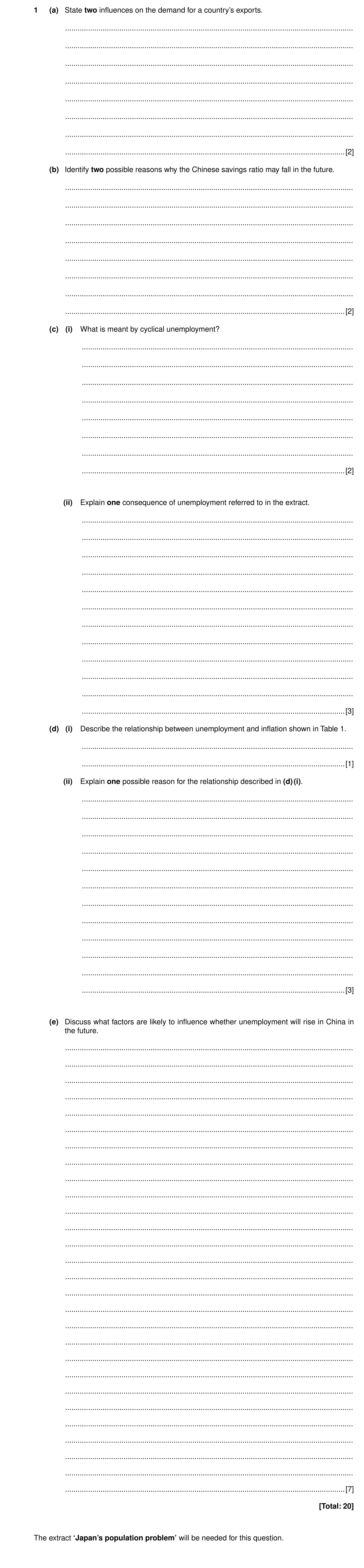
1 (a) State two influences on the demand for a country’s exports. … … … … … … … … [2] (b) Identify two possible reasons why the Chinese savings ratio may fall in the future. … … … … … … … … [2] (c) (i) What is meant by cyclical unemployment? … … … … … … … … [2] (ii) Explain one consequence of unemployment referred to in the extract. … … … … … … … … … … … … [3] (d) (i) Describe the relationship between unemployment and inflation shown in Table 1. … … [1] (ii) Explain one possible reason for the relationship described in (d) (i). … … … … … … … … … … … … [3] (e) Discuss what factors are likely to influence whether unemployment will rise in China in the future. … … … … … … … … … … … … … … … … … … … … … … … … … … … … [7] [Total: 20] The extract ‘Japan’s population problem’ will be needed for this question.
20 marks
Mark scheme: 1 (a) 1 mark each for any two valid influences, e.g. • exchange rate • price • quality • incomes abroad • changing tastes and fashion • trade restrictions (maximum of 1 mark even if more than one trade restriction identified) • foreign substitutes or complements. [2] (b) 1 mark for each of two reasons, e.g. • state provision of health care may increase • state provision of pensions may increase • job security may increase • a change in income • an improvement in the state education system • a rise in employment/fall in unemployment • a rise in the inflation rate • lower interest rates. [2] (c) (i) 2 marks for unemployment caused by a lack of aggregate/total demand. 1 mark for unemployment caused by a lack of demand or people willing and able to work being without jobs or due to trade cycle or recession or boom or slump. [2] (ii) 1 mark for identifying a consequence, one from: • fall in potential output/lower economic growth • lost tax revenue • rise in savings • change in inflation rate. Up to 2 marks for explanation, e.g. • If people are out of work they are not making goods and services and that potential output is lost for all time. • Income will fall and so spending will fall leading to a decline in direct and indirect tax revenue. • If they save more, spending will fall further which can cause even more unemployment. • If fewer people are unemployed this may increase costs of production and increase total demand. Note: consequence must be referred to in the extract. [3] IGCSE – May/June 2011 0455 32 (d) (i) Unemployment falls whilst inflation rises or unemployment rises whilst inflation falls or there is an inverse relationship described (1). (The question only requires a description of the relationship and not the trend shown but the answer must imply an inverse relationship.) [1] (ii) Either: as unemployment changes, incomes change (1), spending/demand changes (1), changes in demand are likely to encourage firms to change their prices (1), and so influence demand-pull inflation (1). Note: maximum of 3 marks but final link is needed to achieve the third mark. Or: as unemployment changes, a shortage or surplus of workers may develop (1). This may alter wage rates (1), and change the costs of production (1) and so influence cost- push inflation (1). Note: maximum of 3 marks but final link is needed to achieve the third mark. [3] Note: OFR – if in (d)(i) a candidate has described a direct relationship between unemployment and inflation, this may change the demand for the countries’ products and so alter the number of people employed/unemployed. Note: OFR – own figure rule which means that a candidate cannot be penalised twice for making the same mistake. (e) 1 mark for identification of each factor, up to a maximum of four, e.g. • level of aggregate demand/economic activity • rise in international competitiveness • consumer confidence • change in government policy influencing aggregate demand, e.g. taxation • change in government policy influencing aggregate supply, e.g. education/training • skills of workers • technological change • mobility of workers • relative cost of labour • level of inflation. Up to 3 marks for discussing the factors, e.g. • If aggregate demand falls, cyclical unemployment will rise. • An increase in the skills of workers may reduce structural unemployment. • Technological change will require workers to learn new skills and may reduce jobs in some industries. • An increase in geographical and occupational mobility should reduce unemployment. Note: up to 3 marks for strong discussion of one factor. [7] IGCSE – May/June 2011 0455 32
This question in 0455/32 May/June 2011
Q3 · State two influences on the demand for a country’s exports 0455/33 May/June 2011
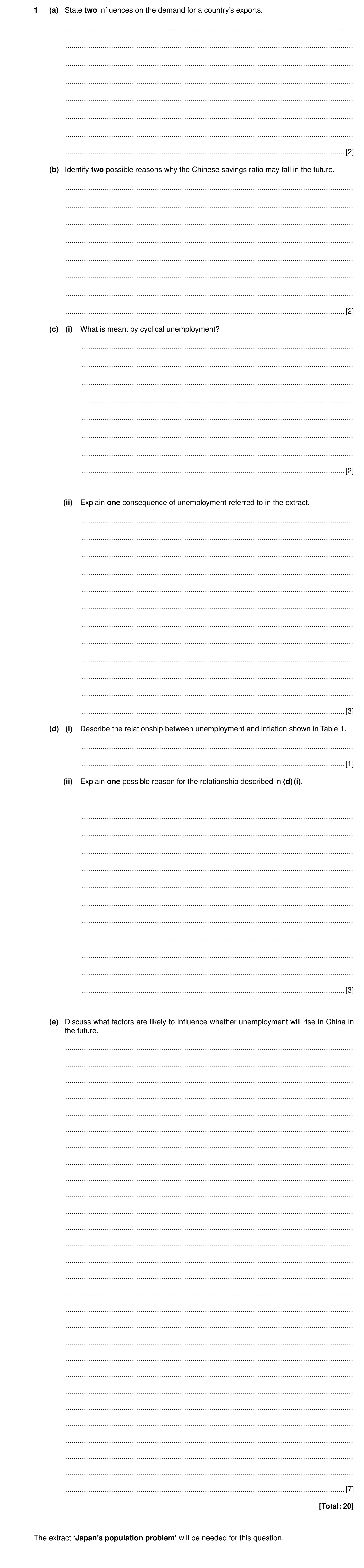
1 (a) State two influences on the demand for a country’s exports. … … … … … … … … [2] (b) Identify two possible reasons why the Chinese savings ratio may fall in the future. … … … … … … … … [2] (c) (i) What is meant by cyclical unemployment? … … … … … … … … [2] (ii) Explain one consequence of unemployment referred to in the extract. … … … … … … … … … … … … [3] (d) (i) Describe the relationship between unemployment and inflation shown in Table 1. … … [1] (ii) Explain one possible reason for the relationship described in (d) (i). … … … … … … … … … … … … [3] (e) Discuss what factors are likely to influence whether unemployment will rise in China in the future. … … … … … … … … … … … … … … … … … … … … … … … … … … … … [7] [Total: 20] The extract ‘Japan’s population problem’ will be needed for this question.
20 marks
Mark scheme: 1 (a) 1 mark each for any two valid influences, e.g. • exchange rate • price • quality • incomes abroad • changing tastes and fashion • trade restrictions (maximum of 1 mark even if more than one trade restriction identified) • foreign substitutes or complements. [2] (b) 1 mark for each of two reasons, e.g. • state provision of health care may increase • state provision of pensions may increase • job security may increase • a change in income • an improvement in the state education system • a rise in employment/fall in unemployment • a rise in the inflation rate • lower interest rates. [2] (c) (i) 2 marks for unemployment caused by a lack of aggregate/total demand. 1 mark for unemployment caused by a lack of demand or people willing and able to work being without jobs or due to trade cycle or recession or boom or slump. [2] (ii) 1 mark for identifying a consequence, one from: • fall in potential output/lower economic growth • lost tax revenue • rise in savings • change in inflation rate. Up to 2 marks for explanation, e.g. • If people are out of work they are not making goods and services and that potential output is lost for all time. • Income will fall and so spending will fall leading to a decline in direct and indirect tax revenue. • If they save more, spending will fall further which can cause even more unemployment. • If fewer people are unemployed this may increase costs of production and increase total demand. Note: consequence must be referred to in the extract. [3] IGCSE – May/June 2011 0455 33 (d) (i) Unemployment falls whilst inflation rises or unemployment rises whilst inflation falls or there is an inverse relationship described (1). (The question only requires a description of the relationship and not the trend shown but the answer must imply an inverse relationship.) [1] (ii) Either: as unemployment changes, incomes change (1), spending/demand changes (1), changes in demand are likely to encourage firms to change their prices (1), and so influence demand-pull inflation (1). Note: maximum of 3 marks but final link is needed to achieve the third mark. Or: as unemployment changes, a shortage or surplus of workers may develop (1). This may alter wage rates (1), and change the costs of production (1) and so influence cost- push inflation (1). Note: maximum of 3 marks but final link is needed to achieve the third mark. [3] Note: OFR – if in (d)(i) a candidate has described a direct relationship between unemployment and inflation, this may change the demand for the countries’ products and so alter the number of people employed/unemployed. Note: OFR – own figure rule which means that a candidate cannot be penalised twice for making the same mistake. (e) 1 mark for identification of each factor, up to a maximum of four, e.g. • level of aggregate demand/economic activity • rise in international competitiveness • consumer confidence • change in government policy influencing aggregate demand, e.g. taxation • change in government policy influencing aggregate supply, e.g. education/training • skills of workers • technological change • mobility of workers • relative cost of labour • level of inflation. Up to 3 marks for discussing the factors, e.g. • If aggregate demand falls, cyclical unemployment will rise. • An increase in the skills of workers may reduce structural unemployment. • Technological change will require workers to learn new skills and may reduce jobs in some industries. • An increase in geographical and occupational mobility should reduce unemployment. Note: up to 3 marks for strong discussion of one factor. [7] IGCSE – May/June 2011 0455 33
This question in 0455/33 May/June 2011
Q4 · Which two government aims are referred to in the extract? 0455/33 Oct/Nov 2011
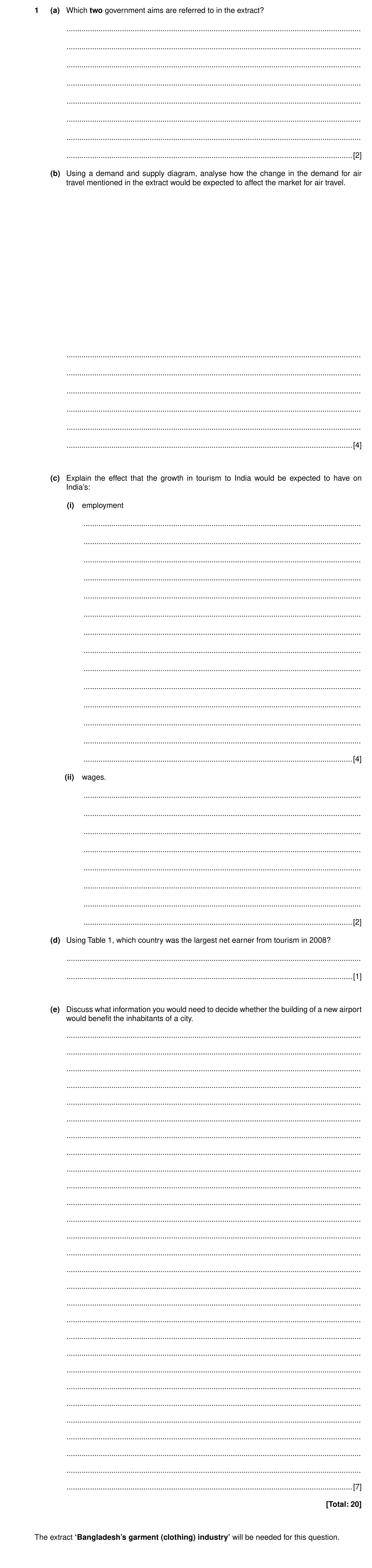
1 (a) Which two government aims are referred to in the extract? … … … … … … … … [2] (b) Using a demand and supply diagram, analyse how the change in the demand for air travel mentioned in the extract would be expected to affect the market for air travel. … … … … … … [4] (c) Explain the effect that the growth in tourism to India would be expected to have on India’s: (i) employment … … … … … … … … … … … … … … [4] (ii) wages. … … … … … … … … [2] (d) Using Table 1, which country was the largest net earner from tourism in 2008? … … [1] (e) Discuss what information you would need to decide whether the building of a new airport would benefit the inhabitants of a city. … … … … … … … … … … … … … … … … … … … … … … … … … … … … [7] [Total: 20] The extract ‘Bangladesh’s garment (clothing) industry’ will be needed for this question.
20 marks
Mark scheme: 1 (a) 1 mark for full employment/lower unemployment. 1 mark for increasing GDP/economic growth. [2] (b) Price of air travel Quantity of air travel 1 mark for labels. 1 mark for shift of the demand curve to the right. 1 mark for correct equilibriums. 1 mark for mentioning that the quantity of air travel bought and sold would increase. 1 mark for mentioning that the increase in demand would tend to increase the price of air travel. Note: maximum mark of 4. [4] IGCSE – October/November 2011 0455 33 (c) (i) Employment: It would be expected to increase employment (1). More jobs will be created in the tourism industry (1) and more employment created in infrastructure (1). Higher employment will lead to more spending, which will generate more jobs (1). Impact on employment will depend on the extent of the rise (1). Some jobs may be filled by people outside the country (1), some jobs may be seasonal (1). Tax revenue may rise (1), which will enable the government to spend more on increasing the skills of the labour force (1). Maximum of 4 marks. [4] (ii) Wages: It would be likely to raise wages (1) as demand for labour would increase/raise ability of firms to pay higher wages (1). Note: accept a diagram which shows demand for labour shifting to the right and wages increasing for 2 marks. [2] (d) Spain. [1] (e) Up to 4 marks for identification of relevant information, for example: • level of capacity at any existing airports • direct and indirect effect on employment • effect on ease of travel to and from the city • where the airport is built • effect on air • noise and visual pollution • private costs • private benefits • external costs • external benefits. Up to 4 marks for commenting on the relevant information, for example: will be more beneficial if any existing airport is working at full capacity, the building of an airport will employ building workers, may increase tourism and may attract new firms into the city but the airport may be built on land of outstanding natural beauty and the pollution resulting from the airport may reduce the quality of people’s lives. A cost-benefit analysis could be conducted to assess whether the building of the airport would be beneficial. Note: a maximum of 3 marks if the answer just discusses whether the building of a new airport would benefit the inhabitants of a city without reference to the information needed. 2 marks if this approach is one-sided. [7] $ $
This question in 0455/33 Oct/Nov 2011
Q5 · Using information from the extract, state what happened to the price level in 2009 in… 0455/32 May/June 2012
2 (a) Using information from the extract, state what happened to the price level in 2009 in: (i) India … … [1] (ii) China. … … [1] (b) Why may a country experience a shortage of workers at the same time as it is encountering a relatively high unemployment rate? … … … … … … … … [2] (c) Explain how raising the rate of interest can reduce aggregate (total) demand. … … … … … … … … … … … … … … … … [4] (d) Using Figure 1, describe the trends in the current accounts of the balance of payments as percentages of GDP in the four countries shown. … … … … … … … … … … … … … … … … [4] (e) Explain an example of a conflict between government economic aims mentioned in the extract. … … … … … … … … [2] Question 2(f) is on the next page
14 marks
Mark scheme: 2 (a) (i) It rose. (1) (No marks for just writing 11.3%) (ii) It fell. (1) (No marks for just writing –1.2%) [2] (b) 1 mark for identifying workers may lack appropriate skills/education/qualifications or be occupationally immobile. 1 mark for identifying workers may be geographically immobile. 1 mark for development of why occupational immobility may have caused this situation. 1 mark for development of why geographical immobility may have caused this situation. Note: it is not necessary to use these particular terms as long as the concepts are clearly understood. [2] (c) 1 mark for consumption/investment/net exports are components of aggregate demand. 1 mark for it may reduce consumption. Up to 2 marks for why it may reduce consumption – encourage saving, discourage borrowing, reduce the money supply. 1 mark for it may reduce investment. Up to 2 marks for why it may discourage investment – increase cost of borrowing, encourage saving, reduce expected sales. 1 mark for it may discourage net exports. Up to 2 marks for why it may reduce net exports – attract hot money, raise exchange rates, raise export prices and lower import prices. Maximum of 3 marks for explanation of the influence on one component of aggregate demand. [4] IGCSE – May/June 2012 0455 32 (d) 1 mark for Brazil’s current account balance changed from a surplus to a growing deficit/current account position deteriorated or worsened. 1 mark for China’s surplus consistently fell/current account position deteriorated or worsened/current account was always in surplus. 1 mark for India’s deficit consistently rose/current account position deteriorated or worsened/current account was always in deficit. 1 mark for Russia’s surplus fluctuated/current account was always in surplus/trend for Russia’s surplus to fall or current account position deteriorated or worsened and then improved. Note: Do not credit purely numerical observations including ‘positive’ and ‘negative’. [4] (e) 1 mark for reference to conflict between reducing inflation and reducing unemployment. 1 mark for recognising inflation may benefit from a reduction in AD whilst such a reduction may increase unemployment. [2] (f) Why it might, e.g. it may result in • higher output • higher tax revenue • less spending on benefits • more efficient use of resources. Why it might not, e.g. it may cause • inflation • shortage of workers • lack of flexibility • more imports. Maximum of 4 marks for a one-sided discussion. Maximum of 3 marks for a list or list-like approach. [6]
This question in 0455/32 May/June 2012
Q6 · Using information from the extract, state what happened to the price level in 2009 in… 0455/33 May/June 2012
2 (a) Using information from the extract, state what happened to the price level in 2009 in: (i) India … … [1] (ii) China. … … [1] (b) Why may a country experience a shortage of workers at the same time as it is encountering a relatively high unemployment rate? … … … … … … … … [2] (c) Explain how raising the rate of interest can reduce aggregate (total) demand. … … … … … … … … … … … … … … … … [4] (d) Using Figure 1, describe the trends in the current accounts of the balance of payments as percentages of GDP in the four countries shown. … … … … … … … … … … … … … … … … [4] (e) Explain an example of a conflict between government economic aims mentioned in the extract. … … … … … … … … [2] Question 2(f) is on the next page
14 marks
Mark scheme: 2 (a) (i) It rose. (1) (No marks for just writing 11.3%) (ii) It fell. (1) (No marks for just writing –1.2%) [2] (b) 1 mark for identifying workers may lack appropriate skills/education/qualifications or be occupationally immobile. 1 mark for identifying workers may be geographically immobile. 1 mark for development of why occupational immobility may have caused this situation. 1 mark for development of why geographical immobility may have caused this situation. Note: it is not necessary to use these particular terms as long as the concepts are clearly understood. [2] (c) 1 mark for consumption/investment/net exports are components of aggregate demand. 1 mark for it may reduce consumption. Up to 2 marks for why it may reduce consumption – encourage saving, discourage borrowing, reduce the money supply. 1 mark for it may reduce investment. Up to 2 marks for why it may discourage investment – increase cost of borrowing, encourage saving, reduce expected sales. 1 mark for it may discourage net exports. Up to 2 marks for why it may reduce net exports – attract hot money, raise exchange rates, raise export prices and lower import prices. Maximum of 3 marks for explanation of the influence on one component of aggregate demand. [4] IGCSE – May/June 2012 0455 33 (d) 1 mark for Brazil’s current account balance changed from a surplus to a growing deficit/current account position deteriorated or worsened. 1 mark for China’s surplus consistently fell/current account position deteriorated or worsened/current account was always in surplus. 1 mark for India’s deficit consistently rose/current account position deteriorated or worsened/current account was always in deficit. 1 mark for Russia’s surplus fluctuated/current account was always in surplus/trend for Russia’s surplus to fall or current account position deteriorated or worsened and then improved. Note: Do not credit purely numerical observations including ‘positive’ and ‘negative’. [4] (e) 1 mark for reference to conflict between reducing inflation and reducing unemployment. 1 mark for recognising inflation may benefit from a reduction in AD whilst such a reduction may increase unemployment. [2] (f) Why it might, e.g. it may result in • higher output • higher tax revenue • less spending on benefits • more efficient use of resources. Why it might not, e.g. it may cause • inflation • shortage of workers • lack of flexibility • more imports. Maximum of 4 marks for a one-sided discussion. Maximum of 3 marks for a list or list-like approach. [6]
This question in 0455/33 May/June 2012
Q7 · What is meant by economic growth? 0455/32 May/June 2013
2 (a) What is meant by economic growth? … … … … … … … … [2] (b) Using information from the extract, explain one reason, in each case, why India’s labour force is expected to grow in (i) quantity, … … … … … … … … [2] (ii) quality. … … … … … … … … [2] (c) Comment on whether the data in Table 1 supports the expected relationship between investment growth and unemployment. … … … … … … … … … … … … … … … … [4] (d) (i) Using information from the extract, identify two functions of commercial banks. … … … … … … … … [2] (ii) Explain one other function of a commercial bank. … … … … … … … … [2] (e) Discuss what factors will influence the amount saved in India in the future. … … … … …
14 marks
Mark scheme: 2 (a) Two marks for any of the following: • increase in GDP over time • increase in output over time • increase in GDP per head over time • increase in real GDP • increase in productive capacity. One mark maximum for any of the following: • increase in GDP • increase in GDP per head • increase in output • measured by GDP/reference to GDP. Note: Aggregate supply is not on the syllabus but credit an increase in AS for 2 marks (rise in productive capacity). [2] (b) (i) One mark for the population is young. One mark for there will be more people of working age in the future/more people available and or willing to work in the future. Or: One mark for identifying more women/‘more women will seek work’. One mark for it may be more acceptable for women in the future/more women may be willing to work in the future. Or: One mark for identifying more education. One mark for more educated people are likely to be able/willing to work in the future. [2] (ii) One mark for identifying higher government spending on education/more university graduates/government ensuring more children attend school. One mark for improved education should raise labour skills/productivity. Or: One mark for more young workers. One mark for young workers may be more energetic/mobile/more adaptable to change. [2] (c) One mark for identifying the expected relationship as an inverse relationship (as investment grows, unemployment falls and when investment falls, unemployment rises). One mark for most of the data does support the expected relationship. One mark for supporting evidence of an inverse relationship One mark for noting that 2010 is an exception to this expected relationship (allow 2009 – 2010). One mark for investment growth would indicate firms are expanding and so are likely to take on more workers/higher government investment on e.g. infrastructure, education, health care would increase demand for labour. One mark for noting that the relationship will depend on whether the capital goods being produced are being used alongside labour or as a replacement for labour/number unemployed may move in a different direction to the unemployment rate/unemployment may be influenced by other factors/there may be a time lag/higher investment may reduce unemployment in other countries if undertaken by MNCs. Note: a maximum mark of 4. [4] IGCSE – May/June 2013 0455 32 (d) (i) One mark for allowing people to open deposits/keep money safe/save. One mark for lending. [2] (ii) One mark for recognising a function e.g. • enabling customers to receive and make payments • providing foreign currency • providing advice • selling insurance • lending to individuals • keeping valuables safe. One mark for explanation of the function identified e.g. a commercial bank may • provide credit cards and direct debit facilities • allow customers to buy and sell foreign currency • provide guidance on where customers can financially invest their money • provide loans to buy houses • sell insurance to people taking out mortgages • provide facilities to keep e.g. gold and jewellery. Note: if a candidate does not select a relevant function in (d)(i) but explains the function here, it should be credited. [2] (e) Up to three marks for identifying relevant factors e.g. • income • tax • confidence • interest rate • range of banking services/availability of banking services • inflation • deflation • population size • age of population • unemployment rate • people’s desire to educate themselves or their children in the future • economic growth. Up to four marks for discussing the factors e.g. • higher income is likely to result in more saving (1) as it enables people to save more (1) • a low interest rate may reduce saving (1) as it will reduce the return from saving (1) • greater confidence may increase saving (1) as people are more likely to spend at the expense of saving (1) • greater provision of banking services will be likely to increase saving (1) e.g. introduction of saving schemes for the poor (microfinance) (1) • inflation may reduce saving as people seek to spend before prices rise (1) or increase saving to maintain the real value of money (1) • more people in India may increase the amount saved (1) even if the average amount saved remains the same (1) • deflation would increase savings (1) as people would delay spending until prices fall (1). Up to three marks for a list-like approach. Up to three marks for any one point identified and discussed. Note: a maximum of 6 marks. [6]
This question in 0455/32 May/June 2013
Q8 · Define the term ‘trade embargo’ 0455/33 May/June 2013
2 (a) Define the term ‘trade embargo’. … … … … … … … … [2] (b) Using information from the extract, explain why the Cuban Government is raising the retirement age. … … … … … … … … [2] (c) Explain whether Cuba’s income tax system is progressive or regressive. … … … … … … … … [2] (d) The Cuban Government removed the subsidy on sugar. Using a demand and supply diagram, explain the effect this would have had on the market for sugar. … … … … … … … … … … … … … … … … [4] (e) (i) Calculate the size of Cuba’s labour force in 2010. … … … … … … … … [2] (ii) Using Table 1, comment on whether the data supports the view that a slowdown in economic growth results in higher unemployment. … … … … … … … … [2] (f) Discuss whether consumers in Cuba will be likely to benefit from their economy moving towards a market economy. … … … … … … … Additional writing space is on the next page.
14 marks
Mark scheme: 2 (a) 2 marks for a ban on imports/exports. 1 mark for a ban. [2] (b) 1 mark for coping with an ageing population. 1 mark for reducing the cost of state pensions/raising tax revenue. [2] (c) 2 marks for progressive as it takes a higher percentage of the income of the rich. 1 mark for progressive. [2] (d) S1 Price of D Sugar S Q1 Q D S1 S Q1 Q Quantity of Sugar 1 mark for correct labels – P, Q, D and S. 1 mark for shift of the supply curve to the left. 1 mark for original and new equilibriums. 1 mark for explaining price would rise. [4] (e) (i) 2 marks for 5 million. 1 mark for correct working i.e. 0.1 m/2%. [2] (ii) 1 mark for concluding generally no. 1 mark for recognising the economic growth rate falls from 2006 to 2008 but so does unemployment/economic growth rate rises from 2009 to 2010 and so does unemployment. 1 mark for noting that 2008 to 2009 supports the view/over the whole period the economic growth rate fell and the unemployment rate rose. 1 mark for unemployment is so low, it is less likely to be cyclical (demand-deficient) unemployment (more likely to be frictional unemployment). [2] IGCSE – May/June 2013 0455 33 (f) Up to 4 marks for why consumers may benefit e.g. • consumer sovereignty • low prices • choice • high quality • efficient allocation of resources. Up to 4 marks for discussing why consumers may not benefit e.g. • higher prices due to abuse of market power • higher prices due to removal of state subsidies • public goods not being provided • advertising distorting choices • some consumers lacking purchasing power. [6]
This question in 0455/33 May/June 2013
Question 9 0455/31 Oct/Nov 2013
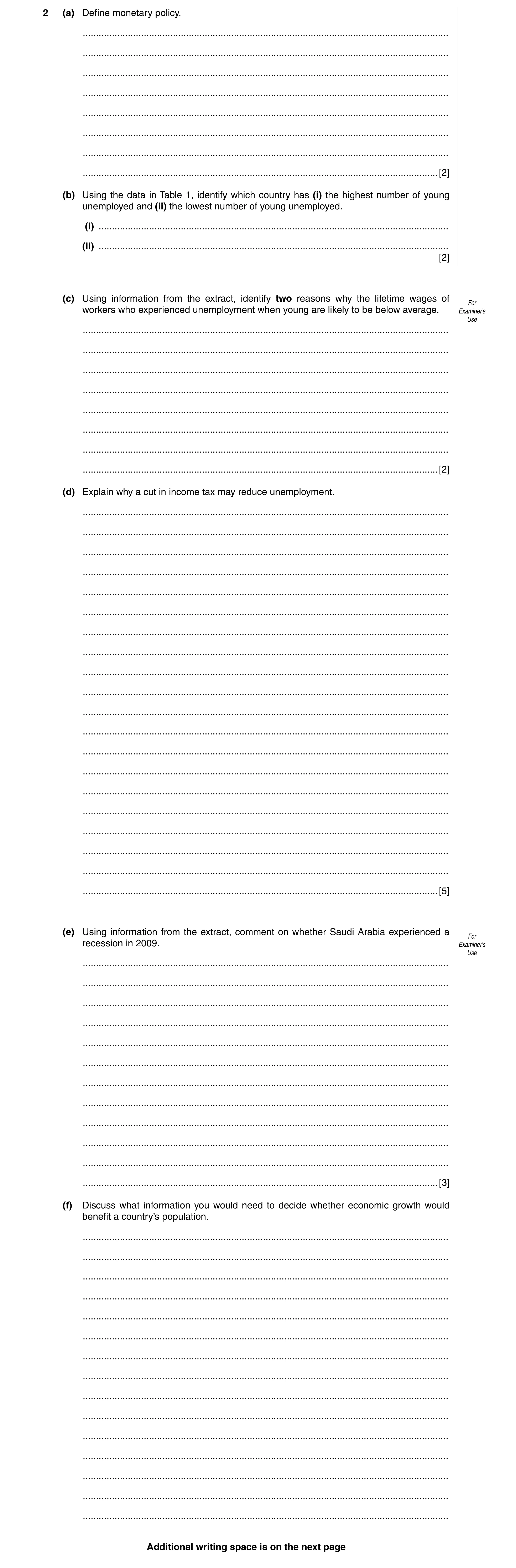
2 (a) Define monetary policy. … … … … … … … … [2] (b) Using the data in Table 1, identify which country has (i) the highest number of young unemployed and (ii) the lowest number of young unemployed. (i) … (ii) … [2] (c) Using information from the extract, identify two reasons why the lifetime wages of workers who experienced unemployment when young are likely to be below average. … … … … … … … … [2] (d) Explain why a cut in income tax may reduce unemployment. … … … … … … … … … … … … … … … … … … … … [5] (e) Using information from the extract, comment on whether Saudi Arabia experienced a recession in 2009. … … … … … … … … … … … … [3] (f) Discuss what information you would need to decide whether economic growth would benefit a country’s population. … … … … … … … … … … … … … … … Additional writing space is on the next page
14 marks
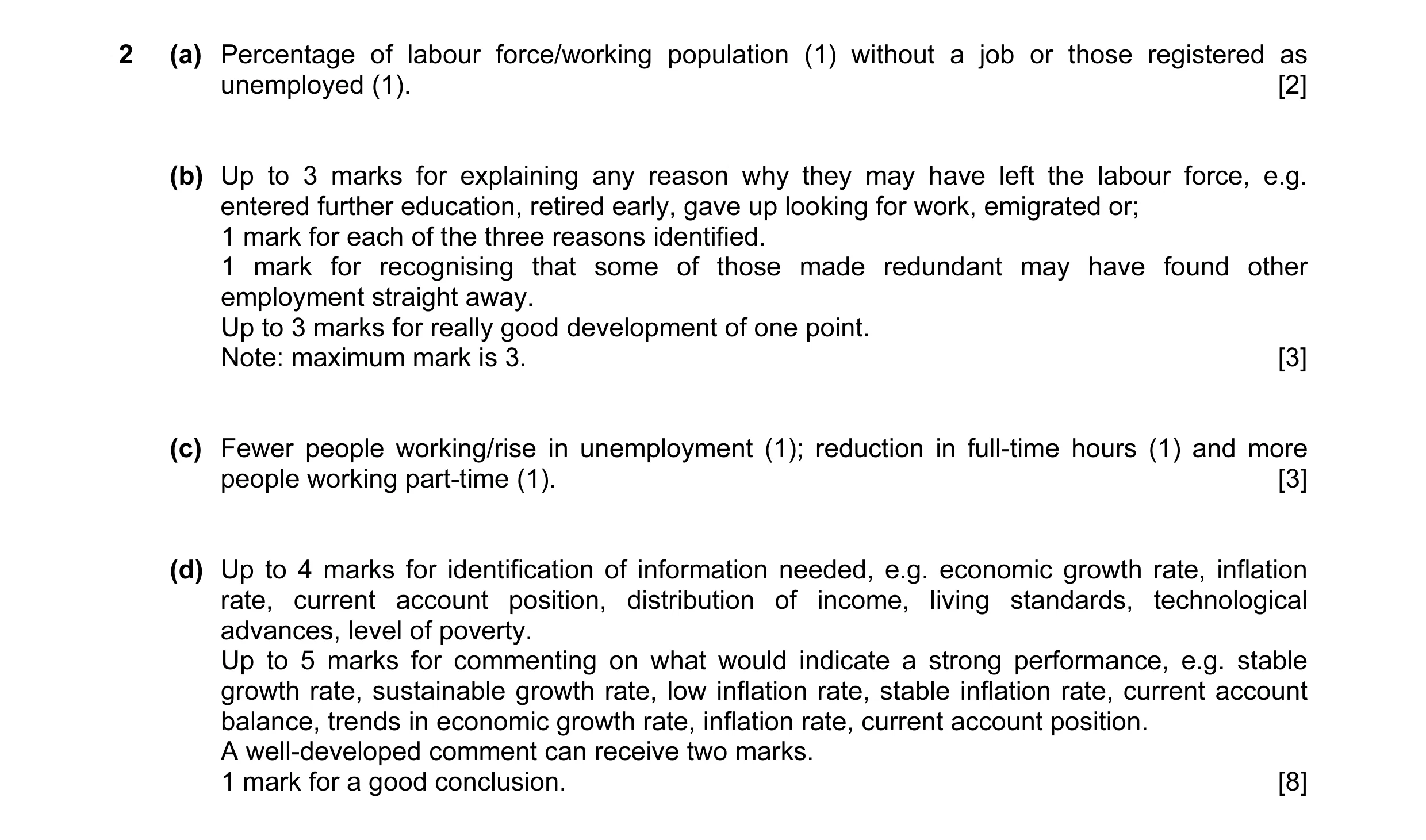
Mark scheme: 2 Youth unemployment (a) Define monetary policy. [2] 2 marks for changes in two from interest rate, money supply and exchange rate. 1 mark for reference to one from interest rate, money supply and exchange rate. 1 mark for reference to any other one of interest rate, money supply and exchange rate. 1 mark for demand-side policy/designed to influence aggregate demand. (b) (i) Using the data in Table 1, identify which country has the highest number of young unemployed. [1] 1 mark for the United States of America. (ii) Using the data in Table 1, identify which country has the lowest number of young unemployed. [1] 1 mark for Germany. (c) Using information from the extract, identify two reasons why the lifetime wages of workers who have experienced unemployment when young are likely to be below average. [2] 1 mark for identifying the young unemployed miss out on training. 1 mark for identifying the young unemployed do not gain as much work experience. (d) Explain why a cut in income tax may reduce unemployment. [5] • a reduction in income tax will increase consumers’ disposable income (1) higher consumer expenditure/spending is likely to rise (1) total demand is likely to increase (1) higher spending will encourage firms to expand their output (1) firms will employ more workers to expand output (1) • a cut in income tax will increase the incentive to work (1) higher return from working (1). (e) Using information from the extract, comment on whether Saudi Arabia experienced a recession in 2009. [3] 1 mark for concluding no. 1 mark for a recession involves a fall in output. 1 mark for Saudi Arabia’s output rose. 1 mark for rise was slower. 2 marks for a recession involves a fall in output (real GDP/GDP) over two or more quarters and so more information is needed. IGCSE – October/November 2013 0455 31 (f) Discuss what information you would need to decide whether economic growth would benefit a country’s population. [6] Up to 3 marks for identifying relevant factors e.g. • type of products produced • distribution of income • change in working hours • change in working conditions • pollution level • effects on other government aims. Up to 4 marks for discussing the factors e.g. • living standards are more likely to increase if consumer goods are produced • not everyone may experience higher living standards if income is unevenly distributed • living standards may fall if working hours have increased • working conditions have declined and there is more pollution • economic growth caused by higher demand may be accompanied by inflation.
This question in 0455/31 Oct/Nov 2013
Question 10 0455/33 Oct/Nov 2013
1 (a) (i) Define profit. … … … … … … … … [2] (ii) Using information from the extract, explain two reasons why Chinese car producers think the production of electronic cars will be profitable. … … … … … … … … … … … … … … … [4] (b) Using a demand and supply diagram, explain why car sales fell in the USA in 2009. … … … … … … … … … … … … … … … … [4] (c) Calculate the percentage of the USA’s labour force employed, directly and indirectly, in the car industry in 2009. … … … … … … … … [2] (d) Identify two ways consumers may benefit from a competitive market. … … … … … … … … [2] (e) Discuss whether a merger of car companies would benefit consumers. … … … … … … … … … … … … … … … … … … … … … … … … [6] [Total: 20] The extract ‘A brighter future for Nigeria?’ will be needed for this question.
20 marks
Mark scheme: 1 (a) (i) Define profit. [2] 2 marks for the positive difference between revenue and cost. 1 mark for idea of reward or payment to entrepreneur/enterprise/risk taker. 1 mark for revenue minus cost. (ii) Using information from the extract, explain two reasons why Chinese car producers think the production of electronic cars will be profitable. [4] 1 mark for identification and 1 mark for explanation of 2 reasons: 1 mark for identifying higher petrol prices. 1 mark for explaining higher petrol prices will increase demand for electronic cars. 1 mark for identifying advances in the technology of producing electronic cars. 1 mark for explaining advances in the technology will reduce costs of production/ increase demand due to higher quality of cars produced. 1 mark for identifying government support. 1 mark for grants/subsidies will reduce costs of production. (b) Using a demand and supply diagram, explain why car sales fell in the USA in 2009. [4] Price D of S Cars D1 P P1 S D1 D 0 Q1 Q Quantity of Cars 1 mark for correct axes – P, Q, D and S. 1 mark for a shift in the demand curve to the left. 1 mark original and new equilibriums. 1 mark for explaining that the fall in demand resulted from a slowdown in the US economy. (c) Calculate the percentage of the USA’s labour force employed, directly and indirectly, in the car industry in 2009. [2] 2 marks for 6.5%/6.49%/1.95% (directly) and 4.55% (indirectly). 1 mark for correct working i.e. 10m/154m × 100/1.95% or 4.55%. IGCSE – October/November 2013 0455 33 (d) Identify two ways consumers benefit from a competitive market. [2] 1 mark for each of 2 relevant benefits identified e.g. low prices, high quality, greater choice, ready availability, innovation. (e) Discuss whether a merger of car companies would benefit consumers. [6] Up to 4 marks for discussing why it might: • greater advantage taken of economies of scale (1) example/s of economies of scale (1) leading to lower average costs (1) and so possibly lower prices (1) • more money being spent on research and development (1) resulting in both lower prices (1) and better quality (1). Up to 4 marks for discussing why it might not: • greater abuse of market power (1) moving closer to a monopoly (1) greater power to raise price (1) restrict supply (1) lower quality (1) less variety of products (1) • diseconomies of scale (1) example/s of diseconomies (1) leading to higher average costs (1) and so possibly higher prices (1). Note: a maximum mark of 5 marks if there is no reference to consumers e.g. in terms of prices, quality and variety. IGCSE – October/November 2013 0455 33
This question in 0455/33 Oct/Nov 2013

 16
16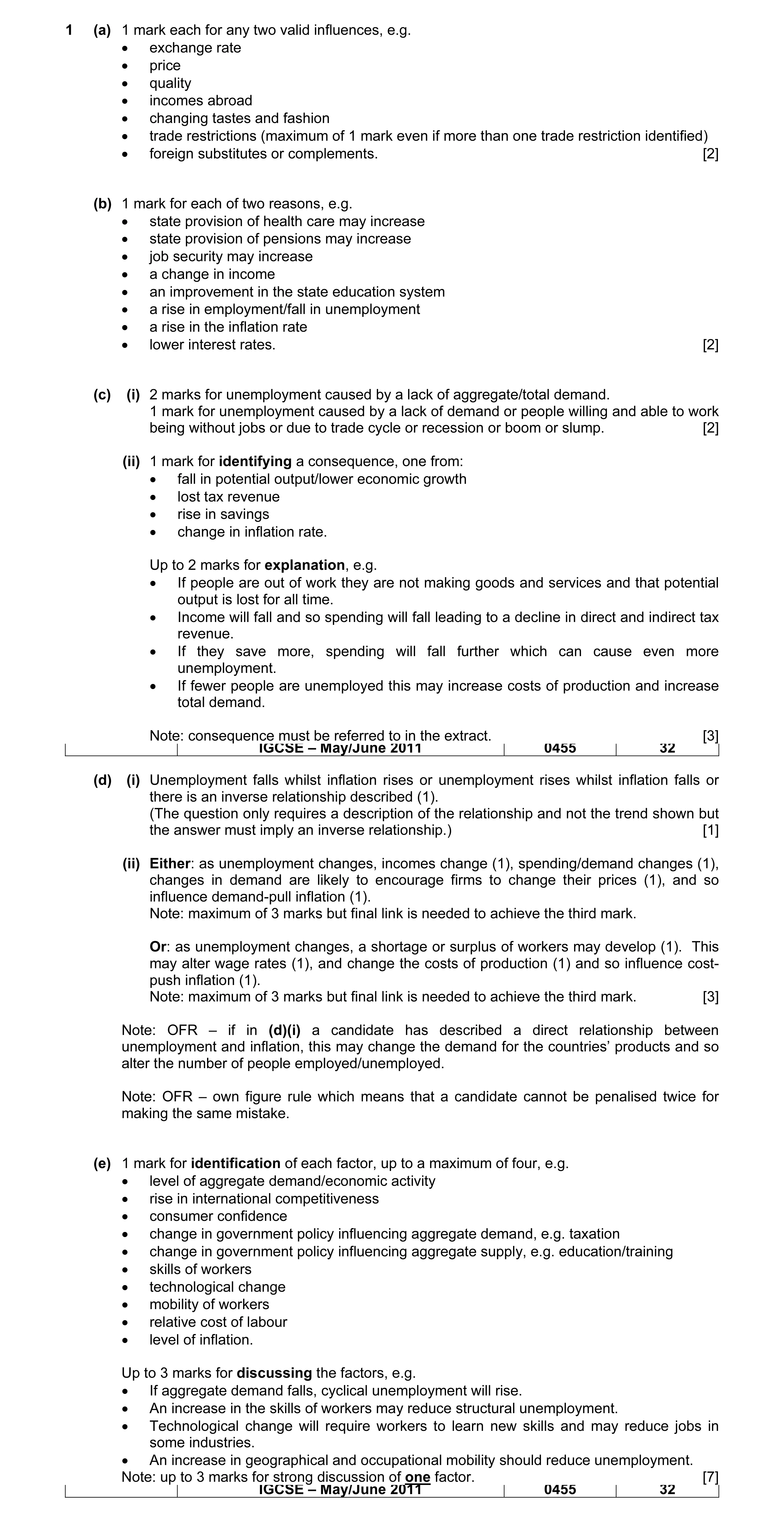 20
20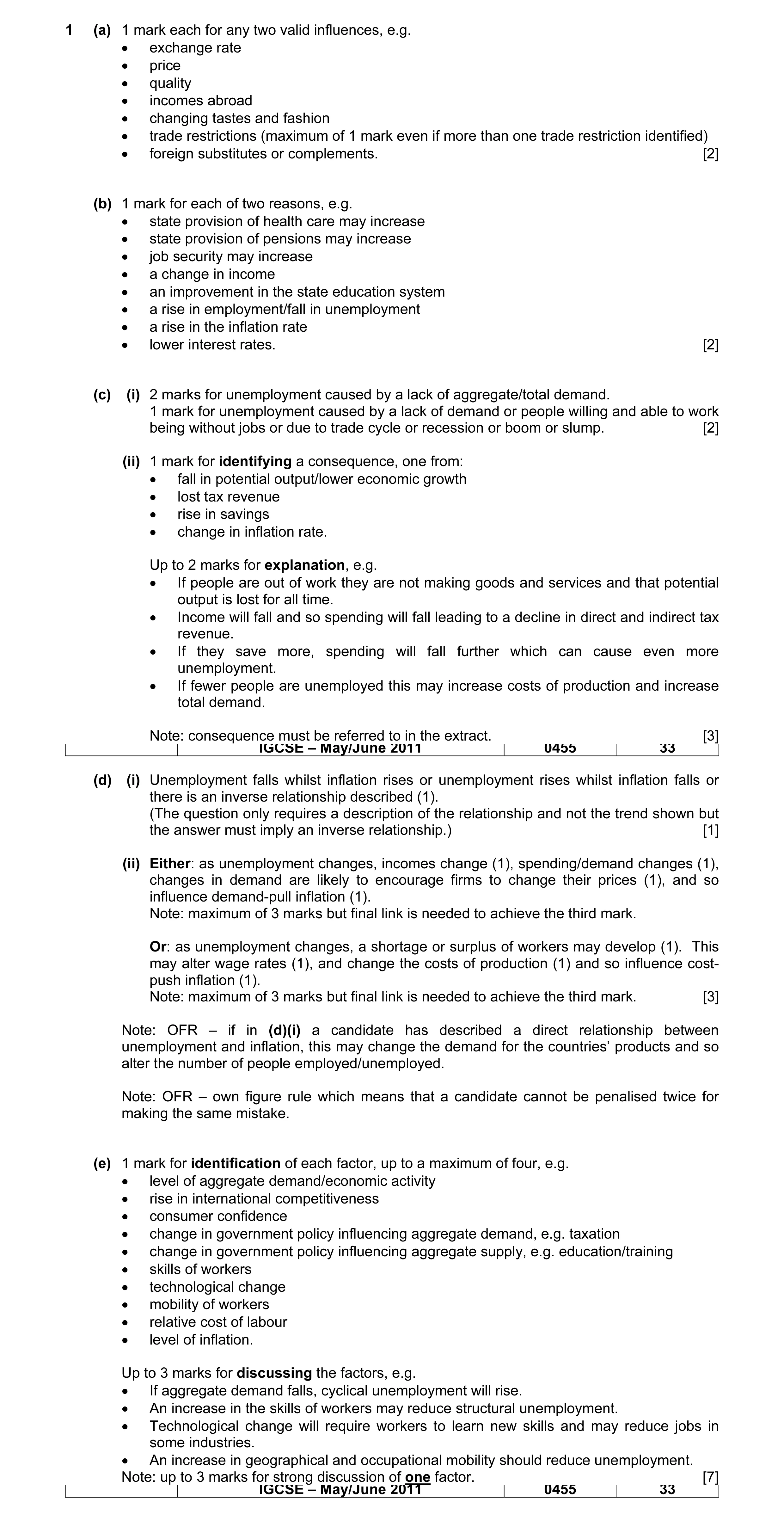 20
20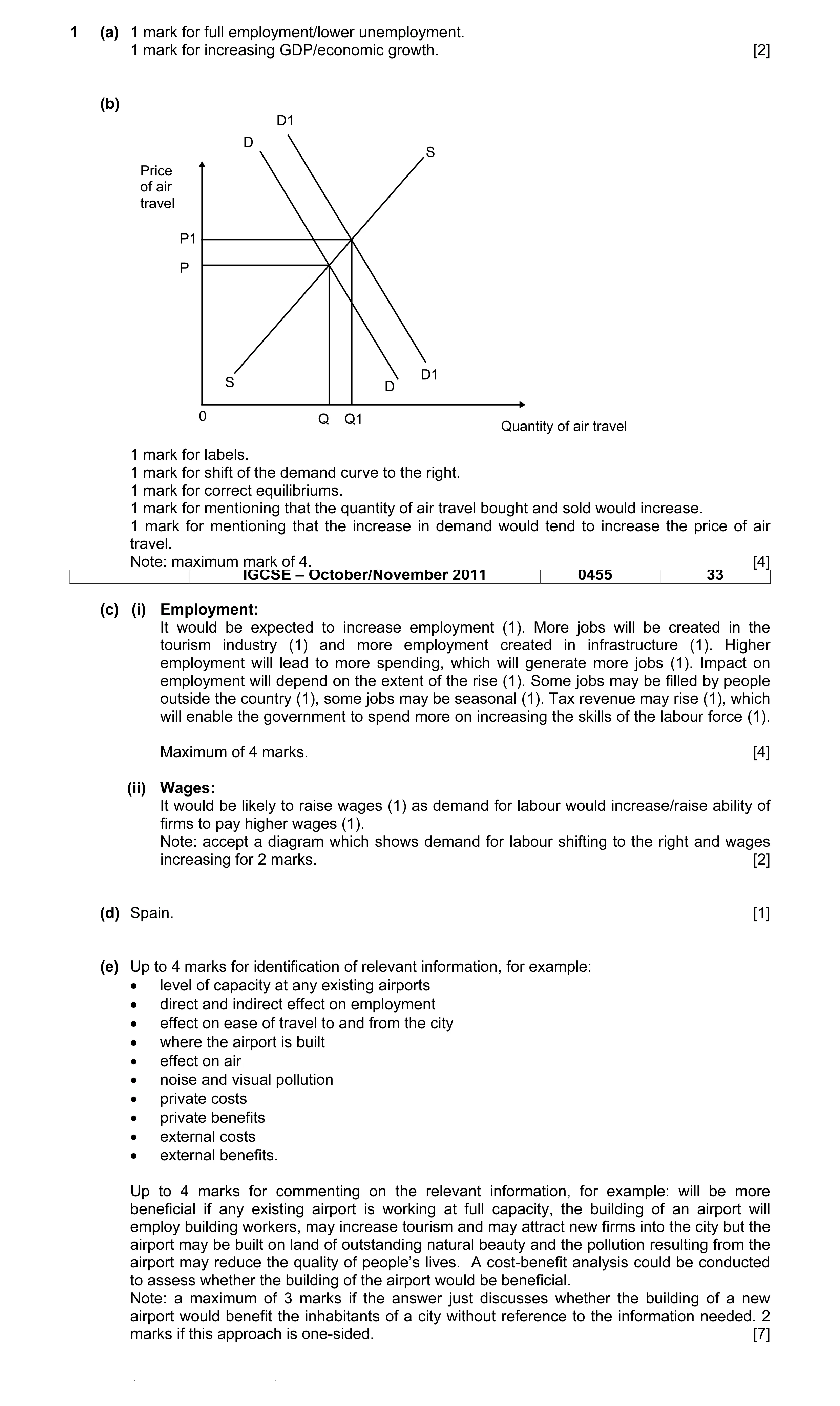 20
20 14
14 14
14 14
14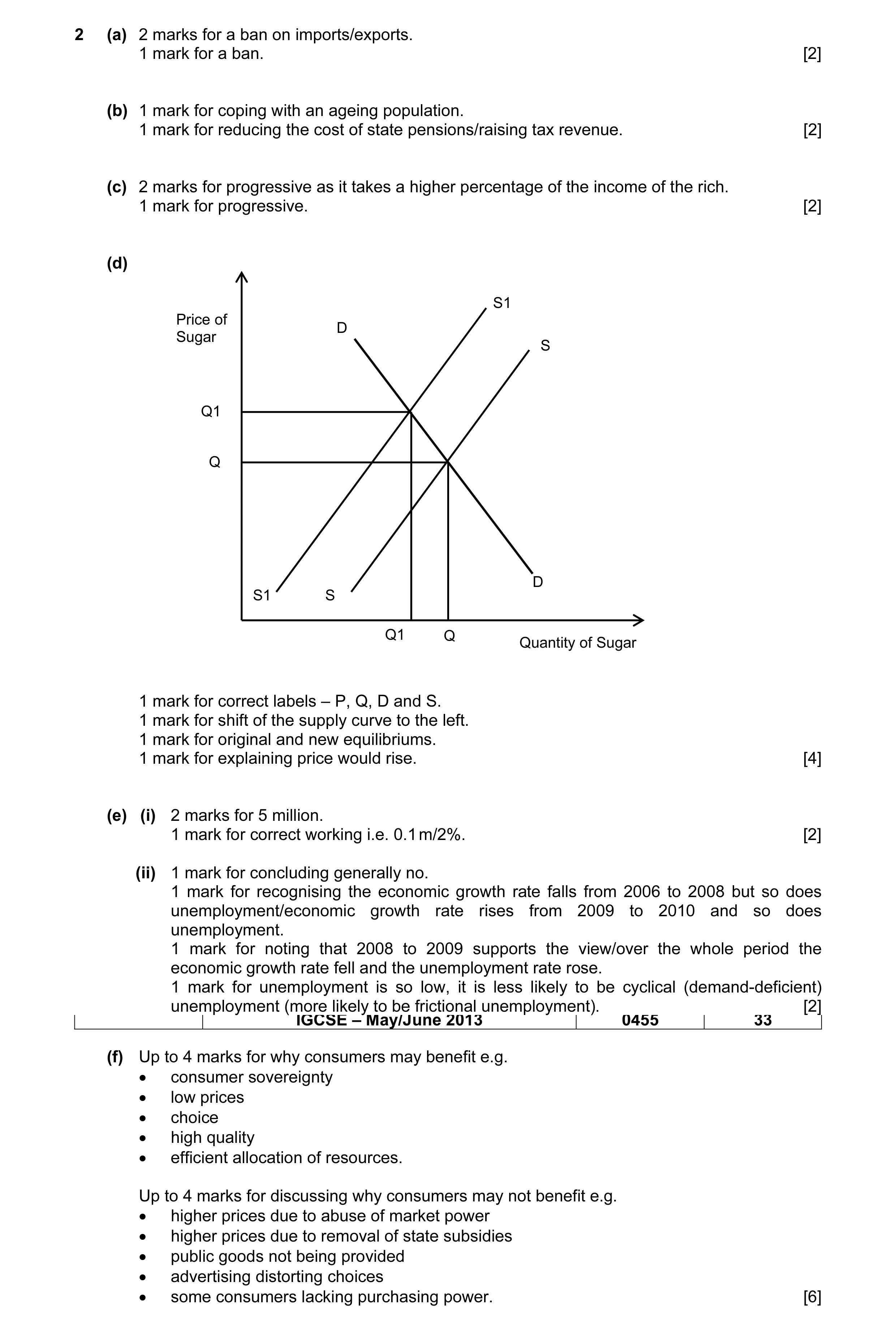 14
14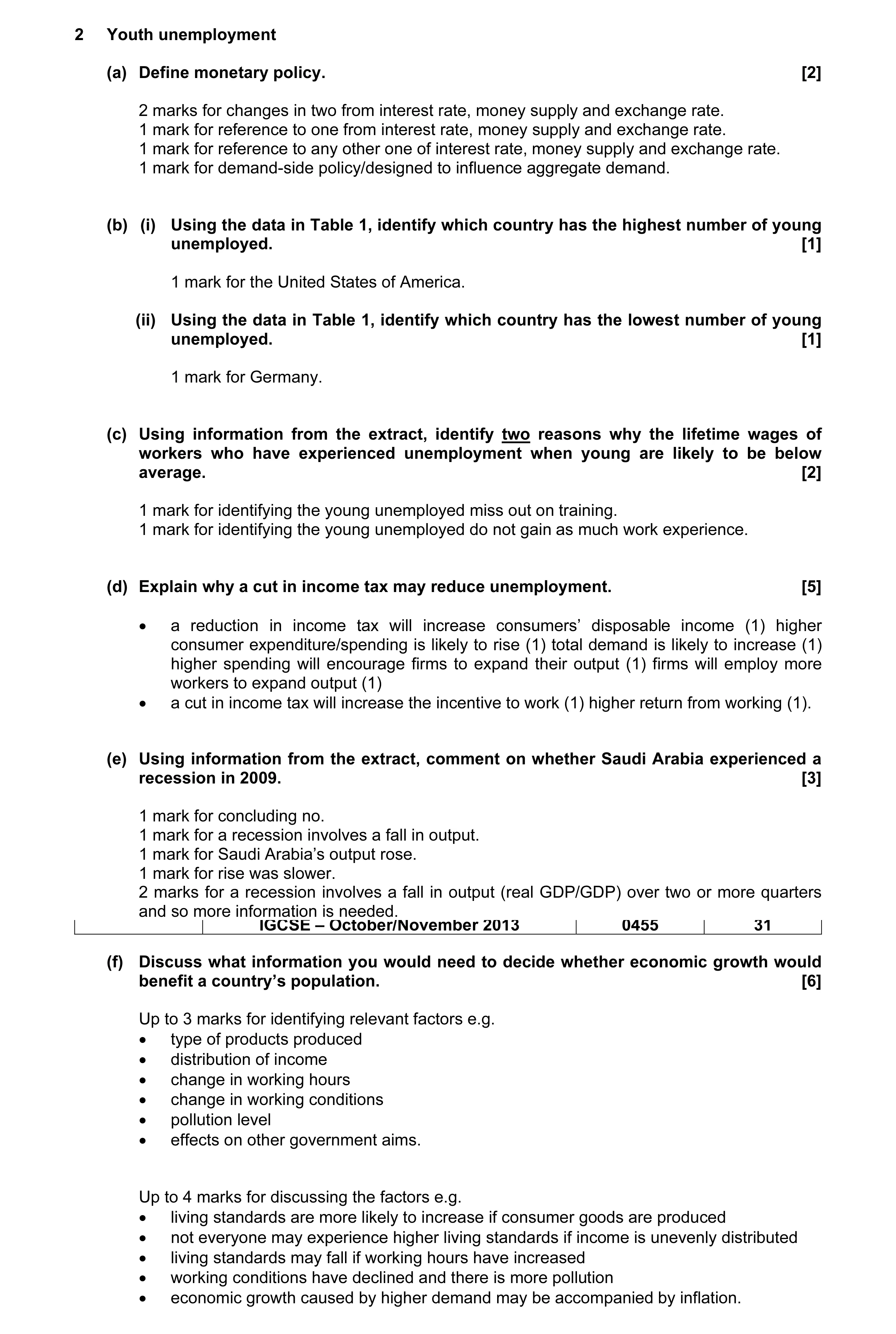 14
14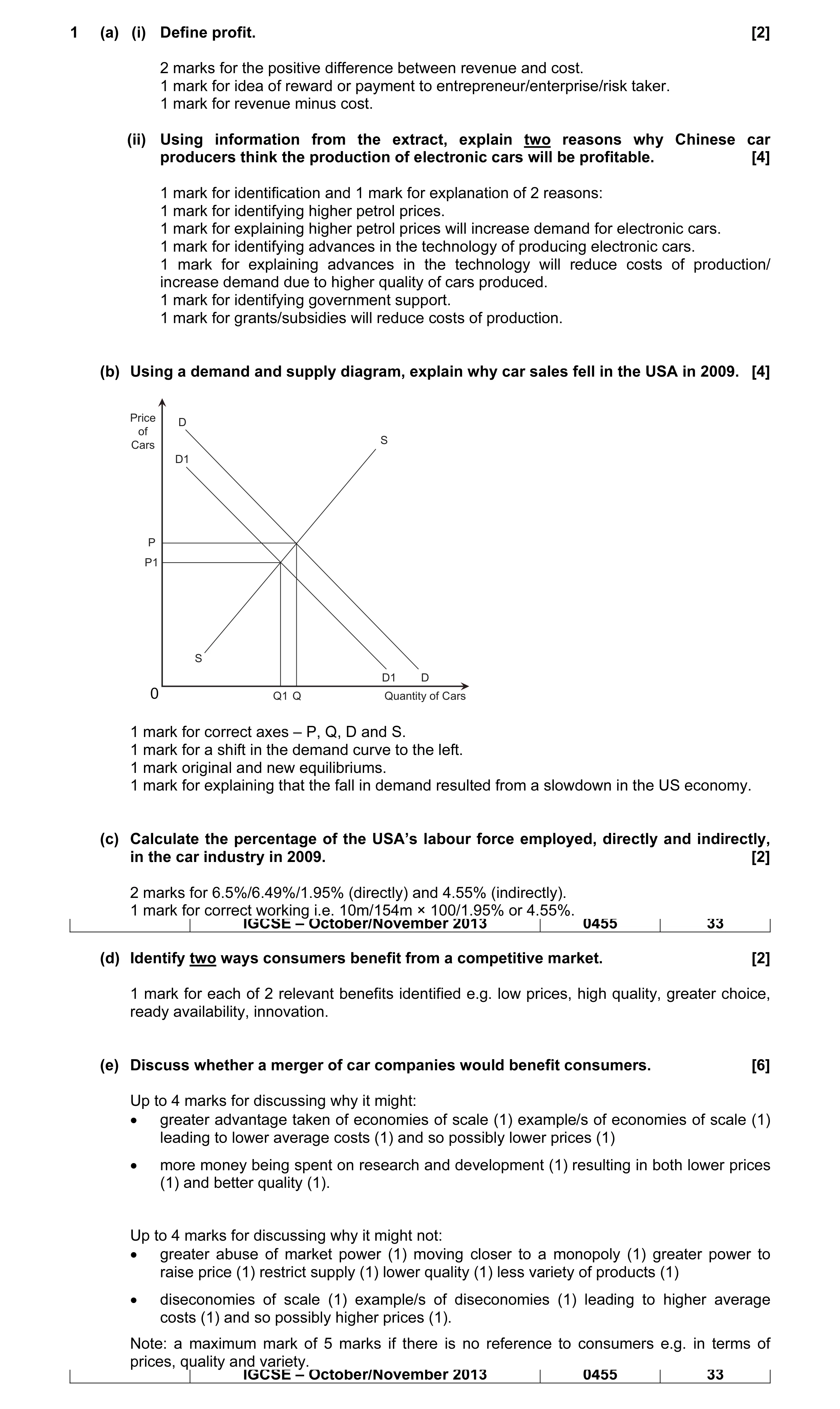 20
20