Cambridge IGCSE Economics 0455 — 2022 Oct/Nov Paper 2 · Variant 1
0455/21/O/N/22 · 5 questions · 90 marks · ≈101 min
The question paper and its mark scheme, free to read here and free to download. This is Cambridge’s own paper, exactly as it was sat.
Question paper8 pages
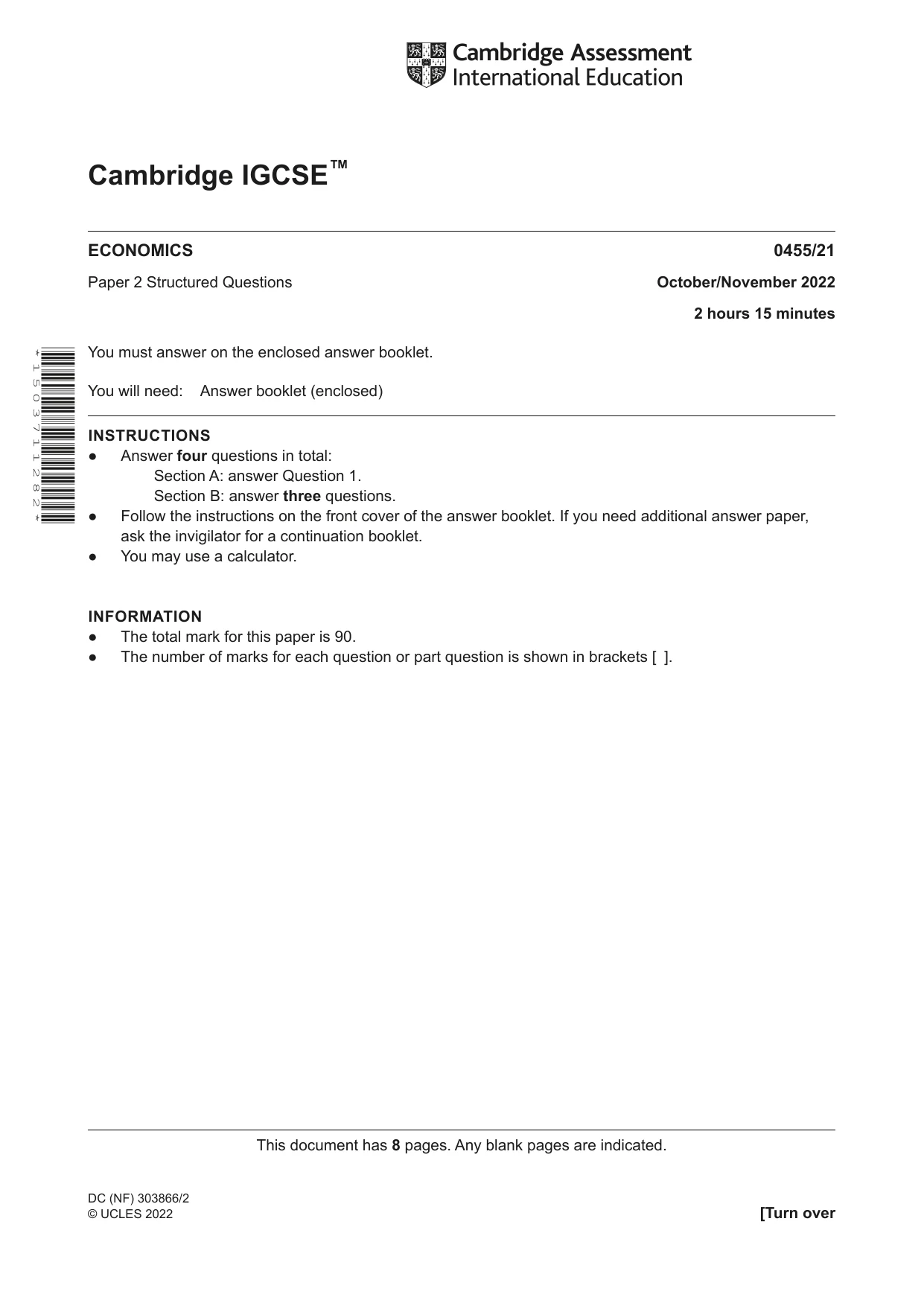



Mark scheme22 pages
Answers below. Sit the paper first if you are practising.

Questions as text
Q1 · Calculate the total value of the tertiary sector in Mauritius in 2019
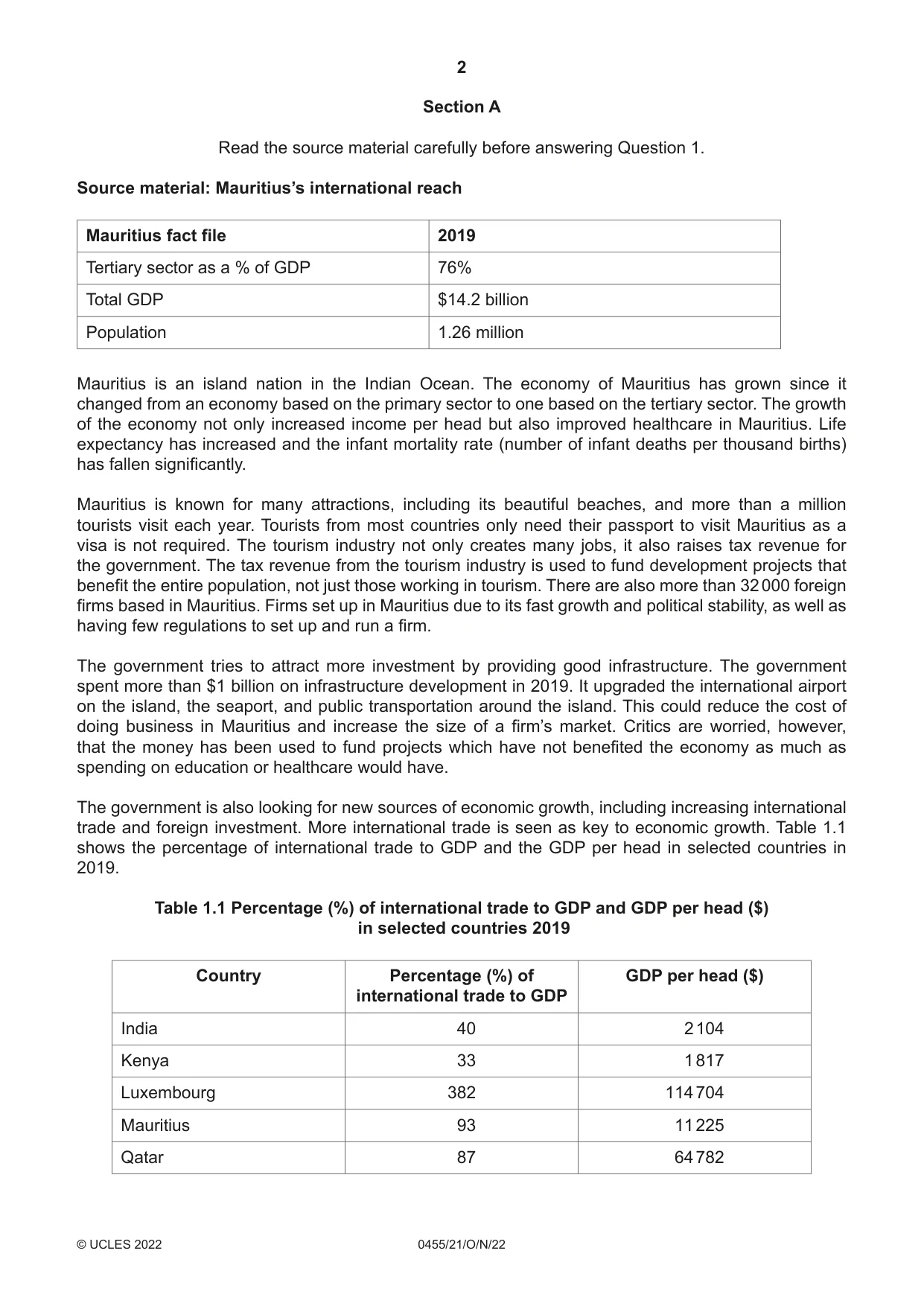
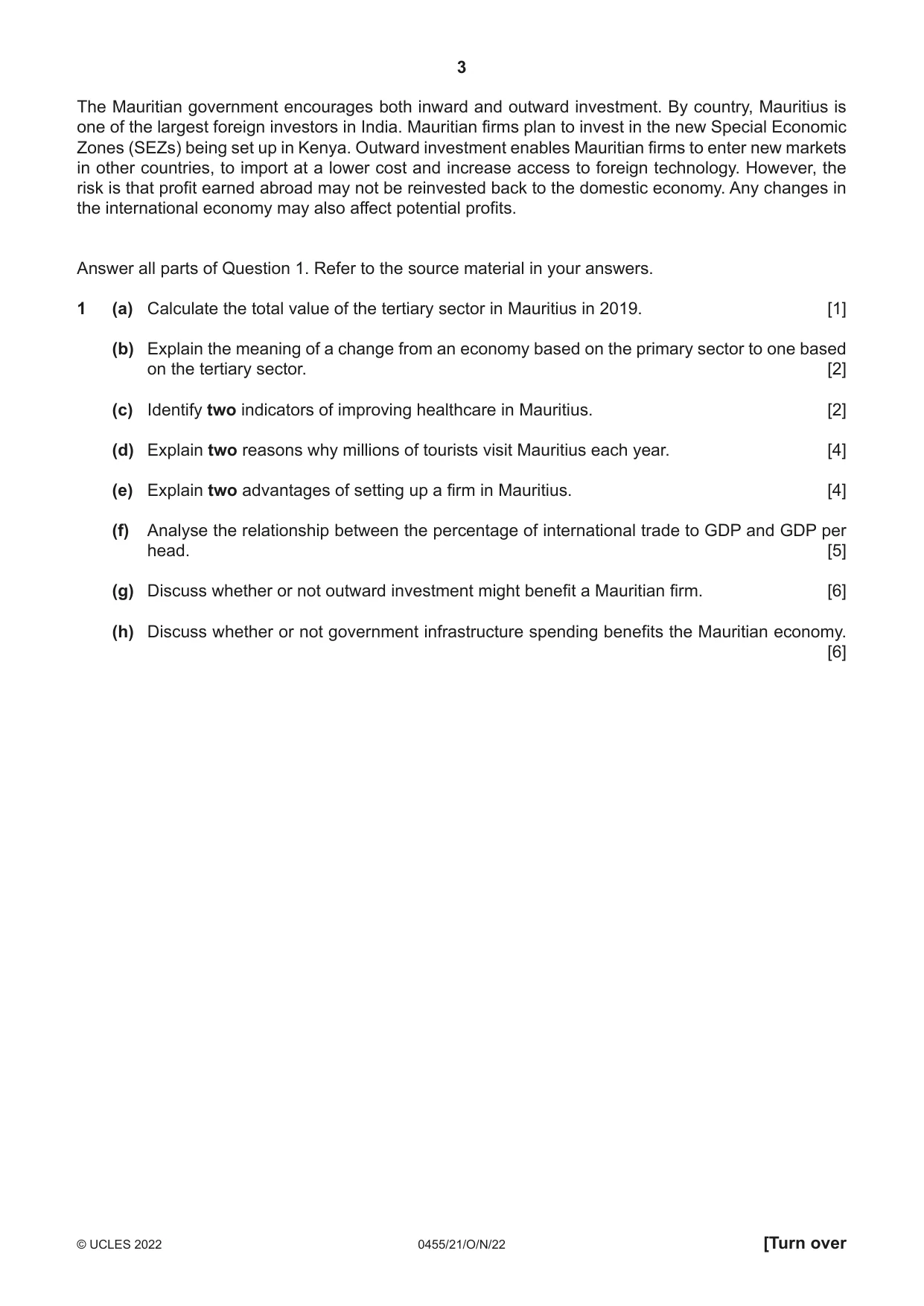
1 (a) Calculate the total value of the tertiary sector in Mauritius in 2019. [1] (b) Explain the meaning of a change from an economy based on the primary sector to one based on the tertiary sector. [2] (c) Identify two indicators of improving healthcare in Mauritius. [2] (d) Explain two reasons why millions of tourists visit Mauritius each year. [4] (e) Explain two advantages of setting up a firm in Mauritius. [4] (f) Analyse the relationship between the percentage of international trade to GDP and GDP per head. [5] (g) Discuss whether or not outward investment might benefit a Mauritian firm. [6] (h) Discuss whether or not government infrastructure spending benefits the Mauritian economy. [6]
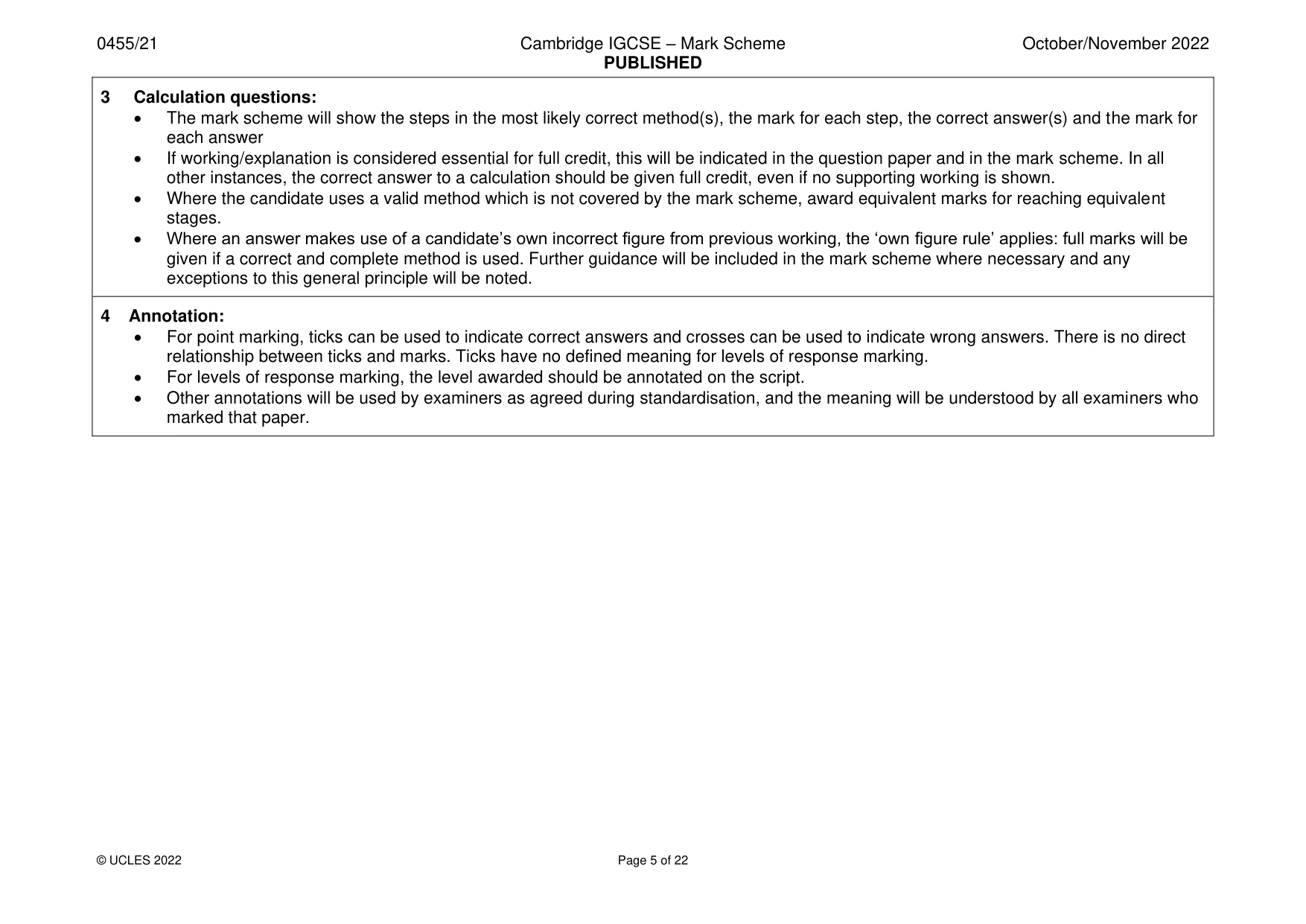
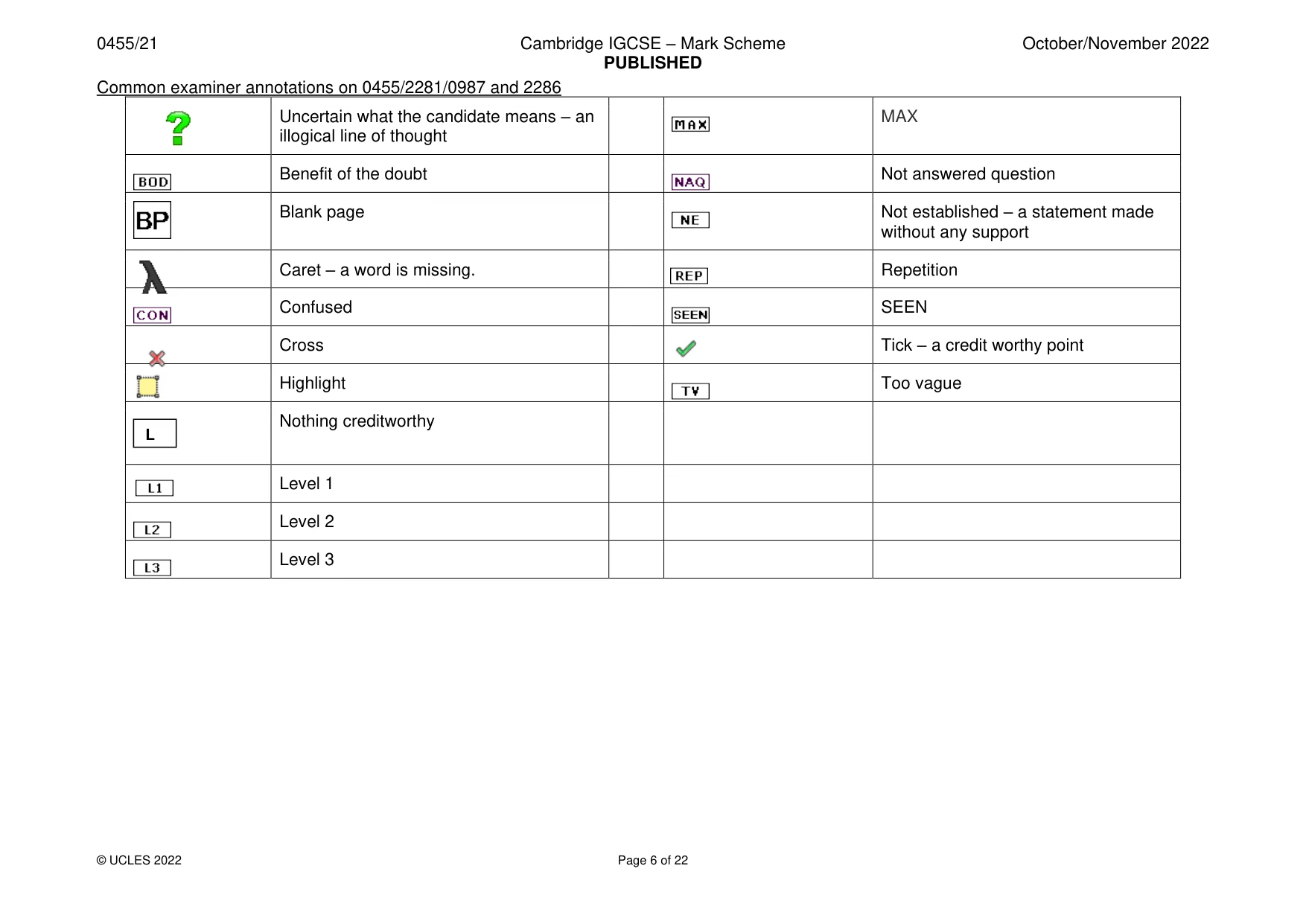
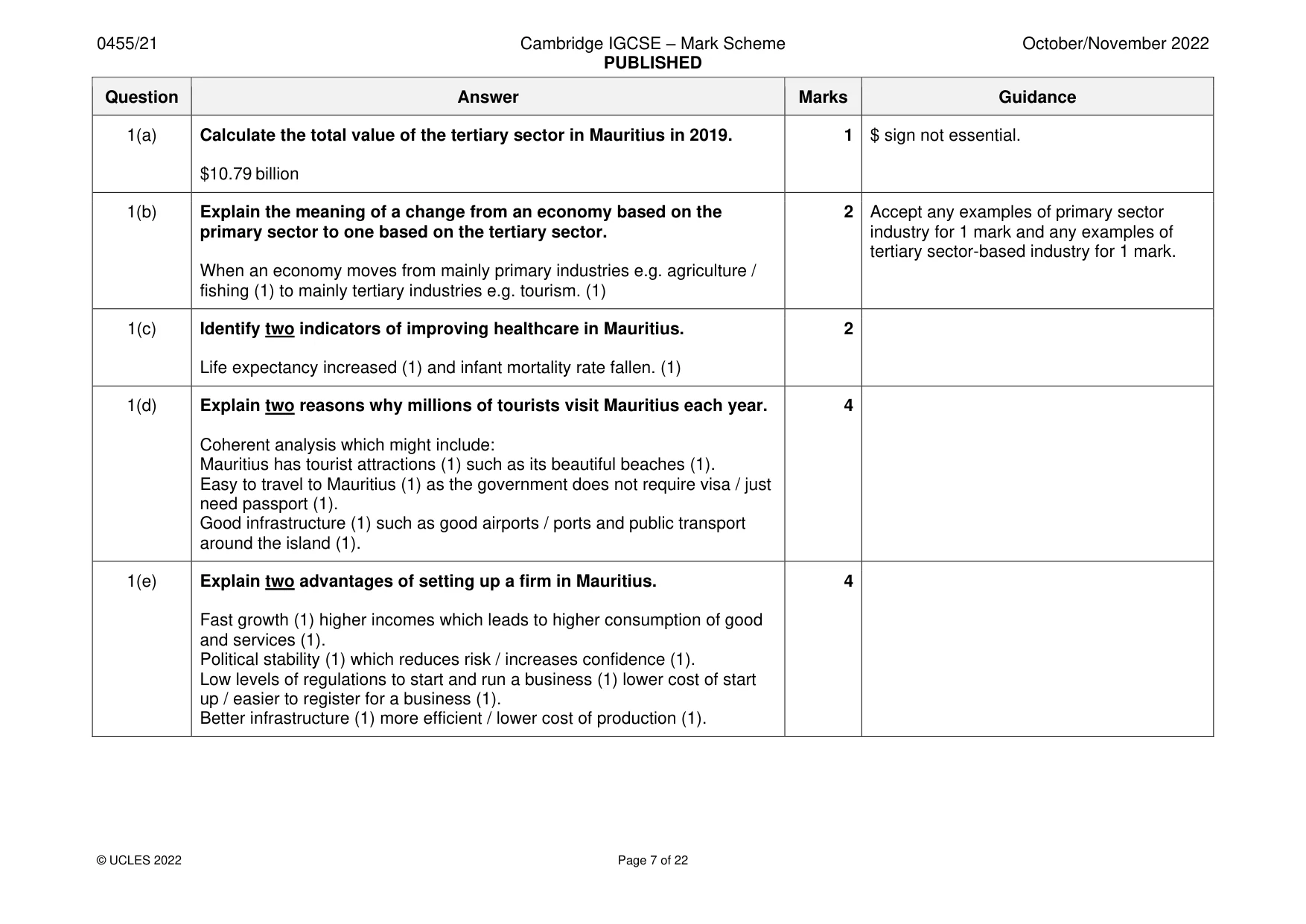
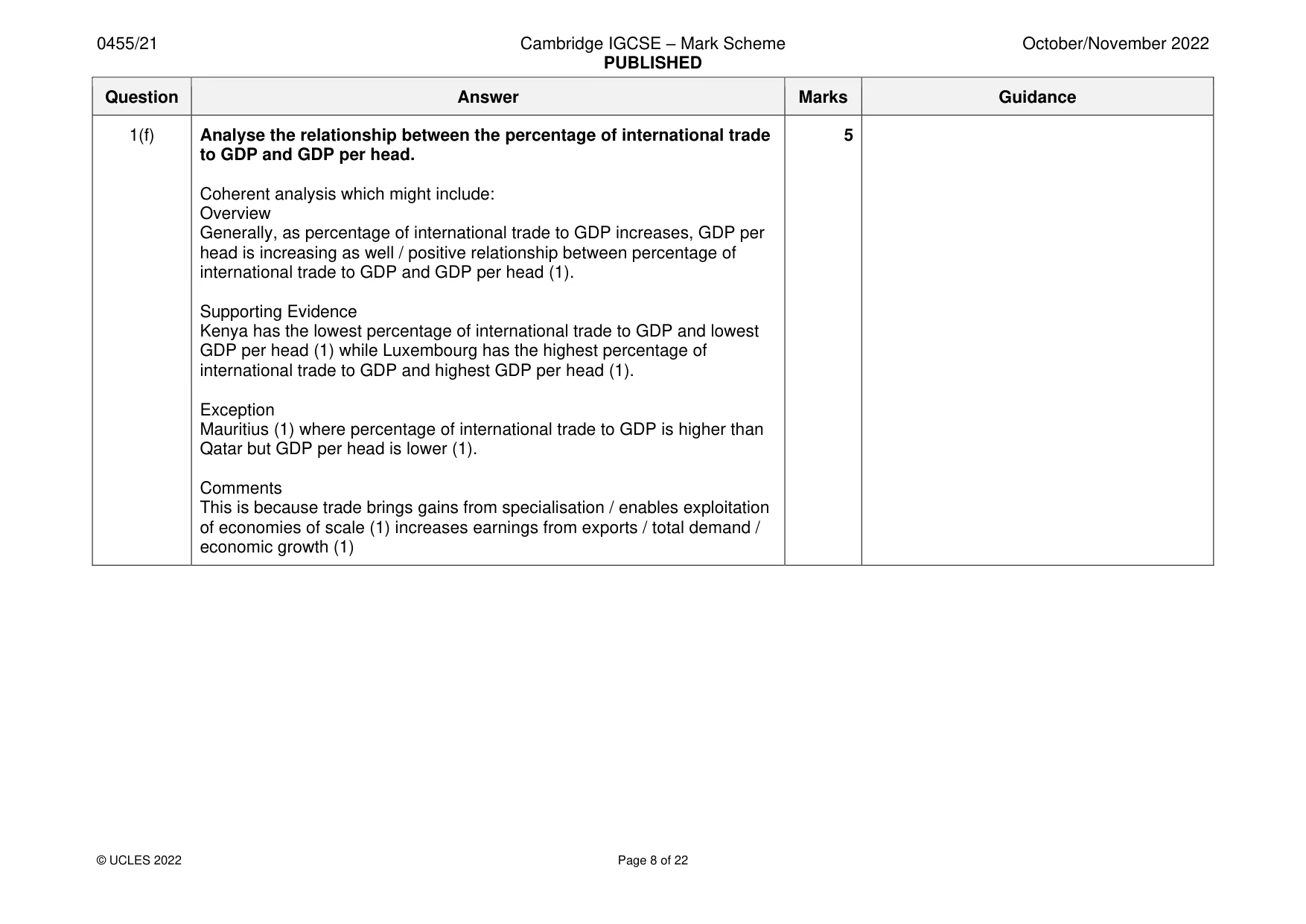
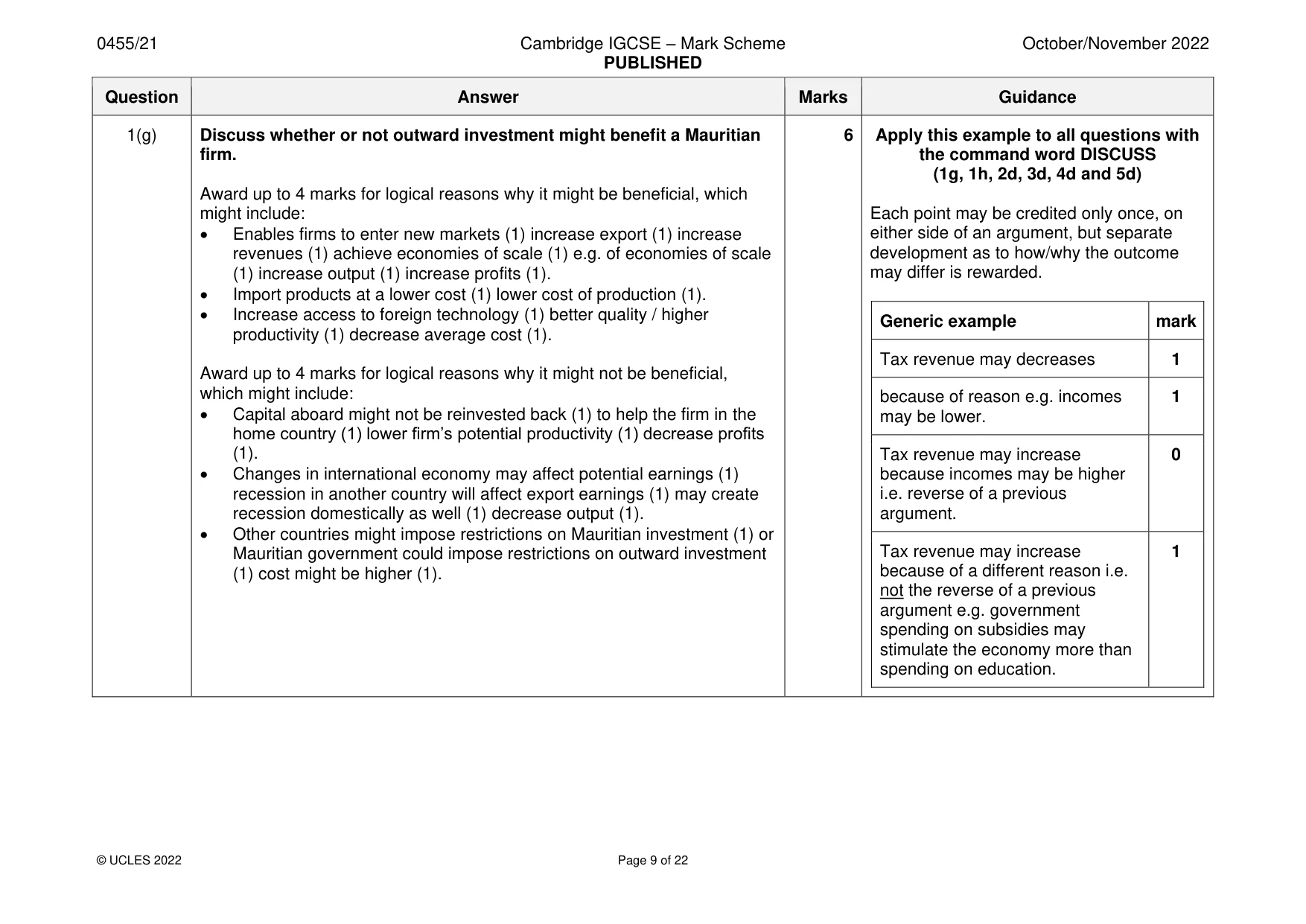
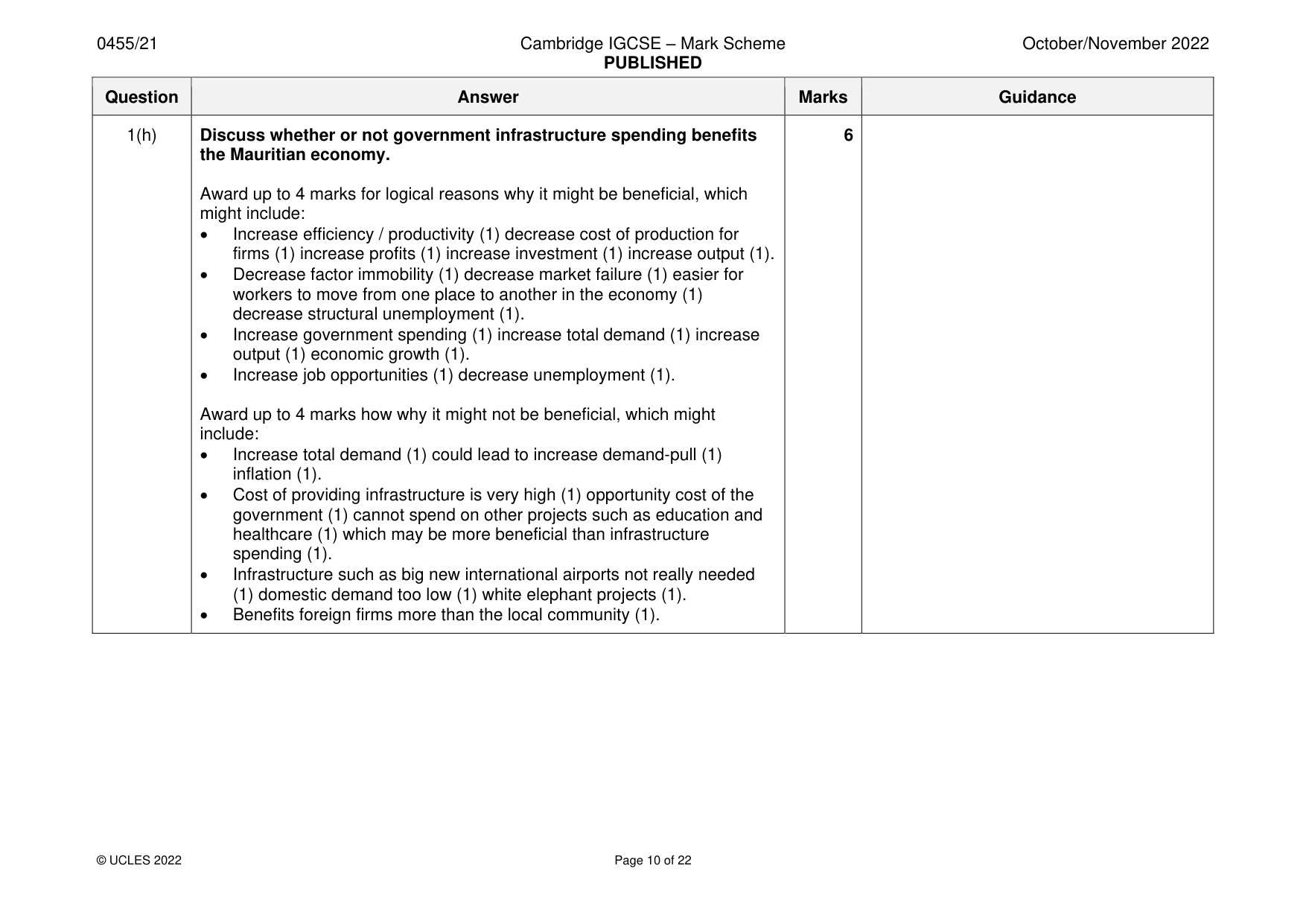
Mark scheme: Question Answer Marks Guidance 1(a) Calculate the total value of the tertiary sector in Mauritius in 2019. 1 $ sign not essential. $10.79 billion 1(b) Explain the meaning of a change from an economy based on the 2 Accept any examples of primary sector primary sector to one based on the tertiary sector. industry for 1 mark and any examples of tertiary sector-based industry for 1 mark. When an economy moves from mainly primary industries e.g. agriculture / fishing (1) to mainly tertiary industries e.g. tourism. (1) 1(c) Identify two indicators of improving healthcare in Mauritius. 2 Life expectancy increased (1) and infant mortality rate fallen. (1) 1(d) Explain two reasons why millions of tourists visit Mauritius each year. 4 Coherent analysis which might include: Mauritius has tourist attractions (1) such as its beautiful beaches (1). Easy to travel to Mauritius (1) as the government does not require visa / just need passport (1). Good infrastructure (1) such as good airports / ports and public transport around the island (1). 1(e) Explain two advantages of setting up a firm in Mauritius. 4 Fast growth (1) higher incomes which leads to higher consumption of good and services (1). Political stability (1) which reduces risk / increases confidence (1). Low levels of regulations to start and run a business (1) lower cost of start up / easier to register for a business (1). Better infrastructure (1) more efficient / lower cost of production (1). 1(f) Analyse the relationship between the percentage of international trade 5 to GDP and GDP per head. Coherent analysis which might include: Overview Generally, as percentage of international trade to GDP increases, GDP per head is increasing as well / positive relationship between percentage of international trade to GDP and GDP per head (1). Supporting Evidence Kenya has the lowest percentage of international trade to GDP and lowest GDP per head (1) while Luxembourg has the highest percentage of international trade to GDP and highest GDP per head (1). Exception Mauritius (1) where percentage of international trade to GDP is higher than Qatar but GDP per head is lower (1). Comments This is because trade brings gains from specialisation / enables exploitation of economies of scale (1) increases earnings from exports / total demand / economic growth (1) 1(g) Discuss whether or not outward investment might benefit a Mauritian 6 Apply this example to all questions with firm. the command word DISCUSS (1g, 1h, 2d, 3d, 4d and 5d) Award up to 4 marks for logical reasons why it might be beneficial, which might include: Each point may be credited only once, on • Enables firms to enter new markets (1) increase export (1) increase either side of an argument, but separate revenues (1) achieve economies of scale (1) e.g. of economies of scale development as to how/why the outcome (1) increase output (1) increase profits (1). may differ is rewarded. • Import products at a lower cost (1) lower cost of production (1). • Increase access to foreign technology (1) better quality / higher Generic example mark productivity (1) decrease average cost (1). Tax revenue may decreases 1 Award up to 4 marks for logical reasons why it might not be beneficial, which might include: because of reason e.g. incomes 1 • Capital aboard might not be reinvested back (1) to help the firm in the may be lower. home country (1) lower firm’s potential productivity (1) decrease profits (1). Tax revenue may increase 0 • Changes in international economy may affect potential earnings (1) because incomes may be higher recession in another country will affect export earnings (1) may create i.e. reverse of a previous recession domestically as well (1) decrease output (1). argument. • Other countries might impose restrictions on Mauritian investment (1) or Mauritian government could impose restrictions on outward investment Tax revenue may increase 1 (1) cost might be higher (1). because of a different reason i.e. not the reverse of a previous argument e.g. government spending on subsidies may stimulate the economy more than spending on education. 1(h) Discuss whether or not government infrastructure spending benefits 6 the Mauritian economy. Award up to 4 marks for logical reasons why it might be beneficial, which might include: • Increase efficiency / productivity (1) decrease cost of production for firms (1) increase profits (1) increase investment (1) increase output (1). • Decrease factor immobility (1) decrease market failure (1) easier for workers to move from one place to another in the economy (1) decrease structural unemployment (1). • Increase government spending (1) increase total demand (1) increase output (1) economic growth (1). • Increase job opportunities (1) decrease unemployment (1). Award up to 4 marks how why it might not be beneficial, which might include: • Increase total demand (1) could lead to increase demand-pull (1) inflation (1). • Cost of providing infrastructure is very high (1) opportunity cost of the government (1) cannot spend on other projects such as education and healthcare (1) which may be more beneficial than infrastructure spending (1). • Infrastructure such as big new international airports not really needed (1) domestic demand too low (1) white elephant projects (1). • Benefits foreign firms more than the local community (1).
Q2 · Medan is the third largest city in Indonesia by population
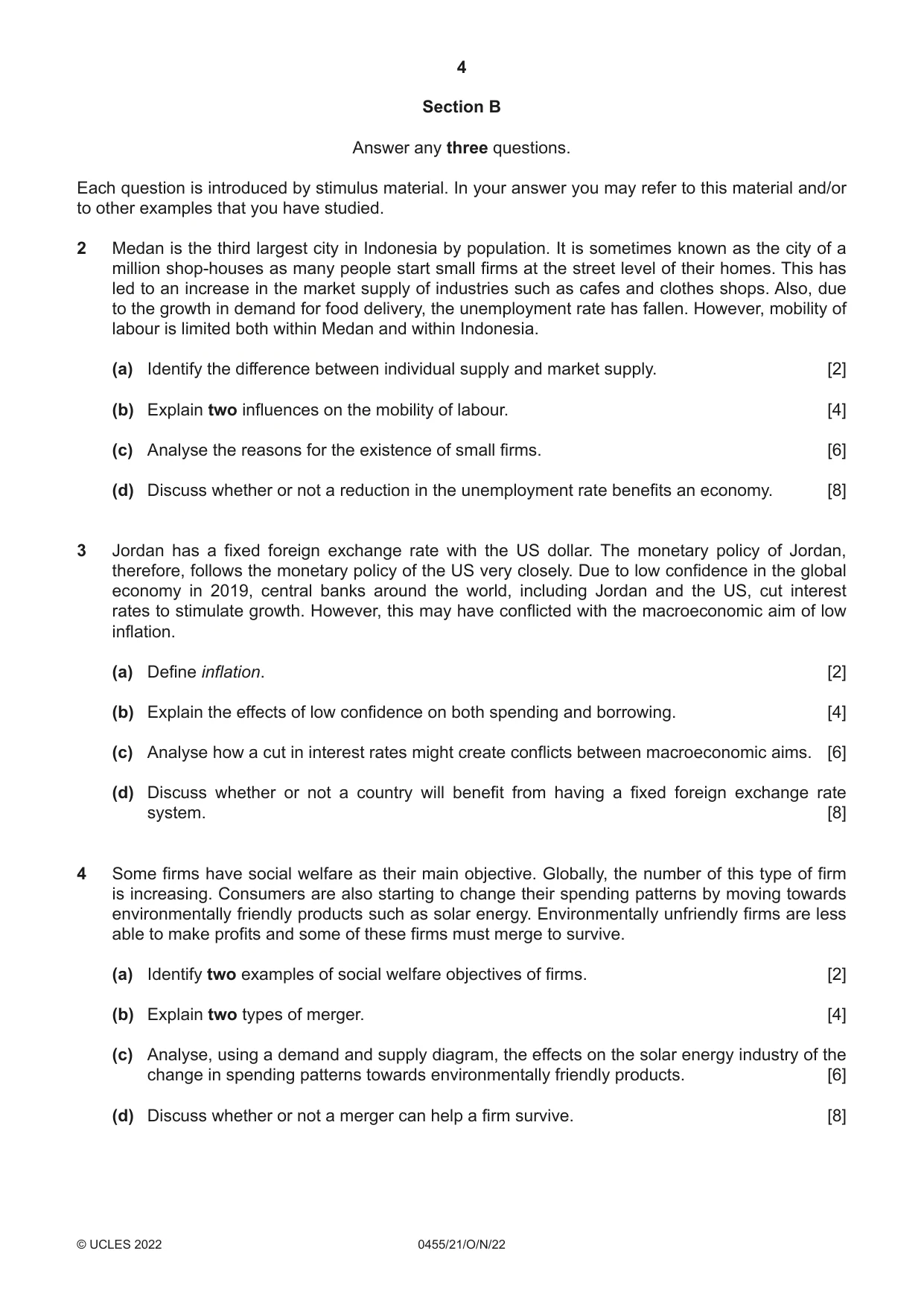
2 Medan is the third largest city in Indonesia by population. It is sometimes known as the city of a million shop-houses as many people start small firms at the street level of their homes. This has led to an increase in the market supply of industries such as cafes and clothes shops. Also, due to the growth in demand for food delivery, the unemployment rate has fallen. However, mobility of labour is limited both within Medan and within Indonesia. (a) Identify the difference between individual supply and market supply. [2] (b) Explain two influences on the mobility of labour. [4] (c) Analyse the reasons for the existence of small firms. [6] (d) Discuss whether or not a reduction in the unemployment rate benefits an economy. [8]
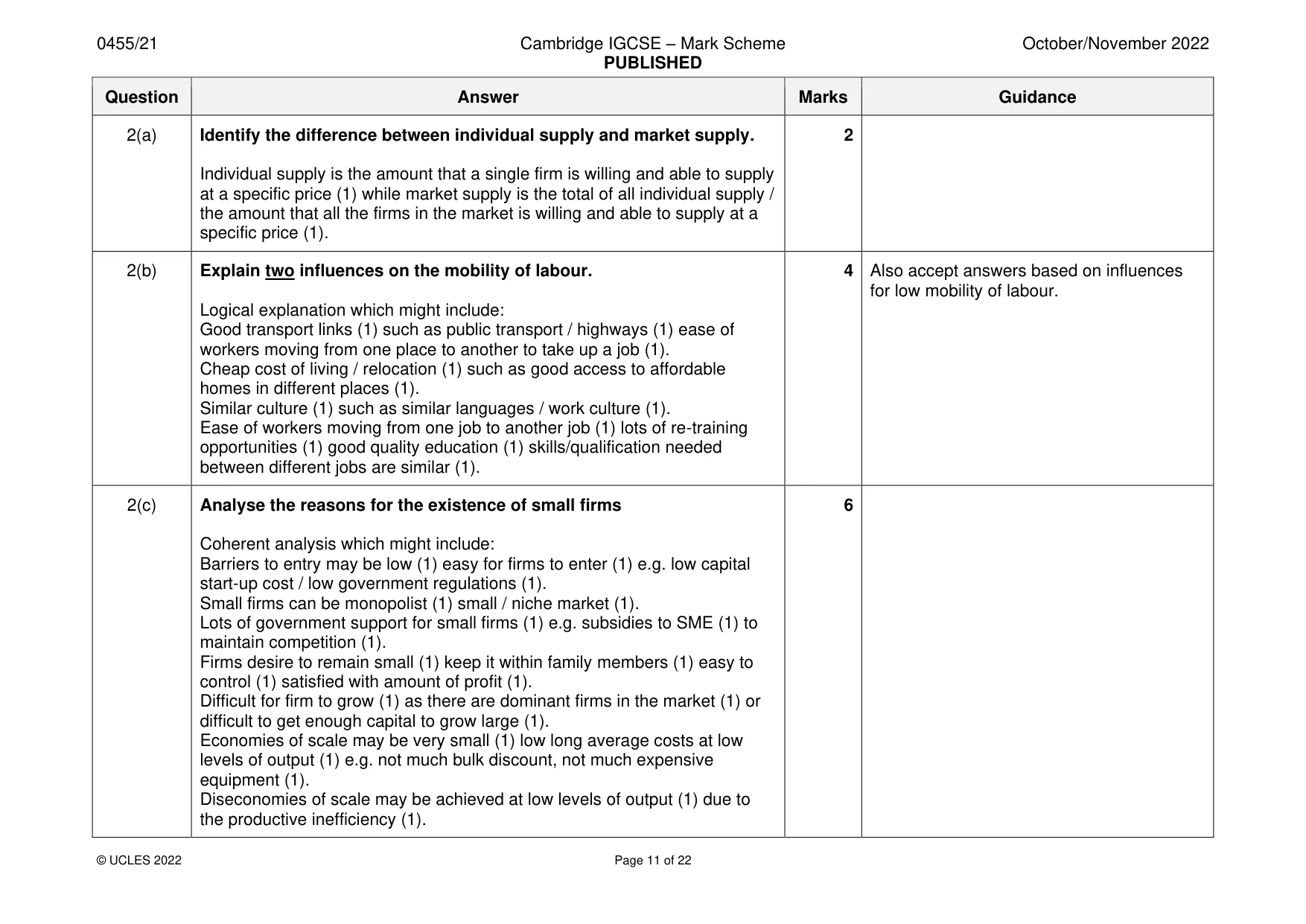
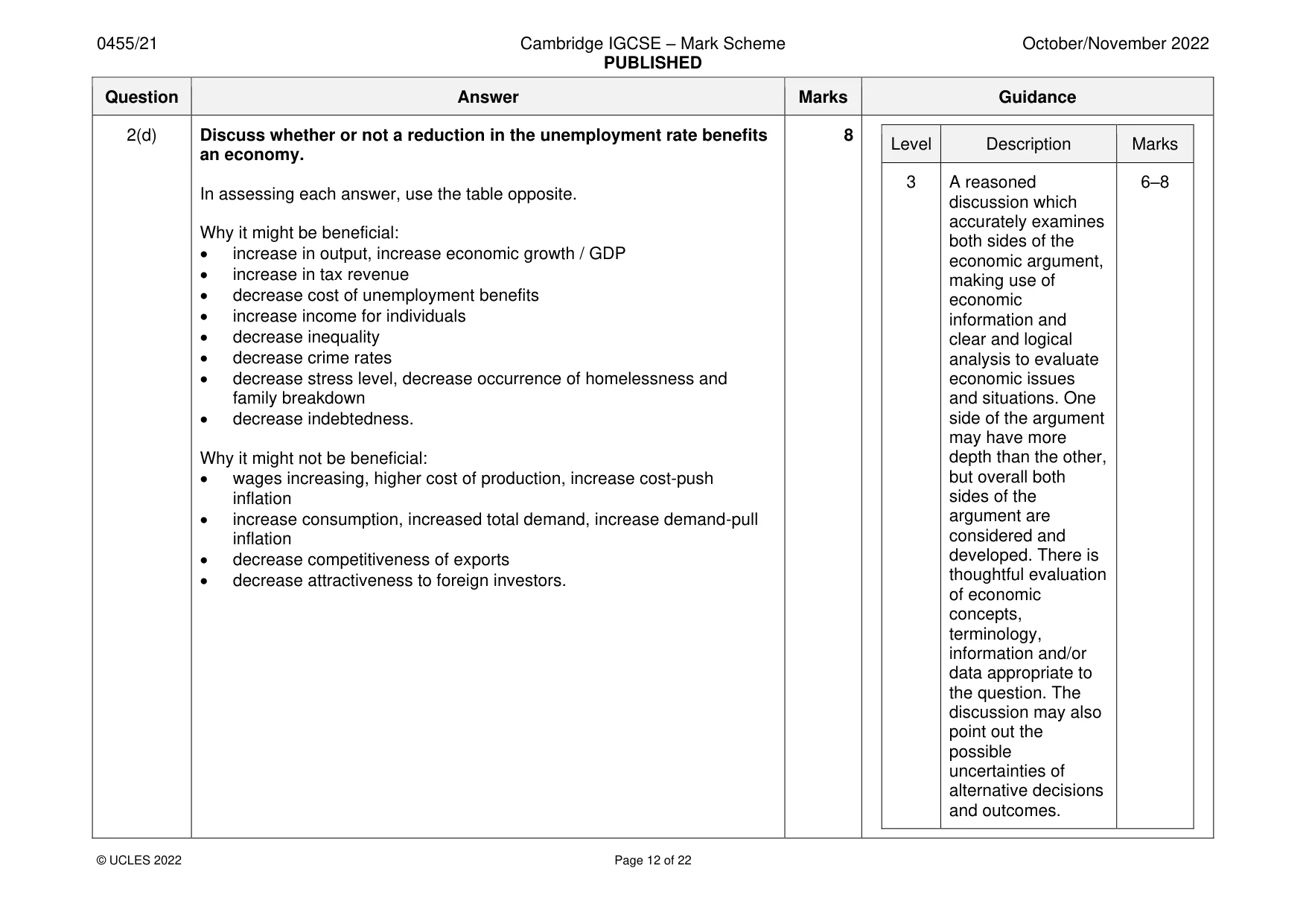
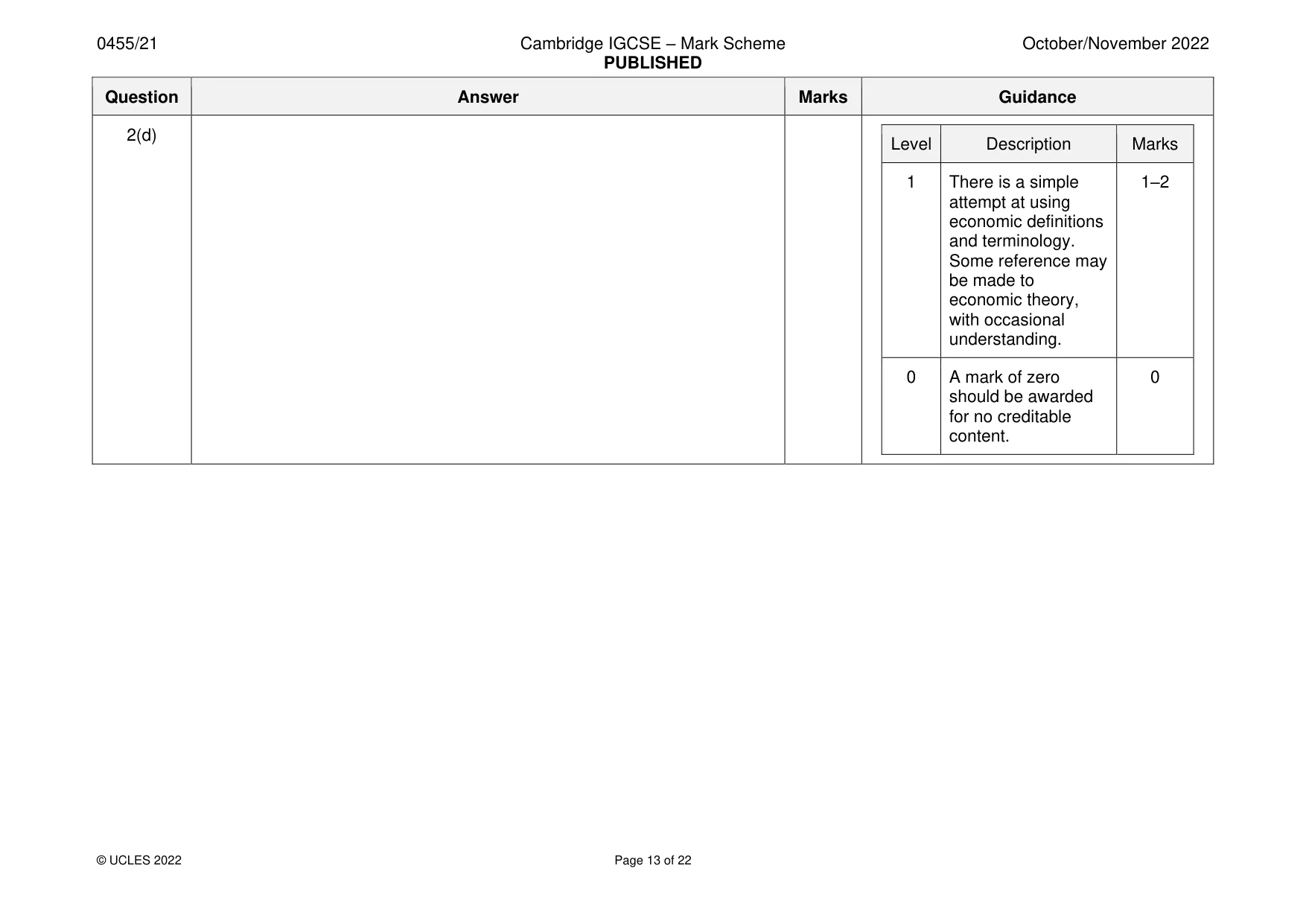
Mark scheme: 2(a) Identify the difference between individual supply and market supply. 2 Individual supply is the amount that a single firm is willing and able to supply at a specific price (1) while market supply is the total of all individual supply / the amount that all the firms in the market is willing and able to supply at a specific price (1). 2(b) Explain two influences on the mobility of labour. 4 Also accept answers based on influences for low mobility of labour. Logical explanation which might include: Good transport links (1) such as public transport / highways (1) ease of workers moving from one place to another to take up a job (1). Cheap cost of living / relocation (1) such as good access to affordable homes in different places (1). Similar culture (1) such as similar languages / work culture (1). Ease of workers moving from one job to another job (1) lots of re-training opportunities (1) good quality education (1) skills/qualification needed between different jobs are similar (1). 2(c) Analyse the reasons for the existence of small firms 6 Coherent analysis which might include: Barriers to entry may be low (1) easy for firms to enter (1) e.g. low capital start-up cost / low government regulations (1). Small firms can be monopolist (1) small / niche market (1). Lots of government support for small firms (1) e.g. subsidies to SME (1) to maintain competition (1). Firms desire to remain small (1) keep it within family members (1) easy to control (1) satisfied with amount of profit (1). Difficult for firm to grow (1) as there are dominant firms in the market (1) or difficult to get enough capital to grow large (1). Economies of scale may be very small (1) low long average costs at low levels of output (1) e.g. not much bulk discount, not much expensive equipment (1). Diseconomies of scale may be achieved at low levels of output (1) due to the productive inefficiency (1). 2(d) Discuss whether or not a reduction in the unemployment rate benefits 8 Level Description Marks an economy. 3 A reasoned 6–8 In assessing each answer, use the table opposite. discussion which accurately examines Why it might be beneficial: both sides of the • increase in output, increase economic growth / GDP economic argument, • increase in tax revenue making use of • decrease cost of unemployment benefits economic • increase income for individuals information and • decrease inequality clear and logical • decrease crime rates analysis to evaluate • decrease stress level, decrease occurrence of homelessness and economic issues family breakdown and situations. One • decrease indebtedness. side of the argument may have more Why it might not be beneficial: depth than the other, • wages increasing, higher cost of production, increase cost-push but overall both inflation sides of the • increase consumption, increased total demand, increase demand-pull argument are inflation considered and • decrease competitiveness of exports developed. There is • decrease attractiveness to foreign investors. thoughtful evaluation of economic concepts, terminology, information and/or data appropriate to the question. The discussion may also point out the possible uncertainties of alternative decisions and outcomes. 2(d) Level Description Marks 1 There is a simple 1–2 attempt at using economic definitions and terminology. Some reference may be made to economic theory, with occasional understanding. 0 A mark of zero 0 should be awarded for no creditable content.
Q3 · Jordan has a fixed foreign exchange rate with the US dollar
3 Jordan has a fixed foreign exchange rate with the US dollar. The monetary policy of Jordan, therefore, follows the monetary policy of the US very closely. Due to low confidence in the global economy in 2019, central banks around the world, including Jordan and the US, cut interest rates to stimulate growth. However, this may have conflicted with the macroeconomic aim of low inflation. (a) Define inflation. [2] (b) Explain the effects of low confidence on both spending and borrowing. [4] (c) Analyse how a cut in interest rates might create conflicts between macroeconomic aims. [6] (d) Discuss whether or not a country will benefit from having a fixed foreign exchange rate system. [8]
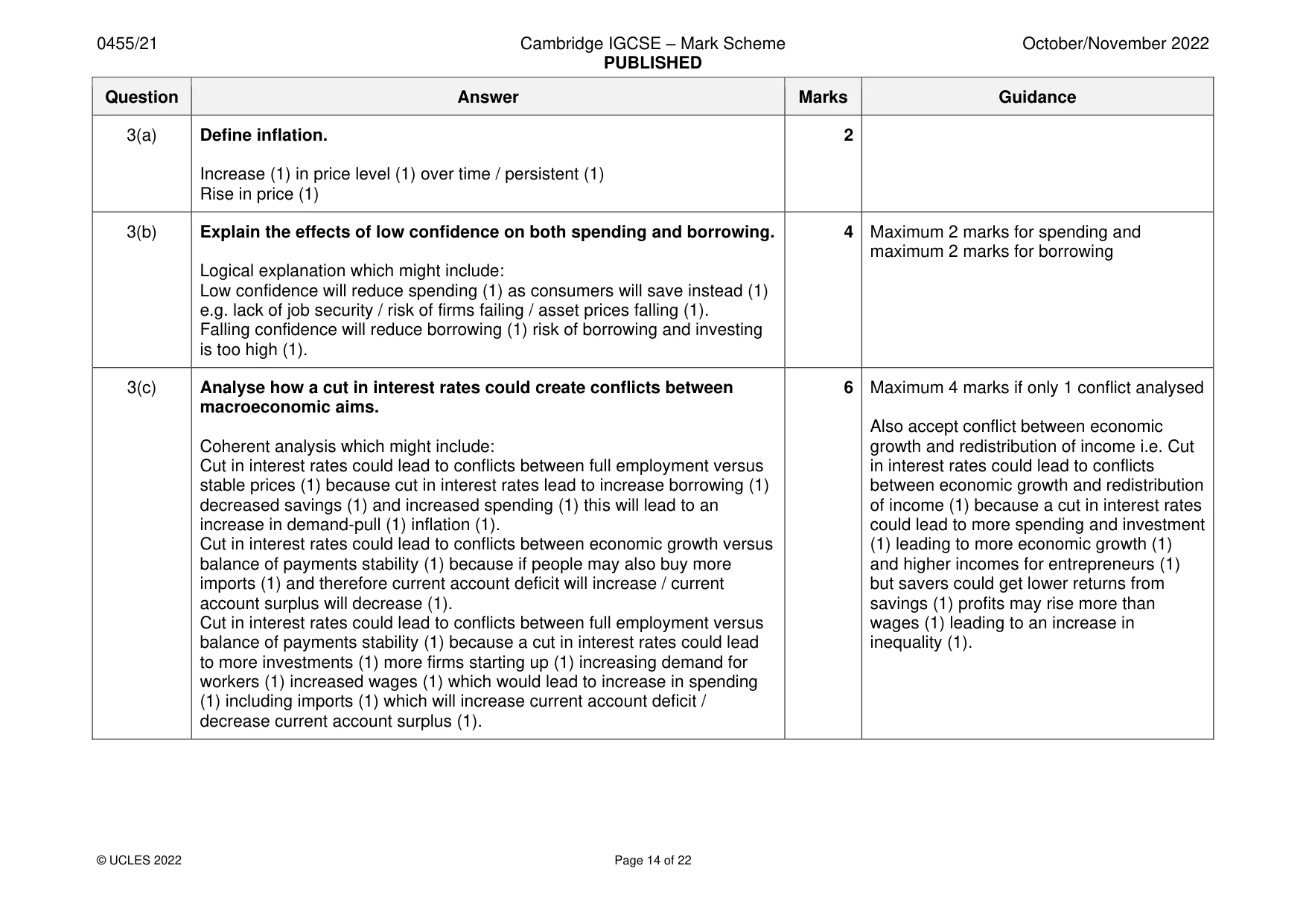
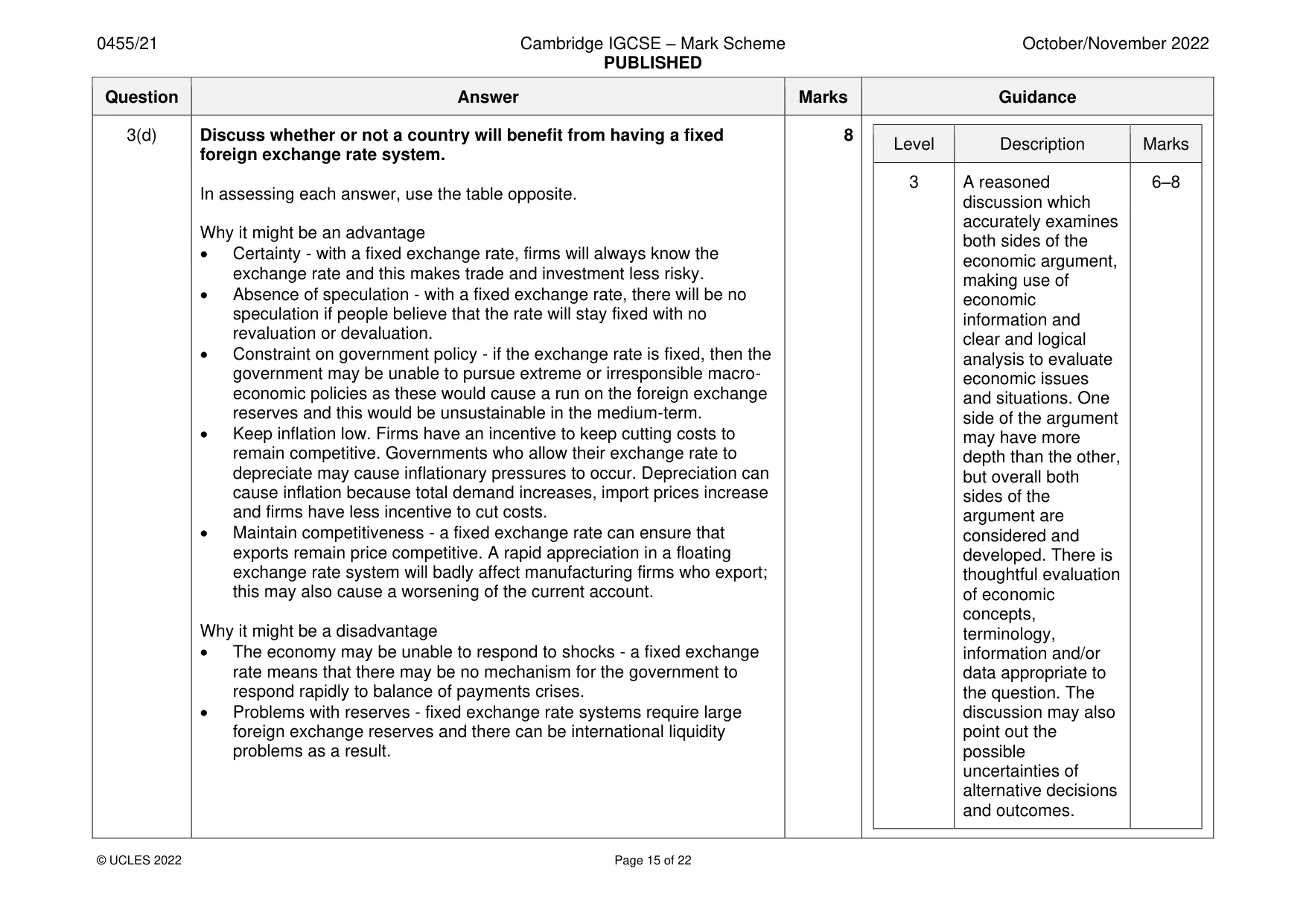
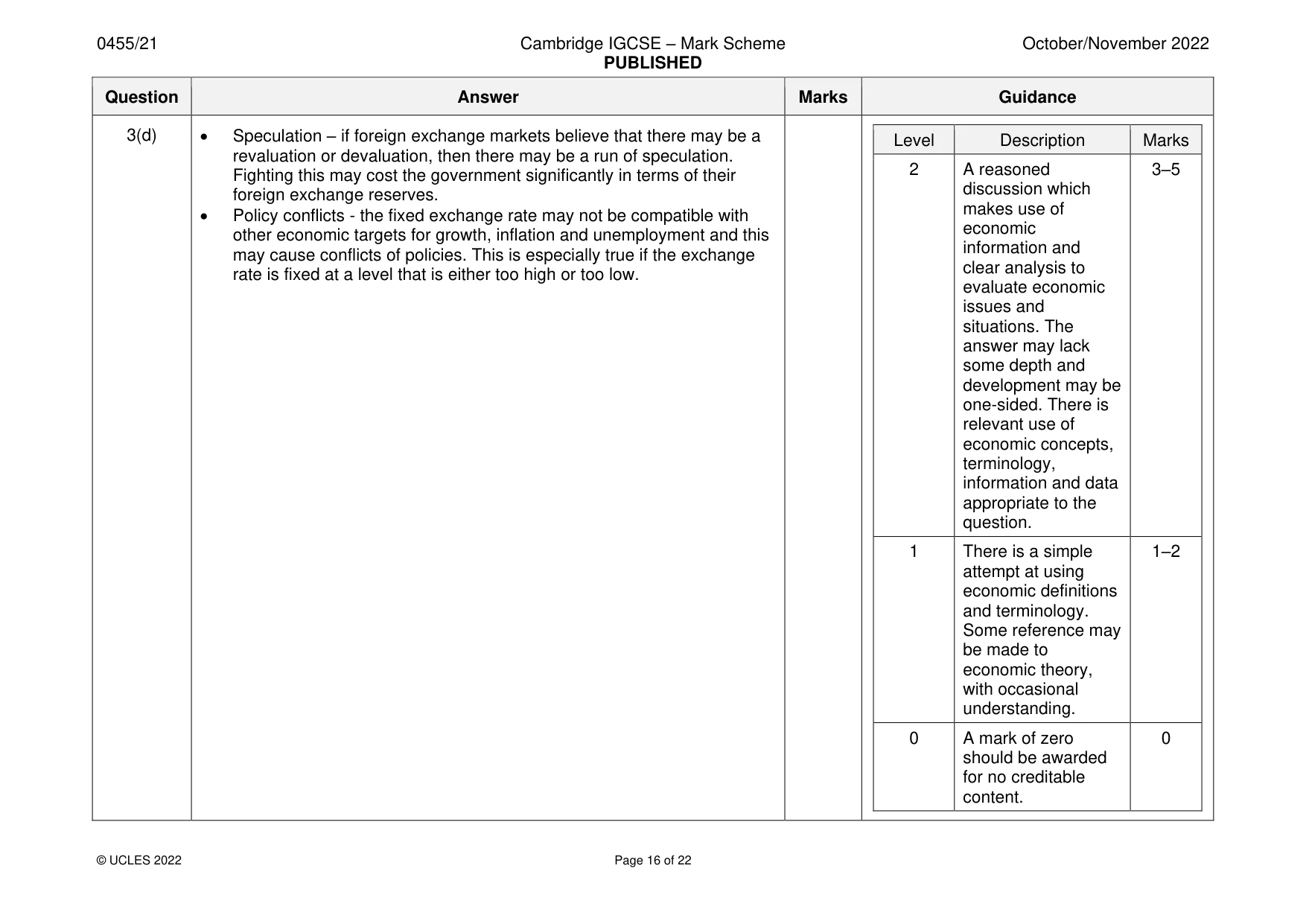
Mark scheme: 3(a) Define inflation. 2 Increase (1) in price level (1) over time / persistent (1) Rise in price (1) 3(b) Explain the effects of low confidence on both spending and borrowing. 4 Maximum 2 marks for spending and maximum 2 marks for borrowing Logical explanation which might include: Low confidence will reduce spending (1) as consumers will save instead (1) e.g. lack of job security / risk of firms failing / asset prices falling (1). Falling confidence will reduce borrowing (1) risk of borrowing and investing is too high (1). 3(c) Analyse how a cut in interest rates could create conflicts between 6 Maximum 4 marks if only 1 conflict analysed macroeconomic aims. Also accept conflict between economic Coherent analysis which might include: growth and redistribution of income i.e. Cut Cut in interest rates could lead to conflicts between full employment versus in interest rates could lead to conflicts stable prices (1) because cut in interest rates lead to increase borrowing (1) between economic growth and redistribution decreased savings (1) and increased spending (1) this will lead to an of income (1) because a cut in interest rates increase in demand-pull (1) inflation (1). could lead to more spending and investment Cut in interest rates could lead to conflicts between economic growth versus (1) leading to more economic growth (1) balance of payments stability (1) because if people may also buy more and higher incomes for entrepreneurs (1) imports (1) and therefore current account deficit will increase / current but savers could get lower returns from account surplus will decrease (1). savings (1) profits may rise more than Cut in interest rates could lead to conflicts between full employment versus wages (1) leading to an increase in balance of payments stability (1) because a cut in interest rates could lead inequality (1). to more investments (1) more firms starting up (1) increasing demand for workers (1) increased wages (1) which would lead to increase in spending (1) including imports (1) which will increase current account deficit / decrease current account surplus (1). 3(d) Discuss whether or not a country will benefit from having a fixed 8 Level Description Marks foreign exchange rate system. 3 A reasoned 6–8 In assessing each answer, use the table opposite. discussion which accurately examines Why it might be an advantage both sides of the • Certainty - with a fixed exchange rate, firms will always know the economic argument, exchange rate and this makes trade and investment less risky. making use of • Absence of speculation - with a fixed exchange rate, there will be no economic speculation if people believe that the rate will stay fixed with no information and revaluation or devaluation. clear and logical • Constraint on government policy - if the exchange rate is fixed, then the analysis to evaluate government may be unable to pursue extreme or irresponsible macro- economic issues economic policies as these would cause a run on the foreign exchange and situations. One reserves and this would be unsustainable in the medium-term. side of the argument • Keep inflation low. Firms have an incentive to keep cutting costs to may have more remain competitive. Governments who allow their exchange rate to depth than the other, depreciate may cause inflationary pressures to occur. Depreciation can but overall both cause inflation because total demand increases, import prices increase sides of the and firms have less incentive to cut costs. argument are • Maintain competitiveness - a fixed exchange rate can ensure that considered and exports remain price competitive. A rapid appreciation in a floating developed. There is exchange rate system will badly affect manufacturing firms who export; thoughtful evaluation this may also cause a worsening of the current account. of economic concepts, Why it might be a disadvantage terminology, • The economy may be unable to respond to shocks - a fixed exchange information and/or rate means that there may be no mechanism for the government to data appropriate to respond rapidly to balance of payments crises. the question. The • Problems with reserves - fixed exchange rate systems require large discussion may also foreign exchange reserves and there can be international liquidity point out the problems as a result. possible uncertainties of alternative decisions and outcomes. 3(d) • Speculation – if foreign exchange markets believe that there may be a Level Description Marks revaluation or devaluation, then there may be a run of speculation. 2 A reasoned 3–5 Fighting this may cost the government significantly in terms of their discussion which foreign exchange reserves. makes use of • Policy conflicts - the fixed exchange rate may not be compatible with economic other economic targets for growth, inflation and unemployment and this information and may cause conflicts of policies. This is especially true if the exchange clear analysis to rate is fixed at a level that is either too high or too low. evaluate economic issues and situations. The answer may lack some depth and development may be one-sided. There is relevant use of economic concepts, terminology, information and data appropriate to the question. 1 There is a simple 1–2 attempt at using economic definitions and terminology. Some reference may be made to economic theory, with occasional understanding. 0 A mark of zero 0 should be awarded for no creditable content.
Q4 · Some firms have social welfare as their main objective
4 Some firms have social welfare as their main objective. Globally, the number of this type of firm is increasing. Consumers are also starting to change their spending patterns by moving towards environmentally friendly products such as solar energy. Environmentally unfriendly firms are less able to make profits and some of these firms must merge to survive. (a) Identify two examples of social welfare objectives of firms. [2] (b) Explain two types of merger. [4] (c) Analyse, using a demand and supply diagram, the effects on the solar energy industry of the change in spending patterns towards environmentally friendly products. [6] (d) Discuss whether or not a merger can help a firm survive. [8]
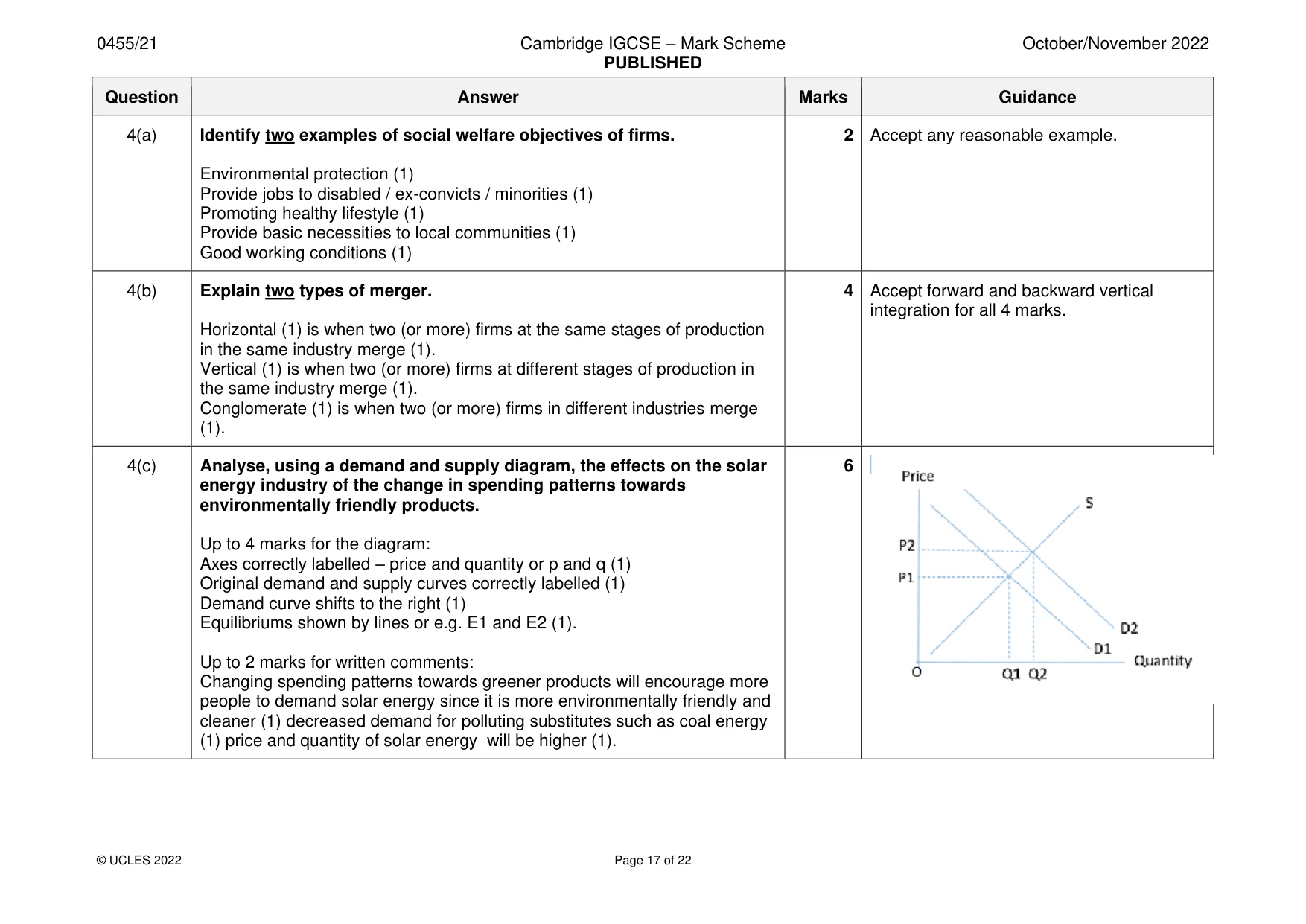
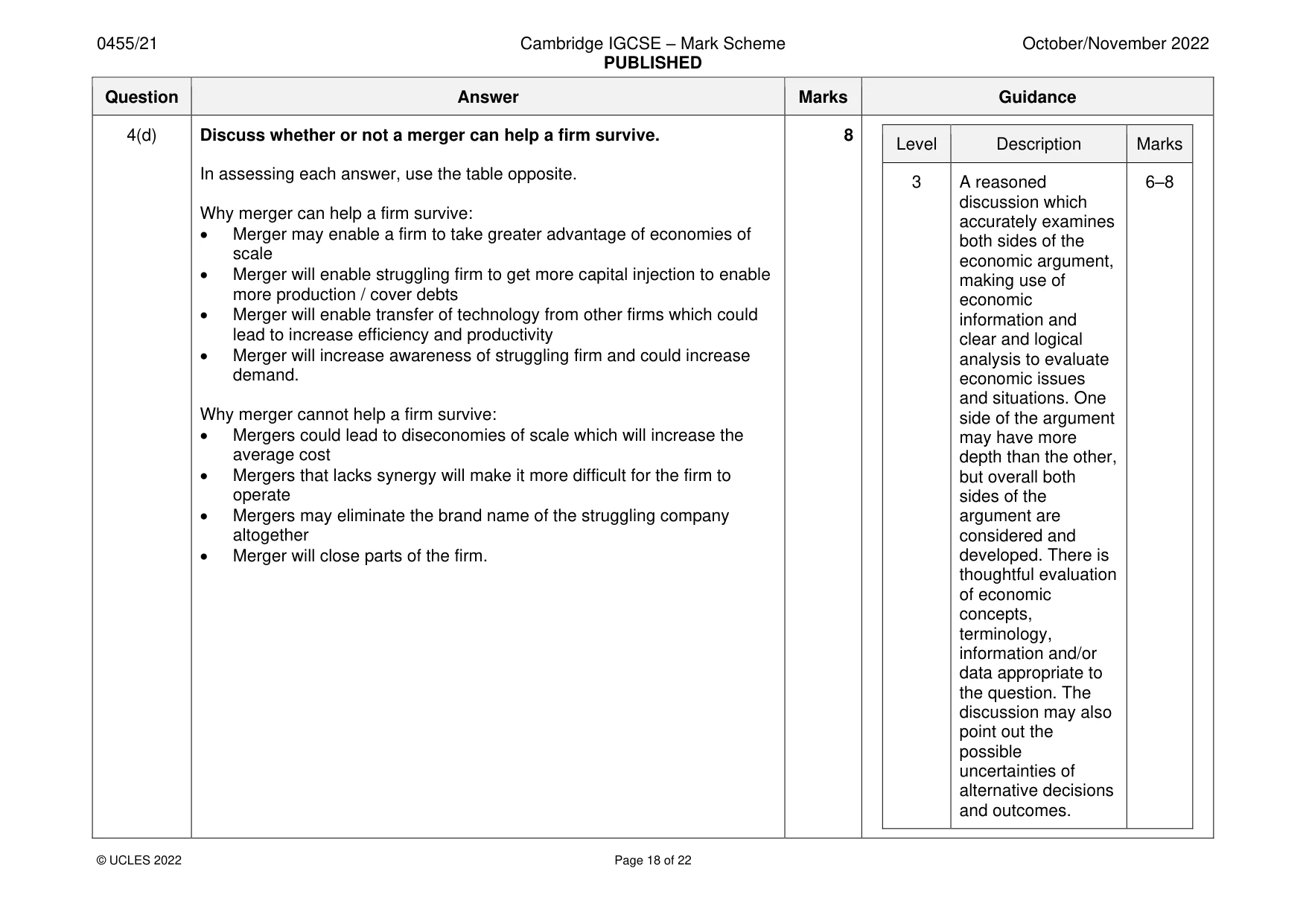
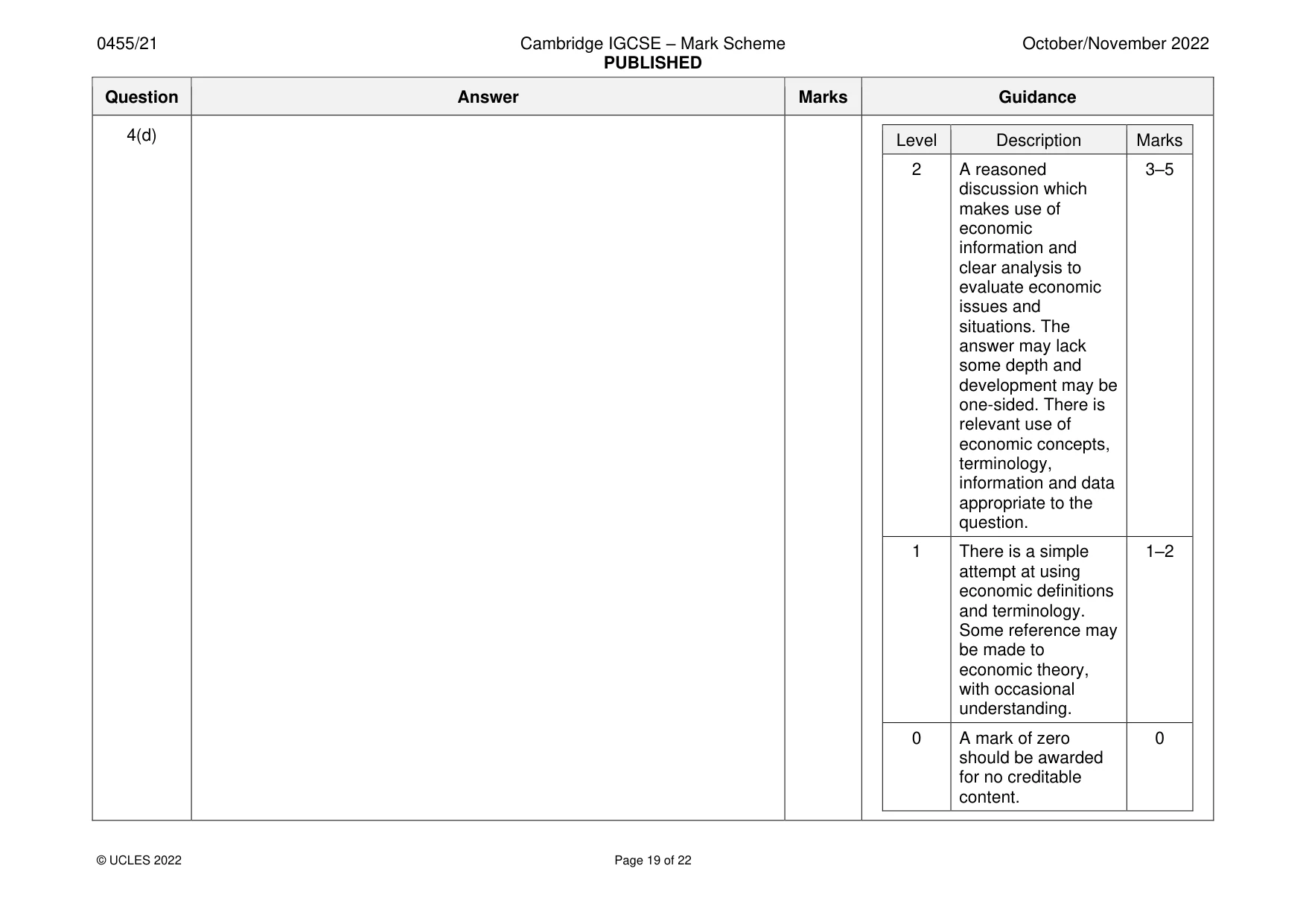
Mark scheme: 4(a) Identify two examples of social welfare objectives of firms. 2 Accept any reasonable example. Environmental protection (1) Provide jobs to disabled / ex-convicts / minorities (1) Promoting healthy lifestyle (1) Provide basic necessities to local communities (1) Good working conditions (1) 4(b) Explain two types of merger. 4 Accept forward and backward vertical integration for all 4 marks. Horizontal (1) is when two (or more) firms at the same stages of production in the same industry merge (1). Vertical (1) is when two (or more) firms at different stages of production in the same industry merge (1). Conglomerate (1) is when two (or more) firms in different industries merge (1). 4(c) Analyse, using a demand and supply diagram, the effects on the solar 6 energy industry of the change in spending patterns towards environmentally friendly products. Up to 4 marks for the diagram: Axes correctly labelled – price and quantity or p and q (1) Original demand and supply curves correctly labelled (1) Demand curve shifts to the right (1) Equilibriums shown by lines or e.g. E1 and E2 (1). Up to 2 marks for written comments: Changing spending patterns towards greener products will encourage more people to demand solar energy since it is more environmentally friendly and cleaner (1) decreased demand for polluting substitutes such as coal energy (1) price and quantity of solar energy will be higher (1). 4(d) Discuss whether or not a merger can help a firm survive. 8 Level Description Marks In assessing each answer, use the table opposite. 3 A reasoned 6–8 discussion which Why merger can help a firm survive: accurately examines • Merger may enable a firm to take greater advantage of economies of both sides of the scale economic argument, • Merger will enable struggling firm to get more capital injection to enable making use of more production / cover debts economic • Merger will enable transfer of technology from other firms which could information and lead to increase efficiency and productivity clear and logical • Merger will increase awareness of struggling firm and could increase analysis to evaluate demand. economic issues and situations. One Why merger cannot help a firm survive: side of the argument • Mergers could lead to diseconomies of scale which will increase the may have more average cost depth than the other, • Mergers that lacks synergy will make it more difficult for the firm to but overall both operate sides of the • Mergers may eliminate the brand name of the struggling company argument are altogether considered and • Merger will close parts of the firm. developed. There is thoughtful evaluation of economic concepts, terminology, information and/or data appropriate to the question. The discussion may also point out the possible uncertainties of alternative decisions and outcomes. 4(d) Level Description Marks 2 A reasoned 3–5 discussion which makes use of economic information and clear analysis to evaluate economic issues and situations. The answer may lack some depth and development may be one-sided. There is relevant use of economic concepts, terminology, information and data appropriate to the question. 1 There is a simple 1–2 attempt at using economic definitions and terminology. Some reference may be made to economic theory, with occasional understanding. 0 A mark of zero 0 should be awarded for no creditable content.
Q5 · Bulgaria is part of the European Union (EU), but it has much lower corporation tax rates…
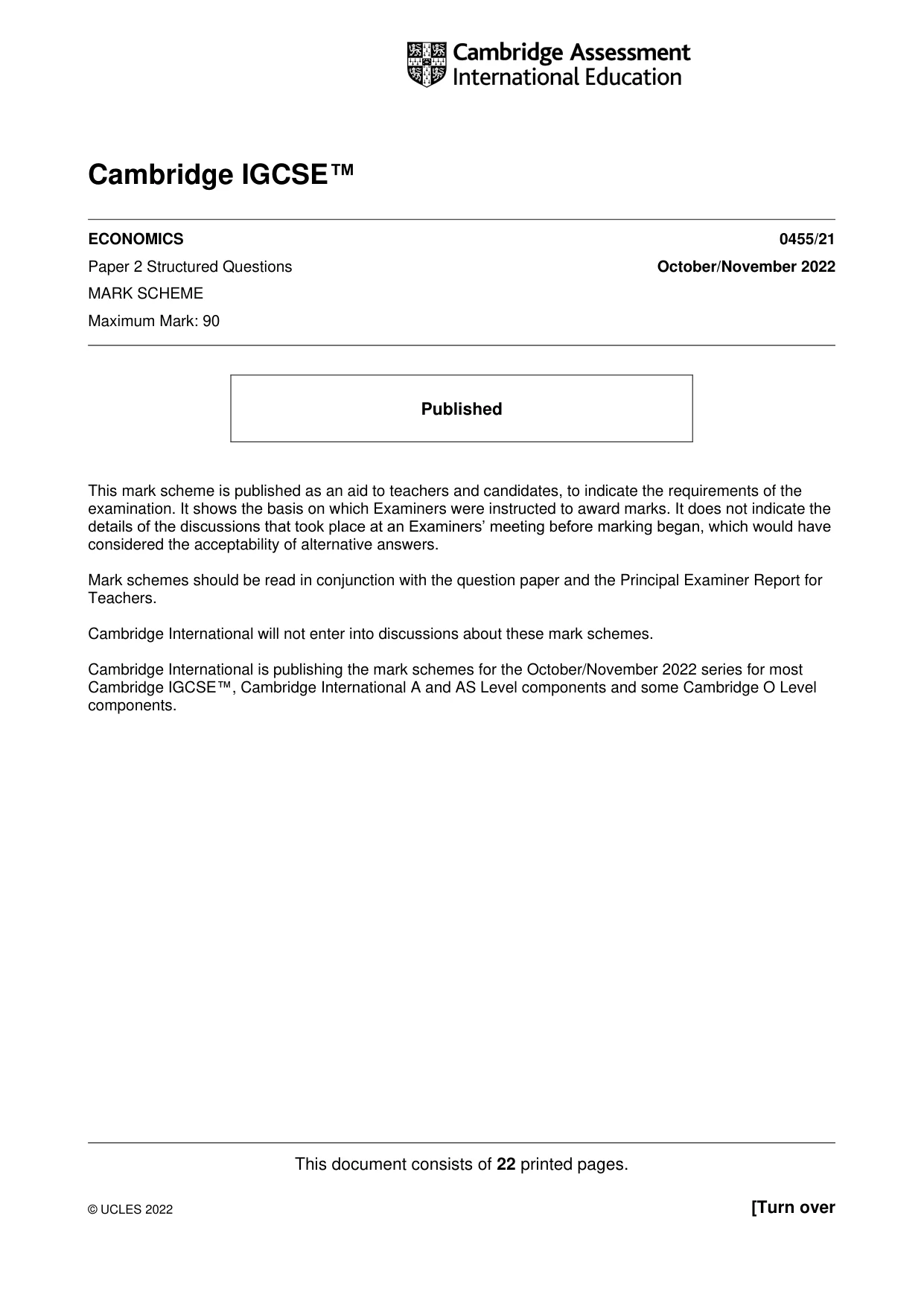
5 Bulgaria is part of the European Union (EU), but it has much lower corporation tax rates than other EU members. However, regulation by the Bulgarian government has discouraged foreign investment into Bulgaria. In addition, Bulgaria’s economic growth rate has decreased in recent years, due in part to a steady fall in its quantity of labour. (a) Define regulation. [2] (b) Explain two causes of a fall in the quantity of labour in a country. [4] (c) Analyse how differences in the rates of corporation tax between countries may affect multinational companies (MNCs). [6] (d) Discuss whether or not a decrease in a country’s economic growth rate will harm its economy. [8]
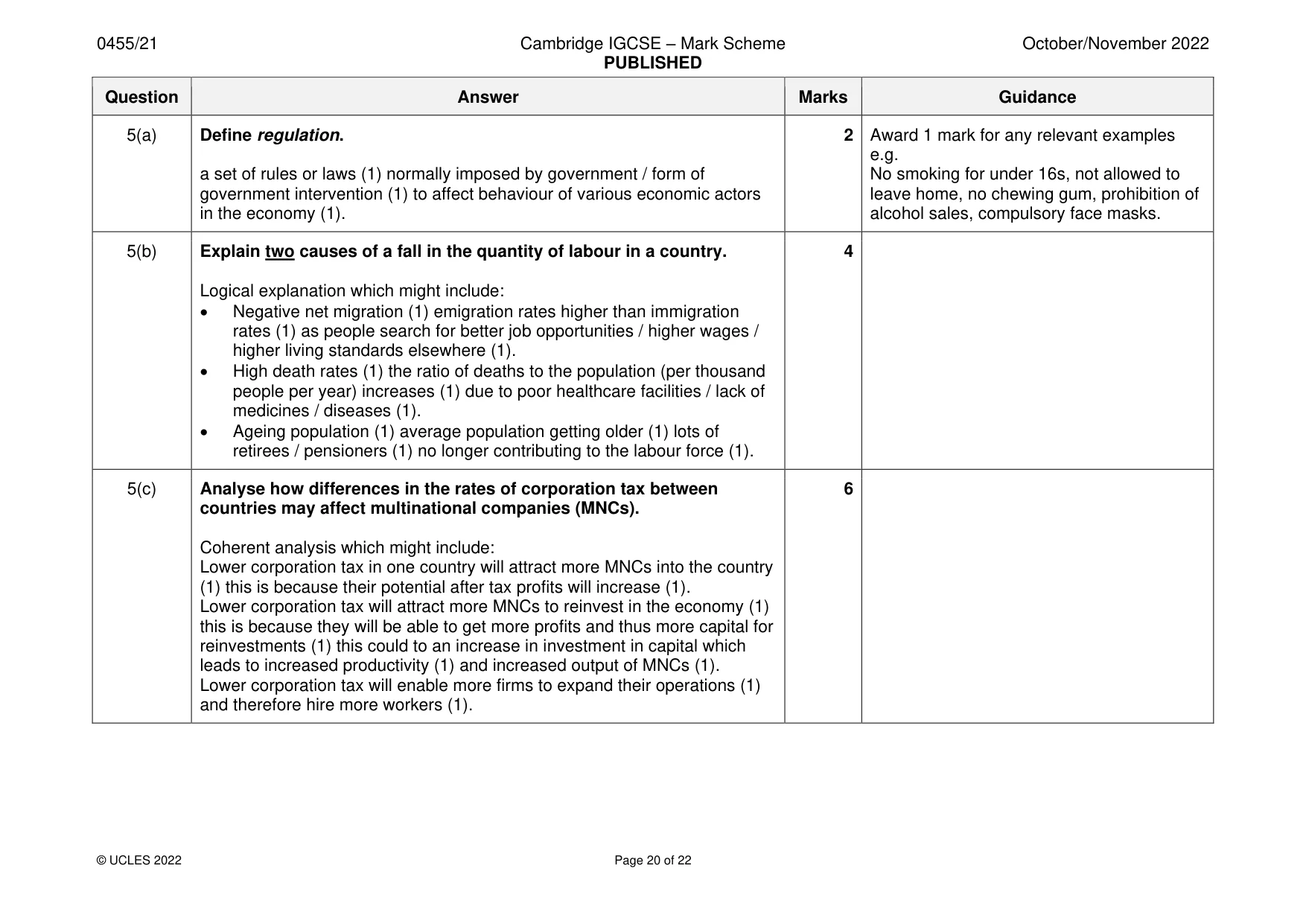
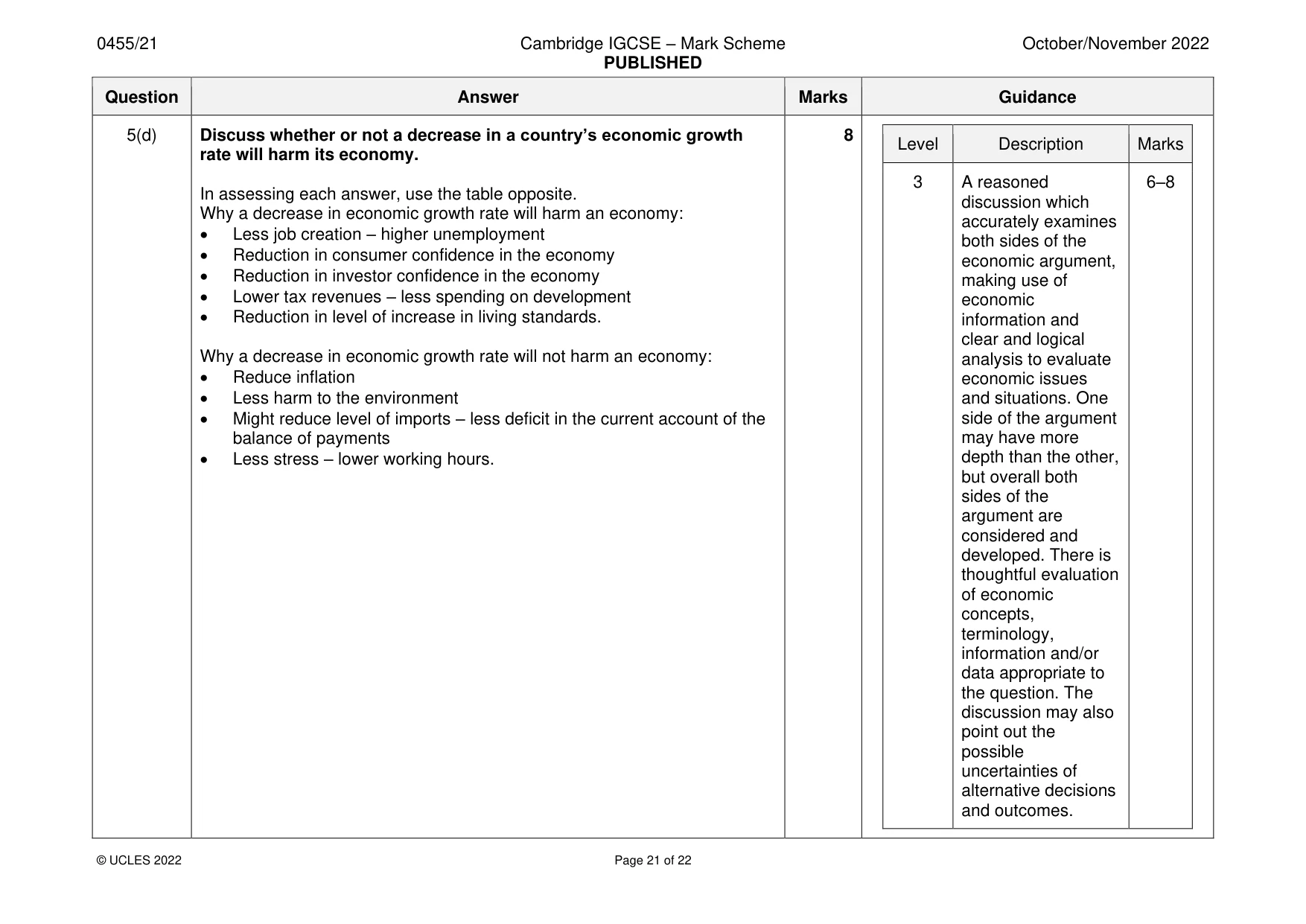
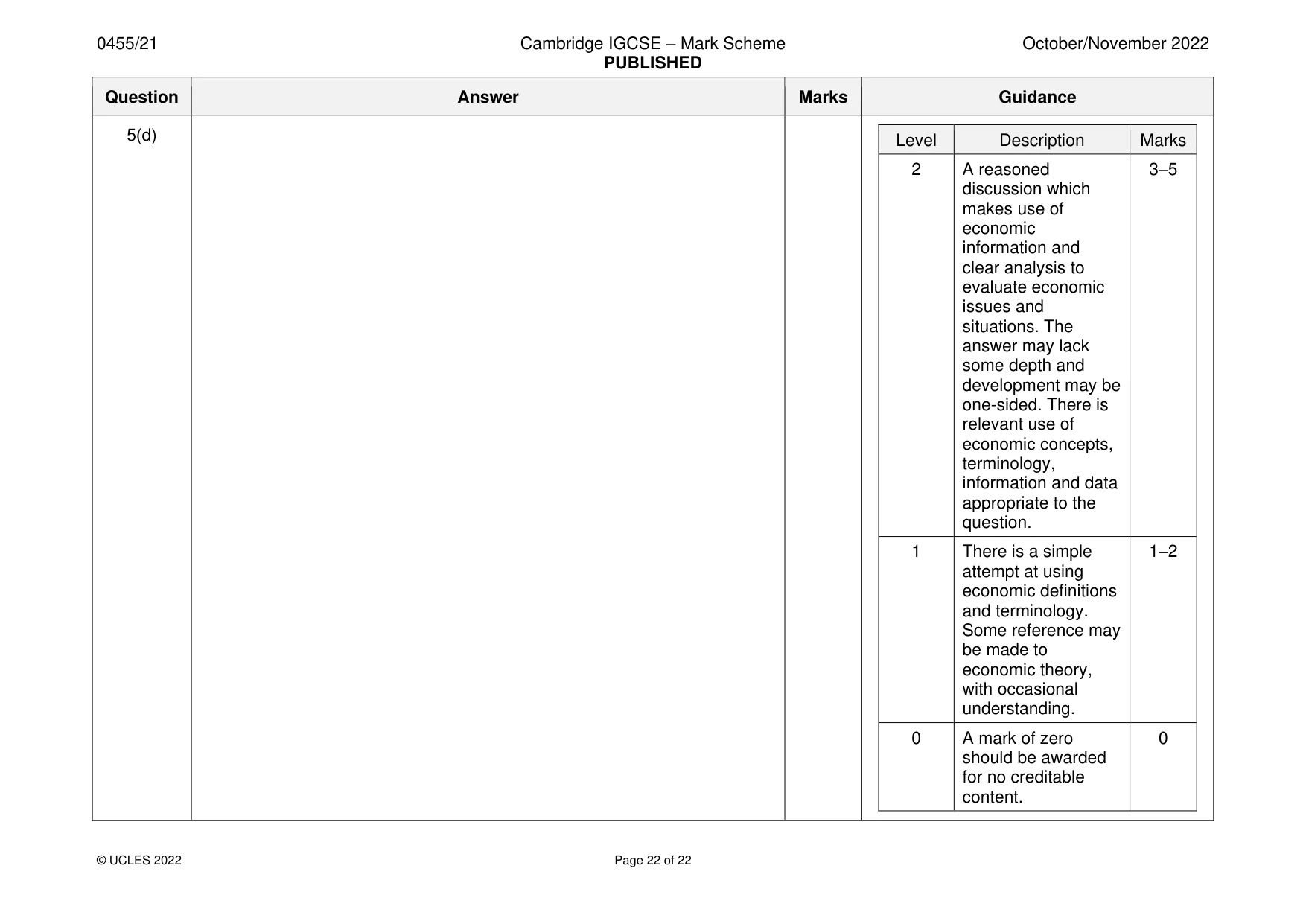
Mark scheme: 5(a) Define regulation. 2 Award 1 mark for any relevant examples e.g. a set of rules or laws (1) normally imposed by government / form of No smoking for under 16s, not allowed to government intervention (1) to affect behaviour of various economic actors leave home, no chewing gum, prohibition of in the economy (1). alcohol sales, compulsory face masks. 5(b) Explain two causes of a fall in the quantity of labour in a country. 4 Logical explanation which might include: • Negative net migration (1) emigration rates higher than immigration rates (1) as people search for better job opportunities / higher wages / higher living standards elsewhere (1). • High death rates (1) the ratio of deaths to the population (per thousand people per year) increases (1) due to poor healthcare facilities / lack of medicines / diseases (1). • Ageing population (1) average population getting older (1) lots of retirees / pensioners (1) no longer contributing to the labour force (1). 5(c) Analyse how differences in the rates of corporation tax between 6 countries may affect multinational companies (MNCs). Coherent analysis which might include: Lower corporation tax in one country will attract more MNCs into the country (1) this is because their potential after tax profits will increase (1). Lower corporation tax will attract more MNCs to reinvest in the economy (1) this is because they will be able to get more profits and thus more capital for reinvestments (1) this could to an increase in investment in capital which leads to increased productivity (1) and increased output of MNCs (1). Lower corporation tax will enable more firms to expand their operations (1) and therefore hire more workers (1). 5(d) Discuss whether or not a decrease in a country’s economic growth 8 Level Description Marks rate will harm its economy. 3 A reasoned 6–8 In assessing each answer, use the table opposite. discussion which Why a decrease in economic growth rate will harm an economy: accurately examines • Less job creation – higher unemployment both sides of the • Reduction in consumer confidence in the economy economic argument, • Reduction in investor confidence in the economy making use of • Lower tax revenues – less spending on development economic • Reduction in level of increase in living standards. information and clear and logical Why a decrease in economic growth rate will not harm an economy: analysis to evaluate • Reduce inflation economic issues • Less harm to the environment and situations. One • Might reduce level of imports – less deficit in the current account of the side of the argument balance of payments may have more • Less stress – lower working hours. depth than the other, but overall both sides of the argument are considered and developed. There is thoughtful evaluation of economic concepts, terminology, information and/or data appropriate to the question. The discussion may also point out the possible uncertainties of alternative decisions and outcomes. 5(d) Level Description Marks 2 A reasoned 3–5 discussion which makes use of economic information and clear analysis to evaluate economic issues and situations. The answer may lack some depth and development may be one-sided. There is relevant use of economic concepts, terminology, information and data appropriate to the question. 1 There is a simple 1–2 attempt at using economic definitions and terminology. Some reference may be made to economic theory, with occasional understanding. 0 A mark of zero 0 should be awarded for no creditable content.
What was in this paper
The subtopics covered by these 5 questions, and how many questions each got. Open one in a new tab to see every Cambridge question on it.
What you needed in this session
Cambridge’s own grade thresholds for 2022 Oct/Nov, Paper 2 · Variant 1. A higher threshold means an easier paper — the bar moves with how the cohort did.