Cambridge IGCSE Economics 0455 — 2021 May/June Paper 2 · Variant 1
0455/21/M/J/21 · 5 questions · 90 marks · ≈101 min
The question paper and its mark scheme, free to read here and free to download. This is Cambridge’s own paper, exactly as it was sat.
Question paper8 pages
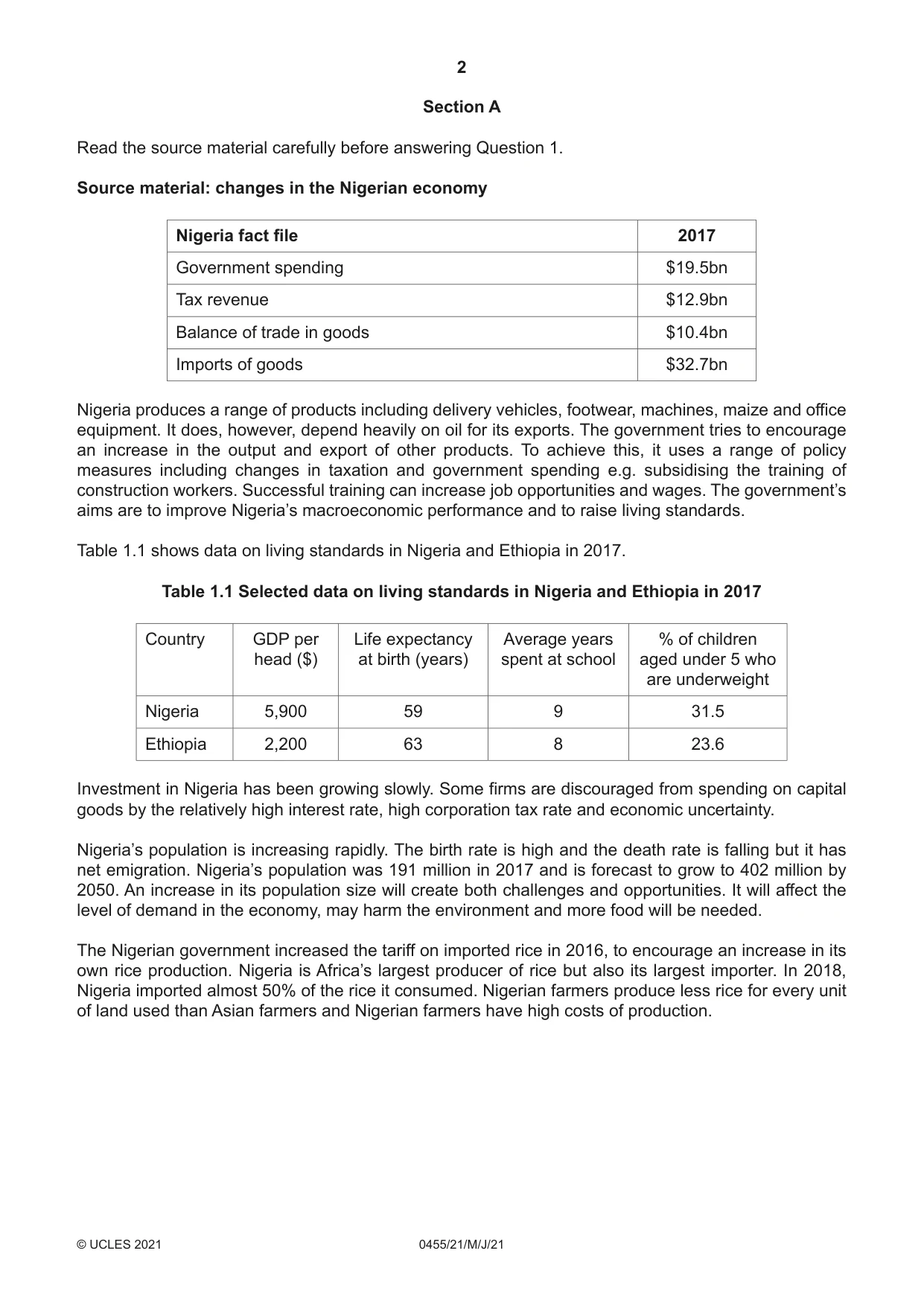
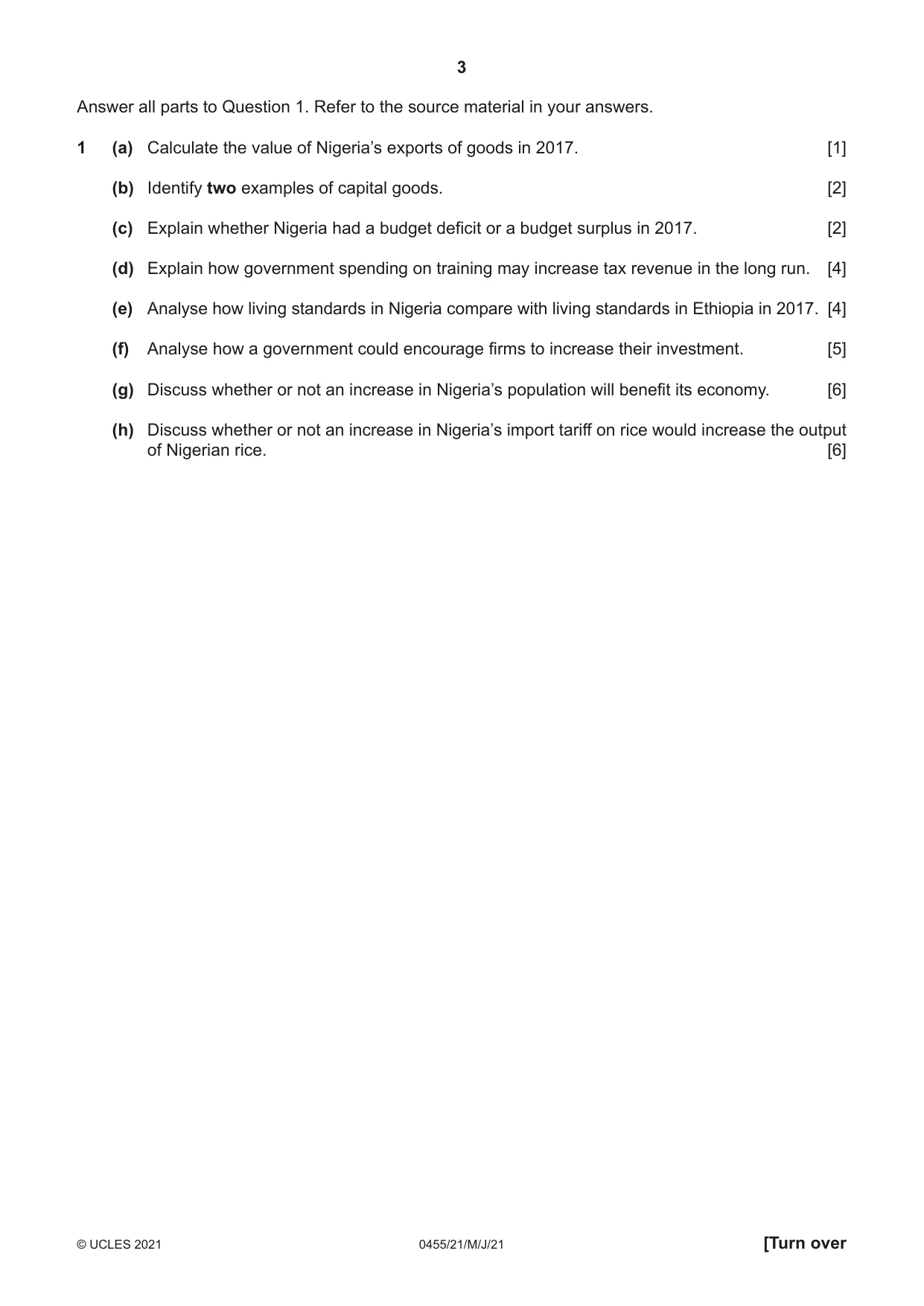
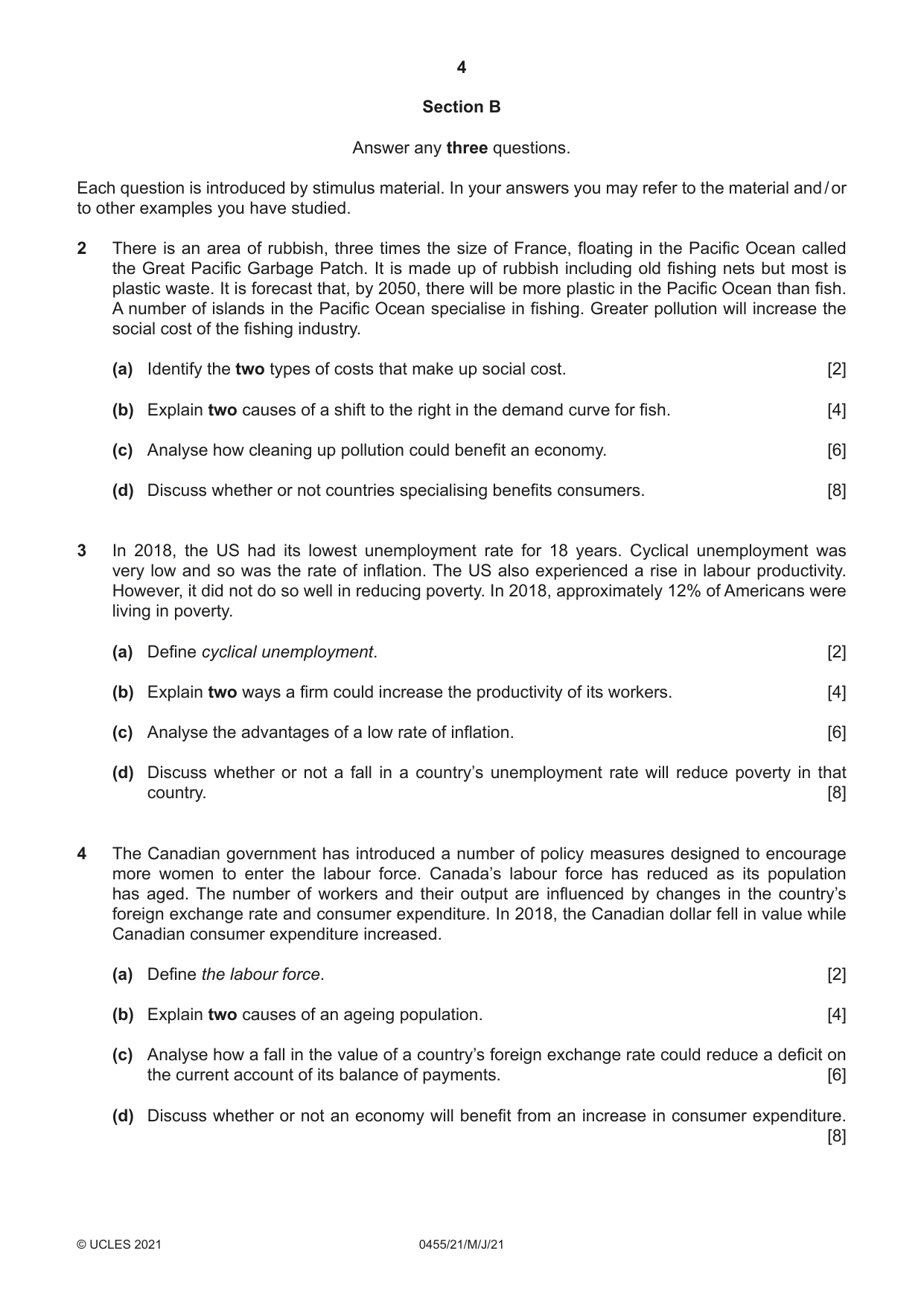




Mark scheme26 pages
Answers below. Sit the paper first if you are practising.
Questions as text
Q1 · Calculate the value of Nigeria’s exports of goods in 2017
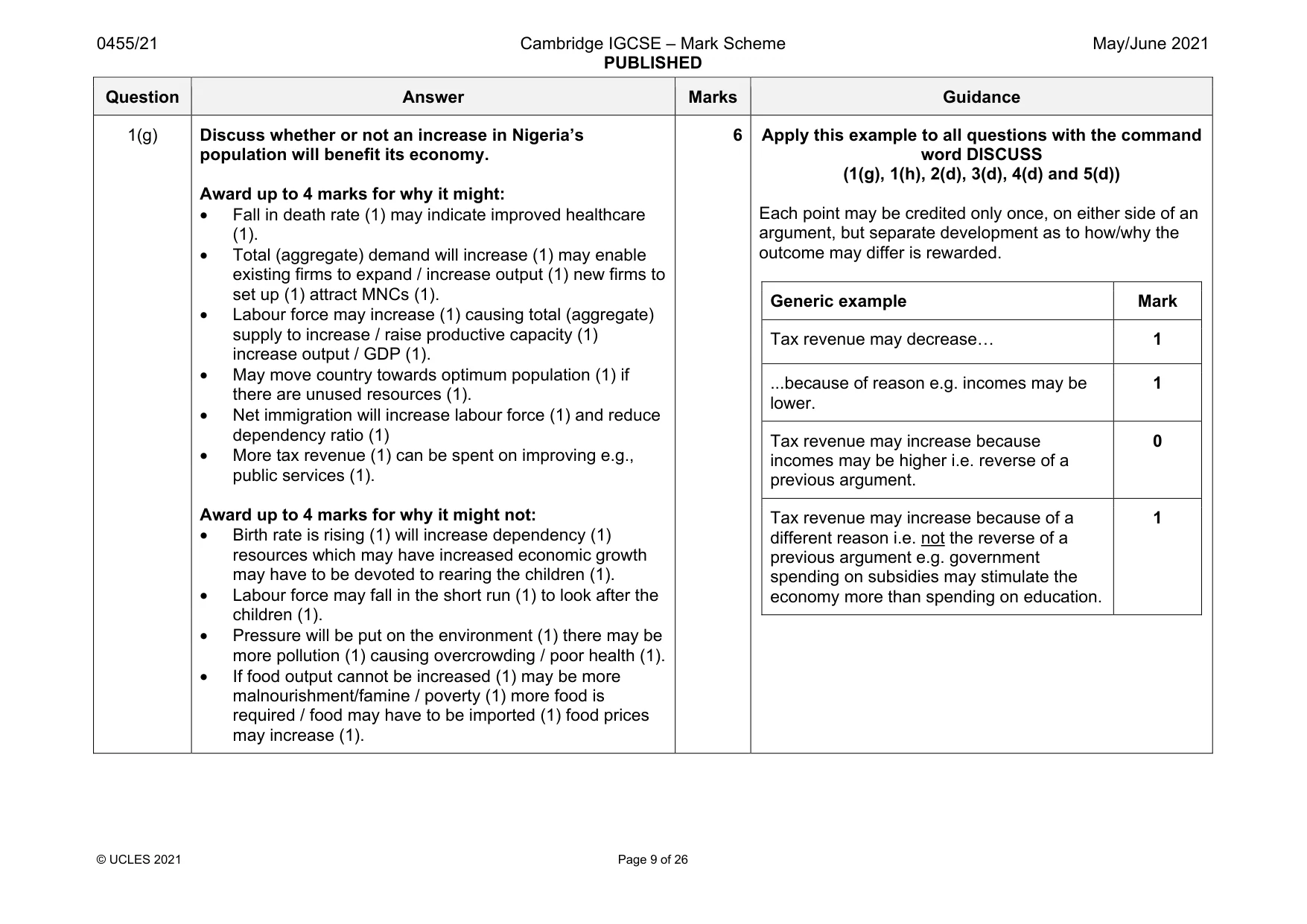
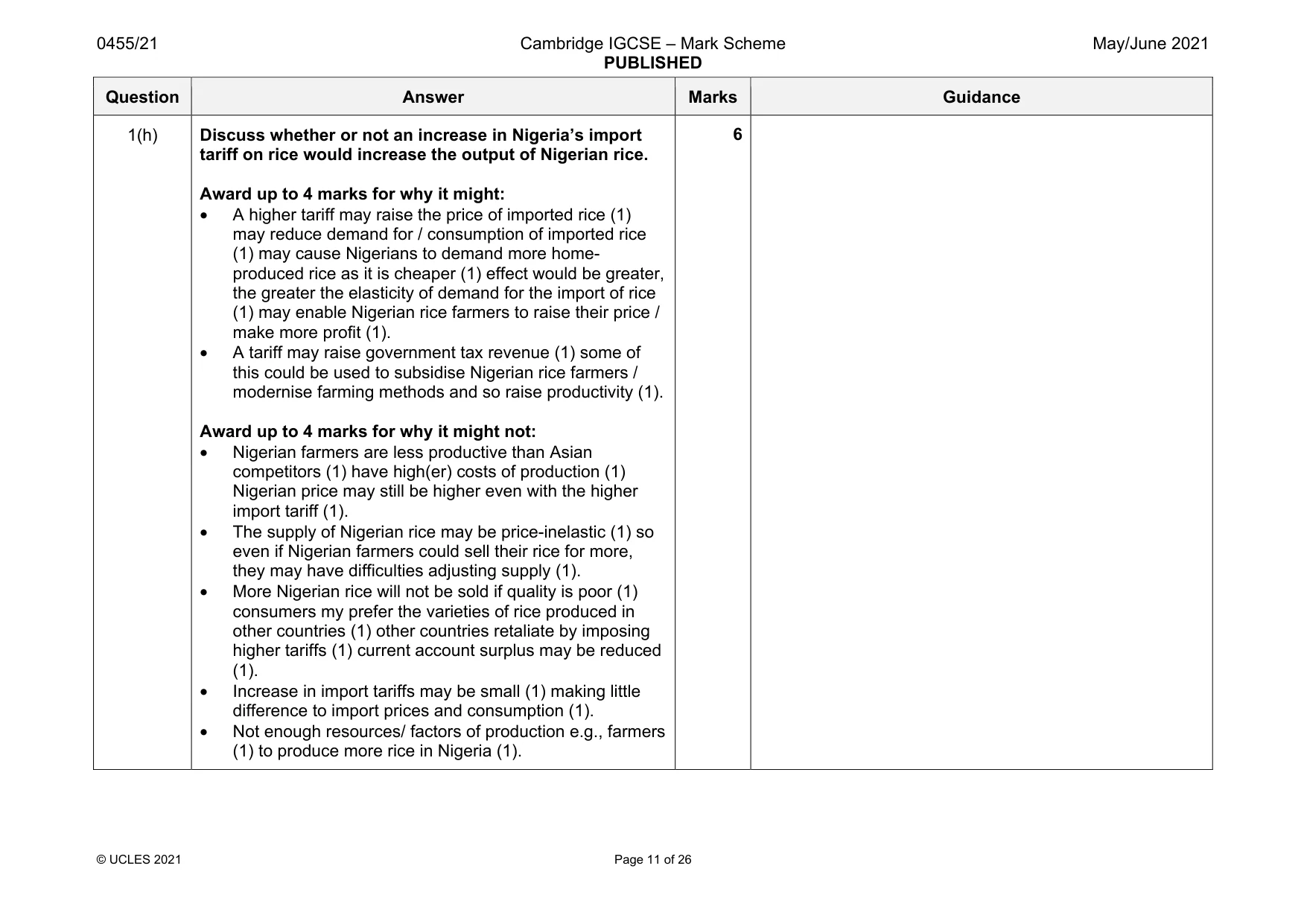
1 (a) Calculate the value of Nigeria’s exports of goods in 2017. [1] (b) Identify two examples of capital goods. [2] (c) Explain whether Nigeria had a budget deficit or a budget surplus in 2017. [2] (d) Explain how government spending on training may increase tax revenue in the long run. [4] (e) Analyse how living standards in Nigeria compare with living standards in Ethiopia in 2017. [4] (f) Analyse how a government could encourage firms to increase their investment. [5] (g) Discuss whether or not an increase in Nigeria’s population will benefit its economy. [6] (h) Discuss whether or not an increase in Nigeria’s import tariff on rice would increase the output of Nigerian rice. [6]
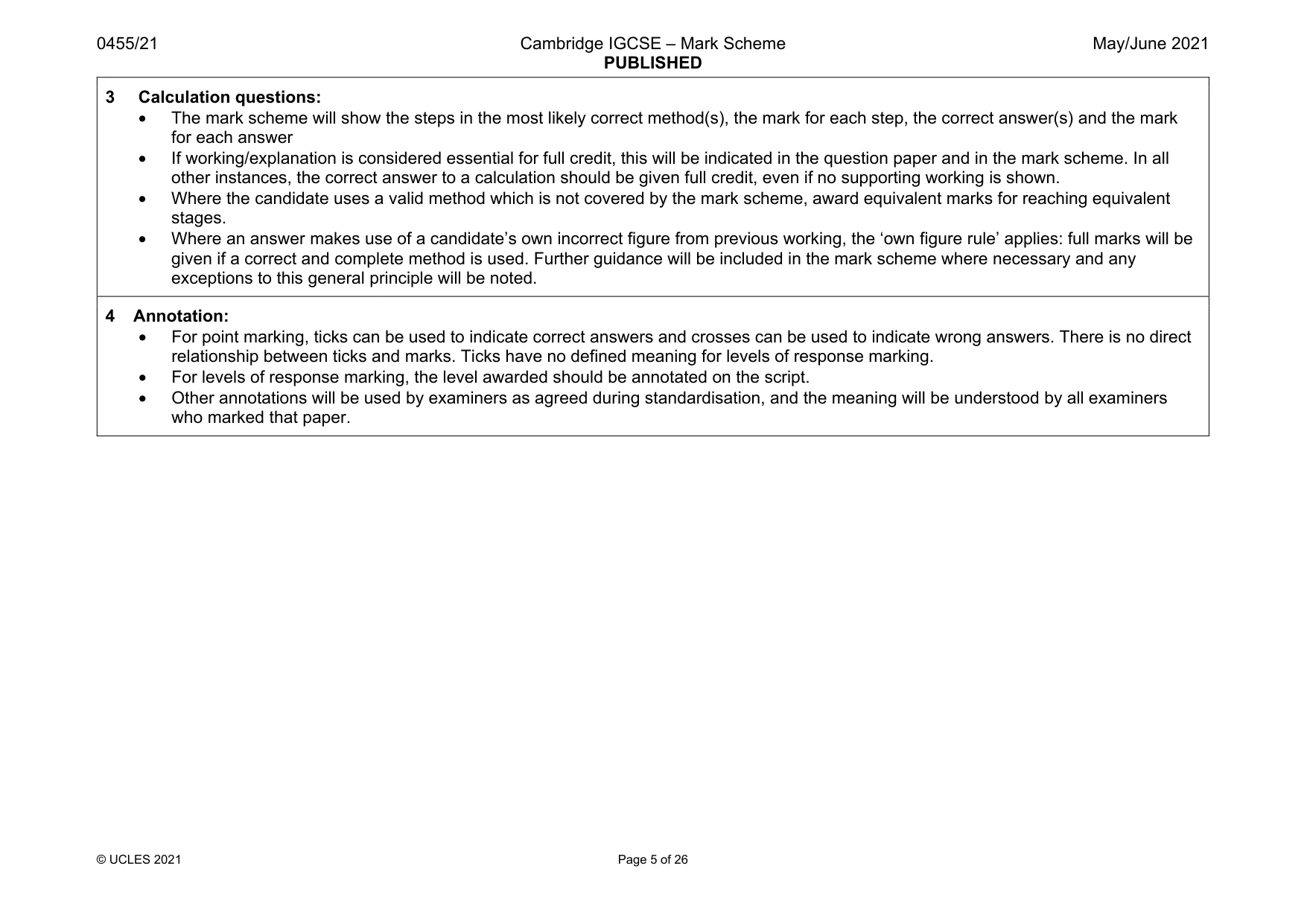
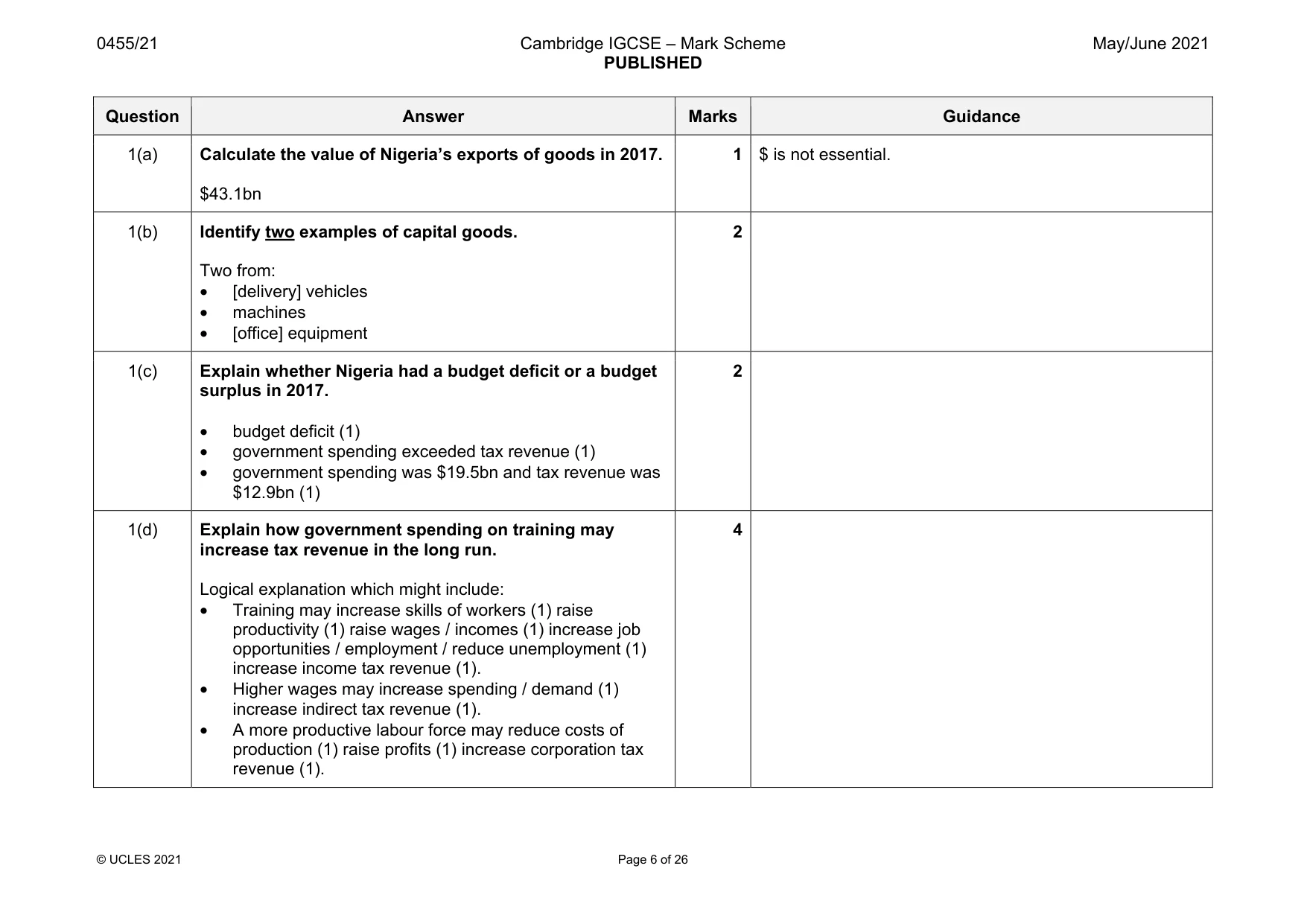
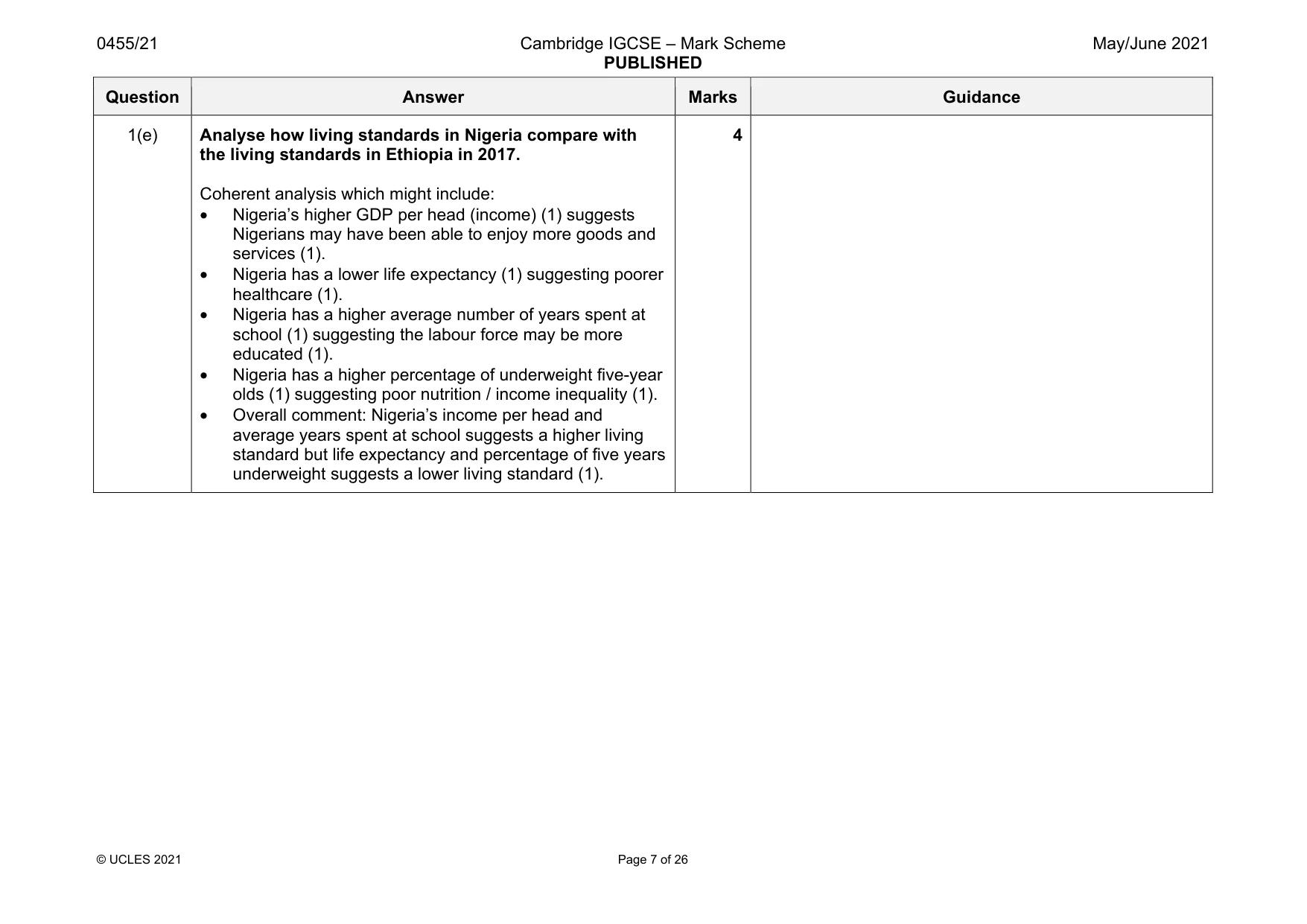
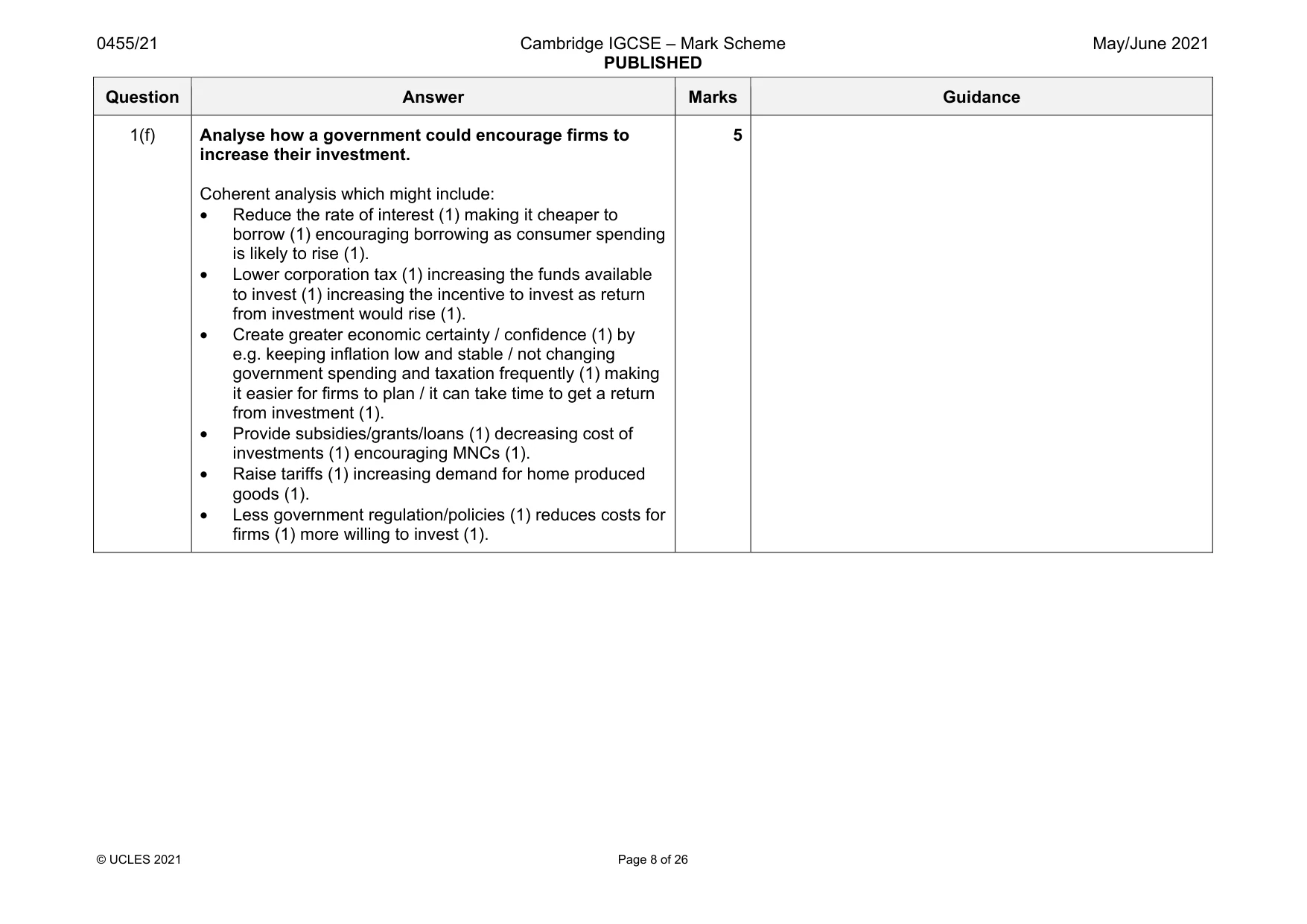
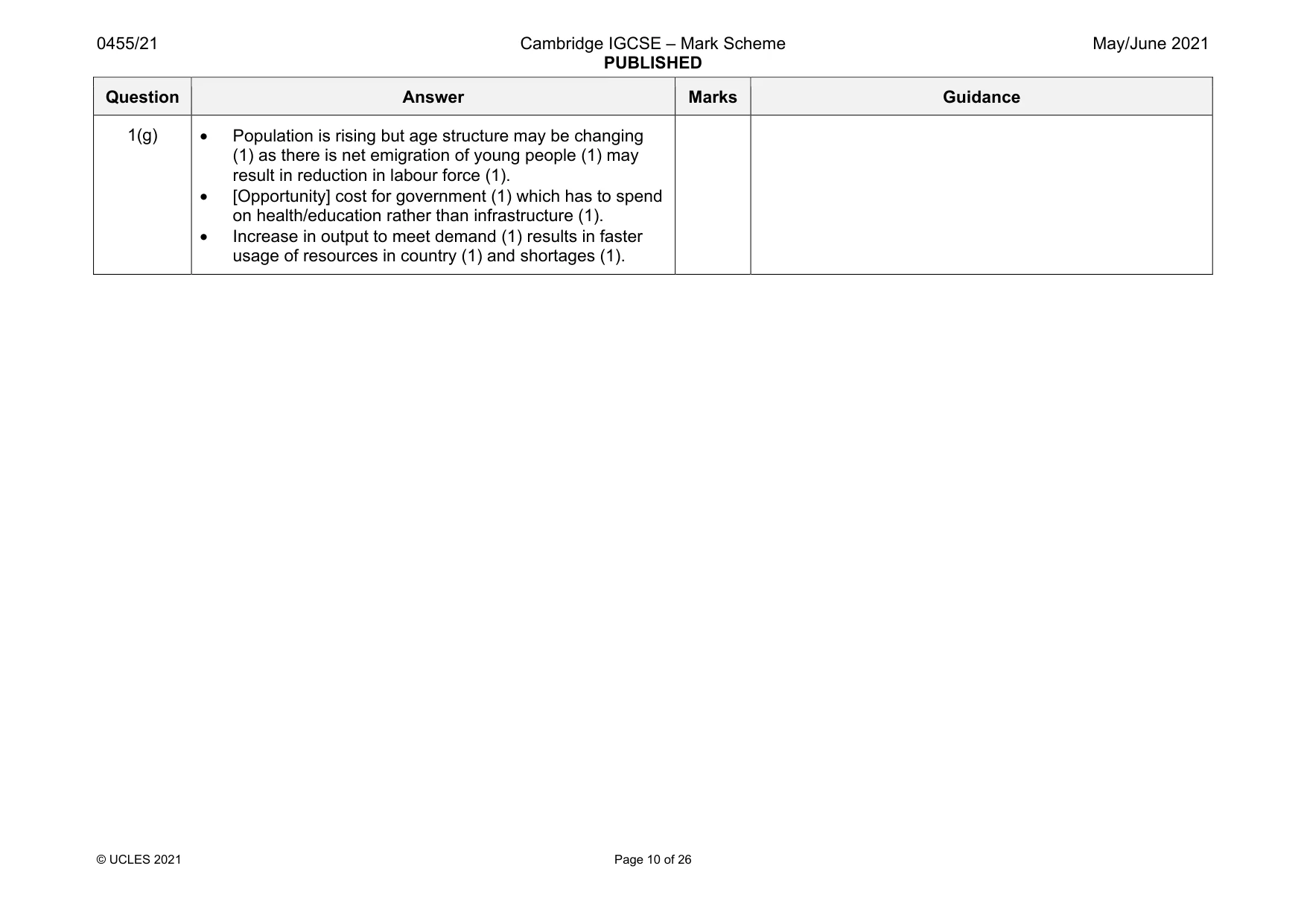
Mark scheme: 1(a) Calculate the value of Nigeria’s exports of goods in 2017. $43.1bn 1 $ is not essential. 1(b) Identify two examples of capital goods. Two from: • [delivery] vehicles • machines • [office] equipment 2 1(c) Explain whether Nigeria had a budget deficit or a budget surplus in 2017. • budget deficit (1) • government spending exceeded tax revenue (1) • government spending was $19.5bn and tax revenue was $12.9bn (1) 2 1(d) Explain how government spending on training may increase tax revenue in the long run. Logical explanation which might include: • Training may increase skills of workers (1) raise productivity (1) raise wages / incomes (1) increase job opportunities / employment / reduce unemployment (1) increase income tax revenue (1). • Higher wages may increase spending / demand (1) increase indirect tax revenue (1). • A more productive labour force may reduce costs of production (1) raise profits (1) increase corporation tax revenue (1). 4 Question Answer Marks Guidance 1(e) Analyse how living standards in Nigeria compare with the living standards in Ethiopia in 2017. Coherent analysis which might include: • Nigeria’s higher GDP per head (income) (1) suggests Nigerians may have been able to enjoy more goods and services (1). • Nigeria has a lower life expectancy (1) suggesting poorer healthcare (1). • Nigeria has a higher average number of years spent at school (1) suggesting the labour force may be more educated (1). • Nigeria has a higher percentage of underweight five-year olds (1) suggesting poor nutrition / income inequality (1). • Overall comment: Nigeria’s income per head and average years spent at school suggests a higher living standard but life expectancy and percentage of five years underweight suggests a lower living standard (1). 4 Question Answer Marks Guidance 1(f) Analyse how a government could encourage firms to increase their investment. Coherent analysis which might include: • Reduce the rate of interest (1) making it cheaper to borrow (1) encouraging borrowing as consumer spending is likely to rise (1). • Lower corporation tax (1) increasing the funds available to invest (1) increasing the incentive to invest as return from investment would rise (1). • Create greater economic certainty / confidence (1) by e.g. keeping inflation low and stable / not changing government spending and taxation frequently (1) making it easier for firms to plan / it can take time to get a return from investment (1). • Provide subsidies/grants/loans (1) decreasing cost of investments (1) encouraging MNCs (1). • Raise tariffs (1) increasing demand for home produced goods (1). • Less government regulation/policies (1) reduces costs for firms (1) more willing to invest (1). 5 Question Answer Marks Guidance 1(g) Discuss whether or not an increase in Nigeria’s population will benefit its economy. Award up to 4 marks for why it might: • Fall in death rate (1) may indicate improved healthcare (1). • Total (aggregate) demand will increase (1) may enable existing firms to expand / increase output (1) new firms to set up (1) attract MNCs (1). • Labour force may increase (1) causing total (aggregate) supply to increase / raise productive capacity (1) increase output / GDP (1). • May move country towards optimum population (1) if there are unused resources (1). • Net immigration will increase labour force (1) and reduce dependency ratio (1) • More tax revenue (1) can be spent on improving e.g., public services (1). Award up to 4 marks for why it might not: • Birth rate is rising (1) will increase dependency (1) resources which may have increased economic growth may have to be devoted to rearing the children (1). • Labour force may fall in the short run (1) to look after the children (1). • Pressure will be put on the environment (1) there may be more pollution (1) causing overcrowding / poor health (1). • If food output cannot be increased (1) may be more malnourishment/famine / poverty (1) more food is required / food may have to be imported (1) food prices may increase (1). 6 Apply this example to all questions with the command word DISCUSS (1(g), 1(h), 2(d), 3(d), 4(d) and 5(d)) Each point may be credited only once, on either side of an argument, but separate development as to how/why the outcome may differ is rewarded. Generic example Mark Tax revenue may decrease… 1 ...because of reason e.g. incomes may be lower. 1 Tax revenue may increase because incomes may be higher i.e. reverse of a previous argument. 0 Tax revenue may increase because of a different reason i.e. not the reverse of a previous argument e.g. government spending on subsidies may stimulate the economy more than spending on education. 1 Question Answer Marks Guidance 1(g) • Population is rising but age structure may be changing (1) as there is net emigration of young people (1) may result in reduction in labour force (1). • [Opportunity] cost for government (1) which has to spend on health/education rather than infrastructure (1). • Increase in output to meet demand (1) results in faster usage of resources in country (1) and shortages (1). Question Answer Marks Guidance 1(h) Discuss whether or not an increase in Nigeria’s import tariff on rice would increase the output of Nigerian rice. Award up to 4 marks for why it might: • A higher tariff may raise the price of imported rice (1) may reduce demand for / consumption of imported rice (1) may cause Nigerians to demand more home- produced rice as it is cheaper (1) effect would be greater, the greater the elasticity of demand for the import of rice (1) may enable Nigerian rice farmers to raise their price / make more profit (1). • A tariff may raise government tax revenue (1) some of this could be used to subsidise Nigerian rice farmers / modernise farming methods and so raise productivity (1). Award up to 4 marks for why it might not: • Nigerian farmers are less productive than Asian competitors (1) have high(er) costs of production (1) Nigerian price may still be higher even with the higher import tariff (1). • The supply of Nigerian rice may be price-inelastic (1) so even if Nigerian farmers could sell their rice for more, they may have difficulties adjusting supply (1). • More Nigerian rice will not be sold if quality is poor (1) consumers my prefer the varieties of rice produced in other countries (1) other countries retaliate by imposing higher tariffs (1) current account surplus may be reduced (1). • Increase in import tariffs may be small (1) making little difference to import prices and consumption (1). • Not enough resources/ factors of production e.g., farmers (1) to produce more rice in Nigeria (1). 6
Q2 · There is an area of rubbish, three times the size of France, floating in the Pacific…
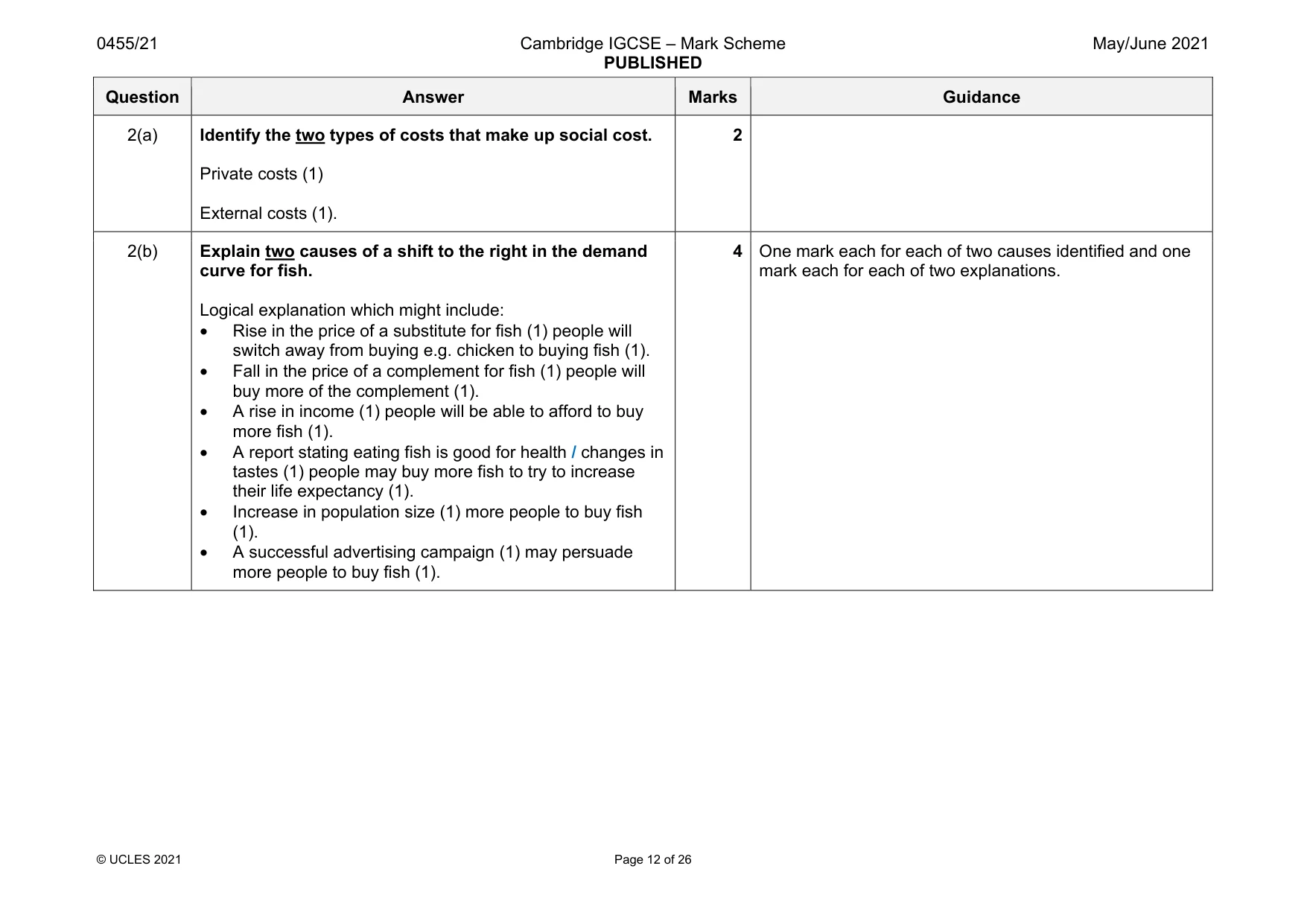
2 There is an area of rubbish, three times the size of France, floating in the Pacific Ocean called the Great Pacific Garbage Patch. It is made up of rubbish including old fishing nets but most is plastic waste. It is forecast that, by 2050, there will be more plastic in the Pacific Ocean than fish. A number of islands in the Pacific Ocean specialise in fishing. Greater pollution will increase the social cost of the fishing industry. (a) Identify the two types of costs that make up social cost. [2] (b) Explain two causes of a shift to the right in the demand curve for fish. [4] (c) Analyse how cleaning up pollution could benefit an economy. [6] (d) Discuss whether or not countries specialising benefits consumers. [8]
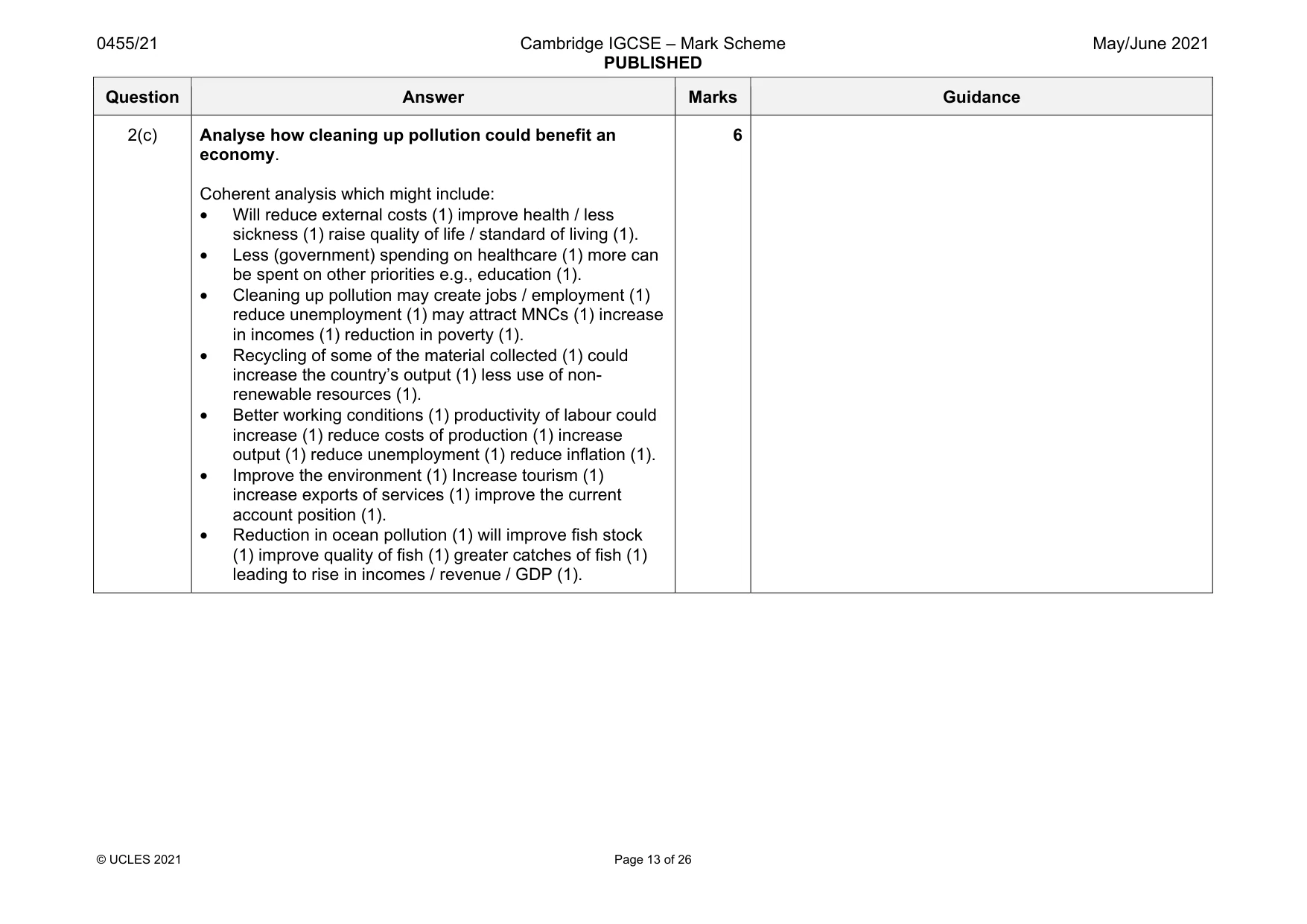
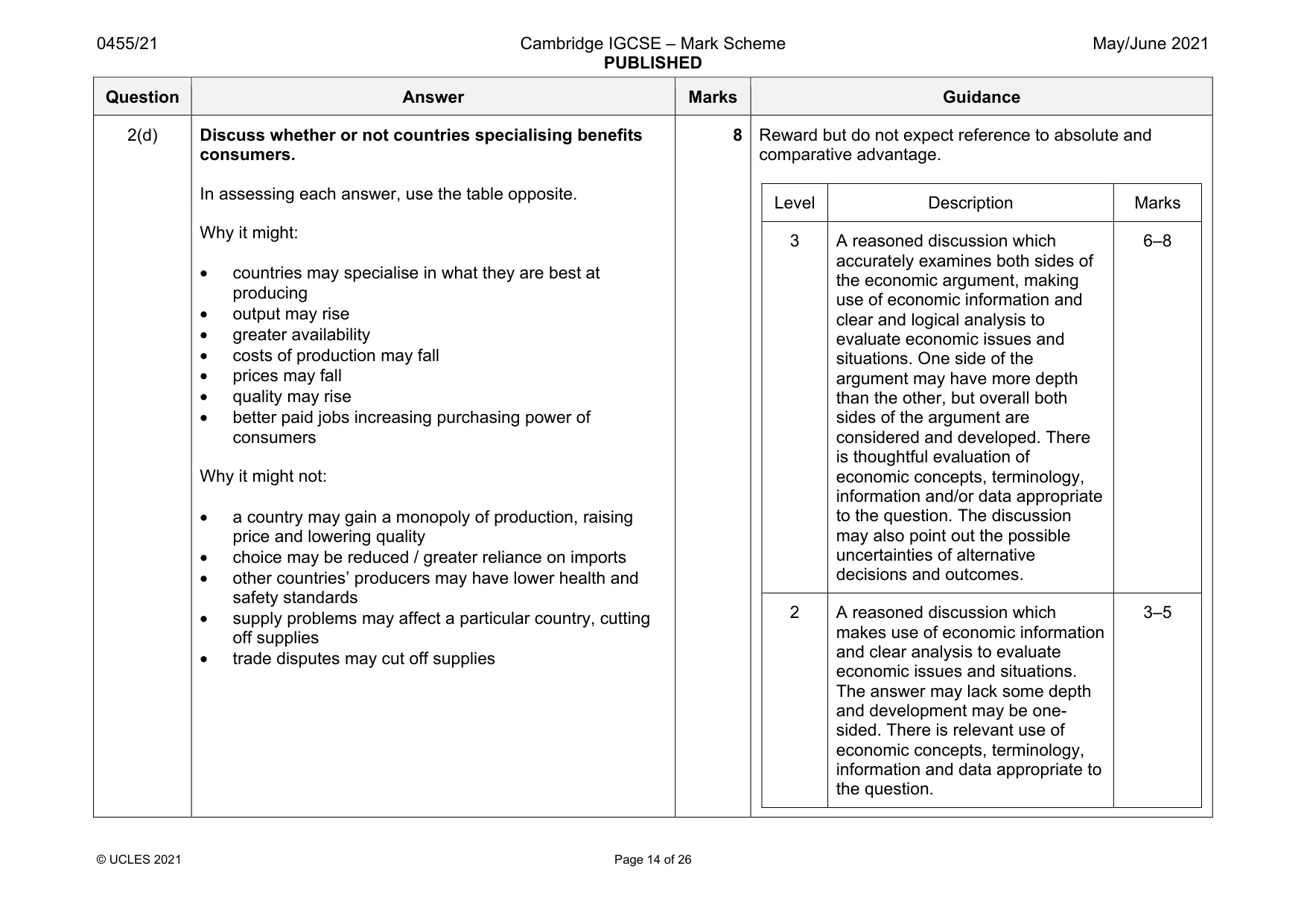
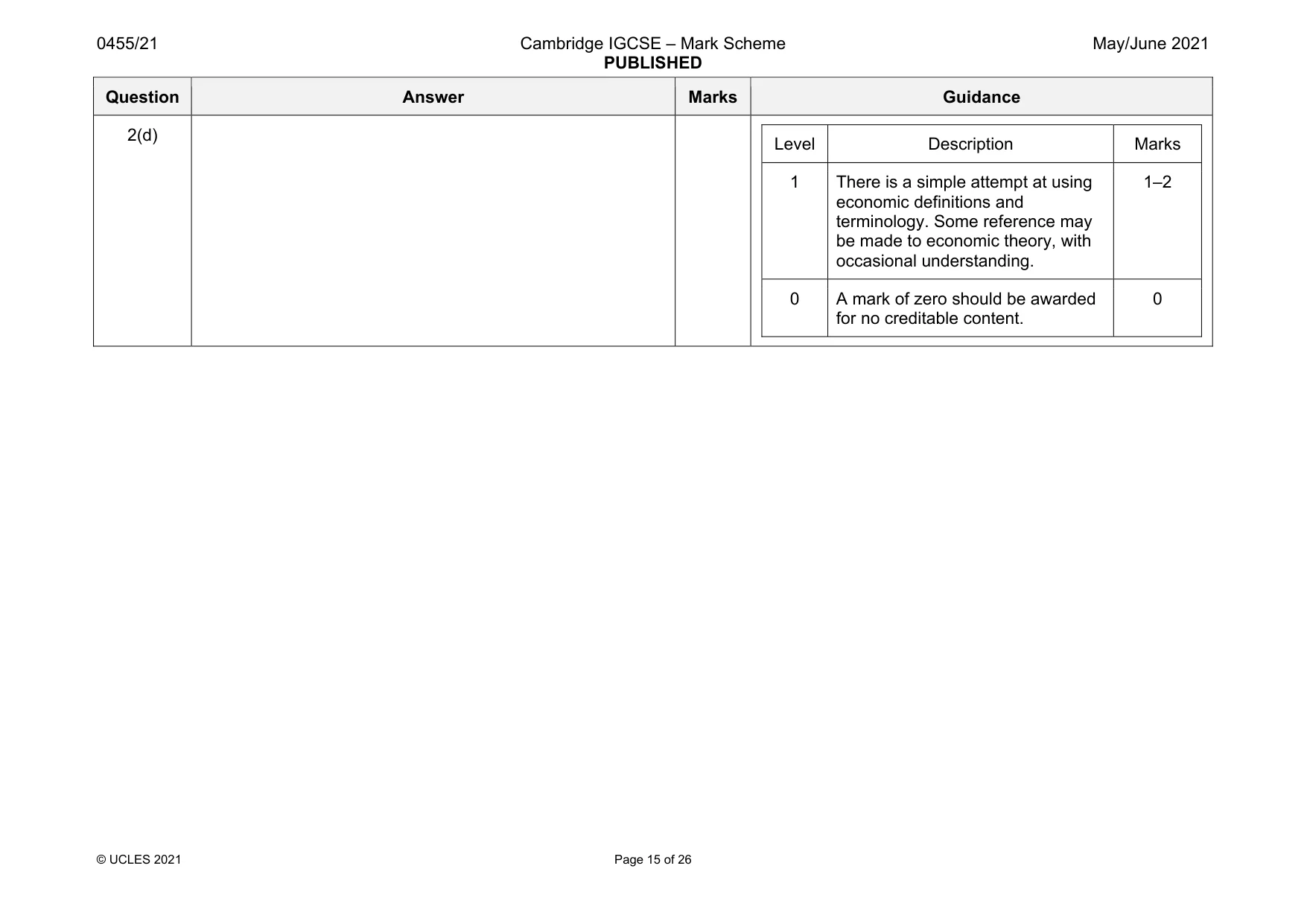
Mark scheme: 2(a) Identify the two types of costs that make up social cost. Private costs (1) External costs (1). 2 2(b) Explain two causes of a shift to the right in the demand curve for fish. Logical explanation which might include: • Rise in the price of a substitute for fish (1) people will switch away from buying e.g. chicken to buying fish (1). • Fall in the price of a complement for fish (1) people will buy more of the complement (1). • A rise in income (1) people will be able to afford to buy more fish (1). • A report stating eating fish is good for health / changes in tastes (1) people may buy more fish to try to increase their life expectancy (1). • Increase in population size (1) more people to buy fish (1). • A successful advertising campaign (1) may persuade more people to buy fish (1). 4 One mark each for each of two causes identified and one mark each for each of two explanations. Question Answer Marks Guidance 2(c) Analyse how cleaning up pollution could benefit an economy. Coherent analysis which might include: • Will reduce external costs (1) improve health / less sickness (1) raise quality of life / standard of living (1). • Less (government) spending on healthcare (1) more can be spent on other priorities e.g., education (1). • Cleaning up pollution may create jobs / employment (1) reduce unemployment (1) may attract MNCs (1) increase in incomes (1) reduction in poverty (1). • Recycling of some of the material collected (1) could increase the country’s output (1) less use of non- renewable resources (1). • Better working conditions (1) productivity of labour could increase (1) reduce costs of production (1) increase output (1) reduce unemployment (1) reduce inflation (1). • Improve the environment (1) Increase tourism (1) increase exports of services (1) improve the current account position (1). • Reduction in ocean pollution (1) will improve fish stock (1) improve quality of fish (1) greater catches of fish (1) leading to rise in incomes / revenue / GDP (1). 6 Question Answer Marks Guidance 2(d) Discuss whether or not countries specialising benefits consumers. In assessing each answer, use the table opposite. Why it might: • countries may specialise in what they are best at producing • output may rise • greater availability • costs of production may fall • prices may fall • quality may rise • better paid jobs increasing purchasing power of consumers Why it might not: • a country may gain a monopoly of production, raising price and lowering quality • choice may be reduced / greater reliance on imports • other countries’ producers may have lower health and safety standards • supply problems may affect a particular country, cutting off supplies • trade disputes may cut off supplies 8 Reward but do not expect reference to absolute and comparative advantage. Level Description Marks 3 A reasoned discussion which accurately examines both sides of the economic argument, making use of economic information and clear and logical analysis to evaluate economic issues and situations. One side of the argument may have more depth than the other, but overall both sides of the argument are considered and developed. There is thoughtful evaluation of economic concepts, terminology, information and/or data appropriate to the question. The discussion may also point out the possible uncertainties of alternative decisions and outcomes. 6–8 2 A reasoned discussion which makes use of economic information and clear analysis to evaluate economic issues and situations. The answer may lack some depth and development may be one- sided. There is relevant use of economic concepts, terminology, information and data appropriate to the question. 3–5 Question Answer Marks Guidance 2(d) Level Description Marks 1 There is a simple attempt at using economic definitions and terminology. Some reference may be made to economic theory, with occasional understanding. 1–2 0 A mark of zero should be awarded for no creditable content. 0
Q3 · In 2018, the US had its lowest unemployment rate for 18 years
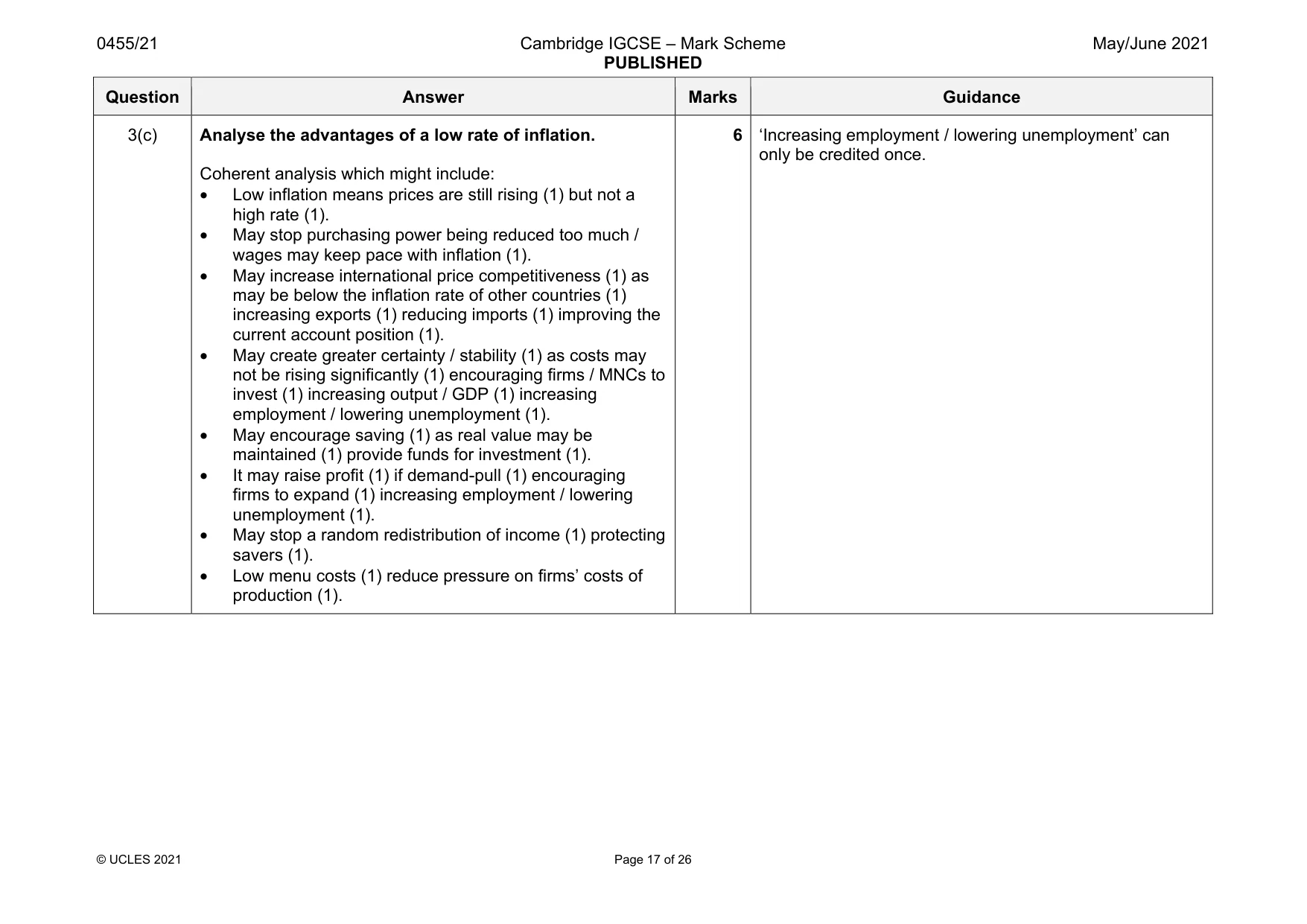
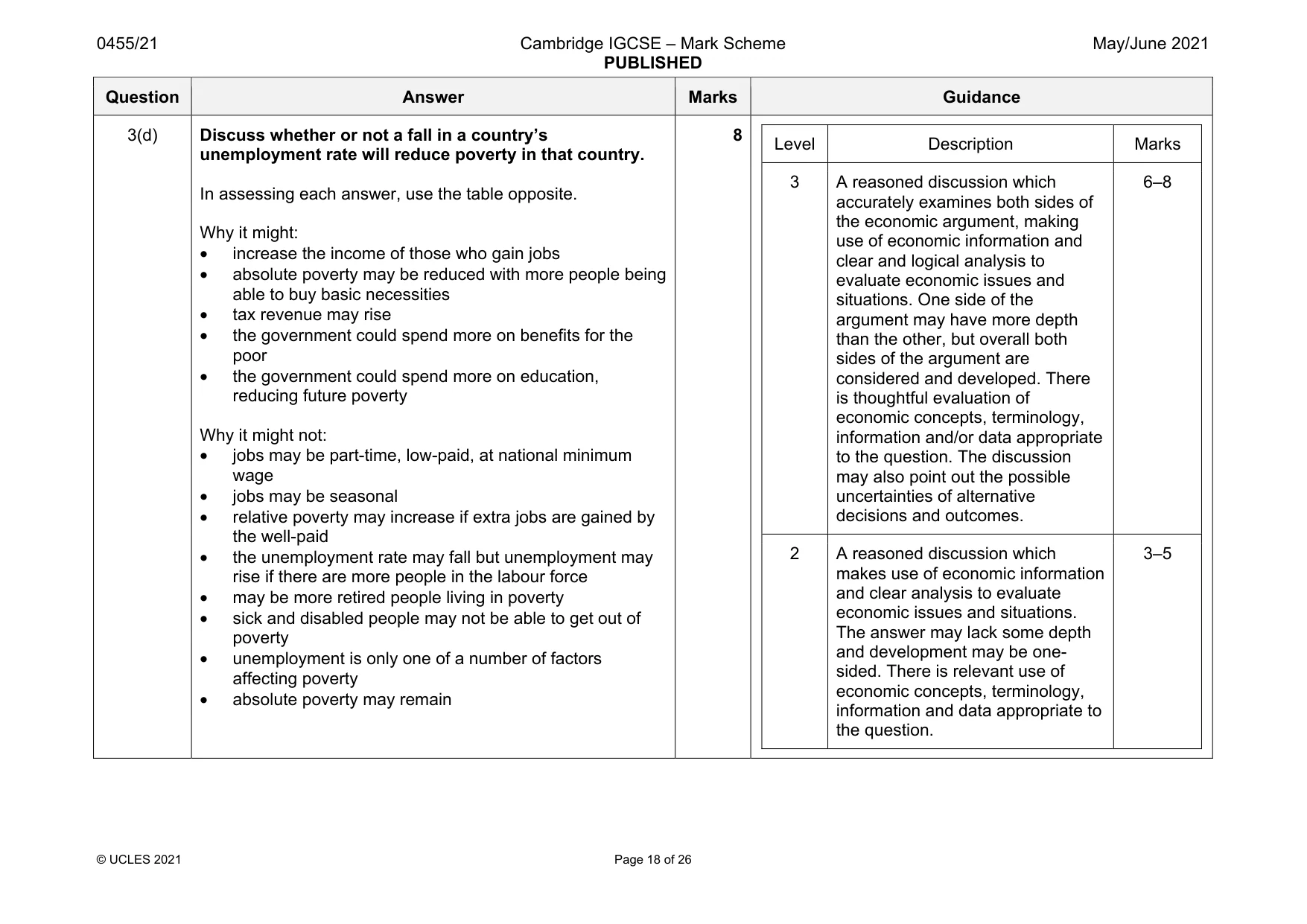
3 In 2018, the US had its lowest unemployment rate for 18 years. Cyclical unemployment was very low and so was the rate of inflation. The US also experienced a rise in labour productivity. However, it did not do so well in reducing poverty. In 2018, approximately 12% of Americans were living in poverty. (a) Define cyclical unemployment. [2] (b) Explain two ways a firm could increase the productivity of its workers. [4] (c) Analyse the advantages of a low rate of inflation. [6] (d) Discuss whether or not a fall in a country’s unemployment rate will reduce poverty in that country. [8]
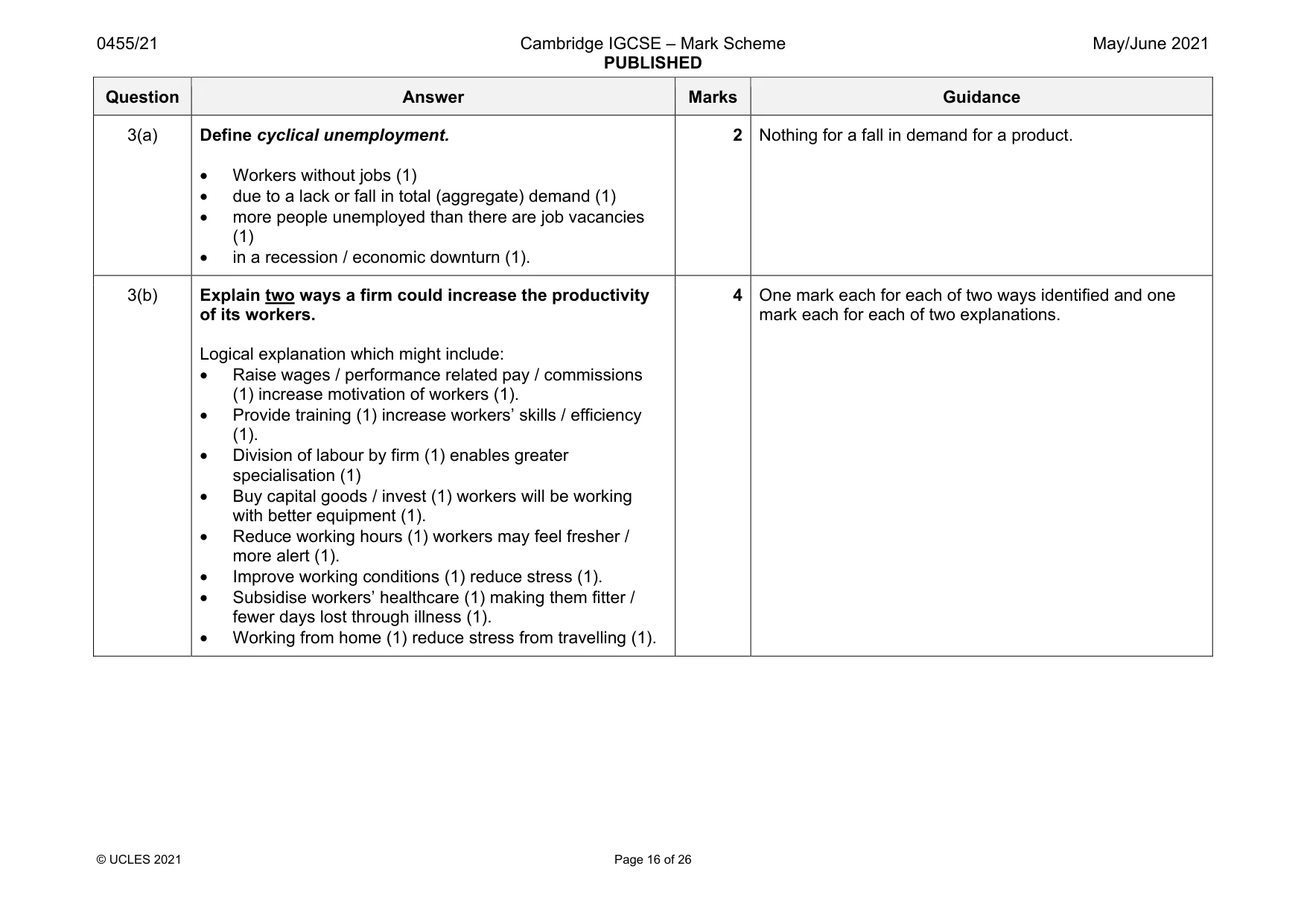
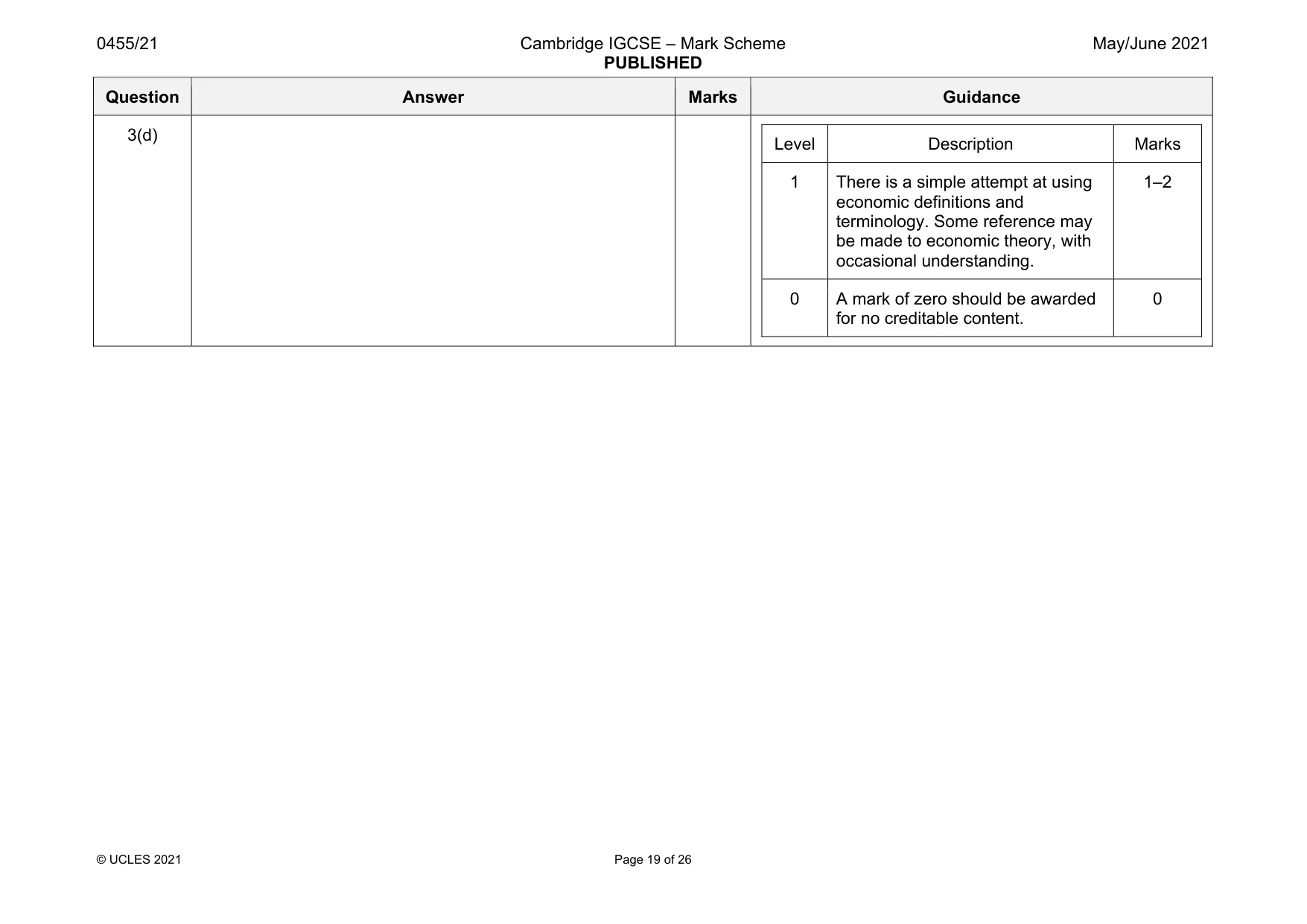
Mark scheme: 3(a) Define cyclical unemployment. • Workers without jobs (1) • due to a lack or fall in total (aggregate) demand (1) • more people unemployed than there are job vacancies (1) • in a recession / economic downturn (1). 2 Nothing for a fall in demand for a product. 3(b) Explain two ways a firm could increase the productivity of its workers. Logical explanation which might include: • Raise wages / performance related pay / commissions (1) increase motivation of workers (1). • Provide training (1) increase workers’ skills / efficiency (1). • Division of labour by firm (1) enables greater specialisation (1) • Buy capital goods / invest (1) workers will be working with better equipment (1). • Reduce working hours (1) workers may feel fresher / more alert (1). • Improve working conditions (1) reduce stress (1). • Subsidise workers’ healthcare (1) making them fitter / fewer days lost through illness (1). • Working from home (1) reduce stress from travelling (1). 4 One mark each for each of two ways identified and one mark each for each of two explanations. Question Answer Marks Guidance 3(c) Analyse the advantages of a low rate of inflation. Coherent analysis which might include: • Low inflation means prices are still rising (1) but not a high rate (1). • May stop purchasing power being reduced too much / wages may keep pace with inflation (1). • May increase international price competitiveness (1) as may be below the inflation rate of other countries (1) increasing exports (1) reducing imports (1) improving the current account position (1). • May create greater certainty / stability (1) as costs may not be rising significantly (1) encouraging firms / MNCs to invest (1) increasing output / GDP (1) increasing employment / lowering unemployment (1). • May encourage saving (1) as real value may be maintained (1) provide funds for investment (1). • It may raise profit (1) if demand-pull (1) encouraging firms to expand (1) increasing employment / lowering unemployment (1). • May stop a random redistribution of income (1) protecting savers (1). • Low menu costs (1) reduce pressure on firms’ costs of production (1). 6 ‘Increasing employment / lowering unemployment’ can only be credited once. Question Answer Marks Guidance 3(d) Discuss whether or not a fall in a country’s unemployment rate will reduce poverty in that country. In assessing each answer, use the table opposite. Why it might: • increase the income of those who gain jobs • absolute poverty may be reduced with more people being able to buy basic necessities • tax revenue may rise • the government could spend more on benefits for the poor • the government could spend more on education, reducing future poverty Why it might not: • jobs may be part-time, low-paid, at national minimum wage • jobs may be seasonal • relative poverty may increase if extra jobs are gained by the well-paid • the unemployment rate may fall but unemployment may rise if there are more people in the labour force • may be more retired people living in poverty • sick and disabled people may not be able to get out of poverty • unemployment is only one of a number of factors affecting poverty • absolute poverty may remain 8 Level Description Marks 3 A reasoned discussion which accurately examines both sides of the economic argument, making use of economic information and clear and logical analysis to evaluate economic issues and situations. One side of the argument may have more depth than the other, but overall both sides of the argument are considered and developed. There is thoughtful evaluation of economic concepts, terminology, information and/or data appropriate to the question. The discussion may also point out the possible uncertainties of alternative decisions and outcomes. 6–8 2 A reasoned discussion which makes use of economic information and clear analysis to evaluate economic issues and situations. The answer may lack some depth and development may be one- sided. There is relevant use of economic concepts, terminology, information and data appropriate to the question. 3–5 Question Answer Marks Guidance 3(d) Level Description Marks 1 There is a simple attempt at using economic definitions and terminology. Some reference may be made to economic theory, with occasional understanding. 1–2 0 A mark of zero should be awarded for no creditable content. 0
Q4 · The Canadian government has introduced a number of policy measures designed to encourage…
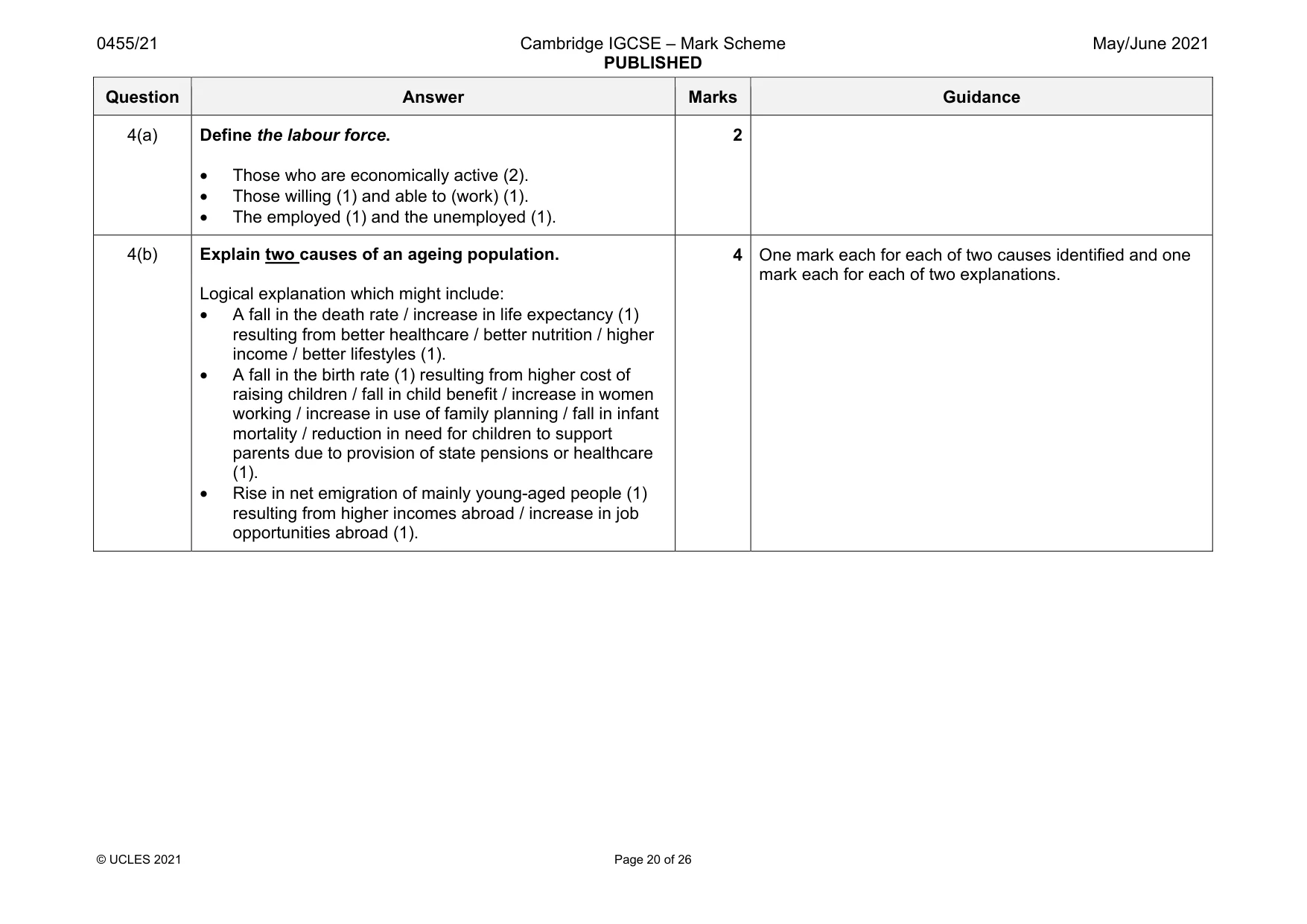
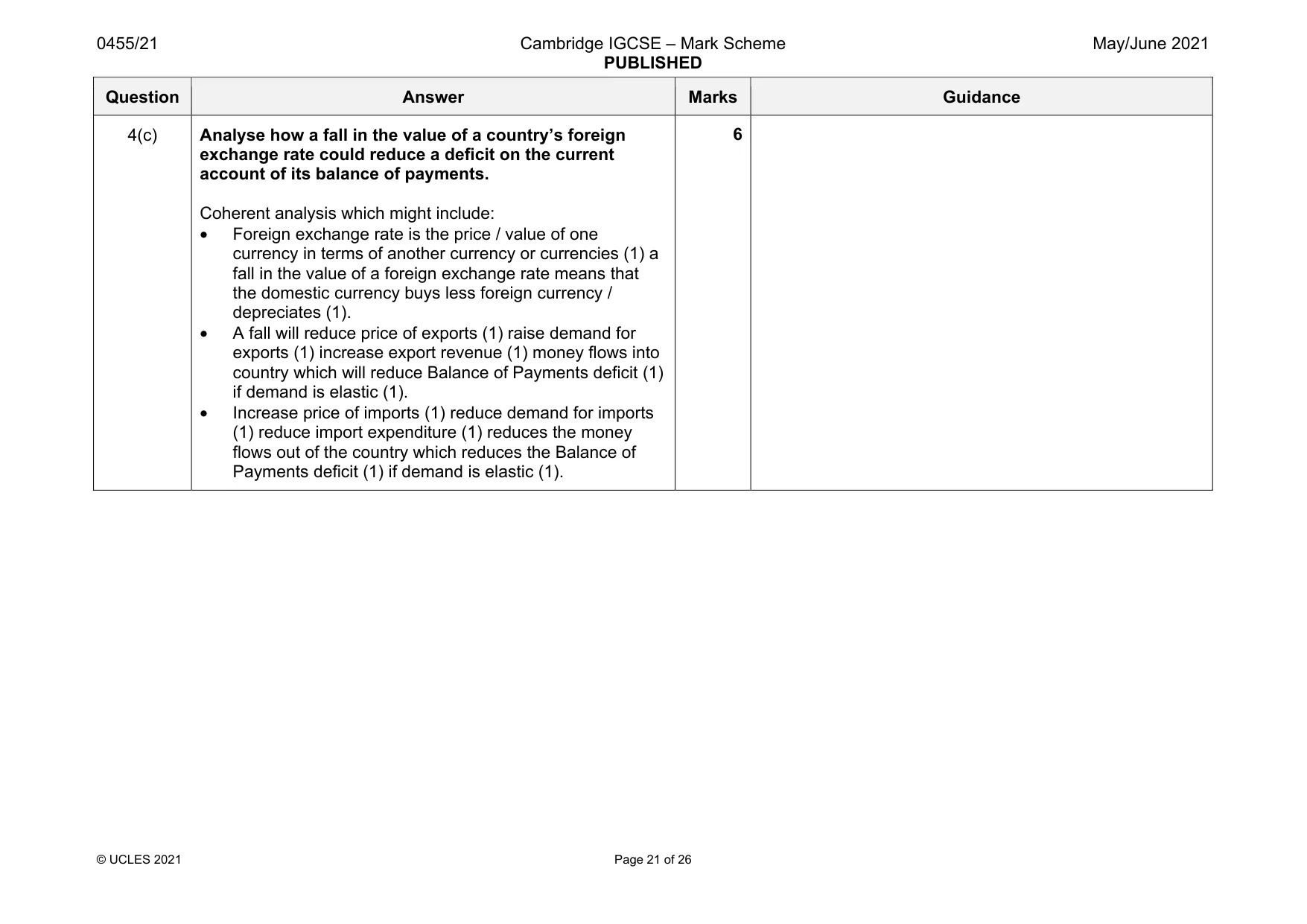
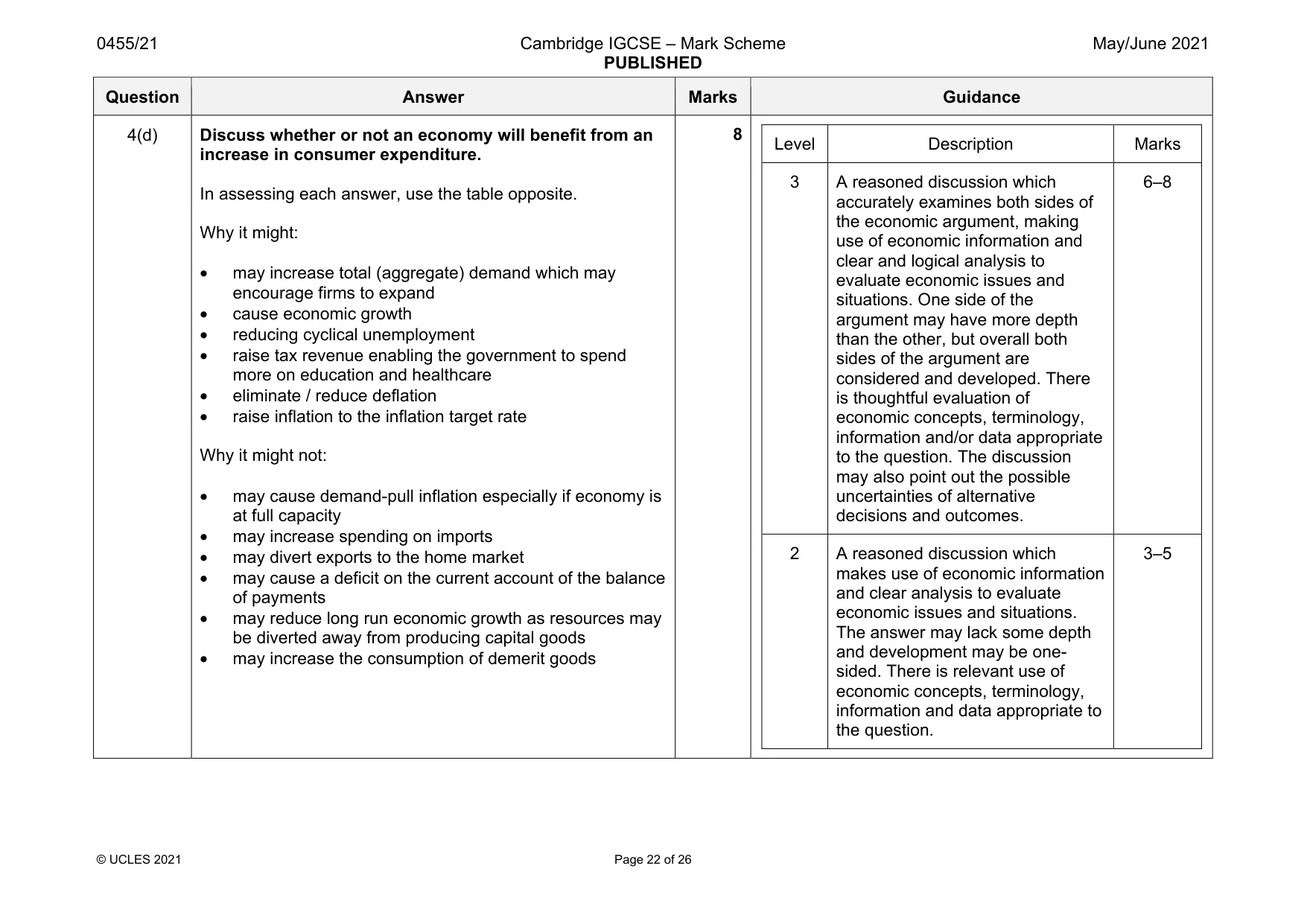
4 The Canadian government has introduced a number of policy measures designed to encourage more women to enter the labour force. Canada’s labour force has reduced as its population has aged. The number of workers and their output are influenced by changes in the country’s foreign exchange rate and consumer expenditure. In 2018, the Canadian dollar fell in value while Canadian consumer expenditure increased. (a) Define the labour force. [2] (b) Explain two causes of an ageing population. [4] (c) Analyse how a fall in the value of a country’s foreign exchange rate could reduce a deficit on the current account of its balance of payments. [6] (d) Discuss whether or not an economy will benefit from an increase in consumer expenditure. [8]
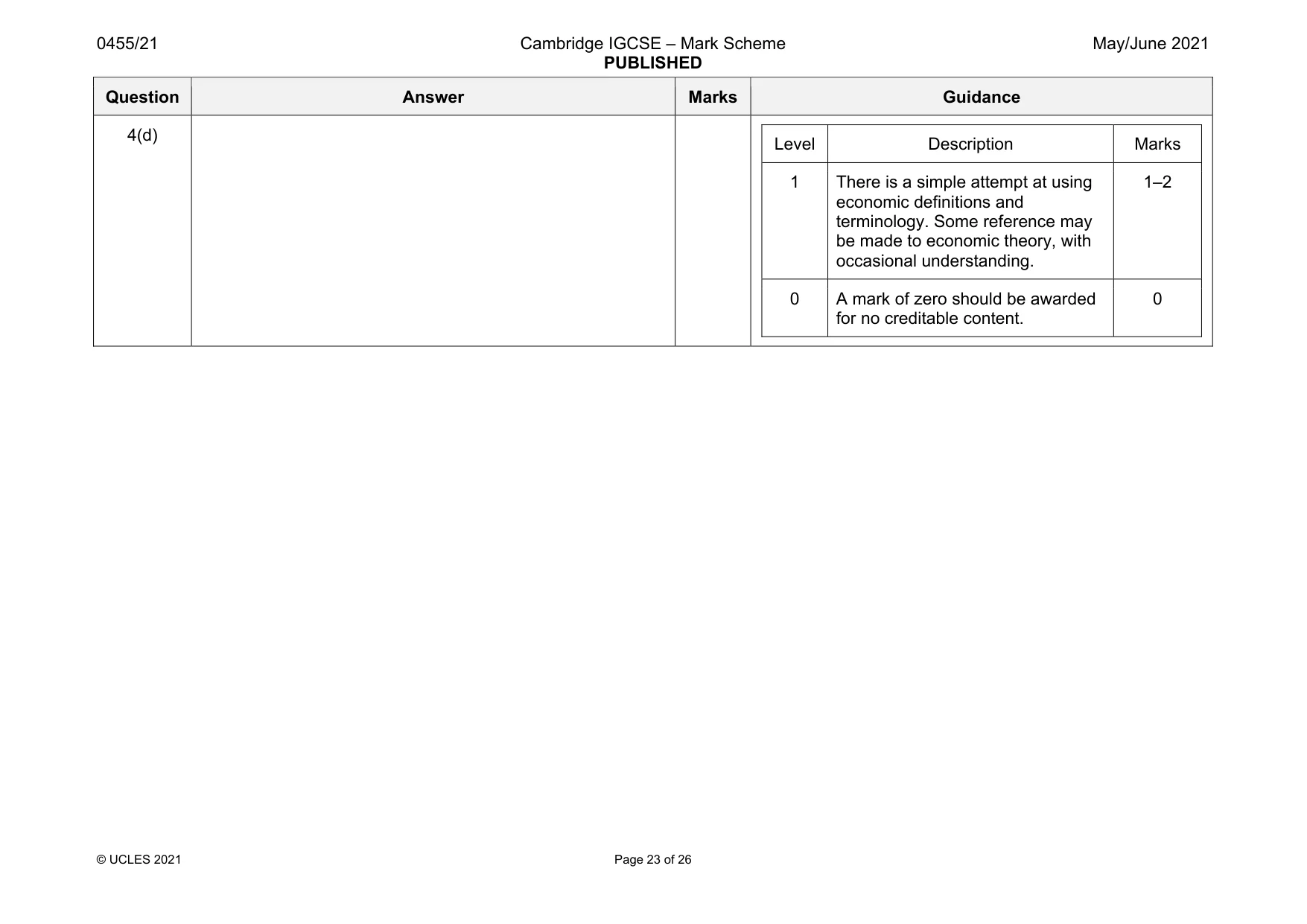
Mark scheme: 4(a) Define the labour force. • Those who are economically active (2). • Those willing (1) and able to (work) (1). • The employed (1) and the unemployed (1). 2 4(b) Explain two causes of an ageing population. Logical explanation which might include: • A fall in the death rate / increase in life expectancy (1) resulting from better healthcare / better nutrition / higher income / better lifestyles (1). • A fall in the birth rate (1) resulting from higher cost of raising children / fall in child benefit / increase in women working / increase in use of family planning / fall in infant mortality / reduction in need for children to support parents due to provision of state pensions or healthcare (1). • Rise in net emigration of mainly young-aged people (1) resulting from higher incomes abroad / increase in job opportunities abroad (1). 4 One mark each for each of two causes identified and one mark each for each of two explanations. Question Answer Marks Guidance 4(c) Analyse how a fall in the value of a country’s foreign exchange rate could reduce a deficit on the current account of its balance of payments. Coherent analysis which might include: • Foreign exchange rate is the price / value of one currency in terms of another currency or currencies (1) a fall in the value of a foreign exchange rate means that the domestic currency buys less foreign currency / depreciates (1). • A fall will reduce price of exports (1) raise demand for exports (1) increase export revenue (1) money flows into country which will reduce Balance of Payments deficit (1) if demand is elastic (1). • Increase price of imports (1) reduce demand for imports (1) reduce import expenditure (1) reduces the money flows out of the country which reduces the Balance of Payments deficit (1) if demand is elastic (1). 6 Question Answer Marks Guidance 4(d) Discuss whether or not an economy will benefit from an increase in consumer expenditure. In assessing each answer, use the table opposite. Why it might: • may increase total (aggregate) demand which may encourage firms to expand • cause economic growth • reducing cyclical unemployment • raise tax revenue enabling the government to spend more on education and healthcare • eliminate / reduce deflation • raise inflation to the inflation target rate Why it might not: • may cause demand-pull inflation especially if economy is at full capacity • may increase spending on imports • may divert exports to the home market • may cause a deficit on the current account of the balance of payments • may reduce long run economic growth as resources may be diverted away from producing capital goods • may increase the consumption of demerit goods 8 Level Description Marks 3 A reasoned discussion which accurately examines both sides of the economic argument, making use of economic information and clear and logical analysis to evaluate economic issues and situations. One side of the argument may have more depth than the other, but overall both sides of the argument are considered and developed. There is thoughtful evaluation of economic concepts, terminology, information and/or data appropriate to the question. The discussion may also point out the possible uncertainties of alternative decisions and outcomes. 6–8 2 A reasoned discussion which makes use of economic information and clear analysis to evaluate economic issues and situations. The answer may lack some depth and development may be one- sided. There is relevant use of economic concepts, terminology, information and data appropriate to the question. 3–5 Question Answer Marks Guidance 4(d) Level Description Marks 1 There is a simple attempt at using economic definitions and terminology. Some reference may be made to economic theory, with occasional understanding. 1–2 0 A mark of zero should be awarded for no creditable content. 0
Q5 · Australia experienced a drought in 2018 which caused its agricultural output to fall
5 Australia experienced a drought in 2018 which caused its agricultural output to fall. Australia’s secondary and tertiary sectors performed better in 2018 than its primary sector. All three sectors were affected by the measures taken by the central bank to avoid deflation. Some firms benefited from these measures and increased their output. (a) Identify two industries, other than agriculture, that operate in the primary sector. [2] (b) Explain two possible disadvantages to an economy of a fall in agricultural output. [4] (c) Analyse how a central bank could avoid deflation. [6] (d) Discuss whether or not a firm should have growth as its main objective. [8]
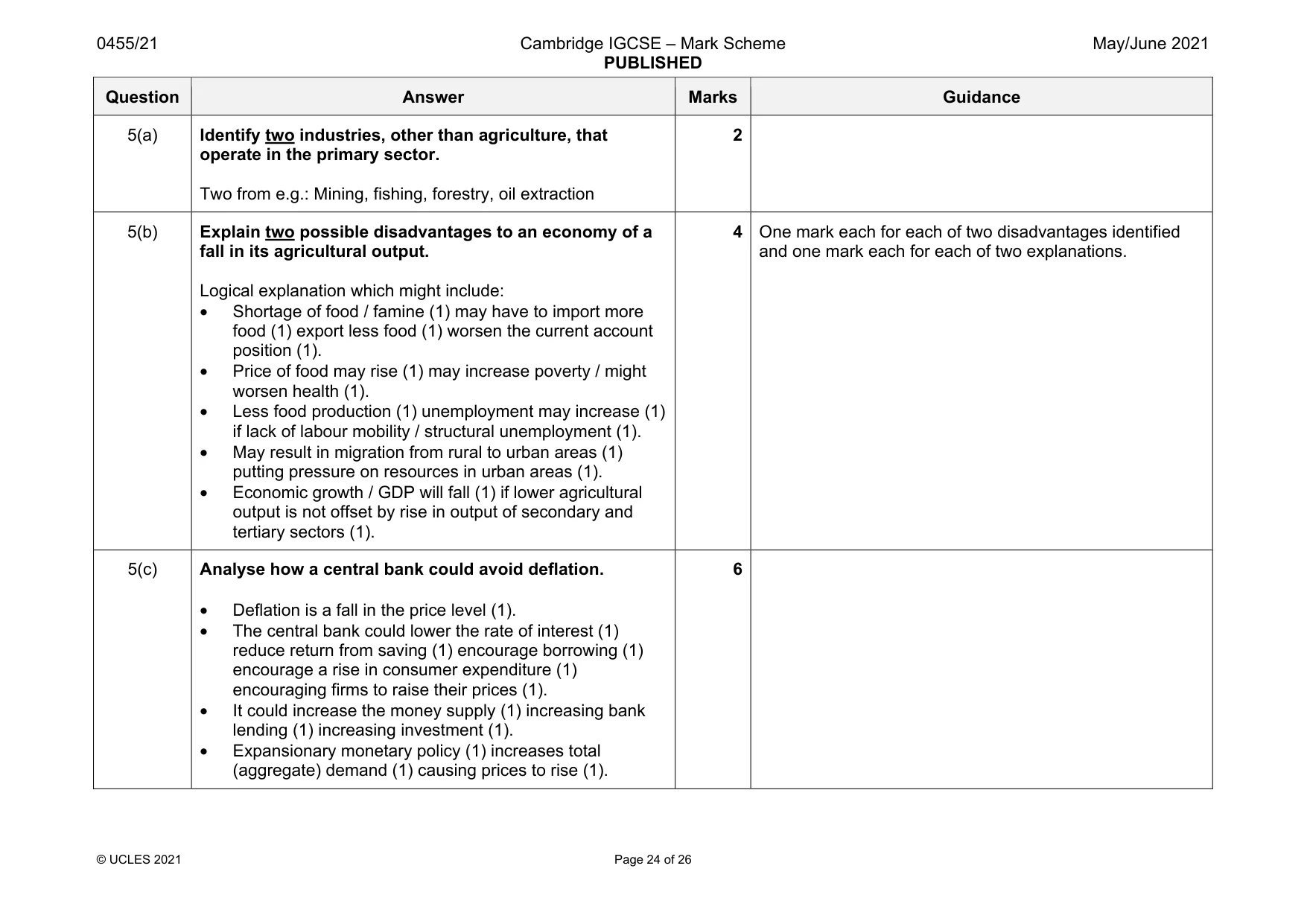
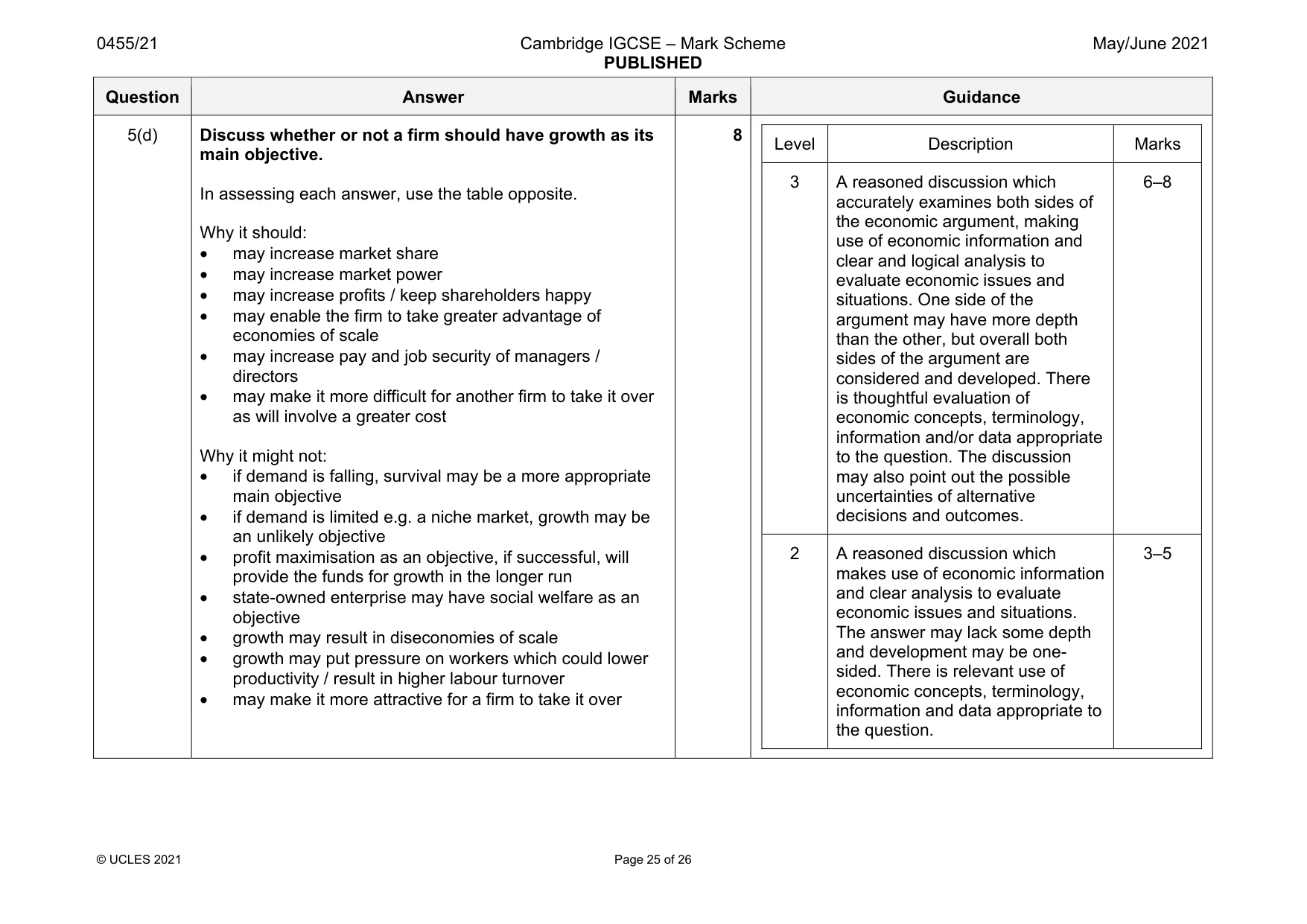
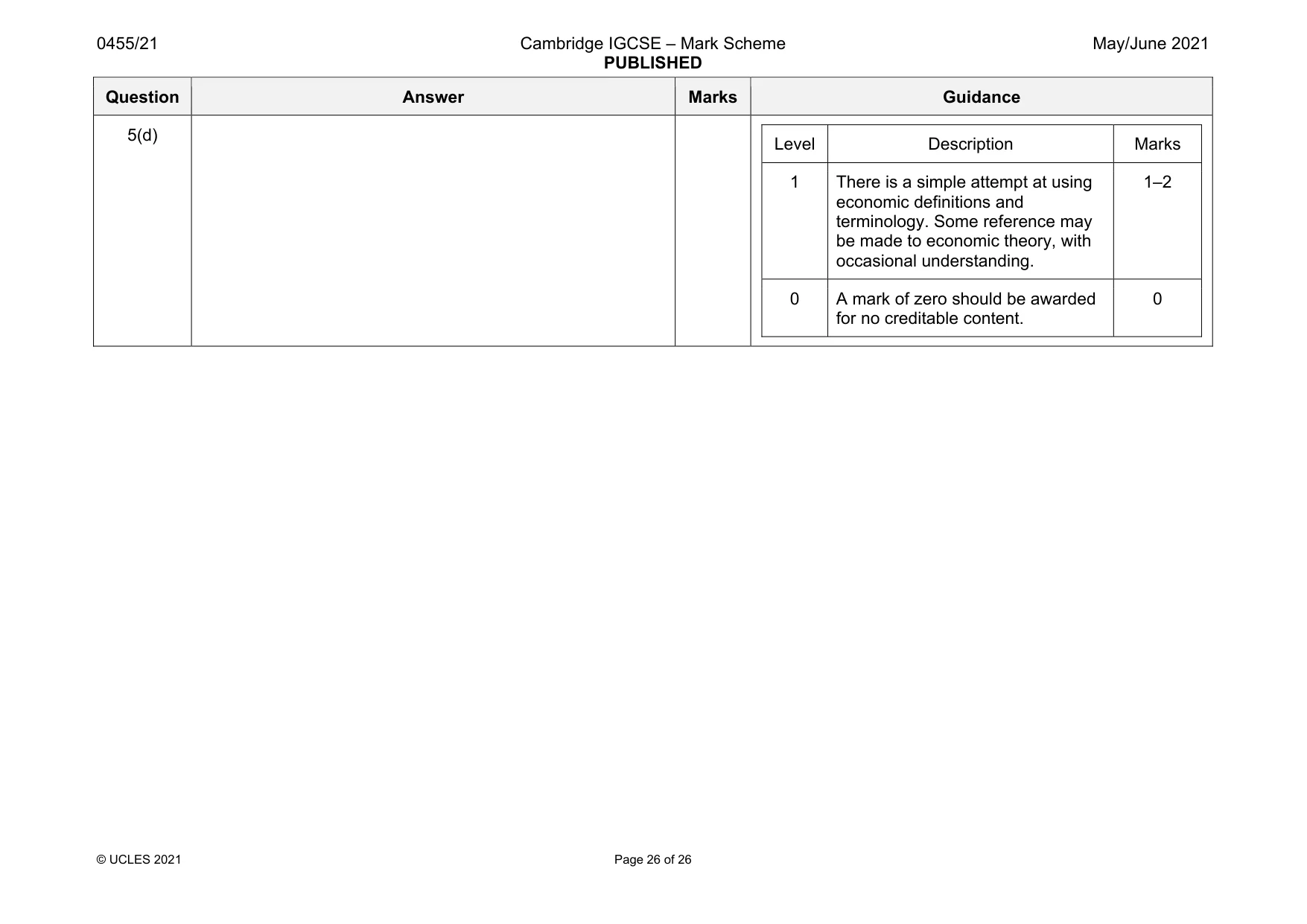
Mark scheme: 5(a) Identify two industries, other than agriculture, that operate in the primary sector. Two from e.g.: Mining, fishing, forestry, oil extraction 2 5(b) Explain two possible disadvantages to an economy of a fall in its agricultural output. Logical explanation which might include: • Shortage of food / famine (1) may have to import more food (1) export less food (1) worsen the current account position (1). • Price of food may rise (1) may increase poverty / might worsen health (1). • Less food production (1) unemployment may increase (1) if lack of labour mobility / structural unemployment (1). • May result in migration from rural to urban areas (1) putting pressure on resources in urban areas (1). • Economic growth / GDP will fall (1) if lower agricultural output is not offset by rise in output of secondary and tertiary sectors (1). 4 One mark each for each of two disadvantages identified and one mark each for each of two explanations. 5(c) Analyse how a central bank could avoid deflation. • Deflation is a fall in the price level (1). • The central bank could lower the rate of interest (1) reduce return from saving (1) encourage borrowing (1) encourage a rise in consumer expenditure (1) encouraging firms to raise their prices (1). • It could increase the money supply (1) increasing bank lending (1) increasing investment (1). • Expansionary monetary policy (1) increases total (aggregate) demand (1) causing prices to rise (1). 6 Question Answer Marks Guidance 5(d) Discuss whether or not a firm should have growth as its main objective. In assessing each answer, use the table opposite. Why it should: • may increase market share • may increase market power • may increase profits / keep shareholders happy • may enable the firm to take greater advantage of economies of scale • may increase pay and job security of managers / directors • may make it more difficult for another firm to take it over as will involve a greater cost Why it might not: • if demand is falling, survival may be a more appropriate main objective • if demand is limited e.g. a niche market, growth may be an unlikely objective • profit maximisation as an objective, if successful, will provide the funds for growth in the longer run • state-owned enterprise may have social welfare as an objective • growth may result in diseconomies of scale • growth may put pressure on workers which could lower productivity / result in higher labour turnover • may make it more attractive for a firm to take it over 8 Level Description Marks 3 A reasoned discussion which accurately examines both sides of the economic argument, making use of economic information and clear and logical analysis to evaluate economic issues and situations. One side of the argument may have more depth than the other, but overall both sides of the argument are considered and developed. There is thoughtful evaluation of economic concepts, terminology, information and/or data appropriate to the question. The discussion may also point out the possible uncertainties of alternative decisions and outcomes. 6–8 2 A reasoned discussion which makes use of economic information and clear analysis to evaluate economic issues and situations. The answer may lack some depth and development may be one- sided. There is relevant use of economic concepts, terminology, information and data appropriate to the question. 3–5 Question Answer Marks Guidance 5(d) Level Description Marks 1 There is a simple attempt at using economic definitions and terminology. Some reference may be made to economic theory, with occasional understanding. 1–2 0 A mark of zero should be awarded for no creditable content. 0
What was in this paper
The subtopics covered by these 5 questions, and how many questions each got. Open one in a new tab to see every Cambridge question on it.
What you needed in this session
Cambridge’s own grade thresholds for 2021 May/June, Paper 2 · Variant 1. A higher threshold means an easier paper — the bar moves with how the cohort did.