Cambridge IGCSE Economics 0455 — 2017 May/June Paper 2 · Variant 1
0455/21/M/J/17 · 7 questions · 90 marks · ≈101 min
The question paper and its mark scheme, free to read here and free to download. This is Cambridge’s own paper, exactly as it was sat.
Question paper8 pages




Mark scheme16 pages
Answers below. Sit the paper first if you are practising.
Questions as text
Q1 · The New Suez Canal In August 2015 the Egyptian Government opened a second Suez Canal…
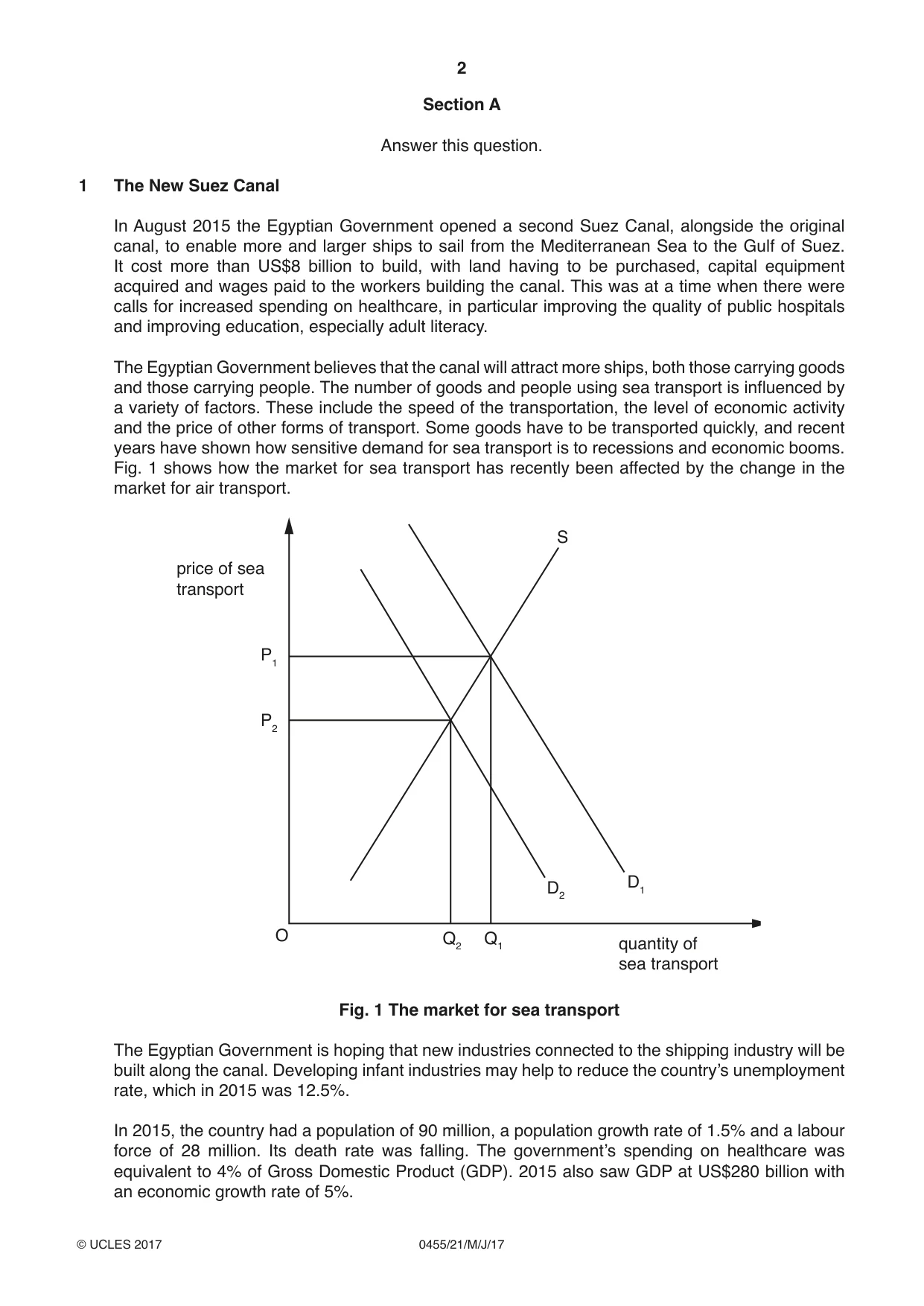
1 The New Suez Canal In August 2015 the Egyptian Government opened a second Suez Canal, alongside the original canal, to enable more and larger ships to sail from the Mediterranean Sea to the Gulf of Suez. It cost more than US$8 billion to build, with land having to be purchased, capital equipment acquired and wages paid to the workers building the canal. This was at a time when there were calls for increased spending on healthcare, in particular improving the quality of public hospitals and improving education, especially adult literacy. The Egyptian Government believes that the canal will attract more ships, both those carrying goods and those carrying people. The number of goods and people using sea transport is influenced by a variety of factors. These include the speed of the transportation, the level of economic activity and the price of other forms of transport. Some goods have to be transported quickly, and recent years have shown how sensitive demand for sea transport is to recessions and economic booms. Fig. 1 shows how the market for sea transport has recently been affected by the change in the market for air transport. S price of sea transport P1 P2 D1 D2 O Q2 Q1 quantity of sea transport Fig. 1 The market for sea transport The Egyptian Government is hoping that new industries connected to the shipping industry will be built along the canal. Developing infant industries may help to reduce the country’s unemployment rate, which in 2015 was 12.5%. In 2015, the country had a population of 90 million, a population growth rate of 1.5% and a labour force of 28 million. Its death rate was falling. The government’s spending on healthcare was equivalent to 4% of Gross Domestic Product (GDP). 2015 also saw GDP at US$280 billion with an economic growth rate of 5%. (a) Define ‘private cost’ and give an example from the extract. [2] (b) Explain opportunity cost and give an example from the extract. [4] (c) Calculate, using information from the extract: (i) the number of people unemployed in Egypt in 2015 [2] (ii) the amount the Egyptian Government spent on healthcare in 2015. [2] (d) Analyse how a global recession could affect demand for sea transport. [5] (e) Discuss whether a fall in a country’s death rate will always result in an increase in its population size. [5] (f) Explain, using information from the extract and Fig. 1, what happened to the market for sea transport as a result of the fall in the price of air transport. [4] (g) Discuss whether a government should protect infant industries. [6]
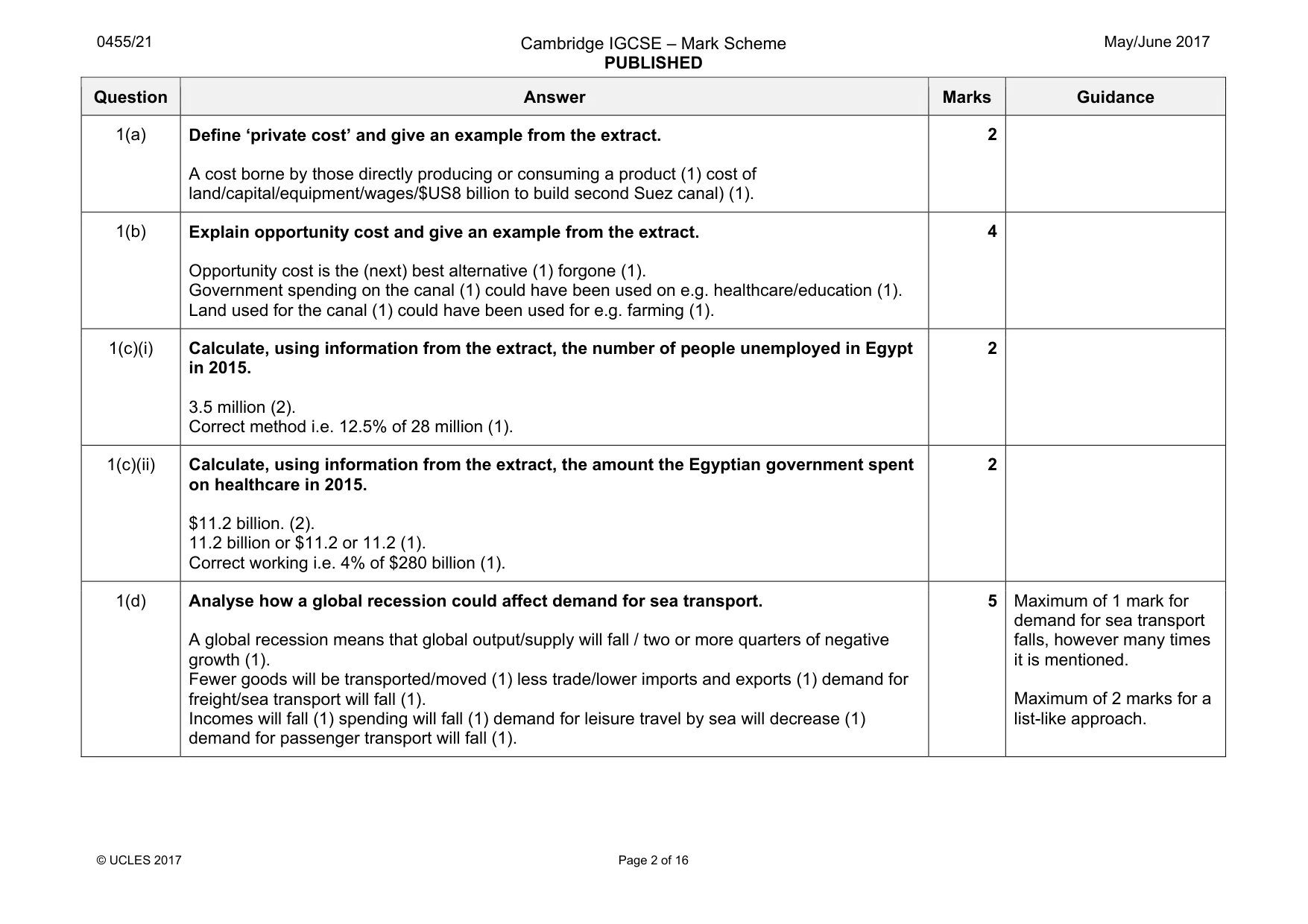
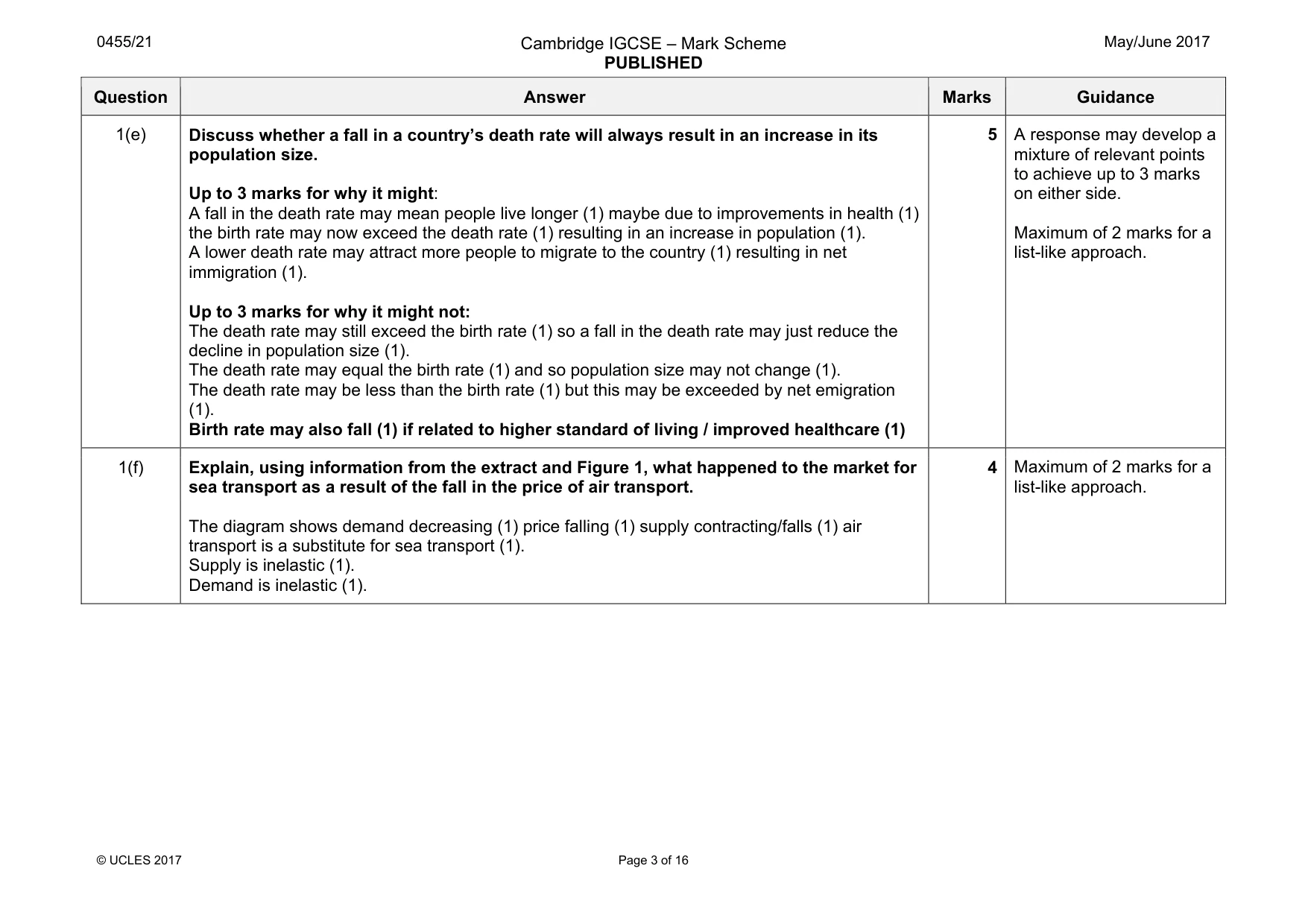
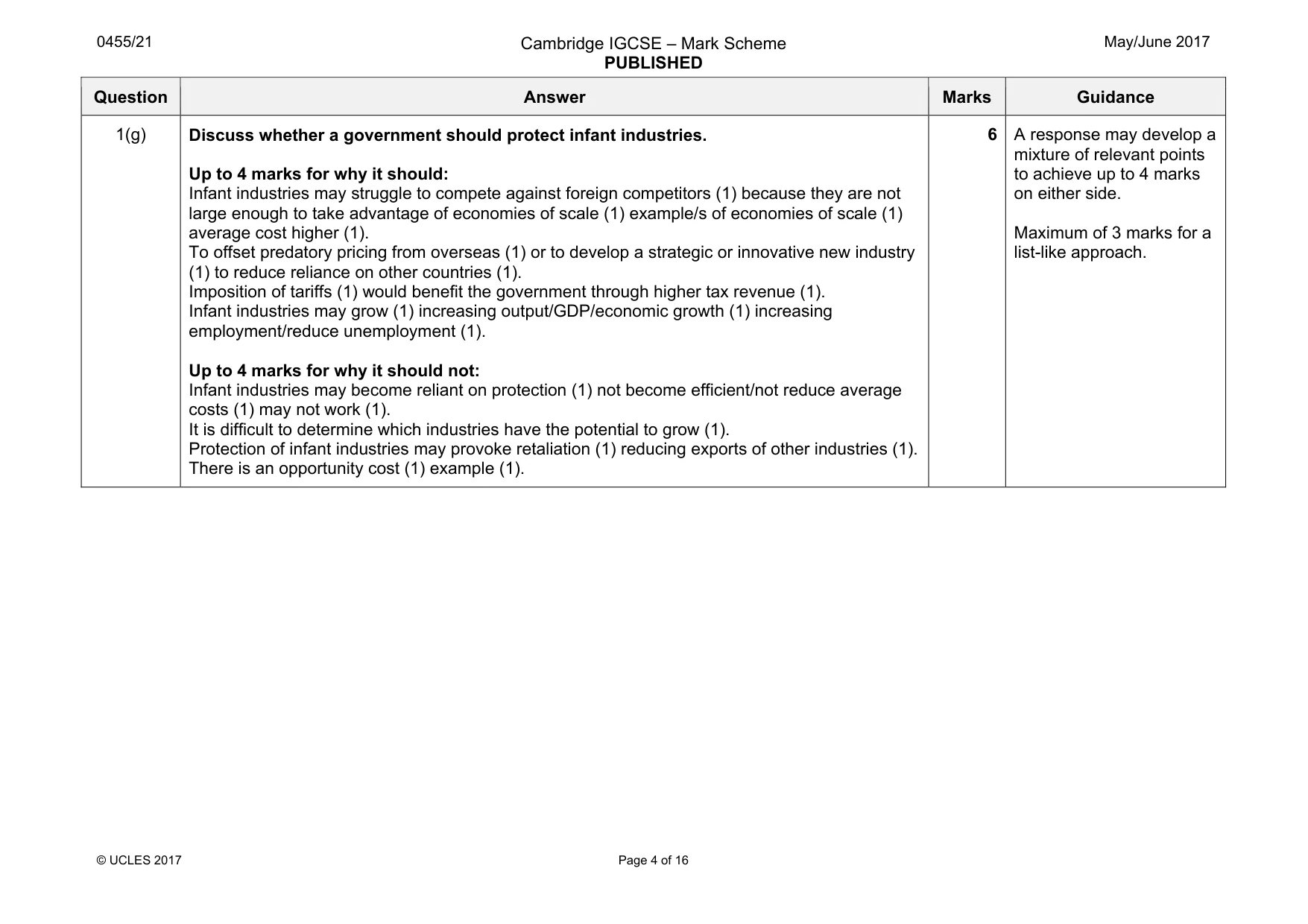
Mark scheme: 1(a) Define ‘private cost’ and give an example from the extract. A cost borne by those directly producing or consuming a product (1) cost of land/capital/equipment/wages/$US8 billion to build second Suez canal) (1). 2 1(b) Explain opportunity cost and give an example from the extract. Opportunity cost is the (next) best alternative (1) forgone (1). Government spending on the canal (1) could have been used on e.g. healthcare/education (1). Land used for the canal (1) could have been used for e.g. farming (1). 4 1(c)(i) Calculate, using information from the extract, the number of people unemployed in Egypt in 2015. 3.5 million (2). Correct method i.e. 12.5% of 28 million (1). 2 1(c)(ii) Calculate, using information from the extract, the amount the Egyptian government spent on healthcare in 2015. $11.2 billion. (2). 11.2 billion or $11.2 or 11.2 (1). Correct working i.e. 4% of $280 billion (1). 2 1(d) Analyse how a global recession could affect demand for sea transport. A global recession means that global output/supply will fall / two or more quarters of negative growth (1). Fewer goods will be transported/moved (1) less trade/lower imports and exports (1) demand for freight/sea transport will fall (1). Incomes will fall (1) spending will fall (1) demand for leisure travel by sea will decrease (1) demand for passenger transport will fall (1). 5 Maximum of 1 mark for demand for sea transport falls, however many times it is mentioned. Maximum of 2 marks for a list-like approach. Question Answer Marks Guidance 1(e) Discuss whether a fall in a country’s death rate will always result in an increase in its population size. Up to 3 marks for why it might: A fall in the death rate may mean people live longer (1) maybe due to improvements in health (1) the birth rate may now exceed the death rate (1) resulting in an increase in population (1). A lower death rate may attract more people to migrate to the country (1) resulting in net immigration (1). Up to 3 marks for why it might not: The death rate may still exceed the birth rate (1) so a fall in the death rate may just reduce the decline in population size (1). The death rate may equal the birth rate (1) and so population size may not change (1). The death rate may be less than the birth rate (1) but this may be exceeded by net emigration (1). Birth rate may also fall (1) if related to higher standard of living / improved healthcare (1) 5 A response may develop a mixture of relevant points to achieve up to 3 marks on either side. Maximum of 2 marks for a list-like approach. 1(f) Explain, using information from the extract and Figure 1, what happened to the market for sea transport as a result of the fall in the price of air transport. The diagram shows demand decreasing (1) price falling (1) supply contracting/falls (1) air transport is a substitute for sea transport (1). Supply is inelastic (1). Demand is inelastic (1). 4 Maximum of 2 marks for a list-like approach. Question Answer Marks Guidance 1(g) Discuss whether a government should protect infant industries. Up to 4 marks for why it should: Infant industries may struggle to compete against foreign competitors (1) because they are not large enough to take advantage of economies of scale (1) example/s of economies of scale (1) average cost higher (1). To offset predatory pricing from overseas (1) or to develop a strategic or innovative new industry (1) to reduce reliance on other countries (1). Imposition of tariffs (1) would benefit the government through higher tax revenue (1). Infant industries may grow (1) increasing output/GDP/economic growth (1) increasing employment/reduce unemployment (1). Up to 4 marks for why it should not: Infant industries may become reliant on protection (1) not become efficient/not reduce average costs (1) may not work (1). It is difficult to determine which industries have the potential to grow (1). Protection of infant industries may provoke retaliation (1) reducing exports of other industries (1). There is an opportunity cost (1) example (1). 6 A response may develop a mixture of relevant points to achieve up to 4 marks on either side. Maximum of 3 marks for a list-like approach.
Q2 · Sales of bottled water in China doubled between 2010 and 2015
2 Sales of bottled water in China doubled between 2010 and 2015. In 2013 China overtook the USA as the biggest market for water by volume, but not value as the price of a bottle was higher in the USA. The increase in global consumption of bottled water has increased the size of firms producing bottled water but has also increased pollution. (a) Why is pollution an example of market failure? [2] (b) Explain two causes of a shift of a supply curve to the right. [4] (c) Analyse why the price of a product may be higher in the USA than China. [6] (d) Discuss whether large firms or small firms benefit consumers more. [8]
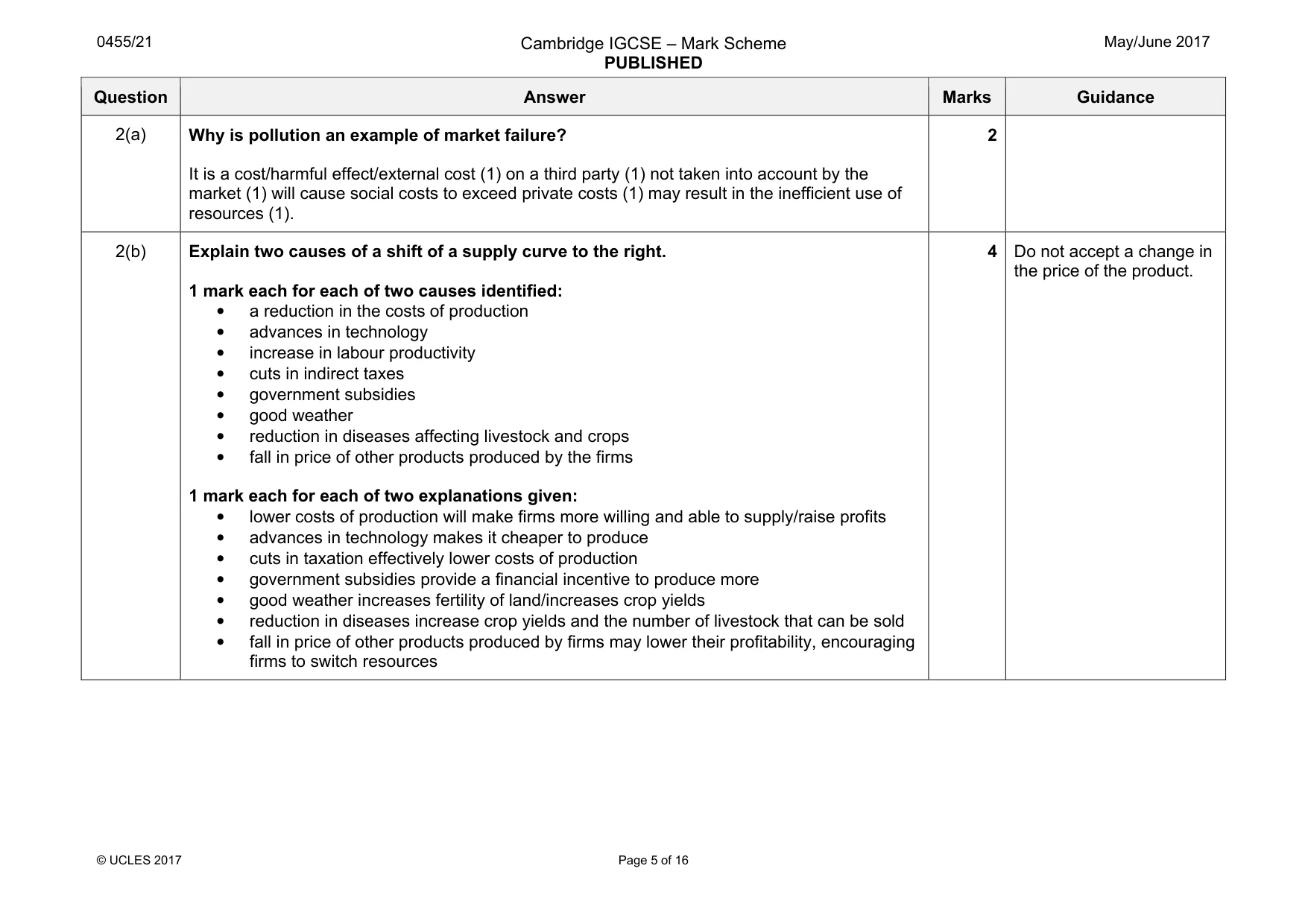
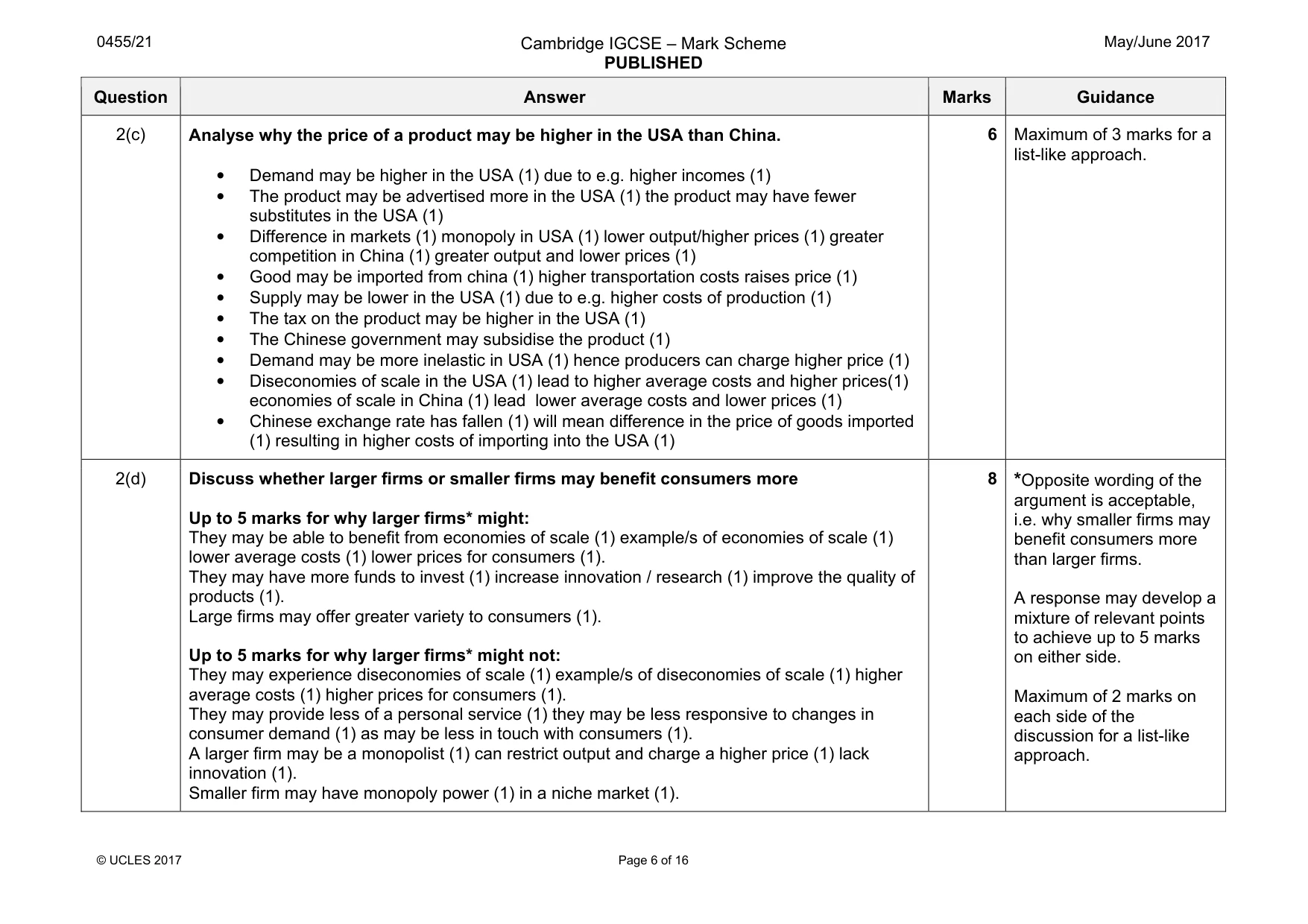
Mark scheme: 2(a) Why is pollution an example of market failure? It is a cost/harmful effect/external cost (1) on a third party (1) not taken into account by the market (1) will cause social costs to exceed private costs (1) may result in the inefficient use of resources (1). 2 2(b) Explain two causes of a shift of a supply curve to the right. 1 mark each for each of two causes identified: • a reduction in the costs of production • advances in technology • increase in labour productivity • cuts in indirect taxes • government subsidies • good weather • reduction in diseases affecting livestock and crops • fall in price of other products produced by the firms 1 mark each for each of two explanations given: • lower costs of production will make firms more willing and able to supply/raise profits • advances in technology makes it cheaper to produce • cuts in taxation effectively lower costs of production • government subsidies provide a financial incentive to produce more • good weather increases fertility of land/increases crop yields • reduction in diseases increase crop yields and the number of livestock that can be sold • fall in price of other products produced by firms may lower their profitability, encouraging firms to switch resources 4 Do not accept a change in the price of the product. Question Answer Marks Guidance 2(c) Analyse why the price of a product may be higher in the USA than China. • Demand may be higher in the USA (1) due to e.g. higher incomes (1) • The product may be advertised more in the USA (1) the product may have fewer substitutes in the USA (1) • Difference in markets (1) monopoly in USA (1) lower output/higher prices (1) greater competition in China (1) greater output and lower prices (1) • Good may be imported from china (1) higher transportation costs raises price (1) • Supply may be lower in the USA (1) due to e.g. higher costs of production (1) • The tax on the product may be higher in the USA (1) • The Chinese government may subsidise the product (1) • Demand may be more inelastic in USA (1) hence producers can charge higher price (1) • Diseconomies of scale in the USA (1) lead to higher average costs and higher prices(1) economies of scale in China (1) lead lower average costs and lower prices (1) • Chinese exchange rate has fallen (1) will mean difference in the price of goods imported (1) resulting in higher costs of importing into the USA (1) 6 Maximum of 3 marks for a list-like approach. 2(d) Discuss whether larger firms or smaller firms may benefit consumers more Up to 5 marks for why larger firms* might: They may be able to benefit from economies of scale (1) example/s of economies of scale (1) lower average costs (1) lower prices for consumers (1). They may have more funds to invest (1) increase innovation / research (1) improve the quality of products (1). Large firms may offer greater variety to consumers (1). Up to 5 marks for why larger firms* might not: They may experience diseconomies of scale (1) example/s of diseconomies of scale (1) higher average costs (1) higher prices for consumers (1). They may provide less of a personal service (1) they may be less responsive to changes in consumer demand (1) as may be less in touch with consumers (1). A larger firm may be a monopolist (1) can restrict output and charge a higher price (1) lack innovation (1). Smaller firm may have monopoly power (1) in a niche market (1). 8 *Opposite wording of the argument is acceptable, i.e. why smaller firms may benefit consumers more than larger firms. A response may develop a mixture of relevant points to achieve up to 5 marks on either side. Maximum of 2 marks on each side of the discussion for a list-like approach.
Q3 · Money and banking are closely linked
3 Money and banking are closely linked. Money performs a number of functions, including being a standard for deferred payments, and it is used to pay workers, often directly into their bank accounts. The amount workers earn differs depending on the industry in which they work. Bank lending from both private sector and public sector (state-owned) banks has increased in some countries in recent years. (a) Define ‘a standard for deferred payments’. [2] (b) Explain two reasons why agricultural workers may be paid less than manufacturing workers. [4] (c) Analyse why private sector banks may earn higher profits than public sector banks. [6] (d) Discuss whether an increase in bank lending will benefit an economy. [8]
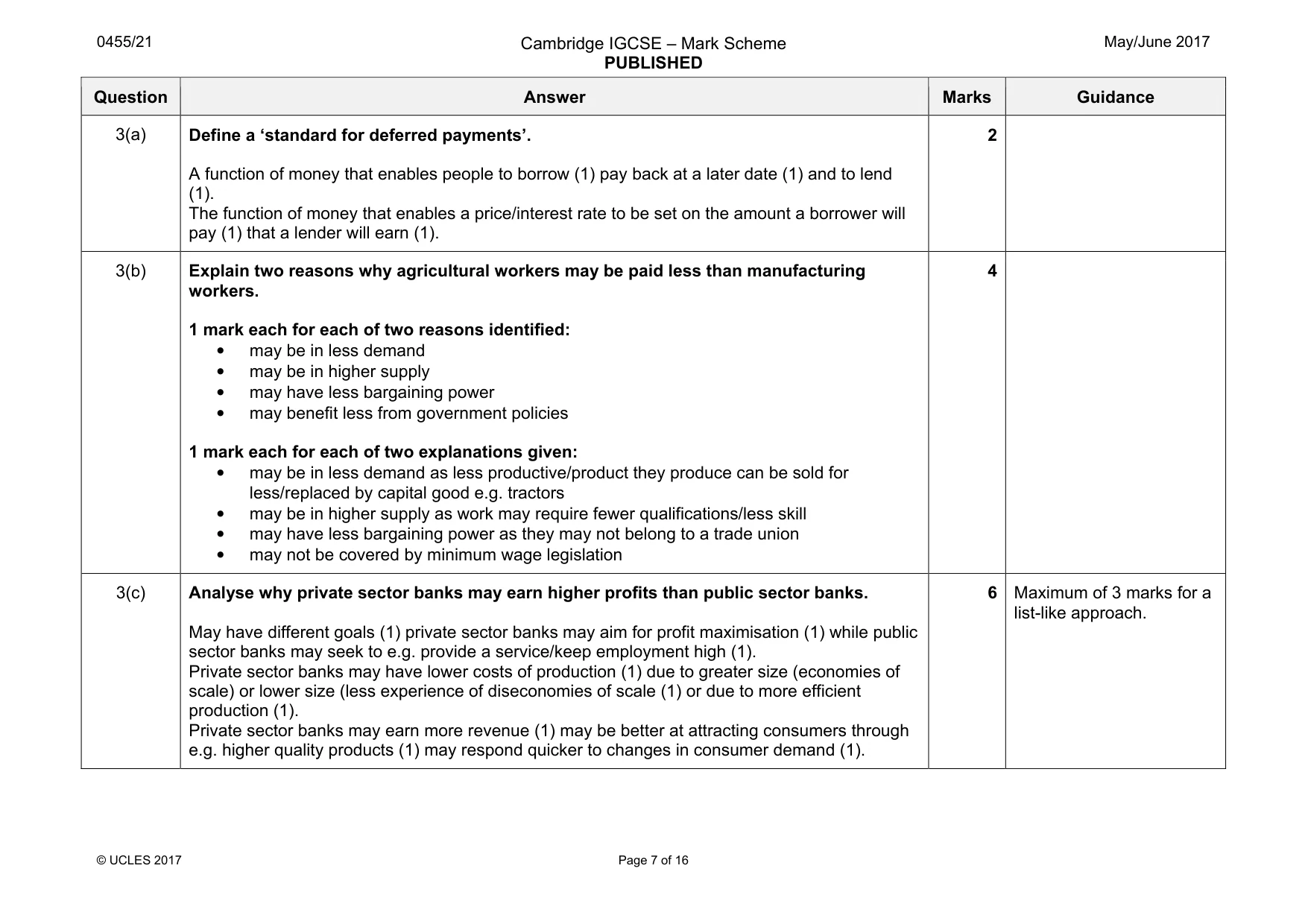
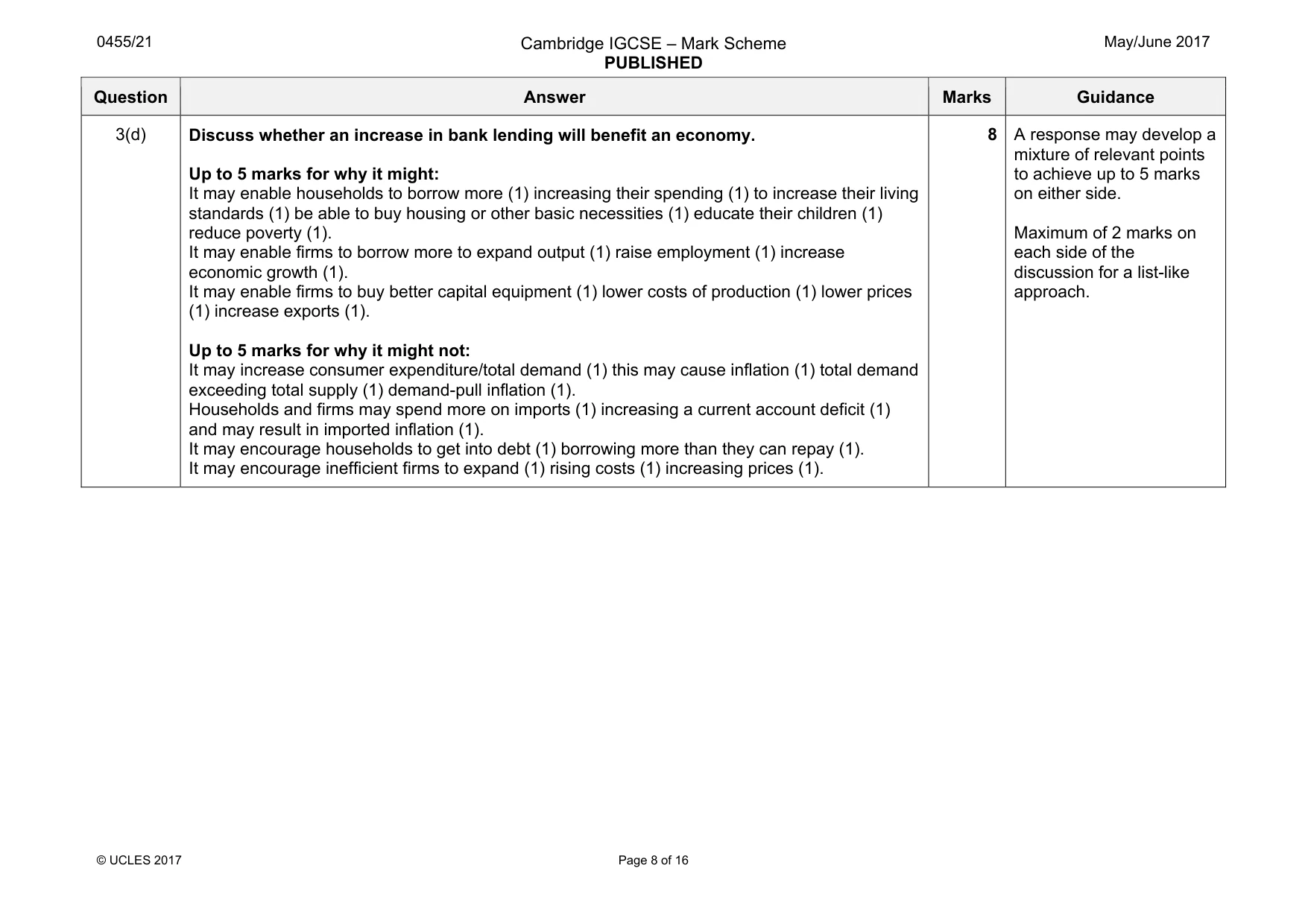
Mark scheme: 3(a) Define a ‘standard for deferred payments’. A function of money that enables people to borrow (1) pay back at a later date (1) and to lend (1). The function of money that enables a price/interest rate to be set on the amount a borrower will pay (1) that a lender will earn (1). 2 3(b) Explain two reasons why agricultural workers may be paid less than manufacturing workers. 1 mark each for each of two reasons identified: • may be in less demand • may be in higher supply • may have less bargaining power • may benefit less from government policies 1 mark each for each of two explanations given: • may be in less demand as less productive/product they produce can be sold for less/replaced by capital good e.g. tractors • may be in higher supply as work may require fewer qualifications/less skill • may have less bargaining power as they may not belong to a trade union • may not be covered by minimum wage legislation 4 3(c) Analyse why private sector banks may earn higher profits than public sector banks. May have different goals (1) private sector banks may aim for profit maximisation (1) while public sector banks may seek to e.g. provide a service/keep employment high (1). Private sector banks may have lower costs of production (1) due to greater size (economies of scale) or lower size (less experience of diseconomies of scale (1) or due to more efficient production (1). Private sector banks may earn more revenue (1) may be better at attracting consumers through e.g. higher quality products (1) may respond quicker to changes in consumer demand (1). 6 Maximum of 3 marks for a list-like approach. Question Answer Marks Guidance 3(d) Discuss whether an increase in bank lending will benefit an economy. Up to 5 marks for why it might: It may enable households to borrow more (1) increasing their spending (1) to increase their living standards (1) be able to buy housing or other basic necessities (1) educate their children (1) reduce poverty (1). It may enable firms to borrow more to expand output (1) raise employment (1) increase economic growth (1). It may enable firms to buy better capital equipment (1) lower costs of production (1) lower prices (1) increase exports (1). Up to 5 marks for why it might not: It may increase consumer expenditure/total demand (1) this may cause inflation (1) total demand exceeding total supply (1) demand-pull inflation (1). Households and firms may spend more on imports (1) increasing a current account deficit (1) and may result in imported inflation (1). It may encourage households to get into debt (1) borrowing more than they can repay (1). It may encourage inefficient firms to expand (1) rising costs (1) increasing prices (1). 8 A response may develop a mixture of relevant points to achieve up to 5 marks on either side. Maximum of 2 marks on each side of the discussion for a list-like approach.
Q4 · In 2012 oil was discovered in Kenya, but in 2014 an American firm stopped its plans to…
4 In 2012 oil was discovered in Kenya, but in 2014 an American firm stopped its plans to explore for oil in the Arabuko Sokoke forest in the country. The relative sizes of Kenya’s primary, secondary and tertiary sectors are changing. The amount of capital goods in the country is also increasing. (a) Define the ‘secondary sector’ and give an example. [2] (b) Explain two benefits that an economy may gain as a result of the discovery of oil on its land. [4] (c) Analyse why the social costs of oil extraction may be greater than the private costs. [6] (d) Discuss whether a country would benefit from devoting more resources to producing capital goods. [8]
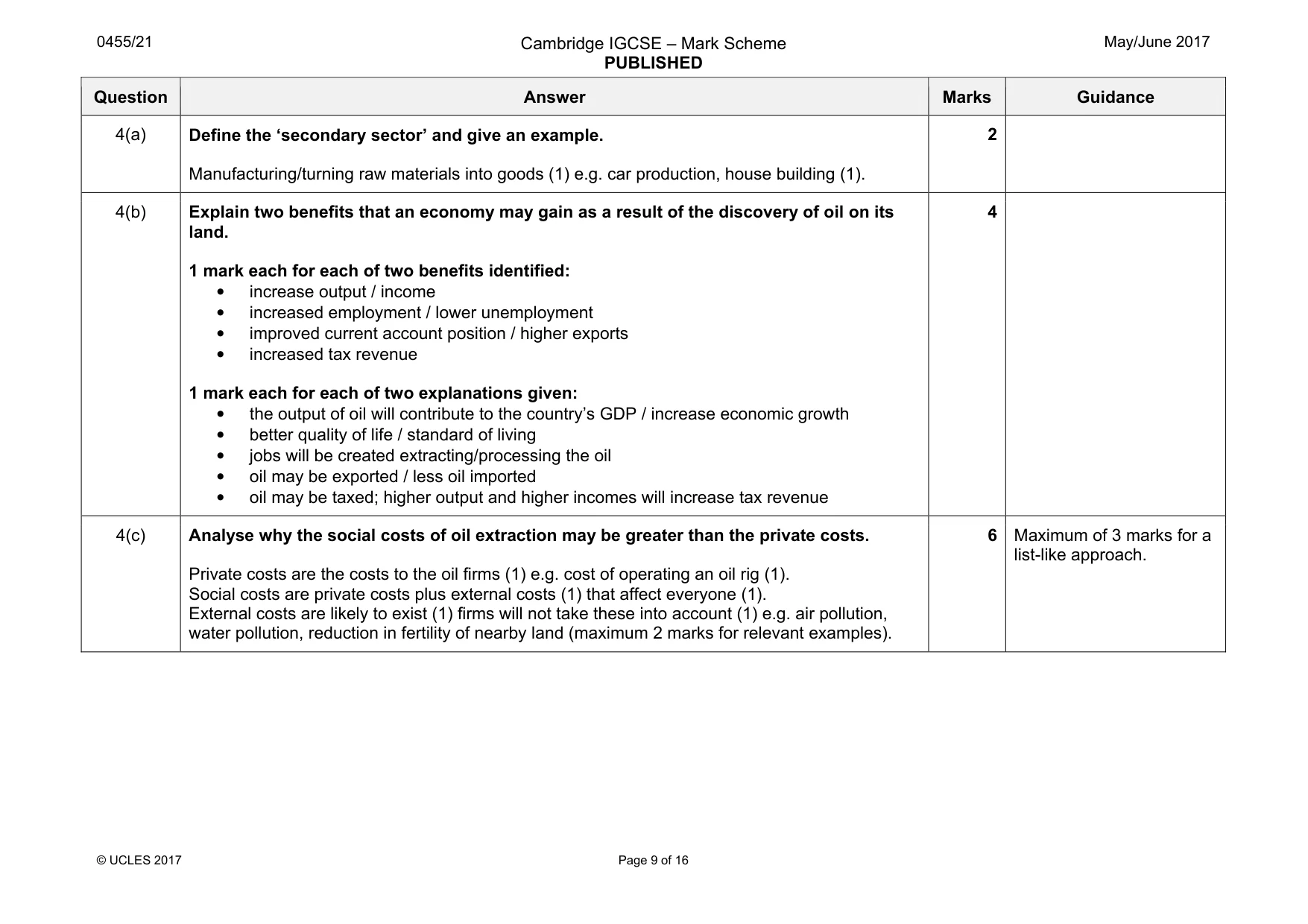
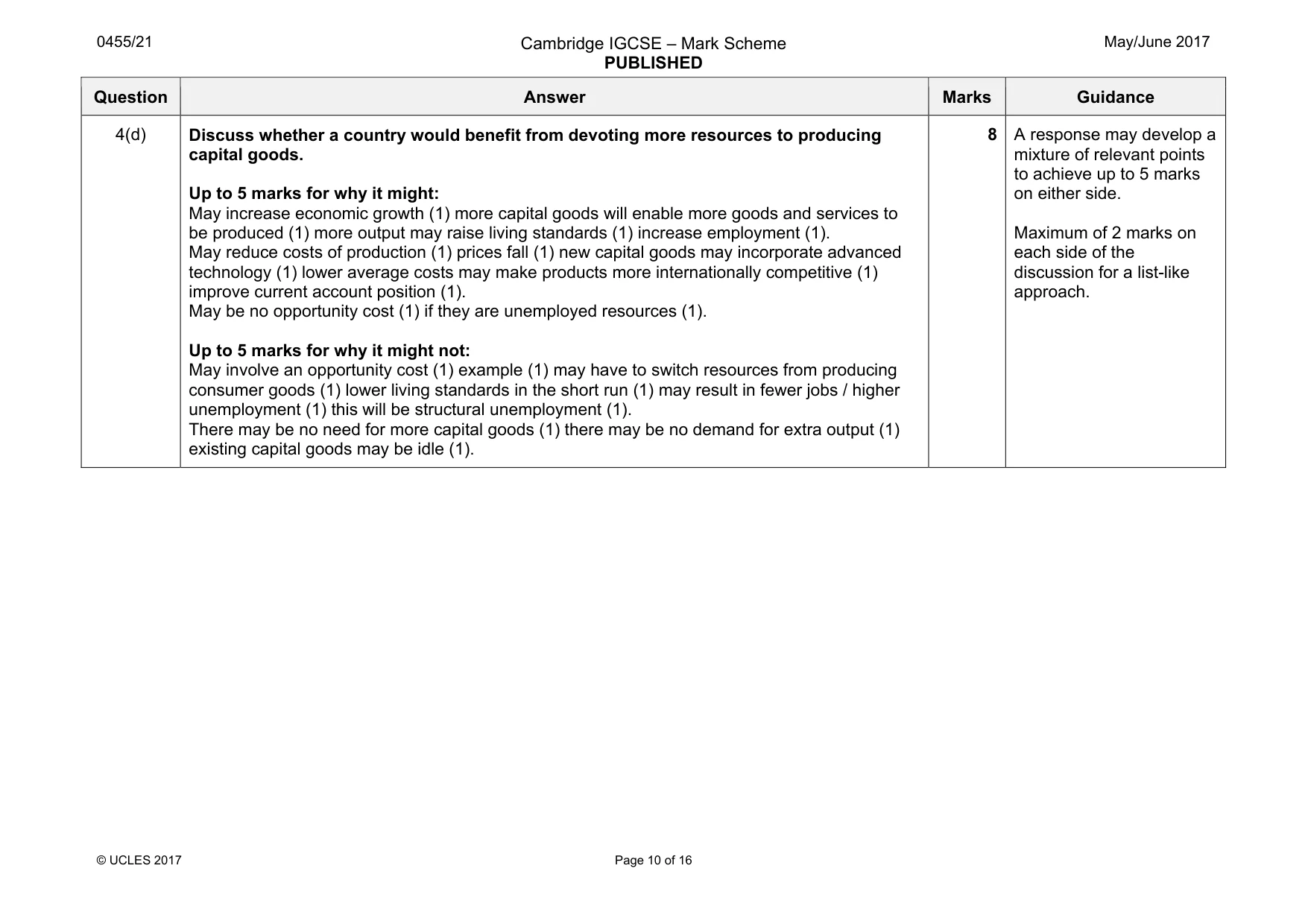
Mark scheme: 4(a) Define the ‘secondary sector’ and give an example. Manufacturing/turning raw materials into goods (1) e.g. car production, house building (1). 2 4(b) Explain two benefits that an economy may gain as a result of the discovery of oil on its land. 1 mark each for each of two benefits identified: • increase output / income • increased employment / lower unemployment • improved current account position / higher exports • increased tax revenue 1 mark each for each of two explanations given: • the output of oil will contribute to the country’s GDP / increase economic growth • better quality of life / standard of living • jobs will be created extracting/processing the oil • oil may be exported / less oil imported • oil may be taxed; higher output and higher incomes will increase tax revenue 4 4(c) Analyse why the social costs of oil extraction may be greater than the private costs. Private costs are the costs to the oil firms (1) e.g. cost of operating an oil rig (1). Social costs are private costs plus external costs (1) that affect everyone (1). External costs are likely to exist (1) firms will not take these into account (1) e.g. air pollution, water pollution, reduction in fertility of nearby land (maximum 2 marks for relevant examples). 6 Maximum of 3 marks for a list-like approach. Question Answer Marks Guidance 4(d) Discuss whether a country would benefit from devoting more resources to producing capital goods. Up to 5 marks for why it might: May increase economic growth (1) more capital goods will enable more goods and services to be produced (1) more output may raise living standards (1) increase employment (1). May reduce costs of production (1) prices fall (1) new capital goods may incorporate advanced technology (1) lower average costs may make products more internationally competitive (1) improve current account position (1). May be no opportunity cost (1) if they are unemployed resources (1). Up to 5 marks for why it might not: May involve an opportunity cost (1) example (1) may have to switch resources from producing consumer goods (1) lower living standards in the short run (1) may result in fewer jobs / higher unemployment (1) this will be structural unemployment (1). There may be no need for more capital goods (1) there may be no demand for extra output (1) existing capital goods may be idle (1). 8 A response may develop a mixture of relevant points to achieve up to 5 marks on either side. Maximum of 2 marks on each side of the discussion for a list-like approach.
Q5 · In June 2015 the value of the Swiss franc rose by 30% against the euro
5 In June 2015 the value of the Swiss franc rose by 30% against the euro. The countries that Switzerland exports to are changing. Exports to the USA, UK, India and South Korea are growing in importance, while exports to Germany, Italy and France are declining. A possible effect of an appreciation of the exchange rate is a fall in the inflation rate. (a) Define ‘inflation’. [2] (b) Explain why a country’s exports to one country may increase, while those to another country decrease. [4] (c) Analyse how an appreciation of the exchange rate may reduce the country’s inflation rate. [6] (d) Discuss whether a low inflation rate always benefits an economy. [8]
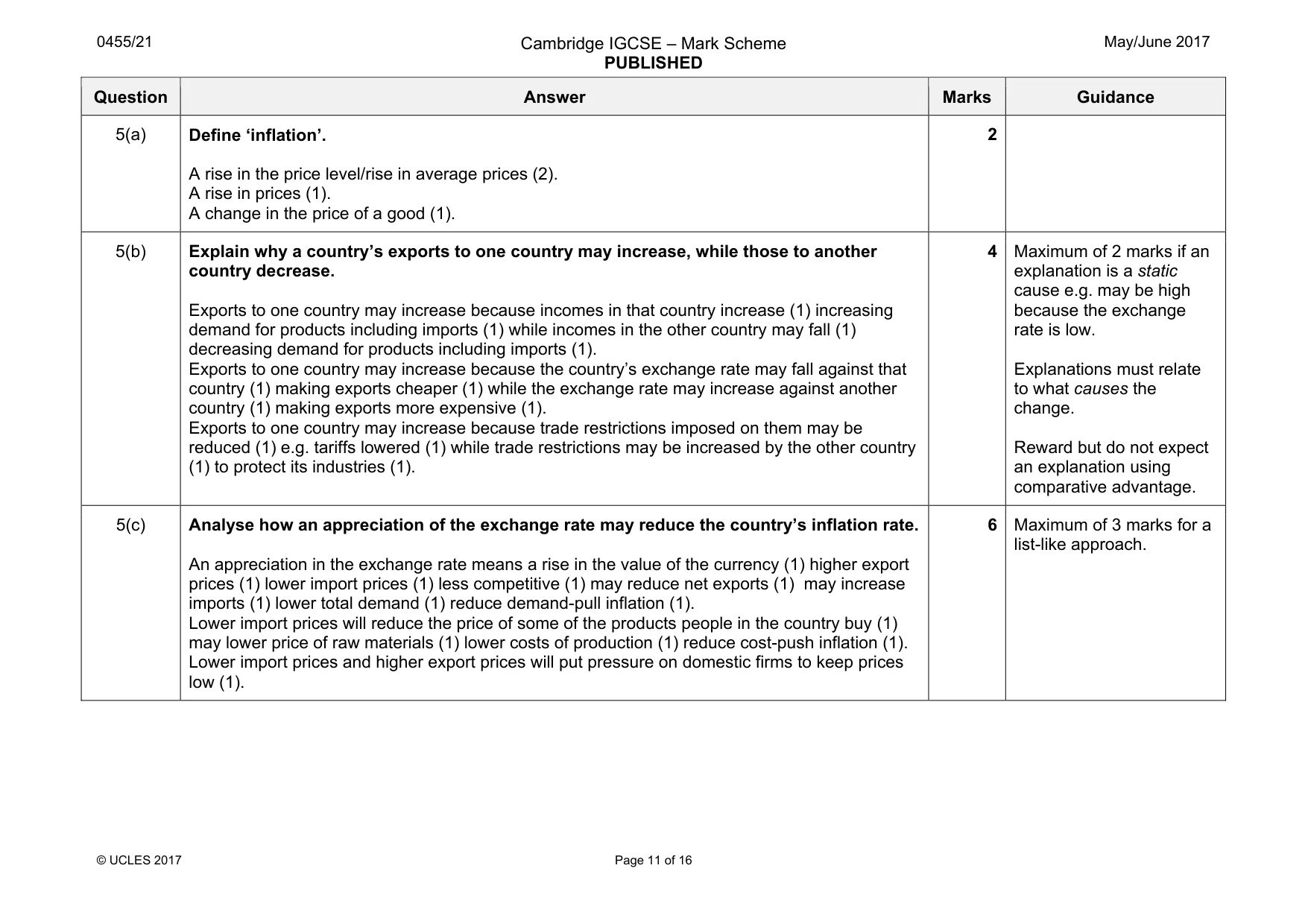
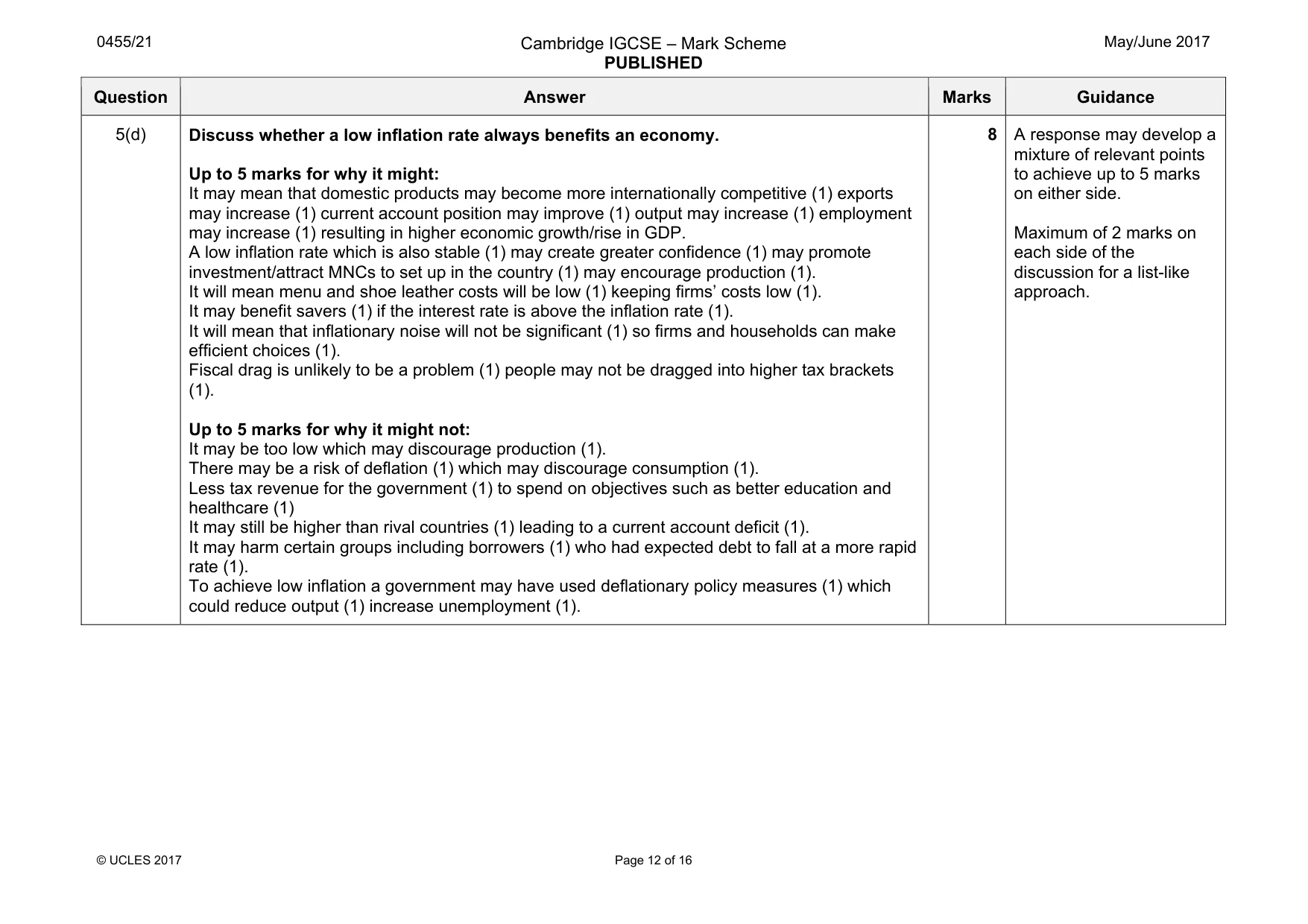
Mark scheme: 5(a) Define ‘inflation’. A rise in the price level/rise in average prices (2). A rise in prices (1). A change in the price of a good (1). 2 5(b) Explain why a country’s exports to one country may increase, while those to another country decrease. Exports to one country may increase because incomes in that country increase (1) increasing demand for products including imports (1) while incomes in the other country may fall (1) decreasing demand for products including imports (1). Exports to one country may increase because the country’s exchange rate may fall against that country (1) making exports cheaper (1) while the exchange rate may increase against another country (1) making exports more expensive (1). Exports to one country may increase because trade restrictions imposed on them may be reduced (1) e.g. tariffs lowered (1) while trade restrictions may be increased by the other country (1) to protect its industries (1). 4 Maximum of 2 marks if an explanation is a static cause e.g. may be high because the exchange rate is low. Explanations must relate to what causes the change. Reward but do not expect an explanation using comparative advantage. 5(c) Analyse how an appreciation of the exchange rate may reduce the country’s inflation rate. An appreciation in the exchange rate means a rise in the value of the currency (1) higher export prices (1) lower import prices (1) less competitive (1) may reduce net exports (1) may increase imports (1) lower total demand (1) reduce demand-pull inflation (1). Lower import prices will reduce the price of some of the products people in the country buy (1) may lower price of raw materials (1) lower costs of production (1) reduce cost-push inflation (1). Lower import prices and higher export prices will put pressure on domestic firms to keep prices low (1). 6 Maximum of 3 marks for a list-like approach. Question Answer Marks Guidance 5(d) Discuss whether a low inflation rate always benefits an economy. Up to 5 marks for why it might: It may mean that domestic products may become more internationally competitive (1) exports may increase (1) current account position may improve (1) output may increase (1) employment may increase (1) resulting in higher economic growth/rise in GDP. A low inflation rate which is also stable (1) may create greater confidence (1) may promote investment/attract MNCs to set up in the country (1) may encourage production (1). It will mean menu and shoe leather costs will be low (1) keeping firms’ costs low (1). It may benefit savers (1) if the interest rate is above the inflation rate (1). It will mean that inflationary noise will not be significant (1) so firms and households can make efficient choices (1). Fiscal drag is unlikely to be a problem (1) people may not be dragged into higher tax brackets (1). Up to 5 marks for why it might not: It may be too low which may discourage production (1). There may be a risk of deflation (1) which may discourage consumption (1). Less tax revenue for the government (1) to spend on objectives such as better education and healthcare (1) It may still be higher than rival countries (1) leading to a current account deficit (1). It may harm certain groups including borrowers (1) who had expected debt to fall at a more rapid rate (1). To achieve low inflation a government may have used deflationary policy measures (1) which could reduce output (1) increase unemployment (1). 8 A response may develop a mixture of relevant points to achieve up to 5 marks on either side. Maximum of 2 marks on each side of the discussion for a list-like approach.
Q6 · Japan’s birth rate is falling
6 Japan’s birth rate is falling. Its population is ageing, and declining at a faster rate than any other country’s population. This has an impact on the amount that the Japanese Government spends on pensions. Its government is considering measures to increase the country’s birth rate and to encourage immigration. (a) Identify two causes of a fall in a country’s birth rate. [2] (b) Explain two reasons why more educated people tend to live longer than less educated people. [4] (c) Analyse, using a production possibility curve diagram, what effect net immigration is likely to have on an economy. [6] (d) Discuss whether the government of a country should reduce the pensions it pays to retired people. [8]
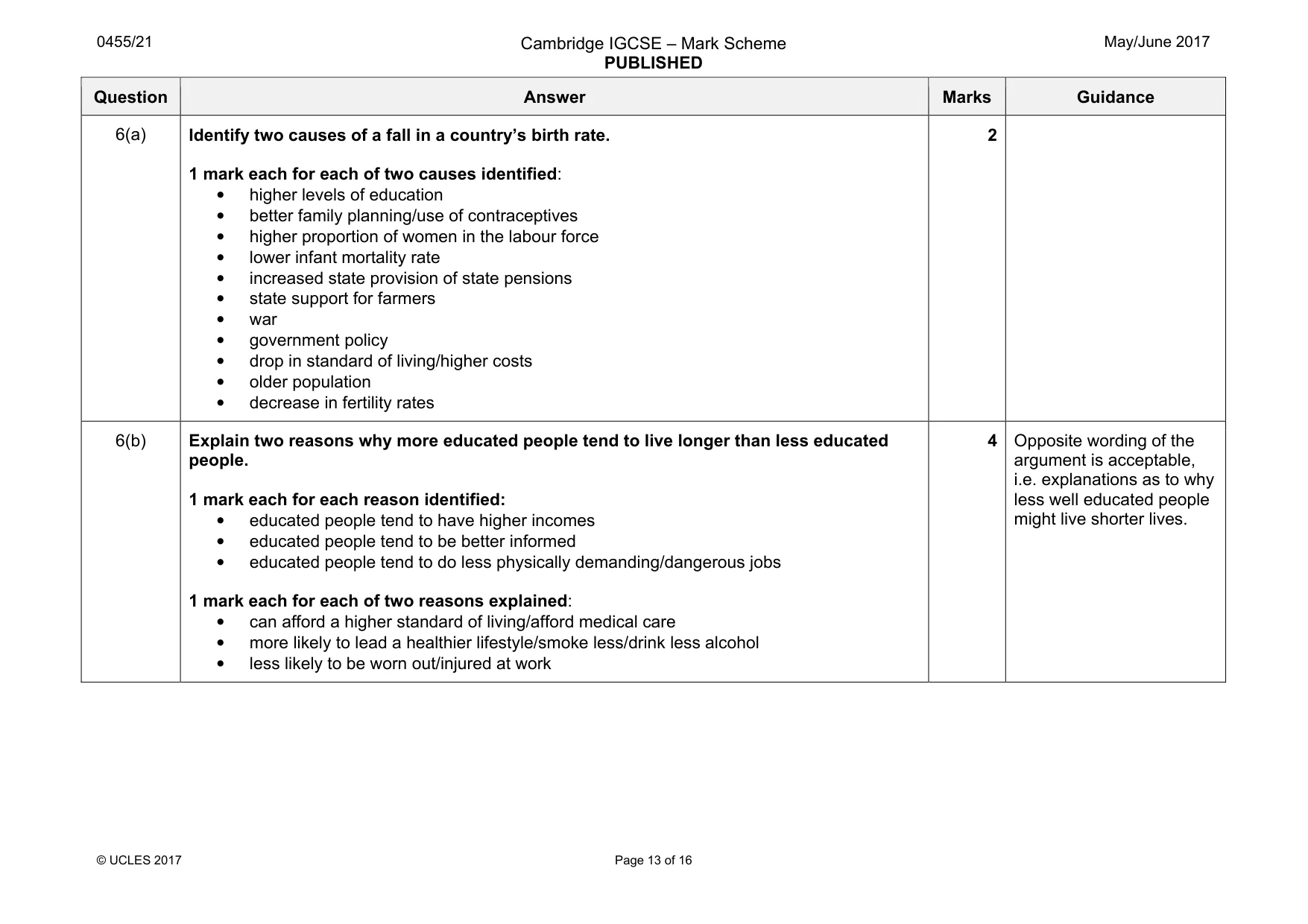
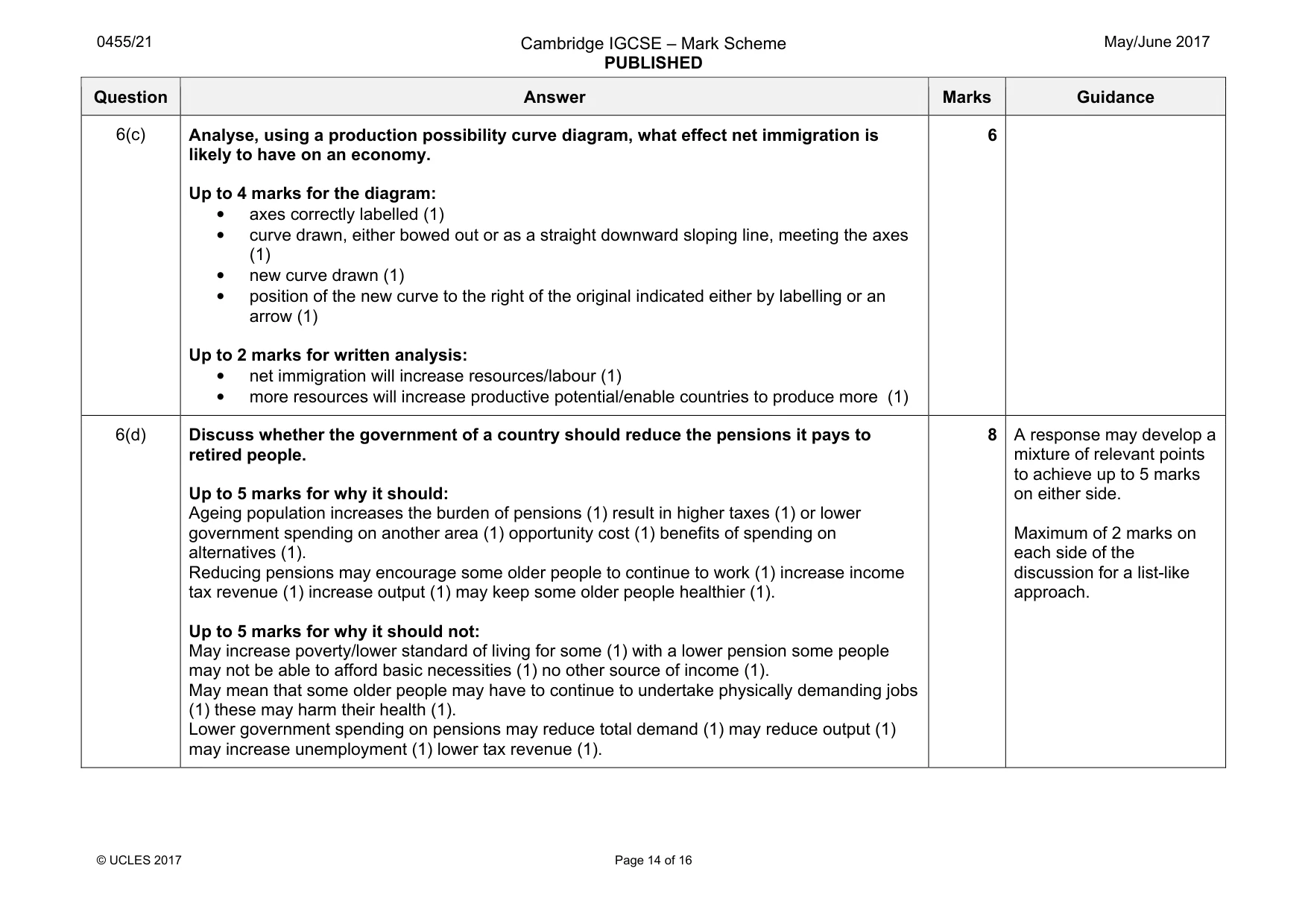
Mark scheme: 6(a) Identify two causes of a fall in a country’s birth rate. 1 mark each for each of two causes identified: • higher levels of education • better family planning/use of contraceptives • higher proportion of women in the labour force • lower infant mortality rate • increased state provision of state pensions • state support for farmers • war • government policy • drop in standard of living/higher costs • older population • decrease in fertility rates 2 6(b) Explain two reasons why more educated people tend to live longer than less educated people. 1 mark each for each reason identified: • educated people tend to have higher incomes • educated people tend to be better informed • educated people tend to do less physically demanding/dangerous jobs 1 mark each for each of two reasons explained: • can afford a higher standard of living/afford medical care • more likely to lead a healthier lifestyle/smoke less/drink less alcohol • less likely to be worn out/injured at work 4 Opposite wording of the argument is acceptable, i.e. explanations as to why less well educated people might live shorter lives. Question Answer Marks Guidance 6(c) Analyse, using a production possibility curve diagram, what effect net immigration is likely to have on an economy. Up to 4 marks for the diagram: • axes correctly labelled (1) • curve drawn, either bowed out or as a straight downward sloping line, meeting the axes (1) • new curve drawn (1) • position of the new curve to the right of the original indicated either by labelling or an arrow (1) Up to 2 marks for written analysis: • net immigration will increase resources/labour (1) • more resources will increase productive potential/enable countries to produce more (1) 6 6(d) Discuss whether the government of a country should reduce the pensions it pays to retired people. Up to 5 marks for why it should: Ageing population increases the burden of pensions (1) result in higher taxes (1) or lower government spending on another area (1) opportunity cost (1) benefits of spending on alternatives (1). Reducing pensions may encourage some older people to continue to work (1) increase income tax revenue (1) increase output (1) may keep some older people healthier (1). Up to 5 marks for why it should not: May increase poverty/lower standard of living for some (1) with a lower pension some people may not be able to afford basic necessities (1) no other source of income (1). May mean that some older people may have to continue to undertake physically demanding jobs (1) these may harm their health (1). Lower government spending on pensions may reduce total demand (1) may reduce output (1) may increase unemployment (1) lower tax revenue (1). 8 A response may develop a mixture of relevant points to achieve up to 5 marks on either side. Maximum of 2 marks on each side of the discussion for a list-like approach.
Q7 · In recent years there has been an increase in prices in Mexico
7 In recent years there has been an increase in prices in Mexico. Indirect taxes have also been increased. Bus fares and food have become more expensive. In 2015, the Mexican Government was planning to cut its spending by US$8.3 billion. (a) Define ‘indirect taxes’ and give an example. [2] (b) Explain two causes of an increase in demand for bus transport. [4] (c) Analyse how a reduction in government spending on education could cause unemployment. [6] (d) Discuss whether a government should increase taxes on food. [8]
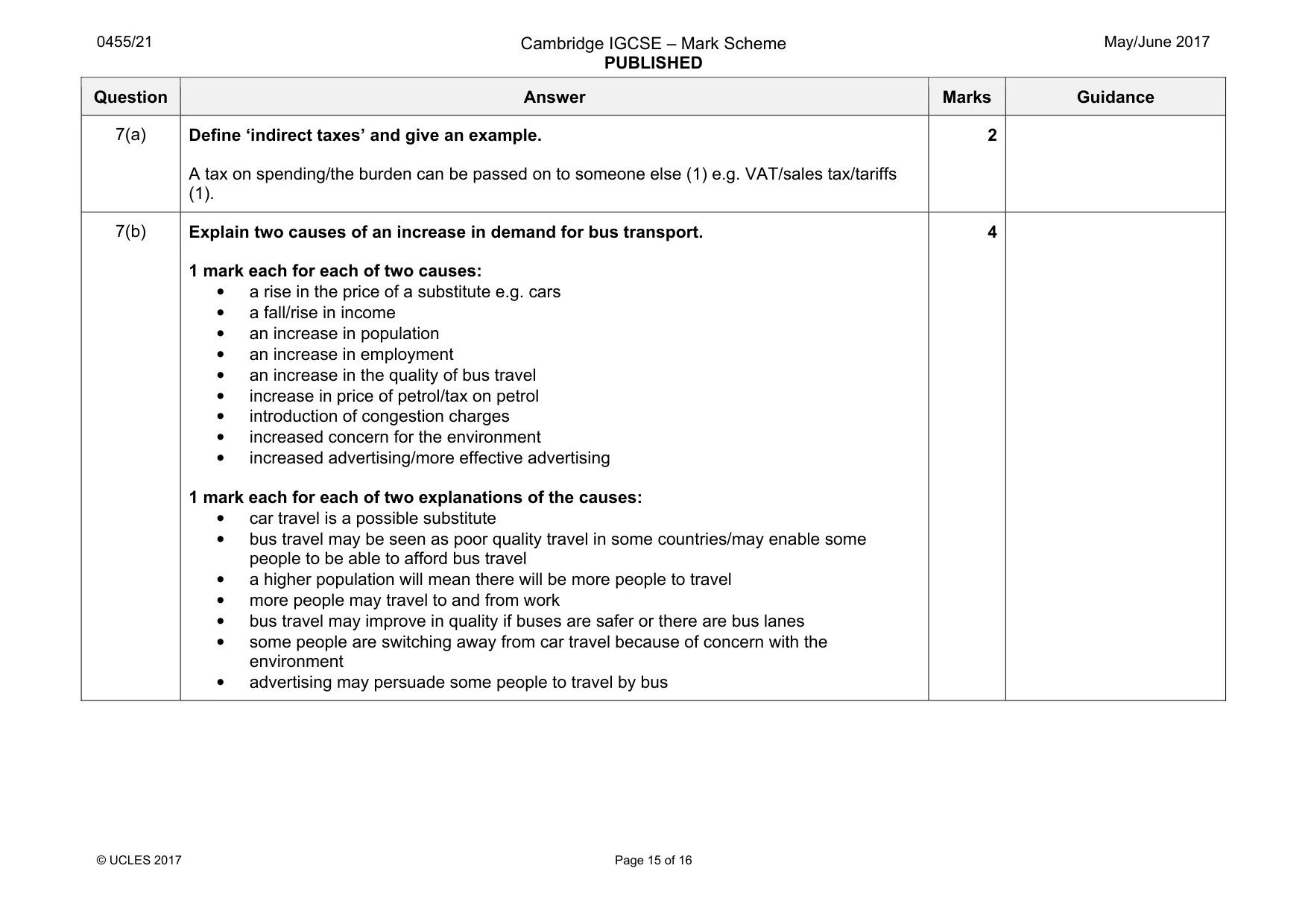
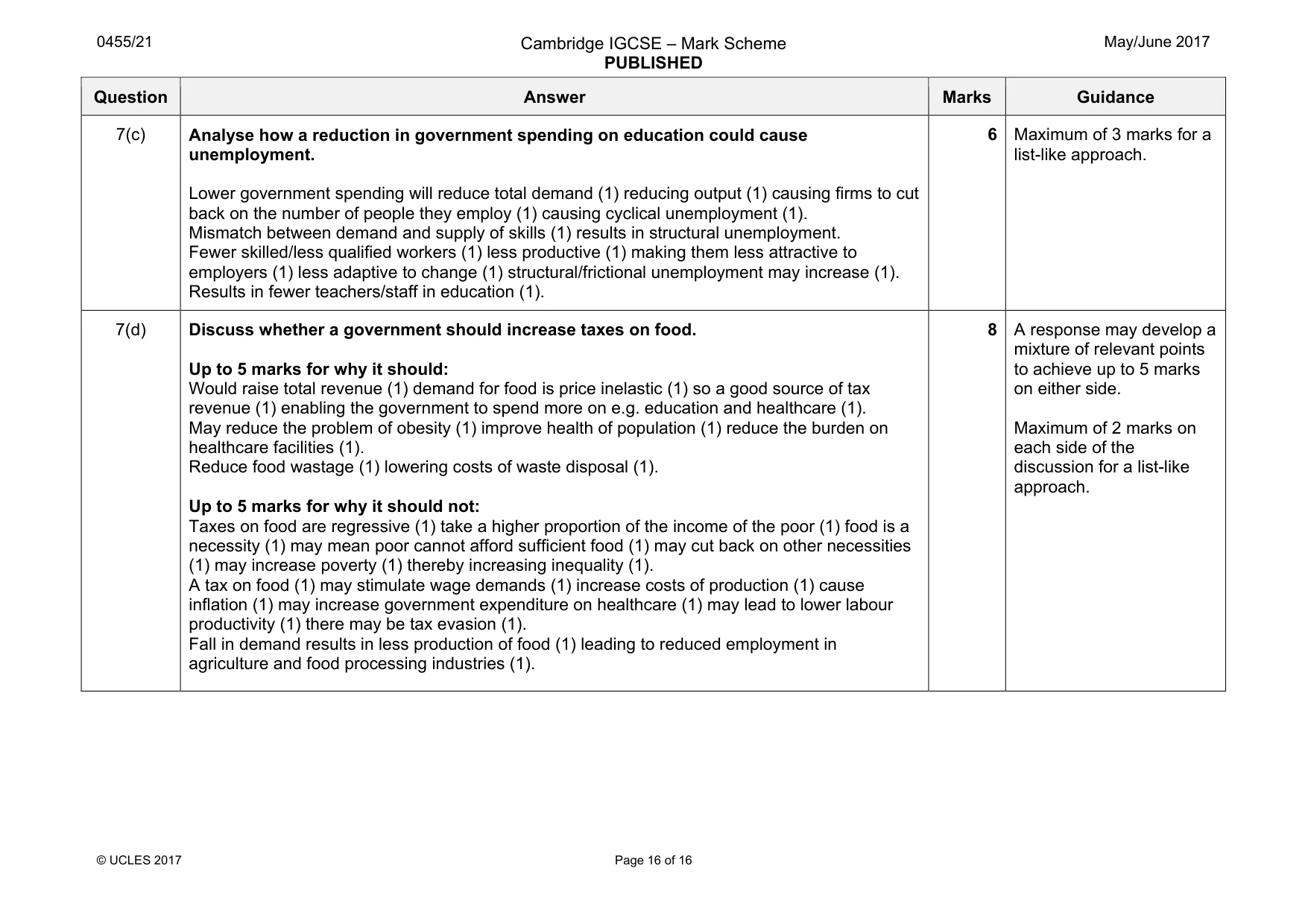
Mark scheme: 7(a) Define ‘indirect taxes’ and give an example. A tax on spending/the burden can be passed on to someone else (1) e.g. VAT/sales tax/tariffs (1). 2 7(b) Explain two causes of an increase in demand for bus transport. 1 mark each for each of two causes: • a rise in the price of a substitute e.g. cars • a fall/rise in income • an increase in population • an increase in employment • an increase in the quality of bus travel • increase in price of petrol/tax on petrol • introduction of congestion charges • increased concern for the environment • increased advertising/more effective advertising 1 mark each for each of two explanations of the causes: • car travel is a possible substitute • bus travel may be seen as poor quality travel in some countries/may enable some people to be able to afford bus travel • a higher population will mean there will be more people to travel • more people may travel to and from work • bus travel may improve in quality if buses are safer or there are bus lanes • some people are switching away from car travel because of concern with the environment • advertising may persuade some people to travel by bus 4 Question Answer Marks Guidance 7(c) Analyse how a reduction in government spending on education could cause unemployment. Lower government spending will reduce total demand (1) reducing output (1) causing firms to cut back on the number of people they employ (1) causing cyclical unemployment (1). Mismatch between demand and supply of skills (1) results in structural unemployment. Fewer skilled/less qualified workers (1) less productive (1) making them less attractive to employers (1) less adaptive to change (1) structural/frictional unemployment may increase (1). Results in fewer teachers/staff in education (1). 6 Maximum of 3 marks for a list-like approach. 7(d) Discuss whether a government should increase taxes on food. Up to 5 marks for why it should: Would raise total revenue (1) demand for food is price inelastic (1) so a good source of tax revenue (1) enabling the government to spend more on e.g. education and healthcare (1). May reduce the problem of obesity (1) improve health of population (1) reduce the burden on healthcare facilities (1). Reduce food wastage (1) lowering costs of waste disposal (1). Up to 5 marks for why it should not: Taxes on food are regressive (1) take a higher proportion of the income of the poor (1) food is a necessity (1) may mean poor cannot afford sufficient food (1) may cut back on other necessities (1) may increase poverty (1) thereby increasing inequality (1). A tax on food (1) may stimulate wage demands (1) increase costs of production (1) cause inflation (1) may increase government expenditure on healthcare (1) may lead to lower labour productivity (1) there may be tax evasion (1). Fall in demand results in less production of food (1) leading to reduced employment in agriculture and food processing industries (1). 8 A response may develop a mixture of relevant points to achieve up to 5 marks on either side. Maximum of 2 marks on each side of the discussion for a list-like approach.
What was in this paper
The subtopics covered by these 7 questions, and how many questions each got. Open one in a new tab to see every Cambridge question on it.
What you needed in this session
Cambridge’s own grade thresholds for 2017 May/June, Paper 2 · Variant 1. A higher threshold means an easier paper — the bar moves with how the cohort did.