Cambridge IGCSE Economics 0455 — 2016 May/June Paper 2 · Variant 3
0455/23/M/J/16 · 90 marks · ≈101 min
The question paper and its mark scheme, free to read here and free to download. This is Cambridge’s own paper, exactly as it was sat.
Question paper4 pages
Mark scheme14 pages
Answers below. Sit the paper first if you are practising.
Paper as text
Question paper, page 1
This document consists of 4 printed pages and 1 Insert. DC (LK) 112826/3 © UCLES 2016 [Turn over * 9 6 7 3 4 7 3 3 5 9 * ECONOMICS 0455/23 Paper 2 Structured Questions May/June 2016 2 hours 15 minutes No Additional Materials are required. READ THESE INSTRUCTIONS FIRST An answer booklet is provided inside this question paper. You should follow the instructions on the front cover of the answer booklet. If you need additional answer paper ask the invigilator for a continuation booklet. Section A Answer Question 1. Section B Answer any three questions. The number of marks is given in brackets [ ] at the end of each question or part question. Cambridge International Examinations Cambridge International General Certificate of Secondary Education
Question paper, page 2
2 0455/23/M/J/16 © UCLES 2016 Section A Answer this question. 1 Changes in the shipbuilding industry China is becoming even more dominant in the global shipbuilding industry. In 2013 it accounted for 45% of ships built in terms of tonnage. It is concentrating particularly on building container ships. In 2012 China built six of the largest container ships for a total cost of US$870 million. In 2013 it produced eight container ships of the same capacity with the total cost rising less proportionately to US$1040 million. The second-largest producer of ships is South Korea. One of its firms has built the largest container ship in the world. The firm is facing increasing competition from another large firm in the country. In 2014 the two firms announced they were planning to merge, if they could get the approval of their shareholders. Both firms are listed on the country’s stock exchange. The relative share of the global market that a shipbuilding firm has is influenced by a number of factors. These include the quality and quantity of the labour force employed. In 2013 China’s total labour force was 800 million, in comparison to South Korea’s 26 million. China’s unemployment rate of 3% was slightly lower than that of South Korea at 4%. A country’s exchange rate also influences how many ships are built and sold. In 2012 the value of the South Korean currency, the won, was 1126 won per dollar. This changed to 1107 won per dollar in 2013. This trend in the value of the won was expected to continue into 2014, with changes in the relative price of South Korean ships and a possible change in South Korea’s economic growth rate. While shipbuilding is increasing in a number of countries, including China and South Korea, it is falling in other countries such as the UK. Some economists welcome the decline, stating that producing fewer ships has reduced noise pollution in a number of cities and has reduced traffic congestion in the areas where the shipyards used to operate. Other economists regret the decline in the shipbuilding industry, which they claim is the result not only of a failure of UK shipbuilders to respond to change but also to the subsidies that foreign governments pay to their shipbuilders. (a) Using information from the extract, explain whether the average cost of building the largest container ships in China rose or fell between 2012 and 2013. [2] (b) Explain what type of business organisation the extract suggests the two large South Korean shipbuilding firms are. [2] (c) Using information from the extract, explain two external costs that shipbuilding can cause. [4] (d) Calculate how many more people were unemployed in China than in South Korea in 2013. [3] (e) Analyse two reasons, referred to in the extract, why shipbuilding is declining in the UK. [4] (f) Discuss whether a merger between two shipbuilding firms will improve the quality of ships built. [5] (g) Using information from the extract, explain whether the value of the South Korean won was expected to rise or fall in 2014. [4] (h) Discuss whether a government should protect its country’s shipbuilding industry. [6]
Question paper, page 3
3 0455/23/M/J/16 © UCLES 2016 [Turn over Section B Answer any three questions from this section. 2 The 2014 crop of Arabica beans, used to make coffee, was reduced by a drought which occurred in Brazil in early 2014. The reduction in production pushed up the price of coffee. The higher price influenced the quantity of coffee demanded and the demand for its substitutes and complements. The demand for coffee tends to be price-inelastic. A change in the quantity and quality of exports of coffee abroad influences Brazil’s current account of the country’s balance of payments. (a) Giving an example, define ‘complements’. [2] (b) Explain two reasons why demand for a product may be price-inelastic. [4] (c) Using a demand and supply diagram, analyse the effect of a rise in the price of coffee on the market for tea. [6] (d) Discuss whether improving the quality of the coffee that a country produces will result in a surplus on the current account of its balance of payments. [8] 3 An increasing number of Pakistani firms are employing managers educated at the country’s universities. Pakistan’s universities are also increasing the number of entrepreneurs in the country. Every entrepreneur and every manager faces a number of challenges including raising finance, sometimes by borrowing. Some entrepreneurs and managers also negotiate with trade unions. These organisations can influence a country’s economic growth rate. (a) Identify two risks that entrepreneurs have to bear. [2] (b) Explain two reasons why firms may prefer to employ local managers rather than foreign managers. [4] (c) Analyse why households and firms may borrow more during times of rapid economic growth. [6] (d) Discuss whether the activities of trade unions are likely to increase or decrease a country’s economic growth rate. [8] 4 In China, a smaller proportion of women are now dying in childbirth and more infants are surviving. These improvements have been the result of better care at birth, countrywide immunisation and improved living standards. The Government has offered subsidies to mothers who give birth in hospitals. This has increased the quality of care received and made it easier to give vaccinations to babies to protect them against illnesses and diseases. (a) Identify two influences on a country’s birth rate. [2] (b) Explain two measures of comparative living standards. [4] (c) Analyse the social benefits of giving vaccinations. [6] (d) Discuss whether health care should be provided by the public sector or the private sector. [8]
Question paper, page 4
4 0455/23/M/J/16 © UCLES 2016 5 In 2014 the Government of Bangladesh lent money to the four big state-owned commercial banks that had got into difficulties by lending to high-risk customers. State-owned commercial banks are becoming less important. Privately-owned commercial banks have been increasing in size and importance and now have 75% of total deposits. The economy is moving from a mixed economy towards a market economy. (a) Identify two reasons why people may keep some of their money in a savings account at a commercial bank. [2] (b) Explain the different goals that state-owned commercial banks and privately-owned commercial banks may have. [4] (c) Analyse how the growth in the size of commercial banks may benefit their customers. [6] (d) Discuss whether living standards are likely to be higher in a mixed economy or a market economy. [8] 6 In 2014 Brazil’s inflation rate was increasing while its unemployment rate was falling. In that year spending by the Government increased by 16% while its tax revenue fell by 8%. As a result the country’s budget deficit increased. (a) What is meant by an inflation rate increasing? [2] (b) Explain two reasons why tax revenue may fall. [4] (c) Analyse how a fall in unemployment may increase inflation. [6] (d) Discuss whether a government should spend more than it raises in taxation. [8] 7 Many economists are predicting that relative poverty will increase whilst absolute poverty will fall in both India and the United States of America. The level of poverty can be influenced by, for example, education, the technology used and the number of new businesses created, including sole proprietorships. (a) Define ‘absolute poverty’. [2] (b) Explain two different opportunity costs that may be involved in a person becoming a sole proprietor. [4] (c) Analyse, using a production possibility curve, the effect of advances in technology. [6] (d) Discuss whether increased spending on education will always reduce absolute poverty. [8] Permission to reproduce items where third-party owned material protected by copyright is included has been sought and cleared where possible. Every reasonable effort has been made by the publisher (UCLES) to trace copyright holders, but if any items requiring clearance have unwittingly been included, the publisher will be pleased to make amends at the earliest possible opportunity. To avoid the issue of disclosure of answer-related information to candidates, all copyright acknowledgements are reproduced online in the Cambridge International Examinations Copyright Acknowledgements Booklet. This is produced for each series of examinations and is freely available to download at www.cie.org.uk after the live examination series. Cambridge International Examinations is part of the Cambridge Assessment Group. Cambridge Assessment is the brand name of University of Cambridge Local Examinations Syndicate (UCLES), which is itself a department of the University of Cambridge.
Mark scheme, page 1
® IGCSE is the registered trademark of Cambridge International Examinations. This document consists of 14 printed pages. © UCLES 2016 [Turn over Cambridge International Examinations Cambridge International General Certificate of Secondary Education ECONOMICS 0455/23 Paper 2 Structured Questions May/June 2016 MARK SCHEME Maximum Mark: 90 Published This mark scheme is published as an aid to teachers and candidates, to indicate the requirements of the examination. It shows the basis on which Examiners were instructed to award marks. It does not indicate the details of the discussions that took place at an Examiners’ meeting before marking began, which would have considered the acceptability of alternative answers. Mark schemes should be read in conjunction with the question paper and the Principal Examiner Report for Teachers. Cambridge will not enter into discussions about these mark schemes. Cambridge is publishing the mark schemes for the May/June 2016 series for most Cambridge IGCSE®, Cambridge International A and AS Level components and some Cambridge O Level components.
Mark scheme, page 2
Page 2 Mark Scheme Syllabus Paper Cambridge IGCSE – May/June 2016 0455 23 © Cambridge International Examinations 2016 1 (a) Using information from the extract, explain whether the average cost of building the largest container ships in China rose or fell between 2012 and 2013. [2] Fell (1) total cost rising proportionally less than output / average cost fell from US$145m to $130m / fell by $15m (Answer must have $) [1] (b) Explain what type of business organisation the extract suggests the two large South Korean shipbuilding firms are. [2] Public limited company (1) has shareholders / listed on the stock exchange (1). (c) Using information from the extract, explain two external costs that shipbuilding can cause. [4] • An external cost is a cost on third parties (1) the difference between social costs and private costs (1). • Shipbuilding creates (noise) pollution (1) reducing the quality of life of people living near shipyards / people need to spend money on soundproofing (1). • Traffic congestion (1) which increases drivers’ journey times (1). (d) Calculate how many more people were unemployed in China than South Korea in 2013. [3] • 22.96m (3) but accept 23m. Correct workings (2). • Unemployment in China is 24m (1). Unemployment in South Korea is 1.04m (1). (e) Analyse two reasons, referred to in the extract, why shipbuilding is declining in the UK. [4] • Failure to respond to change (1) e.g. not picking up on changes in demand / not introducing new technology (1). • Other governments providing subsidies (1) this will reduce their costs of production (1). (f) Discuss whether a merger between two shipbuilding firms will improve the quality of ships built. [5] Up to 3 marks for why it might: • The merged firm might be able to take advantage of economies of scale (1) lower average cost of production (1) higher profits (1) more funds to spend on research and development / afford better resources (1) share ideas / increase innovation (1) eliminates wasteful duplication (1) Up to 3 marks for why it might not: • Reduction in competitive pressure (1) firms may not spend money on research and development (1) consumers have less choice (1). • Internal diseconomies of scale may be experienced (1) e.g. may be a lack of communication between workers and managers (1).
Mark scheme, page 3
Page 3 Mark Scheme Syllabus Paper Cambridge IGCSE – May/June 2016 0455 23 © Cambridge International Examinations 2016 (g) Using information from the extract, explain whether the value of the South Korean won was expected to rise or fall in 2014. [4] • Expected to rise (1). The value rose in 2013 as fewer won had to be exchanged for a dollar / the won could be exchanged for a greater number of dollars (1) and this trend is set to continue (1) it is more likely to do so if South Korea’s ships are becoming more price competitive (1) and if South Korea’s economic growth rate increases (1). • The value of exchange rates is influenced by changes in net exports (1) and economic prospects (1) (h) Discuss whether a government should protect its country’s shipbuilding industry. [6] Up to 4 marks for why it should: • Shipbuilding may be an infant industry (1) not yet able to take advantage of economies of scale (1) average cost of production may be high (1). • To protect employment (1) saving on unemployment benefits (1) shipbuilding may be declining (1). • Shipbuilding may be considered to be a strategic industry (1) the government may be reluctant to rely on ships built in other countries (1). • Shipbuilding may be a major contributor to GDP / employment (1) protecting shipbuilding may also protect other (supplier) industries (1) • May improve the current account position (1) reducing expenditure on imports (1). Up to 4 marks for why it should not: • It may not be making good use of resources / it may be inefficient / there is an opportunity cost (1) the economy’s output may be lower (1) prices may be higher (1). • It may result in retaliation (1) other countries may impose trade restrictions on the country’s products (1) e.g. tariffs may be imposed (1) • The reduction in competition (1) may reduce the quality of the ships built (1). • Reward but do not expect comparative advantage argument (up to 2) Note: no reference to shipbuilding – 4 marks maximum
Mark scheme, page 4
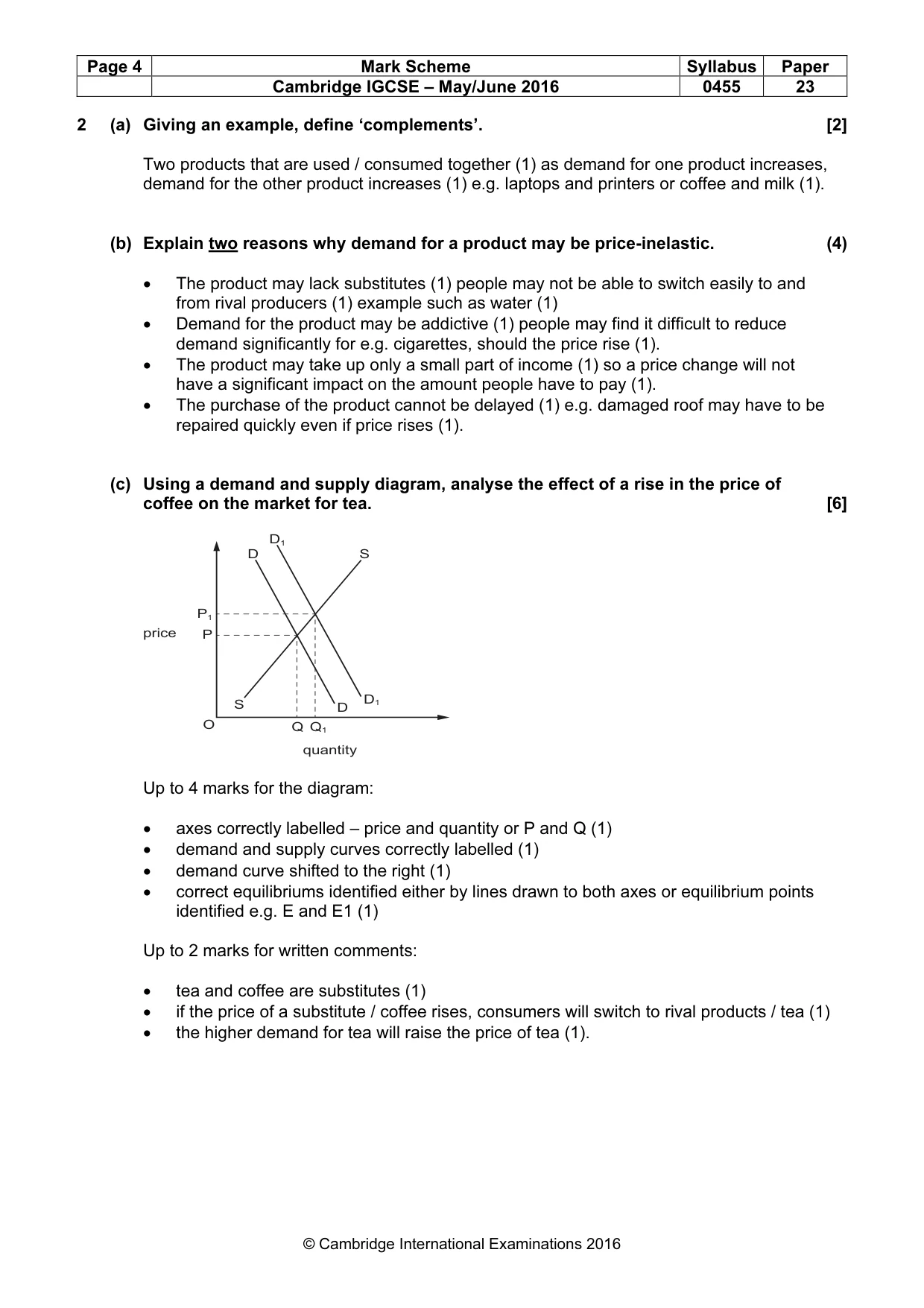
Page 4 Mark Scheme Syllabus Paper Cambridge IGCSE – May/June 2016 0455 23 © Cambridge International Examinations 2016 2 (a) Giving an example, define ‘complements’. [2] Two products that are used / consumed together (1) as demand for one product increases, demand for the other product increases (1) e.g. laptops and printers or coffee and milk (1). (b) Explain two reasons why demand for a product may be price-inelastic. (4) • The product may lack substitutes (1) people may not be able to switch easily to and from rival producers (1) example such as water (1) • Demand for the product may be addictive (1) people may find it difficult to reduce demand significantly for e.g. cigarettes, should the price rise (1). • The product may take up only a small part of income (1) so a price change will not have a significant impact on the amount people have to pay (1). • The purchase of the product cannot be delayed (1) e.g. damaged roof may have to be repaired quickly even if price rises (1). (c) Using a demand and supply diagram, analyse the effect of a rise in the price of coffee on the market for tea. [6] Up to 4 marks for the diagram: • axes correctly labelled – price and quantity or P and Q (1) • demand and supply curves correctly labelled (1) • demand curve shifted to the right (1) • correct equilibriums identified either by lines drawn to both axes or equilibrium points identified e.g. E and E1 (1) Up to 2 marks for written comments: • tea and coffee are substitutes (1) • if the price of a substitute / coffee rises, consumers will switch to rival products / tea (1) • the higher demand for tea will raise the price of tea (1). D D S S P Q Q1 P1 D1 D1 O price quantity
Mark scheme, page 5
Page 5 Mark Scheme Syllabus Paper Cambridge IGCSE – May/June 2016 0455 23 © Cambridge International Examinations 2016 (d) Discuss whether improving the quality of coffee that a country produces will result in a surplus on the current account of its balance of payments. [8] Up to 5 marks for why it might: • The high quality coffee may be in high demand abroad (1) this may increase exports (1) export revenue will increase (1) the trade in goods balance will improve (1). • The high quality coffee may be in high demand at home (1) this may reduce imports of coffee (1) reducing import expenditure (1). Up to 5 marks for why it might not: • The coffee may not be exported if demand is high at home (1) trade restrictions are placed on the country’s exports of coffee (1) the quality may still be below that of other countries (1) the price may be high (1). • Other countries may be improving the quality of their coffee (1) • Coffee may still be imported (1) due to differences in taste (1). • An increase in net exports (1) may not be sufficient to reduce a current account deficit / produce a surplus (1). • Coffee is only one product and there may still be a trade in goods deficit (1) there are other components of the current position e.g. trade in services (1) which may be in deficit (1). • If the country has a strong / strengthening currency (1) exports of coffee will become expensive / imports of coffee will become cheap (1) making the country’s coffee less demanded (1)
Mark scheme, page 6
Page 6 Mark Scheme Syllabus Paper Cambridge IGCSE – May/June 2016 0455 23 © Cambridge International Examinations 2016 3 (a) Identify two risks that entrepreneurs have to bear. [2] 1 mark for each of two risks identified e.g.: • a rival bringing out a better product • demand decreasing due to falling incomes • costs rising. • risk of failure / losses / bankruptcy (b) Explain two reasons why firms may prefer to employ local managers rather than foreign managers. [4] • Local managers may be prepared to work for lower salaries (1) so reducing costs of production (1). • Local managers may have local knowledge / training (1) for example, knowing local tastes/local sources of supplies (1). • Local managers may require fewer fringe benefits (1) for example, subsidised housing (1). • Local managers may communicate better with the workers (1) e.g. speak the same language (1). (c) Analyse why households and firms may borrow more during times of rapid economic growth. [6] • Households may borrow more because they are more optimistic about the future (1) they may expect their income will continue to rise (1) which will make it easier to repay loans (1). • Unemployment is likely to be lower (1) banks are more likely to lend to those in work (1) those in work may offer banks greater security for loans (1) and have more assets (1) • Firms will be producing more (1) will borrow to expand production (1) will be more confident in their ability to repay (1).
Mark scheme, page 7
Page 7 Mark Scheme Syllabus Paper Cambridge IGCSE – May/June 2016 0455 23 © Cambridge International Examinations 2016 (d) Discuss whether the activities of trade unions are likely to increase or decrease a country’s economic growth rate. [8] Up to 5 marks for why they are likely to increase it: • Trade unions may cut firms’ costs of production (1) by reducing the time and effort involved in negotiating with workers (1) lower costs can increase profits (1) higher profits can encourage expansion (1). • Trade unions may push up wages (1) boosting total (aggregate) demand in the economy (1) • Trade unions may help with training and education systems (1) such schemes may raise productivity (1) higher productivity can cut costs of production (1) and increase productive potential (1). • By promoting workers’ rights (1) trade unions may increase the motivation of workers / workers may gain more job satisfaction (1) which will raise productivity (1). Up to 5 marks for why they are likely to decrease it: • Trade unions may push up wages (1) higher wages will increase firms’ costs of production (1) this may encourage them to cut production (1). • Trade unions may engage in industrial action (1) e.g. strikes (1) this will disrupt production (1) sales may be lost (1). • The presence of trade unions may discourage MNCs setting up in the country (1) MNCs contribute to economic growth (1).
Mark scheme, page 8
Page 8 Mark Scheme Syllabus Paper Cambridge IGCSE – May/June 2016 0455 23 © Cambridge International Examinations 2016 4 (a) Identify two influences on a country’s birth rate. [2] 1 mark each for two relevant influences identified e.g.: • education levels • income levels / ability to afford children • availability of contraceptives / family planning • proportion of women in the labour force / proportion of child-bearing age • infant mortality rate • state support for families. • availability of healthcare / maternity facilities • availability of maternity/paternity leave • availability of child benefit payments (b) Explain two measures of comparative living standards. [4] • GDP per head (1) GDP divided by population/a measure based on income (1). • The Human Development Index (1) takes into account income, education and life expectancy (1). • Individual indicators e.g. number of doctors per head of the population (1) more doctors per head of the population may indicate better health standards (1). • Accept but do not expect other measures e.g.: • The Multidimensional Poverty Index (1) a survey of households including e.g. lack of sanitation and access to clean water (1). (c) Analyse the social benefits of giving vaccinations. [6] • Social benefits are private benefits plus external benefits (1) the total benefits to society (1) • Vaccinations provide private benefits (1) reduce the chances of people developing illness (1) increase their quality of life (1). • Vaccinations provide private benefits as income to the pharmaceutical industry (1) and employment / income to workers in the pharmaceutical industry (1) • Vaccinations provide external benefits (1) reduce the risk of the spread of disease (1) reduce the burden on the healthcare system (1) increase output (1) avoids a fall in the labour force (1) • Accept answers which consider the avoidance of external costs up to a maximum of 4.
Mark scheme, page 9
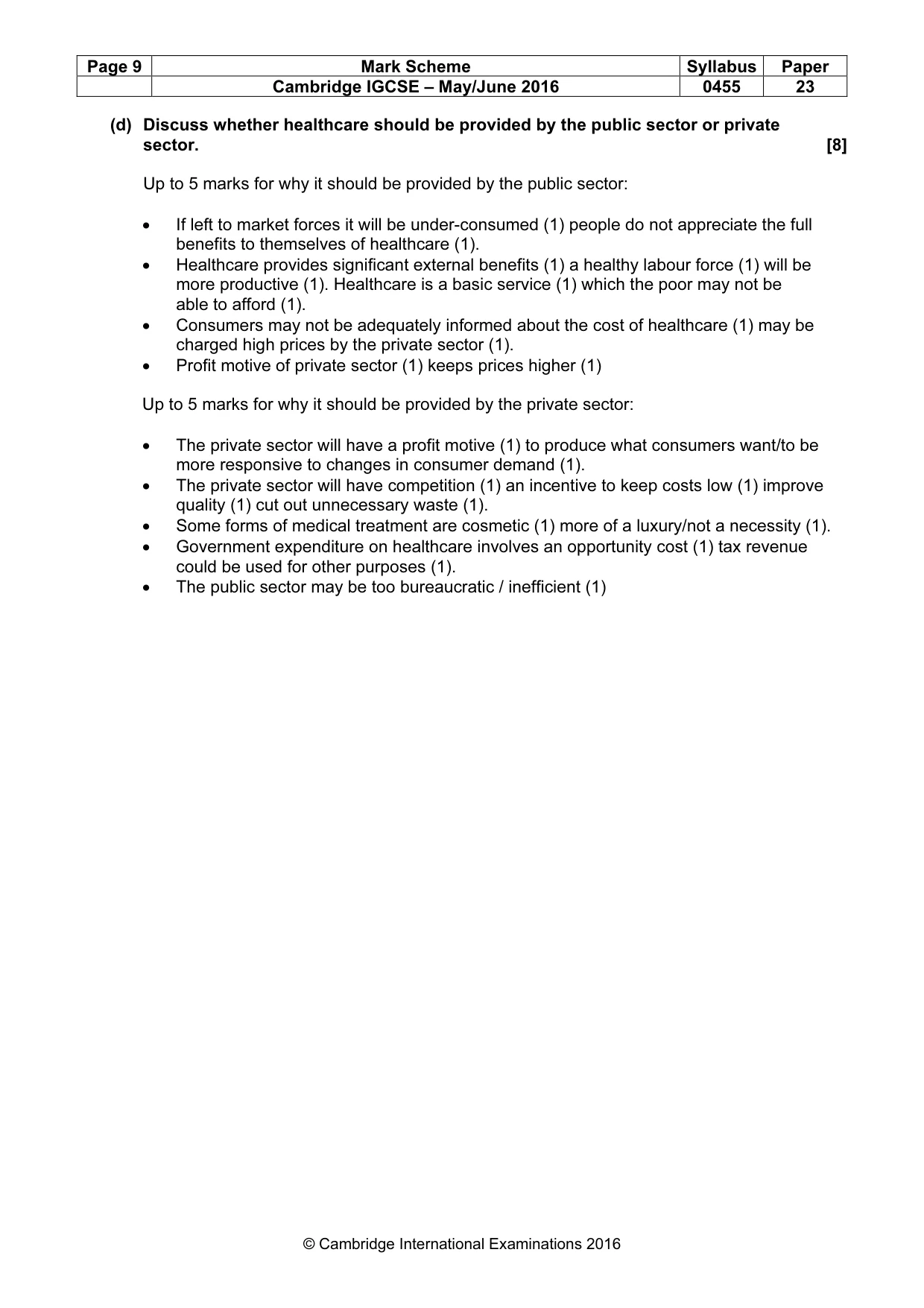
Page 9 Mark Scheme Syllabus Paper Cambridge IGCSE – May/June 2016 0455 23 © Cambridge International Examinations 2016 (d) Discuss whether healthcare should be provided by the public sector or private sector. [8] Up to 5 marks for why it should be provided by the public sector: • If left to market forces it will be under-consumed (1) people do not appreciate the full benefits to themselves of healthcare (1). • Healthcare provides significant external benefits (1) a healthy labour force (1) will be more productive (1). Healthcare is a basic service (1) which the poor may not be able to afford (1). • Consumers may not be adequately informed about the cost of healthcare (1) may be charged high prices by the private sector (1). • Profit motive of private sector (1) keeps prices higher (1) Up to 5 marks for why it should be provided by the private sector: • The private sector will have a profit motive (1) to produce what consumers want/to be more responsive to changes in consumer demand (1). • The private sector will have competition (1) an incentive to keep costs low (1) improve quality (1) cut out unnecessary waste (1). • Some forms of medical treatment are cosmetic (1) more of a luxury/not a necessity (1). • Government expenditure on healthcare involves an opportunity cost (1) tax revenue could be used for other purposes (1). • The public sector may be too bureaucratic / inefficient (1)
Mark scheme, page 10
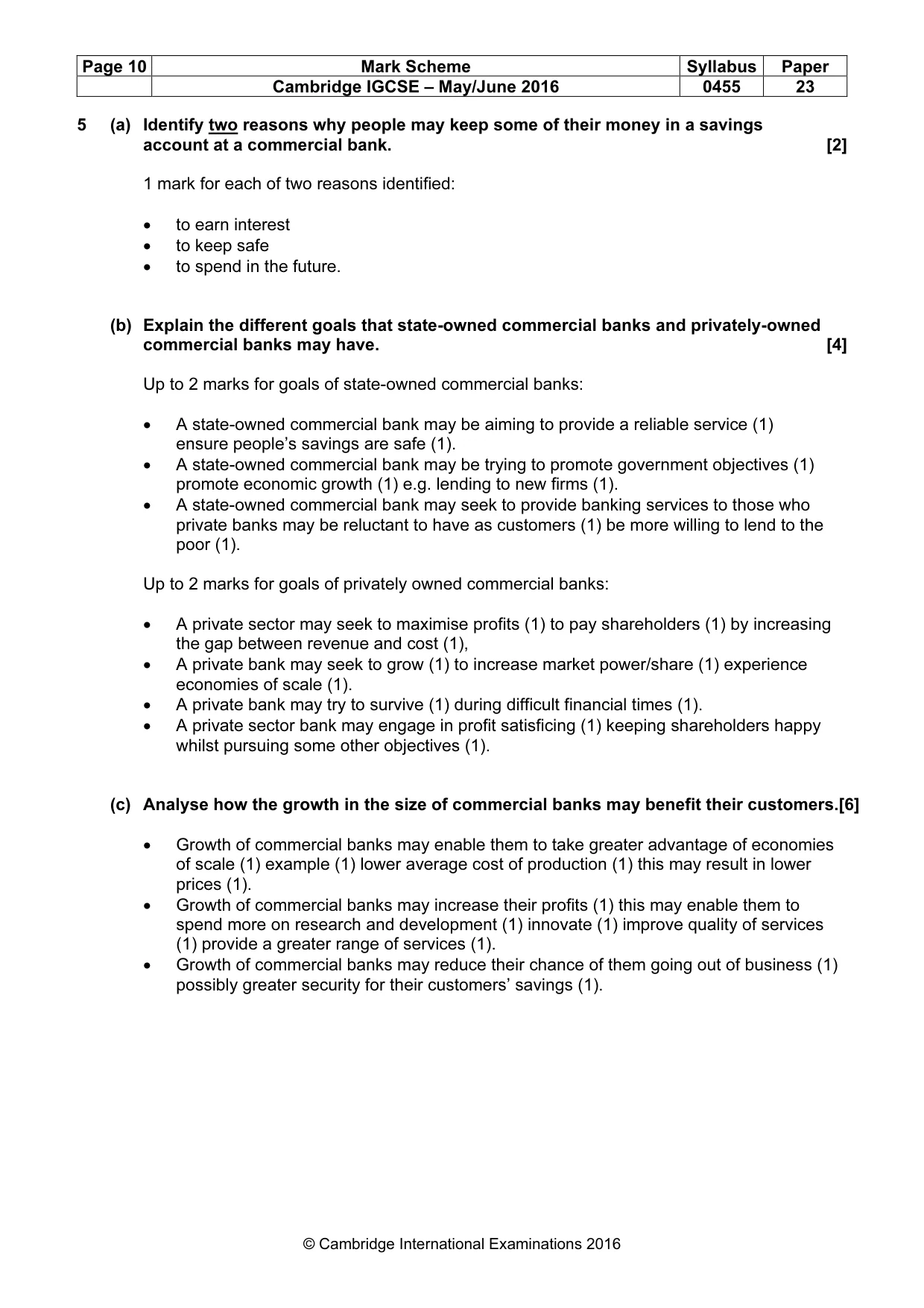
Page 10 Mark Scheme Syllabus Paper Cambridge IGCSE – May/June 2016 0455 23 © Cambridge International Examinations 2016 5 (a) Identify two reasons why people may keep some of their money in a savings account at a commercial bank. [2] 1 mark for each of two reasons identified: • to earn interest • to keep safe • to spend in the future. (b) Explain the different goals that state-owned commercial banks and privately-owned commercial banks may have. [4] Up to 2 marks for goals of state-owned commercial banks: • A state-owned commercial bank may be aiming to provide a reliable service (1) ensure people’s savings are safe (1). • A state-owned commercial bank may be trying to promote government objectives (1) promote economic growth (1) e.g. lending to new firms (1). • A state-owned commercial bank may seek to provide banking services to those who private banks may be reluctant to have as customers (1) be more willing to lend to the poor (1). Up to 2 marks for goals of privately owned commercial banks: • A private sector may seek to maximise profits (1) to pay shareholders (1) by increasing the gap between revenue and cost (1), • A private bank may seek to grow (1) to increase market power/share (1) experience economies of scale (1). • A private bank may try to survive (1) during difficult financial times (1). • A private sector bank may engage in profit satisficing (1) keeping shareholders happy whilst pursuing some other objectives (1). (c) Analyse how the growth in the size of commercial banks may benefit their customers.[6] • Growth of commercial banks may enable them to take greater advantage of economies of scale (1) example (1) lower average cost of production (1) this may result in lower prices (1). • Growth of commercial banks may increase their profits (1) this may enable them to spend more on research and development (1) innovate (1) improve quality of services (1) provide a greater range of services (1). • Growth of commercial banks may reduce their chance of them going out of business (1) possibly greater security for their customers’ savings (1).
Mark scheme, page 11
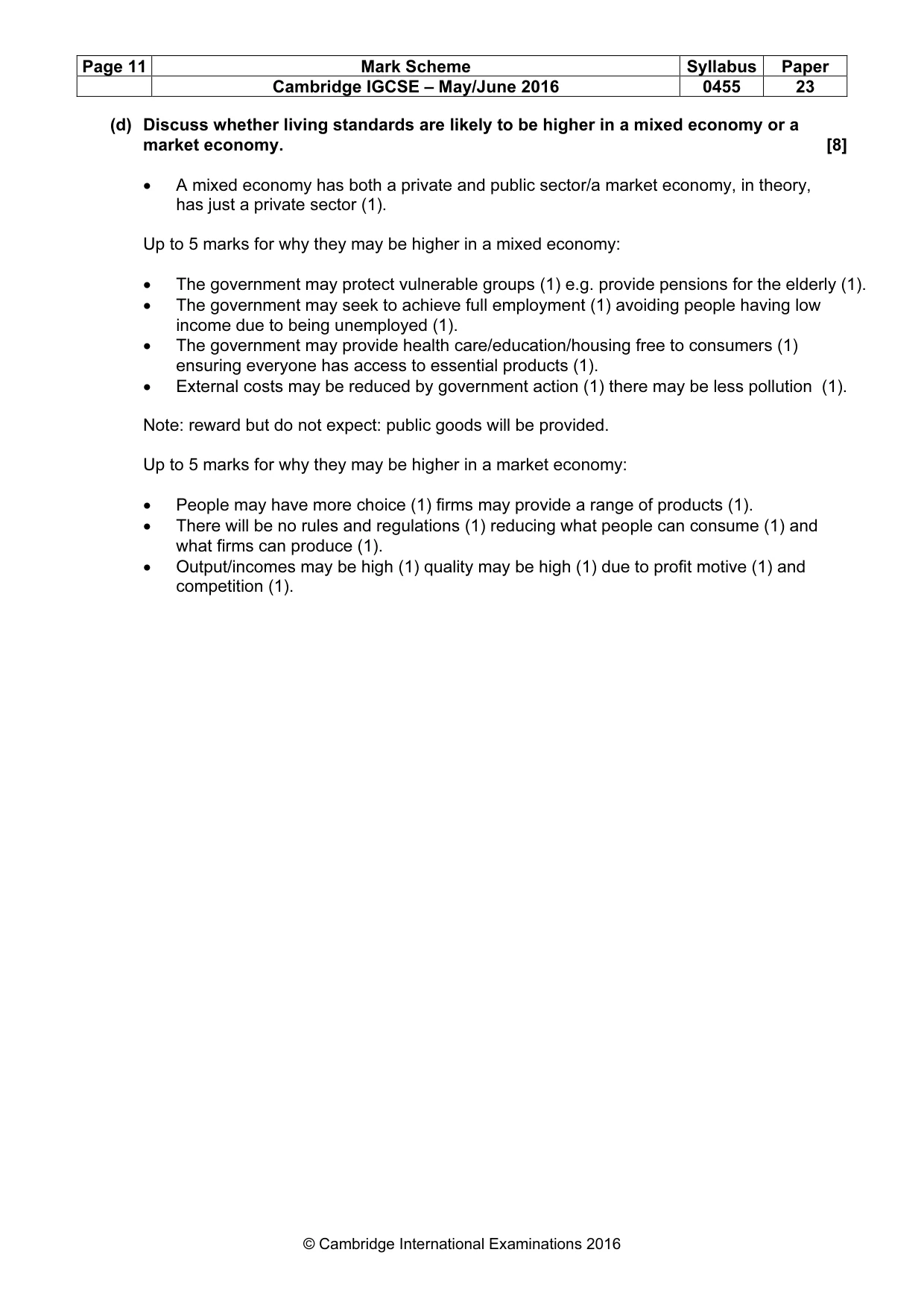
Page 11 Mark Scheme Syllabus Paper Cambridge IGCSE – May/June 2016 0455 23 © Cambridge International Examinations 2016 (d) Discuss whether living standards are likely to be higher in a mixed economy or a market economy. [8] • A mixed economy has both a private and public sector/a market economy, in theory, has just a private sector (1). Up to 5 marks for why they may be higher in a mixed economy: • The government may protect vulnerable groups (1) e.g. provide pensions for the elderly (1). • The government may seek to achieve full employment (1) avoiding people having low income due to being unemployed (1). • The government may provide health care/education/housing free to consumers (1) ensuring everyone has access to essential products (1). • External costs may be reduced by government action (1) there may be less pollution (1). Note: reward but do not expect: public goods will be provided. Up to 5 marks for why they may be higher in a market economy: • People may have more choice (1) firms may provide a range of products (1). • There will be no rules and regulations (1) reducing what people can consume (1) and what firms can produce (1). • Output/incomes may be high (1) quality may be high (1) due to profit motive (1) and competition (1).
Mark scheme, page 12
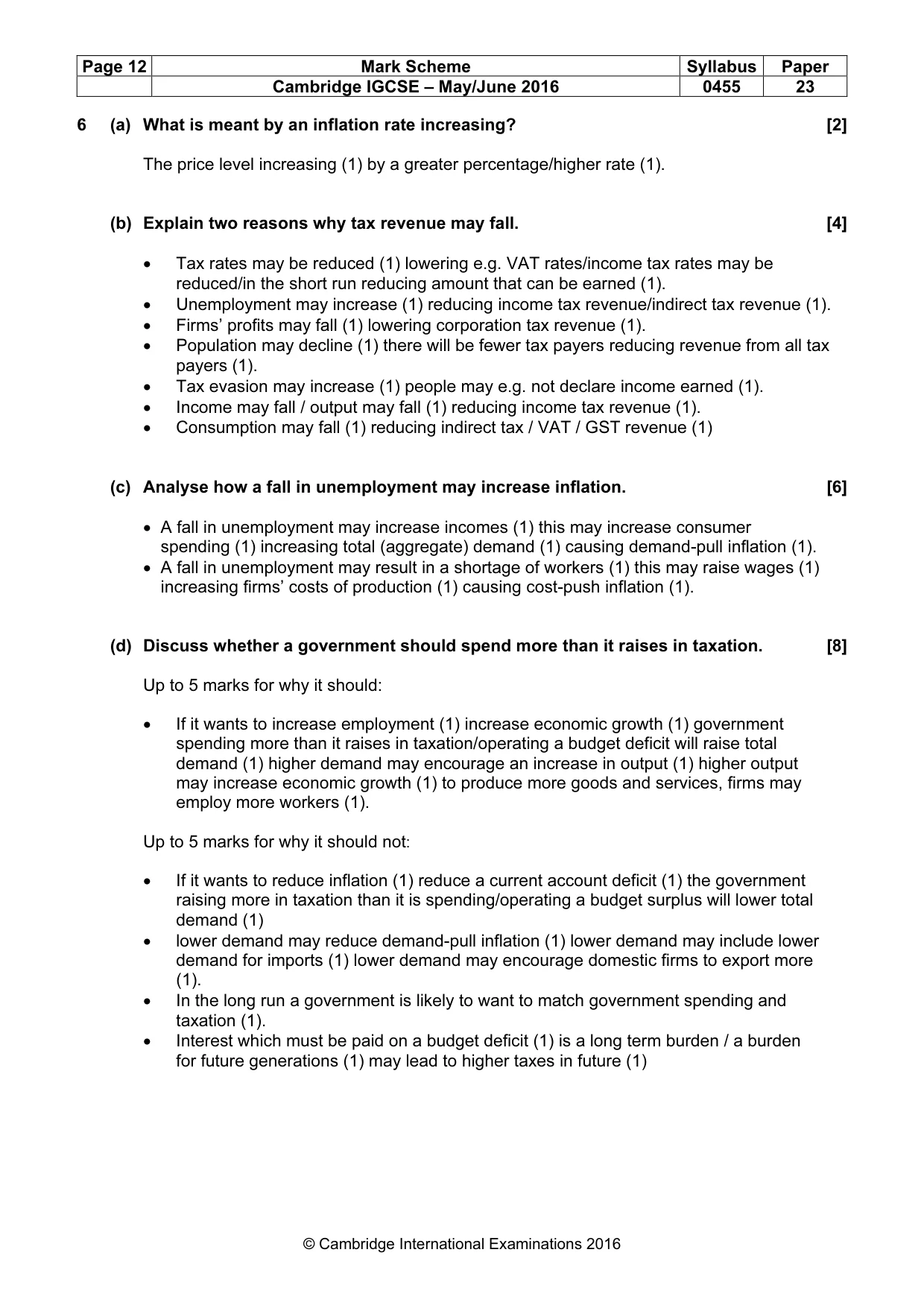
Page 12 Mark Scheme Syllabus Paper Cambridge IGCSE – May/June 2016 0455 23 © Cambridge International Examinations 2016 6 (a) What is meant by an inflation rate increasing? [2] The price level increasing (1) by a greater percentage/higher rate (1). (b) Explain two reasons why tax revenue may fall. [4] • Tax rates may be reduced (1) lowering e.g. VAT rates/income tax rates may be reduced/in the short run reducing amount that can be earned (1). • Unemployment may increase (1) reducing income tax revenue/indirect tax revenue (1). • Firms’ profits may fall (1) lowering corporation tax revenue (1). • Population may decline (1) there will be fewer tax payers reducing revenue from all tax payers (1). • Tax evasion may increase (1) people may e.g. not declare income earned (1). • Income may fall / output may fall (1) reducing income tax revenue (1). • Consumption may fall (1) reducing indirect tax / VAT / GST revenue (1) (c) Analyse how a fall in unemployment may increase inflation. [6] • A fall in unemployment may increase incomes (1) this may increase consumer spending (1) increasing total (aggregate) demand (1) causing demand-pull inflation (1). • A fall in unemployment may result in a shortage of workers (1) this may raise wages (1) increasing firms’ costs of production (1) causing cost-push inflation (1). (d) Discuss whether a government should spend more than it raises in taxation. [8] Up to 5 marks for why it should: • If it wants to increase employment (1) increase economic growth (1) government spending more than it raises in taxation/operating a budget deficit will raise total demand (1) higher demand may encourage an increase in output (1) higher output may increase economic growth (1) to produce more goods and services, firms may employ more workers (1). Up to 5 marks for why it should not: • If it wants to reduce inflation (1) reduce a current account deficit (1) the government raising more in taxation than it is spending/operating a budget surplus will lower total demand (1) • lower demand may reduce demand-pull inflation (1) lower demand may include lower demand for imports (1) lower demand may encourage domestic firms to export more (1). • In the long run a government is likely to want to match government spending and taxation (1). • Interest which must be paid on a budget deficit (1) is a long term burden / a burden for future generations (1) may lead to higher taxes in future (1)
Mark scheme, page 13
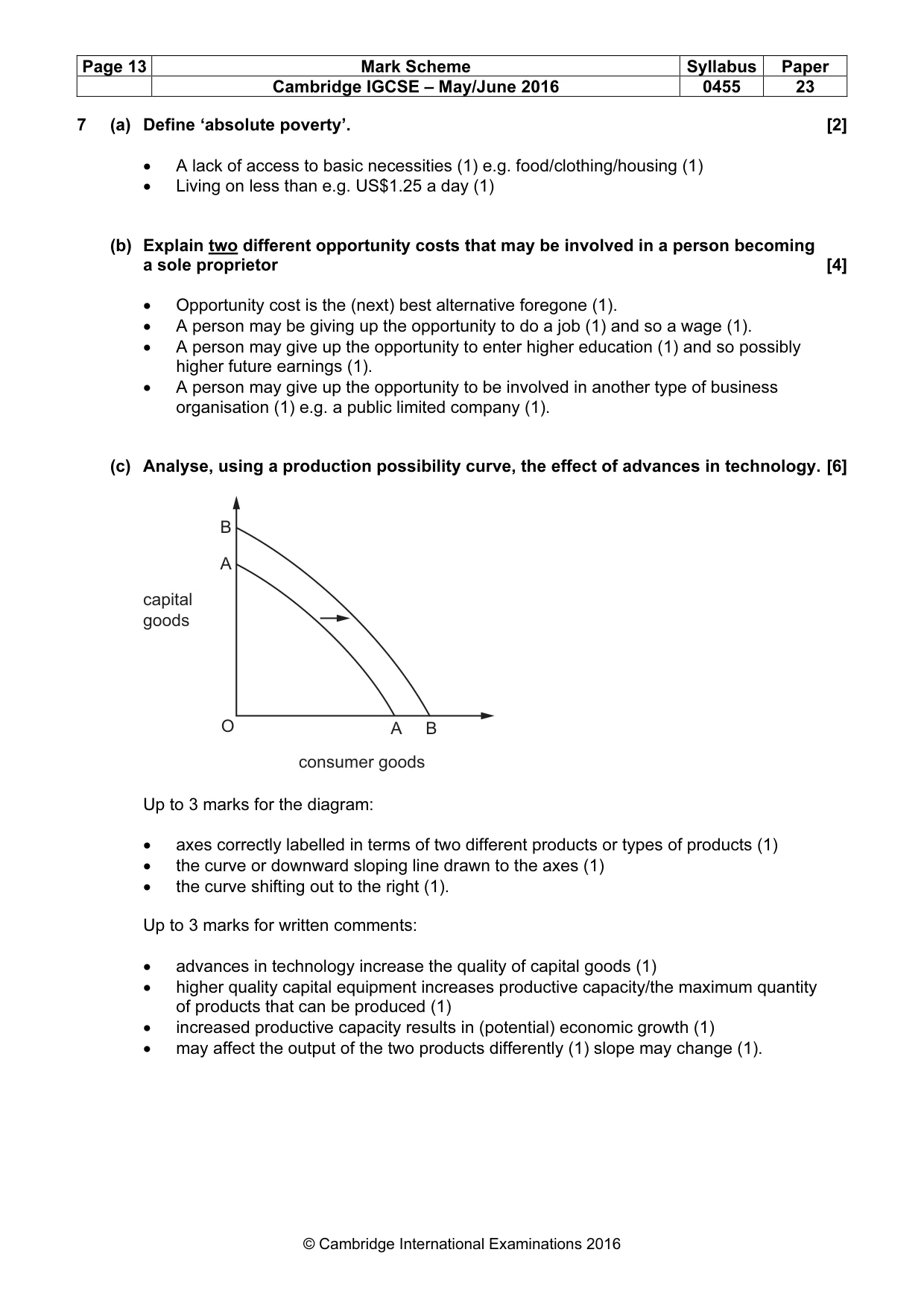
Page 13 Mark Scheme Syllabus Paper Cambridge IGCSE – May/June 2016 0455 23 © Cambridge International Examinations 2016 7 (a) Define ‘absolute poverty’. [2] • A lack of access to basic necessities (1) e.g. food/clothing/housing (1) • Living on less than e.g. US$1.25 a day (1) (b) Explain two different opportunity costs that may be involved in a person becoming a sole proprietor [4] • Opportunity cost is the (next) best alternative foregone (1). • A person may be giving up the opportunity to do a job (1) and so a wage (1). • A person may give up the opportunity to enter higher education (1) and so possibly higher future earnings (1). • A person may give up the opportunity to be involved in another type of business organisation (1) e.g. a public limited company (1). (c) Analyse, using a production possibility curve, the effect of advances in technology. [6] Up to 3 marks for the diagram: • axes correctly labelled in terms of two different products or types of products (1) • the curve or downward sloping line drawn to the axes (1) • the curve shifting out to the right (1). Up to 3 marks for written comments: • advances in technology increase the quality of capital goods (1) • higher quality capital equipment increases productive capacity/the maximum quantity of products that can be produced (1) • increased productive capacity results in (potential) economic growth (1) • may affect the output of the two products differently (1) slope may change (1). B A B A O capital goods consumer goods
Mark scheme, page 14
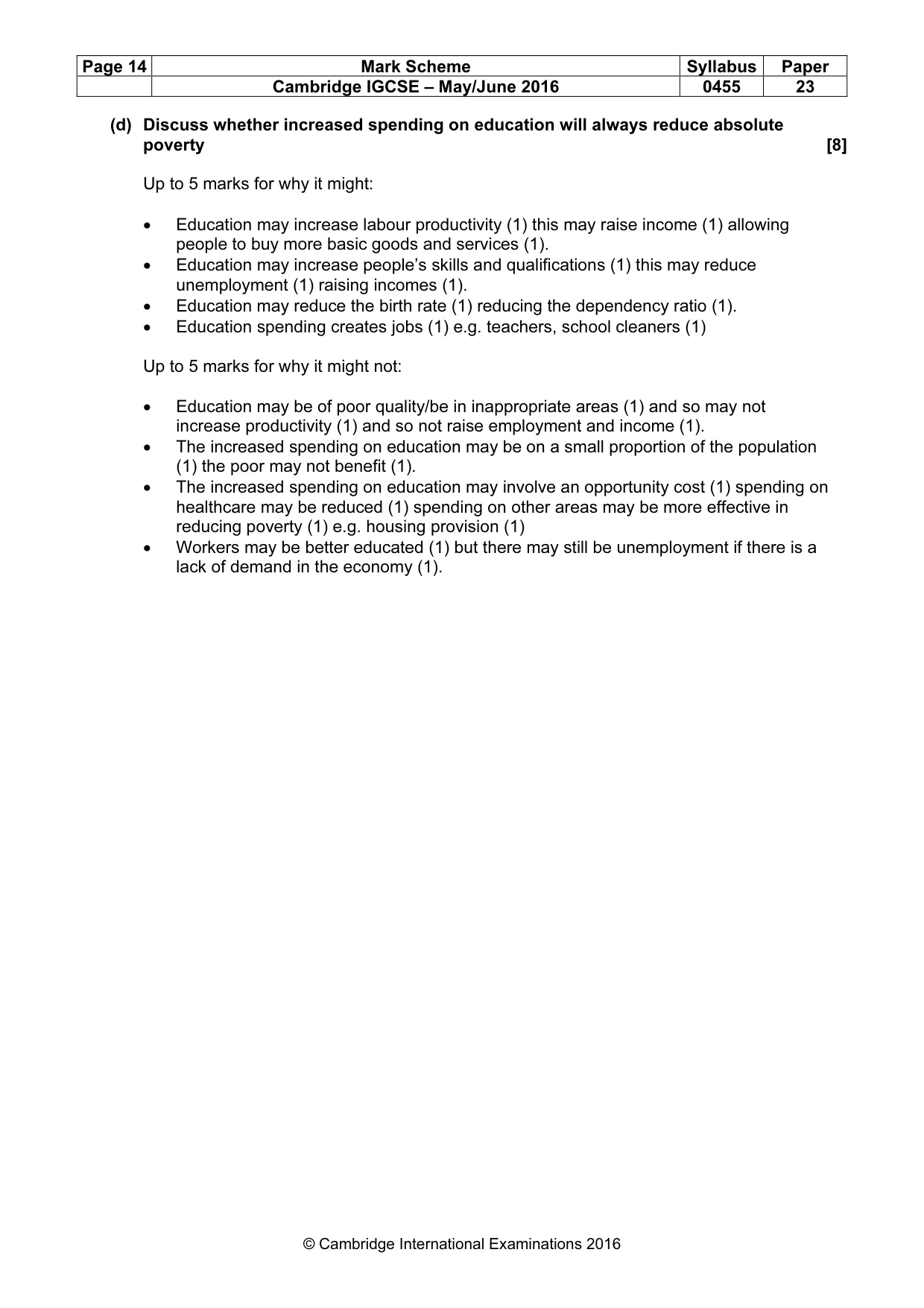
Page 14 Mark Scheme Syllabus Paper Cambridge IGCSE – May/June 2016 0455 23 © Cambridge International Examinations 2016 (d) Discuss whether increased spending on education will always reduce absolute poverty [8] Up to 5 marks for why it might: • Education may increase labour productivity (1) this may raise income (1) allowing people to buy more basic goods and services (1). • Education may increase people’s skills and qualifications (1) this may reduce unemployment (1) raising incomes (1). • Education may reduce the birth rate (1) reducing the dependency ratio (1). • Education spending creates jobs (1) e.g. teachers, school cleaners (1) Up to 5 marks for why it might not: • Education may be of poor quality/be in inappropriate areas (1) and so may not increase productivity (1) and so not raise employment and income (1). • The increased spending on education may be on a small proportion of the population (1) the poor may not benefit (1). • The increased spending on education may involve an opportunity cost (1) spending on healthcare may be reduced (1) spending on other areas may be more effective in reducing poverty (1) e.g. housing provision (1) • Workers may be better educated (1) but there may still be unemployment if there is a lack of demand in the economy (1).
What you needed in this session
Cambridge’s own grade thresholds for 2016 May/June, Paper 2 · Variant 3. A higher threshold means an easier paper — the bar moves with how the cohort did.