Cambridge IGCSE Economics 0455 — 2016 May/June Paper 2 · Variant 2
0455/22/M/J/16 · 90 marks · ≈101 min
The question paper and its mark scheme, free to read here and free to download. This is Cambridge’s own paper, exactly as it was sat.
Question paper8 pages


Mark scheme11 pages
Answers below. Sit the paper first if you are practising.
Paper as text
Question paper, page 1
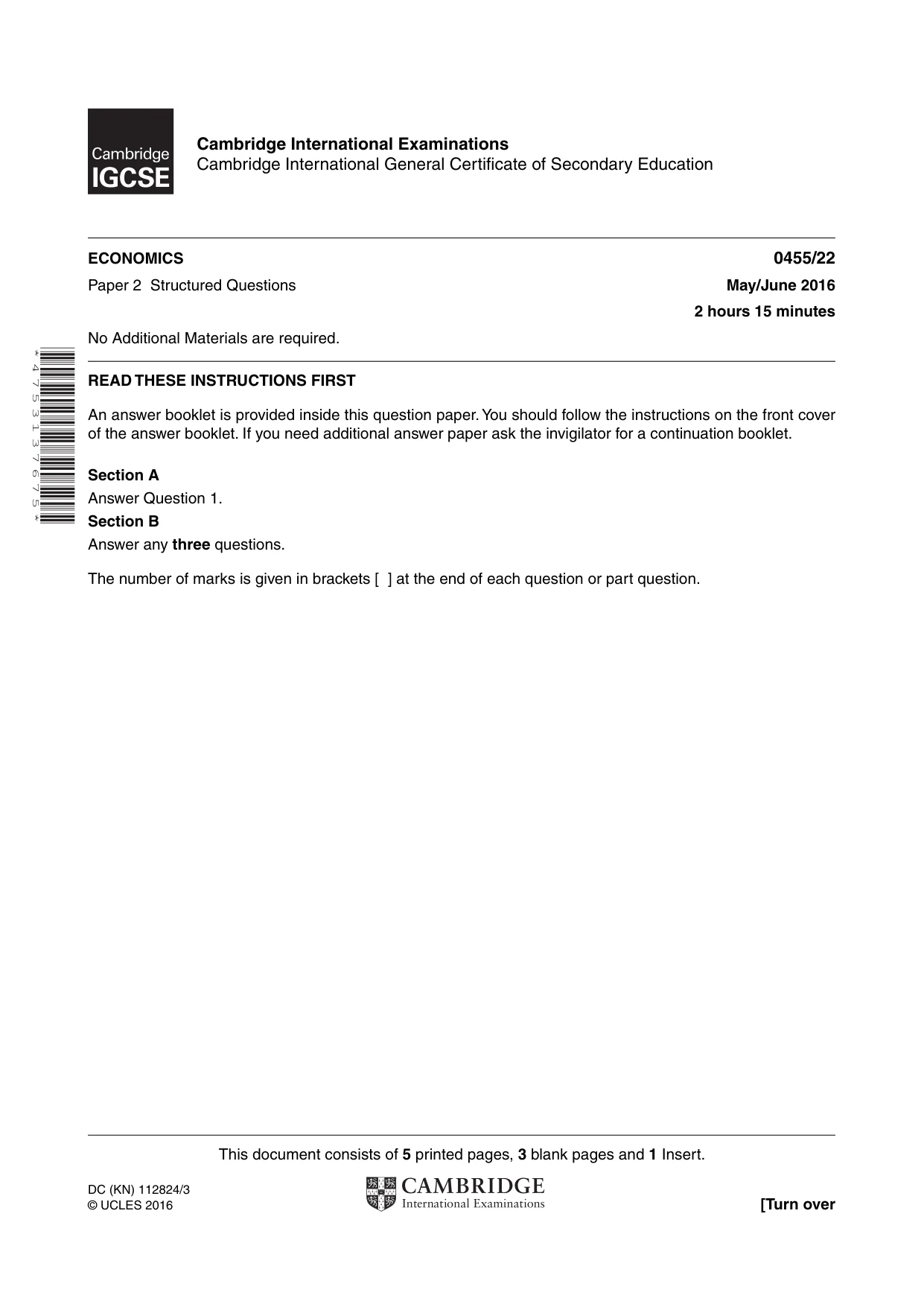
This document consists of 5 printed pages, 3 blank pages and 1 Insert. DC (KN) 112824/3 © UCLES 2016 [Turn over Cambridge International Examinations Cambridge International General Certificate of Secondary Education * 4 7 5 3 1 3 7 6 7 5 * ECONOMICS 0455/22 Paper 2 Structured Questions May/June 2016 2 hours 15 minutes No Additional Materials are required. READ THESE INSTRUCTIONS FIRST An answer booklet is provided inside this question paper. You should follow the instructions on the front cover of the answer booklet. If you need additional answer paper ask the invigilator for a continuation booklet. Section A Answer Question 1. Section B Answer any three questions. The number of marks is given in brackets [ ] at the end of each question or part question.
Question paper, page 2
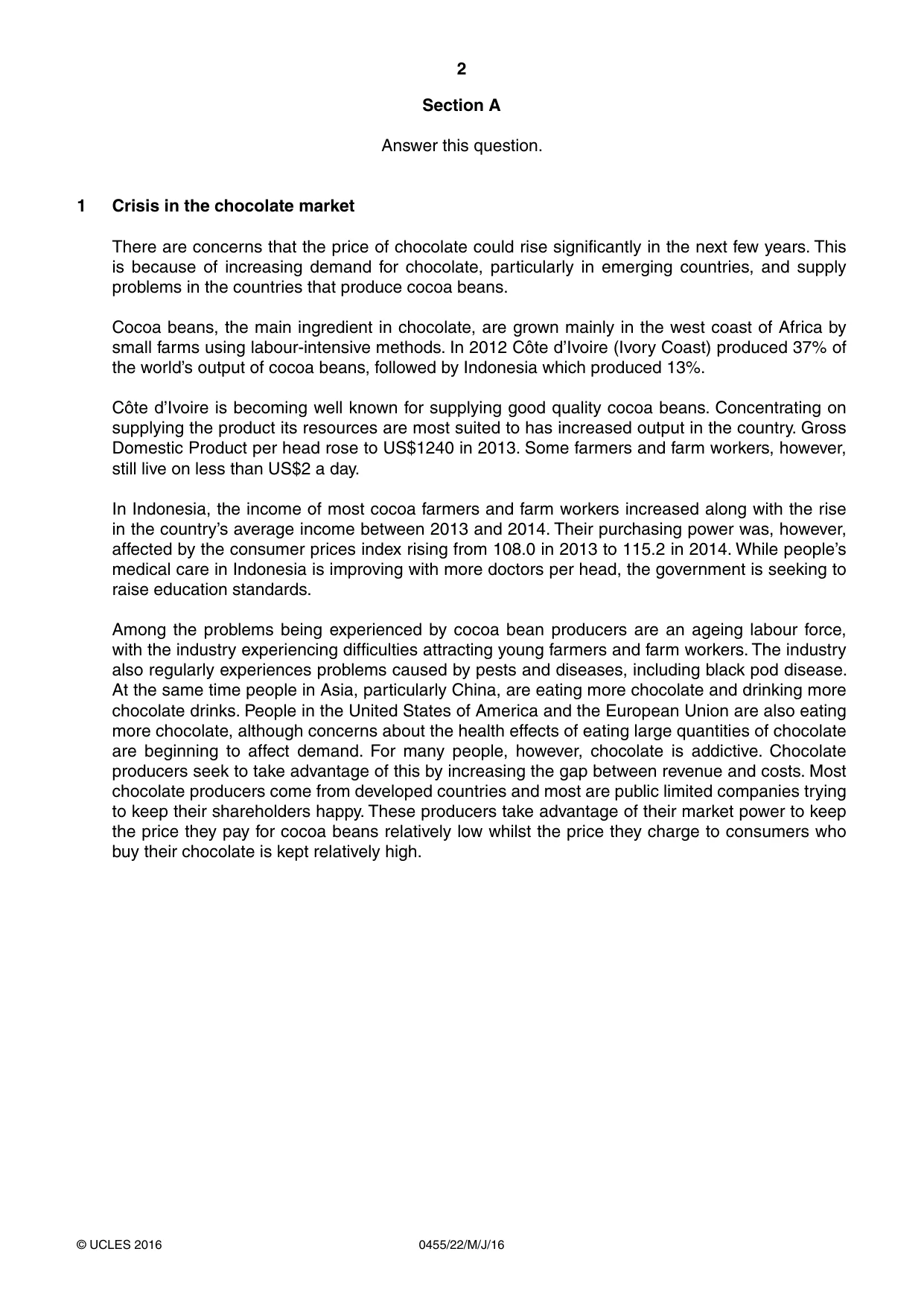
2 0455/22/M/J/16 © UCLES 2016 Section A Answer this question. 1 Crisis in the chocolate market There are concerns that the price of chocolate could rise significantly in the next few years. This is because of increasing demand for chocolate, particularly in emerging countries, and supply problems in the countries that produce cocoa beans. Cocoa beans, the main ingredient in chocolate, are grown mainly in the west coast of Africa by small farms using labour-intensive methods. In 2012 Côte d’Ivoire (Ivory Coast) produced 37% of the world’s output of cocoa beans, followed by Indonesia which produced 13%. Côte d’Ivoire is becoming well known for supplying good quality cocoa beans. Concentrating on supplying the product its resources are most suited to has increased output in the country. Gross Domestic Product per head rose to US$1240 in 2013. Some farmers and farm workers, however, still live on less than US$2 a day. In Indonesia, the income of most cocoa farmers and farm workers increased along with the rise in the country’s average income between 2013 and 2014. Their purchasing power was, however, affected by the consumer prices index rising from 108.0 in 2013 to 115.2 in 2014. While people’s medical care in Indonesia is improving with more doctors per head, the government is seeking to raise education standards. Among the problems being experienced by cocoa bean producers are an ageing labour force, with the industry experiencing difficulties attracting young farmers and farm workers. The industry also regularly experiences problems caused by pests and diseases, including black pod disease. At the same time people in Asia, particularly China, are eating more chocolate and drinking more chocolate drinks. People in the United States of America and the European Union are also eating more chocolate, although concerns about the health effects of eating large quantities of chocolate are beginning to affect demand. For many people, however, chocolate is addictive. Chocolate producers seek to take advantage of this by increasing the gap between revenue and costs. Most chocolate producers come from developed countries and most are public limited companies trying to keep their shareholders happy. These producers take advantage of their market power to keep the price they pay for cocoa beans relatively low whilst the price they charge to consumers who buy their chocolate is kept relatively high.
Question paper, page 3
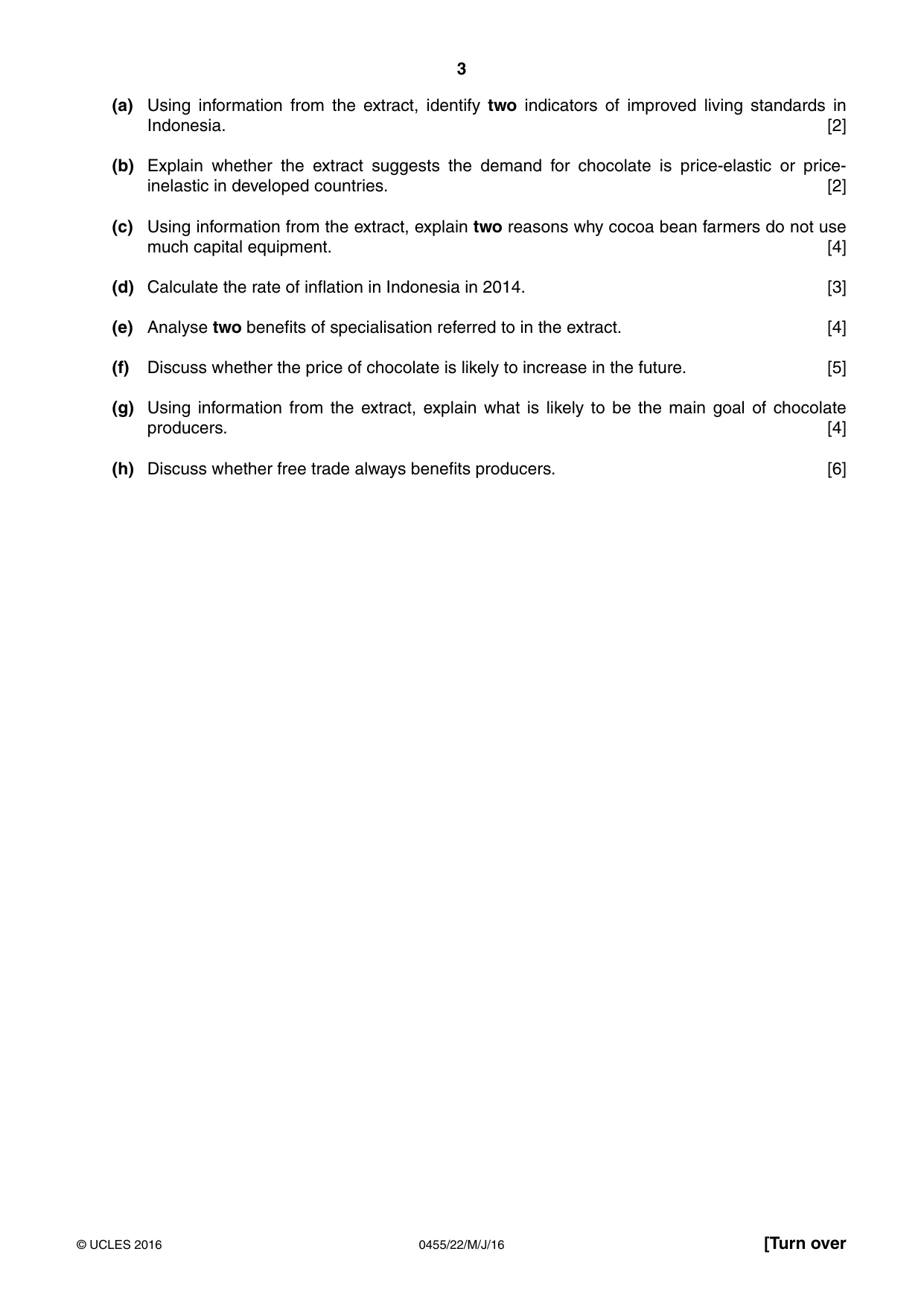
3 0455/22/M/J/16 © UCLES 2016 [Turn over (a) Using information from the extract, identify two indicators of improved living standards in Indonesia. [2] (b) Explain whether the extract suggests the demand for chocolate is price-elastic or price- inelastic in developed countries. [2] (c) Using information from the extract, explain two reasons why cocoa bean farmers do not use much capital equipment. [4] (d) Calculate the rate of inflation in Indonesia in 2014. [3] (e) Analyse two benefits of specialisation referred to in the extract. [4] (f) Discuss whether the price of chocolate is likely to increase in the future. [5] (g) Using information from the extract, explain what is likely to be the main goal of chocolate producers. [4] (h) Discuss whether free trade always benefits producers. [6]
Question paper, page 4
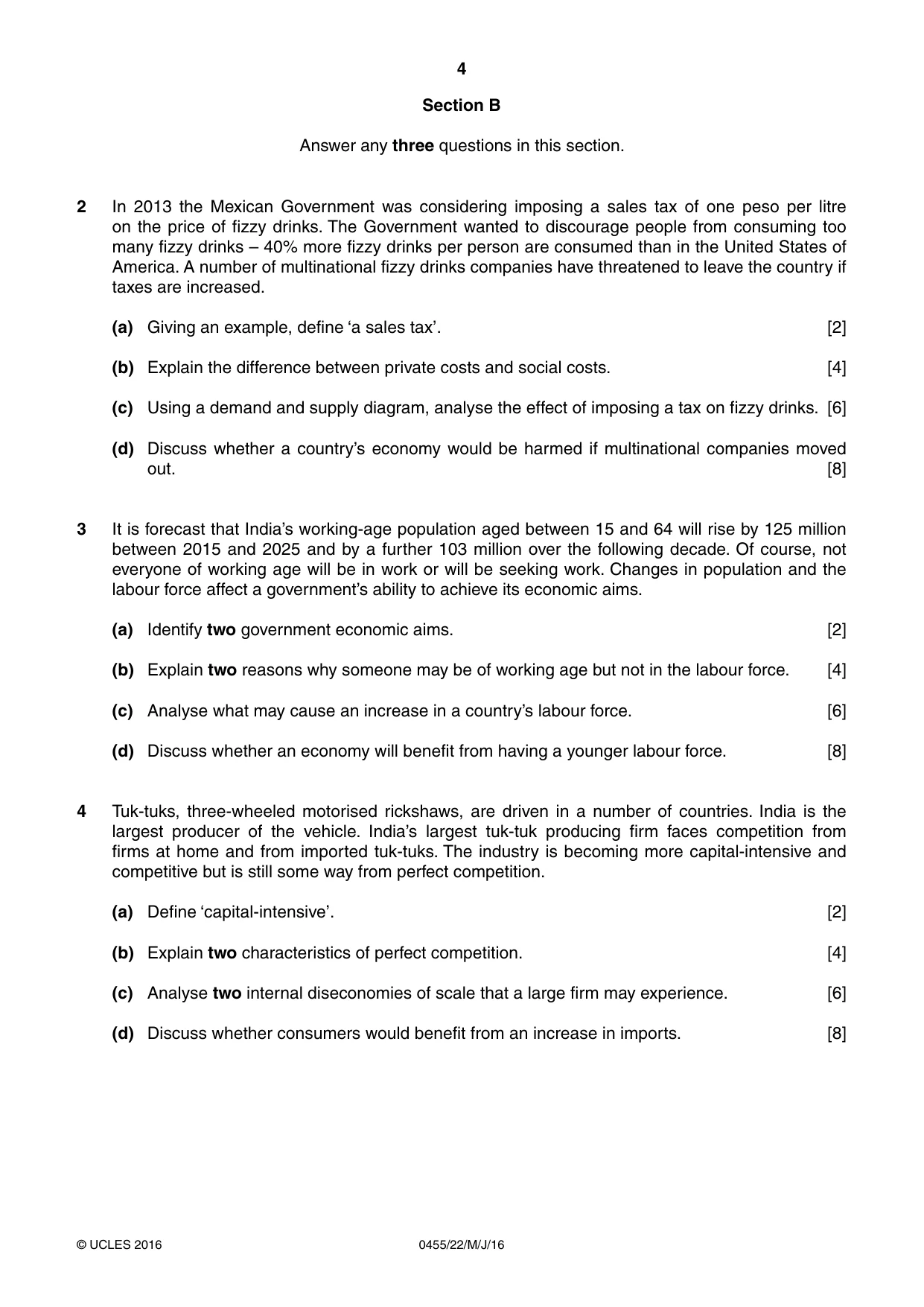
4 0455/22/M/J/16 © UCLES 2016 Section B Answer any three questions in this section. 2 In 2013 the Mexican Government was considering imposing a sales tax of one peso per litre on the price of fizzy drinks. The Government wanted to discourage people from consuming too many fizzy drinks – 40% more fizzy drinks per person are consumed than in the United States of America. A number of multinational fizzy drinks companies have threatened to leave the country if taxes are increased. (a) Giving an example, define ‘a sales tax’. [2] (b) Explain the difference between private costs and social costs. [4] (c) Using a demand and supply diagram, analyse the effect of imposing a tax on fizzy drinks. [6] (d) Discuss whether a country’s economy would be harmed if multinational companies moved out. [8] 3 It is forecast that India’s working-age population aged between 15 and 64 will rise by 125 million between 2015 and 2025 and by a further 103 million over the following decade. Of course, not everyone of working age will be in work or will be seeking work. Changes in population and the labour force affect a government’s ability to achieve its economic aims. (a) Identify two government economic aims. [2] (b) Explain two reasons why someone may be of working age but not in the labour force. [4] (c) Analyse what may cause an increase in a country’s labour force. [6] (d) Discuss whether an economy will benefit from having a younger labour force. [8] 4 Tuk-tuks, three-wheeled motorised rickshaws, are driven in a number of countries. India is the largest producer of the vehicle. India’s largest tuk-tuk producing firm faces competition from firms at home and from imported tuk-tuks. The industry is becoming more capital-intensive and competitive but is still some way from perfect competition. (a) Define ‘capital-intensive’. [2] (b) Explain two characteristics of perfect competition. [4] (c) Analyse two internal diseconomies of scale that a large firm may experience. [6] (d) Discuss whether consumers would benefit from an increase in imports. [8]
Question paper, page 5
5 0455/22/M/J/16 © UCLES 2016 5 In July 2016 the Sveriges Riksbank, Sweden’s central bank, cut the rate of interest to 0.25%. The Swedish economy was experiencing deflation, with the weighted price index falling by 0.2% on the previous year. The fall in the rate of interest reduced the value of the krona, Sweden’s currency, and was expected to end deflation. (a) Define a ‘weighted price index’. [2] (b) Explain two ways in which a central bank differs from a commercial bank. [4] (c) Analyse how a fall in the value of a currency may increase a current account surplus on the balance of payments. [6] (d) Discuss whether a cut in the rate of interest would end deflation. [8] 6 Deposits in banks in Dubai rose by 40% in 2013. More financial companies are locating in Dubai. The growth in its financial sector is being accompanied by horizontal mergers between financial companies and workers becoming more specialised. The economy is becoming richer but the economic problem will never be solved here or elsewhere in the world. (a) Why can the economic problem never be solved? [2] (b) Explain two reasons why workers specialising can reduce the average cost of production. [4] (c) Analyse how an increase in bank lending can increase economic growth. [6] (d) Discuss whether consumers benefit from horizontal mergers. [8] 7 Countries have to decide how to use their scarce resources. A number of countries are devoting more of their resources to tourism. Some of the jobs in the industry are, however, low-paid and offer little job security. The average age of workers employed, for example, in hotels is relatively young although some older workers have spent their working life in the hotel industry. (a) What is meant by ‘scarce resources’? [2] (b) Explain two reasons why someone may be willing to do a low-paid job with little job security. [4] (c) Analyse how the spending, saving and borrowing patterns of young workers may differ from older workers. [6] (d) Discuss whether developing countries should encourage foreign tourism. [8]
Question paper, page 6
6 0455/22/M/J/16 © UCLES 2016 BLANK PAGE
Question paper, page 7
7 0455/22/M/J/16 © UCLES 2016 BLANK PAGE
Question paper, page 8
8 0455/22/M/J/16 © UCLES 2016 BLANK PAGE Permission to reproduce items where third-party owned material protected by copyright is included has been sought and cleared where possible. Every reasonable effort has been made by the publisher (UCLES) to trace copyright holders, but if any items requiring clearance have unwittingly been included, the publisher will be pleased to make amends at the earliest possible opportunity. To avoid the issue of disclosure of answer-related information to candidates, all copyright acknowledgements are reproduced online in the Cambridge International Examinations Copyright Acknowledgements Booklet. This is produced for each series of examinations and is freely available to download at www.cie.org.uk after the live examination series. Cambridge International Examinations is part of the Cambridge Assessment Group. Cambridge Assessment is the brand name of University of Cambridge Local Examinations Syndicate (UCLES), which is itself a department of the University of Cambridge.
Mark scheme, page 1
® IGCSE is the registered trademark of Cambridge International Examinations. This document consists of 11 printed pages. © UCLES 2016 [Turn over Cambridge International Examinations Cambridge International General Certificate of Secondary Education ECONOMICS 0455/22 Paper 2 Structured Questions May/June 2016 MARK SCHEME Maximum Mark: 90 Published This mark scheme is published as an aid to teachers and candidates, to indicate the requirements of the examination. It shows the basis on which Examiners were instructed to award marks. It does not indicate the details of the discussions that took place at an Examiners’ meeting before marking began, which would have considered the acceptability of alternative answers. Mark schemes should be read in conjunction with the question paper and the Principal Examiner Report for Teachers. Cambridge will not enter into discussions about these mark schemes. Cambridge is publishing the mark schemes for the May/June 2016 series for most Cambridge IGCSE®, Cambridge International A and AS Level components and some Cambridge O Level components.
Mark scheme, page 2
Page 2 Mark Scheme Syllabus Paper Cambridge IGCSE – May/June 2016 0455 22 © Cambridge International Examinations 2016 1 (a) Using information from the extract, identify two indicators of improved living standards in Indonesia. [2] • A rise in incomes/increase in purchasing power (1) improved medical care/an increase in doctors per head (1). (b) Explain whether the extract suggests the demand for chocolate is price-elastic or price-inelastic in developed countries. [2] • It suggests it is price-inelastic (1) as it is addictive (2). (c) Using information from the extract, explain two reasons why cocoa bean farmers do not use much capital equipment. [4] • Low incomes of cocoa bean farmers (1) mean they cannot afford capital equipment (1). • Small size of cocoa bean farms (1) makes it impractical to use much capital equipment (1). • Low wages of cocoa bean farm workers (1) makes it more cost effective to employ labour rather than capital/high cost of capital equipment (1). • Lack of education/unskilled/older workers (1) may not know how to use capital equipment (1). (d) Calculate the rate of inflation in Indonesia in 2014. [3] • 6.67% / 6.7% / 6.6% / 6.666666% (3) • Correct working: 7.2/108 x 100/115.2 – 108 x 100/108 or 6.67/6.7/6.6/6.66666/ 1.067 or version of (2) • 7.2 / 7.2% (1). (e) Analyse two benefits of specialisation referred to in the extract. [4] • A country can specialise in what it is best at producing/increase efficiency/increase productivity (1) so leading to higher output/higher income (1). Maximum mark = 2. • A country can gain a good reputation in producing the product/produce a high quality product (1) this may increase demand for the product (1). Maximum mark = 2.
Mark scheme, page 3
Page 3 Mark Scheme Syllabus Paper Cambridge IGCSE – May/June 2016 0455 22 © Cambridge International Examinations 2016 (f) Discuss whether the price of chocolate is likely to increase in the future. [5] Up to 3 marks for why it might: • Demand is increasing/high demand (1) as incomes are rising/population increasing (1) • Sellers may raise price as demand is inelastic (1) market power enables producers to raise price (1) • Supply may fall/low supply (1) due to pests and disease (1). • Farmers may switch to other products (1). • Farmers and farm workers may become less productive (1) becoming older (1). Up to 3 marks for why it might not: • Farms may be merged (1) enabling greater advantage to be taken of economies of scale (1) lowering average costs (1). • Concerns about obesity/diabetes/health effects (1) may reduce demand for chocolate (1) • If more producers enter the market (1). This will increase competitive pressure/increase supply which will drive down price (1) • Up to a maximum of 2 marks for showing relevant shifts in demand and supply curves in place of statements about e.g. increase in demand. (g) Using information from the extract, explain what is likely to be the main goal of chocolate producers. [4] • Profit maximisation (1) chocolate producers are seeking to increase the gap between revenue and cost/low costs and high prices (1) to satisfy shareholders (1) shareholders want a good return on their shares (1) Attract more shareholders (1) higher profits could be reinvested (1). (h) Discuss whether free trade always benefits producers. [6] Up to 4 marks for why it might: • Enables producers to specialise/expand (1) selling to a large market (1) can take advantage of economies of scale (1). • May be able to purchase raw materials more cheaply from foreign suppliers (1) lowering costs of production/increase efficiency/not having to pay tariffs on e.g. imported raw materials (1) buy better quality raw materials (1). • May be able to import new technology (1) ideas on new production methods (1) which could lower costs of production (1). Up to 4 marks for why it might not: • Increases competition from other producers (1) if cannot compete due to higher costs may go out of business (1) may need protection to survive (1). • If there is inflation in the countries they import from (1) will raise costs of production (1). • Will not be able to compete when there is dumping (1) will go out of business (1). Note: the focus of the question is on the benefits to producers and not consumers.
Mark scheme, page 4
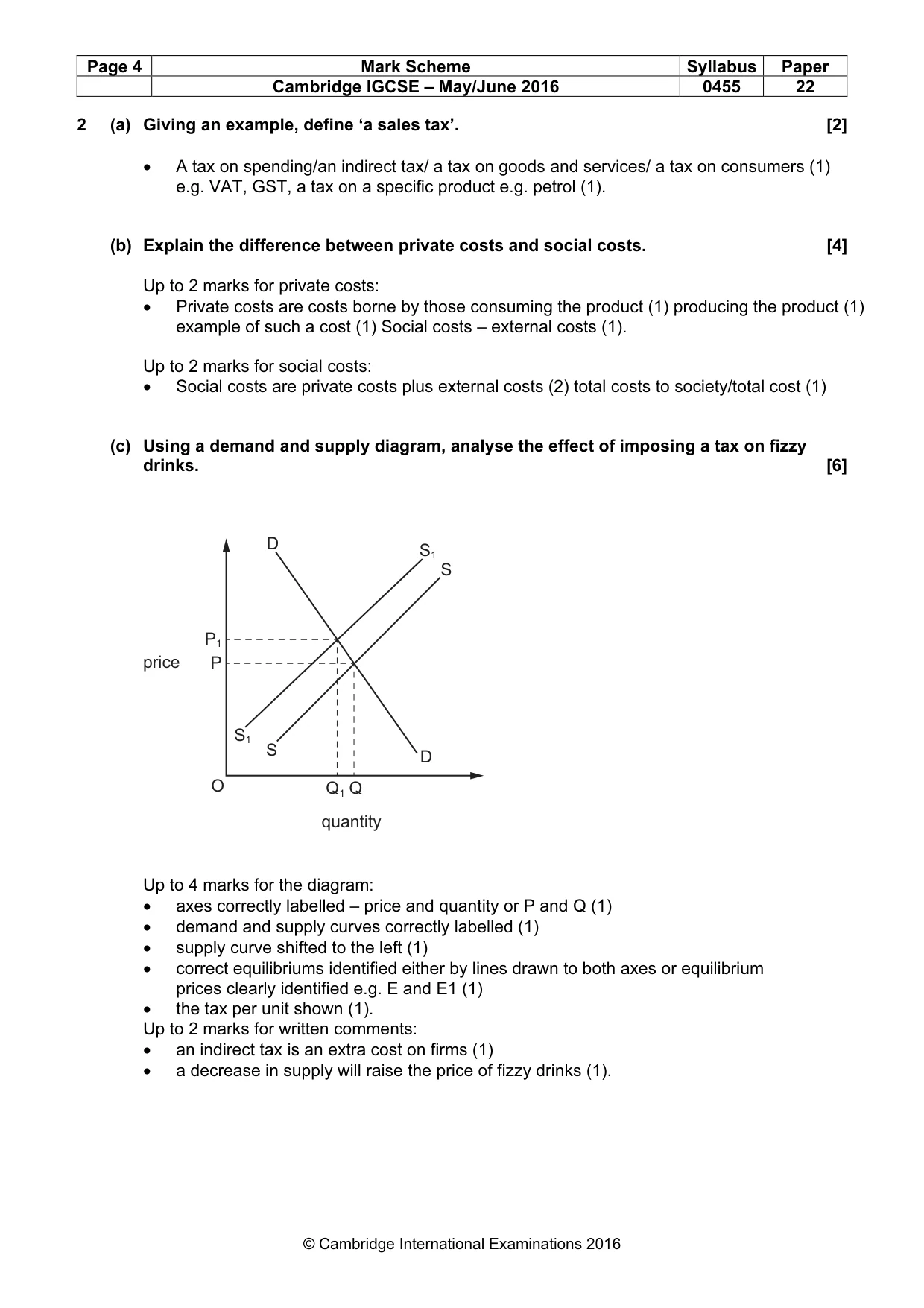
Page 4 Mark Scheme Syllabus Paper Cambridge IGCSE – May/June 2016 0455 22 © Cambridge International Examinations 2016 2 (a) Giving an example, define ‘a sales tax’. [2] • A tax on spending/an indirect tax/ a tax on goods and services/ a tax on consumers (1) e.g. VAT, GST, a tax on a specific product e.g. petrol (1). (b) Explain the difference between private costs and social costs. [4] Up to 2 marks for private costs: • Private costs are costs borne by those consuming the product (1) producing the product (1) example of such a cost (1) Social costs – external costs (1). Up to 2 marks for social costs: • Social costs are private costs plus external costs (2) total costs to society/total cost (1) (c) Using a demand and supply diagram, analyse the effect of imposing a tax on fizzy drinks. [6] Up to 4 marks for the diagram: • axes correctly labelled – price and quantity or P and Q (1) • demand and supply curves correctly labelled (1) • supply curve shifted to the left (1) • correct equilibriums identified either by lines drawn to both axes or equilibrium prices clearly identified e.g. E and E1 (1) • the tax per unit shown (1). Up to 2 marks for written comments: • an indirect tax is an extra cost on firms (1) • a decrease in supply will raise the price of fizzy drinks (1). D D S S1 S1 S P Q Q1 P1 O price quantity
Mark scheme, page 5
Page 5 Mark Scheme Syllabus Paper Cambridge IGCSE – May/June 2016 0455 22 © Cambridge International Examinations 2016 (d) Discuss whether a country’s economy would be harmed if multinational companies moved out. [8] Up to 5 marks for why it might: • Employment may fall (1) and output/income/GDP/economic growth may decline (1). • The current account position may worsen (1) as the MNC may have contributed to exports (1). • Wages may fall (1) if the MNC was paying above wages paid by domestic employers (1). • Government tax revenues may fall (1) reducing its ability to spend on e.g. education (1). • Less variety of products may be available to consumers (1). • Discourage other MNCs setting up (1). Up to 5 marks for why it might not: • The MNC may have been depleting the country’s resources (1) reducing its ability to grow in the future (1). • More domestic firms may set up/expand (1) to meet the demand that had previously been supplied by the MNC (1). • The MNC have been sending profits home (1) and so tax revenue may not fall significantly (1). • The MNC may have been putting pressure on the government to follow policies not in the country’s interest (1). • The MNC may have not have created much employment (1) keeping top jobs for workers from own country (1). • MNCs may have been subsidised (1) can use tax revenue for other purposes (1) 3 (a) Identify two government economic aims. [2] • 1 mark for each of two economic aims identified: • full employment/low unemployment/high rate of employment • price stability/low inflation/control inflation • economic growth • redistribution of income • high living standards/low poverty • balance of payments stability/favourable balance of payments/ reduce deficit or move to a surplus on the current account of the balance of payments.
Mark scheme, page 6
Page 6 Mark Scheme Syllabus Paper Cambridge IGCSE – May/June 2016 0455 22 © Cambridge International Examinations 2016 (b) Explain two reasons why someone may be of working-age but not in the labour force. [4] • A person may be a homemaker (1) deciding to stay at home to e.g. look after children (1). • A person may be a student (1) staying in education to improve qualifications/increase employment prospects/increase earning potential (1). • A person may have taken early retirement (1) as may not need to work/may be unfit to work (1). • A person may be sick/disabled (1) and so not able to work (1). • Some people who have been unemployed for a long time may give up the search for employment and so exit the labour force (1). These people are sometimes called discouraged workers (1). • A person may be working in the informal economy (1) not in official figures (1). (c) Analyse what may cause an increase in a country’s labour force. [6] • Net immigration (1) of people of working-age (1) will increase the supply of potential workers (1). • A decrease in the number of people of working-age who are economically inactive (1) reduction in those who are students/retired/homemakers/sick and disabled (1) this may be the result of e.g. a fall in the school leaving age (1) or rise in the retirement age (1). • An increase in the size of the population (1) due to a fall in death rate/rise in birth rate/rise in the birth rate some years before (1). • An increase in the cost of living (1) may force more family members to work/seek work (1). (d) Discuss whether an economy will benefit from having a younger labour force. [8] Up to 5 marks for why it might: • A younger labour force may be more adaptable to new ideas (1) more up to date with advances in technology (1) received up to date education (1). • A younger labour force may be occupationally mobile (1) more willing and able to switch jobs (1) enabling the economy to adjust to changes in demand (1) reducing structural unemployment (1). • A younger labour force may be more geographically mobile (1) reducing structural unemployment (1). • A younger labour force may be physically stronger (1) have less health problems (1) be more productive/efficient (1) be prepared to work longer hours (1) increase output/GDP (1). • A younger labour force may work for lower wages (1) reduce firms’ costs of production (1). Up to 5 marks for why it might not: • A younger labour force may be less experienced (1) not built up skills (1) less productive (1). • A younger labour force may require more training (1) increasing firms’ costs of production (1). • A younger labour force may be less reliable and patient than the older population (1) this may reduce demand for some products (1). 4 (a) Define ‘capital-intensive’. [2] • A production method that uses a large proportion of capital (1) relative to labour (1).
Mark scheme, page 7
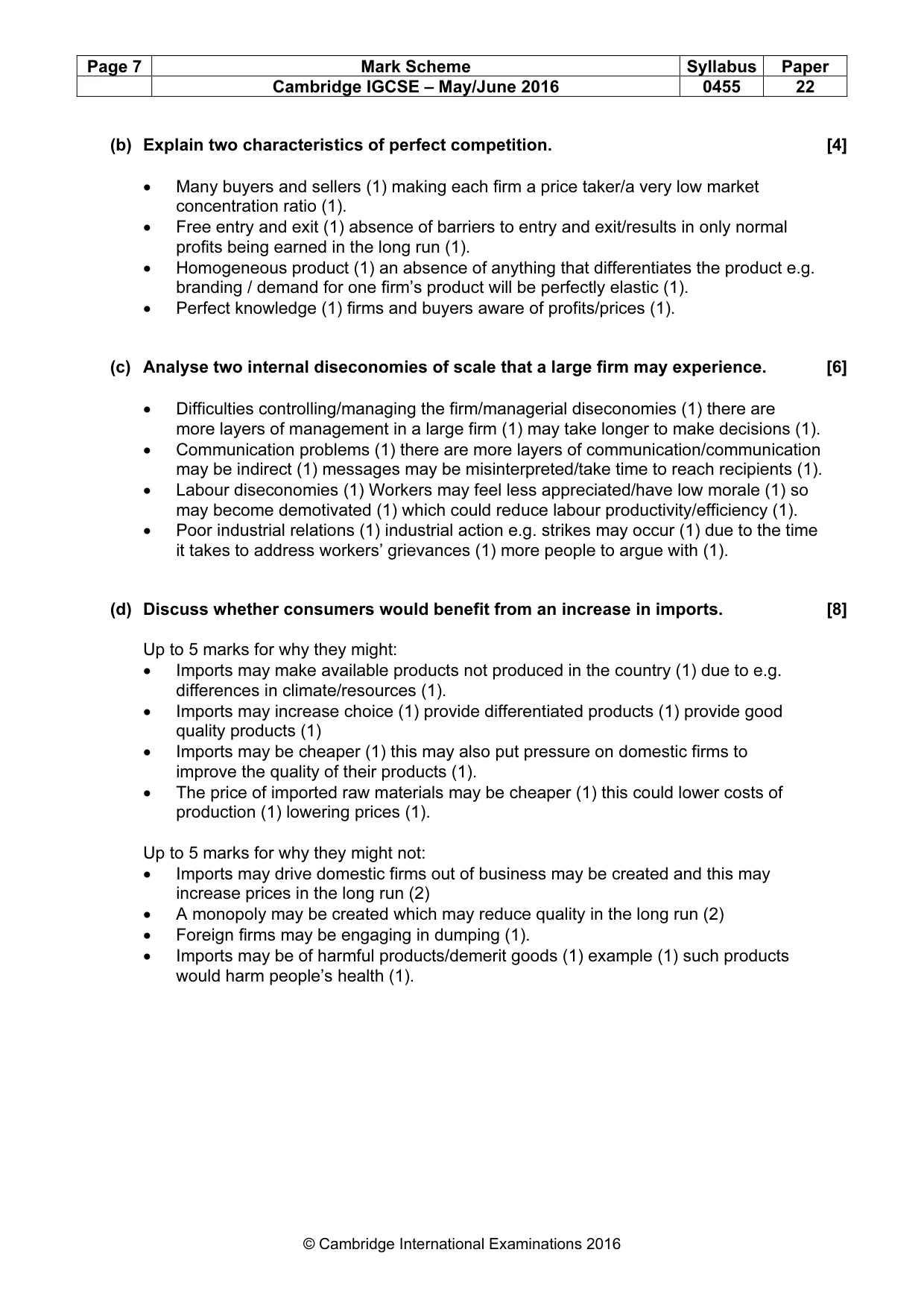
Page 7 Mark Scheme Syllabus Paper Cambridge IGCSE – May/June 2016 0455 22 © Cambridge International Examinations 2016 (b) Explain two characteristics of perfect competition. [4] • Many buyers and sellers (1) making each firm a price taker/a very low market concentration ratio (1). • Free entry and exit (1) absence of barriers to entry and exit/results in only normal profits being earned in the long run (1). • Homogeneous product (1) an absence of anything that differentiates the product e.g. branding / demand for one firm’s product will be perfectly elastic (1). • Perfect knowledge (1) firms and buyers aware of profits/prices (1). (c) Analyse two internal diseconomies of scale that a large firm may experience. [6] • Difficulties controlling/managing the firm/managerial diseconomies (1) there are more layers of management in a large firm (1) may take longer to make decisions (1). • Communication problems (1) there are more layers of communication/communication may be indirect (1) messages may be misinterpreted/take time to reach recipients (1). • Labour diseconomies (1) Workers may feel less appreciated/have low morale (1) so may become demotivated (1) which could reduce labour productivity/efficiency (1). • Poor industrial relations (1) industrial action e.g. strikes may occur (1) due to the time it takes to address workers’ grievances (1) more people to argue with (1). (d) Discuss whether consumers would benefit from an increase in imports. [8] Up to 5 marks for why they might: • Imports may make available products not produced in the country (1) due to e.g. differences in climate/resources (1). • Imports may increase choice (1) provide differentiated products (1) provide good quality products (1) • Imports may be cheaper (1) this may also put pressure on domestic firms to improve the quality of their products (1). • The price of imported raw materials may be cheaper (1) this could lower costs of production (1) lowering prices (1). Up to 5 marks for why they might not: • Imports may drive domestic firms out of business may be created and this may increase prices in the long run (2) • A monopoly may be created which may reduce quality in the long run (2) • Foreign firms may be engaging in dumping (1). • Imports may be of harmful products/demerit goods (1) example (1) such products would harm people’s health (1).
Mark scheme, page 8
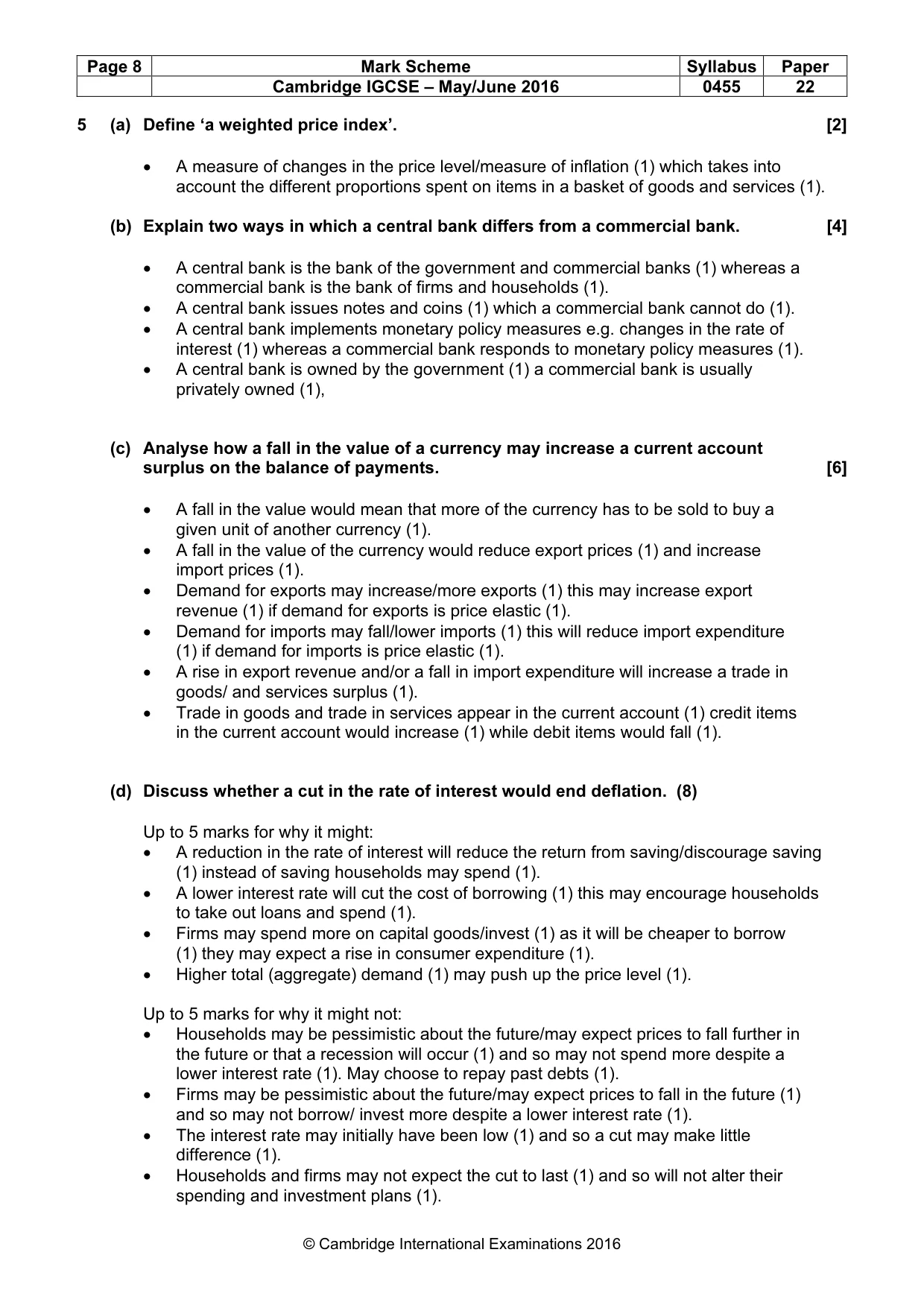
Page 8 Mark Scheme Syllabus Paper Cambridge IGCSE – May/June 2016 0455 22 © Cambridge International Examinations 2016 5 (a) Define ‘a weighted price index’. [2] • A measure of changes in the price level/measure of inflation (1) which takes into account the different proportions spent on items in a basket of goods and services (1). (b) Explain two ways in which a central bank differs from a commercial bank. [4] • A central bank is the bank of the government and commercial banks (1) whereas a commercial bank is the bank of firms and households (1). • A central bank issues notes and coins (1) which a commercial bank cannot do (1). • A central bank implements monetary policy measures e.g. changes in the rate of interest (1) whereas a commercial bank responds to monetary policy measures (1). • A central bank is owned by the government (1) a commercial bank is usually privately owned (1), (c) Analyse how a fall in the value of a currency may increase a current account surplus on the balance of payments. [6] • A fall in the value would mean that more of the currency has to be sold to buy a given unit of another currency (1). • A fall in the value of the currency would reduce export prices (1) and increase import prices (1). • Demand for exports may increase/more exports (1) this may increase export revenue (1) if demand for exports is price elastic (1). • Demand for imports may fall/lower imports (1) this will reduce import expenditure (1) if demand for imports is price elastic (1). • A rise in export revenue and/or a fall in import expenditure will increase a trade in goods/ and services surplus (1). • Trade in goods and trade in services appear in the current account (1) credit items in the current account would increase (1) while debit items would fall (1). (d) Discuss whether a cut in the rate of interest would end deflation. (8) Up to 5 marks for why it might: • A reduction in the rate of interest will reduce the return from saving/discourage saving (1) instead of saving households may spend (1). • A lower interest rate will cut the cost of borrowing (1) this may encourage households to take out loans and spend (1). • Firms may spend more on capital goods/invest (1) as it will be cheaper to borrow (1) they may expect a rise in consumer expenditure (1). • Higher total (aggregate) demand (1) may push up the price level (1). Up to 5 marks for why it might not: • Households may be pessimistic about the future/may expect prices to fall further in the future or that a recession will occur (1) and so may not spend more despite a lower interest rate (1). May choose to repay past debts (1). • Firms may be pessimistic about the future/may expect prices to fall in the future (1) and so may not borrow/ invest more despite a lower interest rate (1). • The interest rate may initially have been low (1) and so a cut may make little difference (1). • Households and firms may not expect the cut to last (1) and so will not alter their spending and investment plans (1).
Mark scheme, page 9
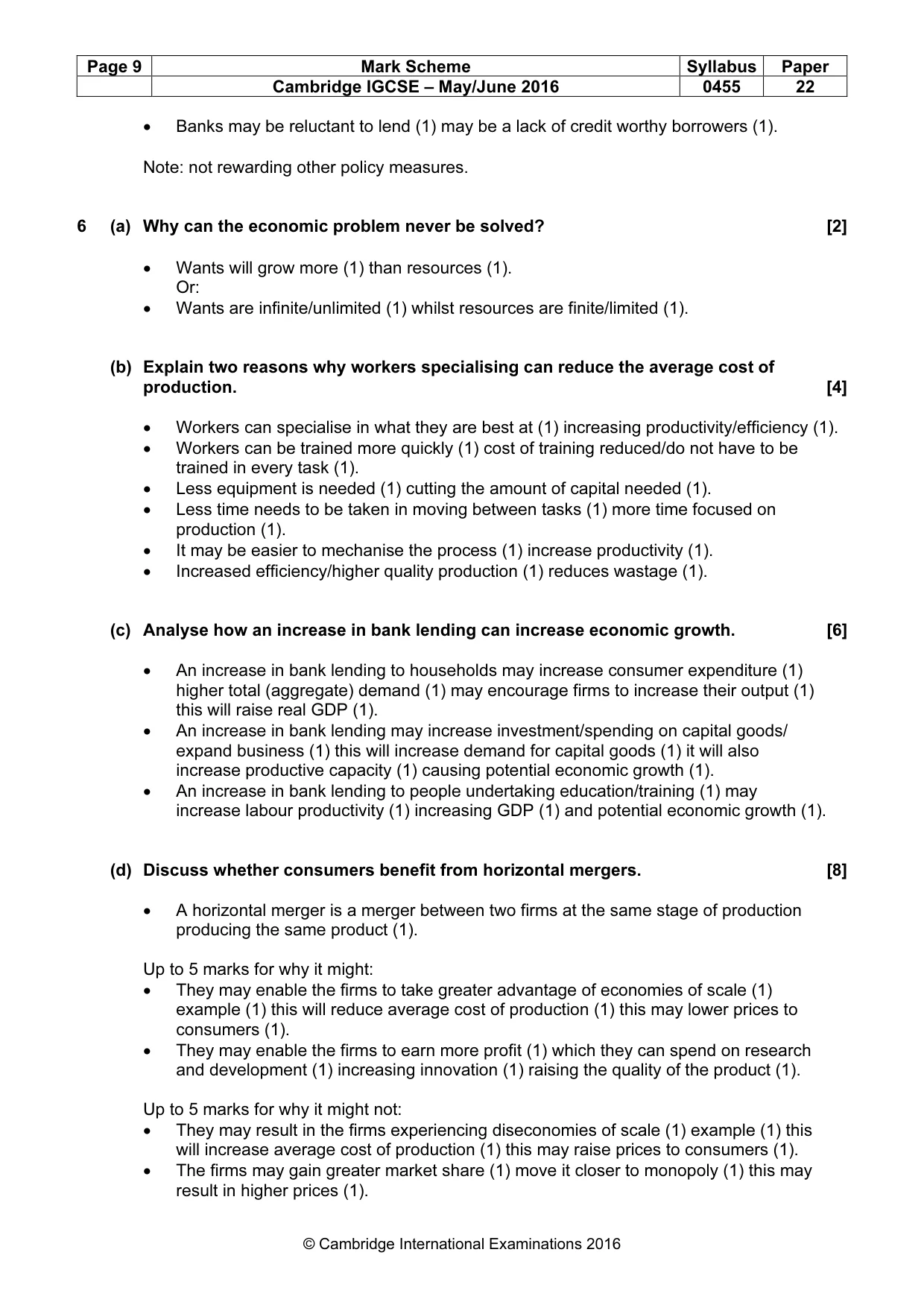
Page 9 Mark Scheme Syllabus Paper Cambridge IGCSE – May/June 2016 0455 22 © Cambridge International Examinations 2016 • Banks may be reluctant to lend (1) may be a lack of credit worthy borrowers (1). Note: not rewarding other policy measures. 6 (a) Why can the economic problem never be solved? [2] • Wants will grow more (1) than resources (1). Or: • Wants are infinite/unlimited (1) whilst resources are finite/limited (1). (b) Explain two reasons why workers specialising can reduce the average cost of production. [4] • Workers can specialise in what they are best at (1) increasing productivity/efficiency (1). • Workers can be trained more quickly (1) cost of training reduced/do not have to be trained in every task (1). • Less equipment is needed (1) cutting the amount of capital needed (1). • Less time needs to be taken in moving between tasks (1) more time focused on production (1). • It may be easier to mechanise the process (1) increase productivity (1). • Increased efficiency/higher quality production (1) reduces wastage (1). (c) Analyse how an increase in bank lending can increase economic growth. [6] • An increase in bank lending to households may increase consumer expenditure (1) higher total (aggregate) demand (1) may encourage firms to increase their output (1) this will raise real GDP (1). • An increase in bank lending may increase investment/spending on capital goods/ expand business (1) this will increase demand for capital goods (1) it will also increase productive capacity (1) causing potential economic growth (1). • An increase in bank lending to people undertaking education/training (1) may increase labour productivity (1) increasing GDP (1) and potential economic growth (1). (d) Discuss whether consumers benefit from horizontal mergers. [8] • A horizontal merger is a merger between two firms at the same stage of production producing the same product (1). Up to 5 marks for why it might: • They may enable the firms to take greater advantage of economies of scale (1) example (1) this will reduce average cost of production (1) this may lower prices to consumers (1). • They may enable the firms to earn more profit (1) which they can spend on research and development (1) increasing innovation (1) raising the quality of the product (1). Up to 5 marks for why it might not: • They may result in the firms experiencing diseconomies of scale (1) example (1) this will increase average cost of production (1) this may raise prices to consumers (1). • The firms may gain greater market share (1) move it closer to monopoly (1) this may result in higher prices (1).
Mark scheme, page 10
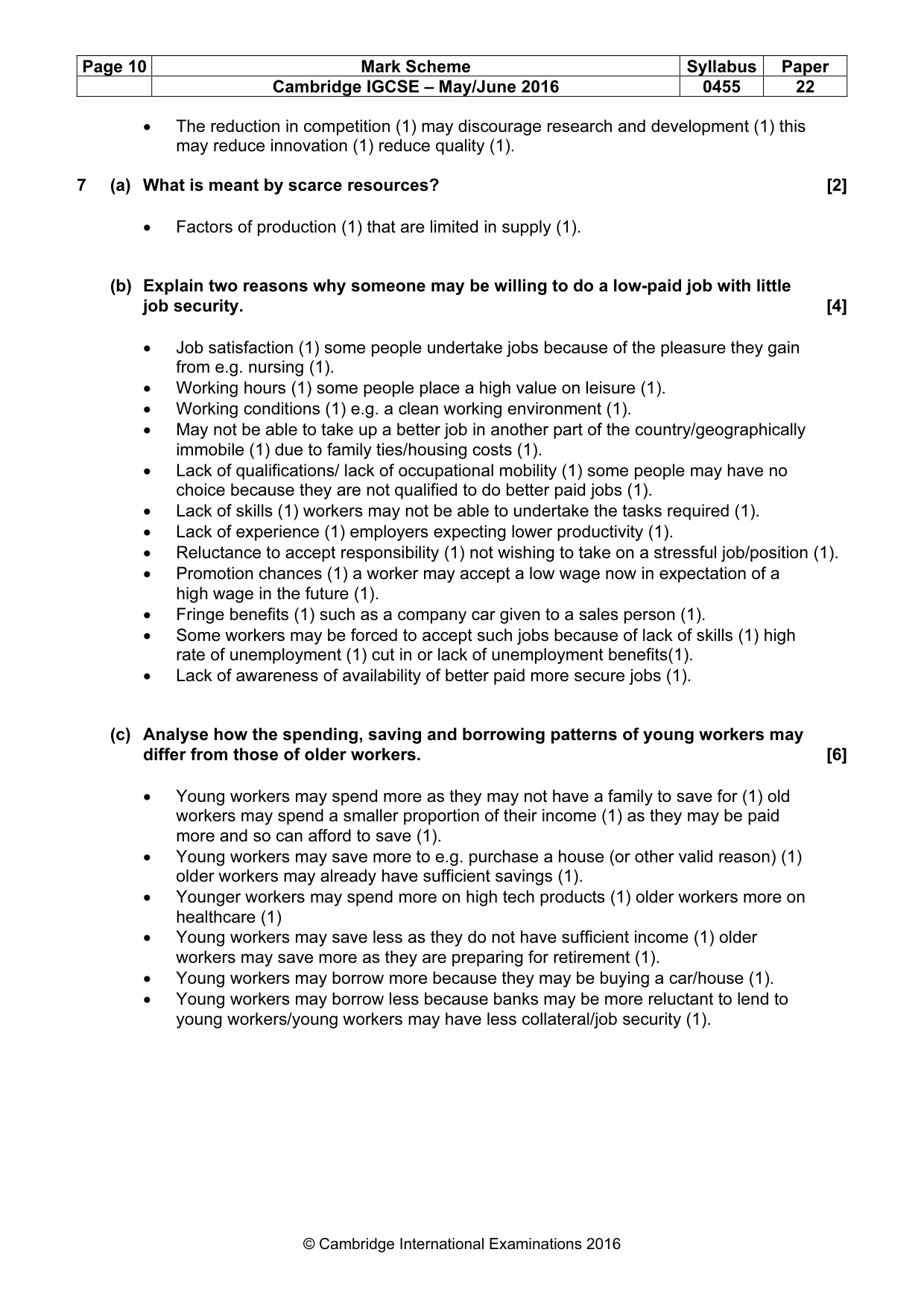
Page 10 Mark Scheme Syllabus Paper Cambridge IGCSE – May/June 2016 0455 22 © Cambridge International Examinations 2016 • The reduction in competition (1) may discourage research and development (1) this may reduce innovation (1) reduce quality (1). 7 (a) What is meant by scarce resources? [2] • Factors of production (1) that are limited in supply (1). (b) Explain two reasons why someone may be willing to do a low-paid job with little job security. [4] • Job satisfaction (1) some people undertake jobs because of the pleasure they gain from e.g. nursing (1). • Working hours (1) some people place a high value on leisure (1). • Working conditions (1) e.g. a clean working environment (1). • May not be able to take up a better job in another part of the country/geographically immobile (1) due to family ties/housing costs (1). • Lack of qualifications/ lack of occupational mobility (1) some people may have no choice because they are not qualified to do better paid jobs (1). • Lack of skills (1) workers may not be able to undertake the tasks required (1). • Lack of experience (1) employers expecting lower productivity (1). • Reluctance to accept responsibility (1) not wishing to take on a stressful job/position (1). • Promotion chances (1) a worker may accept a low wage now in expectation of a high wage in the future (1). • Fringe benefits (1) such as a company car given to a sales person (1). • Some workers may be forced to accept such jobs because of lack of skills (1) high rate of unemployment (1) cut in or lack of unemployment benefits(1). • Lack of awareness of availability of better paid more secure jobs (1). (c) Analyse how the spending, saving and borrowing patterns of young workers may differ from those of older workers. [6] • Young workers may spend more as they may not have a family to save for (1) old workers may spend a smaller proportion of their income (1) as they may be paid more and so can afford to save (1). • Young workers may save more to e.g. purchase a house (or other valid reason) (1) older workers may already have sufficient savings (1). • Younger workers may spend more on high tech products (1) older workers more on healthcare (1) • Young workers may save less as they do not have sufficient income (1) older workers may save more as they are preparing for retirement (1). • Young workers may borrow more because they may be buying a car/house (1). • Young workers may borrow less because banks may be more reluctant to lend to young workers/young workers may have less collateral/job security (1).
Mark scheme, page 11
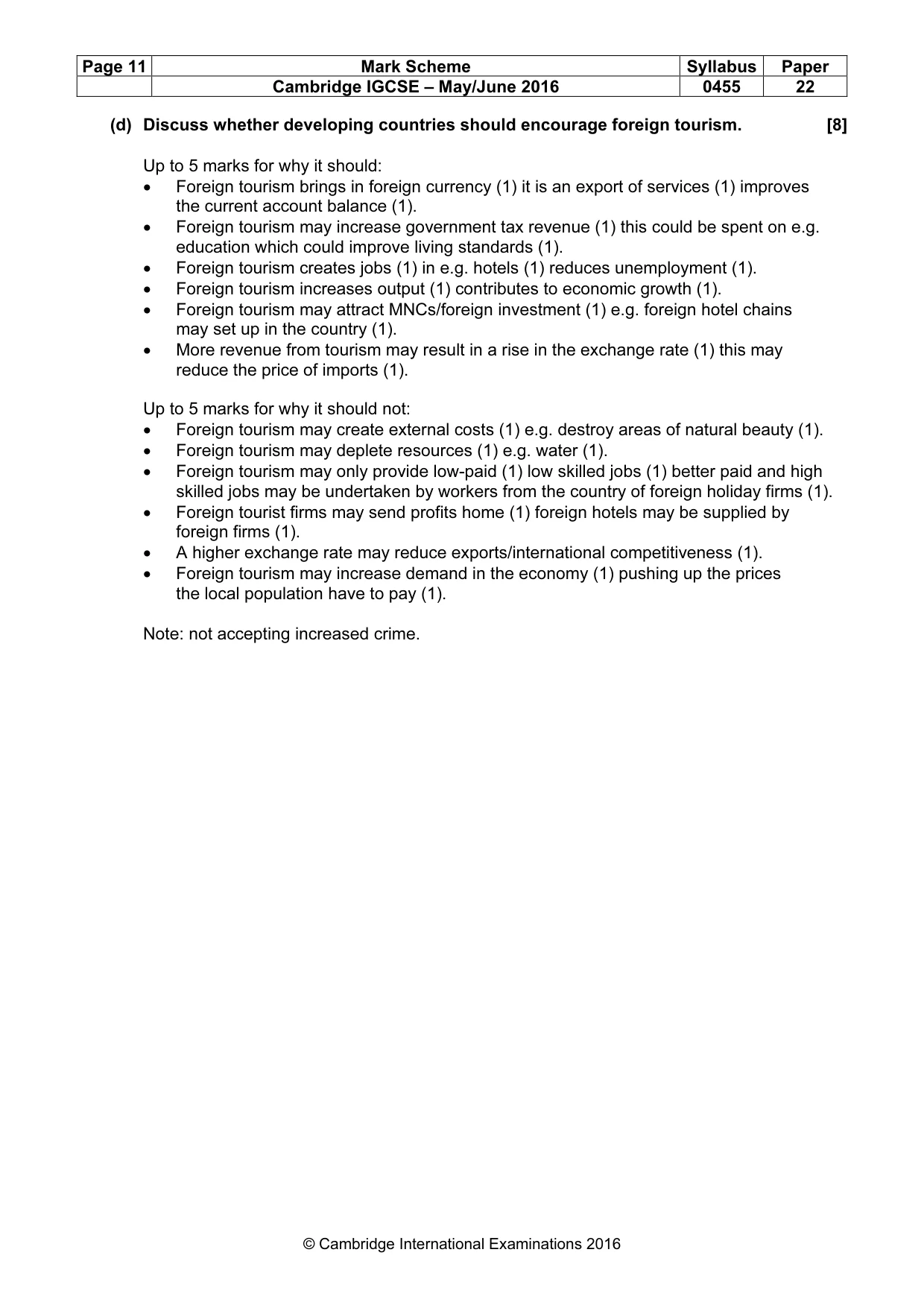
Page 11 Mark Scheme Syllabus Paper Cambridge IGCSE – May/June 2016 0455 22 © Cambridge International Examinations 2016 (d) Discuss whether developing countries should encourage foreign tourism. [8] Up to 5 marks for why it should: • Foreign tourism brings in foreign currency (1) it is an export of services (1) improves the current account balance (1). • Foreign tourism may increase government tax revenue (1) this could be spent on e.g. education which could improve living standards (1). • Foreign tourism creates jobs (1) in e.g. hotels (1) reduces unemployment (1). • Foreign tourism increases output (1) contributes to economic growth (1). • Foreign tourism may attract MNCs/foreign investment (1) e.g. foreign hotel chains may set up in the country (1). • More revenue from tourism may result in a rise in the exchange rate (1) this may reduce the price of imports (1). Up to 5 marks for why it should not: • Foreign tourism may create external costs (1) e.g. destroy areas of natural beauty (1). • Foreign tourism may deplete resources (1) e.g. water (1). • Foreign tourism may only provide low-paid (1) low skilled jobs (1) better paid and high skilled jobs may be undertaken by workers from the country of foreign holiday firms (1). • Foreign tourist firms may send profits home (1) foreign hotels may be supplied by foreign firms (1). • A higher exchange rate may reduce exports/international competitiveness (1). • Foreign tourism may increase demand in the economy (1) pushing up the prices the local population have to pay (1). Note: not accepting increased crime.
What you needed in this session
Cambridge’s own grade thresholds for 2016 May/June, Paper 2 · Variant 2. A higher threshold means an easier paper — the bar moves with how the cohort did.