Cambridge IGCSE Economics 0455 — 2012 Oct/Nov Paper 2 · Variant 3
0455/23/O/N/12 · 80 marks · ≈90 min
The question paper and its mark scheme, free to read here and free to download. This is Cambridge’s own paper, exactly as it was sat.
Question paper4 pages
Mark scheme10 pages
Answers below. Sit the paper first if you are practising.
Paper as text
Question paper, page 1
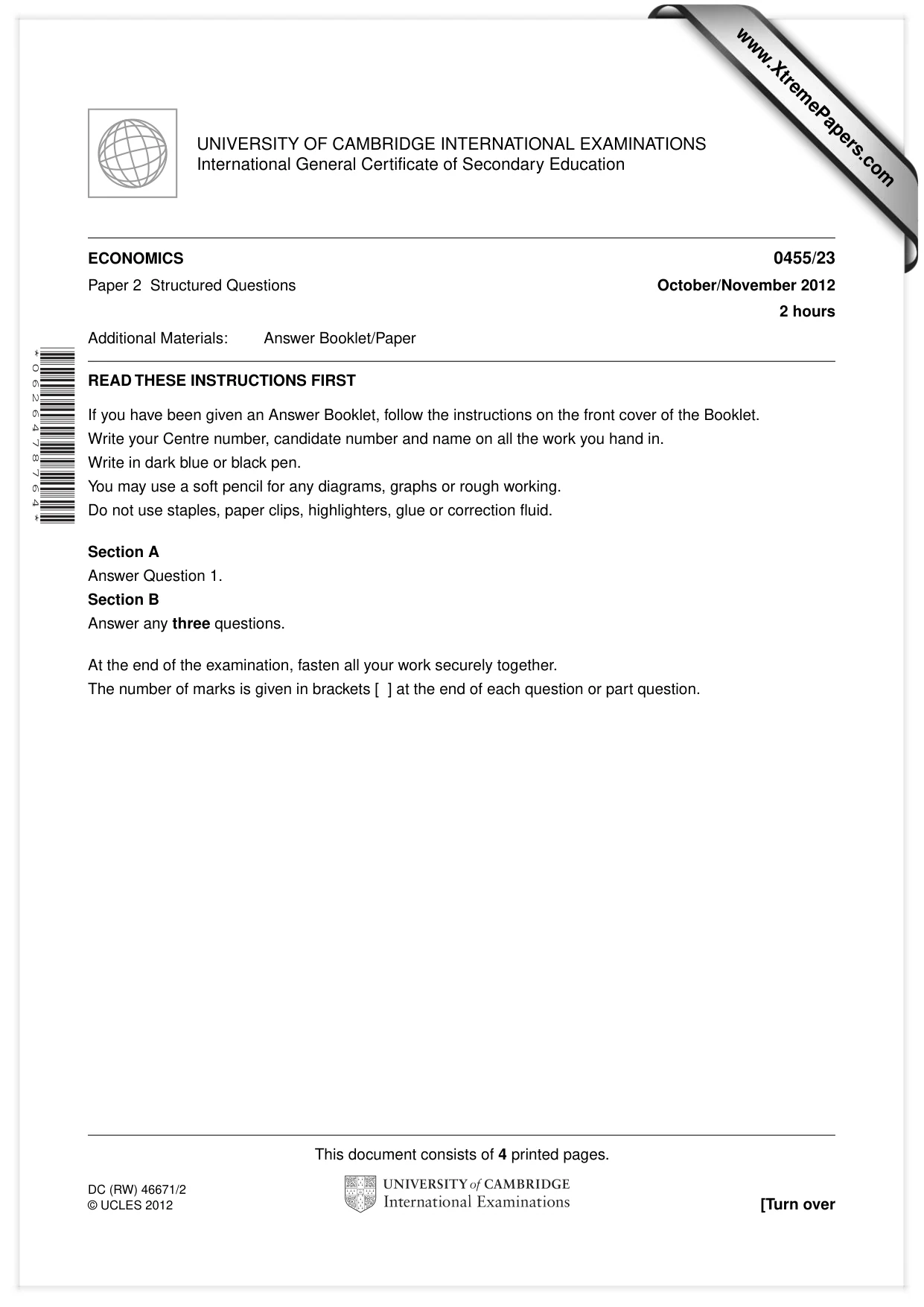
This document consists of 4 printed pages. DC (RW) 46671/2 © UCLES 2012 [Turn over UNIVERSITY OF CAMBRIDGE INTERNATIONAL EXAMINATIONS International General Certificate of Secondary Education * 0 6 2 6 4 7 8 7 6 4 * ECONOMICS 0455/23 Paper 2 Structured Questions October/November 2012 2 hours Additional Materials: Answer Booklet/Paper READ THESE INSTRUCTIONS FIRST If you have been given an Answer Booklet, follow the instructions on the front cover of the Booklet. Write your Centre number, candidate number and name on all the work you hand in. Write in dark blue or black pen. You may use a soft pencil for any diagrams, graphs or rough working. Do not use staples, paper clips, highlighters, glue or correction fluid. Section A Answer Question 1. Section B Answer any three questions. At the end of the examination, fasten all your work securely together. The number of marks is given in brackets [ ] at the end of each question or part question. www.XtremePapers.com
Question paper, page 2
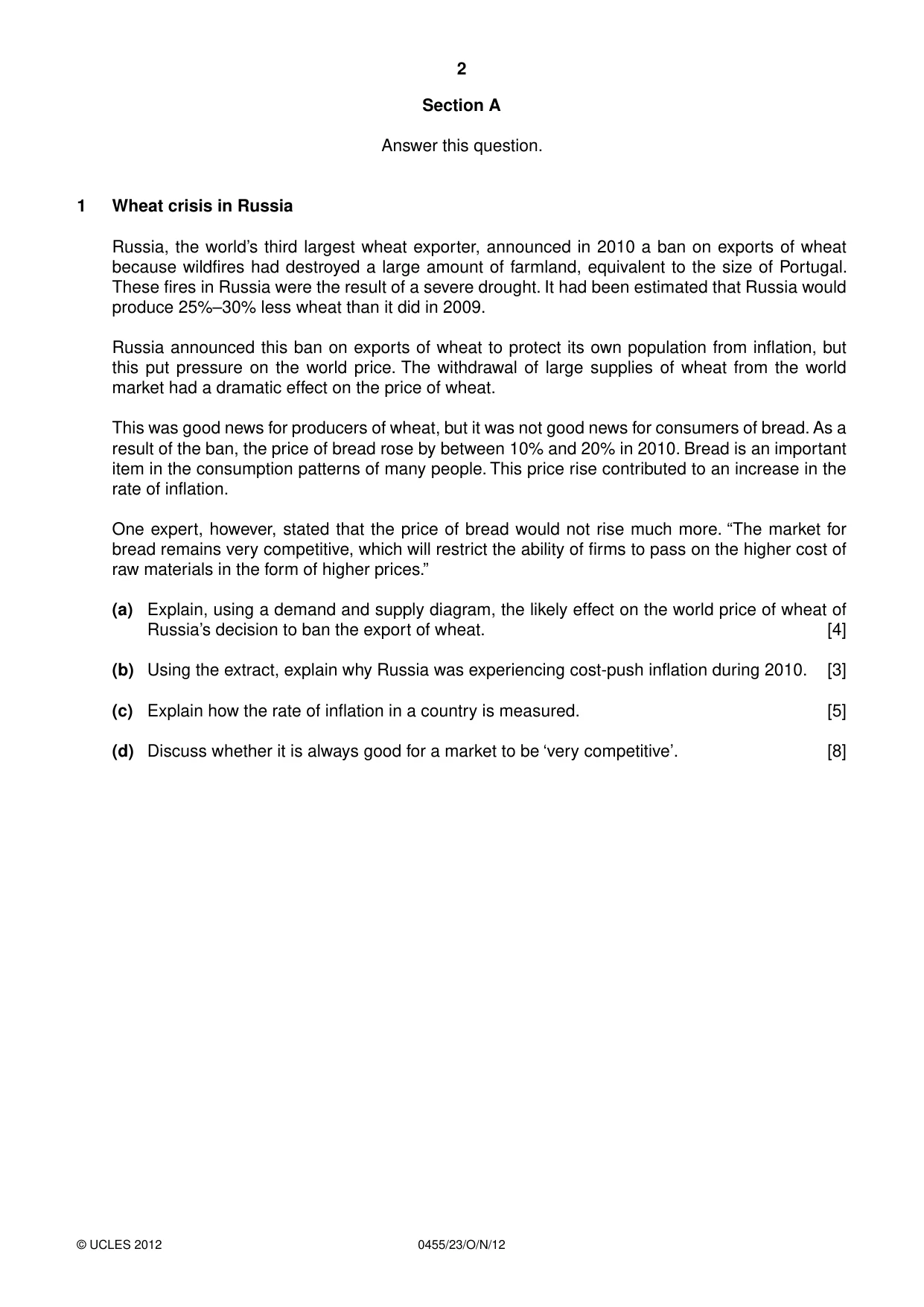
2 0455/23/O/N/12 © UCLES 2012 Section A Answer this question. 1 Wheat crisis in Russia Russia, the world’s third largest wheat exporter, announced in 2010 a ban on exports of wheat because wildfires had destroyed a large amount of farmland, equivalent to the size of Portugal. These fires in Russia were the result of a severe drought. It had been estimated that Russia would produce 25%–30% less wheat than it did in 2009. Russia announced this ban on exports of wheat to protect its own population from inflation, but this put pressure on the world price. The withdrawal of large supplies of wheat from the world market had a dramatic effect on the price of wheat. This was good news for producers of wheat, but it was not good news for consumers of bread. As a result of the ban, the price of bread rose by between 10% and 20% in 2010. Bread is an important item in the consumption patterns of many people. This price rise contributed to an increase in the rate of inflation. One expert, however, stated that the price of bread would not rise much more. “The market for bread remains very competitive, which will restrict the ability of firms to pass on the higher cost of raw materials in the form of higher prices.” (a) Explain, using a demand and supply diagram, the likely effect on the world price of wheat of Russia’s decision to ban the export of wheat. [4] (b) Using the extract, explain why Russia was experiencing cost-push inflation during 2010. [3] (c) Explain how the rate of inflation in a country is measured. [5] (d) Discuss whether it is always good for a market to be ‘very competitive’. [8]
Question paper, page 3
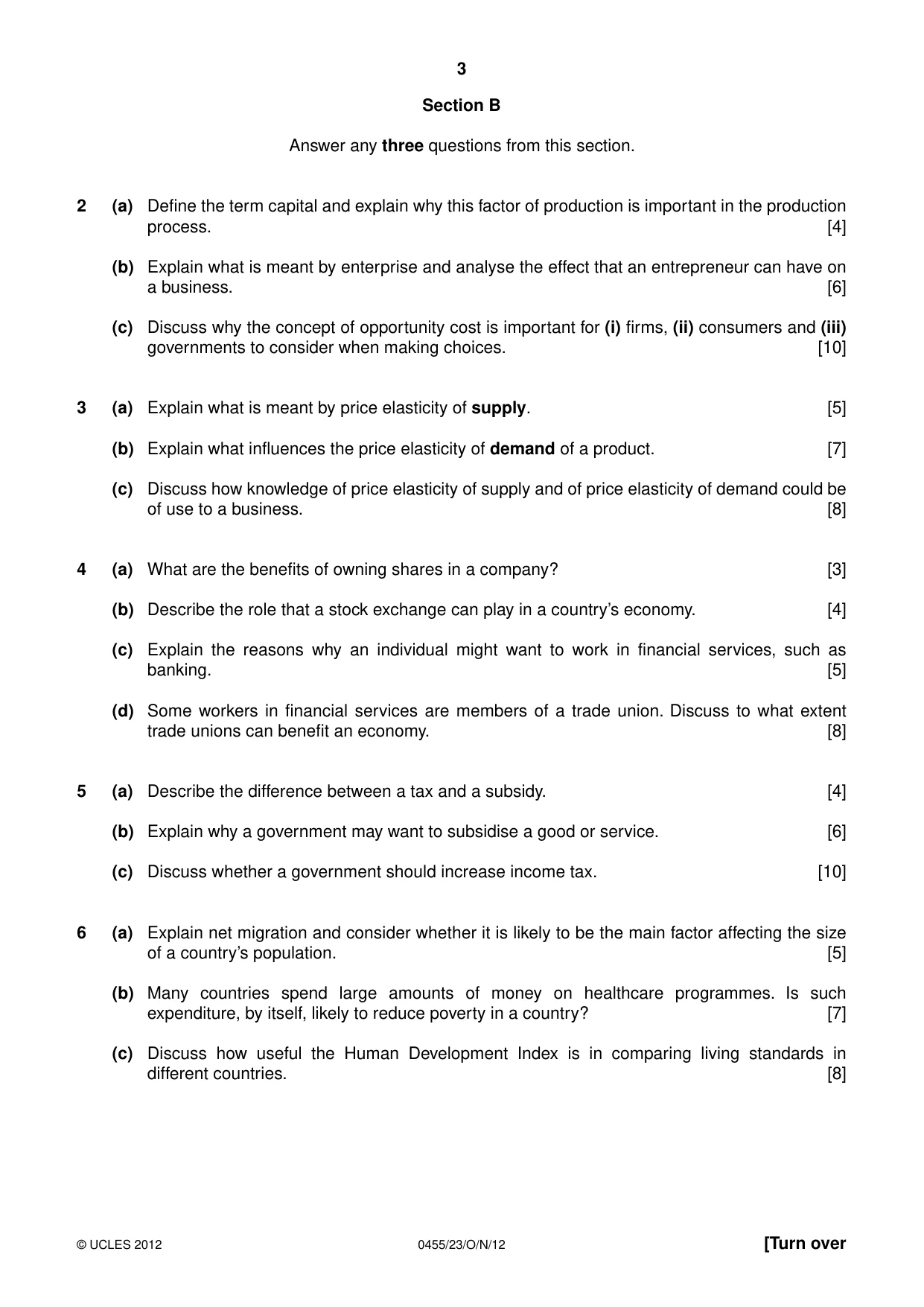
3 0455/23/O/N/12 © UCLES 2012 [Turn over Section B Answer any three questions from this section. 2 (a) Define the term capital and explain why this factor of production is important in the production process. [4] (b) Explain what is meant by enterprise and analyse the effect that an entrepreneur can have on a business. [6] (c) Discuss why the concept of opportunity cost is important for (i) firms, (ii) consumers and (iii) governments to consider when making choices. [10] 3 (a) Explain what is meant by price elasticity of supply. [5] (b) Explain what influences the price elasticity of demand of a product. [7] (c) Discuss how knowledge of price elasticity of supply and of price elasticity of demand could be of use to a business. [8] 4 (a) What are the benefits of owning shares in a company? [3] (b) Describe the role that a stock exchange can play in a country’s economy. [4] (c) Explain the reasons why an individual might want to work in financial services, such as banking. [5] (d) Some workers in financial services are members of a trade union. Discuss to what extent trade unions can benefit an economy. [8] 5 (a) Describe the difference between a tax and a subsidy. [4] (b) Explain why a government may want to subsidise a good or service. [6] (c) Discuss whether a government should increase income tax. [10] 6 (a) Explain net migration and consider whether it is likely to be the main factor affecting the size of a country’s population. [5] (b) Many countries spend large amounts of money on healthcare programmes. Is such expenditure, by itself, likely to reduce poverty in a country? [7] (c) Discuss how useful the Human Development Index is in comparing living standards in different countries. [8]
Question paper, page 4
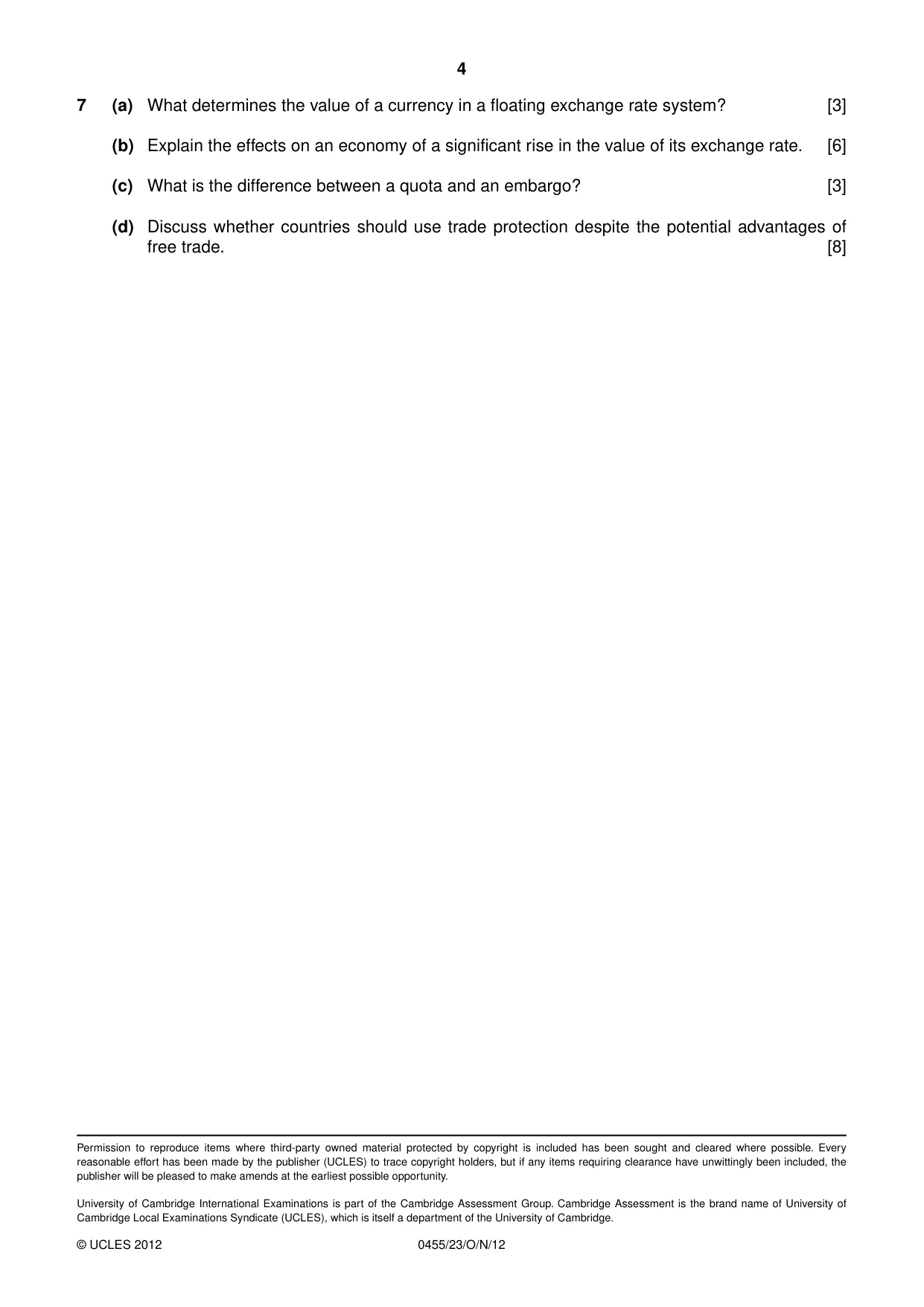
4 0455/23/O/N/12 © UCLES 2012 Permission to reproduce items where third-party owned material protected by copyright is included has been sought and cleared where possible. Every reasonable effort has been made by the publisher (UCLES) to trace copyright holders, but if any items requiring clearance have unwittingly been included, the publisher will be pleased to make amends at the earliest possible opportunity. University of Cambridge International Examinations is part of the Cambridge Assessment Group. Cambridge Assessment is the brand name of University of Cambridge Local Examinations Syndicate (UCLES), which is itself a department of the University of Cambridge. 7 (a) What determines the value of a currency in a floating exchange rate system? [3] (b) Explain the effects on an economy of a significant rise in the value of its exchange rate. [6] (c) What is the difference between a quota and an embargo? [3] (d) Discuss whether countries should use trade protection despite the potential advantages of free trade. [8]
Mark scheme, page 1
CAMBRIDGE INTERNATIONAL EXAMINATIONS International General Certificate of Secondary Education MARK SCHEME for the October/November 2012 series 0455 ECONOMICS 0455/23 Paper 2 (Structured Questions), maximum raw mark 80 This mark scheme is published as an aid to teachers and candidates, to indicate the requirements of the examination. It shows the basis on which Examiners were instructed to award marks. It does not indicate the details of the discussions that took place at an Examiners’ meeting before marking began, which would have considered the acceptability of alternative answers. Mark schemes should be read in conjunction with the question paper and the Principal Examiner Report for Teachers. Cambridge will not enter into discussions about these mark schemes. Cambridge is publishing the mark schemes for the October/November 2012 series for most IGCSE, GCE Advanced Level and Advanced Subsidiary Level components and some Ordinary Level components. www.XtremePapers.com
Mark scheme, page 2
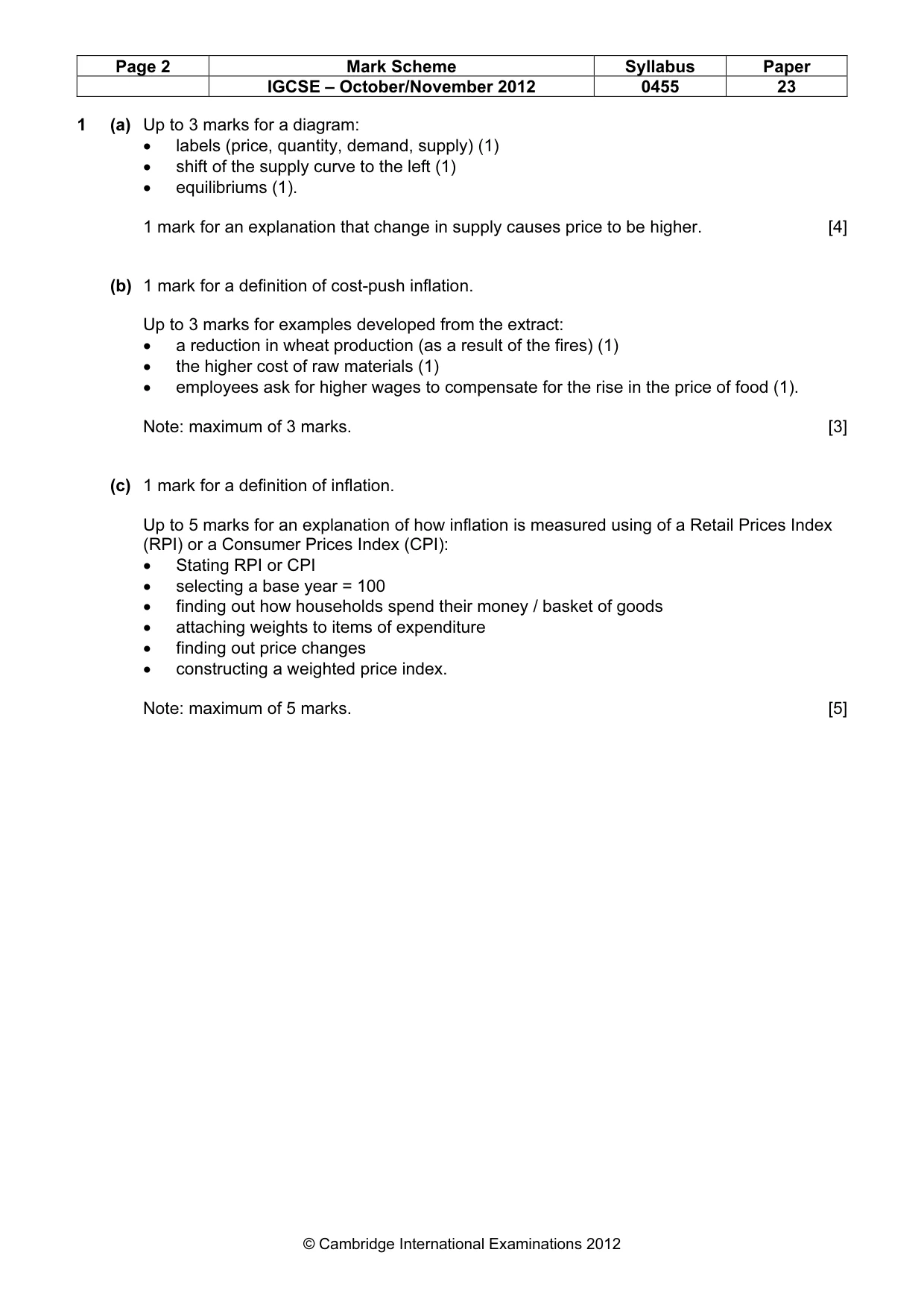
Page 2 Mark Scheme Syllabus Paper IGCSE – October/November 2012 0455 23 © Cambridge International Examinations 2012 1 (a) Up to 3 marks for a diagram: • labels (price, quantity, demand, supply) (1) • shift of the supply curve to the left (1) • equilibriums (1). 1 mark for an explanation that change in supply causes price to be higher. [4] (b) 1 mark for a definition of cost-push inflation. Up to 3 marks for examples developed from the extract: • a reduction in wheat production (as a result of the fires) (1) • the higher cost of raw materials (1) • employees ask for higher wages to compensate for the rise in the price of food (1). Note: maximum of 3 marks. [3] (c) 1 mark for a definition of inflation. Up to 5 marks for an explanation of how inflation is measured using of a Retail Prices Index (RPI) or a Consumer Prices Index (CPI): • Stating RPI or CPI • selecting a base year = 100 • finding out how households spend their money / basket of goods • attaching weights to items of expenditure • finding out price changes • constructing a weighted price index. Note: maximum of 5 marks. [5]
Mark scheme, page 3
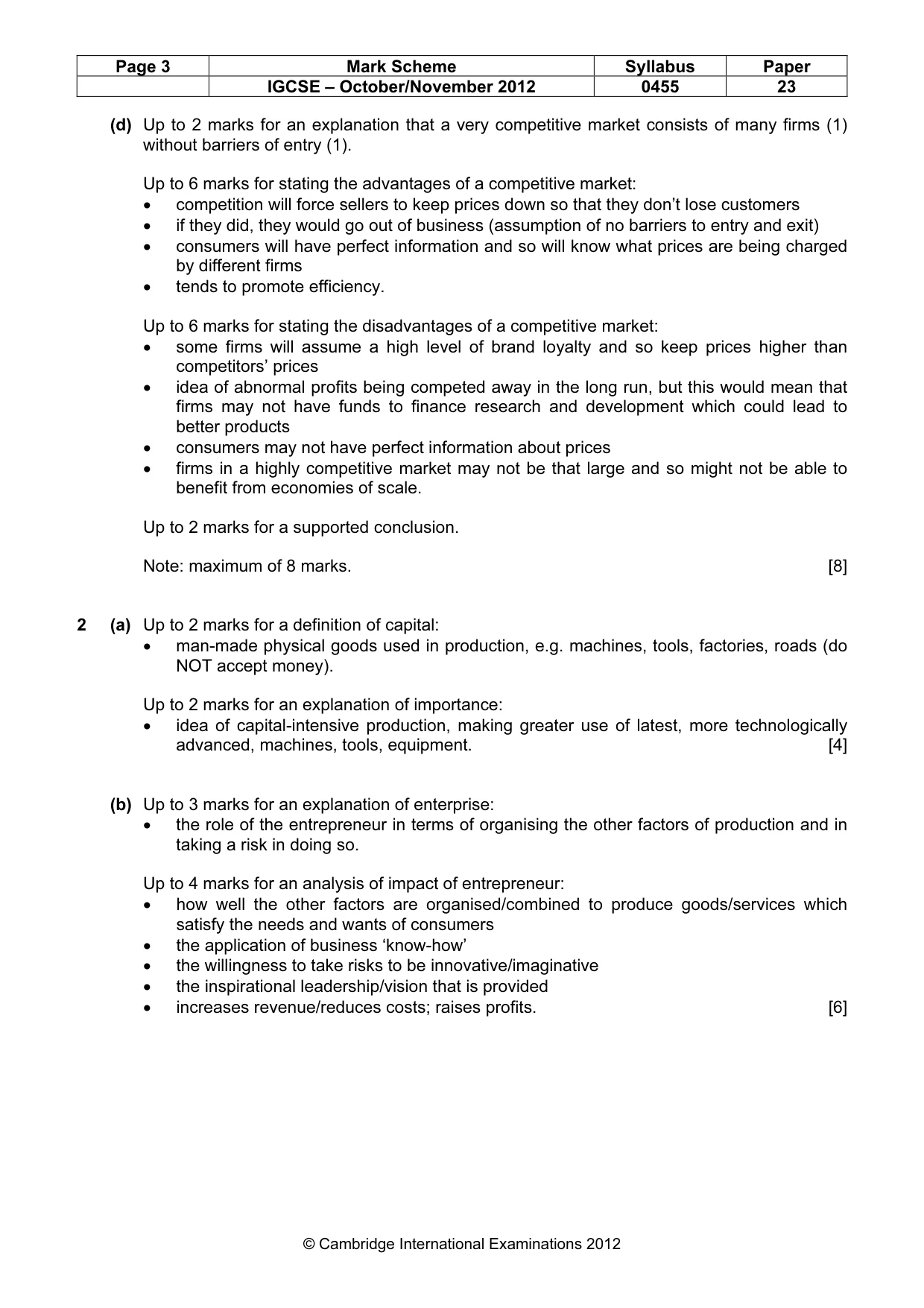
Page 3 Mark Scheme Syllabus Paper IGCSE – October/November 2012 0455 23 © Cambridge International Examinations 2012 (d) Up to 2 marks for an explanation that a very competitive market consists of many firms (1) without barriers of entry (1). Up to 6 marks for stating the advantages of a competitive market: • competition will force sellers to keep prices down so that they don’t lose customers • if they did, they would go out of business (assumption of no barriers to entry and exit) • consumers will have perfect information and so will know what prices are being charged by different firms • tends to promote efficiency. Up to 6 marks for stating the disadvantages of a competitive market: • some firms will assume a high level of brand loyalty and so keep prices higher than competitors’ prices • idea of abnormal profits being competed away in the long run, but this would mean that firms may not have funds to finance research and development which could lead to better products • consumers may not have perfect information about prices • firms in a highly competitive market may not be that large and so might not be able to benefit from economies of scale. Up to 2 marks for a supported conclusion. Note: maximum of 8 marks. [8] 2 (a) Up to 2 marks for a definition of capital: • man-made physical goods used in production, e.g. machines, tools, factories, roads (do NOT accept money). Up to 2 marks for an explanation of importance: • idea of capital-intensive production, making greater use of latest, more technologically advanced, machines, tools, equipment. [4] (b) Up to 3 marks for an explanation of enterprise: • the role of the entrepreneur in terms of organising the other factors of production and in taking a risk in doing so. Up to 4 marks for an analysis of impact of entrepreneur: • how well the other factors are organised/combined to produce goods/services which satisfy the needs and wants of consumers • the application of business ‘know-how’ • the willingness to take risks to be innovative/imaginative • the inspirational leadership/vision that is provided • increases revenue/reduces costs; raises profits. [6]
Mark scheme, page 4
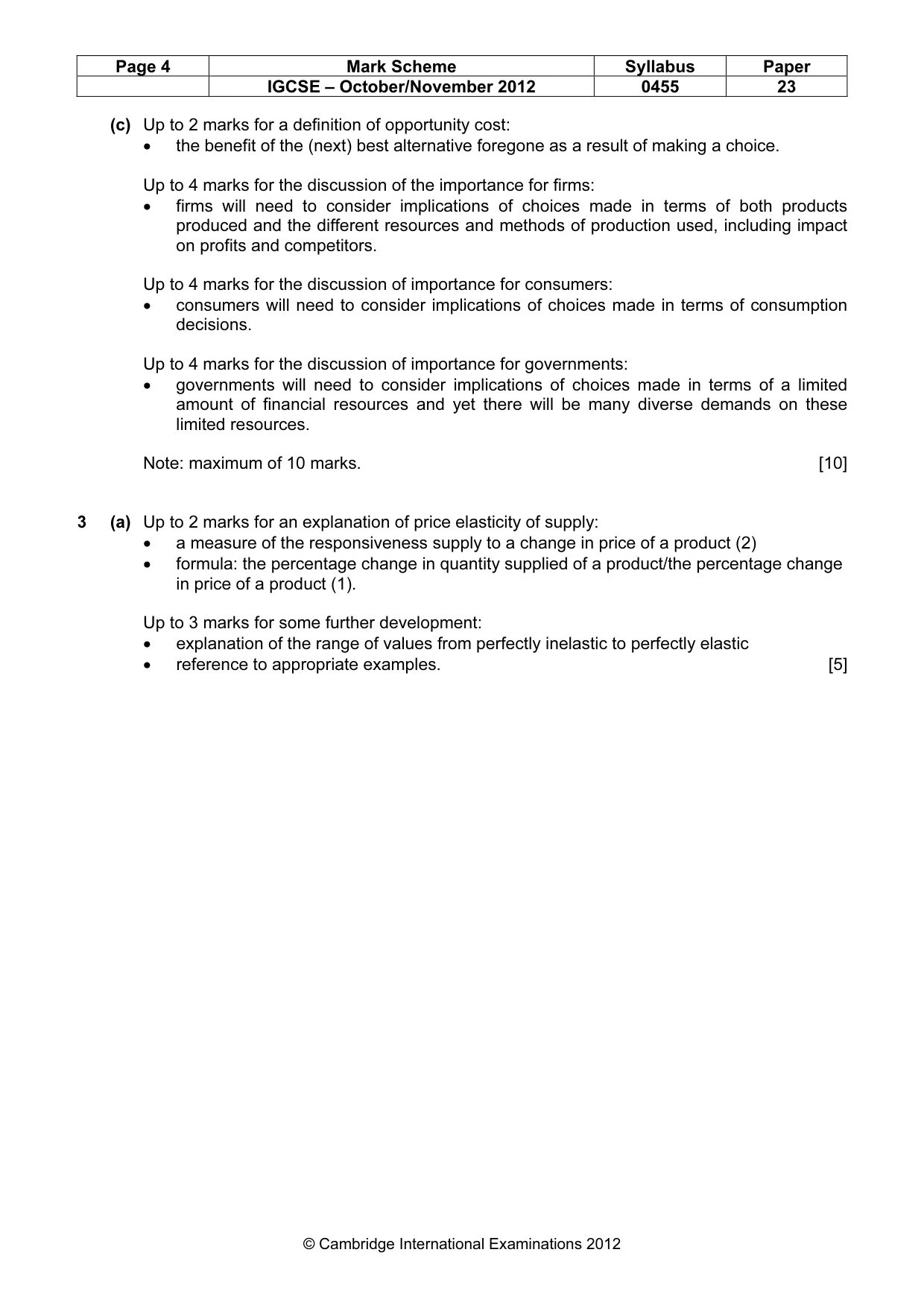
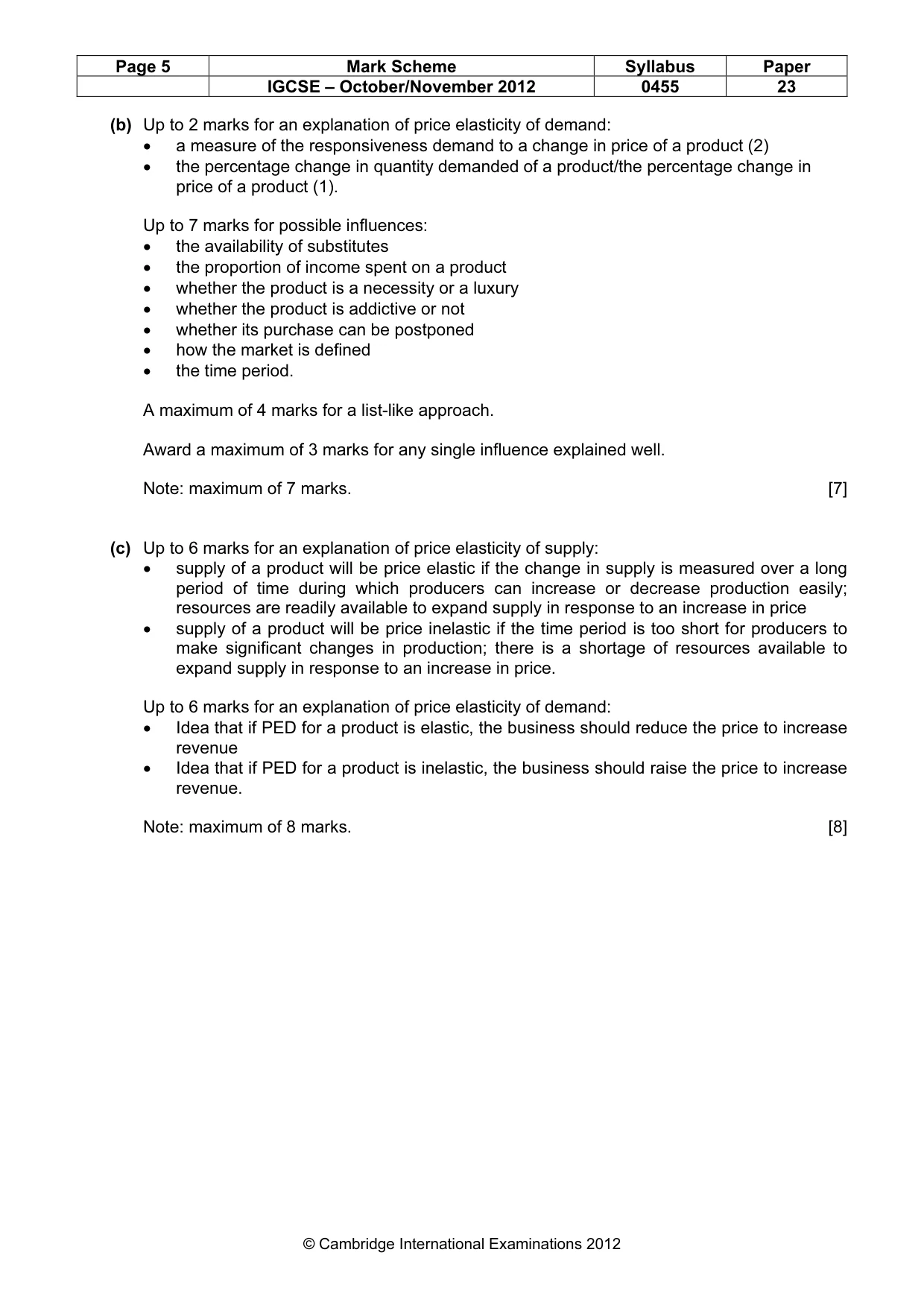
Page 4 Mark Scheme Syllabus Paper IGCSE – October/November 2012 0455 23 © Cambridge International Examinations 2012 (c) Up to 2 marks for a definition of opportunity cost: • the benefit of the (next) best alternative foregone as a result of making a choice. Up to 4 marks for the discussion of the importance for firms: • firms will need to consider implications of choices made in terms of both products produced and the different resources and methods of production used, including impact on profits and competitors. Up to 4 marks for the discussion of importance for consumers: • consumers will need to consider implications of choices made in terms of consumption decisions. Up to 4 marks for the discussion of importance for governments: • governments will need to consider implications of choices made in terms of a limited amount of financial resources and yet there will be many diverse demands on these limited resources. Note: maximum of 10 marks. [10] 3 (a) Up to 2 marks for an explanation of price elasticity of supply: • a measure of the responsiveness supply to a change in price of a product (2) • formula: the percentage change in quantity supplied of a product/the percentage change in price of a product (1). Up to 3 marks for some further development: • explanation of the range of values from perfectly inelastic to perfectly elastic • reference to appropriate examples. [5]
Mark scheme, page 5
Page 5 Mark Scheme Syllabus Paper IGCSE – October/November 2012 0455 23 © Cambridge International Examinations 2012 (b) Up to 2 marks for an explanation of price elasticity of demand: • a measure of the responsiveness demand to a change in price of a product (2) • the percentage change in quantity demanded of a product/the percentage change in price of a product (1). Up to 7 marks for possible influences: • the availability of substitutes • the proportion of income spent on a product • whether the product is a necessity or a luxury • whether the product is addictive or not • whether its purchase can be postponed • how the market is defined • the time period. A maximum of 4 marks for a list-like approach. Award a maximum of 3 marks for any single influence explained well. Note: maximum of 7 marks. [7] (c) Up to 6 marks for an explanation of price elasticity of supply: • supply of a product will be price elastic if the change in supply is measured over a long period of time during which producers can increase or decrease production easily; resources are readily available to expand supply in response to an increase in price • supply of a product will be price inelastic if the time period is too short for producers to make significant changes in production; there is a shortage of resources available to expand supply in response to an increase in price. Up to 6 marks for an explanation of price elasticity of demand: • Idea that if PED for a product is elastic, the business should reduce the price to increase revenue • Idea that if PED for a product is inelastic, the business should raise the price to increase revenue. Note: maximum of 8 marks. [8]
Mark scheme, page 6
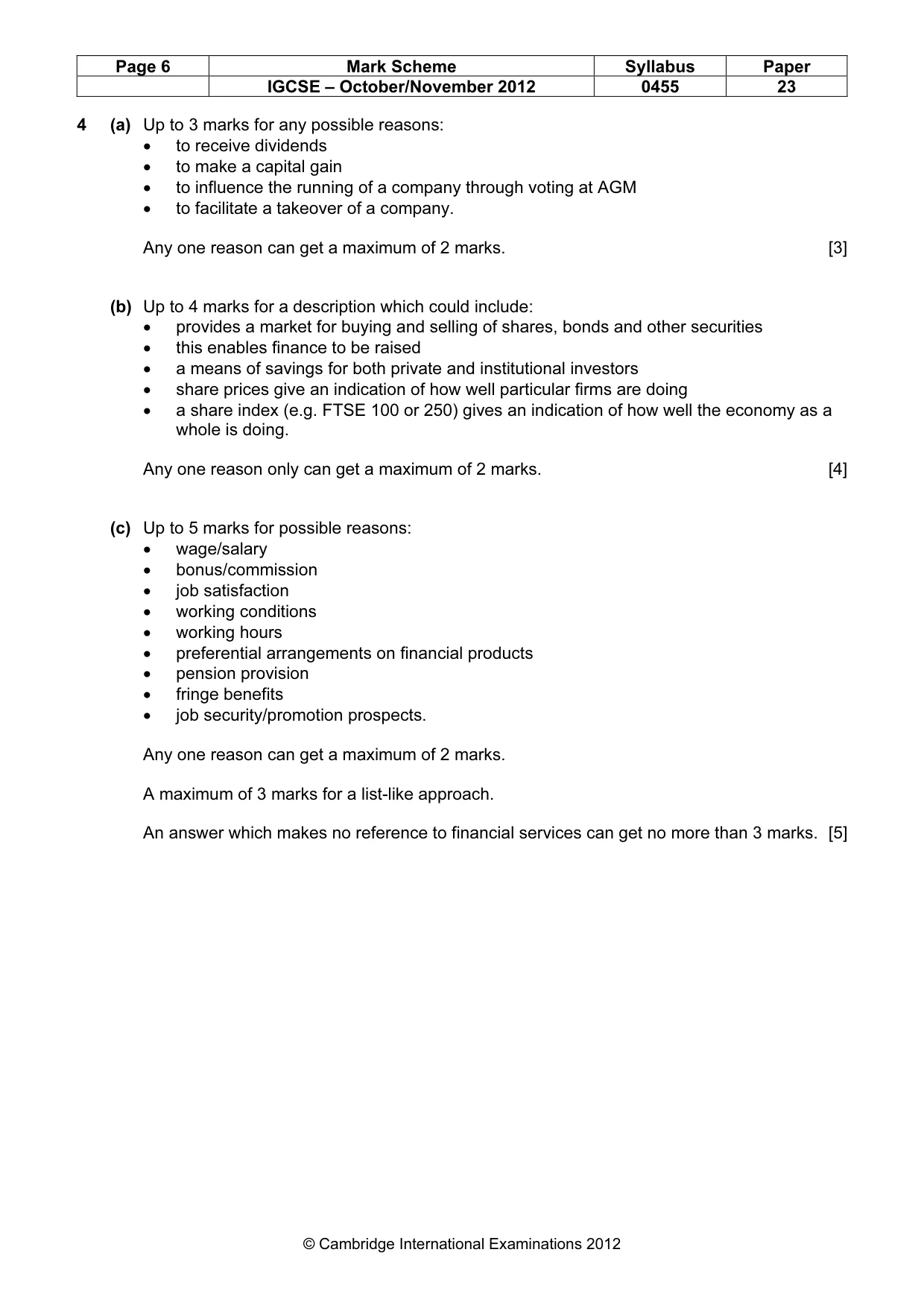
Page 6 Mark Scheme Syllabus Paper IGCSE – October/November 2012 0455 23 © Cambridge International Examinations 2012 4 (a) Up to 3 marks for any possible reasons: • to receive dividends • to make a capital gain • to influence the running of a company through voting at AGM • to facilitate a takeover of a company. Any one reason can get a maximum of 2 marks. [3] (b) Up to 4 marks for a description which could include: • provides a market for buying and selling of shares, bonds and other securities • this enables finance to be raised • a means of savings for both private and institutional investors • share prices give an indication of how well particular firms are doing • a share index (e.g. FTSE 100 or 250) gives an indication of how well the economy as a whole is doing. Any one reason only can get a maximum of 2 marks. [4] (c) Up to 5 marks for possible reasons: • wage/salary • bonus/commission • job satisfaction • working conditions • working hours • preferential arrangements on financial products • pension provision • fringe benefits • job security/promotion prospects. Any one reason can get a maximum of 2 marks. A maximum of 3 marks for a list-like approach. An answer which makes no reference to financial services can get no more than 3 marks. [5]
Mark scheme, page 7
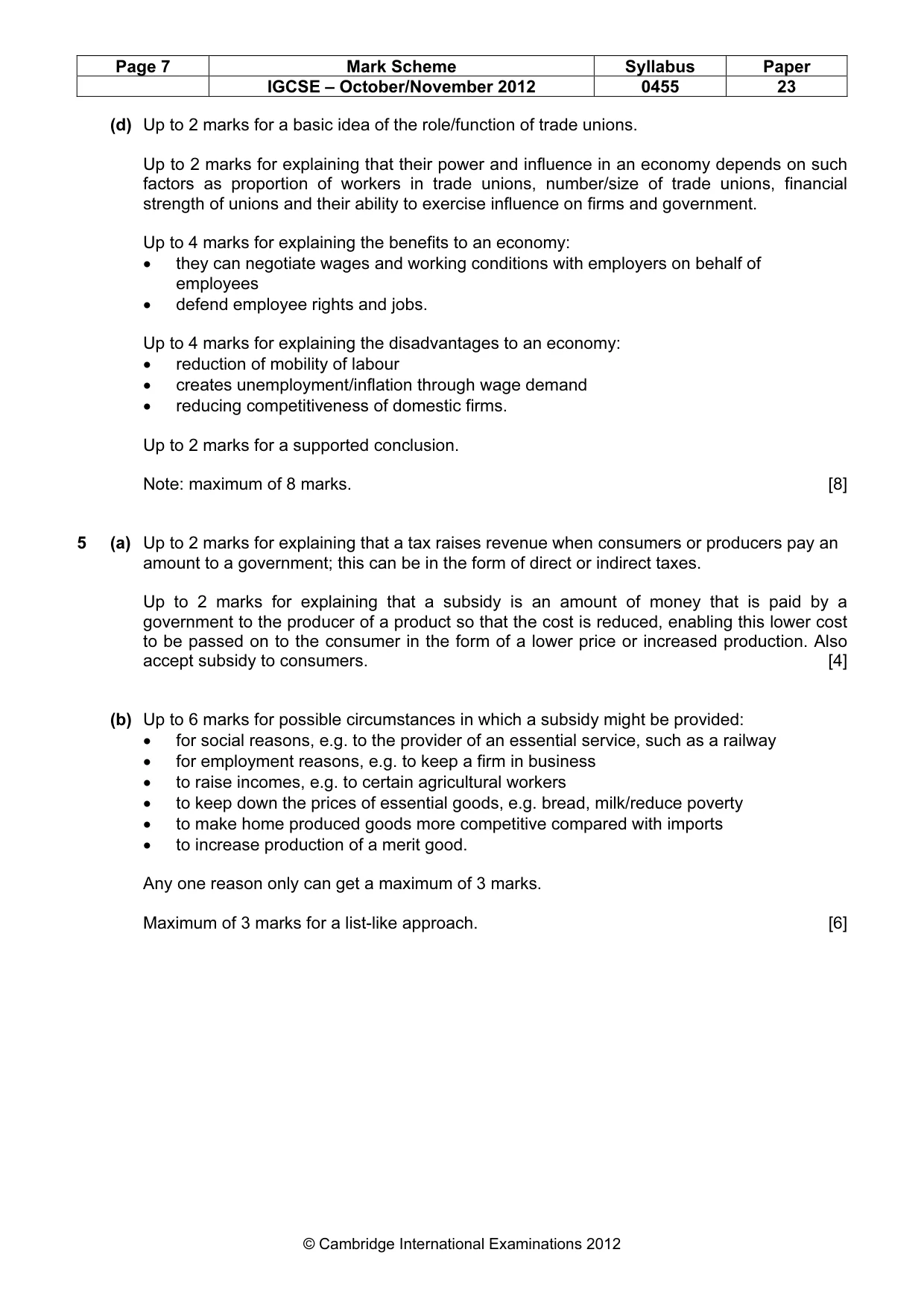
Page 7 Mark Scheme Syllabus Paper IGCSE – October/November 2012 0455 23 © Cambridge International Examinations 2012 (d) Up to 2 marks for a basic idea of the role/function of trade unions. Up to 2 marks for explaining that their power and influence in an economy depends on such factors as proportion of workers in trade unions, number/size of trade unions, financial strength of unions and their ability to exercise influence on firms and government. Up to 4 marks for explaining the benefits to an economy: • they can negotiate wages and working conditions with employers on behalf of employees • defend employee rights and jobs. Up to 4 marks for explaining the disadvantages to an economy: • reduction of mobility of labour • creates unemployment/inflation through wage demand • reducing competitiveness of domestic firms. Up to 2 marks for a supported conclusion. Note: maximum of 8 marks. [8] 5 (a) Up to 2 marks for explaining that a tax raises revenue when consumers or producers pay an amount to a government; this can be in the form of direct or indirect taxes. Up to 2 marks for explaining that a subsidy is an amount of money that is paid by a government to the producer of a product so that the cost is reduced, enabling this lower cost to be passed on to the consumer in the form of a lower price or increased production. Also accept subsidy to consumers. [4] (b) Up to 6 marks for possible circumstances in which a subsidy might be provided: • for social reasons, e.g. to the provider of an essential service, such as a railway • for employment reasons, e.g. to keep a firm in business • to raise incomes, e.g. to certain agricultural workers • to keep down the prices of essential goods, e.g. bread, milk/reduce poverty • to make home produced goods more competitive compared with imports • to increase production of a merit good. Any one reason only can get a maximum of 3 marks. Maximum of 3 marks for a list-like approach. [6]
Mark scheme, page 8
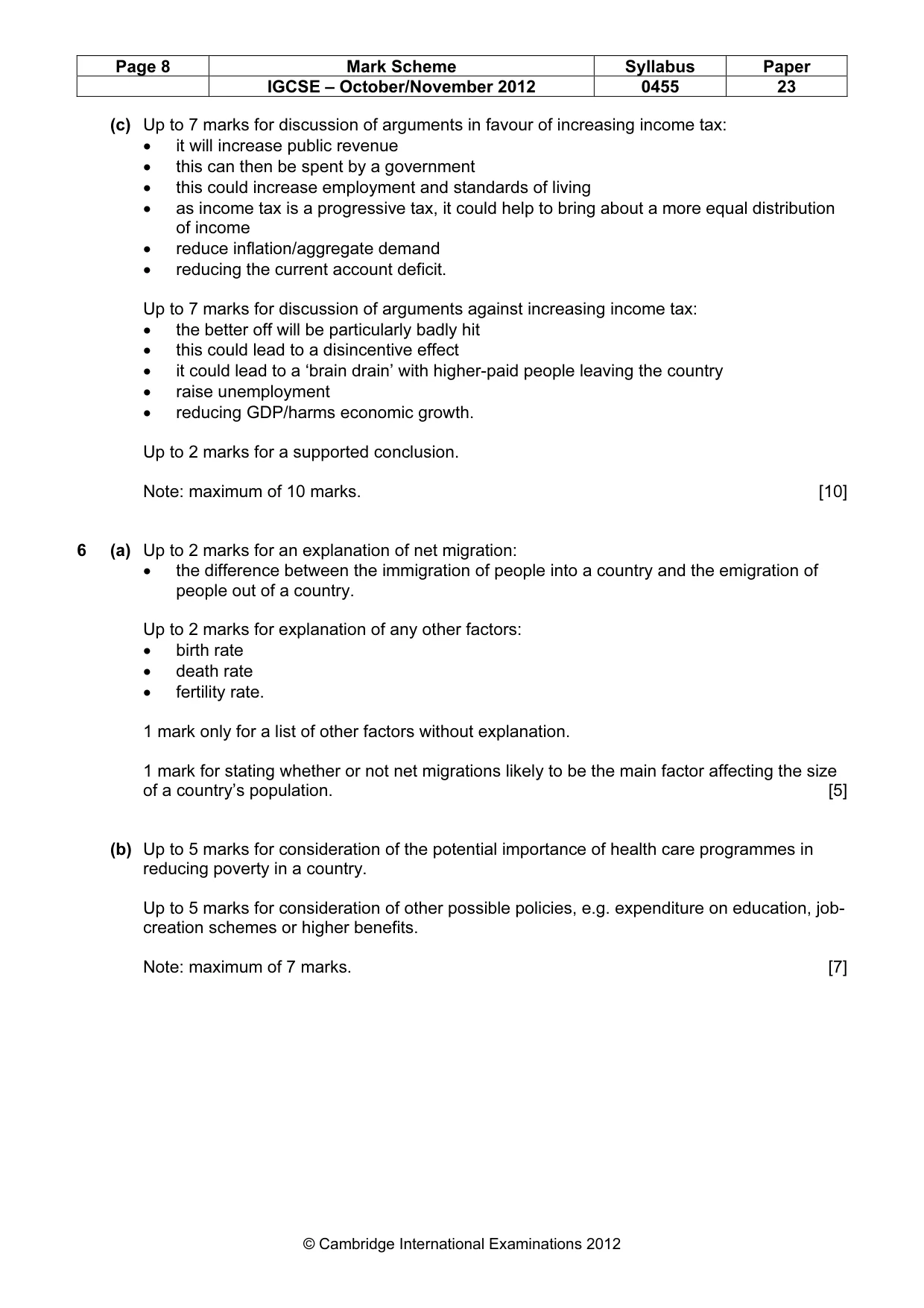
Page 8 Mark Scheme Syllabus Paper IGCSE – October/November 2012 0455 23 © Cambridge International Examinations 2012 (c) Up to 7 marks for discussion of arguments in favour of increasing income tax: • it will increase public revenue • this can then be spent by a government • this could increase employment and standards of living • as income tax is a progressive tax, it could help to bring about a more equal distribution of income • reduce inflation/aggregate demand • reducing the current account deficit. Up to 7 marks for discussion of arguments against increasing income tax: • the better off will be particularly badly hit • this could lead to a disincentive effect • it could lead to a ‘brain drain’ with higher-paid people leaving the country • raise unemployment • reducing GDP/harms economic growth. Up to 2 marks for a supported conclusion. Note: maximum of 10 marks. [10] 6 (a) Up to 2 marks for an explanation of net migration: • the difference between the immigration of people into a country and the emigration of people out of a country. Up to 2 marks for explanation of any other factors: • birth rate • death rate • fertility rate. 1 mark only for a list of other factors without explanation. 1 mark for stating whether or not net migrations likely to be the main factor affecting the size of a country’s population. [5] (b) Up to 5 marks for consideration of the potential importance of health care programmes in reducing poverty in a country. Up to 5 marks for consideration of other possible policies, e.g. expenditure on education, job- creation schemes or higher benefits. Note: maximum of 7 marks. [7]
Mark scheme, page 9
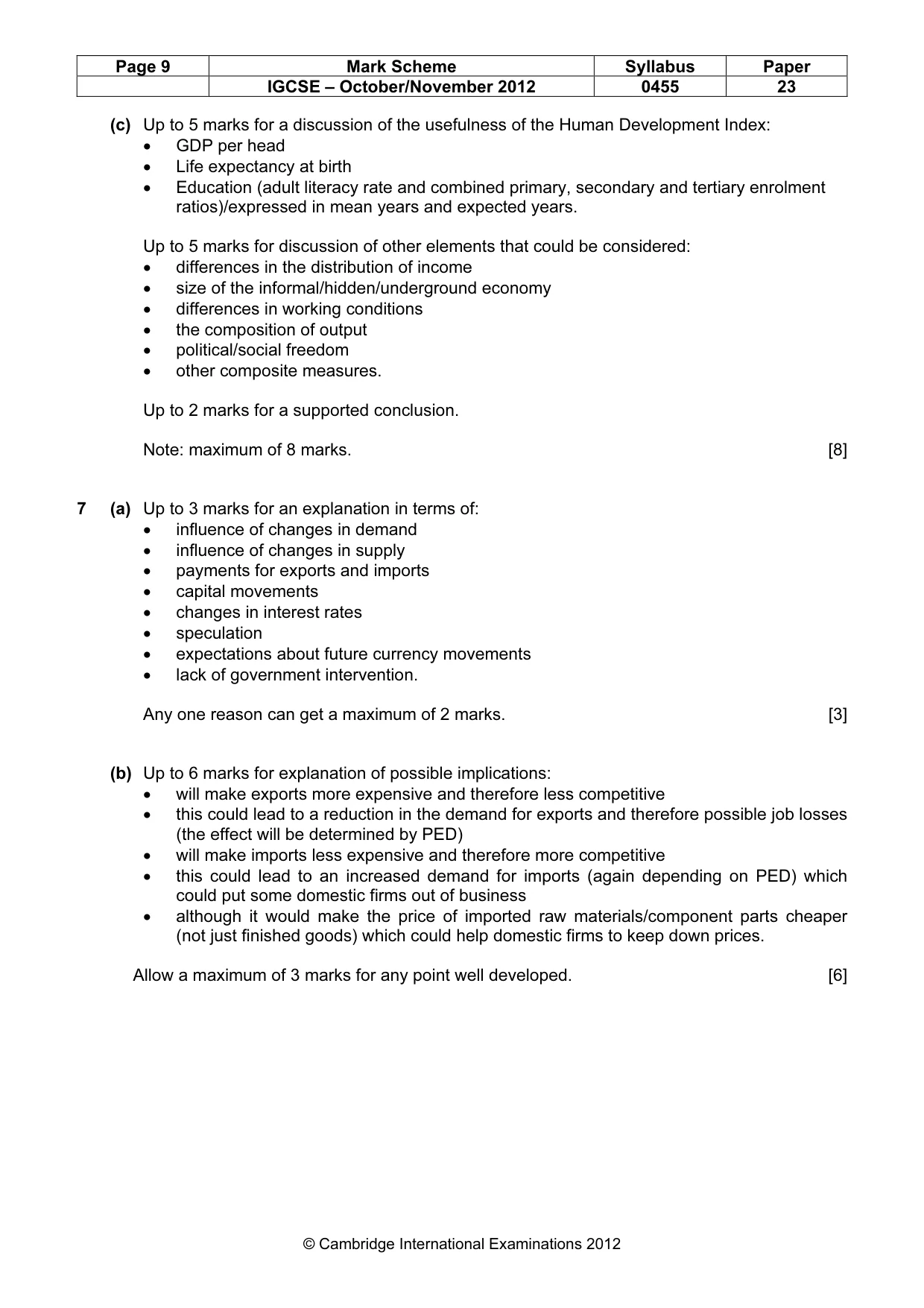
Page 9 Mark Scheme Syllabus Paper IGCSE – October/November 2012 0455 23 © Cambridge International Examinations 2012 (c) Up to 5 marks for a discussion of the usefulness of the Human Development Index: • GDP per head • Life expectancy at birth • Education (adult literacy rate and combined primary, secondary and tertiary enrolment ratios)/expressed in mean years and expected years. Up to 5 marks for discussion of other elements that could be considered: • differences in the distribution of income • size of the informal/hidden/underground economy • differences in working conditions • the composition of output • political/social freedom • other composite measures. Up to 2 marks for a supported conclusion. Note: maximum of 8 marks. [8] 7 (a) Up to 3 marks for an explanation in terms of: • influence of changes in demand • influence of changes in supply • payments for exports and imports • capital movements • changes in interest rates • speculation • expectations about future currency movements • lack of government intervention. Any one reason can get a maximum of 2 marks. [3] (b) Up to 6 marks for explanation of possible implications: • will make exports more expensive and therefore less competitive • this could lead to a reduction in the demand for exports and therefore possible job losses (the effect will be determined by PED) • will make imports less expensive and therefore more competitive • this could lead to an increased demand for imports (again depending on PED) which could put some domestic firms out of business • although it would make the price of imported raw materials/component parts cheaper (not just finished goods) which could help domestic firms to keep down prices. Allow a maximum of 3 marks for any point well developed. [6]
Mark scheme, page 10
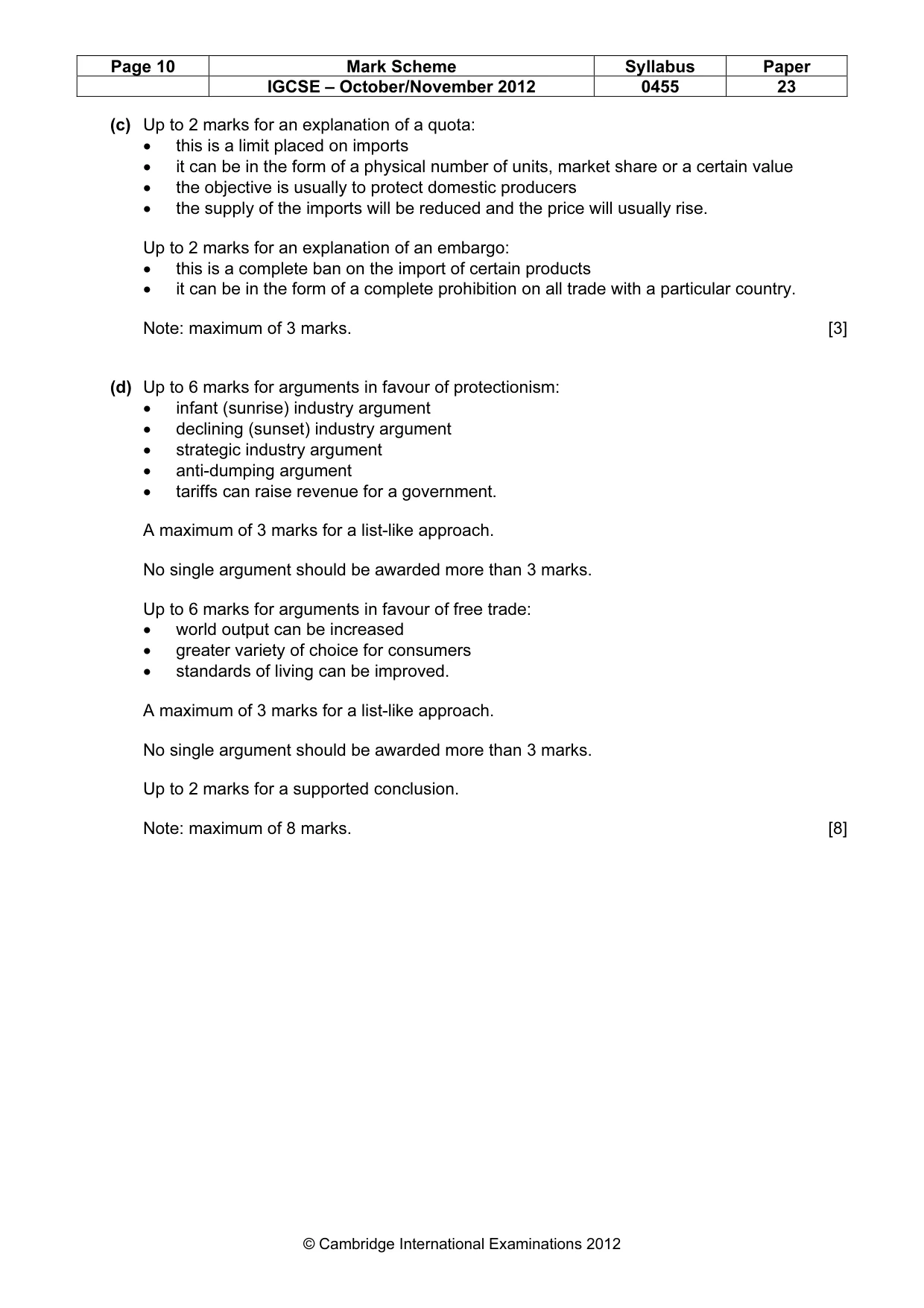
Page 10 Mark Scheme Syllabus Paper IGCSE – October/November 2012 0455 23 © Cambridge International Examinations 2012 (c) Up to 2 marks for an explanation of a quota: • this is a limit placed on imports • it can be in the form of a physical number of units, market share or a certain value • the objective is usually to protect domestic producers • the supply of the imports will be reduced and the price will usually rise. Up to 2 marks for an explanation of an embargo: • this is a complete ban on the import of certain products • it can be in the form of a complete prohibition on all trade with a particular country. Note: maximum of 3 marks. [3] (d) Up to 6 marks for arguments in favour of protectionism: • infant (sunrise) industry argument • declining (sunset) industry argument • strategic industry argument • anti-dumping argument • tariffs can raise revenue for a government. A maximum of 3 marks for a list-like approach. No single argument should be awarded more than 3 marks. Up to 6 marks for arguments in favour of free trade: • world output can be increased • greater variety of choice for consumers • standards of living can be improved. A maximum of 3 marks for a list-like approach. No single argument should be awarded more than 3 marks. Up to 2 marks for a supported conclusion. Note: maximum of 8 marks. [8]
What you needed in this session
Cambridge’s own grade thresholds for 2012 Oct/Nov, Paper 2 · Variant 3. A higher threshold means an easier paper — the bar moves with how the cohort did.