Cambridge IGCSE Economics 0455 — 2012 Oct/Nov Paper 2 · Variant 1
0455/21/O/N/12 · 80 marks · ≈90 min
The question paper and its mark scheme, free to read here and free to download. This is Cambridge’s own paper, exactly as it was sat.
Question paper4 pages
Mark scheme10 pages
Answers below. Sit the paper first if you are practising.
Paper as text
Question paper, page 1
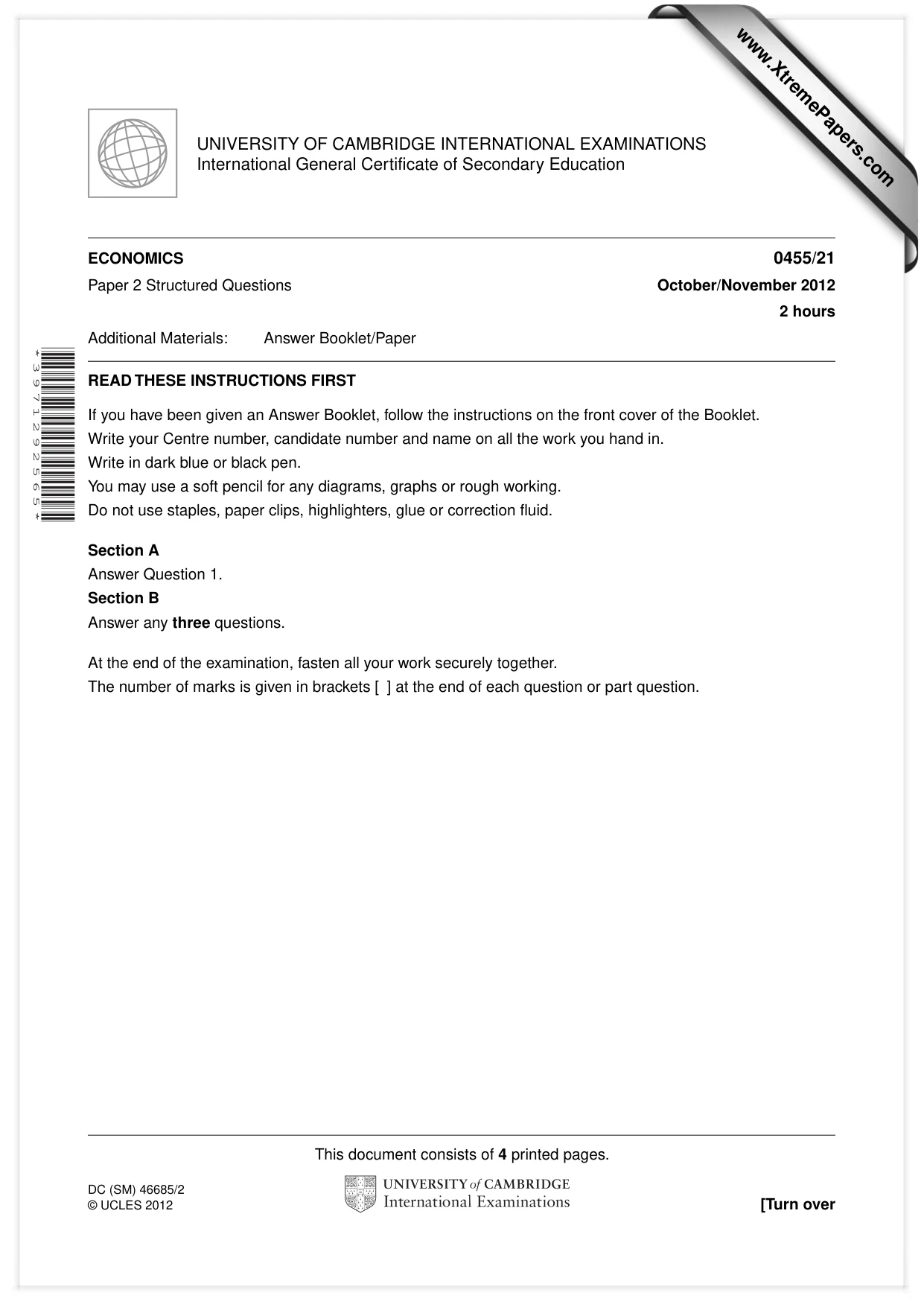
This document consists of 4 printed pages. DC (SM) 46685/2 © UCLES 2012 [Turn over UNIVERSITY OF CAMBRIDGE INTERNATIONAL EXAMINATIONS International General Certificate of Secondary Education * 3 9 7 1 2 9 2 5 6 5 * ECONOMICS 0455/21 Paper 2 Structured Questions October/November 2012 2 hours Additional Materials: Answer Booklet/Paper READ THESE INSTRUCTIONS FIRST If you have been given an Answer Booklet, follow the instructions on the front cover of the Booklet. Write your Centre number, candidate number and name on all the work you hand in. Write in dark blue or black pen. You may use a soft pencil for any diagrams, graphs or rough working. Do not use staples, paper clips, highlighters, glue or correction fluid. Section A Answer Question 1. Section B Answer any three questions. At the end of the examination, fasten all your work securely together. The number of marks is given in brackets [ ] at the end of each question or part question. www.XtremePapers.com
Question paper, page 2
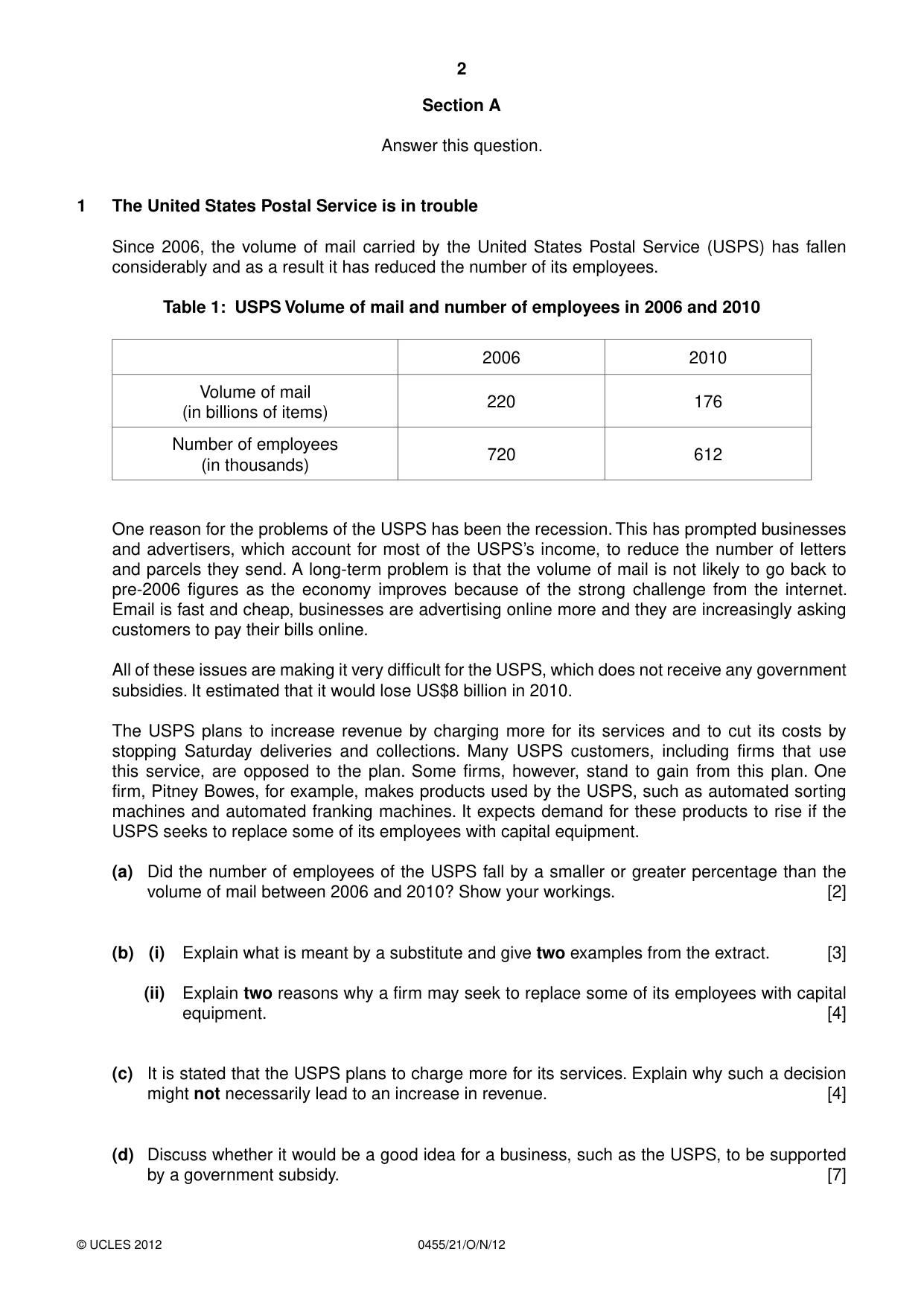
2 0455/21/O/N/12 © UCLES 2012 Section A Answer this question. 1 The United States Postal Service is in trouble Since 2006, the volume of mail carried by the United States Postal Service (USPS) has fallen considerably and as a result it has reduced the number of its employees. Table 1: USPS Volume of mail and number of employees in 2006 and 2010 2006 2010 Volume of mail (in billions of items) 220 176 Number of employees (in thousands) 720 612 One reason for the problems of the USPS has been the recession. This has prompted businesses and advertisers, which account for most of the USPS’s income, to reduce the number of letters and parcels they send. A long-term problem is that the volume of mail is not likely to go back to pre-2006 figures as the economy improves because of the strong challenge from the internet. Email is fast and cheap, businesses are advertising online more and they are increasingly asking customers to pay their bills online. All of these issues are making it very difficult for the USPS, which does not receive any government subsidies. It estimated that it would lose US$8 billion in 2010. The USPS plans to increase revenue by charging more for its services and to cut its costs by stopping Saturday deliveries and collections. Many USPS customers, including firms that use this service, are opposed to the plan. Some firms, however, stand to gain from this plan. One firm, Pitney Bowes, for example, makes products used by the USPS, such as automated sorting machines and automated franking machines. It expects demand for these products to rise if the USPS seeks to replace some of its employees with capital equipment. (a) Did the number of employees of the USPS fall by a smaller or greater percentage than the volume of mail between 2006 and 2010? Show your workings. [2] (b) (i) Explain what is meant by a substitute and give two examples from the extract. [3] (ii) Explain two reasons why a firm may seek to replace some of its employees with capital equipment. [4] (c) It is stated that the USPS plans to charge more for its services. Explain why such a decision might not necessarily lead to an increase in revenue. [4] (d) Discuss whether it would be a good idea for a business, such as the USPS, to be supported by a government subsidy. [7]
Question paper, page 3
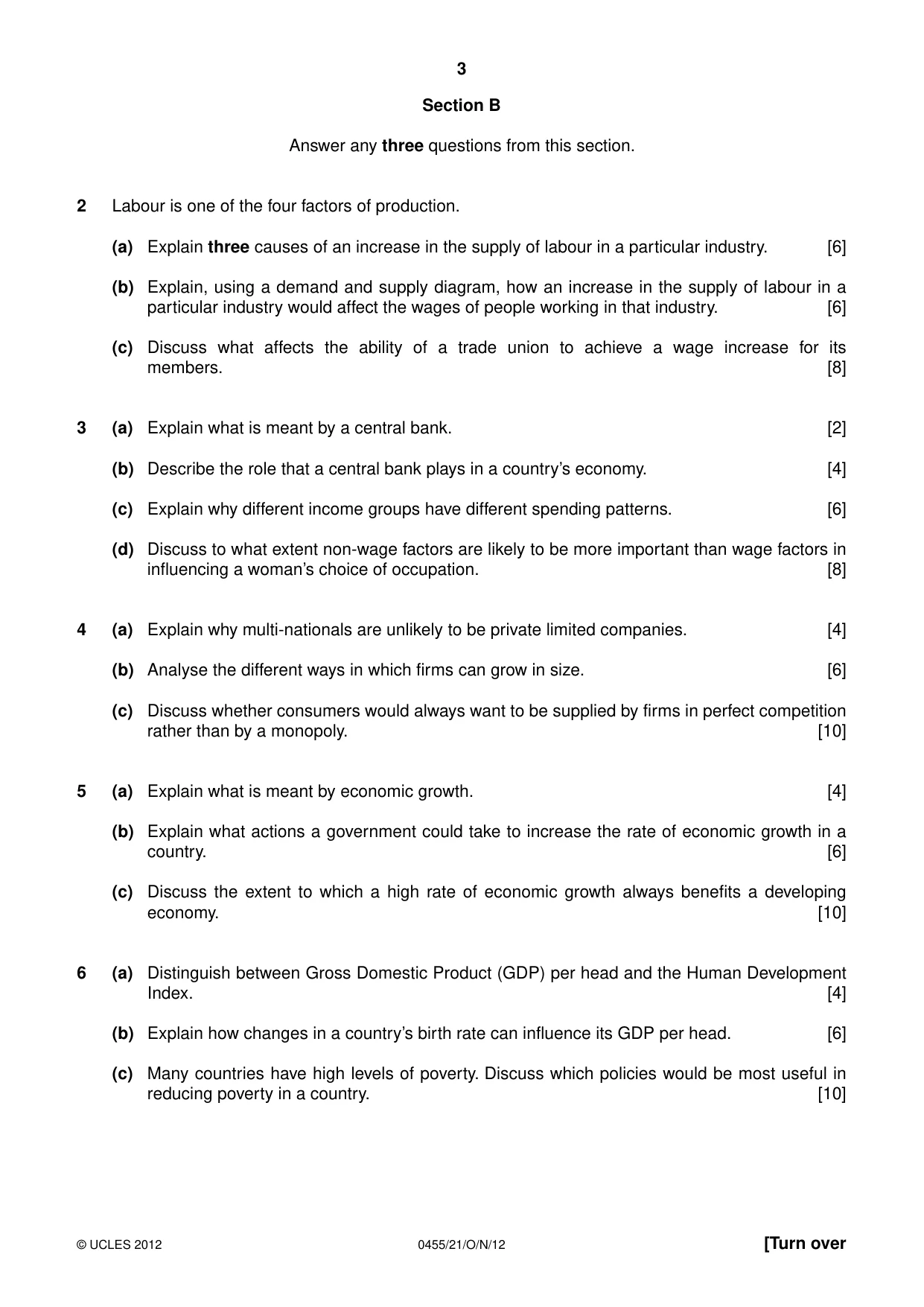
3 0455/21/O/N/12 © UCLES 2012 [Turn over Section B Answer any three questions from this section. 2 Labour is one of the four factors of production. (a) Explain three causes of an increase in the supply of labour in a particular industry. [6] (b) Explain, using a demand and supply diagram, how an increase in the supply of labour in a particular industry would affect the wages of people working in that industry. [6] (c) Discuss what affects the ability of a trade union to achieve a wage increase for its members. [8] 3 (a) Explain what is meant by a central bank. [2] (b) Describe the role that a central bank plays in a country’s economy. [4] (c) Explain why different income groups have different spending patterns. [6] (d) Discuss to what extent non-wage factors are likely to be more important than wage factors in influencing a woman’s choice of occupation. [8] 4 (a) Explain why multi-nationals are unlikely to be private limited companies. [4] (b) Analyse the different ways in which firms can grow in size. [6] (c) Discuss whether consumers would always want to be supplied by firms in perfect competition rather than by a monopoly. [10] 5 (a) Explain what is meant by economic growth. [4] (b) Explain what actions a government could take to increase the rate of economic growth in a country. [6] (c) Discuss the extent to which a high rate of economic growth always benefits a developing economy. [10] 6 (a) Distinguish between Gross Domestic Product (GDP) per head and the Human Development Index. [4] (b) Explain how changes in a country’s birth rate can influence its GDP per head. [6] (c) Many countries have high levels of poverty. Discuss which policies would be most useful in reducing poverty in a country. [10]
Question paper, page 4
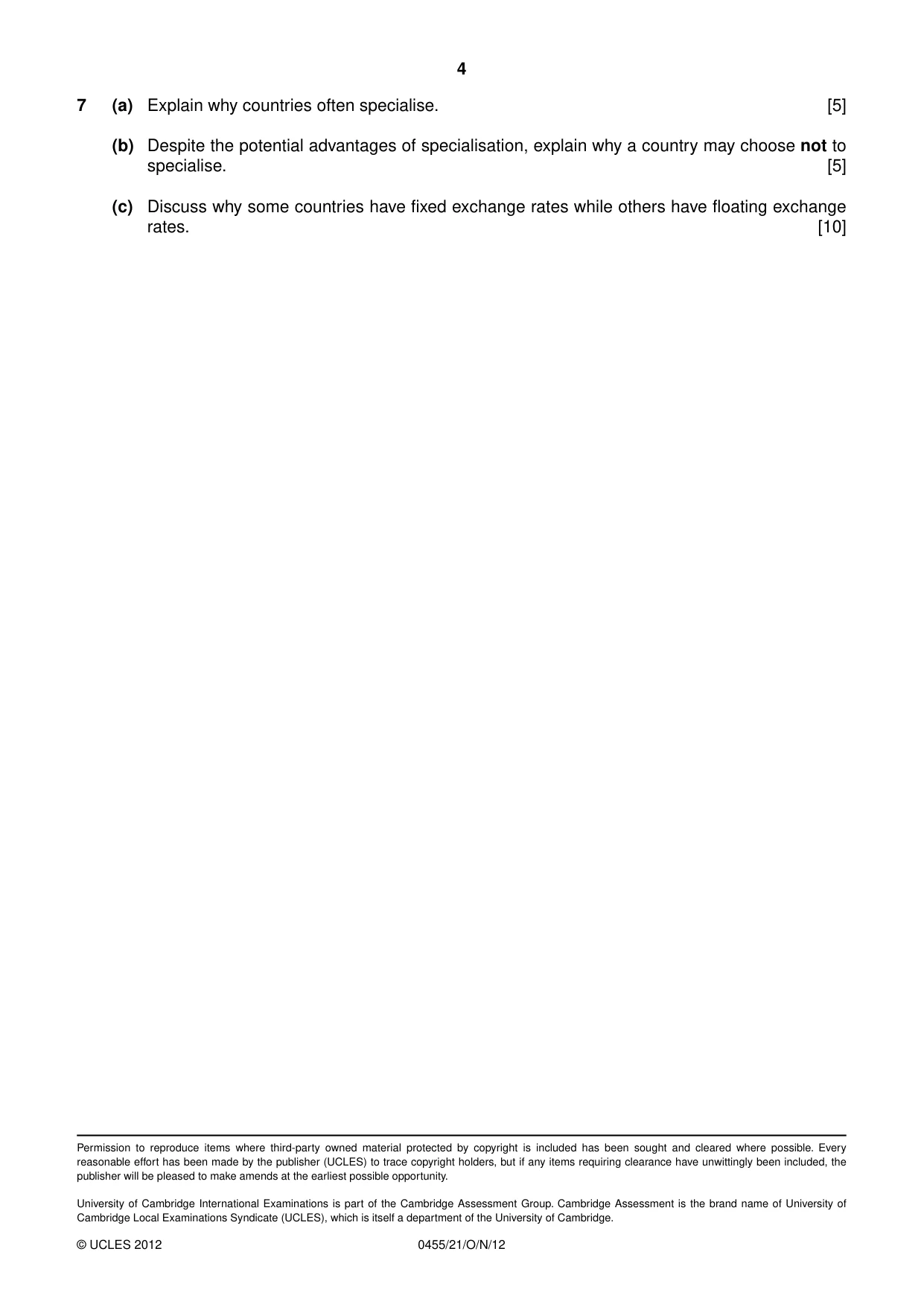
4 0455/21/O/N/12 © UCLES 2012 Permission to reproduce items where third-party owned material protected by copyright is included has been sought and cleared where possible. Every reasonable effort has been made by the publisher (UCLES) to trace copyright holders, but if any items requiring clearance have unwittingly been included, the publisher will be pleased to make amends at the earliest possible opportunity. University of Cambridge International Examinations is part of the Cambridge Assessment Group. Cambridge Assessment is the brand name of University of Cambridge Local Examinations Syndicate (UCLES), which is itself a department of the University of Cambridge. 7 (a) Explain why countries often specialise. [5] (b) Despite the potential advantages of specialisation, explain why a country may choose not to specialise. [5] (c) Discuss why some countries have fixed exchange rates while others have floating exchange rates. [10]
Mark scheme, page 1
CAMBRIDGE INTERNATIONAL EXAMINATIONS International General Certificate of Secondary Education MARK SCHEME for the October/November 2012 series 0455 ECONOMICS 0455/21 Paper 2 (Structured Questions), maximum raw mark 80 This mark scheme is published as an aid to teachers and candidates, to indicate the requirements of the examination. It shows the basis on which Examiners were instructed to award marks. It does not indicate the details of the discussions that took place at an Examiners’ meeting before marking began, which would have considered the acceptability of alternative answers. Mark schemes should be read in conjunction with the question paper and the Principal Examiner Report for Teachers. Cambridge will not enter into discussions about these mark schemes. Cambridge is publishing the mark schemes for the October/November 2012 series for most IGCSE, GCE Advanced Level and Advanced Subsidiary Level components and some Ordinary Level components. www.XtremePapers.com
Mark scheme, page 2
Page 2 Mark Scheme Syllabus Paper IGCSE – October/November 2012 0455 21 © Cambridge International Examinations 2012 1 (a) Up to 2 marks for: • answer: the volume of mail fell by a greater percentage (1) • the volume of mail fell by 20% (44/220) from 2006 to 2010 (1) • the number of employees fell by 15% (108/720) from 2006 to 2010 (1). Note: maximum 2 marks for this question. [2] (b) (i) 1 mark for explanation of a substitute product: • products which are possible alternatives for the consumer. Up to 2 marks for examples from the extract: • email • online advertising • online billing • capital as substitute for labour. No credit can be given for examples not included in the extract. [3] (ii) Up to 2 marks for identifying any two possible reasons: • it could be more efficient/reduce production costs • it can be used for longer periods of time each day • it should be cheaper (at least in the long term once it has been paid for) • the machinery will not be involved in industrial action • technology becomes more advanced. Up to 2 marks for explaining these any two possible reasons. [4] (c) 1 mark for the correct formula: • percentage change in the quantity demanded of a product/percentage change in the price of a product. Up to 2 marks for explanation of price elasticity of demand: • the responsiveness/sensitivity of quantity of a product demanded to a change in its price. A maximum of 2 marks can be given for an answer which implies understanding of the concept of PED but does not specifically refer to the term. Note: Maximum 2 marks for any of the explanations of PED above. Up to 2 marks for an explanation of the link with revenue: • if the PED for the services of the USPS is inelastic, the proposal will lead to an increase in revenue • if the PED for the services of the USPS, however, is elastic, the proposal will lead to a fall in revenue and so the aim will not be achieved. [4]
Mark scheme, page 3
Page 3 Mark Scheme Syllabus Paper IGCSE – October/November 2012 0455 21 © Cambridge International Examinations 2012 (d) Up to 5 marks for reasons why it would be a good idea: • it would enable costs to be kept down and therefore prices charged to consumers would be lower • a country’s postal service is an essential service and so prices should be kept as affordable as possible • if demand increases, more jobs would be created, keeping down the rate of unemployment in the country • subsidy as investment (e.g. in R&D) – higher returns in the long run. Up to 5 marks for why it would not be a good idea: • government would need to pay for subsidies; this would be a burden on it • the subsidies could mean that other forms of government expenditure might be reduced/cancelled: idea of opportunity cost. • they could protect the business from the full rigour of competition, contributing to it becoming less efficient. Up to 2 marks for a supported conclusion. A maximum 4 marks for an understanding of subsidies, but not applied to the question. Note: maximum 7 marks for this question. [7] 2 (a) Up to 3 marks for identifying possible causes: • the size of the population • the age structure of the population • unemployment in similar industries frees labour for this industry • change in relative wage rates between industries • the retirement age • the school leaving age • attitudes to working women • the average number of hours worked • the proportion of full-time/part-time employees • the extent of overtime • the length of holidays • the number of days lost through illness. Up to 3 marks for explaining possible causes. [6]
Mark scheme, page 4
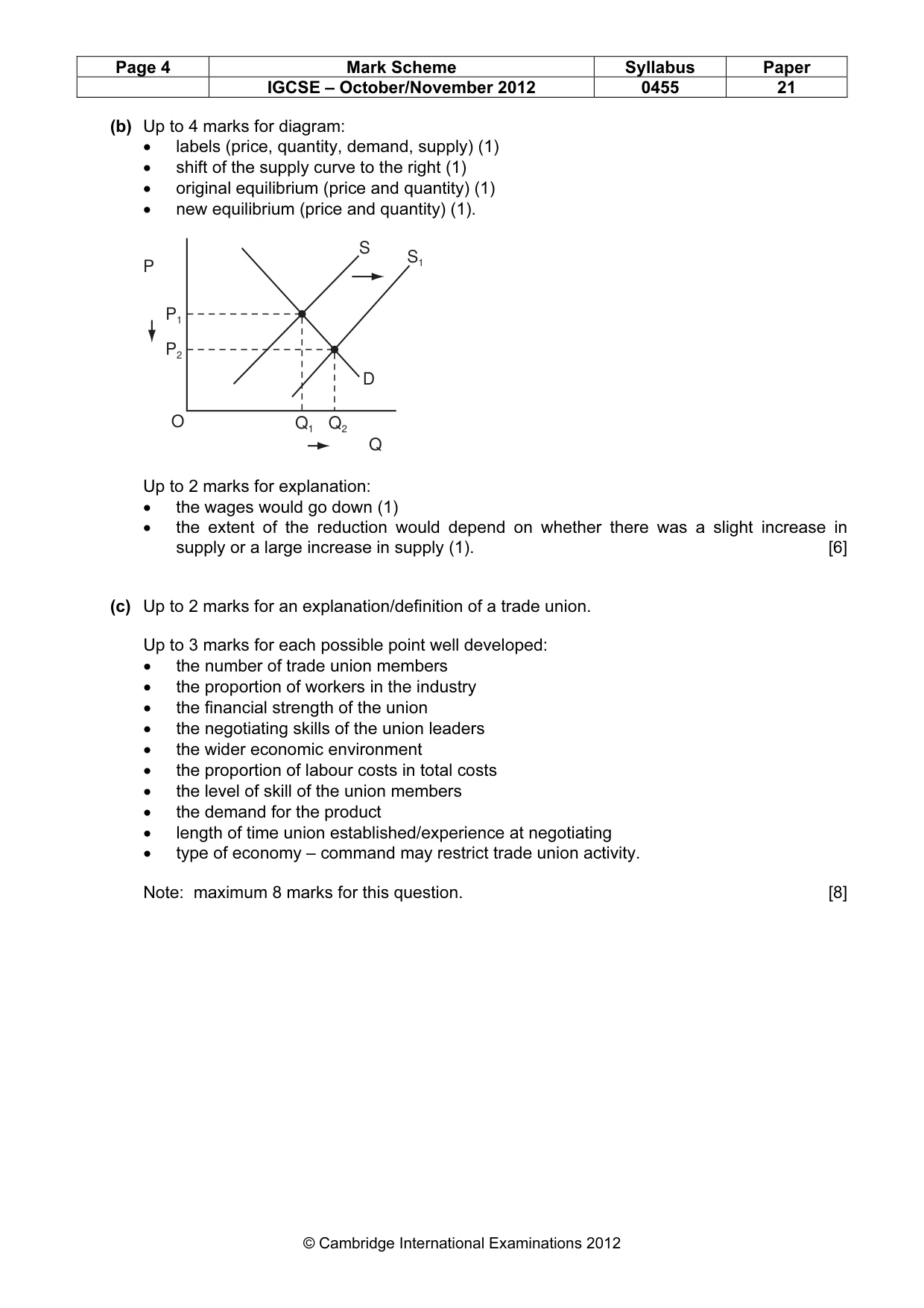
Page 4 Mark Scheme Syllabus Paper IGCSE – October/November 2012 0455 21 © Cambridge International Examinations 2012 (b) Up to 4 marks for diagram: • labels (price, quantity, demand, supply) (1) • shift of the supply curve to the right (1) • original equilibrium (price and quantity) (1) • new equilibrium (price and quantity) (1). O Q1 P1 S1 P2 Q2 S D Q P Up to 2 marks for explanation: • the wages would go down (1) • the extent of the reduction would depend on whether there was a slight increase in supply or a large increase in supply (1). [6] (c) Up to 2 marks for an explanation/definition of a trade union. Up to 3 marks for each possible point well developed: • the number of trade union members • the proportion of workers in the industry • the financial strength of the union • the negotiating skills of the union leaders • the wider economic environment • the proportion of labour costs in total costs • the level of skill of the union members • the demand for the product • length of time union established/experience at negotiating • type of economy – command may restrict trade union activity. Note: maximum 8 marks for this question. [8]
Mark scheme, page 5
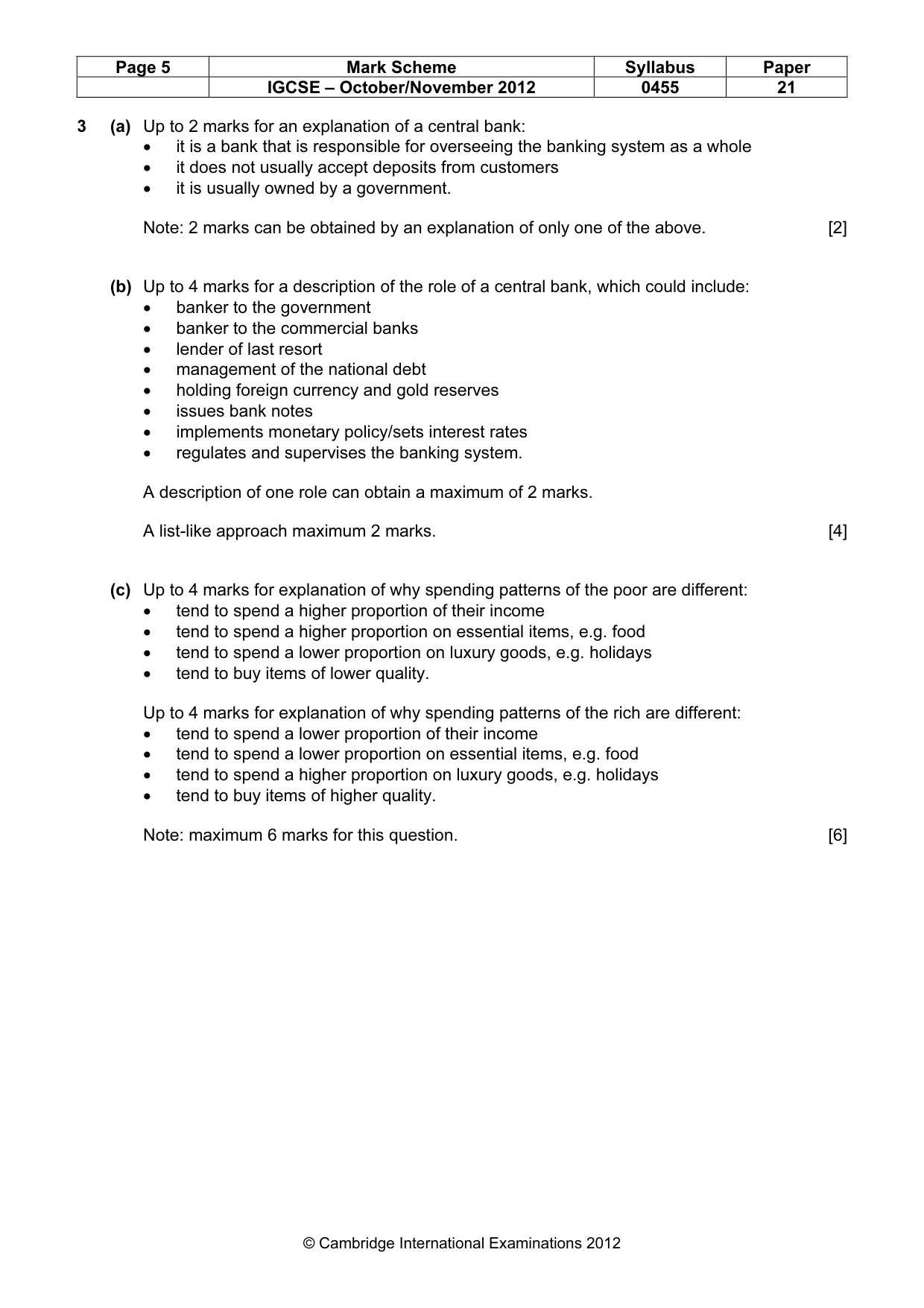
Page 5 Mark Scheme Syllabus Paper IGCSE – October/November 2012 0455 21 © Cambridge International Examinations 2012 3 (a) Up to 2 marks for an explanation of a central bank: • it is a bank that is responsible for overseeing the banking system as a whole • it does not usually accept deposits from customers • it is usually owned by a government. Note: 2 marks can be obtained by an explanation of only one of the above. [2] (b) Up to 4 marks for a description of the role of a central bank, which could include: • banker to the government • banker to the commercial banks • lender of last resort • management of the national debt • holding foreign currency and gold reserves • issues bank notes • implements monetary policy/sets interest rates • regulates and supervises the banking system. A description of one role can obtain a maximum of 2 marks. A list-like approach maximum 2 marks. [4] (c) Up to 4 marks for explanation of why spending patterns of the poor are different: • tend to spend a higher proportion of their income • tend to spend a higher proportion on essential items, e.g. food • tend to spend a lower proportion on luxury goods, e.g. holidays • tend to buy items of lower quality. Up to 4 marks for explanation of why spending patterns of the rich are different: • tend to spend a lower proportion of their income • tend to spend a lower proportion on essential items, e.g. food • tend to spend a higher proportion on luxury goods, e.g. holidays • tend to buy items of higher quality. Note: maximum 6 marks for this question. [6]
Mark scheme, page 6
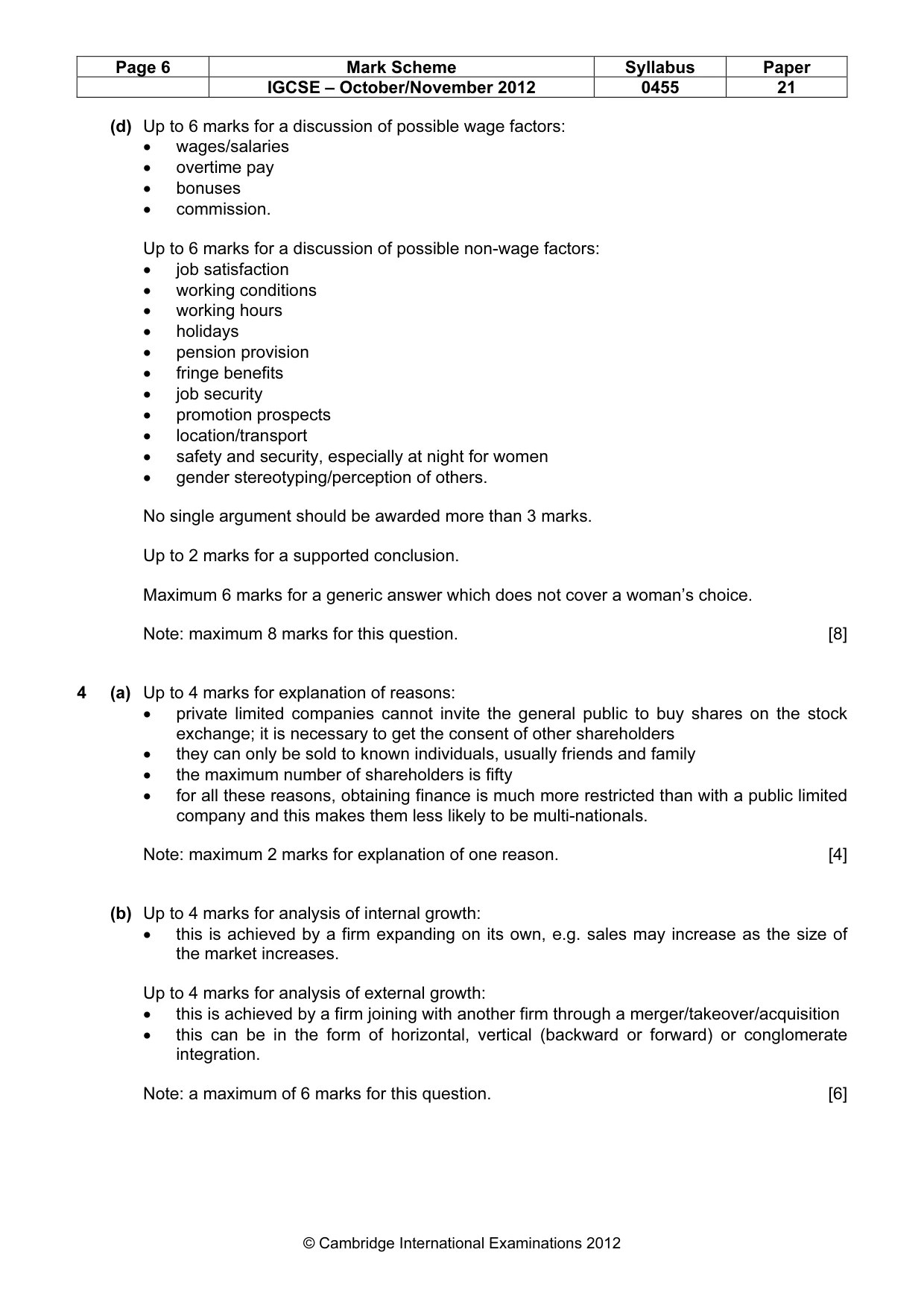
Page 6 Mark Scheme Syllabus Paper IGCSE – October/November 2012 0455 21 © Cambridge International Examinations 2012 (d) Up to 6 marks for a discussion of possible wage factors: • wages/salaries • overtime pay • bonuses • commission. Up to 6 marks for a discussion of possible non-wage factors: • job satisfaction • working conditions • working hours • holidays • pension provision • fringe benefits • job security • promotion prospects • location/transport • safety and security, especially at night for women • gender stereotyping/perception of others. No single argument should be awarded more than 3 marks. Up to 2 marks for a supported conclusion. Maximum 6 marks for a generic answer which does not cover a woman’s choice. Note: maximum 8 marks for this question. [8] 4 (a) Up to 4 marks for explanation of reasons: • private limited companies cannot invite the general public to buy shares on the stock exchange; it is necessary to get the consent of other shareholders • they can only be sold to known individuals, usually friends and family • the maximum number of shareholders is fifty • for all these reasons, obtaining finance is much more restricted than with a public limited company and this makes them less likely to be multi-nationals. Note: maximum 2 marks for explanation of one reason. [4] (b) Up to 4 marks for analysis of internal growth: • this is achieved by a firm expanding on its own, e.g. sales may increase as the size of the market increases. Up to 4 marks for analysis of external growth: • this is achieved by a firm joining with another firm through a merger/takeover/acquisition • this can be in the form of horizontal, vertical (backward or forward) or conglomerate integration. Note: a maximum of 6 marks for this question. [6]
Mark scheme, page 7
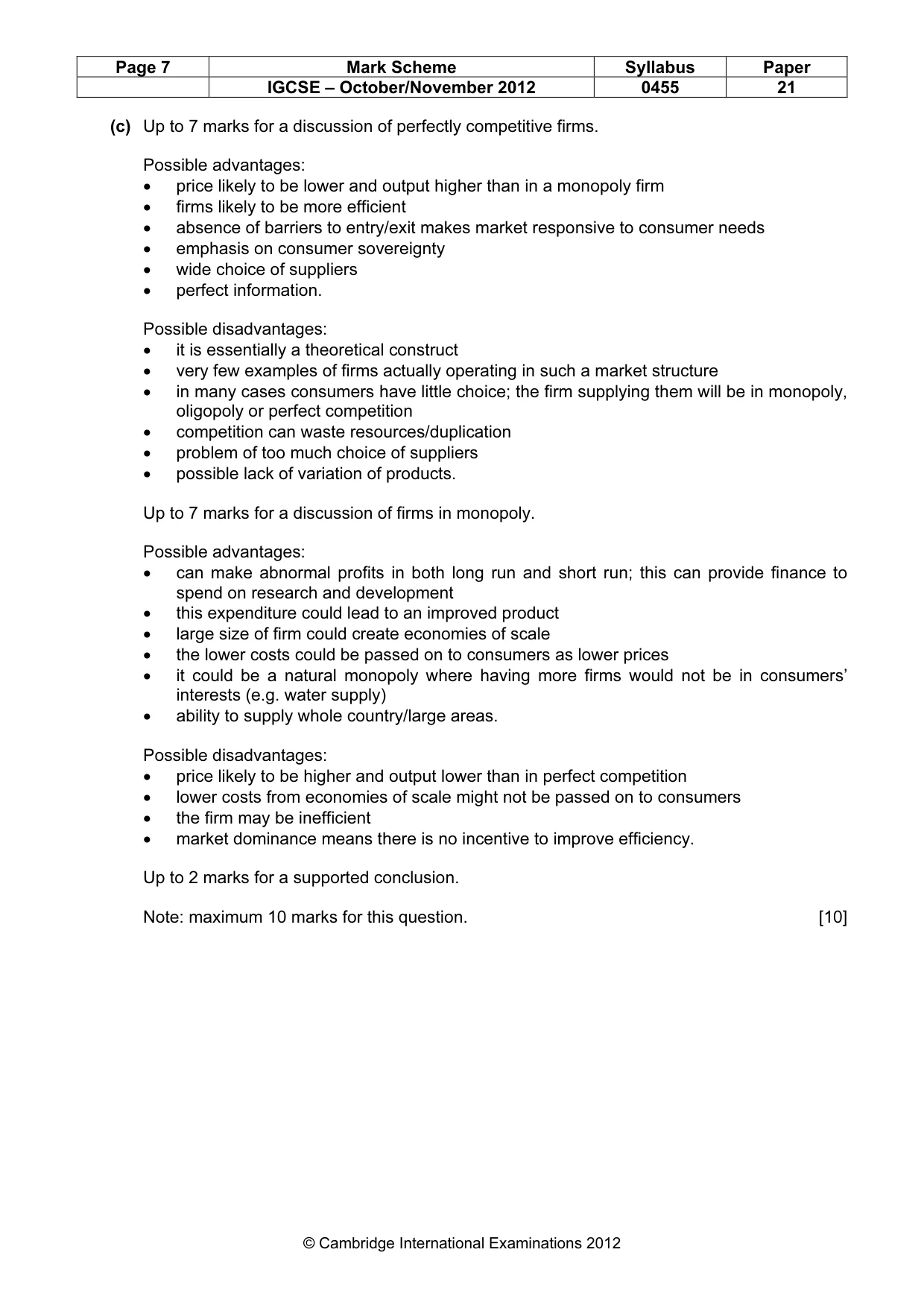
Page 7 Mark Scheme Syllabus Paper IGCSE – October/November 2012 0455 21 © Cambridge International Examinations 2012 (c) Up to 7 marks for a discussion of perfectly competitive firms. Possible advantages: • price likely to be lower and output higher than in a monopoly firm • firms likely to be more efficient • absence of barriers to entry/exit makes market responsive to consumer needs • emphasis on consumer sovereignty • wide choice of suppliers • perfect information. Possible disadvantages: • it is essentially a theoretical construct • very few examples of firms actually operating in such a market structure • in many cases consumers have little choice; the firm supplying them will be in monopoly, oligopoly or perfect competition • competition can waste resources/duplication • problem of too much choice of suppliers • possible lack of variation of products. Up to 7 marks for a discussion of firms in monopoly. Possible advantages: • can make abnormal profits in both long run and short run; this can provide finance to spend on research and development • this expenditure could lead to an improved product • large size of firm could create economies of scale • the lower costs could be passed on to consumers as lower prices • it could be a natural monopoly where having more firms would not be in consumers’ interests (e.g. water supply) • ability to supply whole country/large areas. Possible disadvantages: • price likely to be higher and output lower than in perfect competition • lower costs from economies of scale might not be passed on to consumers • the firm may be inefficient • market dominance means there is no incentive to improve efficiency. Up to 2 marks for a supported conclusion. Note: maximum 10 marks for this question. [10]
Mark scheme, page 8
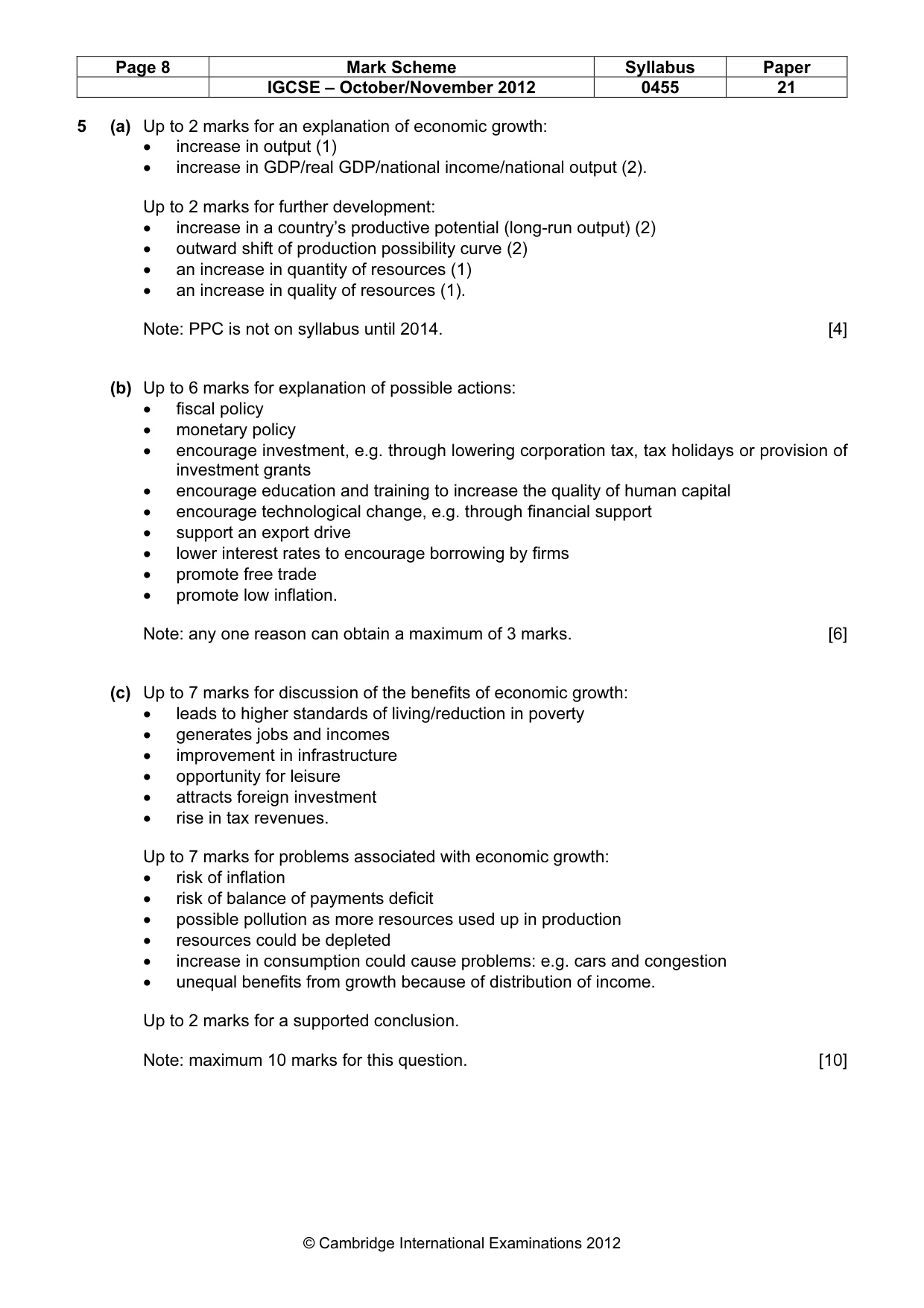
Page 8 Mark Scheme Syllabus Paper IGCSE – October/November 2012 0455 21 © Cambridge International Examinations 2012 5 (a) Up to 2 marks for an explanation of economic growth: • increase in output (1) • increase in GDP/real GDP/national income/national output (2). Up to 2 marks for further development: • increase in a country’s productive potential (long-run output) (2) • outward shift of production possibility curve (2) • an increase in quantity of resources (1) • an increase in quality of resources (1). Note: PPC is not on syllabus until 2014. [4] (b) Up to 6 marks for explanation of possible actions: • fiscal policy • monetary policy • encourage investment, e.g. through lowering corporation tax, tax holidays or provision of investment grants • encourage education and training to increase the quality of human capital • encourage technological change, e.g. through financial support • support an export drive • lower interest rates to encourage borrowing by firms • promote free trade • promote low inflation. Note: any one reason can obtain a maximum of 3 marks. [6] (c) Up to 7 marks for discussion of the benefits of economic growth: • leads to higher standards of living/reduction in poverty • generates jobs and incomes • improvement in infrastructure • opportunity for leisure • attracts foreign investment • rise in tax revenues. Up to 7 marks for problems associated with economic growth: • risk of inflation • risk of balance of payments deficit • possible pollution as more resources used up in production • resources could be depleted • increase in consumption could cause problems: e.g. cars and congestion • unequal benefits from growth because of distribution of income. Up to 2 marks for a supported conclusion. Note: maximum 10 marks for this question. [10]
Mark scheme, page 9
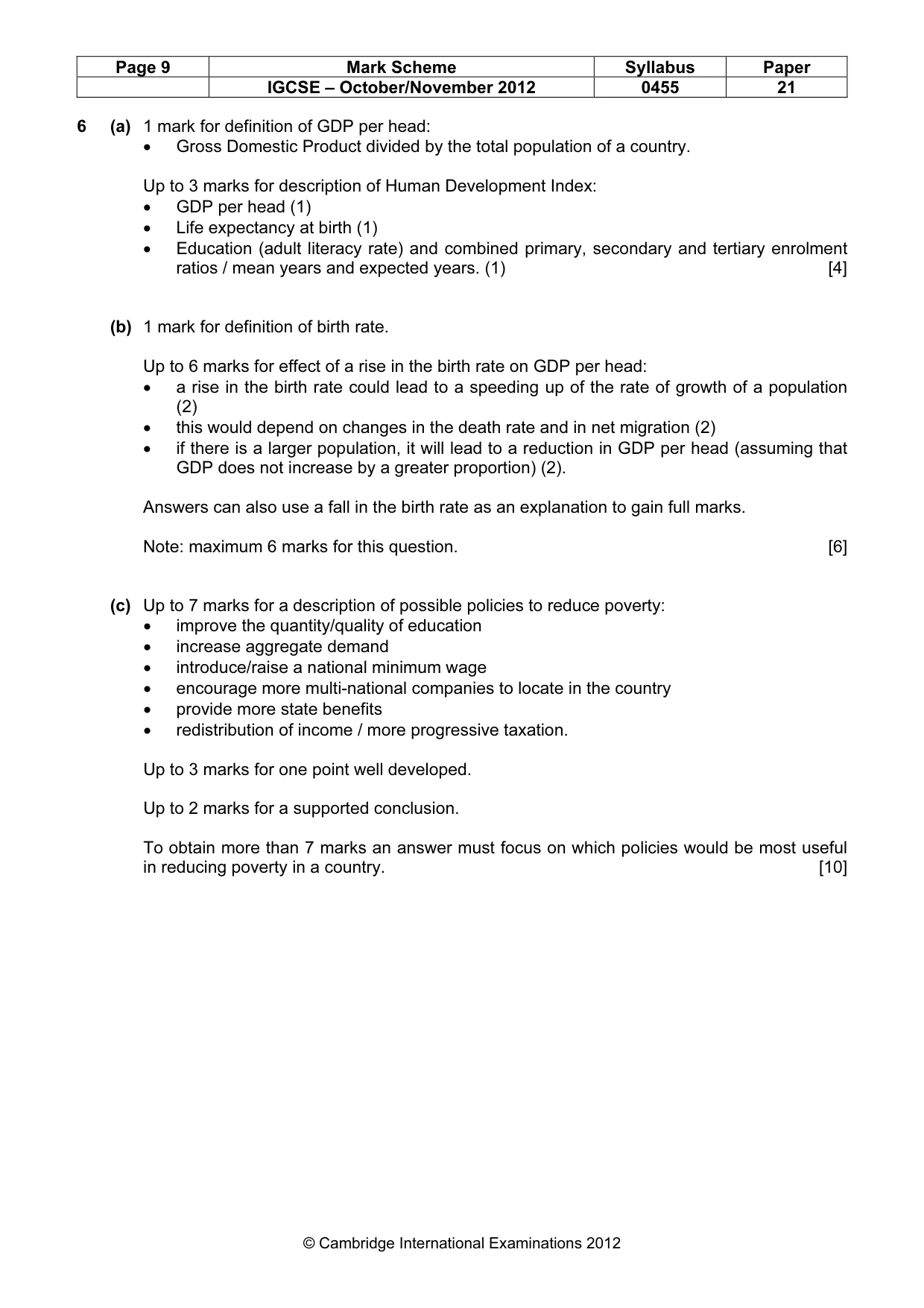
Page 9 Mark Scheme Syllabus Paper IGCSE – October/November 2012 0455 21 © Cambridge International Examinations 2012 6 (a) 1 mark for definition of GDP per head: • Gross Domestic Product divided by the total population of a country. Up to 3 marks for description of Human Development Index: • GDP per head (1) • Life expectancy at birth (1) • Education (adult literacy rate) and combined primary, secondary and tertiary enrolment ratios / mean years and expected years. (1) [4] (b) 1 mark for definition of birth rate. Up to 6 marks for effect of a rise in the birth rate on GDP per head: • a rise in the birth rate could lead to a speeding up of the rate of growth of a population (2) • this would depend on changes in the death rate and in net migration (2) • if there is a larger population, it will lead to a reduction in GDP per head (assuming that GDP does not increase by a greater proportion) (2). Answers can also use a fall in the birth rate as an explanation to gain full marks. Note: maximum 6 marks for this question. [6] (c) Up to 7 marks for a description of possible policies to reduce poverty: • improve the quantity/quality of education • increase aggregate demand • introduce/raise a national minimum wage • encourage more multi-national companies to locate in the country • provide more state benefits • redistribution of income / more progressive taxation. Up to 3 marks for one point well developed. Up to 2 marks for a supported conclusion. To obtain more than 7 marks an answer must focus on which policies would be most useful in reducing poverty in a country. [10]
Mark scheme, page 10
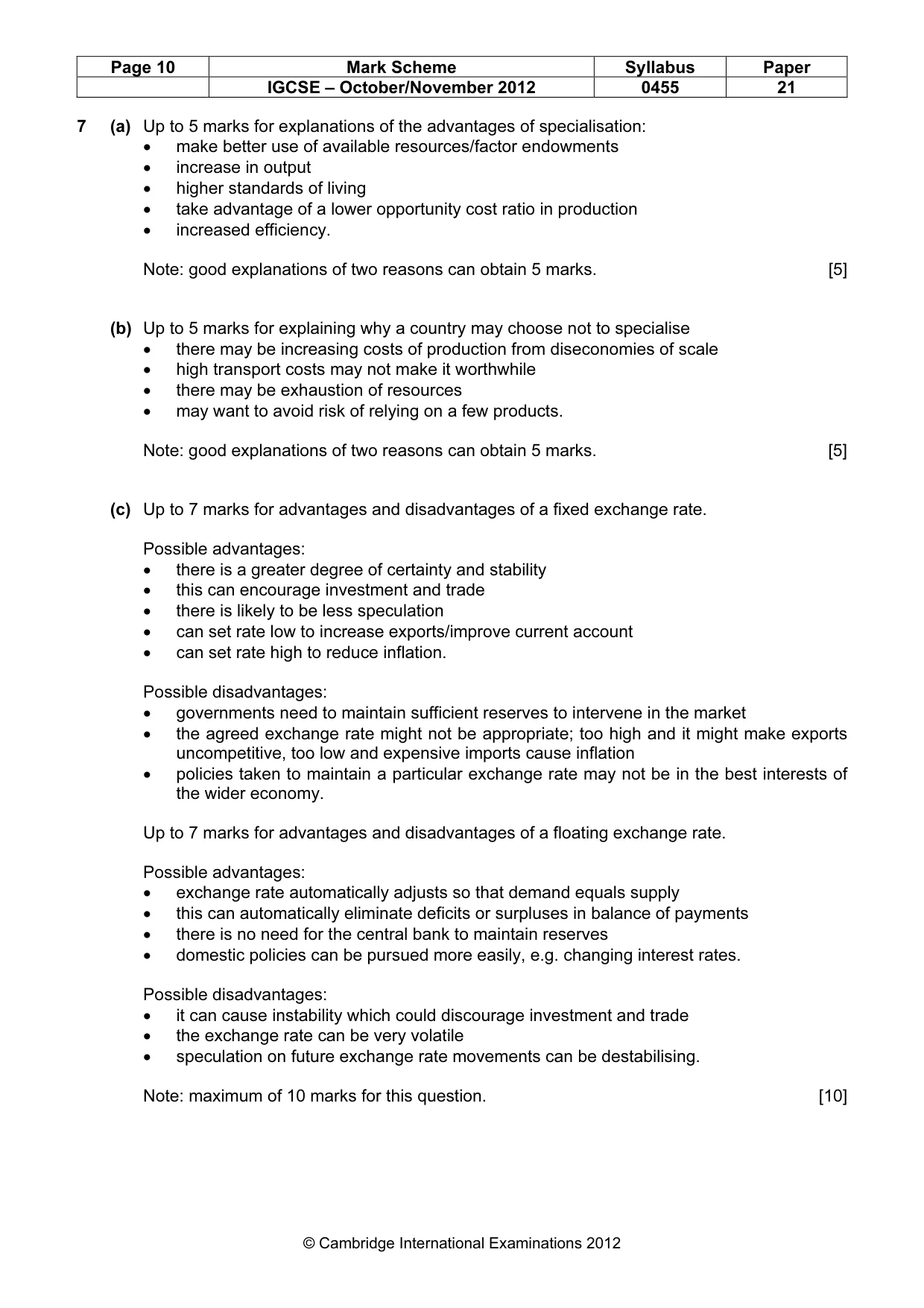
Page 10 Mark Scheme Syllabus Paper IGCSE – October/November 2012 0455 21 © Cambridge International Examinations 2012 7 (a) Up to 5 marks for explanations of the advantages of specialisation: • make better use of available resources/factor endowments • increase in output • higher standards of living • take advantage of a lower opportunity cost ratio in production • increased efficiency. Note: good explanations of two reasons can obtain 5 marks. [5] (b) Up to 5 marks for explaining why a country may choose not to specialise • there may be increasing costs of production from diseconomies of scale • high transport costs may not make it worthwhile • there may be exhaustion of resources • may want to avoid risk of relying on a few products. Note: good explanations of two reasons can obtain 5 marks. [5] (c) Up to 7 marks for advantages and disadvantages of a fixed exchange rate. Possible advantages: • there is a greater degree of certainty and stability • this can encourage investment and trade • there is likely to be less speculation • can set rate low to increase exports/improve current account • can set rate high to reduce inflation. Possible disadvantages: • governments need to maintain sufficient reserves to intervene in the market • the agreed exchange rate might not be appropriate; too high and it might make exports uncompetitive, too low and expensive imports cause inflation • policies taken to maintain a particular exchange rate may not be in the best interests of the wider economy. Up to 7 marks for advantages and disadvantages of a floating exchange rate. Possible advantages: • exchange rate automatically adjusts so that demand equals supply • this can automatically eliminate deficits or surpluses in balance of payments • there is no need for the central bank to maintain reserves • domestic policies can be pursued more easily, e.g. changing interest rates. Possible disadvantages: • it can cause instability which could discourage investment and trade • the exchange rate can be very volatile • speculation on future exchange rate movements can be destabilising. Note: maximum of 10 marks for this question. [10]
What you needed in this session
Cambridge’s own grade thresholds for 2012 Oct/Nov, Paper 2 · Variant 1. A higher threshold means an easier paper — the bar moves with how the cohort did.