Cambridge IGCSE Economics 0455 — 2012 May/June Paper 2 · Variant 3
0455/23/M/J/12 · 80 marks · ≈90 min
The question paper and its mark scheme, free to read here and free to download. This is Cambridge’s own paper, exactly as it was sat.
Question paper4 pages
Mark scheme8 pages
Answers below. Sit the paper first if you are practising.
Paper as text
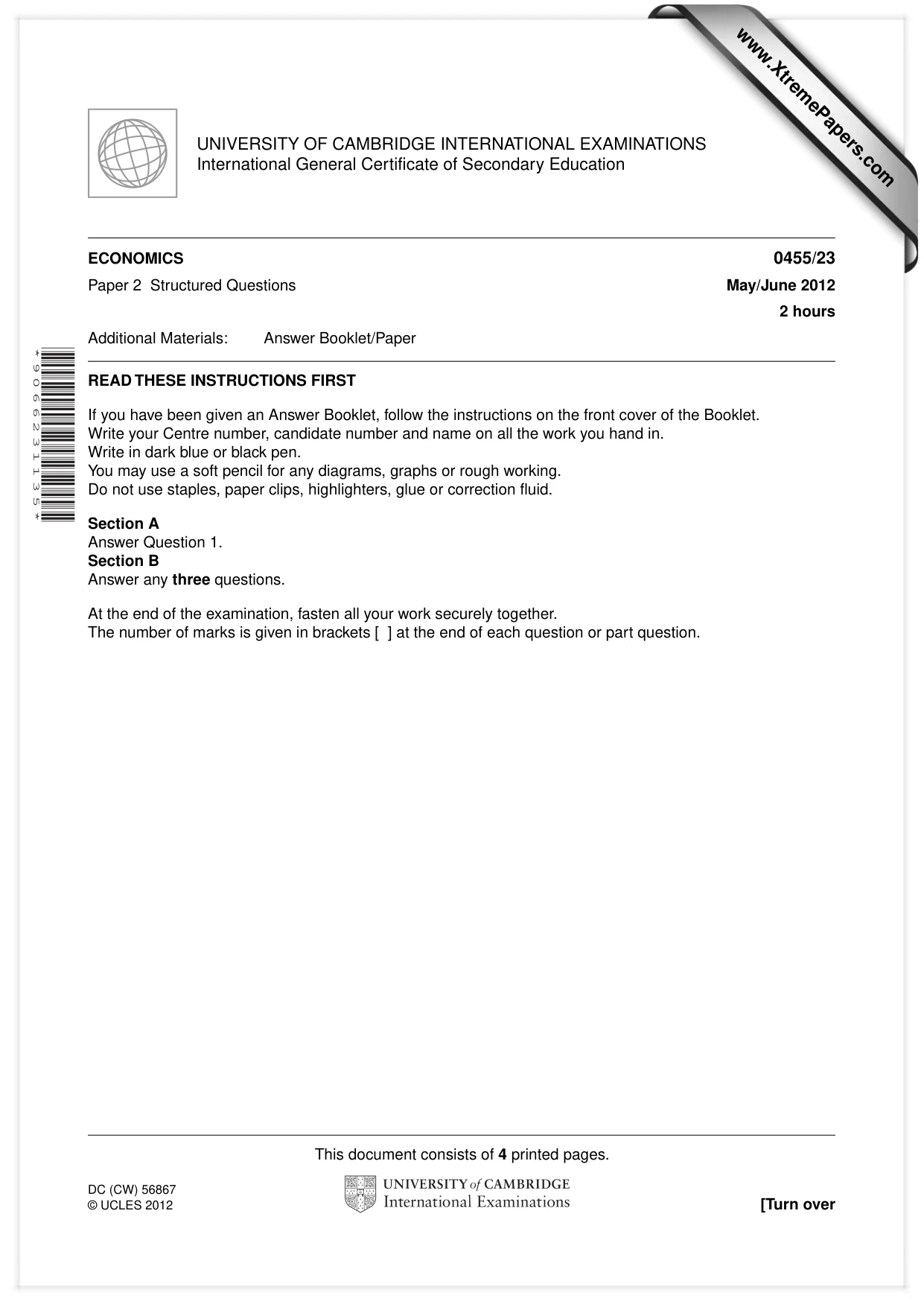
Question paper, page 1
This document consists of 4 printed pages. DC (CW) 56867 © UCLES 2012 [Turn over UNIVERSITY OF CAMBRIDGE INTERNATIONAL EXAMINATIONS International General Certificate of Secondary Education * 9 0 6 6 2 3 1 1 3 5 * ECONOMICS 0455/23 Paper 2 Structured Questions May/June 2012 2 hours Additional Materials: Answer Booklet/Paper READ THESE INSTRUCTIONS FIRST If you have been given an Answer Booklet, follow the instructions on the front cover of the Booklet. Write your Centre number, candidate number and name on all the work you hand in. Write in dark blue or black pen. You may use a soft pencil for any diagrams, graphs or rough working. Do not use staples, paper clips, highlighters, glue or correction fluid. Section A Answer Question 1. Section B Answer any three questions. At the end of the examination, fasten all your work securely together. The number of marks is given in brackets [ ] at the end of each question or part question. www.XtremePapers.com
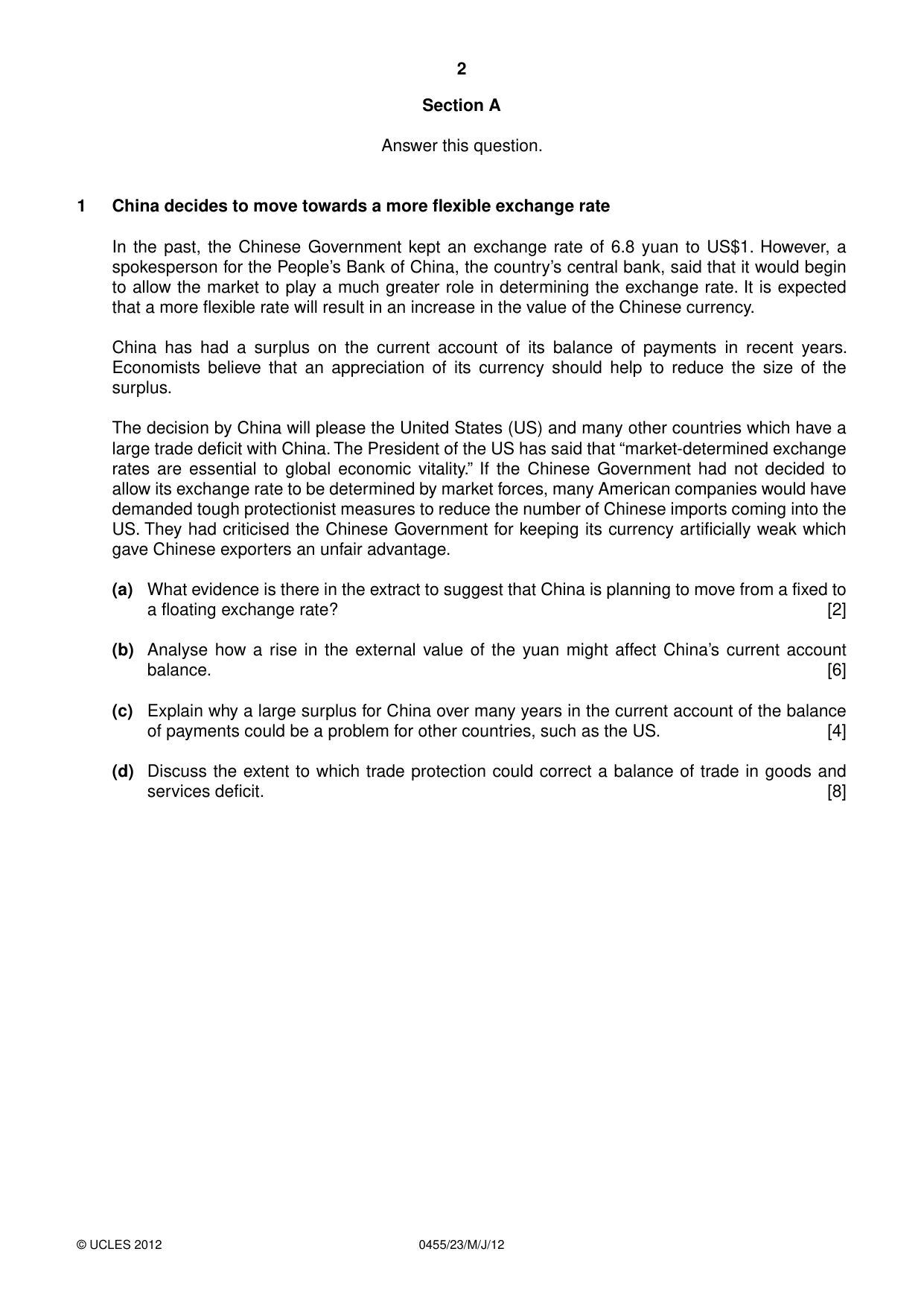
Question paper, page 2
2 0455/23/M/J/12 © UCLES 2012 Section A Answer this question. 1 China decides to move towards a more flexible exchange rate In the past, the Chinese Government kept an exchange rate of 6.8 yuan to US$1. However, a spokesperson for the People’s Bank of China, the country’s central bank, said that it would begin to allow the market to play a much greater role in determining the exchange rate. It is expected that a more flexible rate will result in an increase in the value of the Chinese currency. China has had a surplus on the current account of its balance of payments in recent years. Economists believe that an appreciation of its currency should help to reduce the size of the surplus. The decision by China will please the United States (US) and many other countries which have a large trade deficit with China. The President of the US has said that “market-determined exchange rates are essential to global economic vitality.” If the Chinese Government had not decided to allow its exchange rate to be determined by market forces, many American companies would have demanded tough protectionist measures to reduce the number of Chinese imports coming into the US. They had criticised the Chinese Government for keeping its currency artificially weak which gave Chinese exporters an unfair advantage. (a) What evidence is there in the extract to suggest that China is planning to move from a fixed to a floating exchange rate? [2] (b) Analyse how a rise in the external value of the yuan might affect China’s current account balance. [6] (c) Explain why a large surplus for China over many years in the current account of the balance of payments could be a problem for other countries, such as the US. [4] (d) Discuss the extent to which trade protection could correct a balance of trade in goods and services deficit. [8]
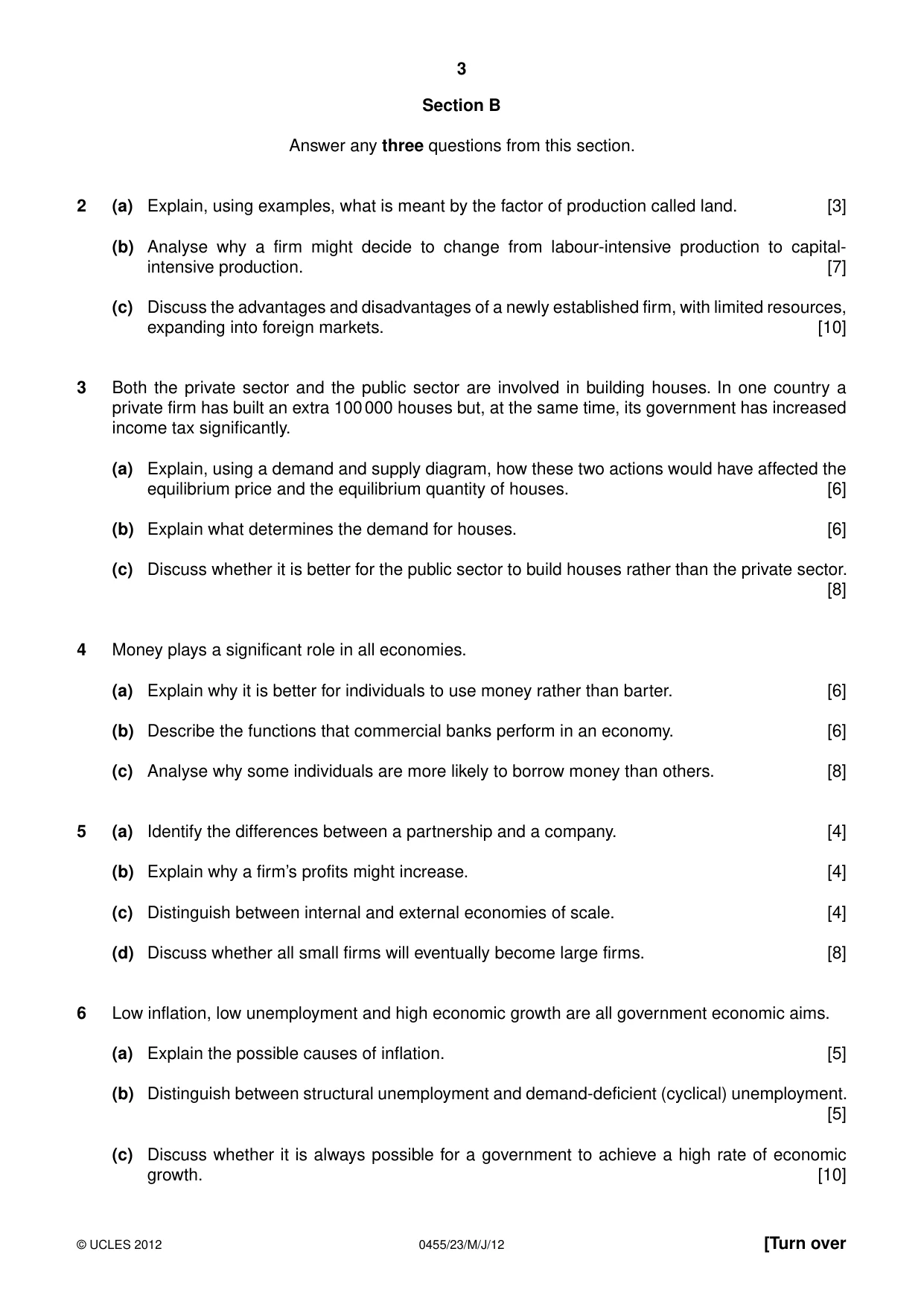
Question paper, page 3
3 0455/23/M/J/12 © UCLES 2012 [Turn over Section B Answer any three questions from this section. 2 (a) Explain, using examples, what is meant by the factor of production called land. [3] (b) Analyse why a firm might decide to change from labour-intensive production to capital- intensive production. [7] (c) Discuss the advantages and disadvantages of a newly established firm, with limited resources, expanding into foreign markets. [10] 3 Both the private sector and the public sector are involved in building houses. In one country a private firm has built an extra 100 000 houses but, at the same time, its government has increased income tax significantly. (a) Explain, using a demand and supply diagram, how these two actions would have affected the equilibrium price and the equilibrium quantity of houses. [6] (b) Explain what determines the demand for houses. [6] (c) Discuss whether it is better for the public sector to build houses rather than the private sector. [8] 4 Money plays a significant role in all economies. (a) Explain why it is better for individuals to use money rather than barter. [6] (b) Describe the functions that commercial banks perform in an economy. [6] (c) Analyse why some individuals are more likely to borrow money than others. [8] 5 (a) Identify the differences between a partnership and a company. [4] (b) Explain why a firm’s profits might increase. [4] (c) Distinguish between internal and external economies of scale. [4] (d) Discuss whether all small firms will eventually become large firms. [8] 6 Low inflation, low unemployment and high economic growth are all government economic aims. (a) Explain the possible causes of inflation. [5] (b) Distinguish between structural unemployment and demand-deficient (cyclical) unemployment. [5] (c) Discuss whether it is always possible for a government to achieve a high rate of economic growth. [10]
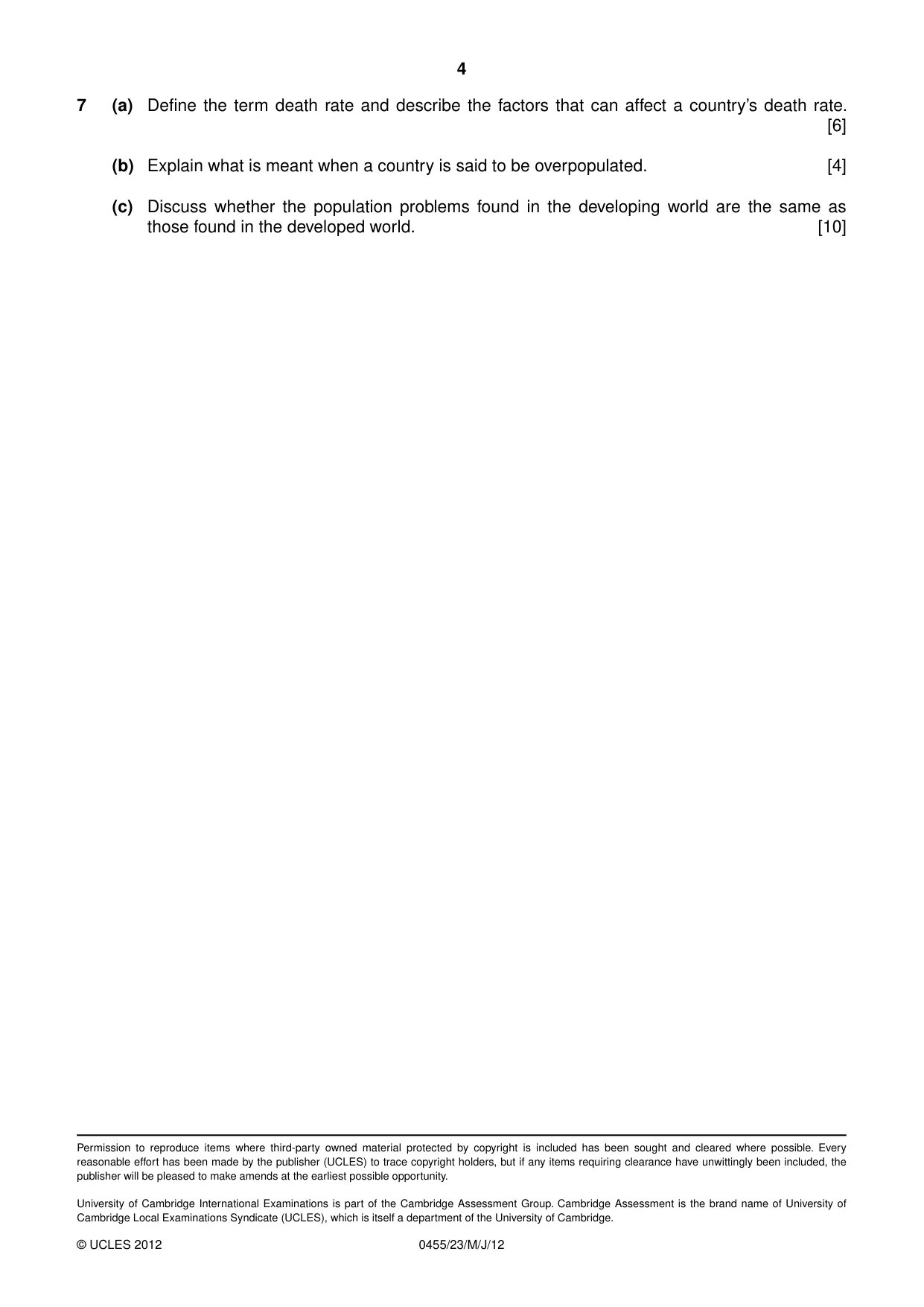
Question paper, page 4
4 0455/23/M/J/12 © UCLES 2012 7 (a) Define the term death rate and describe the factors that can affect a country’s death rate. [6] (b) Explain what is meant when a country is said to be overpopulated. [4] (c) Discuss whether the population problems found in the developing world are the same as those found in the developed world. [10] Permission to reproduce items where third-party owned material protected by copyright is included has been sought and cleared where possible. Every reasonable effort has been made by the publisher (UCLES) to trace copyright holders, but if any items requiring clearance have unwittingly been included, the publisher will be pleased to make amends at the earliest possible opportunity. University of Cambridge International Examinations is part of the Cambridge Assessment Group. Cambridge Assessment is the brand name of University of Cambridge Local Examinations Syndicate (UCLES), which is itself a department of the University of Cambridge.
Mark scheme, page 1
UNIVERSITY OF CAMBRIDGE INTERNATIONAL EXAMINATIONS International General Certificate of Secondary Education MARK SCHEME for the May/June 2012 question paper for the guidance of teachers 0455 ECONOMICS 0455/23 Paper 2 (Structured Questions), maximum raw mark 80 This mark scheme is published as an aid to teachers and candidates, to indicate the requirements of the examination. It shows the basis on which Examiners were instructed to award marks. It does not indicate the details of the discussions that took place at an Examiners’ meeting before marking began, which would have considered the acceptability of alternative answers. Mark schemes must be read in conjunction with the question papers and the report on the examination. • Cambridge will not enter into discussions or correspondence in connection with these mark schemes. Cambridge is publishing the mark schemes for the May/June 2012 question papers for most IGCSE, GCE Advanced Level and Advanced Subsidiary Level syllabuses and some Ordinary Level syllabuses. www.XtremePapers.com
Mark scheme, page 2
Page 2 Mark Scheme: Teachers’ version Syllabus Paper IGCSE – May/June 2012 0455 23 © University of Cambridge International Examinations 2012 1 (a) Evidence could include: • a spokesperson for the People’s Bank of China has said that the bank would begin to allow the market to play a much greater role in determining the exchange rate • view of economists that an appreciation of currency should help to reduce the size of China’s current account surplus • supportive comment from the President of the US. Any two comments. [2] (b) Possible reason: • appreciation of the currency will make exports more expensive • and imports less expensive • this is likely to decrease the demand for Chinese exports and increase the demand for imports • this will decrease China’s total export revenue and increase total import expenditure if PED is elastic • this will reduce China’s current account surplus. [6] (c) Possible problems: • distinction between short-term and long-term needs to be made clear • one country’s surplus is another country’s deficit; the country with the deficit may introduce protectionist measures (as indicated) • countries with deficits could face exchange rate problem • countries with deficits could face employment problem. [4] (d) Up to 4 marks for description of protection, such as: • tariffs • quotas • subsidies • exchange controls • embargoes/bans. There is a maximum of 2 marks for a basic list of protection methods. Up to 4 marks for discussion of their effectiveness and the other possible ways to reduce the trade deficit, such as: • increase in exports • reduction of exchange rate. There is a maximum of 6 marks if there is no consideration of other possible ways to reduce the deficit OR where the candidate does not consider the relative effectiveness of different possible methods. [8]
Mark scheme, page 3
Page 3 Mark Scheme: Teachers’ version Syllabus Paper IGCSE – May/June 2012 0455 23 © University of Cambridge International Examinations 2012 2 (a) Explanation could include: • it refers to all those natural resources used in production (1). Examples could include: • coal, oil, gold, fish, forests and the land itself (2). [3] (b) Possible reasons: • labour has become too expensive • there has been too much disruption e.g. as a result of strike action • there is not enough labour available • the labour available does not have the necessary skills/training/qualifications • the firm wants to take advantage of new capital equipment • this could increase the efficiency of production and keep costs down • increased complexity of product being made. [7] (c) Possible advantages: • would be able to benefit from expanded production • such as through benefiting from economies of scale • lowering the cost of production • firm would be able to increase profits. Possible disadvantages: • we are told that it is newly established, so would such expansion be unwise/premature? • it might be better to get itself established in domestic market • this is especially given the reference to limited resources. Credit comment on opportunity cost in relation to limited resources and comment on the advantages and disadvantages to a firm, a domestic economy or the international economy. There is a maximum mark of 8 for an answer which does not address the impact of limited resources. Allow answers on expanding into foreign markets in terms of either exporting to, or establishing production units in, foreign markets. [10]
Mark scheme, page 4
Page 4 Mark Scheme: Teachers’ version Syllabus Paper IGCSE – May/June 2012 0455 23 © University of Cambridge International Examinations 2012 3 (a) Diagram: • labels (price, quantity, demand, supply) (1) • shift of the demand curve to the left (1) • shift of the supply curve to the right (1) • change in equilibrium position (1). Explanation: • explanation of why both demand and supply curves shift (1) • explanation of the correct eventual equilibrium position in terms of equilibrium price or equilibrium quantity (1). [6] (b) Possible factors: • level of (disposable) income • price of houses • condition/size of houses • location of houses • knowledge about/advertising of houses available • associated fees • taxation to be paid. A list-like answer can gain no more than 3 marks. There is a maximum of 3 marks for an explanation of one influence. 6 marks can be gained by a candidate for a thorough explanation of two influences. [6] (c) Discussion could include: Arguments in favour: Arguments against: • a government should be better able to raise funds to pay for the building of houses • safety standards might be better enforced • a government would be better able to make it affordable for all people • this would help to reduce poverty • this would help to increase the standards of living of the people • a government might not be able to raise funds • private sector may be in a better position to do this • would depend on fiscal stance of government • a government might have to raise taxation to bring in the necessary revenue to pay for the house building • what of other areas of public expenditure – issue of opportunity cost A one-sided answer can gain no more than 5 marks; conclusion likely to be that a mixture of housing provision, involving both sectors, would be the best solution. [8]
Mark scheme, page 5
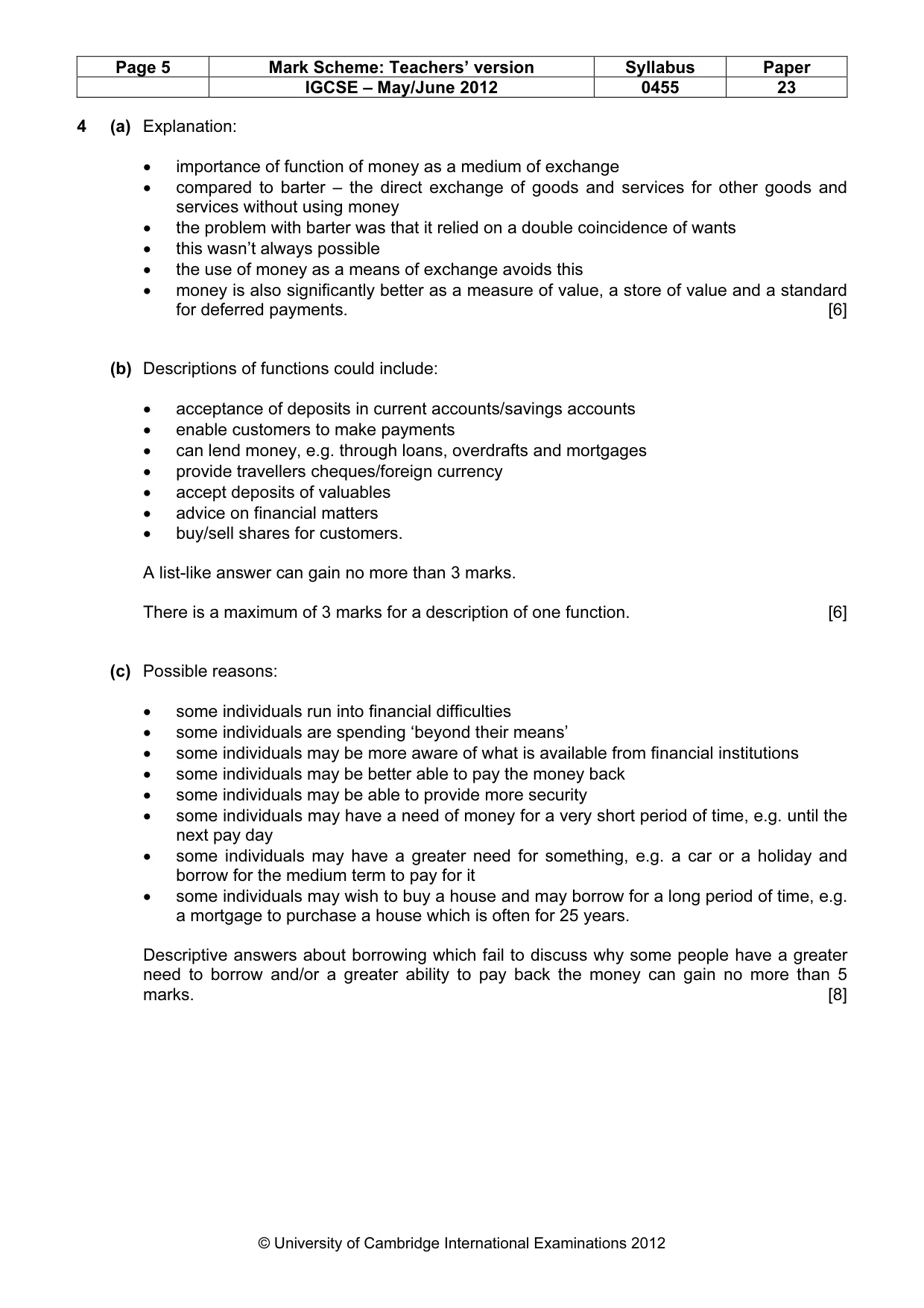
Page 5 Mark Scheme: Teachers’ version Syllabus Paper IGCSE – May/June 2012 0455 23 © University of Cambridge International Examinations 2012 4 (a) Explanation: • importance of function of money as a medium of exchange • compared to barter – the direct exchange of goods and services for other goods and services without using money • the problem with barter was that it relied on a double coincidence of wants • this wasn’t always possible • the use of money as a means of exchange avoids this • money is also significantly better as a measure of value, a store of value and a standard for deferred payments. [6] (b) Descriptions of functions could include: • acceptance of deposits in current accounts/savings accounts • enable customers to make payments • can lend money, e.g. through loans, overdrafts and mortgages • provide travellers cheques/foreign currency • accept deposits of valuables • advice on financial matters • buy/sell shares for customers. A list-like answer can gain no more than 3 marks. There is a maximum of 3 marks for a description of one function. [6] (c) Possible reasons: • some individuals run into financial difficulties • some individuals are spending ‘beyond their means’ • some individuals may be more aware of what is available from financial institutions • some individuals may be better able to pay the money back • some individuals may be able to provide more security • some individuals may have a need of money for a very short period of time, e.g. until the next pay day • some individuals may have a greater need for something, e.g. a car or a holiday and borrow for the medium term to pay for it • some individuals may wish to buy a house and may borrow for a long period of time, e.g. a mortgage to purchase a house which is often for 25 years. Descriptive answers about borrowing which fail to discuss why some people have a greater need to borrow and/or a greater ability to pay back the money can gain no more than 5 marks. [8]
Mark scheme, page 6
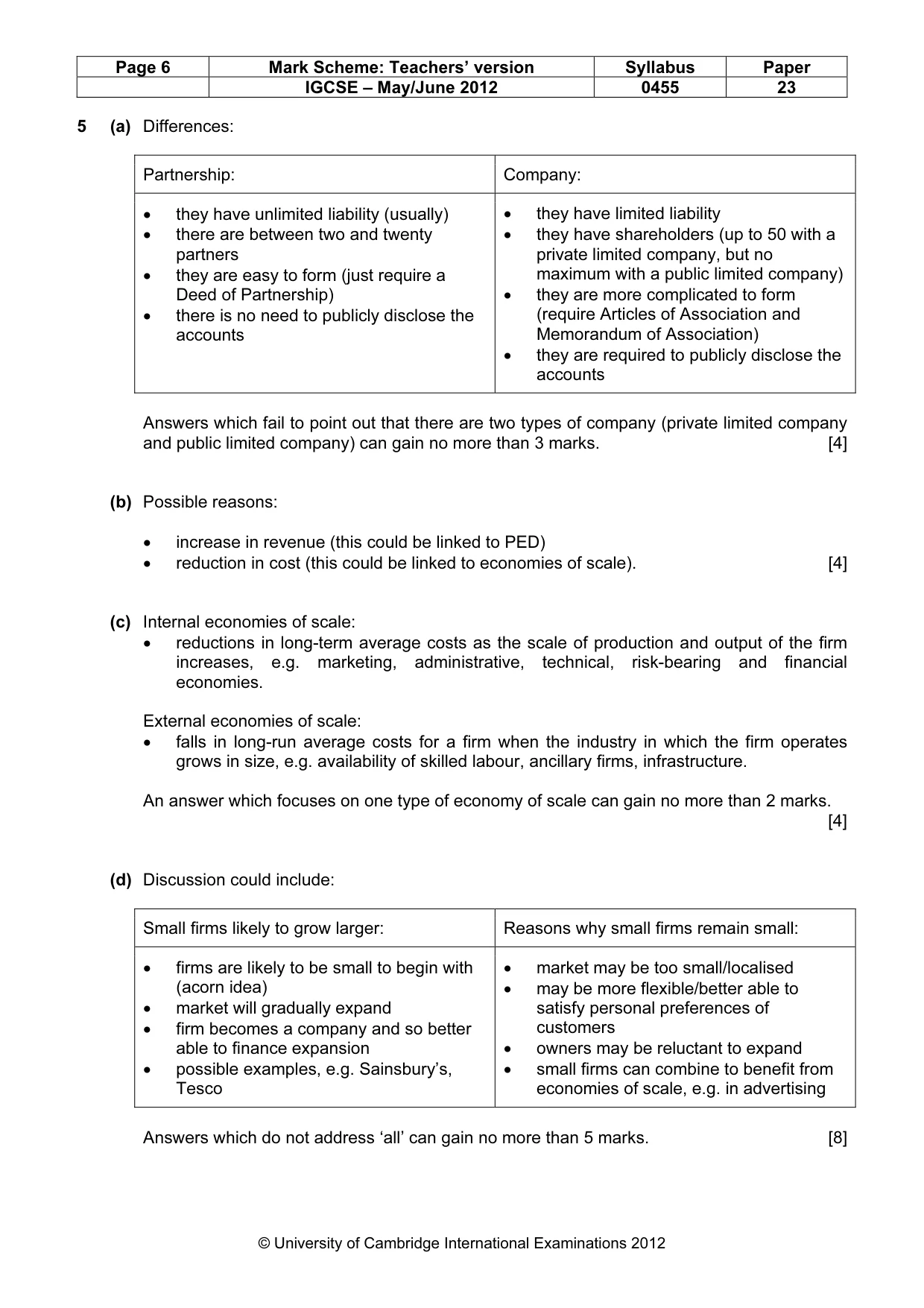
Page 6 Mark Scheme: Teachers’ version Syllabus Paper IGCSE – May/June 2012 0455 23 © University of Cambridge International Examinations 2012 5 (a) Differences: Partnership: Company: • they have unlimited liability (usually) • there are between two and twenty partners • they are easy to form (just require a Deed of Partnership) • there is no need to publicly disclose the accounts • they have limited liability • they have shareholders (up to 50 with a private limited company, but no maximum with a public limited company) • they are more complicated to form (require Articles of Association and Memorandum of Association) • they are required to publicly disclose the accounts Answers which fail to point out that there are two types of company (private limited company and public limited company) can gain no more than 3 marks. [4] (b) Possible reasons: • increase in revenue (this could be linked to PED) • reduction in cost (this could be linked to economies of scale). [4] (c) Internal economies of scale: • reductions in long-term average costs as the scale of production and output of the firm increases, e.g. marketing, administrative, technical, risk-bearing and financial economies. External economies of scale: • falls in long-run average costs for a firm when the industry in which the firm operates grows in size, e.g. availability of skilled labour, ancillary firms, infrastructure. An answer which focuses on one type of economy of scale can gain no more than 2 marks. [4] (d) Discussion could include: Small firms likely to grow larger: Reasons why small firms remain small: • firms are likely to be small to begin with (acorn idea) • market will gradually expand • firm becomes a company and so better able to finance expansion • possible examples, e.g. Sainsbury’s, Tesco • market may be too small/localised • may be more flexible/better able to satisfy personal preferences of customers • owners may be reluctant to expand • small firms can combine to benefit from economies of scale, e.g. in advertising Answers which do not address ‘all’ can gain no more than 5 marks. [8]
Mark scheme, page 7
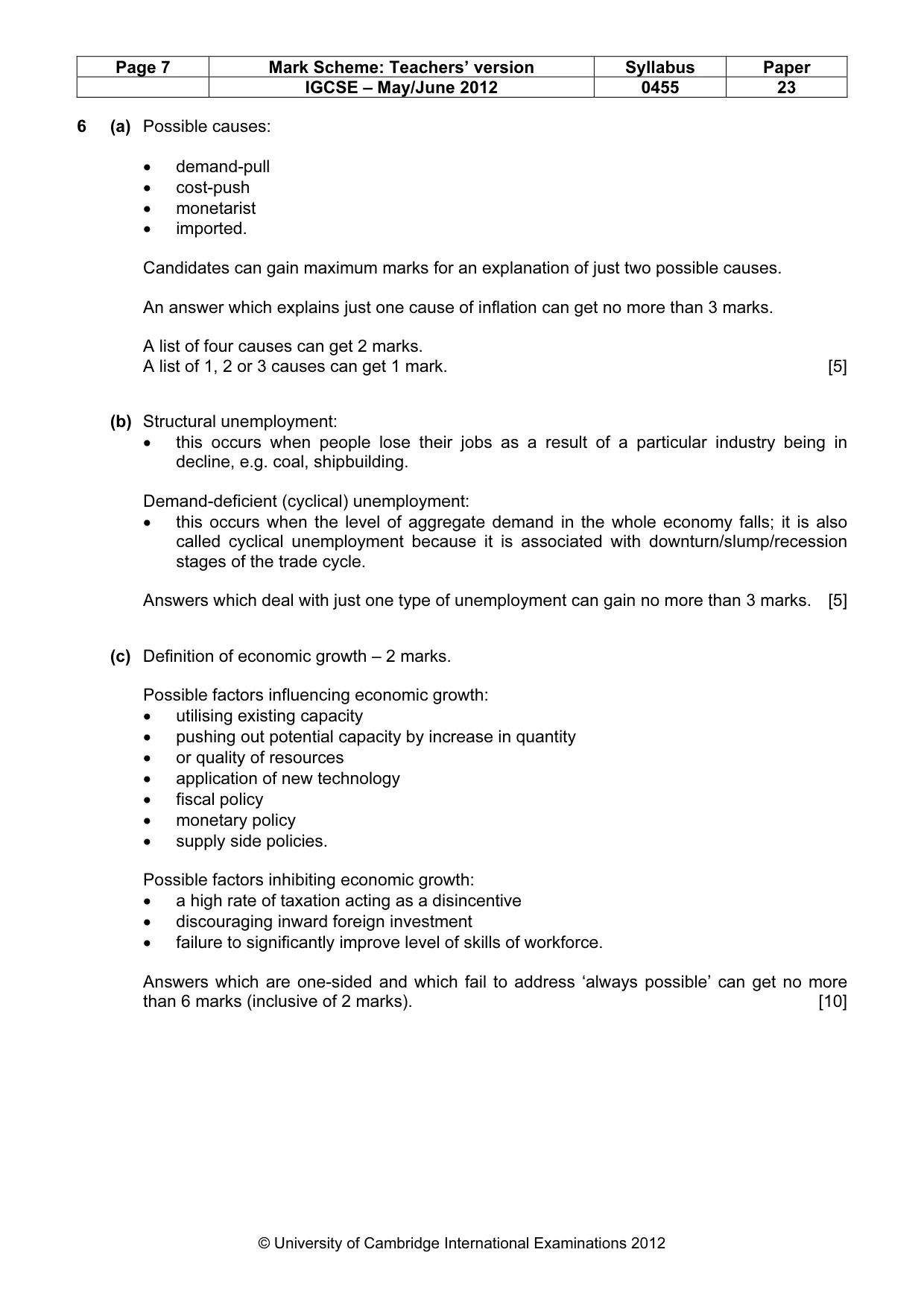
Page 7 Mark Scheme: Teachers’ version Syllabus Paper IGCSE – May/June 2012 0455 23 © University of Cambridge International Examinations 2012 6 (a) Possible causes: • demand-pull • cost-push • monetarist • imported. Candidates can gain maximum marks for an explanation of just two possible causes. An answer which explains just one cause of inflation can get no more than 3 marks. A list of four causes can get 2 marks. A list of 1, 2 or 3 causes can get 1 mark. [5] (b) Structural unemployment: • this occurs when people lose their jobs as a result of a particular industry being in decline, e.g. coal, shipbuilding. Demand-deficient (cyclical) unemployment: • this occurs when the level of aggregate demand in the whole economy falls; it is also called cyclical unemployment because it is associated with downturn/slump/recession stages of the trade cycle. Answers which deal with just one type of unemployment can gain no more than 3 marks. [5] (c) Definition of economic growth – 2 marks. Possible factors influencing economic growth: • utilising existing capacity • pushing out potential capacity by increase in quantity • or quality of resources • application of new technology • fiscal policy • monetary policy • supply side policies. Possible factors inhibiting economic growth: • a high rate of taxation acting as a disincentive • discouraging inward foreign investment • failure to significantly improve level of skills of workforce. Answers which are one-sided and which fail to address ‘always possible’ can get no more than 6 marks (inclusive of 2 marks). [10]
Mark scheme, page 8
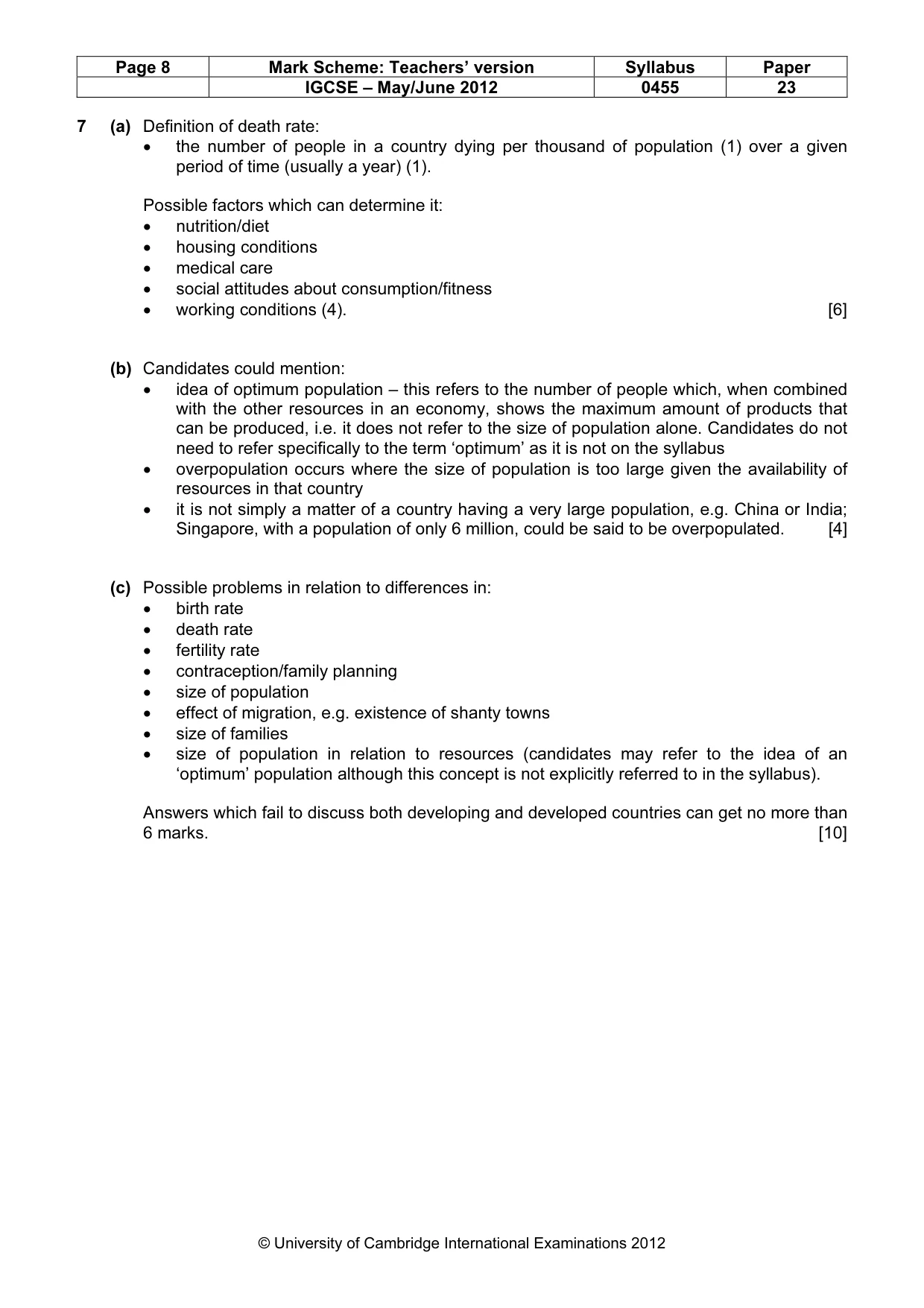
Page 8 Mark Scheme: Teachers’ version Syllabus Paper IGCSE – May/June 2012 0455 23 © University of Cambridge International Examinations 2012 7 (a) Definition of death rate: • the number of people in a country dying per thousand of population (1) over a given period of time (usually a year) (1). Possible factors which can determine it: • nutrition/diet • housing conditions • medical care • social attitudes about consumption/fitness • working conditions (4). [6] (b) Candidates could mention: • idea of optimum population – this refers to the number of people which, when combined with the other resources in an economy, shows the maximum amount of products that can be produced, i.e. it does not refer to the size of population alone. Candidates do not need to refer specifically to the term ‘optimum’ as it is not on the syllabus • overpopulation occurs where the size of population is too large given the availability of resources in that country • it is not simply a matter of a country having a very large population, e.g. China or India; Singapore, with a population of only 6 million, could be said to be overpopulated. [4] (c) Possible problems in relation to differences in: • birth rate • death rate • fertility rate • contraception/family planning • size of population • effect of migration, e.g. existence of shanty towns • size of families • size of population in relation to resources (candidates may refer to the idea of an ‘optimum’ population although this concept is not explicitly referred to in the syllabus). Answers which fail to discuss both developing and developed countries can get no more than 6 marks. [10]
What you needed in this session
Cambridge’s own grade thresholds for 2012 May/June, Paper 2 · Variant 3. A higher threshold means an easier paper — the bar moves with how the cohort did.