Cambridge IGCSE Economics 0455 — 2012 May/June Paper 2 · Variant 1
0455/21/M/J/12 · 80 marks · ≈90 min
The question paper and its mark scheme, free to read here and free to download. This is Cambridge’s own paper, exactly as it was sat.
Question paper4 pages

Mark scheme10 pages
Answers below. Sit the paper first if you are practising.
Paper as text
Question paper, page 1
This document consists of 3 printed pages and 1 blank page. DC (NH) 46666/2 © UCLES 2012 [Turn over UNIVERSITY OF CAMBRIDGE INTERNATIONAL EXAMINATIONS International General Certificate of Secondary Education * 0 0 7 6 7 6 2 8 3 4 * ECONOMICS 0455/21 Paper 2 Structured Questions May/June 2012 2 hours Additional Materials: Answer Booklet/Paper READ THESE INSTRUCTIONS FIRST If you have been given an Answer Booklet, follow the instructions on the front cover of the Booklet. Write your Centre number, candidate number and name on all the work you hand in. Write in dark blue or black pen. You may use a soft pencil for any diagrams, graphs or rough working. Do not use staples, paper clips, highlighters, glue or correction fluid. Section A Answer Question 1. Section B Answer any three questions. At the end of the examination, fasten all your work securely together. The number of marks is given in brackets [ ] at the end of each question or part question. www.XtremePapers.com
Question paper, page 2
2 0455/21/M/J/12 © UCLES 2012 Section A Answer this question. 1 A major change in the Indian economy A major change in India has been the decrease in the primary sector and an increase in the manufacturing sector. Agriculture’s share of India’s national output has dropped from 40% in 1980 to 17% in 2010. For the first time, the primary sector is smaller than the secondary sector (manufacturing and construction). As a result, even more workers are leaving the land to work in the secondary sector. There has been a large increase in investment in new plant and machinery in the manufacturing sector and much of this has been due to multi-national firms deciding to locate in India. In April 2008, the Indian Government passed the National Rural Employment Guarantee Act. This promised those living in the rural areas at least 100 days’ work each year at a minimum wage. A local trade union leader stated that “people here are feeling a sense of security for the first time.” A major problem for India, however, is inflation. The prices of many items have been rising significantly. The price of sugar, for example, rose by 35% in 2010. The Reserve Bank of India, the country’s central bank, has announced that it will need to change the rate of interest. (a) Explain why workers might decide to move from the primary sector to the secondary sector of an economy. [4] (b) What are the advantages of the Indian Government promising employment in rural areas? [4] (c) Analyse how a change in India’s interest rate might influence its inflation rate. [4] (d) Discuss whether it is always a benefit to a developing economy when a multi-national firm decides to locate there. [8]
Question paper, page 3
3 0455/21/M/J/12 © UCLES 2012 Section B Answer any three questions from this section. 2 (a) Explain the economic problem of scarcity. [3] (b) Define the concept of opportunity cost. [3] (c) Distinguish, using examples, between the different factors of production. [6] (d) Discuss whether a country should conserve or use its natural resources. [8] 3 (a) Explain the functions that money performs in an economy. [6] (b) The demand for workers with a particular skill has increased significantly in the last few years. Explain, using a demand and supply diagram, how this is likely to affect the equilibrium wage and the equilibrium quantity of such workers. [6] (c) Discuss whether skilled workers always earn more than unskilled workers. [8] 4 (a) Explain why a firm might wish to change from a private limited company to a public limited company. [4] (b) Analyse why most firms want to maximise profits. [6] (c) Discuss whether a firm will always benefit from an increase in its size. [10] 5 (a) Explain why a government may sometimes decide to produce certain goods and services itself rather than leave the production of such goods and services to the private sector. [6] (b) Define the term full employment. [4] (c) Discuss the extent to which frictional unemployment and structural unemployment are serious problems for (i) an individual and (ii) the economy. [10] 6 (a) Explain why the rate of population growth varies so much between some countries. [6] (b) Explain the main features of a country classified as being developed. [6] (c) Discuss whether an ageing population should always be regarded as an economic problem. [8] 7 (a) Describe the structure of the current account of a country’s balance of payments. [4] (b) Explain the main causes of a current account deficit. [6] (c) Discuss what would be the most effective policies to increase a country’s exports. [10]
Question paper, page 4
4 0455/21/M/J/12 © UCLES 2012 BLANK PAGE Permission to reproduce items where third-party owned material protected by copyright is included has been sought and cleared where possible. Every reasonable effort has been made by the publisher (UCLES) to trace copyright holders, but if any items requiring clearance have unwittingly been included, the publisher will be pleased to make amends at the earliest possible opportunity. University of Cambridge International Examinations is part of the Cambridge Assessment Group. Cambridge Assessment is the brand name of University of Cambridge Local Examinations Syndicate (UCLES), which is itself a department of the University of Cambridge.
Mark scheme, page 1
UNIVERSITY OF CAMBRIDGE INTERNATIONAL EXAMINATIONS International General Certificate of Secondary Education MARK SCHEME for the May/June 2012 question paper for the guidance of teachers 0455 ECONOMICS 0455/21 Paper 2 (Structured Questions), maximum raw mark 80 This mark scheme is published as an aid to teachers and candidates, to indicate the requirements of the examination. It shows the basis on which Examiners were instructed to award marks. It does not indicate the details of the discussions that took place at an Examiners’ meeting before marking began, which would have considered the acceptability of alternative answers. Mark schemes must be read in conjunction with the question papers and the report on the examination. • Cambridge will not enter into discussions or correspondence in connection with these mark schemes. Cambridge is publishing the mark schemes for the May/June 2012 question papers for most IGCSE, GCE Advanced Level and Advanced Subsidiary Level syllabuses and some Ordinary Level syllabuses. www.XtremePapers.com
Mark scheme, page 2
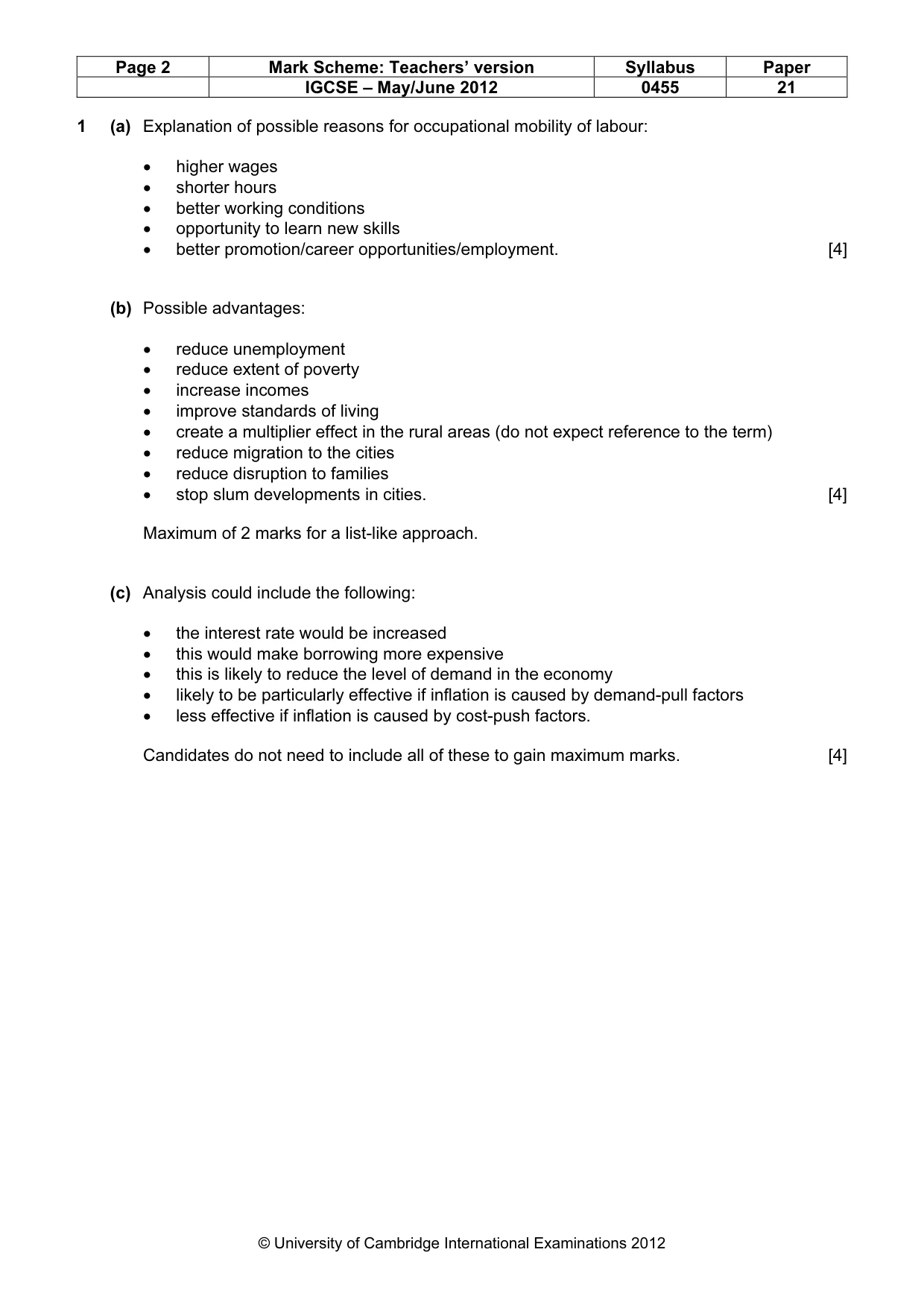
Page 2 Mark Scheme: Teachers’ version Syllabus Paper IGCSE – May/June 2012 0455 21 © University of Cambridge International Examinations 2012 1 (a) Explanation of possible reasons for occupational mobility of labour: • higher wages • shorter hours • better working conditions • opportunity to learn new skills • better promotion/career opportunities/employment. [4] (b) Possible advantages: • reduce unemployment • reduce extent of poverty • increase incomes • improve standards of living • create a multiplier effect in the rural areas (do not expect reference to the term) • reduce migration to the cities • reduce disruption to families • stop slum developments in cities. [4] Maximum of 2 marks for a list-like approach. (c) Analysis could include the following: • the interest rate would be increased • this would make borrowing more expensive • this is likely to reduce the level of demand in the economy • likely to be particularly effective if inflation is caused by demand-pull factors • less effective if inflation is caused by cost-push factors. Candidates do not need to include all of these to gain maximum marks. [4]
Mark scheme, page 3
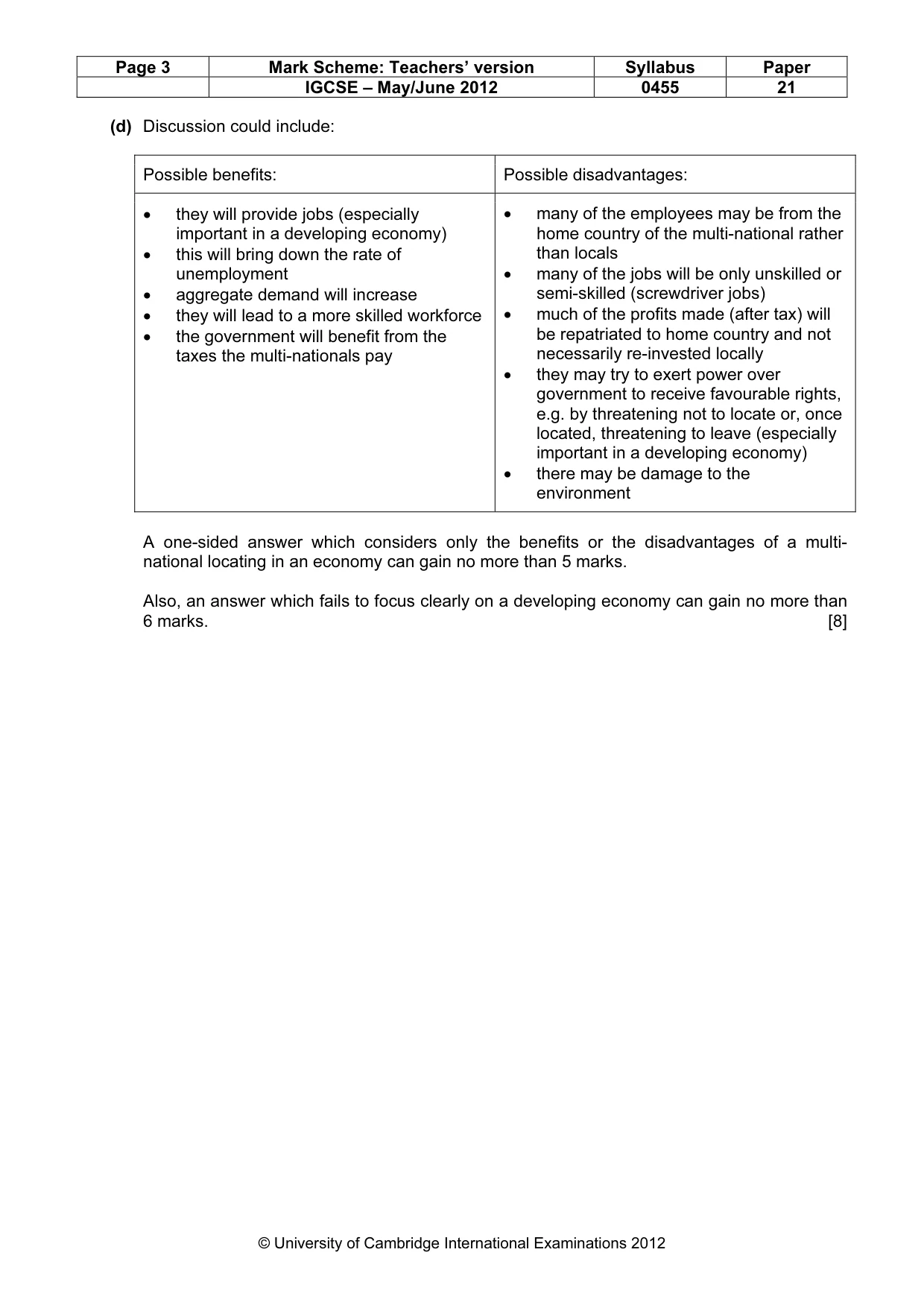
Page 3 Mark Scheme: Teachers’ version Syllabus Paper IGCSE – May/June 2012 0455 21 © University of Cambridge International Examinations 2012 (d) Discussion could include: Possible benefits: Possible disadvantages: • they will provide jobs (especially important in a developing economy) • this will bring down the rate of unemployment • aggregate demand will increase • they will lead to a more skilled workforce • the government will benefit from the taxes the multi-nationals pay • many of the employees may be from the home country of the multi-national rather than locals • many of the jobs will be only unskilled or semi-skilled (screwdriver jobs) • much of the profits made (after tax) will be repatriated to home country and not necessarily re-invested locally • they may try to exert power over government to receive favourable rights, e.g. by threatening not to locate or, once located, threatening to leave (especially important in a developing economy) • there may be damage to the environment A one-sided answer which considers only the benefits or the disadvantages of a multi- national locating in an economy can gain no more than 5 marks. Also, an answer which fails to focus clearly on a developing economy can gain no more than 6 marks. [8]
Mark scheme, page 4
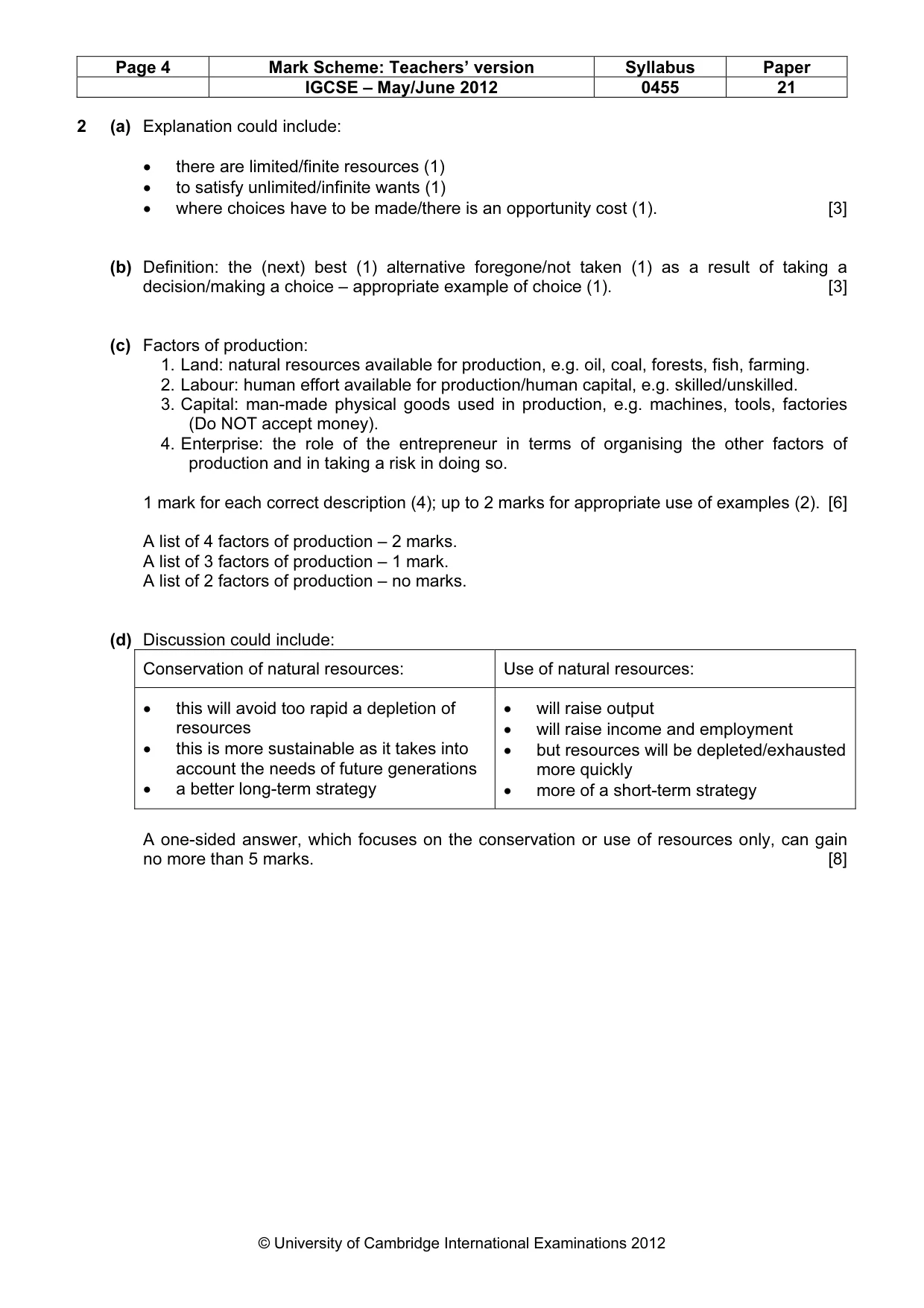
Page 4 Mark Scheme: Teachers’ version Syllabus Paper IGCSE – May/June 2012 0455 21 © University of Cambridge International Examinations 2012 2 (a) Explanation could include: • there are limited/finite resources (1) • to satisfy unlimited/infinite wants (1) • where choices have to be made/there is an opportunity cost (1). [3] (b) Definition: the (next) best (1) alternative foregone/not taken (1) as a result of taking a decision/making a choice – appropriate example of choice (1). [3] (c) Factors of production: 1. Land: natural resources available for production, e.g. oil, coal, forests, fish, farming. 2. Labour: human effort available for production/human capital, e.g. skilled/unskilled. 3. Capital: man-made physical goods used in production, e.g. machines, tools, factories (Do NOT accept money). 4. Enterprise: the role of the entrepreneur in terms of organising the other factors of production and in taking a risk in doing so. 1 mark for each correct description (4); up to 2 marks for appropriate use of examples (2). [6] A list of 4 factors of production – 2 marks. A list of 3 factors of production – 1 mark. A list of 2 factors of production – no marks. (d) Discussion could include: Conservation of natural resources: Use of natural resources: • this will avoid too rapid a depletion of resources • this is more sustainable as it takes into account the needs of future generations • a better long-term strategy • will raise output • will raise income and employment • but resources will be depleted/exhausted more quickly • more of a short-term strategy A one-sided answer, which focuses on the conservation or use of resources only, can gain no more than 5 marks. [8]
Mark scheme, page 5
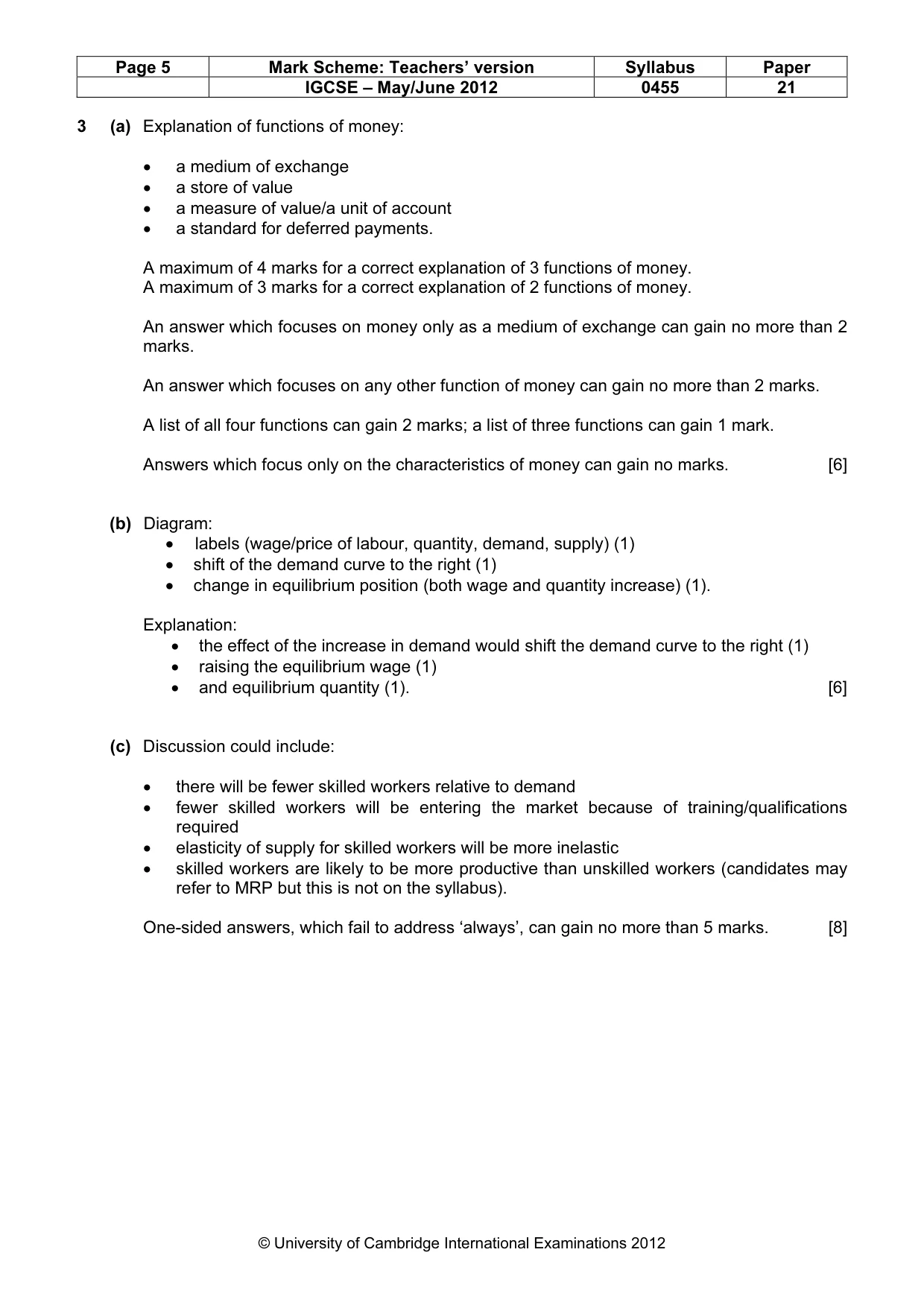
Page 5 Mark Scheme: Teachers’ version Syllabus Paper IGCSE – May/June 2012 0455 21 © University of Cambridge International Examinations 2012 3 (a) Explanation of functions of money: • a medium of exchange • a store of value • a measure of value/a unit of account • a standard for deferred payments. A maximum of 4 marks for a correct explanation of 3 functions of money. A maximum of 3 marks for a correct explanation of 2 functions of money. An answer which focuses on money only as a medium of exchange can gain no more than 2 marks. An answer which focuses on any other function of money can gain no more than 2 marks. A list of all four functions can gain 2 marks; a list of three functions can gain 1 mark. Answers which focus only on the characteristics of money can gain no marks. [6] (b) Diagram: • labels (wage/price of labour, quantity, demand, supply) (1) • shift of the demand curve to the right (1) • change in equilibrium position (both wage and quantity increase) (1). Explanation: • the effect of the increase in demand would shift the demand curve to the right (1) • raising the equilibrium wage (1) • and equilibrium quantity (1). [6] (c) Discussion could include: • there will be fewer skilled workers relative to demand • fewer skilled workers will be entering the market because of training/qualifications required • elasticity of supply for skilled workers will be more inelastic • skilled workers are likely to be more productive than unskilled workers (candidates may refer to MRP but this is not on the syllabus). One-sided answers, which fail to address ‘always’, can gain no more than 5 marks. [8]
Mark scheme, page 6
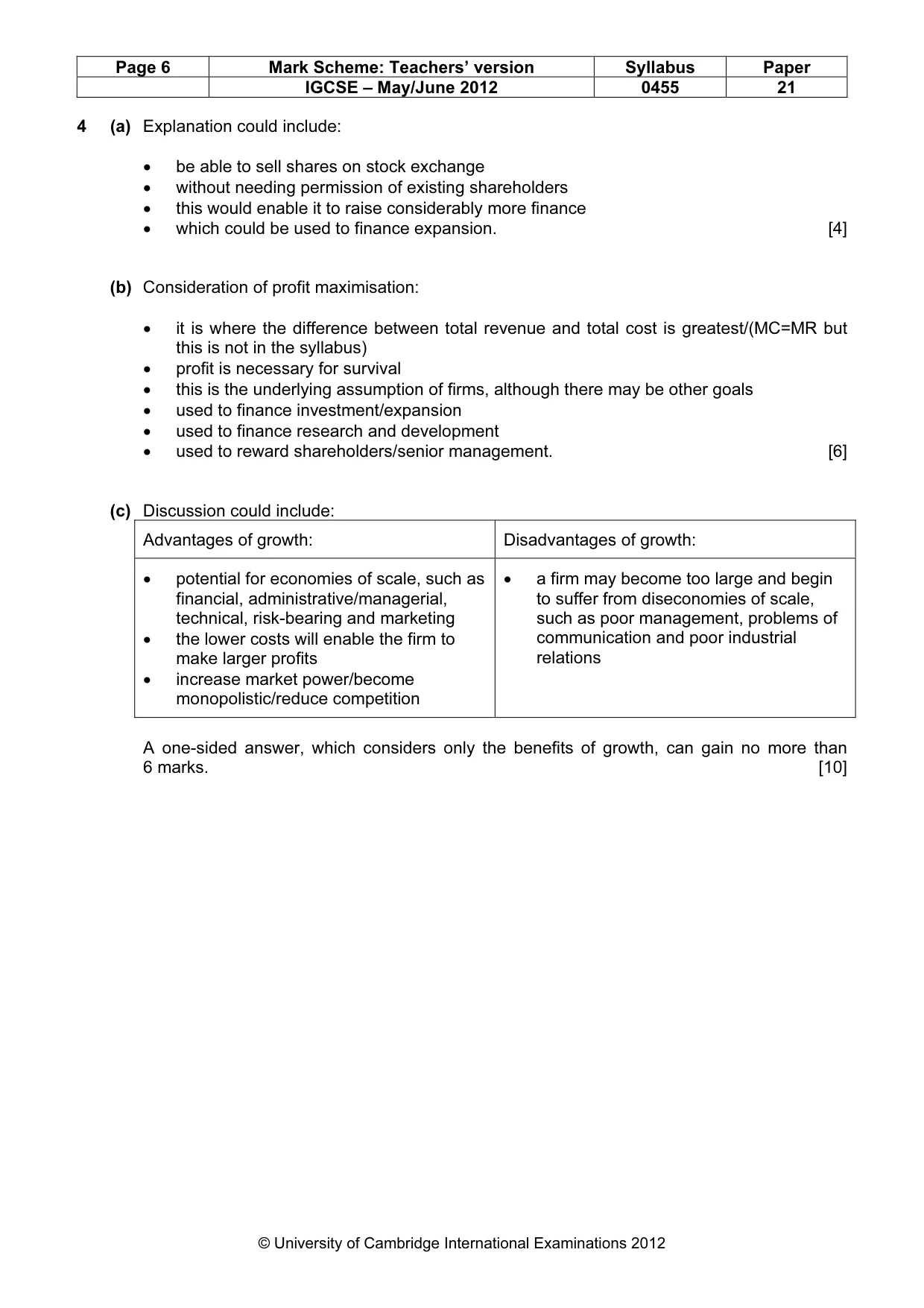
Page 6 Mark Scheme: Teachers’ version Syllabus Paper IGCSE – May/June 2012 0455 21 © University of Cambridge International Examinations 2012 4 (a) Explanation could include: • be able to sell shares on stock exchange • without needing permission of existing shareholders • this would enable it to raise considerably more finance • which could be used to finance expansion. [4] (b) Consideration of profit maximisation: • it is where the difference between total revenue and total cost is greatest/(MC=MR but this is not in the syllabus) • profit is necessary for survival • this is the underlying assumption of firms, although there may be other goals • used to finance investment/expansion • used to finance research and development • used to reward shareholders/senior management. [6] (c) Discussion could include: Advantages of growth: Disadvantages of growth: • potential for economies of scale, such as financial, administrative/managerial, technical, risk-bearing and marketing • the lower costs will enable the firm to make larger profits • increase market power/become monopolistic/reduce competition • a firm may become too large and begin to suffer from diseconomies of scale, such as poor management, problems of communication and poor industrial relations A one-sided answer, which considers only the benefits of growth, can gain no more than 6 marks. [10]
Mark scheme, page 7
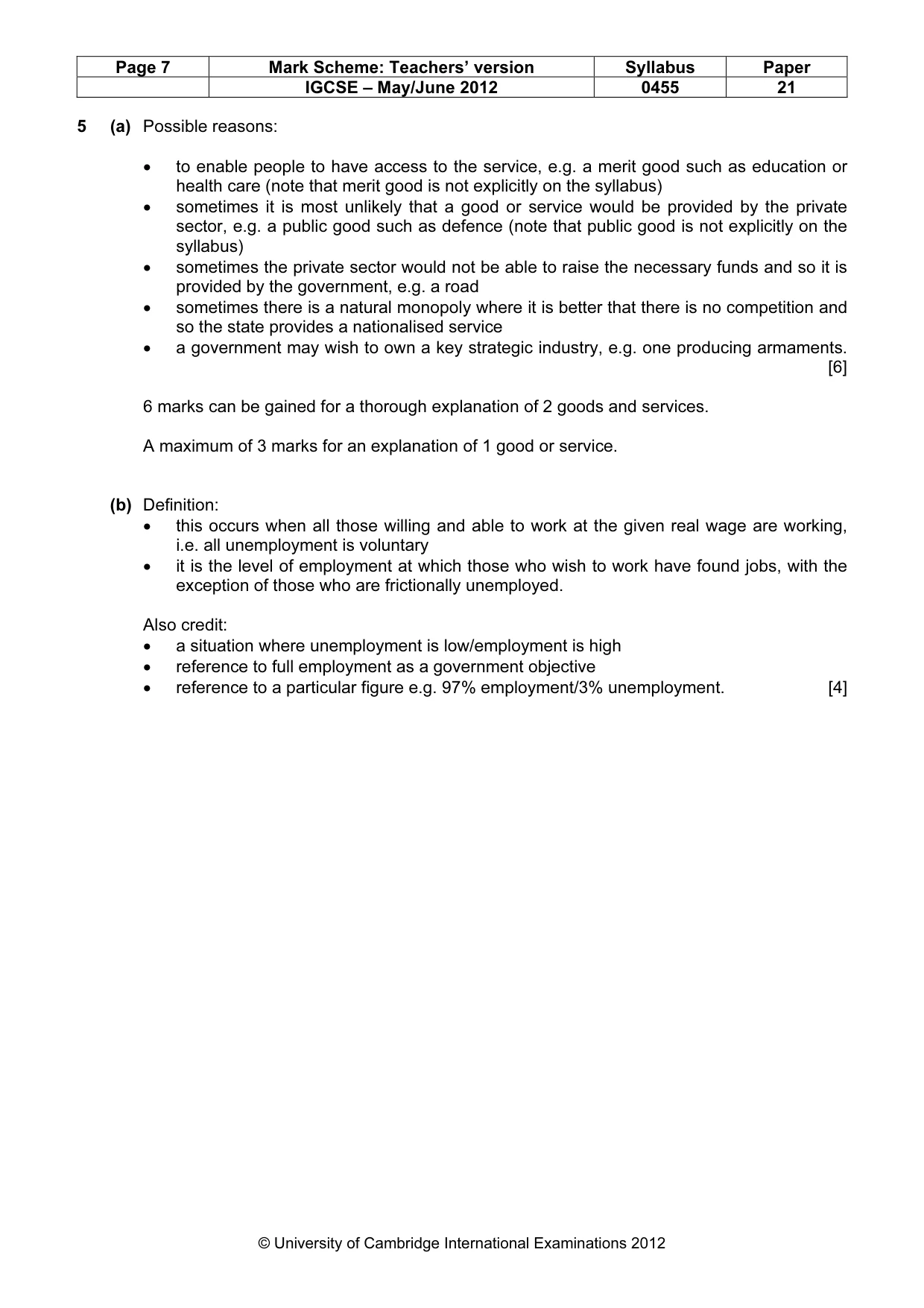
Page 7 Mark Scheme: Teachers’ version Syllabus Paper IGCSE – May/June 2012 0455 21 © University of Cambridge International Examinations 2012 5 (a) Possible reasons: • to enable people to have access to the service, e.g. a merit good such as education or health care (note that merit good is not explicitly on the syllabus) • sometimes it is most unlikely that a good or service would be provided by the private sector, e.g. a public good such as defence (note that public good is not explicitly on the syllabus) • sometimes the private sector would not be able to raise the necessary funds and so it is provided by the government, e.g. a road • sometimes there is a natural monopoly where it is better that there is no competition and so the state provides a nationalised service • a government may wish to own a key strategic industry, e.g. one producing armaments. [6] 6 marks can be gained for a thorough explanation of 2 goods and services. A maximum of 3 marks for an explanation of 1 good or service. (b) Definition: • this occurs when all those willing and able to work at the given real wage are working, i.e. all unemployment is voluntary • it is the level of employment at which those who wish to work have found jobs, with the exception of those who are frictionally unemployed. Also credit: • a situation where unemployment is low/employment is high • reference to full employment as a government objective • reference to a particular figure e.g. 97% employment/3% unemployment. [4]
Mark scheme, page 8
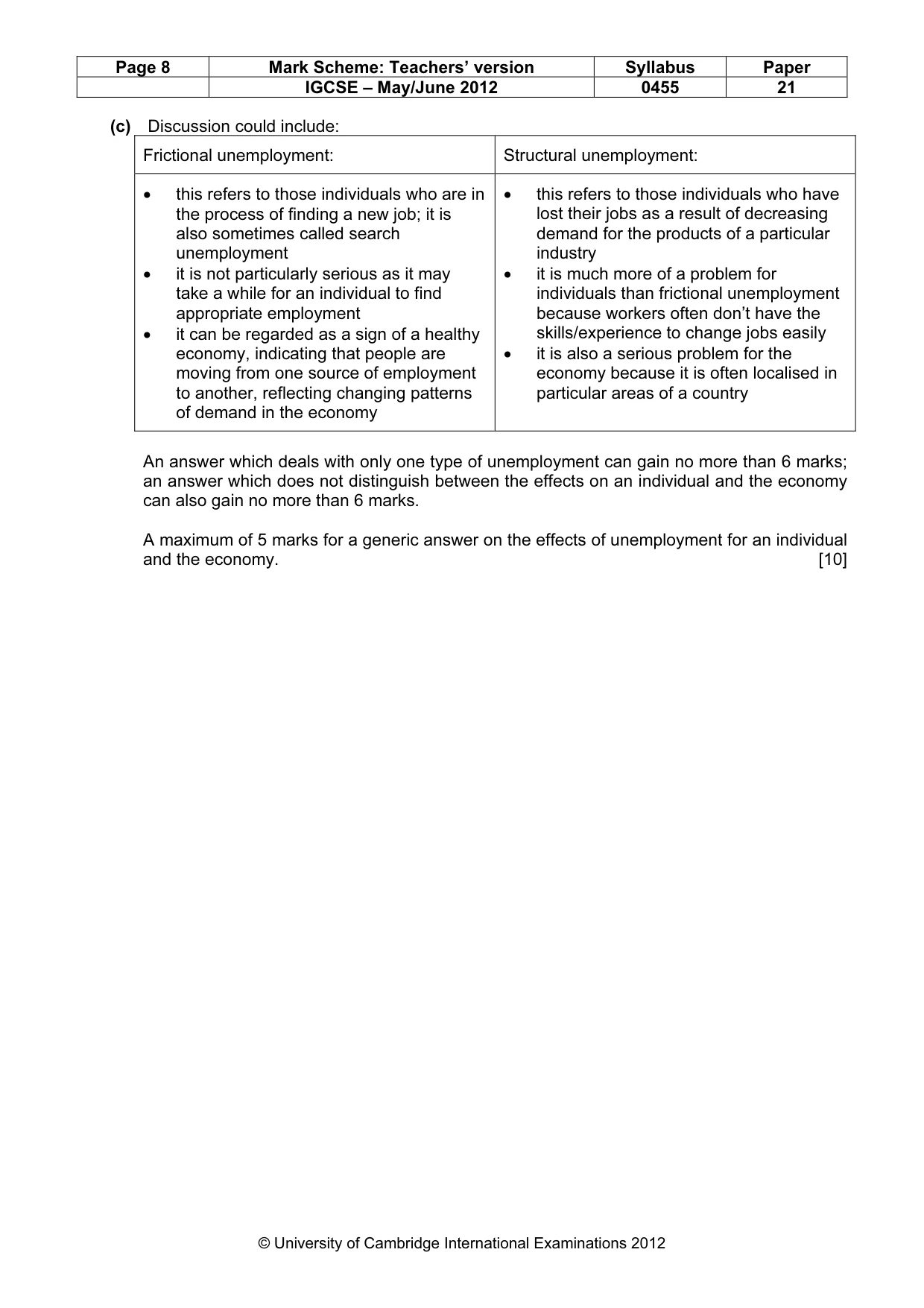
Page 8 Mark Scheme: Teachers’ version Syllabus Paper IGCSE – May/June 2012 0455 21 © University of Cambridge International Examinations 2012 (c) Discussion could include: Frictional unemployment: Structural unemployment: • this refers to those individuals who are in the process of finding a new job; it is also sometimes called search unemployment • it is not particularly serious as it may take a while for an individual to find appropriate employment • it can be regarded as a sign of a healthy economy, indicating that people are moving from one source of employment to another, reflecting changing patterns of demand in the economy • this refers to those individuals who have lost their jobs as a result of decreasing demand for the products of a particular industry • it is much more of a problem for individuals than frictional unemployment because workers often don’t have the skills/experience to change jobs easily • it is also a serious problem for the economy because it is often localised in particular areas of a country An answer which deals with only one type of unemployment can gain no more than 6 marks; an answer which does not distinguish between the effects on an individual and the economy can also gain no more than 6 marks. A maximum of 5 marks for a generic answer on the effects of unemployment for an individual and the economy. [10]
Mark scheme, page 9
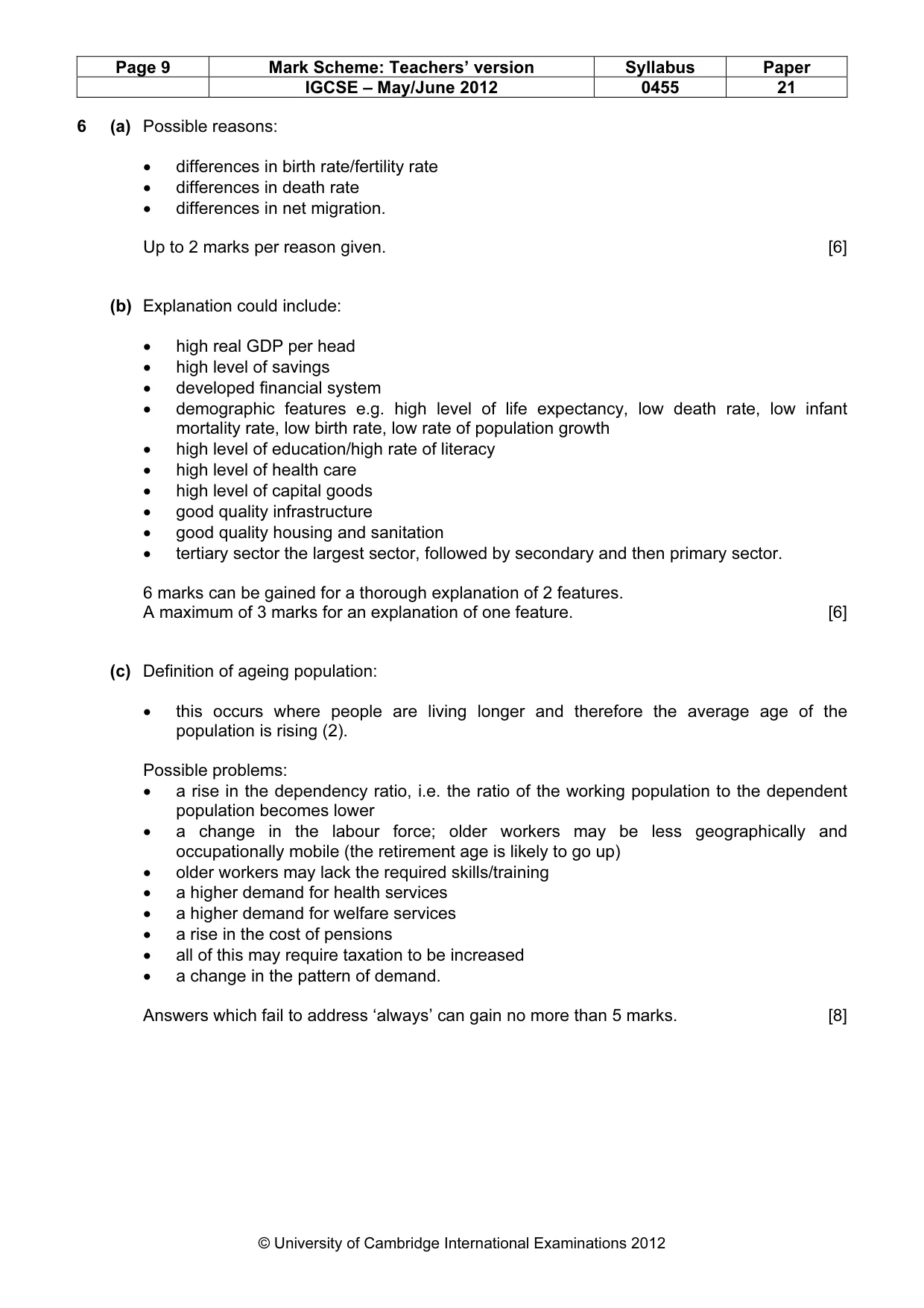
Page 9 Mark Scheme: Teachers’ version Syllabus Paper IGCSE – May/June 2012 0455 21 © University of Cambridge International Examinations 2012 6 (a) Possible reasons: • differences in birth rate/fertility rate • differences in death rate • differences in net migration. Up to 2 marks per reason given. [6] (b) Explanation could include: • high real GDP per head • high level of savings • developed financial system • demographic features e.g. high level of life expectancy, low death rate, low infant mortality rate, low birth rate, low rate of population growth • high level of education/high rate of literacy • high level of health care • high level of capital goods • good quality infrastructure • good quality housing and sanitation • tertiary sector the largest sector, followed by secondary and then primary sector. 6 marks can be gained for a thorough explanation of 2 features. A maximum of 3 marks for an explanation of one feature. [6] (c) Definition of ageing population: • this occurs where people are living longer and therefore the average age of the population is rising (2). Possible problems: • a rise in the dependency ratio, i.e. the ratio of the working population to the dependent population becomes lower • a change in the labour force; older workers may be less geographically and occupationally mobile (the retirement age is likely to go up) • older workers may lack the required skills/training • a higher demand for health services • a higher demand for welfare services • a rise in the cost of pensions • all of this may require taxation to be increased • a change in the pattern of demand. Answers which fail to address ‘always’ can gain no more than 5 marks. [8]
Mark scheme, page 10
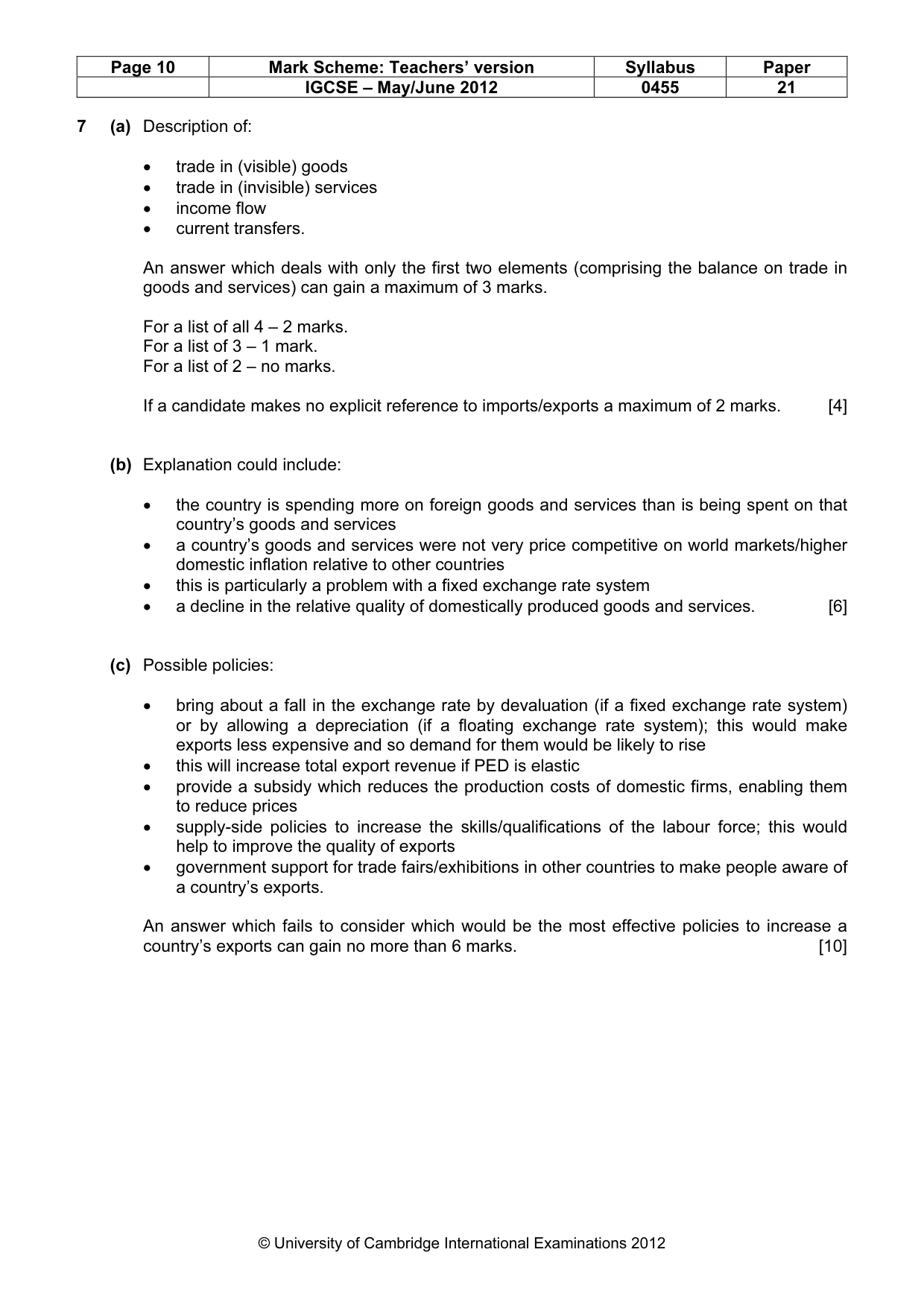
Page 10 Mark Scheme: Teachers’ version Syllabus Paper IGCSE – May/June 2012 0455 21 © University of Cambridge International Examinations 2012 7 (a) Description of: • trade in (visible) goods • trade in (invisible) services • income flow • current transfers. An answer which deals with only the first two elements (comprising the balance on trade in goods and services) can gain a maximum of 3 marks. For a list of all 4 – 2 marks. For a list of 3 – 1 mark. For a list of 2 – no marks. If a candidate makes no explicit reference to imports/exports a maximum of 2 marks. [4] (b) Explanation could include: • the country is spending more on foreign goods and services than is being spent on that country’s goods and services • a country’s goods and services were not very price competitive on world markets/higher domestic inflation relative to other countries • this is particularly a problem with a fixed exchange rate system • a decline in the relative quality of domestically produced goods and services. [6] (c) Possible policies: • bring about a fall in the exchange rate by devaluation (if a fixed exchange rate system) or by allowing a depreciation (if a floating exchange rate system); this would make exports less expensive and so demand for them would be likely to rise • this will increase total export revenue if PED is elastic • provide a subsidy which reduces the production costs of domestic firms, enabling them to reduce prices • supply-side policies to increase the skills/qualifications of the labour force; this would help to improve the quality of exports • government support for trade fairs/exhibitions in other countries to make people aware of a country’s exports. An answer which fails to consider which would be the most effective policies to increase a country’s exports can gain no more than 6 marks. [10]
What you needed in this session
Cambridge’s own grade thresholds for 2012 May/June, Paper 2 · Variant 1. A higher threshold means an easier paper — the bar moves with how the cohort did.