Cambridge IGCSE Economics 0455 — 2011 May/June Paper 2 · Variant 2
0455/22/M/J/11 · 80 marks · ≈90 min
The question paper and its mark scheme, free to read here and free to download. This is Cambridge’s own paper, exactly as it was sat.
Question paper4 pages
Mark scheme8 pages
Answers below. Sit the paper first if you are practising.
Paper as text
Question paper, page 1
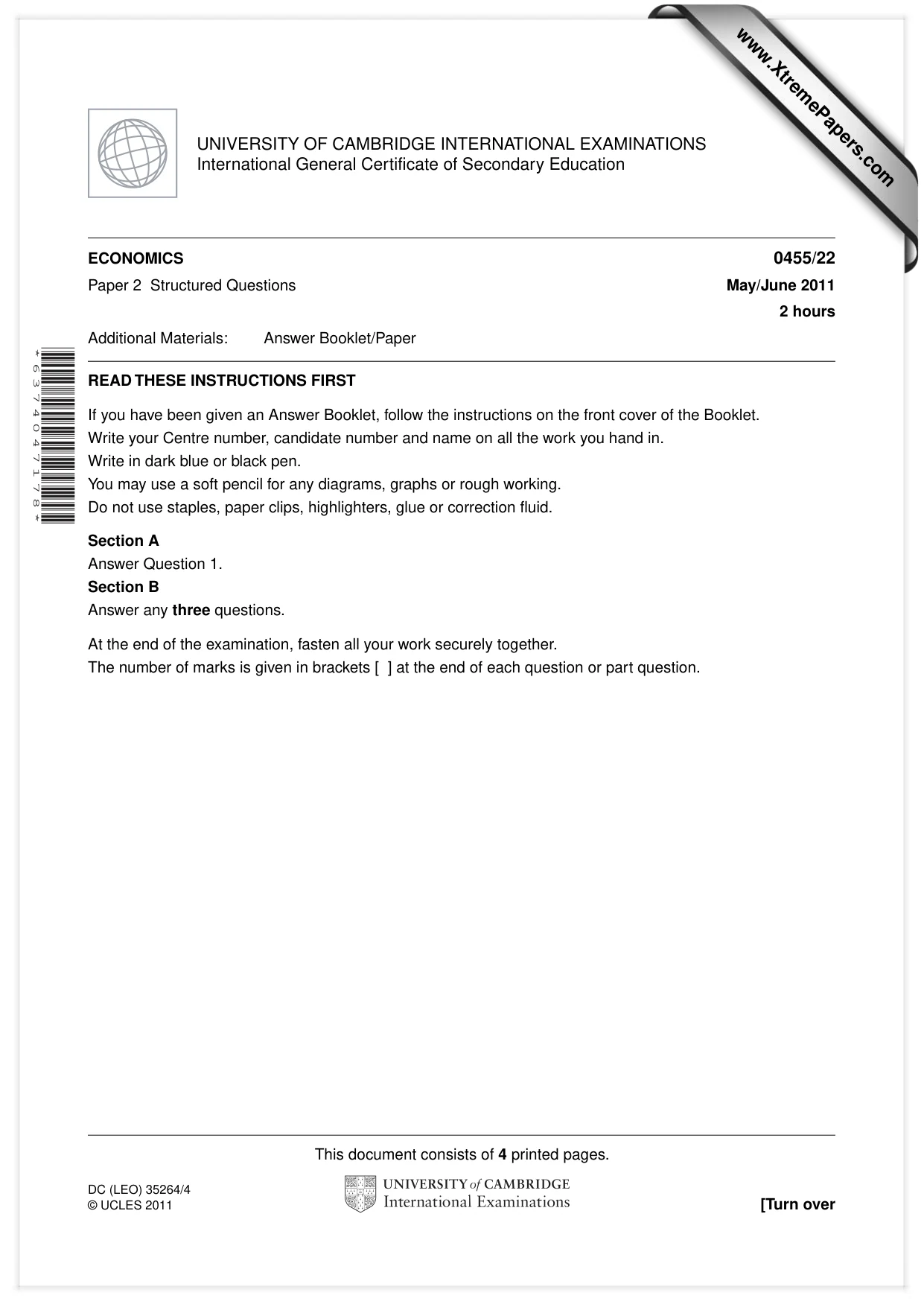
This document consists of 4 printed pages. DC (LEO) 35264/4 © UCLES 2011 [Turn over UNIVERSITY OF CAMBRIDGE INTERNATIONAL EXAMINATIONS International General Certificate of Secondary Education * 6 3 7 4 0 4 7 1 7 8 * ECONOMICS 0455/22 Paper 2 Structured Questions May/June 2011 2 hours Additional Materials: Answer Booklet/Paper READ THESE INSTRUCTIONS FIRST If you have been given an Answer Booklet, follow the instructions on the front cover of the Booklet. Write your Centre number, candidate number and name on all the work you hand in. Write in dark blue or black pen. You may use a soft pencil for any diagrams, graphs or rough working. Do not use staples, paper clips, highlighters, glue or correction fluid. Section A Answer Question 1. Section B Answer any three questions. At the end of the examination, fasten all your work securely together. The number of marks is given in brackets [ ] at the end of each question or part question. www.XtremePapers.com
Question paper, page 2
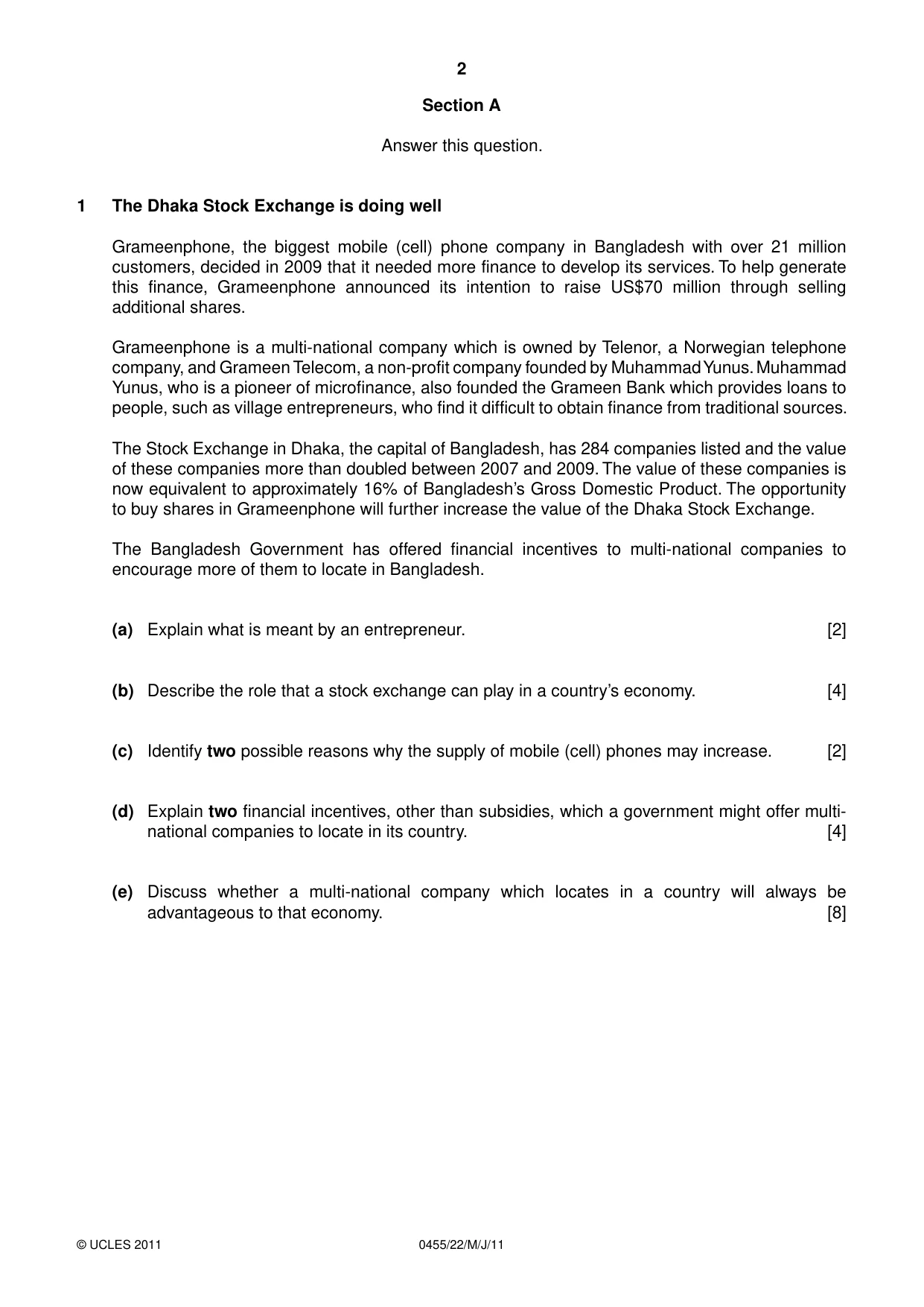
2 0455/22/M/J/11 © UCLES 2011 Section A Answer this question. 1 The Dhaka Stock Exchange is doing well Grameenphone, the biggest mobile (cell) phone company in Bangladesh with over 21 million customers, decided in 2009 that it needed more finance to develop its services. To help generate this finance, Grameenphone announced its intention to raise US$70 million through selling additional shares. Grameenphone is a multi-national company which is owned by Telenor, a Norwegian telephone company, and Grameen Telecom, a non-profit company founded by Muhammad Yunus. Muhammad Yunus, who is a pioneer of microfinance, also founded the Grameen Bank which provides loans to people, such as village entrepreneurs, who find it difficult to obtain finance from traditional sources. The Stock Exchange in Dhaka, the capital of Bangladesh, has 284 companies listed and the value of these companies more than doubled between 2007 and 2009. The value of these companies is now equivalent to approximately 16% of Bangladesh’s Gross Domestic Product. The opportunity to buy shares in Grameenphone will further increase the value of the Dhaka Stock Exchange. The Bangladesh Government has offered financial incentives to multi-national companies to encourage more of them to locate in Bangladesh. (a) Explain what is meant by an entrepreneur. [2] (b) Describe the role that a stock exchange can play in a country’s economy. [4] (c) Identify two possible reasons why the supply of mobile (cell) phones may increase. [2] (d) Explain two financial incentives, other than subsidies, which a government might offer multi- national companies to locate in its country. [4] (e) Discuss whether a multi-national company which locates in a country will always be advantageous to that economy. [8]
Question paper, page 3
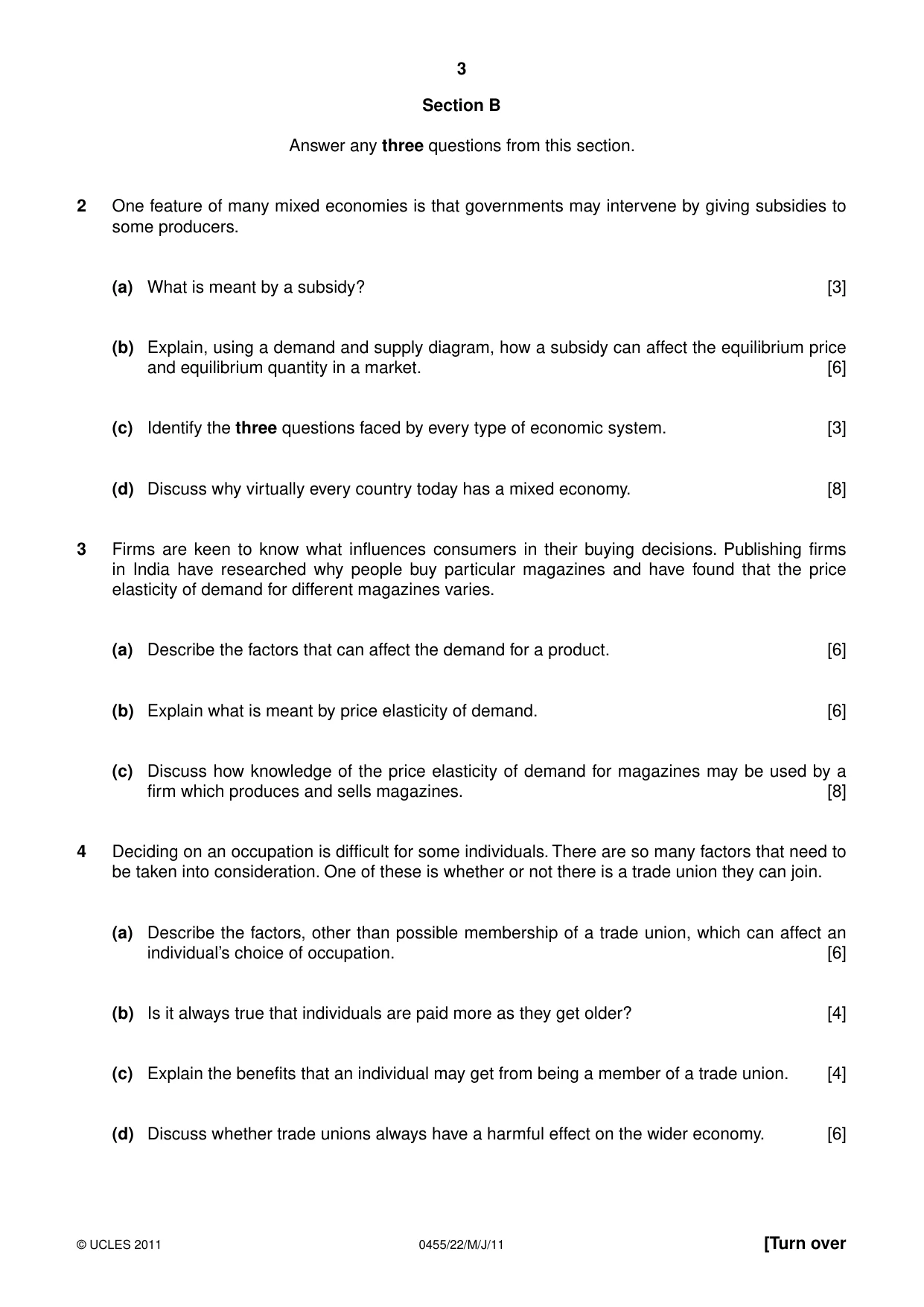
3 0455/22/M/J/11 © UCLES 2011 [Turn over Section B Answer any three questions from this section. 2 One feature of many mixed economies is that governments may intervene by giving subsidies to some producers. (a) What is meant by a subsidy? [3] (b) Explain, using a demand and supply diagram, how a subsidy can affect the equilibrium price and equilibrium quantity in a market. [6] (c) Identify the three questions faced by every type of economic system. [3] (d) Discuss why virtually every country today has a mixed economy. [8] 3 Firms are keen to know what influences consumers in their buying decisions. Publishing firms in India have researched why people buy particular magazines and have found that the price elasticity of demand for different magazines varies. (a) Describe the factors that can affect the demand for a product. [6] (b) Explain what is meant by price elasticity of demand. [6] (c) Discuss how knowledge of the price elasticity of demand for magazines may be used by a firm which produces and sells magazines. [8] 4 Deciding on an occupation is difficult for some individuals. There are so many factors that need to be taken into consideration. One of these is whether or not there is a trade union they can join. (a) Describe the factors, other than possible membership of a trade union, which can affect an individual’s choice of occupation. [6] (b) Is it always true that individuals are paid more as they get older? [4] (c) Explain the benefits that an individual may get from being a member of a trade union. [4] (d) Discuss whether trade unions always have a harmful effect on the wider economy. [6]
Question paper, page 4
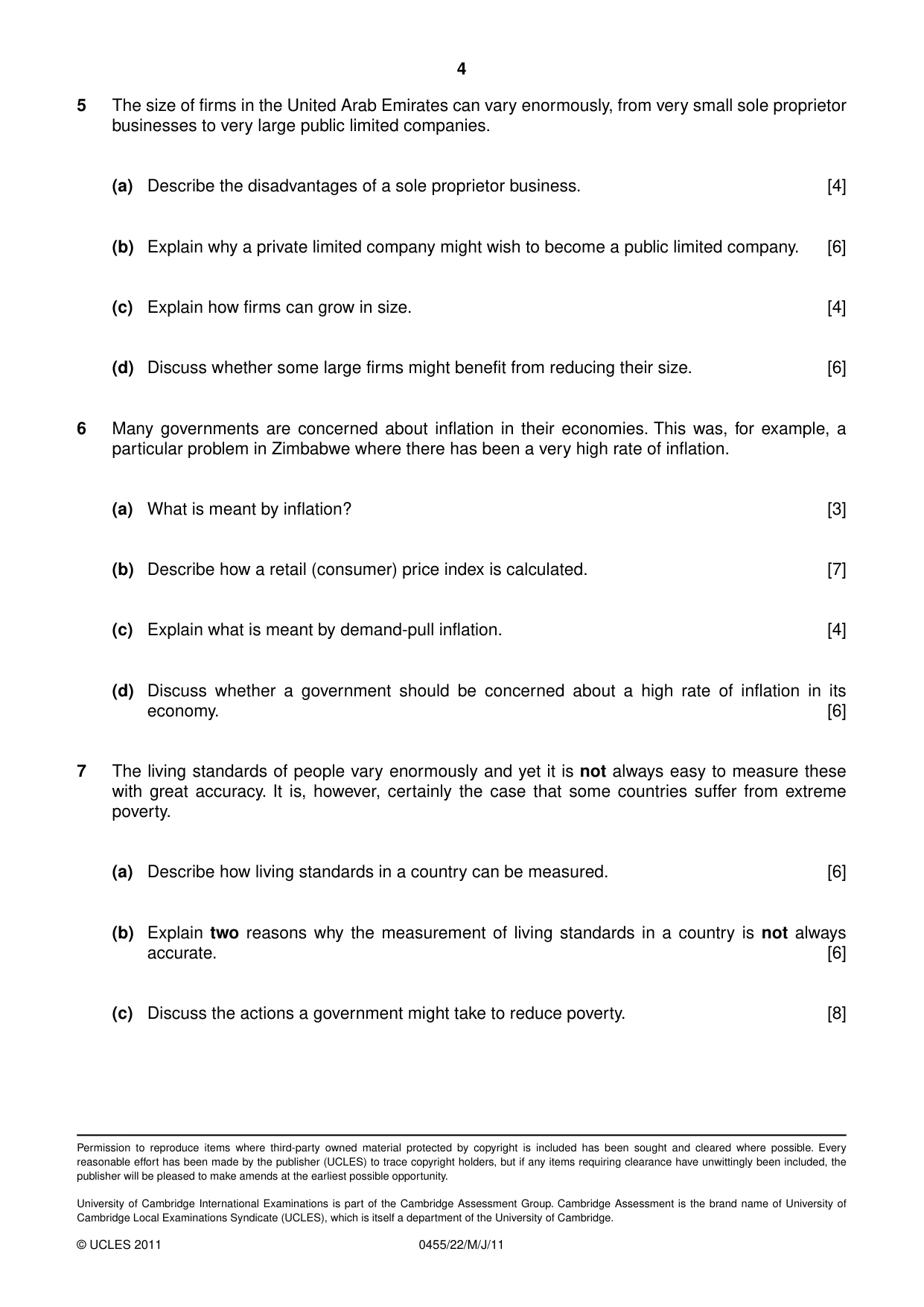
4 0455/22/M/J/11 © UCLES 2011 5 The size of firms in the United Arab Emirates can vary enormously, from very small sole proprietor businesses to very large public limited companies. (a) Describe the disadvantages of a sole proprietor business. [4] (b) Explain why a private limited company might wish to become a public limited company. [6] (c) Explain how firms can grow in size. [4] (d) Discuss whether some large firms might benefit from reducing their size. [6] 6 Many governments are concerned about inflation in their economies. This was, for example, a particular problem in Zimbabwe where there has been a very high rate of inflation. (a) What is meant by inflation? [3] (b) Describe how a retail (consumer) price index is calculated. [7] (c) Explain what is meant by demand-pull inflation. [4] (d) Discuss whether a government should be concerned about a high rate of inflation in its economy. [6] 7 The living standards of people vary enormously and yet it is not always easy to measure these with great accuracy. It is, however, certainly the case that some countries suffer from extreme poverty. (a) Describe how living standards in a country can be measured. [6] (b) Explain two reasons why the measurement of living standards in a country is not always accurate. [6] (c) Discuss the actions a government might take to reduce poverty. [8] Permission to reproduce items where third-party owned material protected by copyright is included has been sought and cleared where possible. Every reasonable effort has been made by the publisher (UCLES) to trace copyright holders, but if any items requiring clearance have unwittingly been included, the publisher will be pleased to make amends at the earliest possible opportunity. University of Cambridge International Examinations is part of the Cambridge Assessment Group. Cambridge Assessment is the brand name of University of Cambridge Local Examinations Syndicate (UCLES), which is itself a department of the University of Cambridge.
Mark scheme, page 1
UNIVERSITY OF CAMBRIDGE INTERNATIONAL EXAMINATIONS International General Certificate of Secondary Education MARK SCHEME for the May/June 2011 question paper for the guidance of teachers 0455 ECONOMICS 0455/22 Paper 2 (Structured Questions), maximum raw mark 80 This mark scheme is published as an aid to teachers and candidates, to indicate the requirements of the examination. It shows the basis on which Examiners were instructed to award marks. It does not indicate the details of the discussions that took place at an Examiners’ meeting before marking began, which would have considered the acceptability of alternative answers. Mark schemes must be read in conjunction with the question papers and the report on the examination. • Cambridge will not enter into discussions or correspondence in connection with these mark schemes. Cambridge is publishing the mark schemes for the May/June 2011 question papers for most IGCSE, GCE Advanced Level and Advanced Subsidiary Level syllabuses and some Ordinary Level syllabuses. www.XtremePapers.com
Mark scheme, page 2
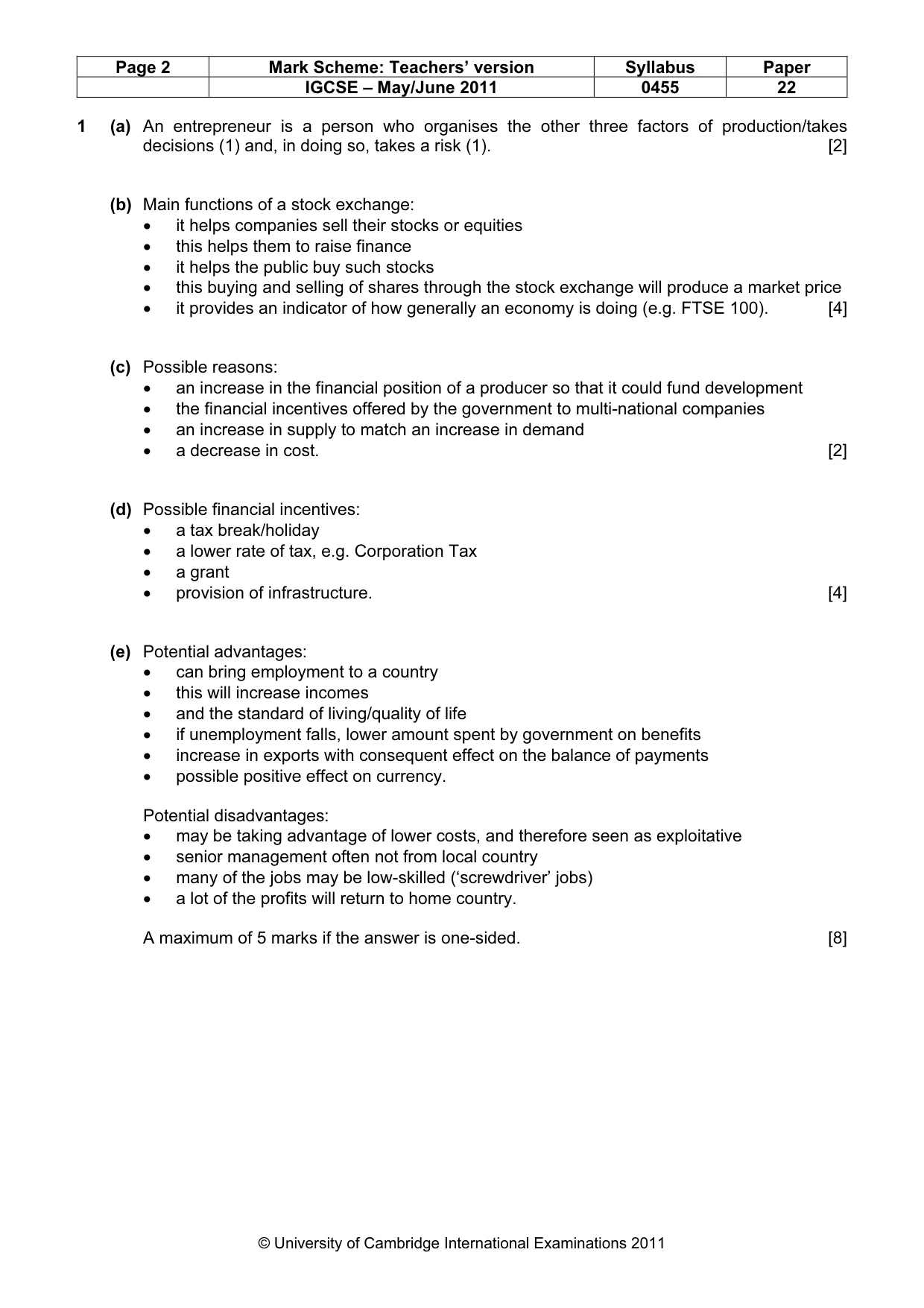
Page 2 Mark Scheme: Teachers’ version Syllabus Paper IGCSE – May/June 2011 0455 22 © University of Cambridge International Examinations 2011 1 (a) An entrepreneur is a person who organises the other three factors of production/takes decisions (1) and, in doing so, takes a risk (1). [2] (b) Main functions of a stock exchange: • it helps companies sell their stocks or equities • this helps them to raise finance • it helps the public buy such stocks • this buying and selling of shares through the stock exchange will produce a market price • it provides an indicator of how generally an economy is doing (e.g. FTSE 100). [4] (c) Possible reasons: • an increase in the financial position of a producer so that it could fund development • the financial incentives offered by the government to multi-national companies • an increase in supply to match an increase in demand • a decrease in cost. [2] (d) Possible financial incentives: • a tax break/holiday • a lower rate of tax, e.g. Corporation Tax • a grant • provision of infrastructure. [4] (e) Potential advantages: • can bring employment to a country • this will increase incomes • and the standard of living/quality of life • if unemployment falls, lower amount spent by government on benefits • increase in exports with consequent effect on the balance of payments • possible positive effect on currency. Potential disadvantages: • may be taking advantage of lower costs, and therefore seen as exploitative • senior management often not from local country • many of the jobs may be low-skilled (‘screwdriver’ jobs) • a lot of the profits will return to home country. A maximum of 5 marks if the answer is one-sided. [8]
Mark scheme, page 3
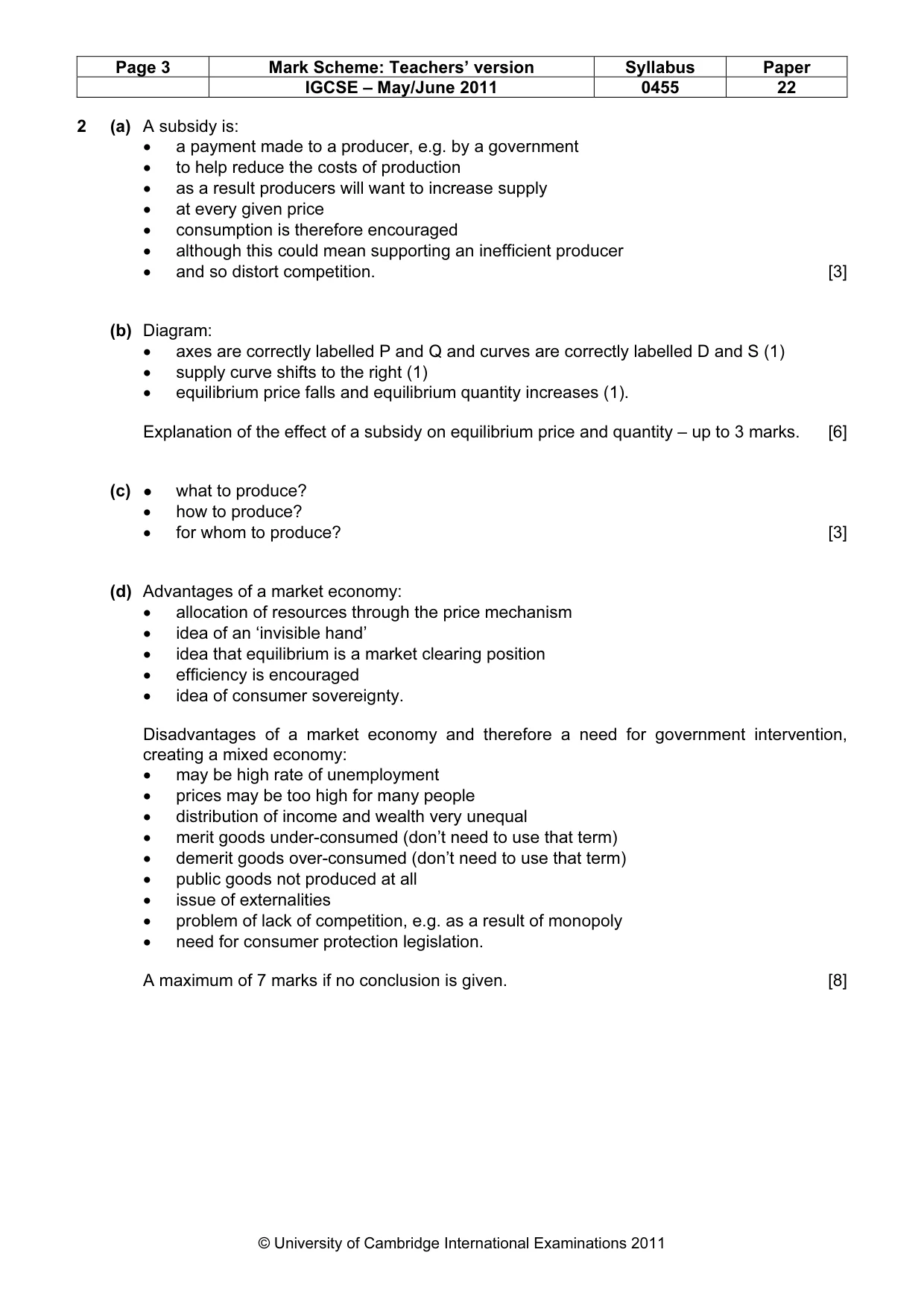
Page 3 Mark Scheme: Teachers’ version Syllabus Paper IGCSE – May/June 2011 0455 22 © University of Cambridge International Examinations 2011 2 (a) A subsidy is: • a payment made to a producer, e.g. by a government • to help reduce the costs of production • as a result producers will want to increase supply • at every given price • consumption is therefore encouraged • although this could mean supporting an inefficient producer • and so distort competition. [3] (b) Diagram: • axes are correctly labelled P and Q and curves are correctly labelled D and S (1) • supply curve shifts to the right (1) • equilibrium price falls and equilibrium quantity increases (1). Explanation of the effect of a subsidy on equilibrium price and quantity – up to 3 marks. [6] (c) ● what to produce? • how to produce? • for whom to produce? [3] (d) Advantages of a market economy: • allocation of resources through the price mechanism • idea of an ‘invisible hand’ • idea that equilibrium is a market clearing position • efficiency is encouraged • idea of consumer sovereignty. Disadvantages of a market economy and therefore a need for government intervention, creating a mixed economy: • may be high rate of unemployment • prices may be too high for many people • distribution of income and wealth very unequal • merit goods under-consumed (don’t need to use that term) • demerit goods over-consumed (don’t need to use that term) • public goods not produced at all • issue of externalities • problem of lack of competition, e.g. as a result of monopoly • need for consumer protection legislation. A maximum of 7 marks if no conclusion is given. [8]
Mark scheme, page 4
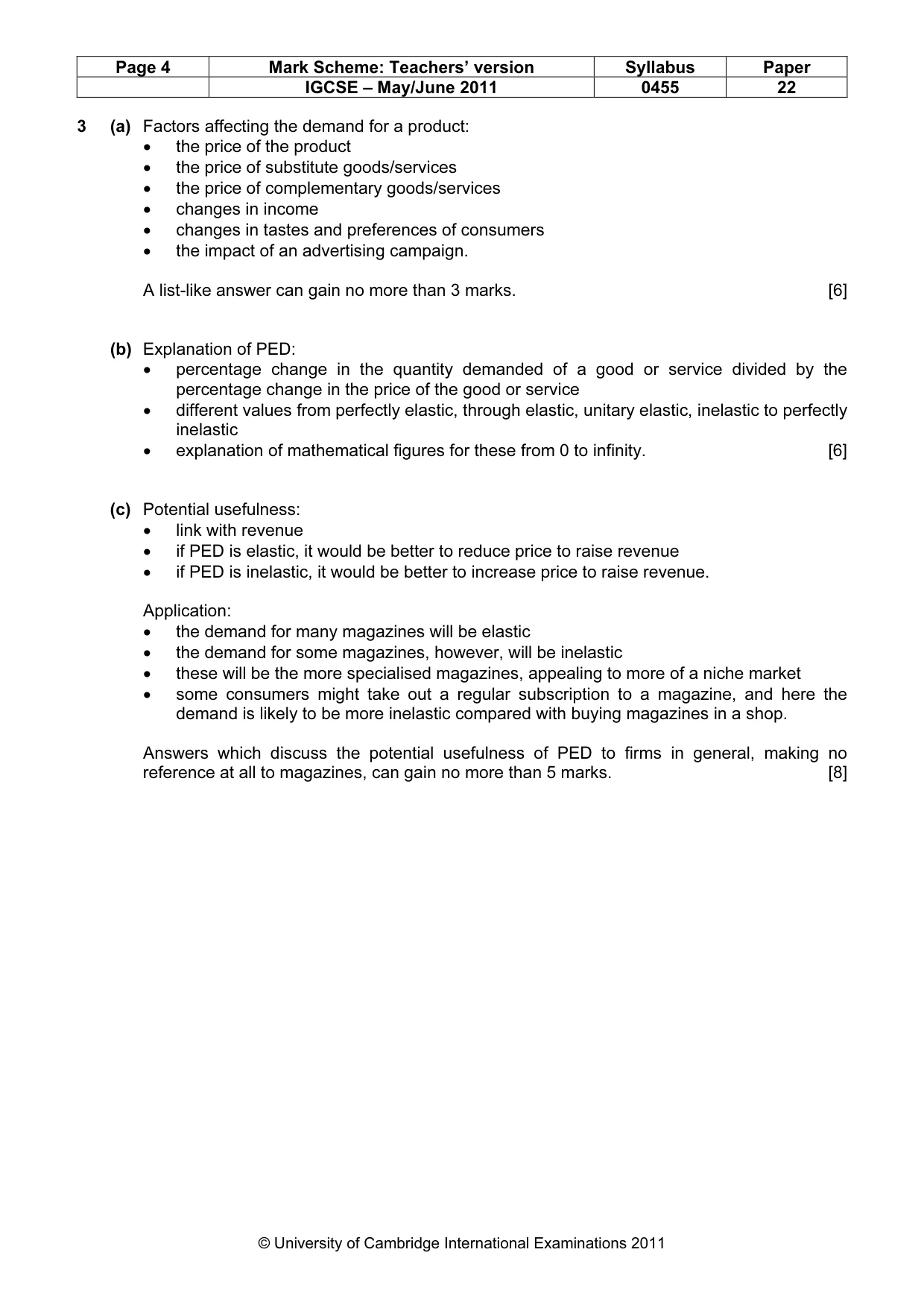
Page 4 Mark Scheme: Teachers’ version Syllabus Paper IGCSE – May/June 2011 0455 22 © University of Cambridge International Examinations 2011 3 (a) Factors affecting the demand for a product: • the price of the product • the price of substitute goods/services • the price of complementary goods/services • changes in income • changes in tastes and preferences of consumers • the impact of an advertising campaign. A list-like answer can gain no more than 3 marks. [6] (b) Explanation of PED: • percentage change in the quantity demanded of a good or service divided by the percentage change in the price of the good or service • different values from perfectly elastic, through elastic, unitary elastic, inelastic to perfectly inelastic • explanation of mathematical figures for these from 0 to infinity. [6] (c) Potential usefulness: • link with revenue • if PED is elastic, it would be better to reduce price to raise revenue • if PED is inelastic, it would be better to increase price to raise revenue. Application: • the demand for many magazines will be elastic • the demand for some magazines, however, will be inelastic • these will be the more specialised magazines, appealing to more of a niche market • some consumers might take out a regular subscription to a magazine, and here the demand is likely to be more inelastic compared with buying magazines in a shop. Answers which discuss the potential usefulness of PED to firms in general, making no reference at all to magazines, can gain no more than 5 marks. [8]
Mark scheme, page 5
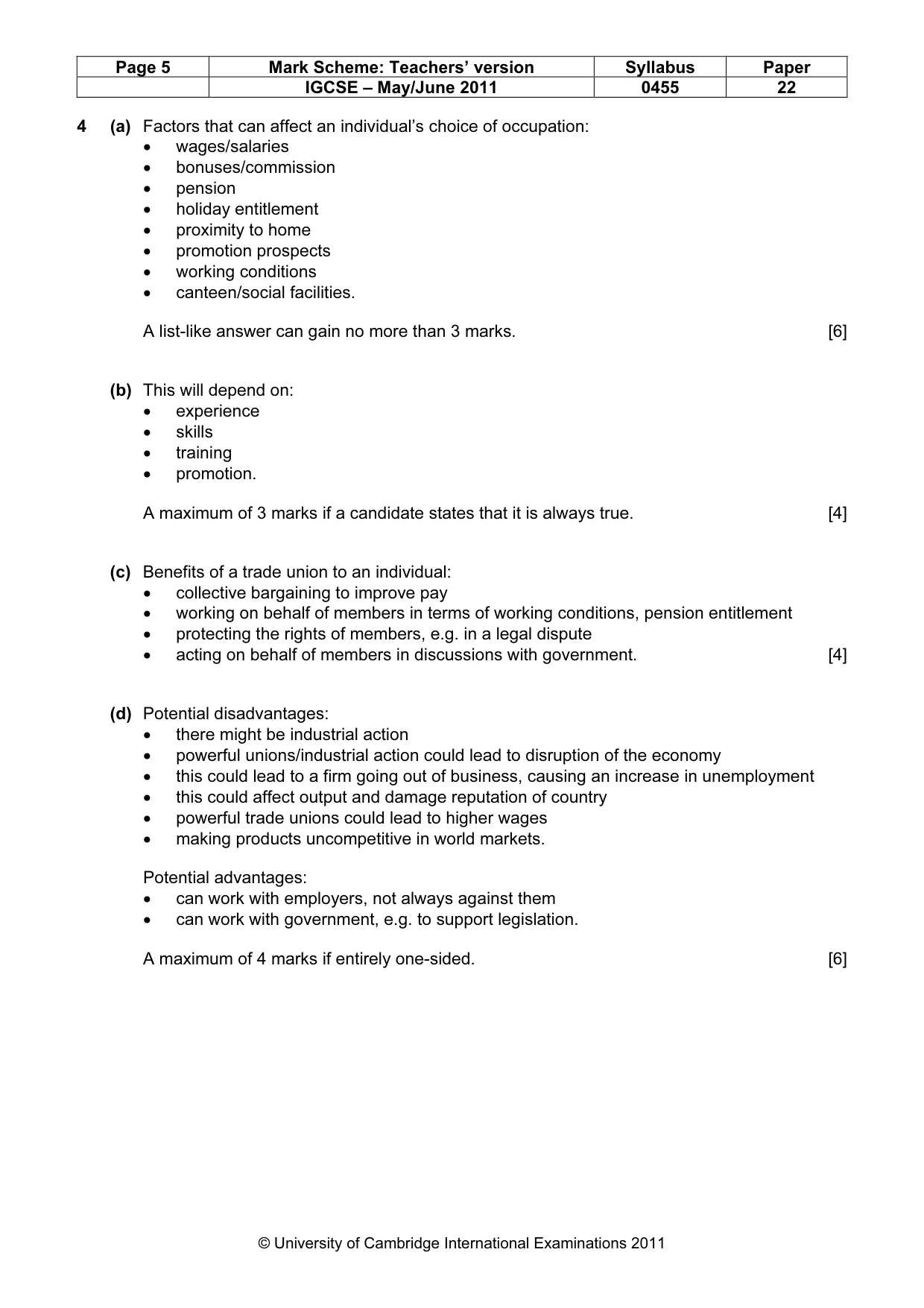
Page 5 Mark Scheme: Teachers’ version Syllabus Paper IGCSE – May/June 2011 0455 22 © University of Cambridge International Examinations 2011 4 (a) Factors that can affect an individual’s choice of occupation: • wages/salaries • bonuses/commission • pension • holiday entitlement • proximity to home • promotion prospects • working conditions • canteen/social facilities. A list-like answer can gain no more than 3 marks. [6] (b) This will depend on: • experience • skills • training • promotion. A maximum of 3 marks if a candidate states that it is always true. [4] (c) Benefits of a trade union to an individual: • collective bargaining to improve pay • working on behalf of members in terms of working conditions, pension entitlement • protecting the rights of members, e.g. in a legal dispute • acting on behalf of members in discussions with government. [4] (d) Potential disadvantages: • there might be industrial action • powerful unions/industrial action could lead to disruption of the economy • this could lead to a firm going out of business, causing an increase in unemployment • this could affect output and damage reputation of country • powerful trade unions could lead to higher wages • making products uncompetitive in world markets. Potential advantages: • can work with employers, not always against them • can work with government, e.g. to support legislation. A maximum of 4 marks if entirely one-sided. [6]
Mark scheme, page 6
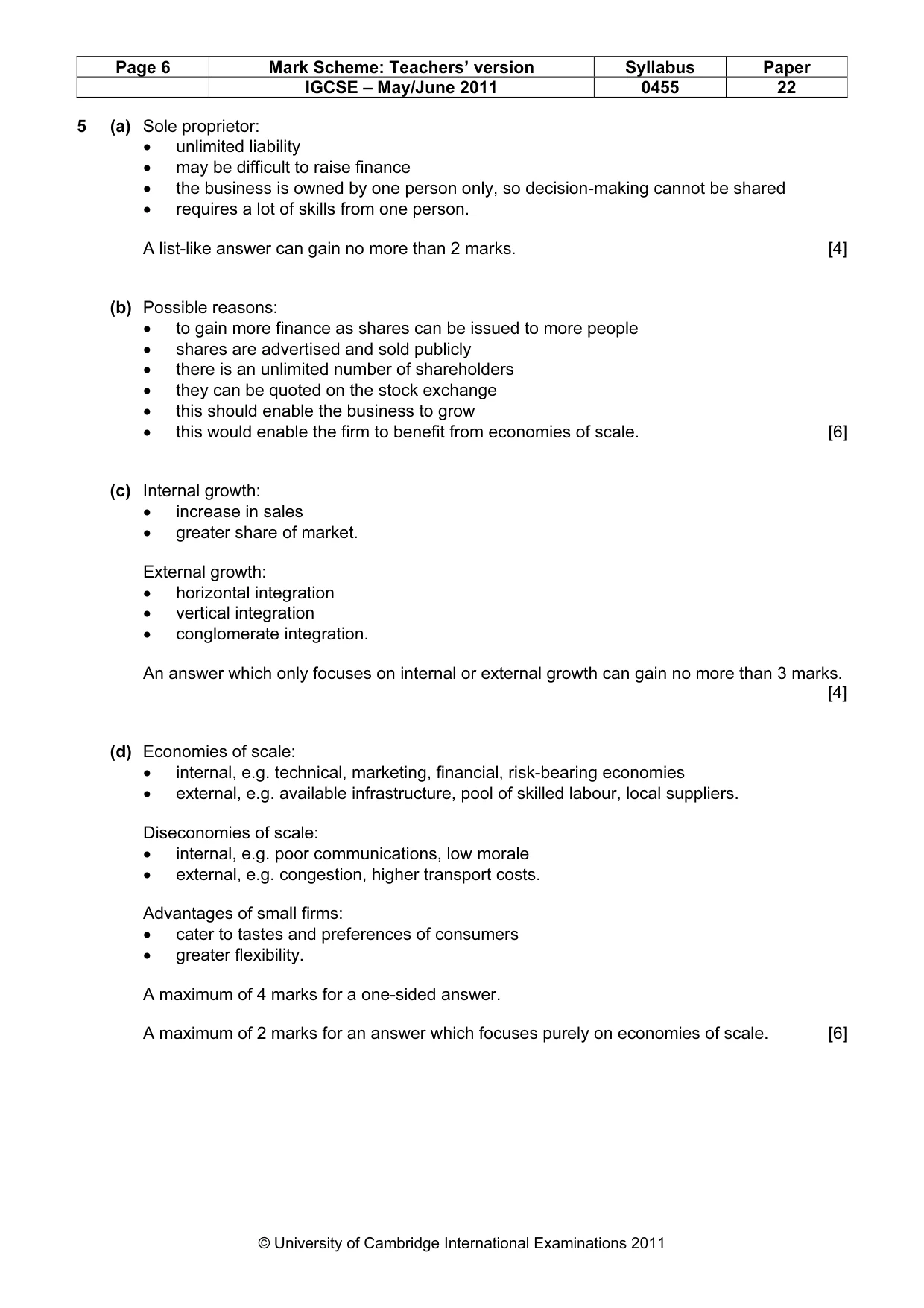
Page 6 Mark Scheme: Teachers’ version Syllabus Paper IGCSE – May/June 2011 0455 22 © University of Cambridge International Examinations 2011 5 (a) Sole proprietor: • unlimited liability • may be difficult to raise finance • the business is owned by one person only, so decision-making cannot be shared • requires a lot of skills from one person. A list-like answer can gain no more than 2 marks. [4] (b) Possible reasons: • to gain more finance as shares can be issued to more people • shares are advertised and sold publicly • there is an unlimited number of shareholders • they can be quoted on the stock exchange • this should enable the business to grow • this would enable the firm to benefit from economies of scale. [6] (c) Internal growth: • increase in sales • greater share of market. External growth: • horizontal integration • vertical integration • conglomerate integration. An answer which only focuses on internal or external growth can gain no more than 3 marks. [4] (d) Economies of scale: • internal, e.g. technical, marketing, financial, risk-bearing economies • external, e.g. available infrastructure, pool of skilled labour, local suppliers. Diseconomies of scale: • internal, e.g. poor communications, low morale • external, e.g. congestion, higher transport costs. Advantages of small firms: • cater to tastes and preferences of consumers • greater flexibility. A maximum of 4 marks for a one-sided answer. A maximum of 2 marks for an answer which focuses purely on economies of scale. [6]
Mark scheme, page 7
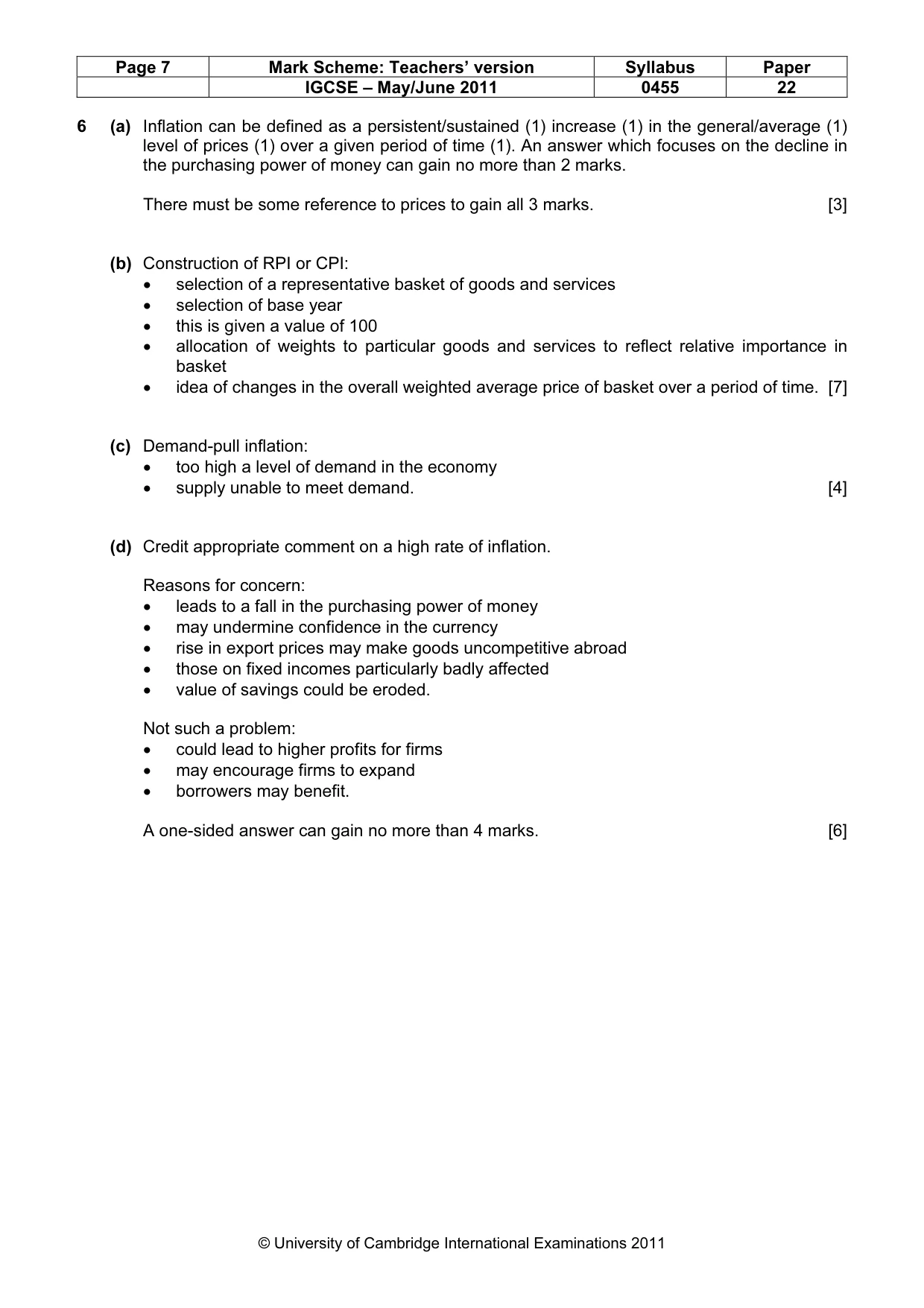
Page 7 Mark Scheme: Teachers’ version Syllabus Paper IGCSE – May/June 2011 0455 22 © University of Cambridge International Examinations 2011 6 (a) Inflation can be defined as a persistent/sustained (1) increase (1) in the general/average (1) level of prices (1) over a given period of time (1). An answer which focuses on the decline in the purchasing power of money can gain no more than 2 marks. There must be some reference to prices to gain all 3 marks. [3] (b) Construction of RPI or CPI: • selection of a representative basket of goods and services • selection of base year • this is given a value of 100 • allocation of weights to particular goods and services to reflect relative importance in basket • idea of changes in the overall weighted average price of basket over a period of time. [7] (c) Demand-pull inflation: • too high a level of demand in the economy • supply unable to meet demand. [4] (d) Credit appropriate comment on a high rate of inflation. Reasons for concern: • leads to a fall in the purchasing power of money • may undermine confidence in the currency • rise in export prices may make goods uncompetitive abroad • those on fixed incomes particularly badly affected • value of savings could be eroded. Not such a problem: • could lead to higher profits for firms • may encourage firms to expand • borrowers may benefit. A one-sided answer can gain no more than 4 marks. [6]
Mark scheme, page 8
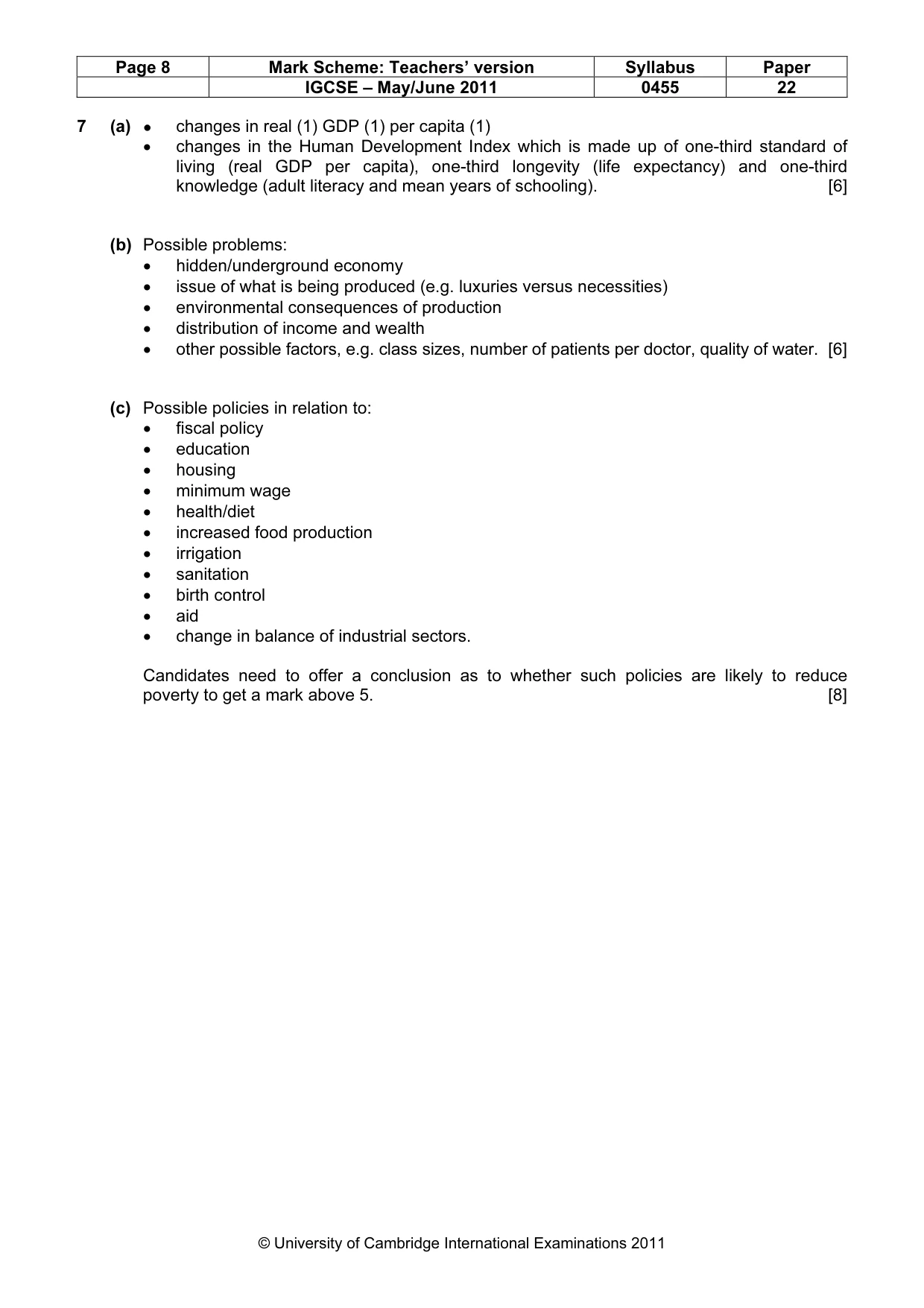
Page 8 Mark Scheme: Teachers’ version Syllabus Paper IGCSE – May/June 2011 0455 22 © University of Cambridge International Examinations 2011 7 (a) ● changes in real (1) GDP (1) per capita (1) • changes in the Human Development Index which is made up of one-third standard of living (real GDP per capita), one-third longevity (life expectancy) and one-third knowledge (adult literacy and mean years of schooling). [6] (b) Possible problems: • hidden/underground economy • issue of what is being produced (e.g. luxuries versus necessities) • environmental consequences of production • distribution of income and wealth • other possible factors, e.g. class sizes, number of patients per doctor, quality of water. [6] (c) Possible policies in relation to: • fiscal policy • education • housing • minimum wage • health/diet • increased food production • irrigation • sanitation • birth control • aid • change in balance of industrial sectors. Candidates need to offer a conclusion as to whether such policies are likely to reduce poverty to get a mark above 5. [8]
What you needed in this session
Cambridge’s own grade thresholds for 2011 May/June, Paper 2 · Variant 2. A higher threshold means an easier paper — the bar moves with how the cohort did.