Cambridge IGCSE Economics 0455 — 2011 May/June Paper 2 · Variant 1
0455/21/M/J/11 · 80 marks · ≈90 min
The question paper and its mark scheme, free to read here and free to download. This is Cambridge’s own paper, exactly as it was sat.
Question paper4 pages

Mark scheme8 pages
Answers below. Sit the paper first if you are practising.
Paper as text
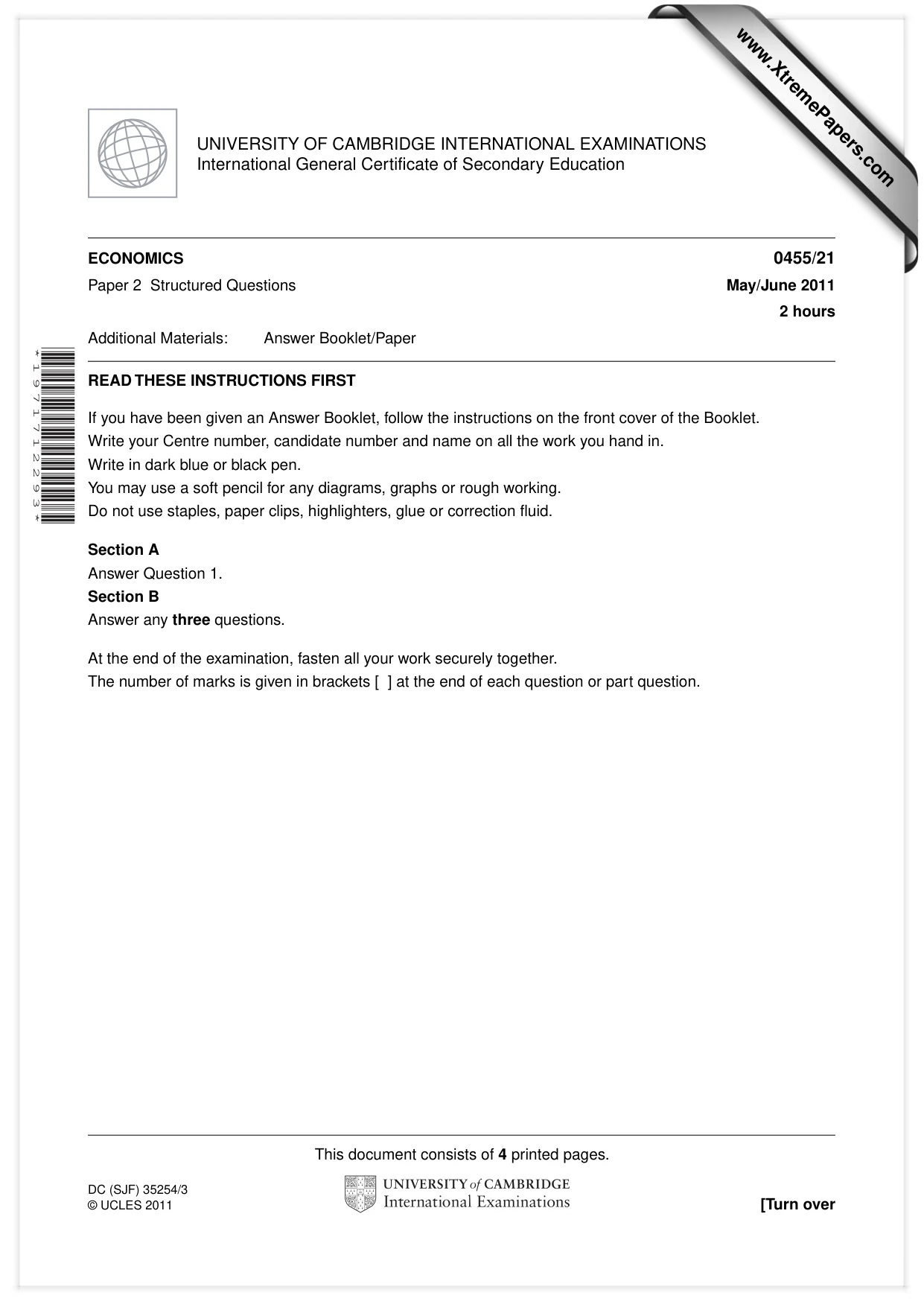
Question paper, page 1
This document consists of 4 printed pages. DC (SJF) 35254/3 © UCLES 2011 [Turn over UNIVERSITY OF CAMBRIDGE INTERNATIONAL EXAMINATIONS International General Certificate of Secondary Education * 1 9 7 1 7 1 2 2 9 3 * ECONOMICS 0455/21 Paper 2 Structured Questions May/June 2011 2 hours Additional Materials: Answer Booklet/Paper READ THESE INSTRUCTIONS FIRST If you have been given an Answer Booklet, follow the instructions on the front cover of the Booklet. Write your Centre number, candidate number and name on all the work you hand in. Write in dark blue or black pen. You may use a soft pencil for any diagrams, graphs or rough working. Do not use staples, paper clips, highlighters, glue or correction fluid. Section A Answer Question 1. Section B Answer any three questions. At the end of the examination, fasten all your work securely together. The number of marks is given in brackets [ ] at the end of each question or part question. www.XtremePapers.com
Question paper, page 2
2 0455/21/M/J/11 © UCLES 2011 Section A Answer this question. 1 Rio de Janeiro wins the vote to host the 2016 Olympic Games The Brazilian city of Rio de Janeiro has been chosen to host the Olympic Games in 2016. Winning the vote would seem to have been the easy bit. Holding the games will require effort and expense on a massive scale. Apart from new stadiums and other sports facilities, the city will need infrastructure such as new bridges and roads, and also double the number of hotel rooms. The metro railway line will need to be extended by almost 10 miles (approximately 16 kilometres). The city government has allocated US$14.4 billion to pay for the improvements in the infrastructure, although it is widely thought that the actual figure will be much higher than this. The decaying port area will be redeveloped and the nearby bay will be cleaned as this is currently affected by sewage and industrial pollution. It is hoped that the construction and redevelopment work will lead to an increase in the demand for labour, thereby reducing the city’s high unemployment rate. There are some people, however, who think that government revenue should be used for other purposes. A spokesperson from the Institute for Studies on Labour and Society suggested that the money should be spent on getting rid of the city’s worst slum areas, reducing the high crime rate and doing something about the poverty in a city where one in six residents is poor. (a) Name two sources of government revenue. [2] (b) Explain why government spending on getting the city ready for the Olympic Games is an example of opportunity cost. [4] (c) Explain, using a demand and supply diagram, how the change in the demand for labour is likely to affect the wages paid to construction workers. [6] (d) Discuss the economic advantages and economic disadvantages to Rio de Janeiro of hosting the Olympic Games in 2016. [8]
Question paper, page 3
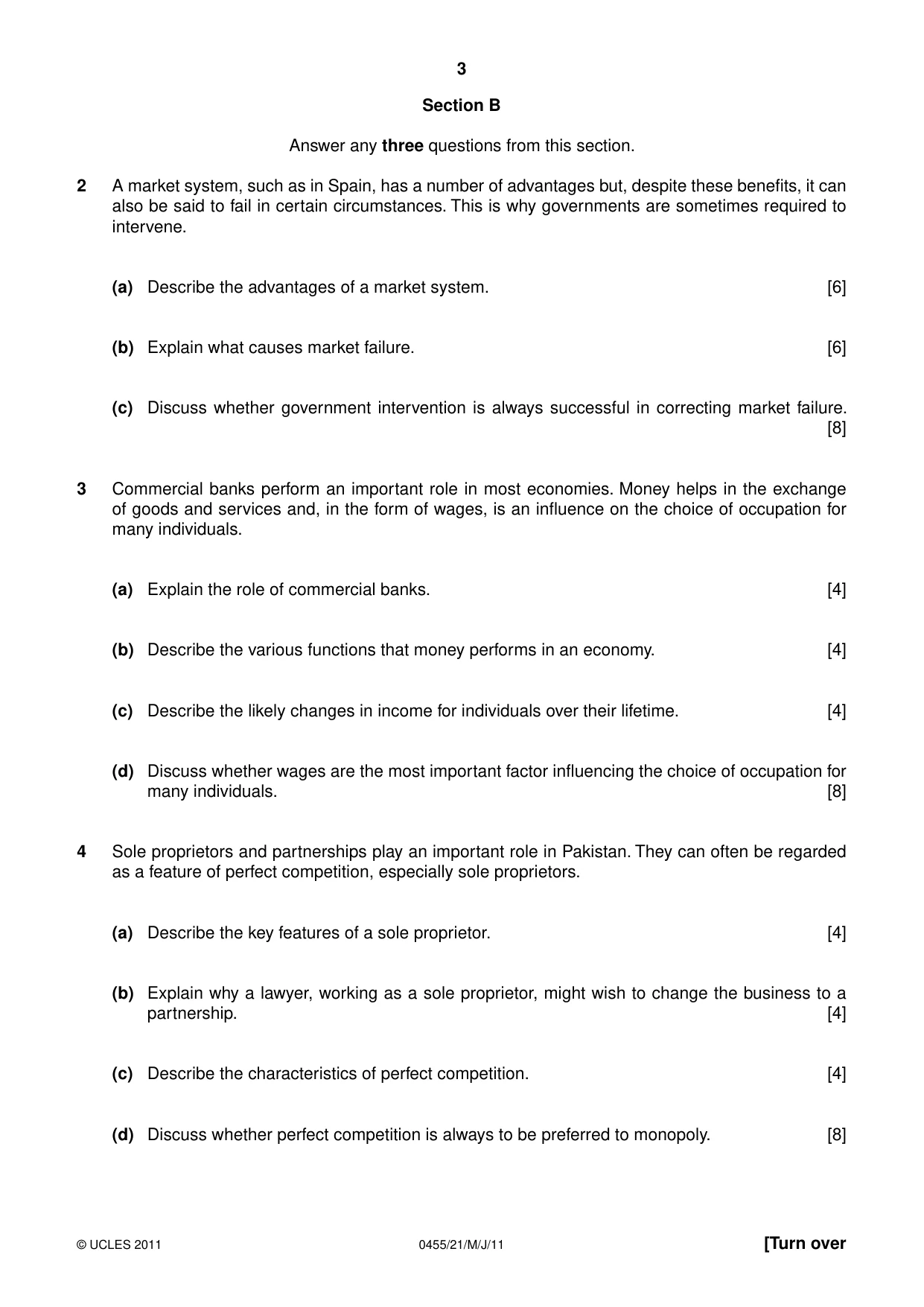
3 0455/21/M/J/11 © UCLES 2011 [Turn over Section B Answer any three questions from this section. 2 A market system, such as in Spain, has a number of advantages but, despite these benefits, it can also be said to fail in certain circumstances. This is why governments are sometimes required to intervene. (a) Describe the advantages of a market system. [6] (b) Explain what causes market failure. [6] (c) Discuss whether government intervention is always successful in correcting market failure. [8] 3 Commercial banks perform an important role in most economies. Money helps in the exchange of goods and services and, in the form of wages, is an influence on the choice of occupation for many individuals. (a) Explain the role of commercial banks. [4] (b) Describe the various functions that money performs in an economy. [4] (c) Describe the likely changes in income for individuals over their lifetime. [4] (d) Discuss whether wages are the most important factor influencing the choice of occupation for many individuals. [8] 4 Sole proprietors and partnerships play an important role in Pakistan. They can often be regarded as a feature of perfect competition, especially sole proprietors. (a) Describe the key features of a sole proprietor. [4] (b) Explain why a lawyer, working as a sole proprietor, might wish to change the business to a partnership. [4] (c) Describe the characteristics of perfect competition. [4] (d) Discuss whether perfect competition is always to be preferred to monopoly. [8]
Question paper, page 4
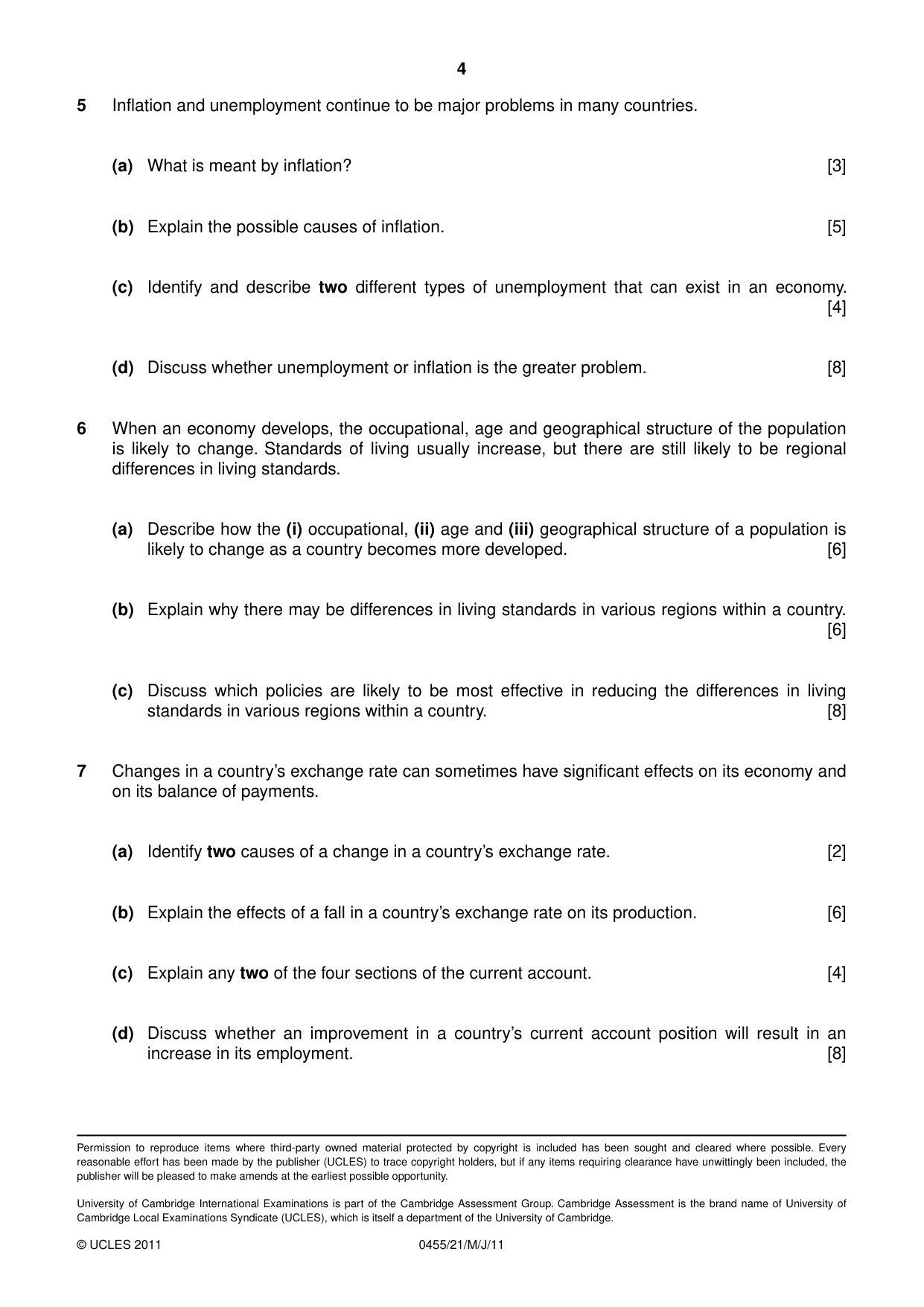
4 0455/21/M/J/11 © UCLES 2011 5 Inflation and unemployment continue to be major problems in many countries. (a) What is meant by inflation? [3] (b) Explain the possible causes of inflation. [5] (c) Identify and describe two different types of unemployment that can exist in an economy. [4] (d) Discuss whether unemployment or inflation is the greater problem. [8] 6 When an economy develops, the occupational, age and geographical structure of the population is likely to change. Standards of living usually increase, but there are still likely to be regional differences in living standards. (a) Describe how the (i) occupational, (ii) age and (iii) geographical structure of a population is likely to change as a country becomes more developed. [6] (b) Explain why there may be differences in living standards in various regions within a country. [6] (c) Discuss which policies are likely to be most effective in reducing the differences in living standards in various regions within a country. [8] 7 Changes in a country’s exchange rate can sometimes have significant effects on its economy and on its balance of payments. (a) Identify two causes of a change in a country’s exchange rate. [2] (b) Explain the effects of a fall in a country’s exchange rate on its production. [6] (c) Explain any two of the four sections of the current account. [4] (d) Discuss whether an improvement in a country’s current account position will result in an increase in its employment. [8] Permission to reproduce items where third-party owned material protected by copyright is included has been sought and cleared where possible. Every reasonable effort has been made by the publisher (UCLES) to trace copyright holders, but if any items requiring clearance have unwittingly been included, the publisher will be pleased to make amends at the earliest possible opportunity. University of Cambridge International Examinations is part of the Cambridge Assessment Group. Cambridge Assessment is the brand name of University of Cambridge Local Examinations Syndicate (UCLES), which is itself a department of the University of Cambridge.
Mark scheme, page 1
UNIVERSITY OF CAMBRIDGE INTERNATIONAL EXAMINATIONS International General Certificate of Secondary Education MARK SCHEME for the May/June 2011 question paper for the guidance of teachers 0455 ECONOMICS 0455/21 Paper 2 (Structured Questions), maximum raw mark 80 This mark scheme is published as an aid to teachers and candidates, to indicate the requirements of the examination. It shows the basis on which Examiners were instructed to award marks. It does not indicate the details of the discussions that took place at an Examiners’ meeting before marking began, which would have considered the acceptability of alternative answers. Mark schemes must be read in conjunction with the question papers and the report on the examination. • Cambridge will not enter into discussions or correspondence in connection with these mark schemes. Cambridge is publishing the mark schemes for the May/June 2011 question papers for most IGCSE, GCE Advanced Level and Advanced Subsidiary Level syllabuses and some Ordinary Level syllabuses. www.XtremePapers.com
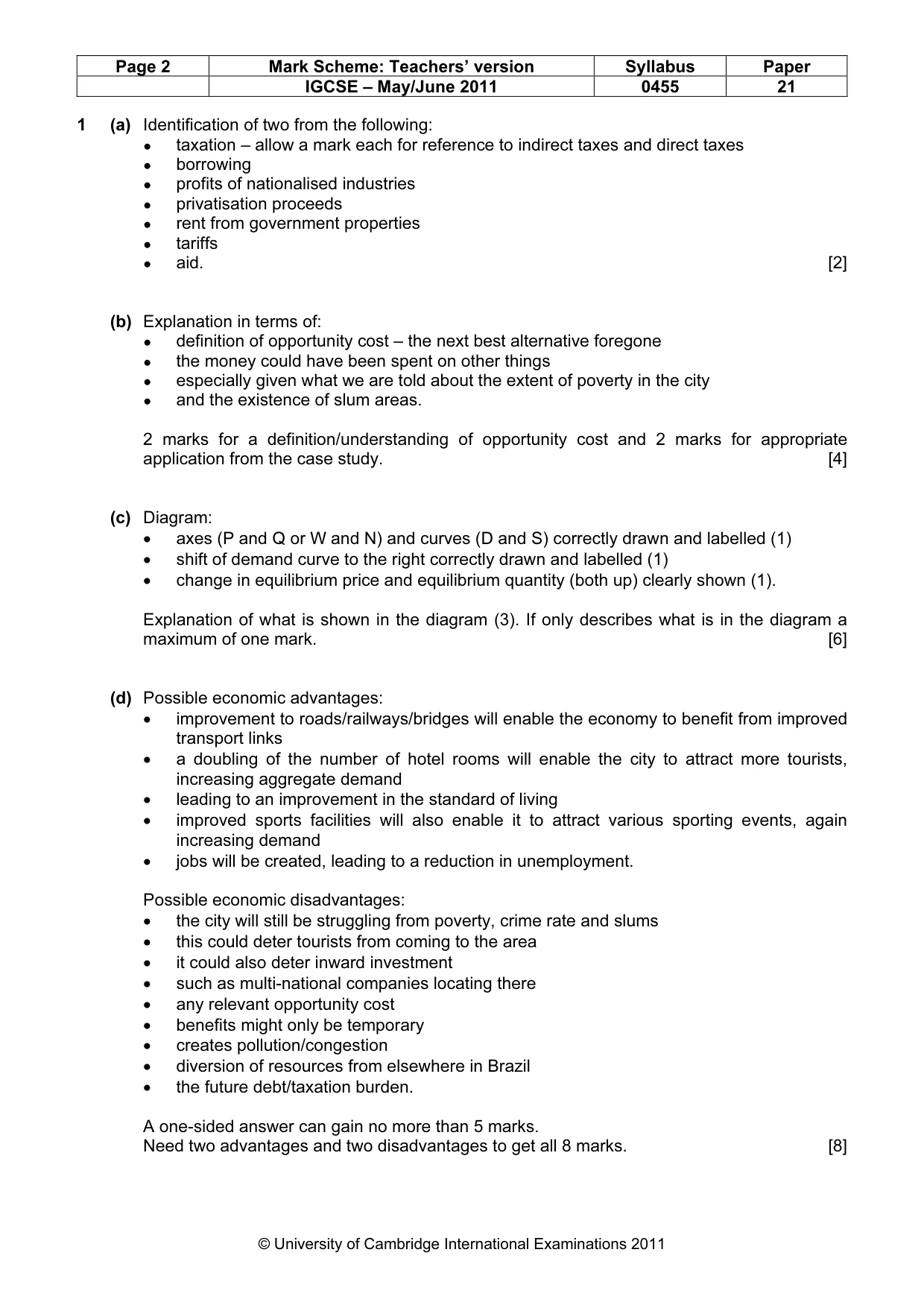
Mark scheme, page 2
Page 2 Mark Scheme: Teachers’ version Syllabus Paper IGCSE – May/June 2011 0455 21 © University of Cambridge International Examinations 2011 1 (a) Identification of two from the following: ● taxation – allow a mark each for reference to indirect taxes and direct taxes ● borrowing ● profits of nationalised industries ● privatisation proceeds ● rent from government properties ● tariffs ● aid. [2] (b) Explanation in terms of: ● definition of opportunity cost – the next best alternative foregone ● the money could have been spent on other things ● especially given what we are told about the extent of poverty in the city ● and the existence of slum areas. 2 marks for a definition/understanding of opportunity cost and 2 marks for appropriate application from the case study. [4] (c) Diagram: • axes (P and Q or W and N) and curves (D and S) correctly drawn and labelled (1) • shift of demand curve to the right correctly drawn and labelled (1) • change in equilibrium price and equilibrium quantity (both up) clearly shown (1). Explanation of what is shown in the diagram (3). If only describes what is in the diagram a maximum of one mark. [6] (d) Possible economic advantages: • improvement to roads/railways/bridges will enable the economy to benefit from improved transport links • a doubling of the number of hotel rooms will enable the city to attract more tourists, increasing aggregate demand • leading to an improvement in the standard of living • improved sports facilities will also enable it to attract various sporting events, again increasing demand • jobs will be created, leading to a reduction in unemployment. Possible economic disadvantages: • the city will still be struggling from poverty, crime rate and slums • this could deter tourists from coming to the area • it could also deter inward investment • such as multi-national companies locating there • any relevant opportunity cost • benefits might only be temporary • creates pollution/congestion • diversion of resources from elsewhere in Brazil • the future debt/taxation burden. A one-sided answer can gain no more than 5 marks. Need two advantages and two disadvantages to get all 8 marks. [8]
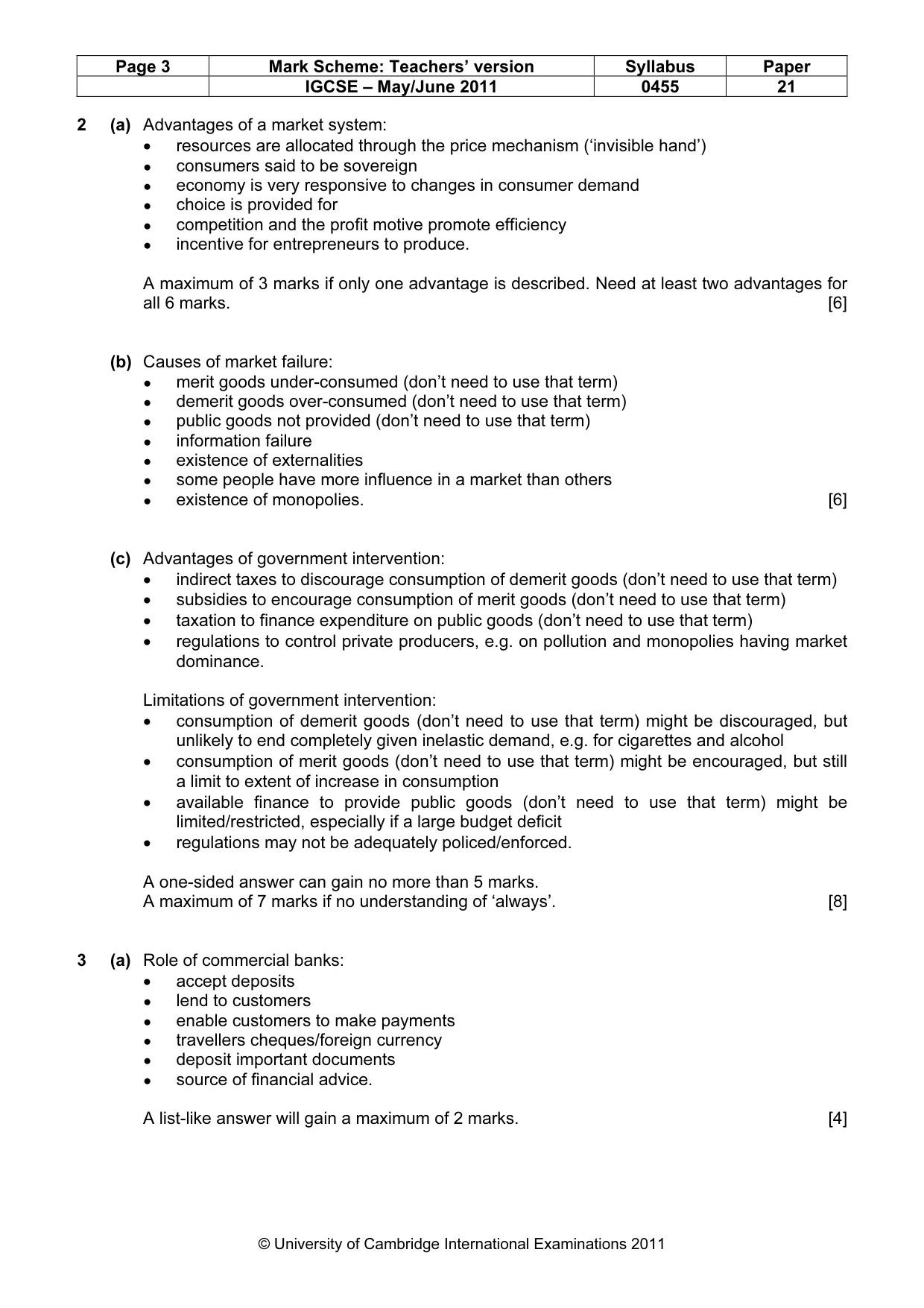
Mark scheme, page 3
Page 3 Mark Scheme: Teachers’ version Syllabus Paper IGCSE – May/June 2011 0455 21 © University of Cambridge International Examinations 2011 2 (a) Advantages of a market system: • resources are allocated through the price mechanism (‘invisible hand’) ● consumers said to be sovereign ● economy is very responsive to changes in consumer demand ● choice is provided for ● competition and the profit motive promote efficiency ● incentive for entrepreneurs to produce. A maximum of 3 marks if only one advantage is described. Need at least two advantages for all 6 marks. [6] (b) Causes of market failure: ● merit goods under-consumed (don’t need to use that term) ● demerit goods over-consumed (don’t need to use that term) ● public goods not provided (don’t need to use that term) ● information failure ● existence of externalities ● some people have more influence in a market than others ● existence of monopolies. [6] (c) Advantages of government intervention: • indirect taxes to discourage consumption of demerit goods (don’t need to use that term) • subsidies to encourage consumption of merit goods (don’t need to use that term) • taxation to finance expenditure on public goods (don’t need to use that term) • regulations to control private producers, e.g. on pollution and monopolies having market dominance. Limitations of government intervention: • consumption of demerit goods (don’t need to use that term) might be discouraged, but unlikely to end completely given inelastic demand, e.g. for cigarettes and alcohol • consumption of merit goods (don’t need to use that term) might be encouraged, but still a limit to extent of increase in consumption • available finance to provide public goods (don’t need to use that term) might be limited/restricted, especially if a large budget deficit • regulations may not be adequately policed/enforced. A one-sided answer can gain no more than 5 marks. A maximum of 7 marks if no understanding of ‘always’. [8] 3 (a) Role of commercial banks: • accept deposits ● lend to customers ● enable customers to make payments ● travellers cheques/foreign currency ● deposit important documents ● source of financial advice. A list-like answer will gain a maximum of 2 marks. [4]
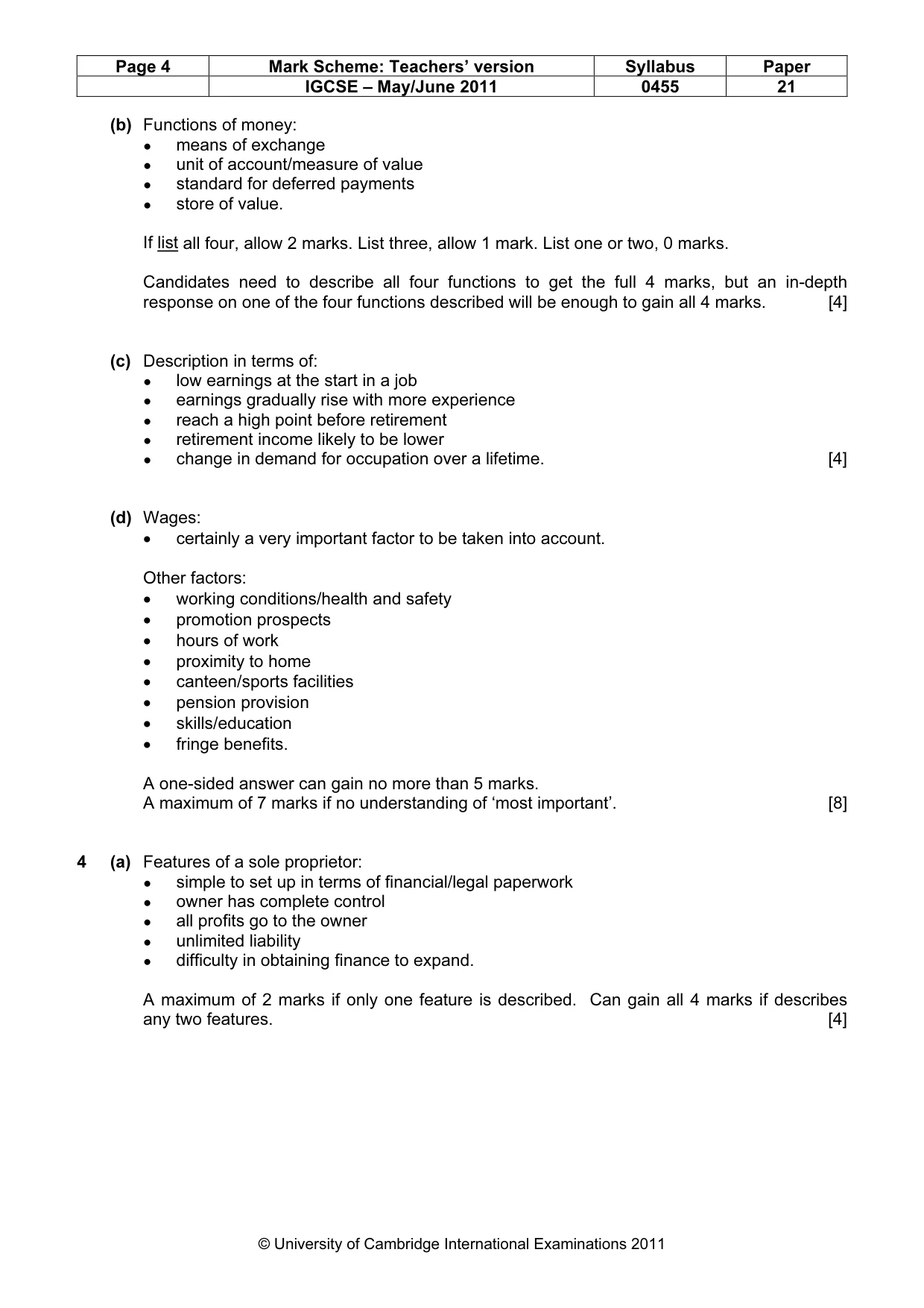
Mark scheme, page 4
Page 4 Mark Scheme: Teachers’ version Syllabus Paper IGCSE – May/June 2011 0455 21 © University of Cambridge International Examinations 2011 (b) Functions of money: ● means of exchange ● unit of account/measure of value ● standard for deferred payments ● store of value. If list all four, allow 2 marks. List three, allow 1 mark. List one or two, 0 marks. Candidates need to describe all four functions to get the full 4 marks, but an in-depth response on one of the four functions described will be enough to gain all 4 marks. [4] (c) Description in terms of: ● low earnings at the start in a job ● earnings gradually rise with more experience ● reach a high point before retirement ● retirement income likely to be lower ● change in demand for occupation over a lifetime. [4] (d) Wages: • certainly a very important factor to be taken into account. Other factors: • working conditions/health and safety • promotion prospects • hours of work • proximity to home • canteen/sports facilities • pension provision • skills/education • fringe benefits. A one-sided answer can gain no more than 5 marks. A maximum of 7 marks if no understanding of ‘most important’. [8] 4 (a) Features of a sole proprietor: ● simple to set up in terms of financial/legal paperwork ● owner has complete control ● all profits go to the owner ● unlimited liability ● difficulty in obtaining finance to expand. A maximum of 2 marks if only one feature is described. Can gain all 4 marks if describes any two features. [4]
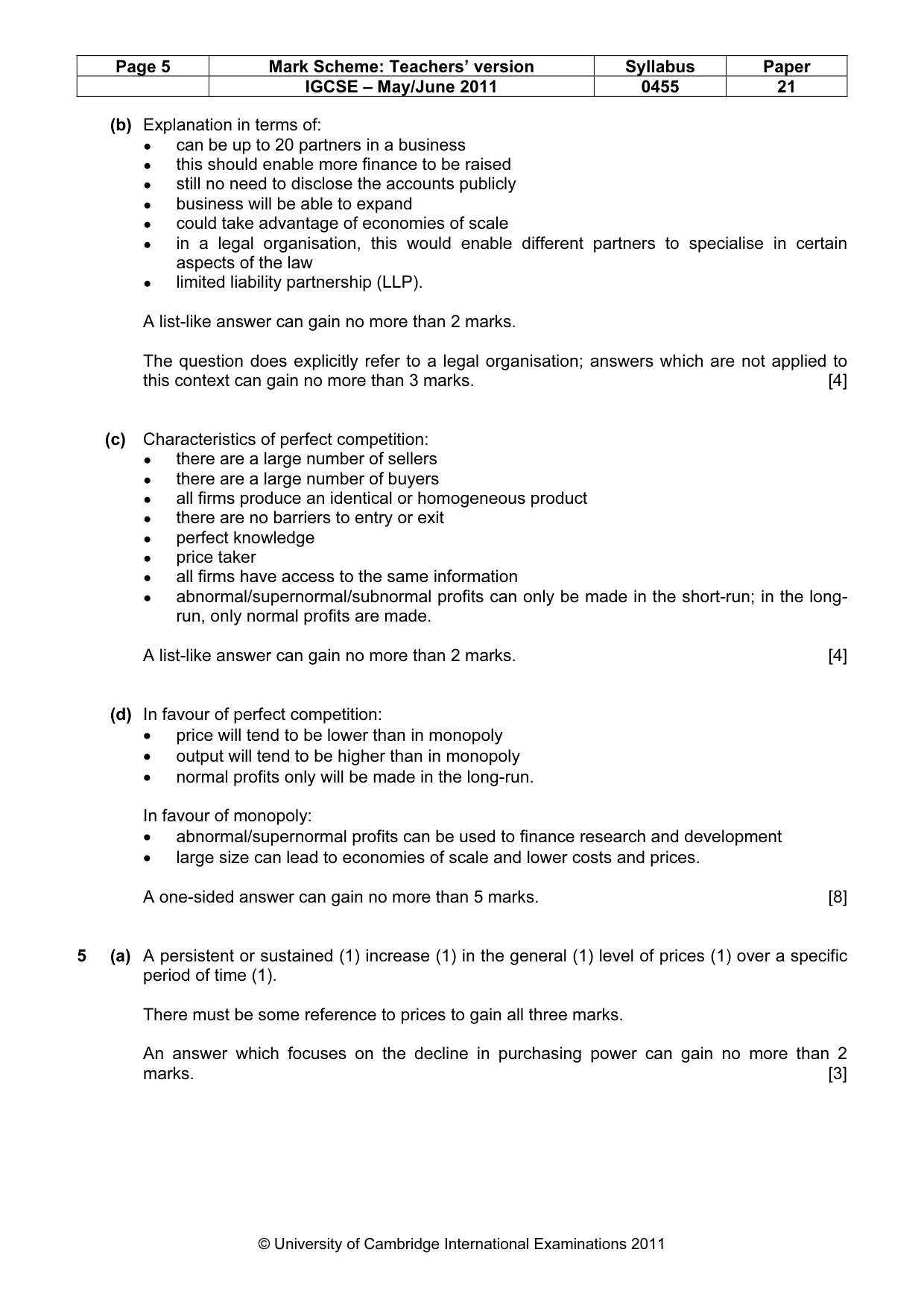
Mark scheme, page 5
Page 5 Mark Scheme: Teachers’ version Syllabus Paper IGCSE – May/June 2011 0455 21 © University of Cambridge International Examinations 2011 (b) Explanation in terms of: ● can be up to 20 partners in a business ● this should enable more finance to be raised ● still no need to disclose the accounts publicly ● business will be able to expand ● could take advantage of economies of scale ● in a legal organisation, this would enable different partners to specialise in certain aspects of the law ● limited liability partnership (LLP). A list-like answer can gain no more than 2 marks. The question does explicitly refer to a legal organisation; answers which are not applied to this context can gain no more than 3 marks. [4] (c) Characteristics of perfect competition: ● there are a large number of sellers ● there are a large number of buyers ● all firms produce an identical or homogeneous product ● there are no barriers to entry or exit ● perfect knowledge ● price taker ● all firms have access to the same information ● abnormal/supernormal/subnormal profits can only be made in the short-run; in the long- run, only normal profits are made. A list-like answer can gain no more than 2 marks. [4] (d) In favour of perfect competition: • price will tend to be lower than in monopoly • output will tend to be higher than in monopoly • normal profits only will be made in the long-run. In favour of monopoly: • abnormal/supernormal profits can be used to finance research and development • large size can lead to economies of scale and lower costs and prices. A one-sided answer can gain no more than 5 marks. [8] 5 (a) A persistent or sustained (1) increase (1) in the general (1) level of prices (1) over a specific period of time (1). There must be some reference to prices to gain all three marks. An answer which focuses on the decline in purchasing power can gain no more than 2 marks. [3]
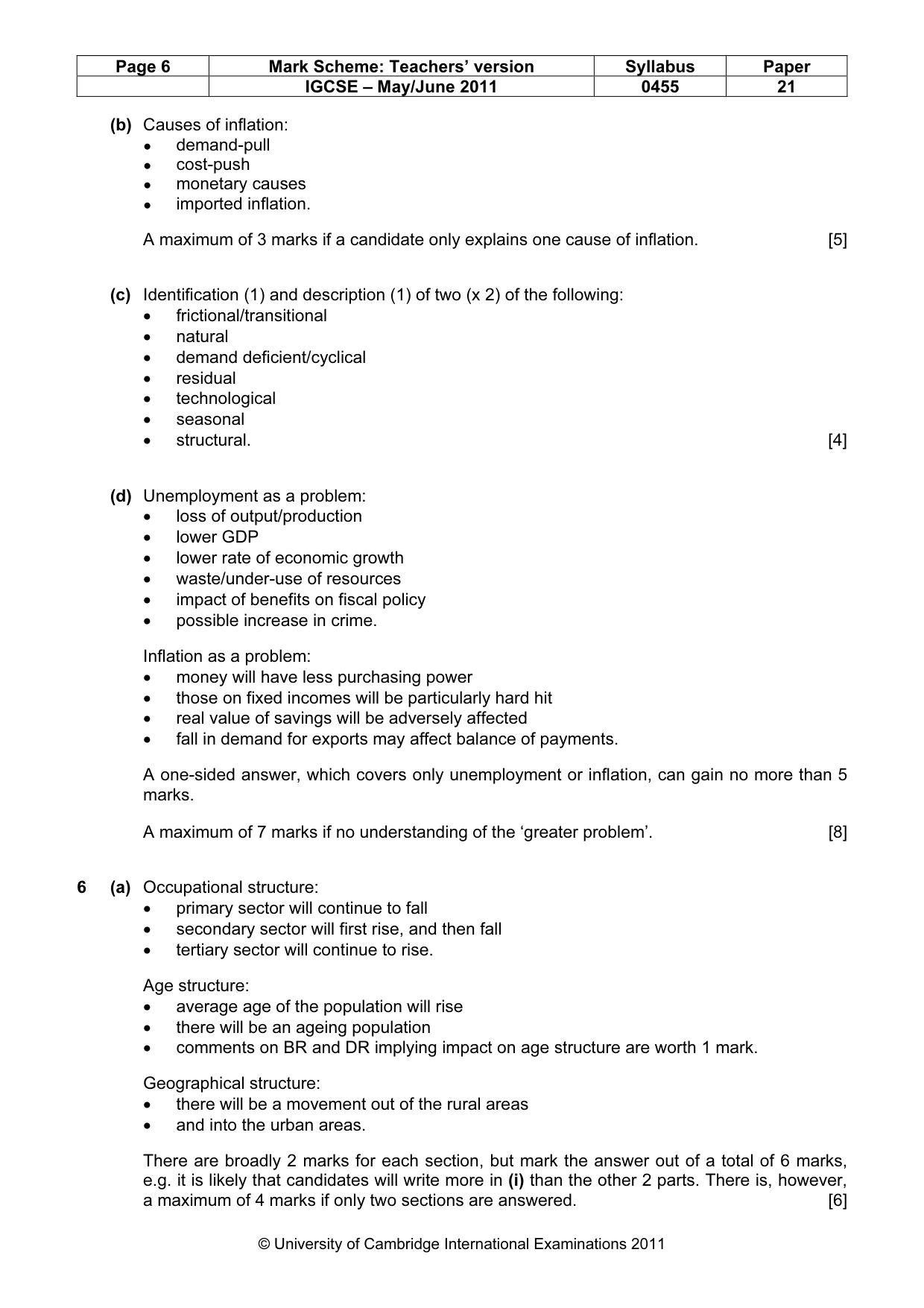
Mark scheme, page 6
Page 6 Mark Scheme: Teachers’ version Syllabus Paper IGCSE – May/June 2011 0455 21 © University of Cambridge International Examinations 2011 (b) Causes of inflation: ● demand-pull ● cost-push ● monetary causes ● imported inflation. A maximum of 3 marks if a candidate only explains one cause of inflation. [5] (c) Identification (1) and description (1) of two (x 2) of the following: • frictional/transitional • natural • demand deficient/cyclical • residual • technological • seasonal • structural. [4] (d) Unemployment as a problem: • loss of output/production • lower GDP • lower rate of economic growth • waste/under-use of resources • impact of benefits on fiscal policy • possible increase in crime. Inflation as a problem: • money will have less purchasing power • those on fixed incomes will be particularly hard hit • real value of savings will be adversely affected • fall in demand for exports may affect balance of payments. A one-sided answer, which covers only unemployment or inflation, can gain no more than 5 marks. A maximum of 7 marks if no understanding of the ‘greater problem’. [8] 6 (a) Occupational structure: • primary sector will continue to fall • secondary sector will first rise, and then fall • tertiary sector will continue to rise. Age structure: • average age of the population will rise • there will be an ageing population • comments on BR and DR implying impact on age structure are worth 1 mark. Geographical structure: • there will be a movement out of the rural areas • and into the urban areas. There are broadly 2 marks for each section, but mark the answer out of a total of 6 marks, e.g. it is likely that candidates will write more in (i) than the other 2 parts. There is, however, a maximum of 4 marks if only two sections are answered. [6]
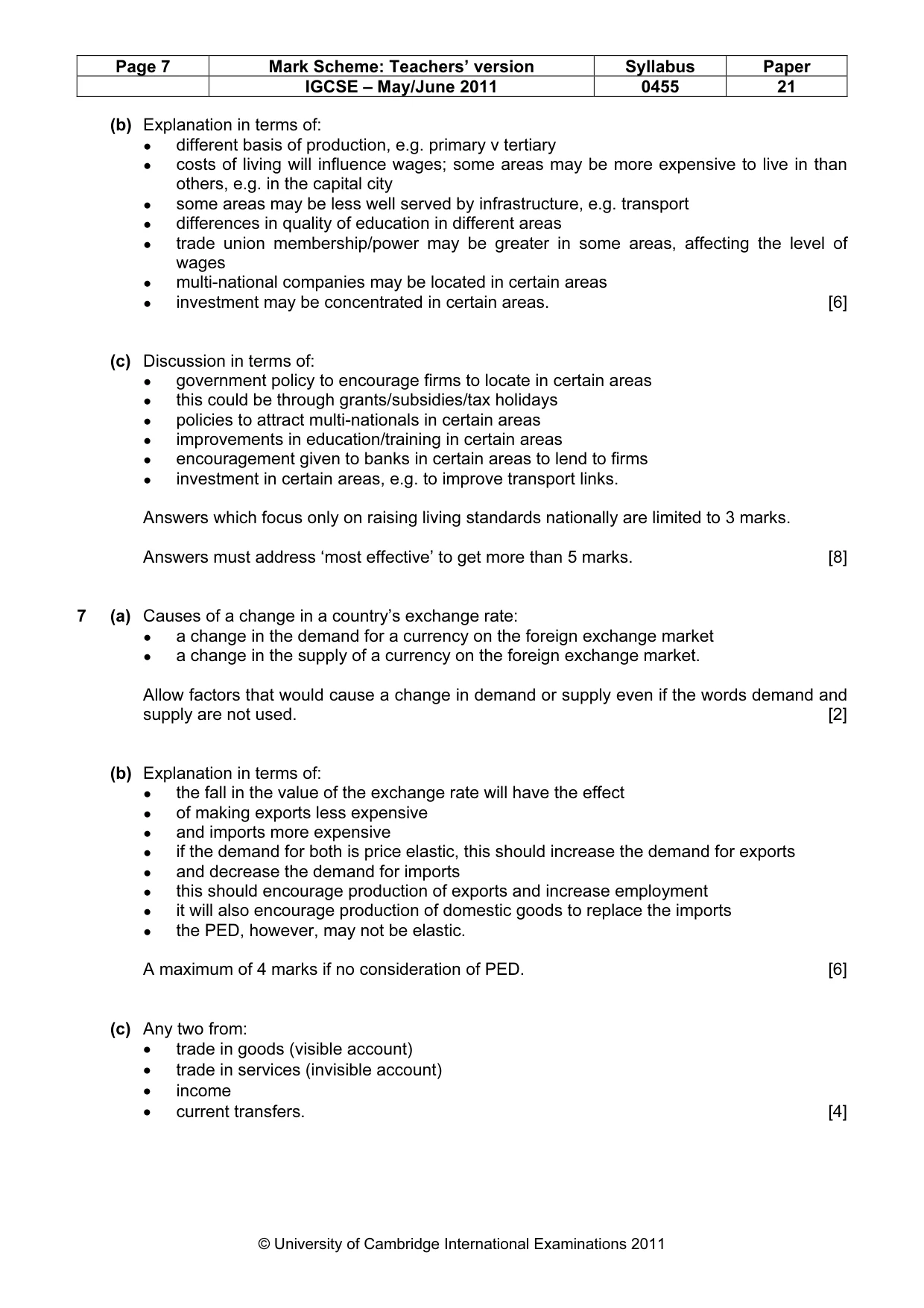
Mark scheme, page 7
Page 7 Mark Scheme: Teachers’ version Syllabus Paper IGCSE – May/June 2011 0455 21 © University of Cambridge International Examinations 2011 (b) Explanation in terms of: ● different basis of production, e.g. primary v tertiary ● costs of living will influence wages; some areas may be more expensive to live in than others, e.g. in the capital city ● some areas may be less well served by infrastructure, e.g. transport ● differences in quality of education in different areas ● trade union membership/power may be greater in some areas, affecting the level of wages ● multi-national companies may be located in certain areas ● investment may be concentrated in certain areas. [6] (c) Discussion in terms of: ● government policy to encourage firms to locate in certain areas ● this could be through grants/subsidies/tax holidays ● policies to attract multi-nationals in certain areas ● improvements in education/training in certain areas ● encouragement given to banks in certain areas to lend to firms ● investment in certain areas, e.g. to improve transport links. Answers which focus only on raising living standards nationally are limited to 3 marks. Answers must address ‘most effective’ to get more than 5 marks. [8] 7 (a) Causes of a change in a country’s exchange rate: ● a change in the demand for a currency on the foreign exchange market ● a change in the supply of a currency on the foreign exchange market. Allow factors that would cause a change in demand or supply even if the words demand and supply are not used. [2] (b) Explanation in terms of: ● the fall in the value of the exchange rate will have the effect ● of making exports less expensive ● and imports more expensive ● if the demand for both is price elastic, this should increase the demand for exports ● and decrease the demand for imports ● this should encourage production of exports and increase employment ● it will also encourage production of domestic goods to replace the imports ● the PED, however, may not be elastic. A maximum of 4 marks if no consideration of PED. [6] (c) Any two from: • trade in goods (visible account) • trade in services (invisible account) • income • current transfers. [4]
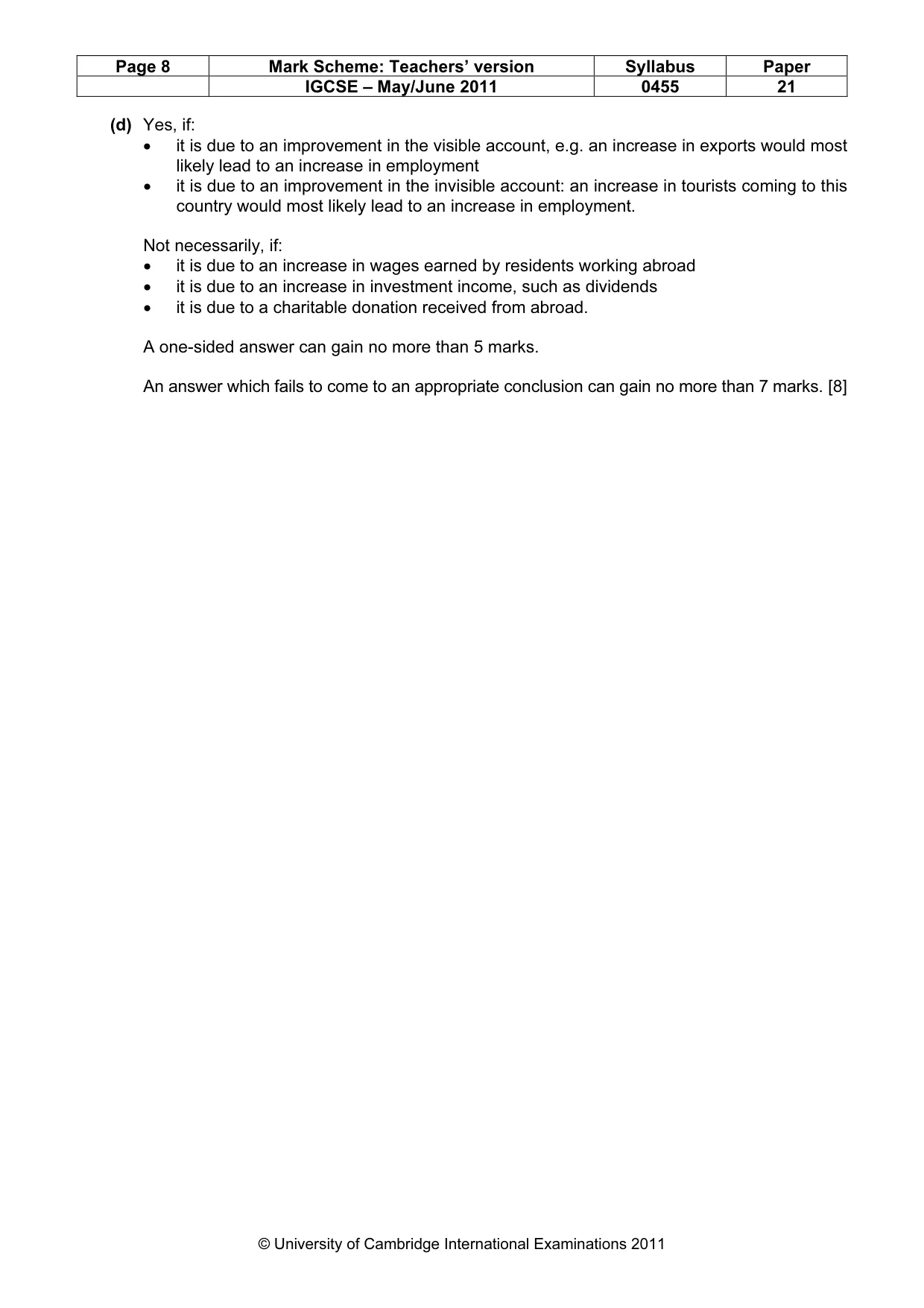
Mark scheme, page 8
Page 8 Mark Scheme: Teachers’ version Syllabus Paper IGCSE – May/June 2011 0455 21 © University of Cambridge International Examinations 2011 (d) Yes, if: • it is due to an improvement in the visible account, e.g. an increase in exports would most likely lead to an increase in employment • it is due to an improvement in the invisible account: an increase in tourists coming to this country would most likely lead to an increase in employment. Not necessarily, if: • it is due to an increase in wages earned by residents working abroad • it is due to an increase in investment income, such as dividends • it is due to a charitable donation received from abroad. A one-sided answer can gain no more than 5 marks. An answer which fails to come to an appropriate conclusion can gain no more than 7 marks. [8]
What you needed in this session
Cambridge’s own grade thresholds for 2011 May/June, Paper 2 · Variant 1. A higher threshold means an easier paper — the bar moves with how the cohort did.