Cambridge IGCSE Economics 0455 — 2010 May/June Paper 2 · Variant 2
0455/22/M/J/10 · 80 marks · ≈90 min
The question paper and its mark scheme, free to read here and free to download. This is Cambridge’s own paper, exactly as it was sat.
Question paper4 pages
Mark scheme8 pages
Answers below. Sit the paper first if you are practising.
Paper as text
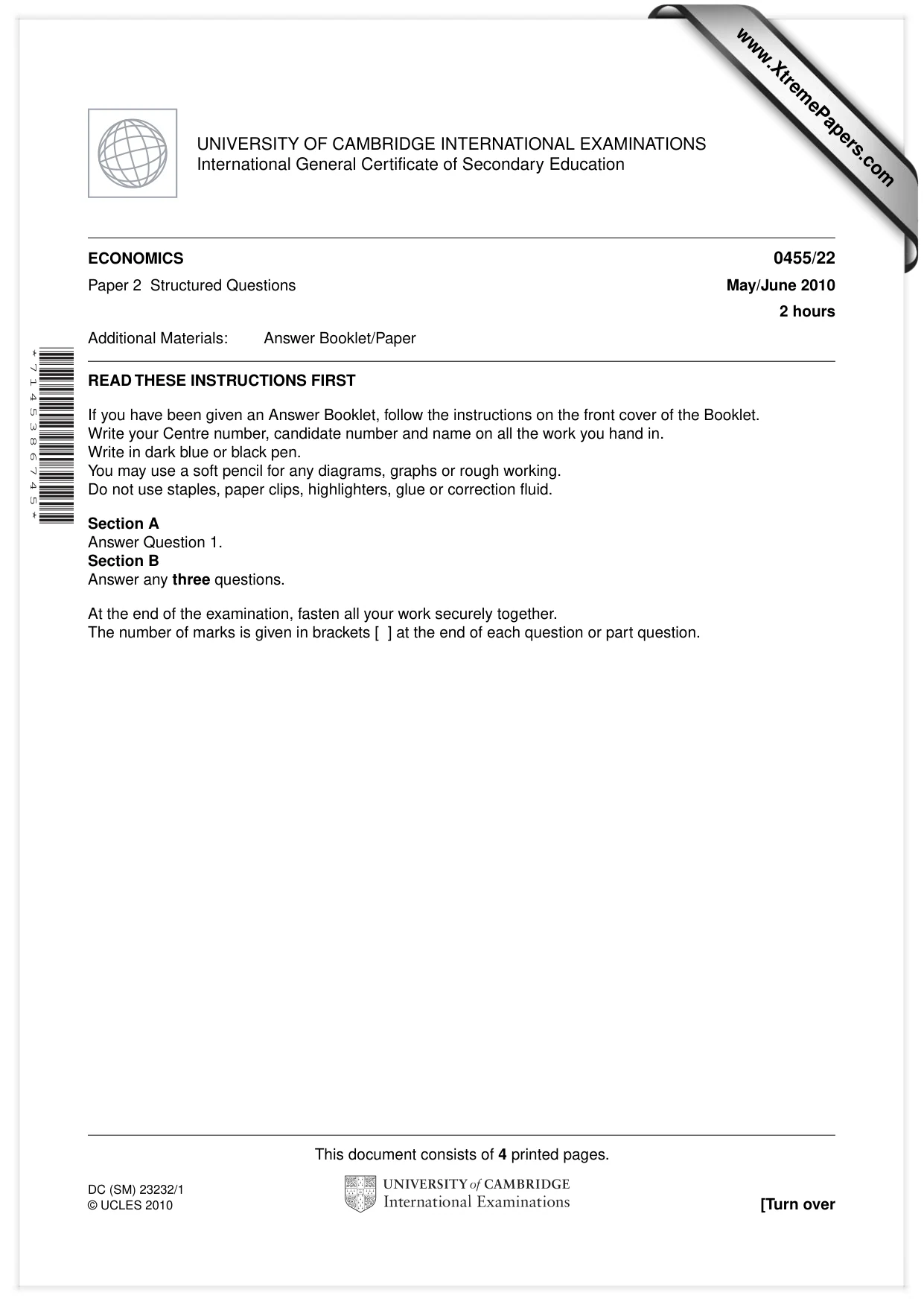
Question paper, page 1
This document consists of 4 printed pages. DC (SM) 23232/1 © UCLES 2010 [Turn over UNIVERSITY OF CAMBRIDGE INTERNATIONAL EXAMINATIONS International General Certificate of Secondary Education * 7 1 4 5 3 8 6 7 4 5 * ECONOMICS 0455/22 Paper 2 Structured Questions May/June 2010 2 hours Additional Materials: Answer Booklet/Paper READ THESE INSTRUCTIONS FIRST If you have been given an Answer Booklet, follow the instructions on the front cover of the Booklet. Write your Centre number, candidate number and name on all the work you hand in. Write in dark blue or black pen. You may use a soft pencil for any diagrams, graphs or rough working. Do not use staples, paper clips, highlighters, glue or correction fluid. Section A Answer Question 1. Section B Answer any three questions. At the end of the examination, fasten all your work securely together. The number of marks is given in brackets [ ] at the end of each question or part question. www.XtremePapers.com
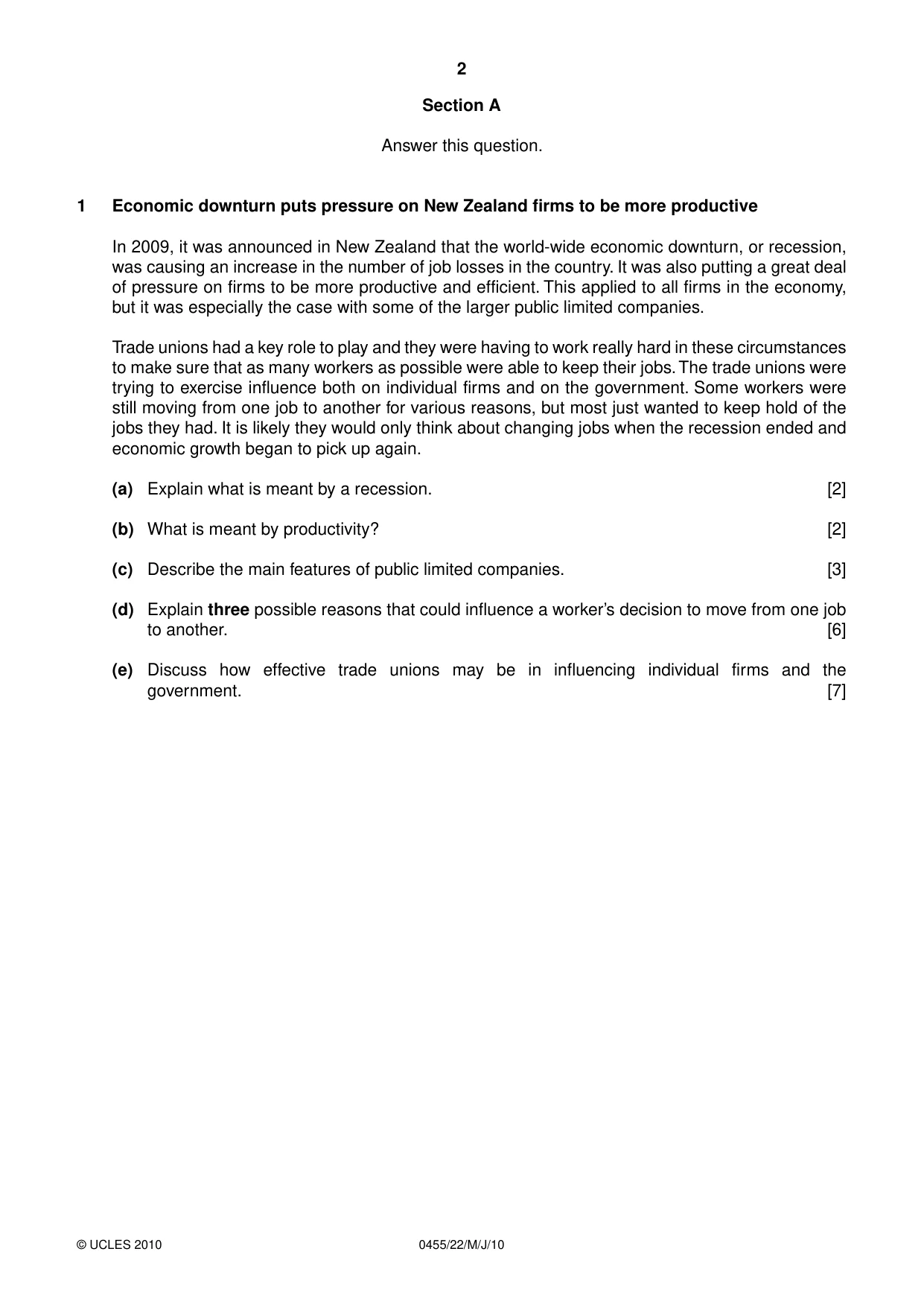
Question paper, page 2
2 0455/22/M/J/10 © UCLES 2010 Section A Answer this question. 1 Economic downturn puts pressure on New Zealand firms to be more productive In 2009, it was announced in New Zealand that the world-wide economic downturn, or recession, was causing an increase in the number of job losses in the country. It was also putting a great deal of pressure on firms to be more productive and efficient. This applied to all firms in the economy, but it was especially the case with some of the larger public limited companies. Trade unions had a key role to play and they were having to work really hard in these circumstances to make sure that as many workers as possible were able to keep their jobs. The trade unions were trying to exercise influence both on individual firms and on the government. Some workers were still moving from one job to another for various reasons, but most just wanted to keep hold of the jobs they had. It is likely they would only think about changing jobs when the recession ended and economic growth began to pick up again. (a) Explain what is meant by a recession. [2] (b) What is meant by productivity? [2] (c) Describe the main features of public limited companies. [3] (d) Explain three possible reasons that could influence a worker’s decision to move from one job to another. [6] (e) Discuss how effective trade unions may be in influencing individual firms and the government. [7]
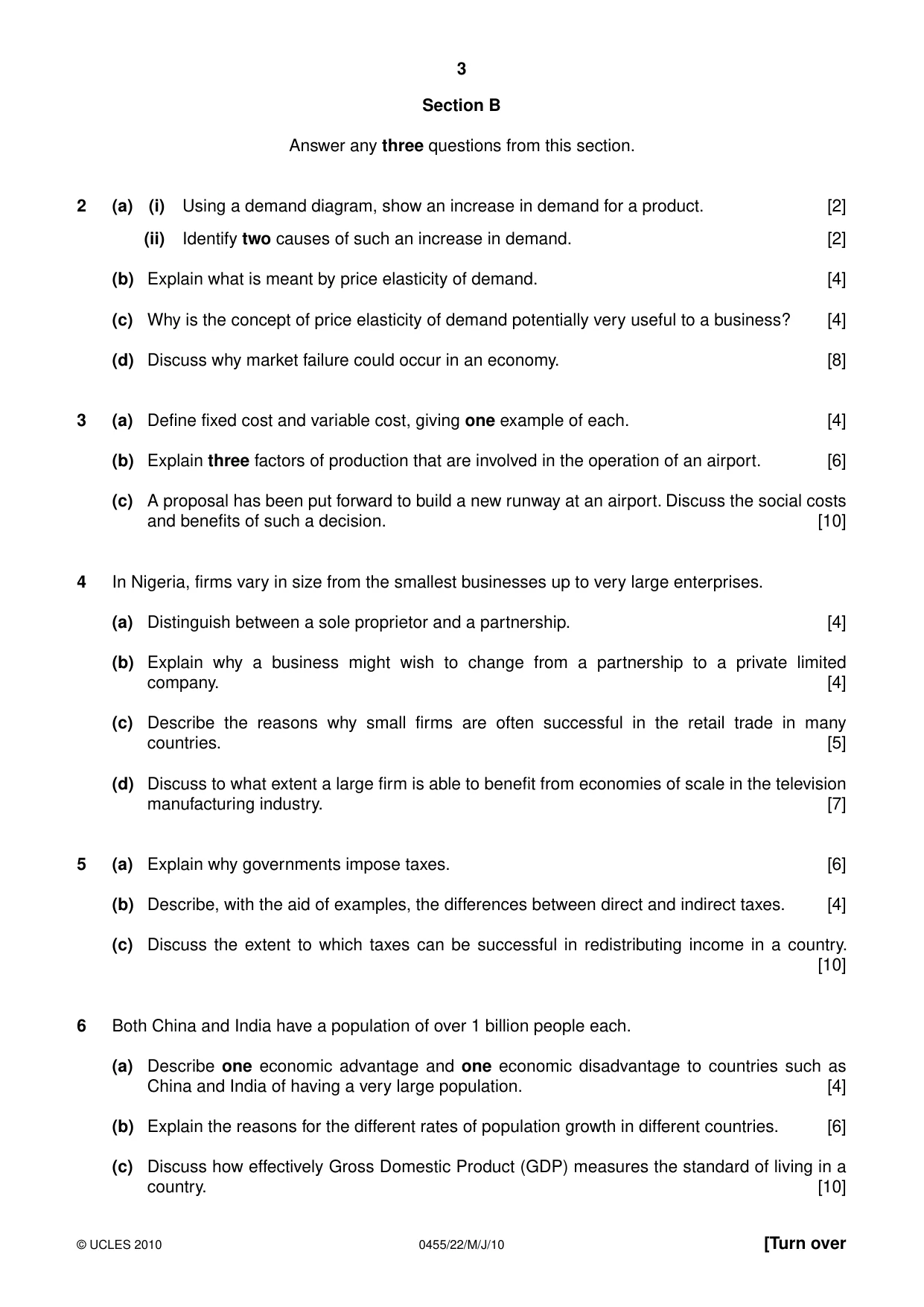
Question paper, page 3
3 0455/22/M/J/10 © UCLES 2010 [Turn over Section B Answer any three questions from this section. 2 (a) (i) Using a demand diagram, show an increase in demand for a product. [2] (ii) Identify two causes of such an increase in demand. [2] (b) Explain what is meant by price elasticity of demand. [4] (c) Why is the concept of price elasticity of demand potentially very useful to a business? [4] (d) Discuss why market failure could occur in an economy. [8] 3 (a) Define fixed cost and variable cost, giving one example of each. [4] (b) Explain three factors of production that are involved in the operation of an airport. [6] (c) A proposal has been put forward to build a new runway at an airport. Discuss the social costs and benefits of such a decision. [10] 4 In Nigeria, firms vary in size from the smallest businesses up to very large enterprises. (a) Distinguish between a sole proprietor and a partnership. [4] (b) Explain why a business might wish to change from a partnership to a private limited company. [4] (c) Describe the reasons why small firms are often successful in the retail trade in many countries. [5] (d) Discuss to what extent a large firm is able to benefit from economies of scale in the television manufacturing industry. [7] 5 (a) Explain why governments impose taxes. [6] (b) Describe, with the aid of examples, the differences between direct and indirect taxes. [4] (c) Discuss the extent to which taxes can be successful in redistributing income in a country. [10] 6 Both China and India have a population of over 1 billion people each. (a) Describe one economic advantage and one economic disadvantage to countries such as China and India of having a very large population. [4] (b) Explain the reasons for the different rates of population growth in different countries. [6] (c) Discuss how effectively Gross Domestic Product (GDP) measures the standard of living in a country. [10]
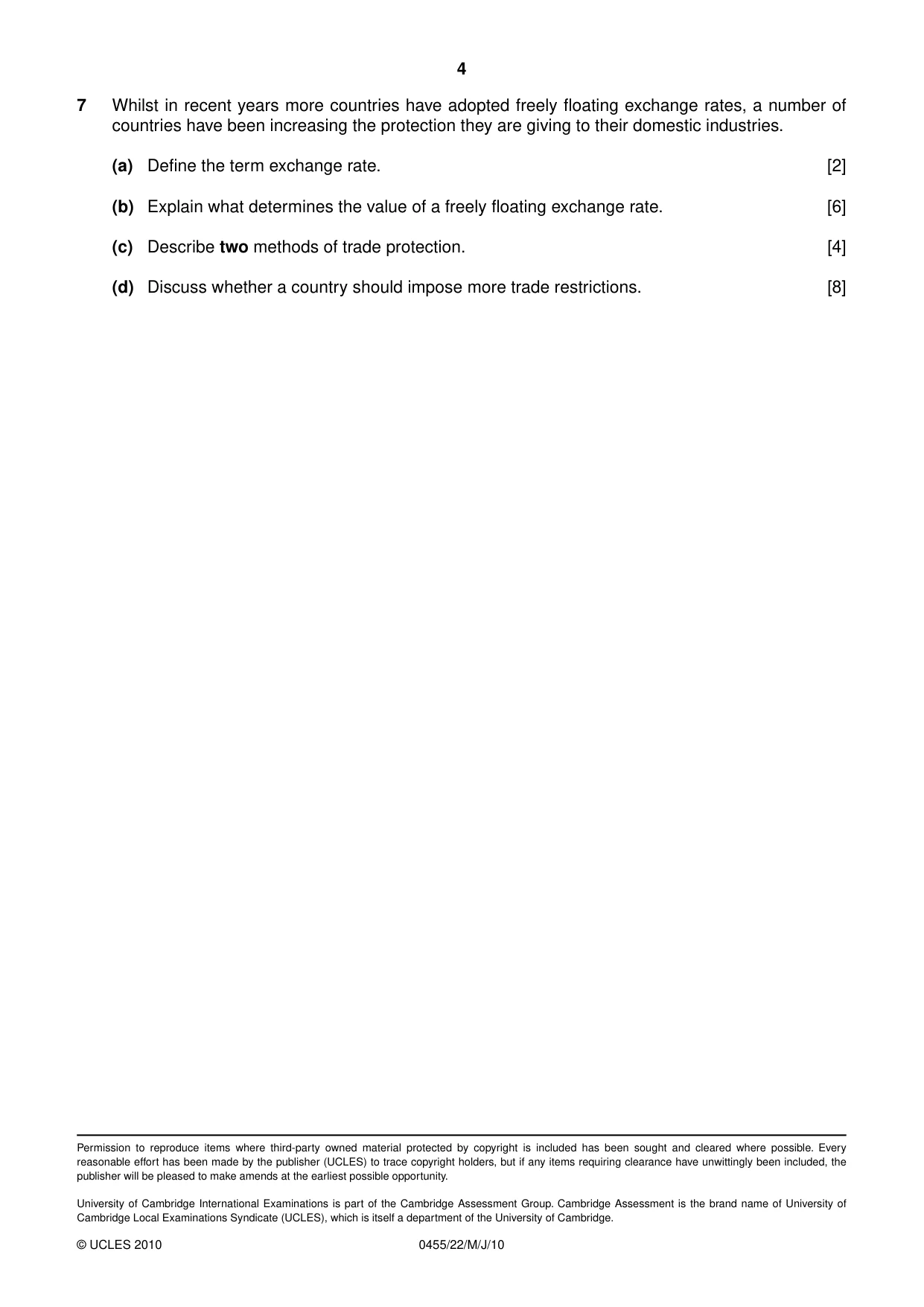
Question paper, page 4
4 0455/22/M/J/10 © UCLES 2010 7 Whilst in recent years more countries have adopted freely floating exchange rates, a number of countries have been increasing the protection they are giving to their domestic industries. (a) Define the term exchange rate. [2] (b) Explain what determines the value of a freely floating exchange rate. [6] (c) Describe two methods of trade protection. [4] (d) Discuss whether a country should impose more trade restrictions. [8] Permission to reproduce items where third-party owned material protected by copyright is included has been sought and cleared where possible. Every reasonable effort has been made by the publisher (UCLES) to trace copyright holders, but if any items requiring clearance have unwittingly been included, the publisher will be pleased to make amends at the earliest possible opportunity. University of Cambridge International Examinations is part of the Cambridge Assessment Group. Cambridge Assessment is the brand name of University of Cambridge Local Examinations Syndicate (UCLES), which is itself a department of the University of Cambridge.
Mark scheme, page 1
UNIVERSITY OF CAMBRIDGE INTERNATIONAL EXAMINATIONS International General Certificate of Secondary Education MARK SCHEME for the May/June 2010 question paper for the guidance of teachers 0455 ECONOMICS 0455/22 Paper 22 (Structured Questions), maximum raw mark 80 This mark scheme is published as an aid to teachers and candidates, to indicate the requirements of the examination. It shows the basis on which Examiners were instructed to award marks. It does not indicate the details of the discussions that took place at an Examiners’ meeting before marking began, which would have considered the acceptability of alternative answers. Mark schemes must be read in conjunction with the question papers and the report on the examination. • CIE will not enter into discussions or correspondence in connection with these mark schemes. CIE is publishing the mark schemes for the May/June 2010 question papers for most IGCSE, GCE Advanced Level and Advanced Subsidiary Level syllabuses and some Ordinary Level syllabuses. www.XtremePapers.com
Mark scheme, page 2
Page 2 Mark Scheme: Teachers’ version Syllabus Paper IGCSE – May/June 2010 0455 22 © UCLES 2010 1 (a) Idea of a downswing/downturn in a business or trade cycle. Economic growth will be negative. Rising unemployment/job losses. Idea of a period of time (technically two successive quarters of negative growth, but we shouldn’t expect candidates to be this precise). [2] (b) Productivity refers to output per factor or input, such as output per worker (1), per period of time (1). A vague comment on an increase in production/output should get no marks. [2] (c) They have a separate legal existence from their owners. They are owned by shareholders. The owners have limited liability. They have plc after their names. Shares can be traded on a stock exchange. The directors must report on the progress of the company to the shareholders at an AGM. A maximum of 2 marks if only one feature is described, but it is done very well. [3] (d) Possible reasons: • wages/salaries • other financial factors, e.g. bonus, commission, profit sharing • hours of work/flexitime • location (possibly reducing travel time/cost) • working conditions • holiday provision • promotion prospects • fringe benefits, e.g. company car • pension arrangements • social/leisure/canteen facilities. Up to 3 marks for identification of reasons. Up to 3 marks for explanation of these reasons. [6] (e) General understanding of what a trade union is (2) (this can be implied throughout the answer). Discussion of role in relation to: • better pay • improved working conditions • putting pressure on individual firms to maintain jobs • putting pressure on government to maintain jobs • threat/different types of industrial action (5). The question does refer to how effective trade unions may be in their influence; answers which fail to address this can gain no more than 4 marks. Answers which only deal with firms or the government can get a maximum of 4 marks. [7]
Mark scheme, page 3
Page 3 Mark Scheme: Teachers’ version Syllabus Paper IGCSE – May/June 2010 0455 22 © UCLES 2010 2 (a) (i) Correctly labelled diagram (price, quantity, demand) (1). Shift of demand curve to the right (1). [2] (ii) Possible causes: • rise in income • greater availability of credit to finance borrowing • fall in interest rate on loans • price of substitute has gone up • price of complement has gone down • effect of advertising campaign • growth in population • change in tastes and preferences of consumers in favour of a product. Note that the question asks candidates to identify two causes. [2] (b) General idea that PED measures the sensitivity of demand to a change in price (1). Precise formula: percentage change in quantity demanded of a product divided by percentage change in price of a product (2). Extra comment, e.g. it is usually negative, it can range from perfectly inelastic to perfectly elastic (1). [4] (c) If PED is elastic, the business should reduce price (1) to benefit from an increase in revenue (1). If PED is inelastic, the business should increase price (1) to benefit from an increase in revenue (1). [4] (d) Firms may come to dominate and have monopoly power, leading to higher prices and lower levels of output. There may be significant differences in income and wealth, which gives some consumers much more power than others. Merit goods, which are socially desirable, may be under-provided and under-consumed. Demerit goods, which are socially undesirable, may be over-provided and over-consumed. Public goods, which cannot be easily provided through a market system, may not be provided at all. Resources cannot always easily move from one use to another, e.g. labour may not have the necessary skills and/or information. Externalities may not be taken into account in consumption and production decisions. Please note that merit, demerit and public goods are not on the syllabus; a maximum mark, therefore, could be obtained without reference to any of these. A general understanding of what is meant by market failure can gain up to 2 marks. A narrow focus on one particular area of market failure, that is done well, can gain a maximum of 5 marks. [8]
Mark scheme, page 4
Page 4 Mark Scheme: Teachers’ version Syllabus Paper IGCSE – May/June 2010 0455 22 © UCLES 2010 3 (a) A fixed or overhead cost is a cost of production which does not vary with changes in output (1), such as the cost of fixed interest payments on loans (1). A variable cost is a cost of production which does vary with changes in output (1), such as the cost of raw materials (1). [4] (b) Three from the following: • land, e.g. where the terminals and runways are constructed • labour, e.g. the skilled and unskilled labour involved in the various activities • capital, e.g. the equipment and machinery used at the airport • enterprise, e.g. the role of the entrepreneur in various airport operations. Allow construction (as opposed to operation) of an airport. A list of three factors of production can gain 1 mark. A good explanation of these three factors, with no application to an airport, can get a maximum of 5 marks. [6] (c) The social cost measures the cost to the whole society of an economic activity; it is equal to the sum of the private cost and the external cost. Examples could include noise and visual pollution (external) and wages paid to building workers (internal). The social benefit measures the benefit to the whole society of an economic activity; it is equal to the sum of the private benefit and the external benefit. Examples could include extra revenue generated in the area, improvement in transport infrastructure and benefit to trade and tourism (external) and profits earned by airlines (internal). A maximum of 6 marks if the candidate only discusses social costs or social benefits. Also, a maximum of 6 marks if no reference to a new runway. An answer that focuses only on external or private costs and benefits can get a maximum of 6 marks. [10]
Mark scheme, page 5
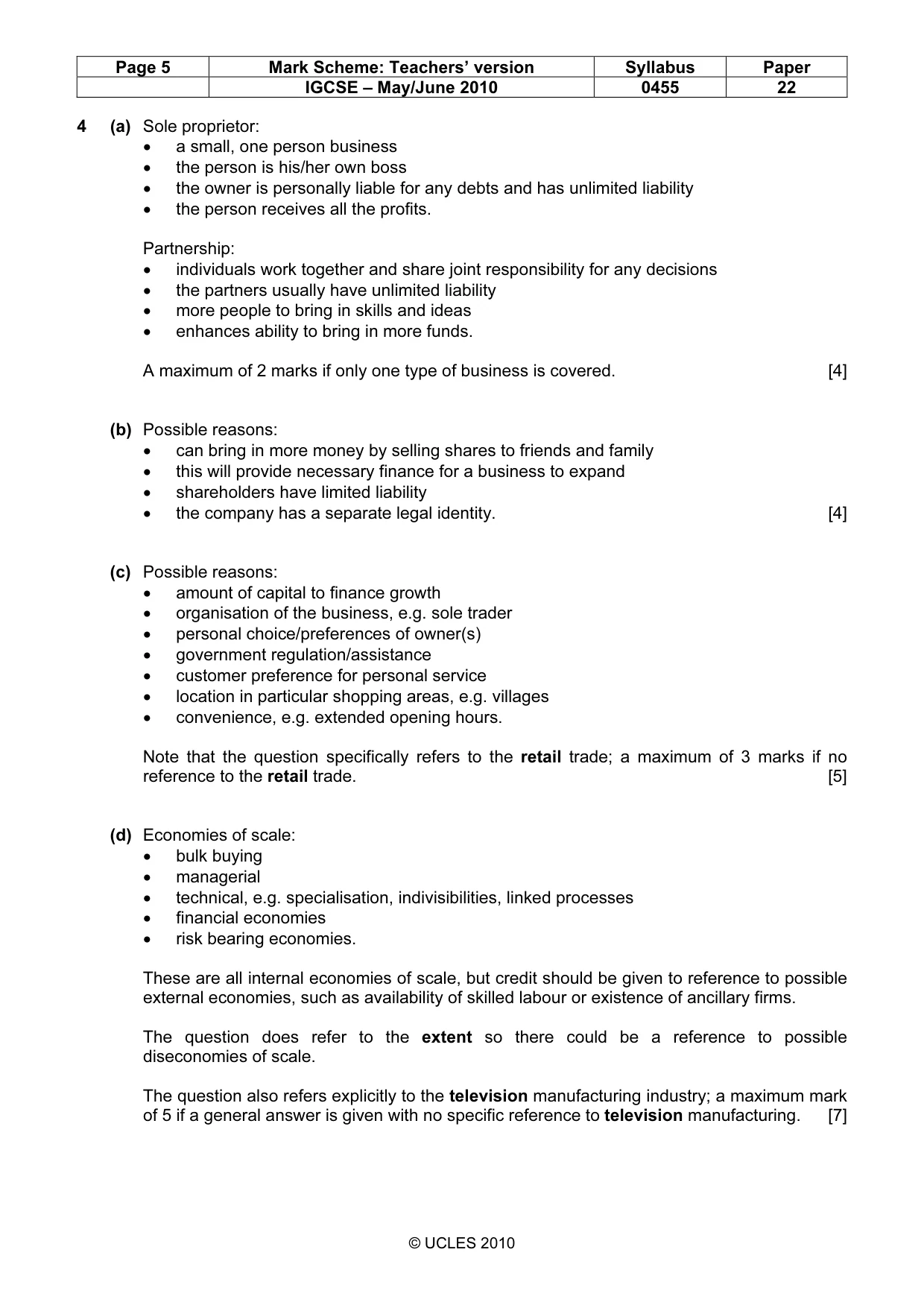
Page 5 Mark Scheme: Teachers’ version Syllabus Paper IGCSE – May/June 2010 0455 22 © UCLES 2010 4 (a) Sole proprietor: • a small, one person business • the person is his/her own boss • the owner is personally liable for any debts and has unlimited liability • the person receives all the profits. Partnership: • individuals work together and share joint responsibility for any decisions • the partners usually have unlimited liability • more people to bring in skills and ideas • enhances ability to bring in more funds. A maximum of 2 marks if only one type of business is covered. [4] (b) Possible reasons: • can bring in more money by selling shares to friends and family • this will provide necessary finance for a business to expand • shareholders have limited liability • the company has a separate legal identity. [4] (c) Possible reasons: • amount of capital to finance growth • organisation of the business, e.g. sole trader • personal choice/preferences of owner(s) • government regulation/assistance • customer preference for personal service • location in particular shopping areas, e.g. villages • convenience, e.g. extended opening hours. Note that the question specifically refers to the retail trade; a maximum of 3 marks if no reference to the retail trade. [5] (d) Economies of scale: • bulk buying • managerial • technical, e.g. specialisation, indivisibilities, linked processes • financial economies • risk bearing economies. These are all internal economies of scale, but credit should be given to reference to possible external economies, such as availability of skilled labour or existence of ancillary firms. The question does refer to the extent so there could be a reference to possible diseconomies of scale. The question also refers explicitly to the television manufacturing industry; a maximum mark of 5 if a general answer is given with no specific reference to television manufacturing. [7]
Mark scheme, page 6
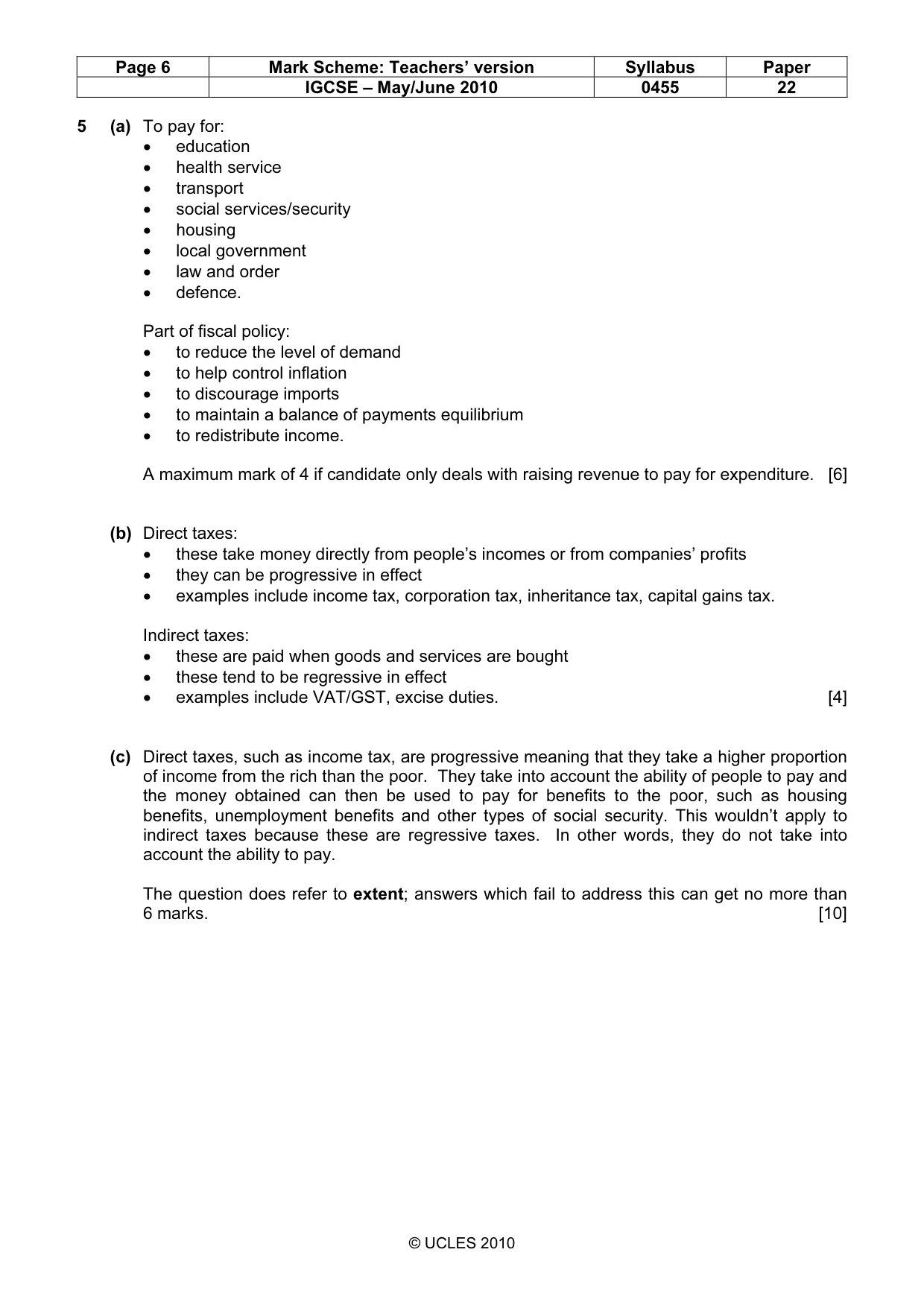
Page 6 Mark Scheme: Teachers’ version Syllabus Paper IGCSE – May/June 2010 0455 22 © UCLES 2010 5 (a) To pay for: • education • health service • transport • social services/security • housing • local government • law and order • defence. Part of fiscal policy: • to reduce the level of demand • to help control inflation • to discourage imports • to maintain a balance of payments equilibrium • to redistribute income. A maximum mark of 4 if candidate only deals with raising revenue to pay for expenditure. [6] (b) Direct taxes: • these take money directly from people’s incomes or from companies’ profits • they can be progressive in effect • examples include income tax, corporation tax, inheritance tax, capital gains tax. Indirect taxes: • these are paid when goods and services are bought • these tend to be regressive in effect • examples include VAT/GST, excise duties. [4] (c) Direct taxes, such as income tax, are progressive meaning that they take a higher proportion of income from the rich than the poor. They take into account the ability of people to pay and the money obtained can then be used to pay for benefits to the poor, such as housing benefits, unemployment benefits and other types of social security. This wouldn’t apply to indirect taxes because these are regressive taxes. In other words, they do not take into account the ability to pay. The question does refer to extent; answers which fail to address this can get no more than 6 marks. [10]
Mark scheme, page 7
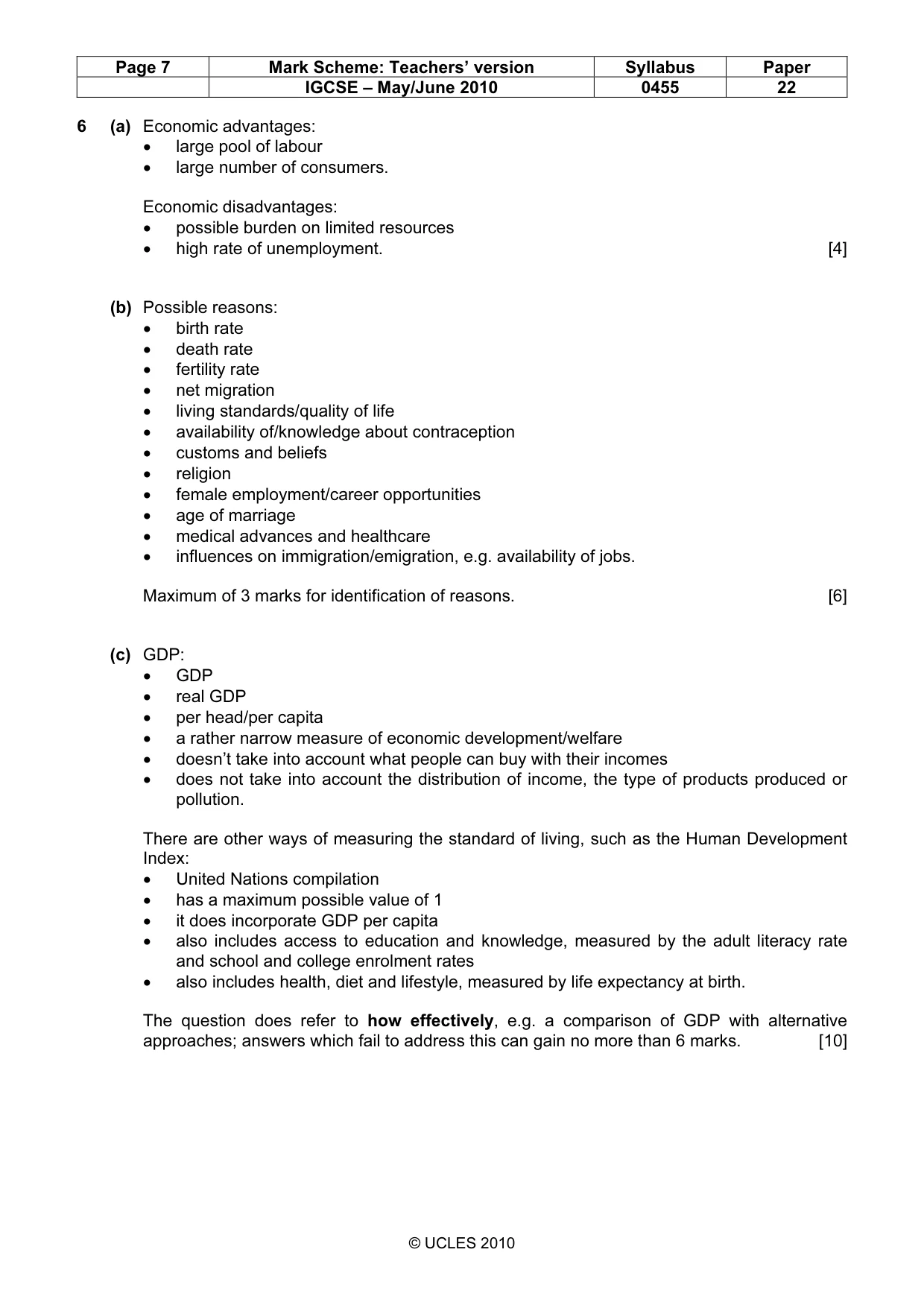
Page 7 Mark Scheme: Teachers’ version Syllabus Paper IGCSE – May/June 2010 0455 22 © UCLES 2010 6 (a) Economic advantages: • large pool of labour • large number of consumers. Economic disadvantages: • possible burden on limited resources • high rate of unemployment. [4] (b) Possible reasons: • birth rate • death rate • fertility rate • net migration • living standards/quality of life • availability of/knowledge about contraception • customs and beliefs • religion • female employment/career opportunities • age of marriage • medical advances and healthcare • influences on immigration/emigration, e.g. availability of jobs. Maximum of 3 marks for identification of reasons. [6] (c) GDP: • GDP • real GDP • per head/per capita • a rather narrow measure of economic development/welfare • doesn’t take into account what people can buy with their incomes • does not take into account the distribution of income, the type of products produced or pollution. There are other ways of measuring the standard of living, such as the Human Development Index: • United Nations compilation • has a maximum possible value of 1 • it does incorporate GDP per capita • also includes access to education and knowledge, measured by the adult literacy rate and school and college enrolment rates • also includes health, diet and lifestyle, measured by life expectancy at birth. The question does refer to how effectively, e.g. a comparison of GDP with alternative approaches; answers which fail to address this can gain no more than 6 marks. [10]
Mark scheme, page 8
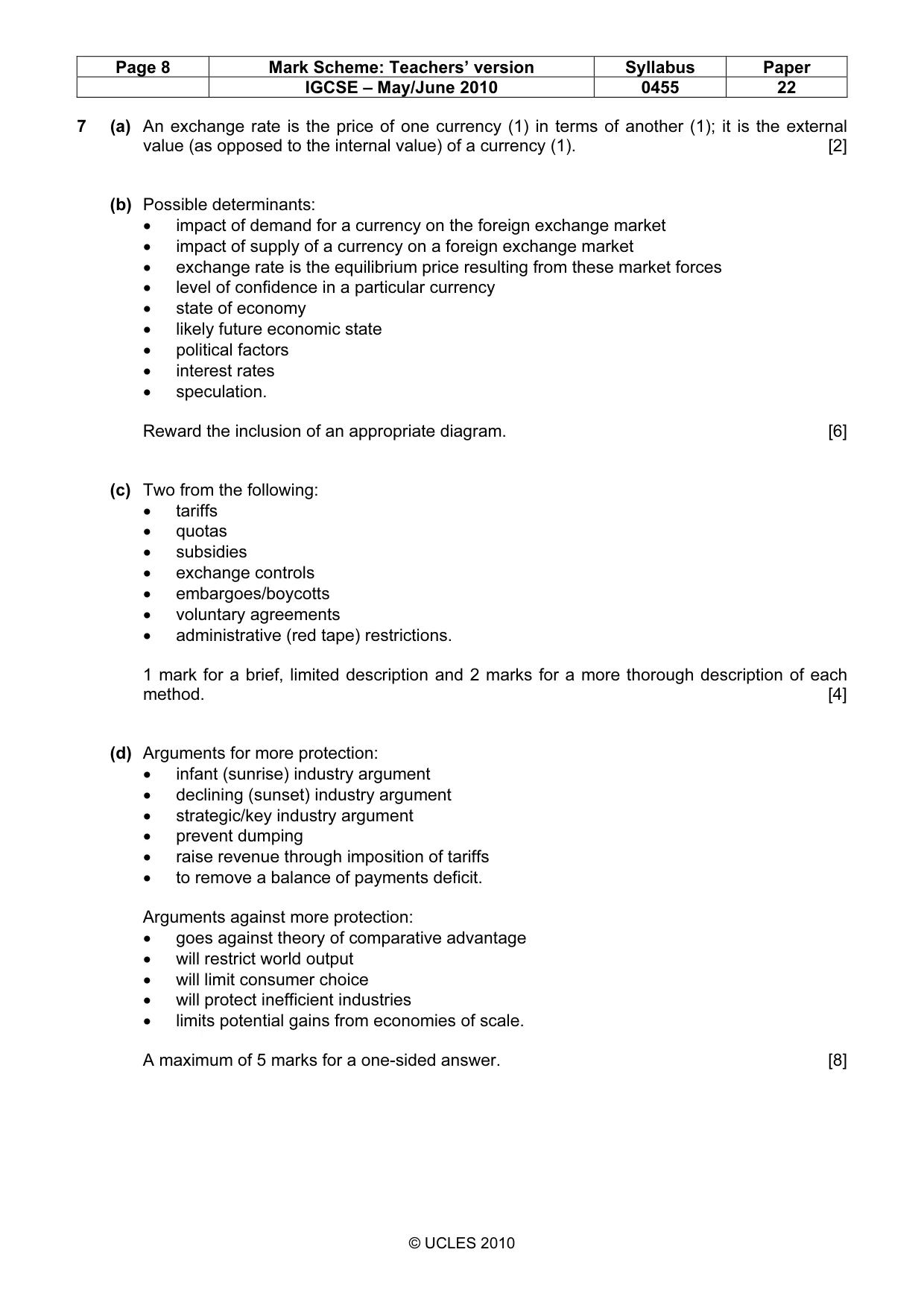
Page 8 Mark Scheme: Teachers’ version Syllabus Paper IGCSE – May/June 2010 0455 22 © UCLES 2010 7 (a) An exchange rate is the price of one currency (1) in terms of another (1); it is the external value (as opposed to the internal value) of a currency (1). [2] (b) Possible determinants: • impact of demand for a currency on the foreign exchange market • impact of supply of a currency on a foreign exchange market • exchange rate is the equilibrium price resulting from these market forces • level of confidence in a particular currency • state of economy • likely future economic state • political factors • interest rates • speculation. Reward the inclusion of an appropriate diagram. [6] (c) Two from the following: • tariffs • quotas • subsidies • exchange controls • embargoes/boycotts • voluntary agreements • administrative (red tape) restrictions. 1 mark for a brief, limited description and 2 marks for a more thorough description of each method. [4] (d) Arguments for more protection: • infant (sunrise) industry argument • declining (sunset) industry argument • strategic/key industry argument • prevent dumping • raise revenue through imposition of tariffs • to remove a balance of payments deficit. Arguments against more protection: • goes against theory of comparative advantage • will restrict world output • will limit consumer choice • will protect inefficient industries • limits potential gains from economies of scale. A maximum of 5 marks for a one-sided answer. [8]
What you needed in this session
Cambridge’s own grade thresholds for 2010 May/June, Paper 2 · Variant 2. A higher threshold means an easier paper — the bar moves with how the cohort did.