Cambridge IGCSE Economics 0455 — 2010 May/June Paper 2 · Variant 1
0455/21/M/J/10 · 80 marks · ≈90 min
The question paper and its mark scheme, free to read here and free to download. This is Cambridge’s own paper, exactly as it was sat.
Question paper4 pages
Mark scheme9 pages
Answers below. Sit the paper first if you are practising.
Paper as text
Question paper, page 1
This document consists of 4 printed pages. DC (LEO/SLM) 19735/1 © UCLES 2010 [Turn over UNIVERSITY OF CAMBRIDGE INTERNATIONAL EXAMINATIONS International General Certificate of Secondary Education * 2 9 0 8 5 9 7 9 3 0 * ECONOMICS 0455/21 Paper 2 Structured Questions May/June 2010 2 hours Additional Materials: Answer Booklet/Paper READ THESE INSTRUCTIONS FIRST If you have been given an Answer Booklet, follow the instructions on the front cover of the Booklet. Write your Centre number, candidate number and name on all the work you hand in. Write in dark blue or black pen. You may use a soft pencil for any diagrams, graphs or rough working. Do not use staples, paper clips, highlighters, glue or correction fluid. Section A Answer Question 1. Section B Answer any three questions. At the end of the examination, fasten all your work securely together. The number of marks is given in brackets [ ] at the end of each question or part question. www.XtremePapers.com
Question paper, page 2
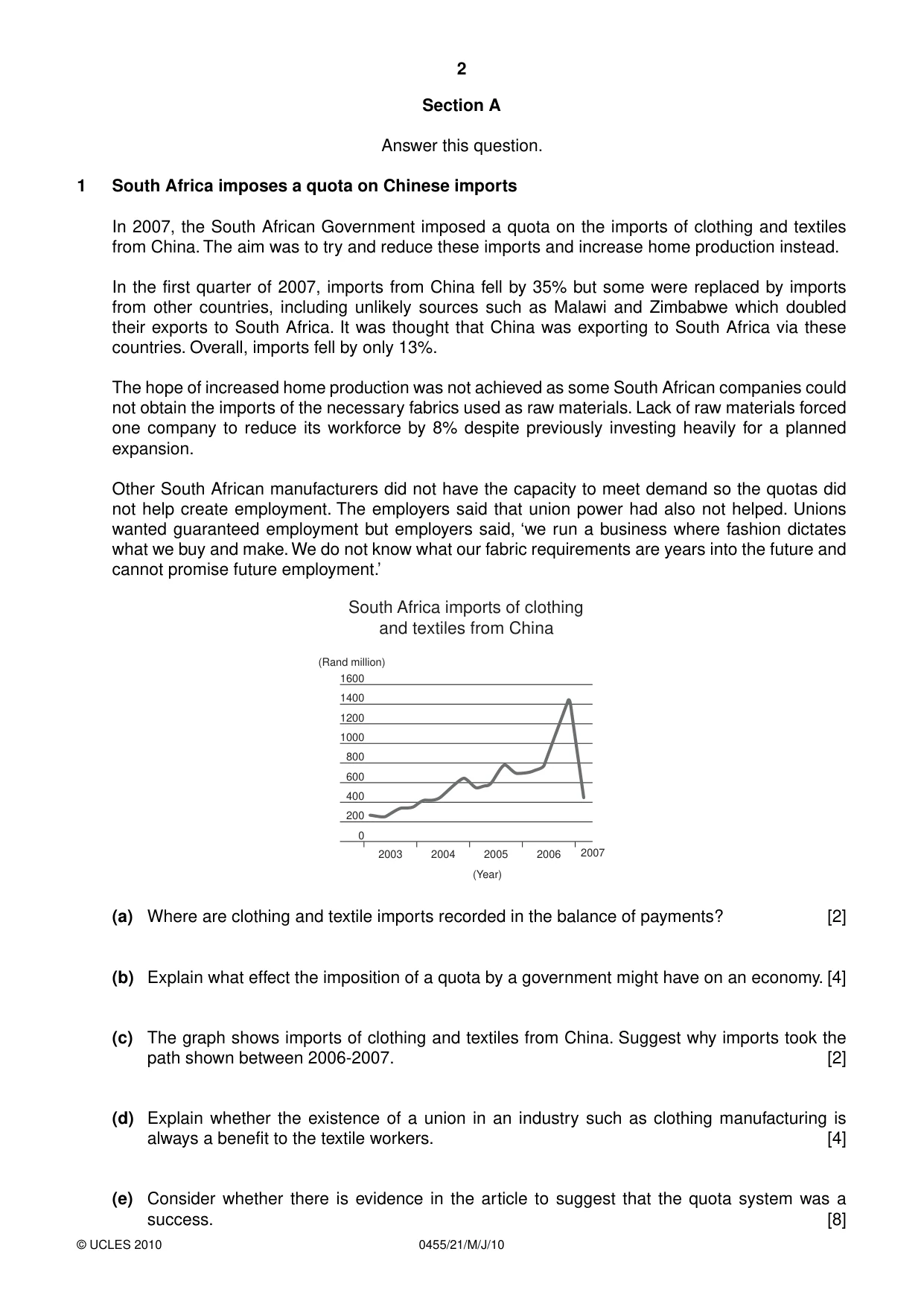
2 0455/21/M/J/10 © UCLES 2010 Section A Answer this question. 1 South Africa imposes a quota on Chinese imports In 2007, the South African Government imposed a quota on the imports of clothing and textiles from China. The aim was to try and reduce these imports and increase home production instead. In the first quarter of 2007, imports from China fell by 35% but some were replaced by imports from other countries, including unlikely sources such as Malawi and Zimbabwe which doubled their exports to South Africa. It was thought that China was exporting to South Africa via these countries. Overall, imports fell by only 13%. The hope of increased home production was not achieved as some South African companies could not obtain the imports of the necessary fabrics used as raw materials. Lack of raw materials forced one company to reduce its workforce by 8% despite previously investing heavily for a planned expansion. Other South African manufacturers did not have the capacity to meet demand so the quotas did not help create employment. The employers said that union power had also not helped. Unions wanted guaranteed employment but employers said, ‘we run a business where fashion dictates what we buy and make. We do not know what our fabric requirements are years into the future and cannot promise future employment.’ 0 2003 2004 2005 (Year) 2006 2007 200 400 600 800 1000 1200 1400 1600 South Africa imports of clothing and textiles from China (Rand million) (a) Where are clothing and textile imports recorded in the balance of payments? [2] (b) Explain what effect the imposition of a quota by a government might have on an economy. [4] (c) The graph shows imports of clothing and textiles from China. Suggest why imports took the path shown between 2006-2007. [2] (d) Explain whether the existence of a union in an industry such as clothing manufacturing is always a benefit to the textile workers. [4] (e) Consider whether there is evidence in the article to suggest that the quota system was a success. [8]
Question paper, page 3
3 0455/21/M/J/10 © UCLES 2010 [Turn over Section B Answer any three questions from this section. 2 A government decided to stop subsidising students when they went to university. This meant a university course cost the students more but the government had extra funds. (a) Define opportunity cost and explain how the above decision might be used to illustrate an opportunity cost. [4] (b) With the aid of a demand and supply diagram discuss how the effect of a subsidy might vary in different markets. [6] (c) Apart from a subsidy, how might a government change the market price of a good? [4] (d) Analyse the differences between a market economy and a mixed economy. [6] 3 (a) Sometimes it is said that a person chooses a job because of non-wage factors. Explain, using three examples, the meaning of non-wage factors. [4] (b) What might determine why one person saves a higher proportion of income and spends a lower proportion than another person? [6] (c) Some occupations pay much more than other occupations. Why might this happen? [10] 4 A large, capital-intensive German company producing electrical goods decided to establish a factory in India. (a) From the information given above, describe the type of business organisation that the German company is likely to be. [4] (b) Discuss what might be the advantages for a company of establishing a factory in another country. [6] (c) How might the establishment of the factory affect existing Indian companies and the Indian economy? [10]
Question paper, page 4
4 0455/21/M/J/10 © UCLES 2010 5 (a) Describe what is meant by economic growth and explain how it might be measured. [5] (b) If there is economic growth, unemployment often declines. Identify three types of unemployment and explain their causes. [6] (c) Discuss how (i) consumers (ii) firms and (iii) the government might benefit if there is economic growth. [9] 6 Firms employ factors of production to produce goods and services in order to make profits. (a) What is meant by the term factors of production? [4] (b) How do the characteristics of a monopoly differ from those of perfect competition? [6] (c) Discuss how firms might become large and evaluate whether monopolies are necessarily advantageous. [10] 7 People often have an account with a commercial bank in which they deposit some of their money and from which they can pay their bills. (a) Describe the functions of money. [6] (b) Identify and explain three functions of a central bank which differ from the functions of a commercial bank. [6] (c) Sometimes the value of money is decreased because of inflation. Discuss the main causes of inflation. [8] Permission to reproduce items where third-party owned material protected by copyright is included has been sought and cleared where possible. Every reasonable effort has been made by the publisher (UCLES) to trace copyright holders, but if any items requiring clearance have unwittingly been included, the publisher will be pleased to make amends at the earliest possible opportunity. University of Cambridge International Examinations is part of the Cambridge Assessment Group. Cambridge Assessment is the brand name of University of Cambridge Local Examinations Syndicate (UCLES), which is itself a department of the University of Cambridge.
Mark scheme, page 1
UNIVERSITY OF CAMBRIDGE INTERNATIONAL EXAMINATIONS International General Certificate of Secondary Education MARK SCHEME for the May/June 2010 question paper for the guidance of teachers 0455 ECONOMICS 0455/21 Paper 21 (Structured Questions), maximum raw mark 80 This mark scheme is published as an aid to teachers and candidates, to indicate the requirements of the examination. It shows the basis on which Examiners were instructed to award marks. It does not indicate the details of the discussions that took place at an Examiners’ meeting before marking began, which would have considered the acceptability of alternative answers. Mark schemes must be read in conjunction with the question papers and the report on the examination. • CIE will not enter into discussions or correspondence in connection with these mark schemes. CIE is publishing the mark schemes for the May/June 2010 question papers for most IGCSE, GCE Advanced Level and Advanced Subsidiary Level syllabuses and some Ordinary Level syllabuses. www.XtremePapers.com
Mark scheme, page 2
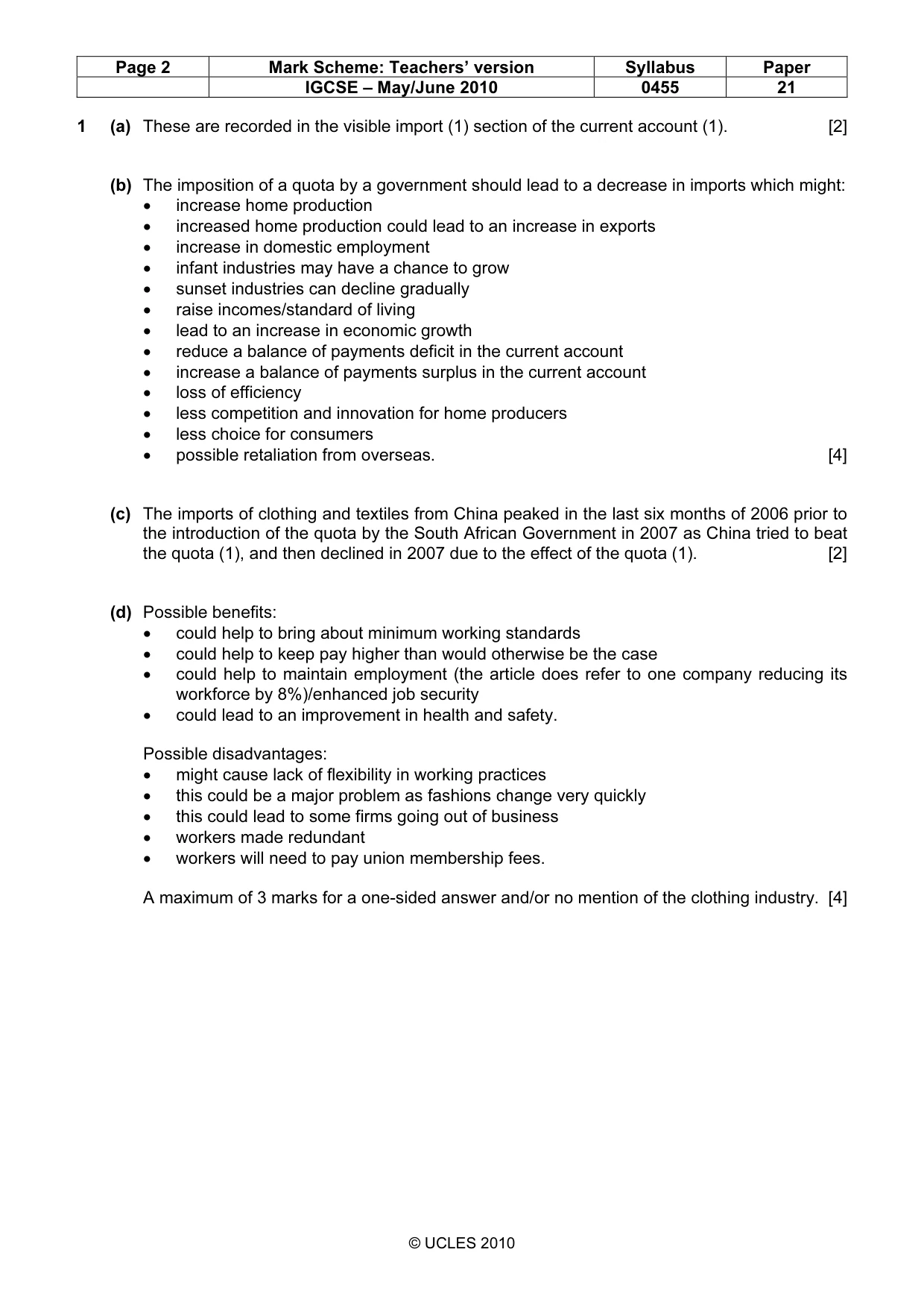
Page 2 Mark Scheme: Teachers’ version Syllabus Paper IGCSE – May/June 2010 0455 21 © UCLES 2010 1 (a) These are recorded in the visible import (1) section of the current account (1). [2] (b) The imposition of a quota by a government should lead to a decrease in imports which might: • increase home production • increased home production could lead to an increase in exports • increase in domestic employment • infant industries may have a chance to grow • sunset industries can decline gradually • raise incomes/standard of living • lead to an increase in economic growth • reduce a balance of payments deficit in the current account • increase a balance of payments surplus in the current account • loss of efficiency • less competition and innovation for home producers • less choice for consumers • possible retaliation from overseas. [4] (c) The imports of clothing and textiles from China peaked in the last six months of 2006 prior to the introduction of the quota by the South African Government in 2007 as China tried to beat the quota (1), and then declined in 2007 due to the effect of the quota (1). [2] (d) Possible benefits: • could help to bring about minimum working standards • could help to keep pay higher than would otherwise be the case • could help to maintain employment (the article does refer to one company reducing its workforce by 8%)/enhanced job security • could lead to an improvement in health and safety. Possible disadvantages: • might cause lack of flexibility in working practices • this could be a major problem as fashions change very quickly • this could lead to some firms going out of business • workers made redundant • workers will need to pay union membership fees. A maximum of 3 marks for a one-sided answer and/or no mention of the clothing industry. [4]
Mark scheme, page 3
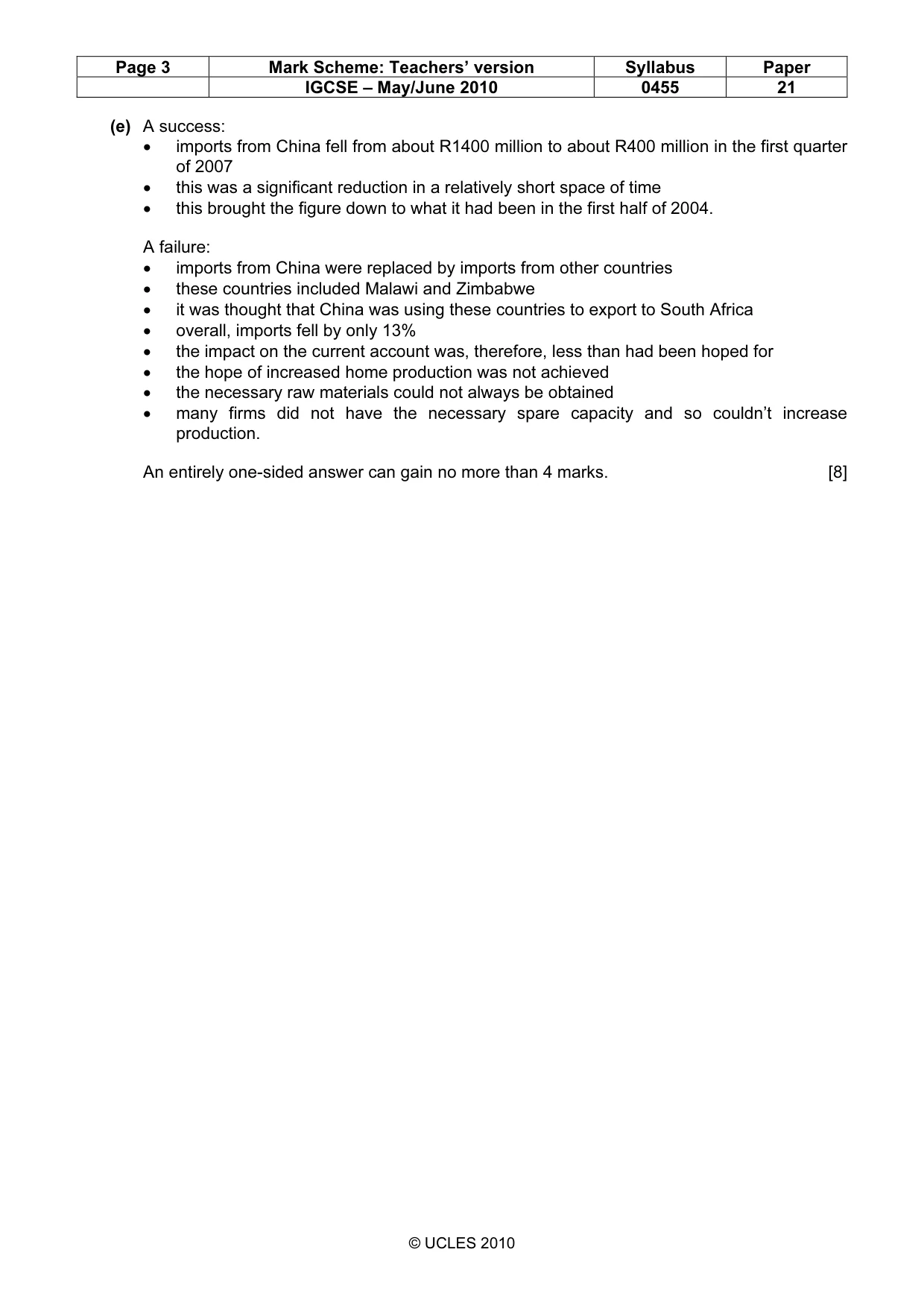
Page 3 Mark Scheme: Teachers’ version Syllabus Paper IGCSE – May/June 2010 0455 21 © UCLES 2010 (e) A success: • imports from China fell from about R1400 million to about R400 million in the first quarter of 2007 • this was a significant reduction in a relatively short space of time • this brought the figure down to what it had been in the first half of 2004. A failure: • imports from China were replaced by imports from other countries • these countries included Malawi and Zimbabwe • it was thought that China was using these countries to export to South Africa • overall, imports fell by only 13% • the impact on the current account was, therefore, less than had been hoped for • the hope of increased home production was not achieved • the necessary raw materials could not always be obtained • many firms did not have the necessary spare capacity and so couldn’t increase production. An entirely one-sided answer can gain no more than 4 marks. [8]
Mark scheme, page 4
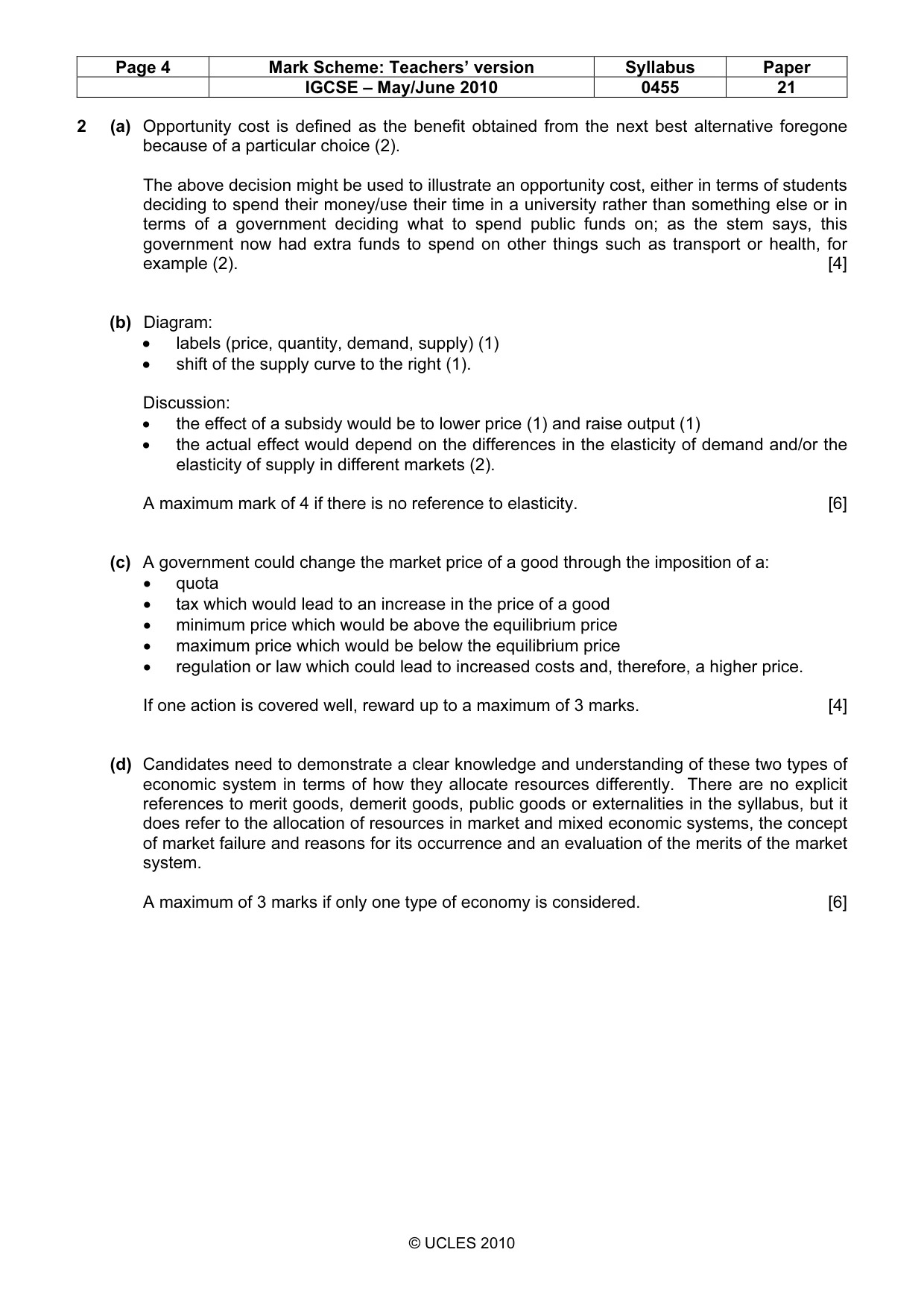
Page 4 Mark Scheme: Teachers’ version Syllabus Paper IGCSE – May/June 2010 0455 21 © UCLES 2010 2 (a) Opportunity cost is defined as the benefit obtained from the next best alternative foregone because of a particular choice (2). The above decision might be used to illustrate an opportunity cost, either in terms of students deciding to spend their money/use their time in a university rather than something else or in terms of a government deciding what to spend public funds on; as the stem says, this government now had extra funds to spend on other things such as transport or health, for example (2). [4] (b) Diagram: • labels (price, quantity, demand, supply) (1) • shift of the supply curve to the right (1). Discussion: • the effect of a subsidy would be to lower price (1) and raise output (1) • the actual effect would depend on the differences in the elasticity of demand and/or the elasticity of supply in different markets (2). A maximum mark of 4 if there is no reference to elasticity. [6] (c) A government could change the market price of a good through the imposition of a: • quota • tax which would lead to an increase in the price of a good • minimum price which would be above the equilibrium price • maximum price which would be below the equilibrium price • regulation or law which could lead to increased costs and, therefore, a higher price. If one action is covered well, reward up to a maximum of 3 marks. [4] (d) Candidates need to demonstrate a clear knowledge and understanding of these two types of economic system in terms of how they allocate resources differently. There are no explicit references to merit goods, demerit goods, public goods or externalities in the syllabus, but it does refer to the allocation of resources in market and mixed economic systems, the concept of market failure and reasons for its occurrence and an evaluation of the merits of the market system. A maximum of 3 marks if only one type of economy is considered. [6]
Mark scheme, page 5
Page 5 Mark Scheme: Teachers’ version Syllabus Paper IGCSE – May/June 2010 0455 21 © UCLES 2010 3 (a) Definition of a non-wage factor – a non remuneration payment (1). Examples of non-wage factors affecting the choice of a job (3): • length/number of holidays • working conditions/environment • hours of work • promotion/career prospects • travelling distance • size of company • social/canteen facilities • provision of insurance scheme • company car. [4] (b) Explanation of such factors as: • level of income/wealth • age • family size and commitments • rates of interest • availability of/knowledge about savings schemes • confidence in banking system • personal needs/lifestyle • health care • education • future expectations. A maximum of 3 marks if only one factor is covered. [6] (c) Discussion could include such factors as: • supply and demand • membership of trade unions • strength of trade unions • public/private sector distinction • training • skill levels • productivity (MRP is not on the syllabus) • proportion of labour costs to total costs • location • danger/risk. An answer which makes no explicit reference to the demand for and supply of labour can gain no more than 6 marks. [10]
Mark scheme, page 6
Page 6 Mark Scheme: Teachers’ version Syllabus Paper IGCSE – May/June 2010 0455 21 © UCLES 2010 4 (a) The type of business (in other words, large and capital-intensive) would suggest that it is most likely to be a multinational public limited company having production units in other countries, such as India, rather than a private limited company or a partnership. Award up to two marks for describing a multinational and up to 2 marks for describing a public limited company. [4] (b) Possible advantages could include: • lower cost of labour • less powerful/non-existent trade unions • availability of skilled workers • availability of machinery • availability of raw materials • tax benefits • transport benefits • higher profits. [6] (c) Effect on existing Indian companies: • a negative effect if they are in competition with the multinational company • there may be competition for a limited number of skilled workers • there could be a damaging effect on the profits of the Indian companies • but a positive effect if the Indian companies are suppliers of components or raw materials • the Indian companies might be involved in the training of workers required by the multinational company • there could, therefore, be a positive effect on the profits of the Indian companies. Effect on the Indian economy: • a positive effect if employment is increased • local incomes could be increased • increase in standard of living/quality of life • government revenue from taxes could increase • a negative effect if much of the profit is repatriated to the home country • senior management may not be from local population • multinational company may quickly withdraw from the economy if economic conditions worsen. A maximum of 6 marks for either a one-sided answer or one which deals with only existing Indian companies or the Indian economy. A maximum of 8 marks if only explains positive effects or only explains negative effects. [10]
Mark scheme, page 7
Page 7 Mark Scheme: Teachers’ version Syllabus Paper IGCSE – May/June 2010 0455 21 © UCLES 2010 5 (a) Description of what is meant by economic growth: (3) • increase in real output over a period of time • improved production possibilities • increased incomes. Explanation of how it is measured: (2) • measured through changes in GDP, GNP or NNP over a period of time in real terms. A distinction could be made between actual economic growth, in terms of an increase in real GDP, and potential economic growth, in terms of an increase in the productive capacity of the economy (though this distinction is not on the syllabus). [5] (b) 1 mark for the identification of each type of unemployment and 1 mark for an explanation of how it is caused. Possible types of unemployment are likely to include: • structural • demand-deficient/cyclical • regional • seasonal/casual • residual • frictional • technological • hidden • search • natural/NAIRU. [6] (c) Consumers might benefit from: • increased choice • increased incomes • higher level of consumption • increased leisure • improvement in standard of living/quality of life • possible lower prices. Firms might benefit from: • higher profits • increased competition contributing to greater efficiency • increased demand for products. The government might benefit from: • increased tax revenue • money that could be spent on better health facilities • money that could be spent on better education facilities • money that could be spent on improved training facilities. A maximum of 4 marks for covering any one aspect (consumers, firms or government). [9]
Mark scheme, page 8
Page 8 Mark Scheme: Teachers’ version Syllabus Paper IGCSE – May/June 2010 0455 21 © UCLES 2010 6 (a) 1 mark for an explanation of each factor of production: • land • labour • capital • enterprise. If a candidate just lists the four, they can gain 2 marks. If they list three of them, they can gain 1 mark. [4] (b) Candidates can comment on: • the size of firms • the number of sellers • availability of knowledge • level of price • level of output • type of product • level of profit • barriers to entry. A maximum of 3 marks if only describe the characteristics of a monopoly or perfect competition. [6] (c) Discussion of how firms might become large. Internal expansion: • increased sales • greater market dominance • pricing policy • increased demand for product • effect of advertising/promotion campaign. External acquisition: • horizontal integration • vertical integration (both backward and forward) • conglomerate integration • mergers, takeovers and acquisitions. Evaluation of whether monopolies are necessarily advantageous: • economies of scale can exist • these will lead to lower costs and this could lead to lower prices • high profits can be used to finance research and development • but prices are likely to be higher than in perfect competition • output is likely to be lower than in perfect competition • abnormal/supernormal profits can exist in the long run • consumers can be denied choice. A maximum of 6 marks for an answer that has no evaluation. [10]
Mark scheme, page 9
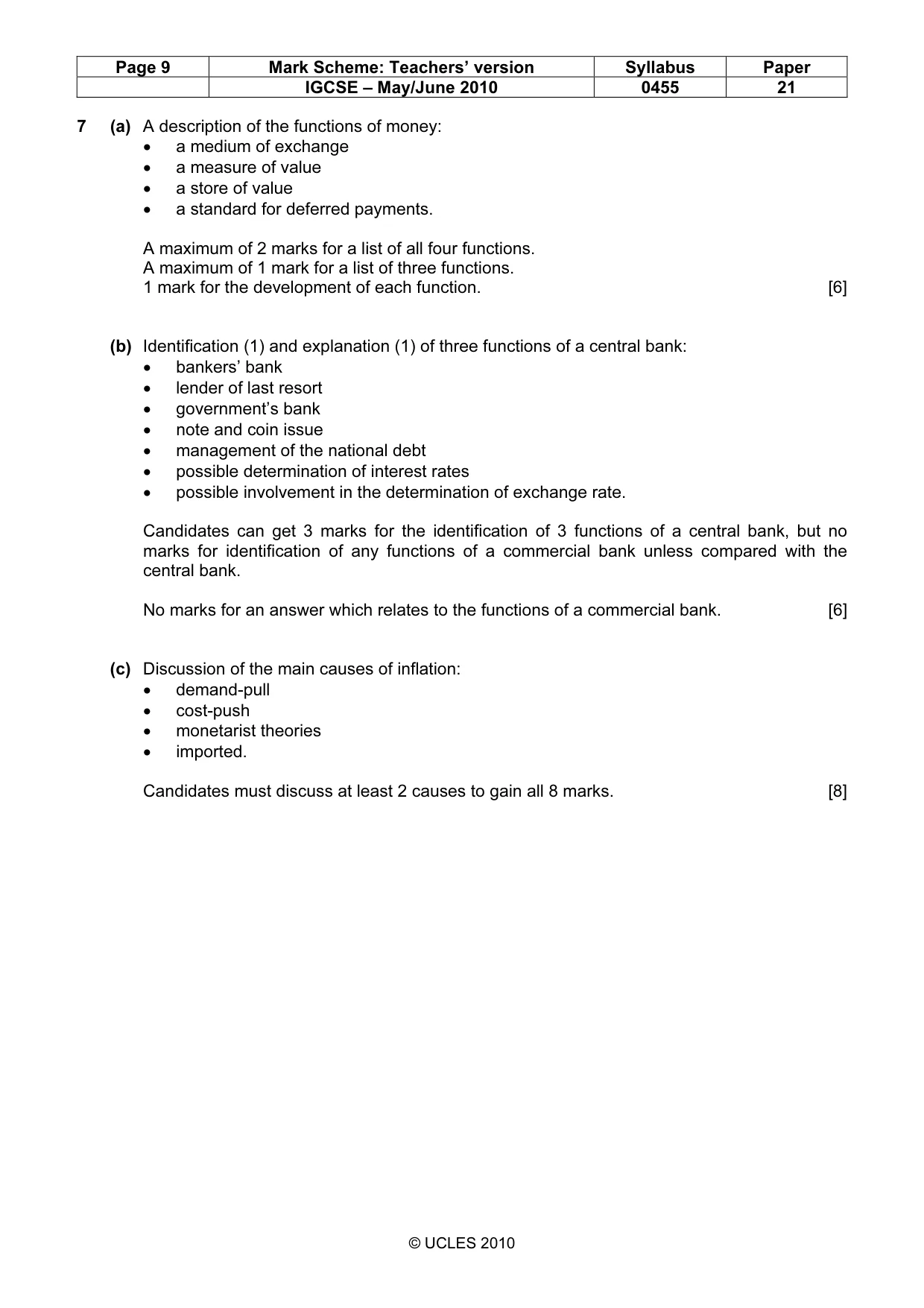
Page 9 Mark Scheme: Teachers’ version Syllabus Paper IGCSE – May/June 2010 0455 21 © UCLES 2010 7 (a) A description of the functions of money: • a medium of exchange • a measure of value • a store of value • a standard for deferred payments. A maximum of 2 marks for a list of all four functions. A maximum of 1 mark for a list of three functions. 1 mark for the development of each function. [6] (b) Identification (1) and explanation (1) of three functions of a central bank: • bankers’ bank • lender of last resort • government’s bank • note and coin issue • management of the national debt • possible determination of interest rates • possible involvement in the determination of exchange rate. Candidates can get 3 marks for the identification of 3 functions of a central bank, but no marks for identification of any functions of a commercial bank unless compared with the central bank. No marks for an answer which relates to the functions of a commercial bank. [6] (c) Discussion of the main causes of inflation: • demand-pull • cost-push • monetarist theories • imported. Candidates must discuss at least 2 causes to gain all 8 marks. [8]
What you needed in this session
Cambridge’s own grade thresholds for 2010 May/June, Paper 2 · Variant 1. A higher threshold means an easier paper — the bar moves with how the cohort did.