Cambridge IGCSE Economics 0455 — 2008 Oct/Nov Paper 6 · Variant 1
0455/61/O/N/08 · 2 questions · 40 marks · ≈45 min
The question paper and its mark scheme, free to read here and free to download. This is Cambridge’s own paper, exactly as it was sat.
Question paper4 pages
Mark scheme2 pages
Answers below. Sit the paper first if you are practising.
Questions as text
Q1 · Chocolate and coffee Extract 1 is from the back of a box of chocolates produced by a UK…
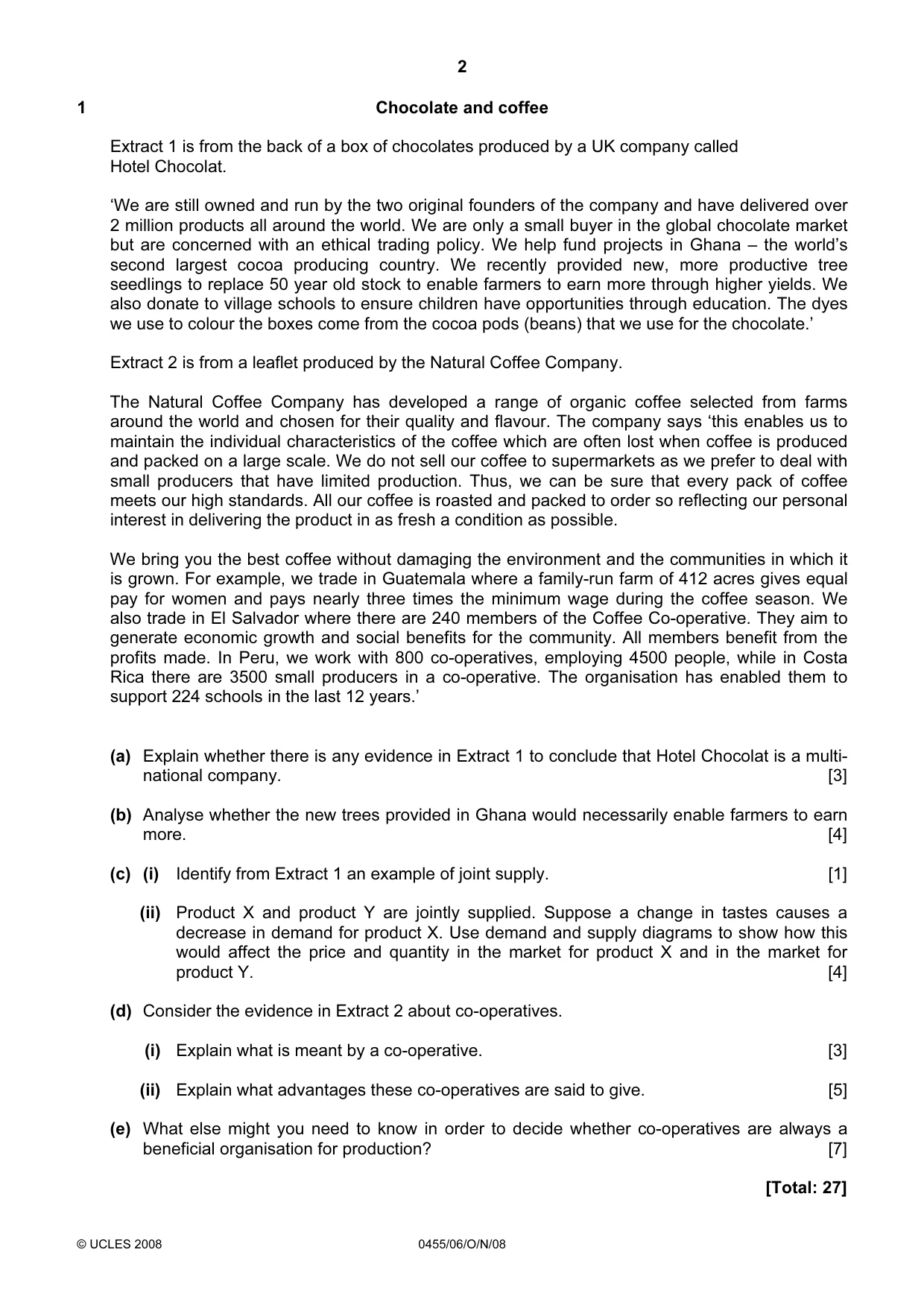
1 Chocolate and coffee Extract 1 is from the back of a box of chocolates produced by a UK company called Hotel Chocolat. ‘We are still owned and run by the two original founders of the company and have delivered over 2 million products all around the world. We are only a small buyer in the global chocolate market but are concerned with an ethical trading policy. We help fund projects in Ghana – the world’s second largest cocoa producing country. We recently provided new, more productive tree seedlings to replace 50 year old stock to enable farmers to earn more through higher yields. We also donate to village schools to ensure children have opportunities through education. The dyes we use to colour the boxes come from the cocoa pods (beans) that we use for the chocolate.’ Extract 2 is from a leaflet produced by the Natural Coffee Company. The Natural Coffee Company has developed a range of organic coffee selected from farms around the world and chosen for their quality and flavour. The company says ‘this enables us to maintain the individual characteristics of the coffee which are often lost when coffee is produced and packed on a large scale. We do not sell our coffee to supermarkets as we prefer to deal with small producers that have limited production. Thus, we can be sure that every pack of coffee meets our high standards. All our coffee is roasted and packed to order so reflecting our personal interest in delivering the product in as fresh a condition as possible. We bring you the best coffee without damaging the environment and the communities in which it is grown. For example, we trade in Guatemala where a family-run farm of 412 acres gives equal pay for women and pays nearly three times the minimum wage during the coffee season. We also trade in El Salvador where there are 240 members of the Coffee Co-operative. They aim to generate economic growth and social benefits for the community. All members benefit from the profits made. In Peru, we work with 800 co-operatives, employing 4500 people, while in Costa Rica there are 3500 small producers in a co-operative. The organisation has enabled them to support 224 schools in the last 12 years.’ (a) Explain whether there is any evidence in Extract 1 to conclude that Hotel Chocolat is a multi- national company. [3] (b) Analyse whether the new trees provided in Ghana would necessarily enable farmers to earn more. [4] (c) (i) Identify from Extract 1 an example of joint supply. [1] (ii) Product X and product Y are jointly supplied. Suppose a change in tastes causes a decrease in demand for product X. Use demand and supply diagrams to show how this would affect the price and quantity in the market for product X and in the market for product Y. [4] (d) Consider the evidence in Extract 2 about co-operatives. (i) Explain what is meant by a co-operative. [3] (ii) Explain what advantages these co-operatives are said to give. [5] (e) What else might you need to know in order to decide whether co-operatives are always a beneficial organisation for production? [7] [Total: 27]
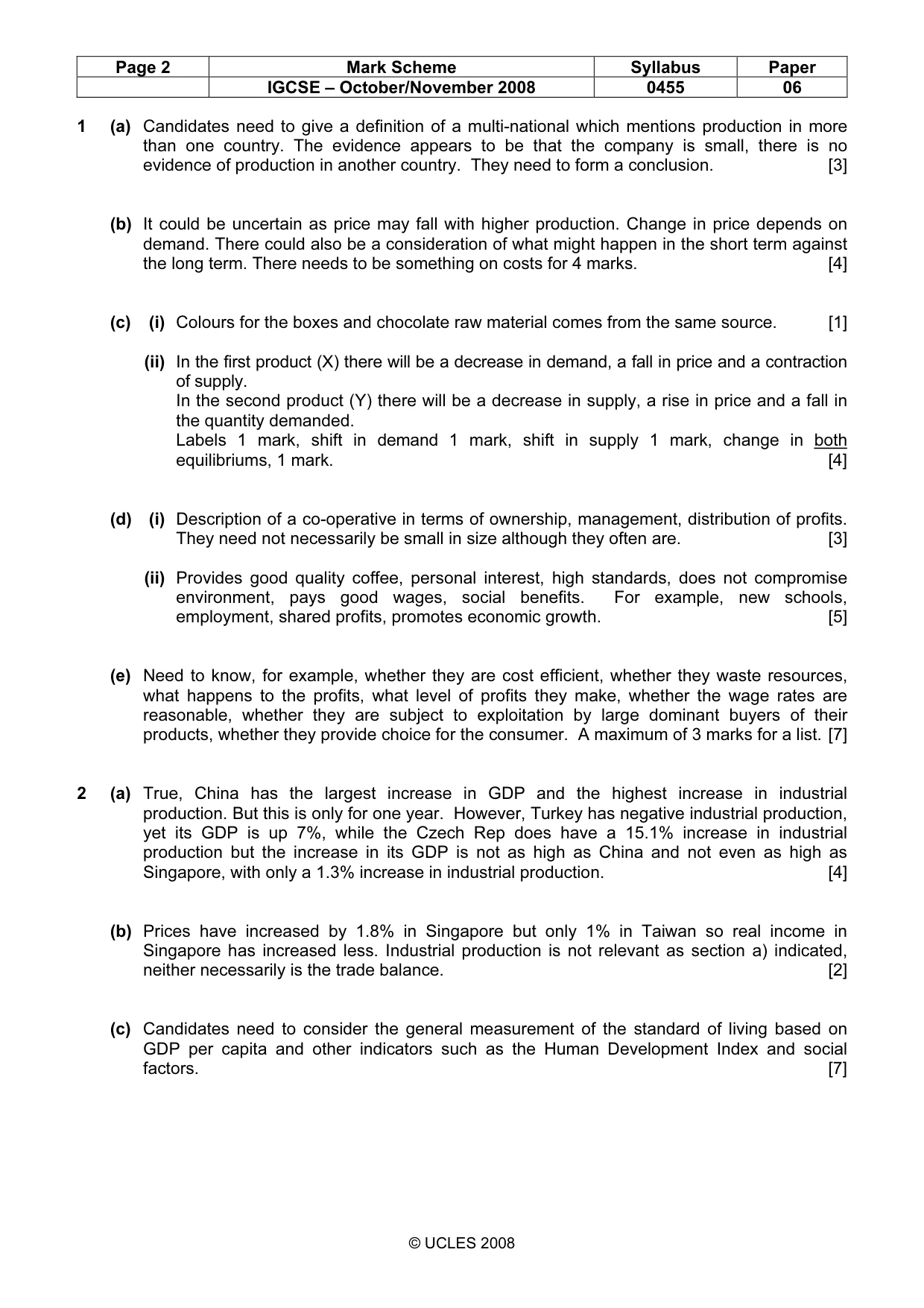
Mark scheme: 1 (a) Candidates need to give a definition of a multi-national which mentions production in more than one country. The evidence appears to be that the company is small, there is no evidence of production in another country. They need to form a conclusion. [3] (b) It could be uncertain as price may fall with higher production. Change in price depends on demand. There could also be a consideration of what might happen in the short term against the long term. There needs to be something on costs for 4 marks. [4] (c) (i) Colours for the boxes and chocolate raw material comes from the same source. [1] (ii) In the first product (X) there will be a decrease in demand, a fall in price and a contraction of supply. In the second product (Y) there will be a decrease in supply, a rise in price and a fall in the quantity demanded. Labels 1 mark, shift in demand 1 mark, shift in supply 1 mark, change in both equilibriums, 1 mark. [4] (d) (i) Description of a co-operative in terms of ownership, management, distribution of profits. They need not necessarily be small in size although they often are. [3] (ii) Provides good quality coffee, personal interest, high standards, does not compromise environment, pays good wages, social benefits. For example, new schools, employment, shared profits, promotes economic growth. [5] (e) Need to know, for example, whether they are cost efficient, whether they waste resources, what happens to the profits, what level of profits they make, whether the wage rates are reasonable, whether they are subject to exploitation by large dominant buyers of their products, whether they provide choice for the consumer. A maximum of 3 marks for a list. [7]
Q2 · Economic indicators The table gives information on Gross Domestic Product (GDP)…
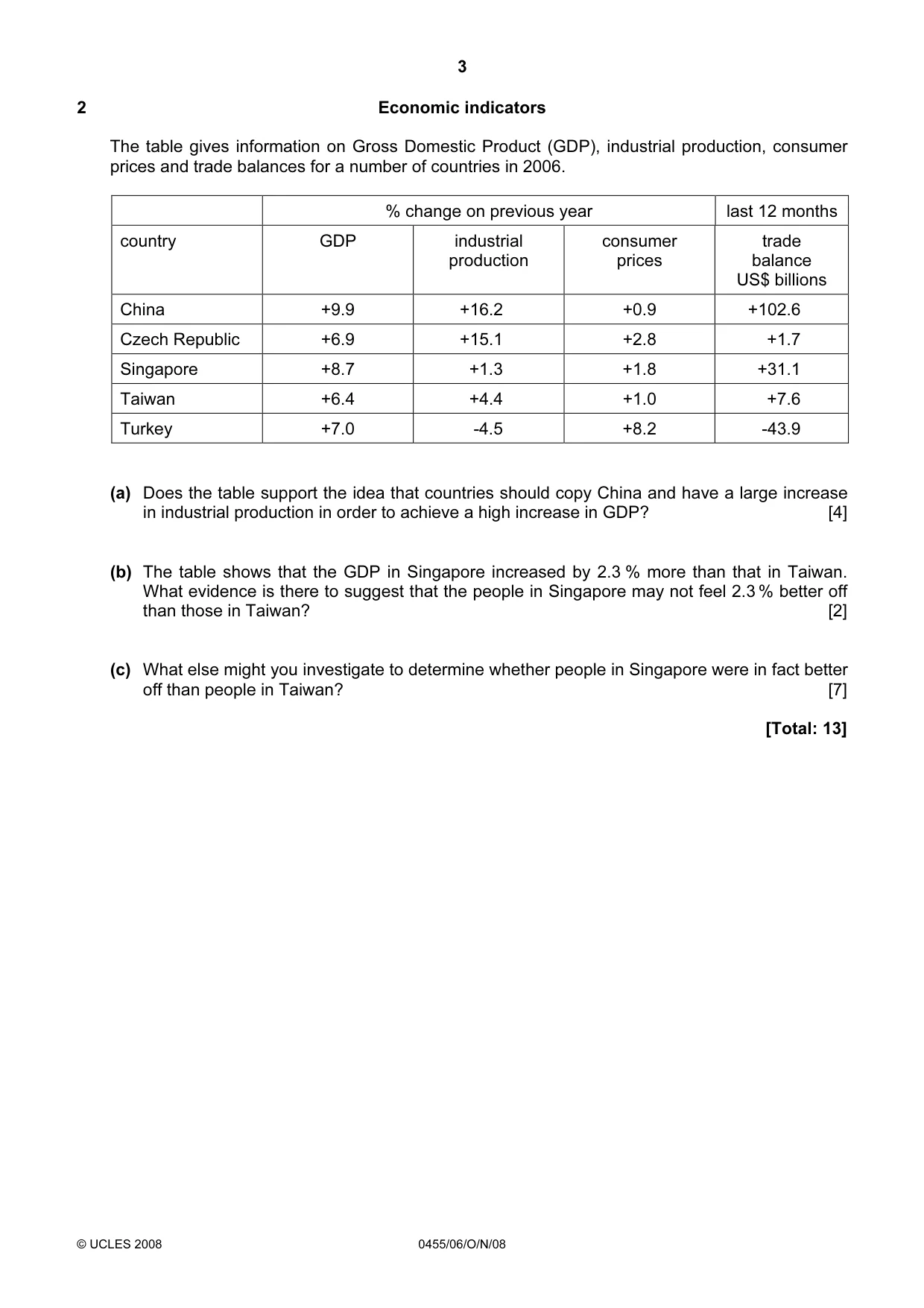
2 Economic indicators The table gives information on Gross Domestic Product (GDP), industrial production, consumer prices and trade balances for a number of countries in 2006. % change on previous year last 12 months country GDP industrial consumer trade production prices balance US$ billions China +9.9 +16.2 +0.9 +102.6 Czech Republic +6.9 +15.1 +2.8 +1.7 Singapore +8.7 +1.3 +1.8 +31.1 Taiwan +6.4 +4.4 +1.0 +7.6 Turkey +7.0 -4.5 +8.2 -43.9 (a) Does the table support the idea that countries should copy China and have a large increase in industrial production in order to achieve a high increase in GDP? [4] (b) The table shows that the GDP in Singapore increased by 2.3 % more than that in Taiwan. What evidence is there to suggest that the people in Singapore may not feel 2.3 % better off than those in Taiwan? [2] (c) What else might you investigate to determine whether people in Singapore were in fact better off than people in Taiwan? [7] [Total: 13]
Mark scheme: 2 (a) True, China has the largest increase in GDP and the highest increase in industrial production. But this is only for one year. However, Turkey has negative industrial production, yet its GDP is up 7%, while the Czech Rep does have a 15.1% increase in industrial production but the increase in its GDP is not as high as China and not even as high as Singapore, with only a 1.3% increase in industrial production. [4] (b) Prices have increased by 1.8% in Singapore but only 1% in Taiwan so real income in Singapore has increased less. Industrial production is not relevant as section a) indicated, neither necessarily is the trade balance. [2] (c) Candidates need to consider the general measurement of the standard of living based on GDP per capita and other indicators such as the Human Development Index and social factors. [7]
What was in this paper
The subtopics covered by these 2 questions, and how many questions each got. Open one in a new tab to see every Cambridge question on it.
What you needed in this session
Cambridge’s own grade thresholds for 2008 Oct/Nov, Paper 6 · Variant 1. A higher threshold means an easier paper — the bar moves with how the cohort did.