Cambridge IGCSE Economics 0455 — 2006 Oct/Nov Paper 6 · Variant 1
0455/61/O/N/06 · 2 questions · 40 marks · ≈45 min
The question paper and its mark scheme, free to read here and free to download. This is Cambridge’s own paper, exactly as it was sat.
Question paper4 pages
Mark scheme2 pages
Answers below. Sit the paper first if you are practising.
Questions as text
Q1 · Alcohol and Government Policy In the UK, the National Health Service often has to deal…
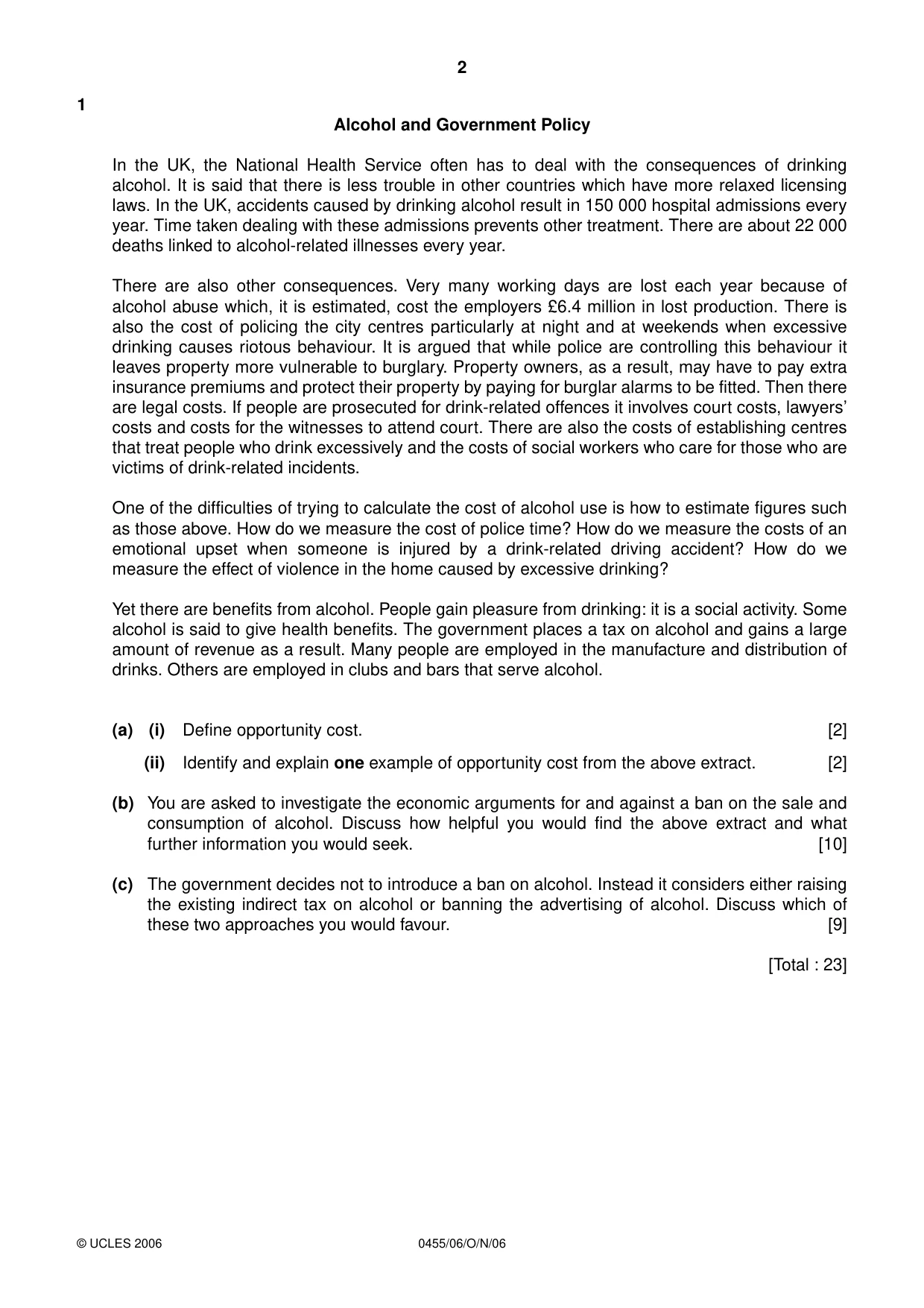
1 Alcohol and Government Policy In the UK, the National Health Service often has to deal with the consequences of drinking alcohol. It is said that there is less trouble in other countries which have more relaxed licensing laws. In the UK, accidents caused by drinking alcohol result in 150 000 hospital admissions every year. Time taken dealing with these admissions prevents other treatment. There are about 22 000 deaths linked to alcohol-related illnesses every year. There are also other consequences. Very many working days are lost each year because of alcohol abuse which, it is estimated, cost the employers £6.4 million in lost production. There is also the cost of policing the city centres particularly at night and at weekends when excessive drinking causes riotous behaviour. It is argued that while police are controlling this behaviour it leaves property more vulnerable to burglary. Property owners, as a result, may have to pay extra insurance premiums and protect their property by paying for burglar alarms to be fitted. Then there are legal costs. If people are prosecuted for drink-related offences it involves court costs, lawyers’ costs and costs for the witnesses to attend court. There are also the costs of establishing centres that treat people who drink excessively and the costs of social workers who care for those who are victims of drink-related incidents. One of the difficulties of trying to calculate the cost of alcohol use is how to estimate figures such as those above. How do we measure the cost of police time? How do we measure the costs of an emotional upset when someone is injured by a drink-related driving accident? How do we measure the effect of violence in the home caused by excessive drinking? Yet there are benefits from alcohol. People gain pleasure from drinking: it is a social activity. Some alcohol is said to give health benefits. The government places a tax on alcohol and gains a large amount of revenue as a result. Many people are employed in the manufacture and distribution of drinks. Others are employed in clubs and bars that serve alcohol. (a) (i) Define opportunity cost. [2] (ii) Identify and explain one example of opportunity cost from the above extract. [2] (b) You are asked to investigate the economic arguments for and against a ban on the sale and consumption of alcohol. Discuss how helpful you would find the above extract and what further information you would seek. [10] (c) The government decides not to introduce a ban on alcohol. Instead it considers either raising the existing indirect tax on alcohol or banning the advertising of alcohol. Discuss which of these two approaches you would favour. [9] [Total : 23]
Mark scheme: 1 (a) (i) Definition – must have next best alternative to get both marks. [2] (ii) Any of: Admissions in hospitals prevent other treatment, policing city centres prevents attention to other areas where burglary takes place, treatment centres prevents money spent on other facilities. (Identification 1, Explanation 1.) [2] (b) Current extract: Helpful: shows range of harmful effects e.g. health service, accidents, death, illness; with some values of effects and difficulties of calculation. Identifies some benefits of alcohol consumption. Unhelpful: makes assumptions which may not be justified, does not give values for all of the costs, does not give an overall total cost. Additional information: Value of benefits, costs of enforcement, other countries’ experience, loss of government revenue, impact on employment. Up to 6 marks on the extract, up to 4 marks on additional information. Maximum of 10 marks. [10] (c) Explanation of operation of policies 2 marks each, evaluation of policy 3 marks each. 5 marks maximum if only one policy considered. Maximum of 9 marks. [9]
Q2 · Success of Toyota In 2003, the Japanese Toyota Corporation sold 6.8 million vehicles…
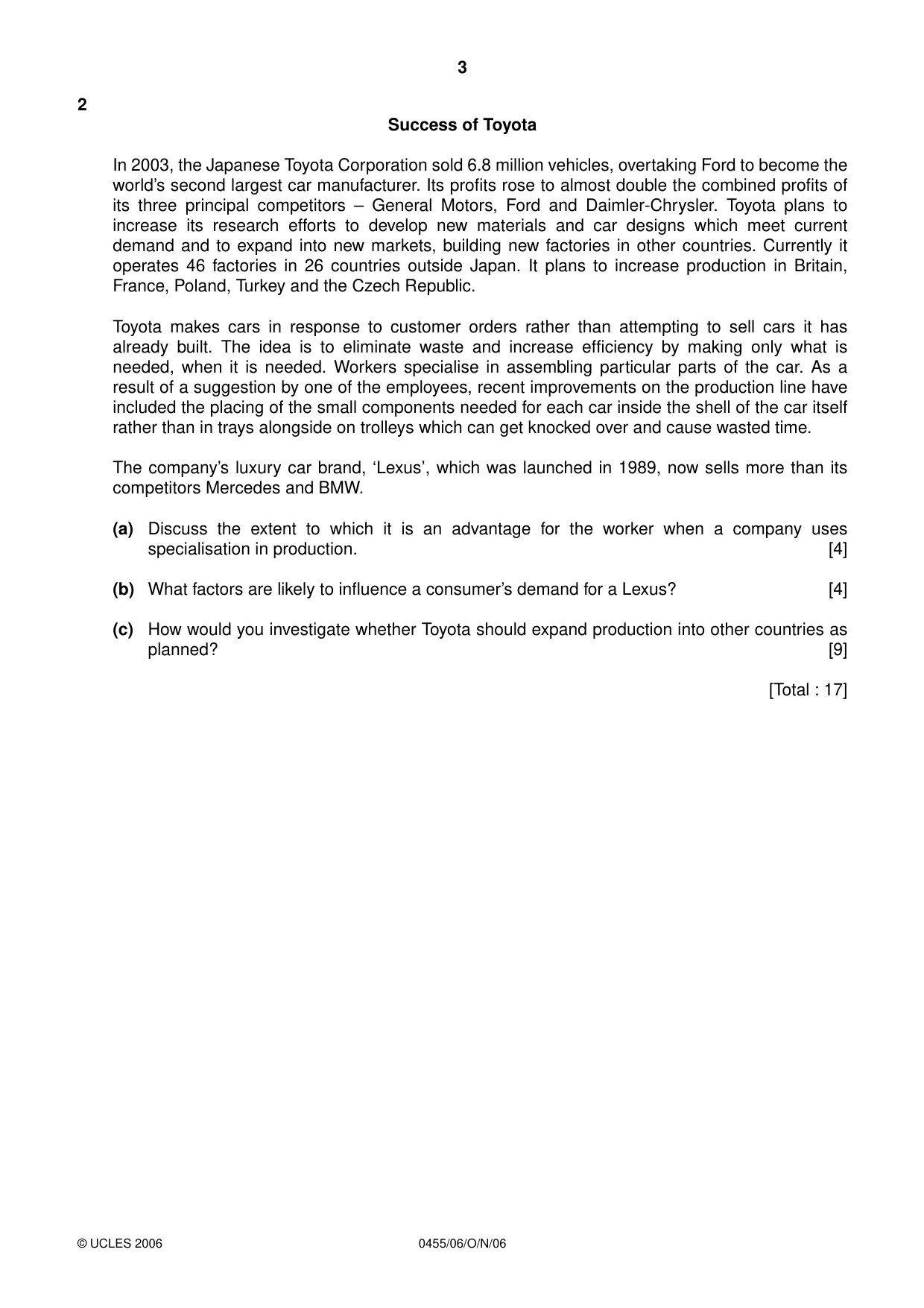
2 Success of Toyota In 2003, the Japanese Toyota Corporation sold 6.8 million vehicles, overtaking Ford to become the world’s second largest car manufacturer. Its profits rose to almost double the combined profits of its three principal competitors – General Motors, Ford and Daimler-Chrysler. Toyota plans to increase its research efforts to develop new materials and car designs which meet current demand and to expand into new markets, building new factories in other countries. Currently it operates 46 factories in 26 countries outside Japan. It plans to increase production in Britain, France, Poland, Turkey and the Czech Republic. Toyota makes cars in response to customer orders rather than attempting to sell cars it has already built. The idea is to eliminate waste and increase efficiency by making only what is needed, when it is needed. Workers specialise in assembling particular parts of the car. As a result of a suggestion by one of the employees, recent improvements on the production line have included the placing of the small components needed for each car inside the shell of the car itself rather than in trays alongside on trolleys which can get knocked over and cause wasted time. The company’s luxury car brand, ‘Lexus’, which was launched in 1989, now sells more than its competitors Mercedes and BMW. (a) Discuss the extent to which it is an advantage for the worker when a company uses specialisation in production. [4] (b) What factors are likely to influence a consumer’s demand for a Lexus? [4] (c) How would you investigate whether Toyota should expand production into other countries as planned? [9] [Total : 17]
Mark scheme: 2 (a) Company is more efficient and makes more profit so this may result in higher wages for some workers. Specialisation can be boring, repetitive and does not develop range of skills or does not always use worker to best advantage. Maximum of 3 marks if only consider one side (pro or con). [4] (b) Candidates can mention standard factors such as income, price and substitutes, but could also mention design, features and accessories. Maximum of 2 marks if not related to cars or a list. [4] (c) Up to 5 marks for investigating cost, labour, land, taxes, grants and transport. Up to 5 marks for investigating the potential sales within immediate area. Maximum of 9 marks. Give credit for consideration of Toyota’s aims. e.g. profit or sales maximisation or for mentioning employment issues and changes in government tax revenues. [9]
What was in this paper
The subtopics covered by these 2 questions, and how many questions each got. Open one in a new tab to see every Cambridge question on it.
What you needed in this session
Cambridge’s own grade thresholds for 2006 Oct/Nov, Paper 6 · Variant 1. A higher threshold means an easier paper — the bar moves with how the cohort did.