Cambridge IGCSE Economics 0455 — 2007 Oct/Nov Paper 6 · Variant 1
0455/61/O/N/07 · 2 questions · 40 marks · ≈45 min
The question paper and its mark scheme, free to read here and free to download. This is Cambridge’s own paper, exactly as it was sat.
Question paper4 pages
Mark scheme2 pages
Answers below. Sit the paper first if you are practising.
Questions as text
Q1 · Cell phones in Africa Living on a mountaintop in South Africa, 24 miles from the nearest…
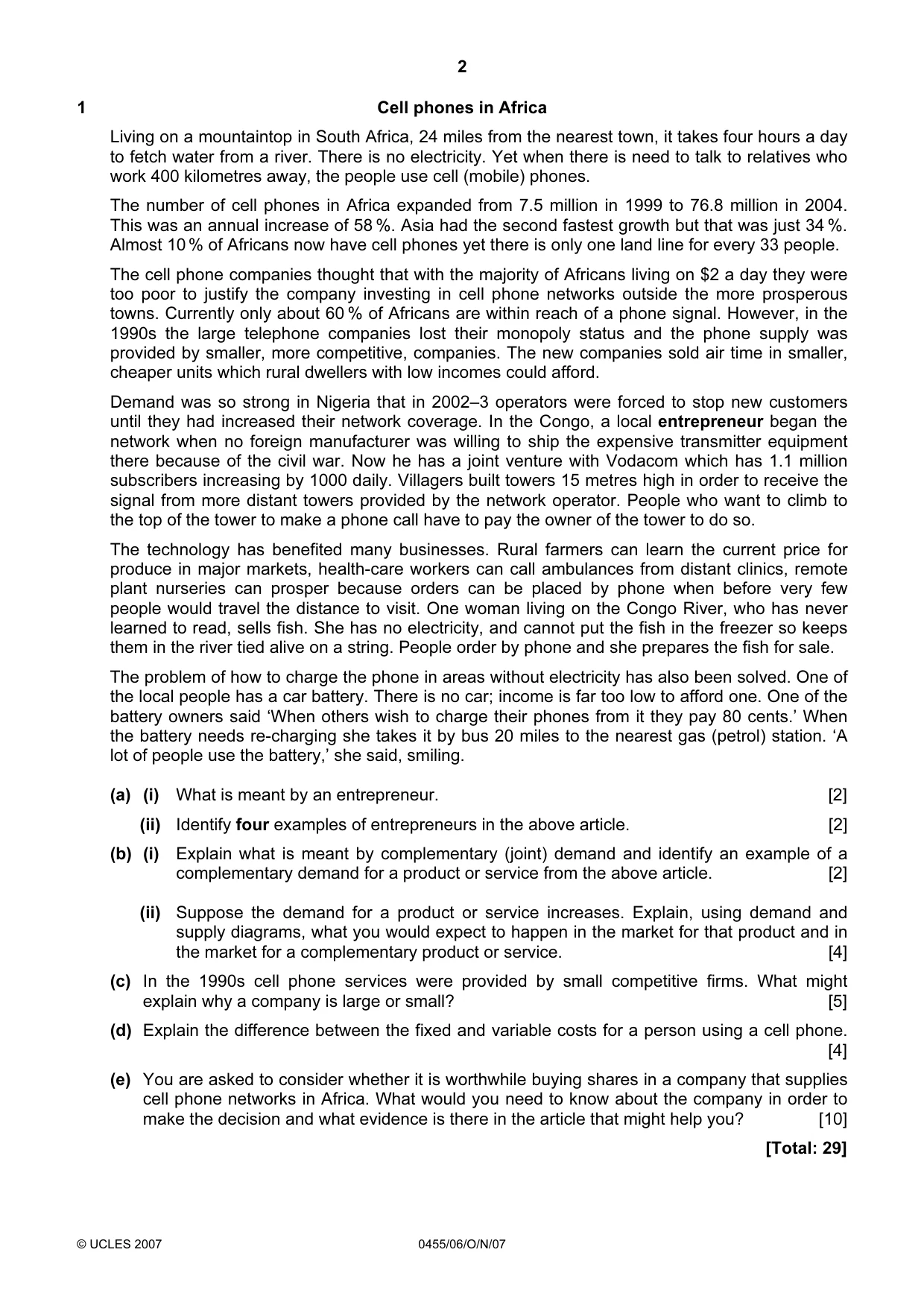
1 Cell phones in Africa Living on a mountaintop in South Africa, 24 miles from the nearest town, it takes four hours a day to fetch water from a river. There is no electricity. Yet when there is need to talk to relatives who work 400 kilometres away, the people use cell (mobile) phones. The number of cell phones in Africa expanded from 7.5 million in 1999 to 76.8 million in 2004. This was an annual increase of 58 %. Asia had the second fastest growth but that was just 34 %. Almost 10 % of Africans now have cell phones yet there is only one land line for every 33 people. The cell phone companies thought that with the majority of Africans living on $2 a day they were too poor to justify the company investing in cell phone networks outside the more prosperous towns. Currently only about 60 % of Africans are within reach of a phone signal. However, in the 1990s the large telephone companies lost their monopoly status and the phone supply was provided by smaller, more competitive, companies. The new companies sold air time in smaller, cheaper units which rural dwellers with low incomes could afford. Demand was so strong in Nigeria that in 2002–3 operators were forced to stop new customers until they had increased their network coverage. In the Congo, a local entrepreneur began the network when no foreign manufacturer was willing to ship the expensive transmitter equipment there because of the civil war. Now he has a joint venture with Vodacom which has 1.1 million subscribers increasing by 1000 daily. Villagers built towers 15 metres high in order to receive the signal from more distant towers provided by the network operator. People who want to climb to the top of the tower to make a phone call have to pay the owner of the tower to do so. The technology has benefited many businesses. Rural farmers can learn the current price for produce in major markets, health-care workers can call ambulances from distant clinics, remote plant nurseries can prosper because orders can be placed by phone when before very few people would travel the distance to visit. One woman living on the Congo River, who has never learned to read, sells fish. She has no electricity, and cannot put the fish in the freezer so keeps them in the river tied alive on a string. People order by phone and she prepares the fish for sale. The problem of how to charge the phone in areas without electricity has also been solved. One of the local people has a car battery. There is no car; income is far too low to afford one. One of the battery owners said ‘When others wish to charge their phones from it they pay 80 cents.’ When the battery needs re-charging she takes it by bus 20 miles to the nearest gas (petrol) station. ‘A lot of people use the battery,’ she said, smiling. (a) (i) What is meant by an entrepreneur. [2] (ii) Identify four examples of entrepreneurs in the above article. [2] (b) (i) Explain what is meant by complementary (joint) demand and identify an example of a complementary demand for a product or service from the above article. [2] (ii) Suppose the demand for a product or service increases. Explain, using demand and supply diagrams, what you would expect to happen in the market for that product and in the market for a complementary product or service. [4] (c) In the 1990s cell phone services were provided by small competitive firms. What might explain why a company is large or small? [5] (d) Explain the difference between the fixed and variable costs for a person using a cell phone. [4] (e) You are asked to consider whether it is worthwhile buying shares in a company that supplies cell phone networks in Africa. What would you need to know about the company in order to make the decision and what evidence is there in the article that might help you? [10] [Total: 29]
Mark scheme: 1 (a) (i) Factor of production, person who takes risk in business, combines other factors together. [2] (ii) Owner of tower in Congo; woman with fish; network owner in Congo; nursery owner; battery owner. [2] (b) (i) One product needed with another. Cell phone and battery charger. Cell phone and transmitter tower. [2] (ii) First diagram, single supply curve with shift of demand curve – price rise, movement along supply curve. Diagram, 1 mark; explanation, 1 mark. Second diagram, shift in demand to right, price rises. Diagram, 1 mark; explanation, 1 mark. [4] (c) Discussion on size of market, amount of capital required, type of organisation required, whether there is a specialist product, personal service, range of market supplied. [5] (d) Fixed costs do not vary with output. For example, the phone itself. Variable costs vary with output/use. For example, the cost of each phone call. [4] (e) Need to know what level the profits have been and how profits have changed in recent years in Africa. Need to know projected costs and revenues company expects from increasing investment. Need to know whether company has skilled staff and expects to be able to staff increased operations. Information that can be used: number of subscribers, 58% increase in cell phone purchases; only 10% have phones, limitation on land line provision; market therefore still very much under-supplied; demand in Nigeria and Congo are useful pieces of information; indications of how various businesses can benefit in seemingly difficult circumstances. Question to ask is whether the individual stories amount to sufficient information to make a general conclusion. Maximum 8 marks without a conclusion. [10]
Q2 · Textile factories in Lesotho close In Lesotho six textile factories closed in early 2005…
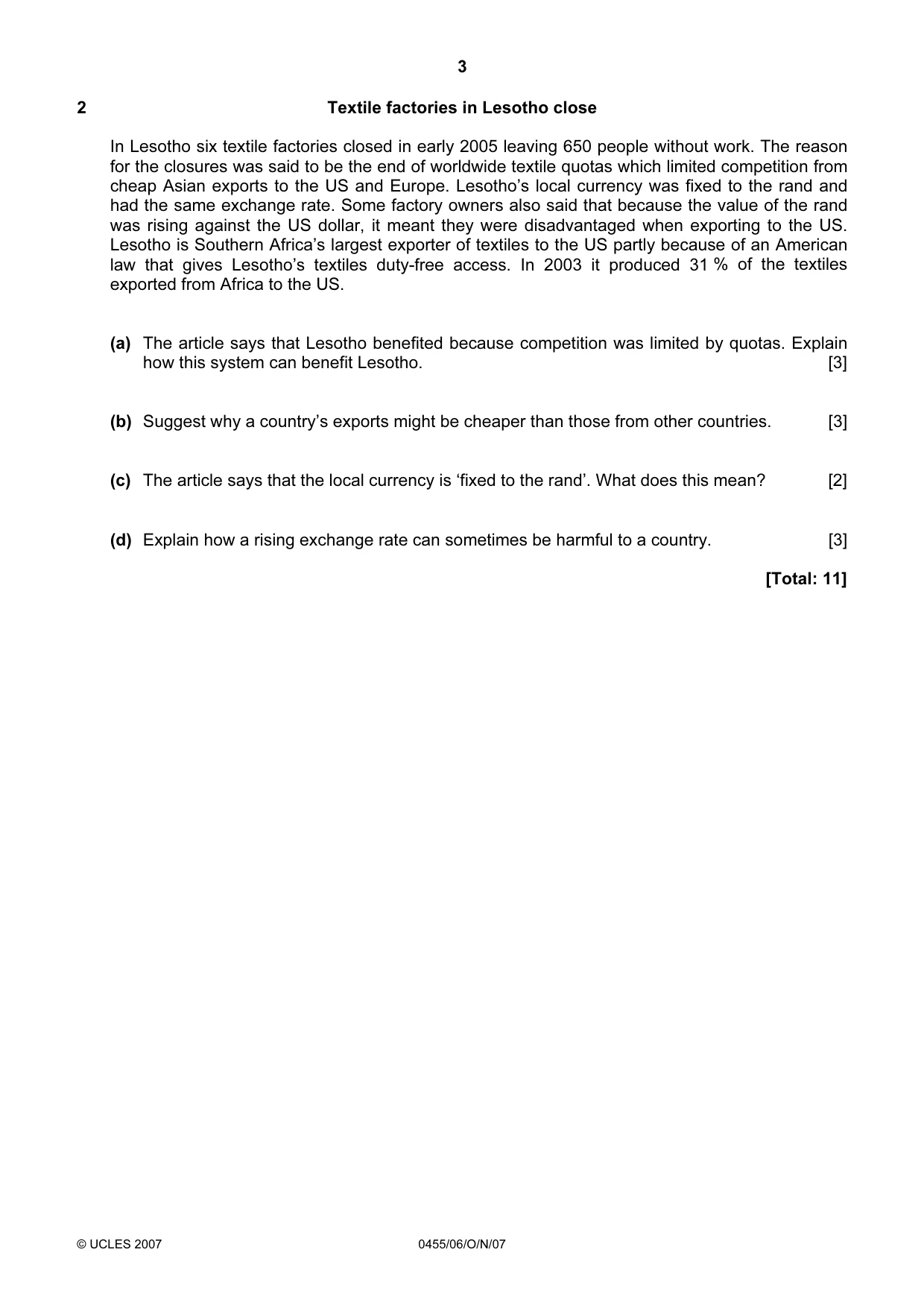
2 Textile factories in Lesotho close In Lesotho six textile factories closed in early 2005 leaving 650 people without work. The reason for the closures was said to be the end of worldwide textile quotas which limited competition from cheap Asian exports to the US and Europe. Lesotho’s local currency was fixed to the rand and had the same exchange rate. Some factory owners also said that because the value of the rand was rising against the US dollar, it meant they were disadvantaged when exporting to the US. Lesotho is Southern Africa’s largest exporter of textiles to the US partly because of an American law that gives Lesotho’s textiles duty-free access. In 2003 it produced 31 % of the textiles exported from Africa to the US. (a) The article says that Lesotho benefited because competition was limited by quotas. Explain how this system can benefit Lesotho. [3] (b) Suggest why a country’s exports might be cheaper than those from other countries. [3] (c) The article says that the local currency is ‘fixed to the rand’. What does this mean? [2] (d) Explain how a rising exchange rate can sometimes be harmful to a country. [3] [Total: 11]
Mark scheme: 2 (a) Quotas are a restriction on the number of imports; other countries had quotas imposed on them, Lesotho did not, so Lesotho was able to trade with limited competition. [3] (b) Candidates should suggest that this is because costs are low. Any factor cost could be lower than elsewhere but the most likely factor to influence the overall cost is the cost of labour. Machinery is possible but not as likely – it may well be imported, the level of profits may be lower per unit but the larger sales enable overall profit to remain high. Land costs are uncertain. There may also be government subsidies and/or low exchange rates. [3] (c) It is linked to the rand and therefore, when the rand changes value in terms of other currencies so does the local currency. [2] (d) Rising exchange rate means local products cost more in other countries, imports are cheaper. Exports therefore may be reduced in number and imports increased. This could worsen the balance of trade, cause less demand for home products, and may affect employment and incomes. [3]
What was in this paper
The subtopics covered by these 2 questions, and how many questions each got. Open one in a new tab to see every Cambridge question on it.
What you needed in this session
Cambridge’s own grade thresholds for 2007 Oct/Nov, Paper 6 · Variant 1. A higher threshold means an easier paper — the bar moves with how the cohort did.