Cambridge IGCSE Economics 0455 — 2005 May/June Paper 6 · Variant 1
0455/61/M/J/05 · 2 questions · 40 marks · ≈45 min
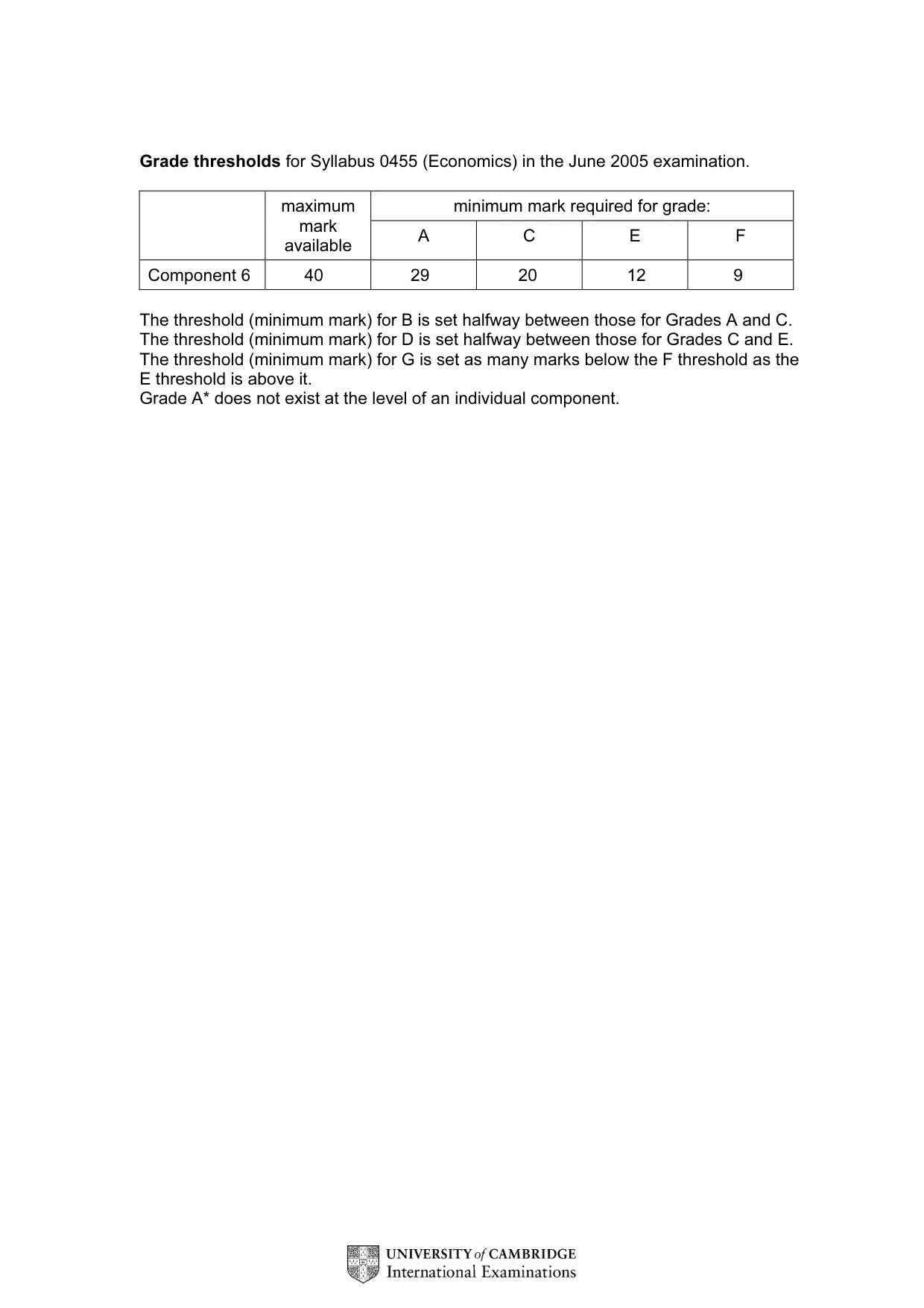
The question paper and its mark scheme, free to read here and free to download. This is Cambridge’s own paper, exactly as it was sat.
Question paper4 pages

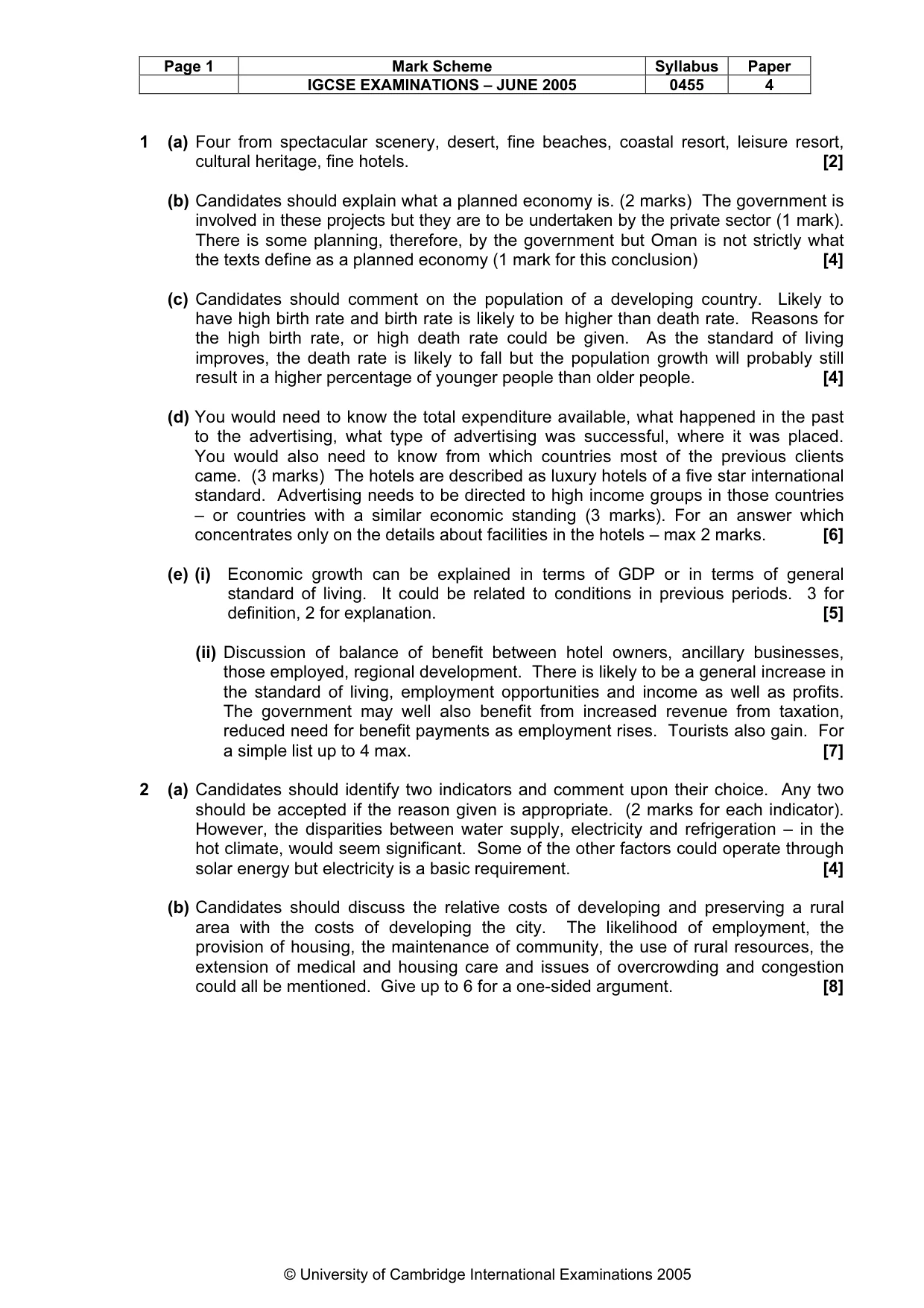
Mark scheme4 pages
Answers below. Sit the paper first if you are practising.
Questions as text
Q1 · Tourism in Oman The government of Oman, a country in the Middle East, has produced a…
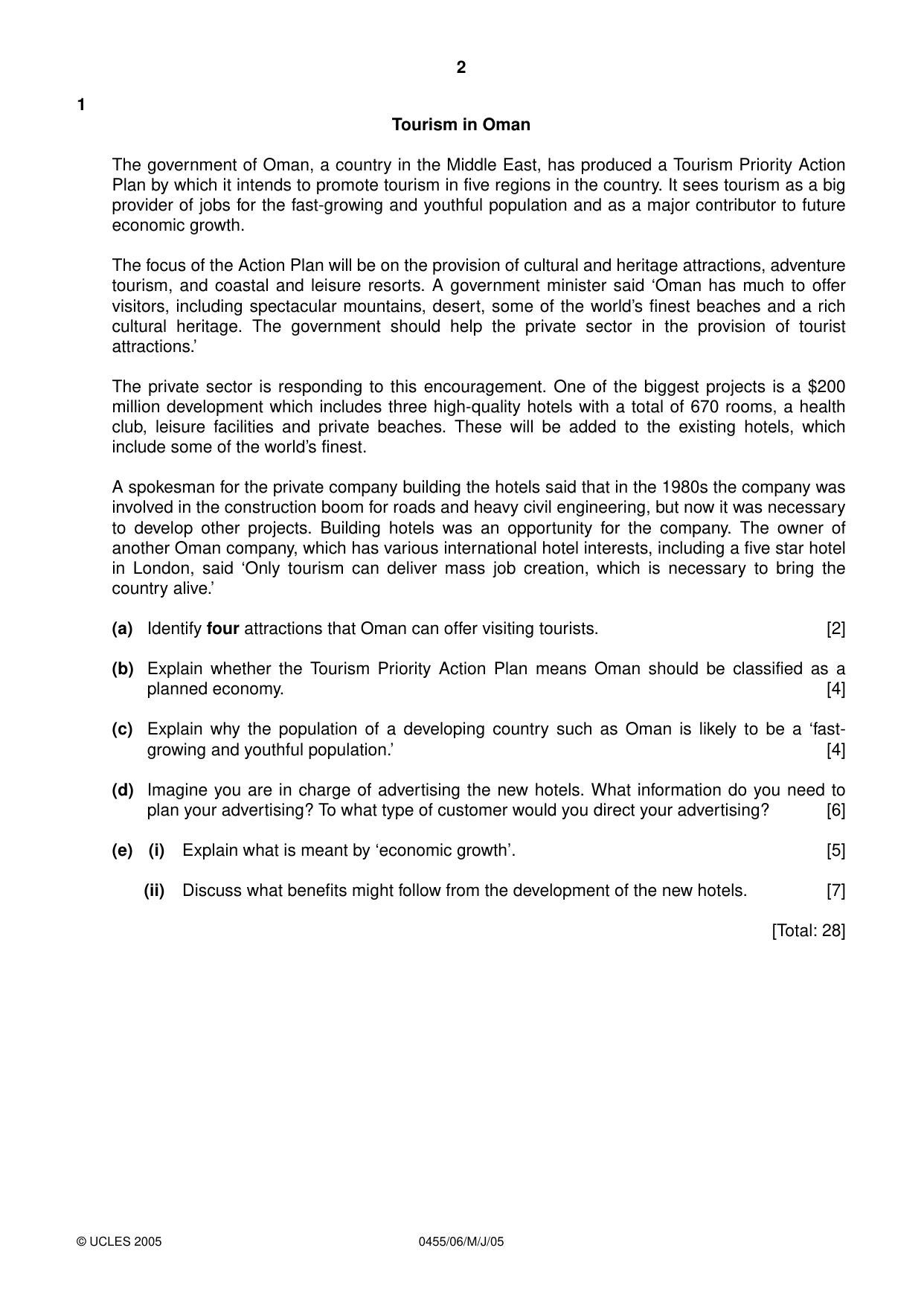
1 Tourism in Oman The government of Oman, a country in the Middle East, has produced a Tourism Priority Action Plan by which it intends to promote tourism in five regions in the country. It sees tourism as a big provider of jobs for the fast-growing and youthful population and as a major contributor to future economic growth. The focus of the Action Plan will be on the provision of cultural and heritage attractions, adventure tourism, and coastal and leisure resorts. A government minister said ‘Oman has much to offer visitors, including spectacular mountains, desert, some of the world’s finest beaches and a rich cultural heritage. The government should help the private sector in the provision of tourist attractions.’ The private sector is responding to this encouragement. One of the biggest projects is a $200 million development which includes three high-quality hotels with a total of 670 rooms, a health club, leisure facilities and private beaches. These will be added to the existing hotels, which include some of the world’s finest. A spokesman for the private company building the hotels said that in the 1980s the company was involved in the construction boom for roads and heavy civil engineering, but now it was necessary to develop other projects. Building hotels was an opportunity for the company. The owner of another Oman company, which has various international hotel interests, including a five star hotel in London, said ‘Only tourism can deliver mass job creation, which is necessary to bring the country alive.’ (a) Identify four attractions that Oman can offer visiting tourists. [2] (b) Explain whether the Tourism Priority Action Plan means Oman should be classified as a planned economy. [4] (c) Explain why the population of a developing country such as Oman is likely to be a ‘fast- growing and youthful population.’ [4] (d) Imagine you are in charge of advertising the new hotels. What information do you need to plan your advertising? To what type of customer would you direct your advertising? [6] (e) (i) Explain what is meant by ‘economic growth’. [5] (ii) Discuss what benefits might follow from the development of the new hotels. [7] [Total: 28]
Q2 · South African Living Standards The charts show the percentages of households with access…
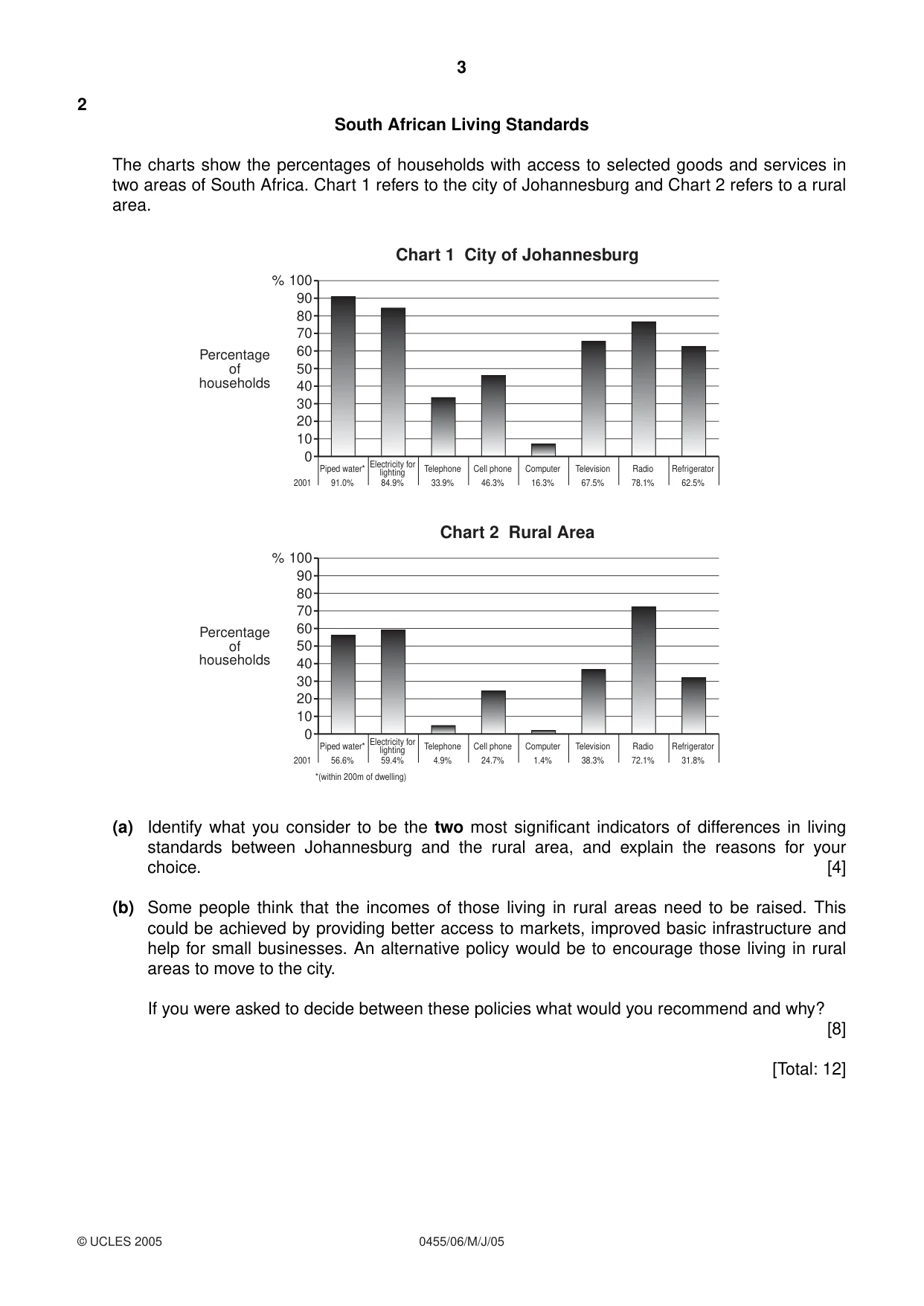
2 South African Living Standards The charts show the percentages of households with access to selected goods and services in two areas of South Africa. Chart 1 refers to the city of Johannesburg and Chart 2 refers to a rural area. Chart 1 City of Johannesburg % 100 90 80 70 Percentage 60 of 50 households 40 30 20 10 0 Piped water* Electricitylighting for Telephone Cell phone Computer Television Radio Refrigerator 2001 91.0% 84.9% 33.9% 46.3% 16.3% 67.5% 78.1% 62.5% Chart 2 Rural Area % 100 90 80 70 Percentage 60 of 50 households 40 30 20 10 0 Piped water* Electricitylighting for Telephone Cell phone Computer Television Radio Refrigerator 2001 56.6% 59.4% 4.9% 24.7% 1.4% 38.3% 72.1% 31.8% *(within 200m of dwelling) (a) Identify what you consider to be the two most significant indicators of differences in living standards between Johannesburg and the rural area, and explain the reasons for your choice. [4] (b) Some people think that the incomes of those living in rural areas need to be raised. This could be achieved by providing better access to markets, improved basic infrastructure and help for small businesses. An alternative policy would be to encourage those living in rural areas to move to the city. If you were asked to decide between these policies what would you recommend and why? [8] [Total: 12]
More questions on Differences in economic development between countries
What was in this paper
The subtopics covered by these 2 questions, and how many questions each got. Open one in a new tab to see every Cambridge question on it.