Cambridge IGCSE Economics 0455 — 2006 May/June Paper 6 · Variant 1
0455/61/M/J/06 · 2 questions · 40 marks · ≈45 min
The question paper and its mark scheme, free to read here and free to download. This is Cambridge’s own paper, exactly as it was sat.
Question paper4 pages

Mark scheme2 pages
Answers below. Sit the paper first if you are practising.
Questions as text
Q1 · Profits In 2004 the price of shares in Manchester United, a well-known British football…
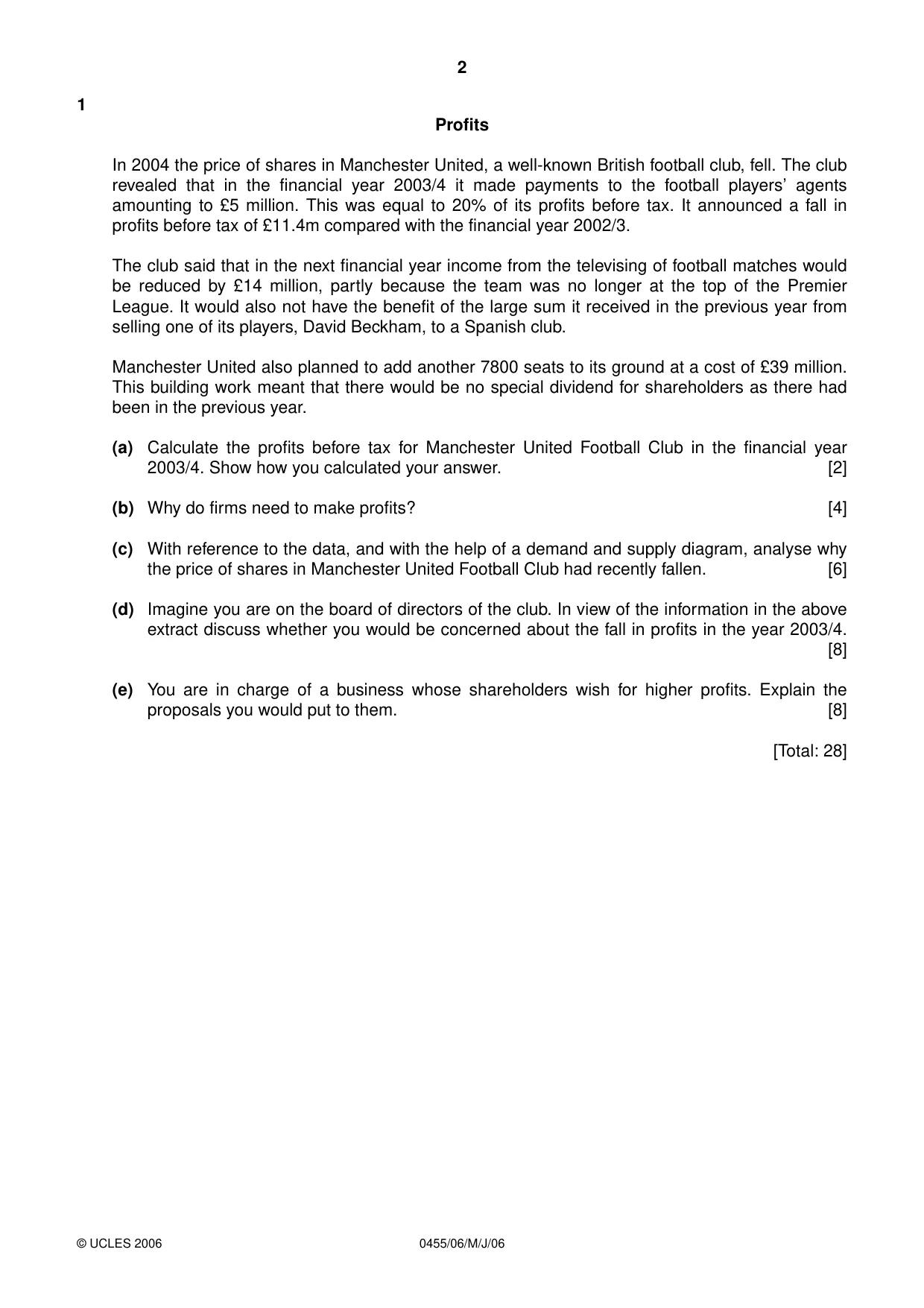
1 Profits In 2004 the price of shares in Manchester United, a well-known British football club, fell. The club revealed that in the financial year 2003/4 it made payments to the football players’ agents amounting to £5 million. This was equal to 20% of its profits before tax. It announced a fall in profits before tax of £11.4m compared with the financial year 2002/3. The club said that in the next financial year income from the televising of football matches would be reduced by £14 million, partly because the team was no longer at the top of the Premier League. It would also not have the benefit of the large sum it received in the previous year from selling one of its players, David Beckham, to a Spanish club. Manchester United also planned to add another 7800 seats to its ground at a cost of £39 million. This building work meant that there would be no special dividend for shareholders as there had been in the previous year. (a) Calculate the profits before tax for Manchester United Football Club in the financial year 2003/4. Show how you calculated your answer. [2] (b) Why do firms need to make profits? [4] (c) With reference to the data, and with the help of a demand and supply diagram, analyse why the price of shares in Manchester United Football Club had recently fallen. [6] (d) Imagine you are on the board of directors of the club. In view of the information in the above extract discuss whether you would be concerned about the fall in profits in the year 2003/4. [8] (e) You are in charge of a business whose shareholders wish for higher profits. Explain the proposals you would put to them. [8] [Total: 28]
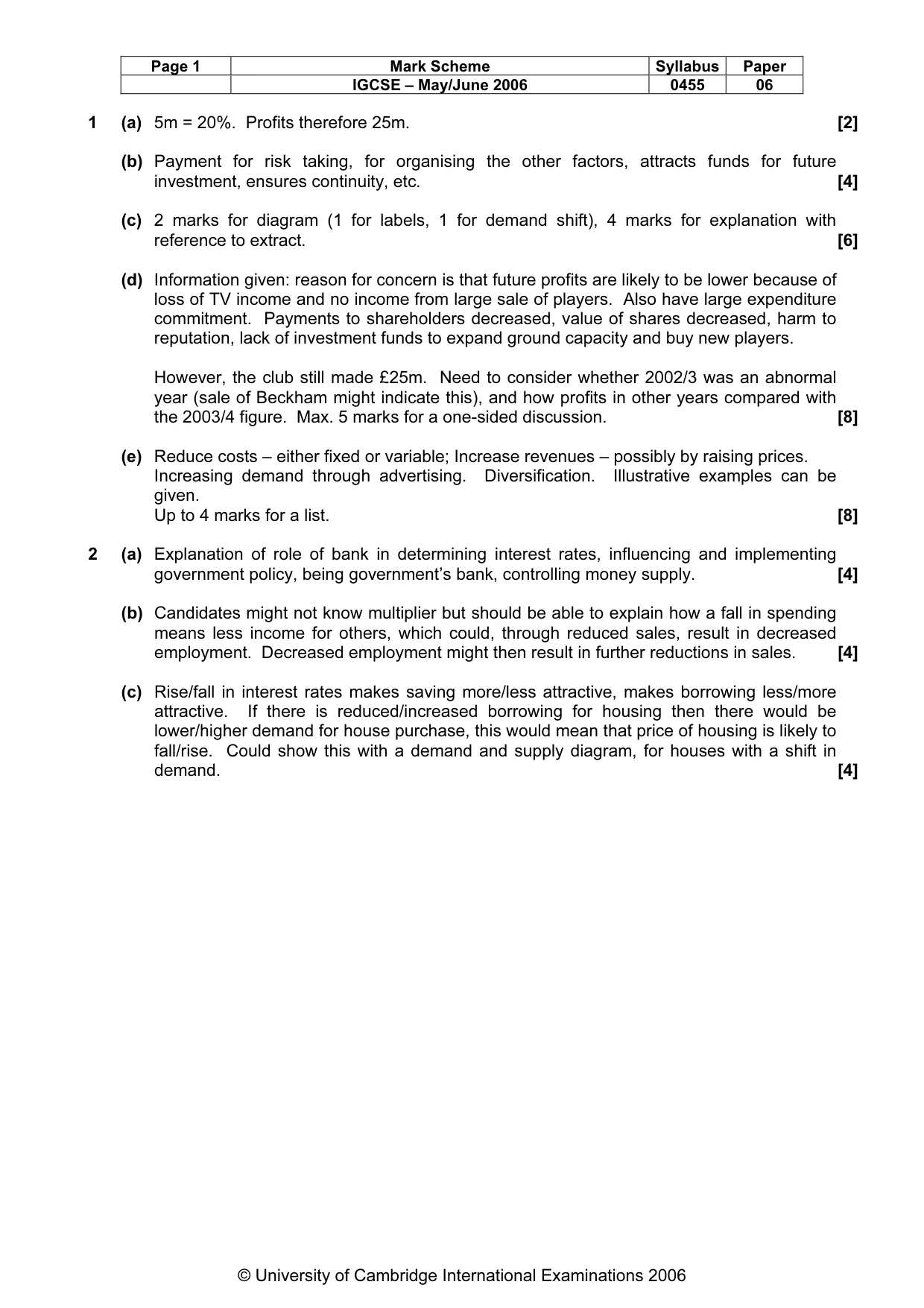
Mark scheme: 1 (a) 5m = 20%. Profits therefore 25m. [2] (b) Payment for risk taking, for organising the other factors, attracts funds for future investment, ensures continuity, etc. [4] (c) 2 marks for diagram (1 for labels, 1 for demand shift), 4 marks for explanation with reference to extract. [6] (d) Information given: reason for concern is that future profits are likely to be lower because of loss of TV income and no income from large sale of players. Also have large expenditure commitment. Payments to shareholders decreased, value of shares decreased, harm to reputation, lack of investment funds to expand ground capacity and buy new players. However, the club still made £25m. Need to consider whether 2002/3 was an abnormal year (sale of Beckham might indicate this), and how profits in other years compared with the 2003/4 figure. Max. 5 marks for a one-sided discussion. [8] (e) Reduce costs – either fixed or variable; Increase revenues – possibly by raising prices. Increasing demand through advertising. Diversification. Illustrative examples can be given. Up to 4 marks for a list. [8]
Q2 · Consumer Spending The Central Bank’s Monetary Committee is considering whether to change…
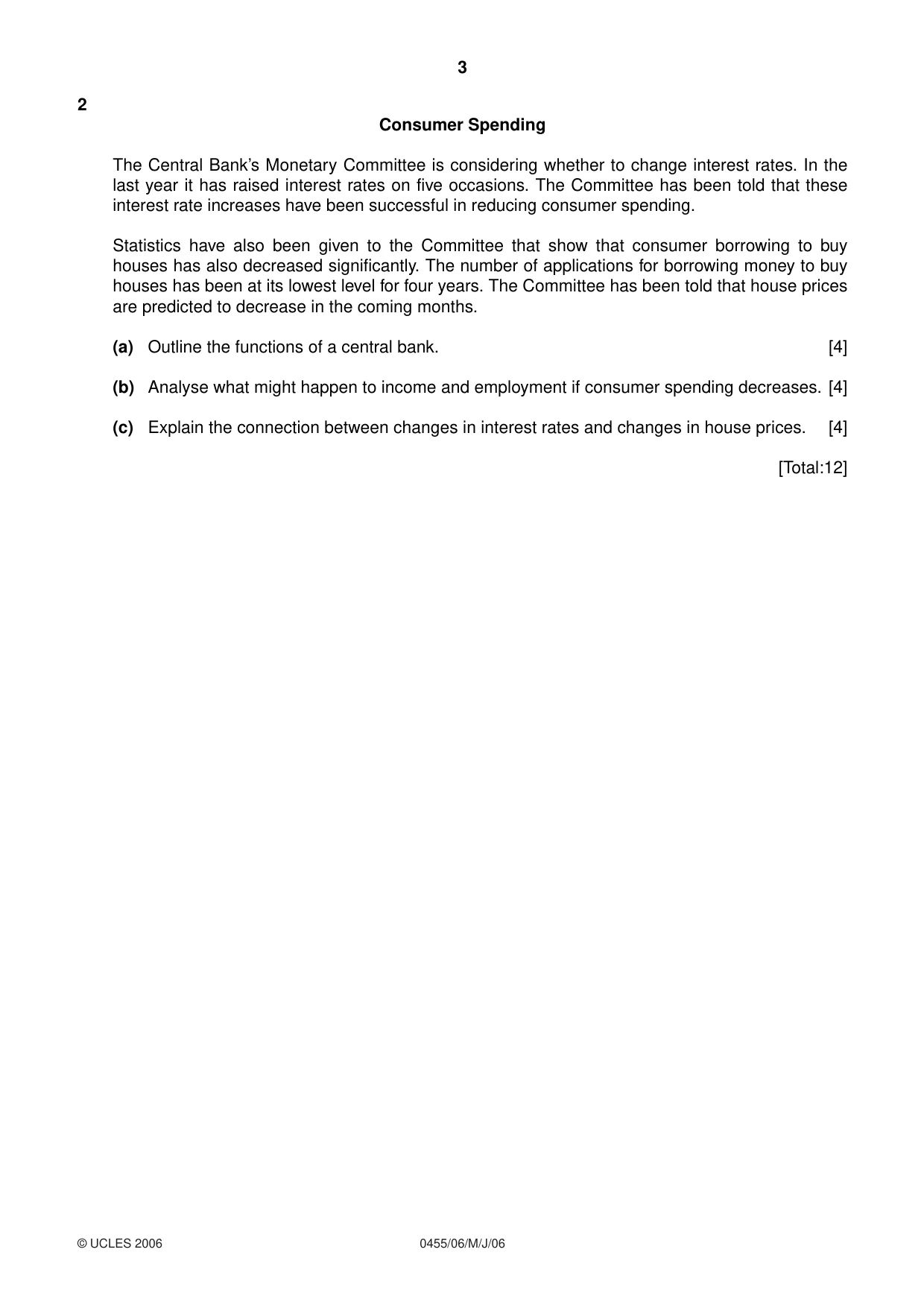
2 Consumer Spending The Central Bank’s Monetary Committee is considering whether to change interest rates. In the last year it has raised interest rates on five occasions. The Committee has been told that these interest rate increases have been successful in reducing consumer spending. Statistics have also been given to the Committee that show that consumer borrowing to buy houses has also decreased significantly. The number of applications for borrowing money to buy houses has been at its lowest level for four years. The Committee has been told that house prices are predicted to decrease in the coming months. (a) Outline the functions of a central bank. [4] (b) Analyse what might happen to income and employment if consumer spending decreases. [4] (c) Explain the connection between changes in interest rates and changes in house prices. [4] [Total:12]
Mark scheme: 2 (a) Explanation of role of bank in determining interest rates, influencing and implementing government policy, being government’s bank, controlling money supply. [4] (b) Candidates might not know multiplier but should be able to explain how a fall in spending means less income for others, which could, through reduced sales, result in decreased employment. Decreased employment might then result in further reductions in sales. [4] (c) Rise/fall in interest rates makes saving more/less attractive, makes borrowing less/more attractive. If there is reduced/increased borrowing for housing then there would be lower/higher demand for house purchase, this would mean that price of housing is likely to fall/rise. Could show this with a demand and supply diagram, for houses with a shift in demand. [4]
What was in this paper
The subtopics covered by these 2 questions, and how many questions each got. Open one in a new tab to see every Cambridge question on it.
What you needed in this session
Cambridge’s own grade thresholds for 2006 May/June, Paper 6 · Variant 1. A higher threshold means an easier paper — the bar moves with how the cohort did.