Cambridge IGCSE Economics 0455 — 2004 Oct/Nov Paper 6 · Variant 1
0455/61/O/N/04
The question paper and its mark scheme, free to read here and free to download. This is Cambridge’s own paper, exactly as it was sat.
Question paper4 pages
Mark scheme5 pages
Answers below. Sit the paper first if you are practising.
Paper as text
Question paper, page 1
This document consists of 3 printed pages and 1 blank page. SP (NF) S65266/2 © UCLES 2004 [Turn over UNIVERSITY OF CAMBRIDGE INTERNATIONAL EXAMINATIONS International General Certificate of Secondary Education ECONOMICS 0455/06 Paper 6 Alternative to Coursework October/November 2004 1 hour 30 minutes Additional Materials: Answer Booklet/Paper READ THESE INSTRUCTIONS FIRST If you have been given an Answer Booklet, follow the instructions on the front cover of the Booklet. Write your Centre number, candidate number and name on all the work you hand in. Write in dark blue or black pen on both sides of the paper. You may use a soft pencil for any diagrams, graphs or rough working. Do not use staples, paper clips, highlighters, glue or correction fluid. Answer all questions. At the end of the examination, fasten all your work securely together. The number of marks is given in brackets [ ] at the end of each question or part question. www.XtremePapers.com
Question paper, page 2
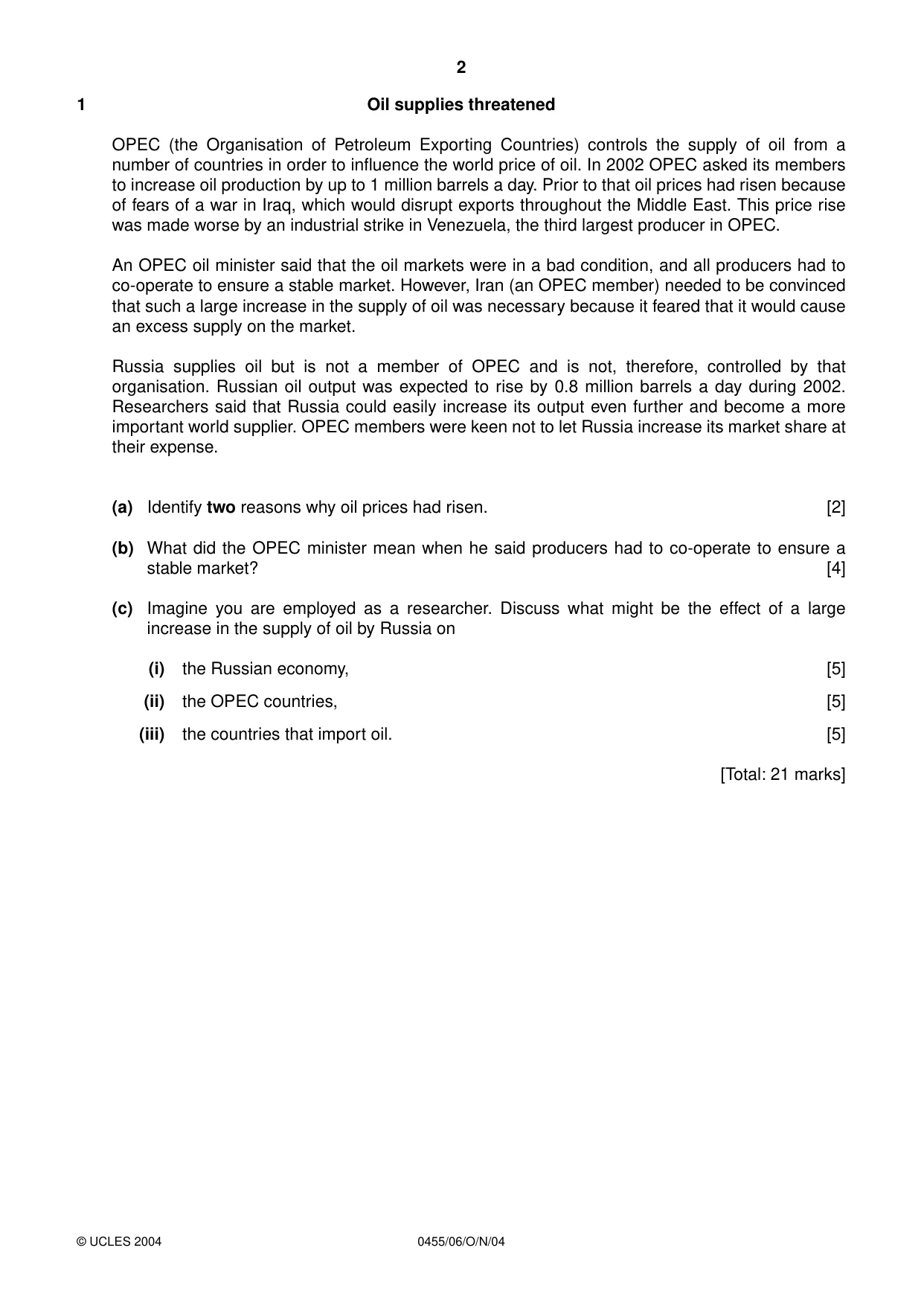
2 0455/06/O/N/04 1 Oil supplies threatened OPEC (the Organisation of Petroleum Exporting Countries) controls the supply of oil from a number of countries in order to influence the world price of oil. In 2002 OPEC asked its members to increase oil production by up to 1 million barrels a day. Prior to that oil prices had risen because of fears of a war in Iraq, which would disrupt exports throughout the Middle East. This price rise was made worse by an industrial strike in Venezuela, the third largest producer in OPEC. An OPEC oil minister said that the oil markets were in a bad condition, and all producers had to co-operate to ensure a stable market. However, Iran (an OPEC member) needed to be convinced that such a large increase in the supply of oil was necessary because it feared that it would cause an excess supply on the market. Russia supplies oil but is not a member of OPEC and is not, therefore, controlled by that organisation. Russian oil output was expected to rise by 0.8 million barrels a day during 2002. Researchers said that Russia could easily increase its output even further and become a more important world supplier. OPEC members were keen not to let Russia increase its market share at their expense. (a) Identify two reasons why oil prices had risen. [2] (b) What did the OPEC minister mean when he said producers had to co-operate to ensure a stable market? [4] (c) Imagine you are employed as a researcher. Discuss what might be the effect of a large increase in the supply of oil by Russia on (i) the Russian economy, [5] (ii) the OPEC countries, [5] (iii) the countries that import oil. [5] [Total: 21 marks] © UCLES 2004
Question paper, page 3
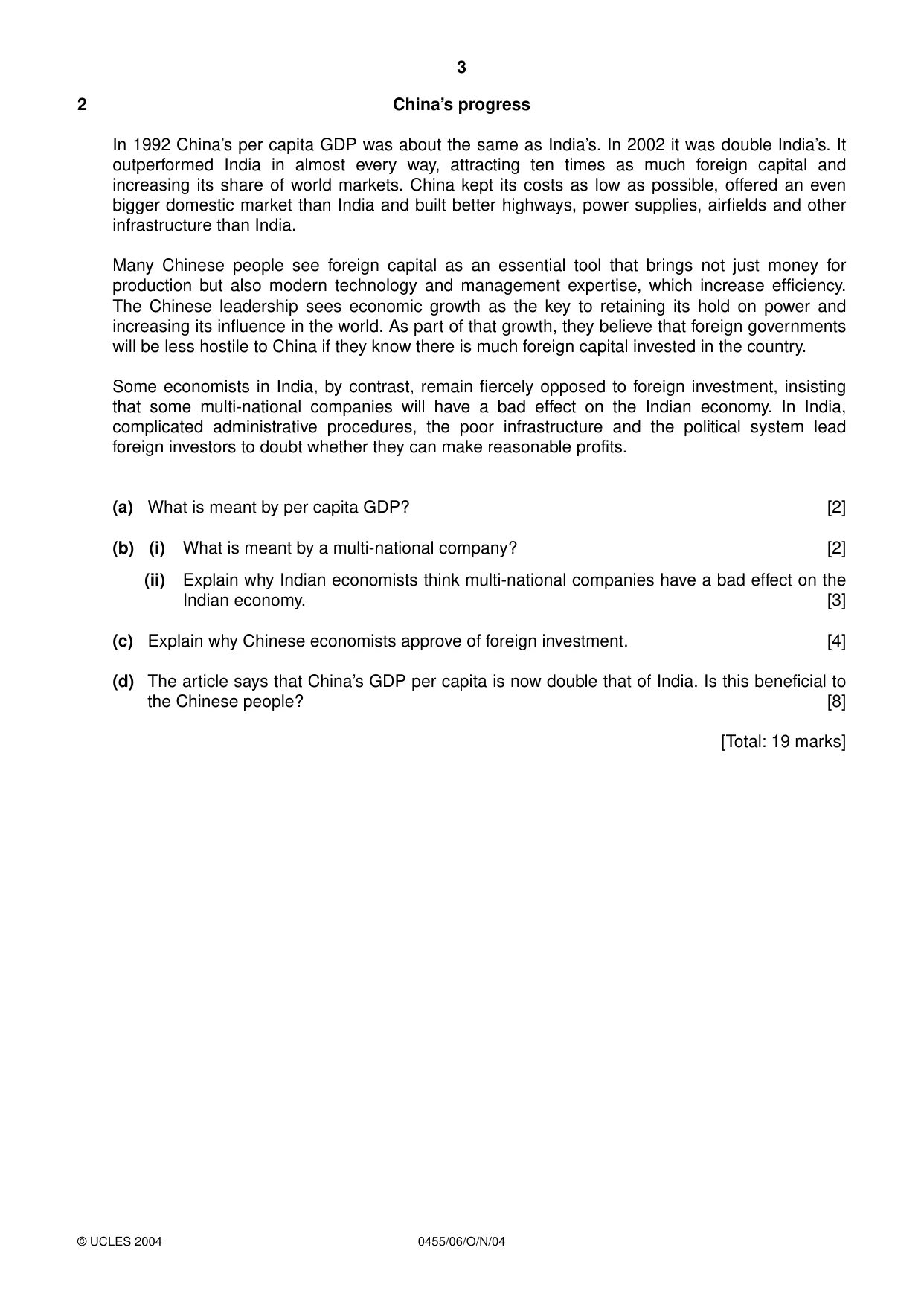
3 0455/06/O/N/04 2 China’s progress In 1992 China’s per capita GDP was about the same as India’s. In 2002 it was double India’s. It outperformed India in almost every way, attracting ten times as much foreign capital and increasing its share of world markets. China kept its costs as low as possible, offered an even bigger domestic market than India and built better highways, power supplies, airfields and other infrastructure than India. Many Chinese people see foreign capital as an essential tool that brings not just money for production but also modern technology and management expertise, which increase efficiency. The Chinese leadership sees economic growth as the key to retaining its hold on power and increasing its influence in the world. As part of that growth, they believe that foreign governments will be less hostile to China if they know there is much foreign capital invested in the country. Some economists in India, by contrast, remain fiercely opposed to foreign investment, insisting that some multi-national companies will have a bad effect on the Indian economy. In India, complicated administrative procedures, the poor infrastructure and the political system lead foreign investors to doubt whether they can make reasonable profits. (a) What is meant by per capita GDP? [2] (b) (i) What is meant by a multi-national company? [2] (ii) Explain why Indian economists think multi-national companies have a bad effect on the Indian economy. [3] (c) Explain why Chinese economists approve of foreign investment. [4] (d) The article says that China’s GDP per capita is now double that of India. Is this beneficial to the Chinese people? [8] [Total: 19 marks] © UCLES 2004
Question paper, page 4
4 0455/06/O/N/04 BLANK PAGE Copyright Acknowledgements: Question 1. The Wall Street Journal. Question 2. © International Herald Tribune. Every reasonable effort has been made to trace all copyright holders. The publishers would be pleased to hear from anyone whose rights we have unwittingly infringed. University of Cambridge International Examinations is part of the University of Cambridge Local Examinations Syndicate (UCLES), which is itself a department of the University of Cambridge.
Mark scheme, page 1
UNIVERSITY OF CAMBRIDGE INTERNATIONAL EXAMINATIONS International General Certificate of Secondary Education MARK SCHEME for the November 2004 question papers 0455 ECONOMICS 0455/06 Paper 6 (Alternative to Coursework), maximum mark 40 This mark scheme is published as an aid to teachers and students, to indicate the requirements of the examination. It shows the basis on which Examiners were initially instructed to award marks. It does not indicate the details of the discussions that took place at an Examiners’ meeting before marking began. Any substantial changes to the mark scheme that arose from these discussions will be recorded in the published Report on the Examination. All Examiners are instructed that alternative correct answers and unexpected approaches in candidates’ scripts must be given marks that fairly reflect the relevant knowledge and skills demonstrated. Mark schemes must be read in conjunction with the question papers and the Report on the Examination. • CIE will not enter into discussion or correspondence in connection with these mark schemes. CIE is publishing the mark schemes for the November 2004 question papers for most IGCSE and GCE Advanced Level syllabuses. www.XtremePapers.com
Mark scheme, page 2
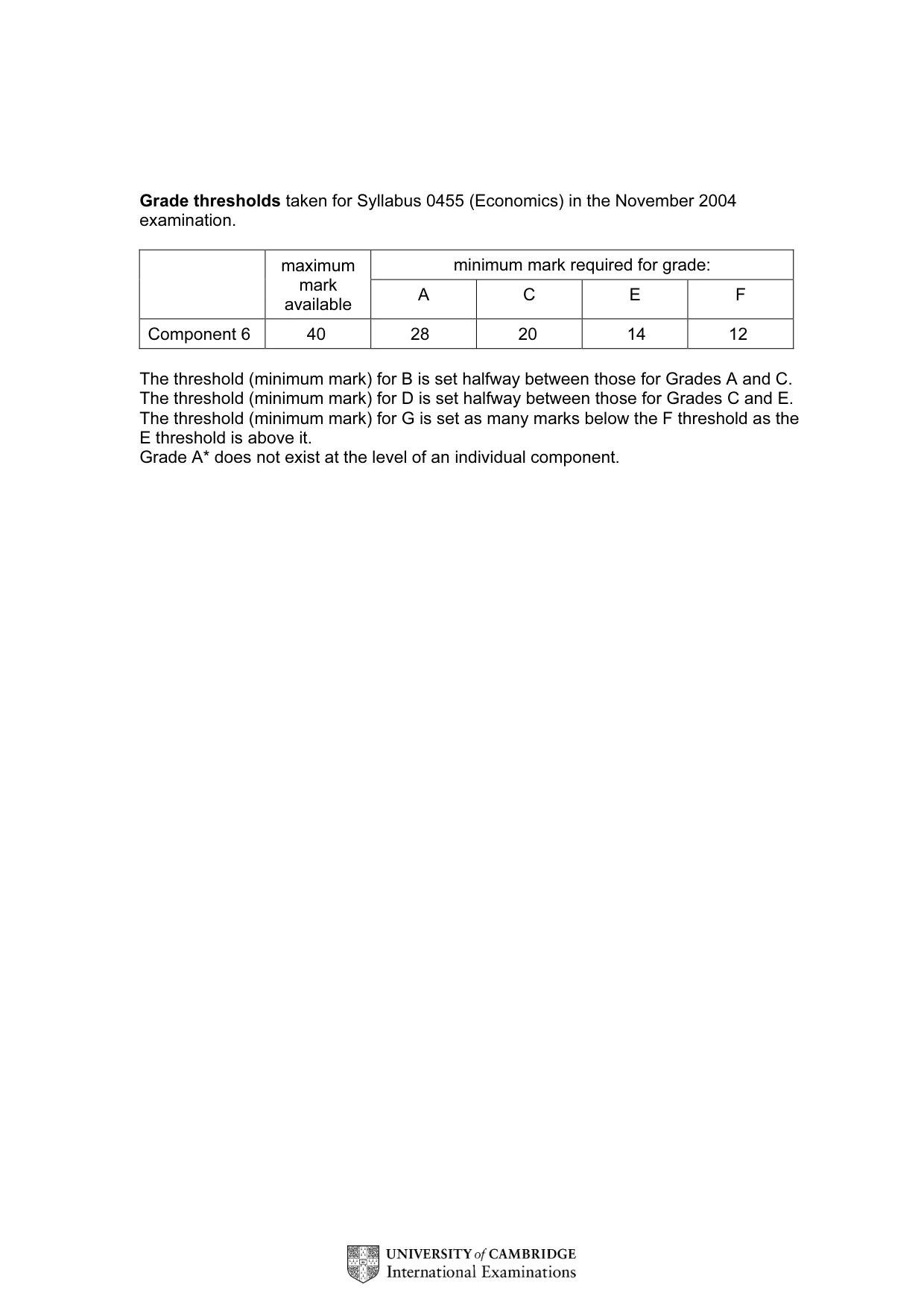
Grade thresholds taken for Syllabus 0455 (Economics) in the November 2004 examination. minimum mark required for grade: maximum mark available A C E F Component 6 40 28 20 14 12 The threshold (minimum mark) for B is set halfway between those for Grades A and C. The threshold (minimum mark) for D is set halfway between those for Grades C and E. The threshold (minimum mark) for G is set as many marks below the F threshold as the E threshold is above it. Grade A* does not exist at the level of an individual component.
Mark scheme, page 3
November 2004 INTERNATIONAL GCSE MARK SCHEME MAXIMUM MARK: 40 SYLLABUS/COMPONENT: 0455/06 ECONOMICS (Alternative to Coursework)
Mark scheme, page 4
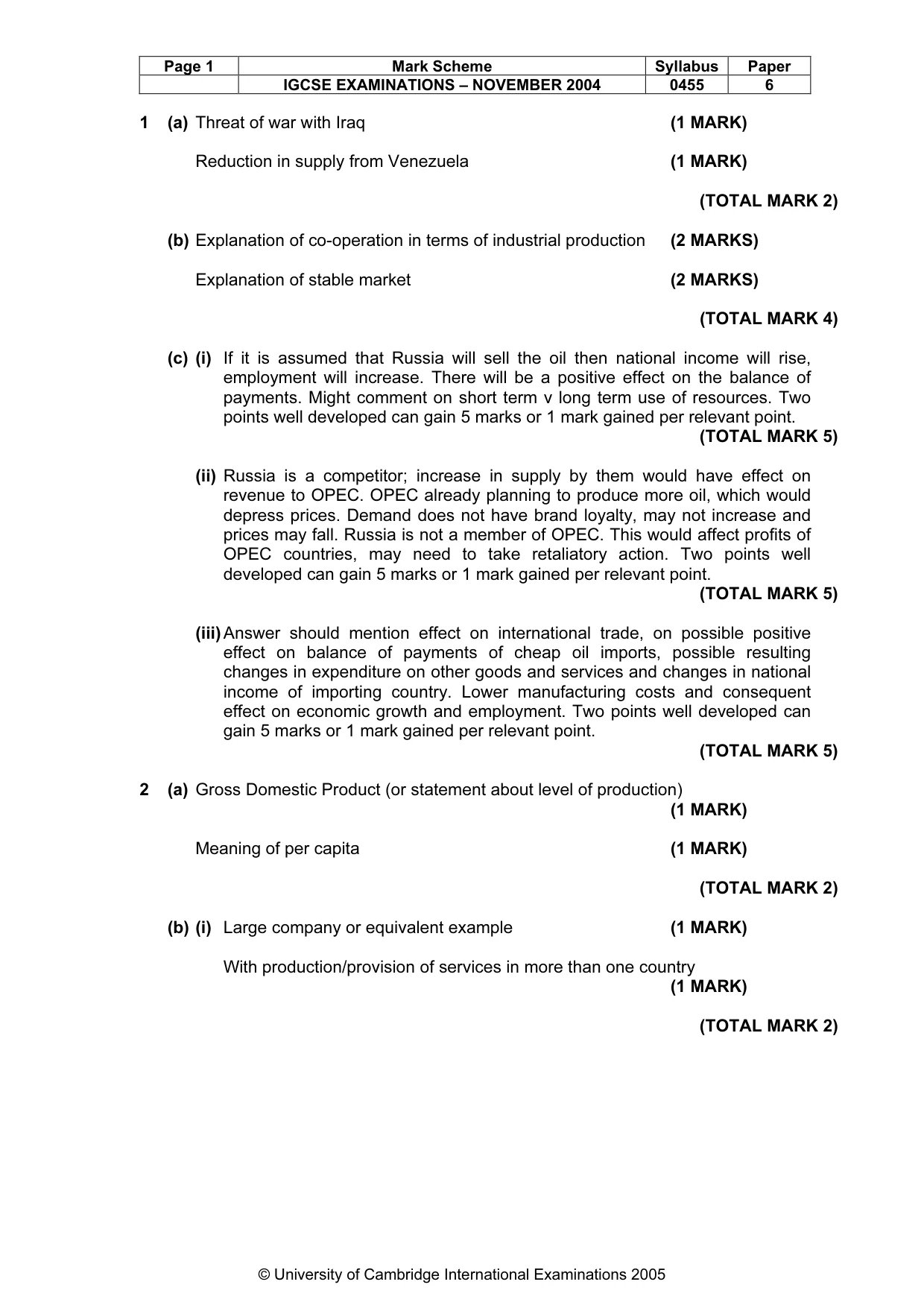
Page 1 Mark Scheme Syllabus Paper IGCSE EXAMINATIONS – NOVEMBER 2004 0455 6 © University of Cambridge International Examinations 2005 1 (a) Threat of war with Iraq (1 MARK) Reduction in supply from Venezuela (1 MARK) (TOTAL MARK 2) (b) Explanation of co-operation in terms of industrial production (2 MARKS) Explanation of stable market (2 MARKS) (TOTAL MARK 4) (c) (i) If it is assumed that Russia will sell the oil then national income will rise, employment will increase. There will be a positive effect on the balance of payments. Might comment on short term v long term use of resources. Two points well developed can gain 5 marks or 1 mark gained per relevant point. (TOTAL MARK 5) (ii) Russia is a competitor; increase in supply by them would have effect on revenue to OPEC. OPEC already planning to produce more oil, which would depress prices. Demand does not have brand loyalty, may not increase and prices may fall. Russia is not a member of OPEC. This would affect profits of OPEC countries, may need to take retaliatory action. Two points well developed can gain 5 marks or 1 mark gained per relevant point. (TOTAL MARK 5) (iii) Answer should mention effect on international trade, on possible positive effect on balance of payments of cheap oil imports, possible resulting changes in expenditure on other goods and services and changes in national income of importing country. Lower manufacturing costs and consequent effect on economic growth and employment. Two points well developed can gain 5 marks or 1 mark gained per relevant point. (TOTAL MARK 5) 2 (a) Gross Domestic Product (or statement about level of production) (1 MARK) Meaning of per capita (1 MARK) (TOTAL MARK 2) (b) (i) Large company or equivalent example (1 MARK) With production/provision of services in more than one country (1 MARK) (TOTAL MARK 2)
Mark scheme, page 5
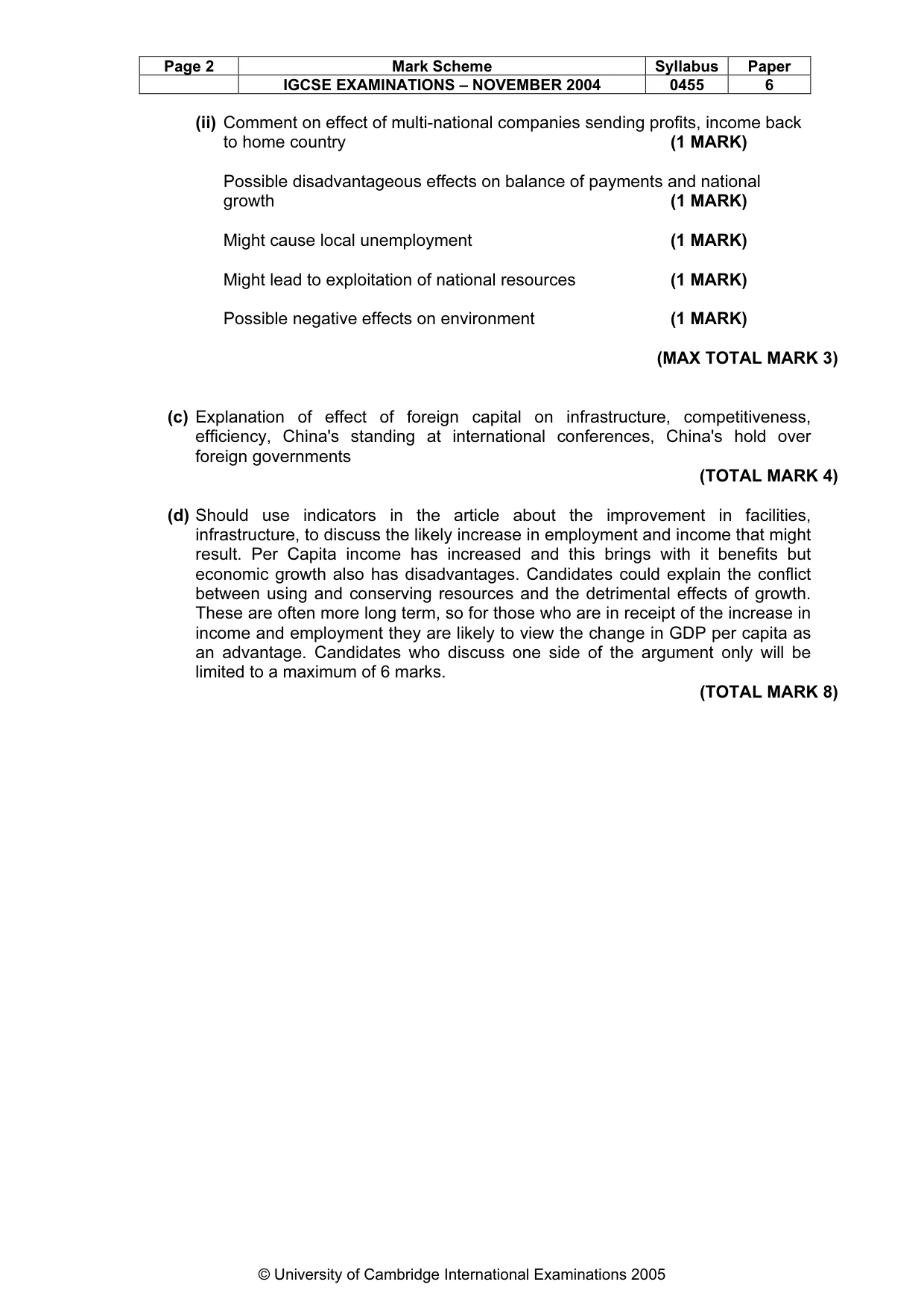
Page 2 Mark Scheme Syllabus Paper IGCSE EXAMINATIONS – NOVEMBER 2004 0455 6 © University of Cambridge International Examinations 2005 (ii) Comment on effect of multi-national companies sending profits, income back to home country (1 MARK) Possible disadvantageous effects on balance of payments and national growth (1 MARK) Might cause local unemployment (1 MARK) Might lead to exploitation of national resources (1 MARK) Possible negative effects on environment (1 MARK) (MAX TOTAL MARK 3) (c) Explanation of effect of foreign capital on infrastructure, competitiveness, efficiency, China's standing at international conferences, China's hold over foreign governments (TOTAL MARK 4) (d) Should use indicators in the article about the improvement in facilities, infrastructure, to discuss the likely increase in employment and income that might result. Per Capita income has increased and this brings with it benefits but economic growth also has disadvantages. Candidates could explain the conflict between using and conserving resources and the detrimental effects of growth. These are often more long term, so for those who are in receipt of the increase in income and employment they are likely to view the change in GDP per capita as an advantage. Candidates who discuss one side of the argument only will be limited to a maximum of 6 marks. (TOTAL MARK 8)