Cambridge IGCSE Development Studies 0453 — 2014 Oct/Nov Paper 2 · Variant 1
0453/21/O/N/14 · 80 marks · ≈90 min
The question paper and its mark scheme, free to read here and free to download. This is Cambridge’s own paper, exactly as it was sat.
Question paper20 pages



Mark scheme9 pages
Answers below. Sit the paper first if you are practising.
Paper as text
Question paper, page 1
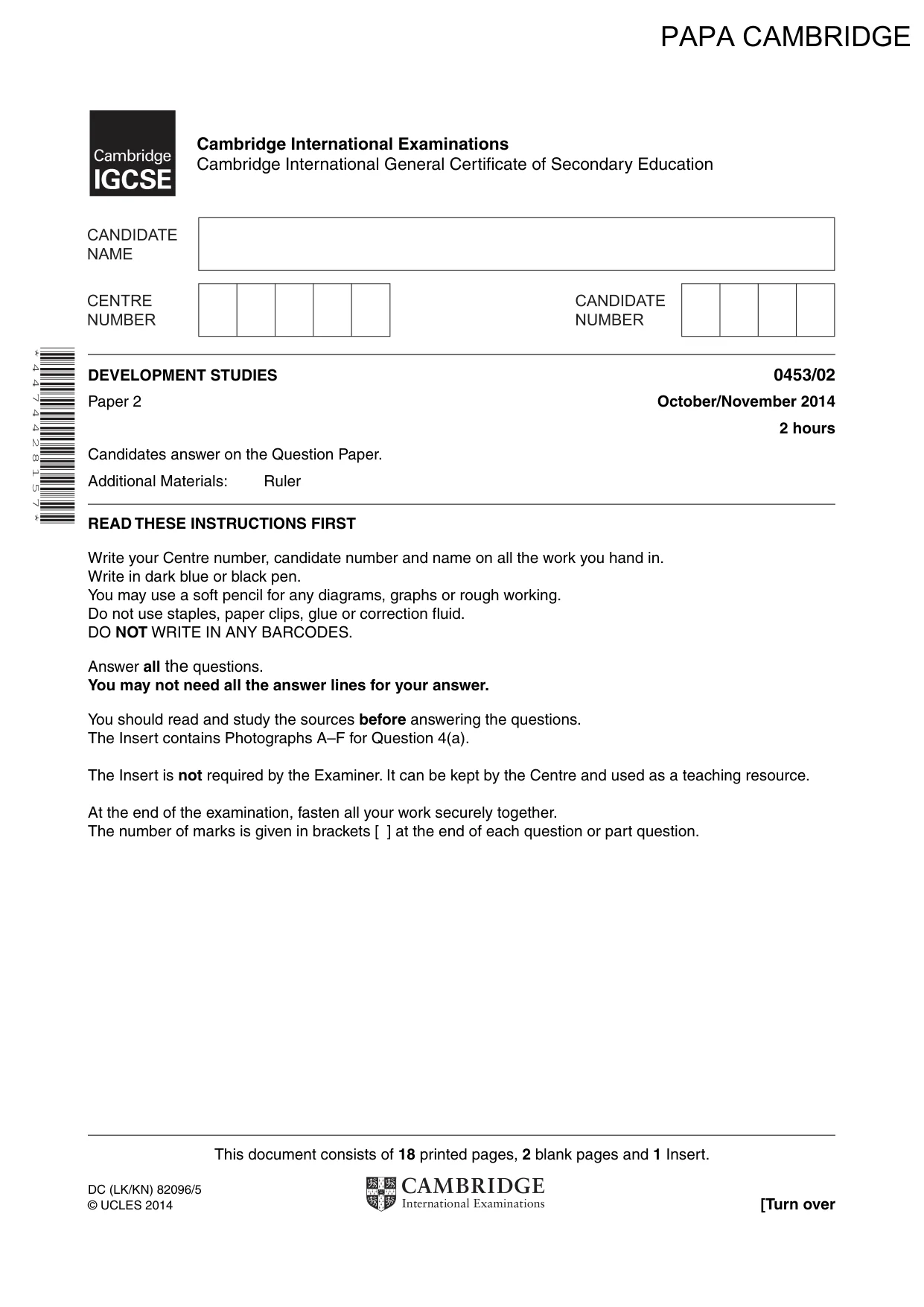
This document consists of 18 printed pages, 2 blank pages and 1 Insert. DC (LK/KN) 82096/5 © UCLES 2014 [Turn over Cambridge International Examinations Cambridge International General Certificate of Secondary Education * 4 4 7 4 4 2 8 1 5 7 * DEVELOPMENT STUDIES 0453/02 Paper 2 October/November 2014 2 hours Candidates answer on the Question Paper. Additional Materials: Ruler READ THESE INSTRUCTIONS FIRST Write your Centre number, candidate number and name on all the work you hand in. Write in dark blue or black pen. You may use a soft pencil for any diagrams, graphs or rough working. Do not use staples, paper clips, glue or correction fluid. DO NOT WRITE IN ANY BARCODES. Answer all the questions. You may not need all the answer lines for your answer. You should read and study the sources before answering the questions. The Insert contains Photographs A–F for Question 4(a). The Insert is not required by the Examiner. It can be kept by the Centre and used as a teaching resource. At the end of the examination, fasten all your work securely together. The number of marks is given in brackets [ ] at the end of each question or part question. PAPA CAMBRIDGE
Question paper, page 2
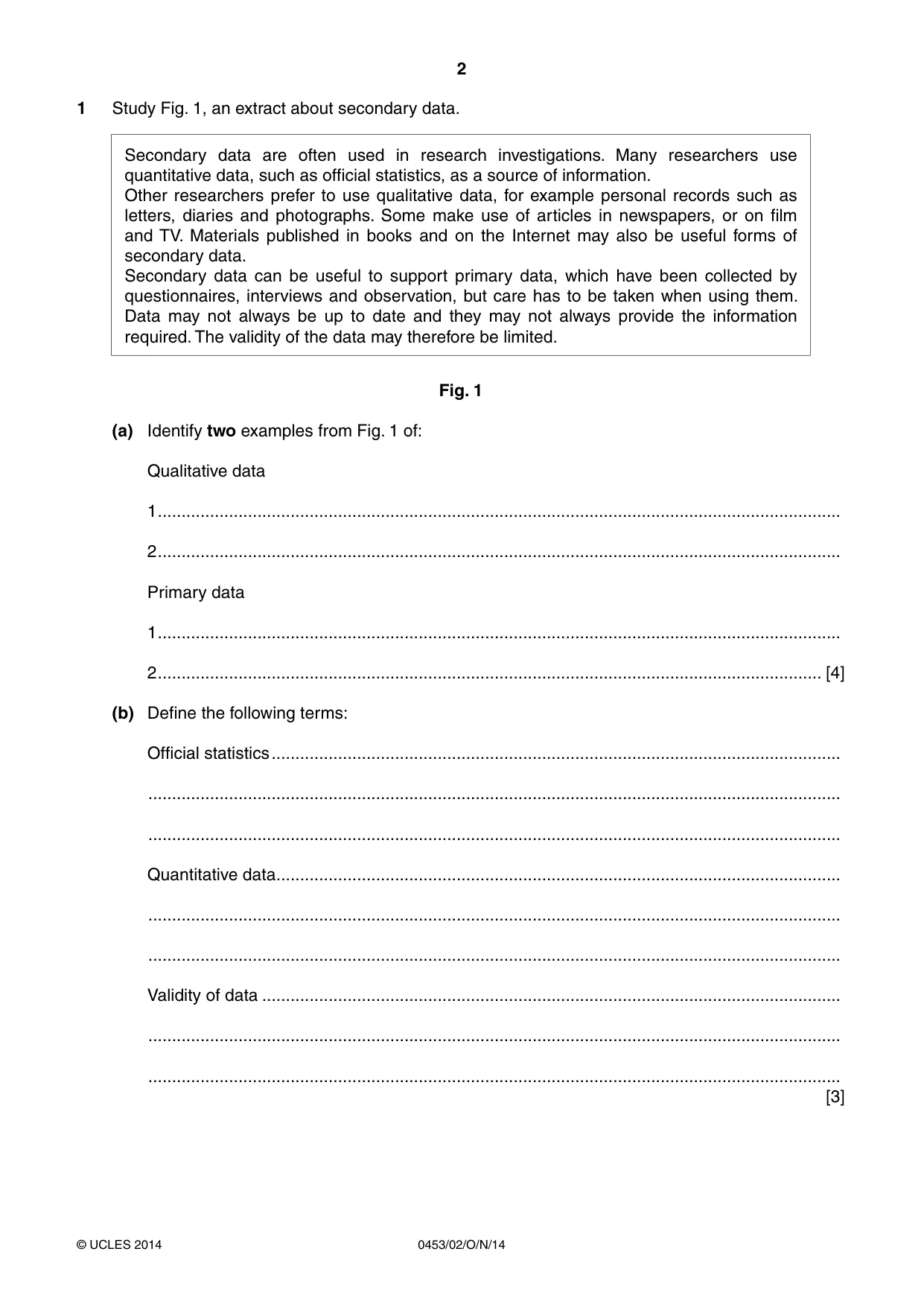
2 0453/02/O/N/14 © UCLES 2014 1 Study Fig. 1, an extract about secondary data. Secondary data are often used in research investigations. Many researchers use quantitative data, such as official statistics, as a source of information. Other researchers prefer to use qualitative data, for example personal records such as letters, diaries and photographs. Some make use of articles in newspapers, or on film and TV. Materials published in books and on the Internet may also be useful forms of secondary data. Secondary data can be useful to support primary data, which have been collected by questionnaires, interviews and observation, but care has to be taken when using them. Data may not always be up to date and they may not always provide the information required. The validity of the data may therefore be limited. Fig. 1 (a) Identify two examples from Fig. 1 of: Qualitative data 1 … 2 … Primary data 1 … 2 … [4] (b) Define the following terms: Official statistics … … … Quantitative data … … … Validity of data … … … [3]
Question paper, page 3
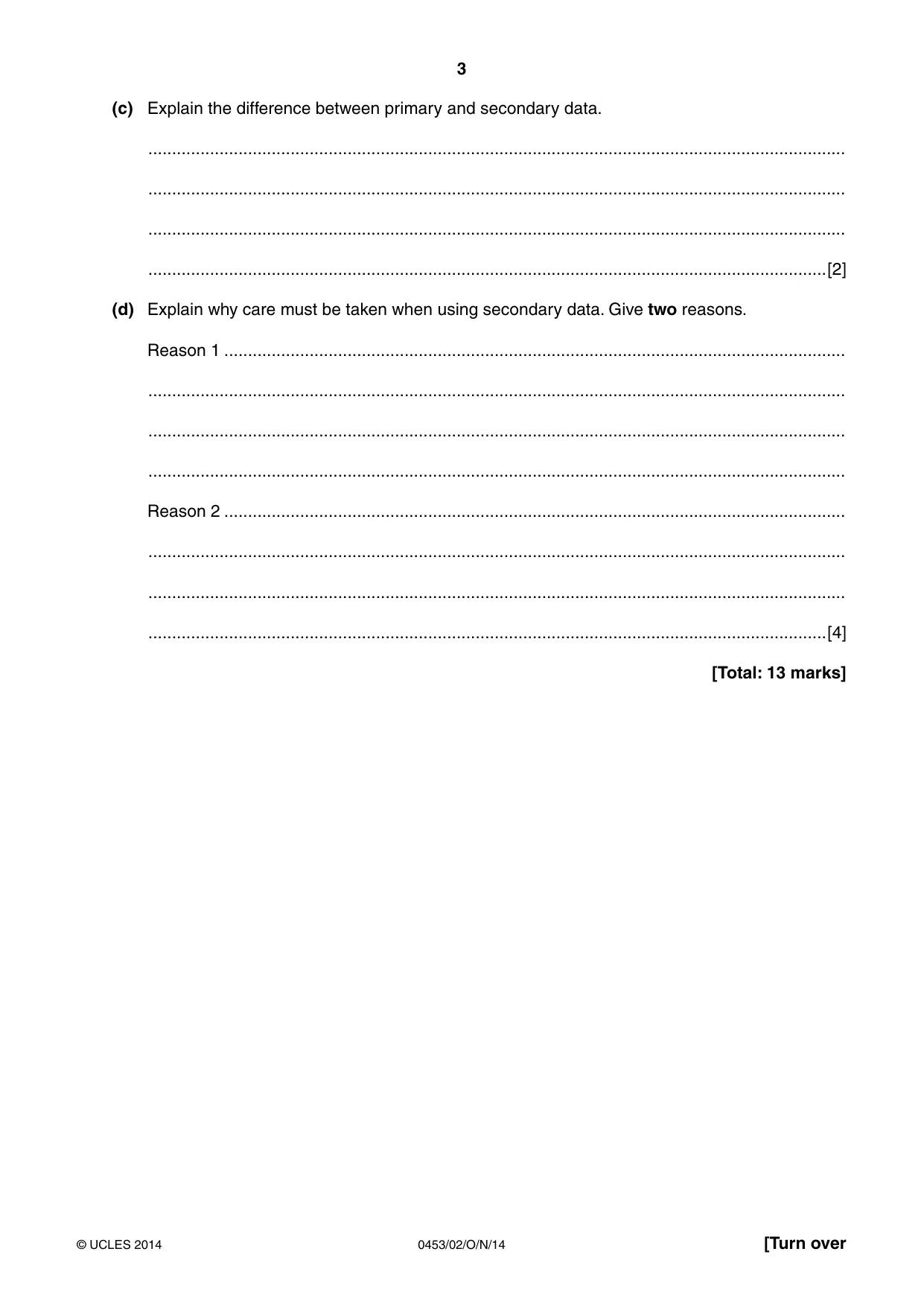
3 0453/02/O/N/14 © UCLES 2014 [Turn over (c) Explain the difference between primary and secondary data. … … … …[2] (d) Explain why care must be taken when using secondary data. Give two reasons. Reason 1 … … … … Reason 2 … … … …[4] [Total: 13 marks]
Question paper, page 4
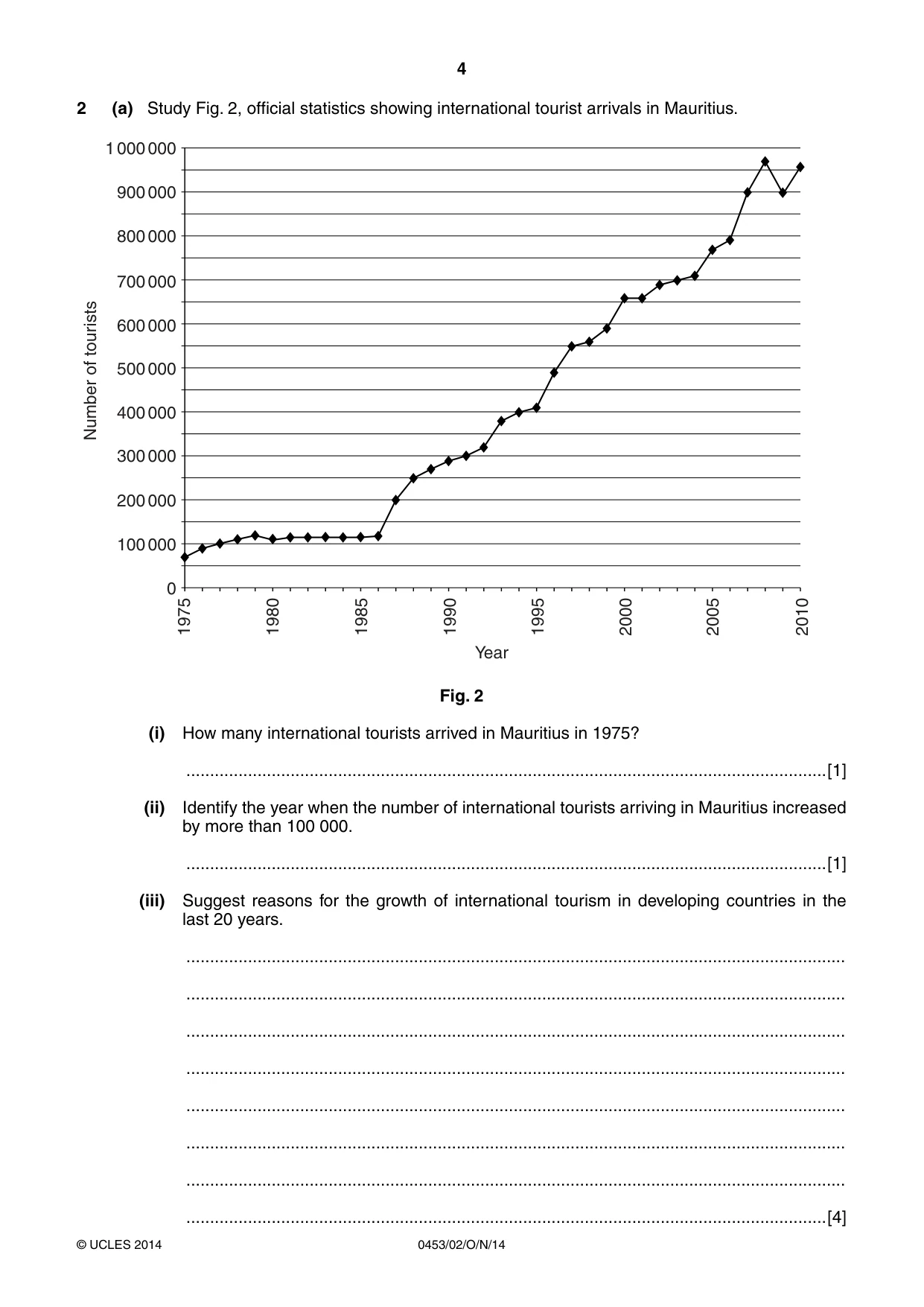
4 0453/02/O/N/14 © UCLES 2014 2 (a) Study Fig. 2, official statistics showing international tourist arrivals in Mauritius. 100 000 Year 200 000 300 000 400 000 500 000 600 000 700 000 800 000 900 000 1 000 000 0 Number of tourists 1975 1980 1985 1990 1995 2000 2005 2010 Fig. 2 (i) How many international tourists arrived in Mauritius in 1975? …[1] (ii) Identify the year when the number of international tourists arriving in Mauritius increased by more than 100 000. …[1] (iii) Suggest reasons for the growth of international tourism in developing countries in the last 20 years. … … … … … … … …[4]
Question paper, page 5
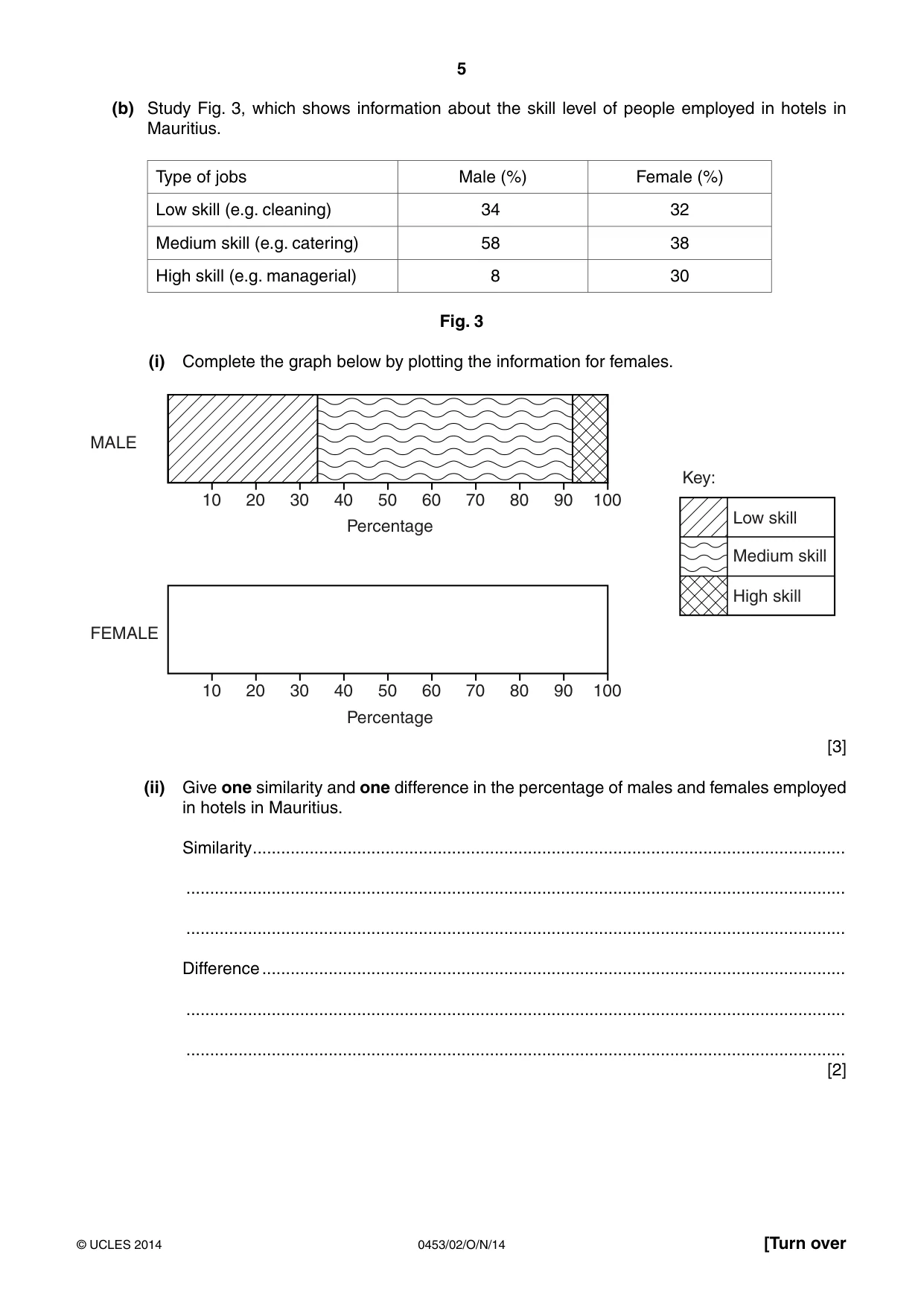
5 0453/02/O/N/14 © UCLES 2014 [Turn over (b) Study Fig. 3, which shows information about the skill level of people employed in hotels in Mauritius. Type of jobs Male (%) Female (%) Low skill (e.g. cleaning) 34 32 Medium skill (e.g. catering) 58 38 High skill (e.g. managerial) 8 30 Fig. 3 (i) Complete the graph below by plotting the information for females. 10 20 30 40 50 Percentage 60 70 80 90 100 Key: Low skill Medium skill High skill MALE 10 20 30 40 50 Percentage 60 70 80 90 100 FEMALE [3] (ii) Give one similarity and one difference in the percentage of males and females employed in hotels in Mauritius. Similarity … … … Difference … … … [2]
Question paper, page 6
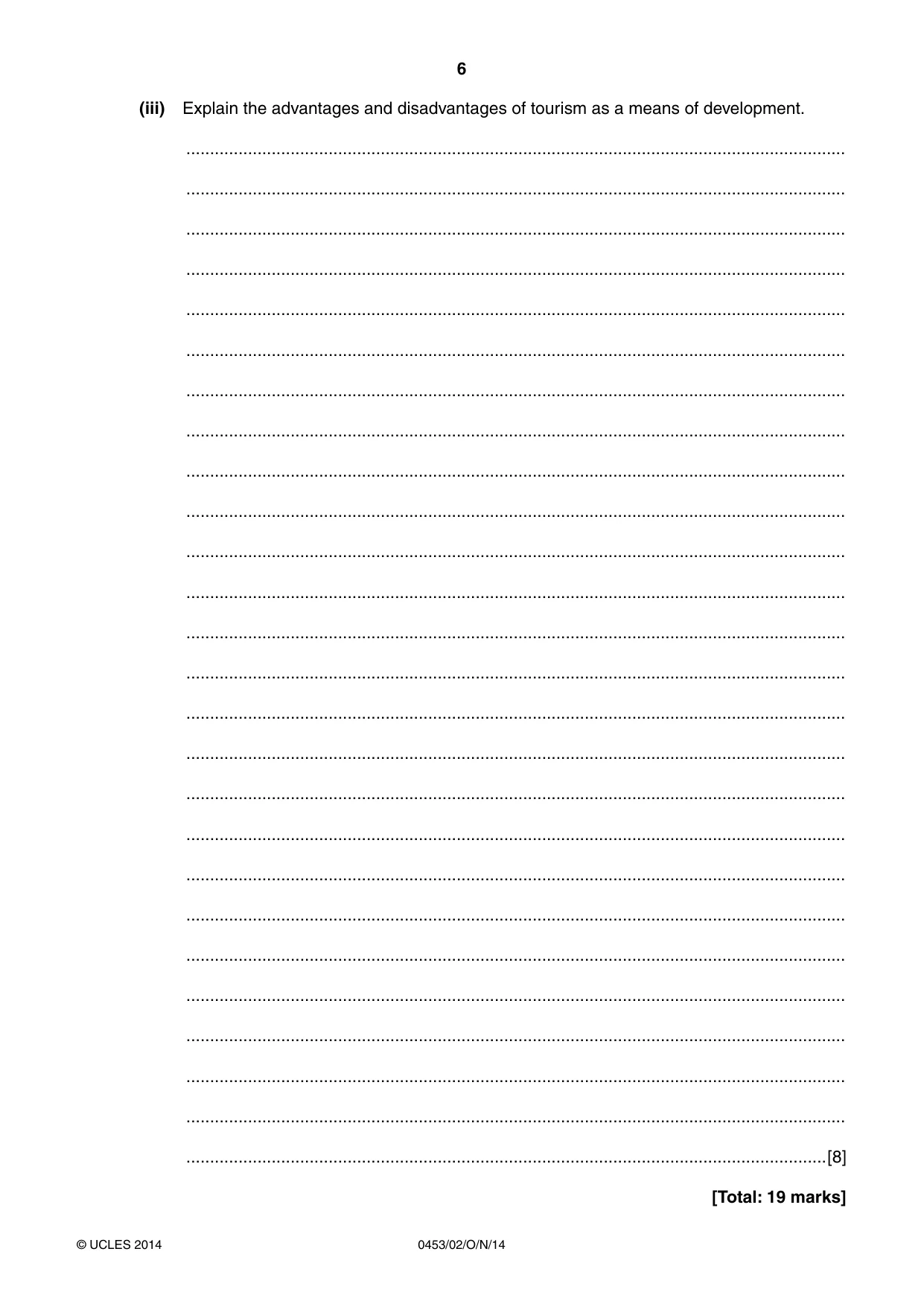
6 0453/02/O/N/14 © UCLES 2014 (iii) Explain the advantages and disadvantages of tourism as a means of development. … … … … … … … … … … … … … … … … … … … … … … … … … …[8] [Total: 19 marks]
Question paper, page 7
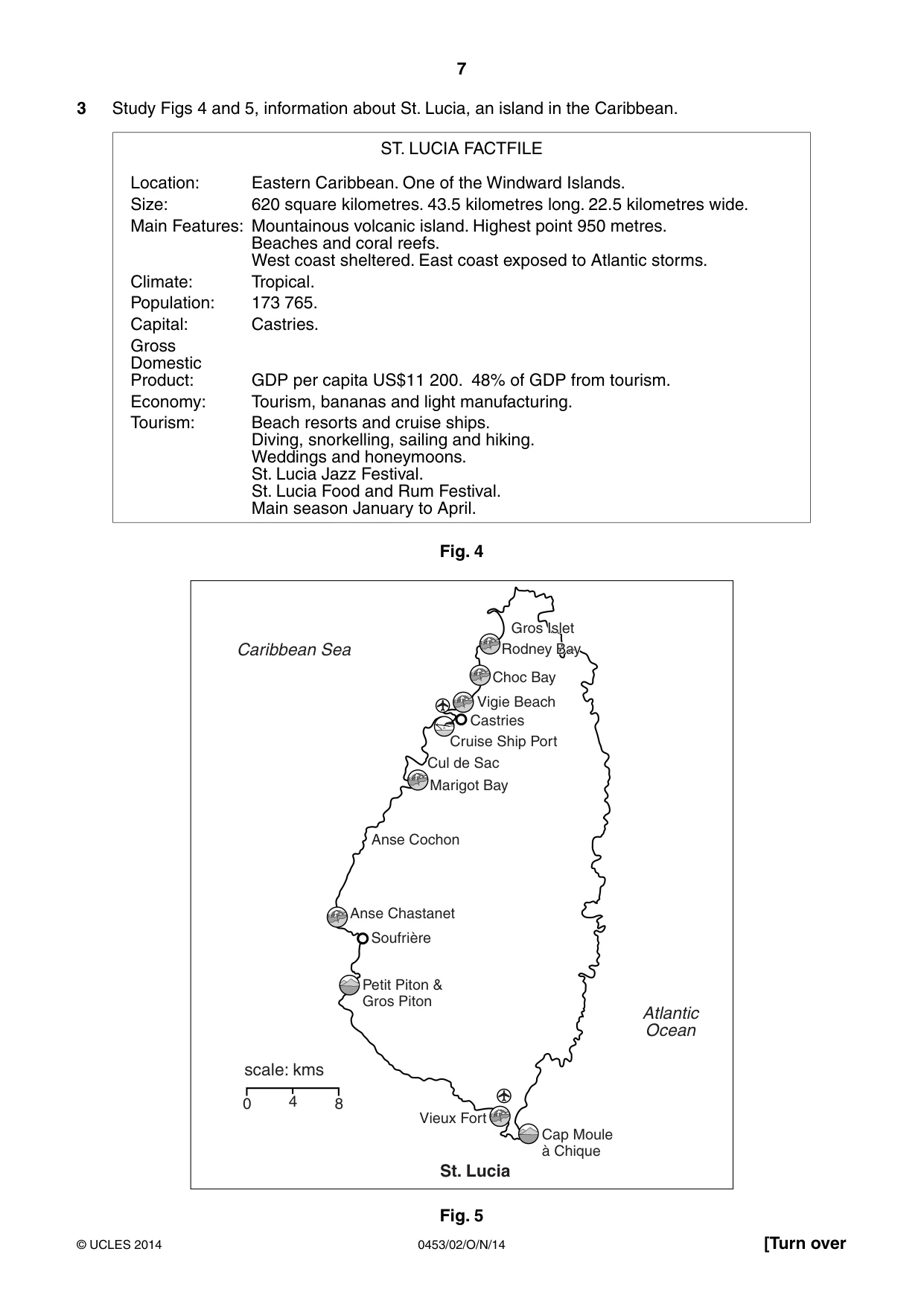
7 0453/02/O/N/14 © UCLES 2014 [Turn over 3 Study Figs 4 and 5, information about St. Lucia, an island in the Caribbean. ST. LUCIA FACTFILE Location: Eastern Caribbean. One of the Windward Islands. Size: 620 square kilometres. 43.5 kilometres long. 22.5 kilometres wide. Main Features: Mountainous volcanic island. Highest point 950 metres. Beaches and coral reefs. West coast sheltered. East coast exposed to Atlantic storms. Climate: Tropical. Population: 173 765. Capital: Castries. Gross Domestic Product: GDP per capita US$11 200. 48% of GDP from tourism. Economy: Tourism, bananas and light manufacturing. Tourism: Beach resorts and cruise ships. Diving, snorkelling, sailing and hiking. Weddings and honeymoons. St. Lucia Jazz Festival. St. Lucia Food and Rum Festival. Main season January to April. Fig. 4 4 4 Gros Islet Rodney Bay Gros Islet Rodney Bay Choc Bay Vigie Beach Castries Cruise Ship Port Cul de Sac Marigot Bay Anse Cochon Anse Chastanet Soufrière Petit Piton & Gros Piton Vieux Fort Cap Moule à Chique 0 4 8 Caribbean Sea Atlantic Ocean scale: kms St. Lucia Fig. 5
Question paper, page 8
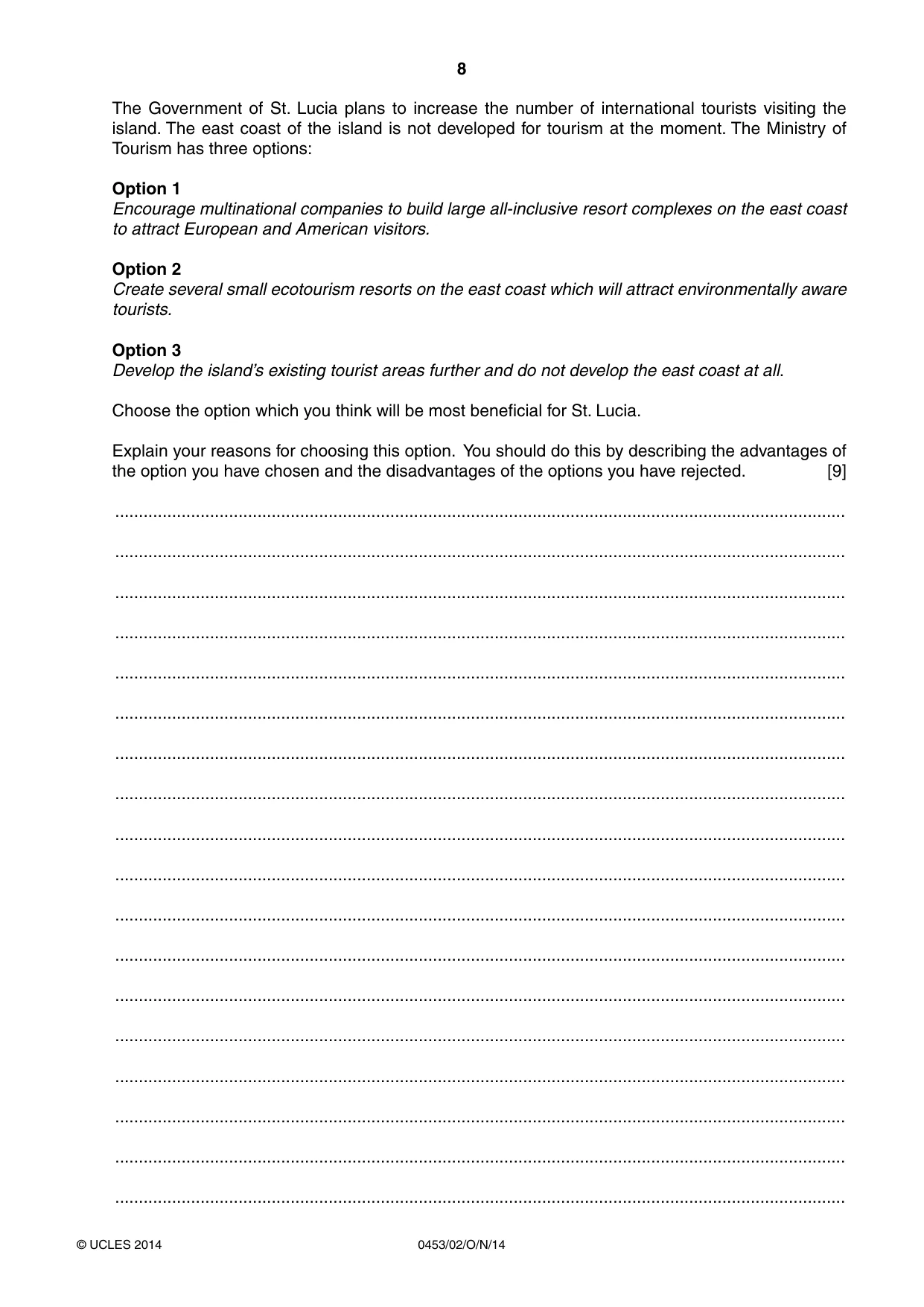
8 0453/02/O/N/14 © UCLES 2014 The Government of St. Lucia plans to increase the number of international tourists visiting the island. The east coast of the island is not developed for tourism at the moment. The Ministry of Tourism has three options: Option 1 Encourage multinational companies to build large all-inclusive resort complexes on the east coast to attract European and American visitors. Option 2 Create several small ecotourism resorts on the east coast which will attract environmentally aware tourists. Option 3 Develop the island’s existing tourist areas further and do not develop the east coast at all. Choose the option which you think will be most beneficial for St. Lucia. Explain your reasons for choosing this option. You should do this by describing the advantages of the option you have chosen and the disadvantages of the options you have rejected. [9] … … … … … … … … … … … … … … … … … …
Question paper, page 9
9 0453/02/O/N/14 © UCLES 2014 [Turn over … … … … … … … … … [Total: 9 marks]
Question paper, page 10
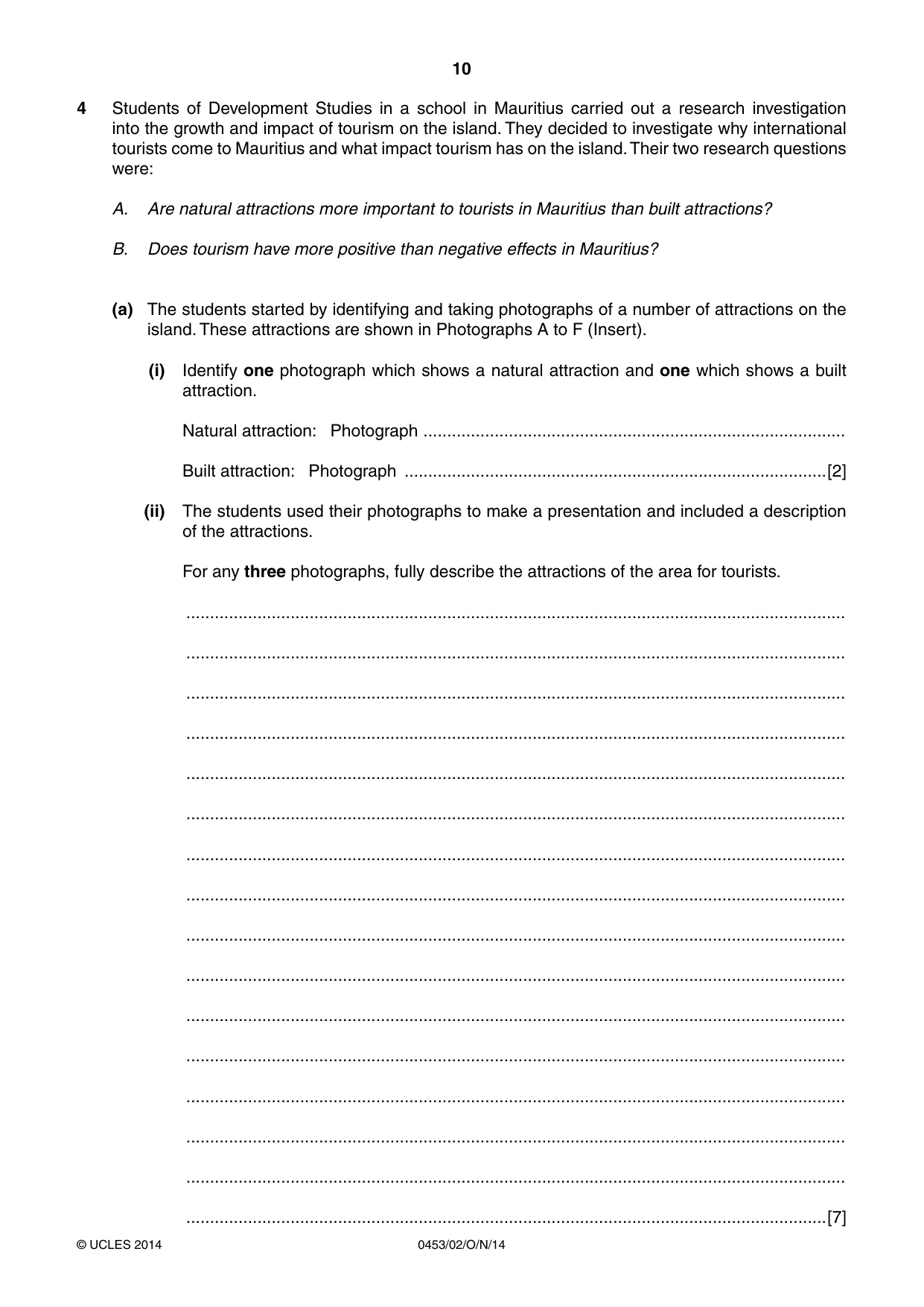
10 0453/02/O/N/14 © UCLES 2014 4 Students of Development Studies in a school in Mauritius carried out a research investigation into the growth and impact of tourism on the island. They decided to investigate why international tourists come to Mauritius and what impact tourism has on the island. Their two research questions were: A. Are natural attractions more important to tourists in Mauritius than built attractions? B. Does tourism have more positive than negative effects in Mauritius? (a) The students started by identifying and taking photographs of a number of attractions on the island. These attractions are shown in Photographs A to F (Insert). (i) Identify one photograph which shows a natural attraction and one which shows a built attraction. Natural attraction: Photograph … Built attraction: Photograph …[2] (ii) The students used their photographs to make a presentation and included a description of the attractions. For any three photographs, fully describe the attractions of the area for tourists. … … … … … … … … … … … … … … … …[7]
Question paper, page 11
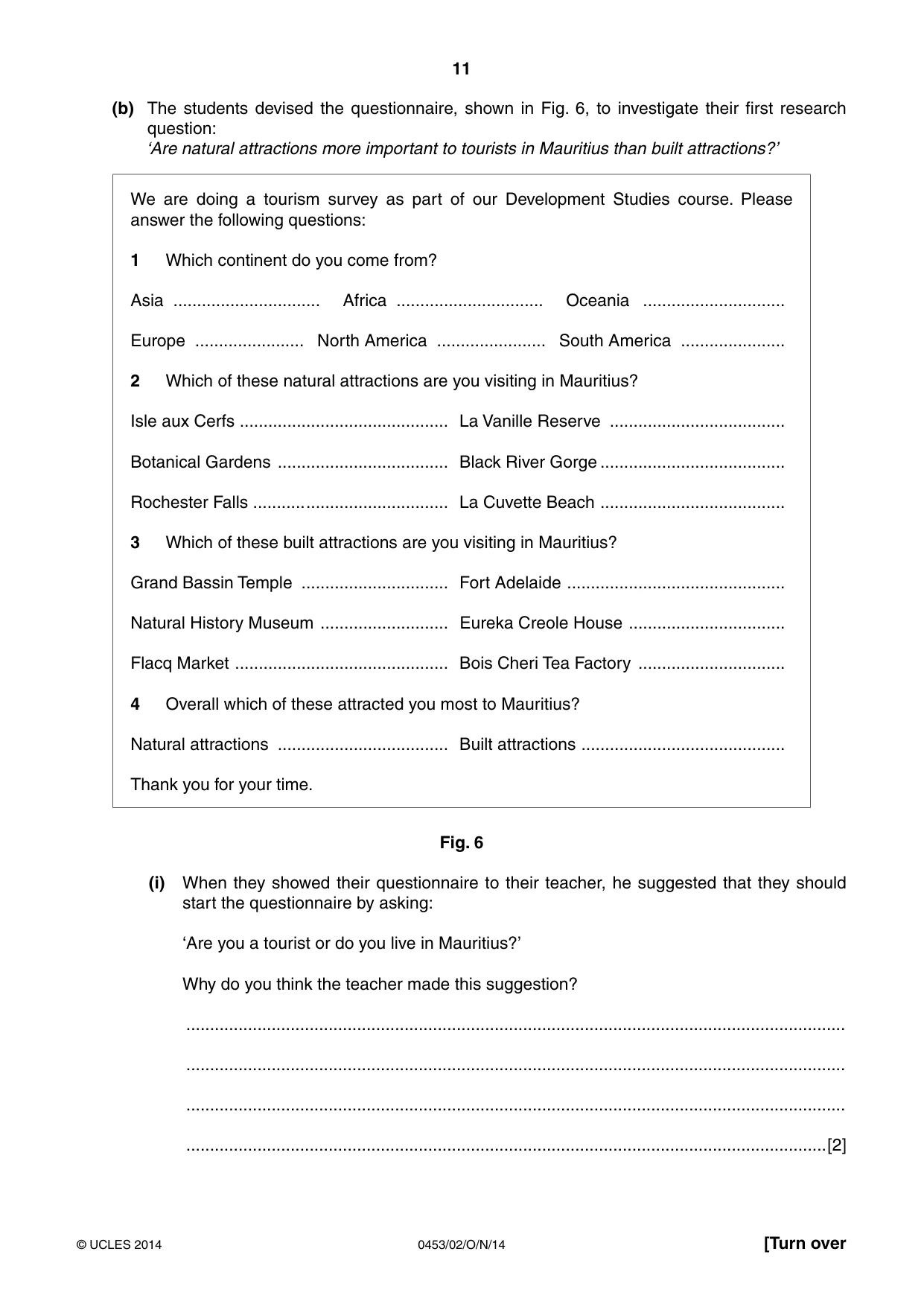
11 0453/02/O/N/14 © UCLES 2014 [Turn over (b) The students devised the questionnaire, shown in Fig. 6, to investigate their first research question: ‘Are natural attractions more important to tourists in Mauritius than built attractions?’ We are doing a tourism survey as part of our Development Studies course. Please answer the following questions: 1 Which continent do you come from? Asia … Africa … Oceania … Europe … North America … South America … 2 Which of these natural attractions are you visiting in Mauritius? Isle aux Cerfs … … La Vanille Reserve … Botanical Gardens … Black River Gorge … Rochester Falls … … La Cuvette Beach … 3 Which of these built attractions are you visiting in Mauritius? Grand Bassin Temple … Fort Adelaide … Natural History Museum … Eureka Creole House … Flacq Market … Bois Cheri Tea Factory … 4 Overall which of these attracted you most to Mauritius? Natural attractions … Built attractions … Thank you for your time. Fig. 6 (i) When they showed their questionnaire to their teacher, he suggested that they should start the questionnaire by asking: ‘Are you a tourist or do you live in Mauritius?’ Why do you think the teacher made this suggestion? … … … …[2]
Question paper, page 12
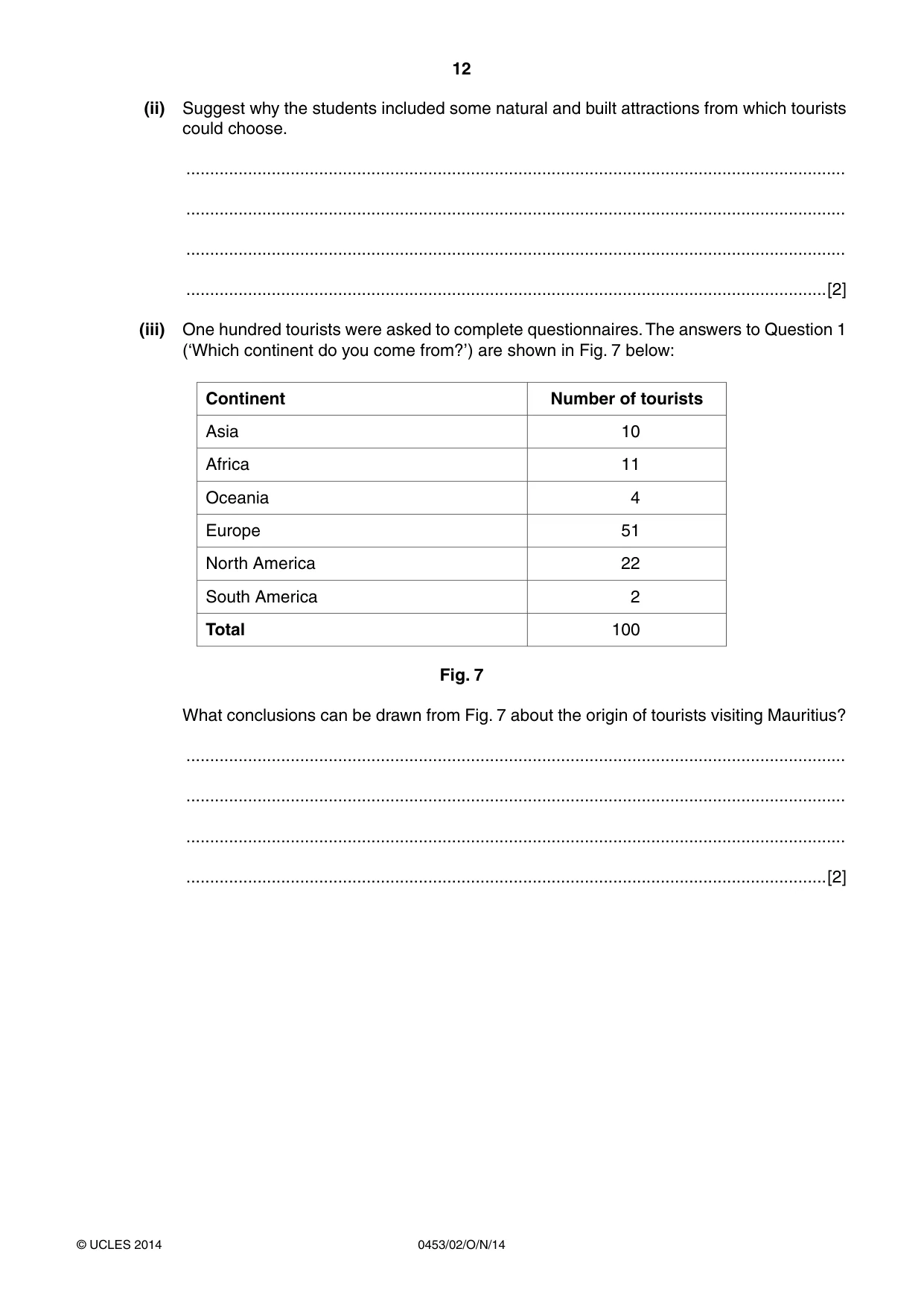
12 0453/02/O/N/14 © UCLES 2014 (ii) Suggest why the students included some natural and built attractions from which tourists could choose. … … … …[2] (iii) One hundred tourists were asked to complete questionnaires. The answers to Question 1 (‘Which continent do you come from?’) are shown in Fig. 7 below: Continent Number of tourists Asia 10 Africa 11 Oceania 4 Europe 51 North America 22 South America 2 Total 100 Fig. 7 What conclusions can be drawn from Fig. 7 about the origin of tourists visiting Mauritius? … … … …[2]
Question paper, page 13
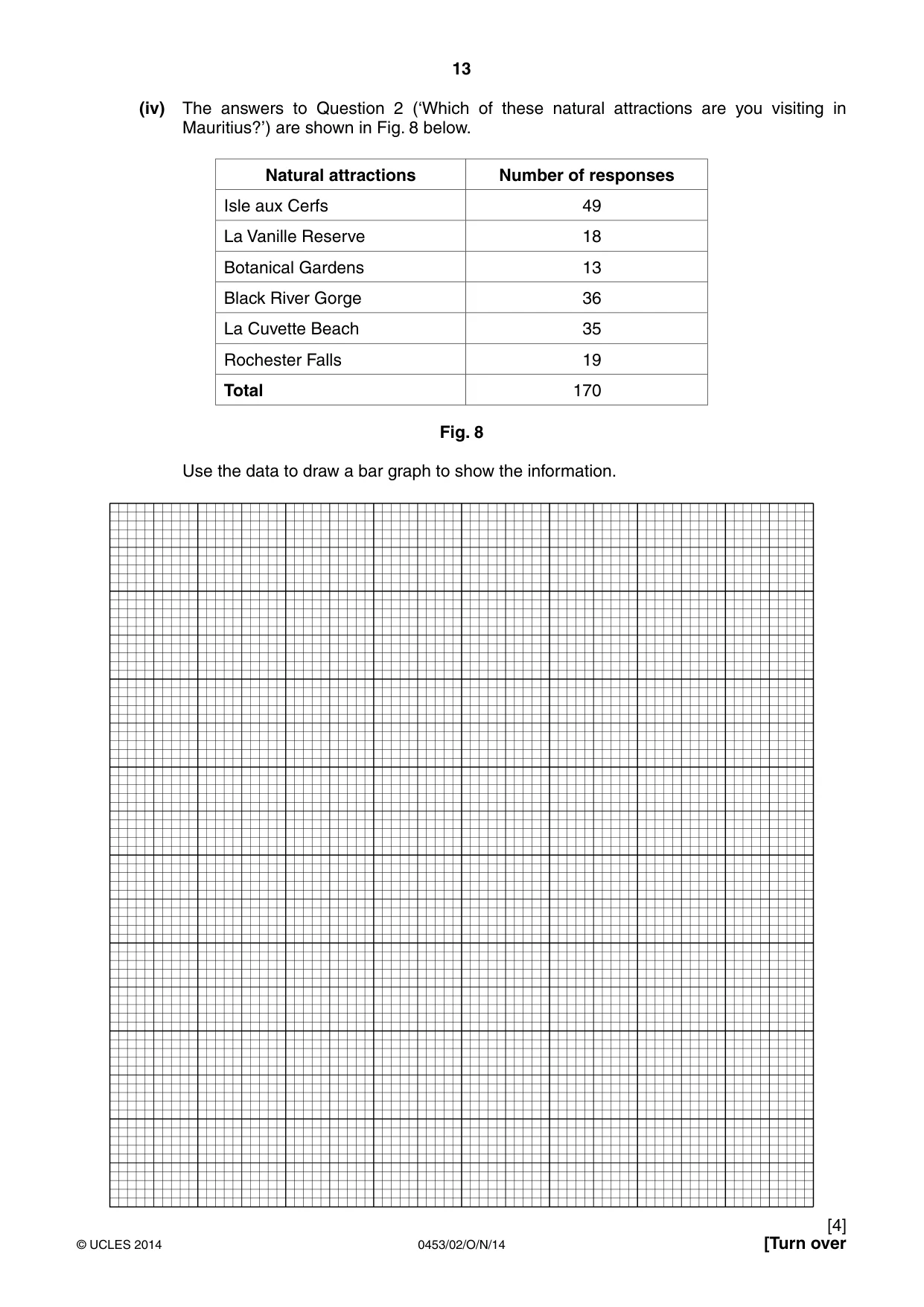
13 0453/02/O/N/14 © UCLES 2014 [Turn over (iv) The answers to Question 2 (‘Which of these natural attractions are you visiting in Mauritius?’) are shown in Fig. 8 below. Natural attractions Number of responses Isle aux Cerfs 49 La Vanille Reserve 18 Botanical Gardens 13 Black River Gorge 36 La Cuvette Beach 35 Rochester Falls 19 Total 170 Fig. 8 Use the data to draw a bar graph to show the information. [4]
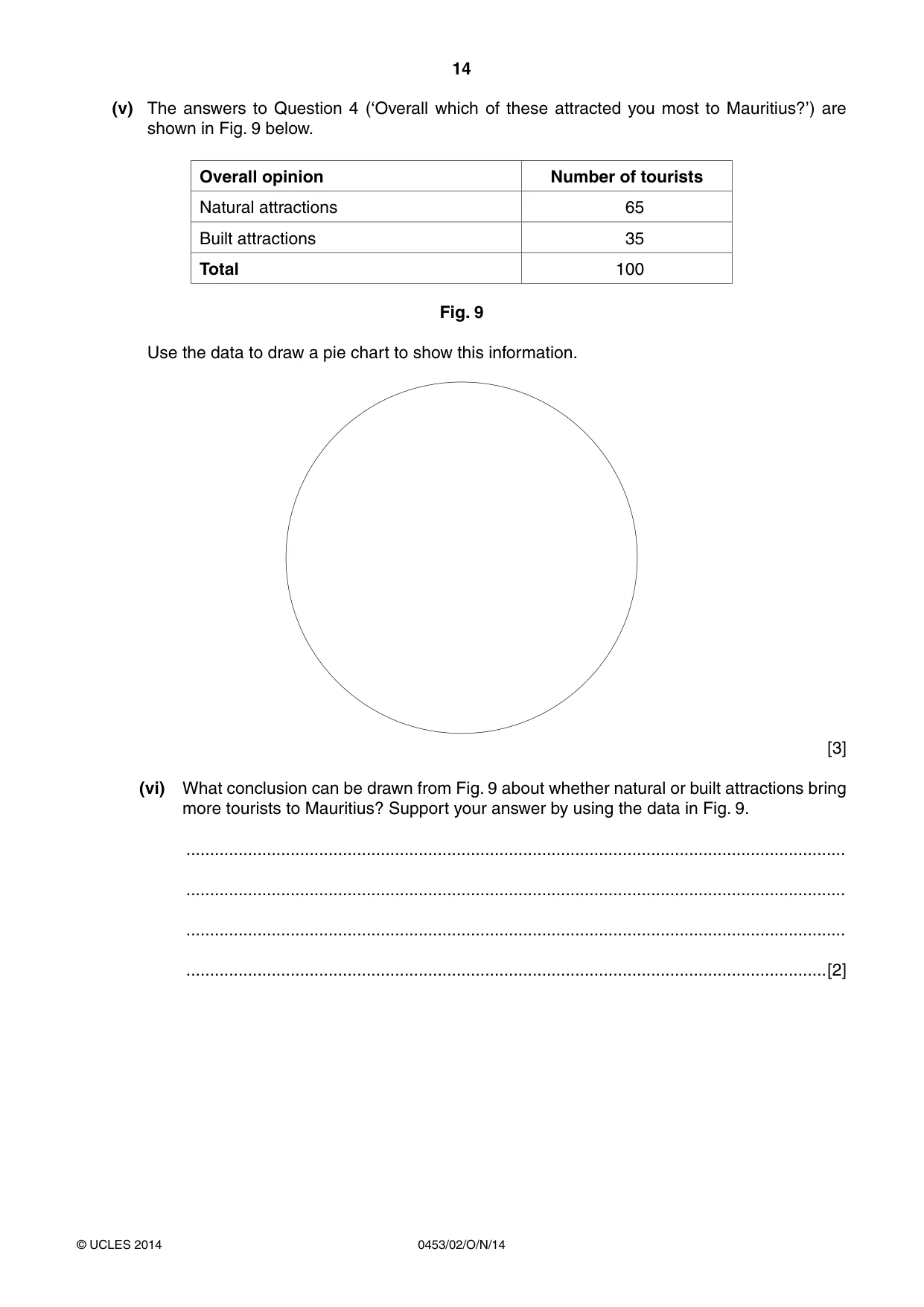
Question paper, page 14
14 0453/02/O/N/14 © UCLES 2014 (v) The answers to Question 4 (‘Overall which of these attracted you most to Mauritius?’) are shown in Fig. 9 below. Overall opinion Number of tourists Natural attractions 65 Built attractions 35 Total 100 Fig. 9 Use the data to draw a pie chart to show this information. [3] (vi) What conclusion can be drawn from Fig. 9 about whether natural or built attractions bring more tourists to Mauritius? Support your answer by using the data in Fig. 9. … … … …[2]
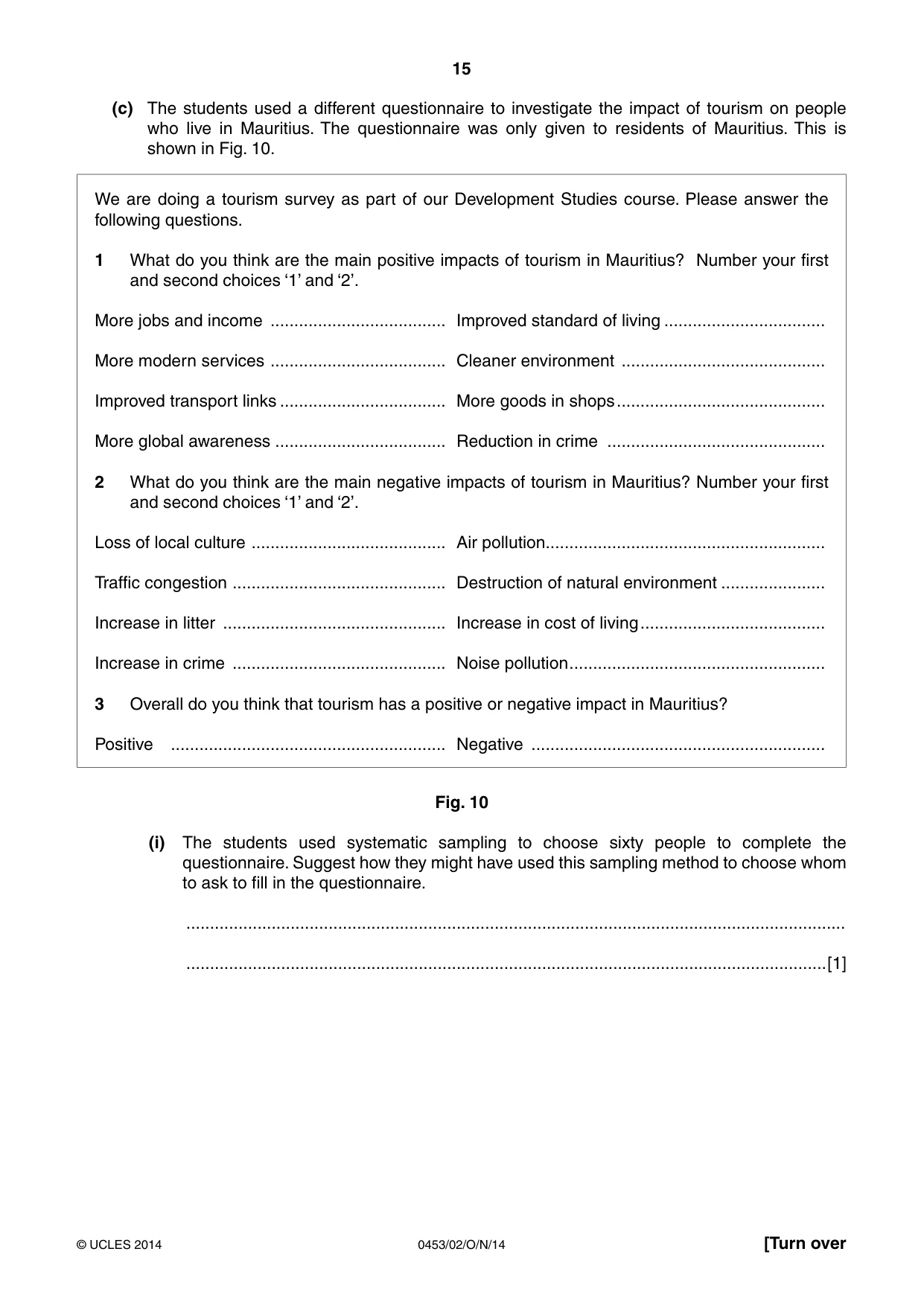
Question paper, page 15
15 0453/02/O/N/14 © UCLES 2014 [Turn over (c) The students used a different questionnaire to investigate the impact of tourism on people who live in Mauritius. The questionnaire was only given to residents of Mauritius. This is shown in Fig. 10. We are doing a tourism survey as part of our Development Studies course. Please answer the following questions. 1 What do you think are the main positive impacts of tourism in Mauritius? Number your first and second choices ‘1’ and ‘2’. More jobs and income … Improved standard of living … More modern services … Cleaner environment … Improved transport links … More goods in shops … More global awareness … Reduction in crime … 2 What do you think are the main negative impacts of tourism in Mauritius? Number your first and second choices ‘1’ and ‘2’. Loss of local culture … Air pollution… Traffic congestion … Destruction of natural environment … Increase in litter … Increase in cost of living … Increase in crime … Noise pollution … 3 Overall do you think that tourism has a positive or negative impact in Mauritius? Positive … Negative … Fig. 10 (i) The students used systematic sampling to choose sixty people to complete the questionnaire. Suggest how they might have used this sampling method to choose whom to ask to fill in the questionnaire. … …[1]
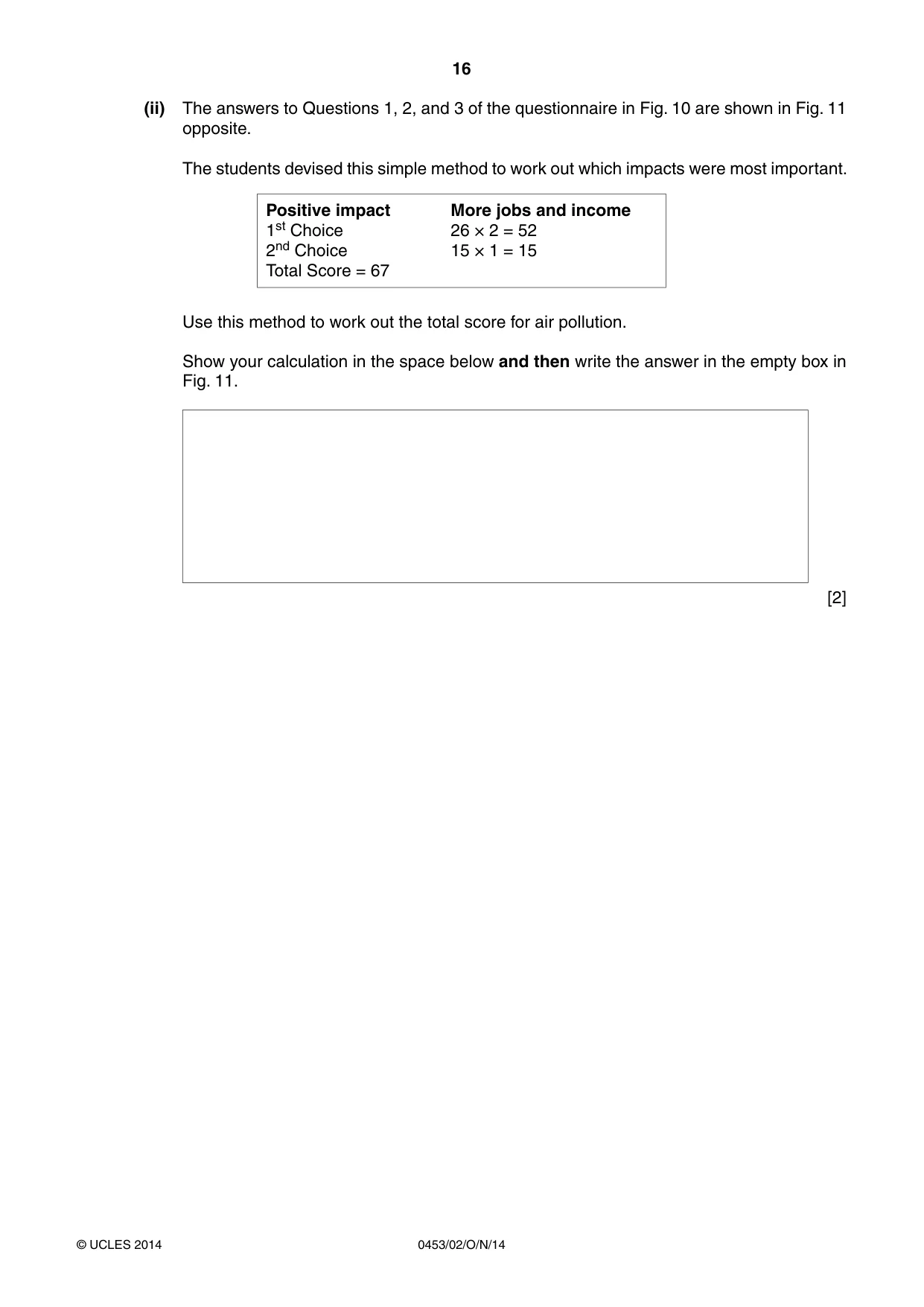
Question paper, page 16
16 0453/02/O/N/14 © UCLES 2014 (ii) The answers to Questions 1, 2, and 3 of the questionnaire in Fig. 10 are shown in Fig. 11 opposite. The students devised this simple method to work out which impacts were most important. Positive impact More jobs and income 1st Choice 26 × 2 = 52 2nd Choice 15 × 1 = 15 Total Score = 67 Use this method to work out the total score for air pollution. Show your calculation in the space below and then write the answer in the empty box in Fig. 11. [2]
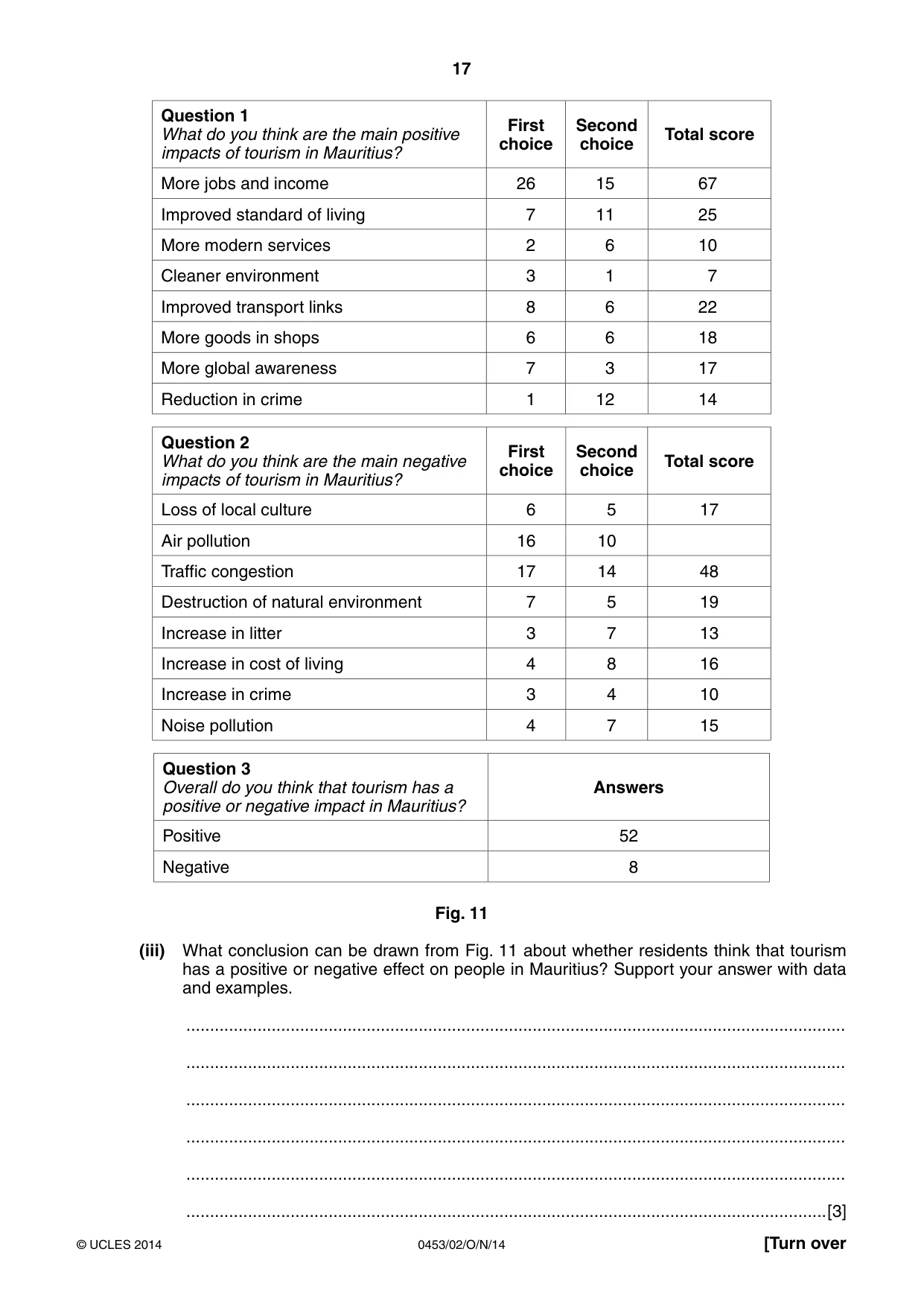
Question paper, page 17
17 0453/02/O/N/14 © UCLES 2014 [Turn over Question 1 What do you think are the main positive impacts of tourism in Mauritius? First choice Second choice Total score More jobs and income 26 15 67 Improved standard of living 7 11 25 More modern services 2 6 10 Cleaner environment 3 1 7 Improved transport links 8 6 22 More goods in shops 6 6 18 More global awareness 7 3 17 Reduction in crime 1 12 14 Question 2 What do you think are the main negative impacts of tourism in Mauritius? First choice Second choice Total score Loss of local culture 6 5 17 Air pollution 16 10 Traffic congestion 17 14 48 Destruction of natural environment 7 5 19 Increase in litter 3 7 13 Increase in cost of living 4 8 16 Increase in crime 3 4 10 Noise pollution 4 7 15 Question 3 Overall do you think that tourism has a positive or negative impact in Mauritius? Answers Positive 52 Negative 8 Fig. 11 (iii) What conclusion can be drawn from Fig. 11 about whether residents think that tourism has a positive or negative effect on people in Mauritius? Support your answer with data and examples. … … … … … …[3]
Question paper, page 18
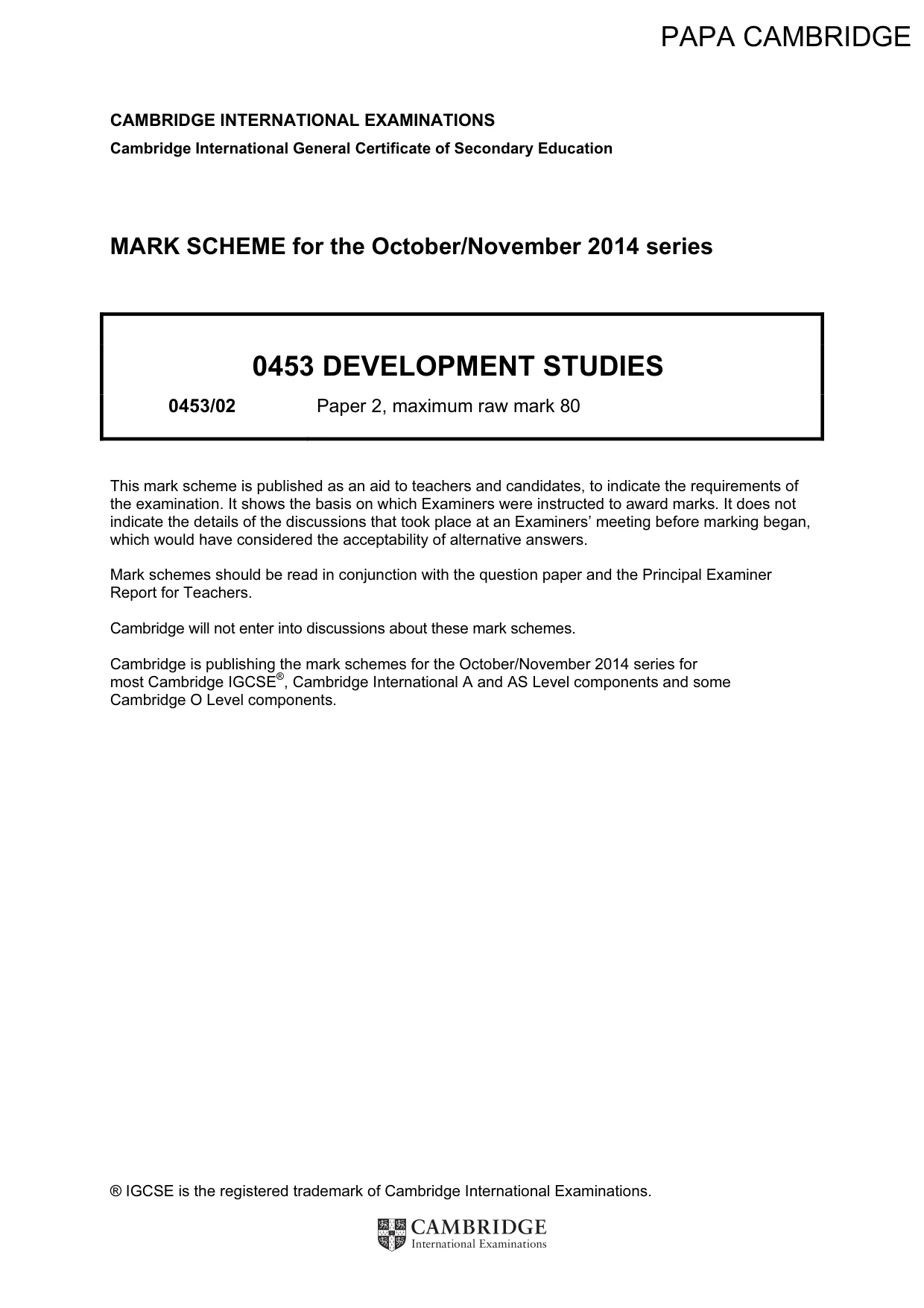
18 0453/02/O/N/14 © UCLES 2014 (iv) Residents identified traffic congestion as the main negative impact of tourism. Explain why tourism is likely to lead to traffic congestion. … … … … … …[3] (v) Describe how the students could have used a variety of methods to carry out research to investigate the impact of traffic congestion caused by tourism in Mauritius. … … … … … … … … … … … …[6] [Total: 39 marks]
Question paper, page 19
19 0453/02/O/N/14 © UCLES 2014 BLANK PAGE
Question paper, page 20
20 0453/02/O/N/14 © UCLES 2014 Copyright Acknowledgements: Question 2 Fig. 2 Adapted from: © http://www.unctad.org/en/docs/diaeia20086_en.pdf. Question 4 Photographs A-F S. Sibley © UCLES. Permission to reproduce items where third-party owned material protected by copyright is included has been sought and cleared where possible. Every reasonable effort has been made by the publisher (UCLES) to trace copyright holders, but if any items requiring clearance have unwittingly been included, the publisher will be pleased to make amends at the earliest possible opportunity. Cambridge International Examinations is part of the Cambridge Assessment Group. Cambridge Assessment is the brand name of University of Cambridge Local Examinations Syndicate (UCLES), which is itself a department of the University of Cambridge. BLANK PAGE
Mark scheme, page 1
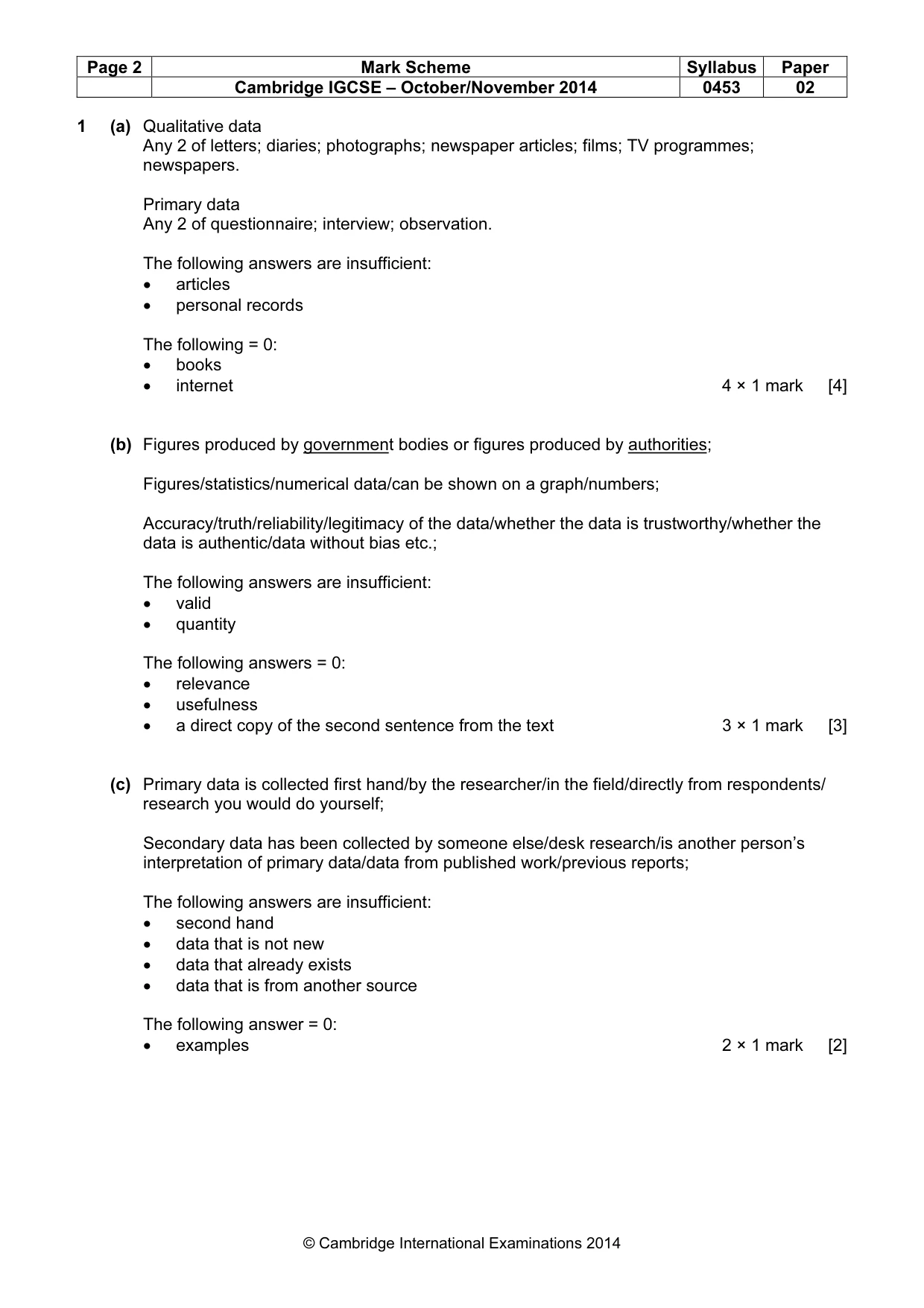
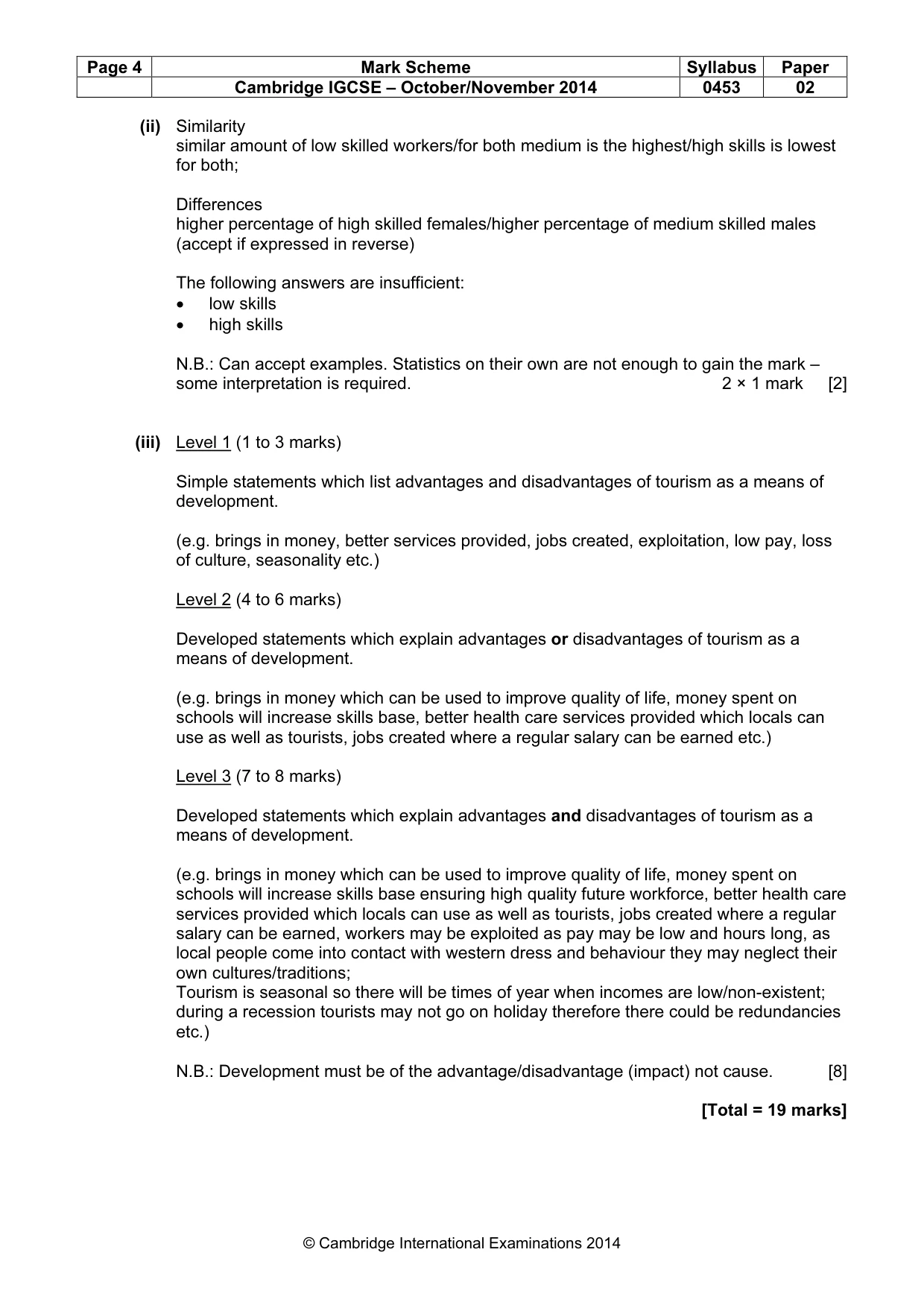
® IGCSE is the registered trademark of Cambridge International Examinations. CAMBRIDGE INTERNATIONAL EXAMINATIONS Cambridge International General Certificate of Secondary Education MARK SCHEME for the October/November 2014 series 0453 DEVELOPMENT STUDIES 0453/02 Paper 2, maximum raw mark 80 This mark scheme is published as an aid to teachers and candidates, to indicate the requirements of the examination. It shows the basis on which Examiners were instructed to award marks. It does not indicate the details of the discussions that took place at an Examiners’ meeting before marking began, which would have considered the acceptability of alternative answers. Mark schemes should be read in conjunction with the question paper and the Principal Examiner Report for Teachers. Cambridge will not enter into discussions about these mark schemes. Cambridge is publishing the mark schemes for the October/November 2014 series for most Cambridge IGCSE®, Cambridge International A and AS Level components and some Cambridge O Level components. PAPA CAMBRIDGE
Mark scheme, page 2
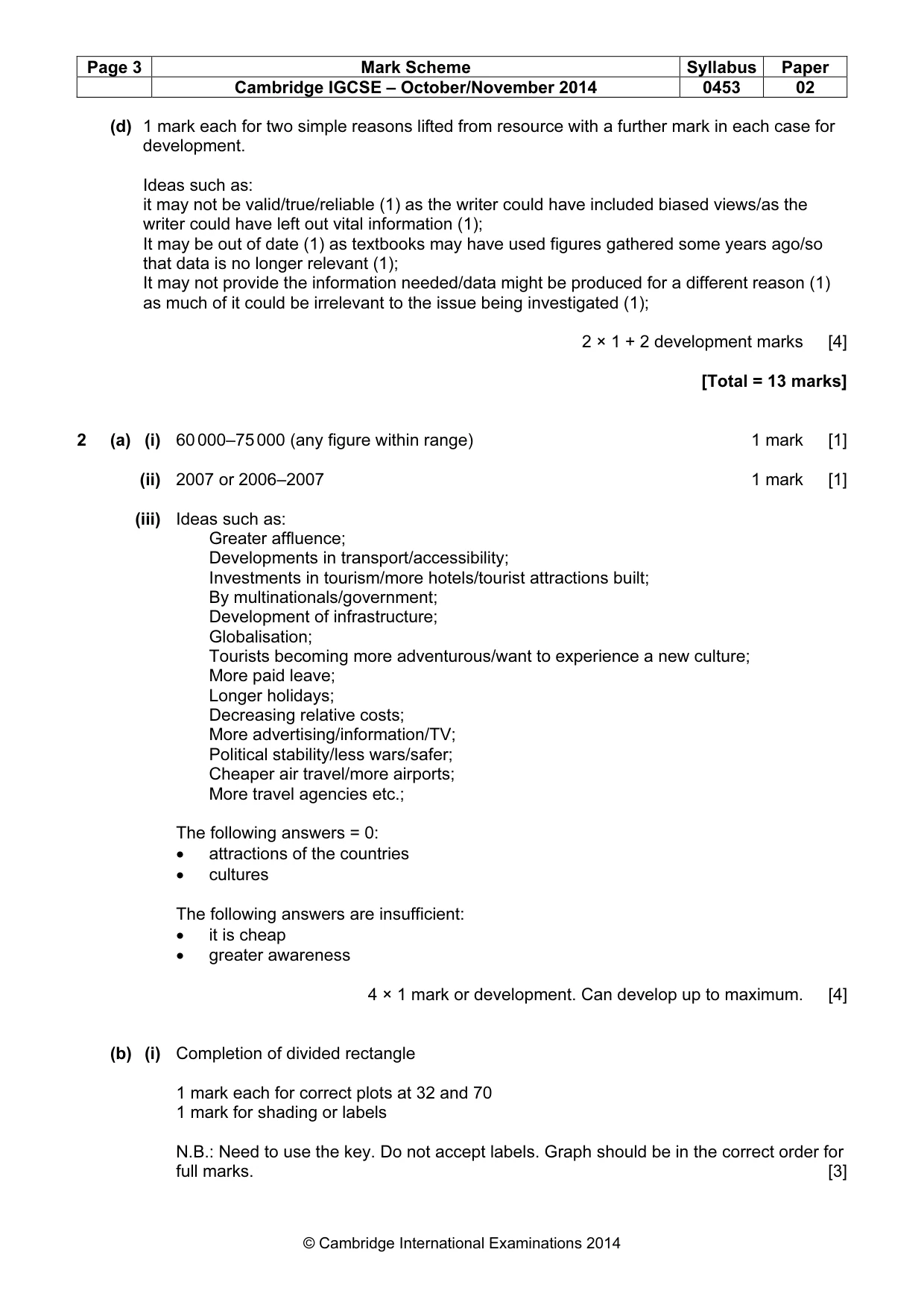
Page 2 Mark Scheme Syllabus Paper Cambridge IGCSE – October/November 2014 0453 02 © Cambridge International Examinations 2014 1 (a) Qualitative data Any 2 of letters; diaries; photographs; newspaper articles; films; TV programmes; newspapers. Primary data Any 2 of questionnaire; interview; observation. The following answers are insufficient: • articles • personal records The following = 0: • books • internet 4 × 1 mark [4] (b) Figures produced by government bodies or figures produced by authorities; Figures/statistics/numerical data/can be shown on a graph/numbers; Accuracy/truth/reliability/legitimacy of the data/whether the data is trustworthy/whether the data is authentic/data without bias etc.; The following answers are insufficient: • valid • quantity The following answers = 0: • relevance • usefulness • a direct copy of the second sentence from the text 3 × 1 mark [3] (c) Primary data is collected first hand/by the researcher/in the field/directly from respondents/ research you would do yourself; Secondary data has been collected by someone else/desk research/is another person’s interpretation of primary data/data from published work/previous reports; The following answers are insufficient: • second hand • data that is not new • data that already exists • data that is from another source The following answer = 0: • examples 2 × 1 mark [2]
Mark scheme, page 3
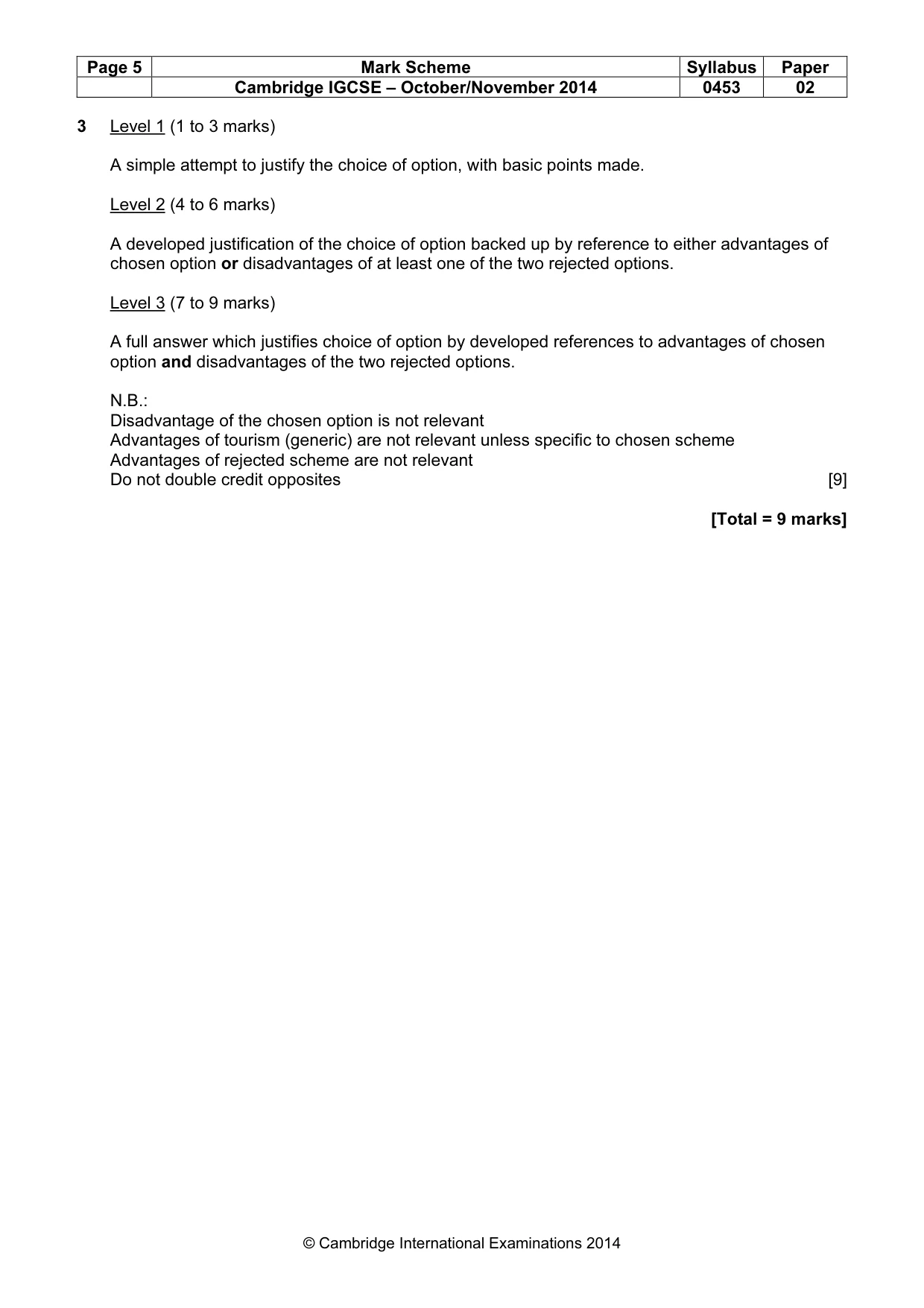
Page 3 Mark Scheme Syllabus Paper Cambridge IGCSE – October/November 2014 0453 02 © Cambridge International Examinations 2014 (d) 1 mark each for two simple reasons lifted from resource with a further mark in each case for development. Ideas such as: it may not be valid/true/reliable (1) as the writer could have included biased views/as the writer could have left out vital information (1); It may be out of date (1) as textbooks may have used figures gathered some years ago/so that data is no longer relevant (1); It may not provide the information needed/data might be produced for a different reason (1) as much of it could be irrelevant to the issue being investigated (1); 2 × 1 + 2 development marks [4] [Total = 13 marks] 2 (a) (i) 60 000–75 000 (any figure within range) 1 mark [1] (ii) 2007 or 2006–2007 1 mark [1] (iii) Ideas such as: Greater affluence; Developments in transport/accessibility; Investments in tourism/more hotels/tourist attractions built; By multinationals/government; Development of infrastructure; Globalisation; Tourists becoming more adventurous/want to experience a new culture; More paid leave; Longer holidays; Decreasing relative costs; More advertising/information/TV; Political stability/less wars/safer; Cheaper air travel/more airports; More travel agencies etc.; The following answers = 0: • attractions of the countries • cultures The following answers are insufficient: • it is cheap • greater awareness 4 × 1 mark or development. Can develop up to maximum. [4] (b) (i) Completion of divided rectangle 1 mark each for correct plots at 32 and 70 1 mark for shading or labels N.B.: Need to use the key. Do not accept labels. Graph should be in the correct order for full marks. [3]
Mark scheme, page 4
Page 4 Mark Scheme Syllabus Paper Cambridge IGCSE – October/November 2014 0453 02 © Cambridge International Examinations 2014 (ii) Similarity similar amount of low skilled workers/for both medium is the highest/high skills is lowest for both; Differences higher percentage of high skilled females/higher percentage of medium skilled males (accept if expressed in reverse) The following answers are insufficient: • low skills • high skills N.B.: Can accept examples. Statistics on their own are not enough to gain the mark – some interpretation is required. 2 × 1 mark [2] (iii) Level 1 (1 to 3 marks) Simple statements which list advantages and disadvantages of tourism as a means of development. (e.g. brings in money, better services provided, jobs created, exploitation, low pay, loss of culture, seasonality etc.) Level 2 (4 to 6 marks) Developed statements which explain advantages or disadvantages of tourism as a means of development. (e.g. brings in money which can be used to improve quality of life, money spent on schools will increase skills base, better health care services provided which locals can use as well as tourists, jobs created where a regular salary can be earned etc.) Level 3 (7 to 8 marks) Developed statements which explain advantages and disadvantages of tourism as a means of development. (e.g. brings in money which can be used to improve quality of life, money spent on schools will increase skills base ensuring high quality future workforce, better health care services provided which locals can use as well as tourists, jobs created where a regular salary can be earned, workers may be exploited as pay may be low and hours long, as local people come into contact with western dress and behaviour they may neglect their own cultures/traditions; Tourism is seasonal so there will be times of year when incomes are low/non-existent; during a recession tourists may not go on holiday therefore there could be redundancies etc.) N.B.: Development must be of the advantage/disadvantage (impact) not cause. [8] [Total = 19 marks]
Mark scheme, page 5
Page 5 Mark Scheme Syllabus Paper Cambridge IGCSE – October/November 2014 0453 02 © Cambridge International Examinations 2014 3 Level 1 (1 to 3 marks) A simple attempt to justify the choice of option, with basic points made. Level 2 (4 to 6 marks) A developed justification of the choice of option backed up by reference to either advantages of chosen option or disadvantages of at least one of the two rejected options. Level 3 (7 to 9 marks) A full answer which justifies choice of option by developed references to advantages of chosen option and disadvantages of the two rejected options. N.B.: Disadvantage of the chosen option is not relevant Advantages of tourism (generic) are not relevant unless specific to chosen scheme Advantages of rejected scheme are not relevant Do not double credit opposites [9] [Total = 9 marks]
Mark scheme, page 6
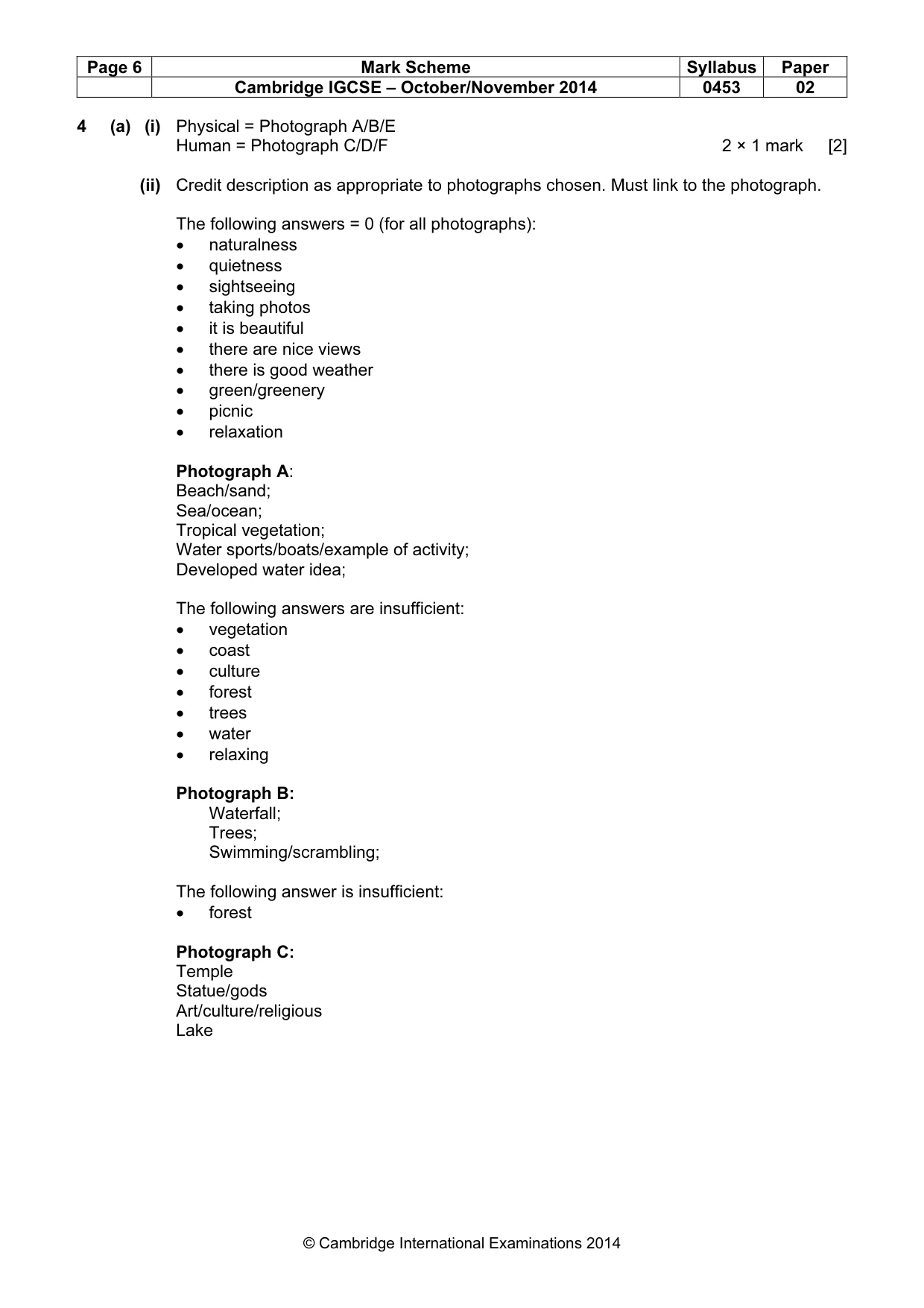
Page 6 Mark Scheme Syllabus Paper Cambridge IGCSE – October/November 2014 0453 02 © Cambridge International Examinations 2014 4 (a) (i) Physical = Photograph A/B/E Human = Photograph C/D/F 2 × 1 mark [2] (ii) Credit description as appropriate to photographs chosen. Must link to the photograph. The following answers = 0 (for all photographs): • naturalness • quietness • sightseeing • taking photos • it is beautiful • there are nice views • there is good weather • green/greenery • picnic • relaxation Photograph A: Beach/sand; Sea/ocean; Tropical vegetation; Water sports/boats/example of activity; Developed water idea; The following answers are insufficient: • vegetation • coast • culture • forest • trees • water • relaxing Photograph B: Waterfall; Trees; Swimming/scrambling; The following answer is insufficient: • forest Photograph C: Temple Statue/gods Art/culture/religious Lake
Mark scheme, page 7
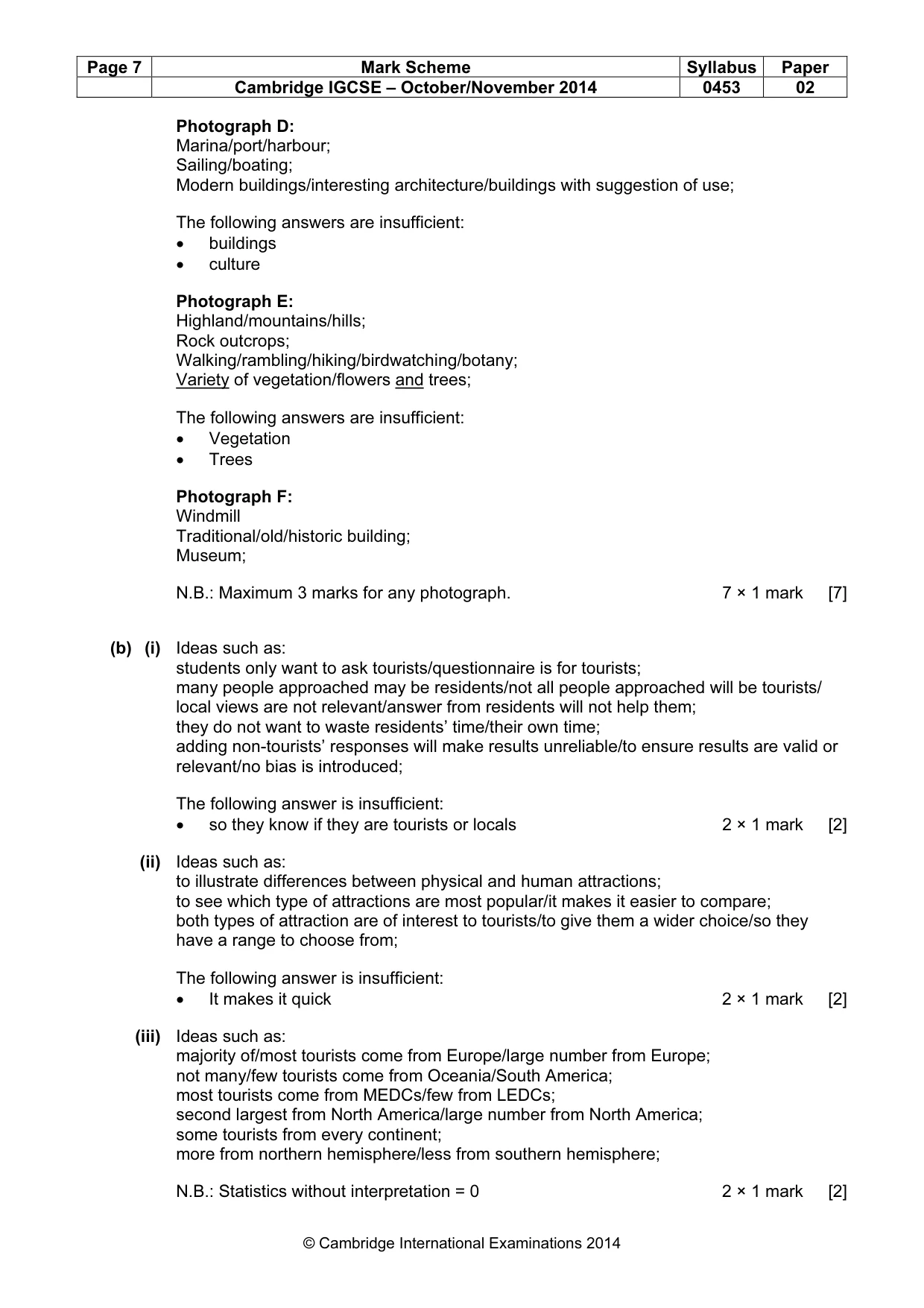
Page 7 Mark Scheme Syllabus Paper Cambridge IGCSE – October/November 2014 0453 02 © Cambridge International Examinations 2014 Photograph D: Marina/port/harbour; Sailing/boating; Modern buildings/interesting architecture/buildings with suggestion of use; The following answers are insufficient: • buildings • culture Photograph E: Highland/mountains/hills; Rock outcrops; Walking/rambling/hiking/birdwatching/botany; Variety of vegetation/flowers and trees; The following answers are insufficient: • Vegetation • Trees Photograph F: Windmill Traditional/old/historic building; Museum; N.B.: Maximum 3 marks for any photograph. 7 × 1 mark [7] (b) (i) Ideas such as: students only want to ask tourists/questionnaire is for tourists; many people approached may be residents/not all people approached will be tourists/ local views are not relevant/answer from residents will not help them; they do not want to waste residents’ time/their own time; adding non-tourists’ responses will make results unreliable/to ensure results are valid or relevant/no bias is introduced; The following answer is insufficient: • so they know if they are tourists or locals 2 × 1 mark [2] (ii) Ideas such as: to illustrate differences between physical and human attractions; to see which type of attractions are most popular/it makes it easier to compare; both types of attraction are of interest to tourists/to give them a wider choice/so they have a range to choose from; The following answer is insufficient: • It makes it quick 2 × 1 mark [2] (iii) Ideas such as: majority of/most tourists come from Europe/large number from Europe; not many/few tourists come from Oceania/South America; most tourists come from MEDCs/few from LEDCs; second largest from North America/large number from North America; some tourists from every continent; more from northern hemisphere/less from southern hemisphere; N.B.: Statistics without interpretation = 0 2 × 1 mark [2]
Mark scheme, page 8
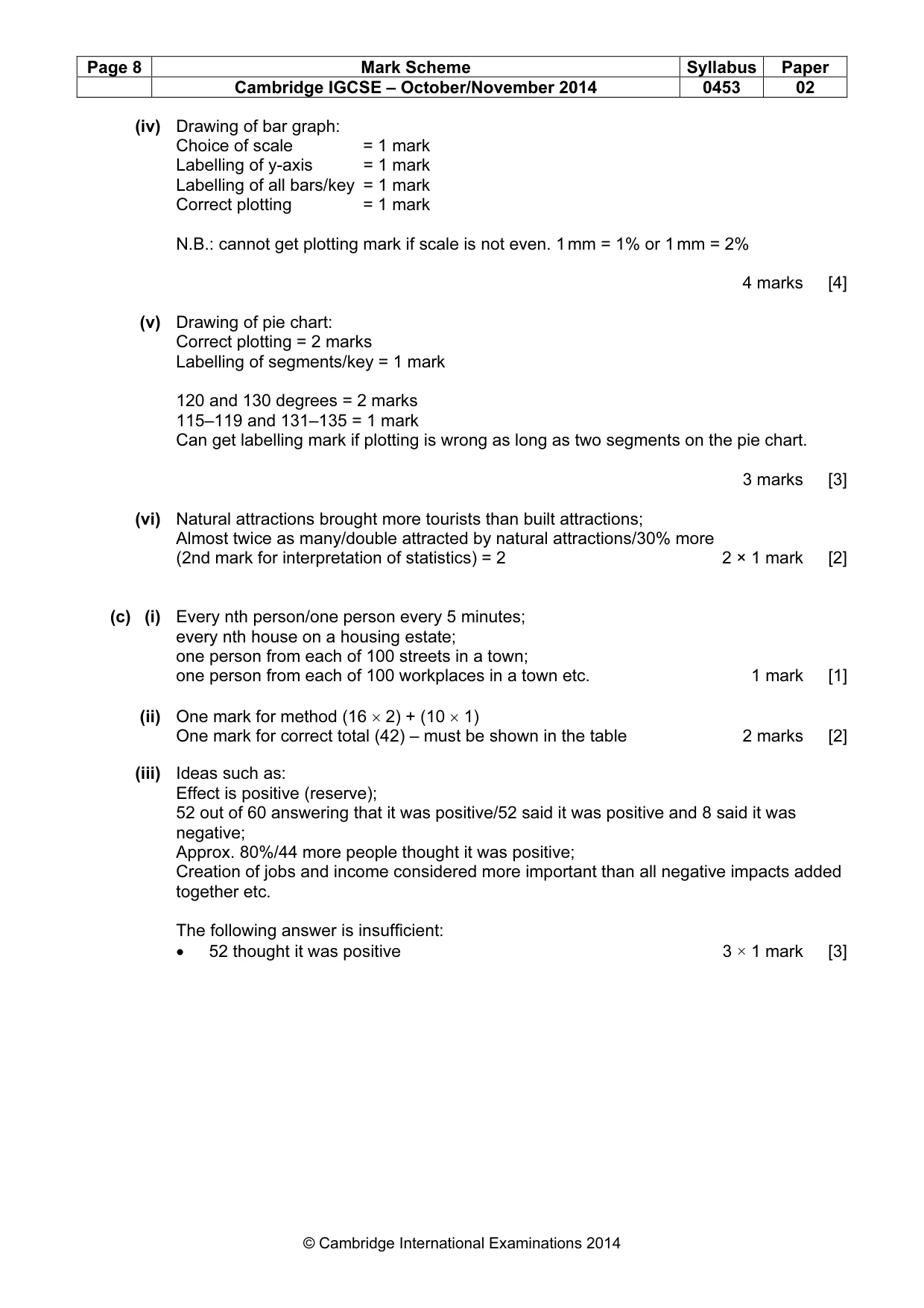
Page 8 Mark Scheme Syllabus Paper Cambridge IGCSE – October/November 2014 0453 02 © Cambridge International Examinations 2014 (iv) Drawing of bar graph: Choice of scale = 1 mark Labelling of y-axis = 1 mark Labelling of all bars/key = 1 mark Correct plotting = 1 mark N.B.: cannot get plotting mark if scale is not even. 1 mm = 1% or 1 mm = 2% 4 marks [4] (v) Drawing of pie chart: Correct plotting = 2 marks Labelling of segments/key = 1 mark 120 and 130 degrees = 2 marks 115–119 and 131–135 = 1 mark Can get labelling mark if plotting is wrong as long as two segments on the pie chart. 3 marks [3] (vi) Natural attractions brought more tourists than built attractions; Almost twice as many/double attracted by natural attractions/30% more (2nd mark for interpretation of statistics) = 2 2 × 1 mark [2] (c) (i) Every nth person/one person every 5 minutes; every nth house on a housing estate; one person from each of 100 streets in a town; one person from each of 100 workplaces in a town etc. 1 mark [1] (ii) One mark for method (16 × 2) + (10 × 1) One mark for correct total (42) – must be shown in the table 2 marks [2] (iii) Ideas such as: Effect is positive (reserve); 52 out of 60 answering that it was positive/52 said it was positive and 8 said it was negative; Approx. 80%/44 more people thought it was positive; Creation of jobs and income considered more important than all negative impacts added together etc. The following answer is insufficient: • 52 thought it was positive 3 × 1 mark [3]
Mark scheme, page 9
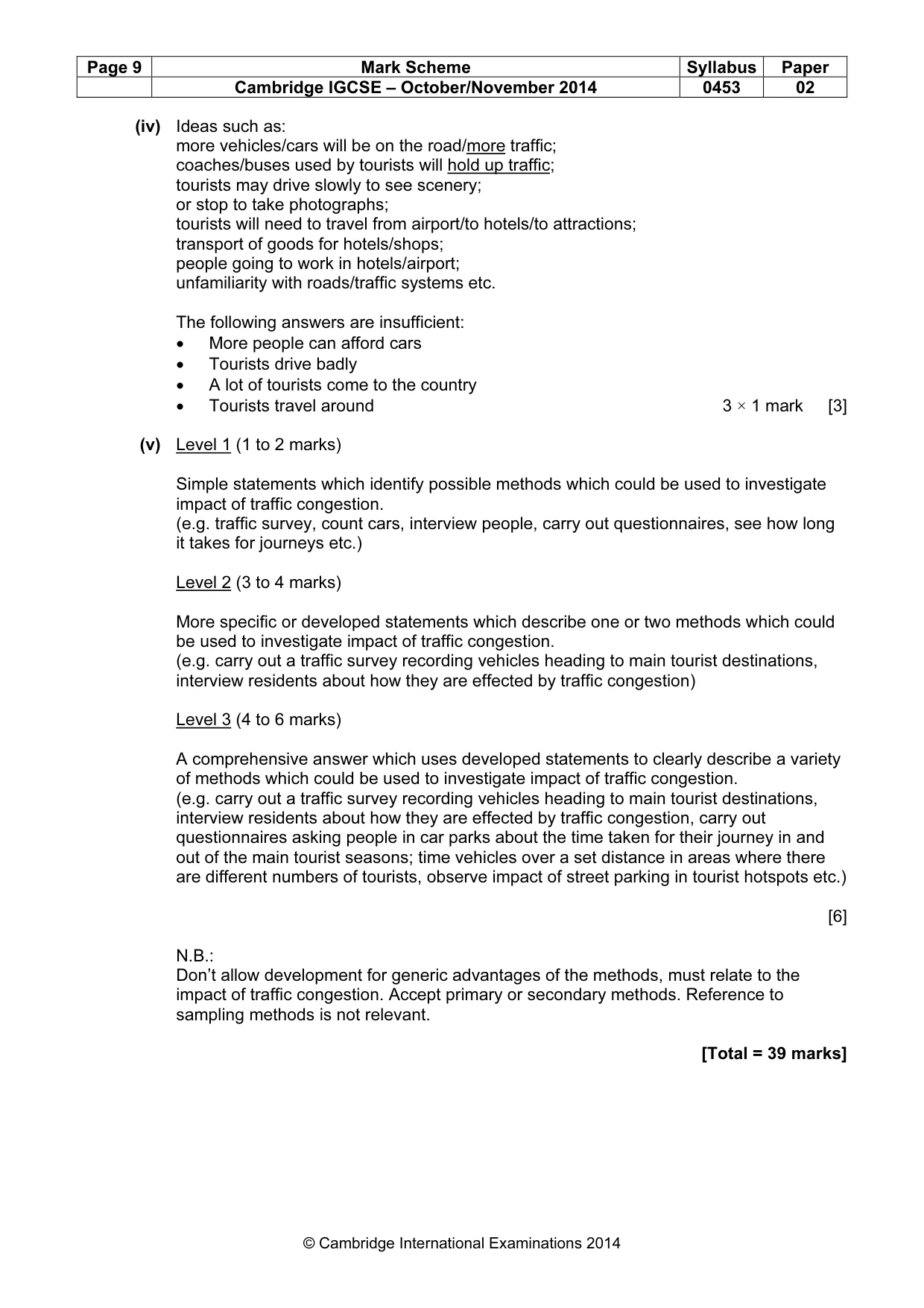
Page 9 Mark Scheme Syllabus Paper Cambridge IGCSE – October/November 2014 0453 02 © Cambridge International Examinations 2014 (iv) Ideas such as: more vehicles/cars will be on the road/more traffic; coaches/buses used by tourists will hold up traffic; tourists may drive slowly to see scenery; or stop to take photographs; tourists will need to travel from airport/to hotels/to attractions; transport of goods for hotels/shops; people going to work in hotels/airport; unfamiliarity with roads/traffic systems etc. The following answers are insufficient: • More people can afford cars • Tourists drive badly • A lot of tourists come to the country • Tourists travel around 3 × 1 mark [3] (v) Level 1 (1 to 2 marks) Simple statements which identify possible methods which could be used to investigate impact of traffic congestion. (e.g. traffic survey, count cars, interview people, carry out questionnaires, see how long it takes for journeys etc.) Level 2 (3 to 4 marks) More specific or developed statements which describe one or two methods which could be used to investigate impact of traffic congestion. (e.g. carry out a traffic survey recording vehicles heading to main tourist destinations, interview residents about how they are effected by traffic congestion) Level 3 (4 to 6 marks) A comprehensive answer which uses developed statements to clearly describe a variety of methods which could be used to investigate impact of traffic congestion. (e.g. carry out a traffic survey recording vehicles heading to main tourist destinations, interview residents about how they are effected by traffic congestion, carry out questionnaires asking people in car parks about the time taken for their journey in and out of the main tourist seasons; time vehicles over a set distance in areas where there are different numbers of tourists, observe impact of street parking in tourist hotspots etc.) [6] N.B.: Don’t allow development for generic advantages of the methods, must relate to the impact of traffic congestion. Accept primary or secondary methods. Reference to sampling methods is not relevant. [Total = 39 marks]
What you needed in this session
Cambridge’s own grade thresholds for 2014 Oct/Nov, Paper 2 · Variant 1. A higher threshold means an easier paper — the bar moves with how the cohort did.