Cambridge IGCSE Development Studies 0453 — 2011 Oct/Nov Paper 1 · Variant 1
0453/11/O/N/11 · 80 marks · ≈90 min
The question paper and its mark scheme, free to read here and free to download. This is Cambridge’s own paper, exactly as it was sat.
Question paper20 pages
Mark scheme9 pages
Answers below. Sit the paper first if you are practising.
Paper as text
Question paper, page 1
This document consists of 16 printed pages, 4 blank pages and 1 insert. DC (RCL (SW/SW)) 31956/5 © UCLES 2011 [Turn over UNIVERSITY OF CAMBRIDGE INTERNATIONAL EXAMINATIONS International General Certificate of Secondary Education * 1 2 3 6 3 4 4 2 2 7 * DEVELOPMENT STUDIES 0453/01 Paper 1 October/November 2011 2 hours Candidates answer on the Question Paper. No Additional Materials are required. READ THESE INSTRUCTIONS FIRST Write your Centre number, candidate number and name on all the work you hand in. Write in dark blue or black pen. Do not use staples, paper clips, highlighters, glue or correction fluid. You may use a pencil for any diagrams, graphs or rough working. DO NOT WRITE IN ANY BARCODES. Answer all the questions. You may not need all the answer lines for your answer. You should read and study the sources before answering the questions. The Insert contains Fig. 4 for Question 2(b). The number of marks is given in brackets [ ] at the end of each question or part question. For Examiner’s Use 1 2 3 4 Total
Question paper, page 2
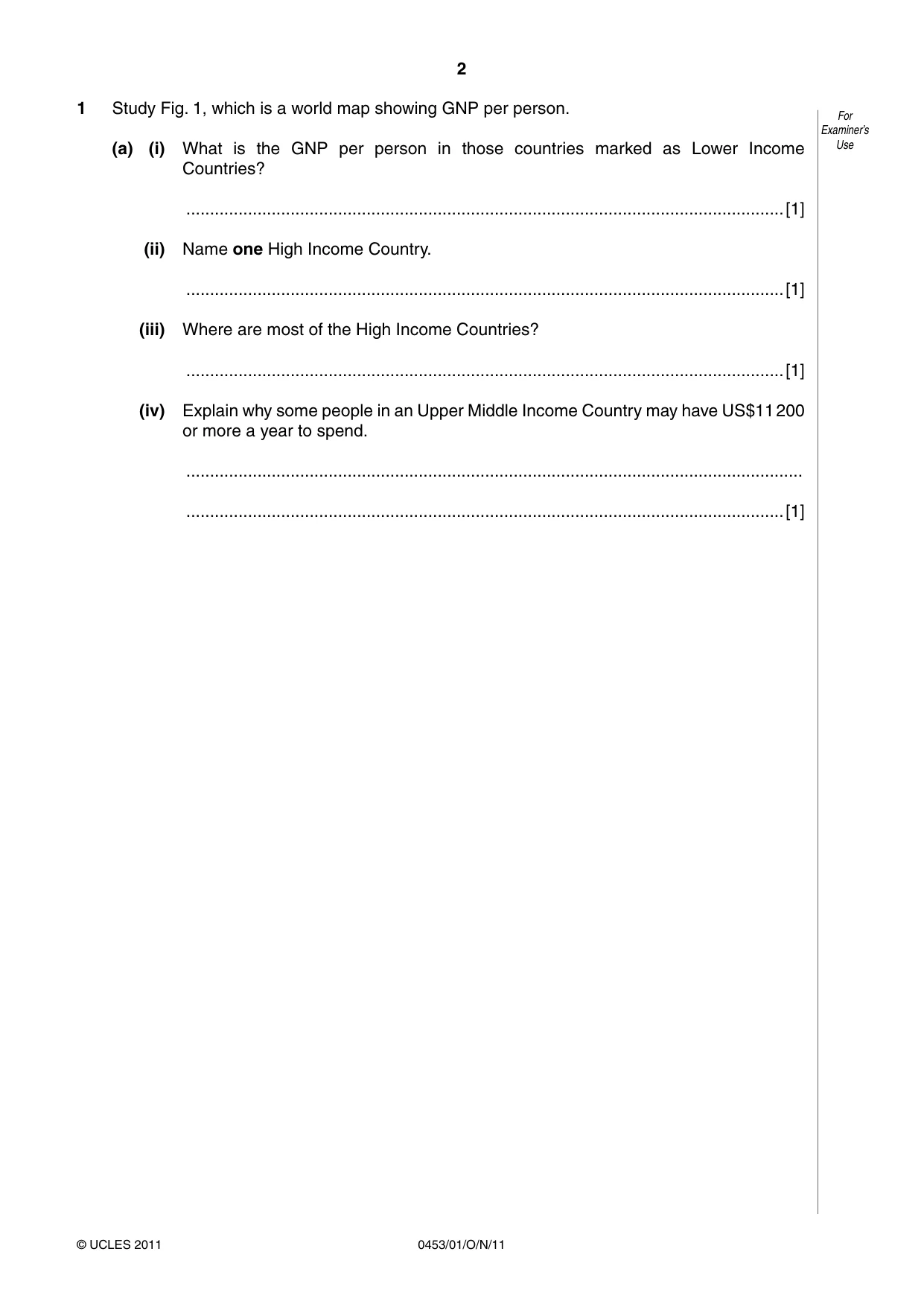
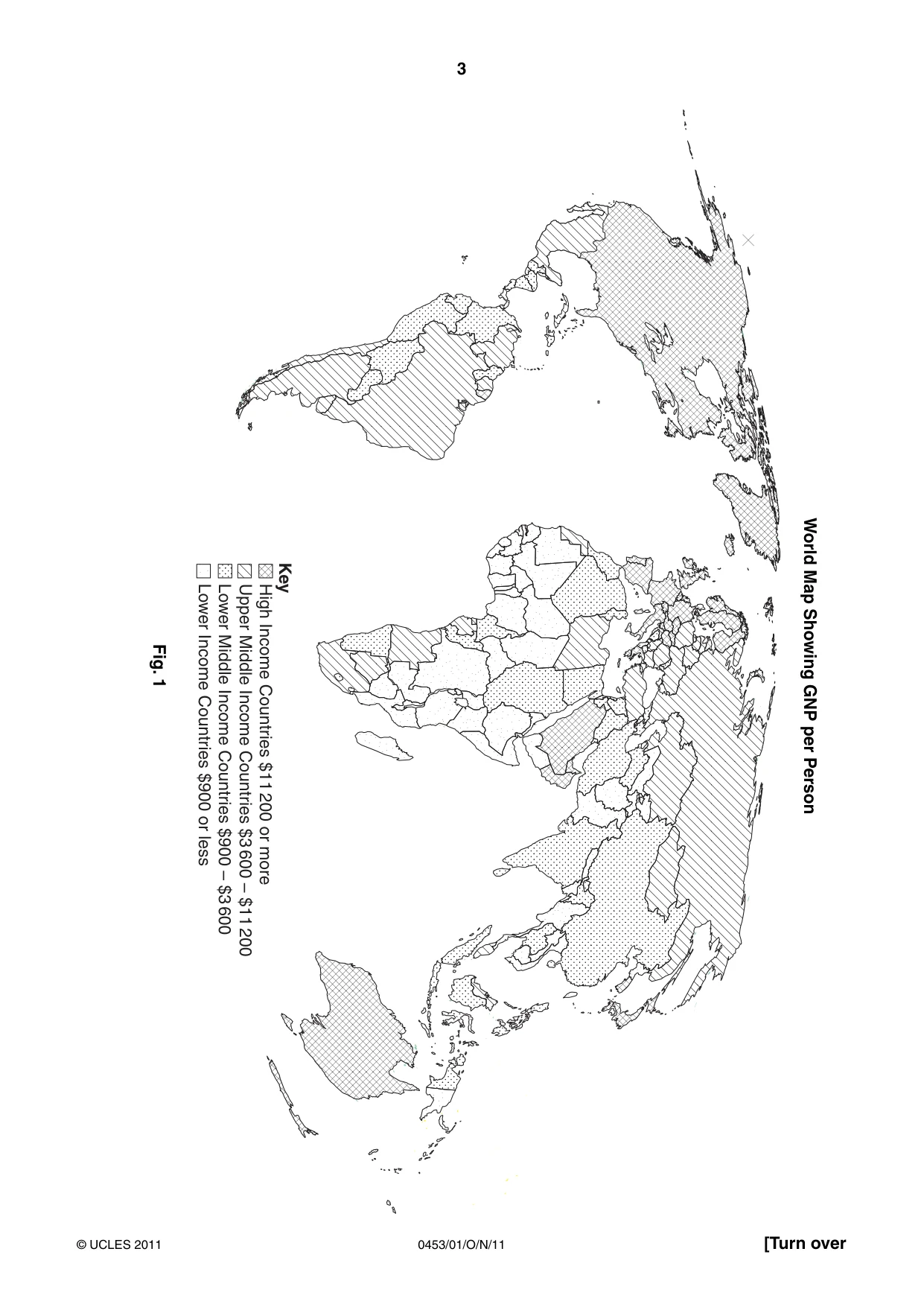
2 0453/01/O/N/11 © UCLES 2011 For Examiner’s Use 1 Study Fig. 1, which is a world map showing GNP per person. (a) (i) What is the GNP per person in those countries marked as Lower Income Countries? …[1] (ii) Name one High Income Country. …[1] (iii) Where are most of the High Income Countries? …[1] (iv) Explain why some people in an Upper Middle Income Country may have US$11 200 or more a year to spend. … …[1]
Question paper, page 3
3 0453/01/O/N/11 © UCLES 2011 [Turn over World Map Showing GNP per Person High Income Countries $11 200 or more Upper Middle Income Countries $3 600 – $11 200 Lower Middle Income Countries $900 – $3 600 Lower Income Countries $900 or less Key Fig. 1
Question paper, page 4
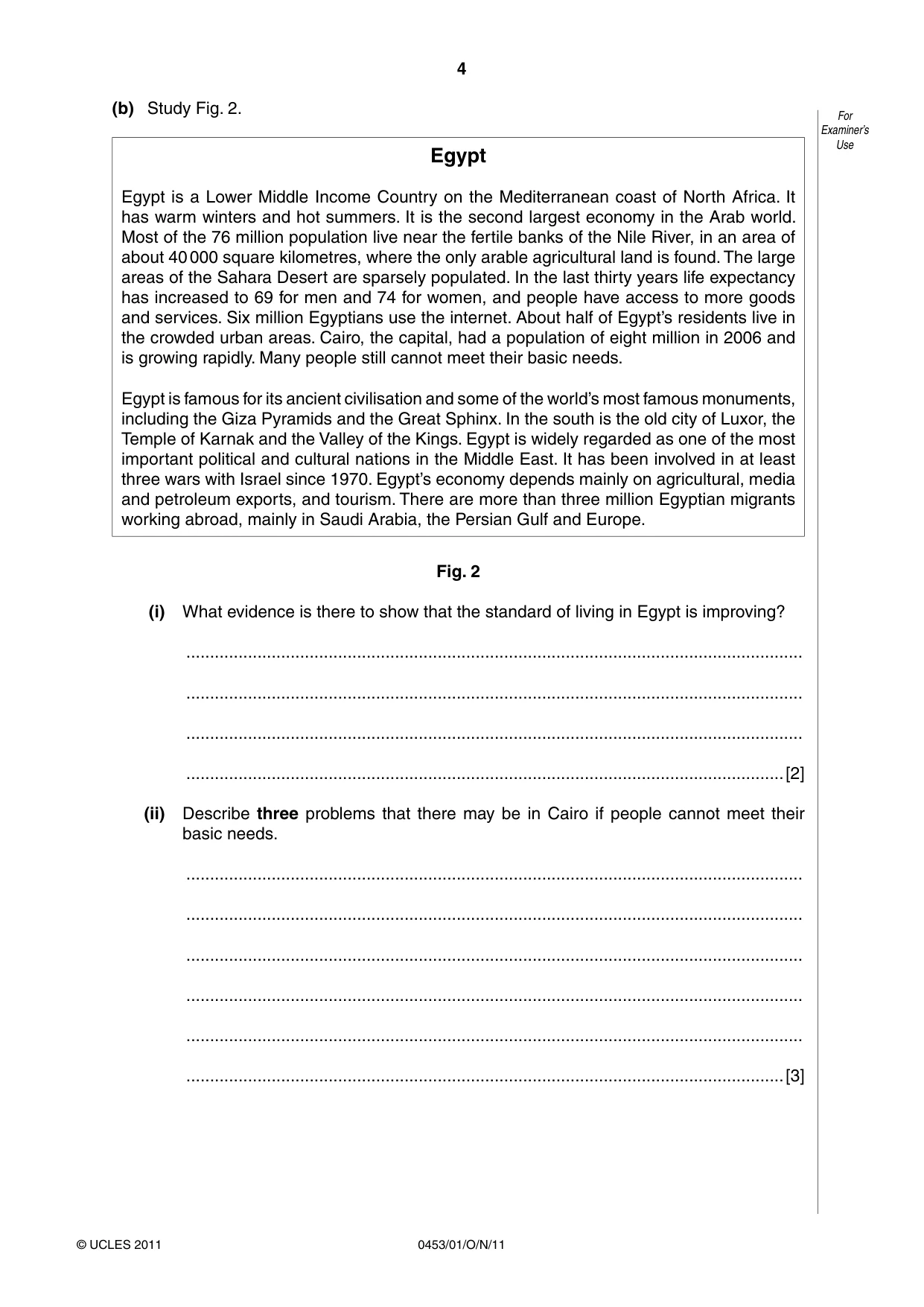
4 0453/01/O/N/11 © UCLES 2011 For Examiner’s Use (b) Study Fig. 2. Egypt Egypt is a Lower Middle Income Country on the Mediterranean coast of North Africa. It has warm winters and hot summers. It is the second largest economy in the Arab world. Most of the 76 million population live near the fertile banks of the Nile River, in an area of about 40 000 square kilometres, where the only arable agricultural land is found. The large areas of the Sahara Desert are sparsely populated. In the last thirty years life expectancy has increased to 69 for men and 74 for women, and people have access to more goods and services. Six million Egyptians use the internet. About half of Egypt’s residents live in the crowded urban areas. Cairo, the capital, had a population of eight million in 2006 and is growing rapidly. Many people still cannot meet their basic needs. Egypt is famous for its ancient civilisation and some of the world’s most famous monuments, including the Giza Pyramids and the Great Sphinx. In the south is the old city of Luxor, the Temple of Karnak and the Valley of the Kings. Egypt is widely regarded as one of the most important political and cultural nations in the Middle East. It has been involved in at least three wars with Israel since 1970. Egypt’s economy depends mainly on agricultural, media and petroleum exports, and tourism. There are more than three million Egyptian migrants working abroad, mainly in Saudi Arabia, the Persian Gulf and Europe. Fig. 2 (i) What evidence is there to show that the standard of living in Egypt is improving? … … … …[2] (ii) Describe three problems that there may be in Cairo if people cannot meet their basic needs. … … … … … …[3]
Question paper, page 5
5 0453/01/O/N/11 © UCLES 2011 [Turn over For Examiner’s Use (iii) Give three advantages for a country’s economy in having a large number of people working abroad. … … … … … …[3] (c) Tourism makes a very important contribution to Egypt’s economy. Identify two different advantages Egypt has for tourism. … … … …[2]
Question paper, page 6
6 0453/01/O/N/11 © UCLES 2011 For Examiner’s Use (d) Referring to Egypt and other areas you have studied, describe the problems of relying on tourism as a major means of development. You should develop the points you make. … … … … … … … … … … … … … … … …[6] [Total: 20 marks]
Question paper, page 7
7 0453/01/O/N/11 © UCLES 2011 [Turn over BLANK PAGE PLEASE TURN OVER FOR QUESTION 2
Question paper, page 8
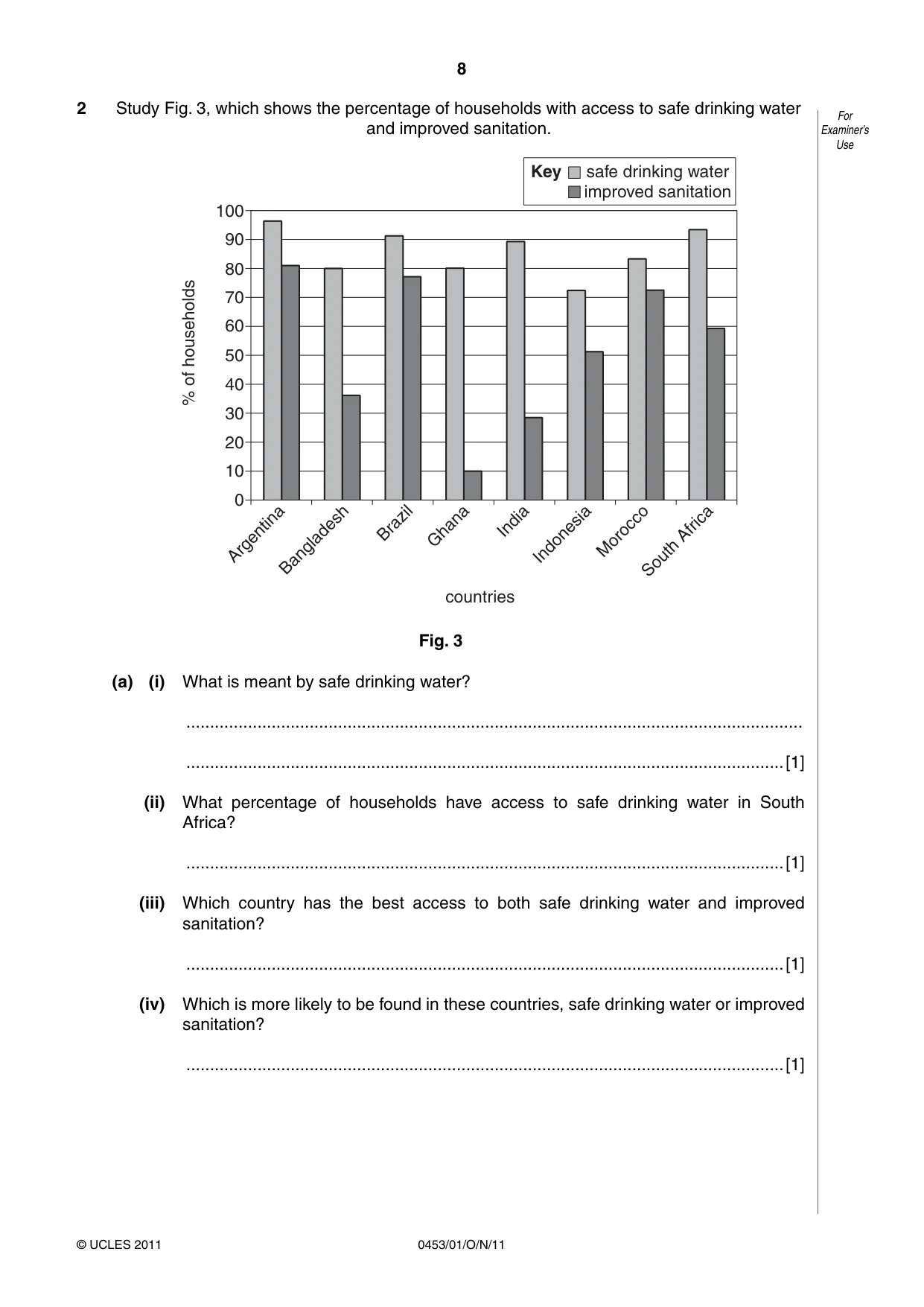
8 0453/01/O/N/11 © UCLES 2011 For Examiner’s Use 2 Study Fig. 3, which shows the percentage of households with access to safe drinking water and improved sanitation. 100 90 80 70 60 50 40 30 20 10 0 Argentina Bangladesh Brazil Ghana India countries % of households Indonesia Morocco South Africa safe drinking water improved sanitation Key Fig. 3 (a) (i) What is meant by safe drinking water? … …[1] (ii) What percentage of households have access to safe drinking water in South Africa? …[1] (iii) Which country has the best access to both safe drinking water and improved sanitation? …[1] (iv) Which is more likely to be found in these countries, safe drinking water or improved sanitation? …[1]
Question paper, page 9
9 0453/01/O/N/11 © UCLES 2011 [Turn over For Examiner’s Use (v) Describe methods that can be used to make people aware of the problems caused by a lack of both safe water and improved sanitation. … … … … … …[3] (b) Study Fig. 4 (Insert), which shows a shanty area in Jakarta, Indonesia. (i) Describe three features of the housing shown in Fig. 4. … … … … … …[3] (ii) Explain why it is difficult to provide safe drinking water and improved sanitation to households such as those shown in Fig. 4. … … … … … … … …[4]
Question paper, page 10
10 0453/01/O/N/11 © UCLES 2011 For Examiner’s Use (c) Describe the social and economic benefits of providing safe water and good sanitation. You should develop the points you make. … … … … … … … … … … … … … … … …[6] [Total: 20 marks]
Question paper, page 11
11 0453/01/O/N/11 © UCLES 2011 [Turn over BLANK PAGE PLEASE TURN OVER FOR QUESTION 3
Question paper, page 12
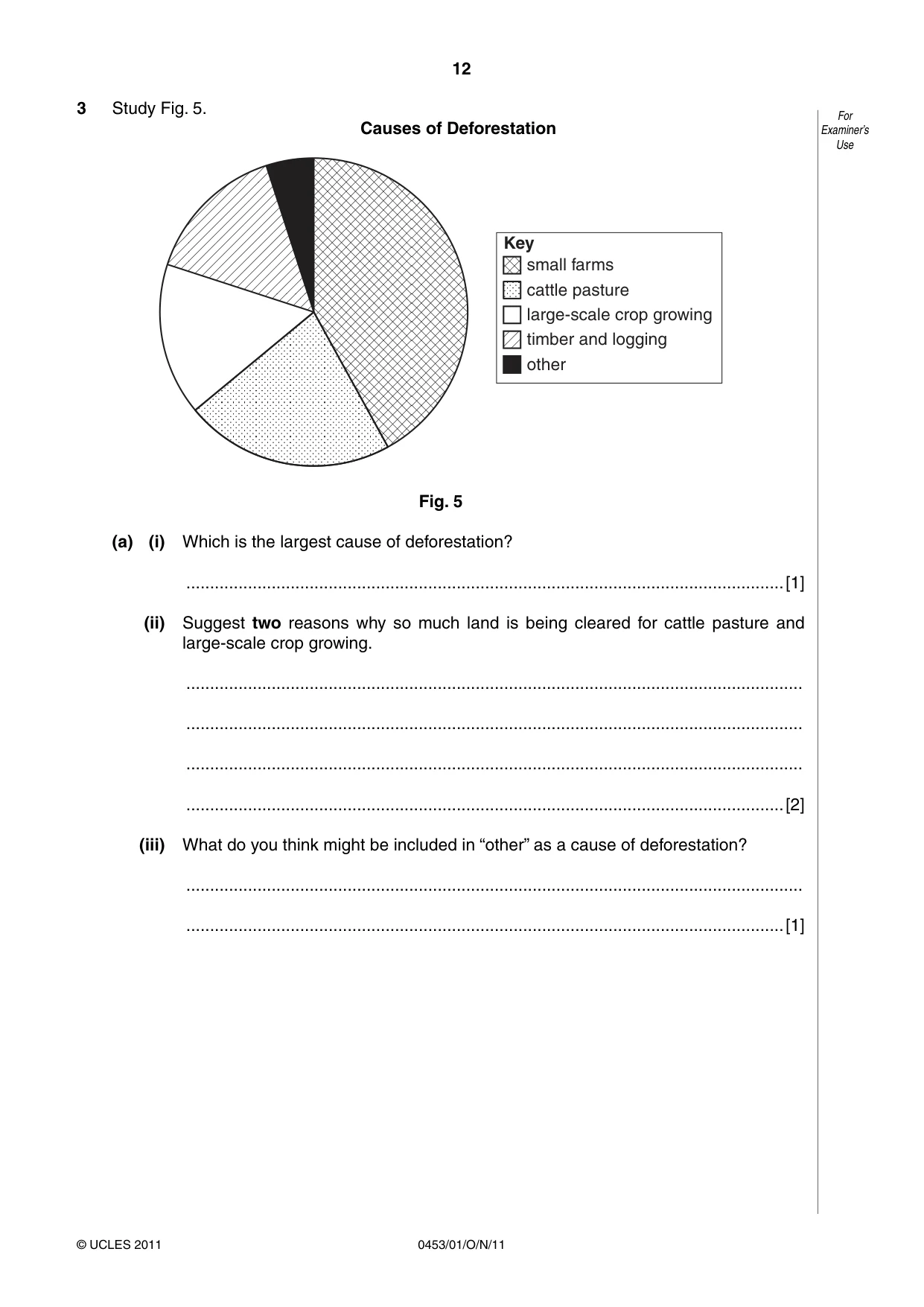
12 0453/01/O/N/11 © UCLES 2011 For Examiner’s Use 3 Study Fig. 5. Causes of Deforestation small farms cattle pasture large-scale crop growing timber and logging other Key Fig. 5 (a) (i) Which is the largest cause of deforestation? …[1] (ii) Suggest two reasons why so much land is being cleared for cattle pasture and large-scale crop growing. … … … …[2] (iii) What do you think might be included in “other” as a cause of deforestation? … …[1]
Question paper, page 13
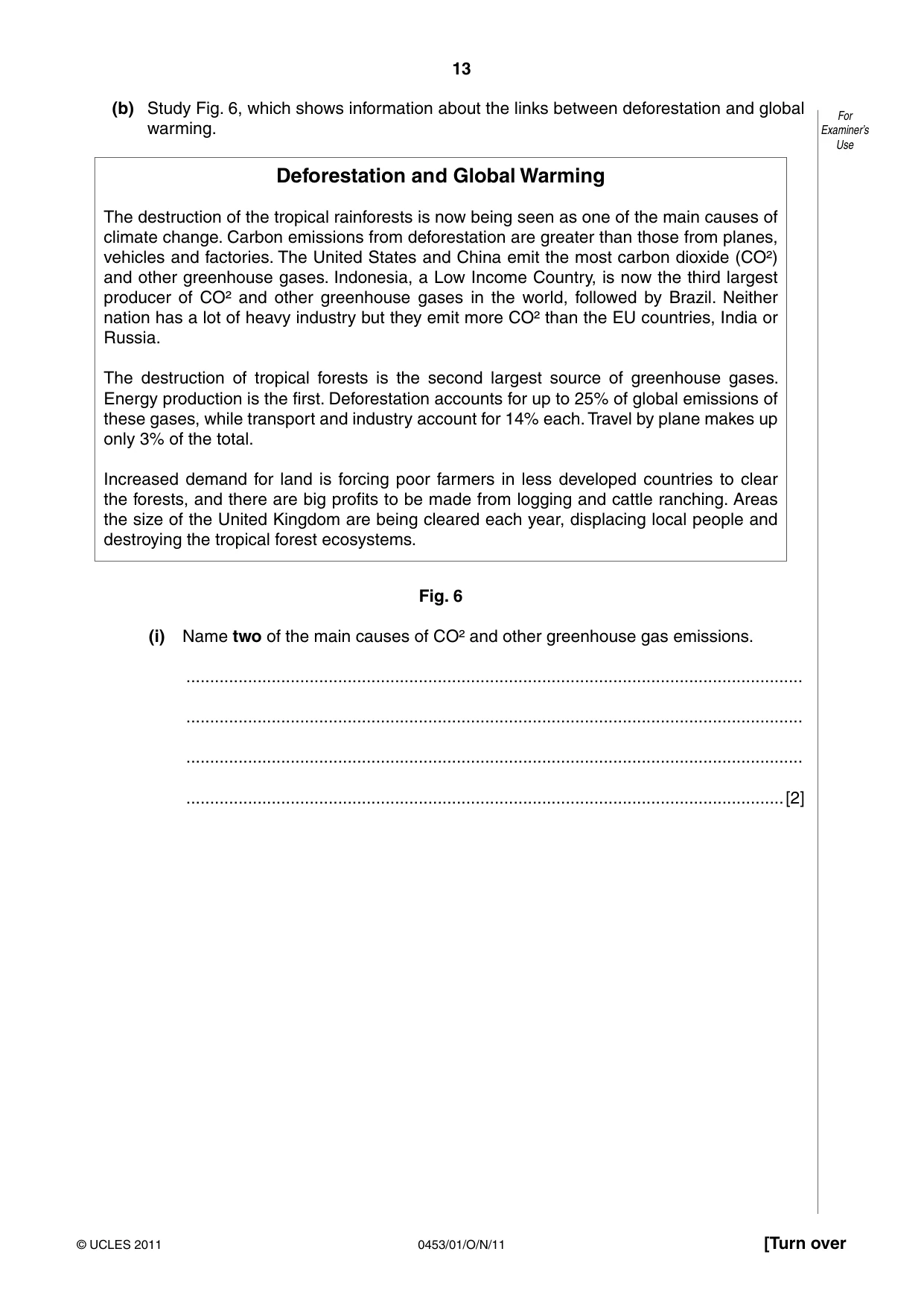
13 0453/01/O/N/11 © UCLES 2011 [Turn over For Examiner’s Use (b) Study Fig. 6, which shows information about the links between deforestation and global warming. Deforestation and Global Warming The destruction of the tropical rainforests is now being seen as one of the main causes of climate change. Carbon emissions from deforestation are greater than those from planes, vehicles and factories. The United States and China emit the most carbon dioxide (CO²) and other greenhouse gases. Indonesia, a Low Income Country, is now the third largest producer of CO² and other greenhouse gases in the world, followed by Brazil. Neither nation has a lot of heavy industry but they emit more CO² than the EU countries, India or Russia. The destruction of tropical forests is the second largest source of greenhouse gases. Energy production is the first. Deforestation accounts for up to 25% of global emissions of these gases, while transport and industry account for 14% each. Travel by plane makes up only 3% of the total. Increased demand for land is forcing poor farmers in less developed countries to clear the forests, and there are big profits to be made from logging and cattle ranching. Areas the size of the United Kingdom are being cleared each year, displacing local people and destroying the tropical forest ecosystems. Fig. 6 (i) Name two of the main causes of CO² and other greenhouse gas emissions. … … … …[2]
Question paper, page 14
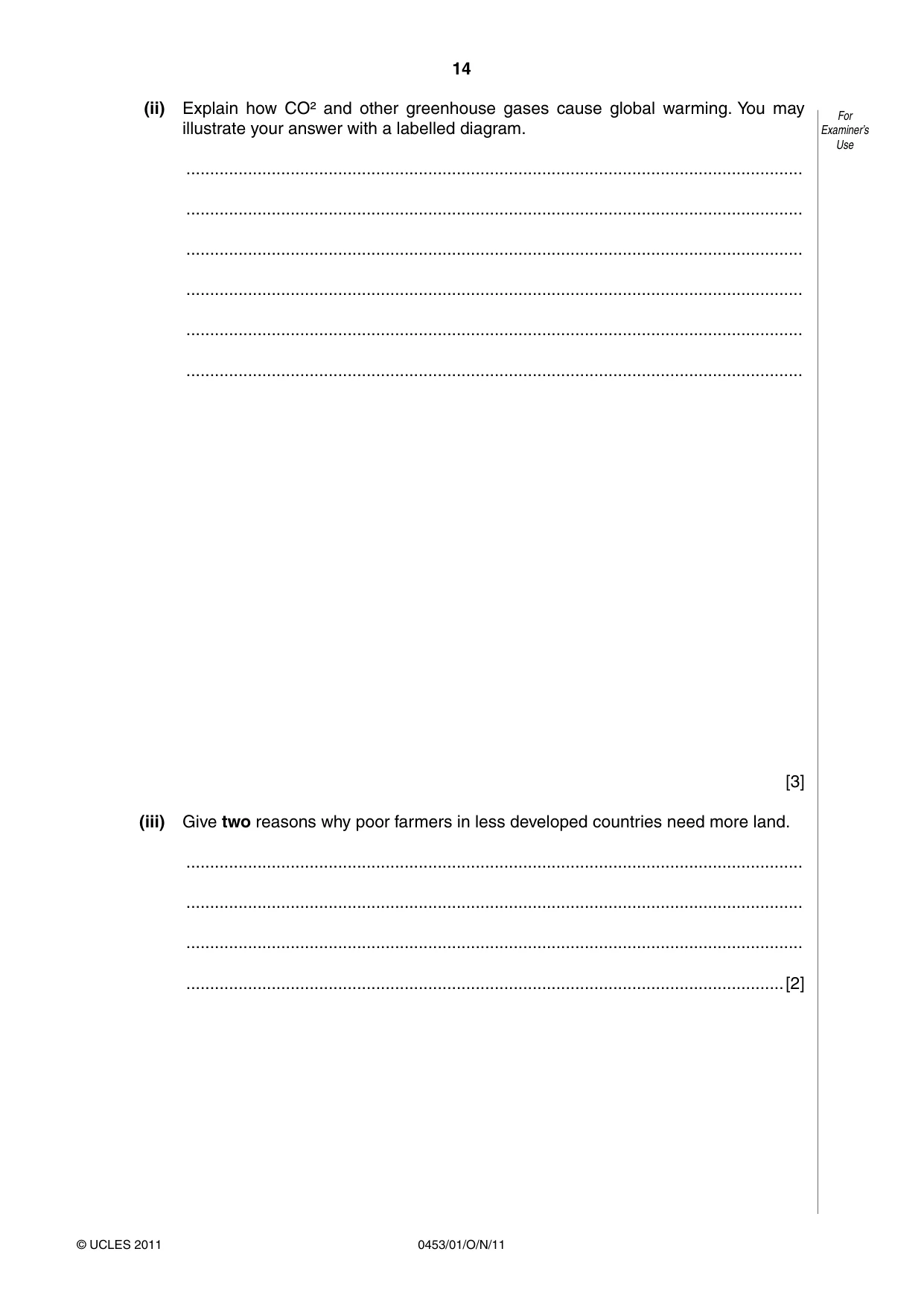
14 0453/01/O/N/11 © UCLES 2011 For Examiner’s Use (ii) Explain how CO² and other greenhouse gases cause global warming. You may illustrate your answer with a labelled diagram. … … … … … … [3] (iii) Give two reasons why poor farmers in less developed countries need more land. … … … …[2]
Question paper, page 15
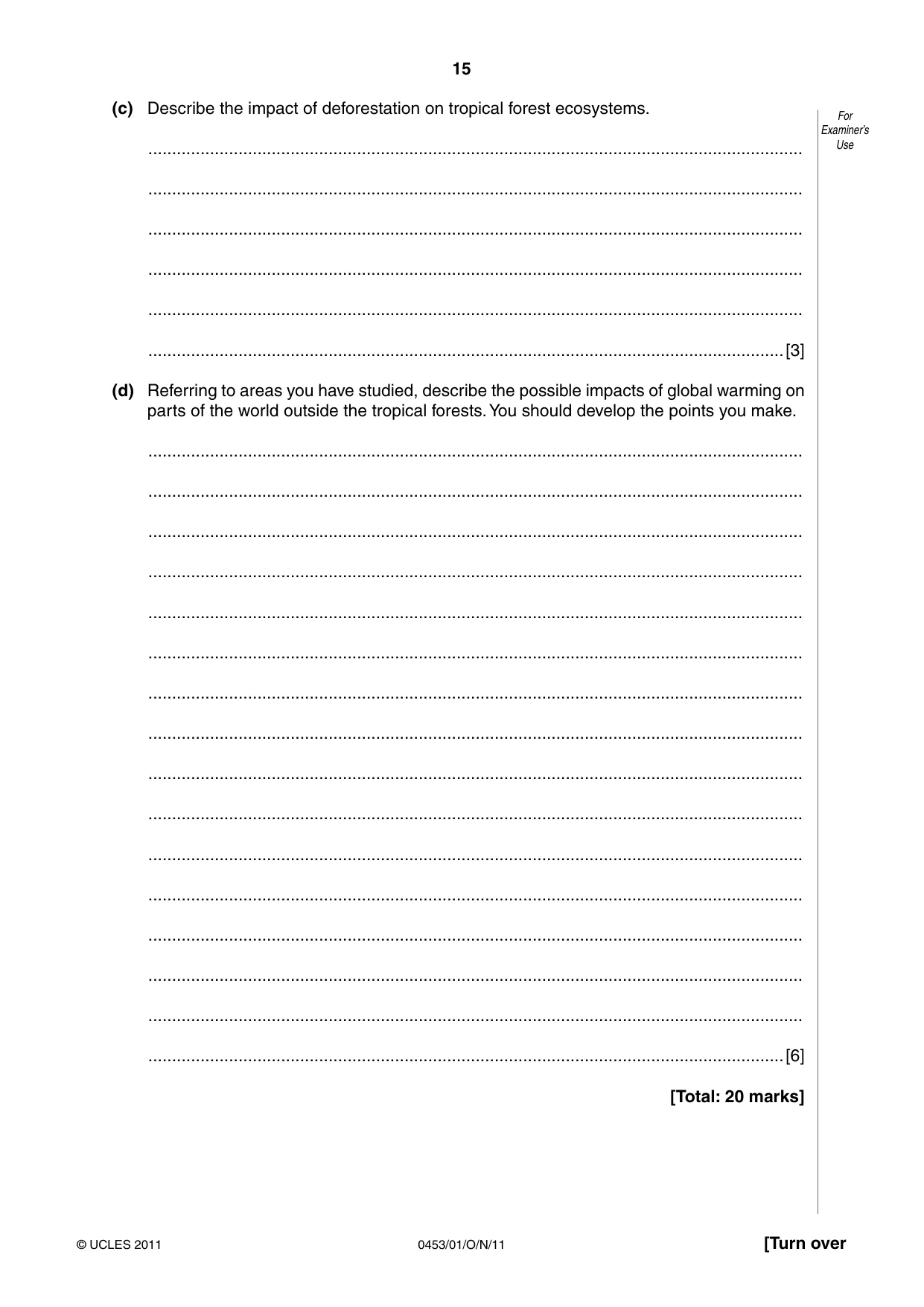
15 0453/01/O/N/11 © UCLES 2011 [Turn over For Examiner’s Use (c) Describe the impact of deforestation on tropical forest ecosystems. … … … … … …[3] (d) Referring to areas you have studied, describe the possible impacts of global warming on parts of the world outside the tropical forests. You should develop the points you make. … … … … … … … … … … … … … … … …[6] [Total: 20 marks]
Question paper, page 16
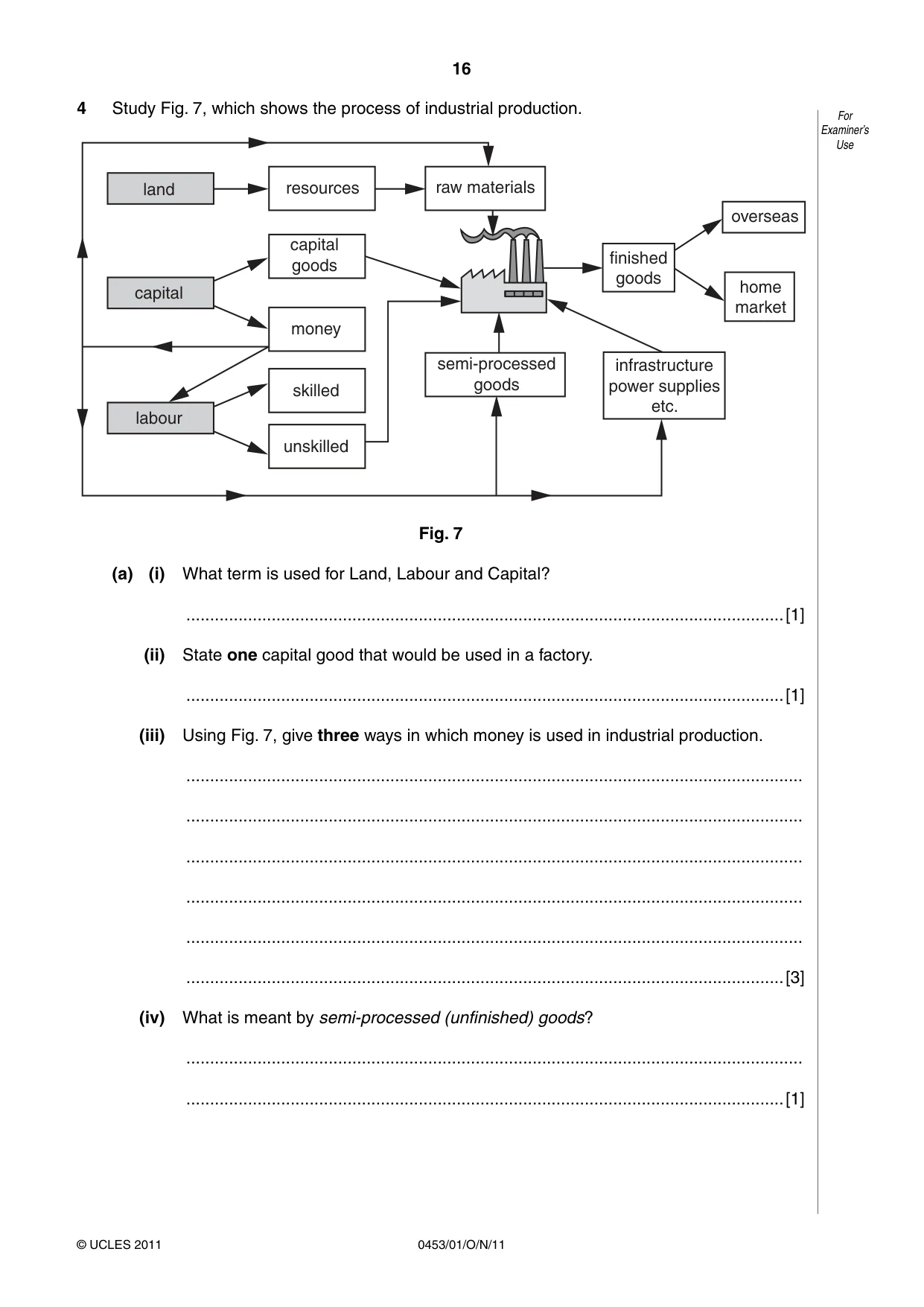
16 0453/01/O/N/11 © UCLES 2011 For Examiner’s Use 4 Study Fig. 7, which shows the process of industrial production. land resources raw materials semi-processed goods finished goods infrastructure power supplies etc. overseas home market capital goods money skilled unskilled capital labour Fig. 7 (a) (i) What term is used for Land, Labour and Capital? …[1] (ii) State one capital good that would be used in a factory. …[1] (iii) Using Fig. 7, give three ways in which money is used in industrial production. … … … … … …[3] (iv) What is meant by semi-processed (unfinished) goods? … …[1]
Question paper, page 17
17 0453/01/O/N/11 © UCLES 2011 [Turn over For Examiner’s Use (b) Give two examples of economies of scale that might be made in a large factory. … … … …[2] (c) Large factories are often located in free trade zones in Low Income Countries. What are two advantages of locating a factory in a free trade zone? … … … …[2] (d) Free trade zones are often in NICs. (i) What do the initials NIC stand for? … …[1] (ii) Give examples of the development policies, other than free trade zones, that have been used by NICs to encourage economic development and attract foreign investment. … … … … … …[3]
Question paper, page 18
18 0453/01/O/N/11 © UCLES 2011 For Examiner’s Use (e) Describe how a factory is linked to the different parts of the economy of the host country and how it might stimulate growth and development. You should develop the points you make. … … … … … … … … … … … … … … … …[6] [Total: 20 marks]
Question paper, page 19
19 0453/01/O/N/11 © UCLES 2011 BLANK PAGE
Question paper, page 20
20 0453/01/O/N/11 © UCLES 2011 BLANK PAGE Permission to reproduce items where third-party owned material protected by copyright is included has been sought and cleared where possible. Every reasonable effort has been made by the publisher (UCLES) to trace copyright holders, but if any items requiring clearance have unwittingly been included, the publisher will be pleased to make amends at the earliest possible opportunity. University of Cambridge International Examinations is part of the Cambridge Assessment Group. Cambridge Assessment is the brand name of University of Cambridge Local Examinations Syndicate (UCLES), which is itself a department of the University of Cambridge.
Mark scheme, page 1
UNIVERSITY OF CAMBRIDGE INTERNATIONAL EXAMINATIONS International General Certificate of Secondary Education MARK SCHEME for the October/November 2011 question paper for the guidance of teachers 0453 DEVELOPMENT STUDIES 0453/01 Paper 1, maximum raw mark 80 This mark scheme is published as an aid to teachers and candidates, to indicate the requirements of the examination. It shows the basis on which Examiners were instructed to award marks. It does not indicate the details of the discussions that took place at an Examiners’ meeting before marking began, which would have considered the acceptability of alternative answers. Mark schemes must be read in conjunction with the question papers and the report on the examination. • Cambridge will not enter into discussions or correspondence in connection with these mark schemes. Cambridge is publishing the mark schemes for the October/November 2011 question papers for most IGCSE, GCE Advanced Level and Advanced Subsidiary Level syllabuses and some Ordinary Level syllabuses.
Mark scheme, page 2
Page 2 Mark Scheme: Teachers’ version Syllabus Paper IGCSE – October/November 2011 0453 01 © University of Cambridge International Examinations 2011 1 (a) (i) $900 or less. [1] (ii) One country correctly named e.g. UK, USA, France, Japan, South Korea, Australia, New Zealand, Canada, Iceland, Qatar, Oman, Saudi Arabia, Greenland, UAE, and any of the Western European countries. [1] (iii) Europe, the North, the Northern Hemisphere, north of/above the Brandt line, the West. Do not accept Developed countries or North America. [1] (iv) The map shows GNP per head which is an average/ there will be some rich people who earn a lot more than the average/ it is not evenly distributed. [1] (b) (i) Two points: Life expectancy has increased. People have greater access to good and services. A large number of Egyptians use the internet. [2] (ii) Description of three problems: Poverty/unemployment leads to crime begging etc. Lack of clean water/proper sanitation leads to unhygienic conditions/spread of disease. Lack of food results in malnutrition. Lack of decent shelter will result in shanty towns/overcrowded living conditions. Max. of one mark for a list. [3] (iii) Three advantages: Foreign currency/increased wealth or income/GNP. Remittances used to stimulate local economy. Fewer mouths to feed/less pressure on services. People learn new skills. [3] (c) Two advantages Egypt has for tourism: It is on the Mediterranean/warm climate/seaside resorts. River Nile and cruise ship routes. Famous ancient monuments/ancient civilisation or a specific example given. Cultural activities. etc. [2]
Mark scheme, page 3
Page 3 Mark Scheme: Teachers’ version Syllabus Paper IGCSE – October/November 2011 0453 01 © University of Cambridge International Examinations 2011 (d) Levels marking: Level 1 (1 or 2 marks) Simple statements with basic points made describing problems: Tourism depends on competing for foreign visitors with other countries. Tourism depends on influences outside the countries direct control. Tourism depends on investment by multinationals. Tourism depends on changing fashions. Tourism is influenced by currency fluctuations. Tourism is influenced by political instability. Tourism can be very seasonal. Tourism can be impacted by natural disasters. Level 2 (3 or 4 marks) A sound attempt with points being developed or exemplified for any area: Tourism depends on competing for foreign visitors with other countries, and demand for certain holidays such as safaris may decline as others become more ‘fashionable’. Tourism depends on influences outside the countries direct control such as currency fluctuations and the availability of credit. Tourism depends on multinationals and requires a lot of investment. Hotels and tourist facilities are very expensive to maintain and need to have highly trained staff. Political instability and terrorist threats may dissuade people from visiting certain countries. Highly publicised crime in tourist areas, such as muggings, may reduce visitor numbers. Level 3 (5 or 6 marks) A comprehensive attempt with points being developed and exemplified for any area: Tourism depends on competing for foreign visitors with other countries, and is dependent on fashion and the quality of the competition. This requires constant improvement of facilities/ advertising and government backing through the countries foreign embassies/cultural activities and the media etc. Tourism depends on influences outside the countries direct control. Currency fluctuations and the world global recession may affect tourist numbers. Egypt’s history of involvement in Middle East conflicts/Israeli wars or the world political situation with the threat of terrorism will influence tourists’ decision to visit a particular country. Tourism depends on multinationals such as the Hilton Group and requires a lot of investment. Hotels and tourist facilities are very expensive to maintain and must be of a very high standard. Hotel staff need to be highly trained, requiring first class chefs, waiters, educated guides etc. First class airports links etc are needed all of which require the use of hard currency and rely on foreign expertise. [6] For Level 1, 2 marks need 2 L1 points. Max. 4 marks/Level 2 for problems of mass tourism only. Max. Level 2 if no specific area example. For Level 2, 4 marks need 2 L2 points For Level 3 require a need to focus on the problems of relying on tourism. [Total: 20]
Mark scheme, page 4
Page 4 Mark Scheme: Teachers’ version Syllabus Paper IGCSE – October/November 2011 0453 01 © University of Cambridge International Examinations 2011 2 (a) (i) Pure water/piped/uncontaminated/free from germs/does not make you ill etc. [1] (ii) 92–94% [1] (iii) Argentina. [1] (iv) Safe drinking water. [1] (v) A description of how people can be made aware of the problems: Schools teaching children, or teaching them to train others. Can be developed e.g. drawing attention to washing hands, drinking pure water, cleanliness etc. Health clinics and health workers, teaching mothers and families. A media programme using the television, cinemas and advertisements. Using posters/billboards/banners/leaflets etc. [3] (b) (i) Three features of the housing: Built out of scraps/waste material/wood/bamboo or not designed out of modern building materials. Two storey buildings, on stilts, live upstairs, no windows. Poor roofing/not watertight/corrugated iron roofing. Built on rubbish, without foundations/flimsy. Cramped/overcrowded/no garden. Near to river/stream/water. Trees next to houses. Poor sanitation/presence of outdoor latrine. Fire risk. Unhygienic/unhealthy. [3] (ii) Problems explained: The area is very overcrowded. The area is unplanned with no roads along which pipes could be laid. It would be very costly. There is no electricity to pump the sewage away. It is an illegal settlement. The residents cannot afford to pay for it. Credit development of the point. [4]
Mark scheme, page 5
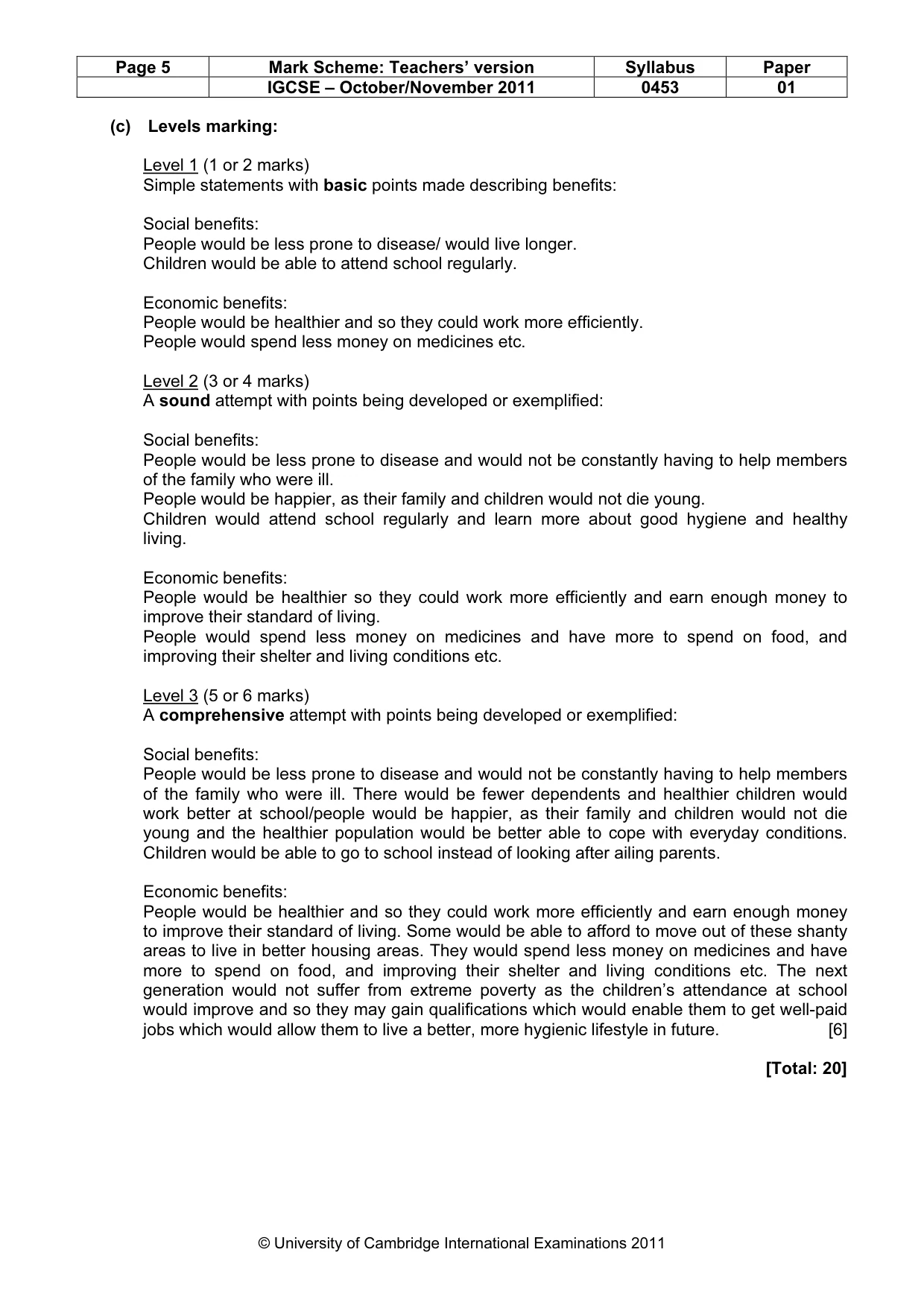
Page 5 Mark Scheme: Teachers’ version Syllabus Paper IGCSE – October/November 2011 0453 01 © University of Cambridge International Examinations 2011 (c) Levels marking: Level 1 (1 or 2 marks) Simple statements with basic points made describing benefits: Social benefits: People would be less prone to disease/ would live longer. Children would be able to attend school regularly. Economic benefits: People would be healthier and so they could work more efficiently. People would spend less money on medicines etc. Level 2 (3 or 4 marks) A sound attempt with points being developed or exemplified: Social benefits: People would be less prone to disease and would not be constantly having to help members of the family who were ill. People would be happier, as their family and children would not die young. Children would attend school regularly and learn more about good hygiene and healthy living. Economic benefits: People would be healthier so they could work more efficiently and earn enough money to improve their standard of living. People would spend less money on medicines and have more to spend on food, and improving their shelter and living conditions etc. Level 3 (5 or 6 marks) A comprehensive attempt with points being developed or exemplified: Social benefits: People would be less prone to disease and would not be constantly having to help members of the family who were ill. There would be fewer dependents and healthier children would work better at school/people would be happier, as their family and children would not die young and the healthier population would be better able to cope with everyday conditions. Children would be able to go to school instead of looking after ailing parents. Economic benefits: People would be healthier and so they could work more efficiently and earn enough money to improve their standard of living. Some would be able to afford to move out of these shanty areas to live in better housing areas. They would spend less money on medicines and have more to spend on food, and improving their shelter and living conditions etc. The next generation would not suffer from extreme poverty as the children’s attendance at school would improve and so they may gain qualifications which would enable them to get well-paid jobs which would allow them to live a better, more hygienic lifestyle in future. [6] [Total: 20]
Mark scheme, page 6
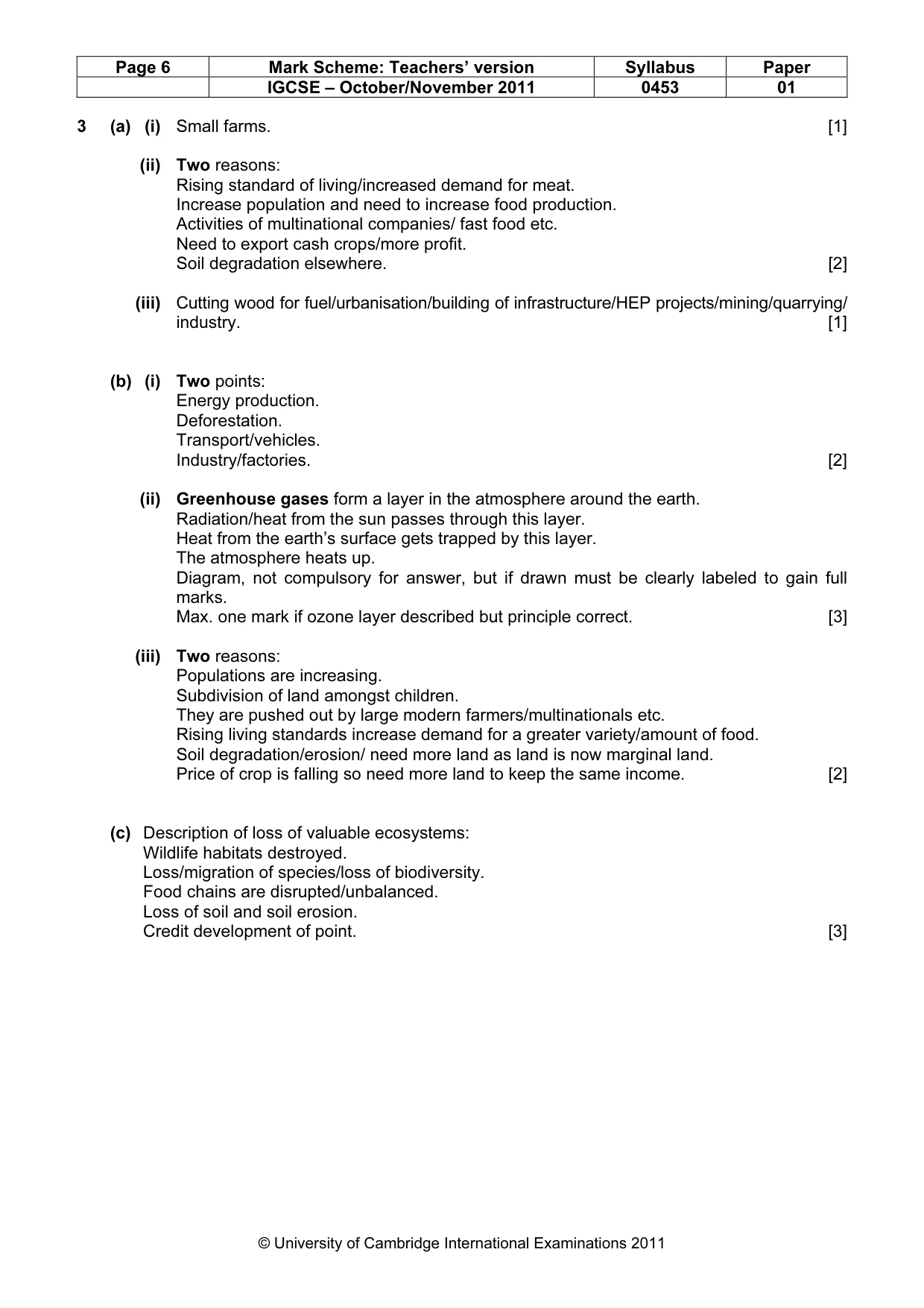
Page 6 Mark Scheme: Teachers’ version Syllabus Paper IGCSE – October/November 2011 0453 01 © University of Cambridge International Examinations 2011 3 (a) (i) Small farms. [1] (ii) Two reasons: Rising standard of living/increased demand for meat. Increase population and need to increase food production. Activities of multinational companies/ fast food etc. Need to export cash crops/more profit. Soil degradation elsewhere. [2] (iii) Cutting wood for fuel/urbanisation/building of infrastructure/HEP projects/mining/quarrying/ industry. [1] (b) (i) Two points: Energy production. Deforestation. Transport/vehicles. Industry/factories. [2] (ii) Greenhouse gases form a layer in the atmosphere around the earth. Radiation/heat from the sun passes through this layer. Heat from the earth’s surface gets trapped by this layer. The atmosphere heats up. Diagram, not compulsory for answer, but if drawn must be clearly labeled to gain full marks. Max. one mark if ozone layer described but principle correct. [3] (iii) Two reasons: Populations are increasing. Subdivision of land amongst children. They are pushed out by large modern farmers/multinationals etc. Rising living standards increase demand for a greater variety/amount of food. Soil degradation/erosion/ need more land as land is now marginal land. Price of crop is falling so need more land to keep the same income. [2] (c) Description of loss of valuable ecosystems: Wildlife habitats destroyed. Loss/migration of species/loss of biodiversity. Food chains are disrupted/unbalanced. Loss of soil and soil erosion. Credit development of point. [3]
Mark scheme, page 7
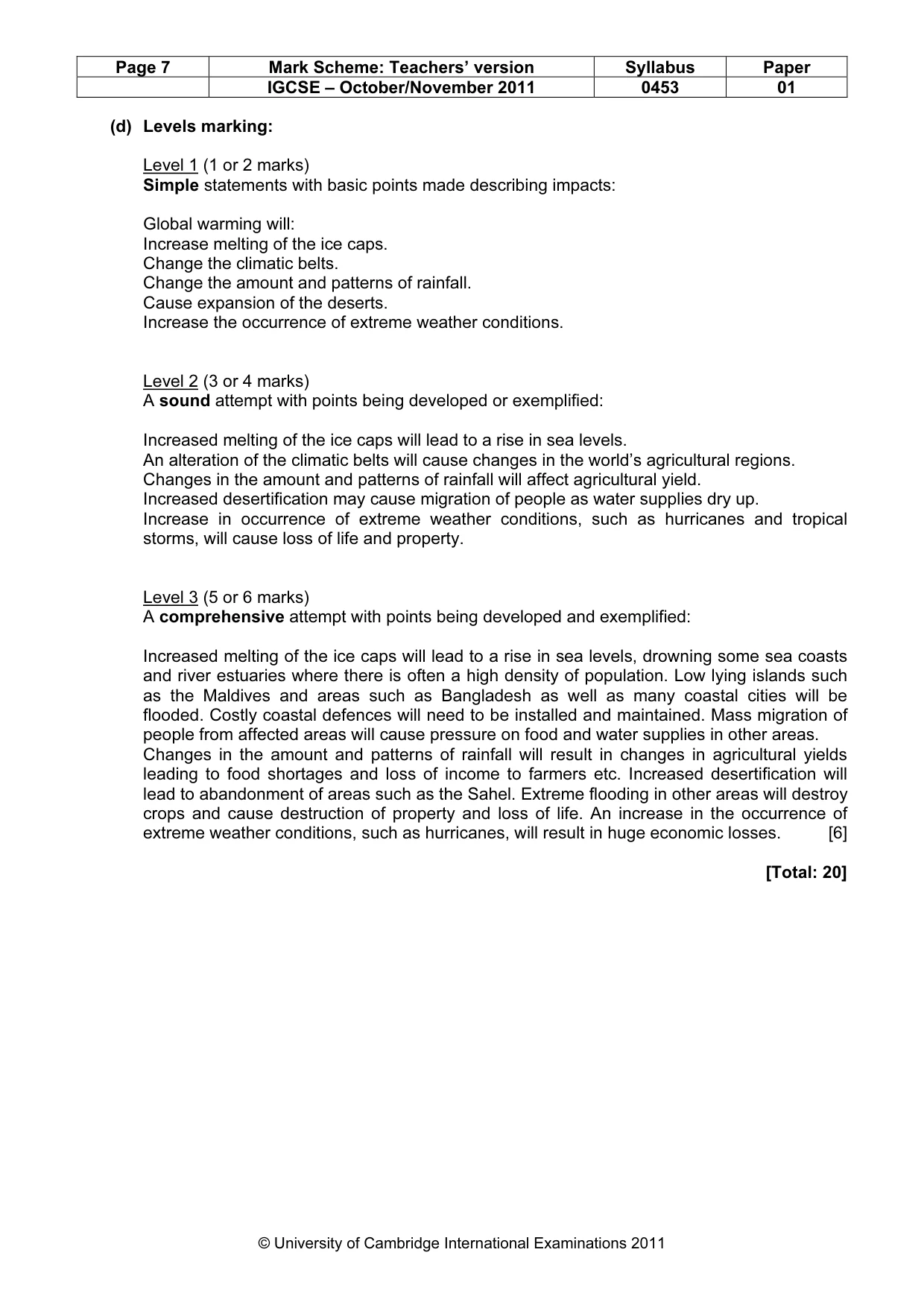
Page 7 Mark Scheme: Teachers’ version Syllabus Paper IGCSE – October/November 2011 0453 01 © University of Cambridge International Examinations 2011 (d) Levels marking: Level 1 (1 or 2 marks) Simple statements with basic points made describing impacts: Global warming will: Increase melting of the ice caps. Change the climatic belts. Change the amount and patterns of rainfall. Cause expansion of the deserts. Increase the occurrence of extreme weather conditions. Level 2 (3 or 4 marks) A sound attempt with points being developed or exemplified: Increased melting of the ice caps will lead to a rise in sea levels. An alteration of the climatic belts will cause changes in the world’s agricultural regions. Changes in the amount and patterns of rainfall will affect agricultural yield. Increased desertification may cause migration of people as water supplies dry up. Increase in occurrence of extreme weather conditions, such as hurricanes and tropical storms, will cause loss of life and property. Level 3 (5 or 6 marks) A comprehensive attempt with points being developed and exemplified: Increased melting of the ice caps will lead to a rise in sea levels, drowning some sea coasts and river estuaries where there is often a high density of population. Low lying islands such as the Maldives and areas such as Bangladesh as well as many coastal cities will be flooded. Costly coastal defences will need to be installed and maintained. Mass migration of people from affected areas will cause pressure on food and water supplies in other areas. Changes in the amount and patterns of rainfall will result in changes in agricultural yields leading to food shortages and loss of income to farmers etc. Increased desertification will lead to abandonment of areas such as the Sahel. Extreme flooding in other areas will destroy crops and cause destruction of property and loss of life. An increase in the occurrence of extreme weather conditions, such as hurricanes, will result in huge economic losses. [6] [Total: 20]
Mark scheme, page 8
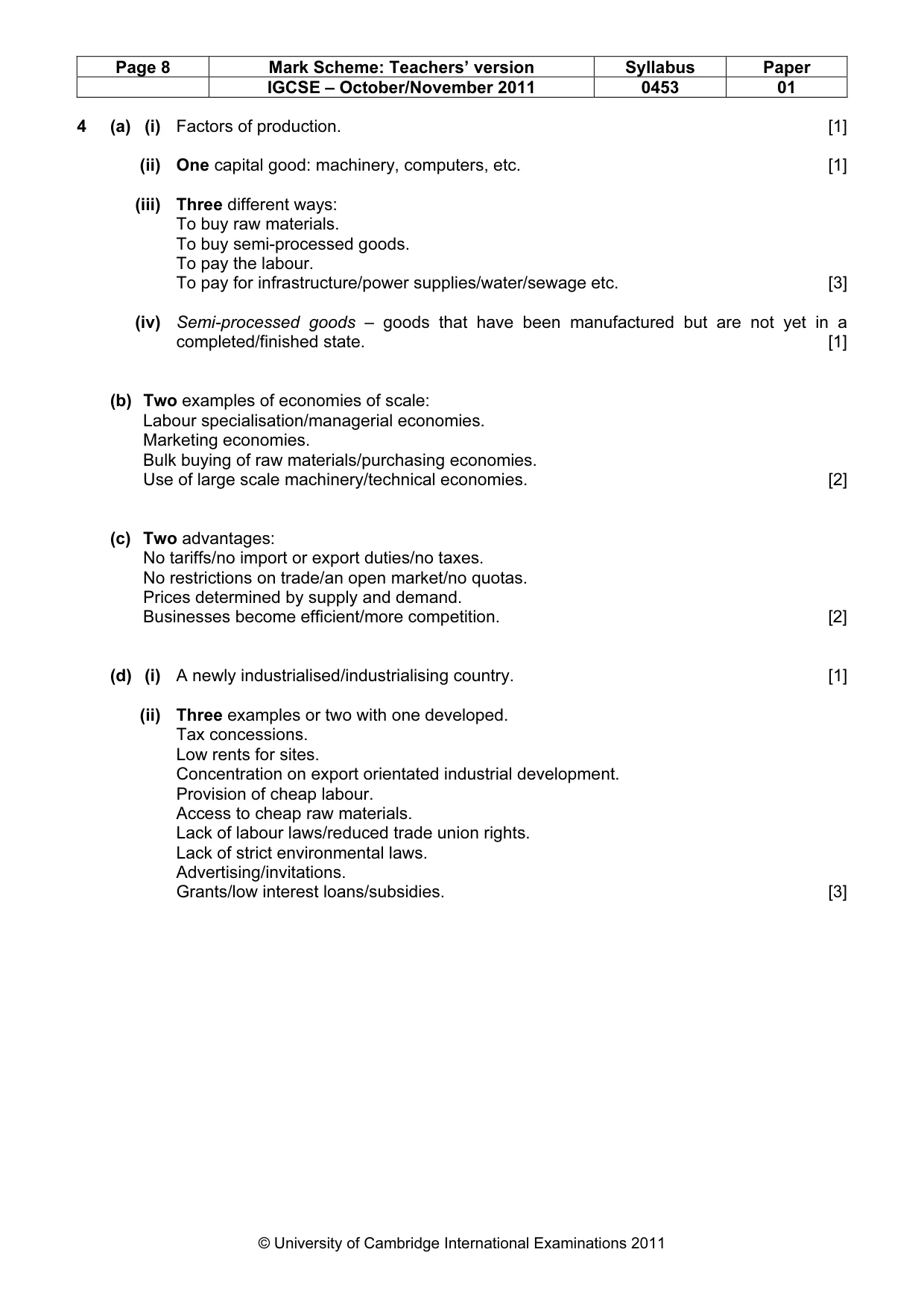
Page 8 Mark Scheme: Teachers’ version Syllabus Paper IGCSE – October/November 2011 0453 01 © University of Cambridge International Examinations 2011 4 (a) (i) Factors of production. [1] (ii) One capital good: machinery, computers, etc. [1] (iii) Three different ways: To buy raw materials. To buy semi-processed goods. To pay the labour. To pay for infrastructure/power supplies/water/sewage etc. [3] (iv) Semi-processed goods – goods that have been manufactured but are not yet in a completed/finished state. [1] (b) Two examples of economies of scale: Labour specialisation/managerial economies. Marketing economies. Bulk buying of raw materials/purchasing economies. Use of large scale machinery/technical economies. [2] (c) Two advantages: No tariffs/no import or export duties/no taxes. No restrictions on trade/an open market/no quotas. Prices determined by supply and demand. Businesses become efficient/more competition. [2] (d) (i) A newly industrialised/industrialising country. [1] (ii) Three examples or two with one developed. Tax concessions. Low rents for sites. Concentration on export orientated industrial development. Provision of cheap labour. Access to cheap raw materials. Lack of labour laws/reduced trade union rights. Lack of strict environmental laws. Advertising/invitations. Grants/low interest loans/subsidies. [3]
Mark scheme, page 9
Page 9 Mark Scheme: Teachers’ version Syllabus Paper IGCSE – October/November 2011 0453 01 © University of Cambridge International Examinations 2011 (e) Levels marking: Level 1 (1 or 2 marks) Simple statements with basic points made describing links: Natural resources may be extracted and crops grown in the primary sector to be used in the factory. Raw materials will need to be transported to the factory. The factory will need electricity from the service sector. Goods produced may be exported. Level 2 (3 or 4 marks) A sound attempt with points being developed or exemplified: Natural resources extracted and crops grown in the primary sector will need to be transported to the factory using deliveries by road or rail. Local employment provided will increase people’s spending power which will stimulate the local economy. Goods produced will be sold at local retailers or may be shipped abroad to earn foreign exchange. Skills learnt from education in the tertiary sector will be used in all aspects of production such as finance, marketing, IT etc. Infrastructure, such as new roads, may attract other industries. Level 3 (5 or 6 marks) A comprehensive attempt with points being developed or exemplified: Resources and raw materials of the host country may be developed to use in the factory, and the increased demand for these raw materials will stimulate increased production and development of those resources with increased employment opportunities. Increased demand for raw materials such as silk in China, cotton in India, may attract other industries using those raw materials. Further stimulus may come from the demand for increased power supplies e.g. coal for power stations. The growing provision of power supplies and transportation networks may attract new industries which will lead to the multiplier effect and the stimulation of growth. Local labour may be used in the factory giving employment to the people which will bring more income and alleviate poverty. People will have more money to spend on health and education and the standards of living will increase. The increased spending power will stimulate the local economy leading to increased exchange of goods and economic development. Export of the product will generate foreign exchange which will be used by the government to further improve services in the country. Tax from the company and from workers will generate improvements in local services such as health and education which will promote development further. [6] [Total: 20]
What you needed in this session
Cambridge’s own grade thresholds for 2011 Oct/Nov, Paper 1 · Variant 1. A higher threshold means an easier paper — the bar moves with how the cohort did.