Cambridge IGCSE Development Studies 0453 — 2014 Oct/Nov Paper 1 · Variant 1
0453/11/O/N/14 · 80 marks · ≈90 min
The question paper and its mark scheme, free to read here and free to download. This is Cambridge’s own paper, exactly as it was sat.
Question paper16 pages




Mark scheme9 pages
Answers below. Sit the paper first if you are practising.
Paper as text
Question paper, page 1
This document consists of 16 printed pages. DC (NF/SW) 82099/3 © UCLES 2014 [Turn over Cambridge International Examinations Cambridge International General Certificate of Secondary Education * 6 7 5 9 3 8 5 9 3 9 * DEVELOPMENT STUDIES 0453/01 Paper 1 October/November 2014 2 hours Candidates answer on the Question Paper. No Additional Materials are required. READ THESE INSTRUCTIONS FIRST Write your Centre number, candidate number and name on all the work you hand in. Write in dark blue or black pen. Do not use staples, paper clips, glue or correction fluid. You may use a pencil for any diagrams, graphs or rough working. DO NOT WRITE IN ANY BARCODES. Answer all the questions. You may not need all the answer lines for your answer. You should read and study the sources before answering the questions. The number of marks is given in brackets [ ] at the end of each question or part question. PAPA CAMBRIDGE
Question paper, page 2
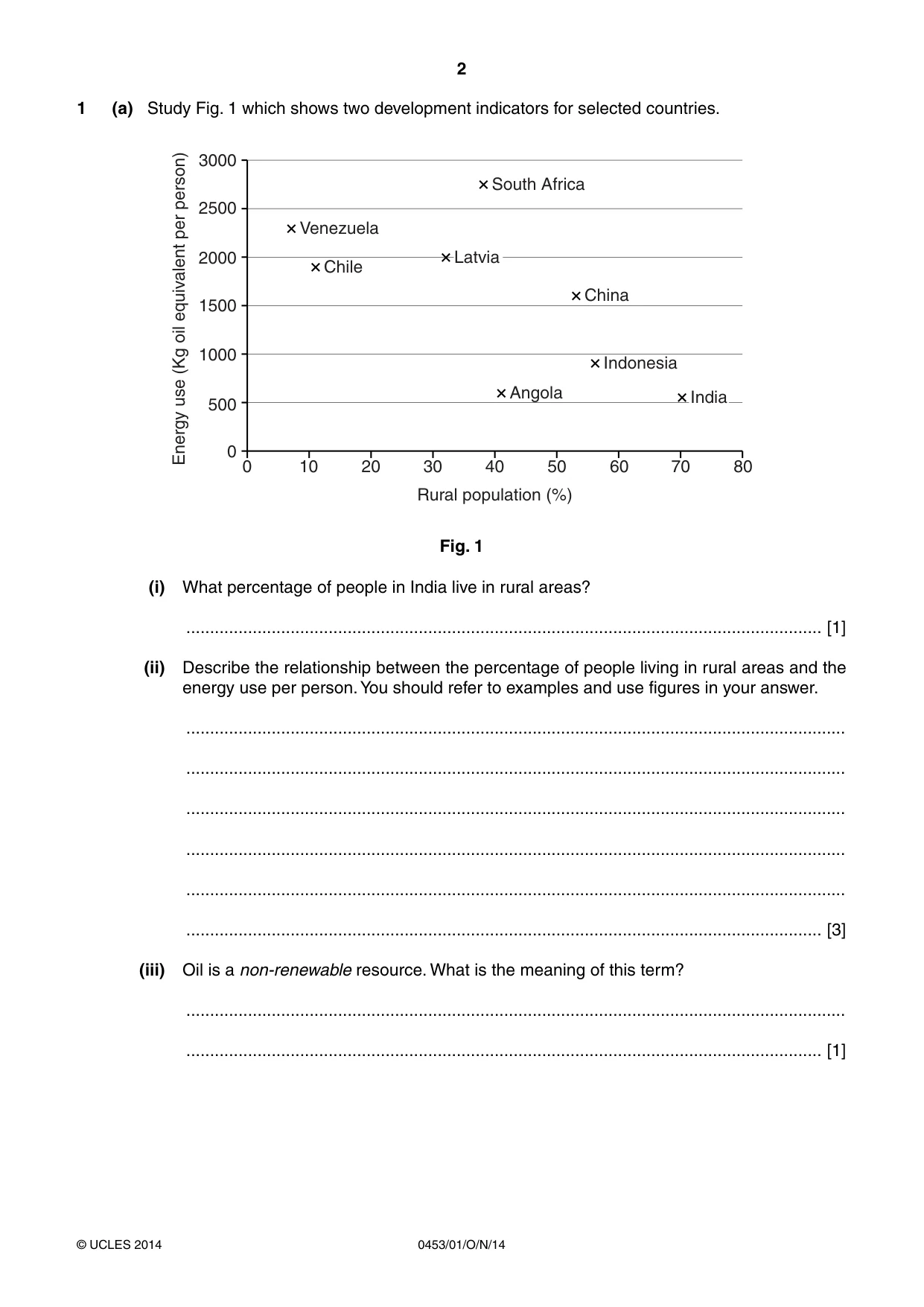
2 0453/01/O/N/14 © UCLES 2014 1 (a) Study Fig. 1 which shows two development indicators for selected countries. 0 3000 2500 2000 1500 1000 500 Energy use (Kg oil equivalent per person) 0 10 20 30 40 Rural population (%) 50 60 70 80 Venezuela Chile Latvia South Africa China Indonesia India Angola Fig. 1 (i) What percentage of people in India live in rural areas? … [1] (ii) Describe the relationship between the percentage of people living in rural areas and the energy use per person. You should refer to examples and use figures in your answer. … … … … … … [3] (iii) Oil is a non-renewable resource. What is the meaning of this term? … … [1]
Question paper, page 3
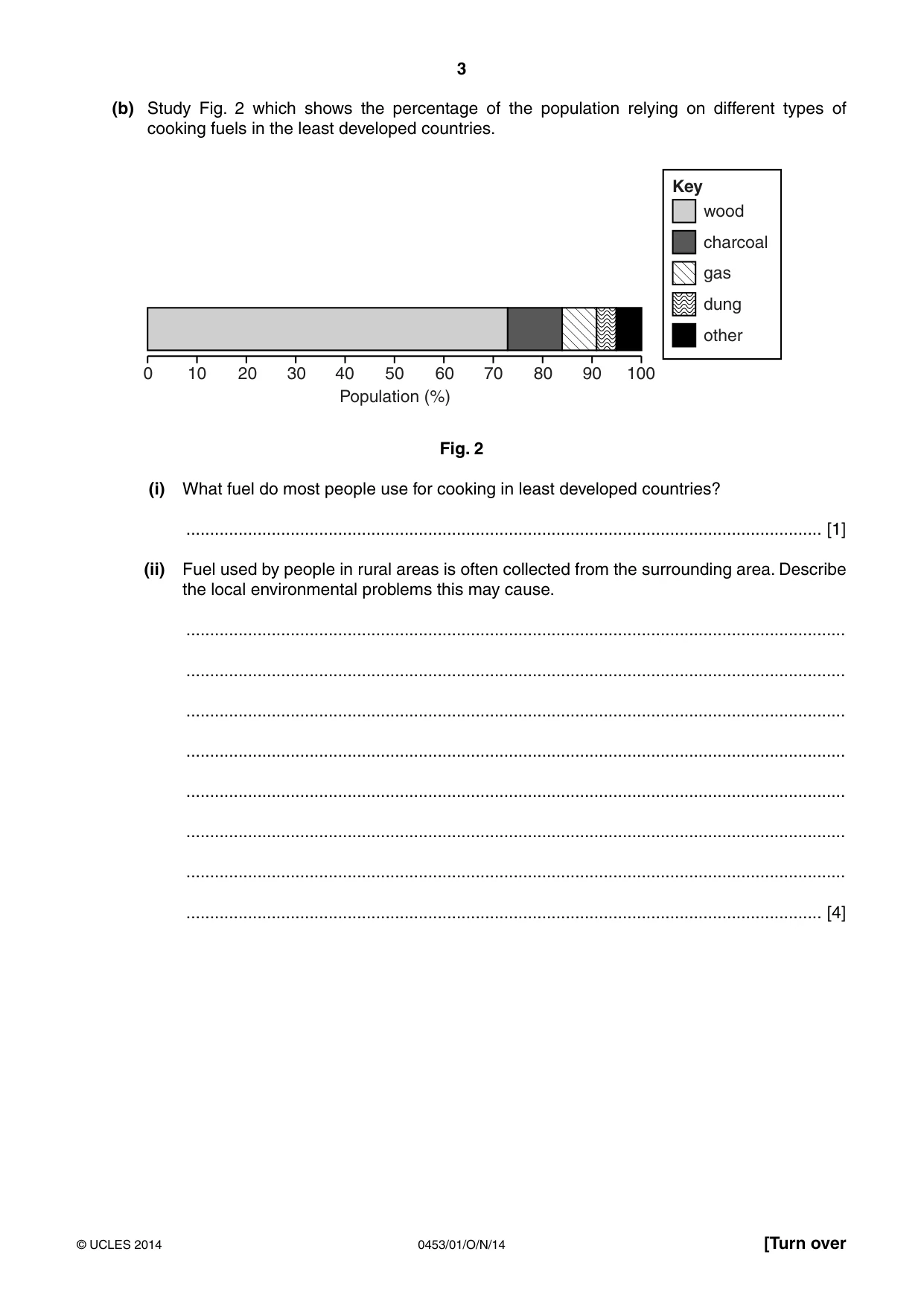
3 0453/01/O/N/14 © UCLES 2014 [Turn over (b) Study Fig. 2 which shows the percentage of the population relying on different types of cooking fuels in the least developed countries. wood charcoal gas dung other Key 0 10 20 30 40 Population (%) 50 60 70 80 90 100 Fig. 2 (i) What fuel do most people use for cooking in least developed countries? … [1] (ii) Fuel used by people in rural areas is often collected from the surrounding area. Describe the local environmental problems this may cause. … … … … … … … … [4]
Question paper, page 4
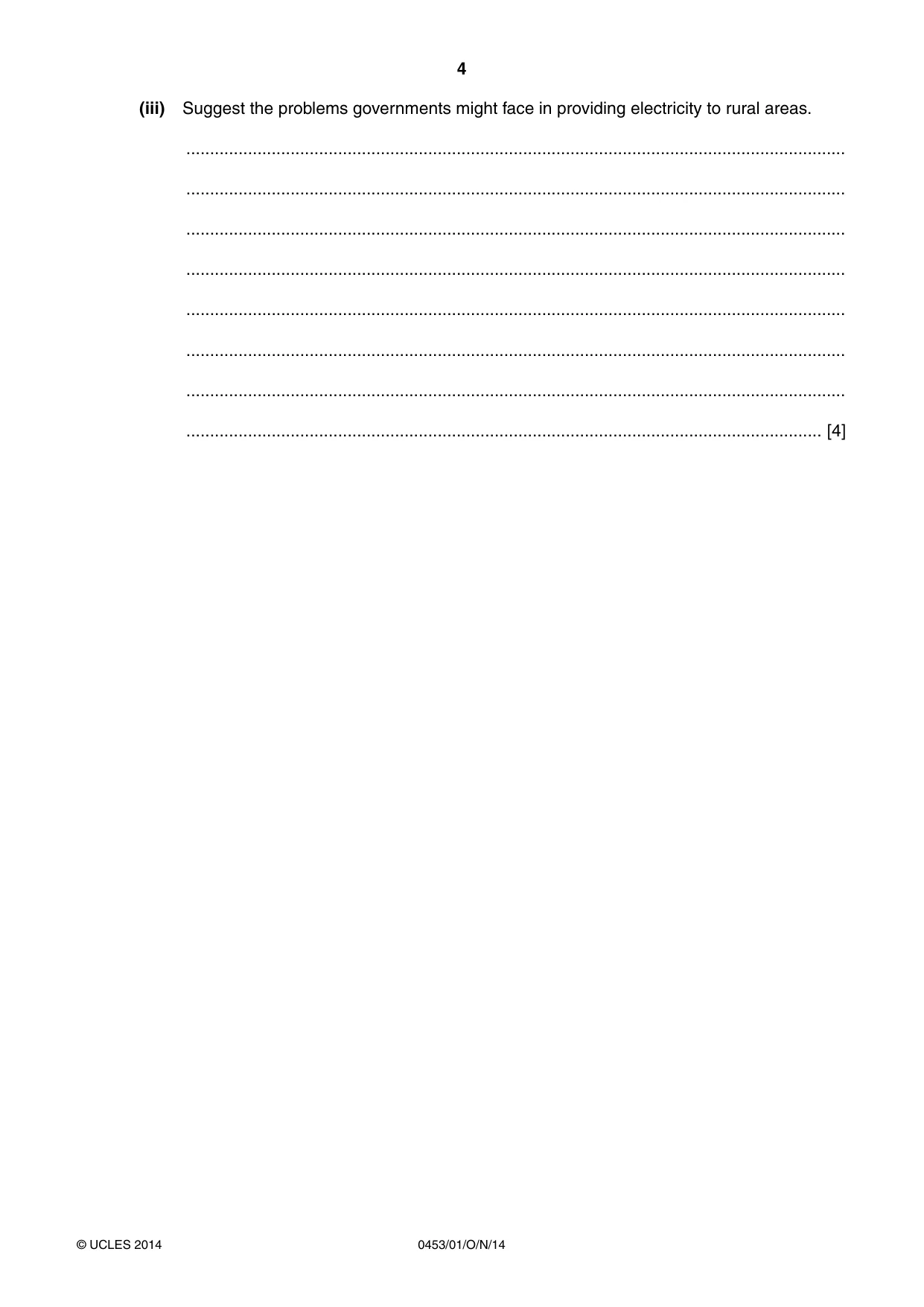
4 0453/01/O/N/14 © UCLES 2014 (iii) Suggest the problems governments might face in providing electricity to rural areas. … … … … … … … … [4]
Question paper, page 5
5 0453/01/O/N/14 © UCLES 2014 [Turn over (c) Large scale destruction of forests is a serious problem in many parts of the world. Describe the methods used to reduce deforestation and protect forests. You should develop the points you make. … … … … … … … … … … … … … … … … … … … … … … … … … [6] [Total: 20 marks]
Question paper, page 6
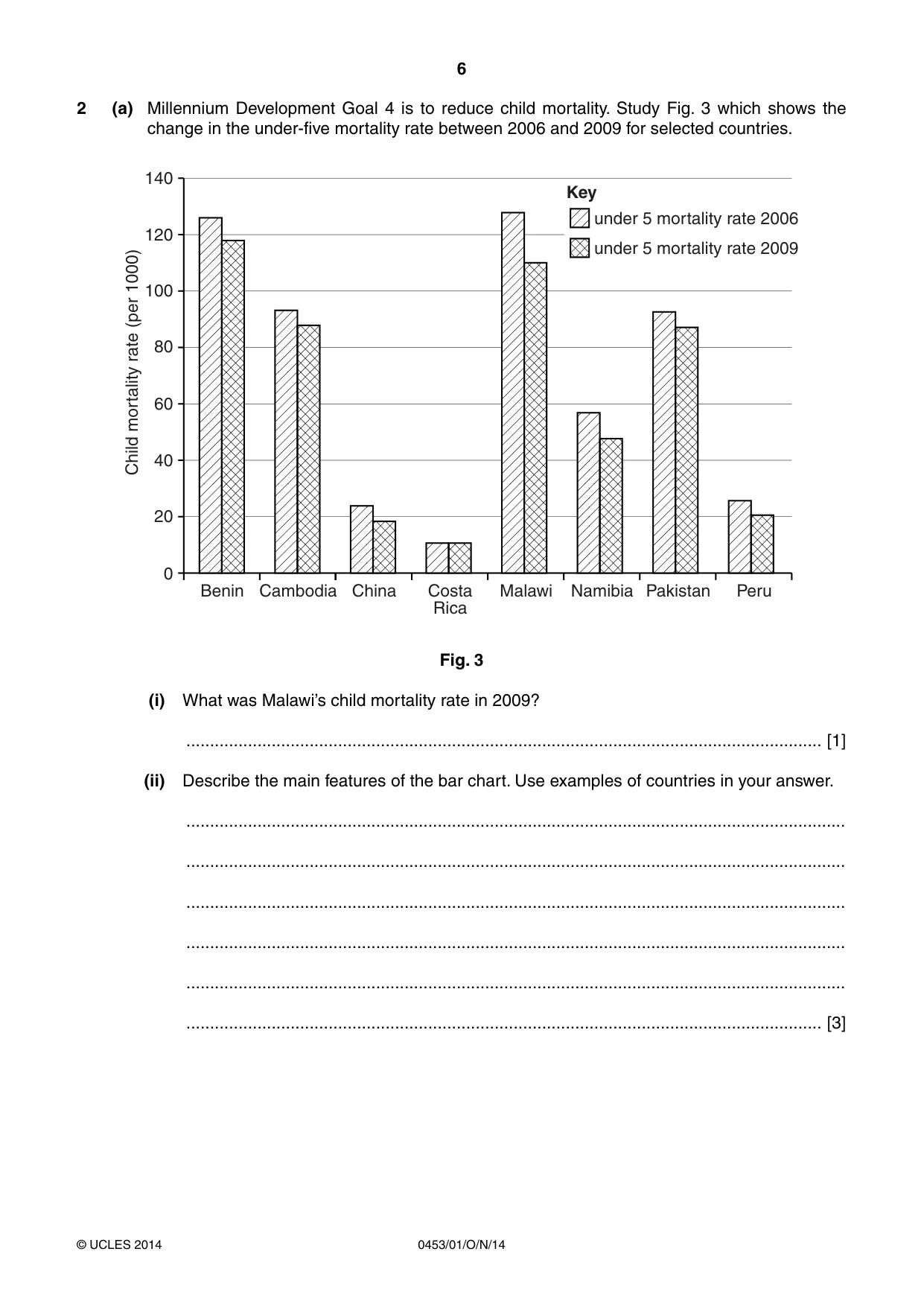
6 0453/01/O/N/14 © UCLES 2014 2 (a) Millennium Development Goal 4 is to reduce child mortality. Study Fig. 3 which shows the change in the under-five mortality rate between 2006 and 2009 for selected countries. Benin Cambodia China Costa Rica Malawi Namibia Pakistan Peru 0 20 40 60 80 100 120 140 Child mortality rate (per 1000) under 5 mortality rate 2006 under 5 mortality rate 2009 Key Fig. 3 (i) What was Malawi’s child mortality rate in 2009? … [1] (ii) Describe the main features of the bar chart. Use examples of countries in your answer. … … … … … … [3]
Question paper, page 7
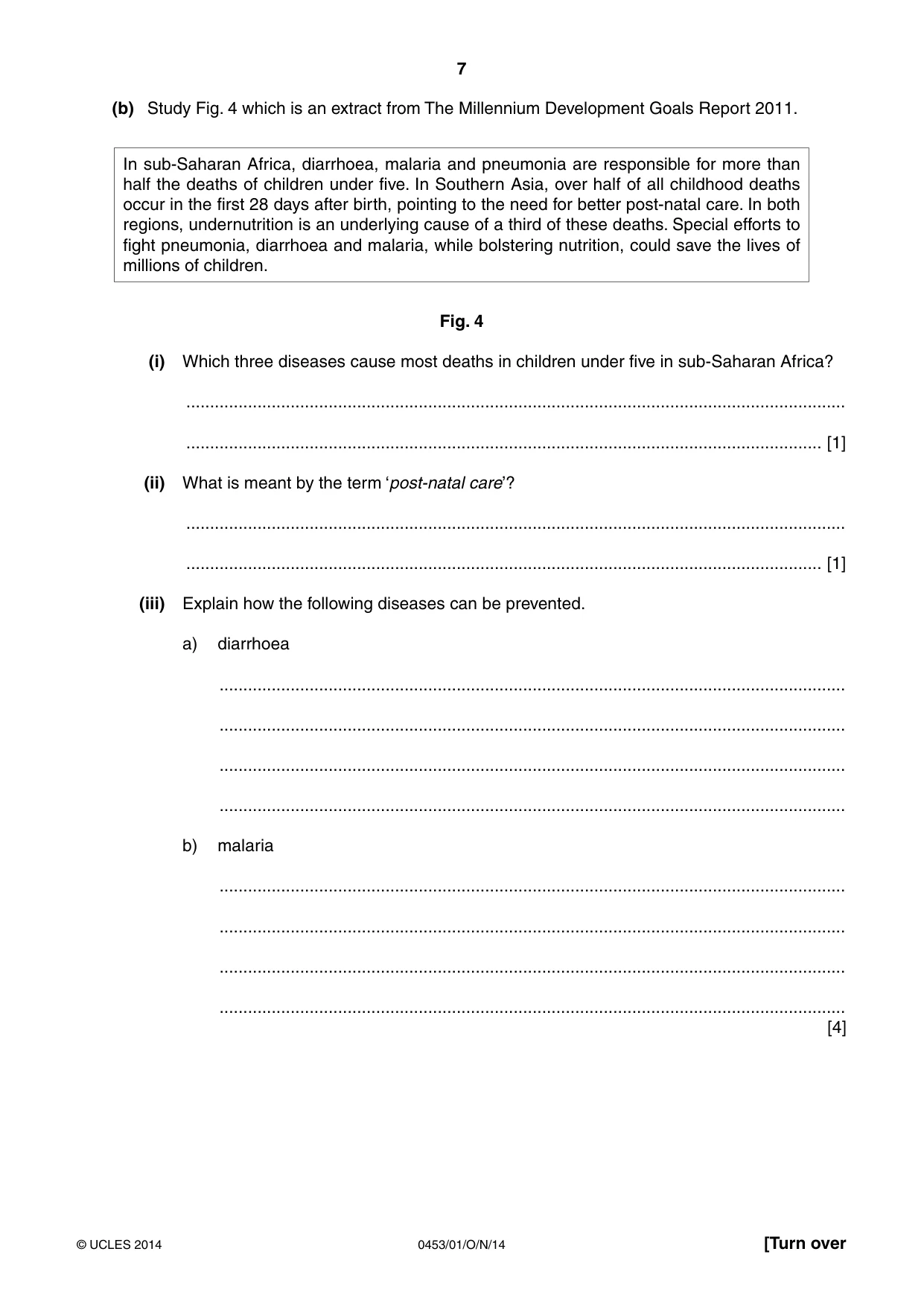
7 0453/01/O/N/14 © UCLES 2014 [Turn over (b) Study Fig. 4 which is an extract from The Millennium Development Goals Report 2011. In sub-Saharan Africa, diarrhoea, malaria and pneumonia are responsible for more than half the deaths of children under five. In Southern Asia, over half of all childhood deaths occur in the first 28 days after birth, pointing to the need for better post-natal care. In both regions, undernutrition is an underlying cause of a third of these deaths. Special efforts to fight pneumonia, diarrhoea and malaria, while bolstering nutrition, could save the lives of millions of children. Fig. 4 (i) Which three diseases cause most deaths in children under five in sub-Saharan Africa? … … [1] (ii) What is meant by the term ‘post-natal care’? … … [1] (iii) Explain how the following diseases can be prevented. a) diarrhoea … … … … b) malaria … … … … [4]
Question paper, page 8
8 0453/01/O/N/14 © UCLES 2014 (c) Measles is another cause of child mortality. How can governments increase vaccination rates for diseases such as measles? … … … … … … … … [4]
Question paper, page 9
9 0453/01/O/N/14 © UCLES 2014 [Turn over (d) Explain why it is important for a country to have healthy children and adults if economic development is to take place. You should develop the points you make. … … … … … … … … … … … … … … … … … … … … … … … … … … [6] [Total: 20 marks]
Question paper, page 10
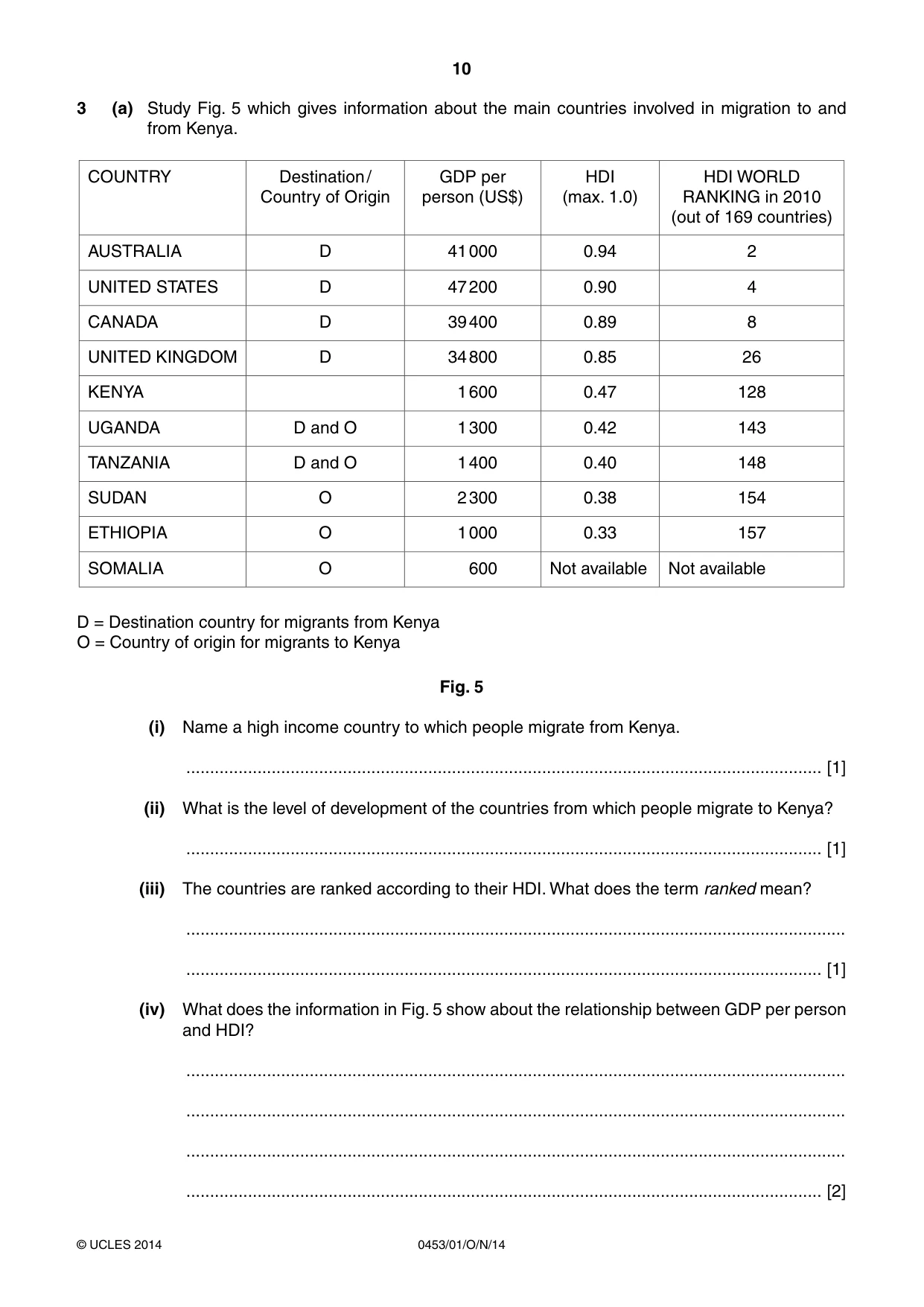
10 0453/01/O/N/14 © UCLES 2014 3 (a) Study Fig. 5 which gives information about the main countries involved in migration to and from Kenya. COUNTRY Destination / Country of Origin GDP per person (US$) HDI (max. 1.0) HDI WORLD RANKING in 2010 (out of 169 countries) AUSTRALIA D 41 000 0.94 2 UNITED STATES D 47 200 0.90 4 CANADA D 39 400 0.89 8 UNITED KINGDOM D 34 800 0.85 26 KENYA 1 600 0.47 128 UGANDA D and O 1 300 0.42 143 TANZANIA D and O 1 400 0.40 148 SUDAN O 2 300 0.38 154 ETHIOPIA O 1 000 0.33 157 SOMALIA O 600 Not available Not available D = Destination country for migrants from Kenya O = Country of origin for migrants to Kenya Fig. 5 (i) Name a high income country to which people migrate from Kenya. … [1] (ii) What is the level of development of the countries from which people migrate to Kenya? … [1] (iii) The countries are ranked according to their HDI. What does the term ranked mean? … … [1] (iv) What does the information in Fig. 5 show about the relationship between GDP per person and HDI? … … … … [2]
Question paper, page 11
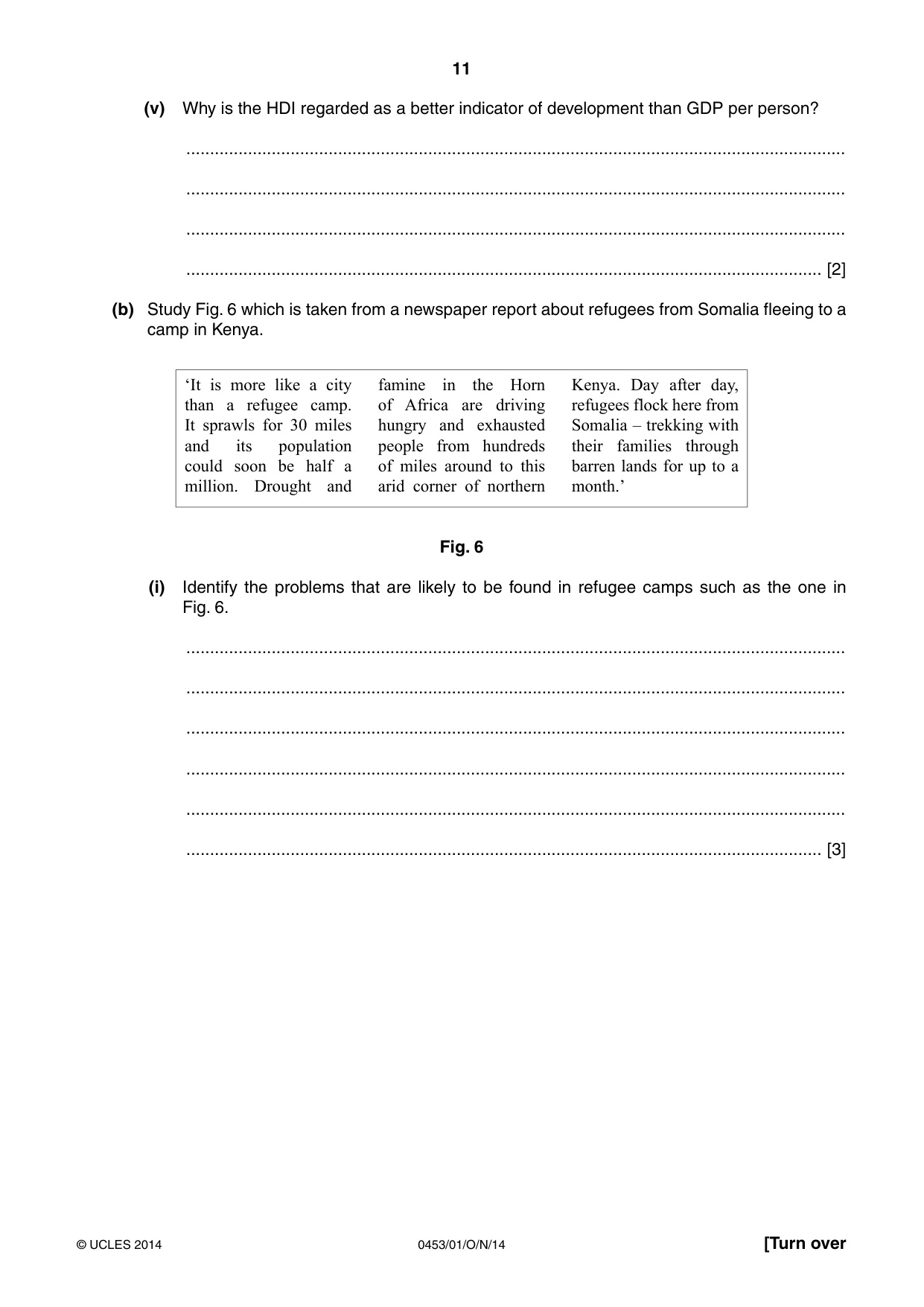
11 0453/01/O/N/14 © UCLES 2014 [Turn over (v) Why is the HDI regarded as a better indicator of development than GDP per person? … … … … [2] (b) Study Fig. 6 which is taken from a newspaper report about refugees from Somalia fleeing to a camp in Kenya. ‘It is more like a city than a refugee camp. It sprawls for 30 miles and its population could soon be half a million. Drought and famine in the Horn of Africa are driving hungry and exhausted people from hundreds of miles around to this arid corner of northern Kenya. Day after day, refugees flock here from Somalia – trekking with their families through barren lands for up to a month.’ Fig. 6 (i) Identify the problems that are likely to be found in refugee camps such as the one in Fig. 6. … … … … … … [3]
Question paper, page 12
12 0453/01/O/N/14 © UCLES 2014 (ii) Explain the impact large numbers of refugees will have on the development of a country such as Kenya. … … … … … … … … [4]
Question paper, page 13
13 0453/01/O/N/14 © UCLES 2014 [Turn over (c) Describe the benefits and the problems for families of economic migrants who travel to work in another country. You should develop the points you make. … … … … … … … … … … … … … … … … … … … … … … … … … … [6] [Total: 20 marks]
Question paper, page 14
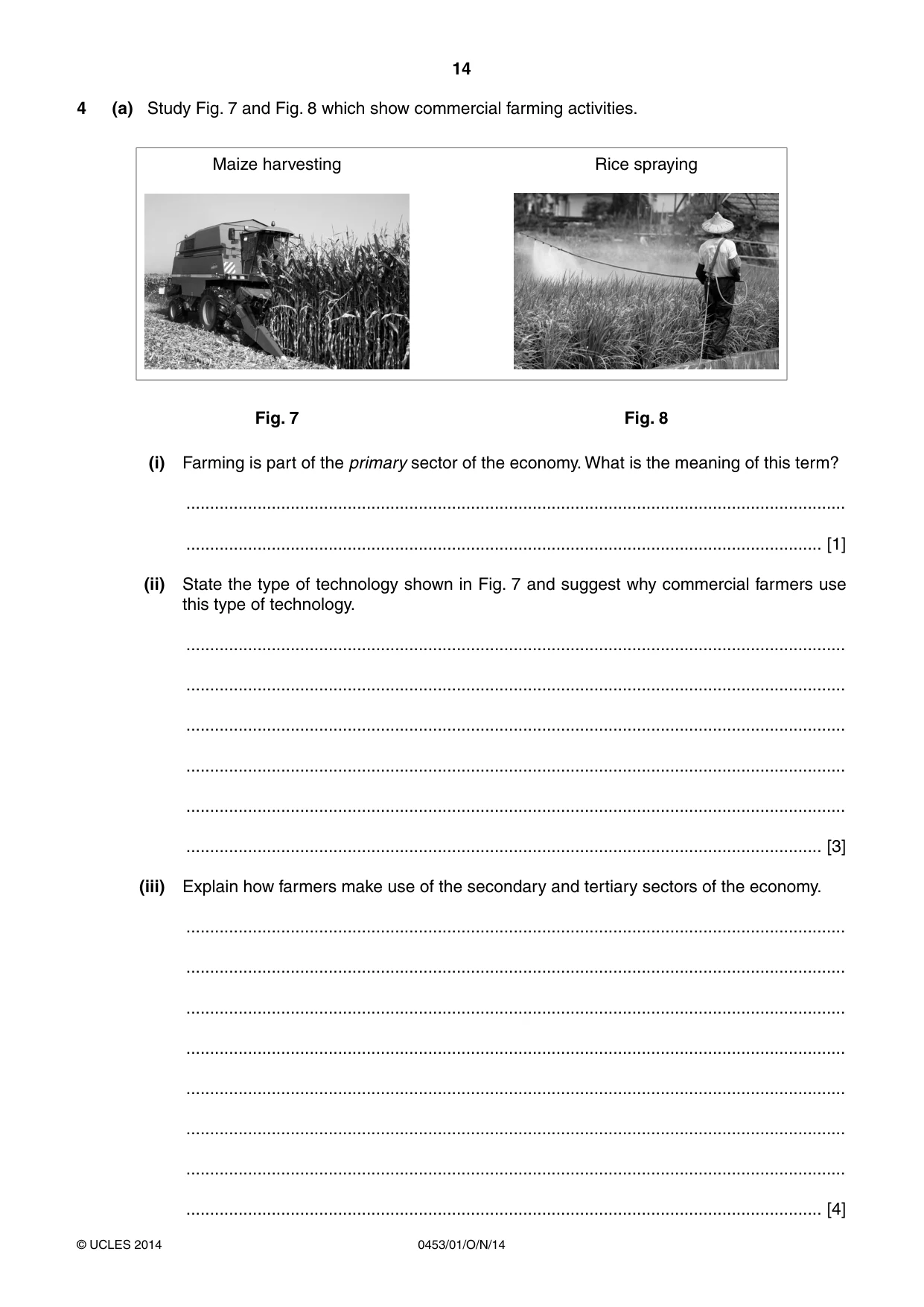
14 0453/01/O/N/14 © UCLES 2014 4 (a) Study Fig. 7 and Fig. 8 which show commercial farming activities. Maize harvesting Rice spraying Fig. 7 Fig. 8 (i) Farming is part of the primary sector of the economy. What is the meaning of this term? … … [1] (ii) State the type of technology shown in Fig. 7 and suggest why commercial farmers use this type of technology. … … … … … … [3] (iii) Explain how farmers make use of the secondary and tertiary sectors of the economy. … … … … … … … … [4]
Question paper, page 15
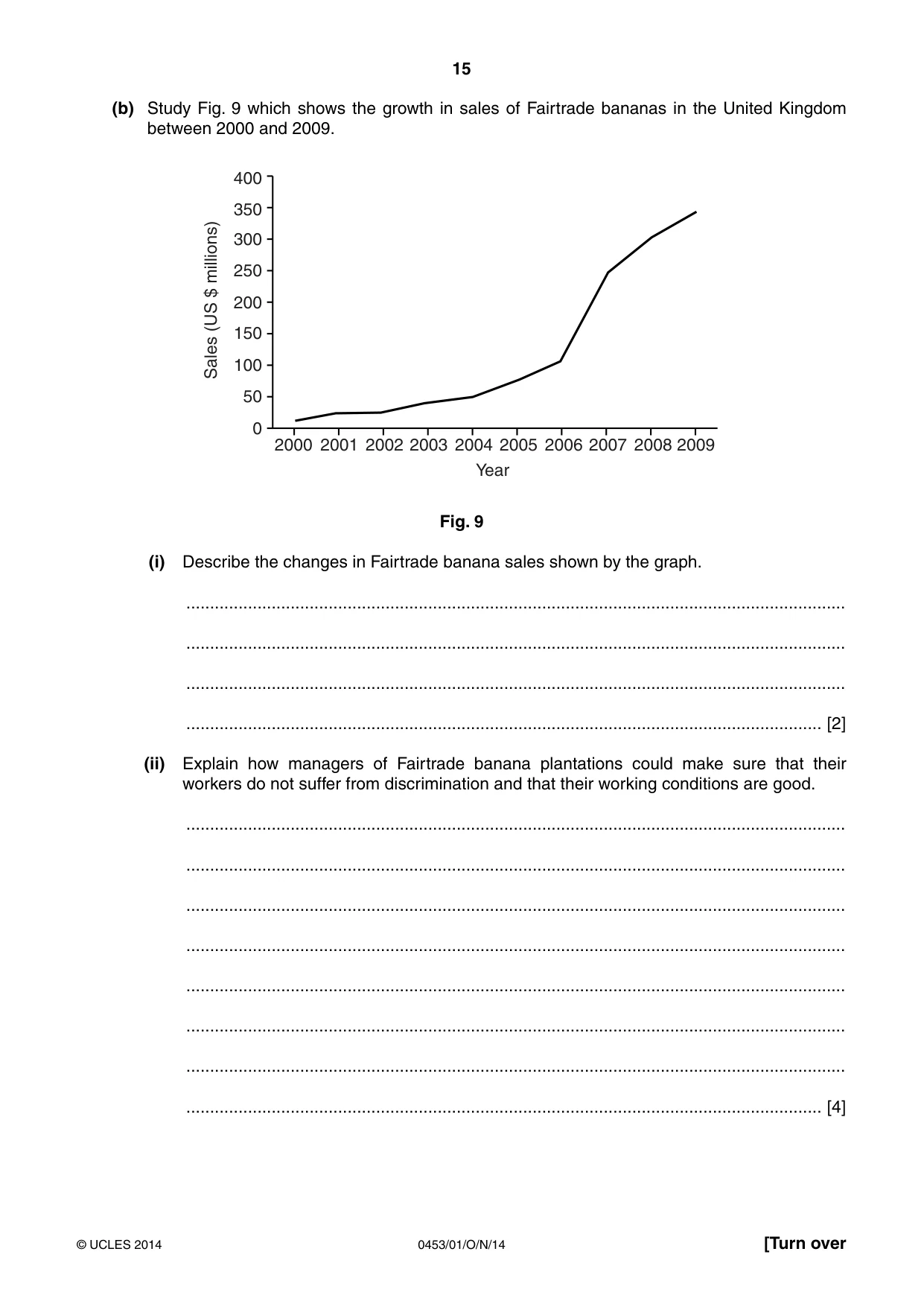
15 0453/01/O/N/14 © UCLES 2014 [Turn over (b) Study Fig. 9 which shows the growth in sales of Fairtrade bananas in the United Kingdom between 2000 and 2009. 2000 0 50 100 150 200 250 300 350 400 2001 2002 2003 2004 Year Sales (US $ millions) 2005 2006 2007 2008 2009 Fig. 9 (i) Describe the changes in Fairtrade banana sales shown by the graph. … … … … [2] (ii) Explain how managers of Fairtrade banana plantations could make sure that their workers do not suffer from discrimination and that their working conditions are good. … … … … … … … … [4]
Question paper, page 16
16 0453/01/O/N/14 © UCLES 2014 Copyright Acknowledgements: Question 1 Figure 1 © www.cia.gov/library/publications/the-world-factbook; http://data.worldbank.org. Question 1 Figure 2 © adapted: The Energy Access Situation in Developing Countries; World Health Organisation; 2009. http://www.who.int/indoorair/publications/PowerPoint_Energy_Access_paper-lr.pdf. Question 2 Figure 3 © http://data.worldbank.org/indicator/. Question 2 Figure 4 © http://data.worldbank.org/indicators. Question 3 Figure 5 © https://www.cia.gov/library/publications/the-world-factbook/index.html; http://hdr.undp.org/en/countries/. Question 3 Figure 6 © Ben Brown; An arid city crying out for help; The Sunday Telegraph; 10 July 2011. Question 4a Figure 7 © Ref: AABXHF; INSADCO Photography; Bilderbox/Alamy; Corn/maize crop/harvesting; www.alamy.com. Question 4a Figure 8 © Ref: AH5YH0 Chao-Yang Chan/Alamy; Farmer spraying pesticide on rice field; www.alamy.com. Permission to reproduce items where third-party owned material protected by copyright is included has been sought and cleared where possible. Every reasonable effort has been made by the publisher (UCLES) to trace copyright holders, but if any items requiring clearance have unwittingly been included, the publisher will be pleased to make amends at the earliest possible opportunity. Cambridge International Examinations is part of the Cambridge Assessment Group. Cambridge Assessment is the brand name of University of Cambridge Local Examinations Syndicate (UCLES), which is itself a department of the University of Cambridge. (c) Modern commercial farming is able to increase output in a number of ways. Explain the effects these methods may have on the natural environment. You should develop the points you make. … … … … … … … … … … … … … … … … … … … … [6] [Total: 20 marks]
Mark scheme, page 1
® IGCSE is the registered trademark of Cambridge International Examinations. fCAMBRIDGE INTERNATIONAL EXAMINATIONS Cambridge International General Certificate of Secondary Education MARK SCHEME for the October/November 2014 series 0453 DEVELOPMENT STUDIES 0453/01 Paper 1, maximum raw mark 80 This mark scheme is published as an aid to teachers and candidates, to indicate the requirements of the examination. It shows the basis on which Examiners were instructed to award marks. It does not indicate the details of the discussions that took place at an Examiners’ meeting before marking began, which would have considered the acceptability of alternative answers. Mark schemes should be read in conjunction with the question paper and the Principal Examiner Report for Teachers. Cambridge will not enter into discussions about these mark schemes. Cambridge is publishing the mark schemes for the October/November 2014 series for most Cambridge IGCSE®, Cambridge International A and AS Level components and some Cambridge O Level components. PAPA CAMBRIDGE
Mark scheme, page 2
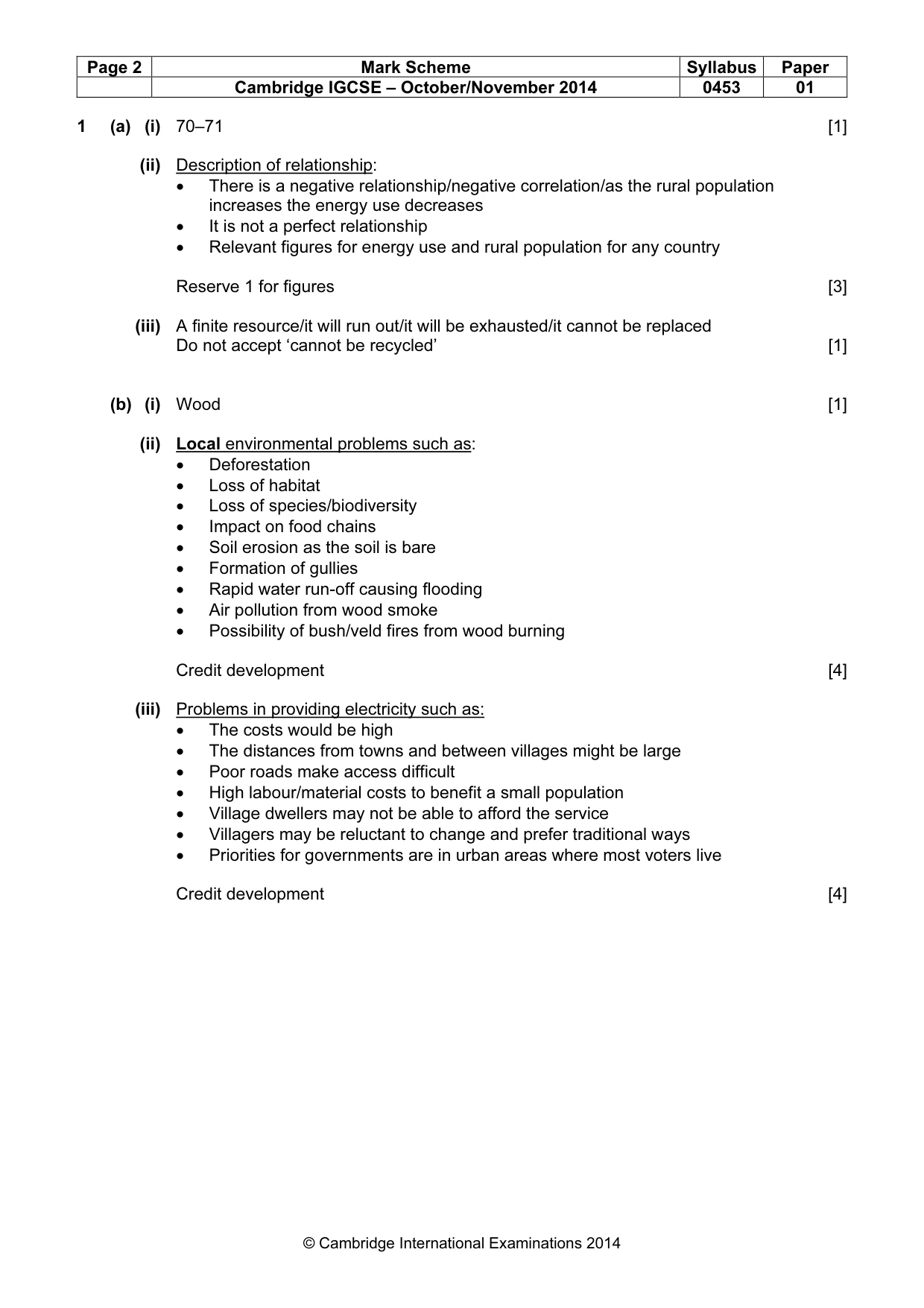
Page 2 Mark Scheme Syllabus Paper Cambridge IGCSE – October/November 2014 0453 01 © Cambridge International Examinations 2014 1 (a) (i) 70–71 [1] (ii) Description of relationship: • There is a negative relationship/negative correlation/as the rural population increases the energy use decreases • It is not a perfect relationship • Relevant figures for energy use and rural population for any country Reserve 1 for figures [3] (iii) A finite resource/it will run out/it will be exhausted/it cannot be replaced Do not accept ‘cannot be recycled’ [1] (b) (i) Wood [1] (ii) Local environmental problems such as: • Deforestation • Loss of habitat • Loss of species/biodiversity • Impact on food chains • Soil erosion as the soil is bare • Formation of gullies • Rapid water run-off causing flooding • Air pollution from wood smoke • Possibility of bush/veld fires from wood burning Credit development [4] (iii) Problems in providing electricity such as: • The costs would be high • The distances from towns and between villages might be large • Poor roads make access difficult • High labour/material costs to benefit a small population • Village dwellers may not be able to afford the service • Villagers may be reluctant to change and prefer traditional ways • Priorities for governments are in urban areas where most voters live Credit development [4]
Mark scheme, page 3
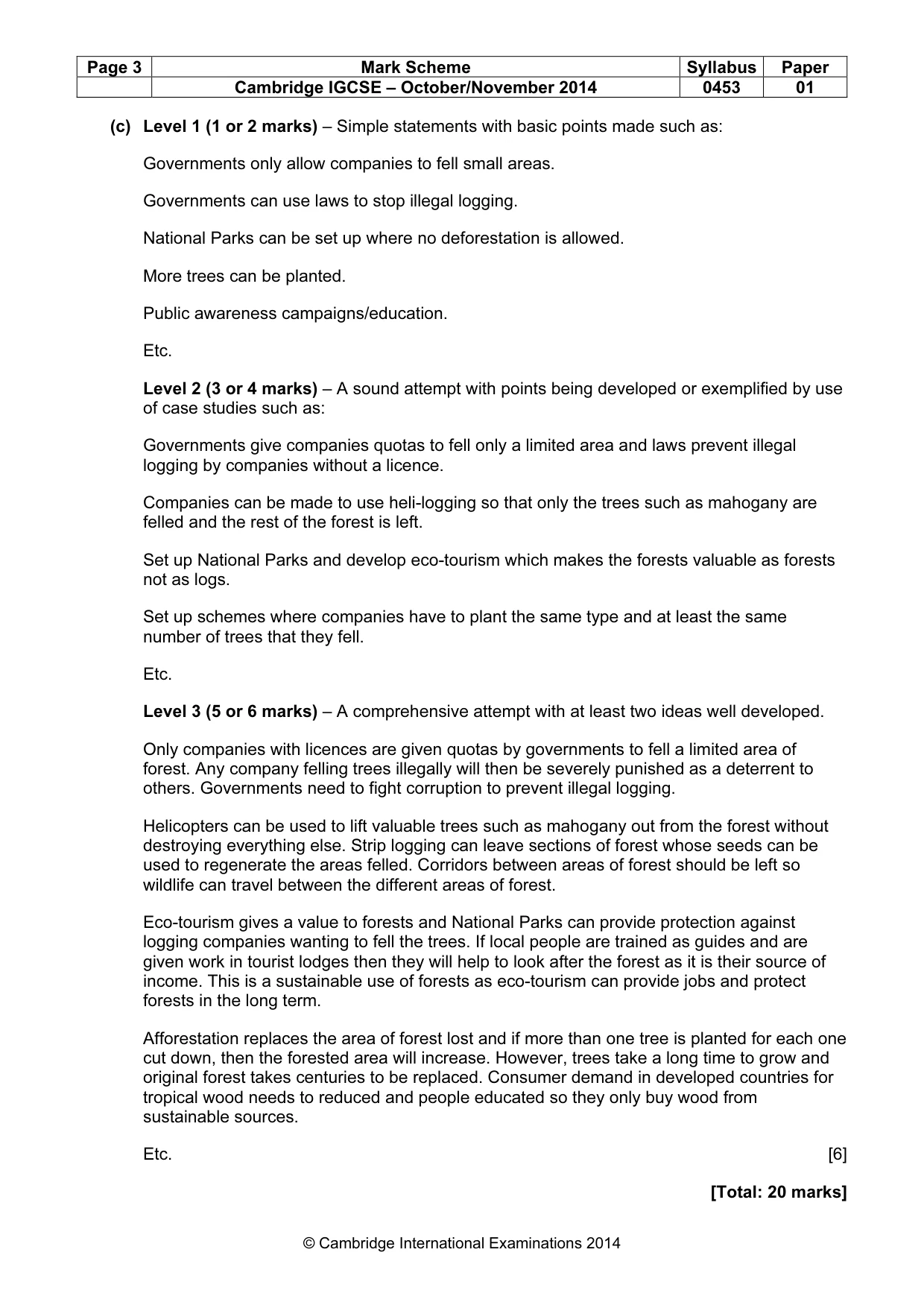
Page 3 Mark Scheme Syllabus Paper Cambridge IGCSE – October/November 2014 0453 01 © Cambridge International Examinations 2014 (c) Level 1 (1 or 2 marks) – Simple statements with basic points made such as: Governments only allow companies to fell small areas. Governments can use laws to stop illegal logging. National Parks can be set up where no deforestation is allowed. More trees can be planted. Public awareness campaigns/education. Etc. Level 2 (3 or 4 marks) – A sound attempt with points being developed or exemplified by use of case studies such as: Governments give companies quotas to fell only a limited area and laws prevent illegal logging by companies without a licence. Companies can be made to use heli-logging so that only the trees such as mahogany are felled and the rest of the forest is left. Set up National Parks and develop eco-tourism which makes the forests valuable as forests not as logs. Set up schemes where companies have to plant the same type and at least the same number of trees that they fell. Etc. Level 3 (5 or 6 marks) – A comprehensive attempt with at least two ideas well developed. Only companies with licences are given quotas by governments to fell a limited area of forest. Any company felling trees illegally will then be severely punished as a deterrent to others. Governments need to fight corruption to prevent illegal logging. Helicopters can be used to lift valuable trees such as mahogany out from the forest without destroying everything else. Strip logging can leave sections of forest whose seeds can be used to regenerate the areas felled. Corridors between areas of forest should be left so wildlife can travel between the different areas of forest. Eco-tourism gives a value to forests and National Parks can provide protection against logging companies wanting to fell the trees. If local people are trained as guides and are given work in tourist lodges then they will help to look after the forest as it is their source of income. This is a sustainable use of forests as eco-tourism can provide jobs and protect forests in the long term. Afforestation replaces the area of forest lost and if more than one tree is planted for each one cut down, then the forested area will increase. However, trees take a long time to grow and original forest takes centuries to be replaced. Consumer demand in developed countries for tropical wood needs to reduced and people educated so they only buy wood from sustainable sources. Etc. [6] [Total: 20 marks]
Mark scheme, page 4
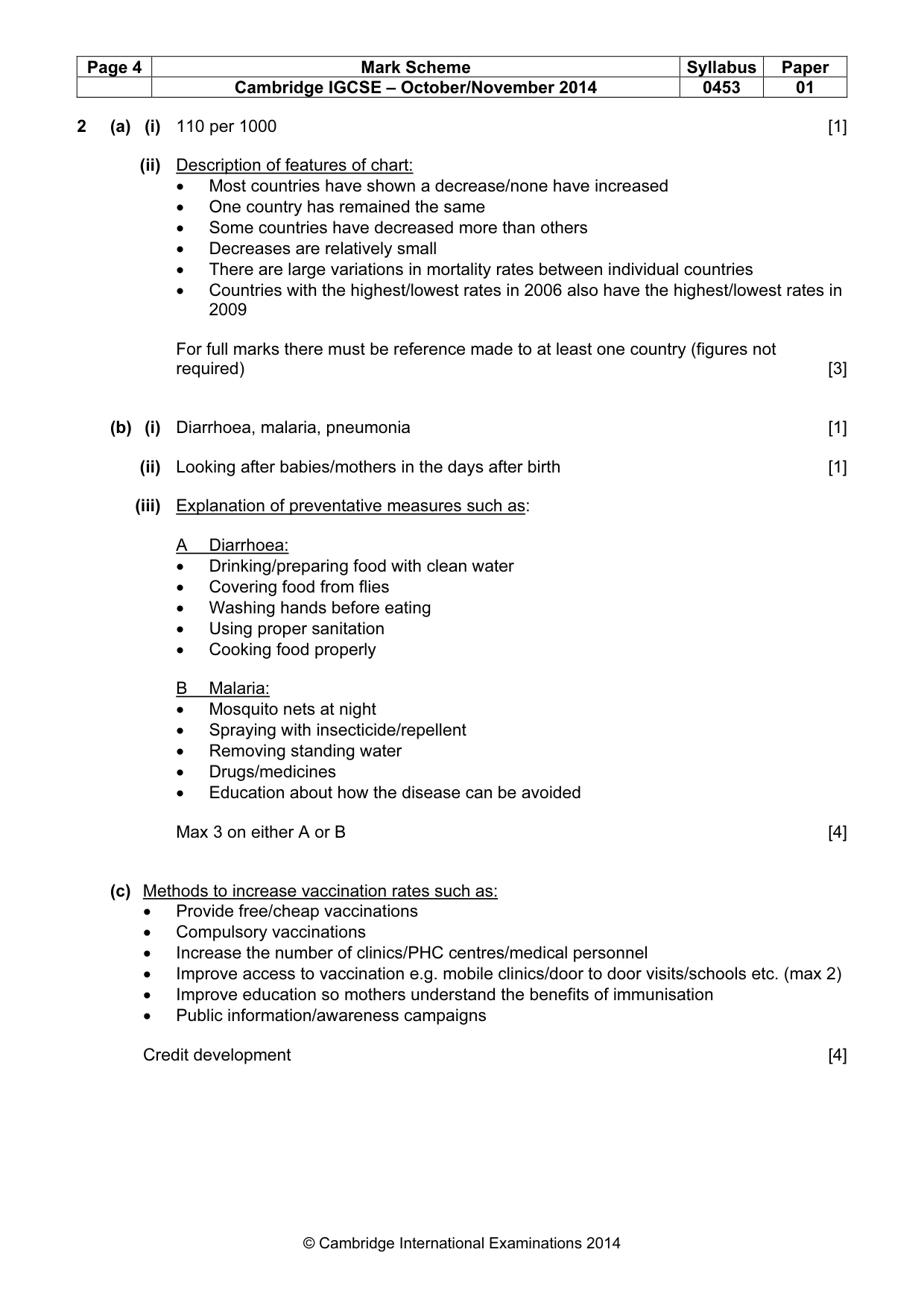
Page 4 Mark Scheme Syllabus Paper Cambridge IGCSE – October/November 2014 0453 01 © Cambridge International Examinations 2014 2 (a) (i) 110 per 1000 [1] (ii) Description of features of chart: • Most countries have shown a decrease/none have increased • One country has remained the same • Some countries have decreased more than others • Decreases are relatively small • There are large variations in mortality rates between individual countries • Countries with the highest/lowest rates in 2006 also have the highest/lowest rates in 2009 For full marks there must be reference made to at least one country (figures not required) [3] (b) (i) Diarrhoea, malaria, pneumonia [1] (ii) Looking after babies/mothers in the days after birth [1] (iii) Explanation of preventative measures such as: A Diarrhoea: • Drinking/preparing food with clean water • Covering food from flies • Washing hands before eating • Using proper sanitation • Cooking food properly B Malaria: • Mosquito nets at night • Spraying with insecticide/repellent • Removing standing water • Drugs/medicines • Education about how the disease can be avoided Max 3 on either A or B [4] (c) Methods to increase vaccination rates such as: • Provide free/cheap vaccinations • Compulsory vaccinations • Increase the number of clinics/PHC centres/medical personnel • Improve access to vaccination e.g. mobile clinics/door to door visits/schools etc. (max 2) • Improve education so mothers understand the benefits of immunisation • Public information/awareness campaigns Credit development [4]
Mark scheme, page 5
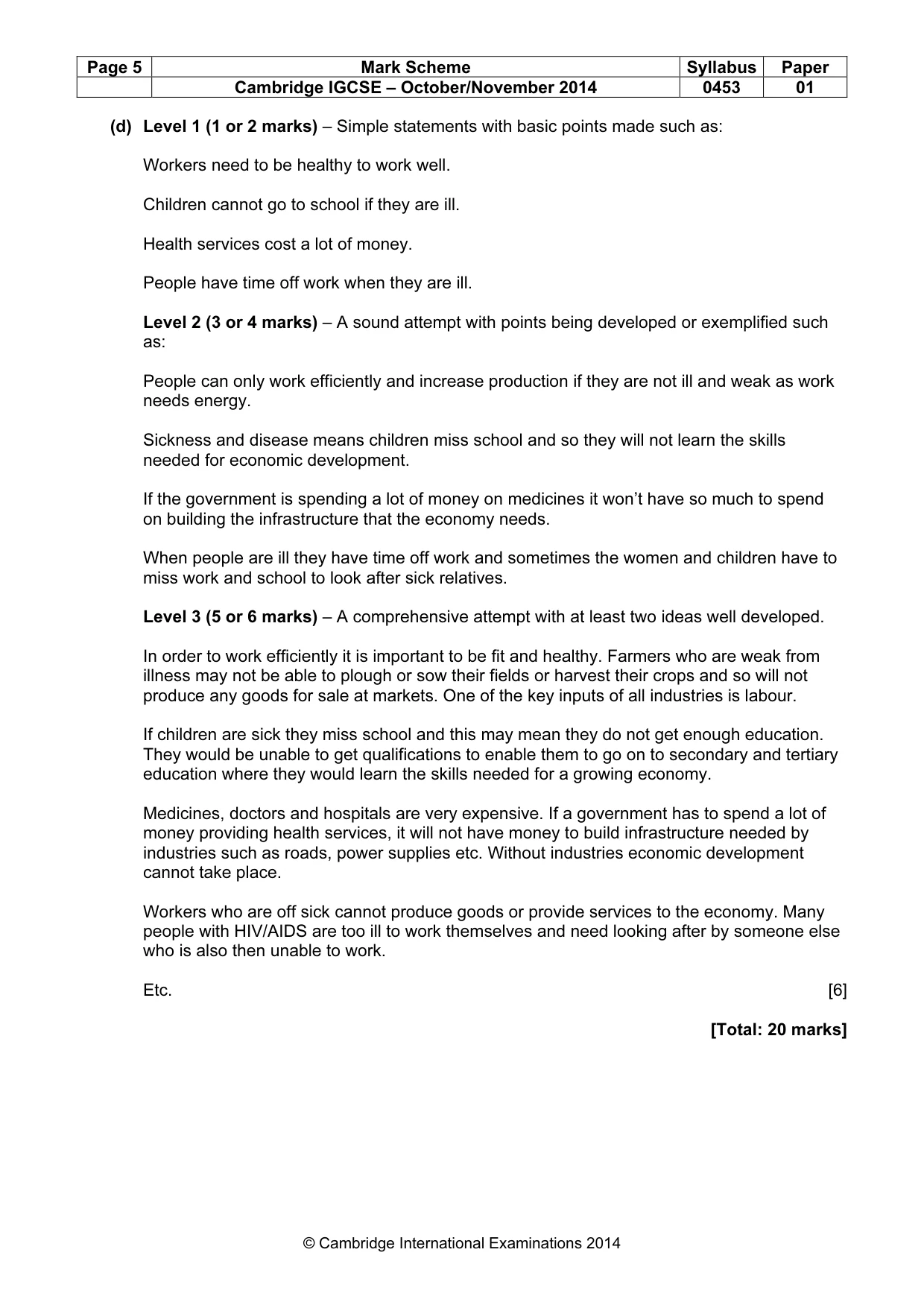
Page 5 Mark Scheme Syllabus Paper Cambridge IGCSE – October/November 2014 0453 01 © Cambridge International Examinations 2014 (d) Level 1 (1 or 2 marks) – Simple statements with basic points made such as: Workers need to be healthy to work well. Children cannot go to school if they are ill. Health services cost a lot of money. People have time off work when they are ill. Level 2 (3 or 4 marks) – A sound attempt with points being developed or exemplified such as: People can only work efficiently and increase production if they are not ill and weak as work needs energy. Sickness and disease means children miss school and so they will not learn the skills needed for economic development. If the government is spending a lot of money on medicines it won’t have so much to spend on building the infrastructure that the economy needs. When people are ill they have time off work and sometimes the women and children have to miss work and school to look after sick relatives. Level 3 (5 or 6 marks) – A comprehensive attempt with at least two ideas well developed. In order to work efficiently it is important to be fit and healthy. Farmers who are weak from illness may not be able to plough or sow their fields or harvest their crops and so will not produce any goods for sale at markets. One of the key inputs of all industries is labour. If children are sick they miss school and this may mean they do not get enough education. They would be unable to get qualifications to enable them to go on to secondary and tertiary education where they would learn the skills needed for a growing economy. Medicines, doctors and hospitals are very expensive. If a government has to spend a lot of money providing health services, it will not have money to build infrastructure needed by industries such as roads, power supplies etc. Without industries economic development cannot take place. Workers who are off sick cannot produce goods or provide services to the economy. Many people with HIV/AIDS are too ill to work themselves and need looking after by someone else who is also then unable to work. Etc. [6] [Total: 20 marks]
Mark scheme, page 6
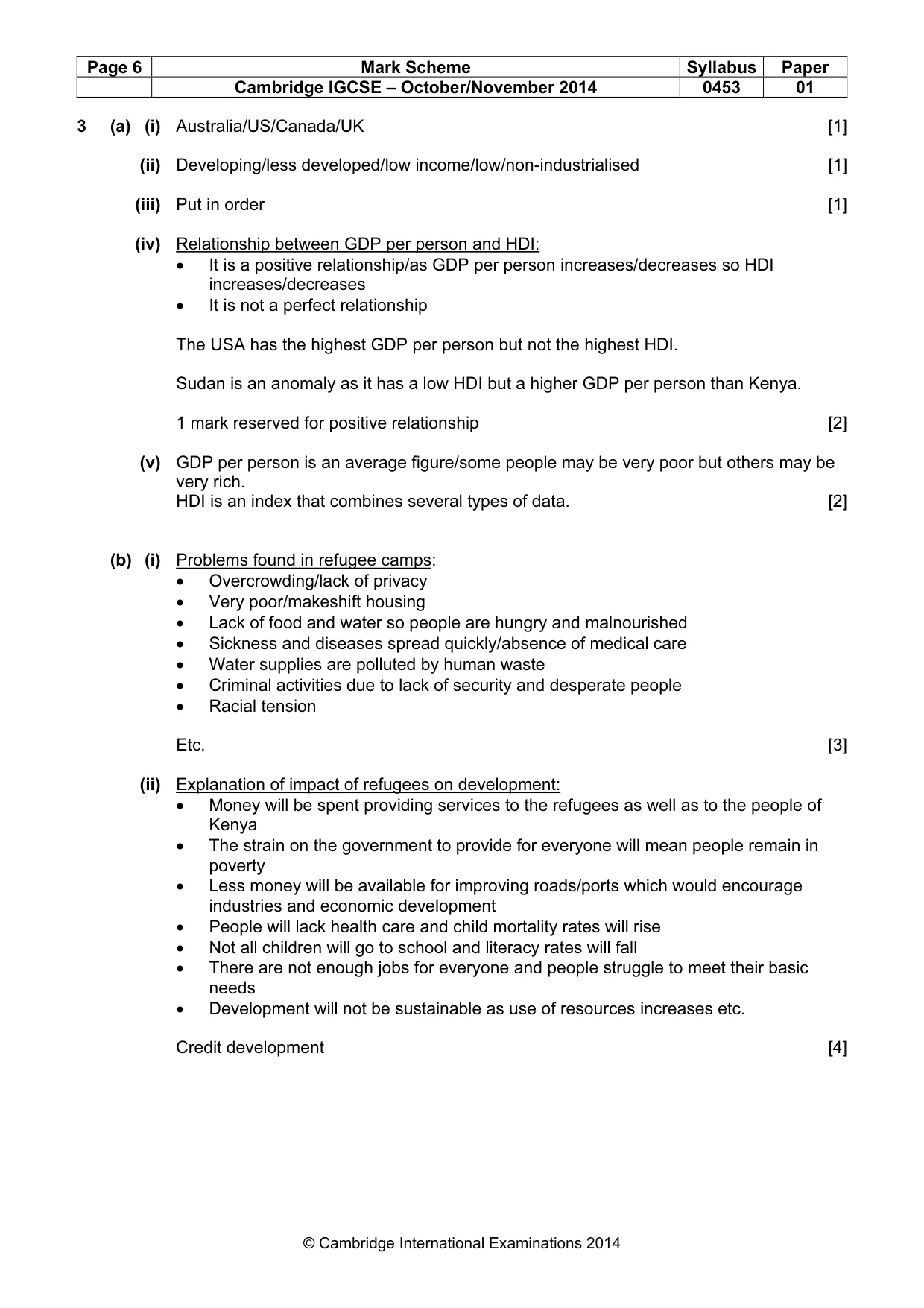
Page 6 Mark Scheme Syllabus Paper Cambridge IGCSE – October/November 2014 0453 01 © Cambridge International Examinations 2014 3 (a) (i) Australia/US/Canada/UK [1] (ii) Developing/less developed/low income/low/non-industrialised [1] (iii) Put in order [1] (iv) Relationship between GDP per person and HDI: • It is a positive relationship/as GDP per person increases/decreases so HDI increases/decreases • It is not a perfect relationship The USA has the highest GDP per person but not the highest HDI. Sudan is an anomaly as it has a low HDI but a higher GDP per person than Kenya. 1 mark reserved for positive relationship [2] (v) GDP per person is an average figure/some people may be very poor but others may be very rich. HDI is an index that combines several types of data. [2] (b) (i) Problems found in refugee camps: • Overcrowding/lack of privacy • Very poor/makeshift housing • Lack of food and water so people are hungry and malnourished • Sickness and diseases spread quickly/absence of medical care • Water supplies are polluted by human waste • Criminal activities due to lack of security and desperate people • Racial tension Etc. [3] (ii) Explanation of impact of refugees on development: • Money will be spent providing services to the refugees as well as to the people of Kenya • The strain on the government to provide for everyone will mean people remain in poverty • Less money will be available for improving roads/ports which would encourage industries and economic development • People will lack health care and child mortality rates will rise • Not all children will go to school and literacy rates will fall • There are not enough jobs for everyone and people struggle to meet their basic needs • Development will not be sustainable as use of resources increases etc. Credit development [4]
Mark scheme, page 7
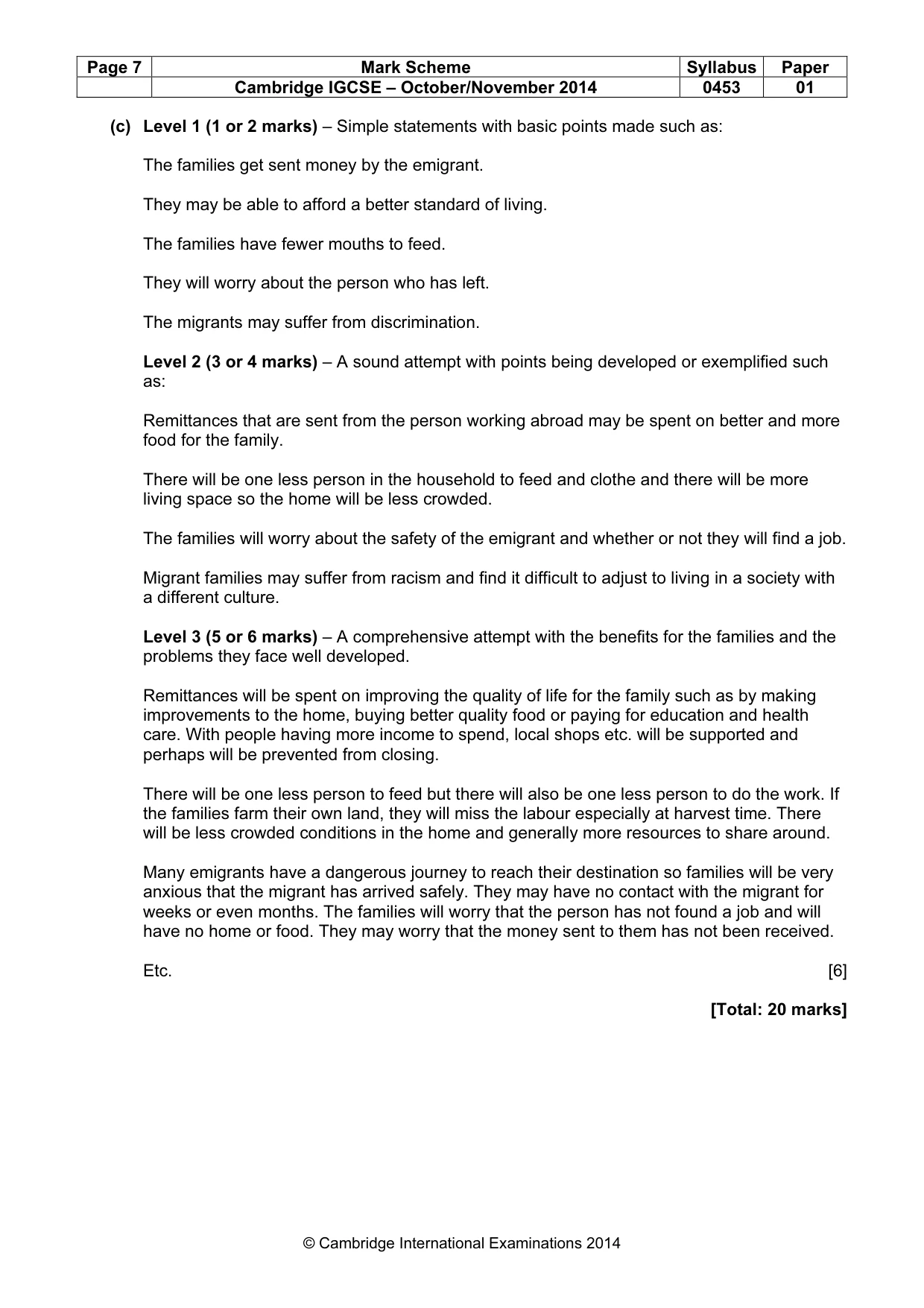
Page 7 Mark Scheme Syllabus Paper Cambridge IGCSE – October/November 2014 0453 01 © Cambridge International Examinations 2014 (c) Level 1 (1 or 2 marks) – Simple statements with basic points made such as: The families get sent money by the emigrant. They may be able to afford a better standard of living. The families have fewer mouths to feed. They will worry about the person who has left. The migrants may suffer from discrimination. Level 2 (3 or 4 marks) – A sound attempt with points being developed or exemplified such as: Remittances that are sent from the person working abroad may be spent on better and more food for the family. There will be one less person in the household to feed and clothe and there will be more living space so the home will be less crowded. The families will worry about the safety of the emigrant and whether or not they will find a job. Migrant families may suffer from racism and find it difficult to adjust to living in a society with a different culture. Level 3 (5 or 6 marks) – A comprehensive attempt with the benefits for the families and the problems they face well developed. Remittances will be spent on improving the quality of life for the family such as by making improvements to the home, buying better quality food or paying for education and health care. With people having more income to spend, local shops etc. will be supported and perhaps will be prevented from closing. There will be one less person to feed but there will also be one less person to do the work. If the families farm their own land, they will miss the labour especially at harvest time. There will be less crowded conditions in the home and generally more resources to share around. Many emigrants have a dangerous journey to reach their destination so families will be very anxious that the migrant has arrived safely. They may have no contact with the migrant for weeks or even months. The families will worry that the person has not found a job and will have no home or food. They may worry that the money sent to them has not been received. Etc. [6] [Total: 20 marks]
Mark scheme, page 8
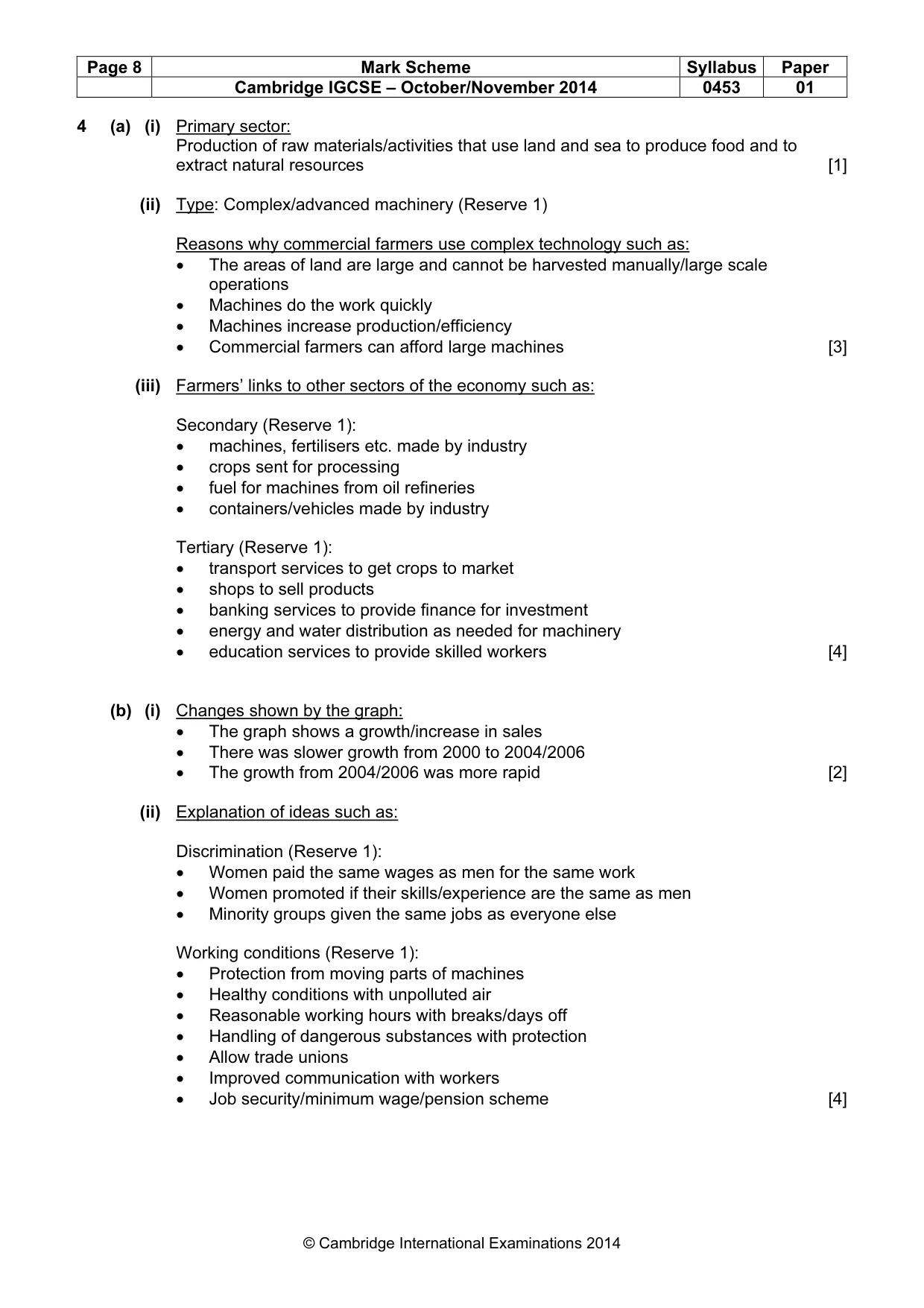
Page 8 Mark Scheme Syllabus Paper Cambridge IGCSE – October/November 2014 0453 01 © Cambridge International Examinations 2014 4 (a) (i) Primary sector: Production of raw materials/activities that use land and sea to produce food and to extract natural resources [1] (ii) Type: Complex/advanced machinery (Reserve 1) Reasons why commercial farmers use complex technology such as: • The areas of land are large and cannot be harvested manually/large scale operations • Machines do the work quickly • Machines increase production/efficiency • Commercial farmers can afford large machines [3] (iii) Farmers’ links to other sectors of the economy such as: Secondary (Reserve 1): • machines, fertilisers etc. made by industry • crops sent for processing • fuel for machines from oil refineries • containers/vehicles made by industry Tertiary (Reserve 1): • transport services to get crops to market • shops to sell products • banking services to provide finance for investment • energy and water distribution as needed for machinery • education services to provide skilled workers [4] (b) (i) Changes shown by the graph: • The graph shows a growth/increase in sales • There was slower growth from 2000 to 2004/2006 • The growth from 2004/2006 was more rapid [2] (ii) Explanation of ideas such as: Discrimination (Reserve 1): • Women paid the same wages as men for the same work • Women promoted if their skills/experience are the same as men • Minority groups given the same jobs as everyone else Working conditions (Reserve 1): • Protection from moving parts of machines • Healthy conditions with unpolluted air • Reasonable working hours with breaks/days off • Handling of dangerous substances with protection • Allow trade unions • Improved communication with workers • Job security/minimum wage/pension scheme [4]
Mark scheme, page 9
Page 9 Mark Scheme Syllabus Paper Cambridge IGCSE – October/November 2014 0453 01 © Cambridge International Examinations 2014 (c) Level 1 (1 or 2 marks) – Simple statements with basic points made such as: Pesticides will kill insects that eat the crop. Fertilisers may run off and pollute rivers. Machines pollute the air. Herbicides may kill all the wild flowers. Irrigation takes water from rivers. Level 2 (3 or 4 marks) – A sound attempt with points being developed or exemplified such as: Pesticides kill insects and this has an impact on the food chain. Some beneficial insects, such as bees, are killed. Fertilisers may run off into rivers and cause a huge growth of river plants. Machines can damage the soil which leads to erosion and loss of fertility. Irrigation may use water from rivers, will mean they suffer from lack of water which can cause fish to die. Level 3 (5 or 6 marks) – A comprehensive attempt with the effects on the natural environment well developed such as: Pesticides and herbicides kill insects and wild flowers which mean that birds have less to eat and this can have an impact up the food chain. Some insects such as bees are important for pollination but all the insects can be killed not just the pests. If the birds have no food supply they will also die and birds are important for seed dispersal. If fertilisers are sprayed onto crops the fertiliser can run-off into rivers when it rains. This can cause eutrophication when river plants grow so much they smother everything else and other river wildlife such as fish cannot survive. The ecosystem is disrupted and out of balance. Irrigation takes water from streams and rivers which means that they may dry up. Water plants and fish will die as they cannot move to other rivers. Many insects spend some of their life in water and they too will not survive. Etc. [6] [Total: 20 marks]
What you needed in this session
Cambridge’s own grade thresholds for 2014 Oct/Nov, Paper 1 · Variant 1. A higher threshold means an easier paper — the bar moves with how the cohort did.