Cambridge IGCSE Development Studies 0453 — 2016 Oct/Nov Paper 1 · Variant 1
0453/11/O/N/16 · 80 marks · ≈90 min
The question paper and its mark scheme, free to read here and free to download. This is Cambridge’s own paper, exactly as it was sat.
Question paper16 pages



Mark scheme11 pages
Answers below. Sit the paper first if you are practising.
Paper as text
Question paper, page 1
This document consists of 14 printed pages, 2 blank pages and 1 Insert. DC (NF/JG) 115845/5 © UCLES 2016 [Turn over Cambridge International Examinations Cambridge International General Certificate of Secondary Education * 7 6 4 7 5 4 0 0 5 0 * DEVELOPMENT STUDIES 0453/01 Paper 1 October/November 2016 2 hours Candidates answer on the Question Paper. Additional Materials: Ruler READ THESE INSTRUCTIONS FIRST Write your Centre number, candidate number and name on all the work you hand in. Write in dark blue or black pen. Do not use staples, paper clips, glue or correction fluid. You may use a pencil for any diagrams, graphs or rough working. DO NOT WRITE IN ANY BARCODES. Answer all the questions. You may not need all the answer lines for your answer. You should read and study the sources before answering the questions. The Insert contains Photographs A and B for Question 3(a). The Insert is not required by the Examiner. It can be kept by the Centre and used as a teaching resource. At the end of the examination, fasten all your work securely together. The number of marks is given in brackets [ ] at the end of each question or part question.
Question paper, page 2
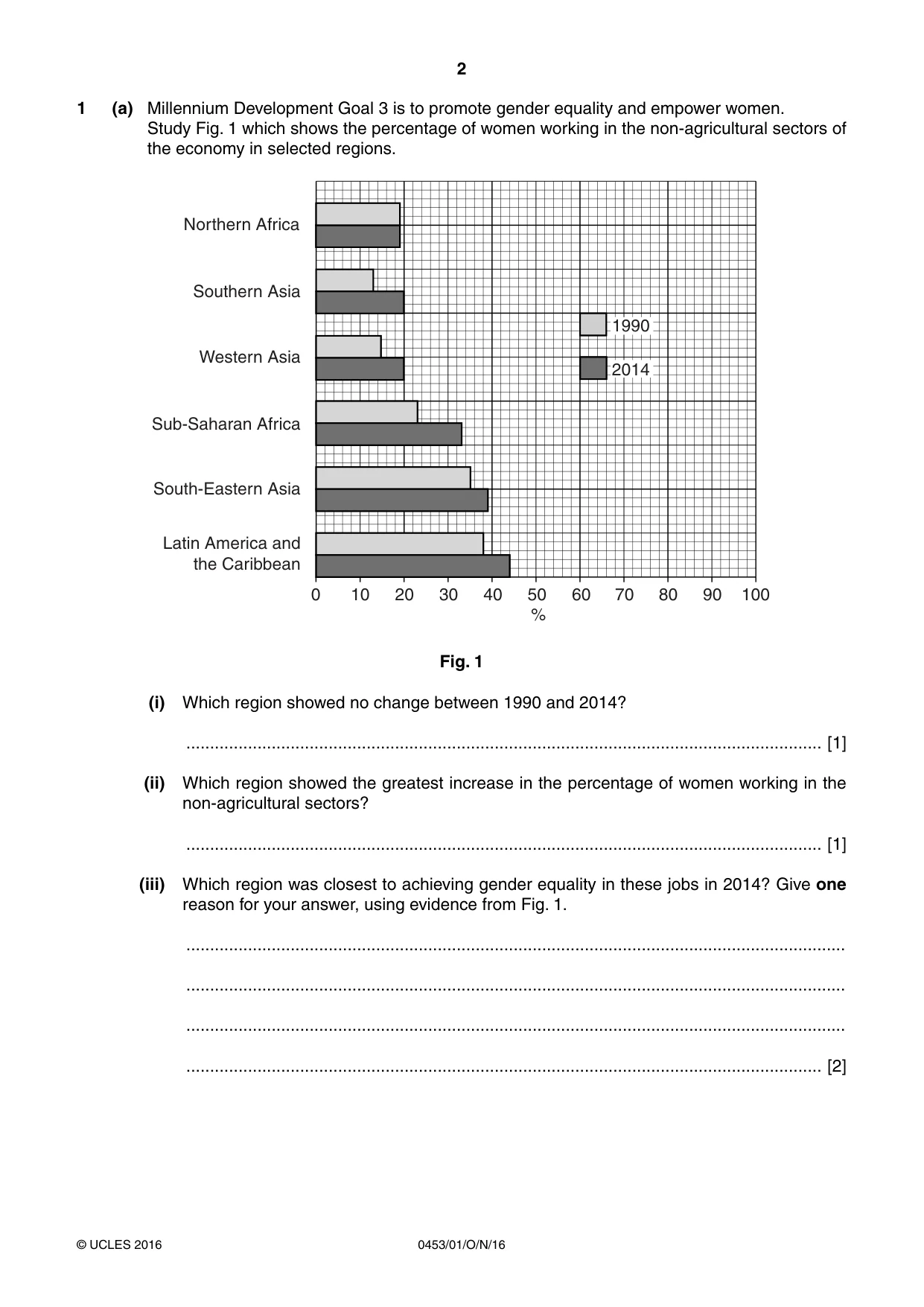
2 0453/01/O/N/16 © UCLES 2016 1 (a) Millennium Development Goal 3 is to promote gender equality and empower women. Study Fig. 1 which shows the percentage of women working in the non-agricultural sectors of the economy in selected regions. Northern Africa 10 0 20 30 40 50 60 70 80 90 100 Southern Asia Sub-Saharan Africa Latin America and the Caribbean South-Eastern Asia Western Asia % 1990 2014 Fig. 1 (i) Which region showed no change between 1990 and 2014? … [1] (ii) Which region showed the g reatest increase in the percentage of women working in the non-agricultural sectors? … [1] (iii) Which region was closest to achieving gender equality in these jobs in 2014? Give one reason for your answer, using evidence from Fig. 1. … … … … [2]
Question paper, page 3
3 0453/01/O/N/16 © UCLES 2016 [Turn over (b) (i) Describe the traditional role of women in many societies in developing countries. … … … … … … [3] (ii) Suggest three policies that would enable more women with families to take paid employment. 1 … … 2 … … 3 … … [3] (iii) Women have many roles at home, at work and in their community. Explain why it is important to involve women in decision-making. You may use examples in your answer. … … … … … … … … [4]
Question paper, page 4
4 0453/01/O/N/16 © UCLES 2016 (c) Explain how poor health and hunger in families can be reduced by promoting gender equality and empowering women. You should develop fully the points you make. … … … … … … … … … … … … … … … … … … … … [6] [Total: 20 marks]
Question paper, page 5
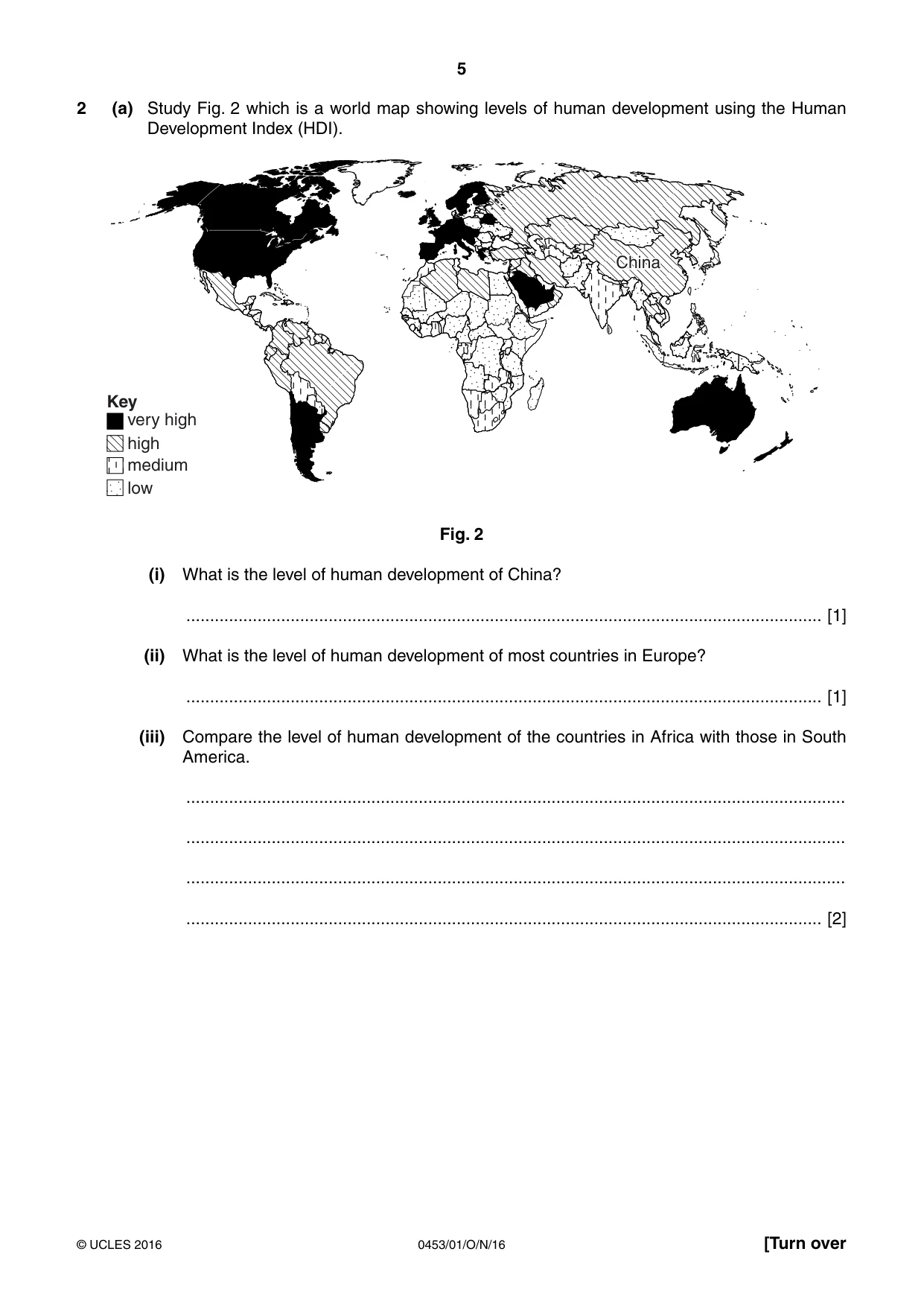
5 0453/01/O/N/16 © UCLES 2016 [Turn over 2 (a) Study Fig. 2 which is a world map showing levels of human development using the Human Development Index (HDI). very high high medium low Key China China Fig. 2 (i) What is the level of human development of China? … [1] (ii) What is the level of human development of most countries in Europe? … [1] (iii) Compare the level of human development of the countries in Africa with those in South America. … … … … [2]
Question paper, page 6
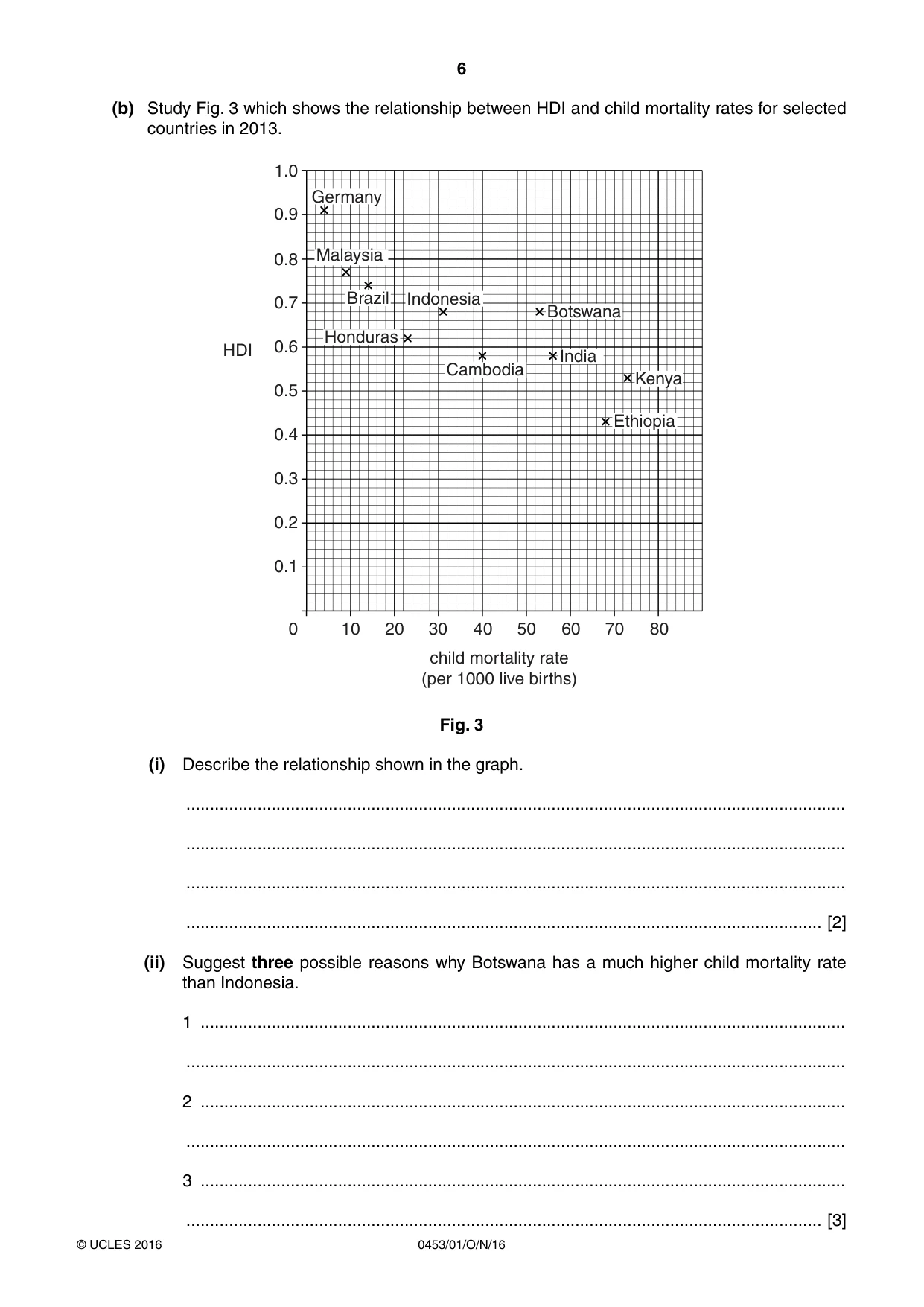
6 0453/01/O/N/16 © UCLES 2016 (b) Study Fig. 3 which shows the relationship between HDI and child mortality rates for selected countries in 2013. 0.6 0.5 0.4 0.3 0.2 0.1 0 10 20 30 40 50 60 70 80 0.7 0.8 0.9 1.0 Botswana Cambodia Indonesia Honduras Germany Ethiopia Kenya Malaysia India Brazil HDI child mortality rate (per 1000 live births) Fig. 3 (i) Describe the relationship shown in the graph. … … … … [2] (ii) Suggest three possible reasons why Botswana has a much higher child mortality rate than Indonesia. 1 … … 2 … … 3 … … [3]
Question paper, page 7
7 0453/01/O/N/16 © UCLES 2016 [Turn over (c) Describe the characteristics of countries at low levels of human development. Your answer should include reference to different indicators of poverty and development. … … … … … … … … … … [5]
Question paper, page 8
8 0453/01/O/N/16 © UCLES 2016 (d) Explain the benefits of providing rural communities with improved energy supplies. You should develop fully the points you make. … … … … … … … … … … … … … … … … … … … … [6] [Total: 20 marks]
Question paper, page 9
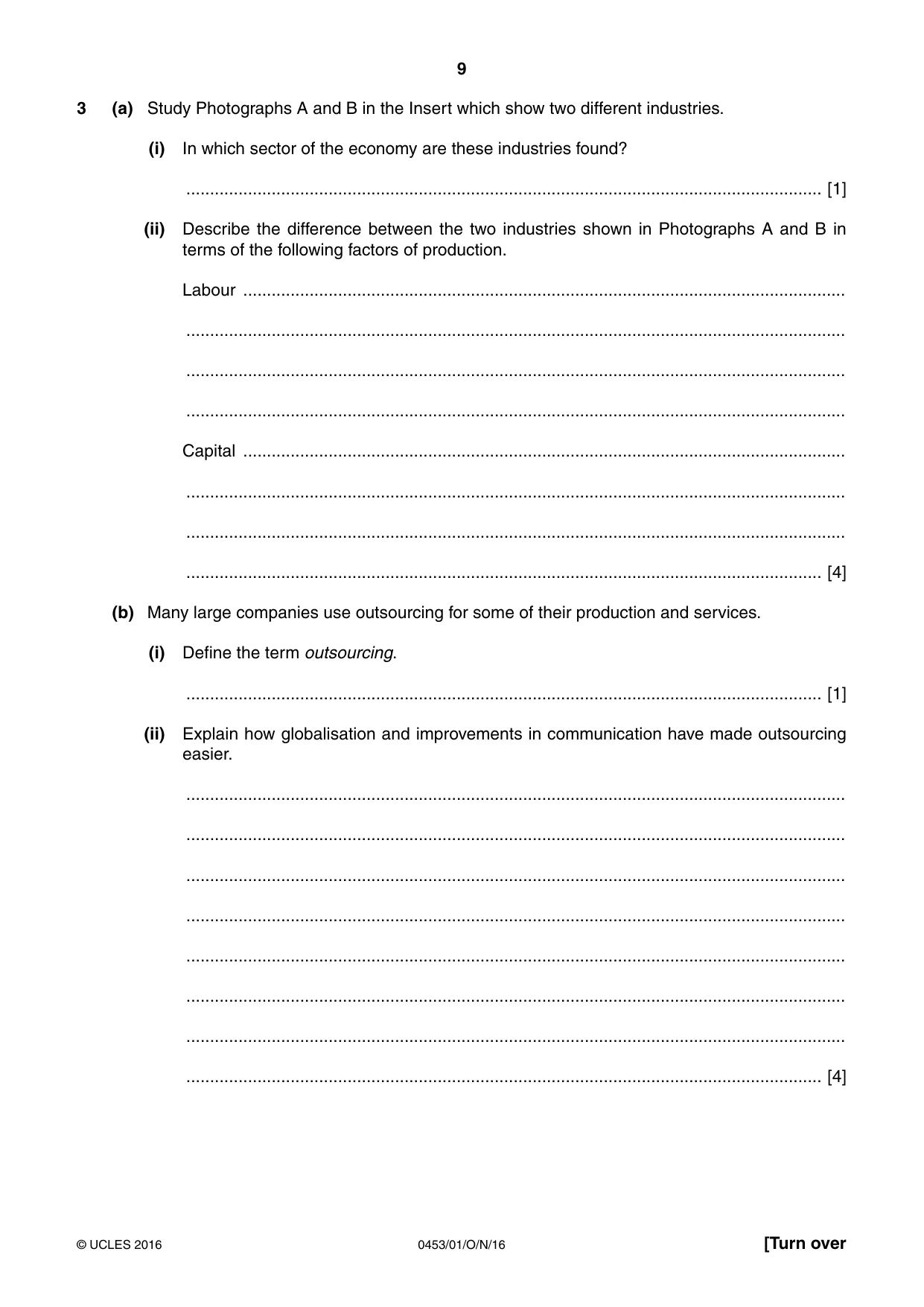
9 0453/01/O/N/16 © UCLES 2016 [Turn over 3 (a) Study Photographs A and B in the Insert which show two different industries. (i) In which sector of the economy are these industries found? … [1] (ii) Describe the difference between the two industries shown in Photographs A and B in terms of the following factors of production. Labour … … … … Capital … … … … [4] (b) Many large companies use outsourcing for some of their production and services. (i) Define the term outsourcing. … [1] (ii) Explain how globalisation and improvements in communication have made outsourcing easier. … … … … … … … … [4]
Question paper, page 10
10 0453/01/O/N/16 © UCLES 2016 (c) Many countries have a negative balance of trade (trade deficit). Explain how a negative balance of trade can be reduced. … … … … … … … … [4]
Question paper, page 11
11 0453/01/O/N/16 © UCLES 2016 [Turn over (d) Explain the advantages and disadvantages for the people in a developing country of a multinational company (MNC) setting up there. You should develop fully the points you make. … … … … … … … … … … … … … … … … … … … … [6] [Total: 20 marks]
Question paper, page 12
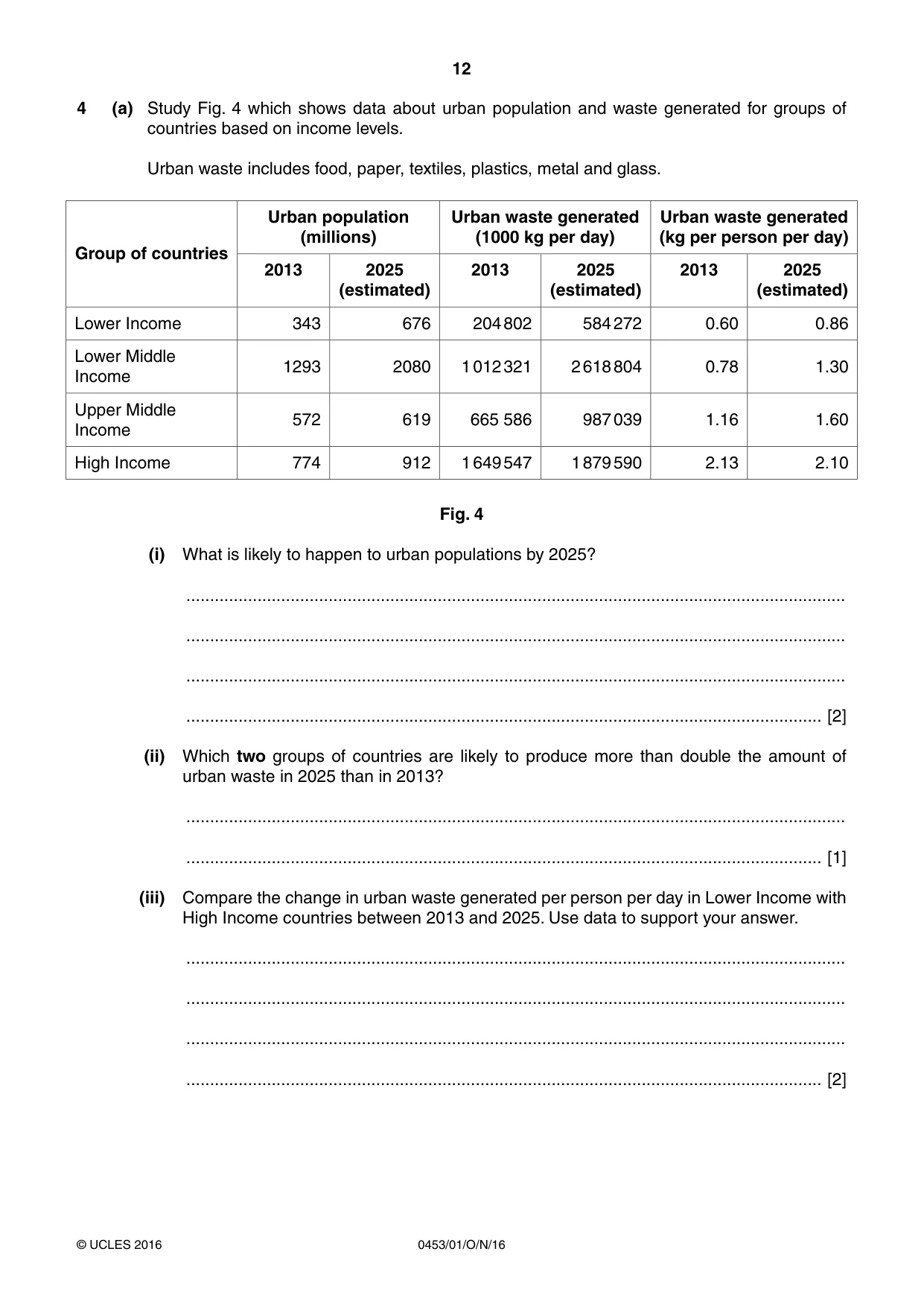
12 0453/01/O/N/16 © UCLES 2016 4 (a) Study Fig. 4 which shows data about urban population and waste generated for groups of countries based on income levels. Urban waste includes food, paper, textiles, plastics, metal and glass. Group of countries Urban population (millions) Urban waste generated (1000 kg per day) Urban waste generated (kg per person per day) 2013 2025 (estimated) 2013 2025 (estimated) 2013 2025 (estimated) Lower Income 343 676 204 802 584 272 0.60 0.86 Lower Middle Income 1293 2080 1 012 321 2 618 804 0.78 1.30 Upper Middle Income 572 619 665 586 987 039 1.16 1.60 High Income 774 912 1 649 547 1 879 590 2.13 2.10 Fig. 4 (i) What is likely to happen to urban populations by 2025? … … … … [2] (ii) Which two groups of countries are likely to produce more than double the amount of urban waste in 2025 than in 2013? … … [1] (iii) Compare the change in urban waste generated per person per day in Lower Income with High Income countries between 2013 and 2025. Use data to support your answer. … … … … [2]
Question paper, page 13
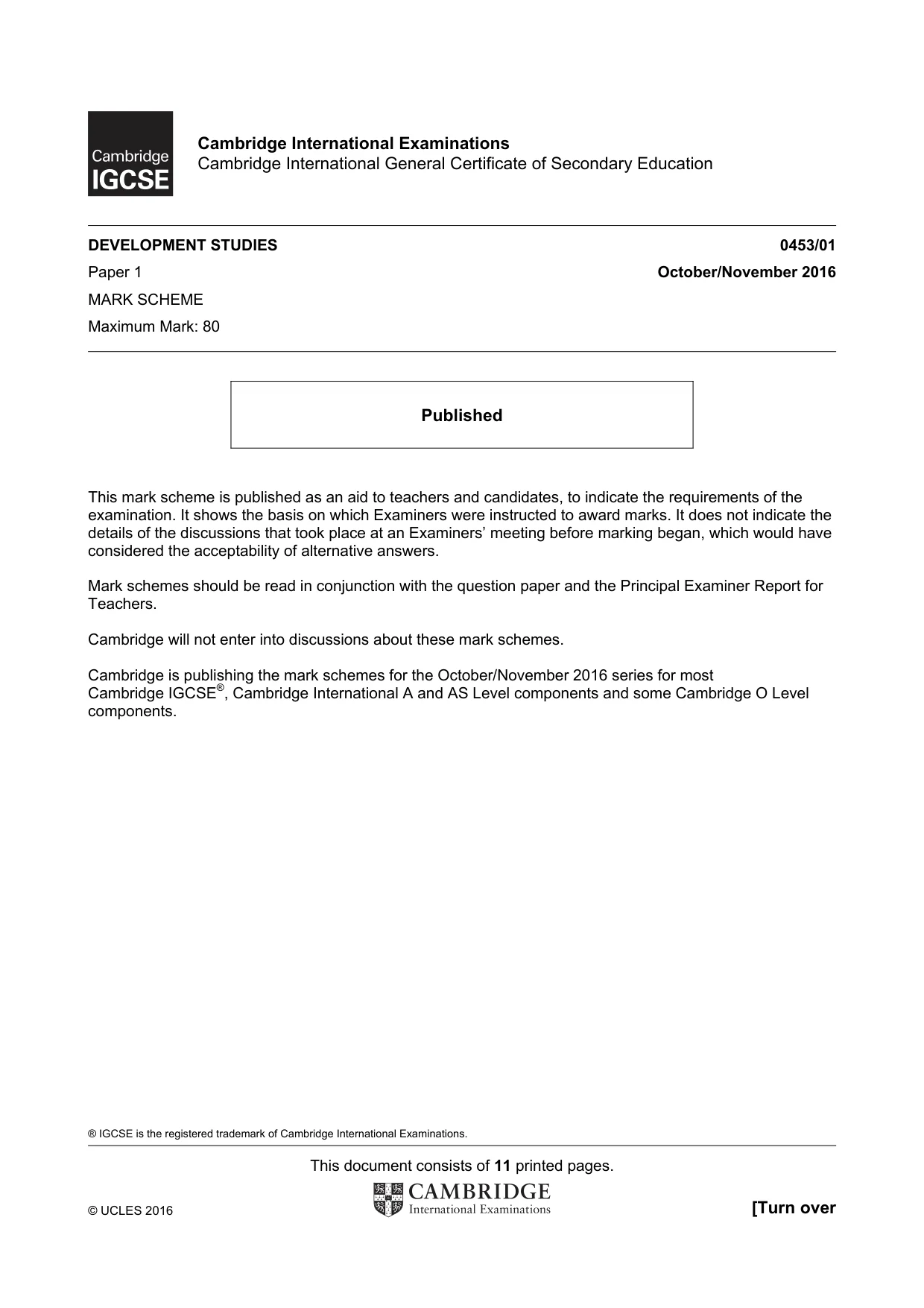
13 0453/01/O/N/16 © UCLES 2016 [Turn over (iv) Urban waste sent to landfill sites causes pollution of various types. Suggest sustainable ways to reduce the amount of urban waste sent to landfill sites. … … … … … … … … [4] (b) Farmers often use chemicals to increase their yields. Explain how the following can cause problems for the natural environment. Fertilisers … … … … … Pesticides/herbicides … … … … … [5]
Question paper, page 14
14 0453/01/O/N/16 © UCLES 2016 (c) The use of fossil fuels, such as oil and coal, causes air pollution. Evaluate ways to reduce the use of fossil fuels. You should develop fully the points you make. … … … … … … … … … … … … … … … … … … … … [6] [Total: 20 marks]
Question paper, page 15
15 0453/01/O/N/16 © UCLES 2016 BLANK PAGE
Question paper, page 16
16 0453/01/O/N/16 © UCLES 2016 BLANK PAGE Permission to reproduce items where third-party owned material protected by copyright is included has been sought and cleared where possible. Every reasonable effort has been made by the publisher (UCLES) to trace copyright holders, but if any items requiring clearance have unwittingly been included, the publisher will be pleased to make amends at the earliest possible opportunity. To avoid the issue of disclosure of answer-related information to candidates, all copyright acknowledgements are reproduced online in the Cambridge International Examinations Copyright Acknowledgements Booklet. This is produced for each series of examinations and is freely available to download at www.cie.org.uk after the live examination series. Cambridge International Examinations is part of the Cambridge Assessment Group. Cambridge Assessment is the brand name of University of Cambridge Local Examinations Syndicate (UCLES), which is itself a department of the University of Cambridge.
Mark scheme, page 1
® IGCSE is the registered trademark of Cambridge International Examinations. This document consists of 11 printed pages. © UCLES 2016 [Turn over Cambridge International Examinations Cambridge International General Certificate of Secondary Education DEVELOPMENT STUDIES 0453/01 Paper 1 October/November 2016 MARK SCHEME Maximum Mark: 80 Published This mark scheme is published as an aid to teachers and candidates, to indicate the requirements of the examination. It shows the basis on which Examiners were instructed to award marks. It does not indicate the details of the discussions that took place at an Examiners’ meeting before marking began, which would have considered the acceptability of alternative answers. Mark schemes should be read in conjunction with the question paper and the Principal Examiner Report for Teachers. Cambridge will not enter into discussions about these mark schemes. Cambridge is publishing the mark schemes for the October/November 2016 series for most Cambridge IGCSE®, Cambridge International A and AS Level components and some Cambridge O Level components.
Mark scheme, page 2
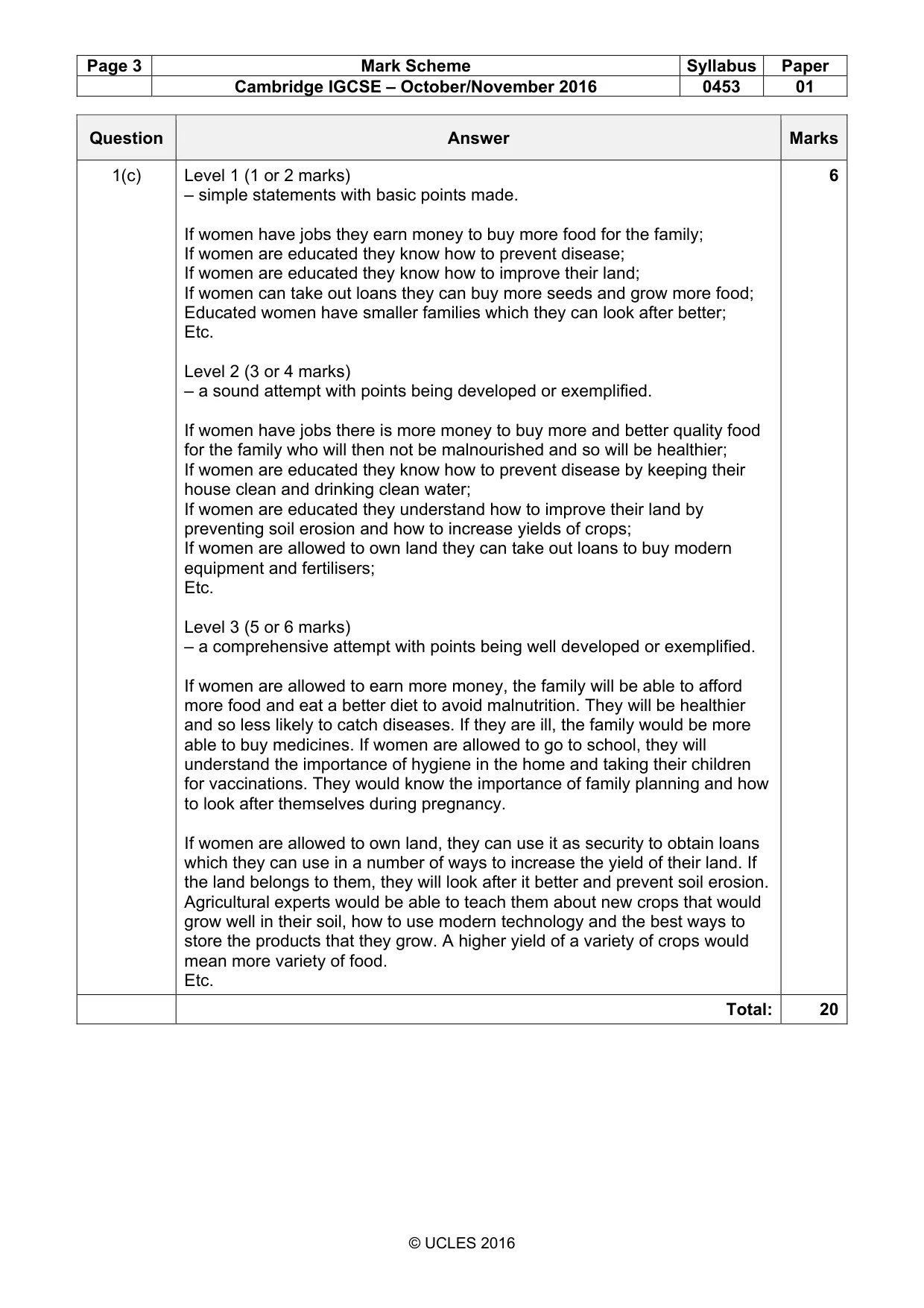
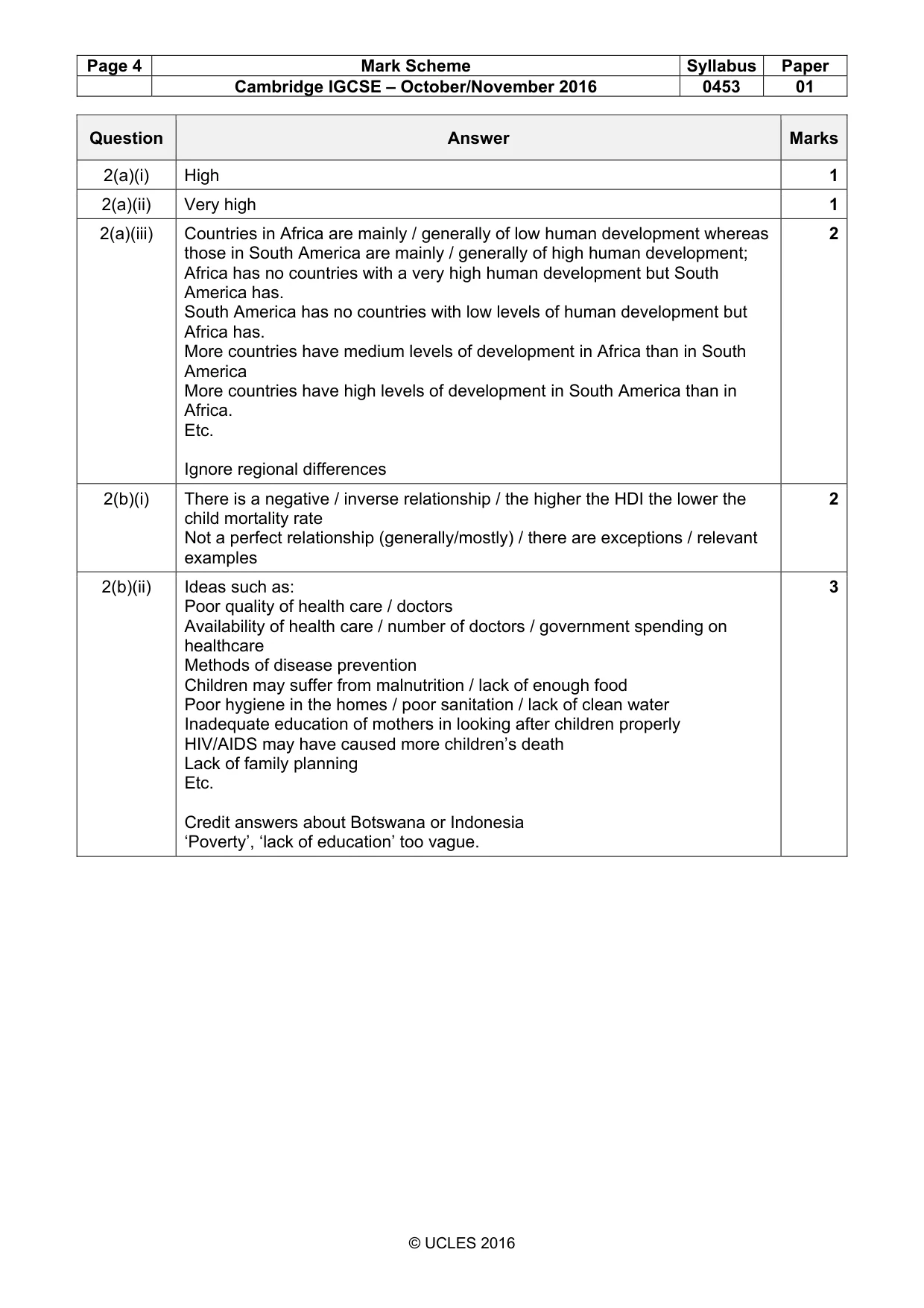
Page 2 Mark Scheme Syllabus Paper Cambridge IGCSE – October/November 2016 0453 01 © UCLES 2016 Question Answer Marks 1(a)(i) Northern Africa 1 1(a)(ii) Sub-Saharan Africa 1 1(a)(iii) Latin America and the Caribbean Women workers are almost / nearly / close to / about to reach 50% 2 1(b)(i) Ideas such as: Doing the housework / cleaning / cooking Cottage industries / informal jobs outside home / e.g. maid, street vendor etc. Bearing children / looking after the children / teaching children Looking after sick / elderly relatives Working on the family farm / looking after livestock Fetching firewood / water / food / shopping Community activities Example of women’s status in home Etc. Lists can be credited. ‘Looking after family’, ‘working from home’ – too vague 3 1(b)(ii) Ideas such as: (Promote) gender equality / reduce discrimination / education for women Example of policy to promote gender equality / women’s empowerment [dev] such as quotas, stopping sexual harassment Encourage men to do greater share of housework / child rearing Availability of primary education / child care / crèches at work; Job sharing; Part-time employment; Day centres for elderly relatives; Flexible working hours; Paid maternity benefits; Etc. Max 2 for addressing women’s equality issues in general 3 1(b)(iii) Ideas such as: Women have different ideas / perspective / opinions / solve problems in a different way Equal rights / gender equality / fairness Issues of importance to women may not be considered if only men make decisions Waste of resources if half the world’s population cannot have a say Women carry out the decisions / are most involved in the home Increase in confidence / women feel more valued / more involved Women now have better skills / are more educated and so can make good decisions Women often have to make decisions if the men have migrated Act as role model for young girls Etc. Credit examples as development to max 1 4
Mark scheme, page 3
Page 3 Mark Scheme Syllabus Paper Cambridge IGCSE – October/November 2016 0453 01 © UCLES 2016 Question Answer Marks 1(c) Level 1 (1 or 2 marks) – simple statements with basic points made. If women have jobs they earn money to buy more food for the family; If women are educated they know how to prevent disease; If women are educated they know how to improve their land; If women can take out loans they can buy more seeds and grow more food; Educated women have smaller families which they can look after better; Etc. Level 2 (3 or 4 marks) – a sound attempt with points being developed or exemplified. If women have jobs there is more money to buy more and better quality food for the family who will then not be malnourished and so will be healthier; If women are educated they know how to prevent disease by keeping their house clean and drinking clean water; If women are educated they understand how to improve their land by preventing soil erosion and how to increase yields of crops; If women are allowed to own land they can take out loans to buy modern equipment and fertilisers; Etc. Level 3 (5 or 6 marks) – a comprehensive attempt with points being well developed or exemplified. If women are allowed to earn more money, the family will be able to afford more food and eat a better diet to avoid malnutrition. They will be healthier and so less likely to catch diseases. If they are ill, the family would be more able to buy medicines. If women are allowed to go to school, they will understand the importance of hygiene in the home and taking their children for vaccinations. They would know the importance of family planning and how to look after themselves during pregnancy. If women are allowed to own land, they can use it as security to obtain loans which they can use in a number of ways to increase the yield of their land. If the land belongs to them, they will look after it better and prevent soil erosion. Agricultural experts would be able to teach them about new crops that would grow well in their soil, how to use modern technology and the best ways to store the products that they grow. A higher yield of a variety of crops would mean more variety of food. Etc. 6 Total: 20
Mark scheme, page 4
Page 4 Mark Scheme Syllabus Paper Cambridge IGCSE – October/November 2016 0453 01 © UCLES 2016 Question Answer Marks 2(a)(i) High 1 2(a)(ii) Very high 1 2(a)(iii) Countries in Africa are mainly / generally of low human development whereas those in South America are mainly / generally of high human development; Africa has no countries with a very high human development but South America has. South America has no countries with low levels of human development but Africa has. More countries have medium levels of development in Africa than in South America More countries have high levels of development in South America than in Africa. Etc. Ignore regional differences 2 2(b)(i) There is a negative / inverse relationship / the higher the HDI the lower the child mortality rate Not a perfect relationship (generally/mostly) / there are exceptions / relevant examples 2 2(b)(ii) Ideas such as: Poor quality of health care / doctors Availability of health care / number of doctors / government spending on healthcare Methods of disease prevention Children may suffer from malnutrition / lack of enough food Poor hygiene in the homes / poor sanitation / lack of clean water Inadequate education of mothers in looking after children properly HIV/AIDS may have caused more children’s death Lack of family planning Etc. Credit answers about Botswana or Indonesia ‘Poverty’, ‘lack of education’ too vague. 3
Mark scheme, page 5
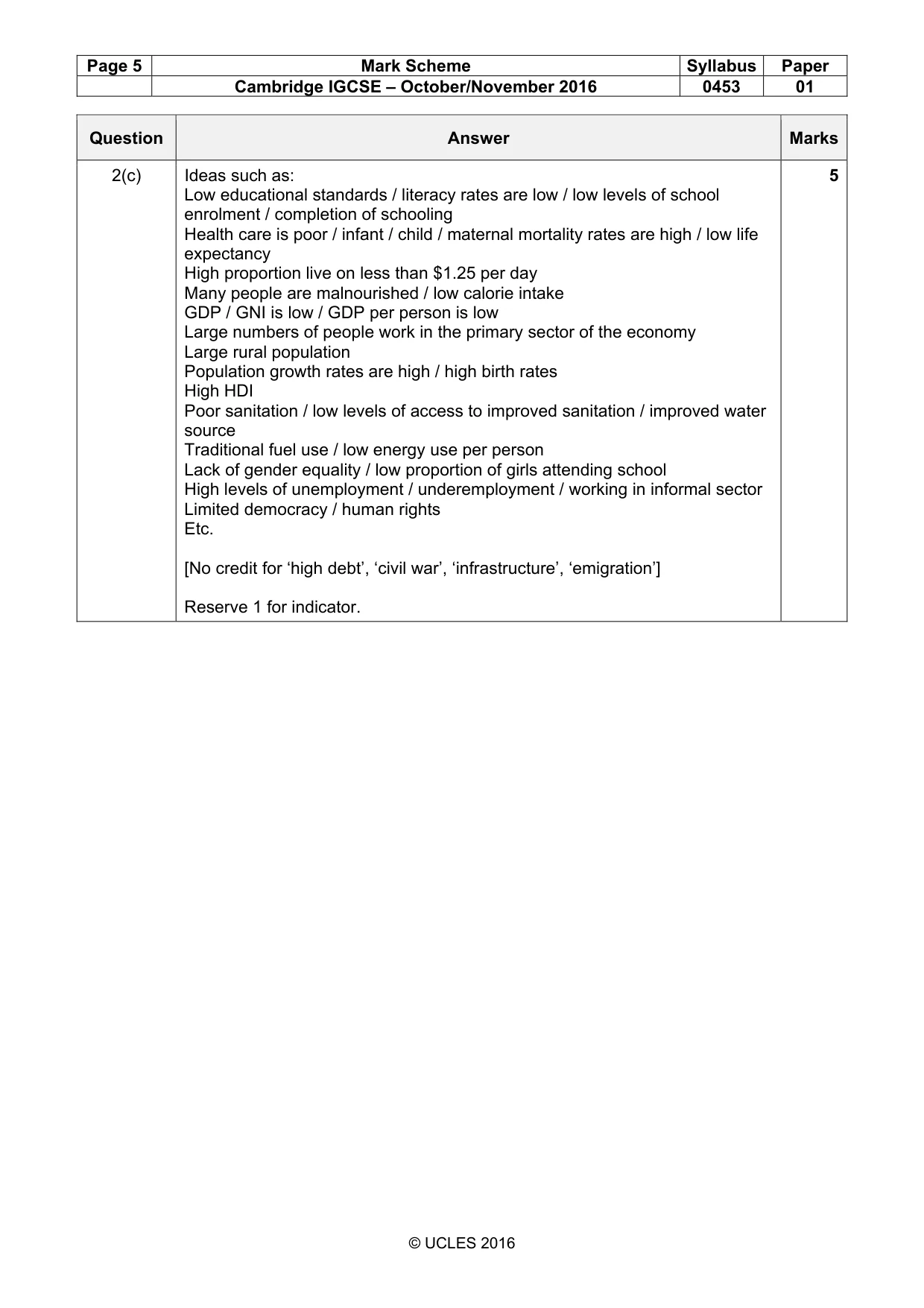
Page 5 Mark Scheme Syllabus Paper Cambridge IGCSE – October/November 2016 0453 01 © UCLES 2016 Question Answer Marks 2(c) Ideas such as: Low educational standards / literacy rates are low / low levels of school enrolment / completion of schooling Health care is poor / infant / child / maternal mortality rates are high / low life expectancy High proportion live on less than $1.25 per day Many people are malnourished / low calorie intake GDP / GNI is low / GDP per person is low Large numbers of people work in the primary sector of the economy Large rural population Population growth rates are high / high birth rates High HDI Poor sanitation / low levels of access to improved sanitation / improved water source Traditional fuel use / low energy use per person Lack of gender equality / low proportion of girls attending school High levels of unemployment / underemployment / working in informal sector Limited democracy / human rights Etc. [No credit for ‘high debt’, ‘civil war’, ‘infrastructure’, ‘emigration’] Reserve 1 for indicator. 5
Mark scheme, page 6
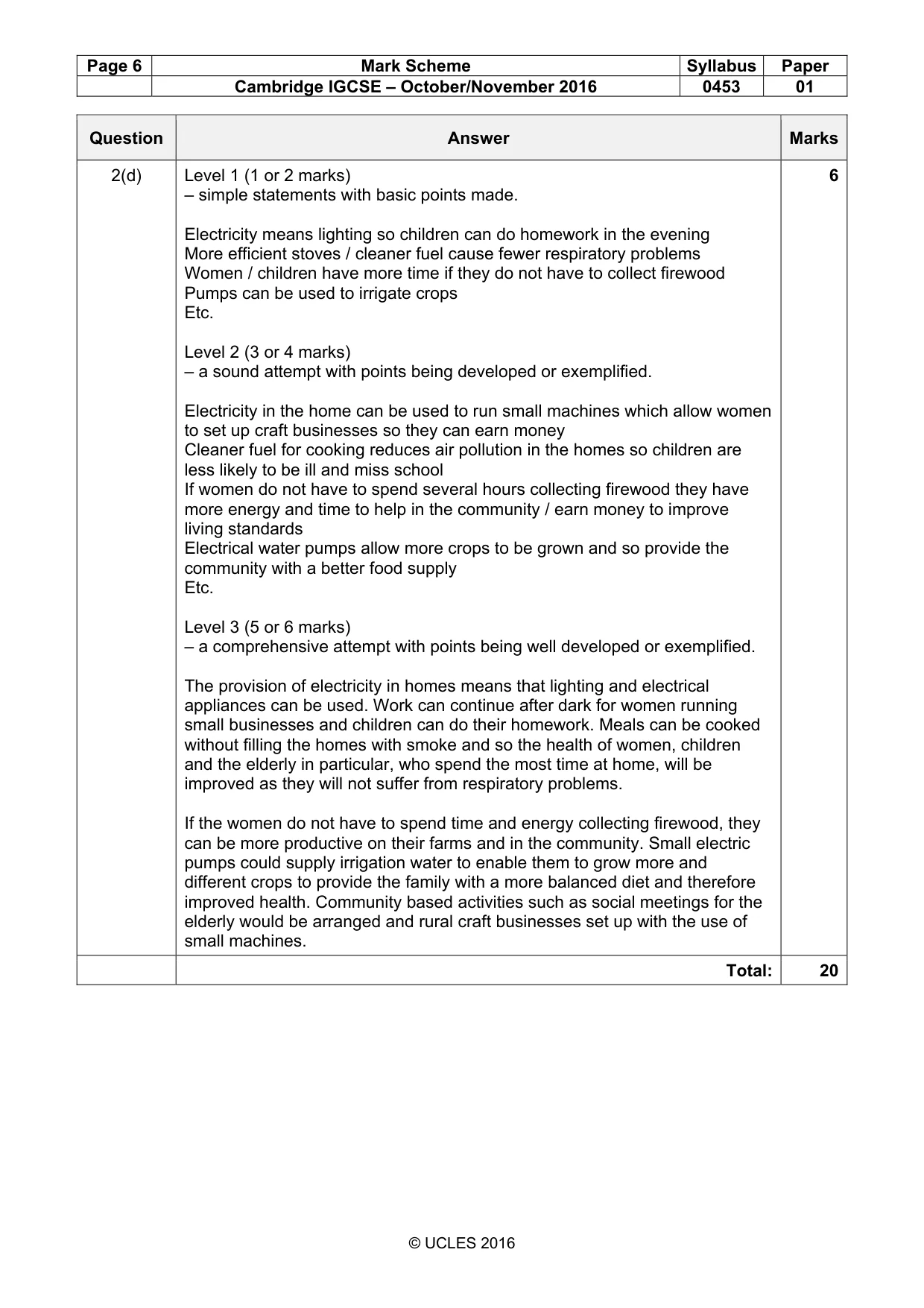
Page 6 Mark Scheme Syllabus Paper Cambridge IGCSE – October/November 2016 0453 01 © UCLES 2016 Question Answer Marks 2(d) Level 1 (1 or 2 marks) – simple statements with basic points made. Electricity means lighting so children can do homework in the evening More efficient stoves / cleaner fuel cause fewer respiratory problems Women / children have more time if they do not have to collect firewood Pumps can be used to irrigate crops Etc. Level 2 (3 or 4 marks) – a sound attempt with points being developed or exemplified. Electricity in the home can be used to run small machines which allow women to set up craft businesses so they can earn money Cleaner fuel for cooking reduces air pollution in the homes so children are less likely to be ill and miss school If women do not have to spend several hours collecting firewood they have more energy and time to help in the community / earn money to improve living standards Electrical water pumps allow more crops to be grown and so provide the community with a better food supply Etc. Level 3 (5 or 6 marks) – a comprehensive attempt with points being well developed or exemplified. The provision of electricity in homes means that lighting and electrical appliances can be used. Work can continue after dark for women running small businesses and children can do their homework. Meals can be cooked without filling the homes with smoke and so the health of women, children and the elderly in particular, who spend the most time at home, will be improved as they will not suffer from respiratory problems. If the women do not have to spend time and energy collecting firewood, they can be more productive on their farms and in the community. Small electric pumps could supply irrigation water to enable them to grow more and different crops to provide the family with a more balanced diet and therefore improved health. Community based activities such as social meetings for the elderly would be arranged and rural craft businesses set up with the use of small machines. 6 Total: 20
Mark scheme, page 7
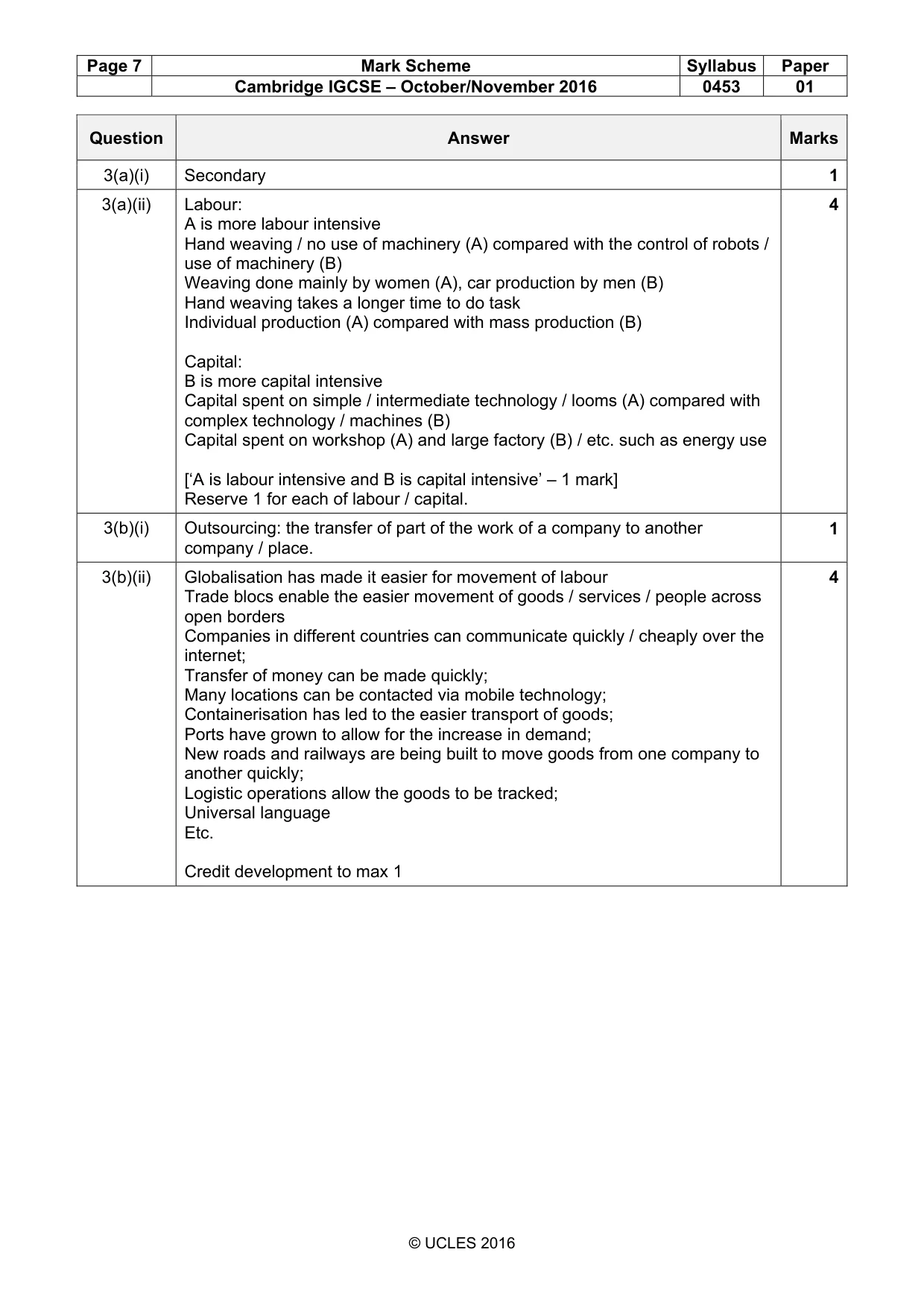
Page 7 Mark Scheme Syllabus Paper Cambridge IGCSE – October/November 2016 0453 01 © UCLES 2016 Question Answer Marks 3(a)(i) Secondary 1 3(a)(ii) Labour: A is more labour intensive Hand weaving / no use of machinery (A) compared with the control of robots / use of machinery (B) Weaving done mainly by women (A), car production by men (B) Hand weaving takes a longer time to do task Individual production (A) compared with mass production (B) Capital: B is more capital intensive Capital spent on simple / intermediate technology / looms (A) compared with complex technology / machines (B) Capital spent on workshop (A) and large factory (B) / etc. such as energy use [‘A is labour intensive and B is capital intensive’ – 1 mark] Reserve 1 for each of labour / capital. 4 3(b)(i) Outsourcing: the transfer of part of the work of a company to another company / place. 1 3(b)(ii) Globalisation has made it easier for movement of labour Trade blocs enable the easier movement of goods / services / people across open borders Companies in different countries can communicate quickly / cheaply over the internet; Transfer of money can be made quickly; Many locations can be contacted via mobile technology; Containerisation has led to the easier transport of goods; Ports have grown to allow for the increase in demand; New roads and railways are being built to move goods from one company to another quickly; Logistic operations allow the goods to be tracked; Universal language Etc. Credit development to max 1 4
Mark scheme, page 8
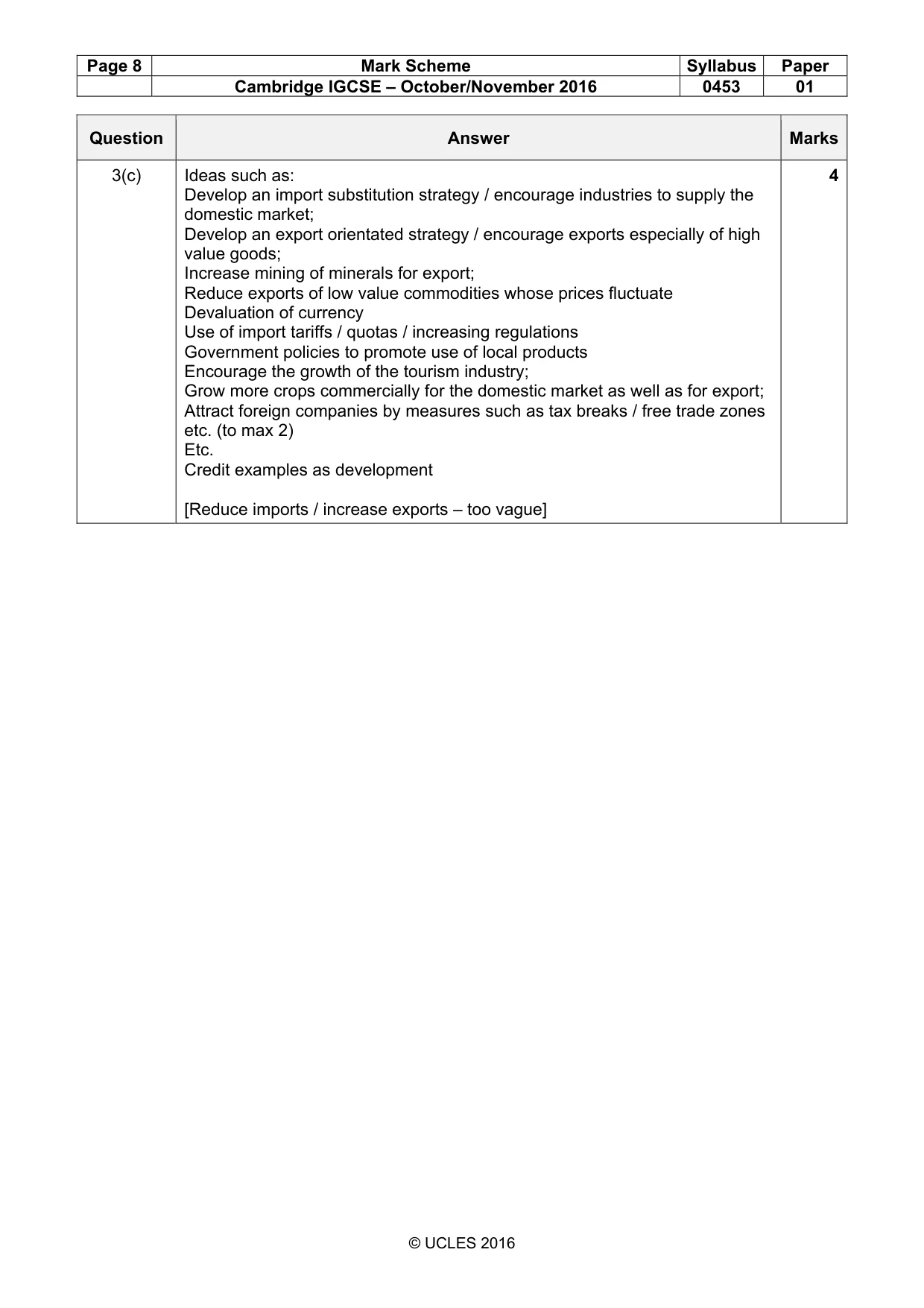
Page 8 Mark Scheme Syllabus Paper Cambridge IGCSE – October/November 2016 0453 01 © UCLES 2016 Question Answer Marks 3(c) Ideas such as: Develop an import substitution strategy / encourage industries to supply the domestic market; Develop an export orientated strategy / encourage exports especially of high value goods; Increase mining of minerals for export; Reduce exports of low value commodities whose prices fluctuate Devaluation of currency Use of import tariffs / quotas / increasing regulations Government policies to promote use of local products Encourage the growth of the tourism industry; Grow more crops commercially for the domestic market as well as for export; Attract foreign companies by measures such as tax breaks / free trade zones etc. (to max 2) Etc. Credit examples as development [Reduce imports / increase exports – too vague] 4
Mark scheme, page 9
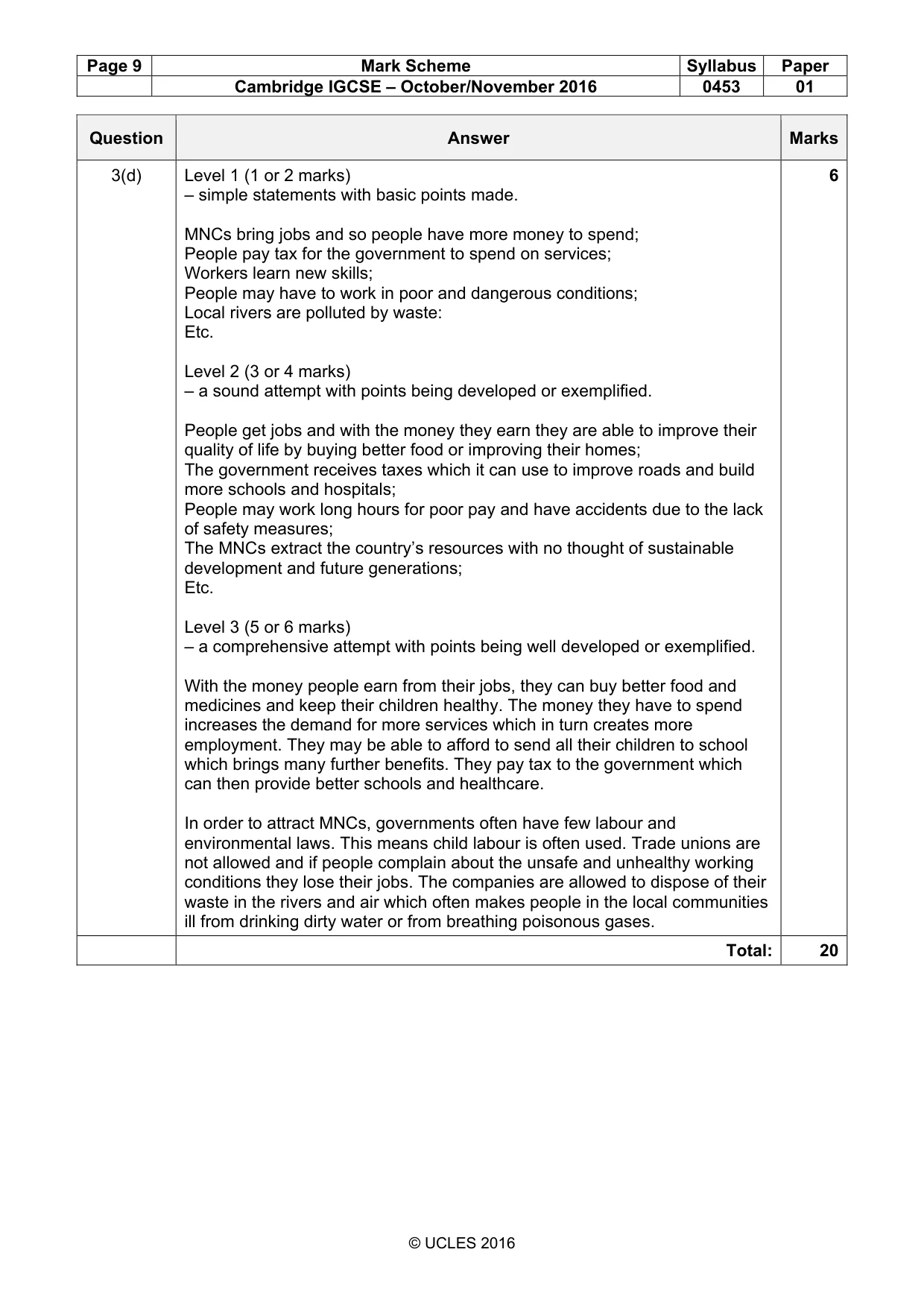
Page 9 Mark Scheme Syllabus Paper Cambridge IGCSE – October/November 2016 0453 01 © UCLES 2016 Question Answer Marks 3(d) Level 1 (1 or 2 marks) – simple statements with basic points made. MNCs bring jobs and so people have more money to spend; People pay tax for the government to spend on services; Workers learn new skills; People may have to work in poor and dangerous conditions; Local rivers are polluted by waste: Etc. Level 2 (3 or 4 marks) – a sound attempt with points being developed or exemplified. People get jobs and with the money they earn they are able to improve their quality of life by buying better food or improving their homes; The government receives taxes which it can use to improve roads and build more schools and hospitals; People may work long hours for poor pay and have accidents due to the lack of safety measures; The MNCs extract the country’s resources with no thought of sustainable development and future generations; Etc. Level 3 (5 or 6 marks) – a comprehensive attempt with points being well developed or exemplified. With the money people earn from their jobs, they can buy better food and medicines and keep their children healthy. The money they have to spend increases the demand for more services which in turn creates more employment. They may be able to afford to send all their children to school which brings many further benefits. They pay tax to the government which can then provide better schools and healthcare. In order to attract MNCs, governments often have few labour and environmental laws. This means child labour is often used. Trade unions are not allowed and if people complain about the unsafe and unhealthy working conditions they lose their jobs. The companies are allowed to dispose of their waste in the rivers and air which often makes people in the local communities ill from drinking dirty water or from breathing poisonous gases. 6 Total: 20
Mark scheme, page 10
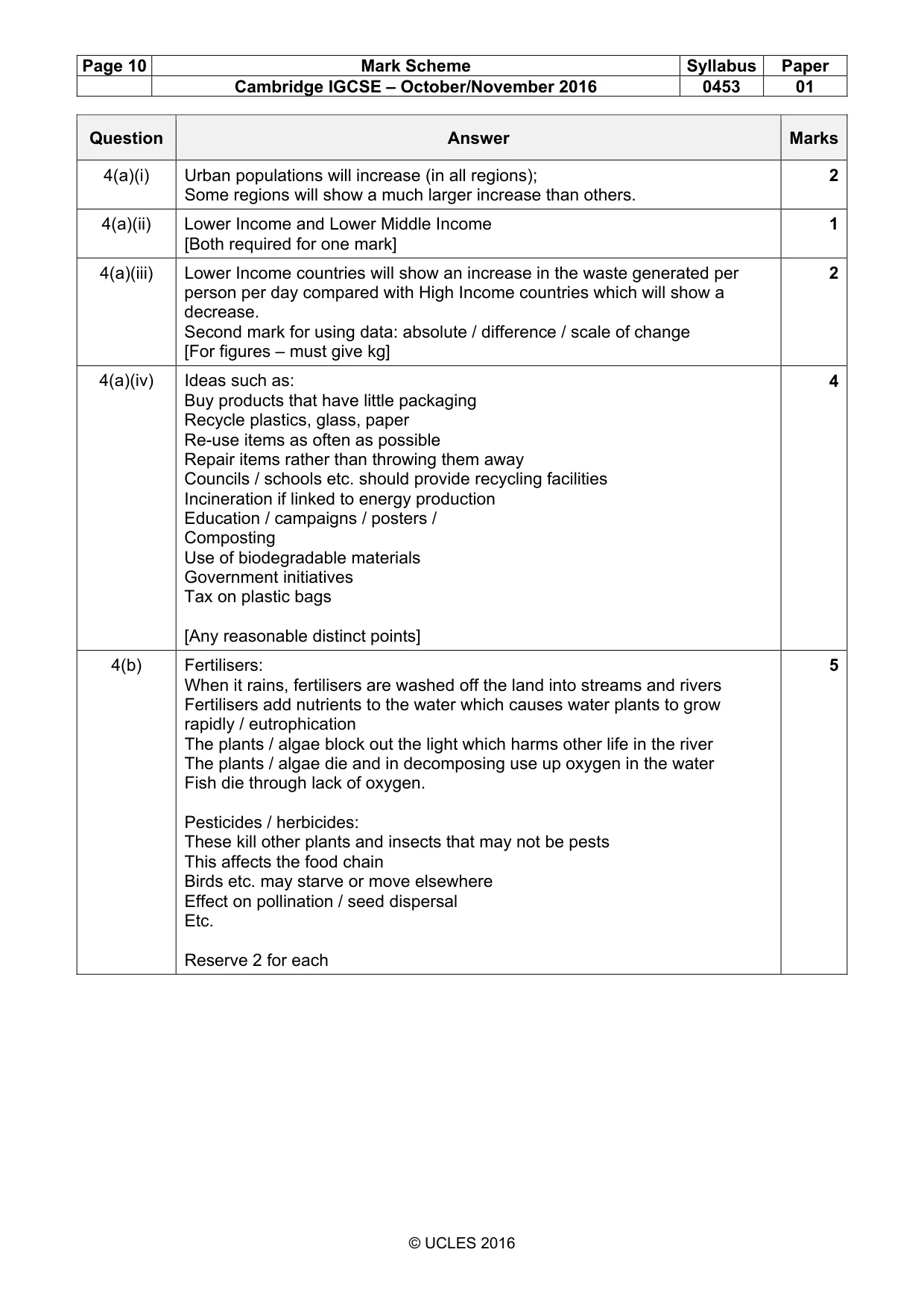
Page 10 Mark Scheme Syllabus Paper Cambridge IGCSE – October/November 2016 0453 01 © UCLES 2016 Question Answer Marks 4(a)(i) Urban populations will increase (in all regions); Some regions will show a much larger increase than others. 2 4(a)(ii) Lower Income and Lower Middle Income [Both required for one mark] 1 4(a)(iii) Lower Income countries will show an increase in the waste generated per person per day compared with High Income countries which will show a decrease. Second mark for using data: absolute / difference / scale of change [For figures – must give kg] 2 4(a)(iv) Ideas such as: Buy products that have little packaging Recycle plastics, glass, paper Re-use items as often as possible Repair items rather than throwing them away Councils / schools etc. should provide recycling facilities Incineration if linked to energy production Education / campaigns / posters / Composting Use of biodegradable materials Government initiatives Tax on plastic bags [Any reasonable distinct points] 4 4(b) Fertilisers: When it rains, fertilisers are washed off the land into streams and rivers Fertilisers add nutrients to the water which causes water plants to grow rapidly / eutrophication The plants / algae block out the light which harms other life in the river The plants / algae die and in decomposing use up oxygen in the water Fish die through lack of oxygen. Pesticides / herbicides: These kill other plants and insects that may not be pests This affects the food chain Birds etc. may starve or move elsewhere Effect on pollination / seed dispersal Etc. Reserve 2 for each 5
Mark scheme, page 11
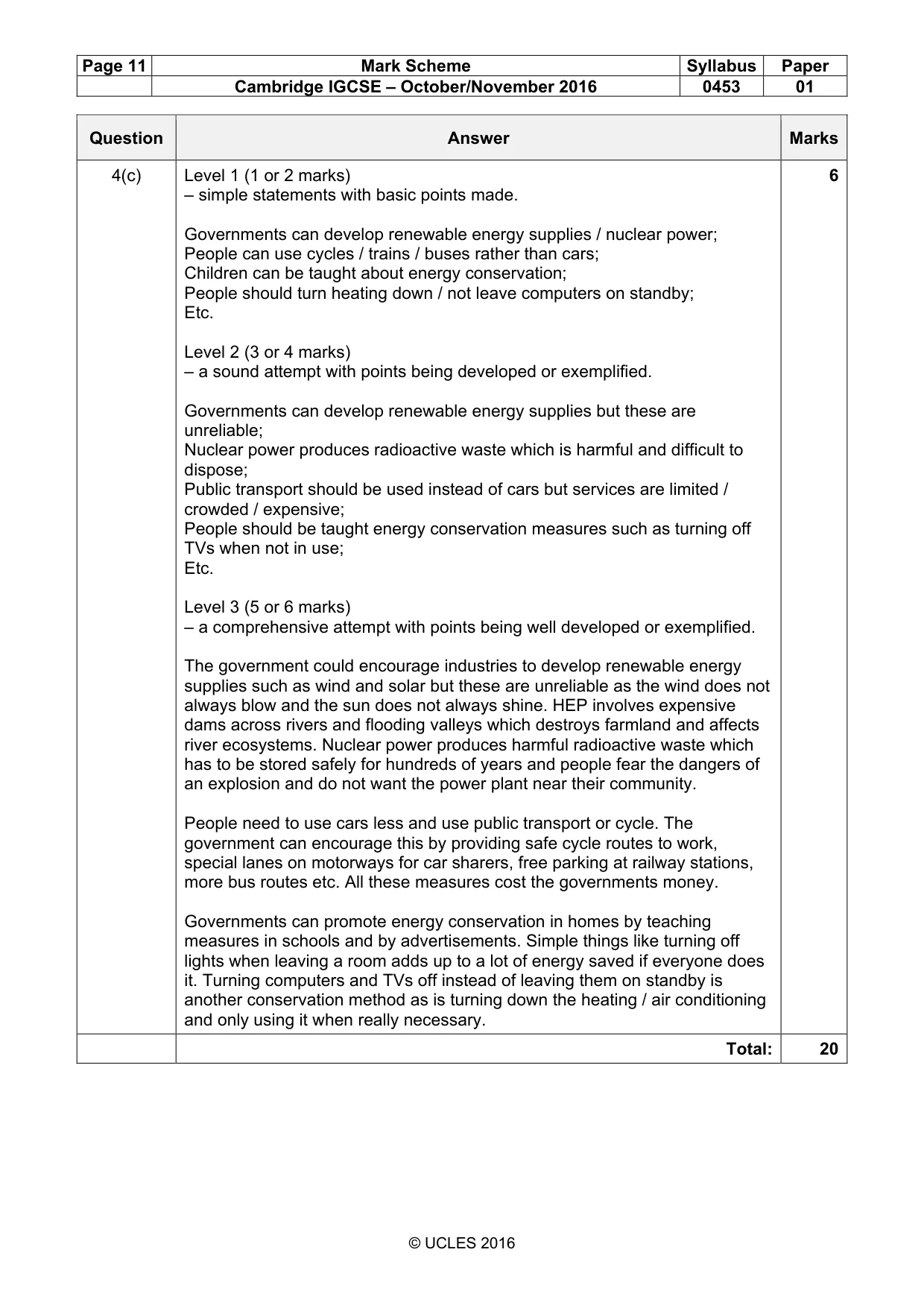
Page 11 Mark Scheme Syllabus Paper Cambridge IGCSE – October/November 2016 0453 01 © UCLES 2016 Question Answer Marks 4(c) Level 1 (1 or 2 marks) – simple statements with basic points made. Governments can develop renewable energy supplies / nuclear power; People can use cycles / trains / buses rather than cars; Children can be taught about energy conservation; People should turn heating down / not leave computers on standby; Etc. Level 2 (3 or 4 marks) – a sound attempt with points being developed or exemplified. Governments can develop renewable energy supplies but these are unreliable; Nuclear power produces radioactive waste which is harmful and difficult to dispose; Public transport should be used instead of cars but services are limited / crowded / expensive; People should be taught energy conservation measures such as turning off TVs when not in use; Etc. Level 3 (5 or 6 marks) – a comprehensive attempt with points being well developed or exemplified. The government could encourage industries to develop renewable energy supplies such as wind and solar but these are unreliable as the wind does not always blow and the sun does not always shine. HEP involves expensive dams across rivers and flooding valleys which destroys farmland and affects river ecosystems. Nuclear power produces harmful radioactive waste which has to be stored safely for hundreds of years and people fear the dangers of an explosion and do not want the power plant near their community. People need to use cars less and use public transport or cycle. The government can encourage this by providing safe cycle routes to work, special lanes on motorways for car sharers, free parking at railway stations, more bus routes etc. All these measures cost the governments money. Governments can promote energy conservation in homes by teaching measures in schools and by advertisements. Simple things like turning off lights when leaving a room adds up to a lot of energy saved if everyone does it. Turning computers and TVs off instead of leaving them on standby is another conservation method as is turning down the heating / air conditioning and only using it when really necessary. 6 Total: 20
What you needed in this session
Cambridge’s own grade thresholds for 2016 Oct/Nov, Paper 1 · Variant 1. A higher threshold means an easier paper — the bar moves with how the cohort did.