Cambridge IGCSE Development Studies 0453 — 2019 Oct/Nov Paper 1 · Variant 1
0453/11/O/N/19 · 80 marks · ≈90 min
The question paper and its mark scheme, free to read here and free to download. This is Cambridge’s own paper, exactly as it was sat.
Question paper16 pages





Mark scheme13 pages
Answers below. Sit the paper first if you are practising.
Paper as text
Question paper, page 1
This document consists of 16 printed pages and 1 Insert. DC (ST/CT) 165062/3 © UCLES 2019 [Turn over Cambridge Assessment International Education Cambridge International General Certificate of Secondary Education * 3 2 7 4 5 5 3 6 5 3 * DEVELOPMENT STUDIES 0453/01 Paper 1 October/November 2019 2 hours Candidates answer on the Question Paper. No Additional Materials are required. READ THESE INSTRUCTIONS FIRST Write your centre number, candidate number and name in the spaces provided. Write in dark blue or black pen. You may use an HB pencil for any diagrams or graphs. Do not use staples, paper clips, glue or correction fluid. DO NOT WRITE IN ANY BARCODES. Answer all the questions. You may not need all the answer lines for your answer. You should read and study the sources before answering the questions. The Insert contains Fig. 4.3 and Fig. 4.4 for Question 4. The Insert is not required by the examiner. At the end of the examination, fasten all your work securely together. The number of marks is given in brackets [ ] at the end of each question or part question.
Question paper, page 2
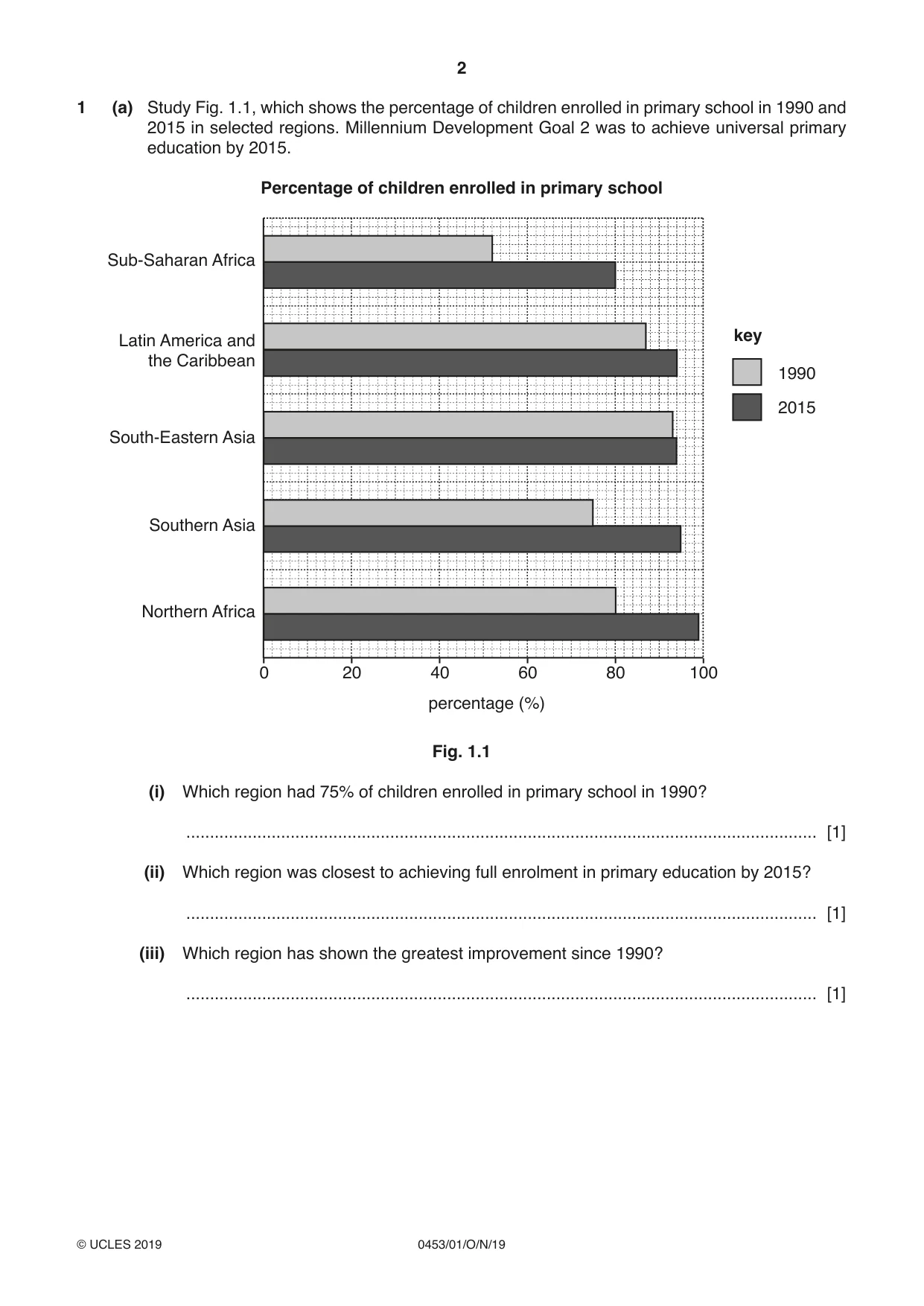
2 0453/01/O/N/19 © UCLES 2019 1 (a) Study Fig. 1.1, which shows the percentage of children enrolled in primary school in 1990 and 2015 in selected regions. Millennium Development Goal 2 was to achieve universal primary education by 2015. Percentage of children enrolled in primary school 0 20 40 60 80 100 percentage (%) Latin America and the Caribbean South-Eastern Asia Southern Asia Northern Africa Sub-Saharan Africa key 1990 2015 Fig. 1.1 (i) Which region had 75% of children enrolled in primary school in 1990? … [1] (ii) Which region was closest to achieving full enrolment in primary education by 2015? … [1] (iii) Which region has shown the greatest improvement since 1990? … [1]
Question paper, page 3
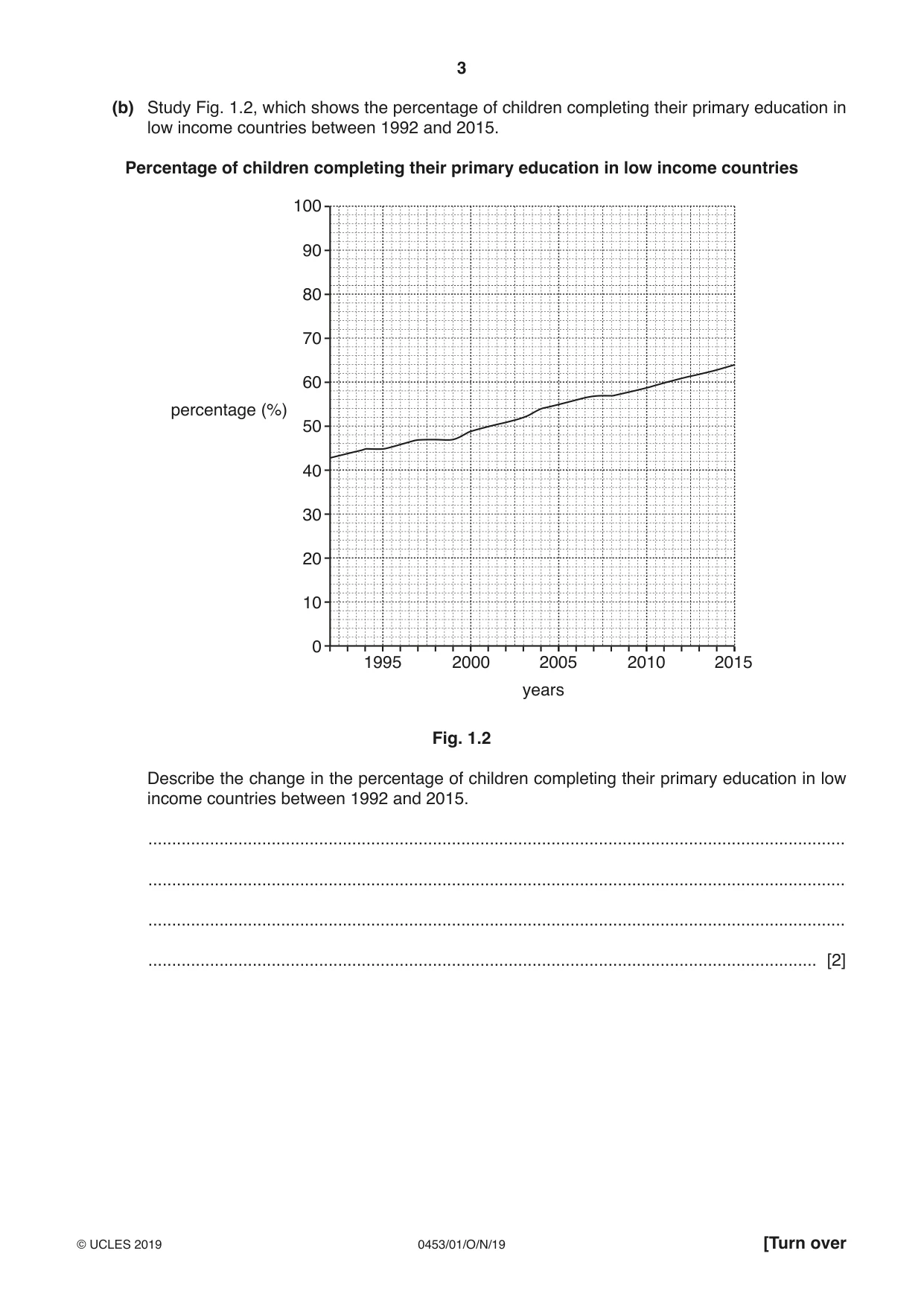
3 0453/01/O/N/19 © UCLES 2019 [Turn over (b) Study Fig. 1.2, which shows the percentage of children completing their primary education in low income countries between 1992 and 2015. Percentage of children completing their primary education in low income countries 0 10 20 30 40 50 60 70 80 90 100 1995 2000 2005 2010 2015 percentage (%) years Fig. 1.2 Describe the change in the percentage of children completing their primary education in low income countries between 1992 and 2015. … … … … [2]
Question paper, page 4
4 0453/01/O/N/19 © UCLES 2019 (c) Describe how traditional (informal) education takes place. Explain its importance to communities. Use examples to illustrate your answer. … … … … … … … … … … [5] (d) For economic development it is important to increase the number of young people who have relevant skills for employment in different sectors. State two skills that need to be taught to enable a country to develop economically. Explain why each one is necessary. 1 … … … … 2 … … … … [4]
Question paper, page 5
5 0453/01/O/N/19 © UCLES 2019 [Turn over (e) Explain the measures that may be taken to make sure more children are able to attend school and complete their education. You should develop fully the points you make. … … … … … … … … … … … … … … … … … … … … … … … … … … … [6] [Total: 20]
Question paper, page 6
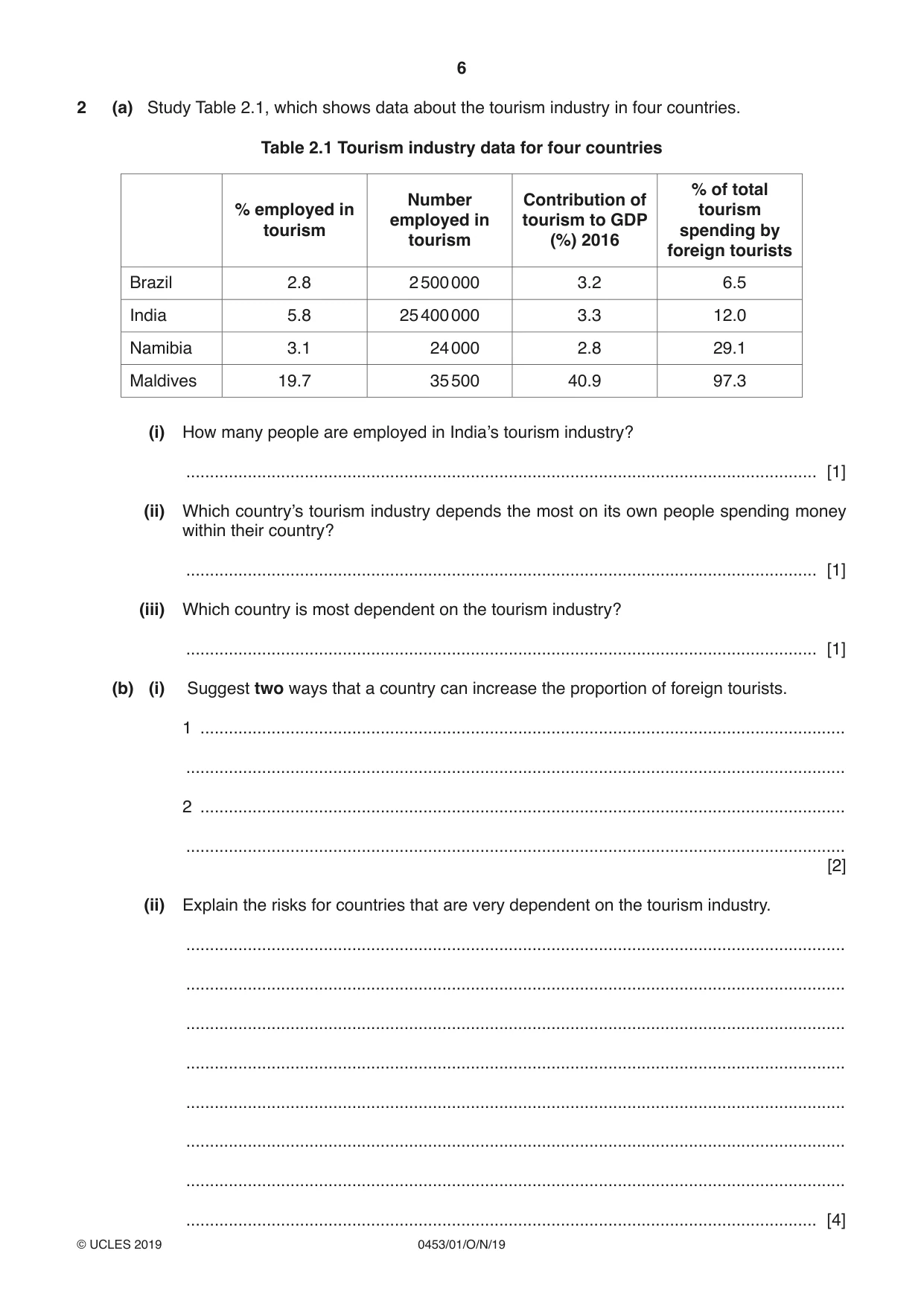
6 0453/01/O/N/19 © UCLES 2019 2 (a) Study Table 2.1, which shows data about the tourism industry in four countries. Table 2.1 Tourism industry data for four countries % employed in tourism Number employed in tourism Contribution of tourism to GDP (%) 2016 % of total tourism spending by foreign tourists Brazil 2.8 2 500 000 3.2 6.5 India 5.8 25 400 000 3.3 12.0 Namibia 3.1 24 000 2.8 29.1 Maldives 19.7 35 500 40.9 97.3 (i) How many people are employed in India’s tourism industry? … [1] (ii) Which country’s tourism industry depends the most on its own people spending money within their country? … [1] (iii) Which country is most dependent on the tourism industry? … [1] (b) (i) Suggest two ways that a country can increase the proportion of foreign tourists. 1 … … 2 … … [2] (ii) Explain the risks for countries that are very dependent on the tourism industry. … … … … … … … … [4]
Question paper, page 7
7 0453/01/O/N/19 © UCLES 2019 [Turn over (c) Describe the ways that tourism can be made more socially and environmentally sustainable. … … … … … … … … … … [5]
Question paper, page 8
8 0453/01/O/N/19 © UCLES 2019 (d) Explain how the tourism industry depends on and promotes other industries and services within a country. You should develop fully the points you make. … … … … … … … … … … … … … … … … … … … … … … … … … … … [6] [Total: 20]
Question paper, page 9
9 0453/01/O/N/19 © UCLES 2019 [Turn over 3 (a) Study Fig. 3.1, which shows the urban population as a percentage of the total population of seven countries in 1960 and 2015. Urban population of selected countries Fig. 3.1 (i) Which country had the highest percentage of urban population in 2015? … [1] (ii) Which country showed the greatest increase in the percentage of urban population between 1960 and 2015? … [1] (b) (i) Urbanisation may lead to overpopulation and an increase in population density in towns. Define these two terms. • overpopulation … … • population density … … [2] Content removed due to copyright restrictions.
Question paper, page 10
10 0453/01/O/N/19 © UCLES 2019 (ii) Describe the effects on rural areas of urbanisation. … … … … … … … … … … [5] Permission to reproduce items where third-party owned material protected by copyright is included has been sought and cleared where possible. Every reasonable effort has been made by the publisher (UCLES) to trace copyright holders, but if any items requiring clearance have unwittingly been included, the publisher will be pleased to make amends at the earliest possible opportunity. To avoid the issue of disclosure of answer-related information to candidates, all copyright acknowledgements are reproduced online in the Cambridge Assessment International Education Copyright Acknowledgements Booklet. This is produced for each series of examinations and is freely available to download at www.cambridgeinternational.org after the live examination series. Cambridge Assessment International Education is part of the Cambridge Assessment Group. Cambridge Assessment is the brand name of the University of Cambridge Local Examinations Syndicate (UCLES), which itself is a department of the University of Cambridge.
Question paper, page 11
11 0453/01/O/N/19 © UCLES 2019 [Turn over (c) Study Fig. 3.2, which describes a rural development project in Kenya. A rural development project in Kenya Fig. 3.2 (i) What is meant by the term staple crop? … [1] (ii) Explain, in your own words, how the project has increased farmers’ incomes. … … … … … … … … [4] Content removed due to copyright restrictions.
Question paper, page 12
12 0453/01/O/N/19 © UCLES 2019 (d) Explain how the provision of electricity and internet access to rural areas could help reduce the migration of people to urban areas. You should develop fully the points you make. … … … … … … … … … … … … … … … … … … … … … … … … … … … [6] [Total: 20]
Question paper, page 13
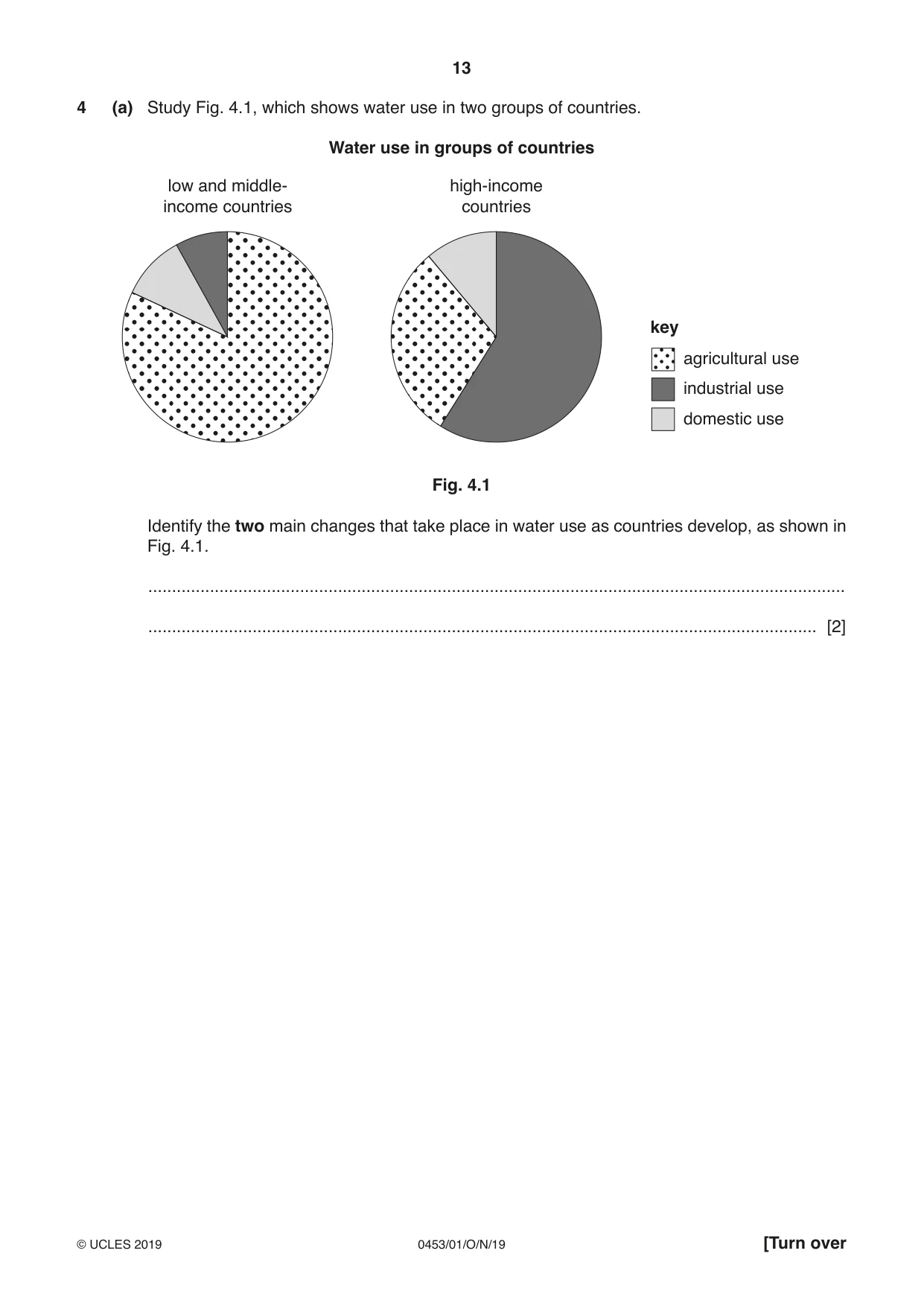
13 0453/01/O/N/19 © UCLES 2019 [Turn over 4 (a) Study Fig. 4.1, which shows water use in two groups of countries. Water use in groups of countries agricultural use key industrial use domestic use high-income countries low and middle- income countries Fig. 4.1 Identify the two main changes that take place in water use as countries develop, as shown in Fig. 4.1. … … [2]
Question paper, page 14
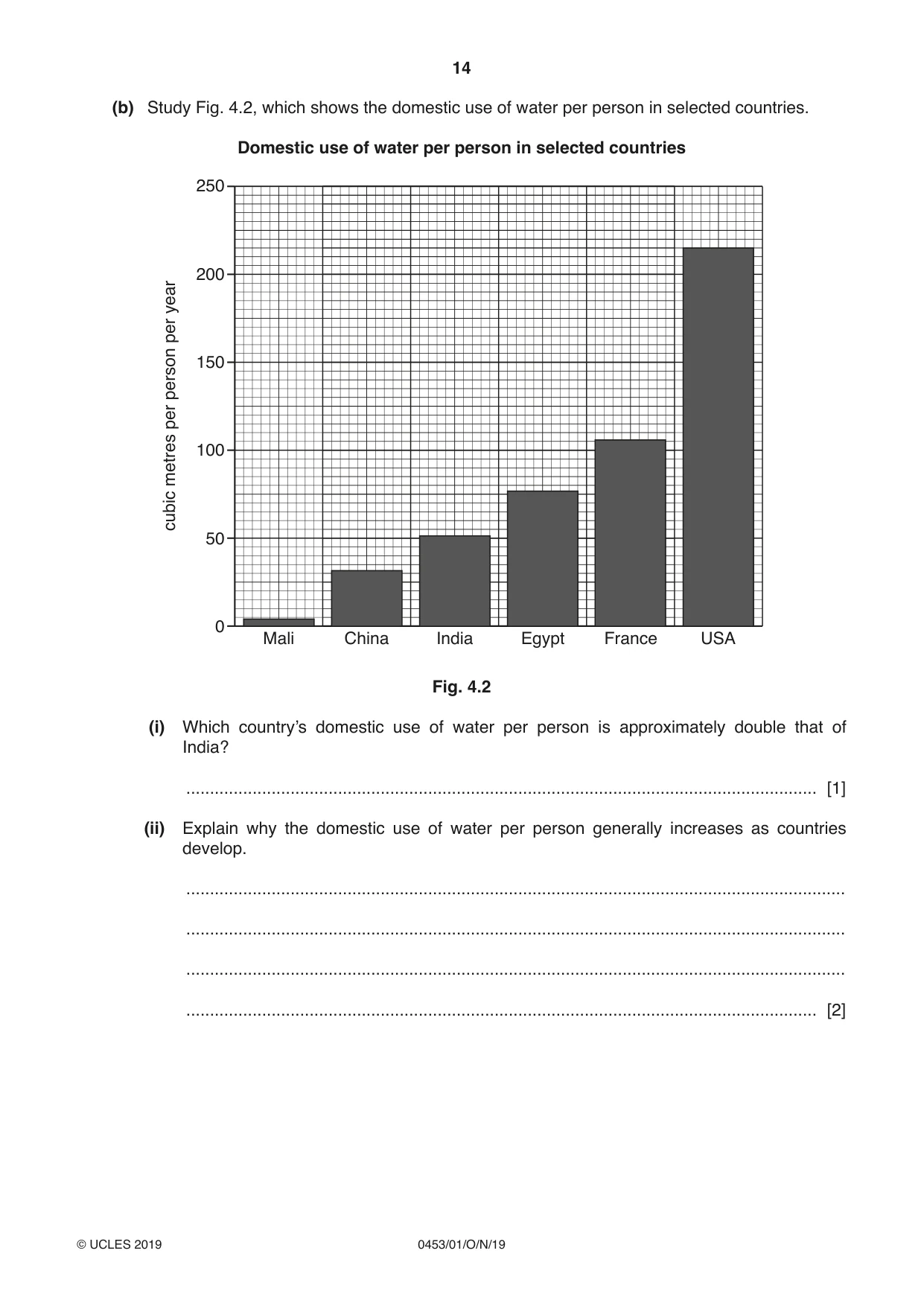
14 0453/01/O/N/19 © UCLES 2019 (b) Study Fig. 4.2, which shows the domestic use of water per person in selected countries. Domestic use of water per person in selected countries cubic metres per person per year Mali China India Egypt France USA 250 200 150 100 50 0 Fig. 4.2 (i) Which country’s domestic use of water per person is approximately double that of India? … [1] (ii) Explain why the domestic use of water per person generally increases as countries develop. … … … … [2]
Question paper, page 15
15 0453/01/O/N/19 © UCLES 2019 [Turn over (c) Study Fig. 4.3 and Fig. 4.4 (Insert), which show two farms in developing countries. (i) Compare the characteristics of the two farms shown in Fig. 4.3 and Fig. 4.4. … … … … … … … … [4] (ii) Explain a problem that farming in developing countries may face in the future. … … … … [2] (iii) Explain how the growing and export of large quantities of flowers help developing countries. … … … … … … [3] Question 4(d) is printed on the next page.
Question paper, page 16
16 0453/01/O/N/19 © UCLES 2019 (d) Water pollution can be caused by domestic waste and industrial production. Evaluate the measures taken to reduce the effect of water pollution on the natural environment. You should develop fully the points you make. … … … … … … … … … … … … … … … … … … … … … … … … … [6] [Total: 20]
Mark scheme, page 1
This document consists of 13 printed pages. © UCLES 2019 [Turn over Cambridge Assessment International Education Cambridge International General Certificate of Secondary Education DEVELOPMENT STUDIES 0453/01 Paper 1 October/November 2019 MARK SCHEME Maximum Mark: 80 Published This mark scheme is published as an aid to teachers and candidates, to indicate the requirements of the examination. It shows the basis on which Examiners were instructed to award marks. It does not indicate the details of the discussions that took place at an Examiners’ meeting before marking began, which would have considered the acceptability of alternative answers. Mark schemes should be read in conjunction with the question paper and the Principal Examiner Report for Teachers. Cambridge International will not enter into discussions about these mark schemes. Cambridge International is publishing the mark schemes for the October/November 2019 series for most Cambridge IGCSE™, Cambridge International A and AS Level components and some Cambridge O Level components.
Mark scheme, page 2
0453/01 Cambridge IGCSE – Mark Scheme PUBLISHED October/November 2019 © UCLES 2019 Page 2 of 13 Generic Marking Principles These general marking principles must be applied by all examiners when marking candidate answers. They should be applied alongside the specific content of the mark scheme or generic level descriptors for a question. Each question paper and mark scheme will also comply with these marking principles. GENERIC MARKING PRINCIPLE 1: Marks must be awarded in line with: • the specific content of the mark scheme or the generic level descriptors for the question • the specific skills defined in the mark scheme or in the generic level descriptors for the question • the standard of response required by a candidate as exemplified by the standardisation scripts. GENERIC MARKING PRINCIPLE 2: Marks awarded are always whole marks (not half marks, or other fractions). GENERIC MARKING PRINCIPLE 3: Marks must be awarded positively: • marks are awarded for correct/valid answers, as defined in the mark scheme. However, credit is given for valid answers which go beyond the scope of the syllabus and mark scheme, referring to your Team Leader as appropriate • marks are awarded when candidates clearly demonstrate what they know and can do • marks are not deducted for errors • marks are not deducted for omissions • answers should only be judged on the quality of spelling, punctuation and grammar when these features are specifically assessed by the question as indicated by the mark scheme. The meaning, however, should be unambiguous. GENERIC MARKING PRINCIPLE 4: Rules must be applied consistently e.g. in situations where candidates have not followed instructions or in the application of generic level descriptors.
Mark scheme, page 3
0453/01 Cambridge IGCSE – Mark Scheme PUBLISHED October/November 2019 © UCLES 2019 Page 3 of 13 GENERIC MARKING PRINCIPLE 5: Marks should be awarded using the full range of marks defined in the mark scheme for the question (however; the use of the full mark range may be limited according to the quality of the candidate responses seen). GENERIC MARKING PRINCIPLE 6: Marks awarded are based solely on the requirements as defined in the mark scheme. Marks should not be awarded with grade thresholds or grade descriptors in mind.
Mark scheme, page 4
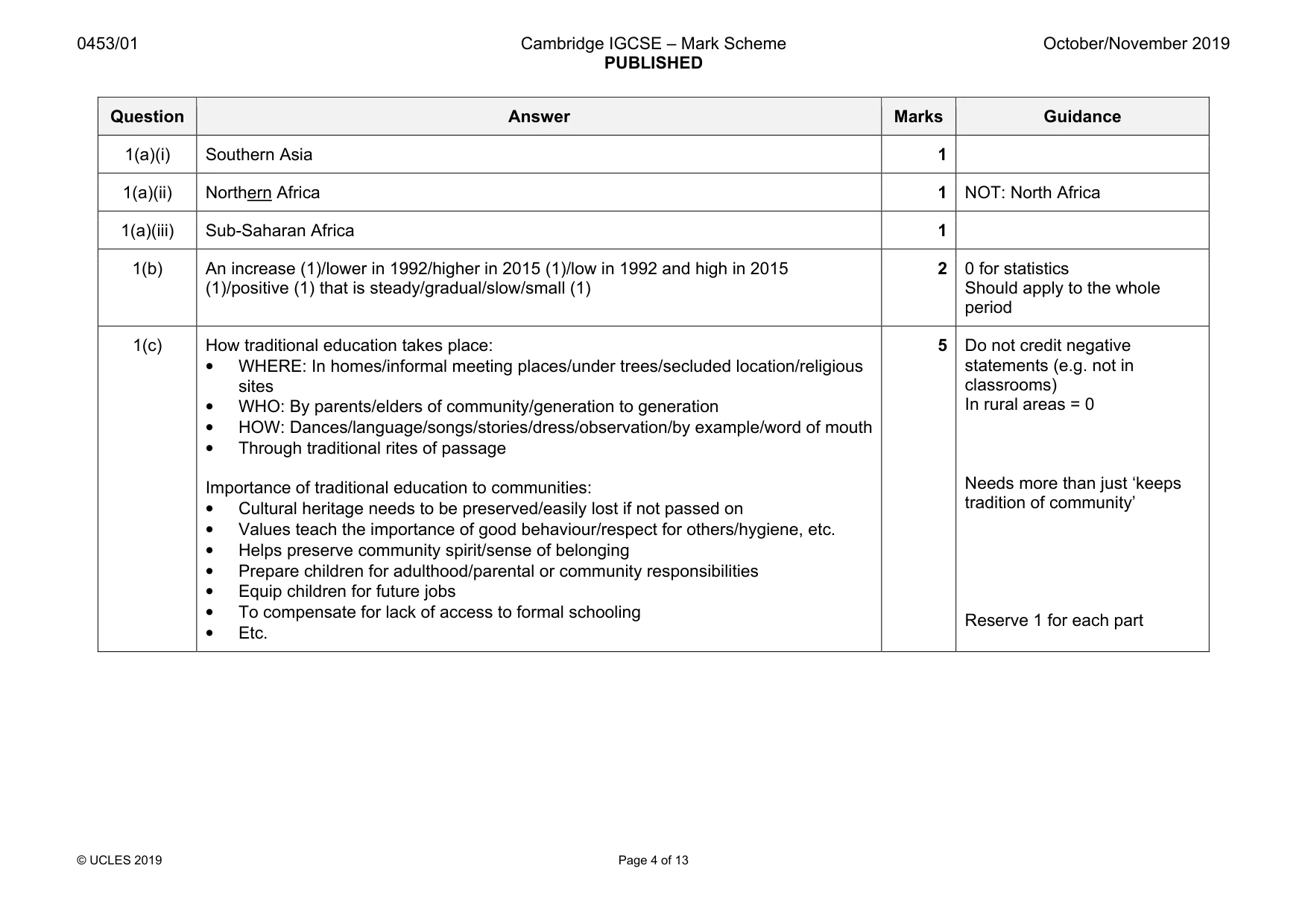
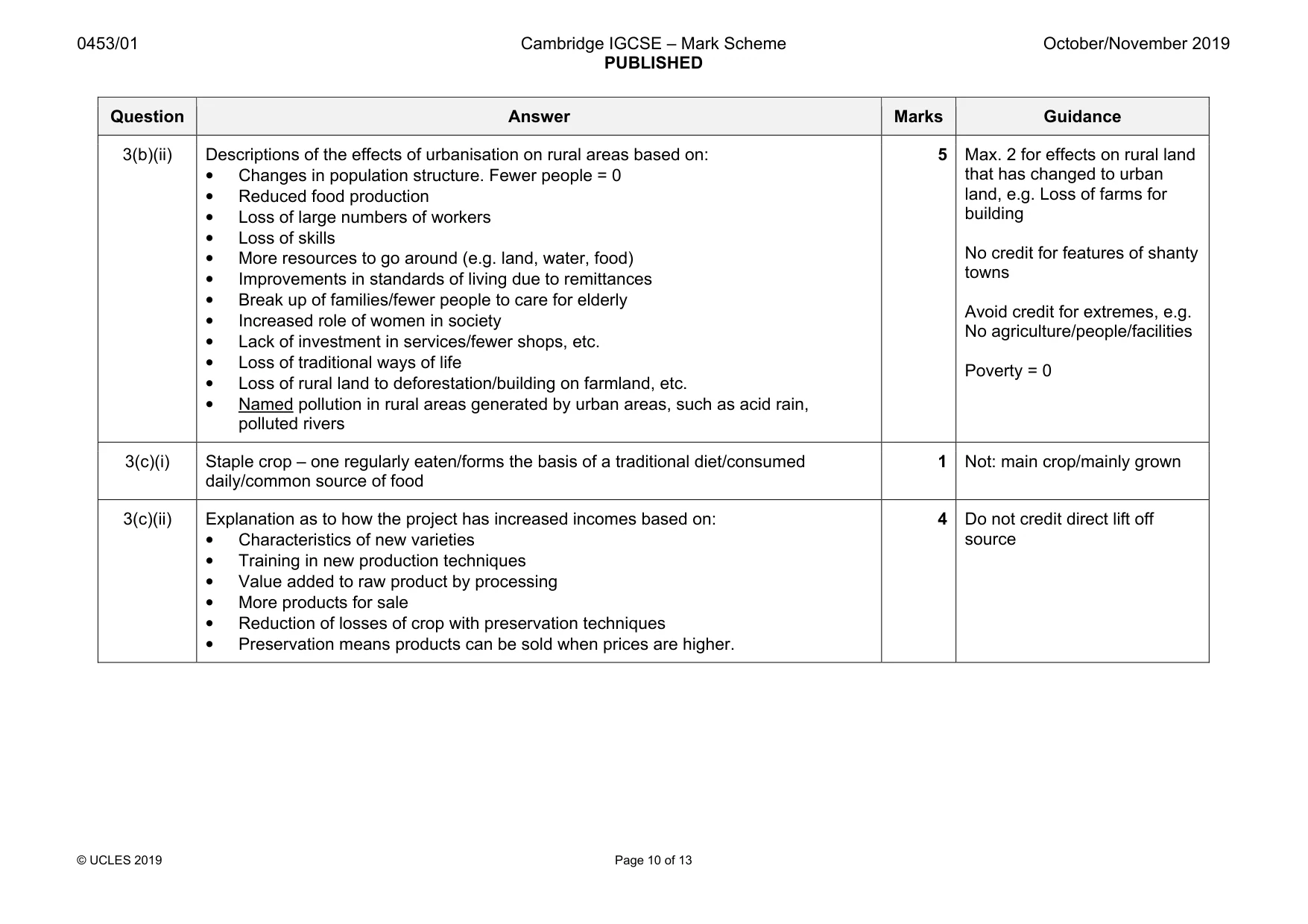
0453/01 Cambridge IGCSE – Mark Scheme PUBLISHED October/November 2019 © UCLES 2019 Page 4 of 13 Question Answer Marks Guidance 1(a)(i) Southern Asia 1 1(a)(ii) Northern Africa 1 NOT: North Africa 1(a)(iii) Sub-Saharan Africa 1 1(b) An increase (1)/lower in 1992/higher in 2015 (1)/low in 1992 and high in 2015 (1)/positive (1) that is steady/gradual/slow/small (1) 2 0 for statistics Should apply to the whole period 1(c) How traditional education takes place: • WHERE: In homes/informal meeting places/under trees/secluded location/religious sites • WHO: By parents/elders of community/generation to generation • HOW: Dances/language/songs/stories/dress/observation/by example/word of mouth • Through traditional rites of passage Importance of traditional education to communities: • Cultural heritage needs to be preserved/easily lost if not passed on • Values teach the importance of good behaviour/respect for others/hygiene, etc. • Helps preserve community spirit/sense of belonging • Prepare children for adulthood/parental or community responsibilities • Equip children for future jobs • To compensate for lack of access to formal schooling • Etc. 5 Do not credit negative statements (e.g. not in classrooms) In rural areas = 0 Needs more than just ‘keeps tradition of community’ Reserve 1 for each part
Mark scheme, page 5
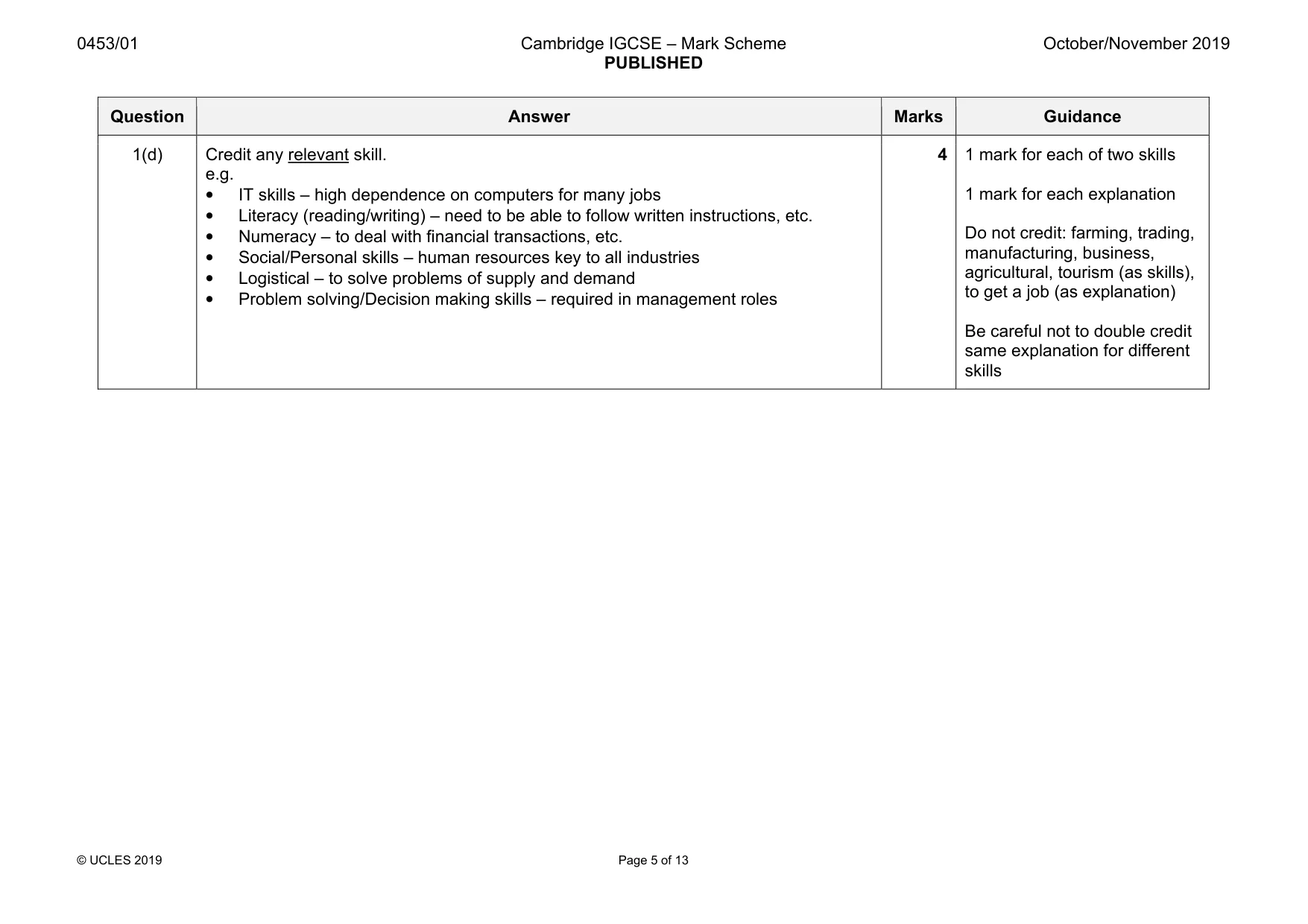
0453/01 Cambridge IGCSE – Mark Scheme PUBLISHED October/November 2019 © UCLES 2019 Page 5 of 13 Question Answer Marks Guidance 1(d) Credit any relevant skill. e.g. • IT skills – high dependence on computers for many jobs • Literacy (reading/writing) – need to be able to follow written instructions, etc. • Numeracy – to deal with financial transactions, etc. • Social/Personal skills – human resources key to all industries • Logistical – to solve problems of supply and demand • Problem solving/Decision making skills – required in management roles 4 1 mark for each of two skills 1 mark for each explanation Do not credit: farming, trading, manufacturing, business, agricultural, tourism (as skills), to get a job (as explanation) Be careful not to double credit same explanation for different skills
Mark scheme, page 6
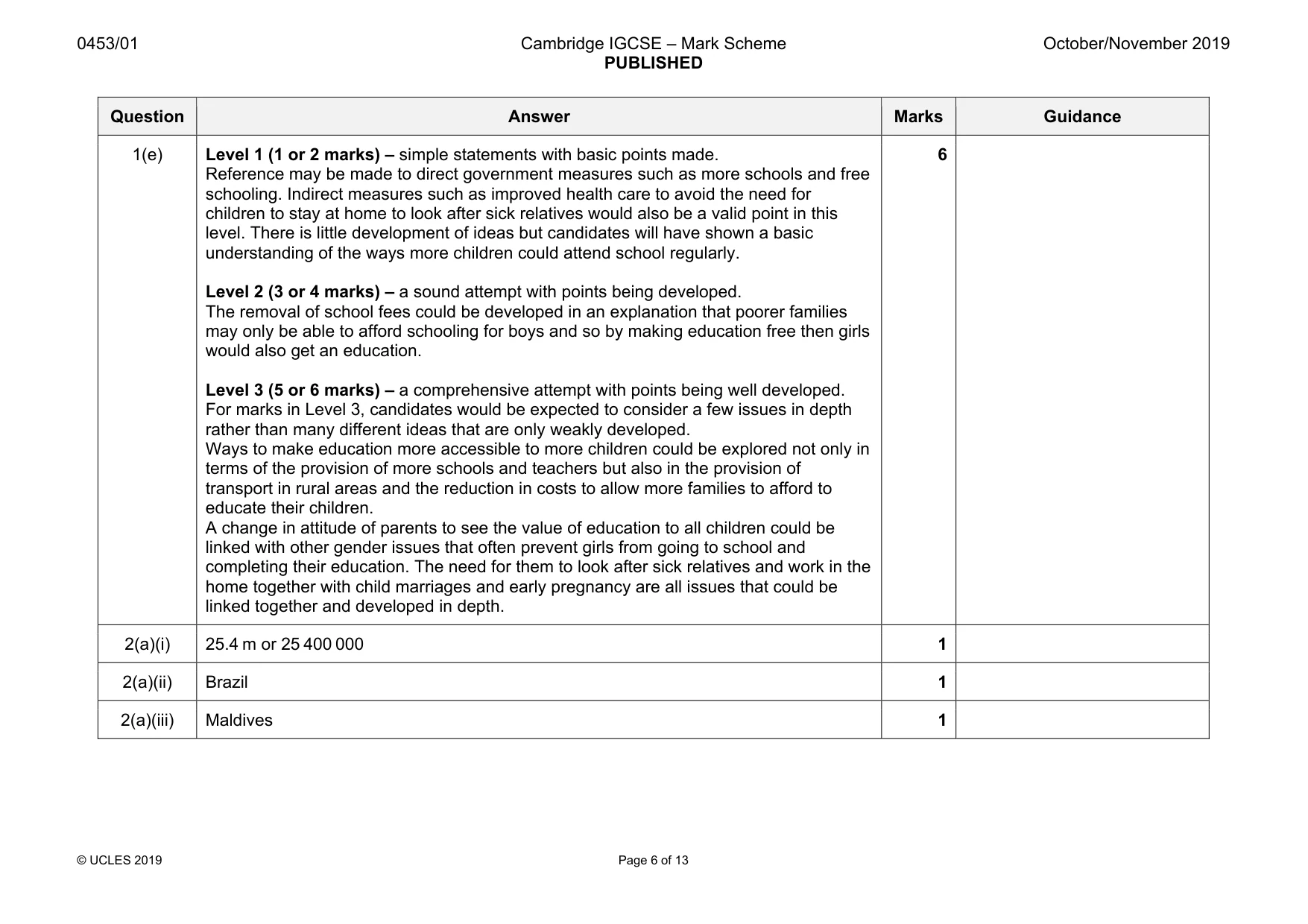
0453/01 Cambridge IGCSE – Mark Scheme PUBLISHED October/November 2019 © UCLES 2019 Page 6 of 13 Question Answer Marks Guidance 1(e) Level 1 (1 or 2 marks) – simple statements with basic points made. Reference may be made to direct government measures such as more schools and free schooling. Indirect measures such as improved health care to avoid the need for children to stay at home to look after sick relatives would also be a valid point in this level. There is little development of ideas but candidates will have shown a basic understanding of the ways more children could attend school regularly. Level 2 (3 or 4 marks) – a sound attempt with points being developed. The removal of school fees could be developed in an explanation that poorer families may only be able to afford schooling for boys and so by making education free then girls would also get an education. Level 3 (5 or 6 marks) – a comprehensive attempt with points being well developed. For marks in Level 3, candidates would be expected to consider a few issues in depth rather than many different ideas that are only weakly developed. Ways to make education more accessible to more children could be explored not only in terms of the provision of more schools and teachers but also in the provision of transport in rural areas and the reduction in costs to allow more families to afford to educate their children. A change in attitude of parents to see the value of education to all children could be linked with other gender issues that often prevent girls from going to school and completing their education. The need for them to look after sick relatives and work in the home together with child marriages and early pregnancy are all issues that could be linked together and developed in depth. 6 2(a)(i) 25.4 m or 25 400 000 1 2(a)(ii) Brazil 1 2(a)(iii) Maldives 1
Mark scheme, page 7
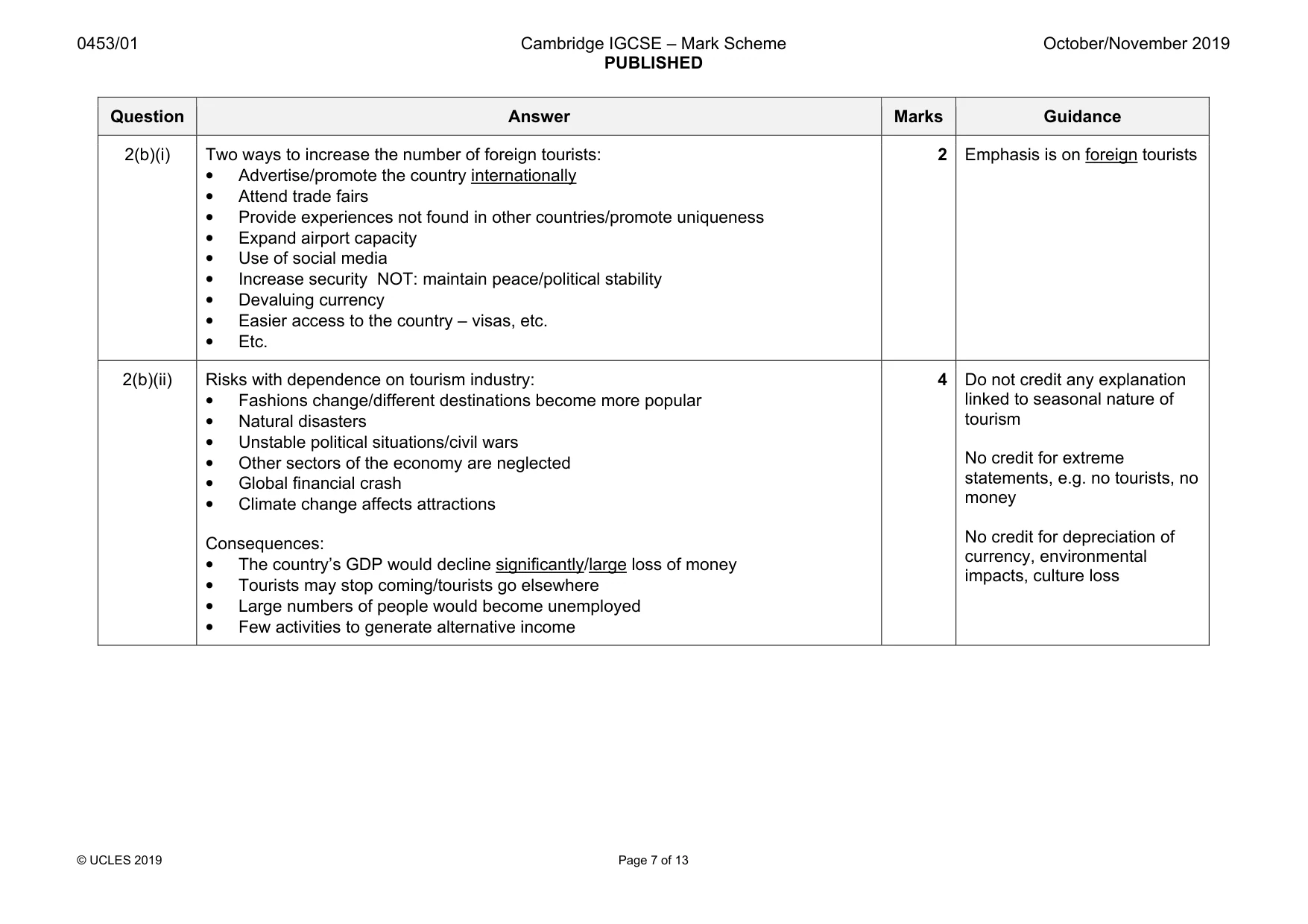
0453/01 Cambridge IGCSE – Mark Scheme PUBLISHED October/November 2019 © UCLES 2019 Page 7 of 13 Question Answer Marks Guidance 2(b)(i) Two ways to increase the number of foreign tourists: • Advertise/promote the country internationally • Attend trade fairs • Provide experiences not found in other countries/promote uniqueness • Expand airport capacity • Use of social media • Increase security NOT: maintain peace/political stability • Devaluing currency • Easier access to the country – visas, etc. • Etc. 2 Emphasis is on foreign tourists 2(b)(ii) Risks with dependence on tourism industry: • Fashions change/different destinations become more popular • Natural disasters • Unstable political situations/civil wars • Other sectors of the economy are neglected • Global financial crash • Climate change affects attractions Consequences: • The country’s GDP would decline significantly/large loss of money • Tourists may stop coming/tourists go elsewhere • Large numbers of people would become unemployed • Few activities to generate alternative income 4 Do not credit any explanation linked to seasonal nature of tourism No credit for extreme statements, e.g. no tourists, no money No credit for depreciation of currency, environmental impacts, culture loss
Mark scheme, page 8
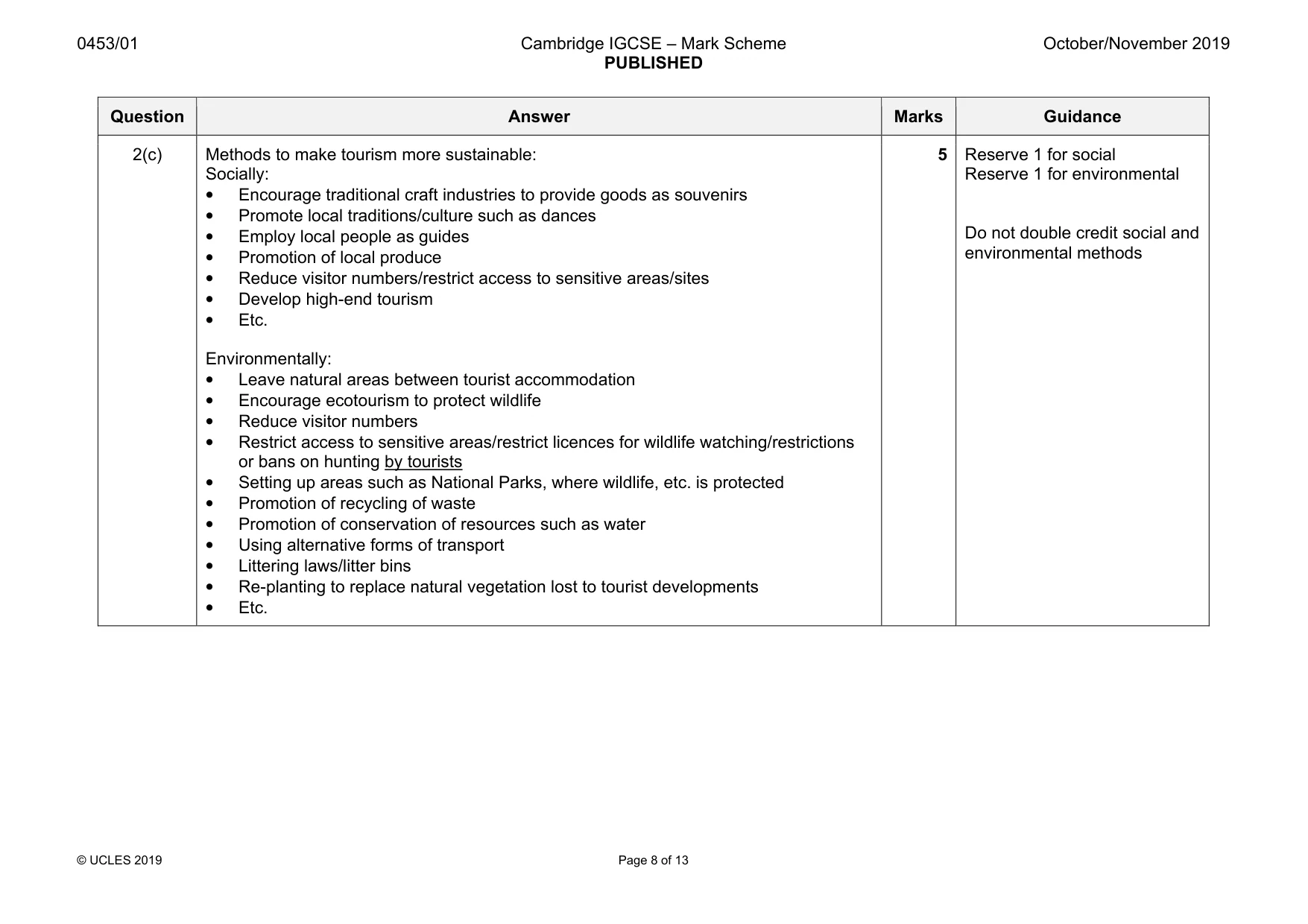
0453/01 Cambridge IGCSE – Mark Scheme PUBLISHED October/November 2019 © UCLES 2019 Page 8 of 13 Question Answer Marks Guidance 2(c) Methods to make tourism more sustainable: Socially: • Encourage traditional craft industries to provide goods as souvenirs • Promote local traditions/culture such as dances • Employ local people as guides • Promotion of local produce • Reduce visitor numbers/restrict access to sensitive areas/sites • Develop high-end tourism • Etc. Environmentally: • Leave natural areas between tourist accommodation • Encourage ecotourism to protect wildlife • Reduce visitor numbers • Restrict access to sensitive areas/restrict licences for wildlife watching/restrictions or bans on hunting by tourists • Setting up areas such as National Parks, where wildlife, etc. is protected • Promotion of recycling of waste • Promotion of conservation of resources such as water • Using alternative forms of transport • Littering laws/litter bins • Re-planting to replace natural vegetation lost to tourist developments • Etc. 5 Reserve 1 for social Reserve 1 for environmental Do not double credit social and environmental methods
Mark scheme, page 9
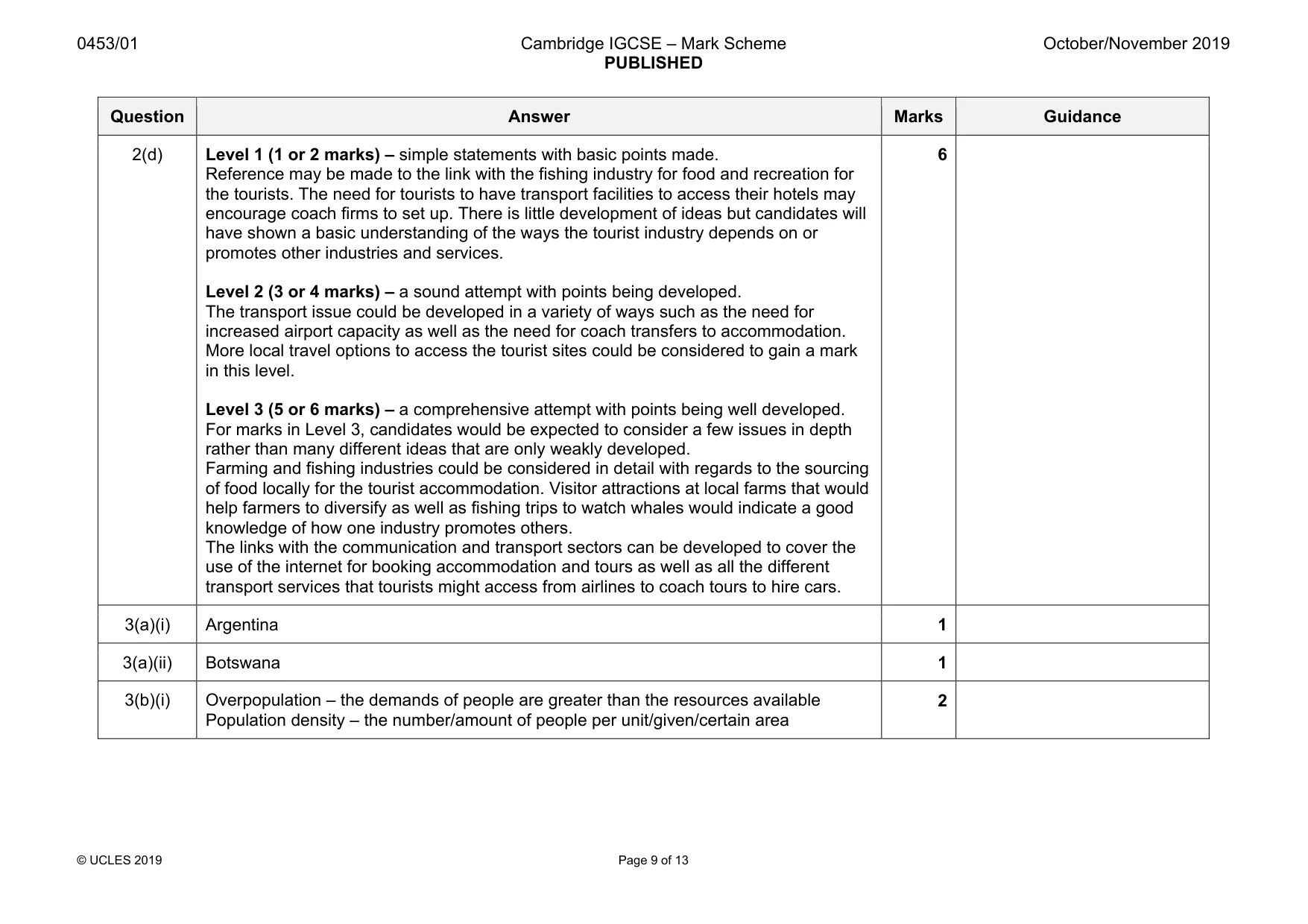
0453/01 Cambridge IGCSE – Mark Scheme PUBLISHED October/November 2019 © UCLES 2019 Page 9 of 13 Question Answer Marks Guidance 2(d) Level 1 (1 or 2 marks) – simple statements with basic points made. Reference may be made to the link with the fishing industry for food and recreation for the tourists. The need for tourists to have transport facilities to access their hotels may encourage coach firms to set up. There is little development of ideas but candidates will have shown a basic understanding of the ways the tourist industry depends on or promotes other industries and services. Level 2 (3 or 4 marks) – a sound attempt with points being developed. The transport issue could be developed in a variety of ways such as the need for increased airport capacity as well as the need for coach transfers to accommodation. More local travel options to access the tourist sites could be considered to gain a mark in this level. Level 3 (5 or 6 marks) – a comprehensive attempt with points being well developed. For marks in Level 3, candidates would be expected to consider a few issues in depth rather than many different ideas that are only weakly developed. Farming and fishing industries could be considered in detail with regards to the sourcing of food locally for the tourist accommodation. Visitor attractions at local farms that would help farmers to diversify as well as fishing trips to watch whales would indicate a good knowledge of how one industry promotes others. The links with the communication and transport sectors can be developed to cover the use of the internet for booking accommodation and tours as well as all the different transport services that tourists might access from airlines to coach tours to hire cars. 6 3(a)(i) Argentina 1 3(a)(ii) Botswana 1 3(b)(i) Overpopulation – the demands of people are greater than the resources available Population density – the number/amount of people per unit/given/certain area 2
Mark scheme, page 10
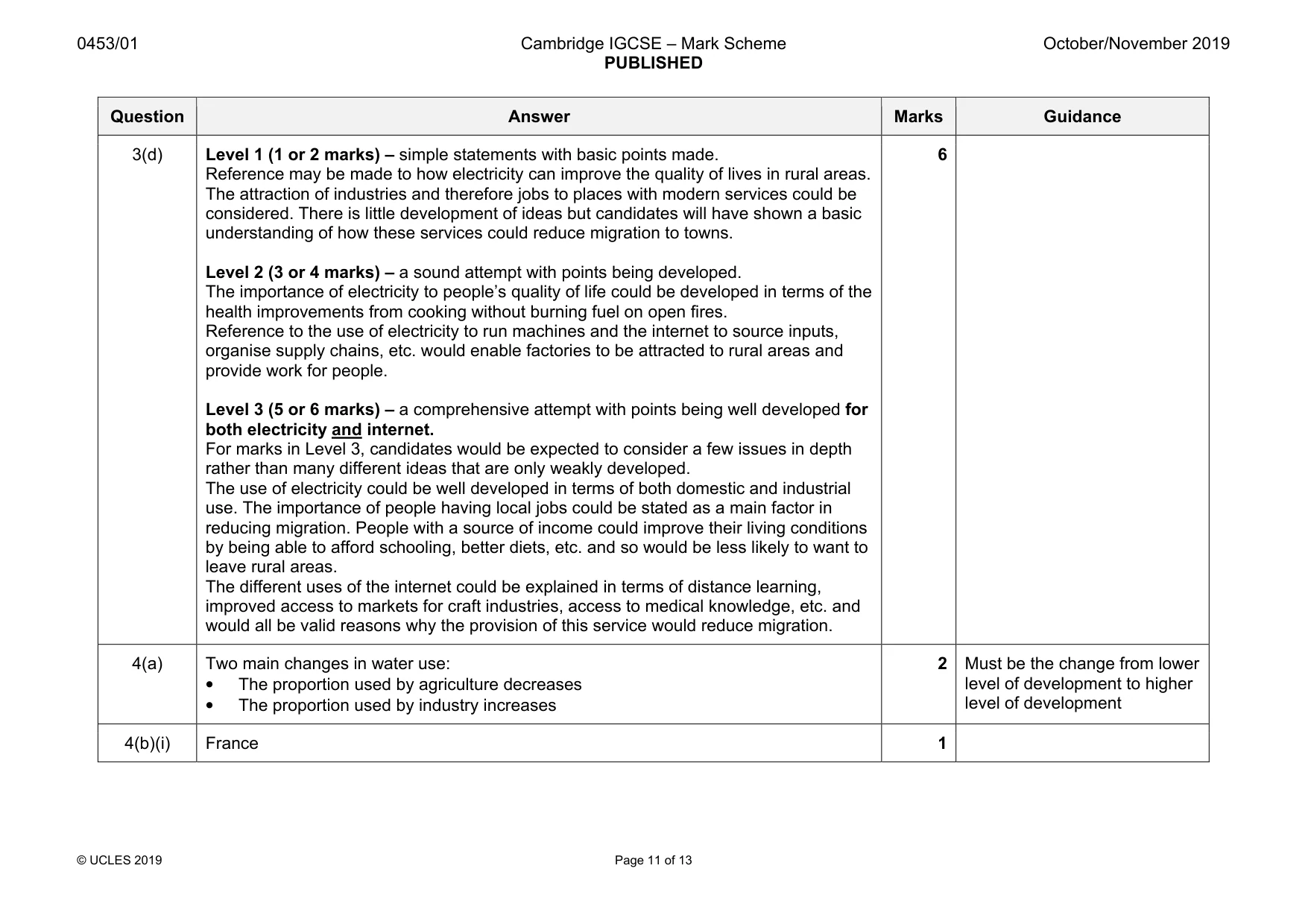
0453/01 Cambridge IGCSE – Mark Scheme PUBLISHED October/November 2019 © UCLES 2019 Page 10 of 13 Question Answer Marks Guidance 3(b)(ii) Descriptions of the effects of urbanisation on rural areas based on: • Changes in population structure. Fewer people = 0 • Reduced food production • Loss of large numbers of workers • Loss of skills • More resources to go around (e.g. land, water, food) • Improvements in standards of living due to remittances • Break up of families/fewer people to care for elderly • Increased role of women in society • Lack of investment in services/fewer shops, etc. • Loss of traditional ways of life • Loss of rural land to deforestation/building on farmland, etc. • Named pollution in rural areas generated by urban areas, such as acid rain, polluted rivers 5 Max. 2 for effects on rural land that has changed to urban land, e.g. Loss of farms for building No credit for features of shanty towns Avoid credit for extremes, e.g. No agriculture/people/facilities Poverty = 0 3(c)(i) Staple crop – one regularly eaten/forms the basis of a traditional diet/consumed daily/common source of food 1 Not: main crop/mainly grown 3(c)(ii) Explanation as to how the project has increased incomes based on: • Characteristics of new varieties • Training in new production techniques • Value added to raw product by processing • More products for sale • Reduction of losses of crop with preservation techniques • Preservation means products can be sold when prices are higher. 4 Do not credit direct lift off source
Mark scheme, page 11
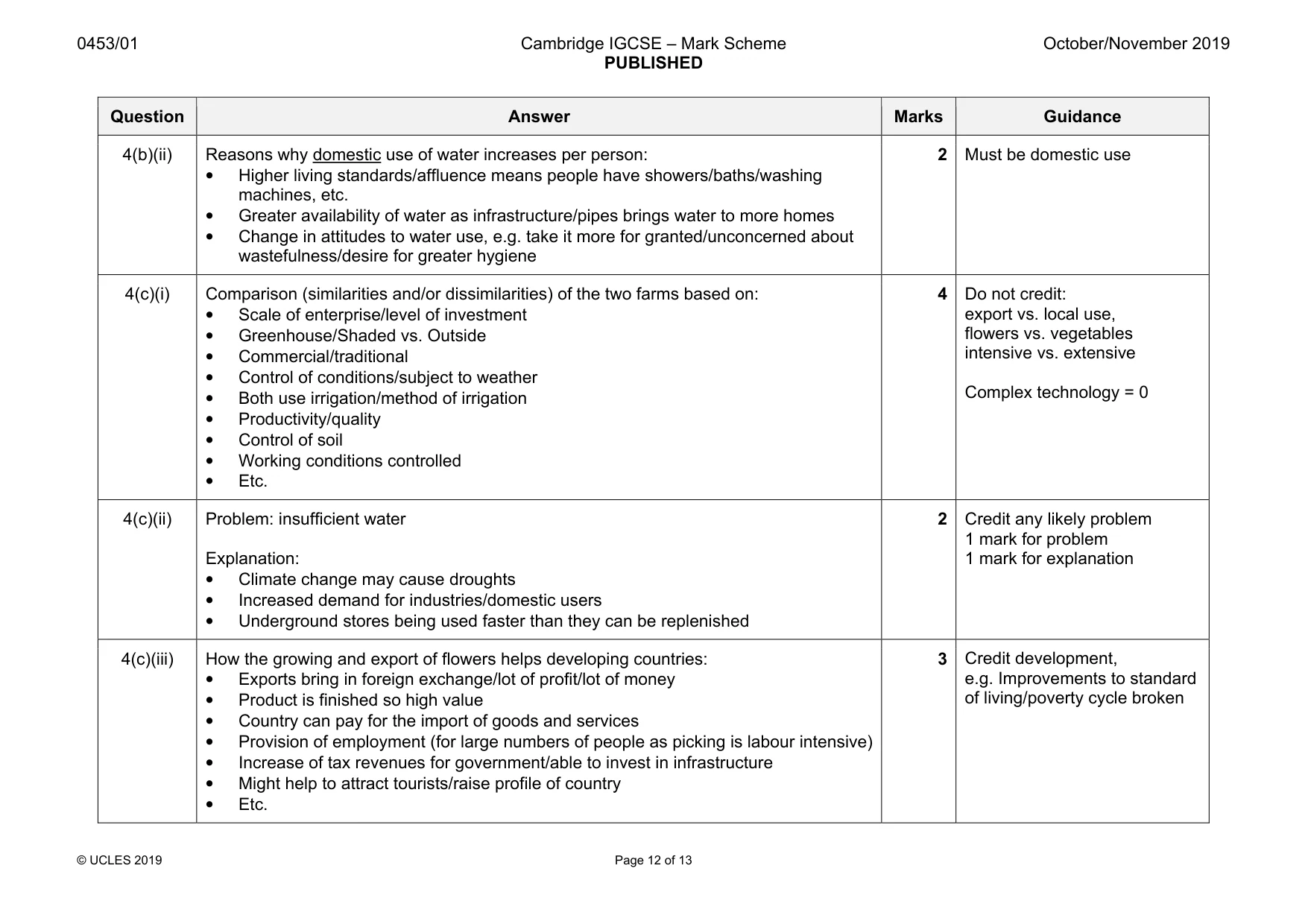
0453/01 Cambridge IGCSE – Mark Scheme PUBLISHED October/November 2019 © UCLES 2019 Page 11 of 13 Question Answer Marks Guidance 3(d) Level 1 (1 or 2 marks) – simple statements with basic points made. Reference may be made to how electricity can improve the quality of lives in rural areas. The attraction of industries and therefore jobs to places with modern services could be considered. There is little development of ideas but candidates will have shown a basic understanding of how these services could reduce migration to towns. Level 2 (3 or 4 marks) – a sound attempt with points being developed. The importance of electricity to people’s quality of life could be developed in terms of the health improvements from cooking without burning fuel on open fires. Reference to the use of electricity to run machines and the internet to source inputs, organise supply chains, etc. would enable factories to be attracted to rural areas and provide work for people. Level 3 (5 or 6 marks) – a comprehensive attempt with points being well developed for both electricity and internet. For marks in Level 3, candidates would be expected to consider a few issues in depth rather than many different ideas that are only weakly developed. The use of electricity could be well developed in terms of both domestic and industrial use. The importance of people having local jobs could be stated as a main factor in reducing migration. People with a source of income could improve their living conditions by being able to afford schooling, better diets, etc. and so would be less likely to want to leave rural areas. The different uses of the internet could be explained in terms of distance learning, improved access to markets for craft industries, access to medical knowledge, etc. and would all be valid reasons why the provision of this service would reduce migration. 6 4(a) Two main changes in water use: • The proportion used by agriculture decreases • The proportion used by industry increases 2 Must be the change from lower level of development to higher level of development 4(b)(i) France 1
Mark scheme, page 12
0453/01 Cambridge IGCSE – Mark Scheme PUBLISHED October/November 2019 © UCLES 2019 Page 12 of 13 Question Answer Marks Guidance 4(b)(ii) Reasons why domestic use of water increases per person: • Higher living standards/affluence means people have showers/baths/washing machines, etc. • Greater availability of water as infrastructure/pipes brings water to more homes • Change in attitudes to water use, e.g. take it more for granted/unconcerned about wastefulness/desire for greater hygiene 2 Must be domestic use 4(c)(i) Comparison (similarities and/or dissimilarities) of the two farms based on: • Scale of enterprise/level of investment • Greenhouse/Shaded vs. Outside • Commercial/traditional • Control of conditions/subject to weather • Both use irrigation/method of irrigation • Productivity/quality • Control of soil • Working conditions controlled • Etc. 4 Do not credit: export vs. local use, flowers vs. vegetables intensive vs. extensive Complex technology = 0 4(c)(ii) Problem: insufficient water Explanation: • Climate change may cause droughts • Increased demand for industries/domestic users • Underground stores being used faster than they can be replenished 2 Credit any likely problem 1 mark for problem 1 mark for explanation 4(c)(iii) How the growing and export of flowers helps developing countries: • Exports bring in foreign exchange/lot of profit/lot of money • Product is finished so high value • Country can pay for the import of goods and services • Provision of employment (for large numbers of people as picking is labour intensive) • Increase of tax revenues for government/able to invest in infrastructure • Might help to attract tourists/raise profile of country • Etc. 3 Credit development, e.g. Improvements to standard of living/poverty cycle broken
Mark scheme, page 13
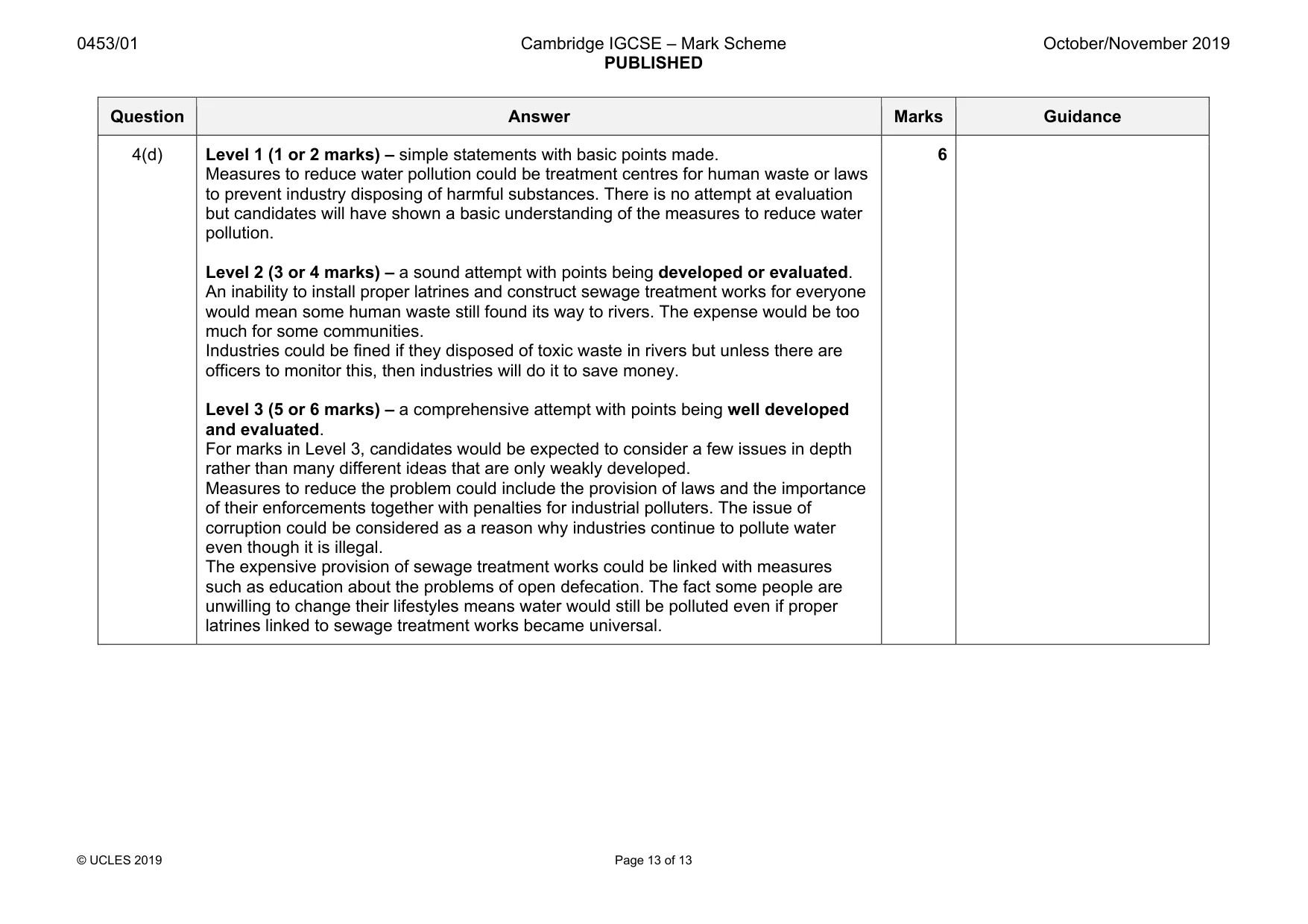
0453/01 Cambridge IGCSE – Mark Scheme PUBLISHED October/November 2019 © UCLES 2019 Page 13 of 13 Question Answer Marks Guidance 4(d) Level 1 (1 or 2 marks) – simple statements with basic points made. Measures to reduce water pollution could be treatment centres for human waste or laws to prevent industry disposing of harmful substances. There is no attempt at evaluation but candidates will have shown a basic understanding of the measures to reduce water pollution. Level 2 (3 or 4 marks) – a sound attempt with points being developed or evaluated. An inability to install proper latrines and construct sewage treatment works for everyone would mean some human waste still found its way to rivers. The expense would be too much for some communities. Industries could be fined if they disposed of toxic waste in rivers but unless there are officers to monitor this, then industries will do it to save money. Level 3 (5 or 6 marks) – a comprehensive attempt with points being well developed and evaluated. For marks in Level 3, candidates would be expected to consider a few issues in depth rather than many different ideas that are only weakly developed. Measures to reduce the problem could include the provision of laws and the importance of their enforcements together with penalties for industrial polluters. The issue of corruption could be considered as a reason why industries continue to pollute water even though it is illegal. The expensive provision of sewage treatment works could be linked with measures such as education about the problems of open defecation. The fact some people are unwilling to change their lifestyles means water would still be polluted even if proper latrines linked to sewage treatment works became universal. 6
What you needed in this session
Cambridge’s own grade thresholds for 2019 Oct/Nov, Paper 1 · Variant 1. A higher threshold means an easier paper — the bar moves with how the cohort did.