Cambridge IGCSE Development Studies 0453 — 2017 Oct/Nov Paper 1 · Variant 1
0453/11/O/N/17 · 80 marks · ≈90 min
The question paper and its mark scheme, free to read here and free to download. This is Cambridge’s own paper, exactly as it was sat.
Question paper16 pages





Mark scheme11 pages
Answers below. Sit the paper first if you are practising.
Paper as text
Question paper, page 1
* 4 6 6 2 5 4 0 6 4 6 * This document consists of 14 printed pages, 2 blank pages and 1 Insert. DC (NF/SG) 135546/2 © UCLES 2017 [Turn over Cambridge International Examinations Cambridge International General Certificate of Secondary Education DEVELOPMENT STUDIES 0453/01 Paper 1 October/November 2017 2 hours Candidates answer on the Question Paper. No Additional Materials are required. READ THESE INSTRUCTIONS FIRST Write your Centre number, candidate number and name on all the work you hand in. Write in dark blue or black pen. Do not use staples, paper clips, glue or correction fluid. You may use a pencil for any diagrams, graphs or rough working. DO NOT WRITE IN ANY BARCODES. Answer all the questions. You may not need all the answer lines for your answer. You should read and study the sources before answering the questions. The Insert contains Photograph A for Question 2. The Insert is not required by the Examiner. It can be kept by the Centre and used as a teaching resource. At the end of the examination, fasten all your work securely together. The number of marks is given in brackets [ ] at the end of each question or part question.
Question paper, page 2
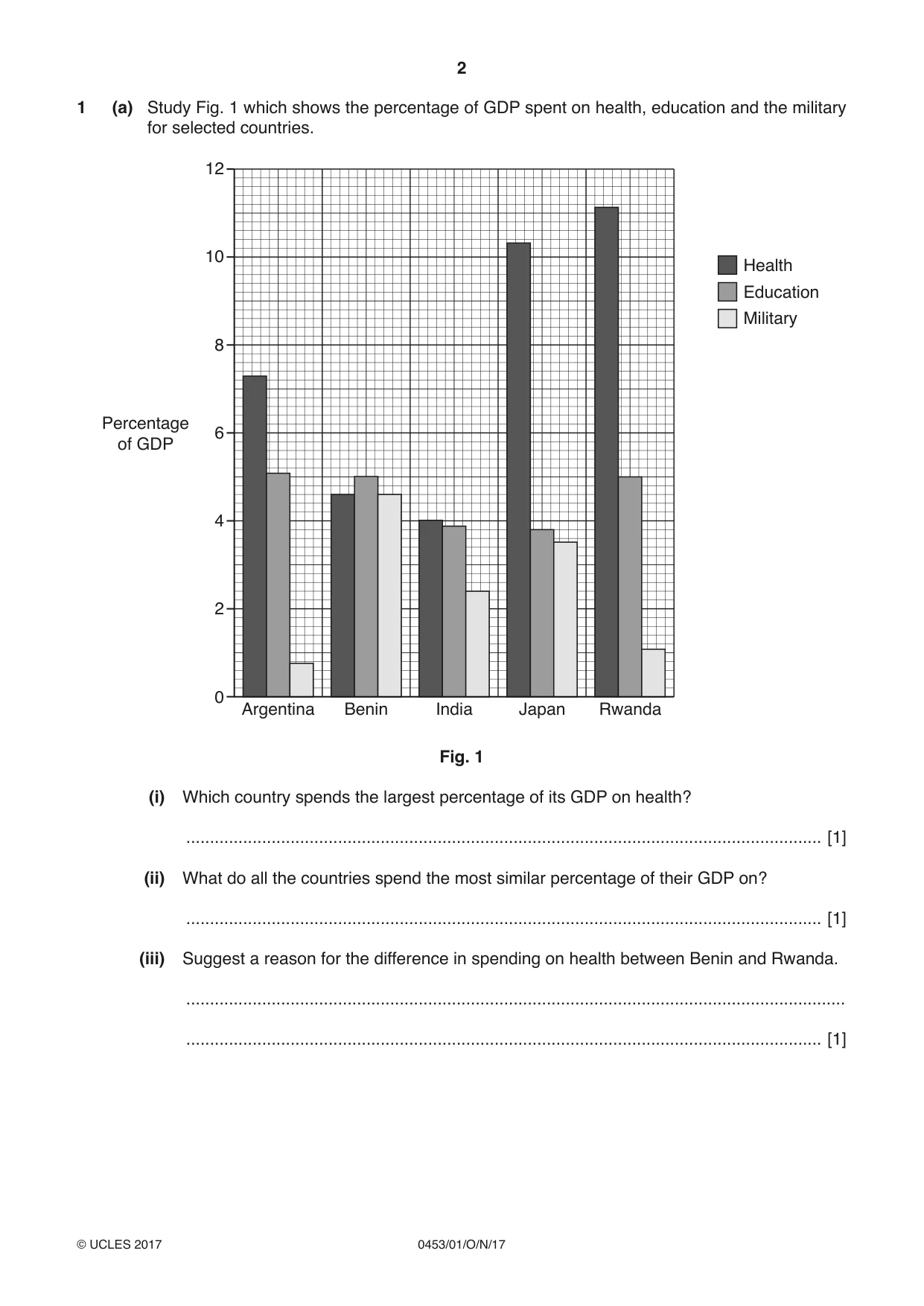
2 0453/01/O/N/17 © UCLES 2017 1 (a) Study Fig. 1 which shows the percentage of GDP spent on health, education and the military for selected countries. Argentina Benin India Japan Rwanda 12 10 8 6 4 2 0 Percentage of GDP Health Education Military Fig. 1 (i) Which country spends the largest percentage of its GDP on health? … [1] (ii) What do all the countries spend the most similar percentage of their GDP on? … [1] (iii) Suggest a reason for the difference in spending on health between Benin and Rwanda. … … [1]
Question paper, page 3
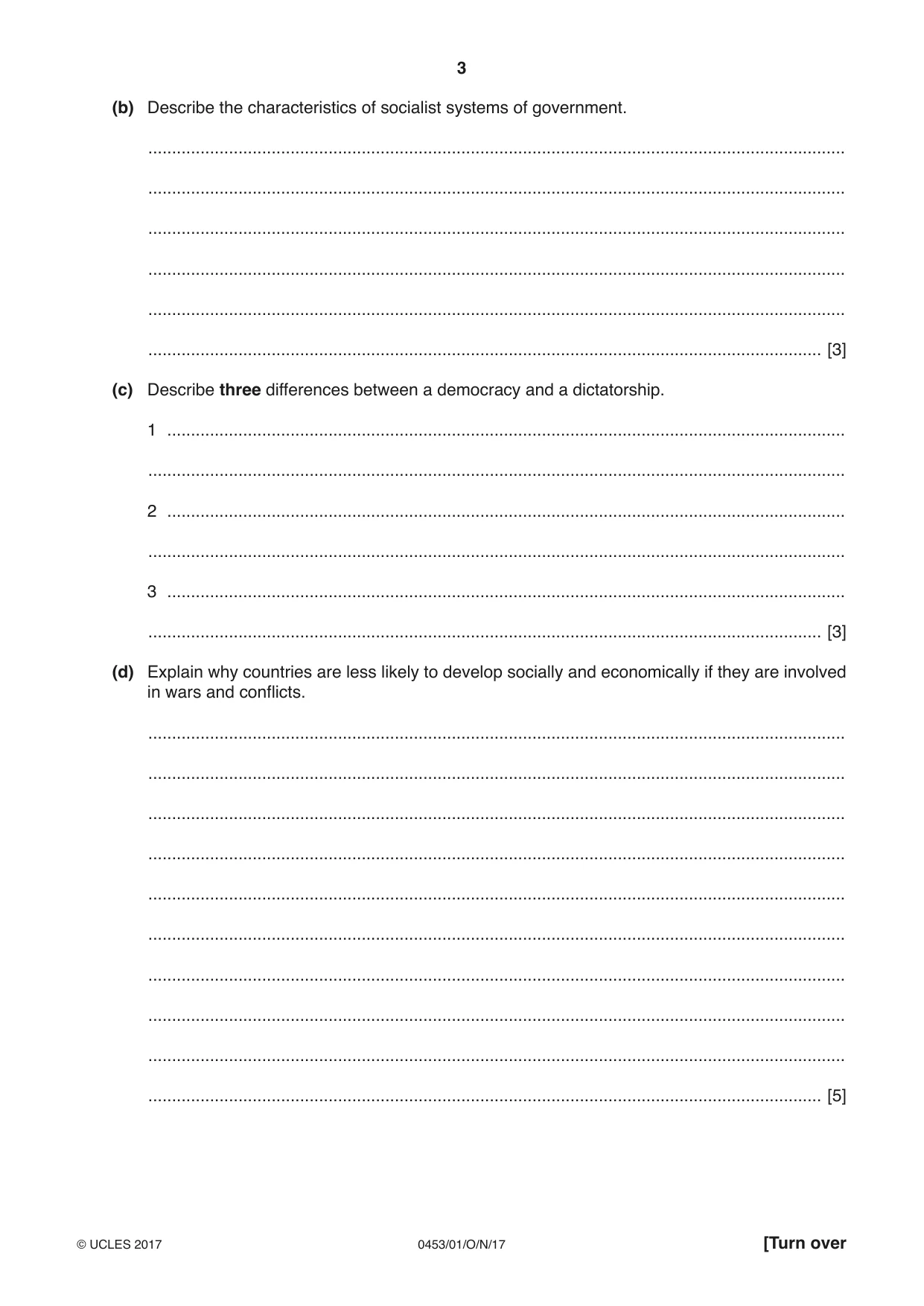
3 0453/01/O/N/17 © UCLES 2017 [Turn over (b) Describe the characteristics of socialist systems of government. … … … … … … [3] (c) Describe three differences between a democracy and a dictatorship. 1 … … 2 … … 3 … … [3] (d) Explain why countries are less likely to develop socially and economically if they are involved in wars and conflicts. … … … … … … … … … … [5]
Question paper, page 4
4 0453/01/O/N/17 © UCLES 2017 (e) One of the roles of government is to plan for development. Choose a large construction project, such as a port, mine or dam. Describe the advantages and disadvantages of the project. You should develop fully the points you make. … … … … … … … … … … … … … … … … … … … … … … … … [6] [Total: 20 marks]
Question paper, page 5
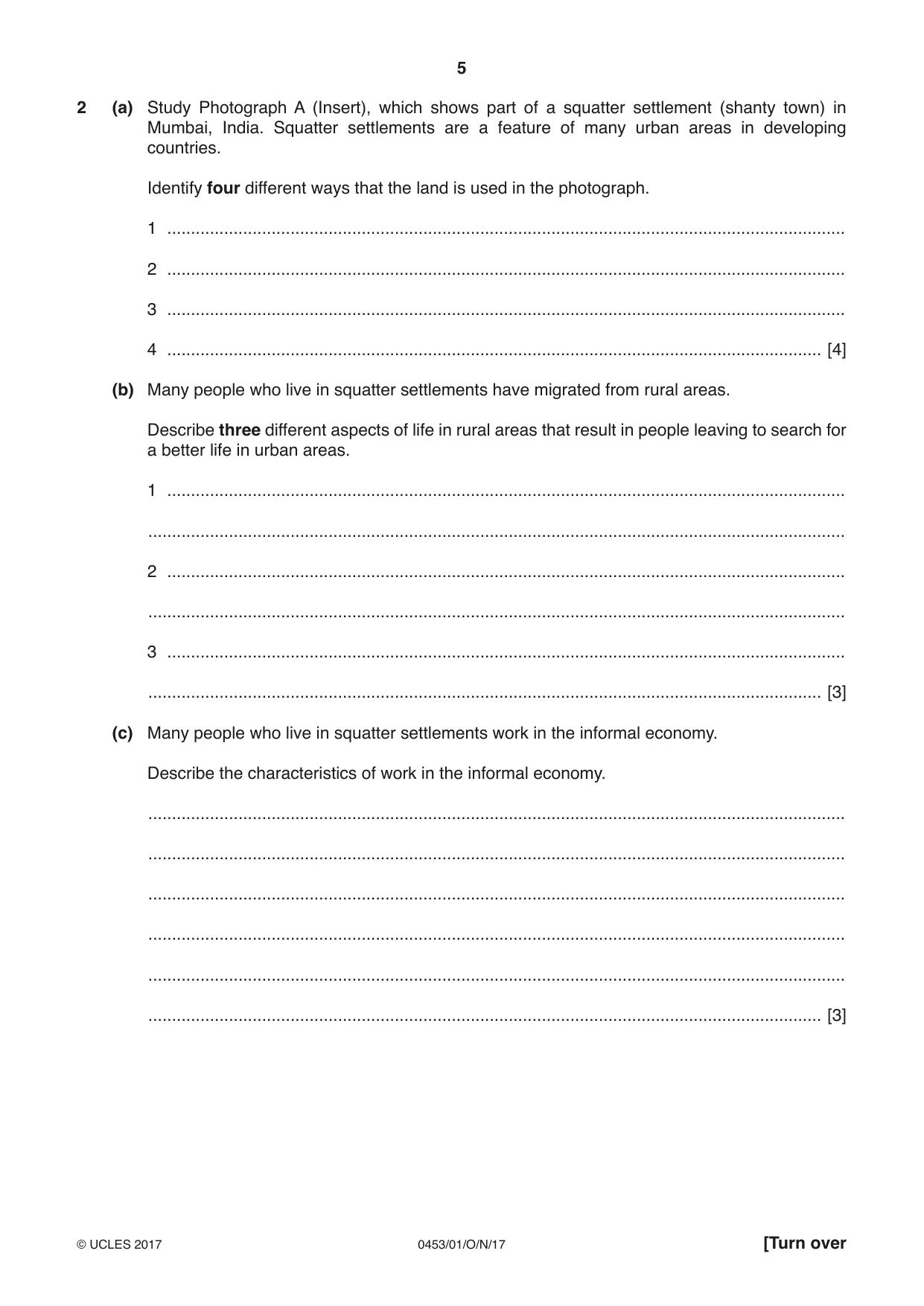
5 0453/01/O/N/17 © UCLES 2017 [Turn over 2 (a) Study Photograph A (Insert), which shows part of a squatter settlement (shanty town) in Mumbai, India. Squatter settlements are a feature of many urban areas in developing countries. Identify four different ways that the land is used in the photograph. 1 … 2 … 3 … 4 … [4] (b) Many people who live in squatter settlements have migrated from rural areas. Describe three different aspects of life in rural areas that result in people leaving to search for a better life in urban areas. 1 … … 2 … … 3 … … [3] (c) Many people who live in squatter settlements work in the informal economy. Describe the characteristics of work in the informal economy. … … … … … … [3]
Question paper, page 6
6 0453/01/O/N/17 © UCLES 2017 (d) Explain how poor housing and a lack of basic services may lead to the poor health of people who live in squatter settlements. … … … … … … … … [4]
Question paper, page 7
7 0453/01/O/N/17 © UCLES 2017 [Turn over (e) Describe possible solutions to the problems found in squatter settlements. You should develop fully the points you make. … … … … … … … … … … … … … … … … … … … … … … … … [6] [Total: 20 marks]
Question paper, page 8
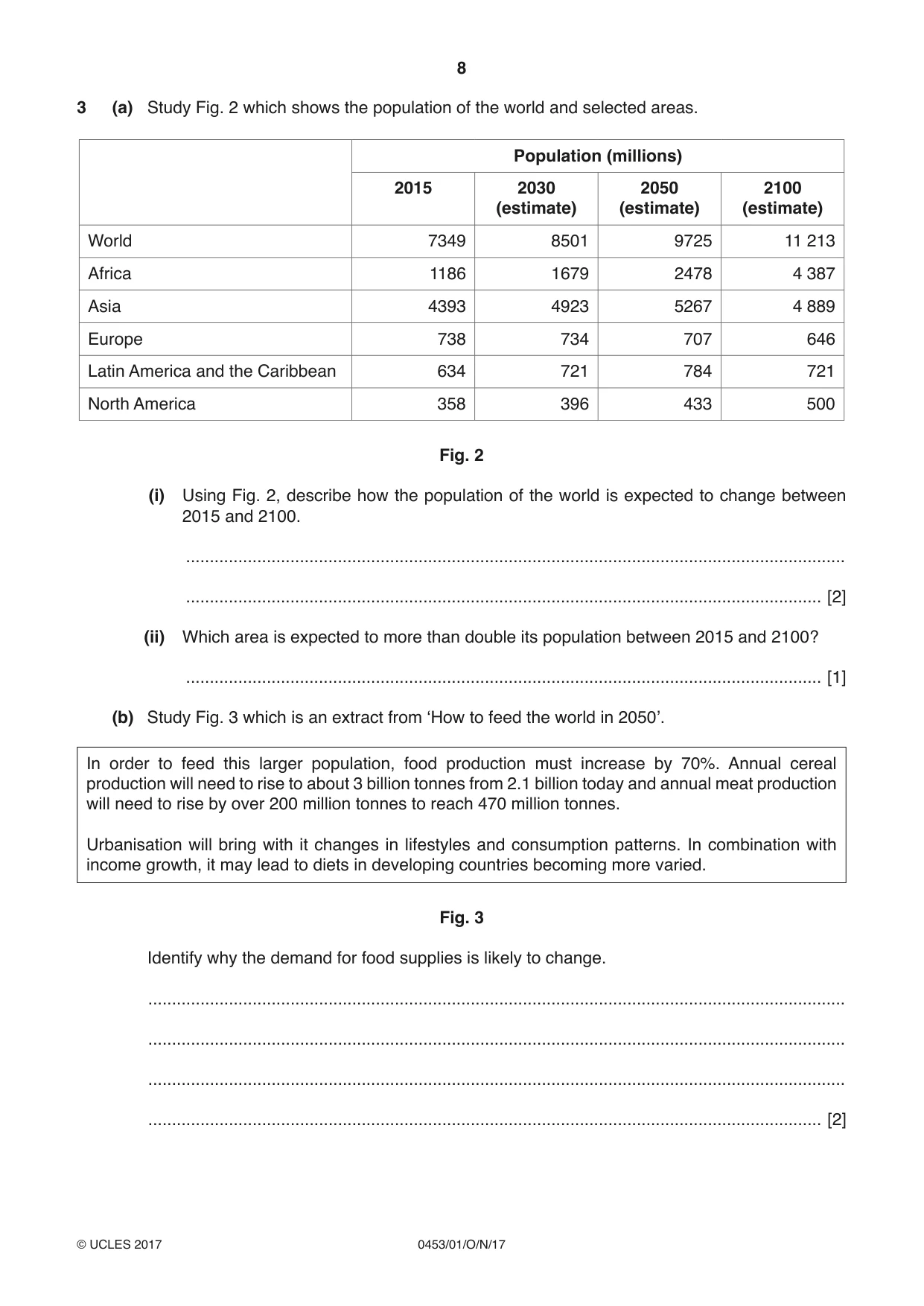
8 0453/01/O/N/17 © UCLES 2017 3 (a) Study Fig. 2 which shows the population of the world and selected areas. Population (millions) 2015 2030 (estimate) 2050 (estimate) 2100 (estimate) World 7349 8501 9725 11 213 Africa 1186 1679 2478 4 387 Asia 4393 4923 5267 4 889 Europe 738 734 707 646 Latin America and the Caribbean 634 721 784 721 North America 358 396 433 500 Fig. 2 (i) Using Fig. 2, describe how the population of the world is expected to change between 2015 and 2100. … … [2] (ii) Which area is expected to more than double its population between 2015 and 2100? … [1] (b) Study Fig. 3 which is an extract from ‘How to feed the world in 2050’. In order to feed this larger population, food production must increase by 70%. Annual cereal production will need to rise to about 3 billion tonnes from 2.1 billion today and annual meat production will need to rise by over 200 million tonnes to reach 470 million tonnes. Urbanisation will bring with it changes in lifestyles and consumption patterns. In combination with income growth, it may lead to diets in developing countries becoming more varied. Fig. 3 Identify why the demand for food supplies is likely to change. … … … … [2]
Question paper, page 9
9 0453/01/O/N/17 © UCLES 2017 [Turn over (c) Up to 40% of food produced in the developing world is wasted before it reaches the market. Suggest how this loss could be reduced. … … … … … … … … [4] (d) Explain why the families of many subsistence farmers in traditional societies are malnourished. … … … … … … … … … … [5]
Question paper, page 10
10 0453/01/O/N/17 © UCLES 2017 (e) Describe methods to increase commercial food production and suggest the extent to which these methods are sustainable. You should develop fully the points you make. … … … … … … … … … … … … … … … … … … … … … … … … [6] [Total: 20 marks]
Question paper, page 11
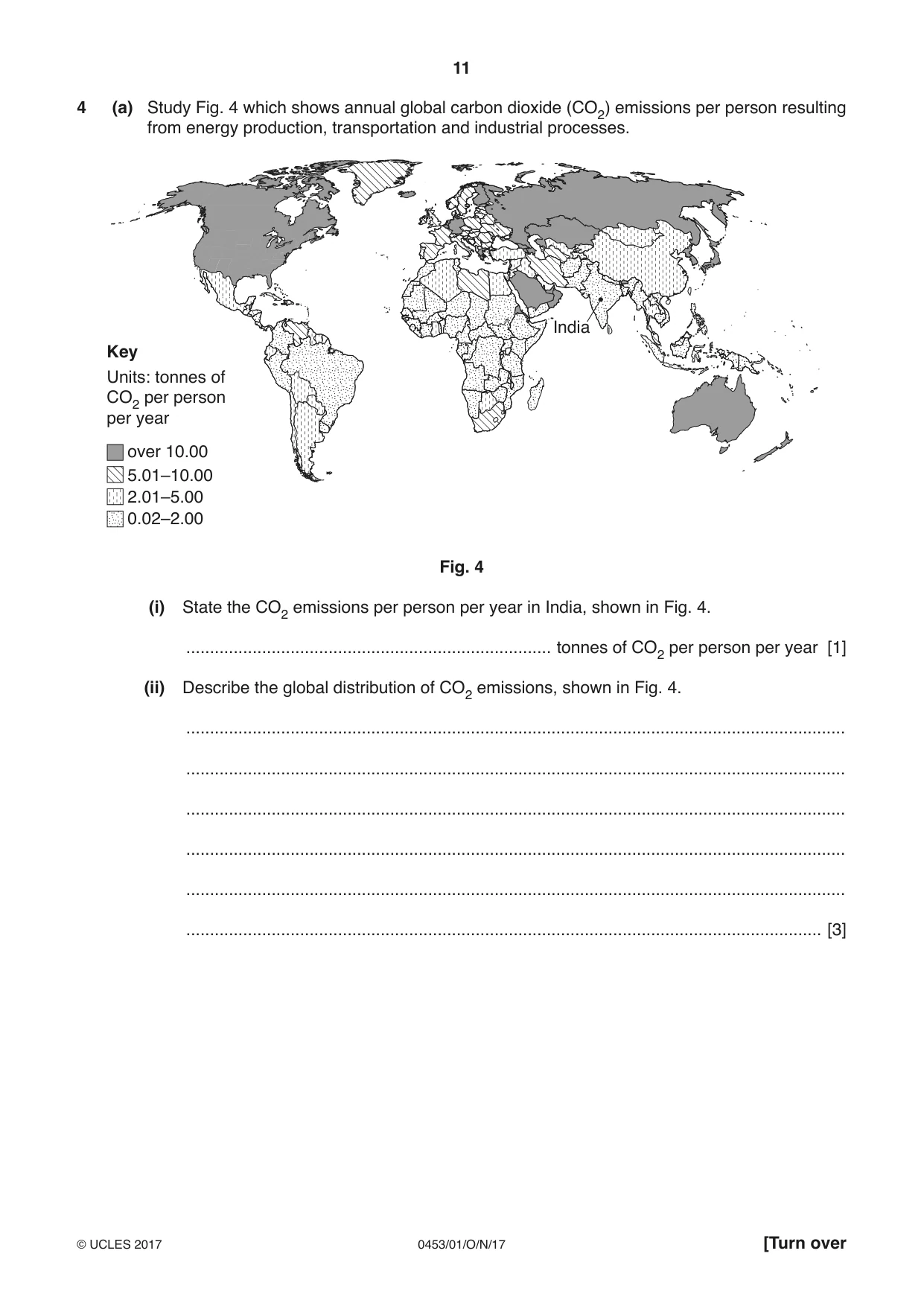
11 0453/01/O/N/17 © UCLES 2017 [Turn over 4 (a) Study Fig. 4 which shows annual global carbon dioxide (CO2) emissions per person resulting from energy production, transportation and industrial processes. over 10.00 5.01–10.00 2.01–5.00 0.02–2.00 Key Units: tonnes of CO2 per person per year India Fig. 4 (i) State the CO2 emissions per person per year in India, shown in Fig. 4. … tonnes of CO2 per person per year [1] (ii) Describe the global distribution of CO2 emissions, shown in Fig. 4. … … … … … … [3]
Question paper, page 12
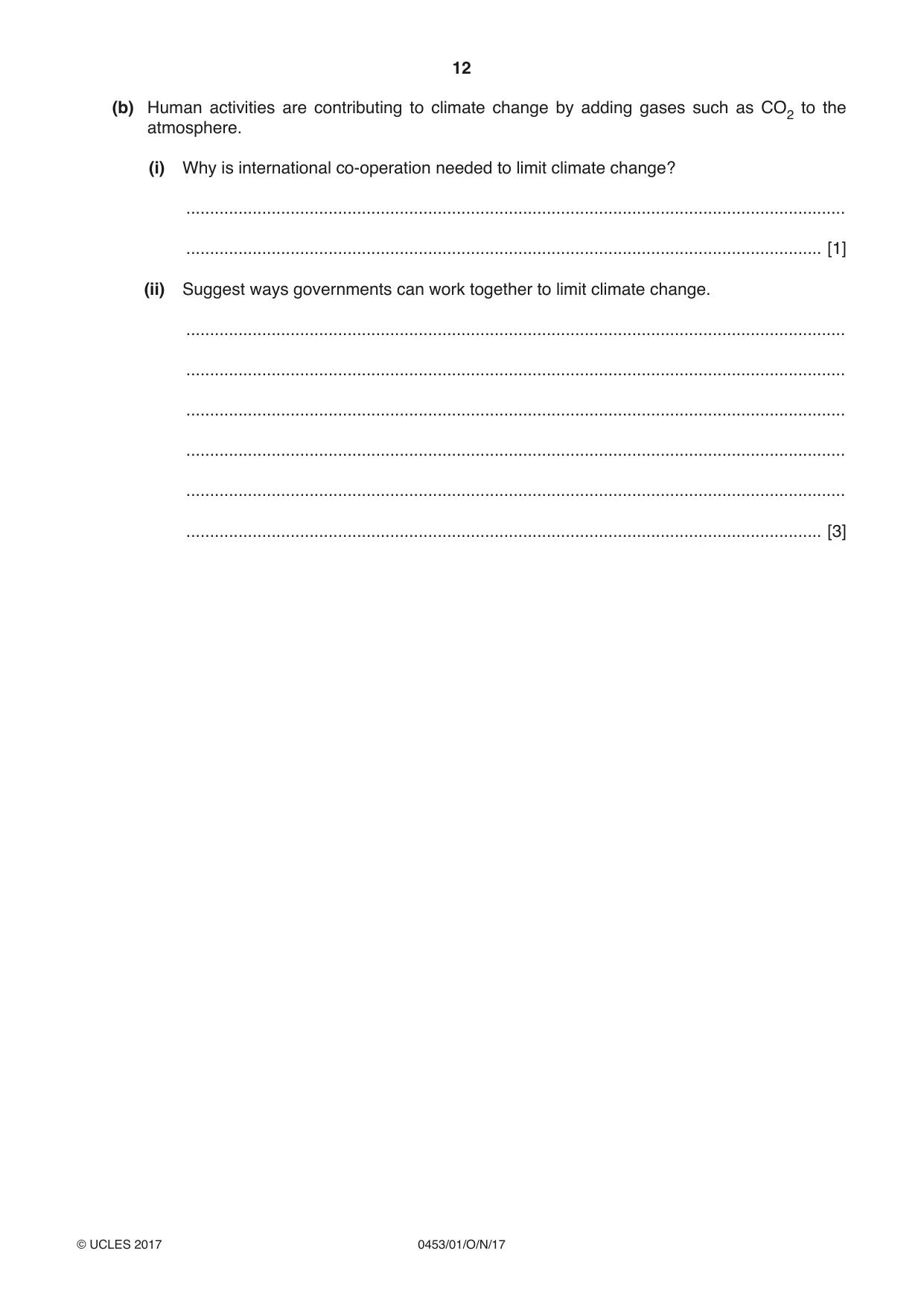
12 0453/01/O/N/17 © UCLES 2017 (b) Human activities are contributing to climate change by adding gases such as CO2 to the atmosphere. (i) Why is international co-operation needed to limit climate change? … … [1] (ii) Suggest ways governments can work together to limit climate change. … … … … … … [3]
Question paper, page 13
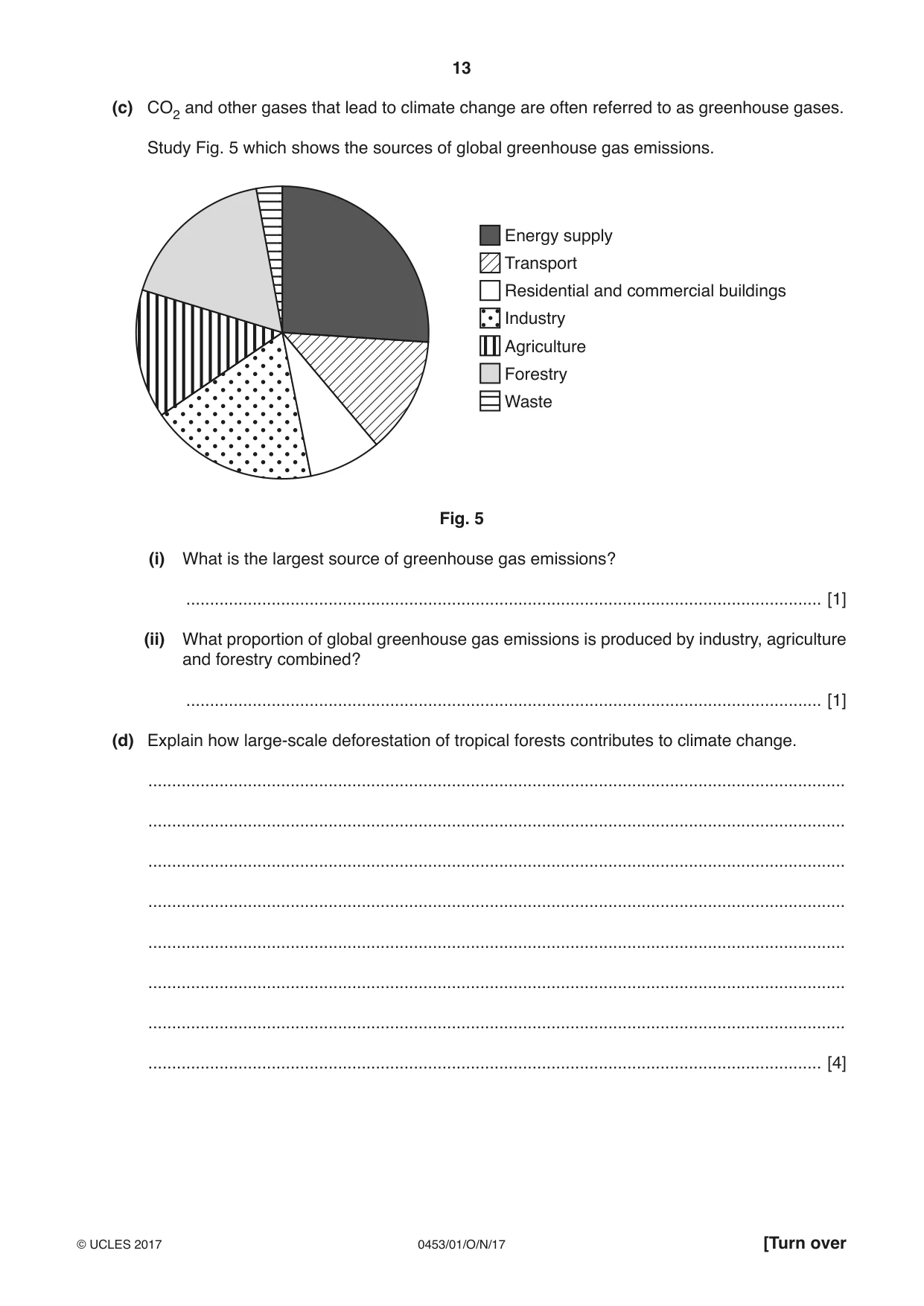
13 0453/01/O/N/17 © UCLES 2017 [Turn over (c) CO2 and other gases that lead to climate change are often referred to as greenhouse gases. Study Fig. 5 which shows the sources of global greenhouse gas emissions. Energy supply Transport Residential and commercial buildings Industry Agriculture Forestry Waste Fig. 5 (i) What is the largest source of greenhouse gas emissions? … [1] (ii) What proportion of global greenhouse gas emissions is produced by industry, agriculture and forestry combined? … [1] (d) Explain how large-scale deforestation of tropical forests contributes to climate change. … … … … … … … … [4]
Question paper, page 14
14 0453/01/O/N/17 © UCLES 2017 (e) Describe the likely impacts of climate change on developing countries. You should develop fully the points you make. … … … … … … … … … … … … … … … … … … … … … … … … [6] [Total: 20 marks]
Question paper, page 15
15 0453/01/O/N/17 © UCLES 2017 BLANK PAGE
Question paper, page 16
16 0453/01/O/N/17 © UCLES 2017 BLANK PAGE Permission to reproduce items where third-party owned material protected by copyright is included has been sought and cleared where possible. Every reasonable effort has been made by the publisher (UCLES) to trace copyright holders, but if any items requiring clearance have unwittingly been included, the publisher will be pleased to make amends at the earliest possible opportunity. To avoid the issue of disclosure of answer-related information to candidates, all copyright acknowledgements are reproduced online in the Cambridge International Examinations Copyright Acknowledgements Booklet. This is produced for each series of examinations and is freely available to download at www.cie.org.uk after the live examination series. Cambridge International Examinations is part of the Cambridge Assessment Group. Cambridge Assessment is the brand name of University of Cambridge Local Examinations Syndicate (UCLES), which is itself a department of the University of Cambridge.
Mark scheme, page 1
® IGCSE is a registered trademark. This document consists of 11 printed pages. © UCLES 2017 [Turn over Cambridge Assessment International Education Cambridge International General Certificate of Secondary Education DEVELOPMENT STUDIES 0453/01 Paper 1 October/November 2017 MARK SCHEME Maximum Mark: 80 Published This mark scheme is published as an aid to teachers and candidates, to indicate the requirements of the examination. It shows the basis on which Examiners were instructed to award marks. It does not indicate the details of the discussions that took place at an Examiners’ meeting before marking began, which would have considered the acceptability of alternative answers. Mark schemes should be read in conjunction with the question paper and the Principal Examiner Report for Teachers. Cambridge International will not enter into discussions about these mark schemes. Cambridge International is publishing the mark schemes for the October/November 2017 series for most Cambridge IGCSE®, Cambridge International A and AS Level components and some Cambridge O Level components.
Mark scheme, page 2
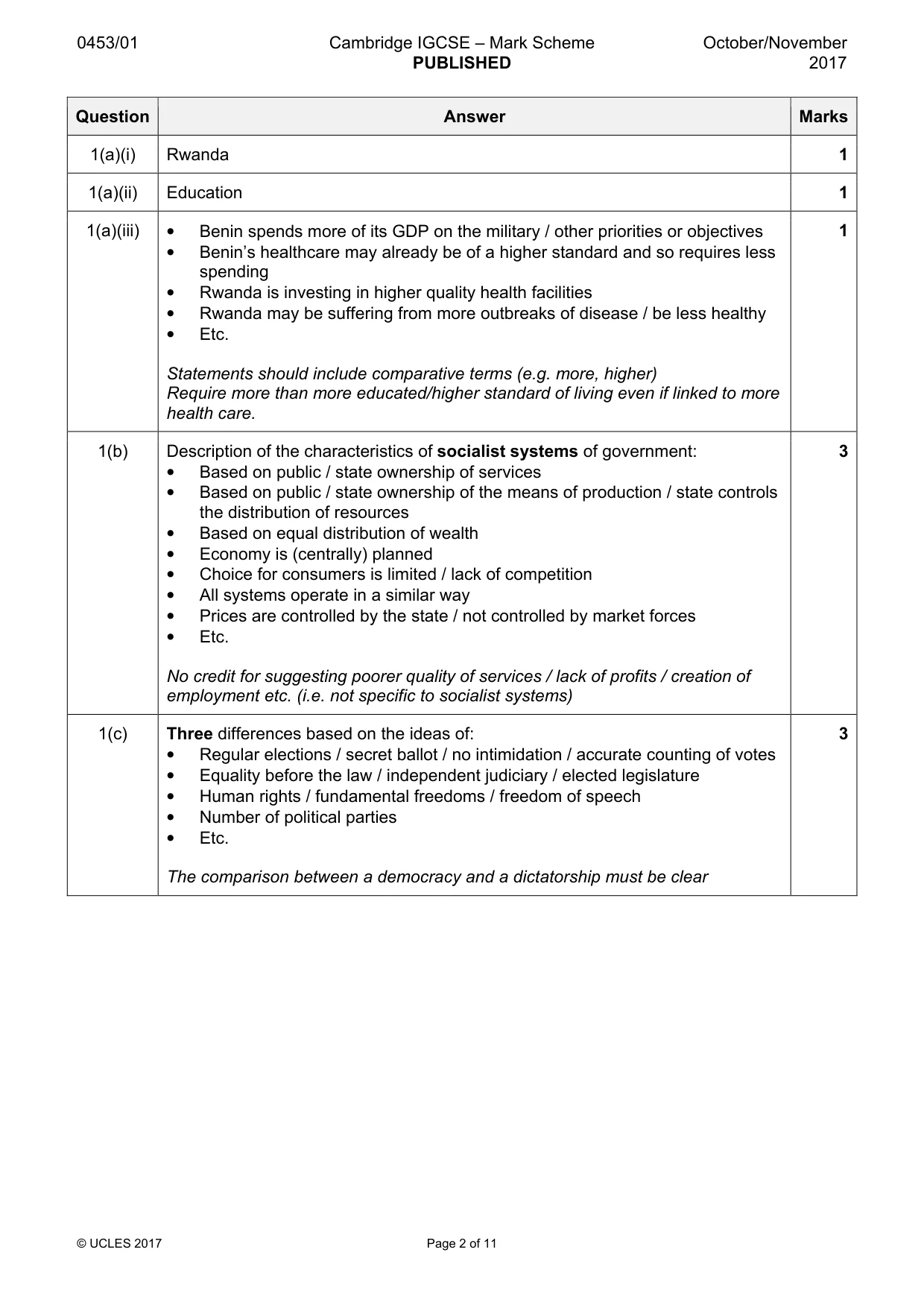
0453/01 Cambridge IGCSE – Mark Scheme PUBLISHED October/November 2017 © UCLES 2017 Page 2 of 11 Question Answer Marks 1(a)(i) Rwanda 1 1(a)(ii) Education 1 1(a)(iii) • Benin spends more of its GDP on the military / other priorities or objectives • Benin’s healthcare may already be of a higher standard and so requires less spending • Rwanda is investing in higher quality health facilities • Rwanda may be suffering from more outbreaks of disease / be less healthy • Etc. Statements should include comparative terms (e.g. more, higher) Require more than more educated/higher standard of living even if linked to more health care. 1 1(b) Description of the characteristics of socialist systems of government: • Based on public / state ownership of services • Based on public / state ownership of the means of production / state controls the distribution of resources • Based on equal distribution of wealth • Economy is (centrally) planned • Choice for consumers is limited / lack of competition • All systems operate in a similar way • Prices are controlled by the state / not controlled by market forces • Etc. No credit for suggesting poorer quality of services / lack of profits / creation of employment etc. (i.e. not specific to socialist systems) 3 1(c) Three differences based on the ideas of: • Regular elections / secret ballot / no intimidation / accurate counting of votes • Equality before the law / independent judiciary / elected legislature • Human rights / fundamental freedoms / freedom of speech • Number of political parties • Etc. The comparison between a democracy and a dictatorship must be clear 3
Mark scheme, page 3
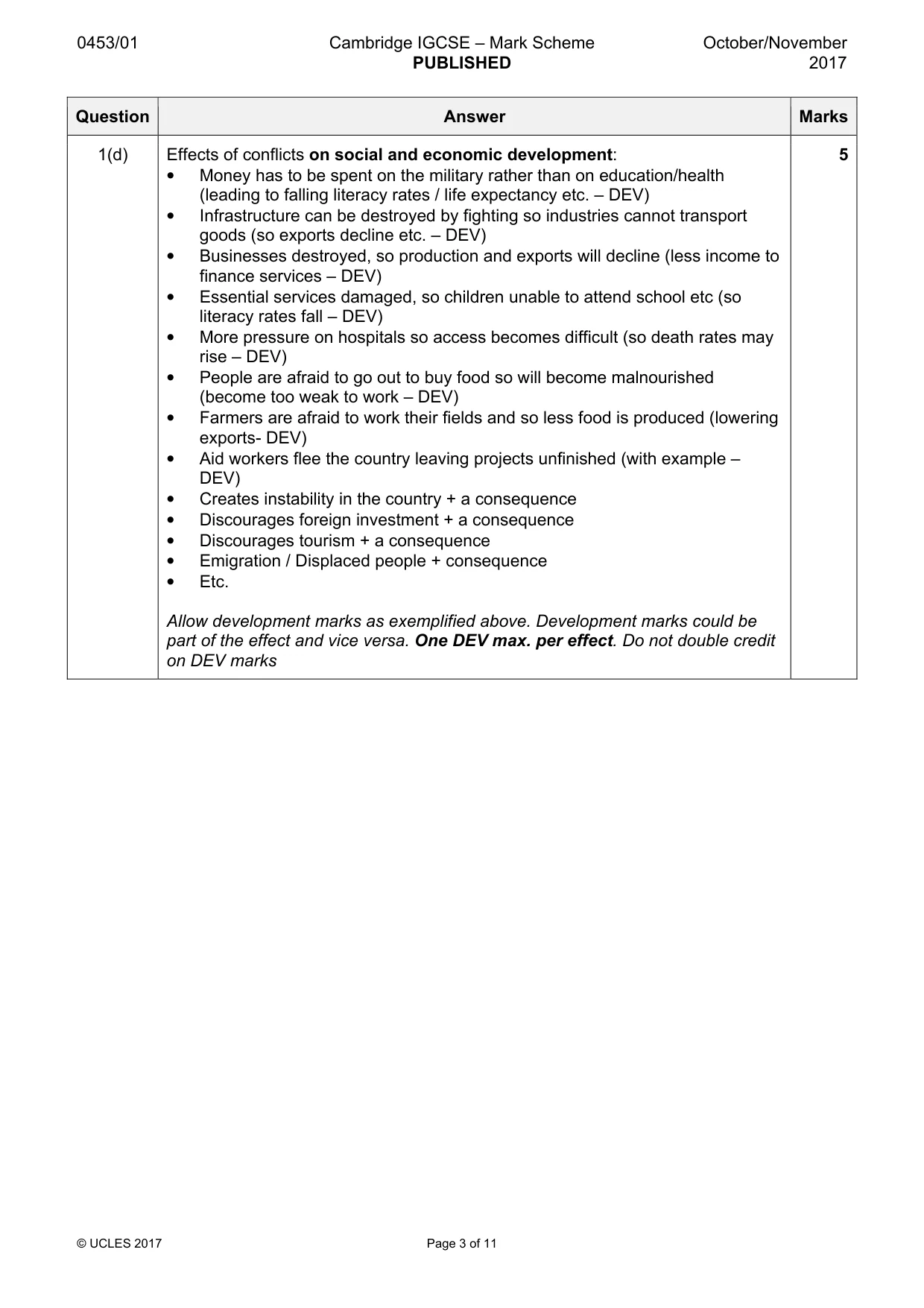
0453/01 Cambridge IGCSE – Mark Scheme PUBLISHED October/November 2017 © UCLES 2017 Page 3 of 11 Question Answer Marks 1(d) Effects of conflicts on social and economic development: • Money has to be spent on the military rather than on education/health (leading to falling literacy rates / life expectancy etc. – DEV) • Infrastructure can be destroyed by fighting so industries cannot transport goods (so exports decline etc. – DEV) • Businesses destroyed, so production and exports will decline (less income to finance services – DEV) • Essential services damaged, so children unable to attend school etc (so literacy rates fall – DEV) • More pressure on hospitals so access becomes difficult (so death rates may rise – DEV) • People are afraid to go out to buy food so will become malnourished (become too weak to work – DEV) • Farmers are afraid to work their fields and so less food is produced (lowering exports- DEV) • Aid workers flee the country leaving projects unfinished (with example – DEV) • Creates instability in the country + a consequence • Discourages foreign investment + a consequence • Discourages tourism + a consequence • Emigration / Displaced people + consequence • Etc. Allow development marks as exemplified above. Development marks could be part of the effect and vice versa. One DEV max. per effect. Do not double credit on DEV marks 5
Mark scheme, page 4
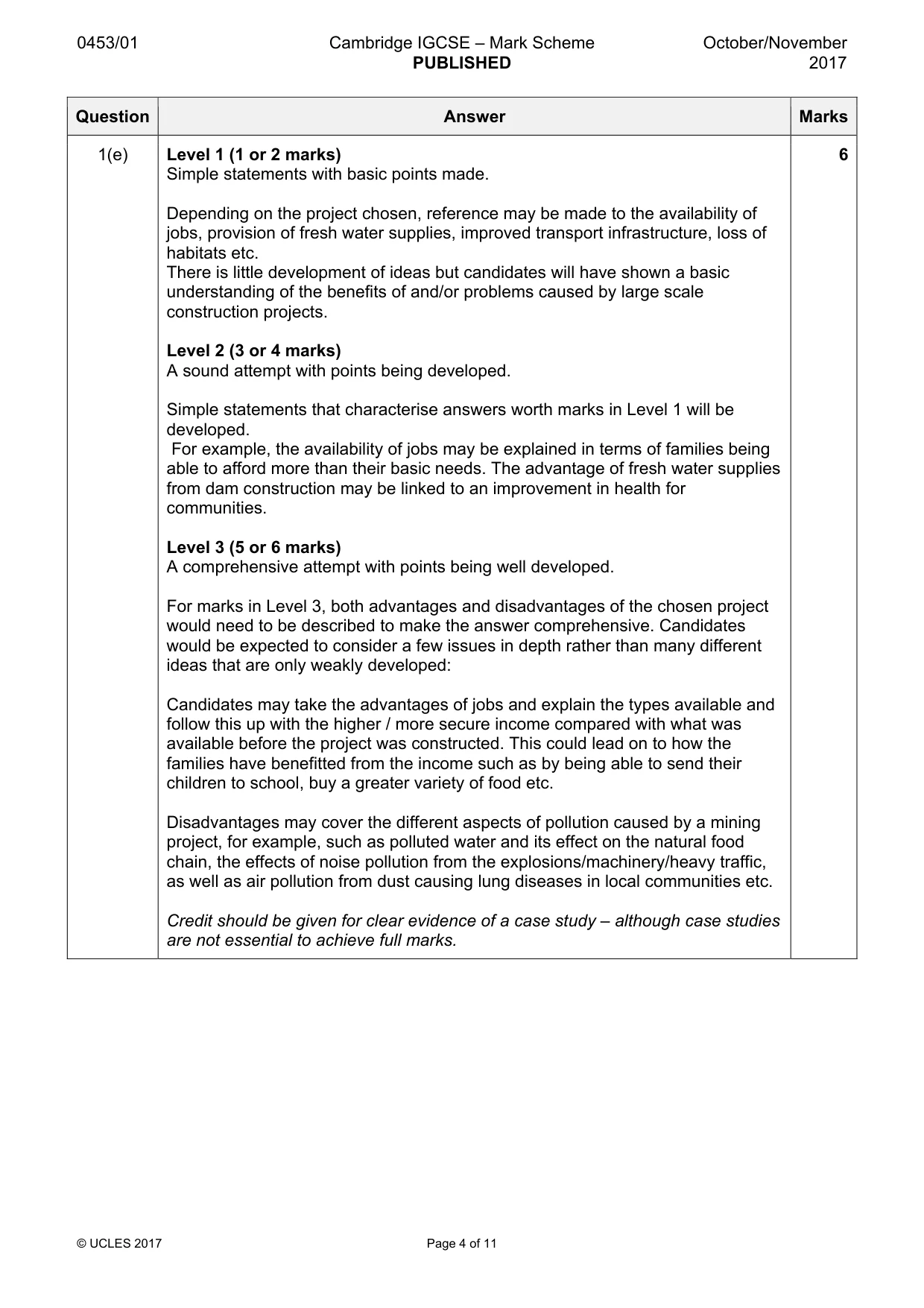
0453/01 Cambridge IGCSE – Mark Scheme PUBLISHED October/November 2017 © UCLES 2017 Page 4 of 11 Question Answer Marks 1(e) Level 1 (1 or 2 marks) Simple statements with basic points made. Depending on the project chosen, reference may be made to the availability of jobs, provision of fresh water supplies, improved transport infrastructure, loss of habitats etc. There is little development of ideas but candidates will have shown a basic understanding of the benefits of and/or problems caused by large scale construction projects. Level 2 (3 or 4 marks) A sound attempt with points being developed. Simple statements that characterise answers worth marks in Level 1 will be developed. For example, the availability of jobs may be explained in terms of families being able to afford more than their basic needs. The advantage of fresh water supplies from dam construction may be linked to an improvement in health for communities. Level 3 (5 or 6 marks) A comprehensive attempt with points being well developed. For marks in Level 3, both advantages and disadvantages of the chosen project would need to be described to make the answer comprehensive. Candidates would be expected to consider a few issues in depth rather than many different ideas that are only weakly developed: Candidates may take the advantages of jobs and explain the types available and follow this up with the higher / more secure income compared with what was available before the project was constructed. This could lead on to how the families have benefitted from the income such as by being able to send their children to school, buy a greater variety of food etc. Disadvantages may cover the different aspects of pollution caused by a mining project, for example, such as polluted water and its effect on the natural food chain, the effects of noise pollution from the explosions/machinery/heavy traffic, as well as air pollution from dust causing lung diseases in local communities etc. Credit should be given for clear evidence of a case study – although case studies are not essential to achieve full marks. 6
Mark scheme, page 5
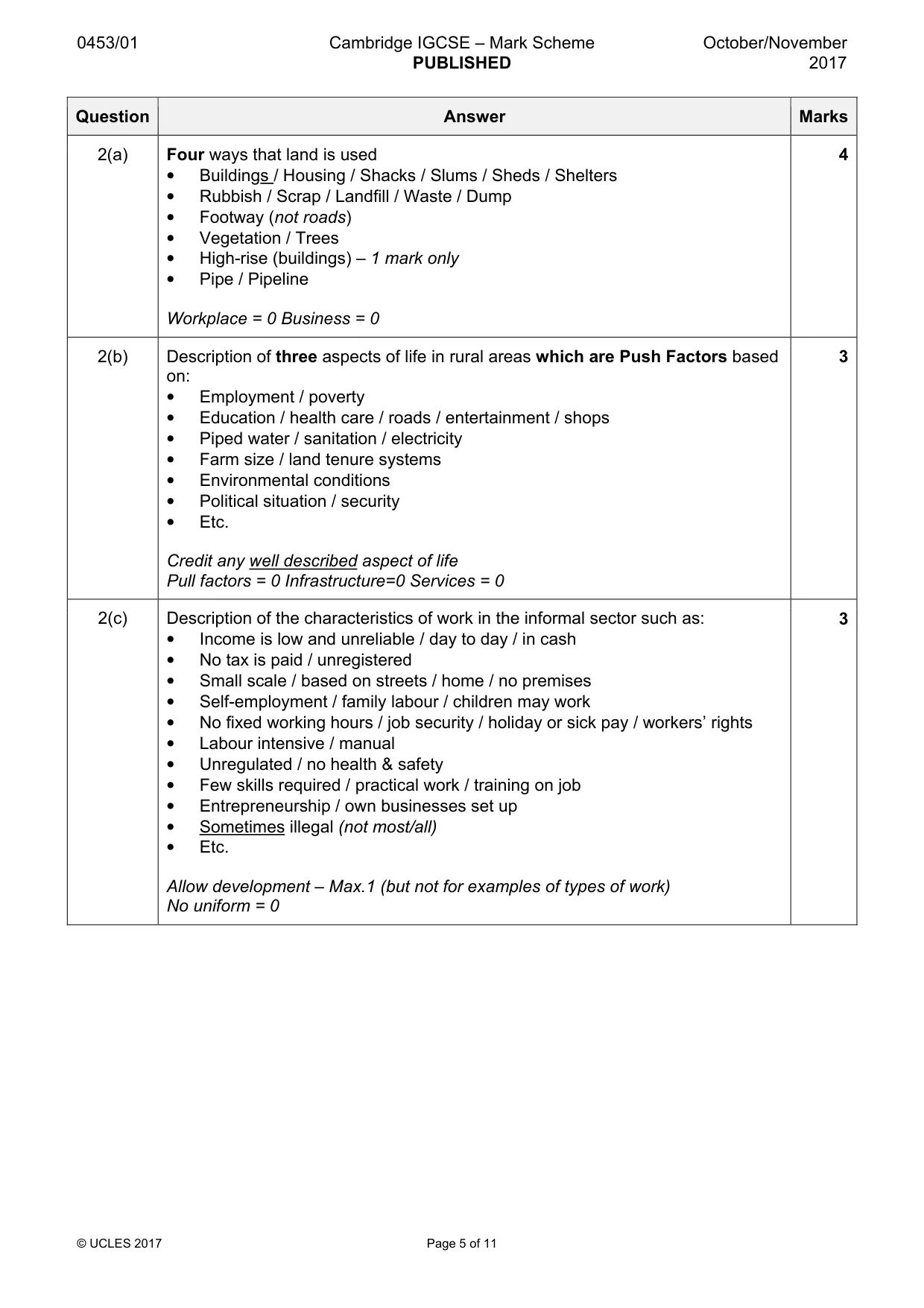
0453/01 Cambridge IGCSE – Mark Scheme PUBLISHED October/November 2017 © UCLES 2017 Page 5 of 11 Question Answer Marks 2(a) Four ways that land is used • Buildings / Housing / Shacks / Slums / Sheds / Shelters • Rubbish / Scrap / Landfill / Waste / Dump • Footway (not roads) • Vegetation / Trees • High-rise (buildings) – 1 mark only • Pipe / Pipeline Workplace = 0 Business = 0 4 2(b) Description of three aspects of life in rural areas which are Push Factors based on: • Employment / poverty • Education / health care / roads / entertainment / shops • Piped water / sanitation / electricity • Farm size / land tenure systems • Environmental conditions • Political situation / security • Etc. Credit any well described aspect of life Pull factors = 0 Infrastructure=0 Services = 0 3 2(c) Description of the characteristics of work in the informal sector such as: • Income is low and unreliable / day to day / in cash • No tax is paid / unregistered • Small scale / based on streets / home / no premises • Self-employment / family labour / children may work • No fixed working hours / job security / holiday or sick pay / workers’ rights • Labour intensive / manual • Unregulated / no health & safety • Few skills required / practical work / training on job • Entrepreneurship / own businesses set up • Sometimes illegal (not most/all) • Etc. Allow development – Max.1 (but not for examples of types of work) No uniform = 0 3
Mark scheme, page 6
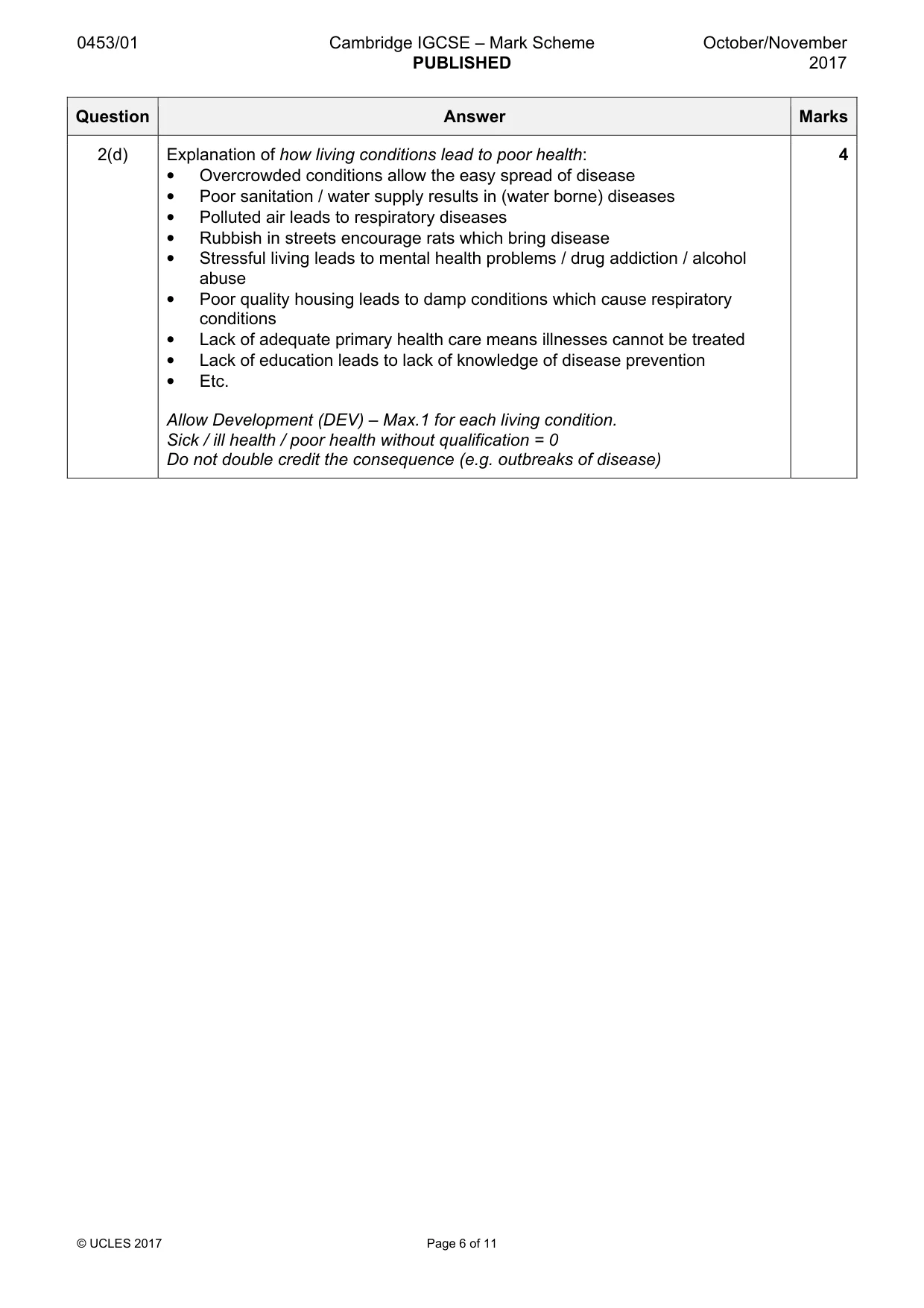
0453/01 Cambridge IGCSE – Mark Scheme PUBLISHED October/November 2017 © UCLES 2017 Page 6 of 11 Question Answer Marks 2(d) Explanation of how living conditions lead to poor health: • Overcrowded conditions allow the easy spread of disease • Poor sanitation / water supply results in (water borne) diseases • Polluted air leads to respiratory diseases • Rubbish in streets encourage rats which bring disease • Stressful living leads to mental health problems / drug addiction / alcohol abuse • Poor quality housing leads to damp conditions which cause respiratory conditions • Lack of adequate primary health care means illnesses cannot be treated • Lack of education leads to lack of knowledge of disease prevention • Etc. Allow Development (DEV) – Max.1 for each living condition. Sick / ill health / poor health without qualification = 0 Do not double credit the consequence (e.g. outbreaks of disease) 4
Mark scheme, page 7
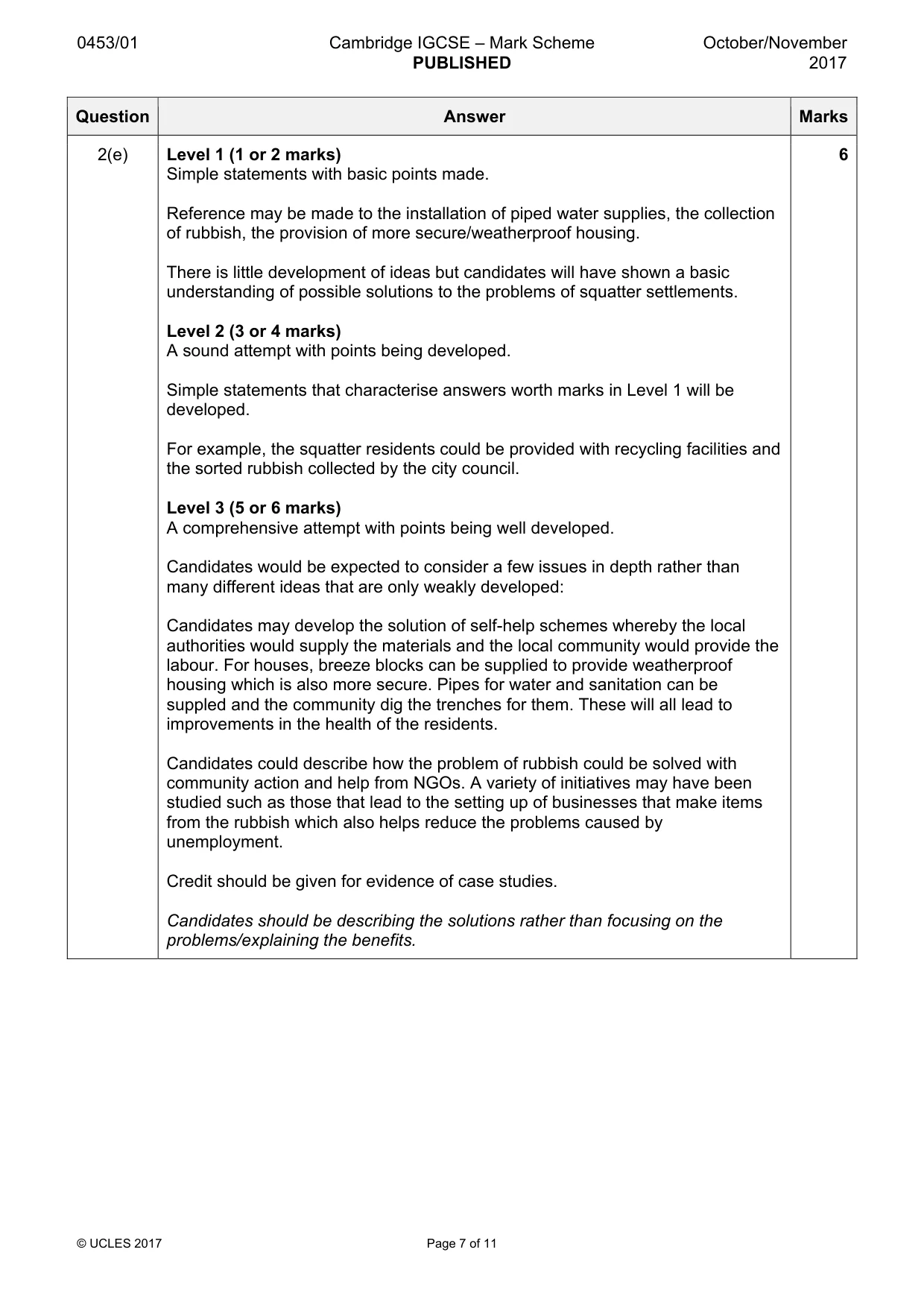
0453/01 Cambridge IGCSE – Mark Scheme PUBLISHED October/November 2017 © UCLES 2017 Page 7 of 11 Question Answer Marks 2(e) Level 1 (1 or 2 marks) Simple statements with basic points made. Reference may be made to the installation of piped water supplies, the collection of rubbish, the provision of more secure/weatherproof housing. There is little development of ideas but candidates will have shown a basic understanding of possible solutions to the problems of squatter settlements. Level 2 (3 or 4 marks) A sound attempt with points being developed. Simple statements that characterise answers worth marks in Level 1 will be developed. For example, the squatter residents could be provided with recycling facilities and the sorted rubbish collected by the city council. Level 3 (5 or 6 marks) A comprehensive attempt with points being well developed. Candidates would be expected to consider a few issues in depth rather than many different ideas that are only weakly developed: Candidates may develop the solution of self-help schemes whereby the local authorities would supply the materials and the local community would provide the labour. For houses, breeze blocks can be supplied to provide weatherproof housing which is also more secure. Pipes for water and sanitation can be suppled and the community dig the trenches for them. These will all lead to improvements in the health of the residents. Candidates could describe how the problem of rubbish could be solved with community action and help from NGOs. A variety of initiatives may have been studied such as those that lead to the setting up of businesses that make items from the rubbish which also helps reduce the problems caused by unemployment. Credit should be given for evidence of case studies. Candidates should be describing the solutions rather than focusing on the problems/explaining the benefits. 6
Mark scheme, page 8
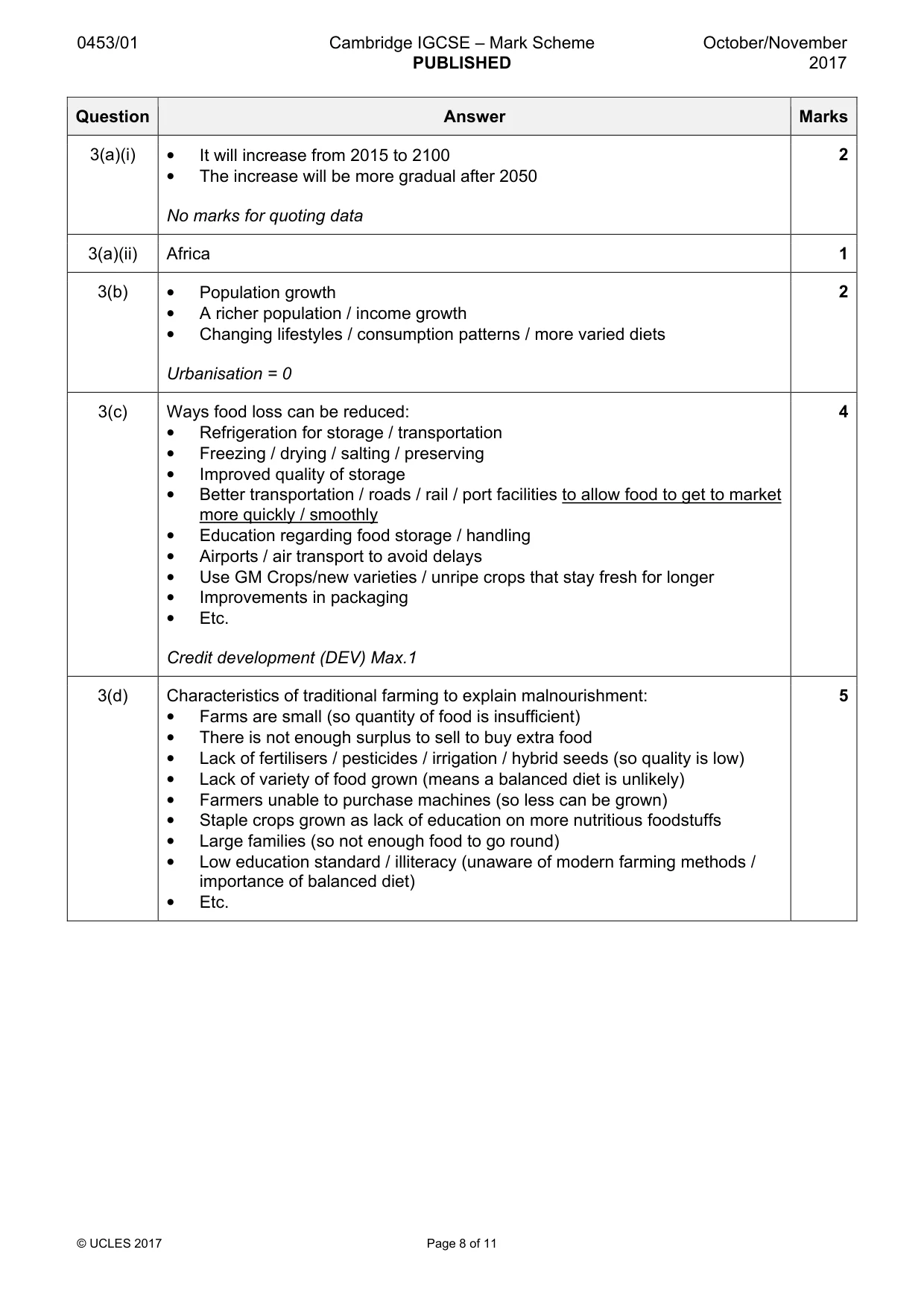
0453/01 Cambridge IGCSE – Mark Scheme PUBLISHED October/November 2017 © UCLES 2017 Page 8 of 11 Question Answer Marks 3(a)(i) • It will increase from 2015 to 2100 • The increase will be more gradual after 2050 No marks for quoting data 2 3(a)(ii) Africa 1 3(b) • Population growth • A richer population / income growth • Changing lifestyles / consumption patterns / more varied diets Urbanisation = 0 2 3(c) Ways food loss can be reduced: • Refrigeration for storage / transportation • Freezing / drying / salting / preserving • Improved quality of storage • Better transportation / roads / rail / port facilities to allow food to get to market more quickly / smoothly • Education regarding food storage / handling • Airports / air transport to avoid delays • Use GM Crops/new varieties / unripe crops that stay fresh for longer • Improvements in packaging • Etc. Credit development (DEV) Max.1 4 3(d) Characteristics of traditional farming to explain malnourishment: • Farms are small (so quantity of food is insufficient) • There is not enough surplus to sell to buy extra food • Lack of fertilisers / pesticides / irrigation / hybrid seeds (so quality is low) • Lack of variety of food grown (means a balanced diet is unlikely) • Farmers unable to purchase machines (so less can be grown) • Staple crops grown as lack of education on more nutritious foodstuffs • Large families (so not enough food to go round) • Low education standard / illiteracy (unaware of modern farming methods / importance of balanced diet) • Etc. 5
Mark scheme, page 9
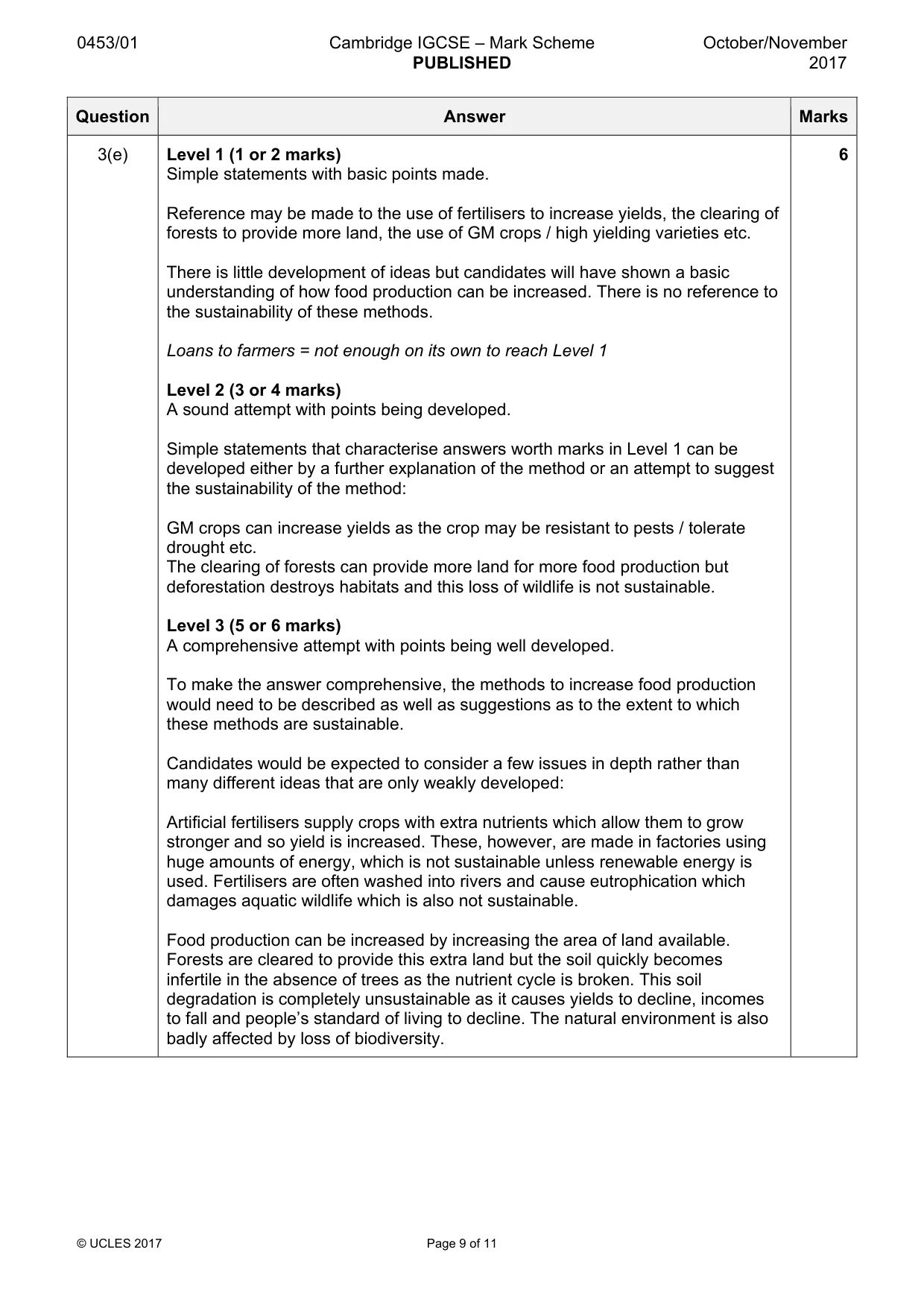
0453/01 Cambridge IGCSE – Mark Scheme PUBLISHED October/November 2017 © UCLES 2017 Page 9 of 11 Question Answer Marks 3(e) Level 1 (1 or 2 marks) Simple statements with basic points made. Reference may be made to the use of fertilisers to increase yields, the clearing of forests to provide more land, the use of GM crops / high yielding varieties etc. There is little development of ideas but candidates will have shown a basic understanding of how food production can be increased. There is no reference to the sustainability of these methods. Loans to farmers = not enough on its own to reach Level 1 Level 2 (3 or 4 marks) A sound attempt with points being developed. Simple statements that characterise answers worth marks in Level 1 can be developed either by a further explanation of the method or an attempt to suggest the sustainability of the method: GM crops can increase yields as the crop may be resistant to pests / tolerate drought etc. The clearing of forests can provide more land for more food production but deforestation destroys habitats and this loss of wildlife is not sustainable. Level 3 (5 or 6 marks) A comprehensive attempt with points being well developed. To make the answer comprehensive, the methods to increase food production would need to be described as well as suggestions as to the extent to which these methods are sustainable. Candidates would be expected to consider a few issues in depth rather than many different ideas that are only weakly developed: Artificial fertilisers supply crops with extra nutrients which allow them to grow stronger and so yield is increased. These, however, are made in factories using huge amounts of energy, which is not sustainable unless renewable energy is used. Fertilisers are often washed into rivers and cause eutrophication which damages aquatic wildlife which is also not sustainable. Food production can be increased by increasing the area of land available. Forests are cleared to provide this extra land but the soil quickly becomes infertile in the absence of trees as the nutrient cycle is broken. This soil degradation is completely unsustainable as it causes yields to decline, incomes to fall and people’s standard of living to decline. The natural environment is also badly affected by loss of biodiversity. 6
Mark scheme, page 10
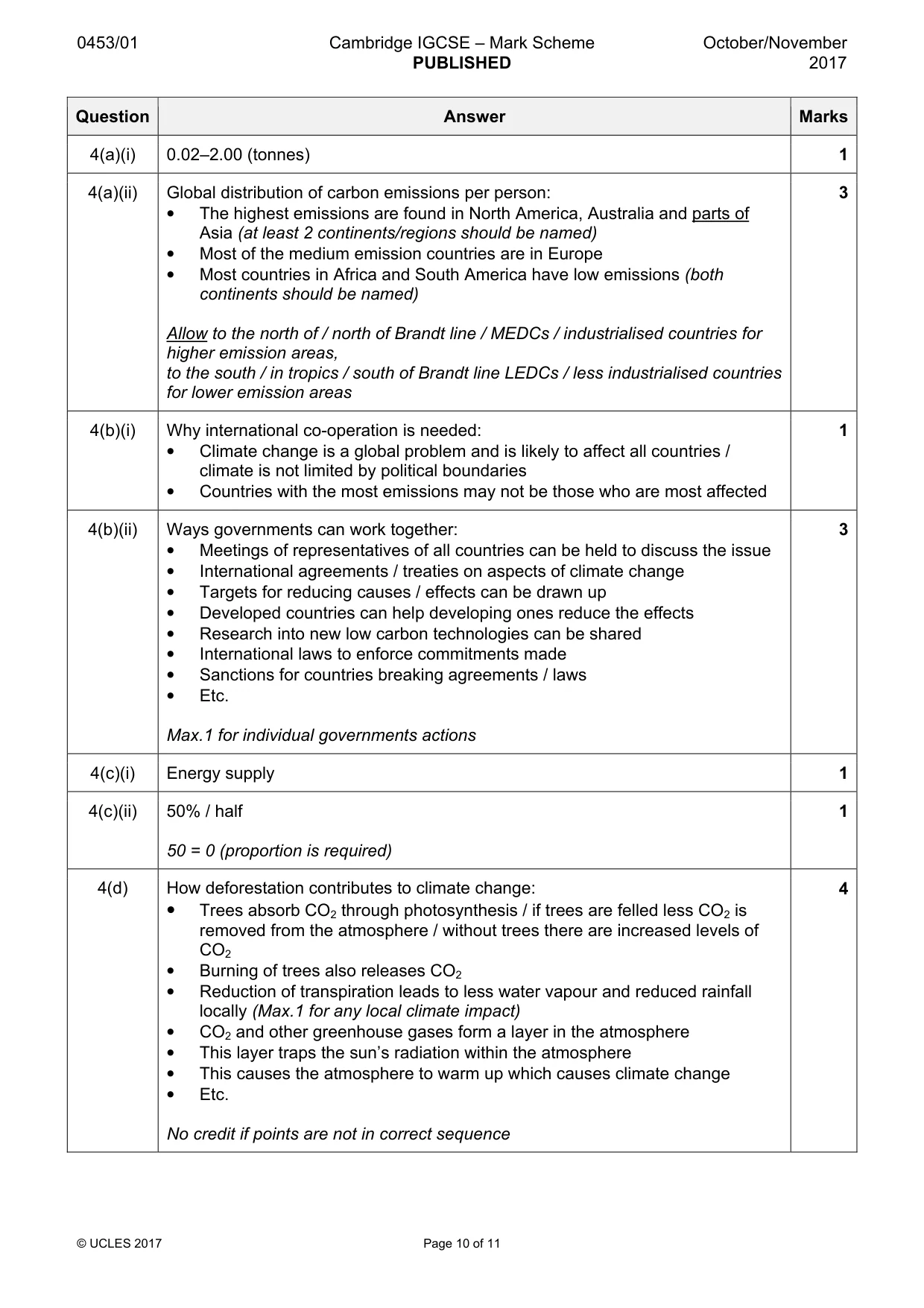
0453/01 Cambridge IGCSE – Mark Scheme PUBLISHED October/November 2017 © UCLES 2017 Page 10 of 11 Question Answer Marks 4(a)(i) 0.02–2.00 (tonnes) 1 4(a)(ii) Global distribution of carbon emissions per person: • The highest emissions are found in North America, Australia and parts of Asia (at least 2 continents/regions should be named) • Most of the medium emission countries are in Europe • Most countries in Africa and South America have low emissions (both continents should be named) Allow to the north of / north of Brandt line / MEDCs / industrialised countries for higher emission areas, to the south / in tropics / south of Brandt line LEDCs / less industrialised countries for lower emission areas 3 4(b)(i) Why international co-operation is needed: • Climate change is a global problem and is likely to affect all countries / climate is not limited by political boundaries • Countries with the most emissions may not be those who are most affected 1 4(b)(ii) Ways governments can work together: • Meetings of representatives of all countries can be held to discuss the issue • International agreements / treaties on aspects of climate change • Targets for reducing causes / effects can be drawn up • Developed countries can help developing ones reduce the effects • Research into new low carbon technologies can be shared • International laws to enforce commitments made • Sanctions for countries breaking agreements / laws • Etc. Max.1 for individual governments actions 3 4(c)(i) Energy supply 1 4(c)(ii) 50% / half 50 = 0 (proportion is required) 1 4(d) How deforestation contributes to climate change: • Trees absorb CO2 through photosynthesis / if trees are felled less CO2 is removed from the atmosphere / without trees there are increased levels of CO2 • Burning of trees also releases CO2 • Reduction of transpiration leads to less water vapour and reduced rainfall locally (Max.1 for any local climate impact) • CO2 and other greenhouse gases form a layer in the atmosphere • This layer traps the sun’s radiation within the atmosphere • This causes the atmosphere to warm up which causes climate change • Etc. No credit if points are not in correct sequence 4
Mark scheme, page 11
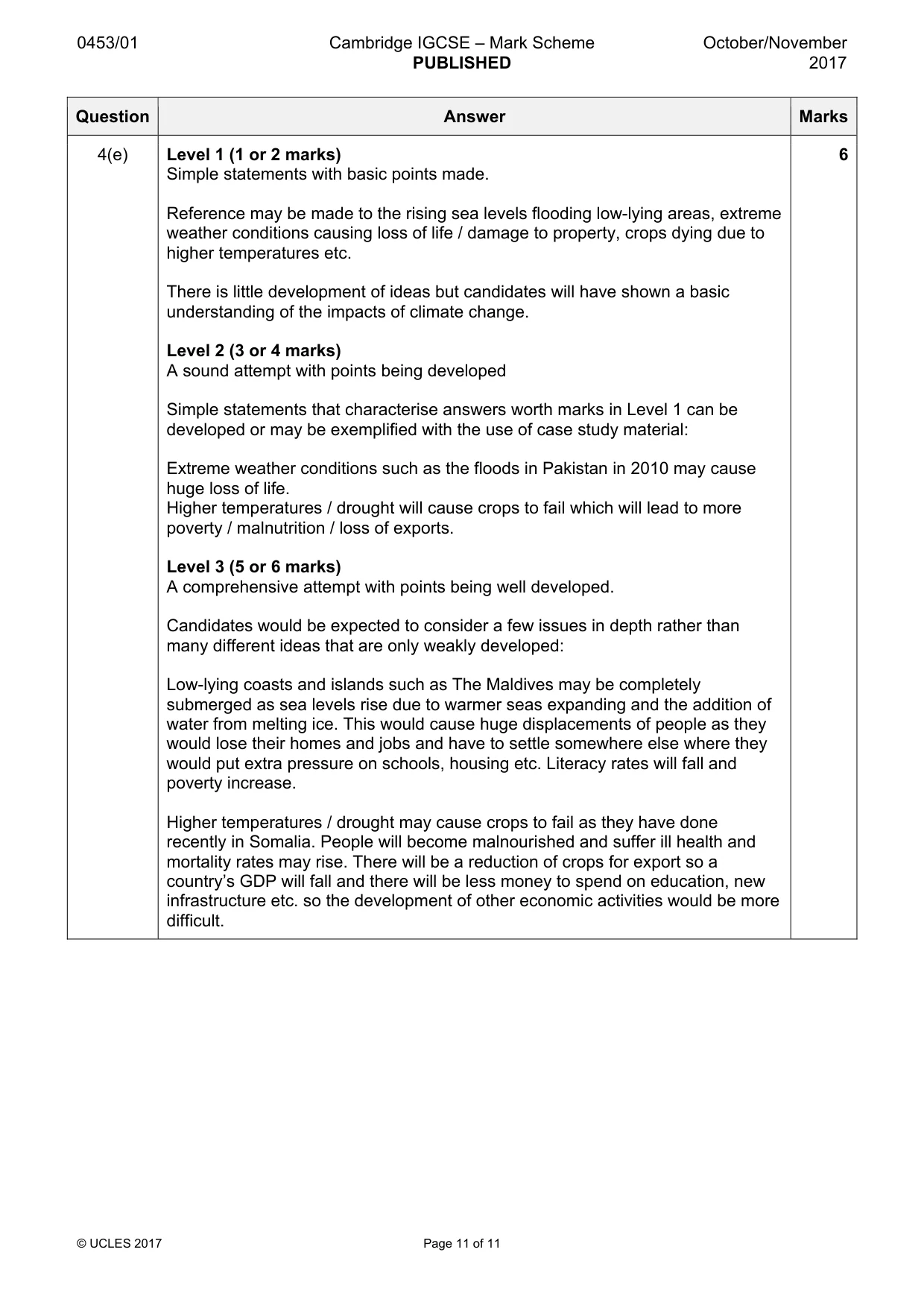
0453/01 Cambridge IGCSE – Mark Scheme PUBLISHED October/November 2017 © UCLES 2017 Page 11 of 11 Question Answer Marks 4(e) Level 1 (1 or 2 marks) Simple statements with basic points made. Reference may be made to the rising sea levels flooding low-lying areas, extreme weather conditions causing loss of life / damage to property, crops dying due to higher temperatures etc. There is little development of ideas but candidates will have shown a basic understanding of the impacts of climate change. Level 2 (3 or 4 marks) A sound attempt with points being developed Simple statements that characterise answers worth marks in Level 1 can be developed or may be exemplified with the use of case study material: Extreme weather conditions such as the floods in Pakistan in 2010 may cause huge loss of life. Higher temperatures / drought will cause crops to fail which will lead to more poverty / malnutrition / loss of exports. Level 3 (5 or 6 marks) A comprehensive attempt with points being well developed. Candidates would be expected to consider a few issues in depth rather than many different ideas that are only weakly developed: Low-lying coasts and islands such as The Maldives may be completely submerged as sea levels rise due to warmer seas expanding and the addition of water from melting ice. This would cause huge displacements of people as they would lose their homes and jobs and have to settle somewhere else where they would put extra pressure on schools, housing etc. Literacy rates will fall and poverty increase. Higher temperatures / drought may cause crops to fail as they have done recently in Somalia. People will become malnourished and suffer ill health and mortality rates may rise. There will be a reduction of crops for export so a country’s GDP will fall and there will be less money to spend on education, new infrastructure etc. so the development of other economic activities would be more difficult. 6
What you needed in this session
Cambridge’s own grade thresholds for 2017 Oct/Nov, Paper 1 · Variant 1. A higher threshold means an easier paper — the bar moves with how the cohort did.