Cambridge IGCSE Development Studies 0453 — 2015 Oct/Nov Paper 1 · Variant 1
0453/11/O/N/15 · 80 marks · ≈90 min
The question paper and its mark scheme, free to read here and free to download. This is Cambridge’s own paper, exactly as it was sat.
Question paper16 pages

Mark scheme9 pages
Answers below. Sit the paper first if you are practising.
Paper as text
Question paper, page 1
This document consists of 14 printed pages, 2 blank pages and 1 Insert. DC (ST/CGW) 100626/2 © UCLES 2015 [Turn over Cambridge International Examinations Cambridge International General Certificate of Secondary Education * 0 0 0 7 7 3 9 8 9 8 * DEVELOPMENT STUDIES 0453/01 Paper 1 October/November 2015 2 hours Candidates answer on the Question Paper. Additional Materials: Ruler READ THESE INSTRUCTIONS FIRST Write your Centre number, candidate number and name on all the work you hand in. Write in dark blue or black pen. Do not use staples, paper clips, glue or correction fluid. You may use a pencil for any diagrams, graphs or rough working. DO NOT WRITE IN ANY BARCODES. Answer all the questions. You may not need all the answer lines for your answer. You should read and study the sources before answering the questions. The Insert contains Fig. 5 for Question 3(b). The Insert is not required by the Examiner. It can be kept by the Centre and used as a teaching resource. At the end of the examination, fasten all your work securely together. The number of marks is given in brackets [ ] at the end of each question or part question.
Question paper, page 2
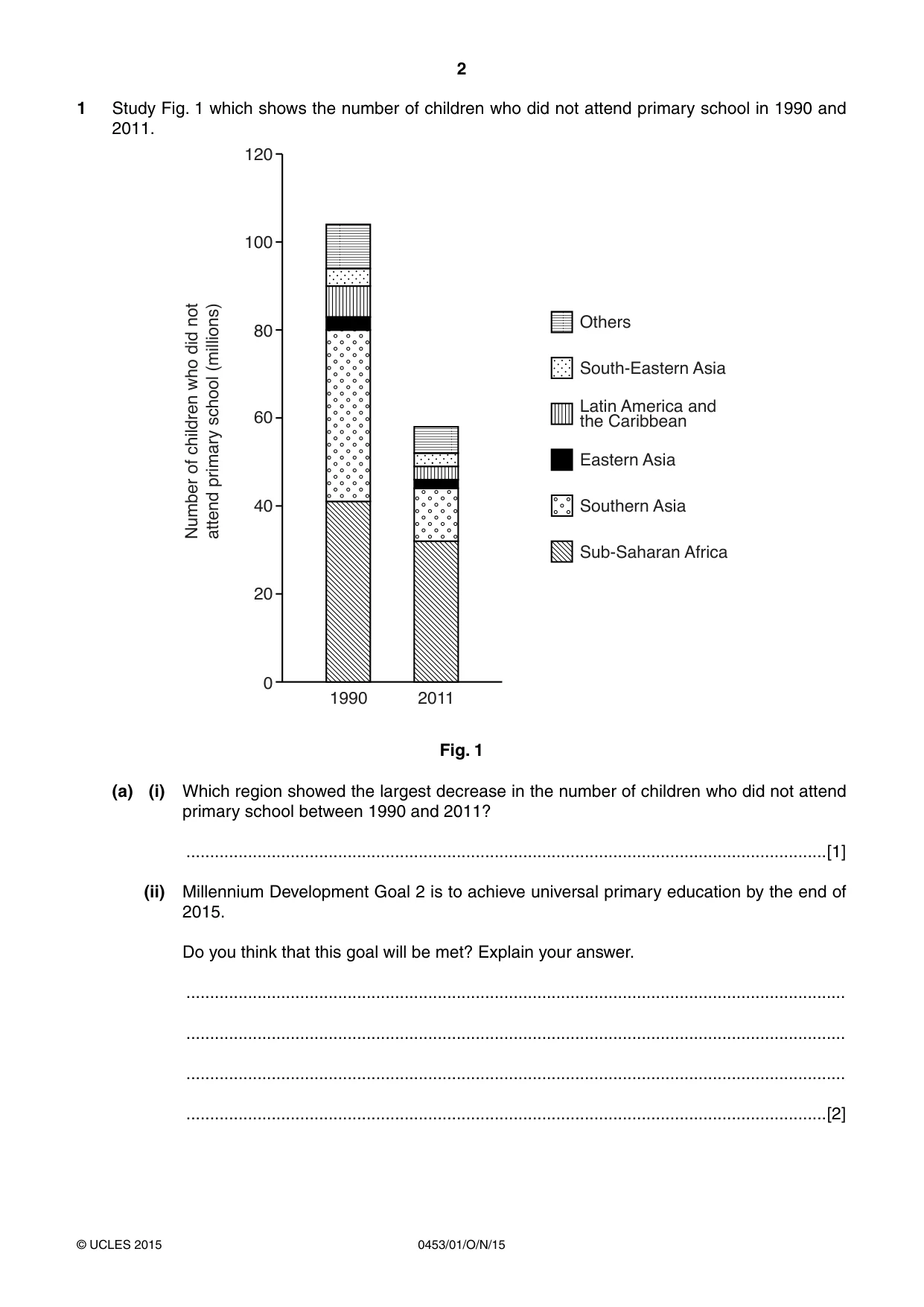
2 0453/01/O/N/15 © UCLES 2015 1 Study Fig. 1 which shows the number of children who did not attend primary school in 1990 and 2011. 0 1990 2011 Others South-Eastern Asia Latin America and the Caribbean Eastern Asia Southern Asia Sub-Saharan Africa 20 40 60 Number of children who did not attend primary school (millions) 80 100 120 Fig. 1 (a) (i) Which region showed the largest decrease in the number of children who did not attend primary school between 1990 and 2011? …[1] (ii) Millennium Development Goal 2 is to achieve universal primary education by the end of 2015. Do you think that this goal will be met? Explain your answer. … … … …[2]
Question paper, page 3
3 0453/01/O/N/15 © UCLES 2015 [Turn over (iii) Explain why many children in developing countries do not attend school. … … … … … … … …[4]
Question paper, page 4
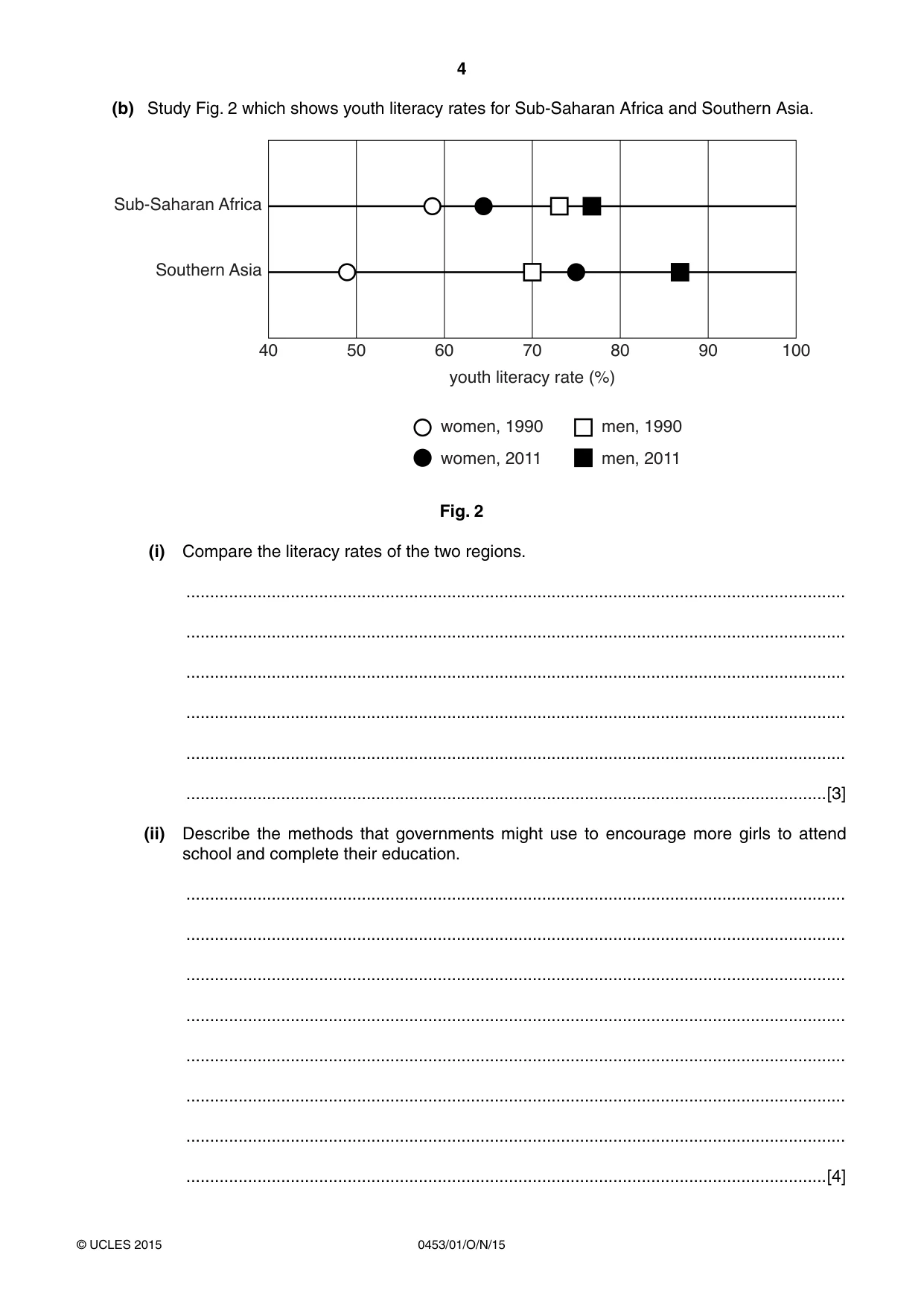
4 0453/01/O/N/15 © UCLES 2015 (b) Study Fig. 2 which shows youth literacy rates for Sub-Saharan Africa and Southern Asia. Sub-Saharan Africa Southern Asia women, 1990 women, 2011 40 50 60 70 youth literacy rate (%) 80 90 100 men, 1990 men, 2011 Fig. 2 (i) Compare the literacy rates of the two regions. … … … … … …[3] (ii) Describe the methods that governments might use to encourage more girls to attend school and complete their education. … … … … … … … …[4]
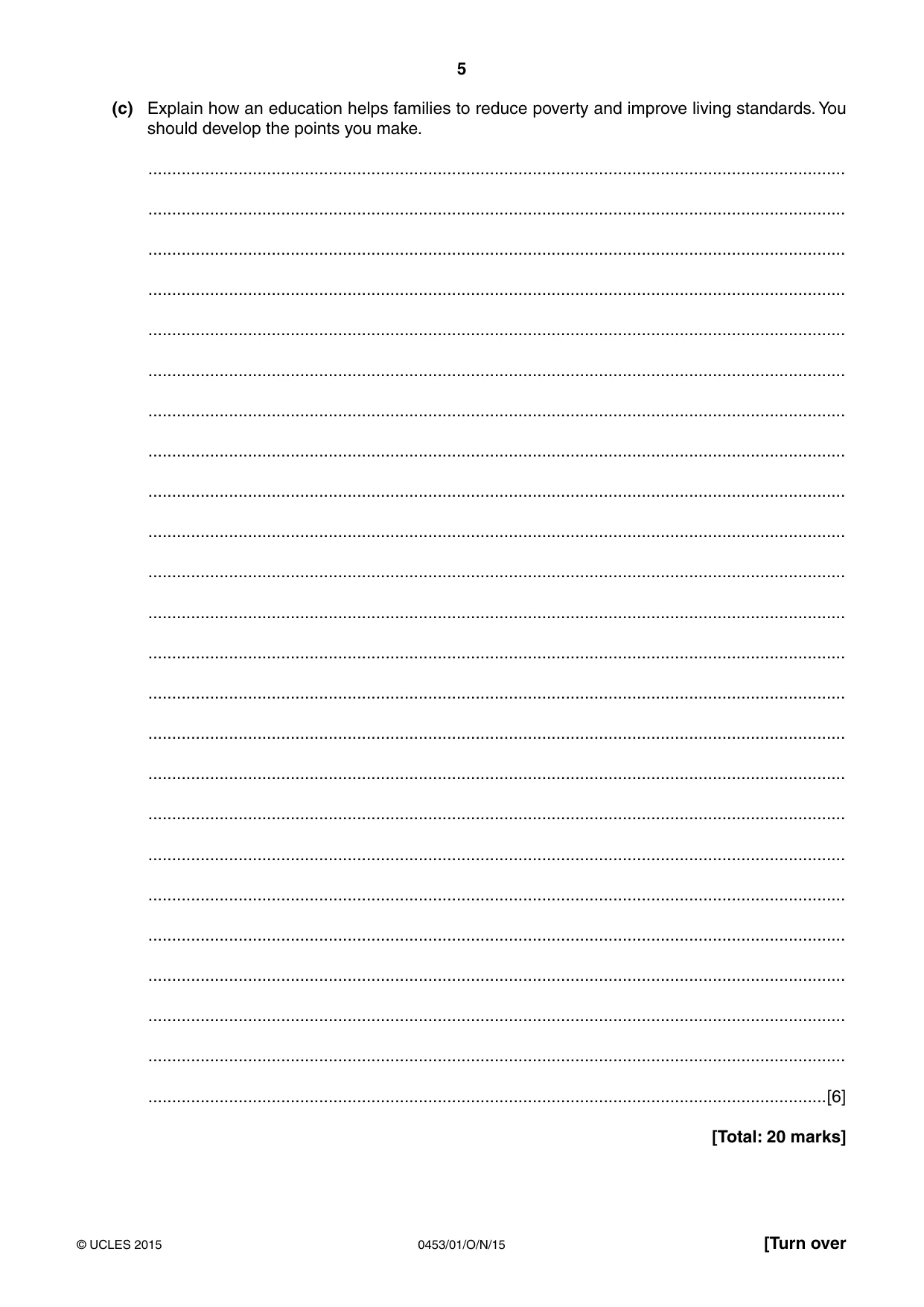
Question paper, page 5
5 0453/01/O/N/15 © UCLES 2015 [Turn over (c) Explain how an education helps families to reduce poverty and improve living standards. You should develop the points you make. … … … … … … … … … … … … … … … … … … … … … … … …[6] [Total: 20 marks]
Question paper, page 6
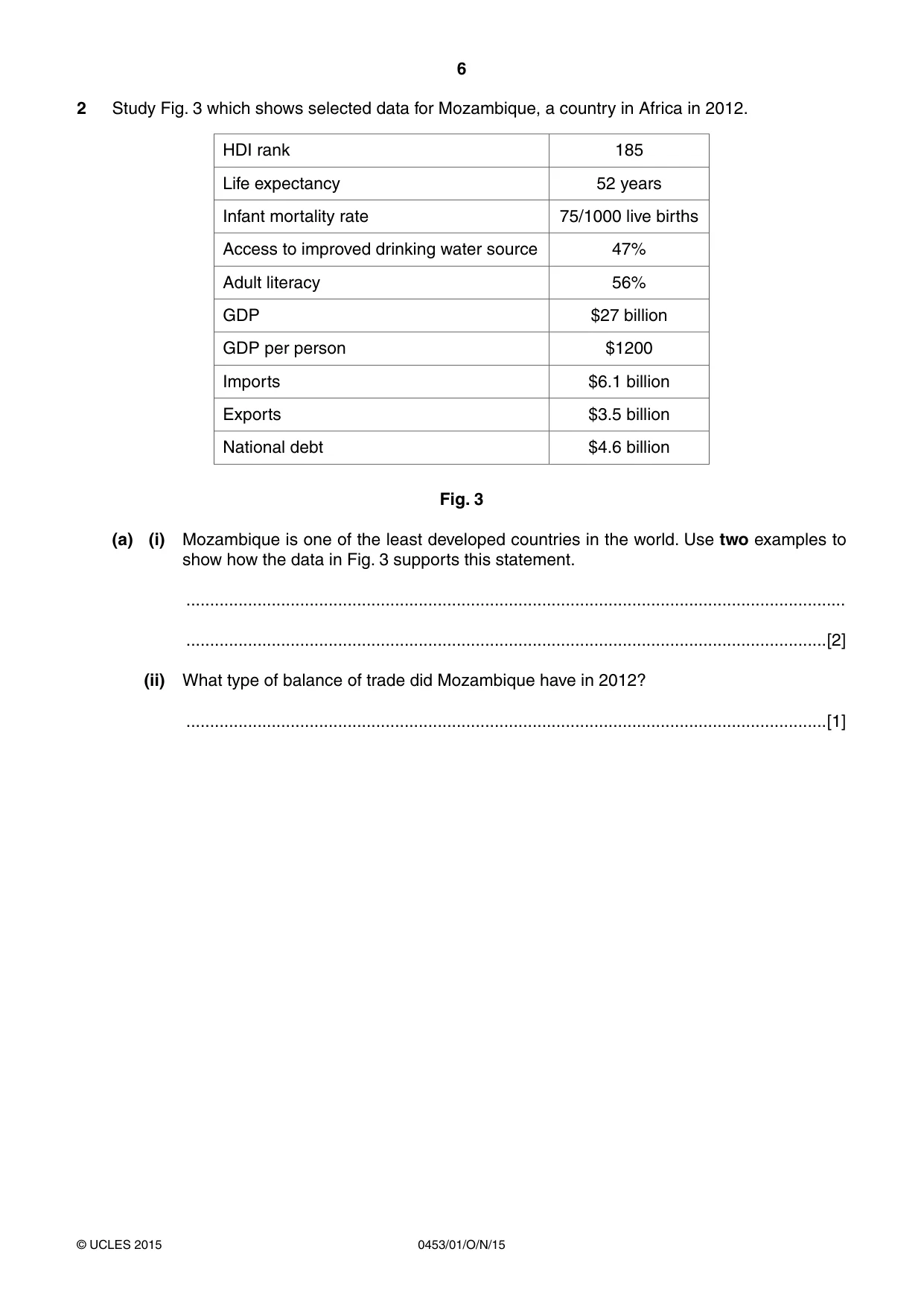
6 0453/01/O/N/15 © UCLES 2015 2 Study Fig. 3 which shows selected data for Mozambique, a country in Africa in 2012. HDI rank 185 Life expectancy 52 years Infant mortality rate 75/1000 live births Access to improved drinking water source 47% Adult literacy 56% GDP $27 billion GDP per person $1200 Imports $6.1 billion Exports $3.5 billion National debt $4.6 billion Fig. 3 (a) (i) Mozambique is one of the least developed countries in the world. Use two examples to show how the data in Fig. 3 supports this statement. … …[2] (ii) What type of balance of trade did Mozambique have in 2012? …[1]
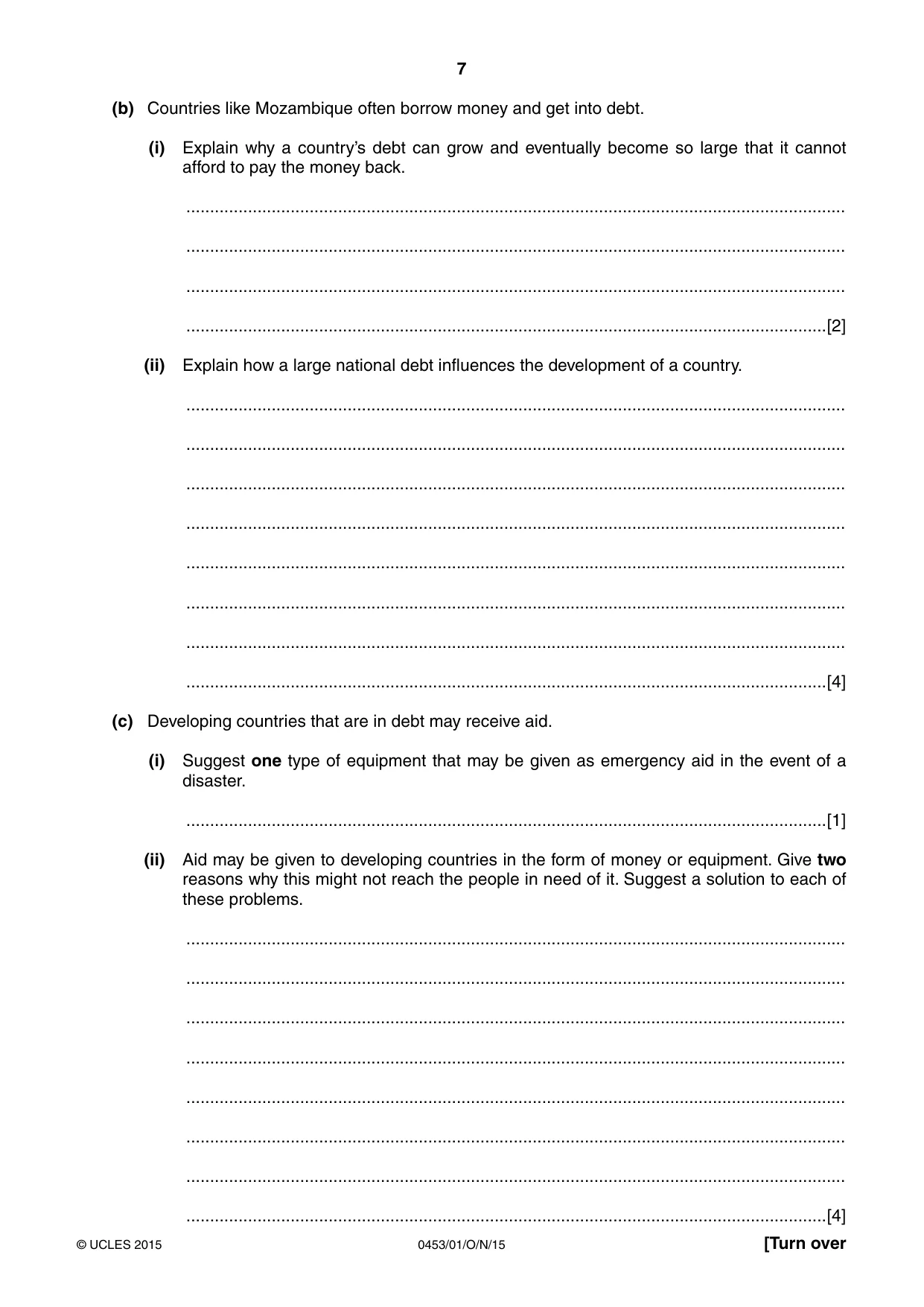
Question paper, page 7
7 0453/01/O/N/15 © UCLES 2015 [Turn over (b) Countries like Mozambique often borrow money and get into debt. (i) Explain why a country’s debt can grow and eventually become so large that it cannot afford to pay the money back. … … … …[2] (ii) Explain how a large national debt influences the development of a country. … … … … … … … …[4] (c) Developing countries that are in debt may receive aid. (i) Suggest one type of equipment that may be given as emergency aid in the event of a disaster. …[1] (ii) Aid may be given to developing countries in the form of money or equipment. Give two reasons why this might not reach the people in need of it. Suggest a solution to each of these problems. … … … … … … … …[4]
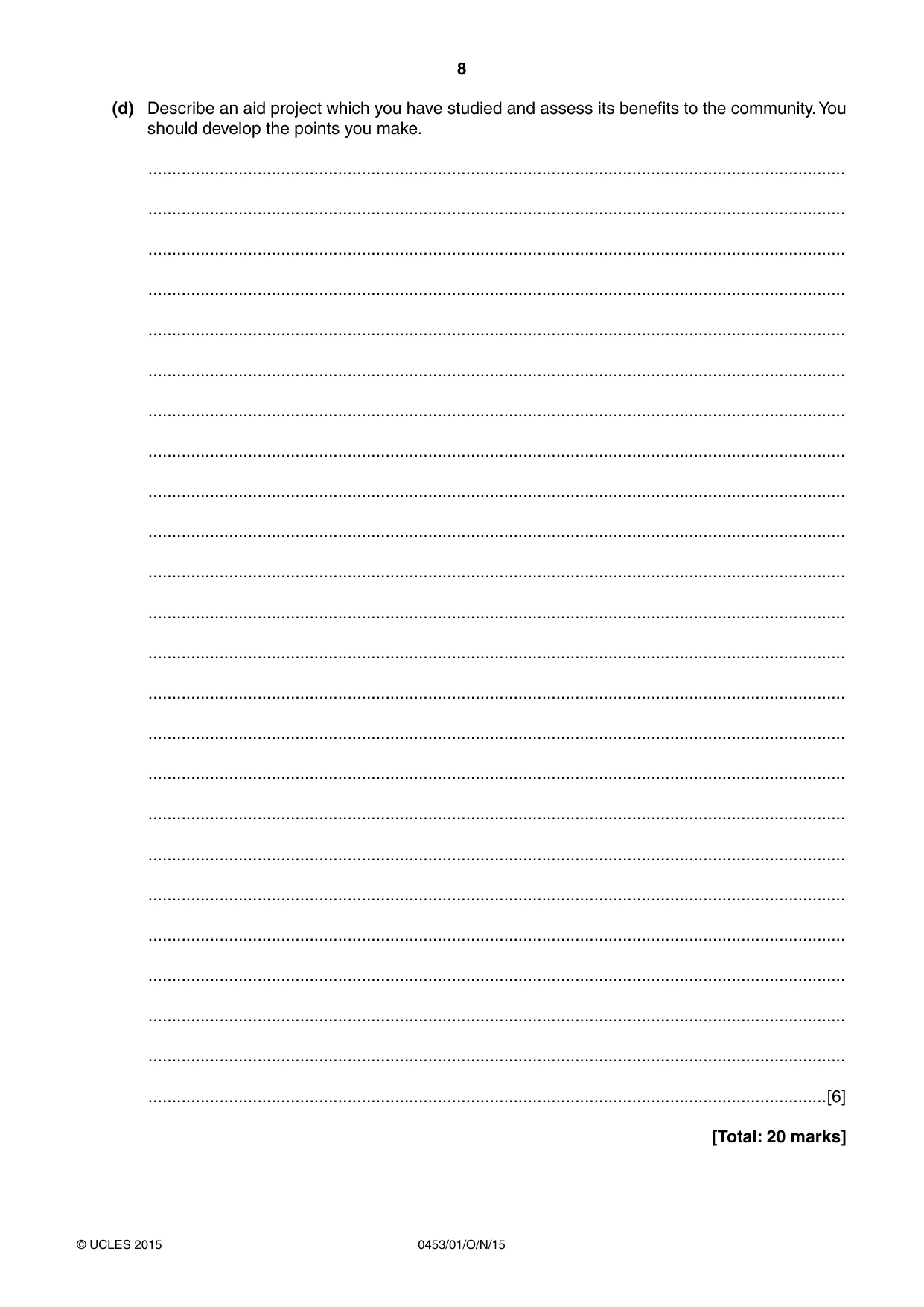
Question paper, page 8
8 0453/01/O/N/15 © UCLES 2015 (d) Describe an aid project which you have studied and assess its benefits to the community. You should develop the points you make. … … … … … … … … … … … … … … … … … … … … … … … …[6] [Total: 20 marks]
Question paper, page 9
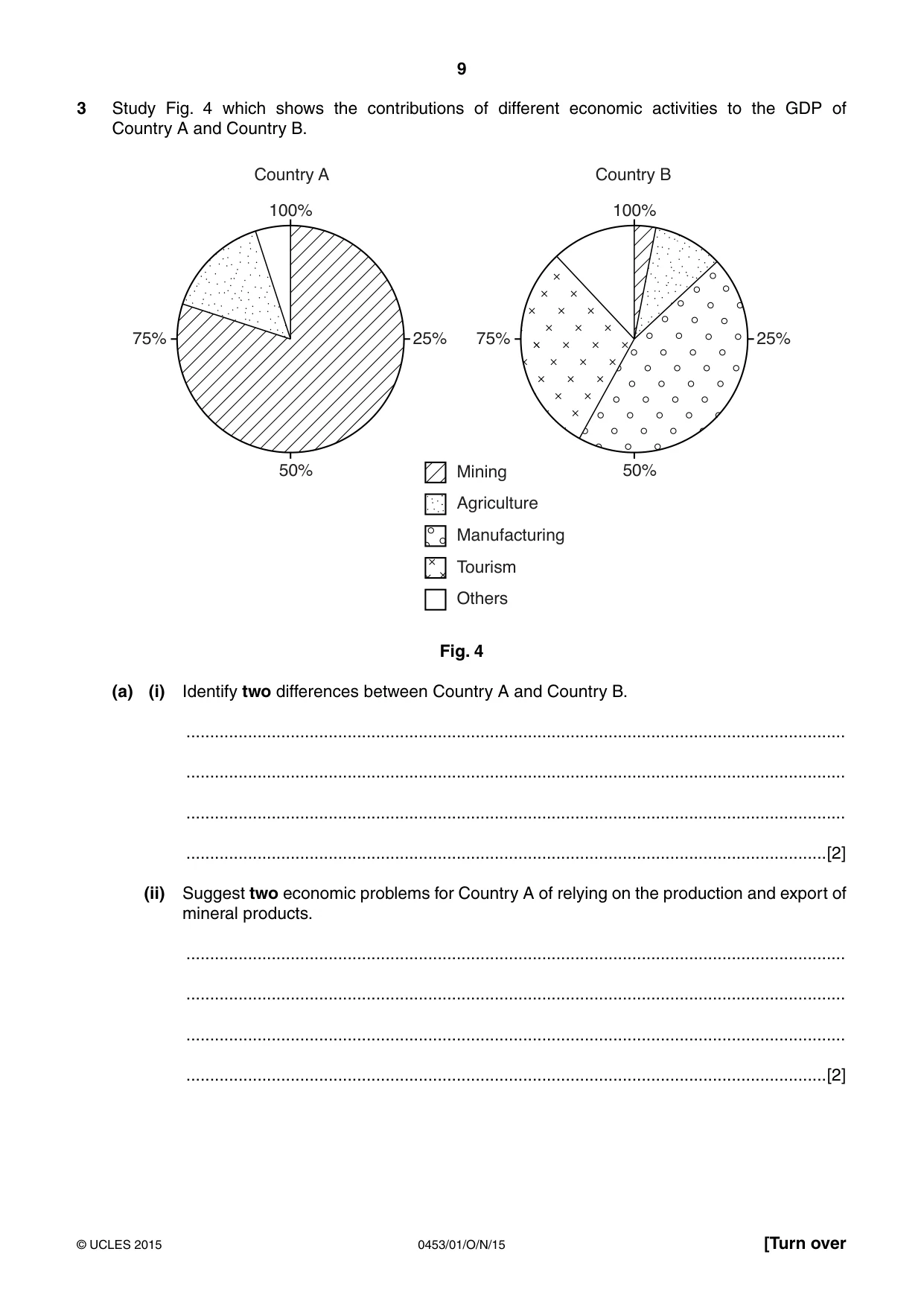
9 0453/01/O/N/15 © UCLES 2015 [Turn over 3 Study Fig. 4 which shows the contributions of different economic activities to the GDP of Country A and Country B. Country A 100% 50% 25% 75% Country B Mining Agriculture Manufacturing Tourism Others 100% 50% 25% 75% Fig. 4 (a) (i) Identify two differences between Country A and Country B. … … … …[2] (ii) Suggest two economic problems for Country A of relying on the production and export of mineral products. … … … …[2]
Question paper, page 10
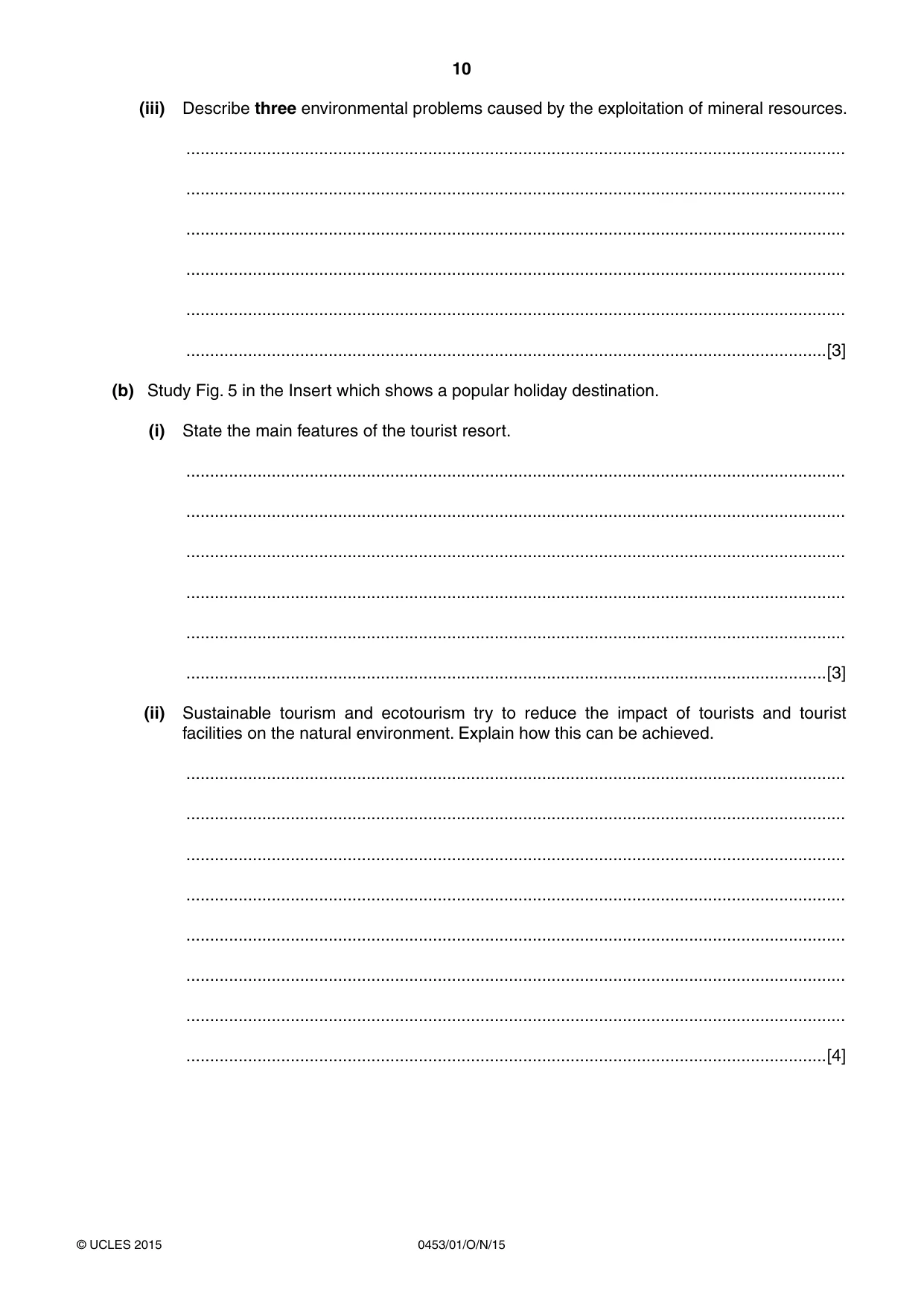
10 0453/01/O/N/15 © UCLES 2015 (iii) Describe three environmental problems caused by the exploitation of mineral resources. … … … … … …[3] (b) Study Fig. 5 in the Insert which shows a popular holiday destination. (i) State the main features of the tourist resort. … … … … … …[3] (ii) Sustainable tourism and ecotourism try to reduce the impact of tourists and tourist facilities on the natural environment. Explain how this can be achieved. … … … … … … … …[4]
Question paper, page 11
11 0453/01/O/N/15 © UCLES 2015 [Turn over (c) Industrialisation is a major contributor to the development process. Explain how industries use the different forms of infrastructure and services that are needed for development to take place. You should develop the points you make. … … … … … … … … … … … … … … … … … … … … … … … …[6] [Total: 20 marks]
Question paper, page 12
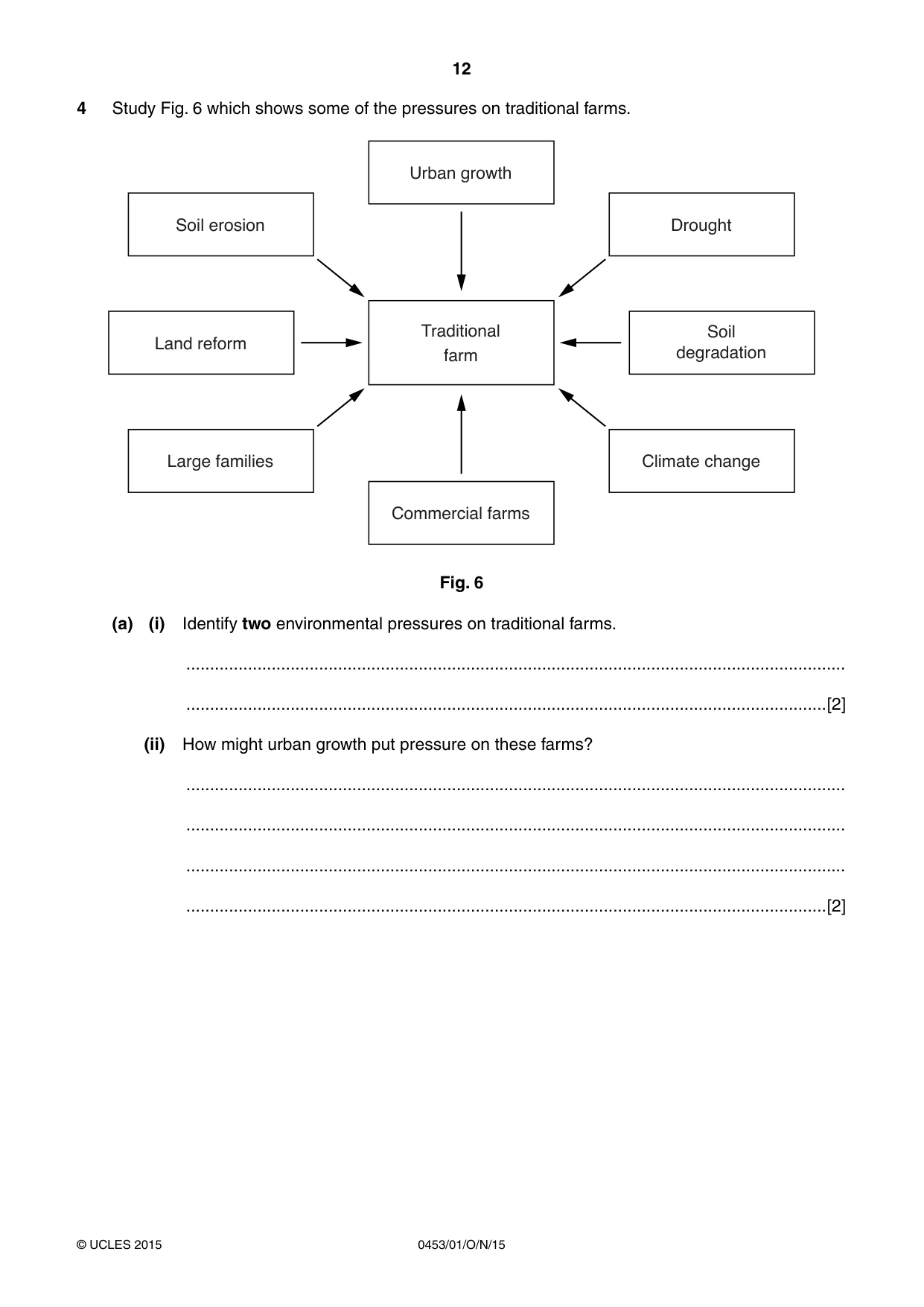
12 0453/01/O/N/15 © UCLES 2015 4 Study Fig. 6 which shows some of the pressures on traditional farms. Urban growth Commercial farms Large families Soil erosion Climate change Drought Land reform Soil degradation Traditional farm Fig. 6 (a) (i) Identify two environmental pressures on traditional farms. … …[2] (ii) How might urban growth put pressure on these farms? … … … …[2]
Question paper, page 13
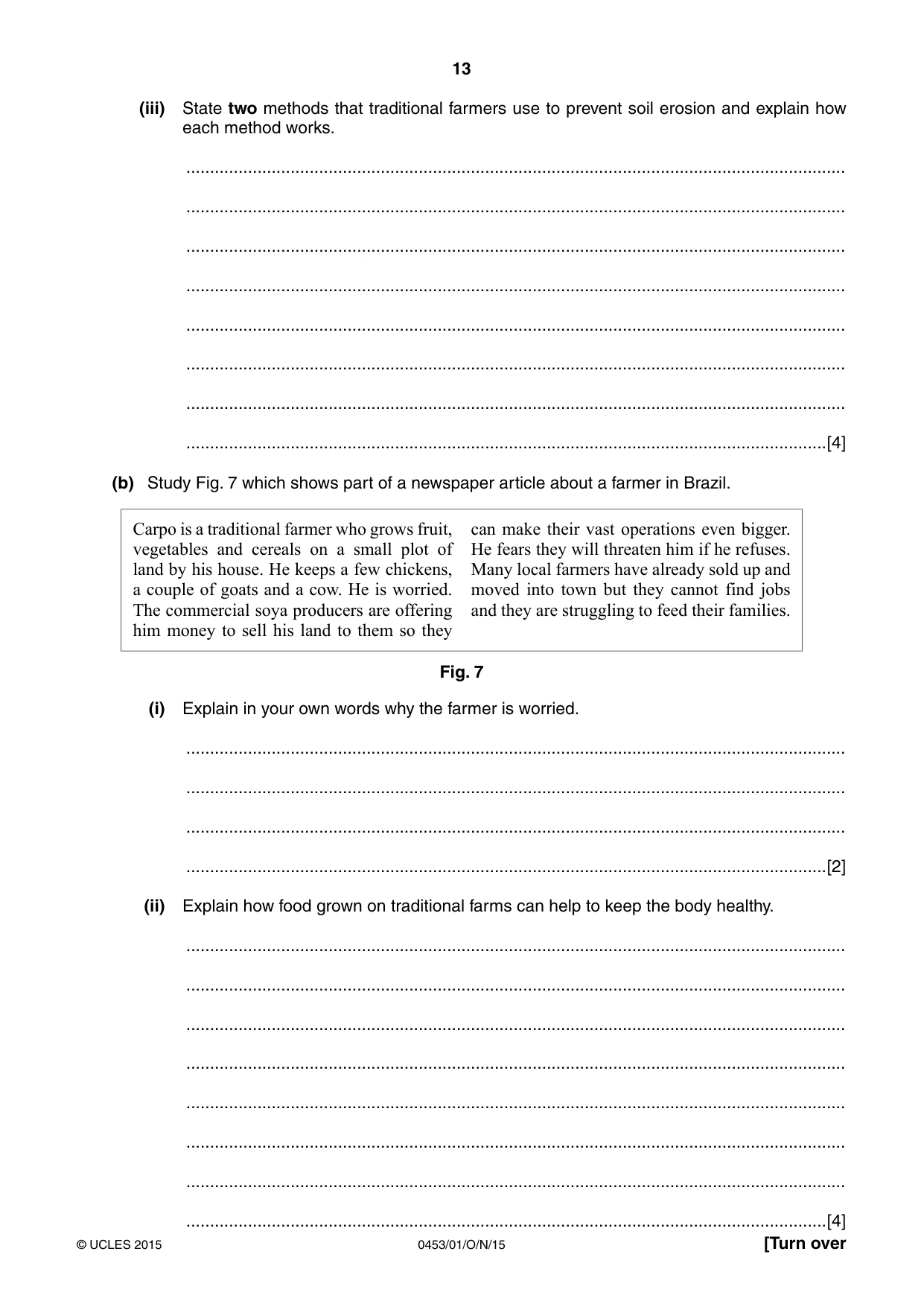
13 0453/01/O/N/15 © UCLES 2015 [Turn over (iii) State two methods that traditional farmers use to prevent soil erosion and explain how each method works. … … … … … … … …[4] (b) Study Fig. 7 which shows part of a newspaper article about a farmer in Brazil. Carpo is a traditional farmer who grows fruit, vegetables and cereals on a small plot of land by his house. He keeps a few chickens, a couple of goats and a cow. He is worried. The commercial soya producers are offering him money to sell his land to them so they can make their vast operations even bigger. He fears they will threaten him if he refuses. Many local farmers have already sold up and moved into town but they cannot find jobs and they are struggling to feed their families. Fig. 7 (i) Explain in your own words why the farmer is worried. … … … …[2] (ii) Explain how food grown on traditional farms can help to keep the body healthy. … … … … … … … …[4]
Question paper, page 14
14 0453/01/O/N/15 © UCLES 2015 (c) Farmers often join together to form groups called co-operatives. Explain how co-operatives can support traditional farmers and help them to increase their output. You should develop the points you make. … … … … … … … … … … … … … … … … … … … … … … … …[6] [Total: 20 marks]
Question paper, page 15
15 0453/01/O/N/15 © UCLES 2015 BLANK PAGE
Question paper, page 16
16 0453/01/O/N/15 © UCLES 2015 BLANK PAGE Permission to reproduce items where third-party owned material protected by copyright is included has been sought and cleared where possible. Every reasonable effort has been made by the publisher (UCLES) to trace copyright holders, but if any items requiring clearance have unwittingly been included, the publisher will be pleased to make amends at the earliest possible opportunity. To avoid the issue of disclosure of answer-related information to candidates, all copyright acknowledgements are reproduced online in the Cambridge International Examinations Copyright Acknowledgements Booklet. This is produced for each series of examinations and is freely available to download at www.cie.org.uk after the live examination series. Cambridge International Examinations is part of the Cambridge Assessment Group. Cambridge Assessment is the brand name of University of Cambridge Local Examinations Syndicate (UCLES), which is itself a department of the University of Cambridge.
Mark scheme, page 1
® IGCSE is the registered trademark of Cambridge International Examinations. CAMBRIDGE INTERNATIONAL EXAMINATIONS Cambridge International General Certificate of Secondary Education MARK SCHEME for the October/November 2015 series 0453 DEVELOPMENT STUDIES 0453/01 Paper 1, maximum raw mark 80 This mark scheme is published as an aid to teachers and candidates, to indicate the requirements of the examination. It shows the basis on which Examiners were instructed to award marks. It does not indicate the details of the discussions that took place at an Examiners’ meeting before marking began, which would have considered the acceptability of alternative answers. Mark schemes should be read in conjunction with the question paper and the Principal Examiner Report for Teachers. Cambridge will not enter into discussions about these mark schemes. Cambridge is publishing the mark schemes for the October/November 2015 series for most Cambridge IGCSE®, Cambridge International A and AS Level components and some Cambridge O Level components.
Mark scheme, page 2
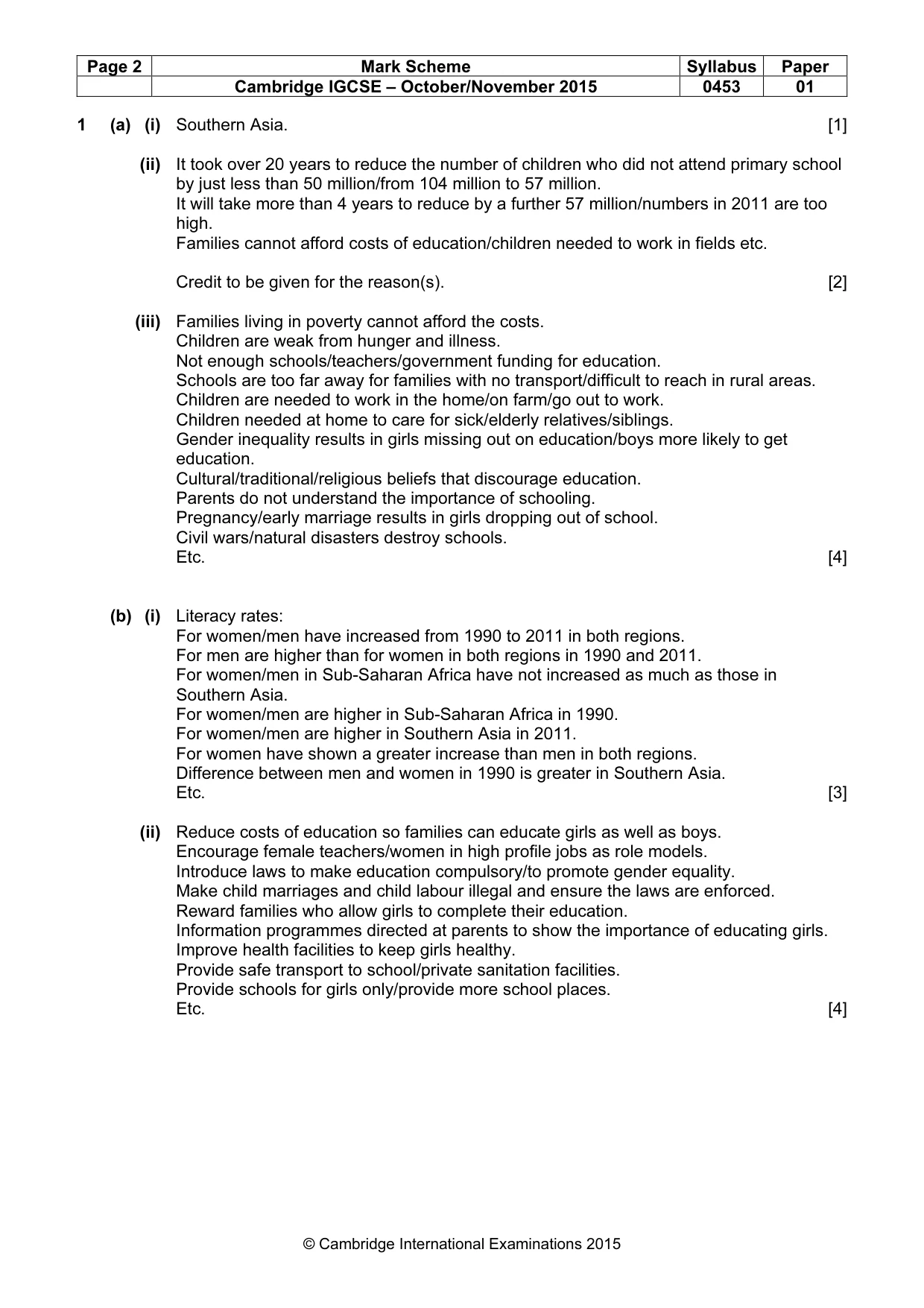
Page 2 Mark Scheme Syllabus Paper Cambridge IGCSE – October/November 2015 0453 01 © Cambridge International Examinations 2015 1 (a) (i) Southern Asia. [1] (ii) It took over 20 years to reduce the number of children who did not attend primary school by just less than 50 million/from 104 million to 57 million. It will take more than 4 years to reduce by a further 57 million/numbers in 2011 are too high. Families cannot afford costs of education/children needed to work in fields etc. Credit to be given for the reason(s). [2] (iii) Families living in poverty cannot afford the costs. Children are weak from hunger and illness. Not enough schools/teachers/government funding for education. Schools are too far away for families with no transport/difficult to reach in rural areas. Children are needed to work in the home/on farm/go out to work. Children needed at home to care for sick/elderly relatives/siblings. Gender inequality results in girls missing out on education/boys more likely to get education. Cultural/traditional/religious beliefs that discourage education. Parents do not understand the importance of schooling. Pregnancy/early marriage results in girls dropping out of school. Civil wars/natural disasters destroy schools. Etc. [4] (b) (i) Literacy rates: For women/men have increased from 1990 to 2011 in both regions. For men are higher than for women in both regions in 1990 and 2011. For women/men in Sub-Saharan Africa have not increased as much as those in Southern Asia. For women/men are higher in Sub-Saharan Africa in 1990. For women/men are higher in Southern Asia in 2011. For women have shown a greater increase than men in both regions. Difference between men and women in 1990 is greater in Southern Asia. Etc. [3] (ii) Reduce costs of education so families can educate girls as well as boys. Encourage female teachers/women in high profile jobs as role models. Introduce laws to make education compulsory/to promote gender equality. Make child marriages and child labour illegal and ensure the laws are enforced. Reward families who allow girls to complete their education. Information programmes directed at parents to show the importance of educating girls. Improve health facilities to keep girls healthy. Provide safe transport to school/private sanitation facilities. Provide schools for girls only/provide more school places. Etc. [4]
Mark scheme, page 3
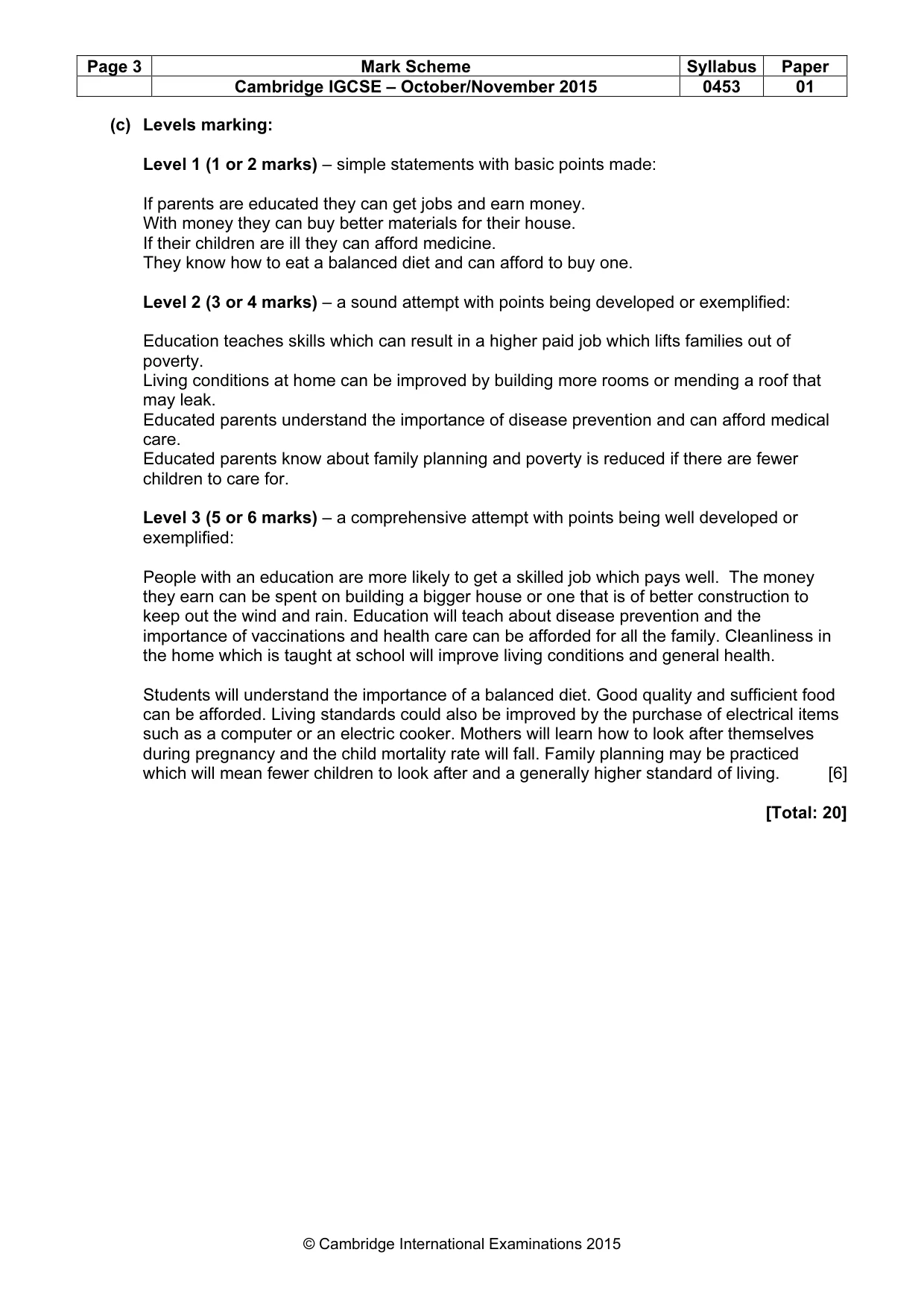
Page 3 Mark Scheme Syllabus Paper Cambridge IGCSE – October/November 2015 0453 01 © Cambridge International Examinations 2015 (c) Levels marking: Level 1 (1 or 2 marks) – simple statements with basic points made: If parents are educated they can get jobs and earn money. With money they can buy better materials for their house. If their children are ill they can afford medicine. They know how to eat a balanced diet and can afford to buy one. Level 2 (3 or 4 marks) – a sound attempt with points being developed or exemplified: Education teaches skills which can result in a higher paid job which lifts families out of poverty. Living conditions at home can be improved by building more rooms or mending a roof that may leak. Educated parents understand the importance of disease prevention and can afford medical care. Educated parents know about family planning and poverty is reduced if there are fewer children to care for. Level 3 (5 or 6 marks) – a comprehensive attempt with points being well developed or exemplified: People with an education are more likely to get a skilled job which pays well. The money they earn can be spent on building a bigger house or one that is of better construction to keep out the wind and rain. Education will teach about disease prevention and the importance of vaccinations and health care can be afforded for all the family. Cleanliness in the home which is taught at school will improve living conditions and general health. Students will understand the importance of a balanced diet. Good quality and sufficient food can be afforded. Living standards could also be improved by the purchase of electrical items such as a computer or an electric cooker. Mothers will learn how to look after themselves during pregnancy and the child mortality rate will fall. Family planning may be practiced which will mean fewer children to look after and a generally higher standard of living. [6] [Total: 20]
Mark scheme, page 4
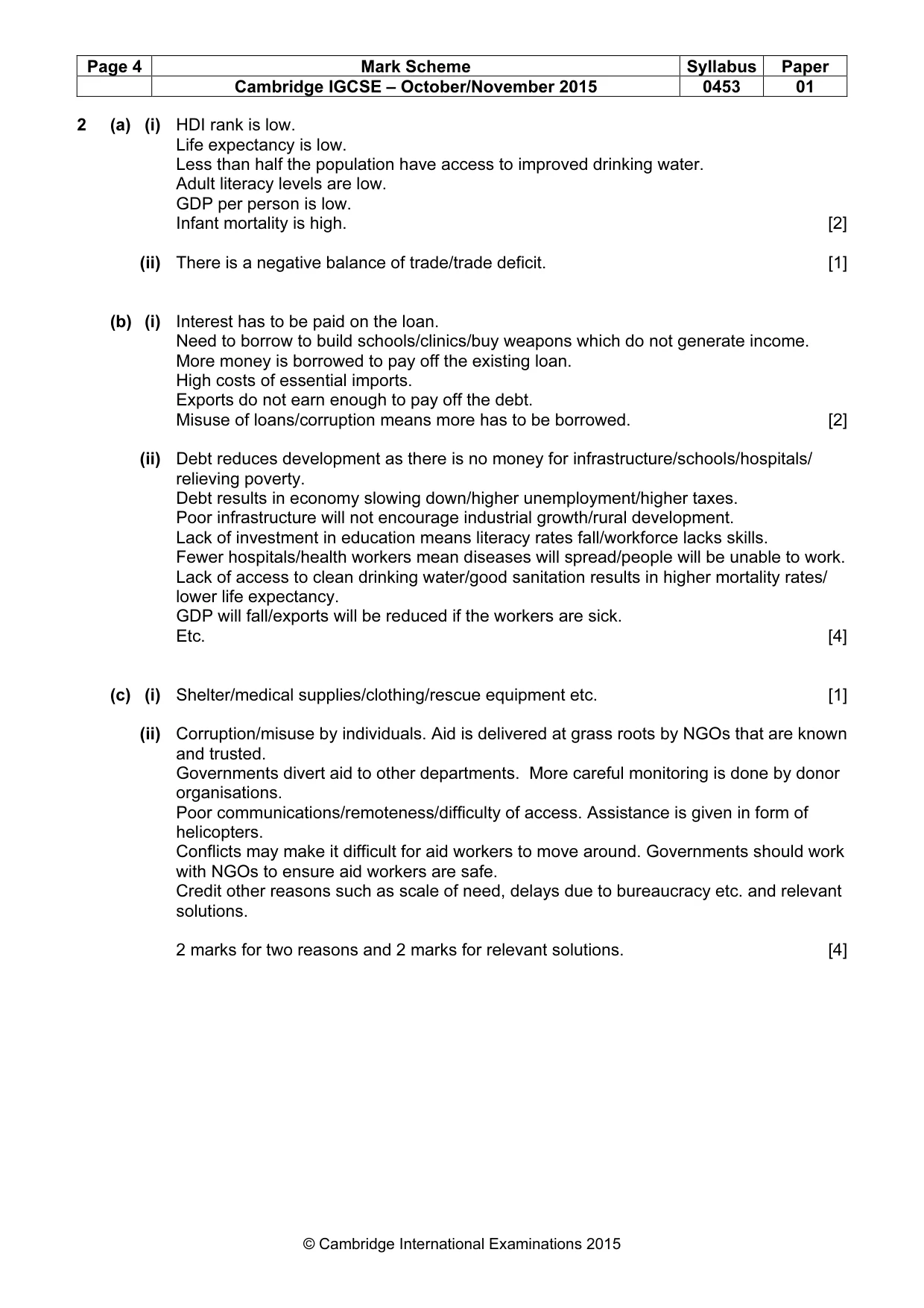
Page 4 Mark Scheme Syllabus Paper Cambridge IGCSE – October/November 2015 0453 01 © Cambridge International Examinations 2015 2 (a) (i) HDI rank is low. Life expectancy is low. Less than half the population have access to improved drinking water. Adult literacy levels are low. GDP per person is low. Infant mortality is high. [2] (ii) There is a negative balance of trade/trade deficit. [1] (b) (i) Interest has to be paid on the loan. Need to borrow to build schools/clinics/buy weapons which do not generate income. More money is borrowed to pay off the existing loan. High costs of essential imports. Exports do not earn enough to pay off the debt. Misuse of loans/corruption means more has to be borrowed. [2] (ii) Debt reduces development as there is no money for infrastructure/schools/hospitals/ relieving poverty. Debt results in economy slowing down/higher unemployment/higher taxes. Poor infrastructure will not encourage industrial growth/rural development. Lack of investment in education means literacy rates fall/workforce lacks skills. Fewer hospitals/health workers mean diseases will spread/people will be unable to work. Lack of access to clean drinking water/good sanitation results in higher mortality rates/ lower life expectancy. GDP will fall/exports will be reduced if the workers are sick. Etc. [4] (c) (i) Shelter/medical supplies/clothing/rescue equipment etc. [1] (ii) Corruption/misuse by individuals. Aid is delivered at grass roots by NGOs that are known and trusted. Governments divert aid to other departments. More careful monitoring is done by donor organisations. Poor communications/remoteness/difficulty of access. Assistance is given in form of helicopters. Conflicts may make it difficult for aid workers to move around. Governments should work with NGOs to ensure aid workers are safe. Credit other reasons such as scale of need, delays due to bureaucracy etc. and relevant solutions. 2 marks for two reasons and 2 marks for relevant solutions. [4]
Mark scheme, page 5
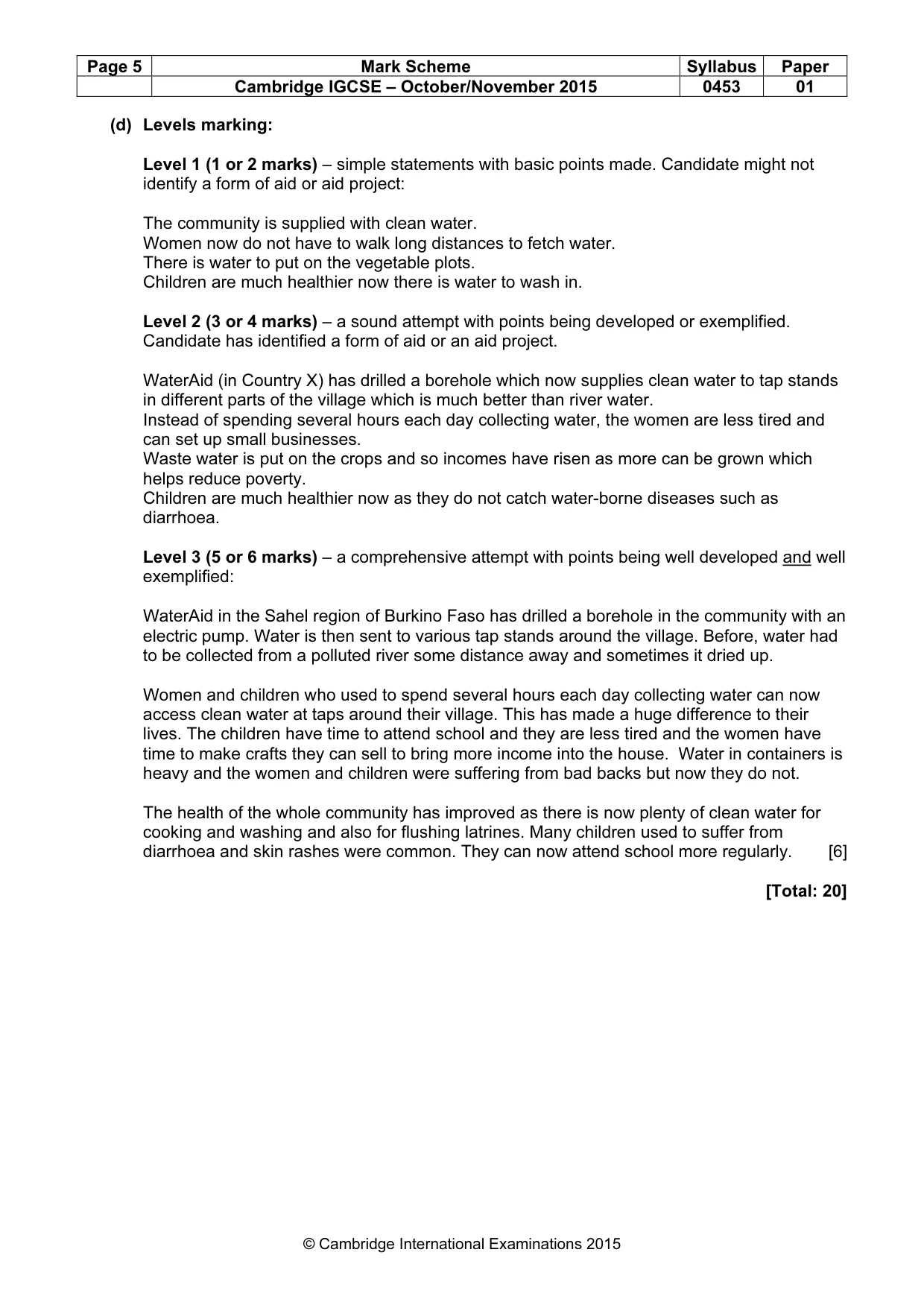
Page 5 Mark Scheme Syllabus Paper Cambridge IGCSE – October/November 2015 0453 01 © Cambridge International Examinations 2015 (d) Levels marking: Level 1 (1 or 2 marks) – simple statements with basic points made. Candidate might not identify a form of aid or aid project: The community is supplied with clean water. Women now do not have to walk long distances to fetch water. There is water to put on the vegetable plots. Children are much healthier now there is water to wash in. Level 2 (3 or 4 marks) – a sound attempt with points being developed or exemplified. Candidate has identified a form of aid or an aid project. WaterAid (in Country X) has drilled a borehole which now supplies clean water to tap stands in different parts of the village which is much better than river water. Instead of spending several hours each day collecting water, the women are less tired and can set up small businesses. Waste water is put on the crops and so incomes have risen as more can be grown which helps reduce poverty. Children are much healthier now as they do not catch water-borne diseases such as diarrhoea. Level 3 (5 or 6 marks) – a comprehensive attempt with points being well developed and well exemplified: WaterAid in the Sahel region of Burkino Faso has drilled a borehole in the community with an electric pump. Water is then sent to various tap stands around the village. Before, water had to be collected from a polluted river some distance away and sometimes it dried up. Women and children who used to spend several hours each day collecting water can now access clean water at taps around their village. This has made a huge difference to their lives. The children have time to attend school and they are less tired and the women have time to make crafts they can sell to bring more income into the house. Water in containers is heavy and the women and children were suffering from bad backs but now they do not. The health of the whole community has improved as there is now plenty of clean water for cooking and washing and also for flushing latrines. Many children used to suffer from diarrhoea and skin rashes were common. They can now attend school more regularly. [6] [Total: 20]
Mark scheme, page 6
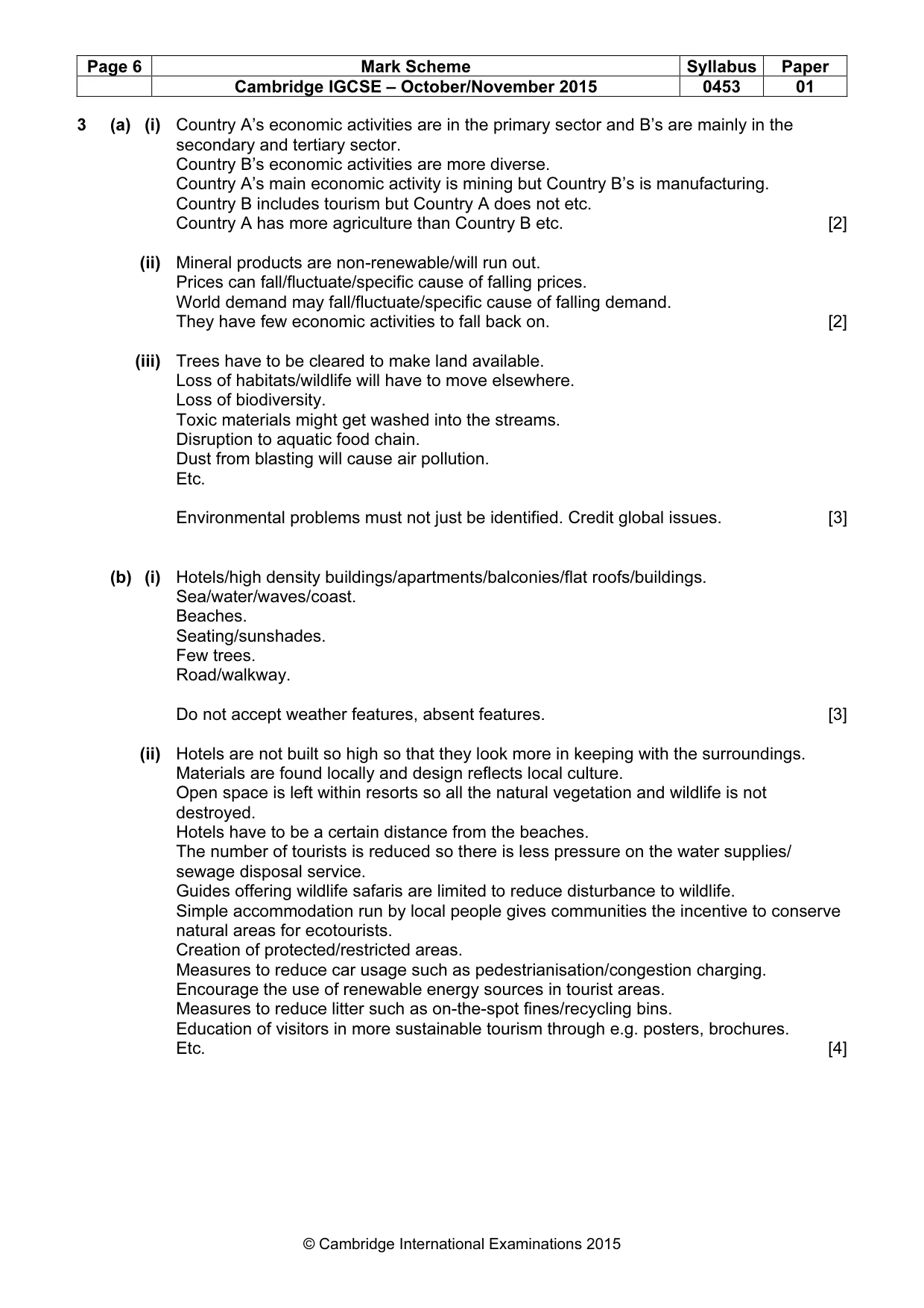
Page 6 Mark Scheme Syllabus Paper Cambridge IGCSE – October/November 2015 0453 01 © Cambridge International Examinations 2015 3 (a) (i) Country A’s economic activities are in the primary sector and B’s are mainly in the secondary and tertiary sector. Country B’s economic activities are more diverse. Country A’s main economic activity is mining but Country B’s is manufacturing. Country B includes tourism but Country A does not etc. Country A has more agriculture than Country B etc. [2] (ii) Mineral products are non-renewable/will run out. Prices can fall/fluctuate/specific cause of falling prices. World demand may fall/fluctuate/specific cause of falling demand. They have few economic activities to fall back on. [2] (iii) Trees have to be cleared to make land available. Loss of habitats/wildlife will have to move elsewhere. Loss of biodiversity. Toxic materials might get washed into the streams. Disruption to aquatic food chain. Dust from blasting will cause air pollution. Etc. Environmental problems must not just be identified. Credit global issues. [3] (b) (i) Hotels/high density buildings/apartments/balconies/flat roofs/buildings. Sea/water/waves/coast. Beaches. Seating/sunshades. Few trees. Road/walkway. Do not accept weather features, absent features. [3] (ii) Hotels are not built so high so that they look more in keeping with the surroundings. Materials are found locally and design reflects local culture. Open space is left within resorts so all the natural vegetation and wildlife is not destroyed. Hotels have to be a certain distance from the beaches. The number of tourists is reduced so there is less pressure on the water supplies/ sewage disposal service. Guides offering wildlife safaris are limited to reduce disturbance to wildlife. Simple accommodation run by local people gives communities the incentive to conserve natural areas for ecotourists. Creation of protected/restricted areas. Measures to reduce car usage such as pedestrianisation/congestion charging. Encourage the use of renewable energy sources in tourist areas. Measures to reduce litter such as on-the-spot fines/recycling bins. Education of visitors in more sustainable tourism through e.g. posters, brochures. Etc. [4]
Mark scheme, page 7
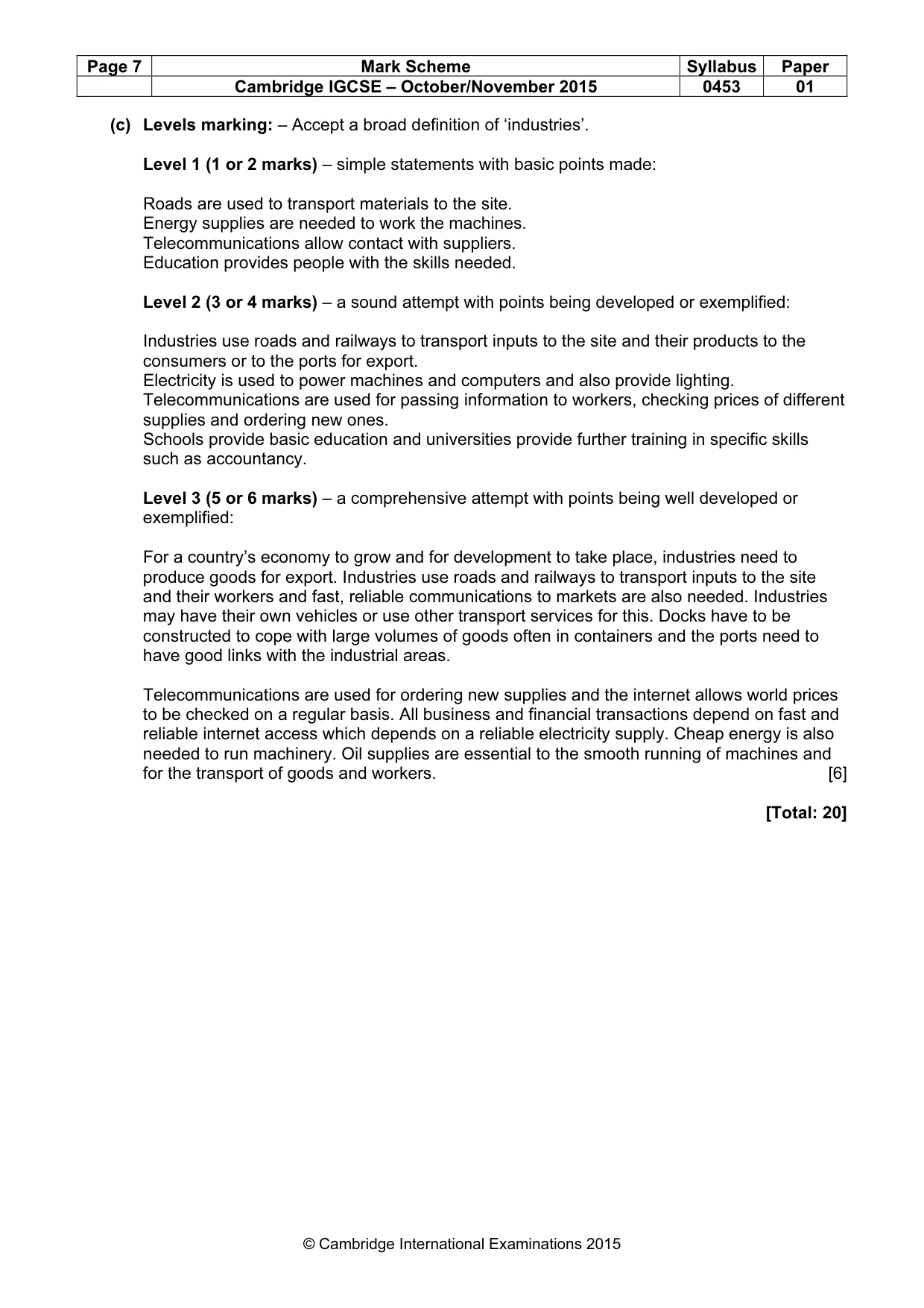
Page 7 Mark Scheme Syllabus Paper Cambridge IGCSE – October/November 2015 0453 01 © Cambridge International Examinations 2015 (c) Levels marking: – Accept a broad definition of ‘industries’. Level 1 (1 or 2 marks) – simple statements with basic points made: Roads are used to transport materials to the site. Energy supplies are needed to work the machines. Telecommunications allow contact with suppliers. Education provides people with the skills needed. Level 2 (3 or 4 marks) – a sound attempt with points being developed or exemplified: Industries use roads and railways to transport inputs to the site and their products to the consumers or to the ports for export. Electricity is used to power machines and computers and also provide lighting. Telecommunications are used for passing information to workers, checking prices of different supplies and ordering new ones. Schools provide basic education and universities provide further training in specific skills such as accountancy. Level 3 (5 or 6 marks) – a comprehensive attempt with points being well developed or exemplified: For a country’s economy to grow and for development to take place, industries need to produce goods for export. Industries use roads and railways to transport inputs to the site and their workers and fast, reliable communications to markets are also needed. Industries may have their own vehicles or use other transport services for this. Docks have to be constructed to cope with large volumes of goods often in containers and the ports need to have good links with the industrial areas. Telecommunications are used for ordering new supplies and the internet allows world prices to be checked on a regular basis. All business and financial transactions depend on fast and reliable internet access which depends on a reliable electricity supply. Cheap energy is also needed to run machinery. Oil supplies are essential to the smooth running of machines and for the transport of goods and workers. [6] [Total: 20]
Mark scheme, page 8
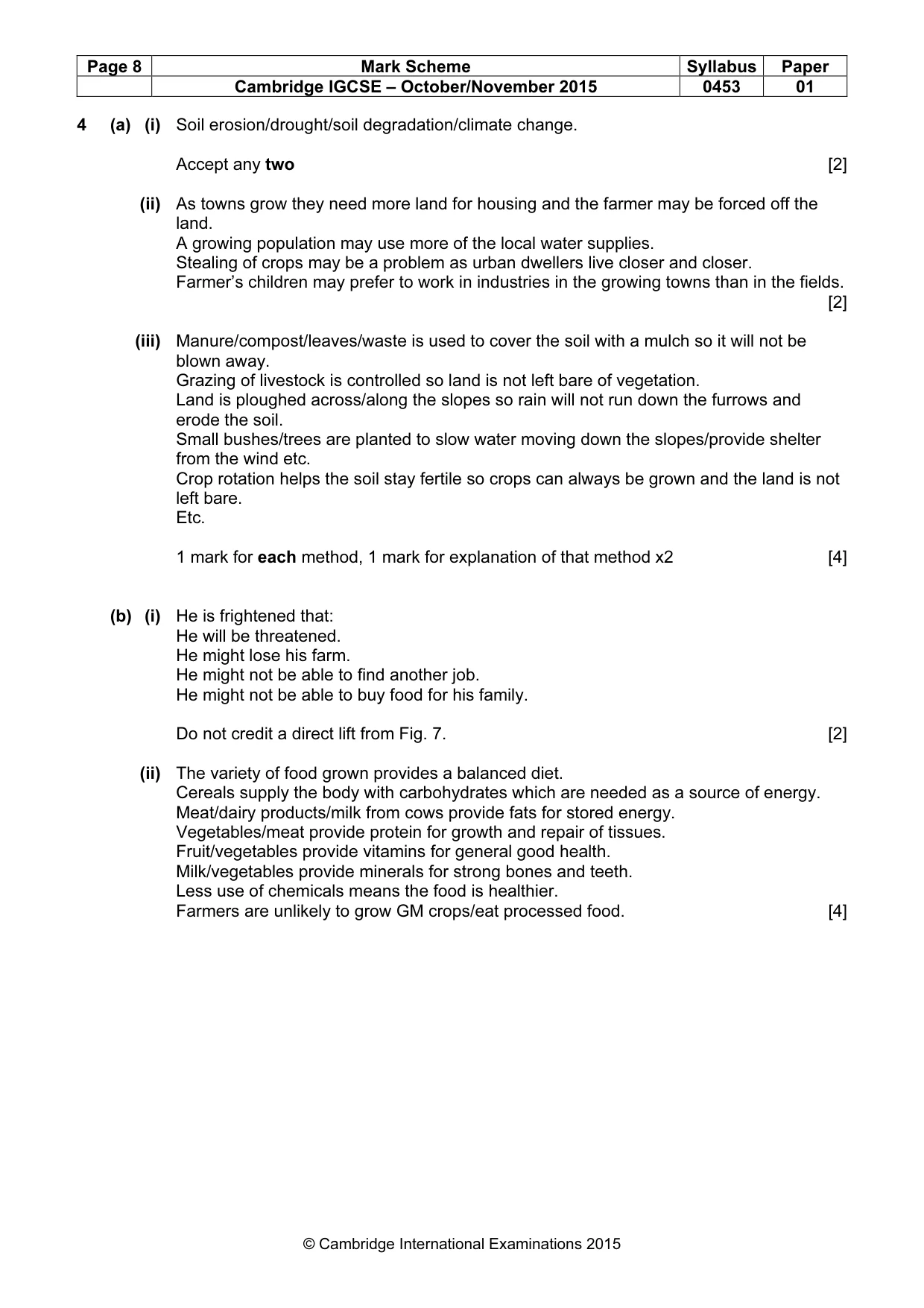
Page 8 Mark Scheme Syllabus Paper Cambridge IGCSE – October/November 2015 0453 01 © Cambridge International Examinations 2015 4 (a) (i) Soil erosion/drought/soil degradation/climate change. Accept any two [2] (ii) As towns grow they need more land for housing and the farmer may be forced off the land. A growing population may use more of the local water supplies. Stealing of crops may be a problem as urban dwellers live closer and closer. Farmer’s children may prefer to work in industries in the growing towns than in the fields. [2] (iii) Manure/compost/leaves/waste is used to cover the soil with a mulch so it will not be blown away. Grazing of livestock is controlled so land is not left bare of vegetation. Land is ploughed across/along the slopes so rain will not run down the furrows and erode the soil. Small bushes/trees are planted to slow water moving down the slopes/provide shelter from the wind etc. Crop rotation helps the soil stay fertile so crops can always be grown and the land is not left bare. Etc. 1 mark for each method, 1 mark for explanation of that method x2 [4] (b) (i) He is frightened that: He will be threatened. He might lose his farm. He might not be able to find another job. He might not be able to buy food for his family. Do not credit a direct lift from Fig. 7. [2] (ii) The variety of food grown provides a balanced diet. Cereals supply the body with carbohydrates which are needed as a source of energy. Meat/dairy products/milk from cows provide fats for stored energy. Vegetables/meat provide protein for growth and repair of tissues. Fruit/vegetables provide vitamins for general good health. Milk/vegetables provide minerals for strong bones and teeth. Less use of chemicals means the food is healthier. Farmers are unlikely to grow GM crops/eat processed food. [4]
Mark scheme, page 9
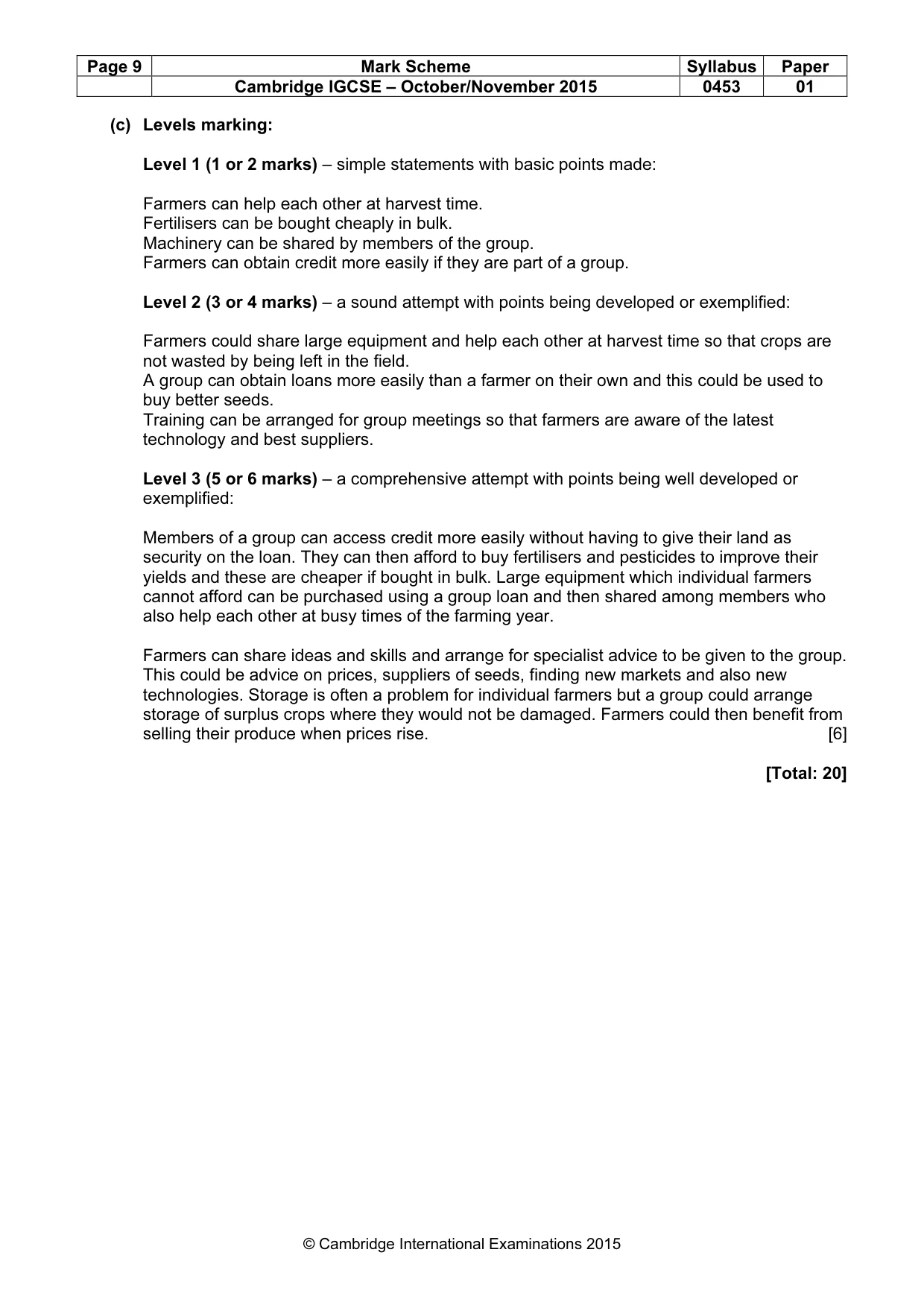
Page 9 Mark Scheme Syllabus Paper Cambridge IGCSE – October/November 2015 0453 01 © Cambridge International Examinations 2015 (c) Levels marking: Level 1 (1 or 2 marks) – simple statements with basic points made: Farmers can help each other at harvest time. Fertilisers can be bought cheaply in bulk. Machinery can be shared by members of the group. Farmers can obtain credit more easily if they are part of a group. Level 2 (3 or 4 marks) – a sound attempt with points being developed or exemplified: Farmers could share large equipment and help each other at harvest time so that crops are not wasted by being left in the field. A group can obtain loans more easily than a farmer on their own and this could be used to buy better seeds. Training can be arranged for group meetings so that farmers are aware of the latest technology and best suppliers. Level 3 (5 or 6 marks) – a comprehensive attempt with points being well developed or exemplified: Members of a group can access credit more easily without having to give their land as security on the loan. They can then afford to buy fertilisers and pesticides to improve their yields and these are cheaper if bought in bulk. Large equipment which individual farmers cannot afford can be purchased using a group loan and then shared among members who also help each other at busy times of the farming year. Farmers can share ideas and skills and arrange for specialist advice to be given to the group. This could be advice on prices, suppliers of seeds, finding new markets and also new technologies. Storage is often a problem for individual farmers but a group could arrange storage of surplus crops where they would not be damaged. Farmers could then benefit from selling their produce when prices rise. [6] [Total: 20]
What you needed in this session
Cambridge’s own grade thresholds for 2015 Oct/Nov, Paper 1 · Variant 1. A higher threshold means an easier paper — the bar moves with how the cohort did.