Cambridge IGCSE Development Studies 0453 — 2013 Oct/Nov Paper 1 · Variant 1
0453/11/O/N/13 · 80 marks · ≈90 min
The question paper and its mark scheme, free to read here and free to download. This is Cambridge’s own paper, exactly as it was sat.
Question paper16 pages
Mark scheme9 pages
Answers below. Sit the paper first if you are practising.
Paper as text
Question paper, page 1
This document consists of 15 printed pages, 1 blank page and 1 insert. DC (NF/CGW) 64119/4 © UCLES 2013 [Turn over UNIVERSITY OF CAMBRIDGE INTERNATIONAL EXAMINATIONS International General Certificate of Secondary Education * 3 3 1 1 5 0 6 6 9 7 * DEVELOPMENT STUDIES 0453/01 Paper 1 October/November 2013 2 hours Candidates answer on the Question Paper. No Additional Materials are required. READ THESE INSTRUCTIONS FIRST Write your Centre number, candidate number and name on all the work you hand in. Write in dark blue or black pen. Do not use staples, paper clips, highlighters, glue or correction fluid. You may use a pencil for any diagrams, graphs or rough working. DO NOT WRITE IN ANY BARCODES. Answer all the questions. You may not need all the answer lines for your answer. You should read and study the sources before answering the questions. The Insert contains Fig. 8 for Question 4(b). The Insert is not required by the Examiner. It can be kept by the Centre and used as a teaching resource. The number of marks is given in brackets [ ] at the end of each question or part question. For Examiner’s Use 1 2 3 4 Total
Question paper, page 2
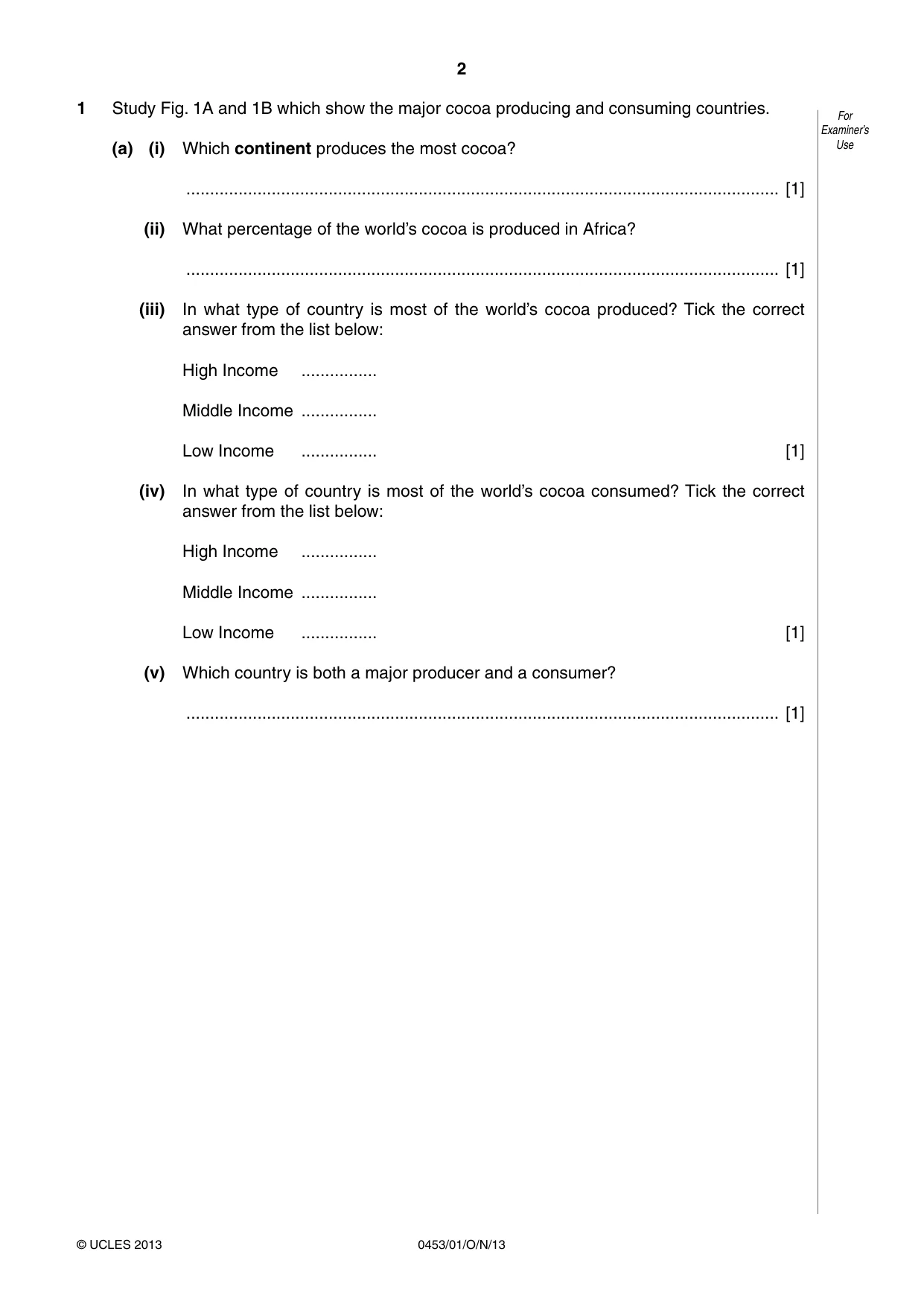
2 0453/01/O/N/13 © UCLES 2013 For Examiner’s Use 1 Study Fig. 1A and 1B which show the major cocoa producing and consuming countries. (a) (i) Which continent produces the most cocoa? … [1] (ii) What percentage of the world’s cocoa is produced in Africa? … [1] (iii) In what type of country is most of the world’s cocoa produced? Tick the correct answer from the list below: High Income … Middle Income … Low Income … [1] (iv) In what type of country is most of the world’s cocoa consumed? Tick the correct answer from the list below: High Income … Middle Income … Low Income … [1] (v) Which country is both a major producer and a consumer? … [1]
Question paper, page 3
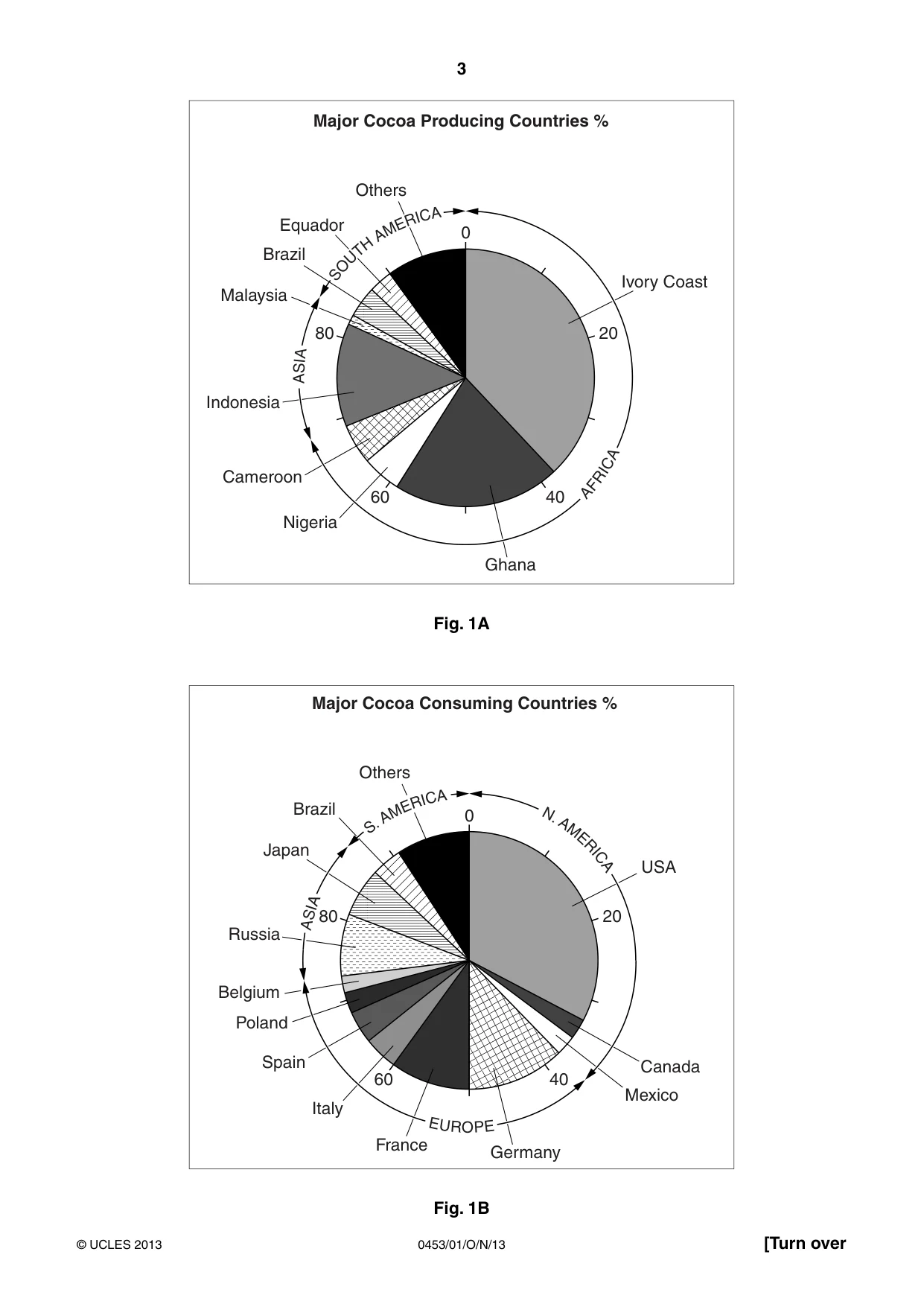
3 0453/01/O/N/13 © UCLES 2013 [Turn over A F R I C A S O U T H A M E R I C A A SI A 20 Ivory Coast Ghana Cameroon Indonesia Nigeria Malaysia Brazil Equador Others 0 Major Cocoa Producing Countries % 80 40 60 S O U T H A M E R I C A Fig. 1A Mexico Canada 20 0 80 40 60 A SI A USA Germany Spain Belgium Poland Italy France Japan Russia Brazil Others Major Cocoa Consuming Countries % S. A M E R I C A E U R O P E N . A M E R I C A Fig. 1B
Question paper, page 4
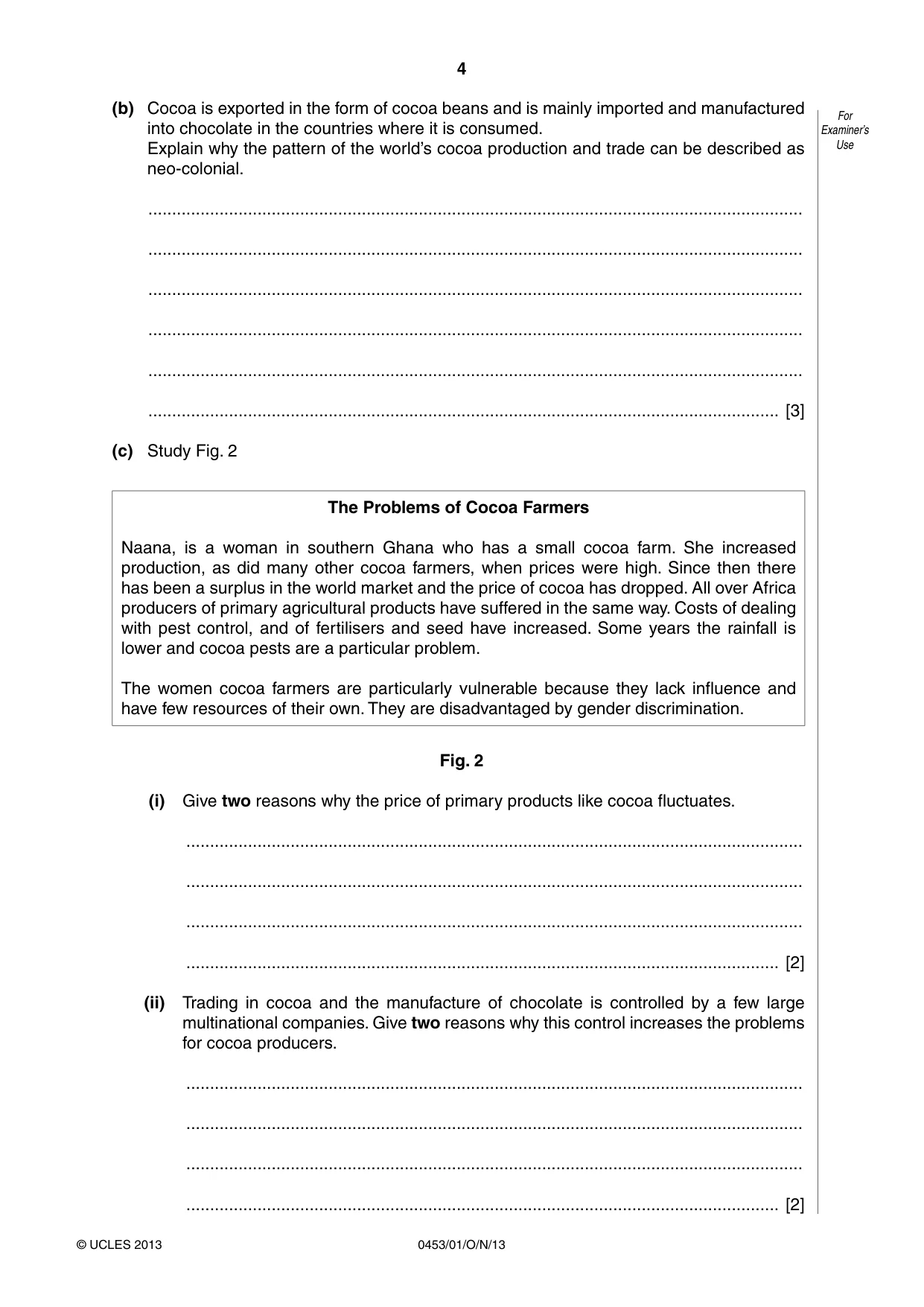
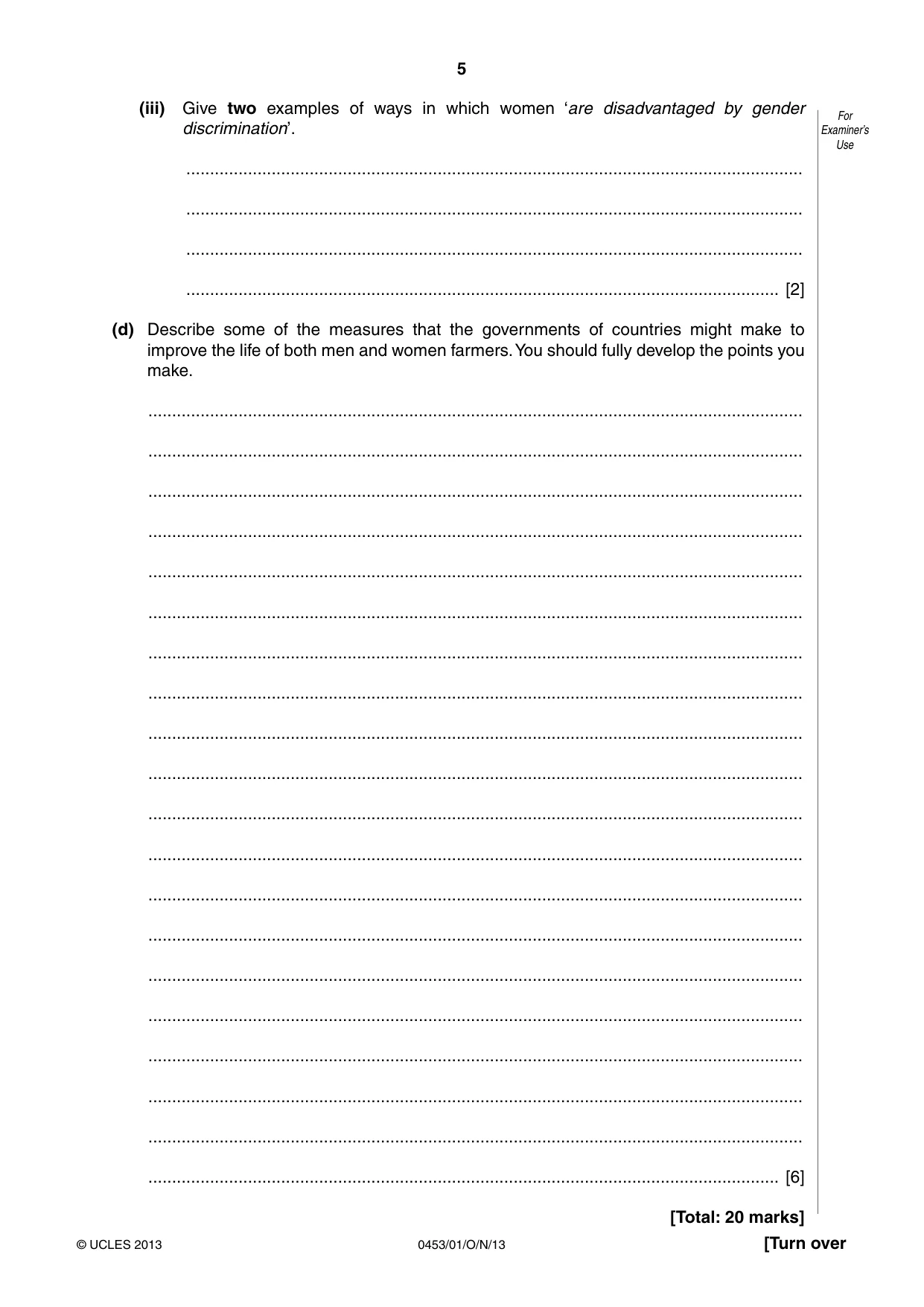
4 0453/01/O/N/13 © UCLES 2013 For Examiner’s Use (b) Cocoa is exported in the form of cocoa beans and is mainly imported and manufactured into chocolate in the countries where it is consumed. Explain why the pattern of the world’s cocoa production and trade can be described as neo-colonial. … … … … … … [3] (c) Study Fig. 2 The Problems of Cocoa Farmers Naana, is a woman in southern Ghana who has a small cocoa farm. She increased production, as did many other cocoa farmers, when prices were high. Since then there has been a surplus in the world market and the price of cocoa has dropped. All over Africa producers of primary agricultural products have suffered in the same way. Costs of dealing with pest control, and of fertilisers and seed have increased. Some years the rainfall is lower and cocoa pests are a particular problem. The women cocoa farmers are particularly vulnerable because they lack influence and have few resources of their own. They are disadvantaged by gender discrimination. Fig. 2 (i) Give two reasons why the price of primary products like cocoa fluctuates. … … … … [2] (ii) Trading in cocoa and the manufacture of chocolate is controlled by a few large multinational companies. Give two reasons why this control increases the problems for cocoa producers. … … … … [2]
Question paper, page 5
5 0453/01/O/N/13 © UCLES 2013 [Turn over For Examiner’s Use (iii) Give two examples of ways in which women ‘are disadvantaged by gender discrimination’. … … … … [2] (d) Describe some of the measures that the governments of countries might make to improve the life of both men and women farmers. You should fully develop the points you make. … … … … … … … … … … … … … … … … … … … … [6] [Total: 20 marks]
Question paper, page 6
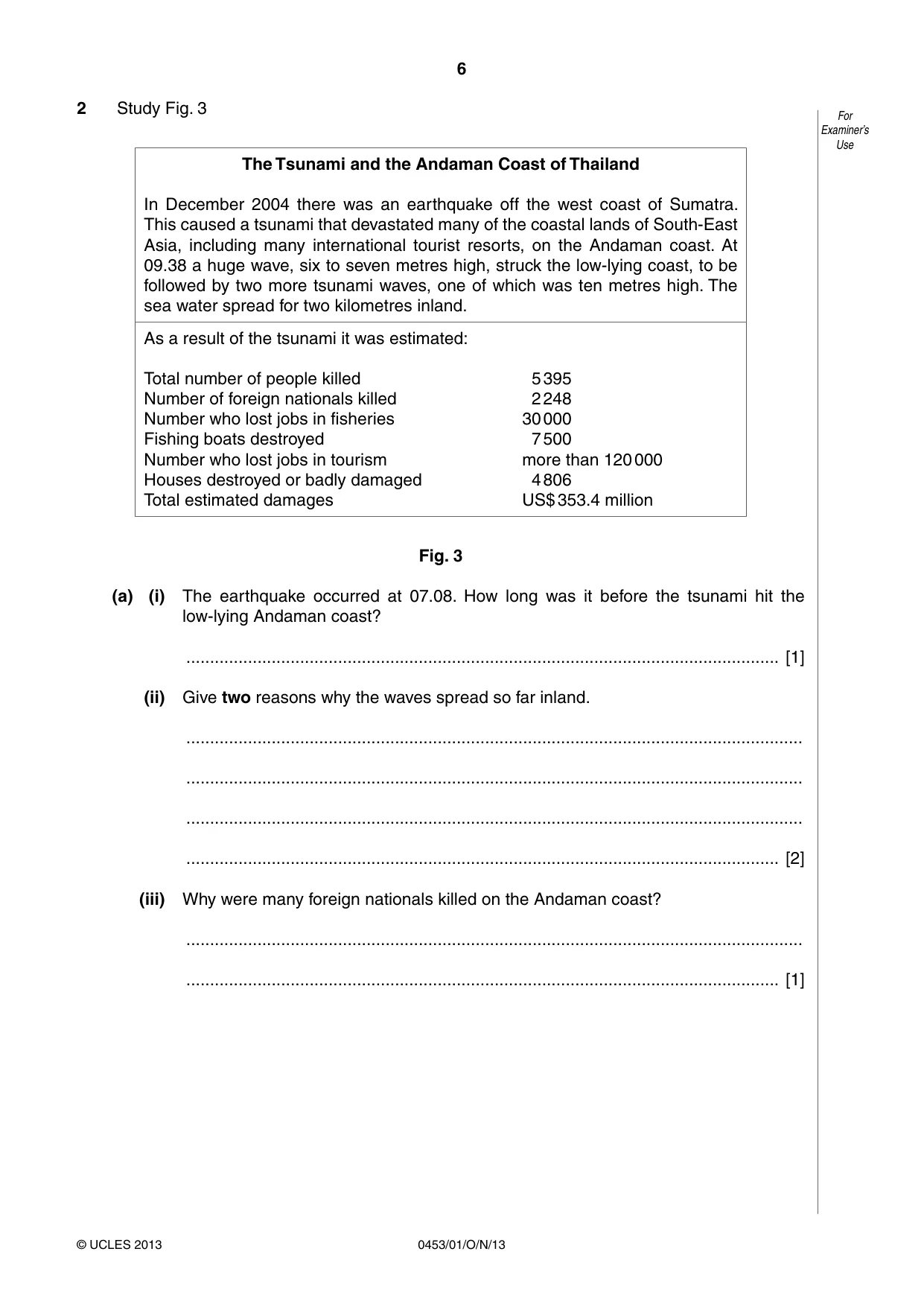
6 0453/01/O/N/13 © UCLES 2013 For Examiner’s Use 2 Study Fig. 3 The Tsunami and the Andaman Coast of Thailand In December 2004 there was an earthquake off the west coast of Sumatra. This caused a tsunami that devastated many of the coastal lands of South-East Asia, including many international tourist resorts, on the Andaman coast. At 09.38 a huge wave, six to seven metres high, struck the low-lying coast, to be followed by two more tsunami waves, one of which was ten metres high. The sea water spread for two kilometres inland. As a result of the tsunami it was estimated: Total number of people killed 5 395 Number of foreign nationals killed 2 248 Number who lost jobs in fisheries 30 000 Fishing boats destroyed 7 500 Number who lost jobs in tourism more than 120 000 Houses destroyed or badly damaged 4 806 Total estimated damages US$ 353.4 million Fig. 3 (a) (i) The earthquake occurred at 07.08. How long was it before the tsunami hit the low-lying Andaman coast? … [1] (ii) Give two reasons why the waves spread so far inland. … … … … [2] (iii) Why were many foreign nationals killed on the Andaman coast? … … [1]
Question paper, page 7
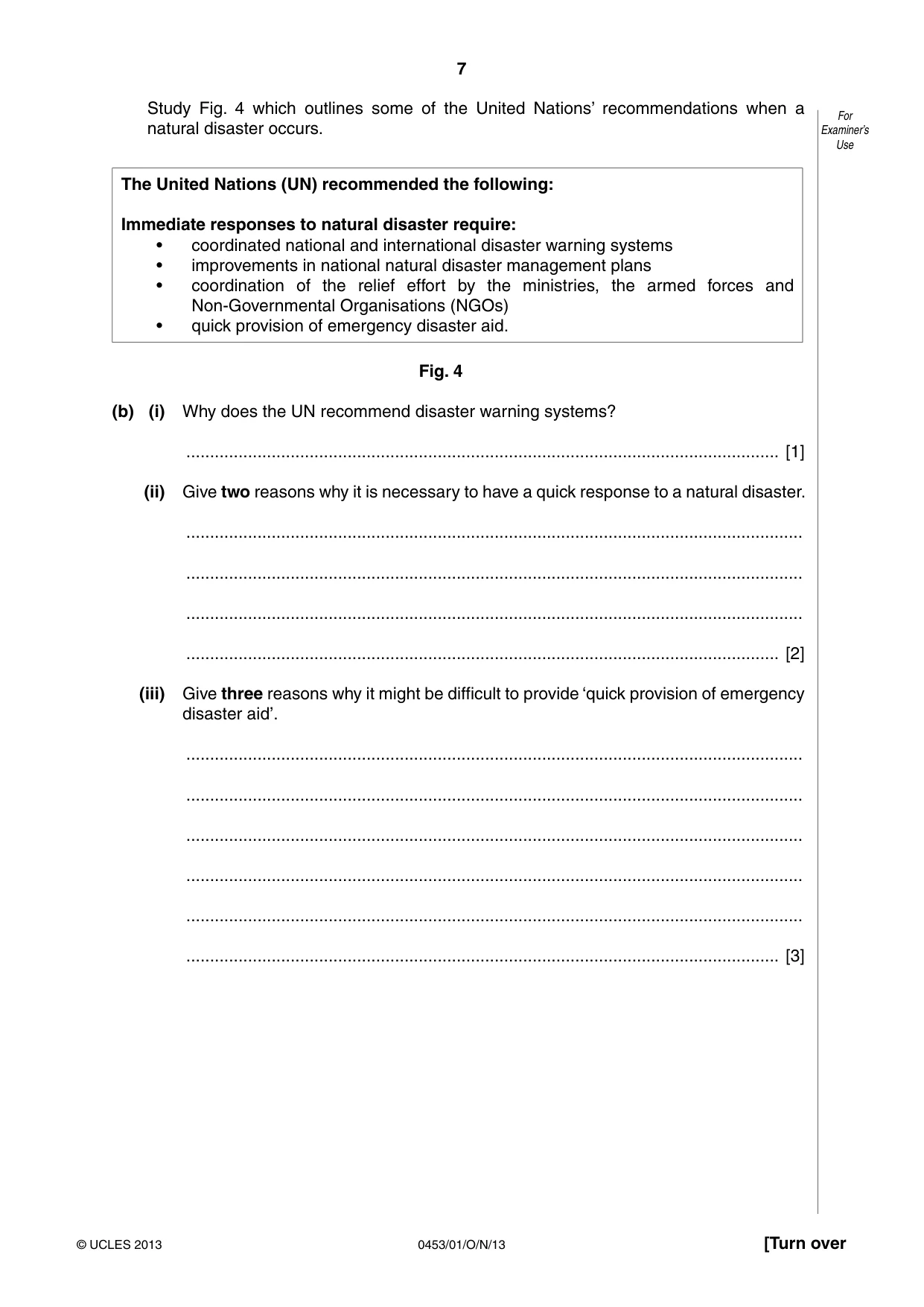
7 0453/01/O/N/13 © UCLES 2013 [Turn over For Examiner’s Use Study Fig. 4 which outlines some of the United Nations’ recommendations when a natural disaster occurs. The United Nations (UN) recommended the following: Immediate responses to natural disaster require: • coordinated national and international disaster warning systems • improvements in national natural disaster management plans • coordination of the relief effort by the ministries, the armed forces and Non-Governmental Organisations (NGOs) • quick provision of emergency disaster aid. Fig. 4 (b) (i) Why does the UN recommend disaster warning systems? … [1] (ii) Give two reasons why it is necessary to have a quick response to a natural disaster. … … … … [2] (iii) Give three reasons why it might be difficult to provide ‘quick provision of emergency disaster aid’. … … … … … … [3]
Question paper, page 8
8 0453/01/O/N/13 © UCLES 2013 For Examiner’s Use (iv) Explain why coordination of the relief effort is important following a natural disaster. … … … … … … … … [4] (c) With reference to a natural disaster: • State the type of natural disaster … • Name the place where it happened … • Explain its impact on development. You should fully develop the points you make. … … … … … … … … … … … … … … [6] [Total: 20 marks]
Question paper, page 9
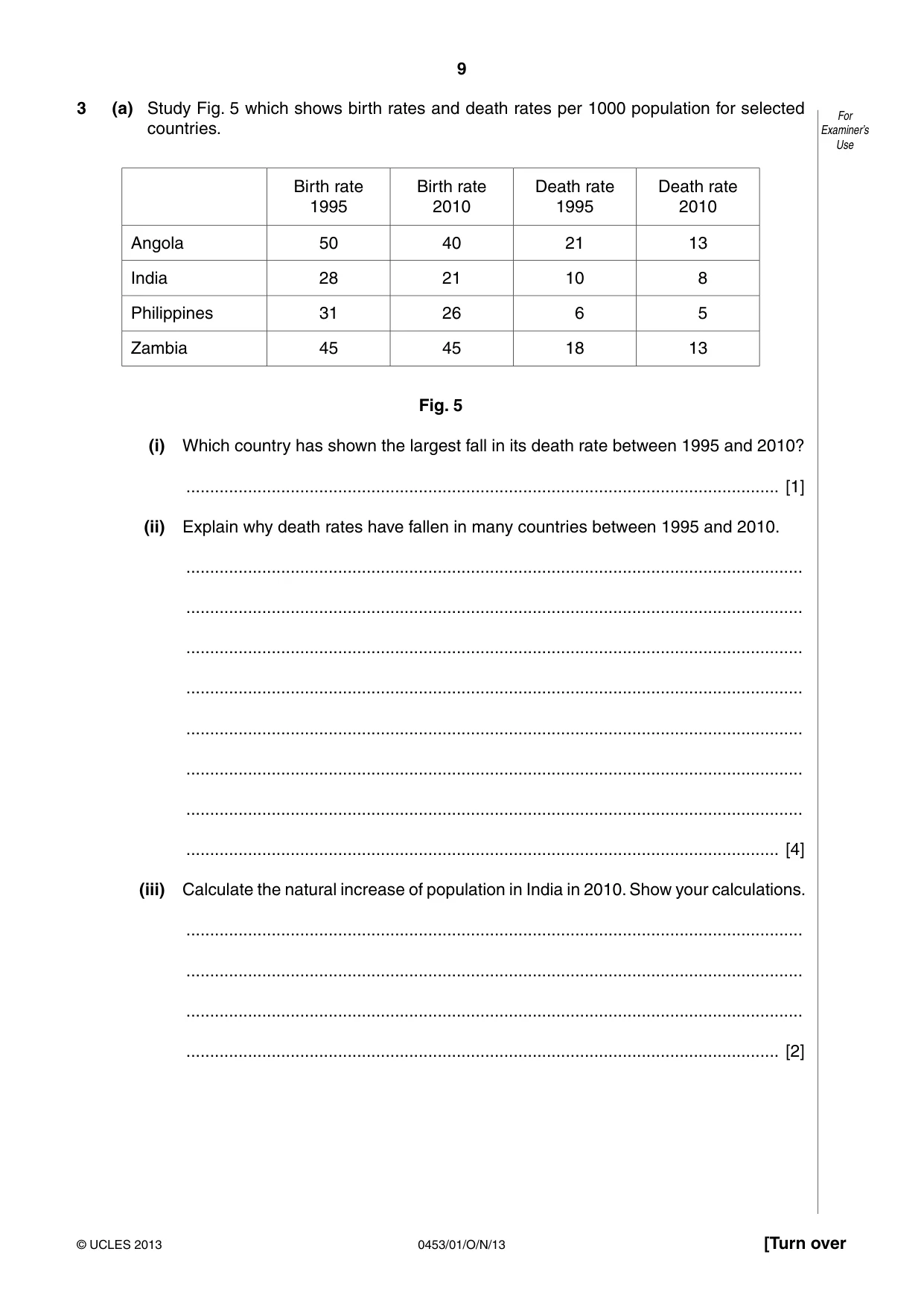
9 0453/01/O/N/13 © UCLES 2013 [Turn over For Examiner’s Use 3 (a) Study Fig. 5 which shows birth rates and death rates per 1000 population for selected countries. Birth rate 1995 Birth rate 2010 Death rate 1995 Death rate 2010 Angola 50 40 21 13 India 28 21 10 8 Philippines 31 26 6 5 Zambia 45 45 18 13 Fig. 5 (i) Which country has shown the largest fall in its death rate between 1995 and 2010? … [1] (ii) Explain why death rates have fallen in many countries between 1995 and 2010. … … … … … … … … [4] (iii) Calculate the natural increase of population in India in 2010. Show your calculations. … … … … [2]
Question paper, page 10
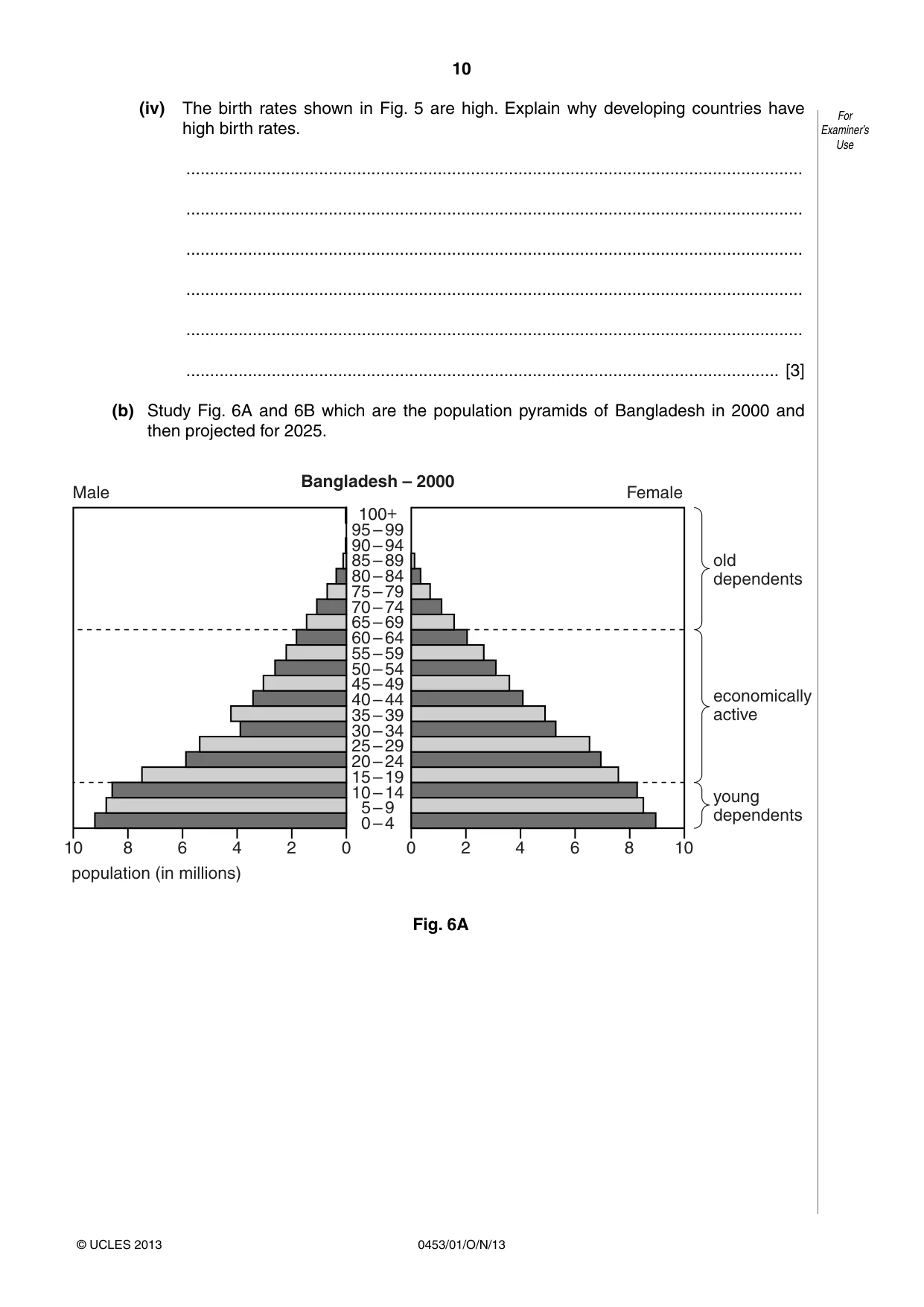
10 0453/01/O/N/13 © UCLES 2013 For Examiner’s Use (iv) The birth rates shown in Fig. 5 are high. Explain why developing countries have high birth rates. … … … … … … [3] (b) Study Fig. 6A and 6B which are the population pyramids of Bangladesh in 2000 and then projected for 2025. 0 – 4 0 2 4 6 8 10 population (in millions) Male Female old dependents young dependents economically active 10 8 6 4 2 0 5 – 9 10 – 14 15 – 19 20 – 24 25 – 29 30 – 34 35 – 39 40 – 44 45 – 49 50 – 54 55 – 59 60 – 64 65 – 69 70 – 74 75 – 79 80 – 84 85 – 89 90 – 94 95 – 99 100+ Bangladesh – 2000 Fig. 6A
Question paper, page 11
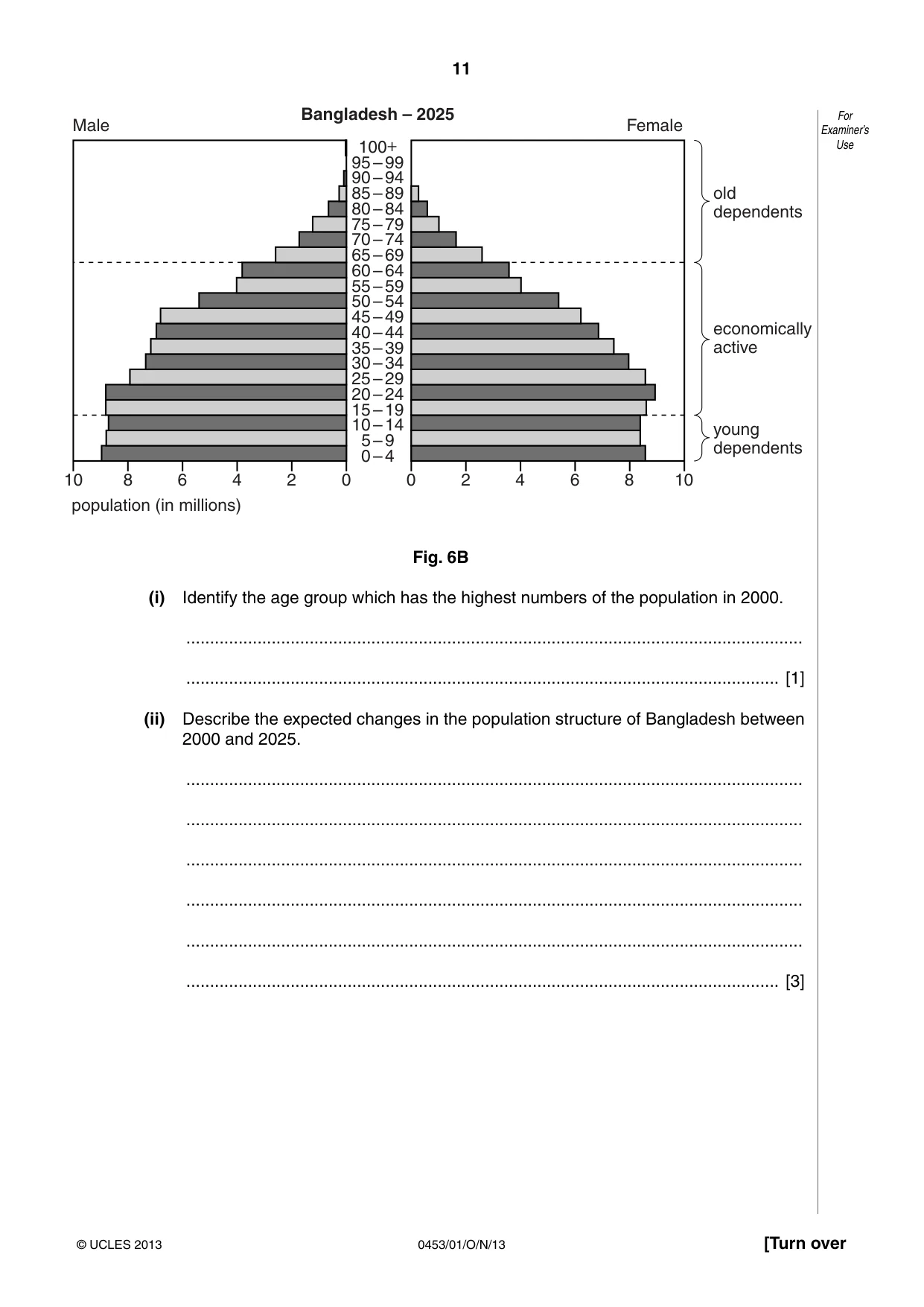
11 0453/01/O/N/13 © UCLES 2013 [Turn over For Examiner’s Use 0 – 4 0 2 4 6 8 10 population (in millions) Male Female old dependents young dependents economically active 10 8 6 4 2 0 5 – 9 10 – 14 15 – 19 20 – 24 25 – 29 30 – 34 35 – 39 40 – 44 45 – 49 50 – 54 55 – 59 60 – 64 65 – 69 70 – 74 75 – 79 80 – 84 85 – 89 90 – 94 95 – 99 100+ Bangladesh – 2025 Fig. 6B (i) Identify the age group which has the highest numbers of the population in 2000. … … [1] (ii) Describe the expected changes in the population structure of Bangladesh between 2000 and 2025. … … … … … … [3]
Question paper, page 12
12 0453/01/O/N/13 © UCLES 2013 For Examiner’s Use (c) Explain the likely effects of population change on the development of a country. You should consider both population growth and structure, and should fully develop the points you make. … … … … … … … … … … … … … … … … … … … … … … … … … [6] [Total: 20 marks]
Question paper, page 13
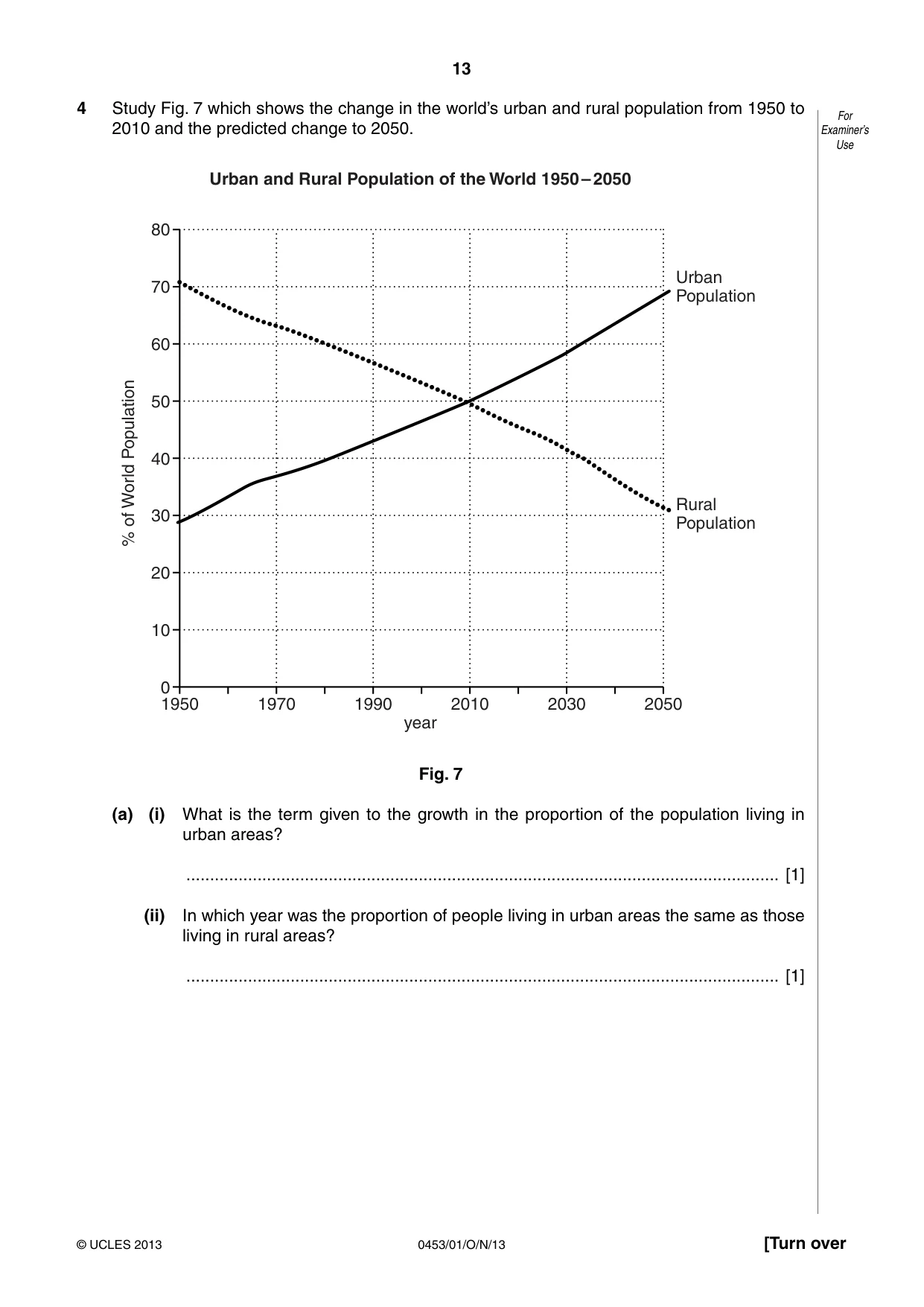
13 0453/01/O/N/13 © UCLES 2013 [Turn over For Examiner’s Use 4 Study Fig. 7 which shows the change in the world’s urban and rural population from 1950 to 2010 and the predicted change to 2050. 0 10 1950 1970 1990 2010 Urban and Rural Population of the World 1950 – 2050 % of World Population year 2030 2050 20 30 40 50 60 70 80 Urban Population Rural Population Fig. 7 (a) (i) What is the term given to the growth in the proportion of the population living in urban areas? … [1] (ii) In which year was the proportion of people living in urban areas the same as those living in rural areas? … [1]
Question paper, page 14
14 0453/01/O/N/13 © UCLES 2013 For Examiner’s Use (iii) The proportion of people living in rural areas is decreasing. Give three difficulties of living in rural areas in a developing country. … … … … … … [3] (b) Study Fig. 8 (Insert), which shows a photograph of a shanty town (squatter settlement) in Manila. (i) What evidence is there in Fig. 8 of overcrowding? … … [1] (ii) Suggest some problems of living in overcrowded conditions. … … … … … … [3] (iii) Use Fig. 8 only to describe the building materials of the shanty town. … … … … [2]
Question paper, page 15
15 0453/01/O/N/13 © UCLES 2013 For Examiner’s Use (c) Explain why so many people who move to urban areas live in shanty towns. … … … … … … [3] (d) One of the targets of the United Nations Millennium Development Goal 7 is ‘By 2020 to have achieved a significant improvement in the lives of at least 100 million slum dwellers’. Describe what can be done by the authorities and residents to achieve this target. You should fully develop the points you make. … … … … … … … … … … … … … … … … … … [6] [Total: 20 marks]
Question paper, page 16
16 0453/01/O/N/13 © UCLES 2013 BLANK PAGE Copyright Acknowledgements: Question 3 Figs 6A & 6B © www.census.gov. Question 4 Fig. 7 © http://en.wikipedia.org. Permission to reproduce items where third-party owned material protected by copyright is included has been sought and cleared where possible. Every reasonable effort has been made by the publisher (UCLES) to trace copyright holders, but if any items requiring clearance have unwittingly been included, the publisher will be pleased to make amends at the earliest possible opportunity. University of Cambridge International Examinations is part of the Cambridge Assessment Group. Cambridge Assessment is the brand name of University of Cambridge Local Examinations Syndicate (UCLES), which is itself a department of the University of Cambridge.
Mark scheme, page 1
CAMBRIDGE INTERNATIONAL EXAMINATIONS International General Certificate of Secondary Education MARK SCHEME for the October/November 2013 series 0453 DEVELOPMENT STUDIES 0453/01 Paper 1, maximum raw mark 80 This mark scheme is published as an aid to teachers and candidates, to indicate the requirements of the examination. It shows the basis on which Examiners were instructed to award marks. It does not indicate the details of the discussions that took place at an Examiners’ meeting before marking began, which would have considered the acceptability of alternative answers. Mark schemes should be read in conjunction with the question paper and the Principal Examiner Report for Teachers. Cambridge will not enter into discussions about these mark schemes. Cambridge is publishing the mark schemes for the October/November 2013 series for most IGCSE, GCE Advanced Level and Advanced Subsidiary Level components and some Ordinary Level components.
Mark scheme, page 2
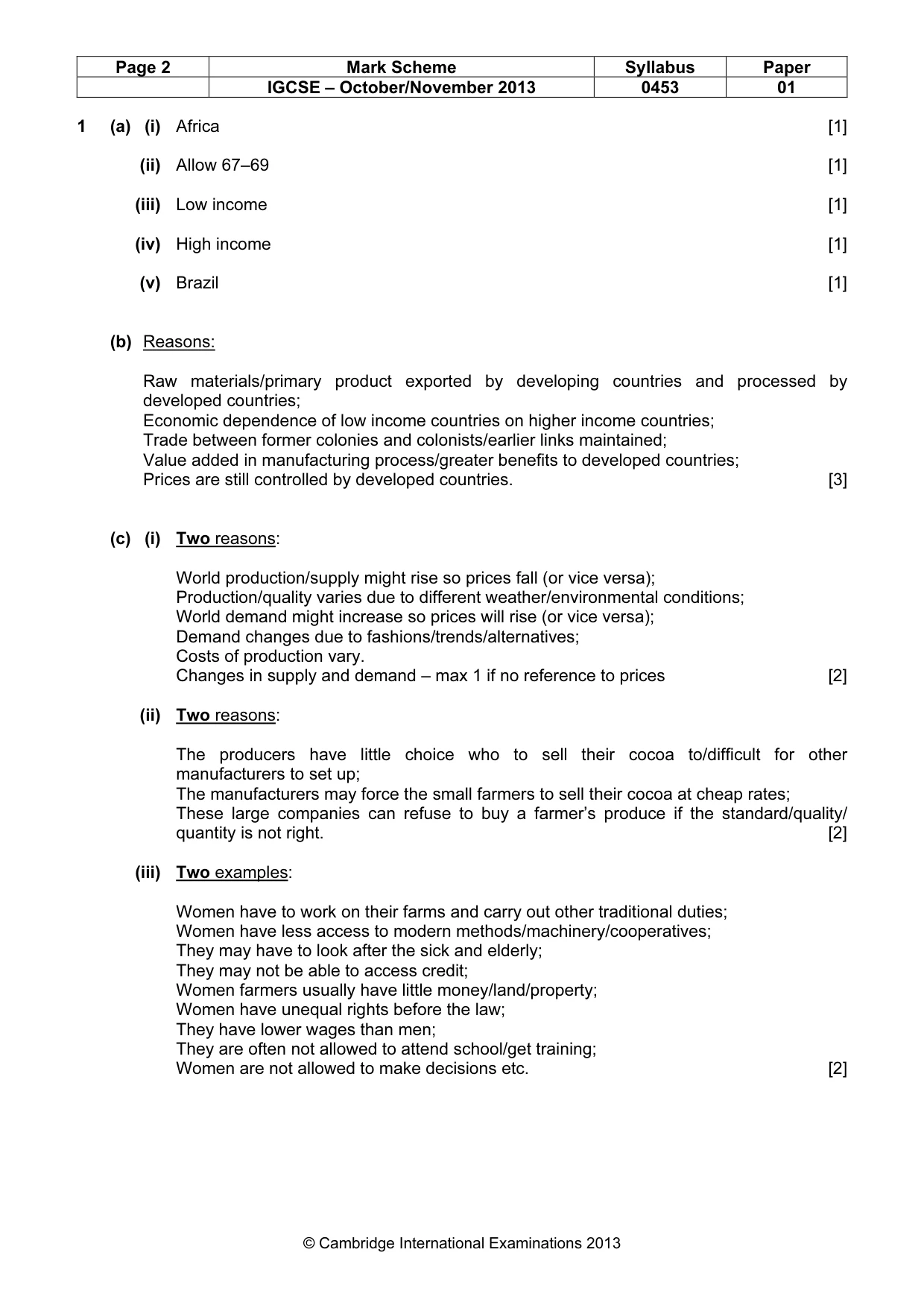
Page 2 Mark Scheme Syllabus Paper IGCSE – October/November 2013 0453 01 © Cambridge International Examinations 2013 1 (a) (i) Africa [1] (ii) Allow 67–69 [1] (iii) Low income [1] (iv) High income [1] (v) Brazil [1] (b) Reasons: Raw materials/primary product exported by developing countries and processed by developed countries; Economic dependence of low income countries on higher income countries; Trade between former colonies and colonists/earlier links maintained; Value added in manufacturing process/greater benefits to developed countries; Prices are still controlled by developed countries. [3] (c) (i) Two reasons: World production/supply might rise so prices fall (or vice versa); Production/quality varies due to different weather/environmental conditions; World demand might increase so prices will rise (or vice versa); Demand changes due to fashions/trends/alternatives; Costs of production vary. Changes in supply and demand – max 1 if no reference to prices [2] (ii) Two reasons: The producers have little choice who to sell their cocoa to/difficult for other manufacturers to set up; The manufacturers may force the small farmers to sell their cocoa at cheap rates; These large companies can refuse to buy a farmer’s produce if the standard/quality/ quantity is not right. [2] (iii) Two examples: Women have to work on their farms and carry out other traditional duties; Women have less access to modern methods/machinery/cooperatives; They may have to look after the sick and elderly; They may not be able to access credit; Women farmers usually have little money/land/property; Women have unequal rights before the law; They have lower wages than men; They are often not allowed to attend school/get training; Women are not allowed to make decisions etc. [2]
Mark scheme, page 3
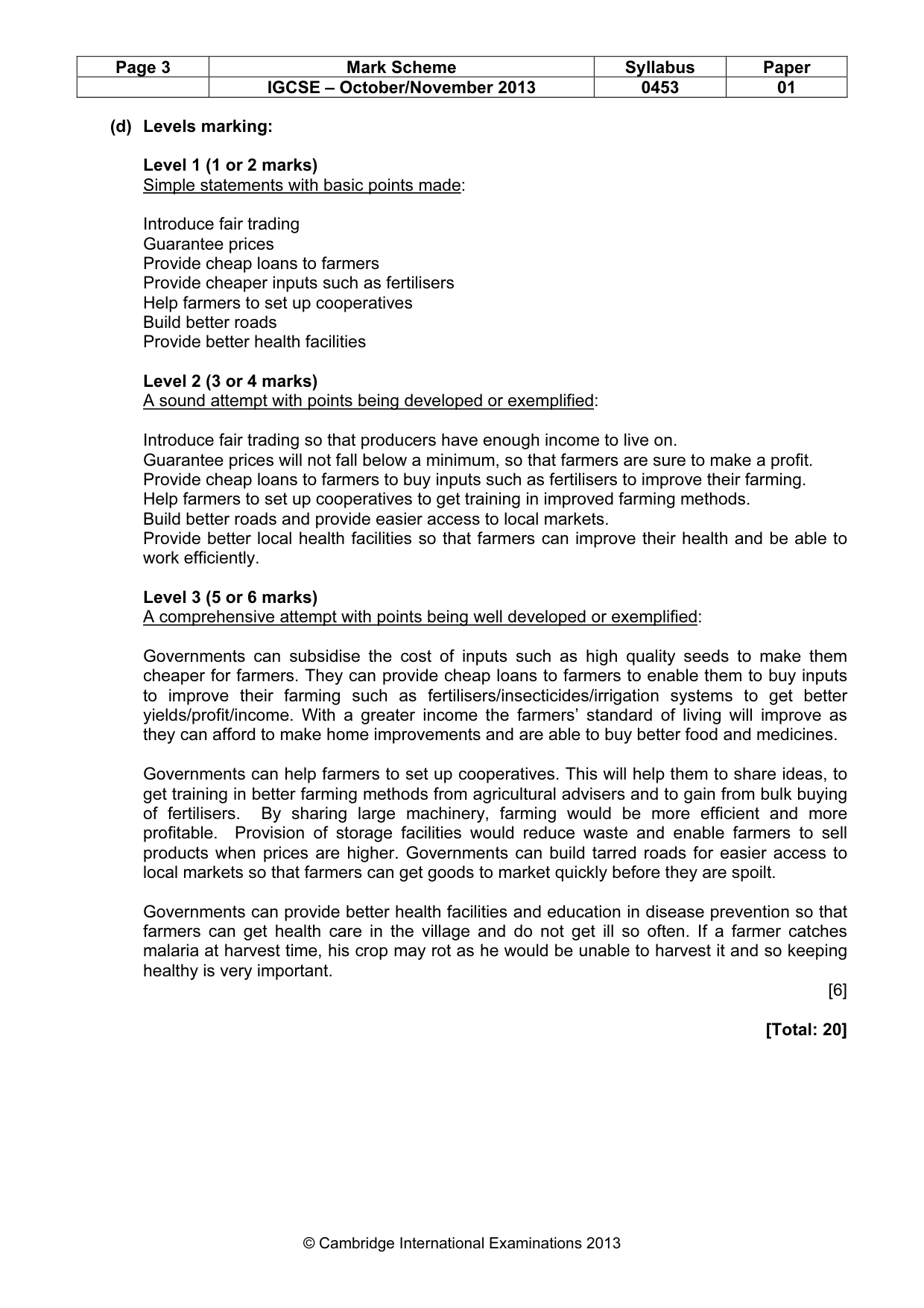
Page 3 Mark Scheme Syllabus Paper IGCSE – October/November 2013 0453 01 © Cambridge International Examinations 2013 (d) Levels marking: Level 1 (1 or 2 marks) Simple statements with basic points made: Introduce fair trading Guarantee prices Provide cheap loans to farmers Provide cheaper inputs such as fertilisers Help farmers to set up cooperatives Build better roads Provide better health facilities Level 2 (3 or 4 marks) A sound attempt with points being developed or exemplified: Introduce fair trading so that producers have enough income to live on. Guarantee prices will not fall below a minimum, so that farmers are sure to make a profit. Provide cheap loans to farmers to buy inputs such as fertilisers to improve their farming. Help farmers to set up cooperatives to get training in improved farming methods. Build better roads and provide easier access to local markets. Provide better local health facilities so that farmers can improve their health and be able to work efficiently. Level 3 (5 or 6 marks) A comprehensive attempt with points being well developed or exemplified: Governments can subsidise the cost of inputs such as high quality seeds to make them cheaper for farmers. They can provide cheap loans to farmers to enable them to buy inputs to improve their farming such as fertilisers/insecticides/irrigation systems to get better yields/profit/income. With a greater income the farmers’ standard of living will improve as they can afford to make home improvements and are able to buy better food and medicines. Governments can help farmers to set up cooperatives. This will help them to share ideas, to get training in better farming methods from agricultural advisers and to gain from bulk buying of fertilisers. By sharing large machinery, farming would be more efficient and more profitable. Provision of storage facilities would reduce waste and enable farmers to sell products when prices are higher. Governments can build tarred roads for easier access to local markets so that farmers can get goods to market quickly before they are spoilt. Governments can provide better health facilities and education in disease prevention so that farmers can get health care in the village and do not get ill so often. If a farmer catches malaria at harvest time, his crop may rot as he would be unable to harvest it and so keeping healthy is very important. [6] [Total: 20]
Mark scheme, page 4
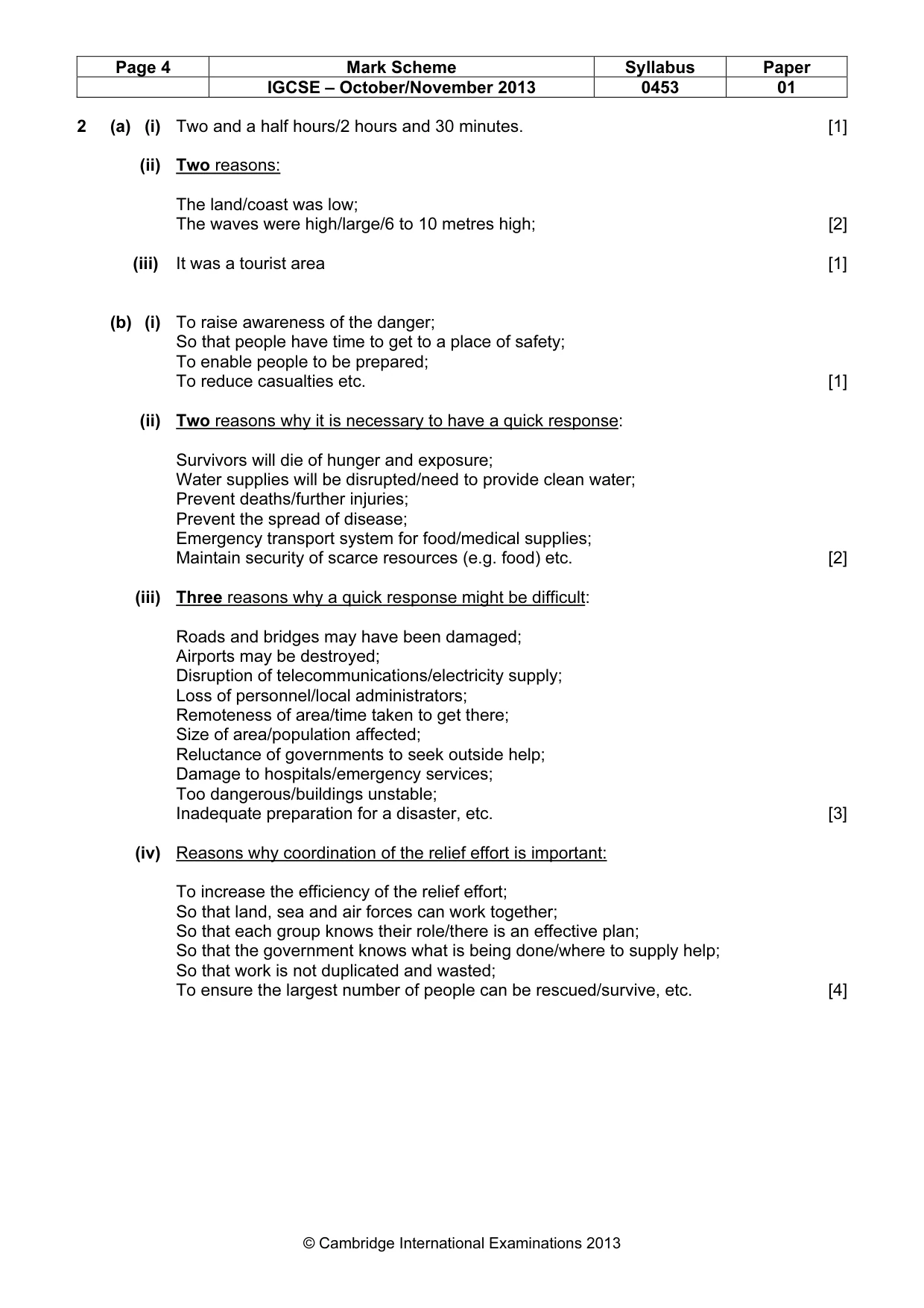
Page 4 Mark Scheme Syllabus Paper IGCSE – October/November 2013 0453 01 © Cambridge International Examinations 2013 2 (a) (i) Two and a half hours/2 hours and 30 minutes. [1] (ii) Two reasons: The land/coast was low; The waves were high/large/6 to 10 metres high; [2] (iii) It was a tourist area [1] (b) (i) To raise awareness of the danger; So that people have time to get to a place of safety; To enable people to be prepared; To reduce casualties etc. [1] (ii) Two reasons why it is necessary to have a quick response: Survivors will die of hunger and exposure; Water supplies will be disrupted/need to provide clean water; Prevent deaths/further injuries; Prevent the spread of disease; Emergency transport system for food/medical supplies; Maintain security of scarce resources (e.g. food) etc. [2] (iii) Three reasons why a quick response might be difficult: Roads and bridges may have been damaged; Airports may be destroyed; Disruption of telecommunications/electricity supply; Loss of personnel/local administrators; Remoteness of area/time taken to get there; Size of area/population affected; Reluctance of governments to seek outside help; Damage to hospitals/emergency services; Too dangerous/buildings unstable; Inadequate preparation for a disaster, etc. [3] (iv) Reasons why coordination of the relief effort is important: To increase the efficiency of the relief effort; So that land, sea and air forces can work together; So that each group knows their role/there is an effective plan; So that the government knows what is being done/where to supply help; So that work is not duplicated and wasted; To ensure the largest number of people can be rescued/survive, etc. [4]
Mark scheme, page 5
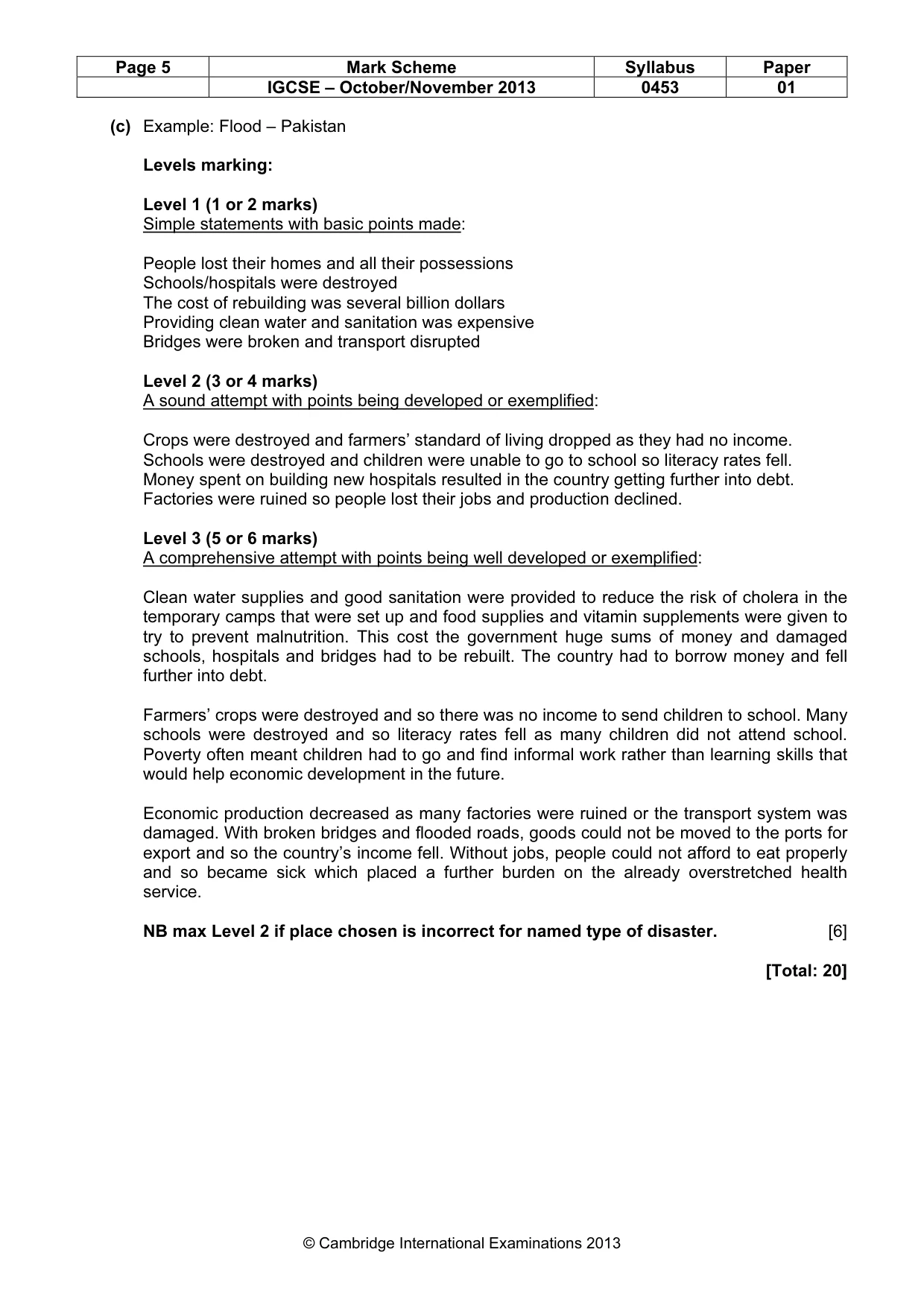
Page 5 Mark Scheme Syllabus Paper IGCSE – October/November 2013 0453 01 © Cambridge International Examinations 2013 (c) Example: Flood – Pakistan Levels marking: Level 1 (1 or 2 marks) Simple statements with basic points made: People lost their homes and all their possessions Schools/hospitals were destroyed The cost of rebuilding was several billion dollars Providing clean water and sanitation was expensive Bridges were broken and transport disrupted Level 2 (3 or 4 marks) A sound attempt with points being developed or exemplified: Crops were destroyed and farmers’ standard of living dropped as they had no income. Schools were destroyed and children were unable to go to school so literacy rates fell. Money spent on building new hospitals resulted in the country getting further into debt. Factories were ruined so people lost their jobs and production declined. Level 3 (5 or 6 marks) A comprehensive attempt with points being well developed or exemplified: Clean water supplies and good sanitation were provided to reduce the risk of cholera in the temporary camps that were set up and food supplies and vitamin supplements were given to try to prevent malnutrition. This cost the government huge sums of money and damaged schools, hospitals and bridges had to be rebuilt. The country had to borrow money and fell further into debt. Farmers’ crops were destroyed and so there was no income to send children to school. Many schools were destroyed and so literacy rates fell as many children did not attend school. Poverty often meant children had to go and find informal work rather than learning skills that would help economic development in the future. Economic production decreased as many factories were ruined or the transport system was damaged. With broken bridges and flooded roads, goods could not be moved to the ports for export and so the country’s income fell. Without jobs, people could not afford to eat properly and so became sick which placed a further burden on the already overstretched health service. NB max Level 2 if place chosen is incorrect for named type of disaster. [6] [Total: 20]
Mark scheme, page 6
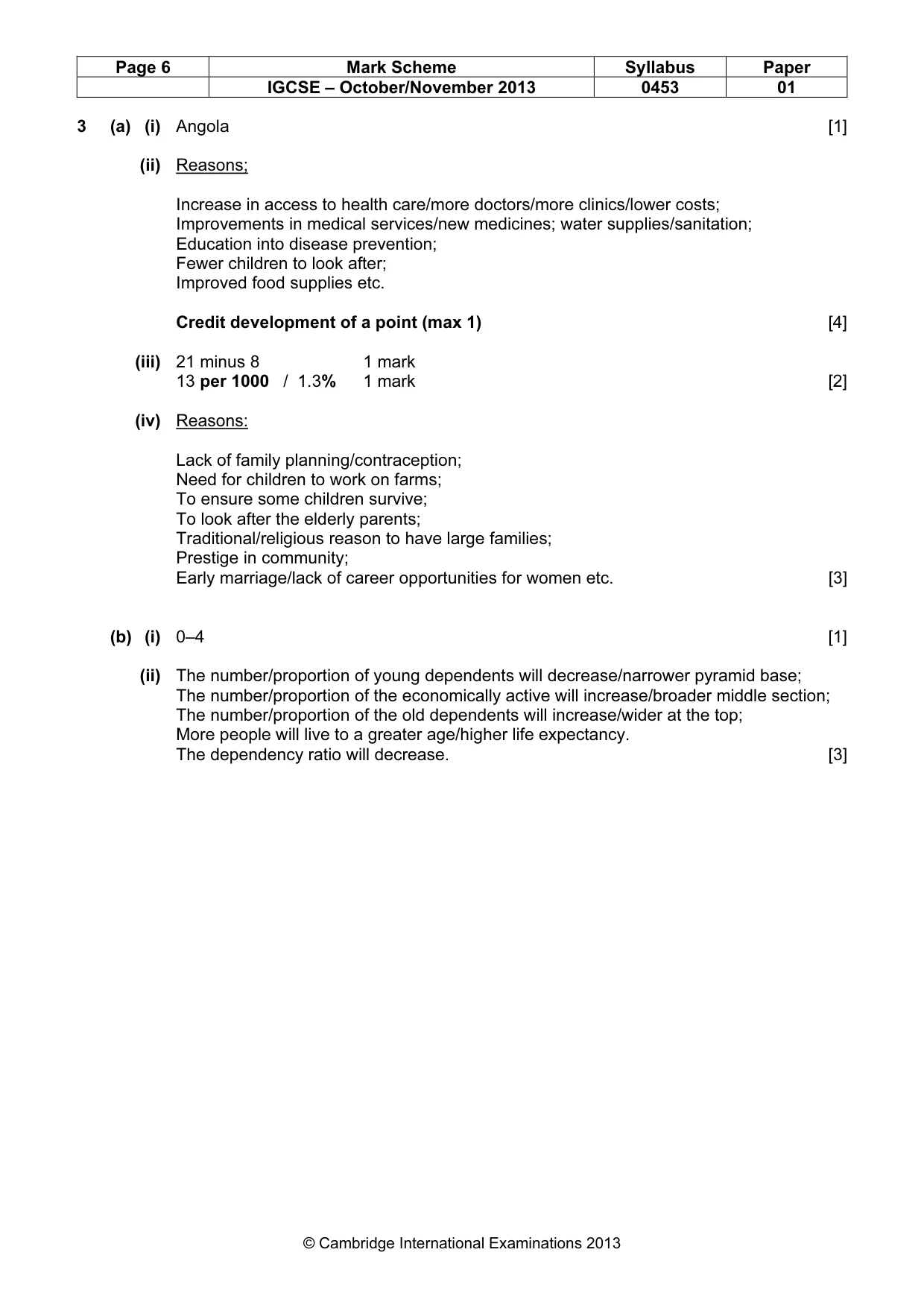
Page 6 Mark Scheme Syllabus Paper IGCSE – October/November 2013 0453 01 © Cambridge International Examinations 2013 3 (a) (i) Angola [1] (ii) Reasons; Increase in access to health care/more doctors/more clinics/lower costs; Improvements in medical services/new medicines; water supplies/sanitation; Education into disease prevention; Fewer children to look after; Improved food supplies etc. Credit development of a point (max 1) [4] (iii) 21 minus 8 1 mark 13 per 1000 / 1.3% 1 mark [2] (iv) Reasons: Lack of family planning/contraception; Need for children to work on farms; To ensure some children survive; To look after the elderly parents; Traditional/religious reason to have large families; Prestige in community; Early marriage/lack of career opportunities for women etc. [3] (b) (i) 0–4 [1] (ii) The number/proportion of young dependents will decrease/narrower pyramid base; The number/proportion of the economically active will increase/broader middle section; The number/proportion of the old dependents will increase/wider at the top; More people will live to a greater age/higher life expectancy. The dependency ratio will decrease. [3]
Mark scheme, page 7
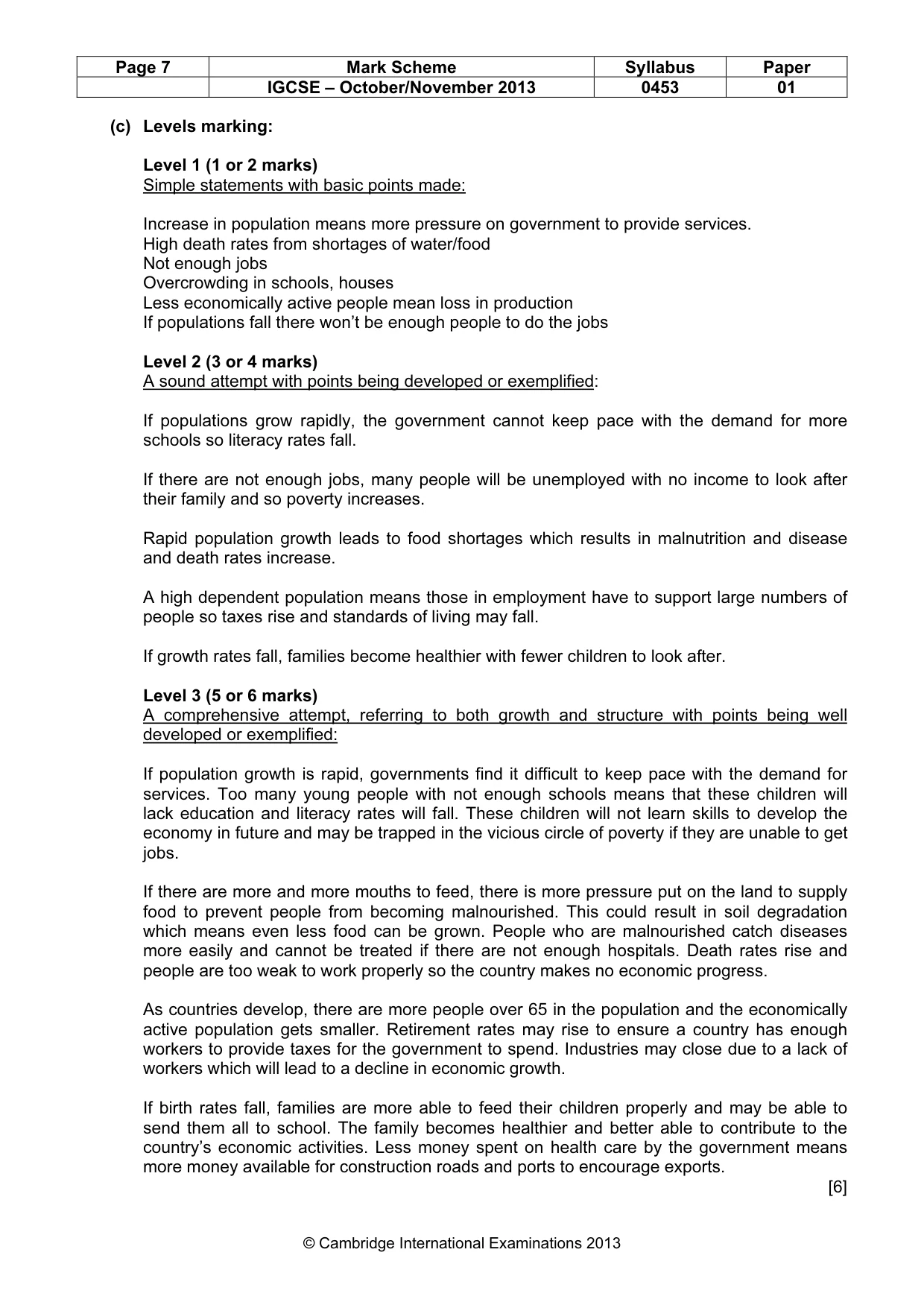
Page 7 Mark Scheme Syllabus Paper IGCSE – October/November 2013 0453 01 © Cambridge International Examinations 2013 (c) Levels marking: Level 1 (1 or 2 marks) Simple statements with basic points made: Increase in population means more pressure on government to provide services. High death rates from shortages of water/food Not enough jobs Overcrowding in schools, houses Less economically active people mean loss in production If populations fall there won’t be enough people to do the jobs Level 2 (3 or 4 marks) A sound attempt with points being developed or exemplified: If populations grow rapidly, the government cannot keep pace with the demand for more schools so literacy rates fall. If there are not enough jobs, many people will be unemployed with no income to look after their family and so poverty increases. Rapid population growth leads to food shortages which results in malnutrition and disease and death rates increase. A high dependent population means those in employment have to support large numbers of people so taxes rise and standards of living may fall. If growth rates fall, families become healthier with fewer children to look after. Level 3 (5 or 6 marks) A comprehensive attempt, referring to both growth and structure with points being well developed or exemplified: If population growth is rapid, governments find it difficult to keep pace with the demand for services. Too many young people with not enough schools means that these children will lack education and literacy rates will fall. These children will not learn skills to develop the economy in future and may be trapped in the vicious circle of poverty if they are unable to get jobs. If there are more and more mouths to feed, there is more pressure put on the land to supply food to prevent people from becoming malnourished. This could result in soil degradation which means even less food can be grown. People who are malnourished catch diseases more easily and cannot be treated if there are not enough hospitals. Death rates rise and people are too weak to work properly so the country makes no economic progress. As countries develop, there are more people over 65 in the population and the economically active population gets smaller. Retirement rates may rise to ensure a country has enough workers to provide taxes for the government to spend. Industries may close due to a lack of workers which will lead to a decline in economic growth. If birth rates fall, families are more able to feed their children properly and may be able to send them all to school. The family becomes healthier and better able to contribute to the country’s economic activities. Less money spent on health care by the government means more money available for construction roads and ports to encourage exports. [6]
Mark scheme, page 8
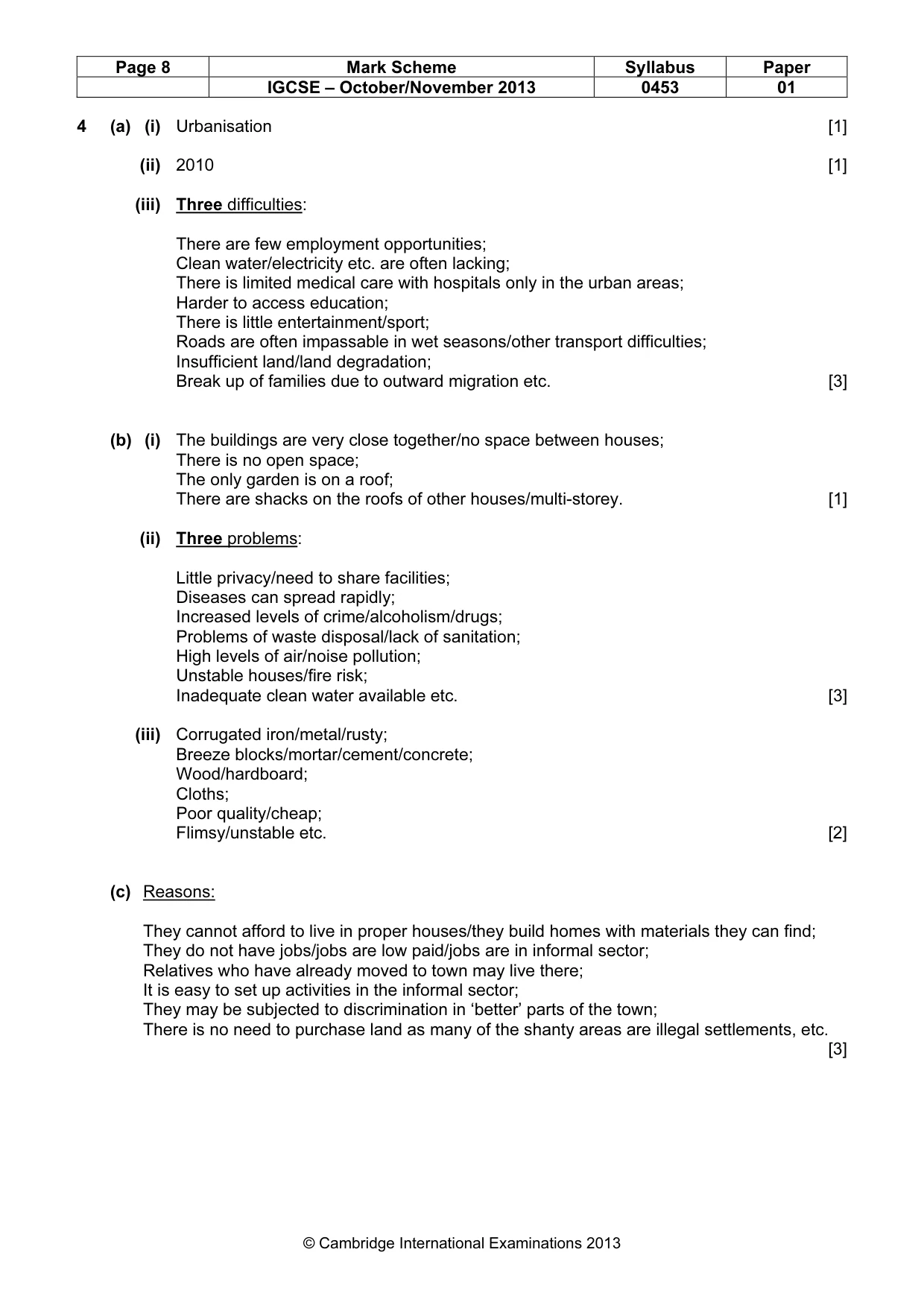
Page 8 Mark Scheme Syllabus Paper IGCSE – October/November 2013 0453 01 © Cambridge International Examinations 2013 4 (a) (i) Urbanisation [1] (ii) 2010 [1] (iii) Three difficulties: There are few employment opportunities; Clean water/electricity etc. are often lacking; There is limited medical care with hospitals only in the urban areas; Harder to access education; There is little entertainment/sport; Roads are often impassable in wet seasons/other transport difficulties; Insufficient land/land degradation; Break up of families due to outward migration etc. [3] (b) (i) The buildings are very close together/no space between houses; There is no open space; The only garden is on a roof; There are shacks on the roofs of other houses/multi-storey. [1] (ii) Three problems: Little privacy/need to share facilities; Diseases can spread rapidly; Increased levels of crime/alcoholism/drugs; Problems of waste disposal/lack of sanitation; High levels of air/noise pollution; Unstable houses/fire risk; Inadequate clean water available etc. [3] (iii) Corrugated iron/metal/rusty; Breeze blocks/mortar/cement/concrete; Wood/hardboard; Cloths; Poor quality/cheap; Flimsy/unstable etc. [2] (c) Reasons: They cannot afford to live in proper houses/they build homes with materials they can find; They do not have jobs/jobs are low paid/jobs are in informal sector; Relatives who have already moved to town may live there; It is easy to set up activities in the informal sector; They may be subjected to discrimination in ‘better’ parts of the town; There is no need to purchase land as many of the shanty areas are illegal settlements, etc. [3]
Mark scheme, page 9
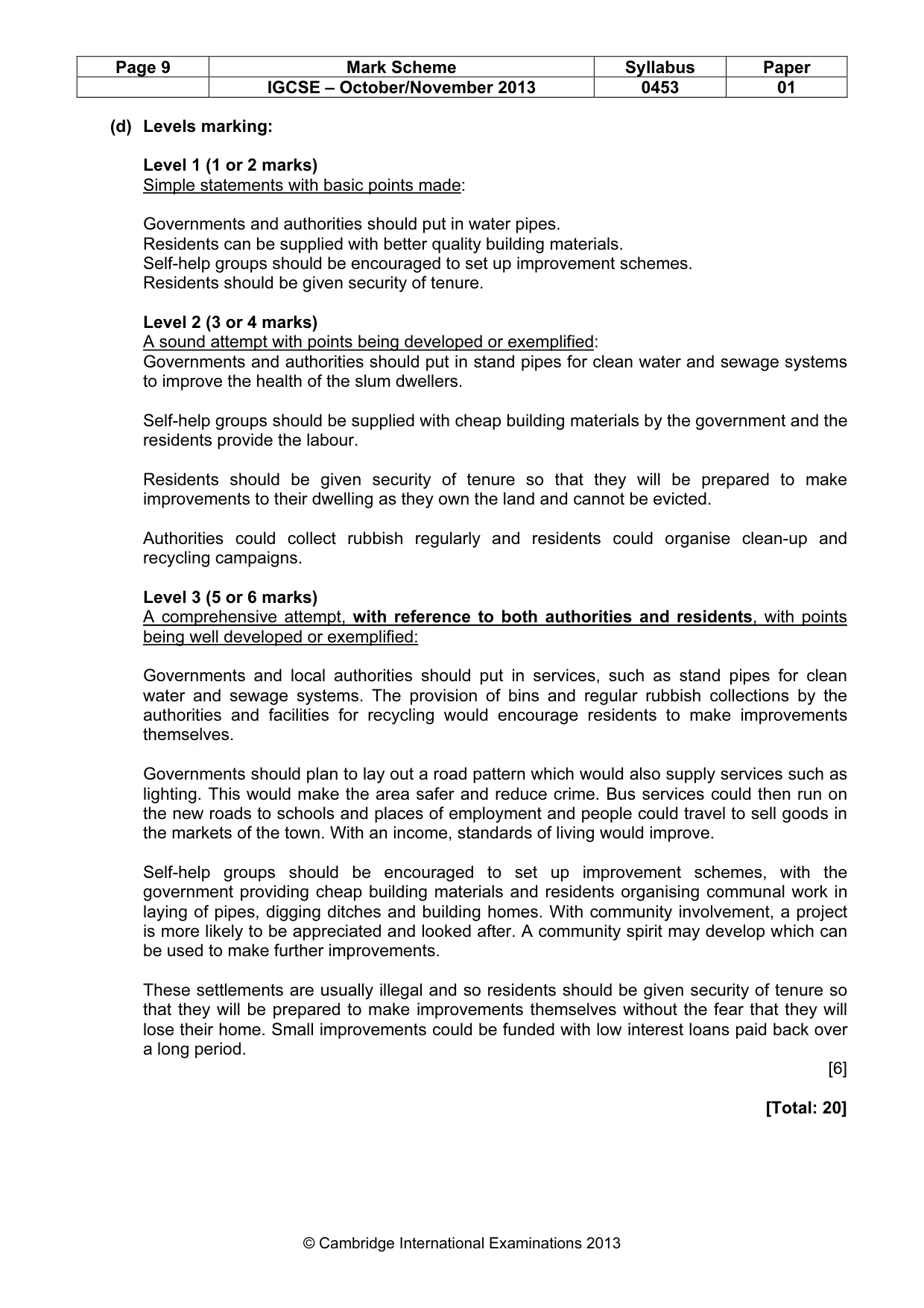
Page 9 Mark Scheme Syllabus Paper IGCSE – October/November 2013 0453 01 © Cambridge International Examinations 2013 (d) Levels marking: Level 1 (1 or 2 marks) Simple statements with basic points made: Governments and authorities should put in water pipes. Residents can be supplied with better quality building materials. Self-help groups should be encouraged to set up improvement schemes. Residents should be given security of tenure. Level 2 (3 or 4 marks) A sound attempt with points being developed or exemplified: Governments and authorities should put in stand pipes for clean water and sewage systems to improve the health of the slum dwellers. Self-help groups should be supplied with cheap building materials by the government and the residents provide the labour. Residents should be given security of tenure so that they will be prepared to make improvements to their dwelling as they own the land and cannot be evicted. Authorities could collect rubbish regularly and residents could organise clean-up and recycling campaigns. Level 3 (5 or 6 marks) A comprehensive attempt, with reference to both authorities and residents, with points being well developed or exemplified: Governments and local authorities should put in services, such as stand pipes for clean water and sewage systems. The provision of bins and regular rubbish collections by the authorities and facilities for recycling would encourage residents to make improvements themselves. Governments should plan to lay out a road pattern which would also supply services such as lighting. This would make the area safer and reduce crime. Bus services could then run on the new roads to schools and places of employment and people could travel to sell goods in the markets of the town. With an income, standards of living would improve. Self-help groups should be encouraged to set up improvement schemes, with the government providing cheap building materials and residents organising communal work in laying of pipes, digging ditches and building homes. With community involvement, a project is more likely to be appreciated and looked after. A community spirit may develop which can be used to make further improvements. These settlements are usually illegal and so residents should be given security of tenure so that they will be prepared to make improvements themselves without the fear that they will lose their home. Small improvements could be funded with low interest loans paid back over a long period. [6] [Total: 20]
What you needed in this session
Cambridge’s own grade thresholds for 2013 Oct/Nov, Paper 1 · Variant 1. A higher threshold means an easier paper — the bar moves with how the cohort did.