Cambridge IGCSE Development Studies 0453 — 2010 Oct/Nov Paper 2 · Variant 1
0453/21/O/N/10 · 80 marks · ≈90 min
The question paper and its mark scheme, free to read here and free to download. This is Cambridge’s own paper, exactly as it was sat.
Question paper16 pages







Mark scheme9 pages
Answers below. Sit the paper first if you are practising.

Paper as text
Question paper, page 1
This document consists of 13 printed pages, 3 blank pages and 2 Inserts. DC (LEO/CGW) 12751/8 © UCLES 2010 [Turn over UNIVERSITY OF CAMBRIDGE INTERNATIONAL EXAMINATIONS International General Certificate of Secondary Education * 5 9 2 7 6 7 6 3 1 2 * DEVELOPMENT STUDIES 0453/02 Paper 2 October/November 2010 2 hours Candidates answer on the Question Paper. Additional Materials: Ruler READ THESE INSTRUCTIONS FIRST Write your Centre number, candidate number and name on all the work you hand in. Write in dark blue or black pen. You may use a soft pencil for any diagrams, graphs or rough working. Do not use staples, paper clips, highlighters, glue or correction fluid. DO NOT WRITE IN ANY BARCODES. Answer all the questions. You may not need all the answer lines for your answer. You should read and study the sources before answering the questions. Insert 1 contains Photographs A and B for Question 1. Insert 2 contains Figs. 5A, 5B, 6, 7 and 8 for Question 3. At the end of the examination, fasten all your work securely together. The number of marks is given in brackets [ ] at the end of each question or part question.
Question paper, page 2
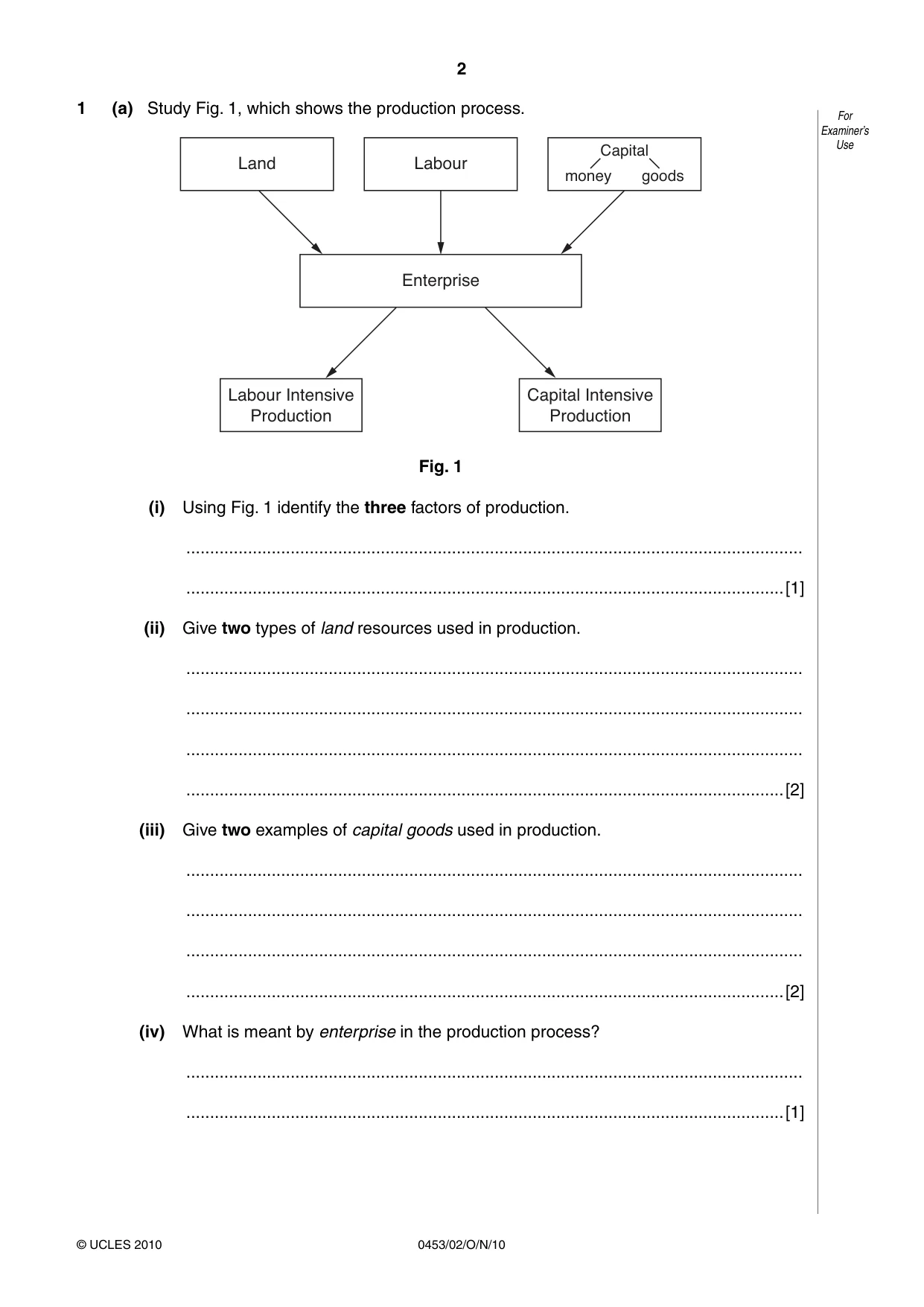
2 0453/02/O/N/10 © UCLES 2010 For Examiner’s Use 1 (a) Study Fig. 1, which shows the production process. Enterprise Labour Capital money goods Land Labour Intensive Production Capital Intensive Production Fig. 1 (i) Using Fig. 1 identify the three factors of production. … …[1] (ii) Give two types of land resources used in production. … … … …[2] (iii) Give two examples of capital goods used in production. … … … …[2] (iv) What is meant by enterprise in the production process? … …[1]
Question paper, page 3
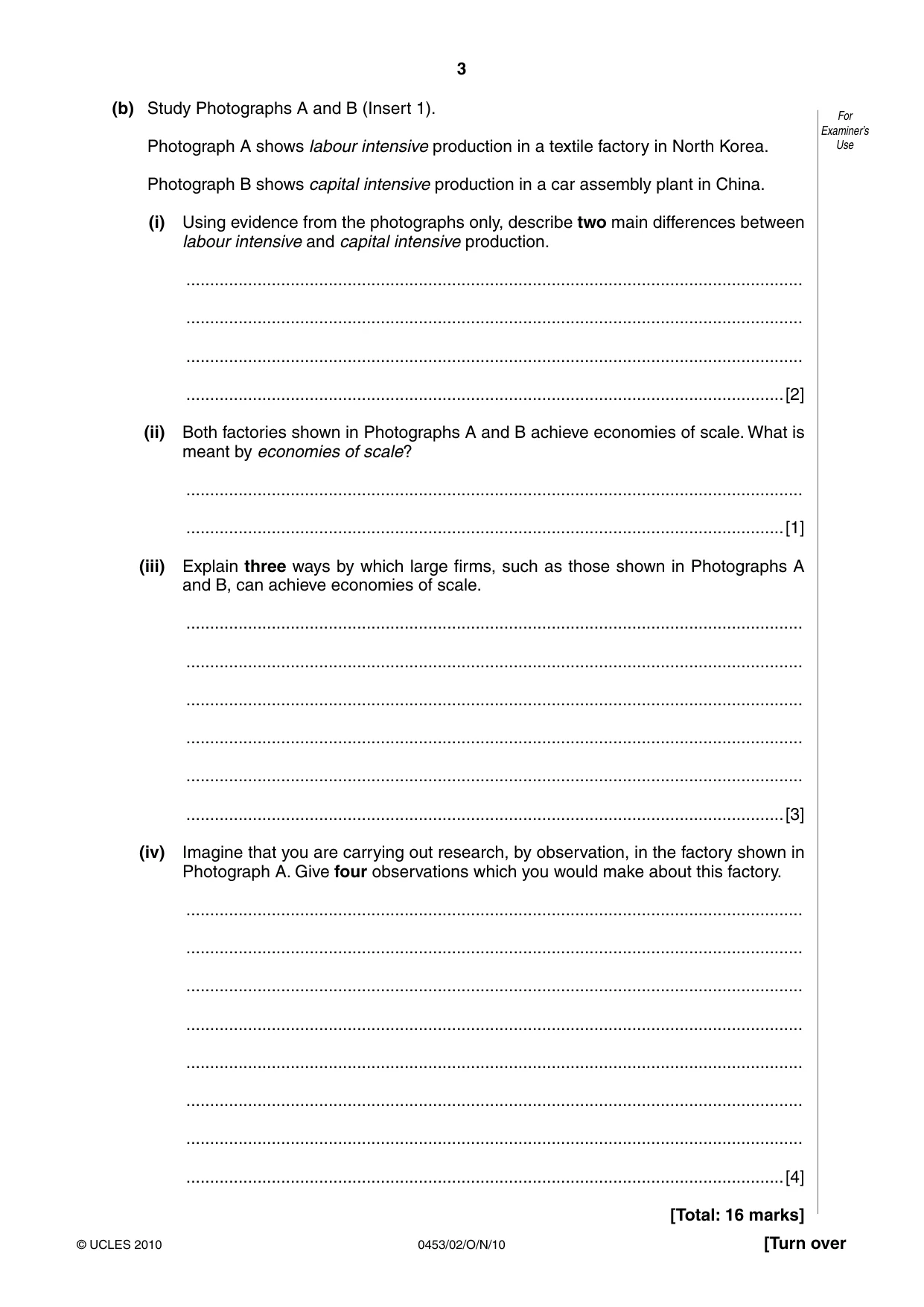
3 0453/02/O/N/10 © UCLES 2010 [Turn over For Examiner’s Use (b) Study Photographs A and B (Insert 1). Photograph A shows labour intensive production in a textile factory in North Korea. Photograph B shows capital intensive production in a car assembly plant in China. (i) Using evidence from the photographs only, describe two main differences between labour intensive and capital intensive production. … … … …[2] (ii) Both factories shown in Photographs A and B achieve economies of scale. What is meant by economies of scale? … …[1] (iii) Explain three ways by which large firms, such as those shown in Photographs A and B, can achieve economies of scale. … … … … … …[3] (iv) Imagine that you are carrying out research, by observation, in the factory shown in Photograph A. Give four observations which you would make about this factory. … … … … … … … …[4] [Total: 16 marks]
Question paper, page 4
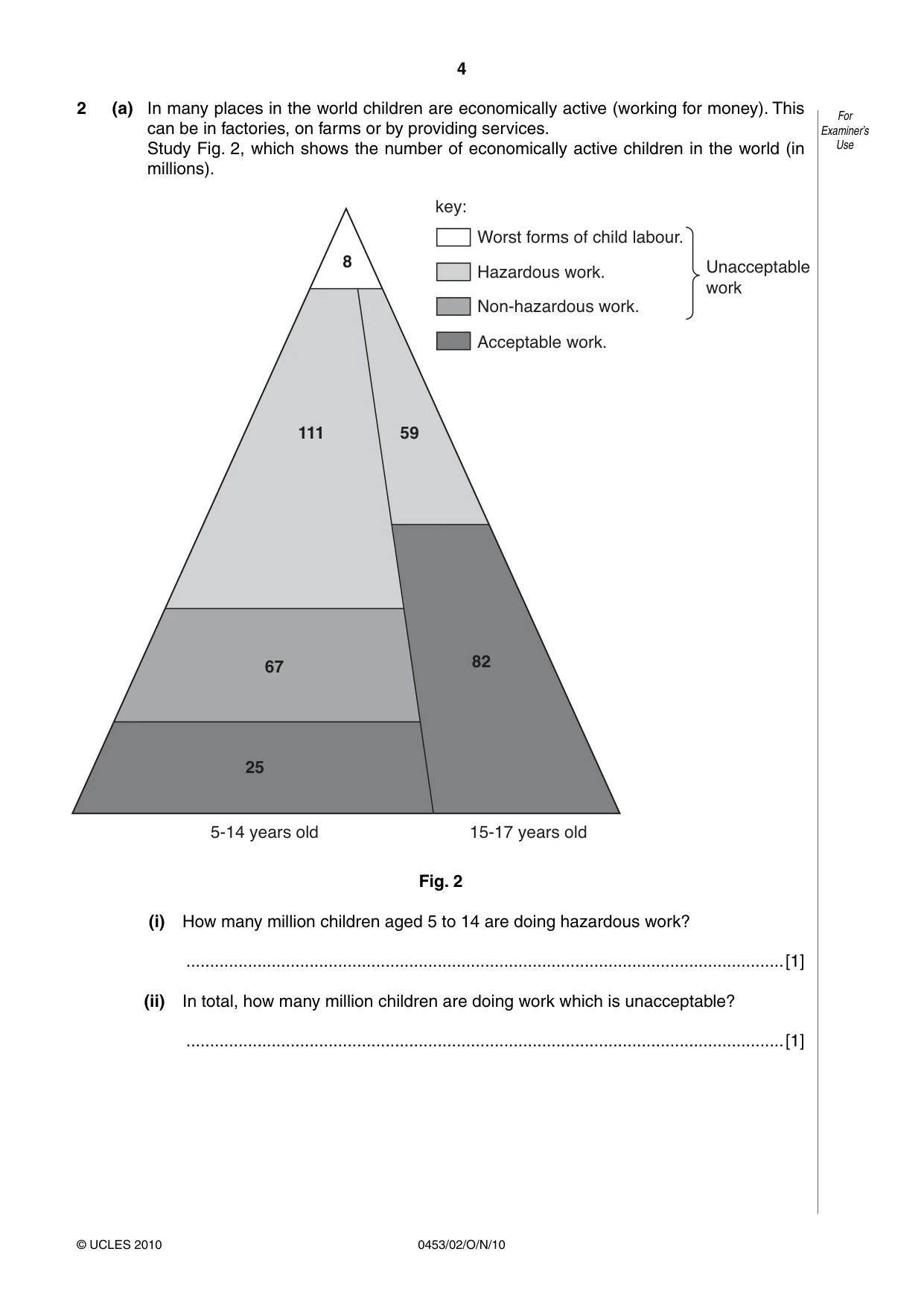
4 0453/02/O/N/10 © UCLES 2010 For Examiner’s Use 2 (a) In many places in the world children are economically active (working for money). This can be in factories, on farms or by providing services. Study Fig. 2, which shows the number of economically active children in the world (in millions). 8 111 67 5-14 years old 15-17 years old 59 25 82 key: Worst forms of child labour. Unacceptable work Hazardous work. Non-hazardous work. Acceptable work. Fig. 2 (i) How many million children aged 5 to 14 are doing hazardous work? …[1] (ii) In total, how many million children are doing work which is unacceptable? …[1]
Question paper, page 5
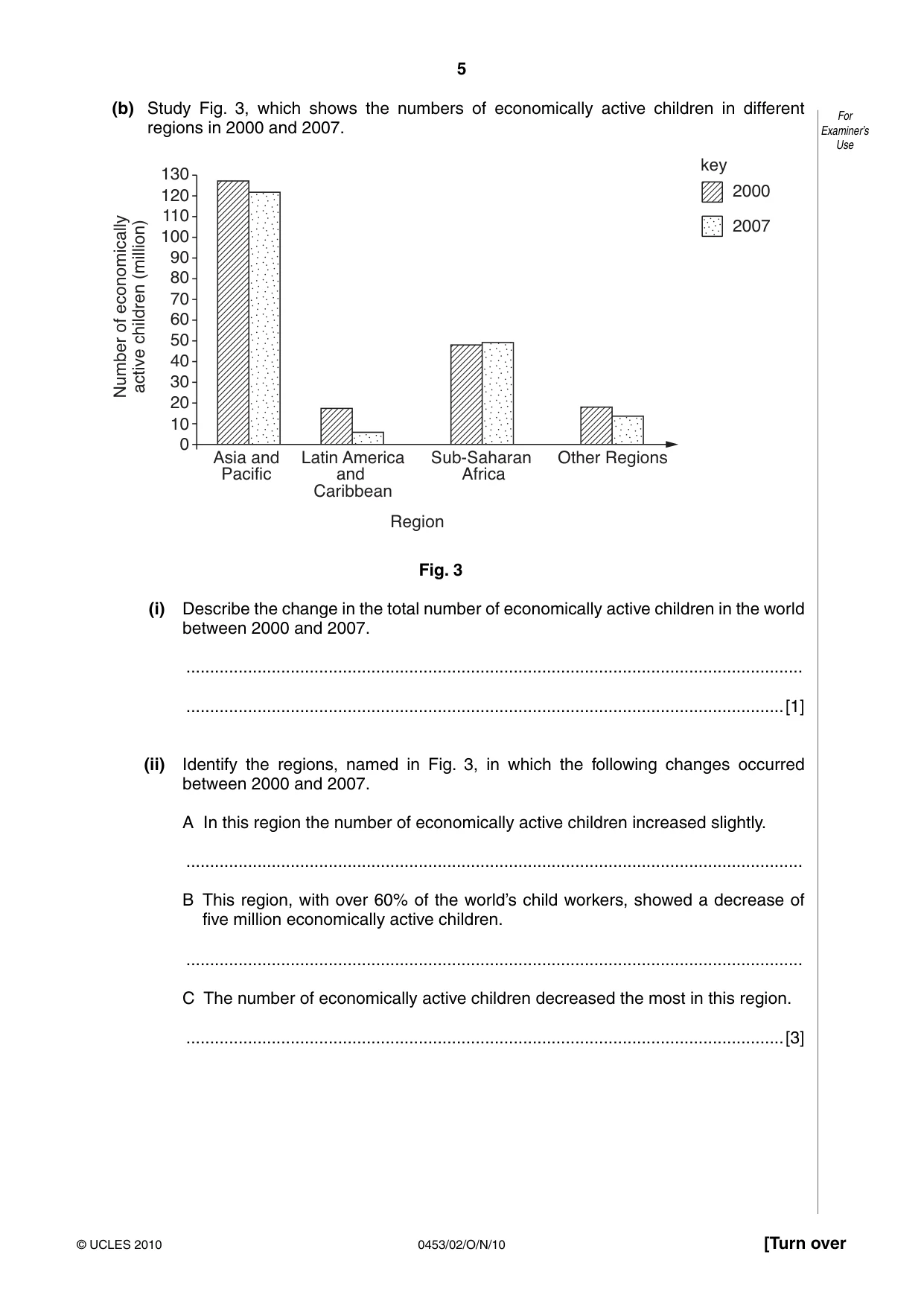
5 0453/02/O/N/10 © UCLES 2010 [Turn over For Examiner’s Use (b) Study Fig. 3, which shows the numbers of economically active children in different regions in 2000 and 2007. Asia and Pacific 130 0 10 20 30 40 50 60 70 80 Number of economically active children (million) 90 100 110 120 Latin America and Caribbean Region key 2000 2007 Sub-Saharan Africa Other Regions Fig. 3 (i) Describe the change in the total number of economically active children in the world between 2000 and 2007. … …[1] (ii) Identify the regions, named in Fig. 3, in which the following changes occurred between 2000 and 2007. A In this region the number of economically active children increased slightly. … B This region, with over 60% of the world’s child workers, showed a decrease of five million economically active children. … C The number of economically active children decreased the most in this region. …[3]
Question paper, page 6
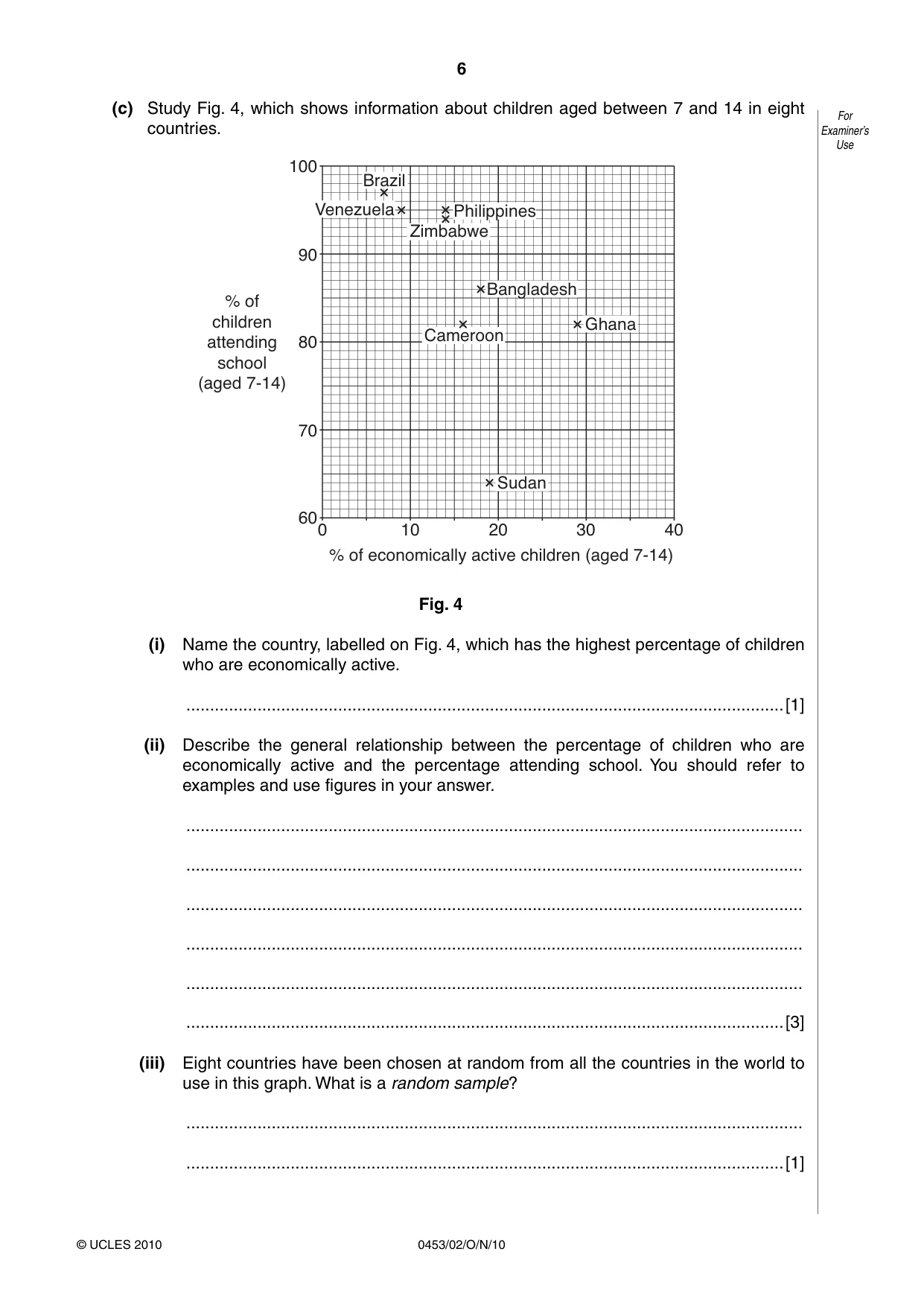
6 0453/02/O/N/10 © UCLES 2010 For Examiner’s Use (c) Study Fig. 4, which shows information about children aged between 7 and 14 in eight countries. 100 90 80 70 60 % of children attending school (aged 7-14) 0 10 20 % of economically active children (aged 7-14) 30 40 Ghana Cameroon Bangladesh Zimbabwe Philippines Brazil Venezuela Sudan Fig. 4 (i) Name the country, labelled on Fig. 4, which has the highest percentage of children who are economically active. …[1] (ii) Describe the general relationship between the percentage of children who are economically active and the percentage attending school. You should refer to examples and use figures in your answer. … … … … … …[3] (iii) Eight countries have been chosen at random from all the countries in the world to use in this graph. What is a random sample? … …[1]
Question paper, page 7
7 0453/02/O/N/10 © UCLES 2010 [Turn over For Examiner’s Use (iv) Suggest a different sampling method that can be used to select eight countries. Explain why you chose this method. Method … … … … …[2] (d) Give one different example of a job which a child, aged 7 to 14, may do in each of the following: • agriculture … • manufacturing industry … • providing services. …[3] [Total: 16 marks]
Question paper, page 8
8 0453/02/O/N/10 © UCLES 2010 For Examiner’s Use 3 A student is carrying out a research investigation about child labour in Bangladesh, as part of a Development Studies course. Study Figs 5A, 5B, 6, 7 and 8 (Insert 2) which are four sources of information which the student wants to use. (a) For each of the following give two examples of sources of information, shown by Figs 5A to 8, which are: (i) primary data … …[2] (ii) secondary data … …[2]
Question paper, page 9
9 0453/02/O/N/10 © UCLES 2010 [Turn over For Examiner’s Use (b) Look again at Fig. 5A and Fig. 5B. The student wants to present and analyse these statistics about child labour in Bangladesh. (i) Draw a graph using Fig. 5A to show the percentage of children in different types of employment in Bangladesh. [4] (ii) Describe what the statistics in Fig. 5B show about the percentages of boys and girls of different ages who are working. … … … … … … … … … …[5]
Question paper, page 10
10 0453/02/O/N/10 © UCLES 2010 For Examiner’s Use (c) Look again at Fig. 6. (i) Give two reasons why information from previous research investigations may not always be reliable. … … … …[2] (ii) Suggest three reasons why some employers use children in their workplaces. … … … … … …[3] (iii) Describe the social and economic impacts of using child labour on a country such as Bangladesh. … … … … … … … … … … … …[6]
Question paper, page 11
11 0453/02/O/N/10 © UCLES 2010 [Turn over For Examiner’s Use (d) Look again at Fig. 7. (i) Explain why it is important to carry out a pilot study before using a questionnaire. … … … …[2] (ii) Do you think the questionnaire is well designed? Give reasons for your answer. … … … … … …[3] (e) Look again at Fig. 8. (i) Explain why an interview was a useful method to obtain information from a child like Yasmin. … … … …[2] (ii) Describe four difficulties which a researcher might have in using interviews and/or questionnaires. … … … … … … … …[4]
Question paper, page 12
12 0453/02/O/N/10 © UCLES 2010 For Examiner’s Use (iii) For each difficulty you have identified in (ii) suggest how it might be overcome. … … … … … … … …[4] [Total: 39 marks]
Question paper, page 13
13 0453/02/O/N/10 © UCLES 2010 For Examiner’s Use 4 In developing countries, like Bangladesh, attempts are being made by government and non-government agencies to reduce child labour. Study the following three methods. Method A Make education up to 14 years compulsory. Method B Fine owners of businesses who employ children under 14 years old. Method C Give financial assistance to business owners to buy computer operated machines. Fig. 9 For each of the methods, A, B and C in Fig. 9, evaluate how successful they are likely to be in reducing the number of children working. In your evaluation you will need to explain the advantages and disadvantages of each of the methods of reducing child labour. … … … … … … … … … … … … … … … … … …[9] [Total: 9 marks]
Question paper, page 14
14 0453/02/O/N/10 © UCLES 2010 BLANK PAGE
Question paper, page 15
15 0453/02/O/N/10 © UCLES 2010 BLANK PAGE
Question paper, page 16
16 0453/02/O/N/10 © UCLES 2010 BLANK PAGE Copyright Acknowledgements: Photograph A © http://cache.daylife.com/imageserve/083L95x1c5gNL/610x.jpg Photograph B © http://cache.daylife.com/imageserve/01xL7Afg51gaW/610x.jpg Figure 2 © http://upload.wikimedia.org/wikipedia/commons/thumb/d/de/child_labour.svg/599px-child_labour.svg.png Figure 3 & Figure 7 © http://www.bracuniversity.ac.bd/journal/contents/412007/shafiqul%20Kalam.pdf Figure 5 © http://www.ucw-project.org/cgi-bin/acw/survey Figure 6 © http://library.fes.de/pdf-files/net2quelle/01310.pdf Permission to reproduce items where third-party owned material protected by copyright is included has been sought and cleared where possible. Every reasonable effort has been made by the publisher (UCLES) to trace copyright holders, but if any items requiring clearance have unwittingly been included, the publisher will be pleased to make amends at the earliest possible opportunity. University of Cambridge International Examinations is part of the Cambridge Assessment Group. Cambridge Assessment is the brand name of University of Cambridge Local Examinations Syndicate (UCLES), which is itself a department of the University of Cambridge.
Mark scheme, page 1
UNIVERSITY OF CAMBRIDGE INTERNATIONAL EXAMINATIONS International General Certificate of Secondary Education MARK SCHEME for the October/November 2010 question paper for the guidance of teachers 0453 DEVELOPMENT STUDIES 0453/02 Paper 2, maximum raw mark 80 This mark scheme is published as an aid to teachers and candidates, to indicate the requirements of the examination. It shows the basis on which Examiners were instructed to award marks. It does not indicate the details of the discussions that took place at an Examiners’ meeting before marking began, which would have considered the acceptability of alternative answers. Mark schemes must be read in conjunction with the question papers and the report on the examination. • CIE will not enter into discussions or correspondence in connection with these mark schemes. CIE is publishing the mark schemes for the October/November 2010 question papers for most IGCSE, GCE Advanced Level and Advanced Subsidiary Level syllabuses and some Ordinary Level syllabuses.
Mark scheme, page 2
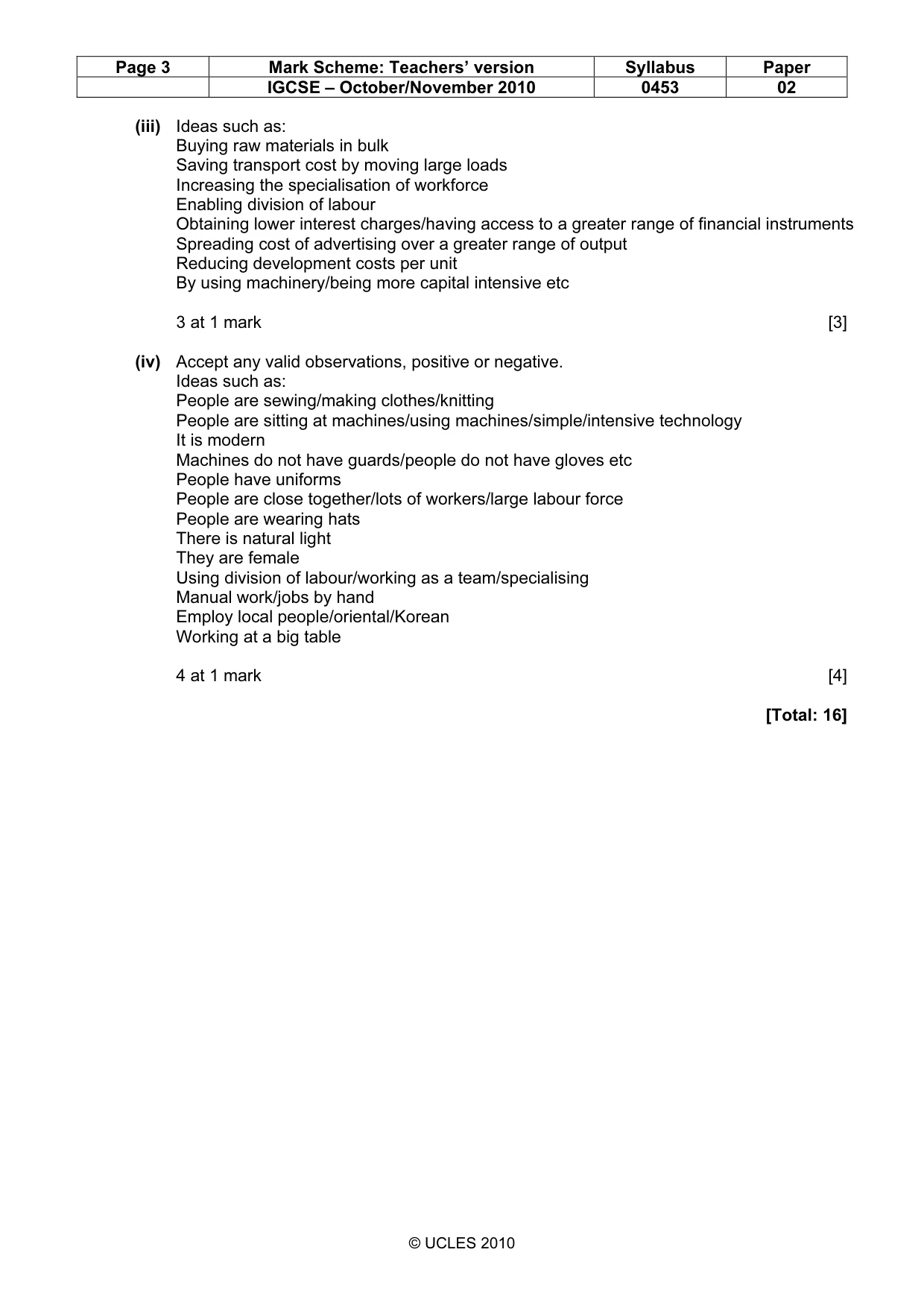
Page 2 Mark Scheme: Teachers’ version Syllabus Paper IGCSE – October/November 2010 0453 02 © UCLES 2010 1 (a) (i) Land, Labour, Capital (or money and goods) All 3 needed for 1 mark [1] (ii) ‘Land’ resources such as: Soil Forests/trees Coal Oil Farmland/fields/land to grow things on Fish Minerals or metals, or examples A mine Water Animals or examples Rock Copper from underground 2 at 1 mark [2] (iii) Capital goods such as: Machinery (or example from factory) Vehicles (or example of transport) Computers Tractors (or other example of agricultural machine) etc Raw materials/components/examples of these Buildings Tools or examples 2 at 1 mark [2] (iv) Enterprise organises/joins/combines/brings together/directs the other factors of production to produce the good or service/enterprise is required to get production moving. [1] (b) (i) Definitions: Capital intensive uses more machines Labour intensive uses lots of workers Capital intensive uses complex machines but labour intensive uses simple machines/technology [2] (ii) Economies of scale occur when the unit cost of production is reduced as a result of producing large quantities/the more they produce the cheaper each item becomes. [1]
Mark scheme, page 3
Page 3 Mark Scheme: Teachers’ version Syllabus Paper IGCSE – October/November 2010 0453 02 © UCLES 2010 (iii) Ideas such as: Buying raw materials in bulk Saving transport cost by moving large loads Increasing the specialisation of workforce Enabling division of labour Obtaining lower interest charges/having access to a greater range of financial instruments Spreading cost of advertising over a greater range of output Reducing development costs per unit By using machinery/being more capital intensive etc 3 at 1 mark [3] (iv) Accept any valid observations, positive or negative. Ideas such as: People are sewing/making clothes/knitting People are sitting at machines/using machines/simple/intensive technology It is modern Machines do not have guards/people do not have gloves etc People have uniforms People are close together/lots of workers/large labour force People are wearing hats There is natural light They are female Using division of labour/working as a team/specialising Manual work/jobs by hand Employ local people/oriental/Korean Working at a big table 4 at 1 mark [4] [Total: 16]
Mark scheme, page 4
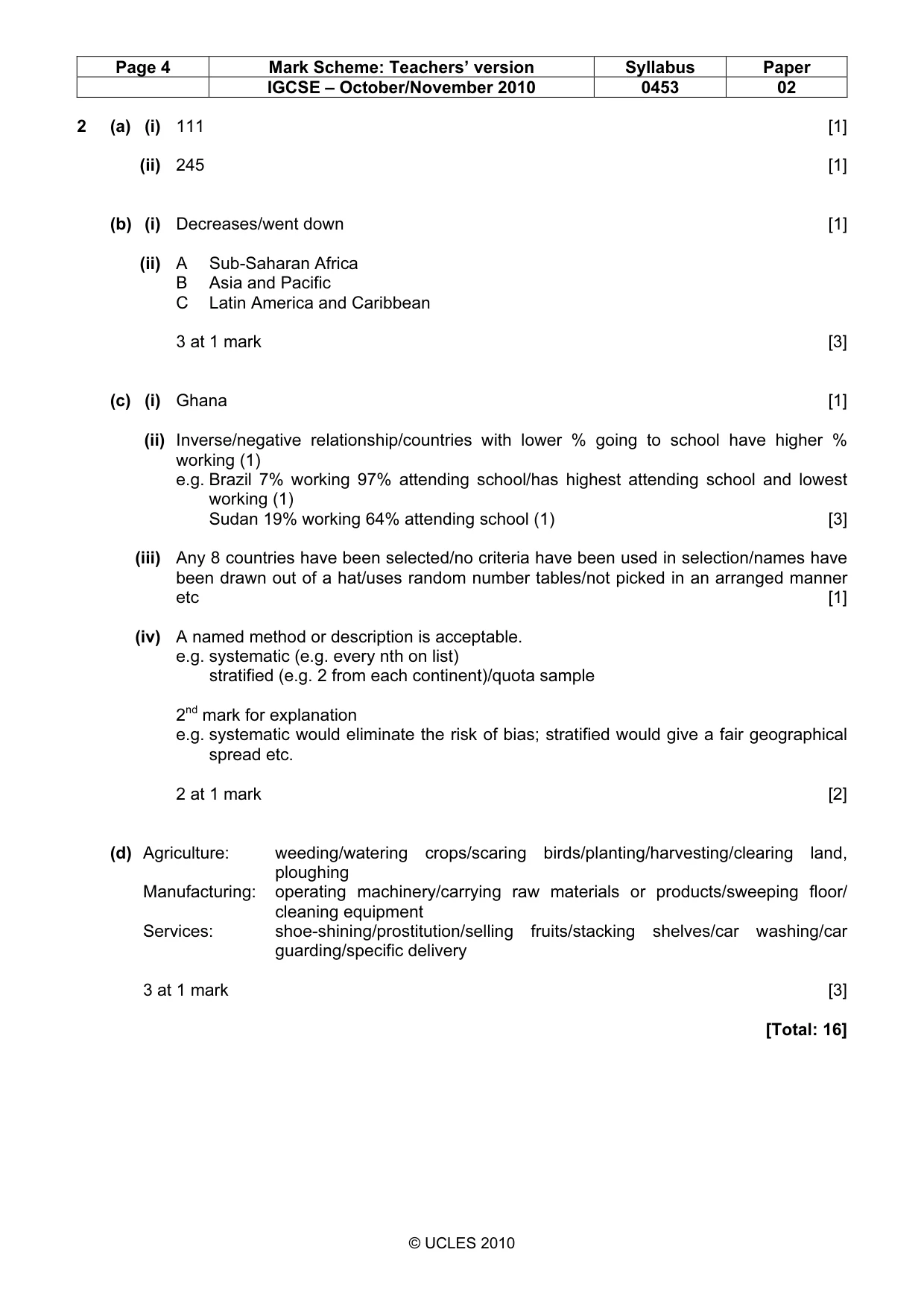
Page 4 Mark Scheme: Teachers’ version Syllabus Paper IGCSE – October/November 2010 0453 02 © UCLES 2010 2 (a) (i) 111 [1] (ii) 245 [1] (b) (i) Decreases/went down [1] (ii) A Sub-Saharan Africa B Asia and Pacific C Latin America and Caribbean 3 at 1 mark [3] (c) (i) Ghana [1] (ii) Inverse/negative relationship/countries with lower % going to school have higher % working (1) e.g. Brazil 7% working 97% attending school/has highest attending school and lowest working (1) Sudan 19% working 64% attending school (1) [3] (iii) Any 8 countries have been selected/no criteria have been used in selection/names have been drawn out of a hat/uses random number tables/not picked in an arranged manner etc [1] (iv) A named method or description is acceptable. e.g. systematic (e.g. every nth on list) stratified (e.g. 2 from each continent)/quota sample 2nd mark for explanation e.g. systematic would eliminate the risk of bias; stratified would give a fair geographical spread etc. 2 at 1 mark [2] (d) Agriculture: weeding/watering crops/scaring birds/planting/harvesting/clearing land, ploughing Manufacturing: operating machinery/carrying raw materials or products/sweeping floor/ cleaning equipment Services: shoe-shining/prostitution/selling fruits/stacking shelves/car washing/car guarding/specific delivery 3 at 1 mark [3] [Total: 16]
Mark scheme, page 5
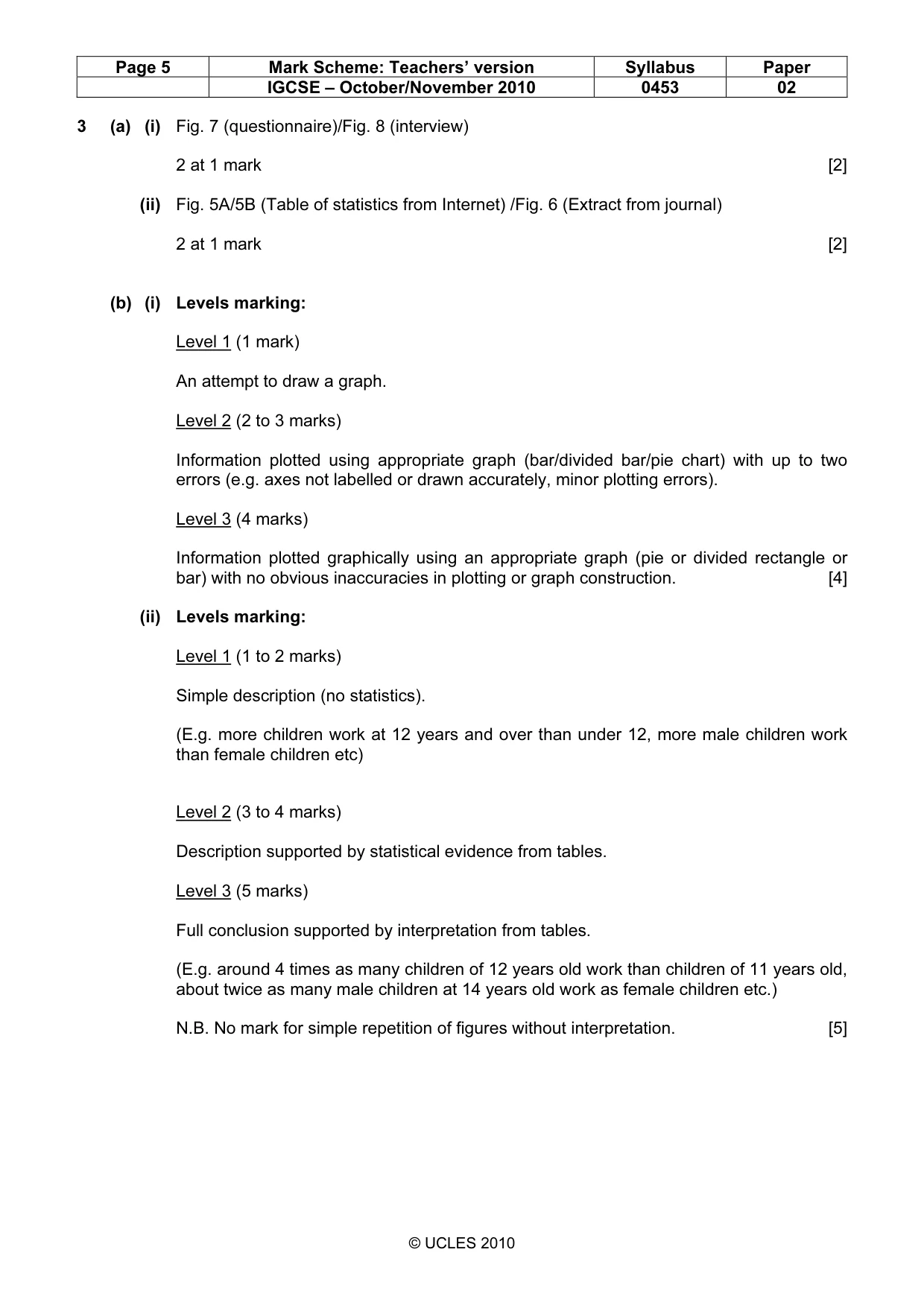
Page 5 Mark Scheme: Teachers’ version Syllabus Paper IGCSE – October/November 2010 0453 02 © UCLES 2010 3 (a) (i) Fig. 7 (questionnaire)/Fig. 8 (interview) 2 at 1 mark [2] (ii) Fig. 5A/5B (Table of statistics from Internet) /Fig. 6 (Extract from journal) 2 at 1 mark [2] (b) (i) Levels marking: Level 1 (1 mark) An attempt to draw a graph. Level 2 (2 to 3 marks) Information plotted using appropriate graph (bar/divided bar/pie chart) with up to two errors (e.g. axes not labelled or drawn accurately, minor plotting errors). Level 3 (4 marks) Information plotted graphically using an appropriate graph (pie or divided rectangle or bar) with no obvious inaccuracies in plotting or graph construction. [4] (ii) Levels marking: Level 1 (1 to 2 marks) Simple description (no statistics). (E.g. more children work at 12 years and over than under 12, more male children work than female children etc) Level 2 (3 to 4 marks) Description supported by statistical evidence from tables. Level 3 (5 marks) Full conclusion supported by interpretation from tables. (E.g. around 4 times as many children of 12 years old work than children of 11 years old, about twice as many male children at 14 years old work as female children etc.) N.B. No mark for simple repetition of figures without interpretation. [5]
Mark scheme, page 6
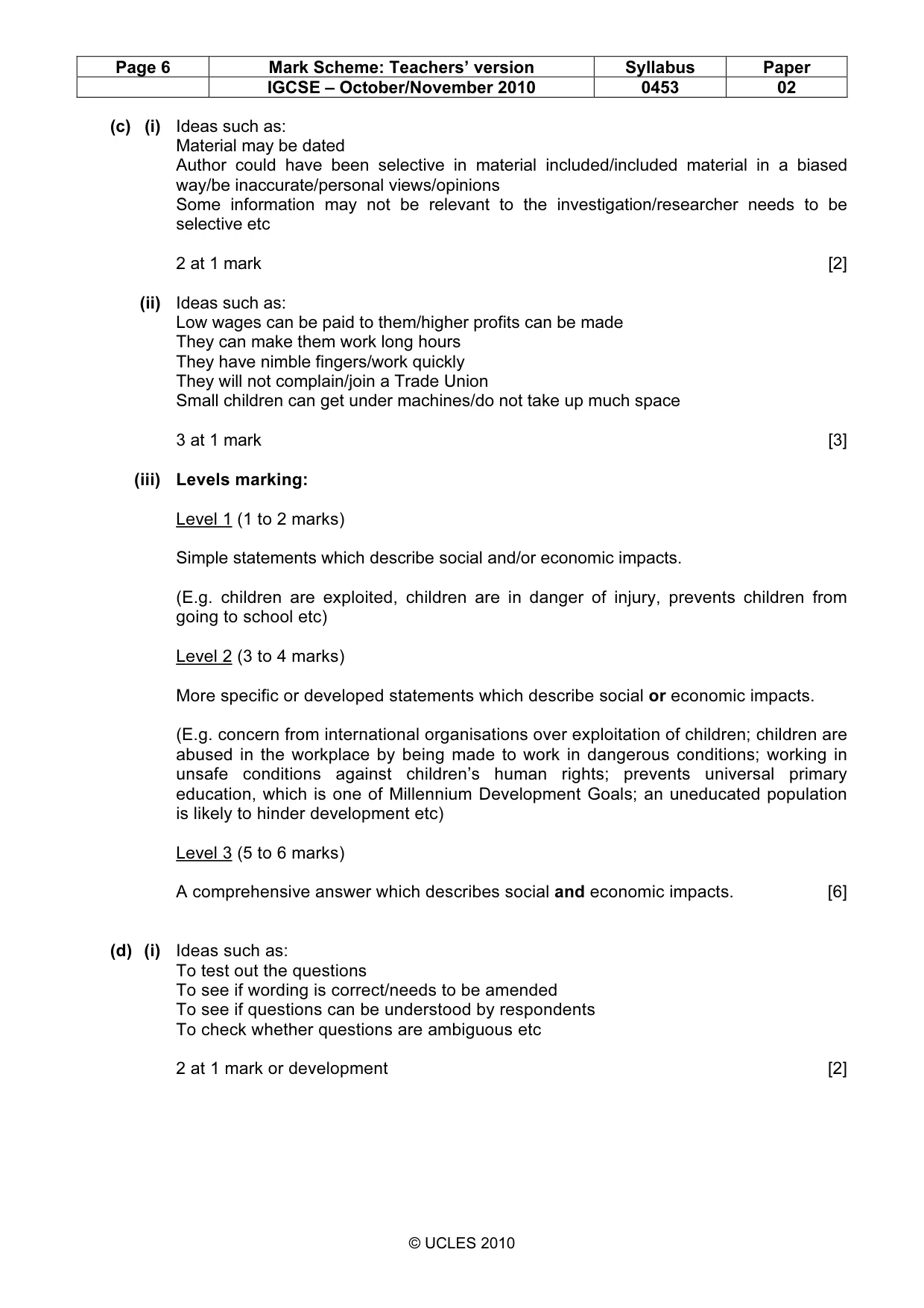
Page 6 Mark Scheme: Teachers’ version Syllabus Paper IGCSE – October/November 2010 0453 02 © UCLES 2010 (c) (i) Ideas such as: Material may be dated Author could have been selective in material included/included material in a biased way/be inaccurate/personal views/opinions Some information may not be relevant to the investigation/researcher needs to be selective etc 2 at 1 mark [2] (ii) Ideas such as: Low wages can be paid to them/higher profits can be made They can make them work long hours They have nimble fingers/work quickly They will not complain/join a Trade Union Small children can get under machines/do not take up much space 3 at 1 mark [3] (iii) Levels marking: Level 1 (1 to 2 marks) Simple statements which describe social and/or economic impacts. (E.g. children are exploited, children are in danger of injury, prevents children from going to school etc) Level 2 (3 to 4 marks) More specific or developed statements which describe social or economic impacts. (E.g. concern from international organisations over exploitation of children; children are abused in the workplace by being made to work in dangerous conditions; working in unsafe conditions against children’s human rights; prevents universal primary education, which is one of Millennium Development Goals; an uneducated population is likely to hinder development etc) Level 3 (5 to 6 marks) A comprehensive answer which describes social and economic impacts. [6] (d) (i) Ideas such as: To test out the questions To see if wording is correct/needs to be amended To see if questions can be understood by respondents To check whether questions are ambiguous etc 2 at 1 mark or development [2]
Mark scheme, page 7
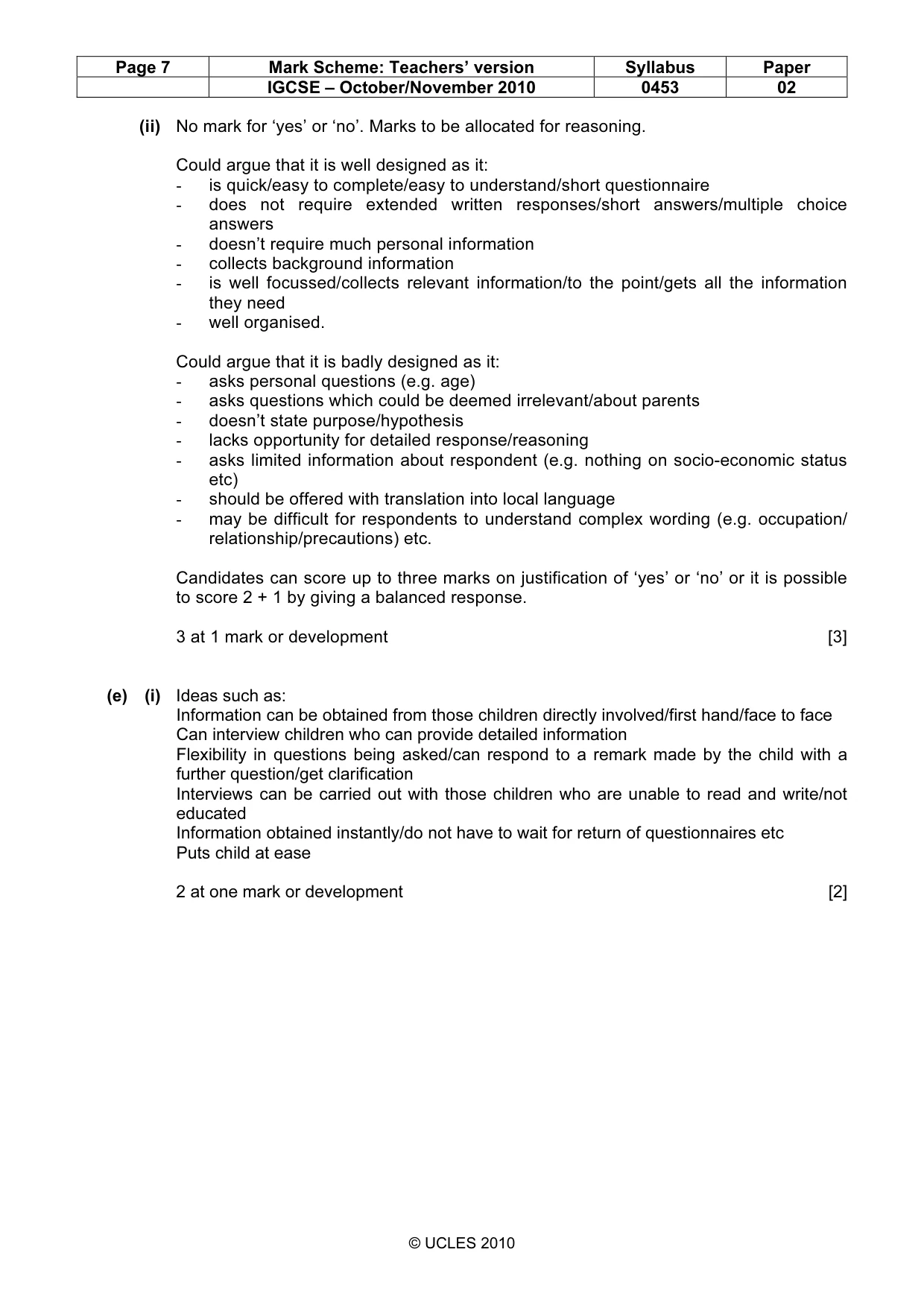
Page 7 Mark Scheme: Teachers’ version Syllabus Paper IGCSE – October/November 2010 0453 02 © UCLES 2010 (ii) No mark for ‘yes’ or ‘no’. Marks to be allocated for reasoning. Could argue that it is well designed as it: - is quick/easy to complete/easy to understand/short questionnaire - does not require extended written responses/short answers/multiple choice answers - doesn’t require much personal information - collects background information - is well focussed/collects relevant information/to the point/gets all the information they need - well organised. Could argue that it is badly designed as it: - asks personal questions (e.g. age) - asks questions which could be deemed irrelevant/about parents - doesn’t state purpose/hypothesis - lacks opportunity for detailed response/reasoning - asks limited information about respondent (e.g. nothing on socio-economic status etc) - should be offered with translation into local language - may be difficult for respondents to understand complex wording (e.g. occupation/ relationship/precautions) etc. Candidates can score up to three marks on justification of ‘yes’ or ‘no’ or it is possible to score 2 + 1 by giving a balanced response. 3 at 1 mark or development [3] (e) (i) Ideas such as: Information can be obtained from those children directly involved/first hand/face to face Can interview children who can provide detailed information Flexibility in questions being asked/can respond to a remark made by the child with a further question/get clarification Interviews can be carried out with those children who are unable to read and write/not educated Information obtained instantly/do not have to wait for return of questionnaires etc Puts child at ease 2 at one mark or development [2]
Mark scheme, page 8
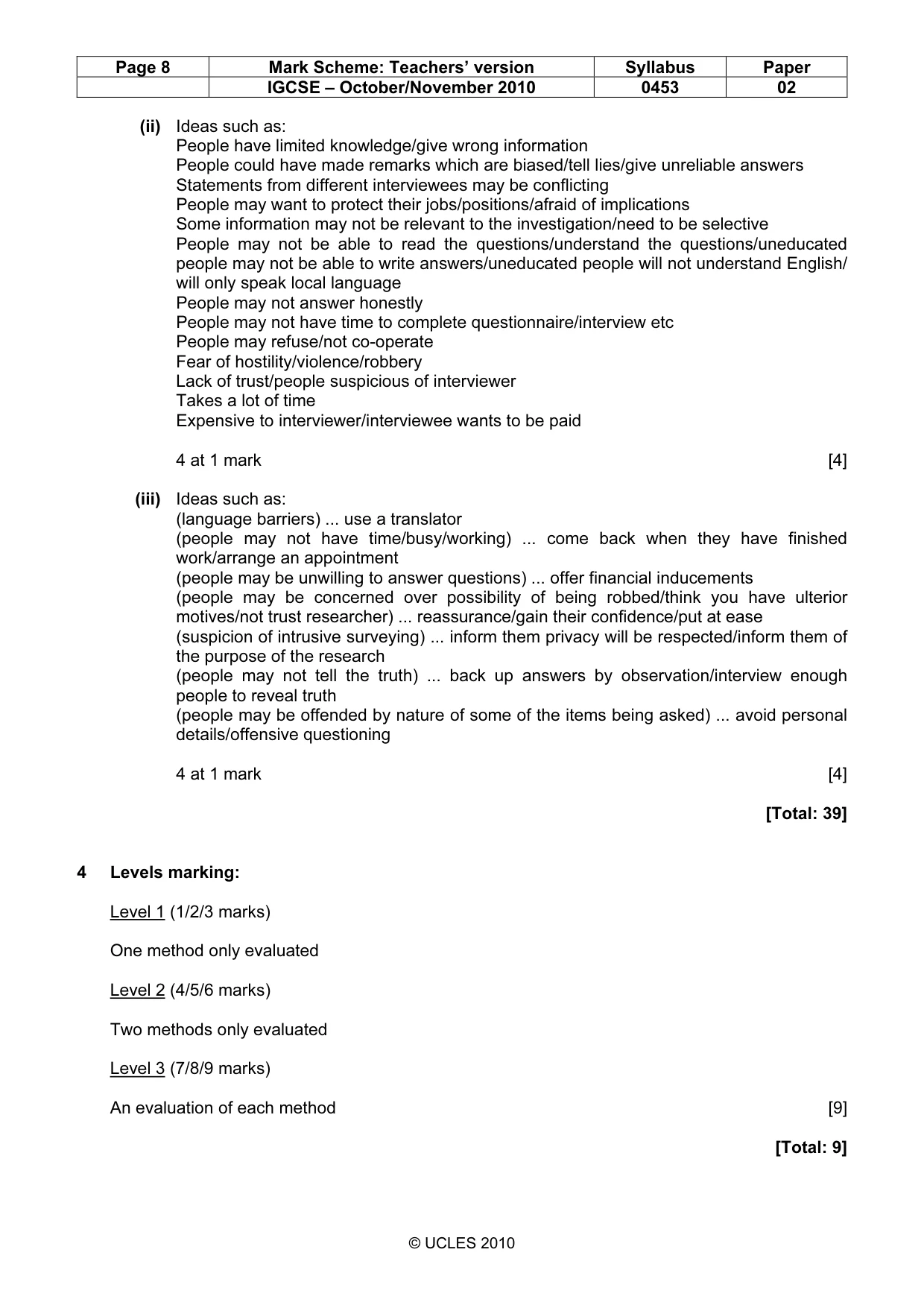
Page 8 Mark Scheme: Teachers’ version Syllabus Paper IGCSE – October/November 2010 0453 02 © UCLES 2010 (ii) Ideas such as: People have limited knowledge/give wrong information People could have made remarks which are biased/tell lies/give unreliable answers Statements from different interviewees may be conflicting People may want to protect their jobs/positions/afraid of implications Some information may not be relevant to the investigation/need to be selective People may not be able to read the questions/understand the questions/uneducated people may not be able to write answers/uneducated people will not understand English/ will only speak local language People may not answer honestly People may not have time to complete questionnaire/interview etc People may refuse/not co-operate Fear of hostility/violence/robbery Lack of trust/people suspicious of interviewer Takes a lot of time Expensive to interviewer/interviewee wants to be paid 4 at 1 mark [4] (iii) Ideas such as: (language barriers) ... use a translator (people may not have time/busy/working) ... come back when they have finished work/arrange an appointment (people may be unwilling to answer questions) ... offer financial inducements (people may be concerned over possibility of being robbed/think you have ulterior motives/not trust researcher) ... reassurance/gain their confidence/put at ease (suspicion of intrusive surveying) ... inform them privacy will be respected/inform them of the purpose of the research (people may not tell the truth) ... back up answers by observation/interview enough people to reveal truth (people may be offended by nature of some of the items being asked) ... avoid personal details/offensive questioning 4 at 1 mark [4] [Total: 39] 4 Levels marking: Level 1 (1/2/3 marks) One method only evaluated Level 2 (4/5/6 marks) Two methods only evaluated Level 3 (7/8/9 marks) An evaluation of each method [9] [Total: 9]
Mark scheme, page 9
Page 9 Mark Scheme: Teachers’ version Syllabus Paper IGCSE – October/November 2010 0453 02 © UCLES 2010 Assessment Objectives Grid Questions 1 2 3 4 Total A Knowledge and Understanding 10 3 9 22 B Analysis and evaluation 2 10 5 9 26 C Investigation and Decision Making 4 3 25 32
What you needed in this session
Cambridge’s own grade thresholds for 2010 Oct/Nov, Paper 2 · Variant 1. A higher threshold means an easier paper — the bar moves with how the cohort did.