Cambridge IGCSE Development Studies 0453 — 2010 Oct/Nov Paper 1 · Variant 1
0453/11/O/N/10 · 80 marks · ≈90 min
The question paper and its mark scheme, free to read here and free to download. This is Cambridge’s own paper, exactly as it was sat.
Question paper20 pages



Mark scheme9 pages
Answers below. Sit the paper first if you are practising.
Paper as text
Question paper, page 1
This document consists of 16 printed pages and 4 blank pages. DC (LEO/SW) 11313/8 © UCLES 2010 [Turn over UNIVERSITY OF CAMBRIDGE INTERNATIONAL EXAMINATIONS International General Certificate of Secondary Education * 1 8 2 1 8 1 9 5 0 7 * DEVELOPMENT STUDIES 0453/01 Paper 1 October/November 2010 2 hours Candidates answer on the Question Paper. No Additional Materials are required. READ THESE INSTRUCTIONS FIRST Write your Centre number, candidate number and name on all the work you hand in. Write in dark blue or black pen. Do not use staples, paper clips, highlighters, glue or correction fluid. You may use a pencil for any diagrams, graphs or rough working. DO NOT WRITE IN ANY BARCODES. Answer all the questions. You may not need all the answer lines for your answer. At the end of the examination, fasten all your work securely together. The number of marks is given in brackets [ ] at the end of each question or part question. For Examiner’s Use 1 2 3 4 Total
Question paper, page 3
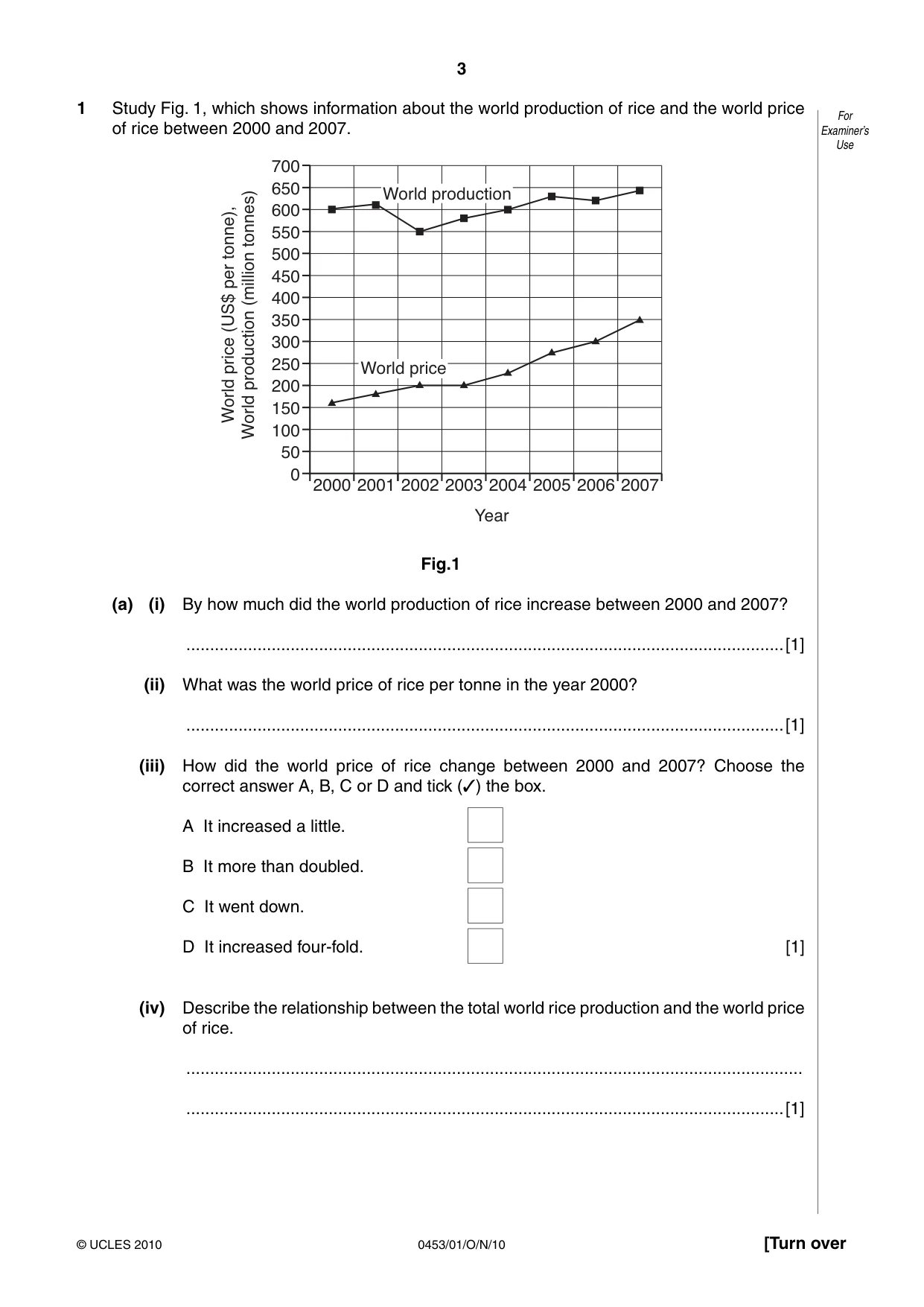
3 0453/01/O/N/10 © UCLES 2010 [Turn over For Examiner’s Use 1 Study Fig. 1, which shows information about the world production of rice and the world price of rice between 2000 and 2007. 2000 2001 2002 2003 Year World price (US$ per tonne), World production (million tonnes) 2004 2005 2006 2007 0 100 200 300 400 500 600 150 50 250 350 450 550 650 700 World price World production Fig.1 (a) (i) By how much did the world production of rice increase between 2000 and 2007? …[1] (ii) What was the world price of rice per tonne in the year 2000? …[1] (iii) How did the world price of rice change between 2000 and 2007? Choose the correct answer A, B, C or D and tick (✓) the box. A It increased a little. B It more than doubled. C It went down. D It increased four-fold. [1] (iv) Describe the relationship between the total world rice production and the world price of rice. … …[1]
Question paper, page 4
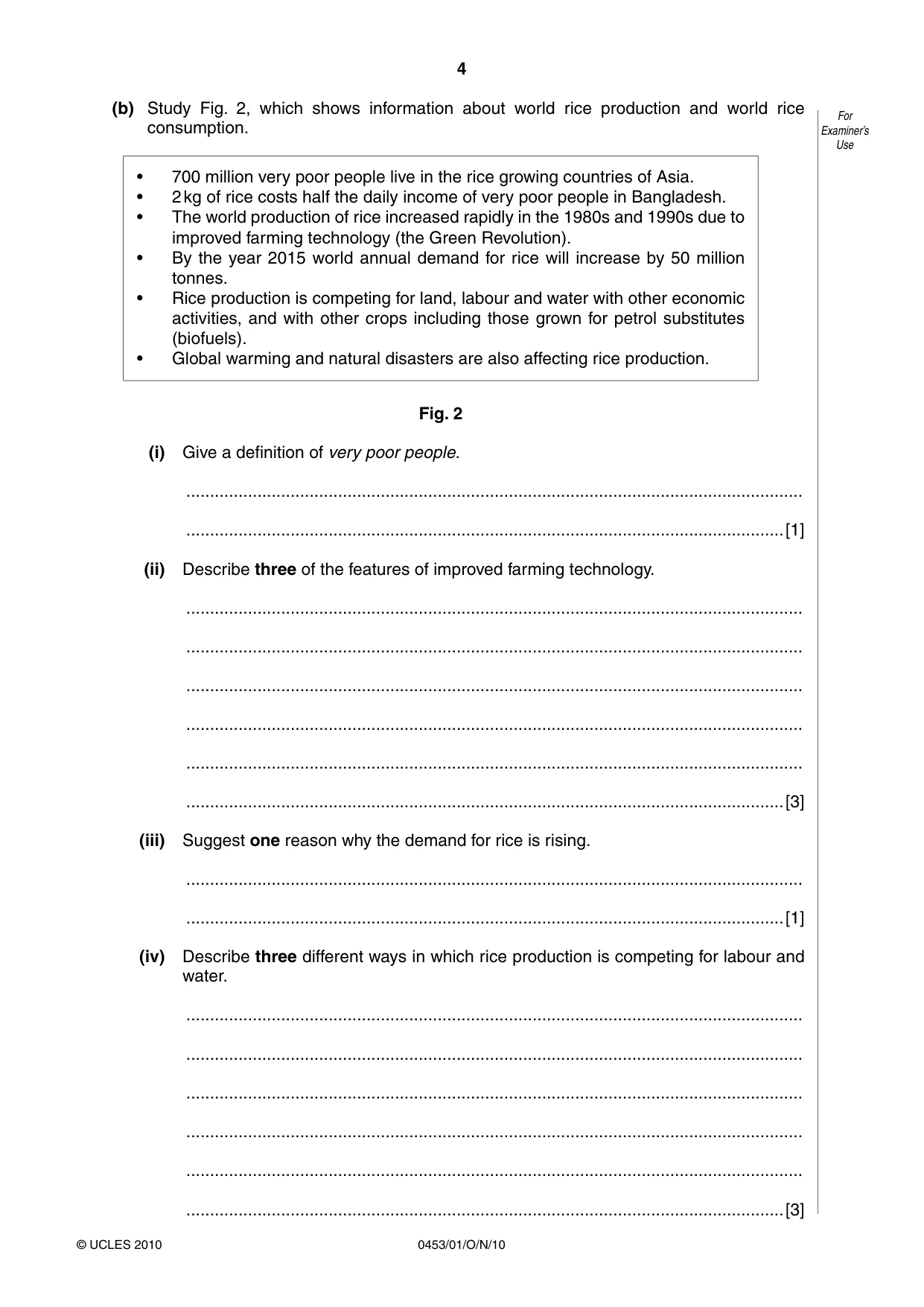
4 0453/01/O/N/10 © UCLES 2010 For Examiner’s Use (b) Study Fig. 2, which shows information about world rice production and world rice consumption. • 700 million very poor people live in the rice growing countries of Asia. • 2 kg of rice costs half the daily income of very poor people in Bangladesh. • The world production of rice increased rapidly in the 1980s and 1990s due to improved farming technology (the Green Revolution). • By the year 2015 world annual demand for rice will increase by 50 million tonnes. • Rice production is competing for land, labour and water with other economic activities, and with other crops including those grown for petrol substitutes (biofuels). • Global warming and natural disasters are also affecting rice production. Fig. 2 (i) Give a definition of very poor people. … …[1] (ii) Describe three of the features of improved farming technology. … … … … … …[3] (iii) Suggest one reason why the demand for rice is rising. … …[1] (iv) Describe three different ways in which rice production is competing for labour and water. … … … … … …[3]
Question paper, page 5
5 0453/01/O/N/10 © UCLES 2010 [Turn over For Examiner’s Use (v) Explain why many farmers are growing other crops rather than staple foods like rice. … … … … …[2] (c) Explain, using examples, how global warming and natural disasters may affect world rice production. … … … … … … … … … … … … … …[6] [Total: 20 marks]
Question paper, page 6
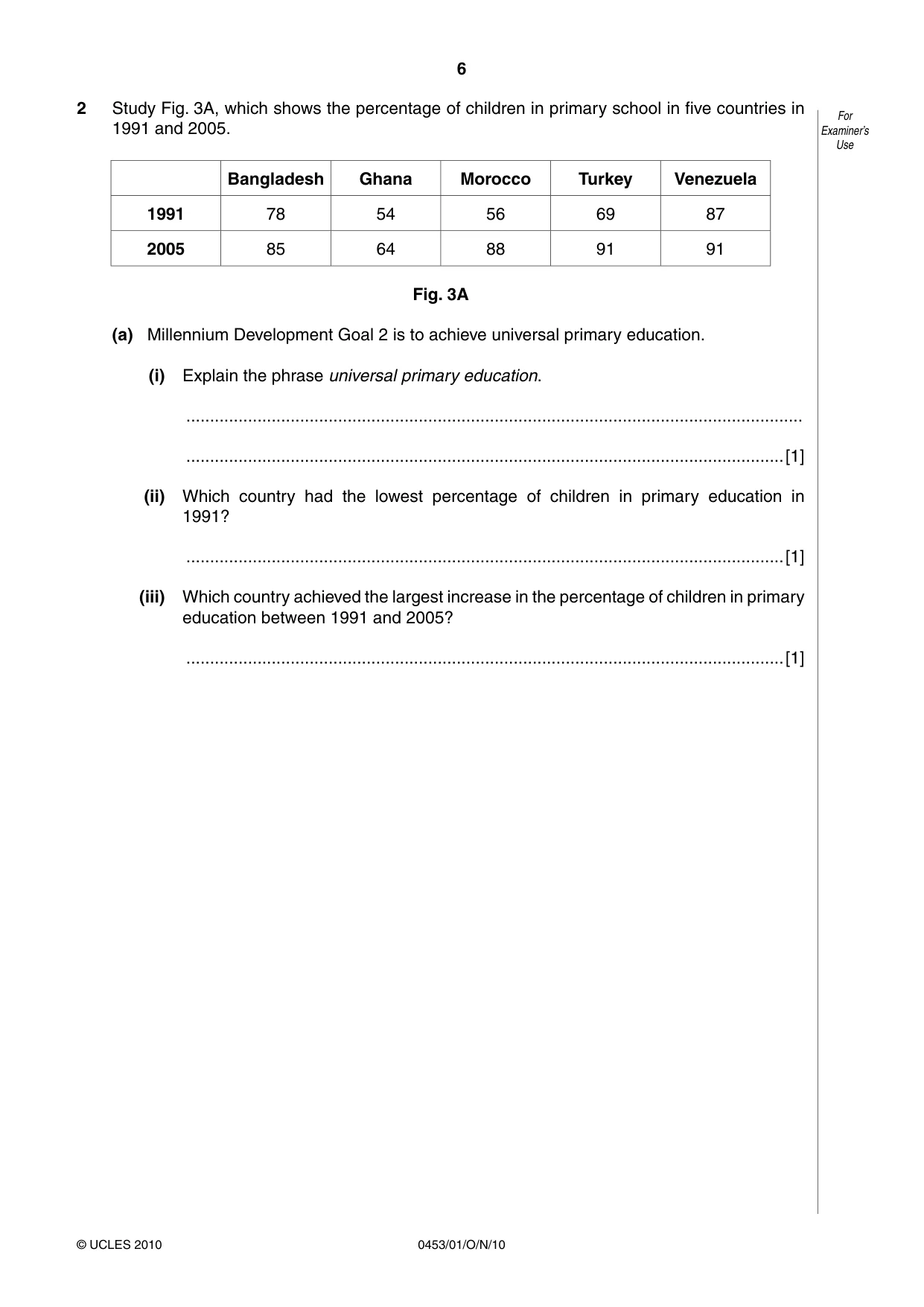
6 0453/01/O/N/10 © UCLES 2010 For Examiner’s Use 2 Study Fig. 3A, which shows the percentage of children in primary school in five countries in 1991 and 2005. Bangladesh Ghana Morocco Turkey Venezuela 1991 78 54 56 69 87 2005 85 64 88 91 91 Fig. 3A (a) Millennium Development Goal 2 is to achieve universal primary education. (i) Explain the phrase universal primary education. … …[1] (ii) Which country had the lowest percentage of children in primary education in 1991? …[1] (iii) Which country achieved the largest increase in the percentage of children in primary education between 1991 and 2005? …[1]
Question paper, page 7
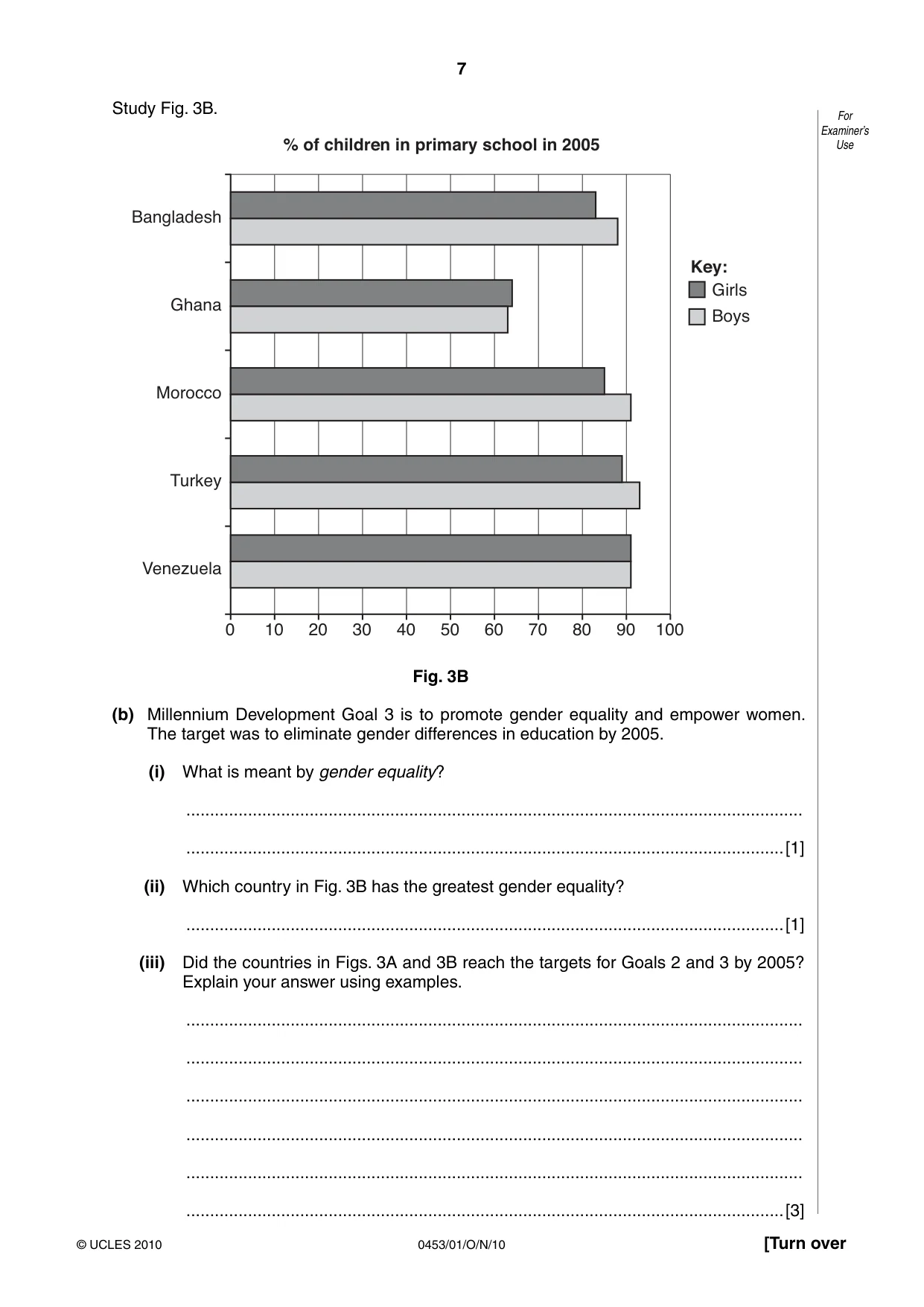
7 0453/01/O/N/10 © UCLES 2010 [Turn over For Examiner’s Use Study Fig. 3B. 0 Venezuela Turkey Morocco Ghana Girls Key: % of children in primary school in 2005 Boys Bangladesh 10 20 30 40 50 60 70 80 90 100 Fig. 3B (b) Millennium Development Goal 3 is to promote gender equality and empower women. The target was to eliminate gender differences in education by 2005. (i) What is meant by gender equality? … …[1] (ii) Which country in Fig. 3B has the greatest gender equality? …[1] (iii) Did the countries in Figs. 3A and 3B reach the targets for Goals 2 and 3 by 2005? Explain your answer using examples. … … … … … …[3]
Question paper, page 8
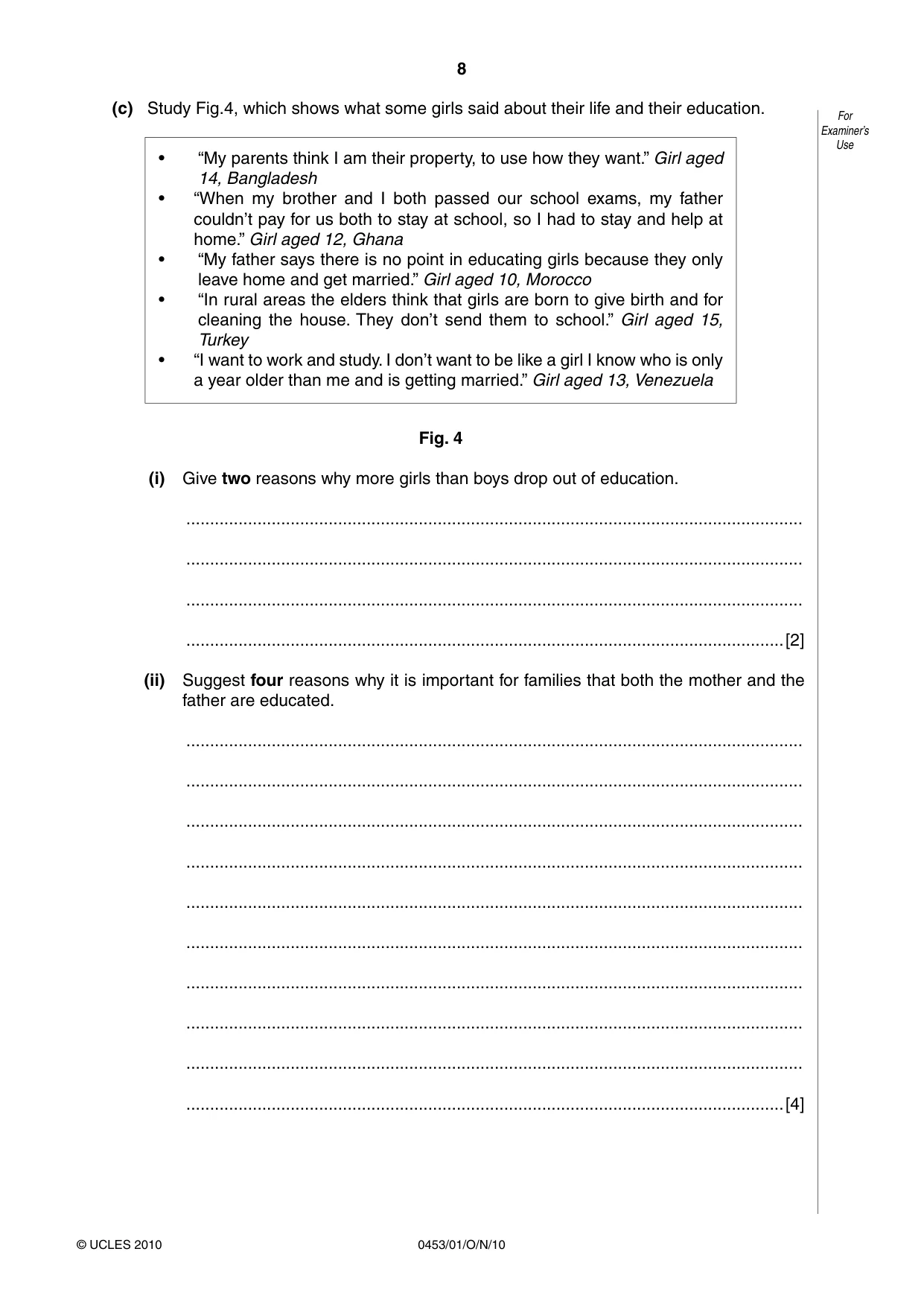
8 0453/01/O/N/10 © UCLES 2010 For Examiner’s Use (c) Study Fig.4, which shows what some girls said about their life and their education. • “My parents think I am their property, to use how they want.” Girl aged 14, Bangladesh • “When my brother and I both passed our school exams, my father couldn’t pay for us both to stay at school, so I had to stay and help at home.” Girl aged 12, Ghana • “My father says there is no point in educating girls because they only leave home and get married.” Girl aged 10, Morocco • “In rural areas the elders think that girls are born to give birth and for cleaning the house. They don’t send them to school.” Girl aged 15, Turkey • “I want to work and study. I don’t want to be like a girl I know who is only a year older than me and is getting married.” Girl aged 13, Venezuela Fig. 4 (i) Give two reasons why more girls than boys drop out of education. … … … …[2] (ii) Suggest four reasons why it is important for families that both the mother and the father are educated. … … … … … … … … … …[4]
Question paper, page 9
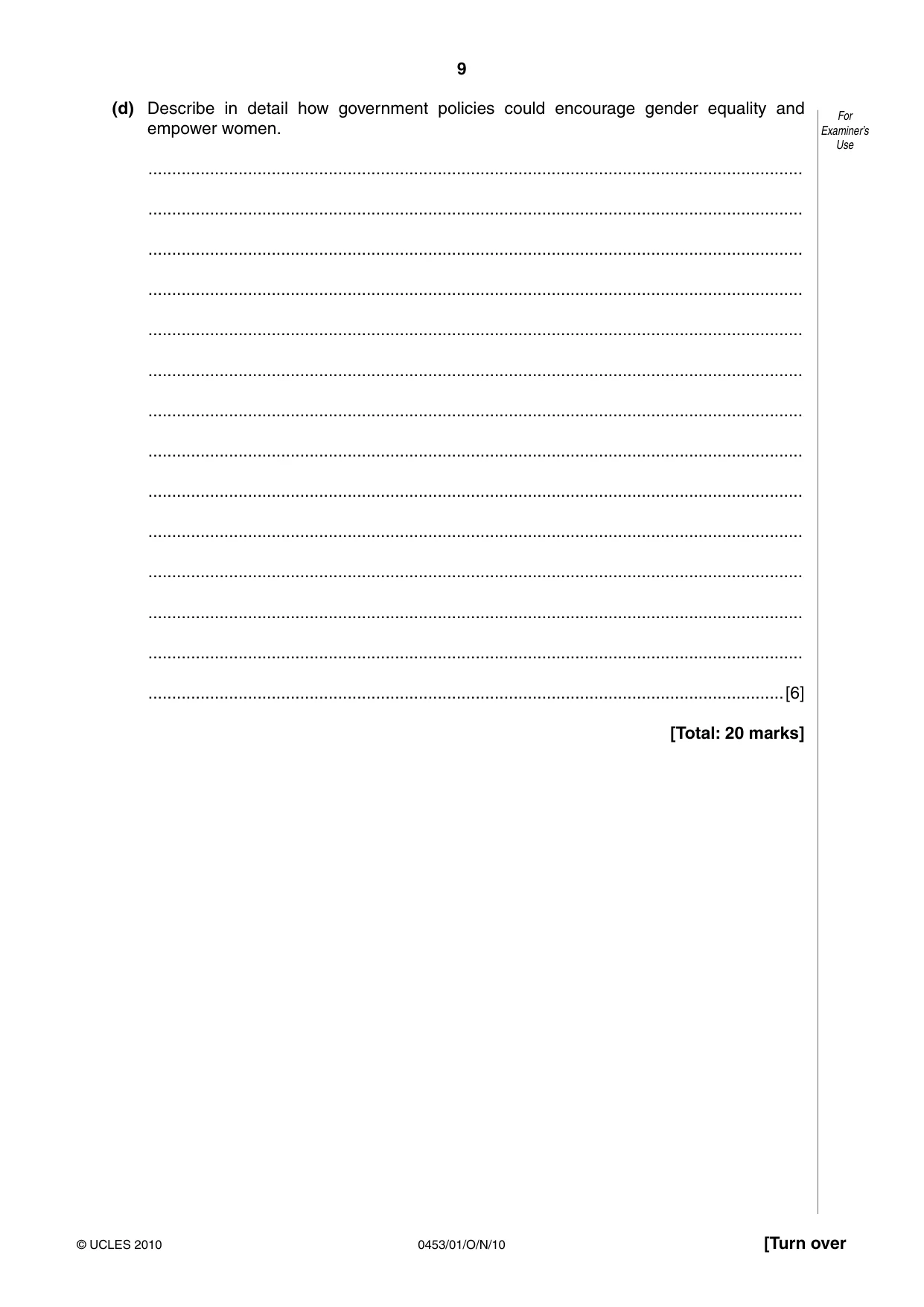
9 0453/01/O/N/10 © UCLES 2010 [Turn over For Examiner’s Use (d) Describe in detail how government policies could encourage gender equality and empower women. … … … … … … … … … … … … … …[6] [Total: 20 marks]
Question paper, page 10
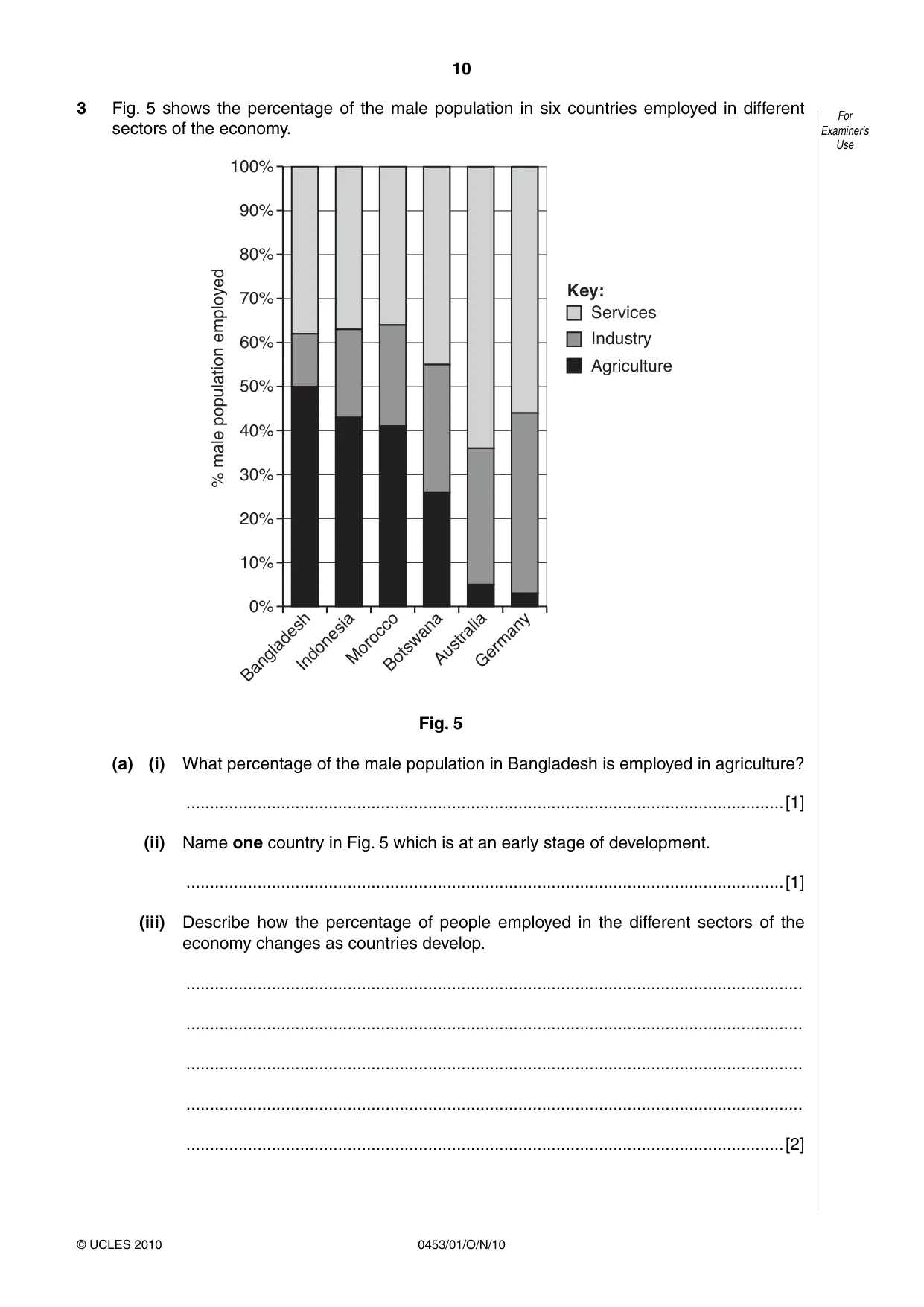
10 0453/01/O/N/10 © UCLES 2010 For Examiner’s Use 3 Fig. 5 shows the percentage of the male population in six countries employed in different sectors of the economy. Agriculture 0% 10% 20% 30% 40% 50% 60% 70% 80% 90% 100% Bangladesh Indonesia Morocco Botswana Australia Germany Services Key: % male population employed Industry Fig. 5 (a) (i) What percentage of the male population in Bangladesh is employed in agriculture? …[1] (ii) Name one country in Fig. 5 which is at an early stage of development. …[1] (iii) Describe how the percentage of people employed in the different sectors of the economy changes as countries develop. … … … … …[2]
Question paper, page 11
11 0453/01/O/N/10 © UCLES 2010 [Turn over For Examiner’s Use (iv) Explain why the percentage of people employed in the different sectors of the economy changes as countries develop. … … … … … … … …[3]
Question paper, page 12
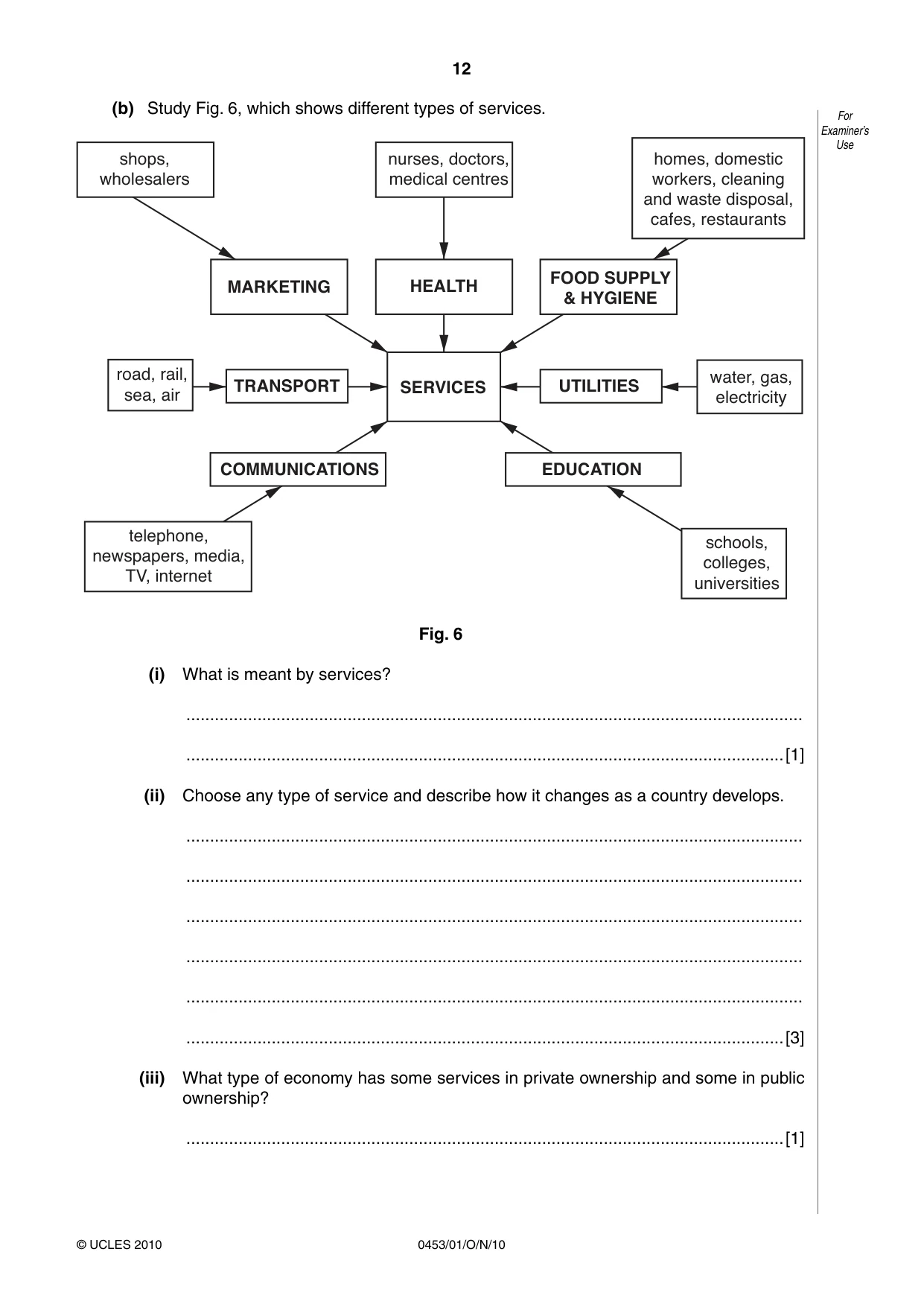
12 0453/01/O/N/10 © UCLES 2010 For Examiner’s Use (b) Study Fig. 6, which shows different types of services. SERVICES TRANSPORT UTILITIES water, gas, electricity road, rail, sea, air shops, wholesalers nurses, doctors, medical centres homes, domestic workers, cleaning and waste disposal, cafes, restaurants telephone, newspapers, media, TV, internet schools, colleges, universities FOOD SUPPLY & HYGIENE HEALTH MARKETING EDUCATION COMMUNICATIONS Fig. 6 (i) What is meant by services? … …[1] (ii) Choose any type of service and describe how it changes as a country develops. … … … … … …[3] (iii) What type of economy has some services in private ownership and some in public ownership? …[1]
Question paper, page 13
13 0453/01/O/N/10 © UCLES 2010 [Turn over For Examiner’s Use (iv) Describe some of the advantages of either private ownership or public ownership. … … … … … …[2] (c) Choose an example of a manufacturing industry and describe how its production process and its output are linked to the other sectors of the economy and to global trade. … … … … … … … … … … … … … …[6] [Total: 20 marks]
Question paper, page 14
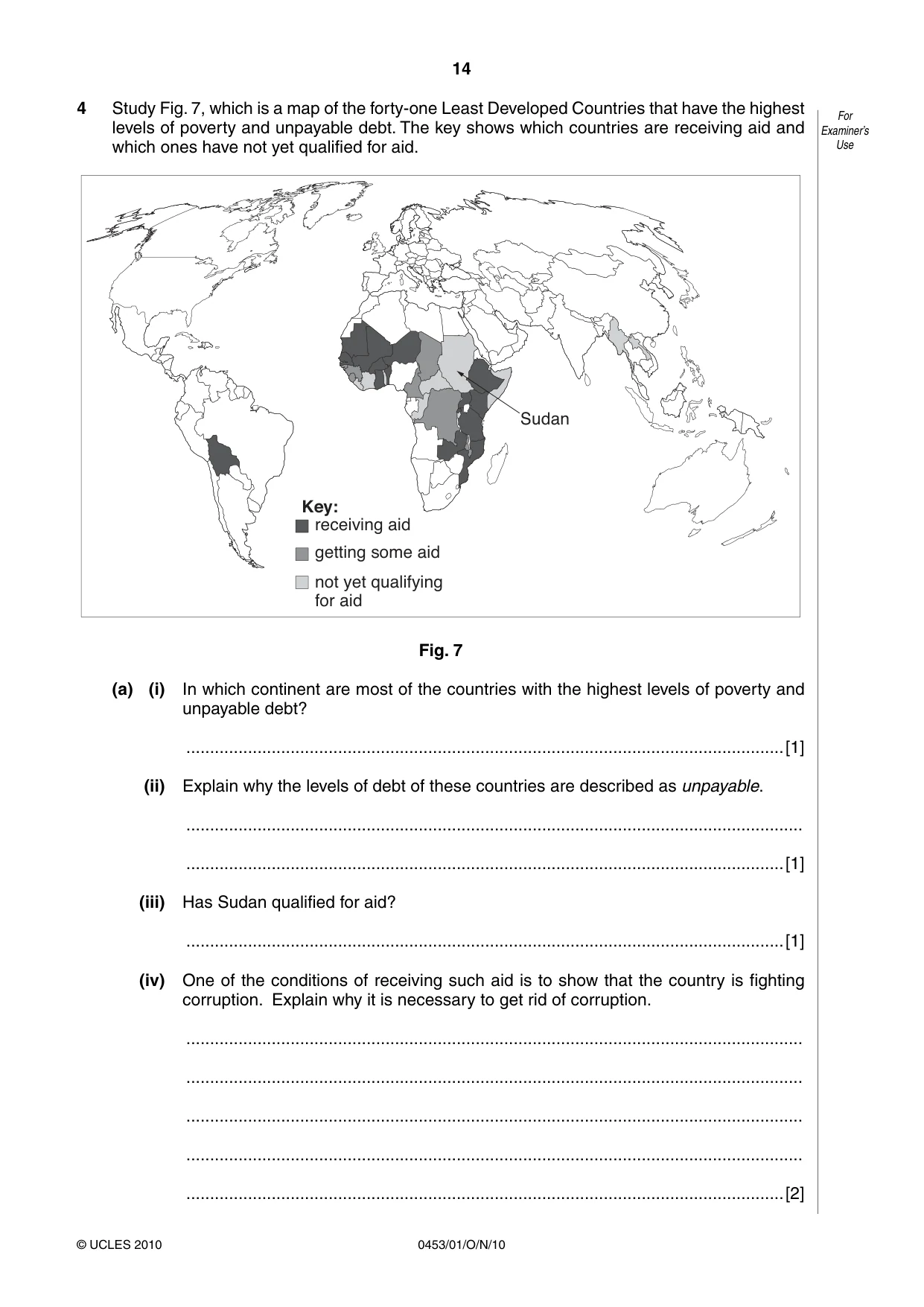
14 0453/01/O/N/10 © UCLES 2010 For Examiner’s Use 4 Study Fig. 7, which is a map of the forty-one Least Developed Countries that have the highest levels of poverty and unpayable debt. The key shows which countries are receiving aid and which ones have not yet qualified for aid. receiving aid Sudan Key: getting some aid not yet qualifying for aid AUSTRALIA U. K. Fig. 7 (a) (i) In which continent are most of the countries with the highest levels of poverty and unpayable debt? …[1] (ii) Explain why the levels of debt of these countries are described as unpayable. … …[1] (iii) Has Sudan qualified for aid? …[1] (iv) One of the conditions of receiving such aid is to show that the country is fighting corruption. Explain why it is necessary to get rid of corruption. … … … … …[2]
Question paper, page 15
15 0453/01/O/N/10 © UCLES 2010 [Turn over For Examiner’s Use (v) Another condition of receiving aid for debt relief is that the country becomes democratic. What are the features of a democracy? … … … … … …[2]
Question paper, page 16
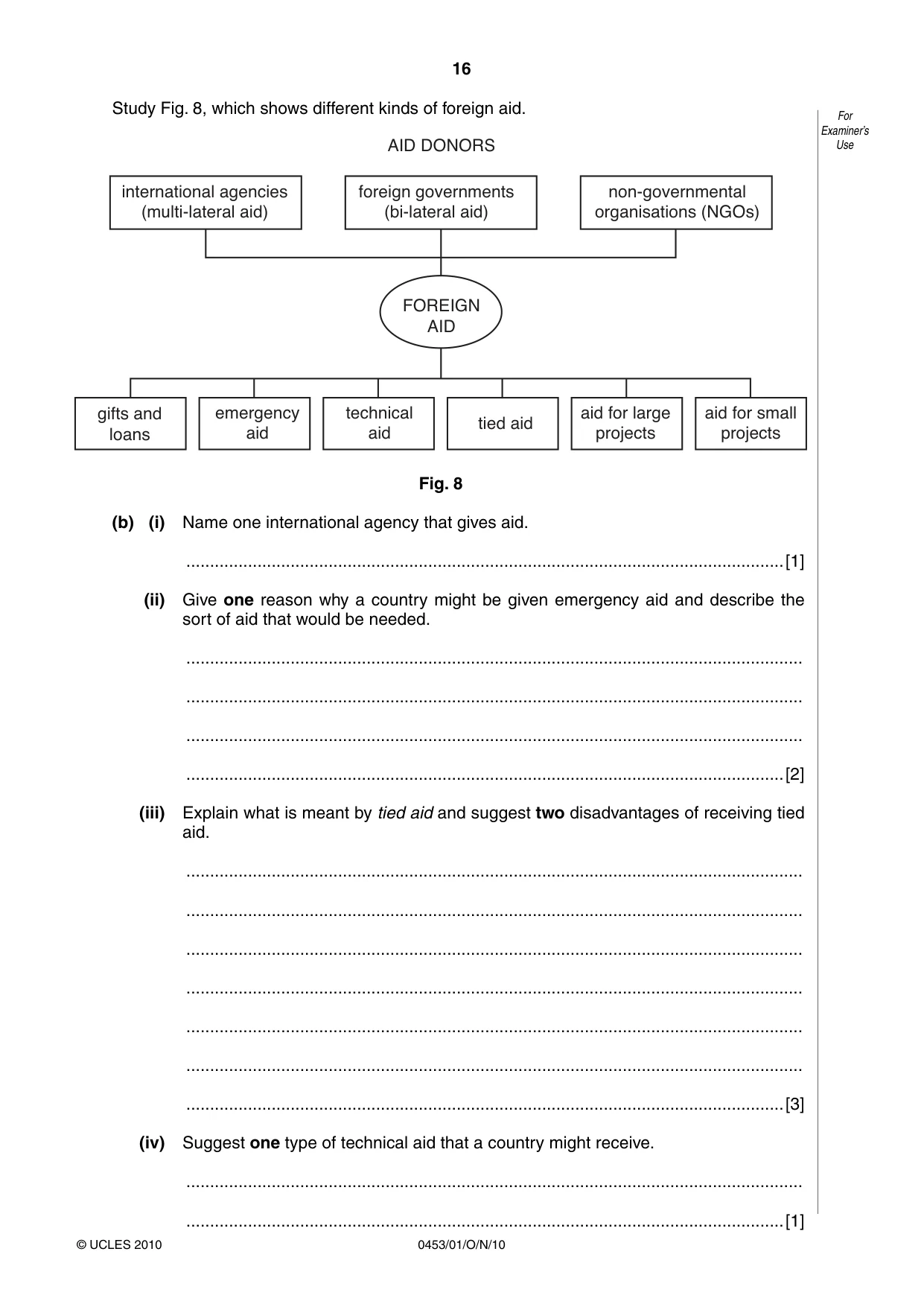
16 0453/01/O/N/10 © UCLES 2010 For Examiner’s Use Study Fig. 8, which shows different kinds of foreign aid. AID DONORS aid for small projects aid for large projects tied aid technical aid emergency aid gifts and loans FOREIGN AID foreign governments (bi-lateral aid) international agencies (multi-lateral aid) non-governmental organisations (NGOs) Fig. 8 (b) (i) Name one international agency that gives aid. …[1] (ii) Give one reason why a country might be given emergency aid and describe the sort of aid that would be needed. … … … …[2] (iii) Explain what is meant by tied aid and suggest two disadvantages of receiving tied aid. … … … … … … …[3] (iv) Suggest one type of technical aid that a country might receive. … …[1]
Question paper, page 17
17 0453/01/O/N/10 © UCLES 2010 For Examiner’s Use (c) Suggest or describe an aid project and explain how it would help a country’s social and economic development. … … … … … … … … … … … … … …[6] [Total: 20 marks]
Question paper, page 18
18 0453/01/O/N/10 © UCLES 2010 BLANK PAGE
Question paper, page 19
19 0453/01/O/N/10 © UCLES 2010 BLANK PAGE
Question paper, page 20
20 0453/01/O/N/10 © UCLES 2010 BLANK PAGE Permission to reproduce items where third-party owned material protected by copyright is included has been sought and cleared where possible. Every reasonable effort has been made by the publisher (UCLES) to trace copyright holders, but if any items requiring clearance have unwittingly been included, the publisher will be pleased to make amends at the earliest possible opportunity. University of Cambridge International Examinations is part of the Cambridge Assessment Group. Cambridge Assessment is the brand name of University of Cambridge Local Examinations Syndicate (UCLES), which is itself a department of the University of Cambridge.
Mark scheme, page 1
UNIVERSITY OF CAMBRIDGE INTERNATIONAL EXAMINATIONS International General Certificate of Secondary Education MARK SCHEME for the October/November 2010 question paper for the guidance of teachers 0453 DEVELOPMENT STUDIES 0453/01 Paper 1, maximum raw mark 80 This mark scheme is published as an aid to teachers and candidates, to indicate the requirements of the examination. It shows the basis on which Examiners were instructed to award marks. It does not indicate the details of the discussions that took place at an Examiners’ meeting before marking began, which would have considered the acceptability of alternative answers. Mark schemes must be read in conjunction with the question papers and the report on the examination. • CIE will not enter into discussions or correspondence in connection with these mark schemes. CIE is publishing the mark schemes for the October/November 2010 question papers for most IGCSE, GCE Advanced Level and Advanced Subsidiary Level syllabuses and some Ordinary Level syllabuses.
Mark scheme, page 2
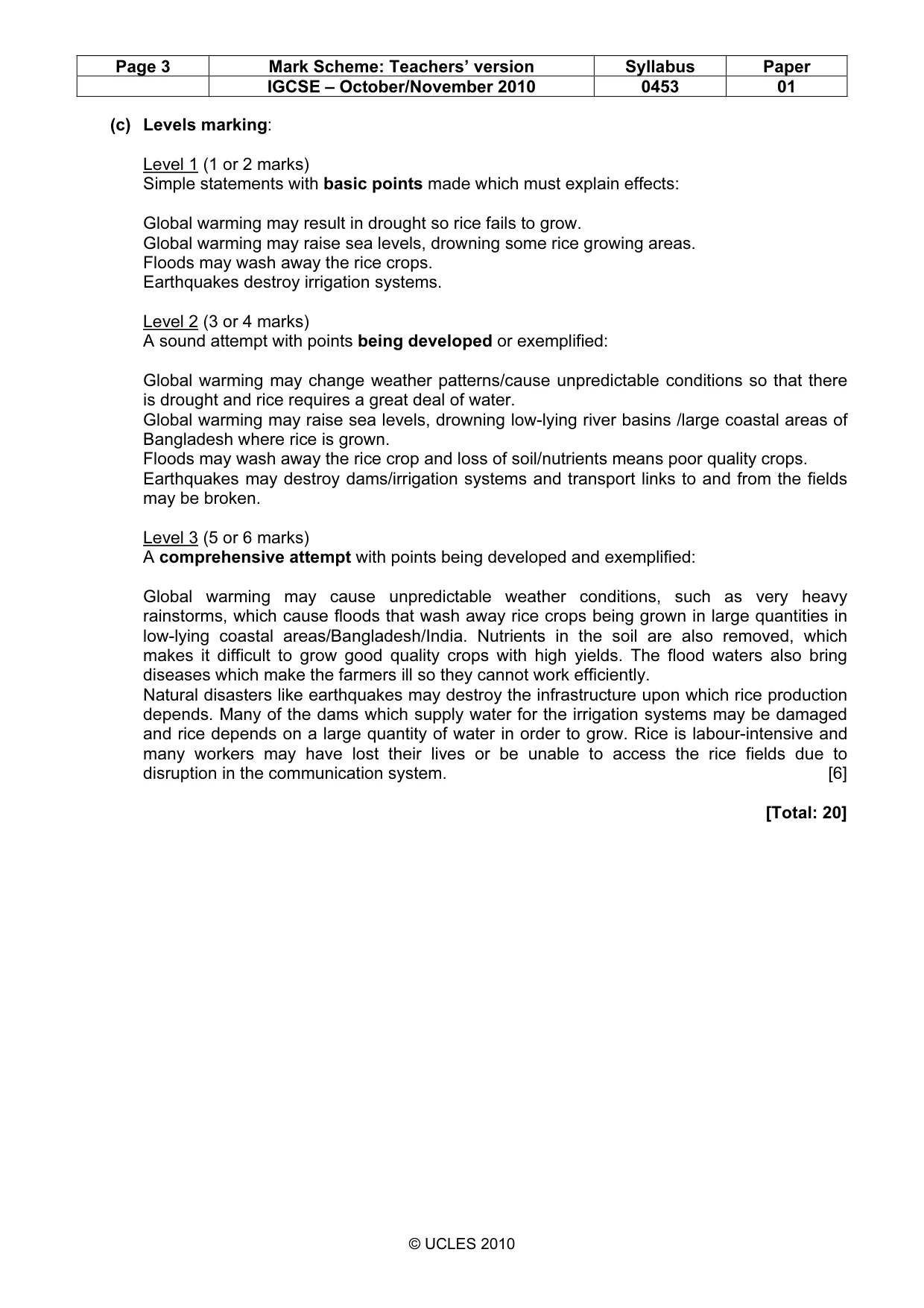
Page 2 Mark Scheme: Teachers’ version Syllabus Paper IGCSE – October/November 2010 0453 01 © UCLES 2010 1 (a) (i) Allow 40 to 50 MILLION TONNES [1] (ii) Allow US$151 to 165 [1] (iii) B. It more than doubled. [1] (iv) Total world rice production and the world price of rice are both increasing. There is a positive relationship. [1] (b) (i) People who earn less than US$2 per day People who cannot meet their basic needs People who are below the poverty line. [1] (ii) Three of following: (List = 1 mark) Hybrid seeds Fertilisers Pesticides/insecticides/herbicides/chemicals Machinery/modern tools/e.g. Irrigation GM crops Modern storage facilities Increased yields/better quality High cost/capital intensive Increased level of skill Faster/more efficient. [3] (iii) One reason: Growing population Rising living standards. [1] (iv) Describe three different examples of competition: Labour moving to work in cities, industry and services Water needed for growing cities/population/industry Rice production needs large quantities of water Rice production is labour intensive Water is needed for irrigation of other crops. [3] (v) Two examples explained: Price for rice has fallen due to increased supply/other crops make a bigger profit Change in demand Change in government policy Other crops less prone to damage from adverse weather conditions/pests Changes in land ownership People now recognise the importance of a balanced diet. [2]
Mark scheme, page 3
Page 3 Mark Scheme: Teachers’ version Syllabus Paper IGCSE – October/November 2010 0453 01 © UCLES 2010 (c) Levels marking: Level 1 (1 or 2 marks) Simple statements with basic points made which must explain effects: Global warming may result in drought so rice fails to grow. Global warming may raise sea levels, drowning some rice growing areas. Floods may wash away the rice crops. Earthquakes destroy irrigation systems. Level 2 (3 or 4 marks) A sound attempt with points being developed or exemplified: Global warming may change weather patterns/cause unpredictable conditions so that there is drought and rice requires a great deal of water. Global warming may raise sea levels, drowning low-lying river basins /large coastal areas of Bangladesh where rice is grown. Floods may wash away the rice crop and loss of soil/nutrients means poor quality crops. Earthquakes may destroy dams/irrigation systems and transport links to and from the fields may be broken. Level 3 (5 or 6 marks) A comprehensive attempt with points being developed and exemplified: Global warming may cause unpredictable weather conditions, such as very heavy rainstorms, which cause floods that wash away rice crops being grown in large quantities in low-lying coastal areas/Bangladesh/India. Nutrients in the soil are also removed, which makes it difficult to grow good quality crops with high yields. The flood waters also bring diseases which make the farmers ill so they cannot work efficiently. Natural disasters like earthquakes may destroy the infrastructure upon which rice production depends. Many of the dams which supply water for the irrigation systems may be damaged and rice depends on a large quantity of water in order to grow. Rice is labour-intensive and many workers may have lost their lives or be unable to access the rice fields due to disruption in the communication system. [6] [Total: 20]
Mark scheme, page 4
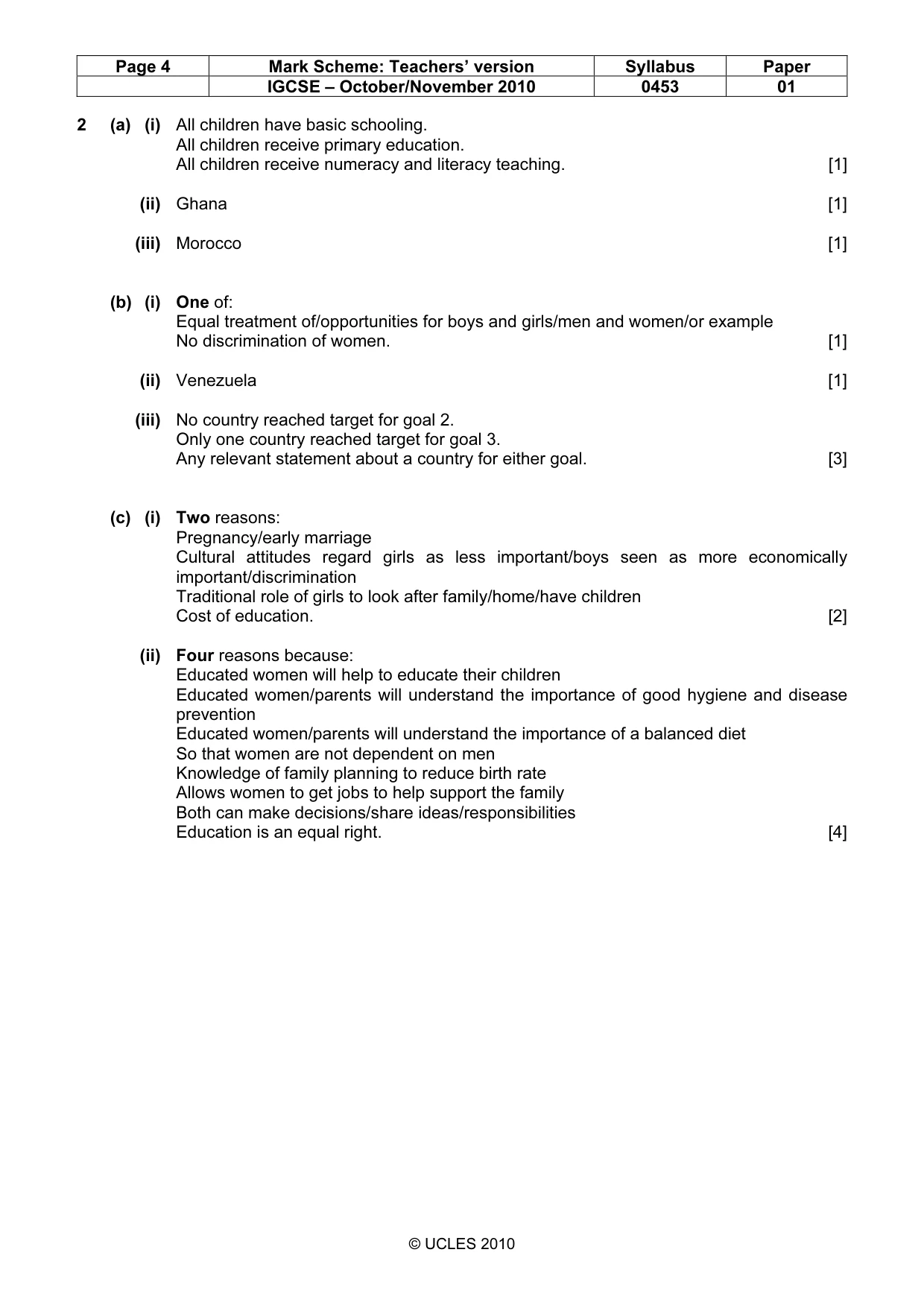
Page 4 Mark Scheme: Teachers’ version Syllabus Paper IGCSE – October/November 2010 0453 01 © UCLES 2010 2 (a) (i) All children have basic schooling. All children receive primary education. All children receive numeracy and literacy teaching. [1] (ii) Ghana [1] (iii) Morocco [1] (b) (i) One of: Equal treatment of/opportunities for boys and girls/men and women/or example No discrimination of women. [1] (ii) Venezuela [1] (iii) No country reached target for goal 2. Only one country reached target for goal 3. Any relevant statement about a country for either goal. [3] (c) (i) Two reasons: Pregnancy/early marriage Cultural attitudes regard girls as less important/boys seen as more economically important/discrimination Traditional role of girls to look after family/home/have children Cost of education. [2] (ii) Four reasons because: Educated women will help to educate their children Educated women/parents will understand the importance of good hygiene and disease prevention Educated women/parents will understand the importance of a balanced diet So that women are not dependent on men Knowledge of family planning to reduce birth rate Allows women to get jobs to help support the family Both can make decisions/share ideas/responsibilities Education is an equal right. [4]
Mark scheme, page 5
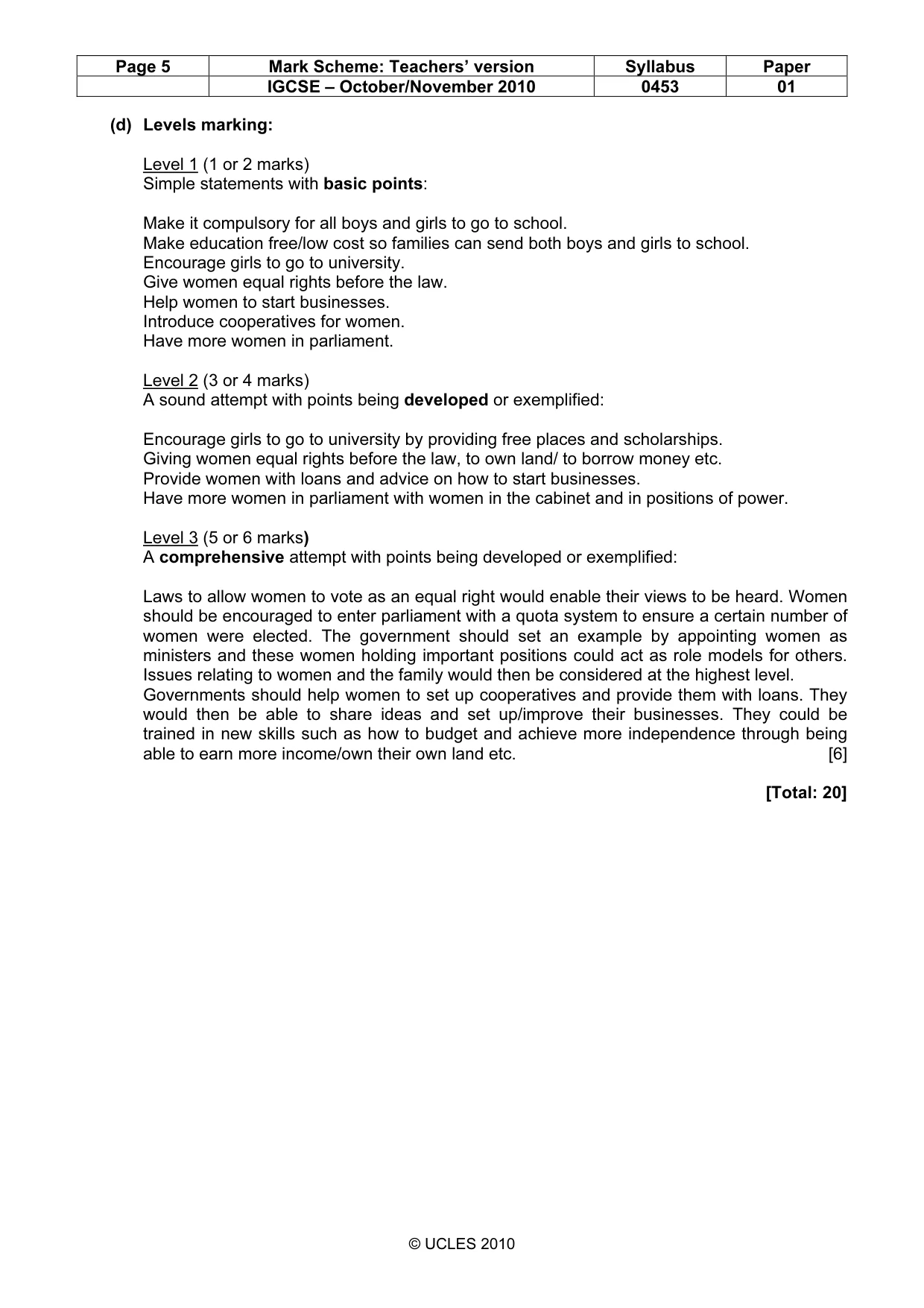
Page 5 Mark Scheme: Teachers’ version Syllabus Paper IGCSE – October/November 2010 0453 01 © UCLES 2010 (d) Levels marking: Level 1 (1 or 2 marks) Simple statements with basic points: Make it compulsory for all boys and girls to go to school. Make education free/low cost so families can send both boys and girls to school. Encourage girls to go to university. Give women equal rights before the law. Help women to start businesses. Introduce cooperatives for women. Have more women in parliament. Level 2 (3 or 4 marks) A sound attempt with points being developed or exemplified: Encourage girls to go to university by providing free places and scholarships. Giving women equal rights before the law, to own land/ to borrow money etc. Provide women with loans and advice on how to start businesses. Have more women in parliament with women in the cabinet and in positions of power. Level 3 (5 or 6 marks) A comprehensive attempt with points being developed or exemplified: Laws to allow women to vote as an equal right would enable their views to be heard. Women should be encouraged to enter parliament with a quota system to ensure a certain number of women were elected. The government should set an example by appointing women as ministers and these women holding important positions could act as role models for others. Issues relating to women and the family would then be considered at the highest level. Governments should help women to set up cooperatives and provide them with loans. They would then be able to share ideas and set up/improve their businesses. They could be trained in new skills such as how to budget and achieve more independence through being able to earn more income/own their own land etc. [6] [Total: 20]
Mark scheme, page 6
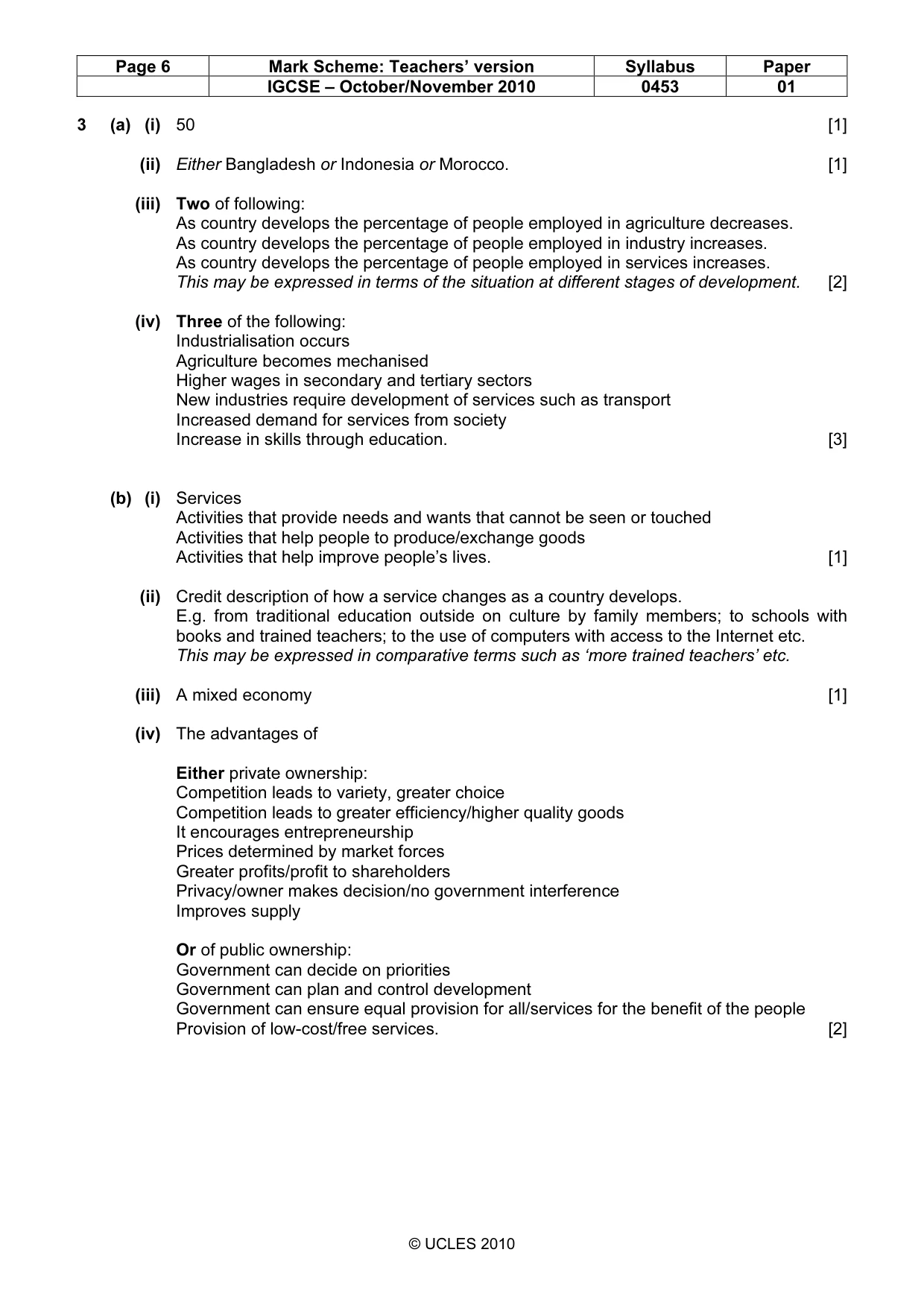
Page 6 Mark Scheme: Teachers’ version Syllabus Paper IGCSE – October/November 2010 0453 01 © UCLES 2010 3 (a) (i) 50 [1] (ii) Either Bangladesh or Indonesia or Morocco. [1] (iii) Two of following: As country develops the percentage of people employed in agriculture decreases. As country develops the percentage of people employed in industry increases. As country develops the percentage of people employed in services increases. This may be expressed in terms of the situation at different stages of development. [2] (iv) Three of the following: Industrialisation occurs Agriculture becomes mechanised Higher wages in secondary and tertiary sectors New industries require development of services such as transport Increased demand for services from society Increase in skills through education. [3] (b) (i) Services Activities that provide needs and wants that cannot be seen or touched Activities that help people to produce/exchange goods Activities that help improve people’s lives. [1] (ii) Credit description of how a service changes as a country develops. E.g. from traditional education outside on culture by family members; to schools with books and trained teachers; to the use of computers with access to the Internet etc. This may be expressed in comparative terms such as ‘more trained teachers’ etc. (iii) A mixed economy [1] (iv) The advantages of Either private ownership: Competition leads to variety, greater choice Competition leads to greater efficiency/higher quality goods It encourages entrepreneurship Prices determined by market forces Greater profits/profit to shareholders Privacy/owner makes decision/no government interference Improves supply Or of public ownership: Government can decide on priorities Government can plan and control development Government can ensure equal provision for all/services for the benefit of the people Provision of low-cost/free services. [2]
Mark scheme, page 7
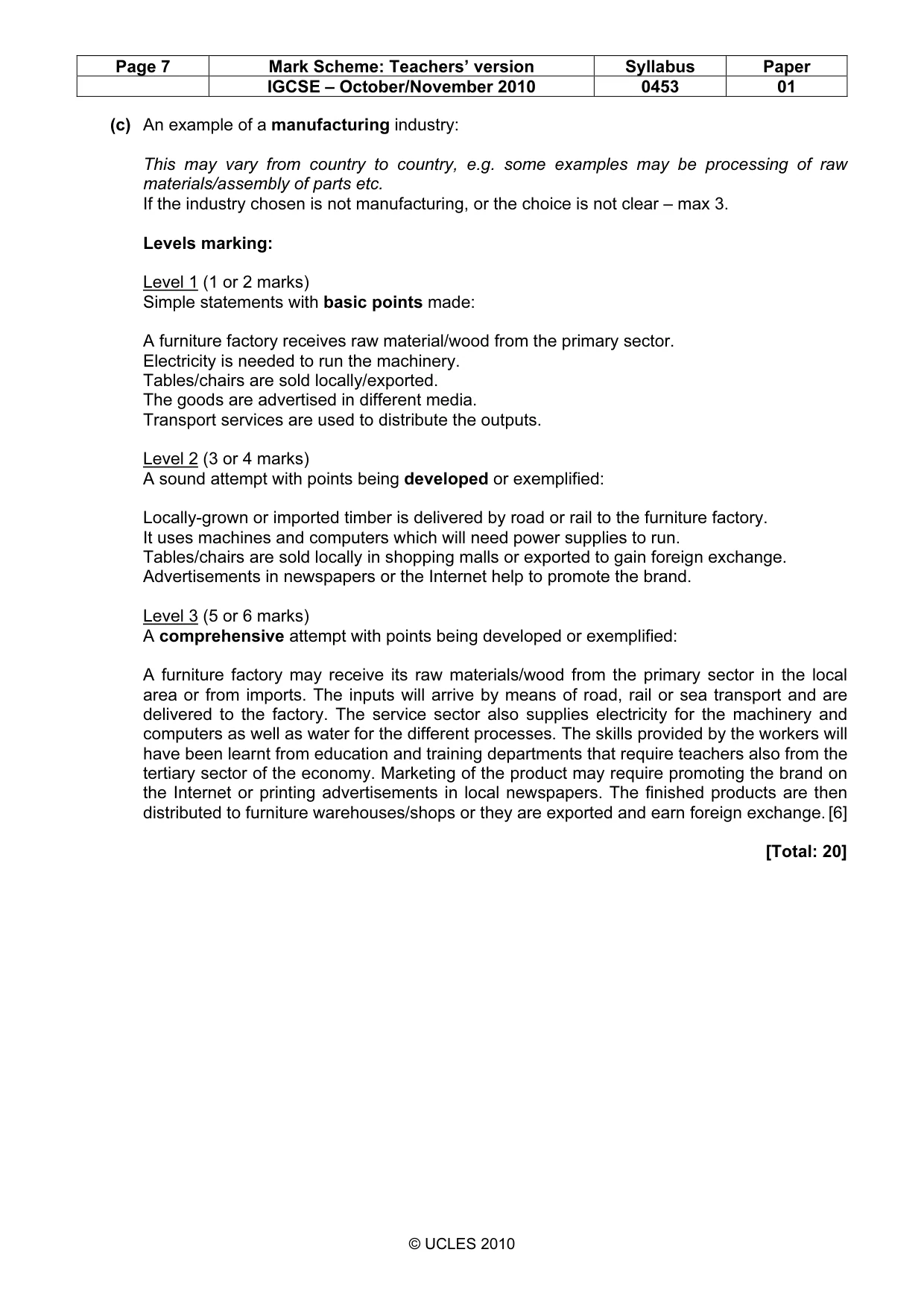
Page 7 Mark Scheme: Teachers’ version Syllabus Paper IGCSE – October/November 2010 0453 01 © UCLES 2010 (c) An example of a manufacturing industry: This may vary from country to country, e.g. some examples may be processing of raw materials/assembly of parts etc. If the industry chosen is not manufacturing, or the choice is not clear – max 3. Levels marking: Level 1 (1 or 2 marks) Simple statements with basic points made: A furniture factory receives raw material/wood from the primary sector. Electricity is needed to run the machinery. Tables/chairs are sold locally/exported. The goods are advertised in different media. Transport services are used to distribute the outputs. Level 2 (3 or 4 marks) A sound attempt with points being developed or exemplified: Locally-grown or imported timber is delivered by road or rail to the furniture factory. It uses machines and computers which will need power supplies to run. Tables/chairs are sold locally in shopping malls or exported to gain foreign exchange. Advertisements in newspapers or the Internet help to promote the brand. Level 3 (5 or 6 marks) A comprehensive attempt with points being developed or exemplified: A furniture factory may receive its raw materials/wood from the primary sector in the local area or from imports. The inputs will arrive by means of road, rail or sea transport and are delivered to the factory. The service sector also supplies electricity for the machinery and computers as well as water for the different processes. The skills provided by the workers will have been learnt from education and training departments that require teachers also from the tertiary sector of the economy. Marketing of the product may require promoting the brand on the Internet or printing advertisements in local newspapers. The finished products are then distributed to furniture warehouses/shops or they are exported and earn foreign exchange. [6] [Total: 20]
Mark scheme, page 8
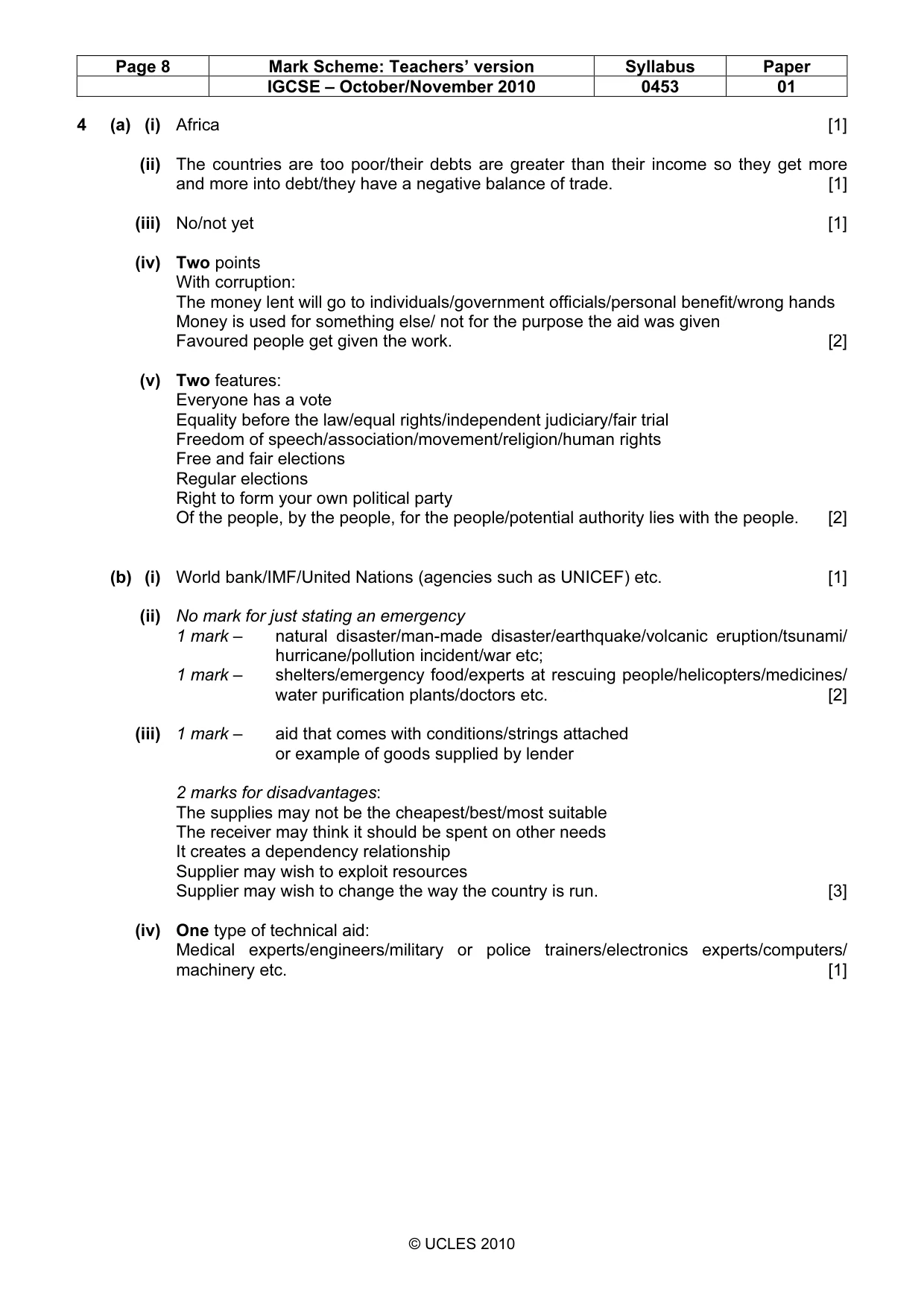
Page 8 Mark Scheme: Teachers’ version Syllabus Paper IGCSE – October/November 2010 0453 01 © UCLES 2010 4 (a) (i) Africa [1] (ii) The countries are too poor/their debts are greater than their income so they get more and more into debt/they have a negative balance of trade. [1] (iii) No/not yet [1] (iv) Two points With corruption: The money lent will go to individuals/government officials/personal benefit/wrong hands Money is used for something else/ not for the purpose the aid was given Favoured people get given the work. [2] (v) Two features: Everyone has a vote Equality before the law/equal rights/independent judiciary/fair trial Freedom of speech/association/movement/religion/human rights Free and fair elections Regular elections Right to form your own political party Of the people, by the people, for the people/potential authority lies with the people. [2] (b) (i) World bank/IMF/United Nations (agencies such as UNICEF) etc. [1] (ii) No mark for just stating an emergency 1 mark – natural disaster/man-made disaster/earthquake/volcanic eruption/tsunami/ hurricane/pollution incident/war etc; 1 mark – shelters/emergency food/experts at rescuing people/helicopters/medicines/ water purification plants/doctors etc. [2] (iii) 1 mark – aid that comes with conditions/strings attached or example of goods supplied by lender 2 marks for disadvantages: The supplies may not be the cheapest/best/most suitable The receiver may think it should be spent on other needs It creates a dependency relationship Supplier may wish to exploit resources Supplier may wish to change the way the country is run. [3] (iv) One type of technical aid: Medical experts/engineers/military or police trainers/electronics experts/computers/ machinery etc. [1]
Mark scheme, page 9
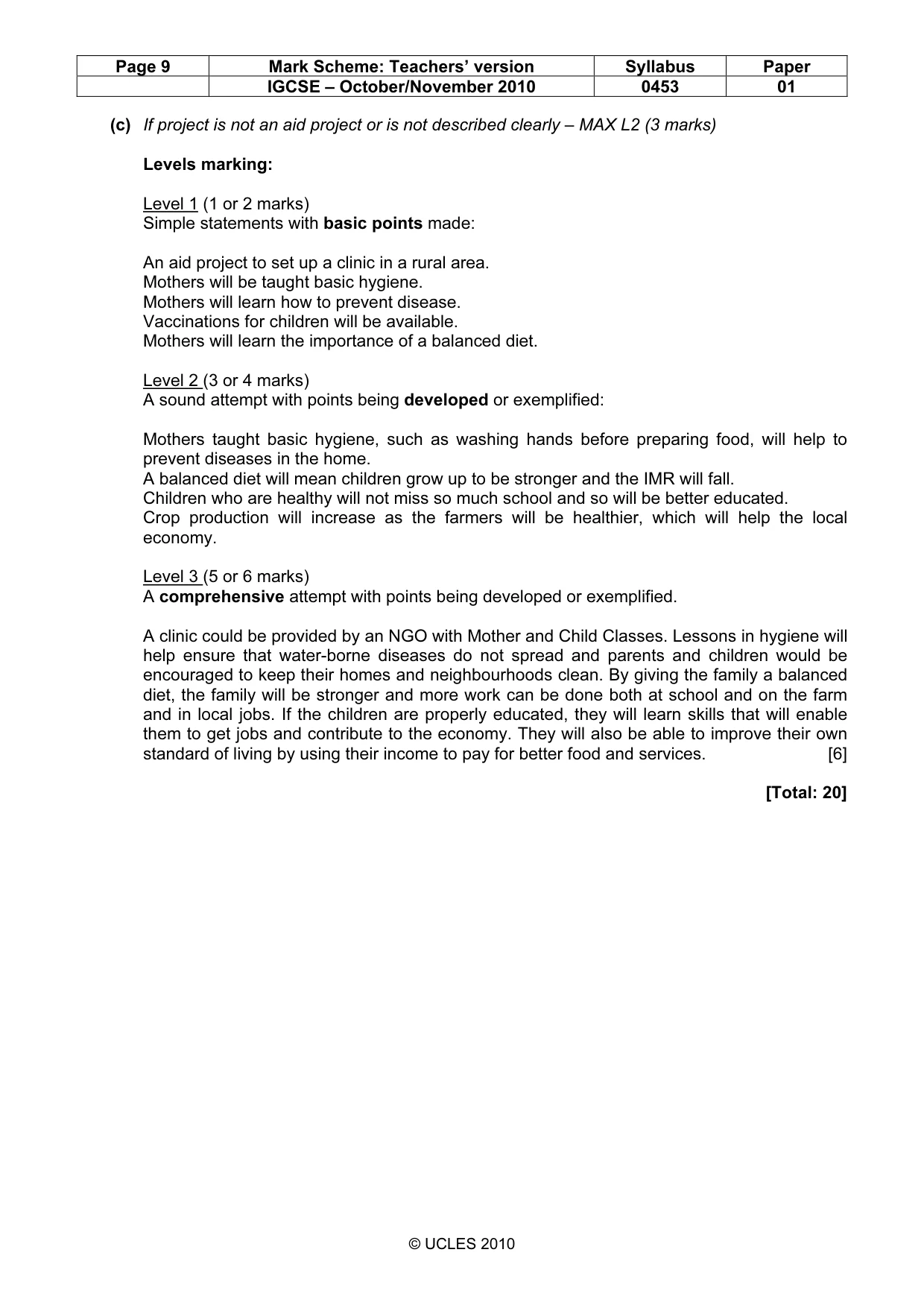
Page 9 Mark Scheme: Teachers’ version Syllabus Paper IGCSE – October/November 2010 0453 01 © UCLES 2010 (c) If project is not an aid project or is not described clearly – MAX L2 (3 marks) Levels marking: Level 1 (1 or 2 marks) Simple statements with basic points made: An aid project to set up a clinic in a rural area. Mothers will be taught basic hygiene. Mothers will learn how to prevent disease. Vaccinations for children will be available. Mothers will learn the importance of a balanced diet. Level 2 (3 or 4 marks) A sound attempt with points being developed or exemplified: Mothers taught basic hygiene, such as washing hands before preparing food, will help to prevent diseases in the home. A balanced diet will mean children grow up to be stronger and the IMR will fall. Children who are healthy will not miss so much school and so will be better educated. Crop production will increase as the farmers will be healthier, which will help the local economy. Level 3 (5 or 6 marks) A comprehensive attempt with points being developed or exemplified. A clinic could be provided by an NGO with Mother and Child Classes. Lessons in hygiene will help ensure that water-borne diseases do not spread and parents and children would be encouraged to keep their homes and neighbourhoods clean. By giving the family a balanced diet, the family will be stronger and more work can be done both at school and on the farm and in local jobs. If the children are properly educated, they will learn skills that will enable them to get jobs and contribute to the economy. They will also be able to improve their own standard of living by using their income to pay for better food and services. [6] [Total: 20]
What you needed in this session
Cambridge’s own grade thresholds for 2010 Oct/Nov, Paper 1 · Variant 1. A higher threshold means an easier paper — the bar moves with how the cohort did.