Cambridge IGCSE Development Studies 0453 — 2009 Oct/Nov Paper 1 · Variant 1
0453/11/O/N/09 · 80 marks · ≈90 min
The question paper and its mark scheme, free to read here and free to download. This is Cambridge’s own paper, exactly as it was sat.
Question paper12 pages


Mark scheme8 pages
Answers below. Sit the paper first if you are practising.
Paper as text
Question paper, page 1
This document consists of 9 printed pages and 3 blank pages. SP (CW/CGW) T64769/6 © UCLES 2009 [Turn over UNIVERSITY OF CAMBRIDGE INTERNATIONAL EXAMINATIONS International General Certificate of Secondary Education READ THESE INSTRUCTIONS FIRST If you have been given an Answer Booklet, follow the instructions on the front cover of the Booklet. Write your Centre number, candidate number and name on all the work you hand in. Write in dark blue or black pen. Do not use staples, paper clips, highlighters, glue or correction fluid. You may use a pencil for any diagrams, graphs or rough working. Answer all the questions. At the end of the examination, fasten all your work securely together. The number of marks is given in brackets [ ] at the end of each question or part question. * 6 9 3 0 1 2 4 1 1 8 * DEVELOPMENT STUDIES 0453/01 Paper 1 October/November 2009 2 hours Additional Materials: Answer Booklet/Paper www.XtremePapers.com
Question paper, page 2
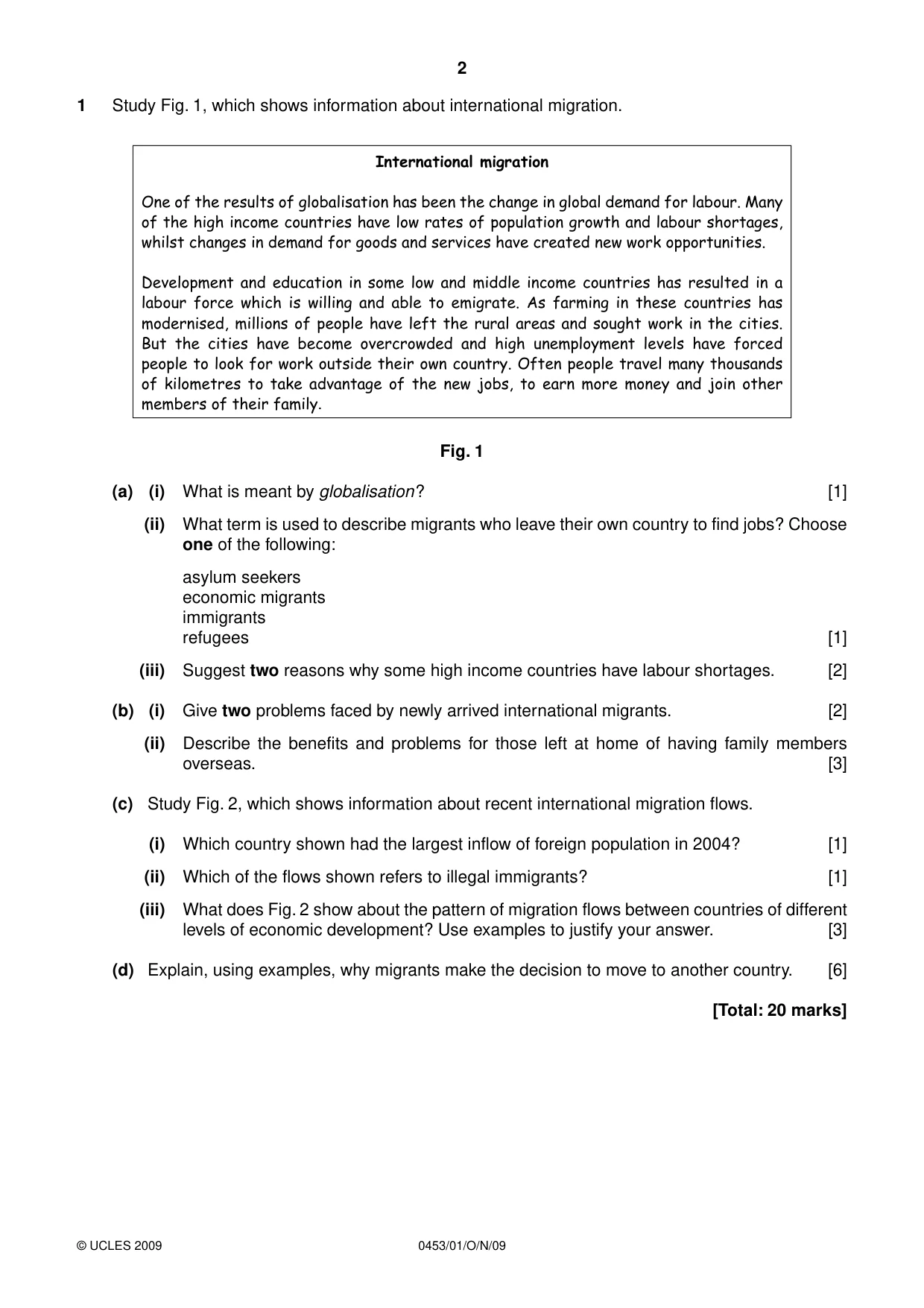
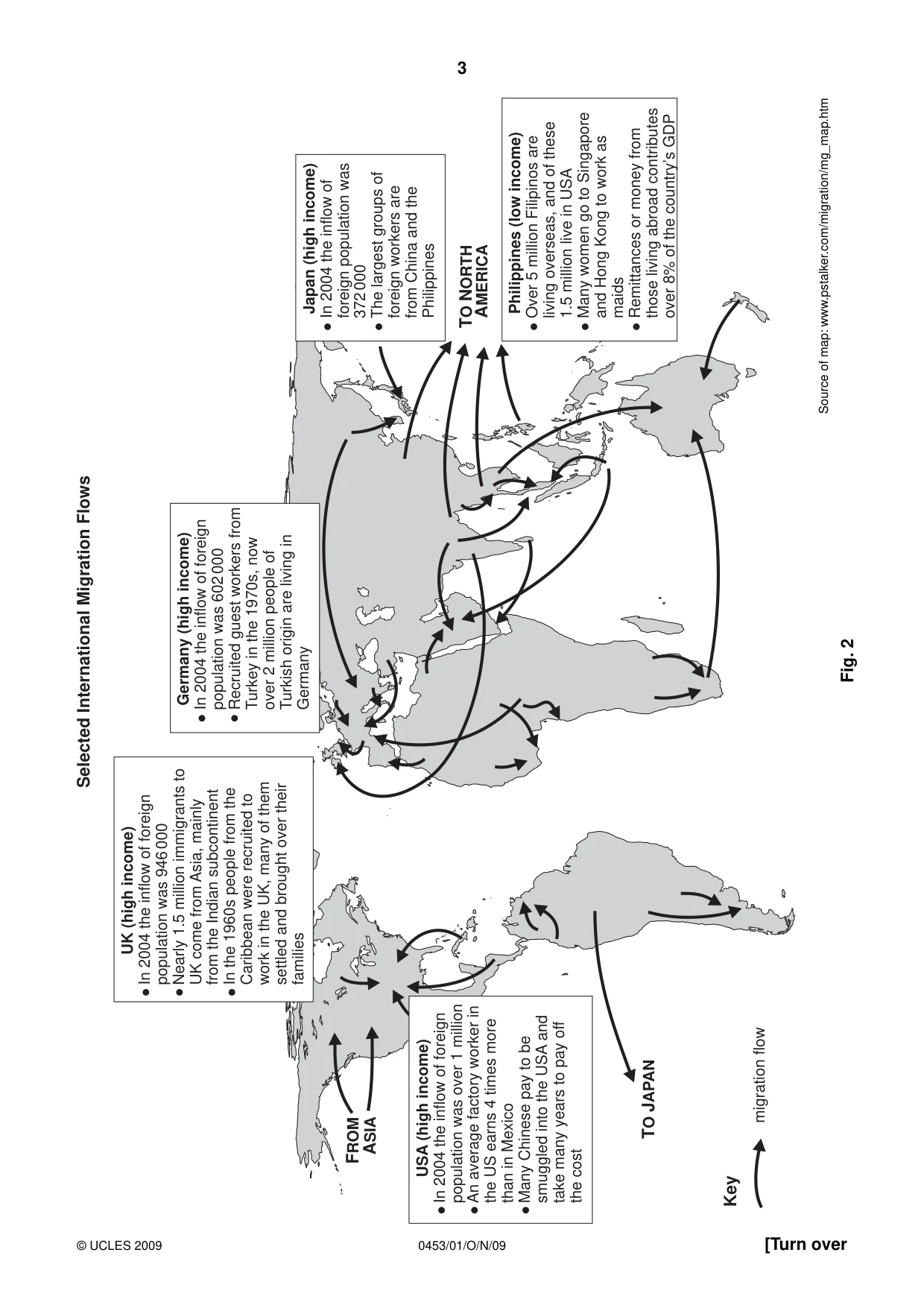
2 0453/01/O/N/09 © UCLES 2009 1 Study Fig. 1, which shows information about international migration. International migration One of the results of globalisation has been the change in global demand for labour. Many of the high income countries have low rates of population growth and labour shortages, whilst changes in demand for goods and services have created new work opportunities. Development and education in some low and middle income countries has resulted in a labour force which is willing and able to emigrate. As farming in these countries has modernised, millions of people have left the rural areas and sought work in the cities. But the cities have become overcrowded and high unemployment levels have forced people to look for work outside their own country. Often people travel many thousands of kilometres to take advantage of the new jobs, to earn more money and join other members of their family. Fig. 1 (a) (i) What is meant by globalisation ? [1] (ii) What term is used to describe migrants who leave their own country to find jobs? Choose one of the following: asylum seekers economic migrants immigrants refugees [1] (iii) Suggest two reasons why some high income countries have labour shortages. [2] (b) (i) Give two problems faced by newly arrived international migrants. [2] (ii) Describe the benefits and problems for those left at home of having family members overseas. [3] (c) Study Fig. 2, which shows information about recent international migration flows. (i) Which country shown had the largest inflow of foreign population in 2004? [1] (ii) Which of the flows shown refers to illegal immigrants? [1] (iii) What does Fig. 2 show about the pattern of migration flows between countries of different levels of economic development? Use examples to justify your answer. [3] (d) Explain, using examples, why migrants make the decision to move to another country. [6] [Total: 20 marks]
Question paper, page 3
3 0453/01/O/N/09 © UCLES 2009 [Turn over UK (high income) In 2004 the inflow of foreign population was 946 000 Nearly 1.5 million immigrants to UK come from Asia, mainly from the Indian subcontinent In the 1960s people from the Caribbean were recruited to work in the UK, many of them settled and brought over their families Germany (high income) In 2004 the inflow of foreign population was 602 000 Recruited guest workers from Turkey in the 1970s, now over 2 million people of Turkish origin are living in Germany Japan (high income) In 2004 the inflow of foreign population was 372 000 The largest groups of foreign workers are from China and the Philippines Philippines (low income) Over 5 million Filipinos are living overseas, and of these 1.5 million live in USA Many women go to Singapore and Hong Kong to work as maids Remittances or money from those living abroad contributes over 8% of the country’s GDP USA (high income) In 2004 the inflow of foreign population was over 1 million An average factory worker in the US earns 4 times more than in Mexico Many Chinese pay to be smuggled into the USA and take many years to pay off the cost migration flow FROM ASIA TO JAPAN Key TO NORTH AMERICA Selected International Migration Flows Source of map: www.pstalker.com/migration/mg_map.htm Fig. 2
Question paper, page 4
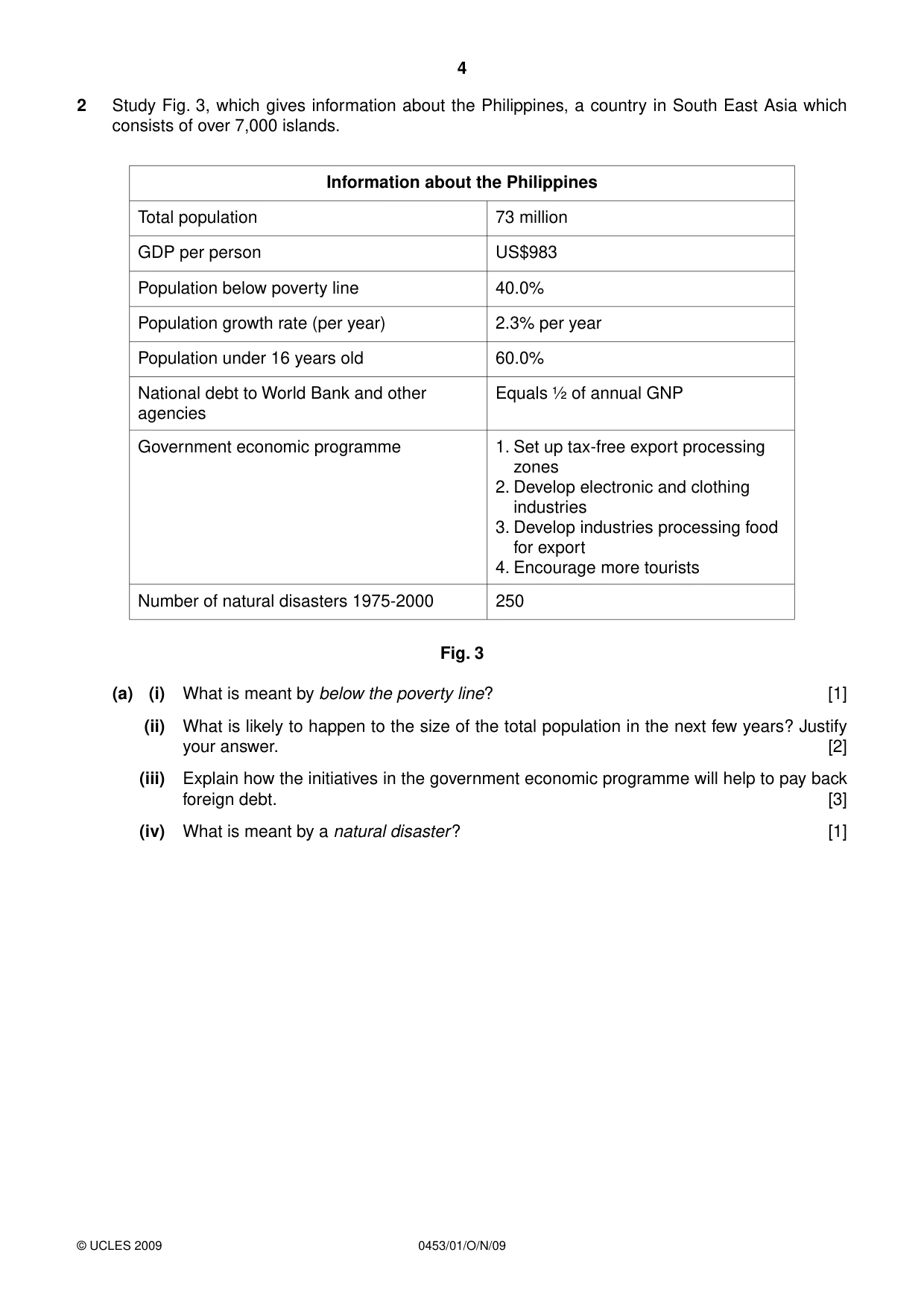
4 0453/01/O/N/09 © UCLES 2009 2 Study Fig. 3, which gives information about the Philippines, a country in South East Asia which consists of over 7,000 islands. Information about the Philippines Total population 73 million GDP per person US$983 Population below poverty line 40.0% Population growth rate (per year) 2.3% per year Population under 16 years old 60.0% National debt to World Bank and other agencies Equals ½ of annual GNP Government economic programme 1. Set up tax-free export processing zones 2. Develop electronic and clothing industries 3. Develop industries processing food for export 4. Encourage more tourists Number of natural disasters 1975-2000 250 Fig. 3 (a) (i) What is meant by below the poverty line? [1] (ii) What is likely to happen to the size of the total population in the next few years? Justify your answer. [2] (iii) Explain how the initiatives in the government economic programme will help to pay back foreign debt. [3] (iv) What is meant by a natural disaster ? [1]
Question paper, page 5
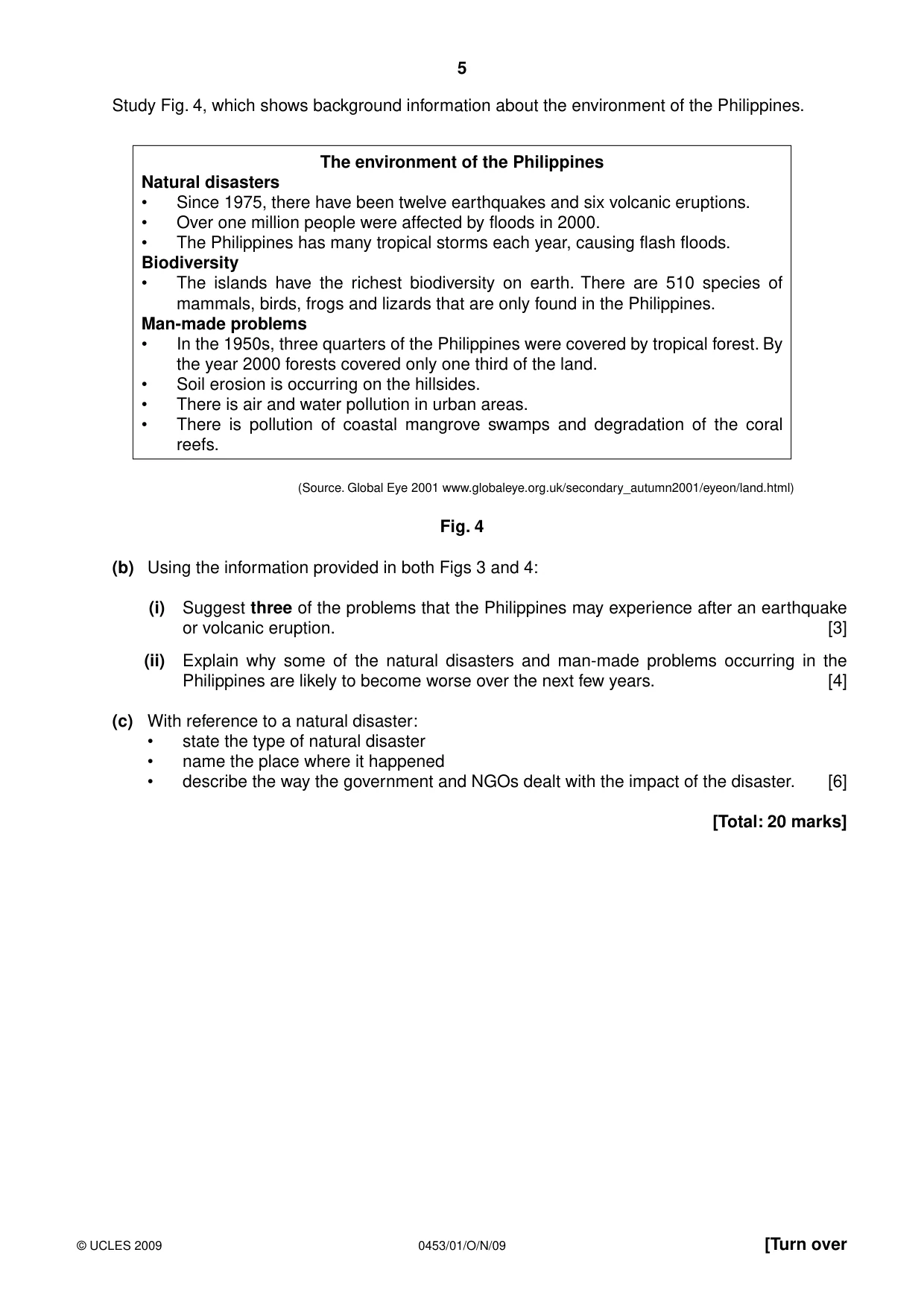
5 0453/01/O/N/09 © UCLES 2009 [Turn over Study Fig. 4, which shows background information about the environment of the Philippines. The environment of the Philippines Natural disasters • Since 1975, there have been twelve earthquakes and six volcanic eruptions. • Over one million people were affected by floods in 2000. • The Philippines has many tropical storms each year, causing flash floods. Biodiversity • The islands have the richest biodiversity on earth. There are 510 species of mammals, birds, frogs and lizards that are only found in the Philippines. Man-made problems • In the 1950s, three quarters of the Philippines were covered by tropical forest. By the year 2000 forests covered only one third of the land. • Soil erosion is occurring on the hillsides. • There is air and water pollution in urban areas. • There is pollution of coastal mangrove swamps and degradation of the coral reefs. (Source. Global Eye 2001 www.globaleye.org.uk/secondary_autumn2001/eyeon/land.html) Fig. 4 (b) Using the information provided in both Figs 3 and 4: (i) Suggest three of the problems that the Philippines may experience after an earthquake or volcanic eruption. [3] (ii) Explain why some of the natural disasters and man-made problems occurring in the Philippines are likely to become worse over the next few years. [4] (c) With reference to a natural disaster: • state the type of natural disaster • name the place where it happened • describe the way the government and NGOs dealt with the impact of the disaster. [6] [Total: 20 marks]
Question paper, page 6
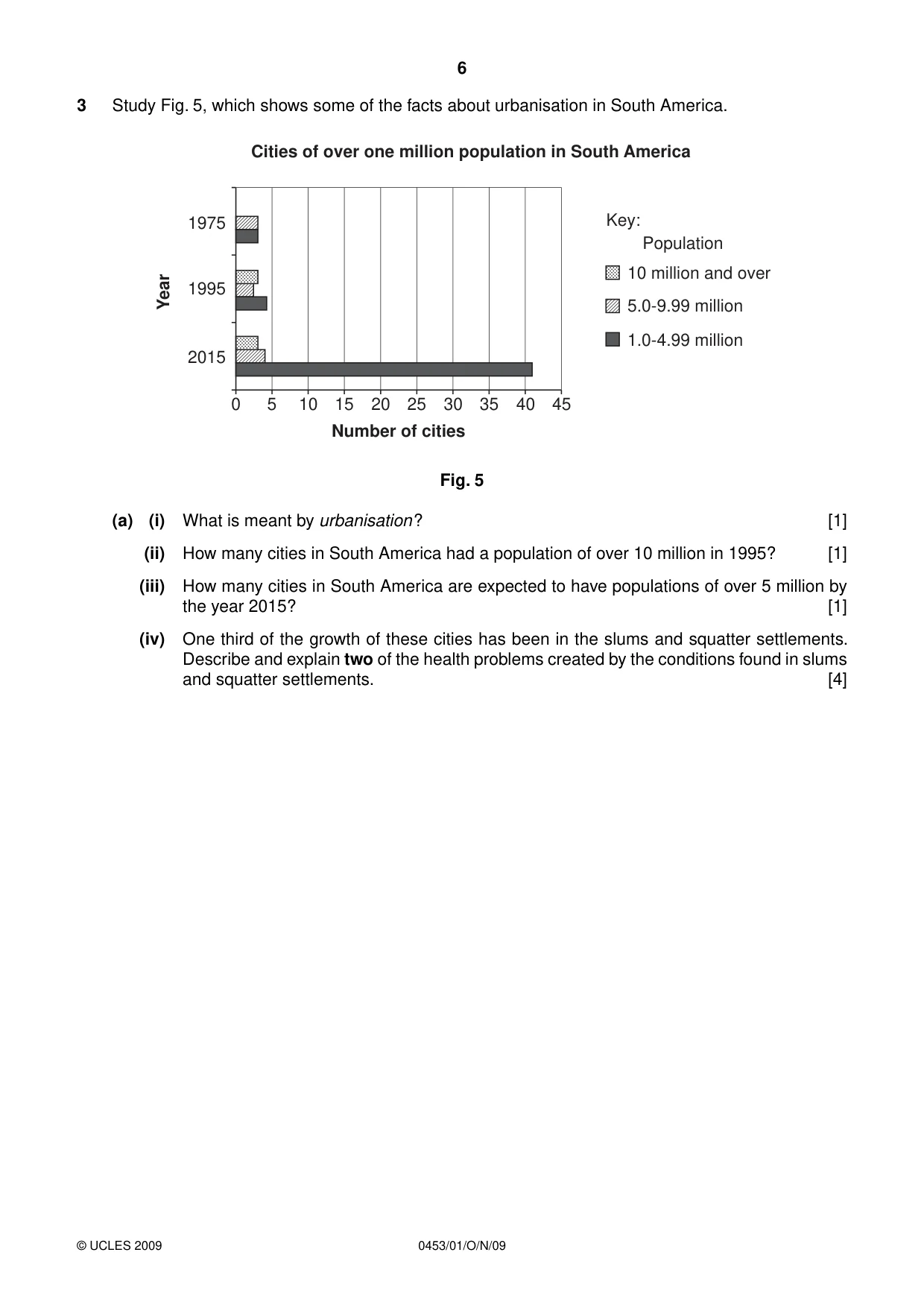
6 0453/01/O/N/09 © UCLES 2009 3 Study Fig. 5, which shows some of the facts about urbanisation in South America. 0 10 20 Number of cities Cities of over one million population in South America 30 40 Key: Population 10 million and over 5.0-9.99 million 1.0-4.99 million 5 2015 1995 Year 1975 15 25 35 45 Fig. 5 (a) (i) What is meant by urbanisation ? [1] (ii) How many cities in South America had a population of over 10 million in 1995? [1] (iii) How many cities in South America are expected to have populations of over 5 million by the year 2015? [1] (iv) One third of the growth of these cities has been in the slums and squatter settlements. Describe and explain two of the health problems created by the conditions found in slums and squatter settlements. [4]
Question paper, page 7
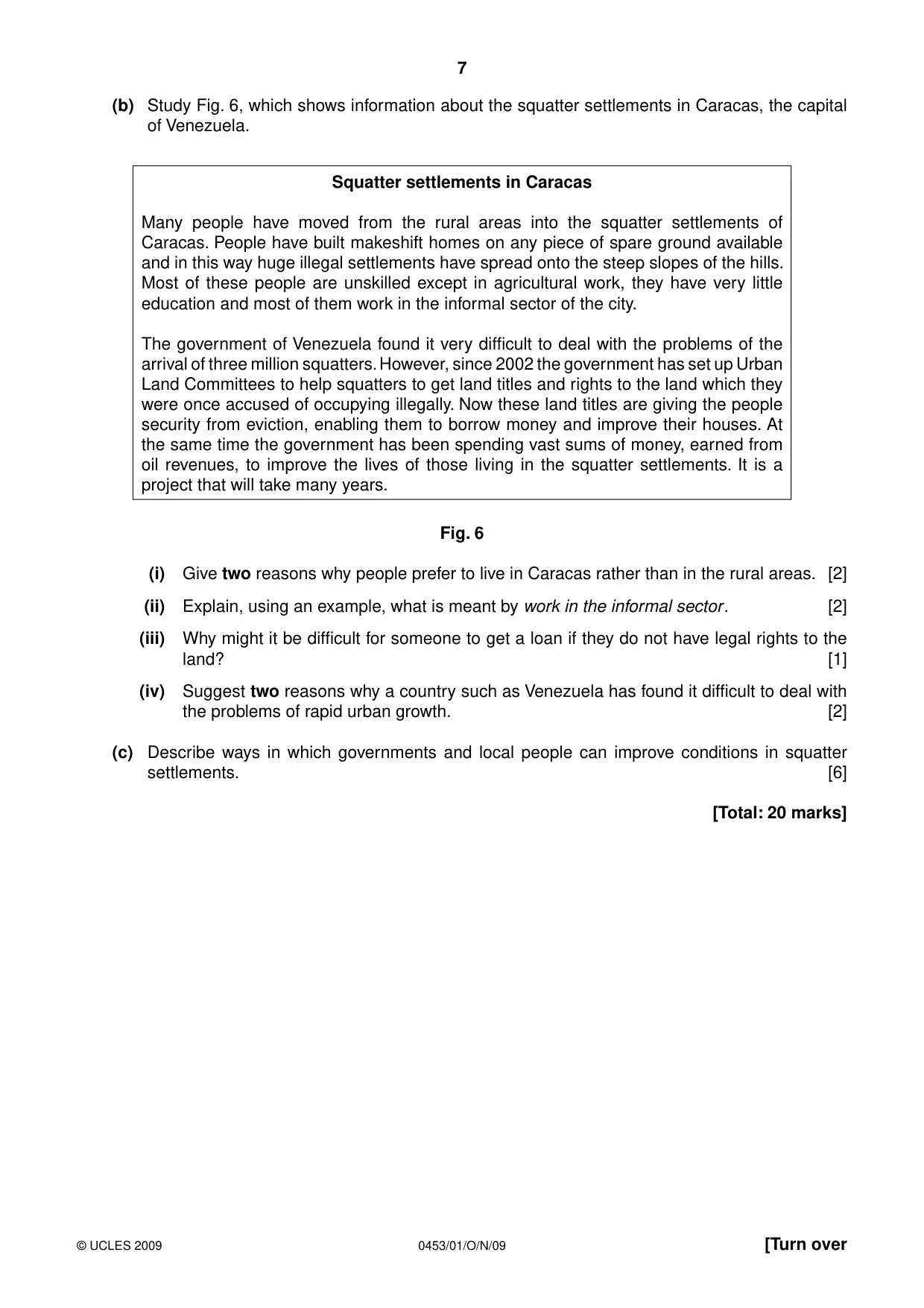
7 0453/01/O/N/09 © UCLES 2009 [Turn over (b) Study Fig. 6, which shows information about the squatter settlements in Caracas, the capital of Venezuela. Squatter settlements in Caracas Many people have moved from the rural areas into the squatter settlements of Caracas. People have built makeshift homes on any piece of spare ground available and in this way huge illegal settlements have spread onto the steep slopes of the hills. Most of these people are unskilled except in agricultural work, they have very little education and most of them work in the informal sector of the city. The government of Venezuela found it very difficult to deal with the problems of the arrival of three million squatters. However, since 2002 the government has set up Urban Land Committees to help squatters to get land titles and rights to the land which they were once accused of occupying illegally. Now these land titles are giving the people security from eviction, enabling them to borrow money and improve their houses. At the same time the government has been spending vast sums of money, earned from oil revenues, to improve the lives of those living in the squatter settlements. It is a project that will take many years. Fig. 6 (i) Give two reasons why people prefer to live in Caracas rather than in the rural areas. [2] (ii) Explain, using an example, what is meant by work in the informal sector . [2] (iii) Why might it be difficult for someone to get a loan if they do not have legal rights to the land? [1] (iv) Suggest two reasons why a country such as Venezuela has found it difficult to deal with the problems of rapid urban growth. [2] (c) Describe ways in which governments and local people can improve conditions in squatter settlements. [6] [Total: 20 marks]
Question paper, page 8
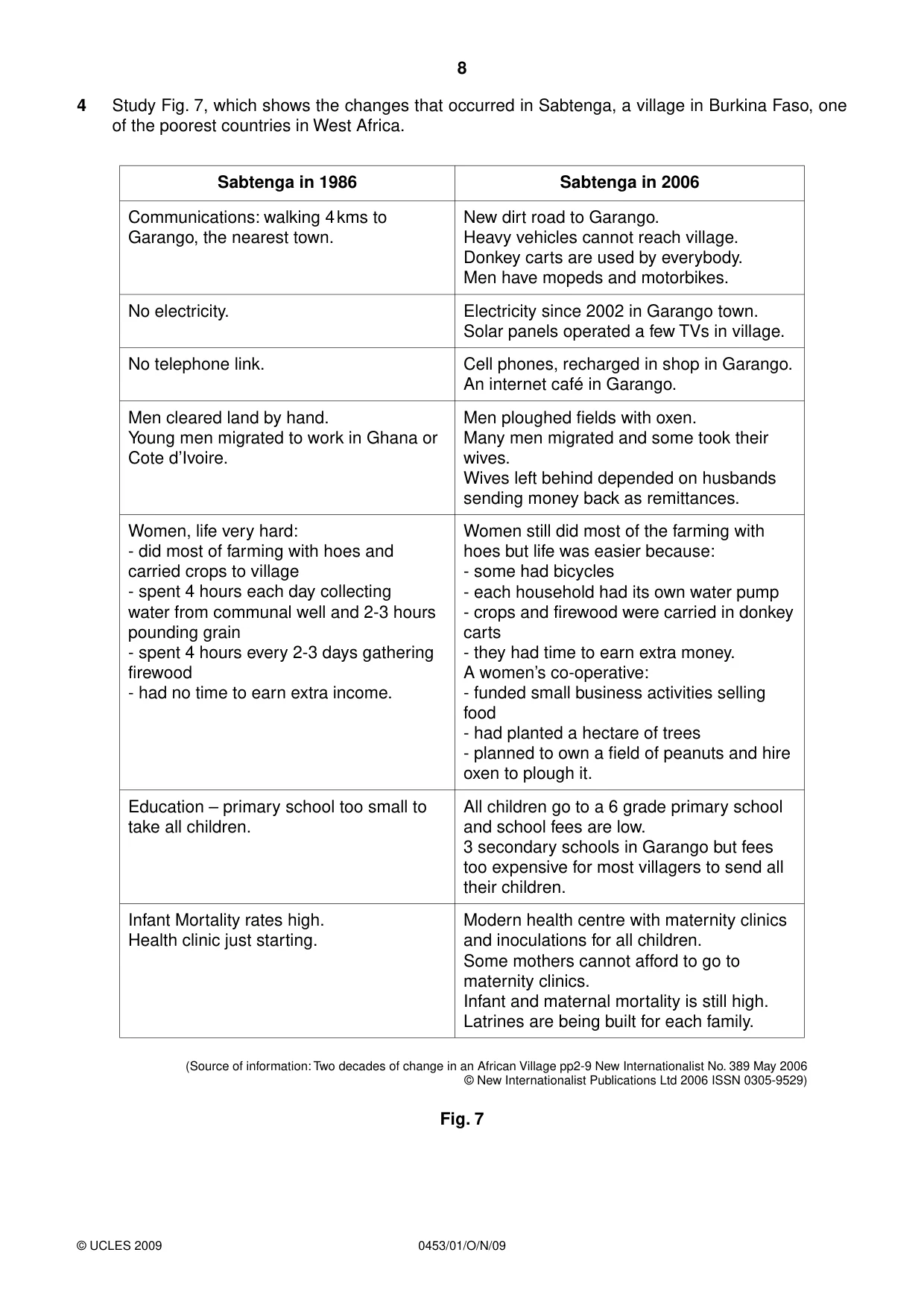
8 0453/01/O/N/09 © UCLES 2009 4 Study Fig. 7, which shows the changes that occurred in Sabtenga, a village in Burkina Faso, one of the poorest countries in West Africa. Sabtenga in 1986 Sabtenga in 2006 Communications: walking 4 kms to Garango, the nearest town. New dirt road to Garango. Heavy vehicles cannot reach village. Donkey carts are used by everybody. Men have mopeds and motorbikes. No electricity. Electricity since 2002 in Garango town. Solar panels operated a few TVs in village. No telephone link. Cell phones, recharged in shop in Garango. An internet café in Garango. Men cleared land by hand. Young men migrated to work in Ghana or Cote d’Ivoire. Men ploughed fields with oxen. Many men migrated and some took their wives. Wives left behind depended on husbands sending money back as remittances. Women, life very hard: - did most of farming with hoes and carried crops to village - spent 4 hours each day collecting water from communal well and 2-3 hours pounding grain - spent 4 hours every 2-3 days gathering firewood - had no time to earn extra income. Women still did most of the farming with hoes but life was easier because: - some had bicycles - each household had its own water pump - crops and firewood were carried in donkey carts - they had time to earn extra money. A women’s co-operative: - funded small business activities selling food - had planted a hectare of trees - planned to own a field of peanuts and hire oxen to plough it. Education – primary school too small to take all children. All children go to a 6 grade primary school and school fees are low. 3 secondary schools in Garango but fees too expensive for most villagers to send all their children. Infant Mortality rates high. Health clinic just starting. Modern health centre with maternity clinics and inoculations for all children. Some mothers cannot afford to go to maternity clinics. Infant and maternal mortality is still high. Latrines are being built for each family. (Source of information: Two decades of change in an African Village pp2-9 New Internationalist No. 389 May 2006 © New Internationalist Publications Ltd 2006 ISSN 0305-9529) Fig. 7
Question paper, page 9
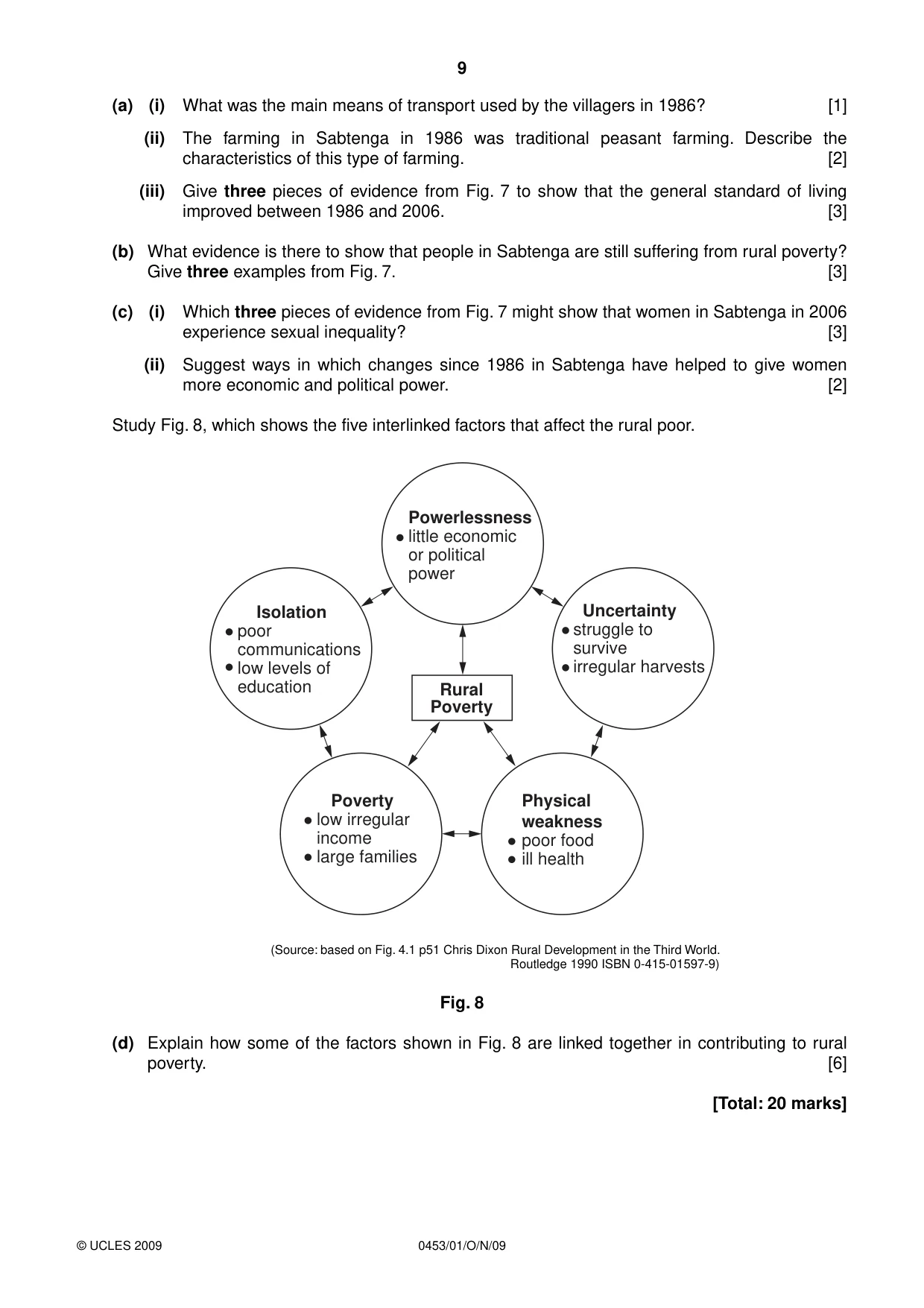
9 0453/01/O/N/09 © UCLES 2009 (a) (i) What was the main means of transport used by the villagers in 1986? [1] (ii) The farming in Sabtenga in 1986 was traditional peasant farming. Describe the characteristics of this type of farming. [2] (iii) Give three pieces of evidence from Fig. 7 to show that the general standard of living improved between 1986 and 2006. [3] (b) What evidence is there to show that people in Sabtenga are still suffering from rural poverty? Give three examples from Fig. 7. [3] (c) (i) Which three pieces of evidence from Fig. 7 might show that women in Sabtenga in 2006 experience sexual inequality? [3] (ii) Suggest ways in which changes since 1986 in Sabtenga have helped to give women more economic and political power. [2] Study Fig. 8, which shows the five interlinked factors that affect the rural poor. Powerlessness little economic or political power Rural Poverty Uncertainty struggle to survive irregular harvests Physical weakness poor food ill health Poverty low irregular income large families Isolation poor communications low levels of education (Source: based on Fig. 4.1 p51 Chris Dixon Rural Development in the Third World. Routledge 1990 ISBN 0-415-01597-9) Fig. 8 (d) Explain how some of the factors shown in Fig. 8 are linked together in contributing to rural poverty. [6] [Total: 20 marks]
Question paper, page 12
12 0453/01/O/N/09 BLANK PAGE Copyright Acknowledgements: Question 1 Fig. 2 © www.pstalker.com/migration/mg_map.htm Permission to reproduce items where third-party owned material protected by copyright is included has been sought and cleared where possible. Every reasonable effort has been made by the publisher (UCLES) to trace copyright holders, but if any items requiring clearance have unwittingly been included, the publisher will be pleased to make amends at the earliest possible opportunity. University of Cambridge International Examinations is part of the Cambridge Assessment Group. Cambridge Assessment is the brand name of University of Cambridge Local Examinations Syndicate (UCLES), which is itself a department of the University of Cambridge.
Mark scheme, page 1
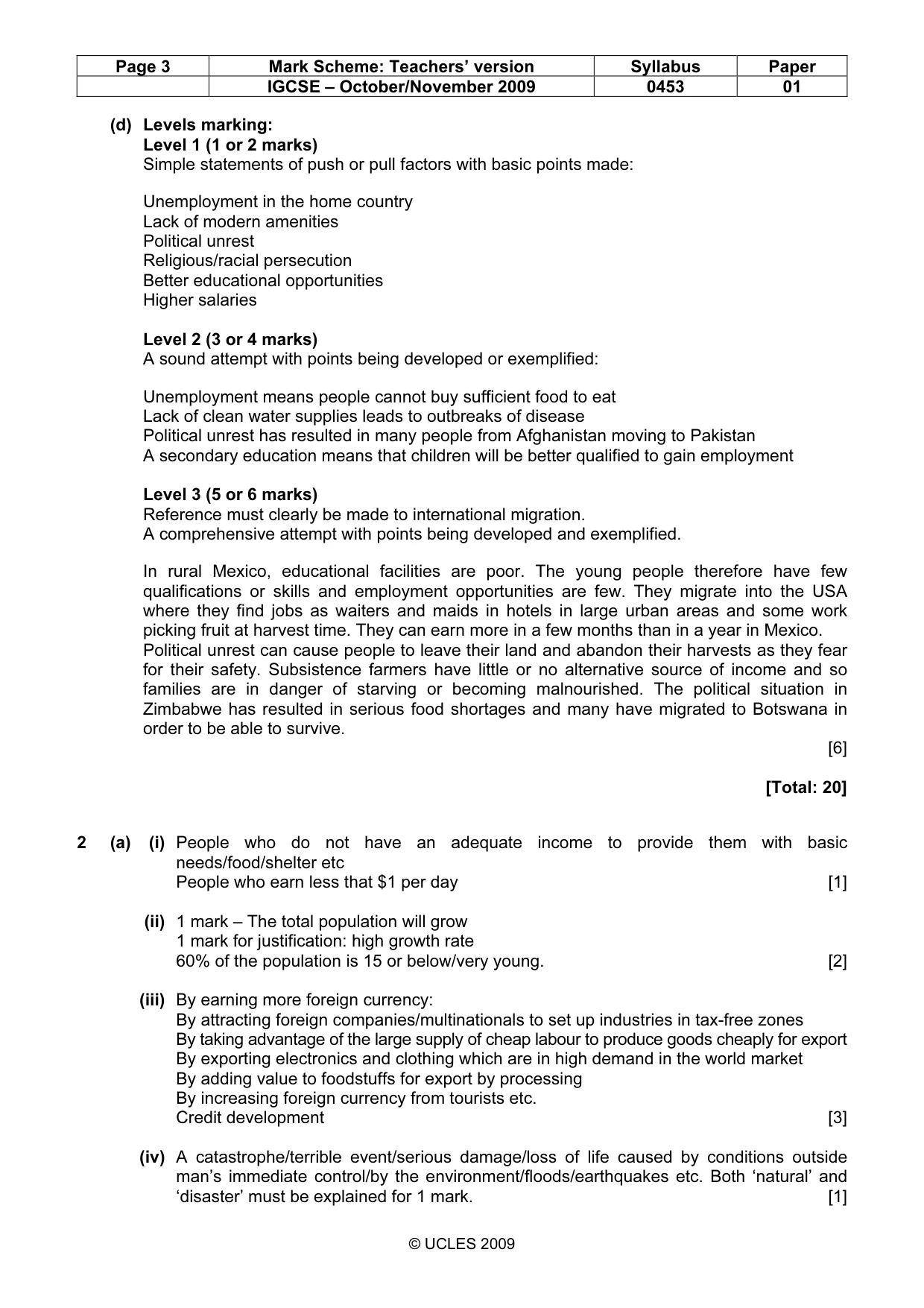
UNIVERSITY OF CAMBRIDGE INTERNATIONAL EXAMINATIONS International General Certificate of Secondary Education MARK SCHEME for the October/November 2009 question paper for the guidance of teachers 0453 DEVELOPMENT STUDIES 0453/01 Paper 1, maximum raw mark 80 This mark scheme is published as an aid to teachers and candidates, to indicate the requirements of the examination. It shows the basis on which Examiners were instructed to award marks. It does not indicate the details of the discussions that took place at an Examiners’ meeting before marking began, which would have considered the acceptability of alternative answers. Mark schemes must be read in conjunction with the question papers and the report on the examination. • CIE will not enter into discussions or correspondence in connection with these mark schemes. CIE is publishing the mark schemes for the October/November 2009 question papers for most IGCSE, GCE Advanced Level and Advanced Subsidiary Level syllabuses and some Ordinary Level syllabuses. www.XtremePapers.com
Mark scheme, page 2
Page 2 Mark Scheme: Teachers’ version Syllabus Paper IGCSE – October/November 2009 0453 01 © UCLES 2009 1 (a) (i) The increasing organisation/integration of the economies of countries into international markets Reference to a worldwide organisation or movement of MNCs/trade/people etc. [1] (ii) Economic migrants [1] (iii) Two reasons: Aging populations/shortage of young workers Low population growth rates Countries have growing industries with increasing demand for labour Many people are not prepared to do low paid jobs The benefit system may mean people do not need to work etc. [2] (b) (i) Two problems: Language difficulties Loneliness/homesickness Adjustment to different methods of work/employment regulations Housing difficulties Cold/change of climate Adjustment to new culture/customs Unemployment Debt Lack of acceptance by host community/prejudice etc. [2] (ii) Benefits: Remittances Use of remittances to educate children/buy better quality food etc. Less mouths to feed Help for other members of the family wishing to migrate Problems: Loneliness/worry due to split families No-one to help with problems/farming/old people [3] 1 mark reserved for benefits and problems (c) (i) USA [1] (ii) The flow of Chinese into USA [1] (iii) 1 mark for stating that migrants usually move to countries which are of a higher income level/from low to high income countries/from LEDCs to MEDCs/developing to developed etc. 2 further marks for 2 examples which must be between countries of different levels of development and be shown on Fig. 2, either in text boxes or as migration flows. No credit for continents [3]
Mark scheme, page 3
Page 3 Mark Scheme: Teachers’ version Syllabus Paper IGCSE – October/November 2009 0453 01 © UCLES 2009 (d) Levels marking: Level 1 (1 or 2 marks) Simple statements of push or pull factors with basic points made: Unemployment in the home country Lack of modern amenities Political unrest Religious/racial persecution Better educational opportunities Higher salaries Level 2 (3 or 4 marks) A sound attempt with points being developed or exemplified: Unemployment means people cannot buy sufficient food to eat Lack of clean water supplies leads to outbreaks of disease Political unrest has resulted in many people from Afghanistan moving to Pakistan A secondary education means that children will be better qualified to gain employment Level 3 (5 or 6 marks) Reference must clearly be made to international migration. A comprehensive attempt with points being developed and exemplified. In rural Mexico, educational facilities are poor. The young people therefore have few qualifications or skills and employment opportunities are few. They migrate into the USA where they find jobs as waiters and maids in hotels in large urban areas and some work picking fruit at harvest time. They can earn more in a few months than in a year in Mexico. Political unrest can cause people to leave their land and abandon their harvests as they fear for their safety. Subsistence farmers have little or no alternative source of income and so families are in danger of starving or becoming malnourished. The political situation in Zimbabwe has resulted in serious food shortages and many have migrated to Botswana in order to be able to survive. [6] [Total: 20] 2 (a) (i) People who do not have an adequate income to provide them with basic needs/food/shelter etc People who earn less that $1 per day [1] (ii) 1 mark – The total population will grow 1 mark for justification: high growth rate 60% of the population is 15 or below/very young. [2] (iii) By earning more foreign currency: By attracting foreign companies/multinationals to set up industries in tax-free zones By taking advantage of the large supply of cheap labour to produce goods cheaply for export By exporting electronics and clothing which are in high demand in the world market By adding value to foodstuffs for export by processing By increasing foreign currency from tourists etc. Credit development [3] (iv) A catastrophe/terrible event/serious damage/loss of life caused by conditions outside man’s immediate control/by the environment/floods/earthquakes etc. Both ‘natural’ and ‘disaster’ must be explained for 1 mark. [1]
Mark scheme, page 4
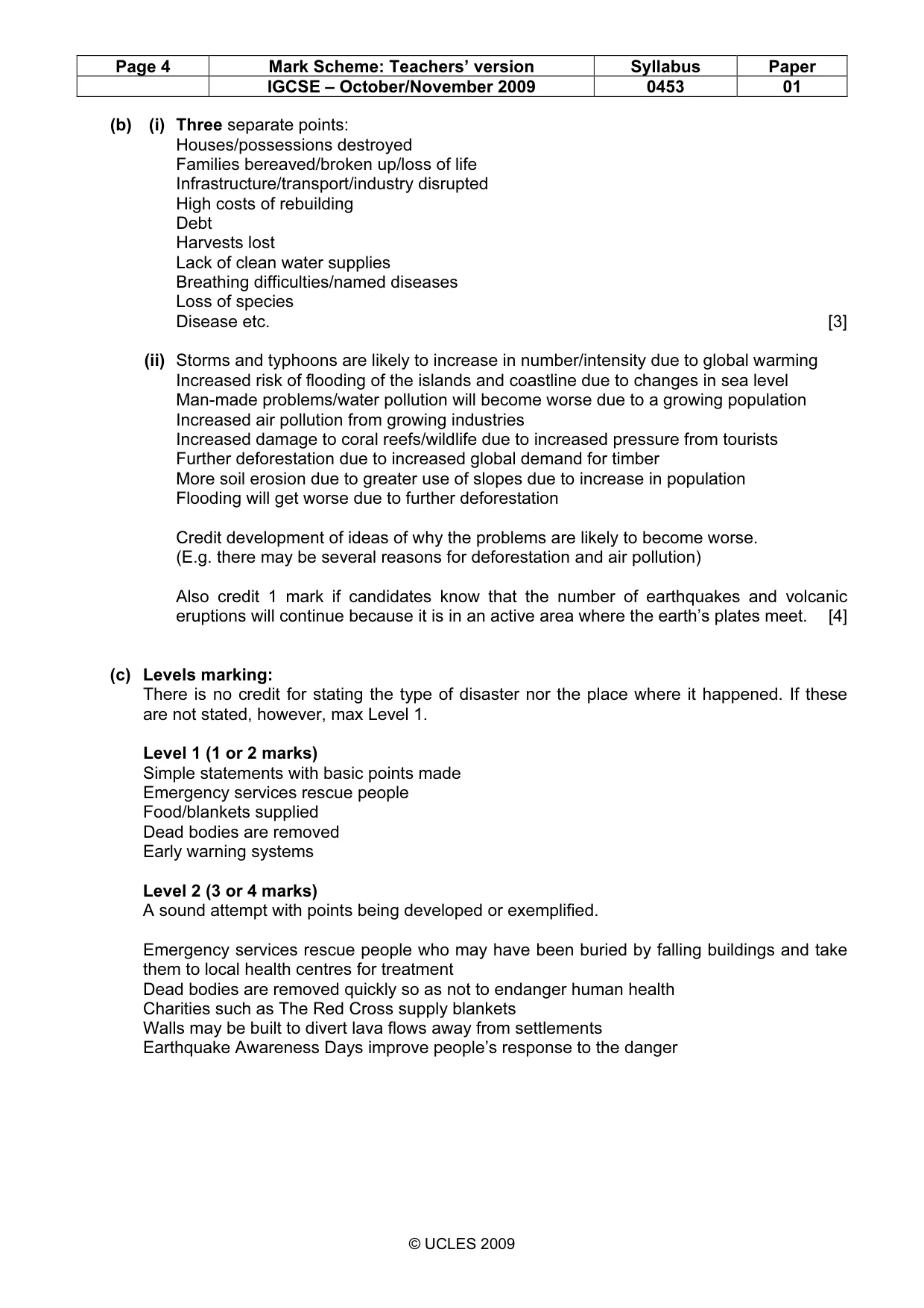
Page 4 Mark Scheme: Teachers’ version Syllabus Paper IGCSE – October/November 2009 0453 01 © UCLES 2009 (b) (i) Three separate points: Houses/possessions destroyed Families bereaved/broken up/loss of life Infrastructure/transport/industry disrupted High costs of rebuilding Debt Harvests lost Lack of clean water supplies Breathing difficulties/named diseases Loss of species Disease etc. [3] (ii) Storms and typhoons are likely to increase in number/intensity due to global warming Increased risk of flooding of the islands and coastline due to changes in sea level Man-made problems/water pollution will become worse due to a growing population Increased air pollution from growing industries Increased damage to coral reefs/wildlife due to increased pressure from tourists Further deforestation due to increased global demand for timber More soil erosion due to greater use of slopes due to increase in population Flooding will get worse due to further deforestation Credit development of ideas of why the problems are likely to become worse. (E.g. there may be several reasons for deforestation and air pollution) Also credit 1 mark if candidates know that the number of earthquakes and volcanic eruptions will continue because it is in an active area where the earth’s plates meet. [4] (c) Levels marking: There is no credit for stating the type of disaster nor the place where it happened. If these are not stated, however, max Level 1. Level 1 (1 or 2 marks) Simple statements with basic points made Emergency services rescue people Food/blankets supplied Dead bodies are removed Early warning systems Level 2 (3 or 4 marks) A sound attempt with points being developed or exemplified. Emergency services rescue people who may have been buried by falling buildings and take them to local health centres for treatment Dead bodies are removed quickly so as not to endanger human health Charities such as The Red Cross supply blankets Walls may be built to divert lava flows away from settlements Earthquake Awareness Days improve people’s response to the danger
Mark scheme, page 5
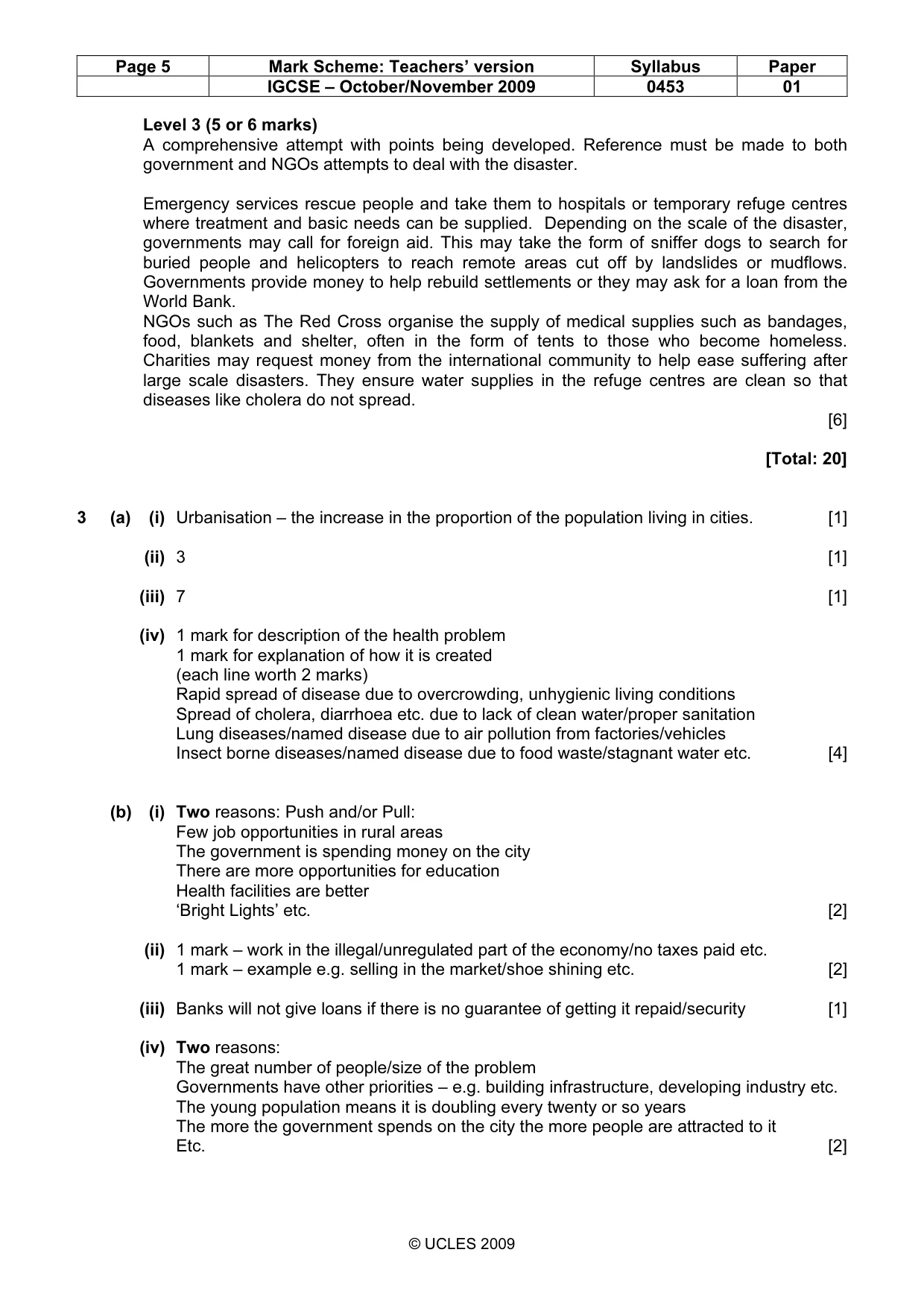
Page 5 Mark Scheme: Teachers’ version Syllabus Paper IGCSE – October/November 2009 0453 01 © UCLES 2009 Level 3 (5 or 6 marks) A comprehensive attempt with points being developed. Reference must be made to both government and NGOs attempts to deal with the disaster. Emergency services rescue people and take them to hospitals or temporary refuge centres where treatment and basic needs can be supplied. Depending on the scale of the disaster, governments may call for foreign aid. This may take the form of sniffer dogs to search for buried people and helicopters to reach remote areas cut off by landslides or mudflows. Governments provide money to help rebuild settlements or they may ask for a loan from the World Bank. NGOs such as The Red Cross organise the supply of medical supplies such as bandages, food, blankets and shelter, often in the form of tents to those who become homeless. Charities may request money from the international community to help ease suffering after large scale disasters. They ensure water supplies in the refuge centres are clean so that diseases like cholera do not spread. [6] [Total: 20] 3 (a) (i) Urbanisation – the increase in the proportion of the population living in cities. [1] (ii) 3 [1] (iii) 7 [1] (iv) 1 mark for description of the health problem 1 mark for explanation of how it is created (each line worth 2 marks) Rapid spread of disease due to overcrowding, unhygienic living conditions Spread of cholera, diarrhoea etc. due to lack of clean water/proper sanitation Lung diseases/named disease due to air pollution from factories/vehicles Insect borne diseases/named disease due to food waste/stagnant water etc. [4] (b) (i) Two reasons: Push and/or Pull: Few job opportunities in rural areas The government is spending money on the city There are more opportunities for education Health facilities are better ‘Bright Lights’ etc. [2] (ii) 1 mark – work in the illegal/unregulated part of the economy/no taxes paid etc. 1 mark – example e.g. selling in the market/shoe shining etc. [2] (iii) Banks will not give loans if there is no guarantee of getting it repaid/security [1] (iv) Two reasons: The great number of people/size of the problem Governments have other priorities – e.g. building infrastructure, developing industry etc. The young population means it is doubling every twenty or so years The more the government spends on the city the more people are attracted to it Etc. [2]
Mark scheme, page 6
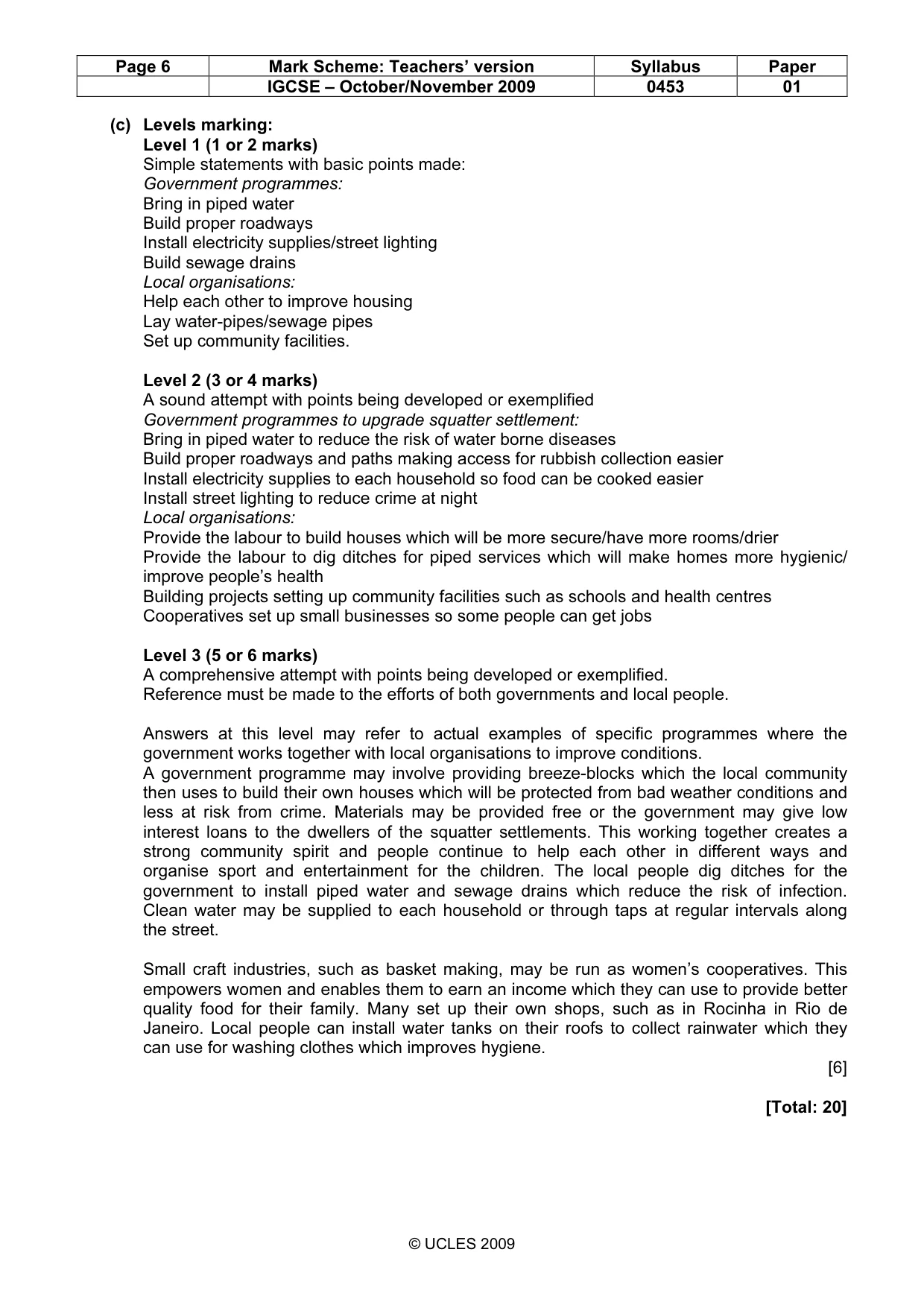
Page 6 Mark Scheme: Teachers’ version Syllabus Paper IGCSE – October/November 2009 0453 01 © UCLES 2009 (c) Levels marking: Level 1 (1 or 2 marks) Simple statements with basic points made: Government programmes: Bring in piped water Build proper roadways Install electricity supplies/street lighting Build sewage drains Local organisations: Help each other to improve housing Lay water-pipes/sewage pipes Set up community facilities. Level 2 (3 or 4 marks) A sound attempt with points being developed or exemplified Government programmes to upgrade squatter settlement: Bring in piped water to reduce the risk of water borne diseases Build proper roadways and paths making access for rubbish collection easier Install electricity supplies to each household so food can be cooked easier Install street lighting to reduce crime at night Local organisations: Provide the labour to build houses which will be more secure/have more rooms/drier Provide the labour to dig ditches for piped services which will make homes more hygienic/ improve people’s health Building projects setting up community facilities such as schools and health centres Cooperatives set up small businesses so some people can get jobs Level 3 (5 or 6 marks) A comprehensive attempt with points being developed or exemplified. Reference must be made to the efforts of both governments and local people. Answers at this level may refer to actual examples of specific programmes where the government works together with local organisations to improve conditions. A government programme may involve providing breeze-blocks which the local community then uses to build their own houses which will be protected from bad weather conditions and less at risk from crime. Materials may be provided free or the government may give low interest loans to the dwellers of the squatter settlements. This working together creates a strong community spirit and people continue to help each other in different ways and organise sport and entertainment for the children. The local people dig ditches for the government to install piped water and sewage drains which reduce the risk of infection. Clean water may be supplied to each household or through taps at regular intervals along the street. Small craft industries, such as basket making, may be run as women’s cooperatives. This empowers women and enables them to earn an income which they can use to provide better quality food for their family. Many set up their own shops, such as in Rocinha in Rio de Janeiro. Local people can install water tanks on their roofs to collect rainwater which they can use for washing clothes which improves hygiene. [6] [Total: 20]
Mark scheme, page 7
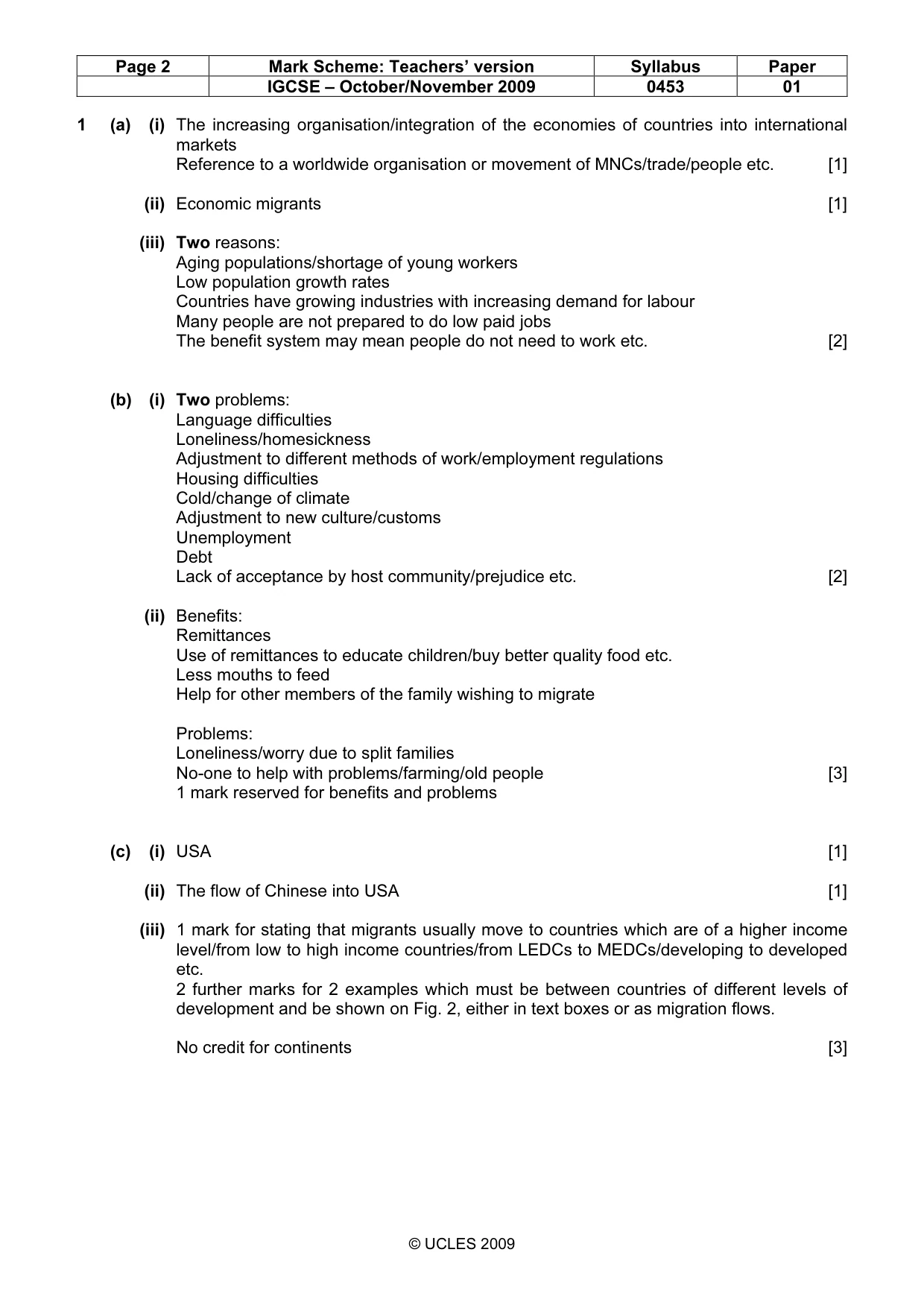
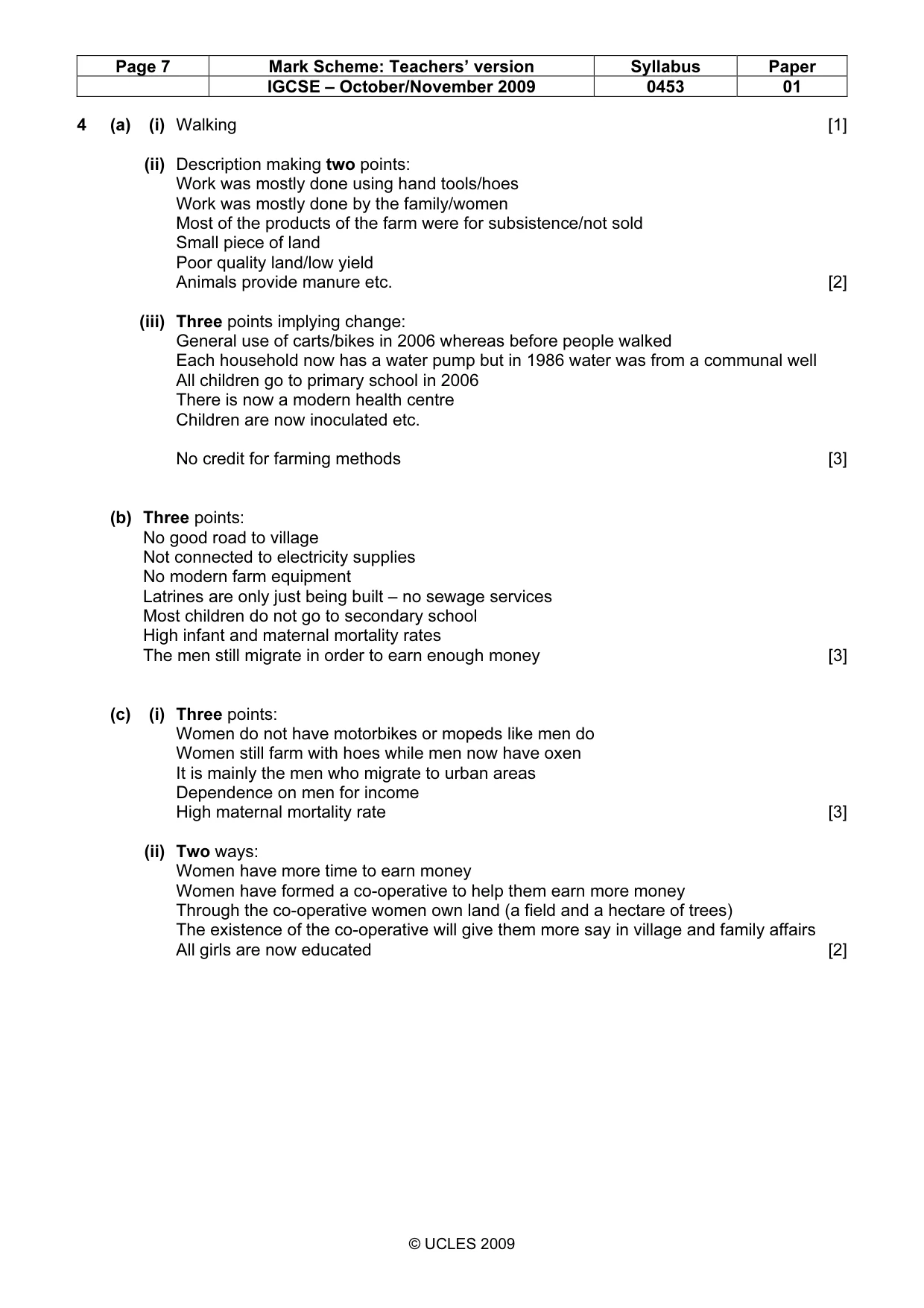
Page 7 Mark Scheme: Teachers’ version Syllabus Paper IGCSE – October/November 2009 0453 01 © UCLES 2009 4 (a) (i) Walking [1] (ii) Description making two points: Work was mostly done using hand tools/hoes Work was mostly done by the family/women Most of the products of the farm were for subsistence/not sold Small piece of land Poor quality land/low yield Animals provide manure etc. [2] (iii) Three points implying change: General use of carts/bikes in 2006 whereas before people walked Each household now has a water pump but in 1986 water was from a communal well All children go to primary school in 2006 There is now a modern health centre Children are now inoculated etc. No credit for farming methods [3] (b) Three points: No good road to village Not connected to electricity supplies No modern farm equipment Latrines are only just being built – no sewage services Most children do not go to secondary school High infant and maternal mortality rates The men still migrate in order to earn enough money [3] (c) (i) Three points: Women do not have motorbikes or mopeds like men do Women still farm with hoes while men now have oxen It is mainly the men who migrate to urban areas Dependence on men for income High maternal mortality rate [3] (ii) Two ways: Women have more time to earn money Women have formed a co-operative to help them earn more money Through the co-operative women own land (a field and a hectare of trees) The existence of the co-operative will give them more say in village and family affairs All girls are now educated [2]
Mark scheme, page 8
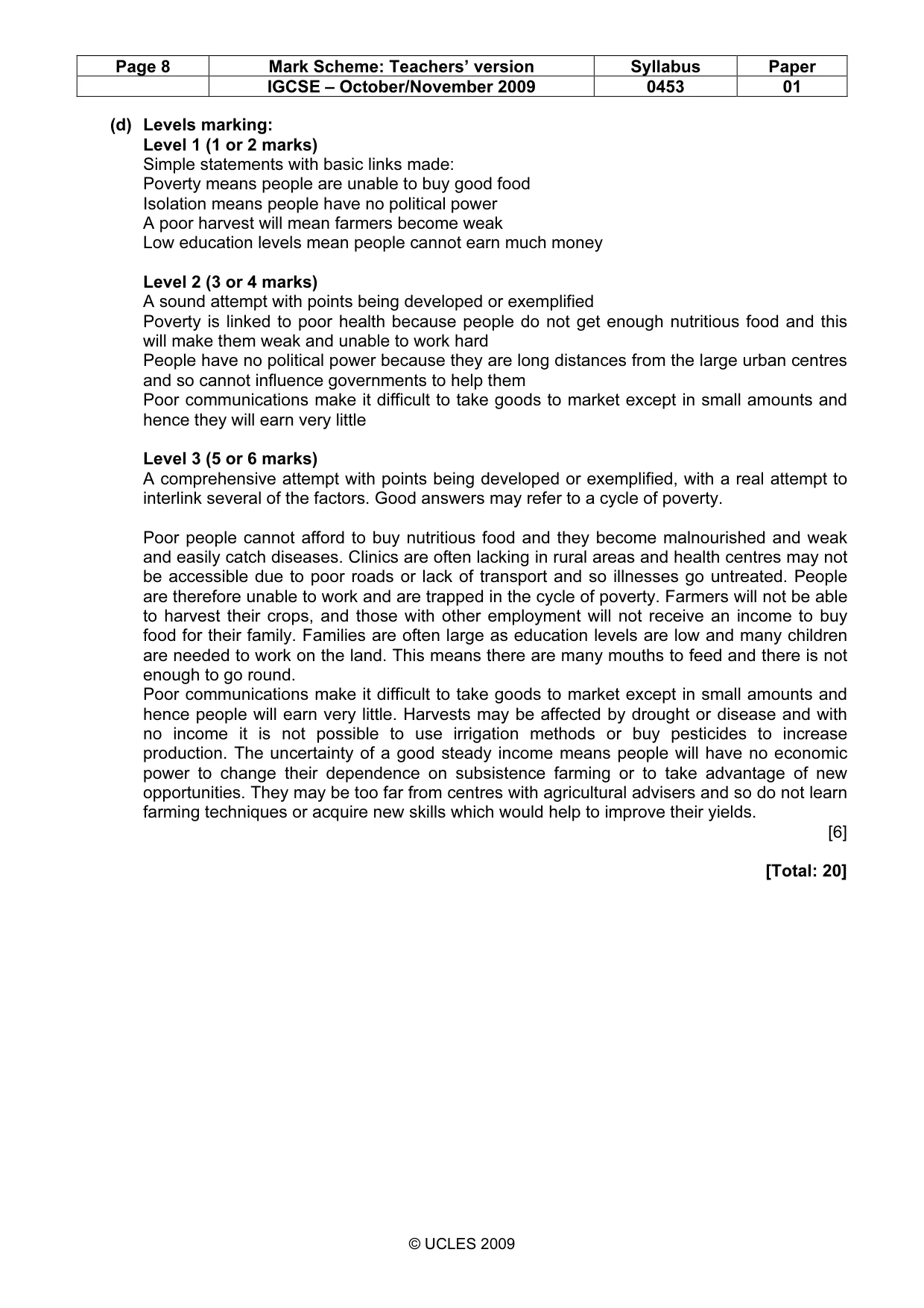
Page 8 Mark Scheme: Teachers’ version Syllabus Paper IGCSE – October/November 2009 0453 01 © UCLES 2009 (d) Levels marking: Level 1 (1 or 2 marks) Simple statements with basic links made: Poverty means people are unable to buy good food Isolation means people have no political power A poor harvest will mean farmers become weak Low education levels mean people cannot earn much money Level 2 (3 or 4 marks) A sound attempt with points being developed or exemplified Poverty is linked to poor health because people do not get enough nutritious food and this will make them weak and unable to work hard People have no political power because they are long distances from the large urban centres and so cannot influence governments to help them Poor communications make it difficult to take goods to market except in small amounts and hence they will earn very little Level 3 (5 or 6 marks) A comprehensive attempt with points being developed or exemplified, with a real attempt to interlink several of the factors. Good answers may refer to a cycle of poverty. Poor people cannot afford to buy nutritious food and they become malnourished and weak and easily catch diseases. Clinics are often lacking in rural areas and health centres may not be accessible due to poor roads or lack of transport and so illnesses go untreated. People are therefore unable to work and are trapped in the cycle of poverty. Farmers will not be able to harvest their crops, and those with other employment will not receive an income to buy food for their family. Families are often large as education levels are low and many children are needed to work on the land. This means there are many mouths to feed and there is not enough to go round. Poor communications make it difficult to take goods to market except in small amounts and hence people will earn very little. Harvests may be affected by drought or disease and with no income it is not possible to use irrigation methods or buy pesticides to increase production. The uncertainty of a good steady income means people will have no economic power to change their dependence on subsistence farming or to take advantage of new opportunities. They may be too far from centres with agricultural advisers and so do not learn farming techniques or acquire new skills which would help to improve their yields. [6] [Total: 20]
What you needed in this session
Cambridge’s own grade thresholds for 2009 Oct/Nov, Paper 1 · Variant 1. A higher threshold means an easier paper — the bar moves with how the cohort did.