Cambridge IGCSE Development Studies 0453 — 2006 Oct/Nov Paper 2 · Variant 1
0453/21/O/N/06 · 70 marks · ≈79 min
The question paper and its mark scheme, free to read here and free to download. This is Cambridge’s own paper, exactly as it was sat.
Question paper12 pages



Mark scheme6 pages
Answers below. Sit the paper first if you are practising.
Paper as text
Question paper, page 1
This document consists of 9 printed pages and 3 blank pages. SPA (SJF3758) S99213/4 © UCLES 2006 [Turn over UNIVERSITY OF CAMBRIDGE INTERNATIONAL EXAMINATIONS International General Certificate of Secondary Education DEVELOPMENT STUDIES 0453/02 Paper 2 October/November 2006 2 hours 15 minutes Additional Materials: Answer Booklet/Paper READ THESE INSTRUCTIONS FIRST If you have been given an Answer Booklet, follow the instructions on the front cover of the Booklet. Write your Centre number, candidate number and name on all the work you hand in. Write in dark blue or black pen. You may use a soft pencil for any diagrams, graphs or rough working. Do not use staples, paper clips, highlighters, glue or correction fluid. Answer both questions. You should read and study the sources before answering the questions. At the end of the examination, fasten all your work securely together. The number of marks is given in brackets [ ] at the end of each question or part question. www.XtremePapers.com
Question paper, page 2
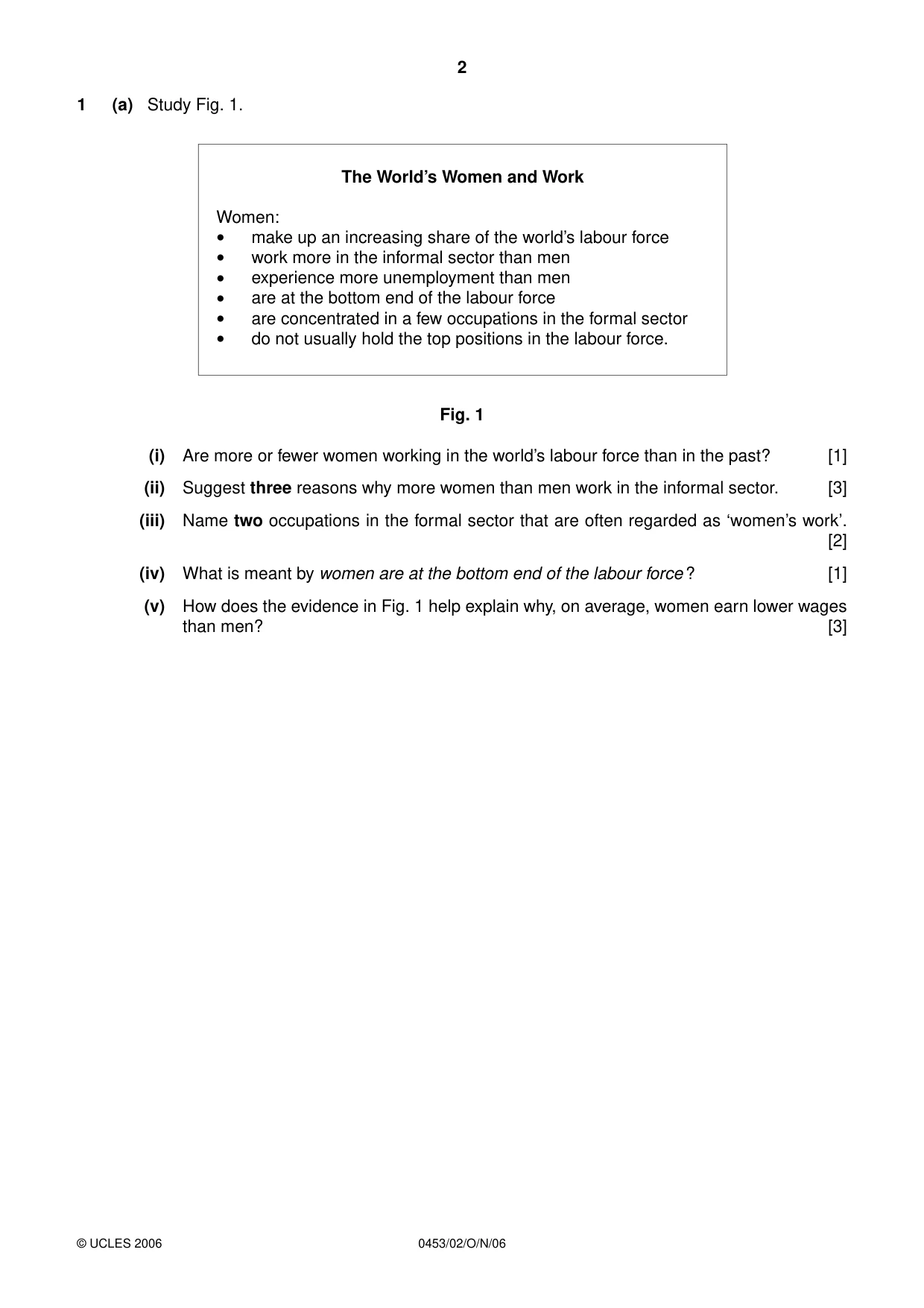
2 0453/02/O/N/06 1 (a) Study Fig. 1. Fig. 1 (i) Are more or fewer women working in the world’s labour force than in the past? [1] (ii) Suggest three reasons why more women than men work in the informal sector. [3] (iii) Name two occupations in the formal sector that are often regarded as ‘women’s work’. [2] (iv) What is meant by women are at the bottom end of the labour force ? [1] (v) How does the evidence in Fig. 1 help explain why, on average, women earn lower wages than men? [3] © UCLES 2006 The World’s Women and Work Women: • make up an increasing share of the world’s labour force • work more in the informal sector than men • experience more unemployment than men • are at the bottom end of the labour force • are concentrated in a few occupations in the formal sector • do not usually hold the top positions in the labour force.
Question paper, page 3
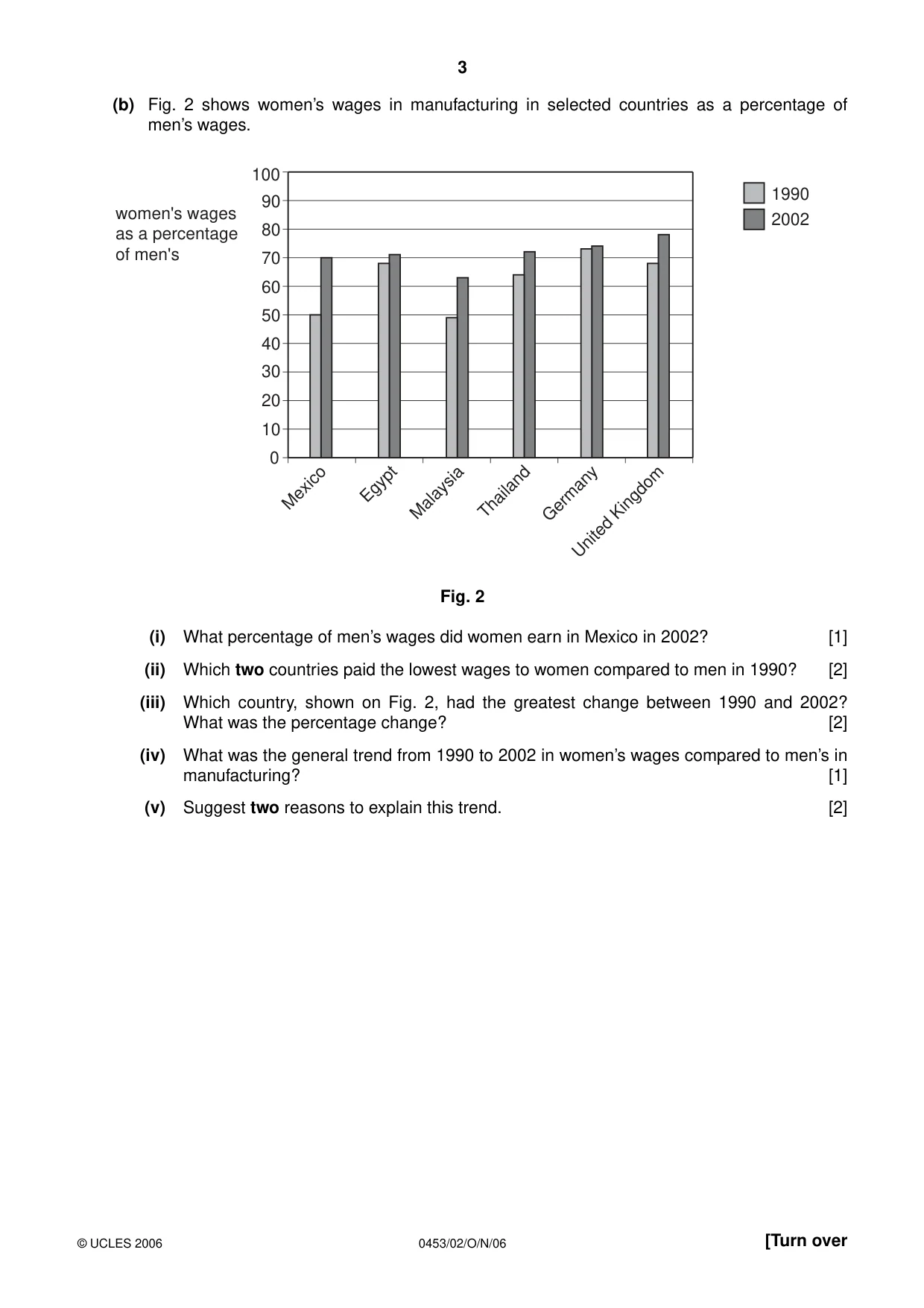
3 0453/02/O/N/06 [Turn over (b) Fig. 2 shows women’s wages in manufacturing in selected countries as a percentage of men’s wages. Fig. 2 (i) What percentage of men’s wages did women earn in Mexico in 2002? [1] (ii) Which two countries paid the lowest wages to women compared to men in 1990? [2] (iii) Which country, shown on Fig. 2, had the greatest change between 1990 and 2002? What was the percentage change? [2] (iv) What was the general trend from 1990 to 2002 in women’s wages compared to men’s in manufacturing? [1] (v) Suggest two reasons to explain this trend. [2] © UCLES 2006 0 10 20 1990 2002 30 40 50 60 women's wages as a percentage of men's 70 80 90 100 Mexico Egypt Malaysia Thailand Germany United Kingdom
Question paper, page 4
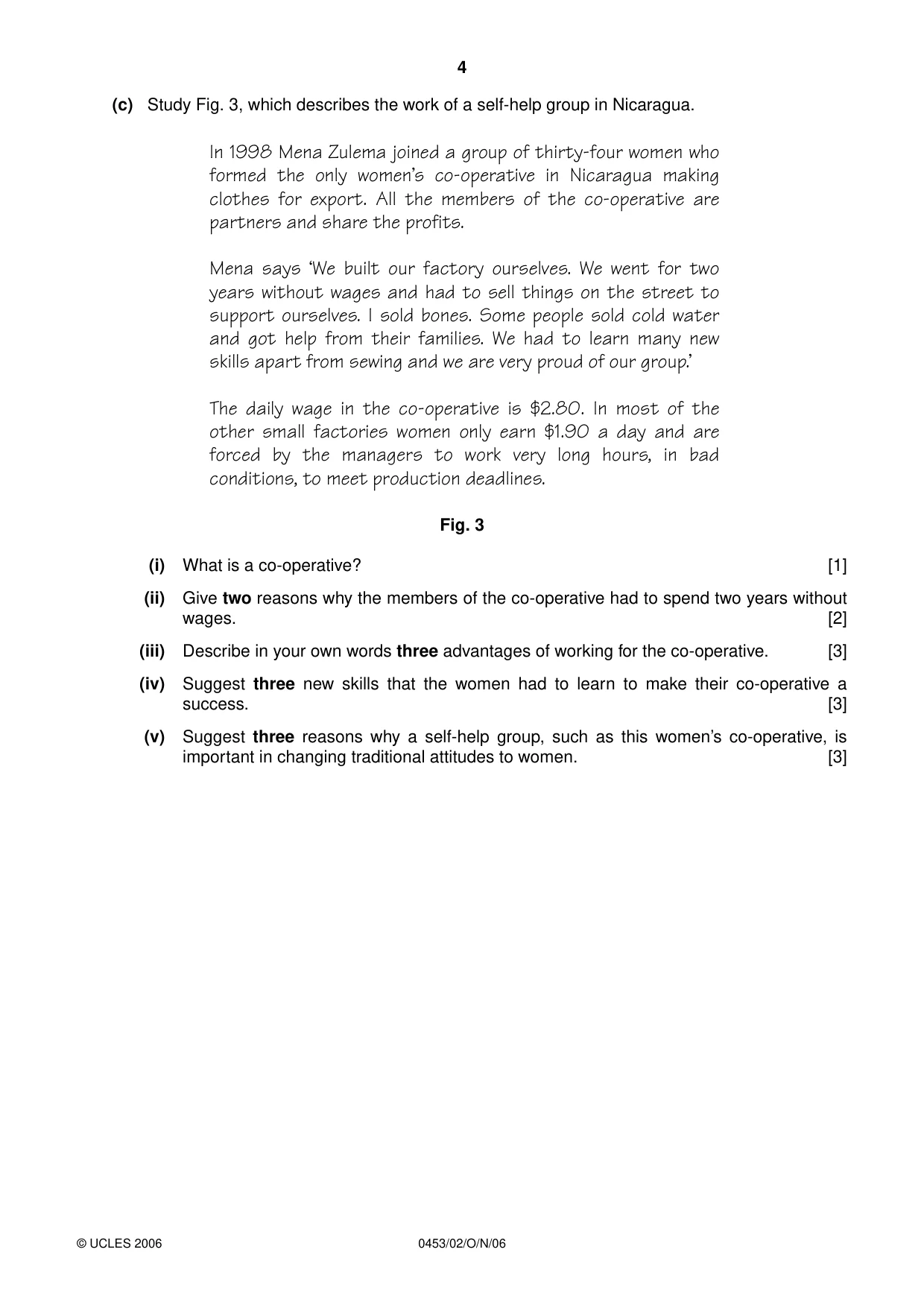
4 0453/02/O/N/06 (c) Study Fig. 3, which describes the work of a self-help group in Nicaragua. Fig. 3 (i) What is a co-operative? [1] (ii) Give two reasons why the members of the co-operative had to spend two years without wages. [2] (iii) Describe in your own words three advantages of working for the co-operative. [3] (iv) Suggest three new skills that the women had to learn to make their co-operative a success. [3] (v) Suggest three reasons why a self-help group, such as this women’s co-operative, is important in changing traditional attitudes to women. [3] © UCLES 2006 In 1998 Mena Zulema joined a group of thirty-four women who formed the only women’s co-operative in Nicaragua making clothes for export. All the members of the co-operative are partners and share the profits. Mena says ‘We built our factory ourselves. We went for two years without wages and had to sell things on the street to support ourselves. I sold bones. Some people sold cold water and got help from their families. We had to learn many new skills apart from sewing and we are very proud of our group.’ The daily wage in the co-operative is $2.80. In most of the other small factories women only earn $1.90 a day and are forced by the managers to work very long hours, in bad conditions, to meet production deadlines.
Question paper, page 5
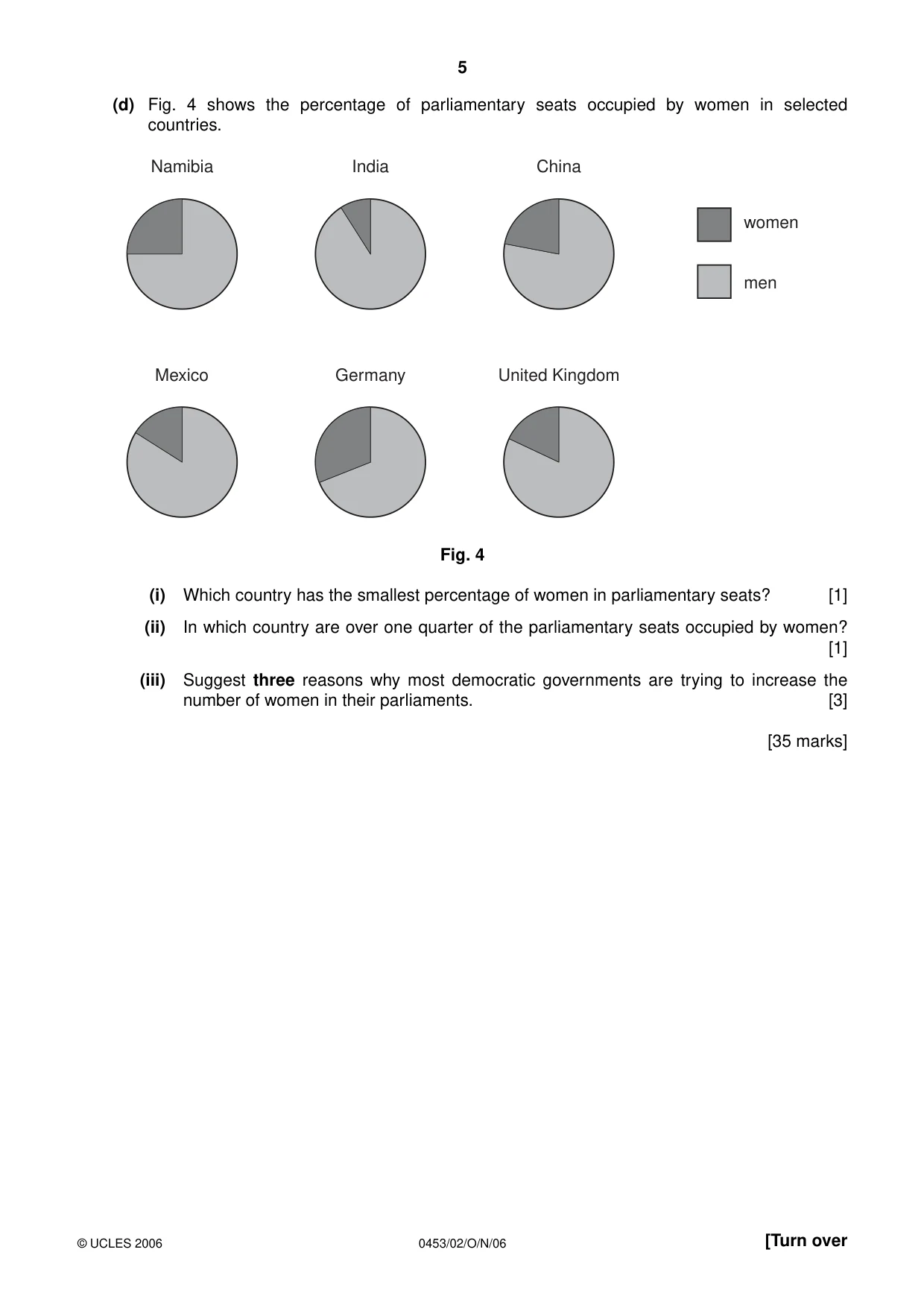
5 0453/02/O/N/06 [Turn over (d) Fig. 4 shows the percentage of parliamentary seats occupied by women in selected countries. Fig. 4 (i) Which country has the smallest percentage of women in parliamentary seats? [1] (ii) In which country are over one quarter of the parliamentary seats occupied by women? [1] (iii) Suggest three reasons why most democratic governments are trying to increase the number of women in their parliaments. [3] [35 marks] Namibia India China women men Mexico Germany United Kingdom © UCLES 2006
Question paper, page 6
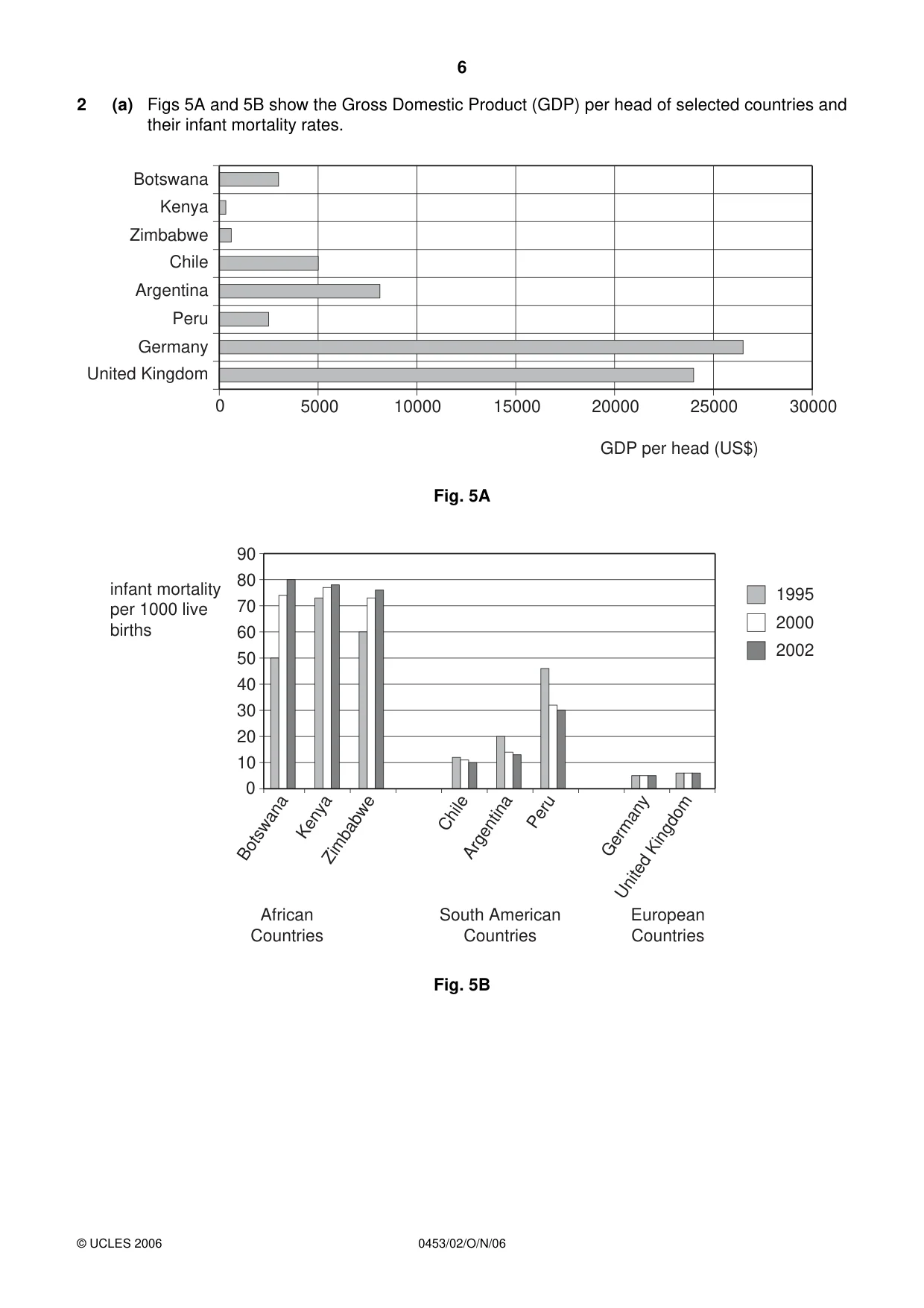
6 0453/02/O/N/06 2 (a) Figs 5A and 5B show the Gross Domestic Product (GDP) per head of selected countries and their infant mortality rates. Fig. 5A Fig. 5B © UCLES 2006 0 United Kingdom Germany Peru Argentina Chile Zimbabwe Kenya Botswana 5000 10000 15000 GDP per head (US$) 20000 25000 30000 0 10 Botswana Kenya Zimbabwe Chile Argentina Peru Germany United Kingdom 20 African Countries infant mortality per 1000 live births South American Countries European Countries 30 40 50 60 70 80 90 1995 2000 2002
Question paper, page 7
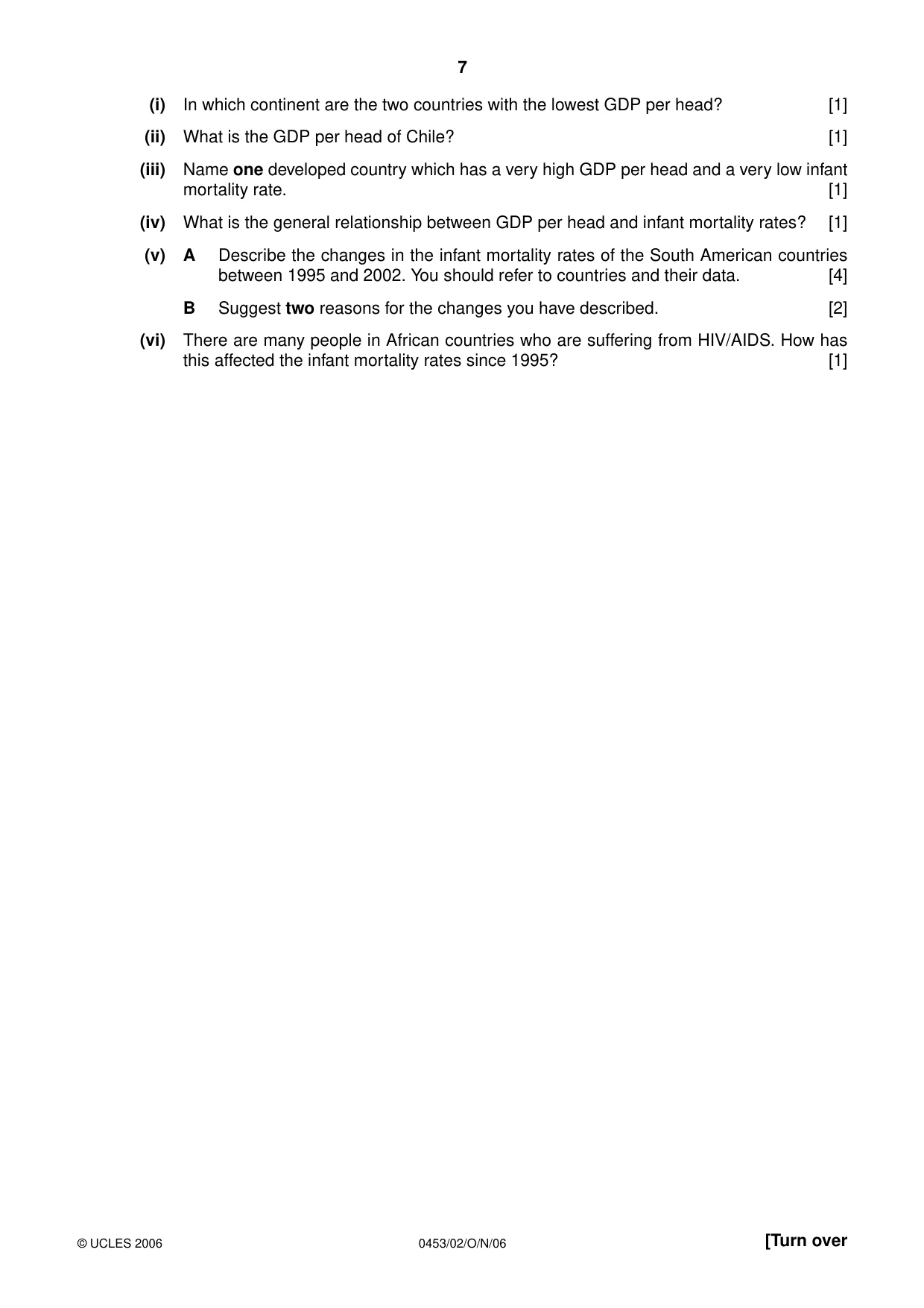
7 0453/02/O/N/06 [Turn over (i) In which continent are the two countries with the lowest GDP per head? [1] (ii) What is the GDP per head of Chile? [1] (iii) Name one developed country which has a very high GDP per head and a very low infant mortality rate. [1] (iv) What is the general relationship between GDP per head and infant mortality rates? [1] (v) A Describe the changes in the infant mortality rates of the South American countries between 1995 and 2002. You should refer to countries and their data. [4] B Suggest two reasons for the changes you have described. [2] (vi) There are many people in African countries who are suffering from HIV/AIDS. How has this affected the infant mortality rates since 1995? [1] © UCLES 2006
Question paper, page 8
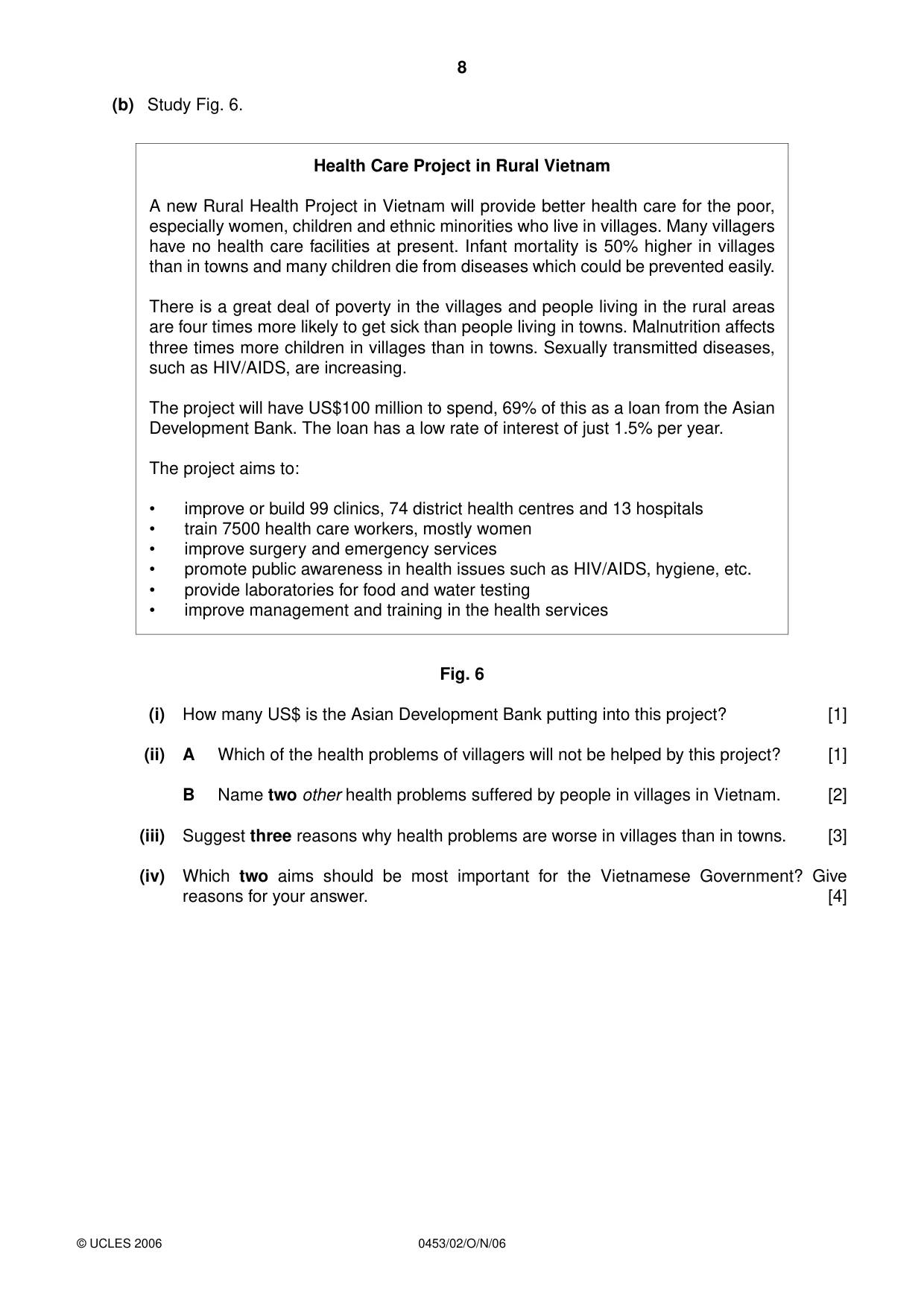
8 0453/02/O/N/06 (b) Study Fig. 6. Fig. 6 (i) How many US$ is the Asian Development Bank putting into this project? [1] (ii) A Which of the health problems of villagers will not be helped by this project? [1] B Name two other health problems suffered by people in villages in Vietnam. [2] (iii) Suggest three reasons why health problems are worse in villages than in towns. [3] (iv) Which two aims should be most important for the Vietnamese Government? Give reasons for your answer. [4] Health Care Project in Rural Vietnam A new Rural Health Project in Vietnam will provide better health care for the poor, especially women, children and ethnic minorities who live in villages. Many villagers have no health care facilities at present. Infant mortality is 50% higher in villages than in towns and many children die from diseases which could be prevented easily. There is a great deal of poverty in the villages and people living in the rural areas are four times more likely to get sick than people living in towns. Malnutrition affects three times more children in villages than in towns. Sexually transmitted diseases, such as HIV/AIDS, are increasing. The project will have US$100 million to spend, 69% of this as a loan from the Asian Development Bank. The loan has a low rate of interest of just 1.5% per year. The project aims to: • improve or build 99 clinics, 74 district health centres and 13 hospitals • train 7500 health care workers, mostly women • improve surgery and emergency services • promote public awareness in health issues such as HIV/AIDS, hygiene, etc. • provide laboratories for food and water testing • improve management and training in the health services © UCLES 2006
Question paper, page 9
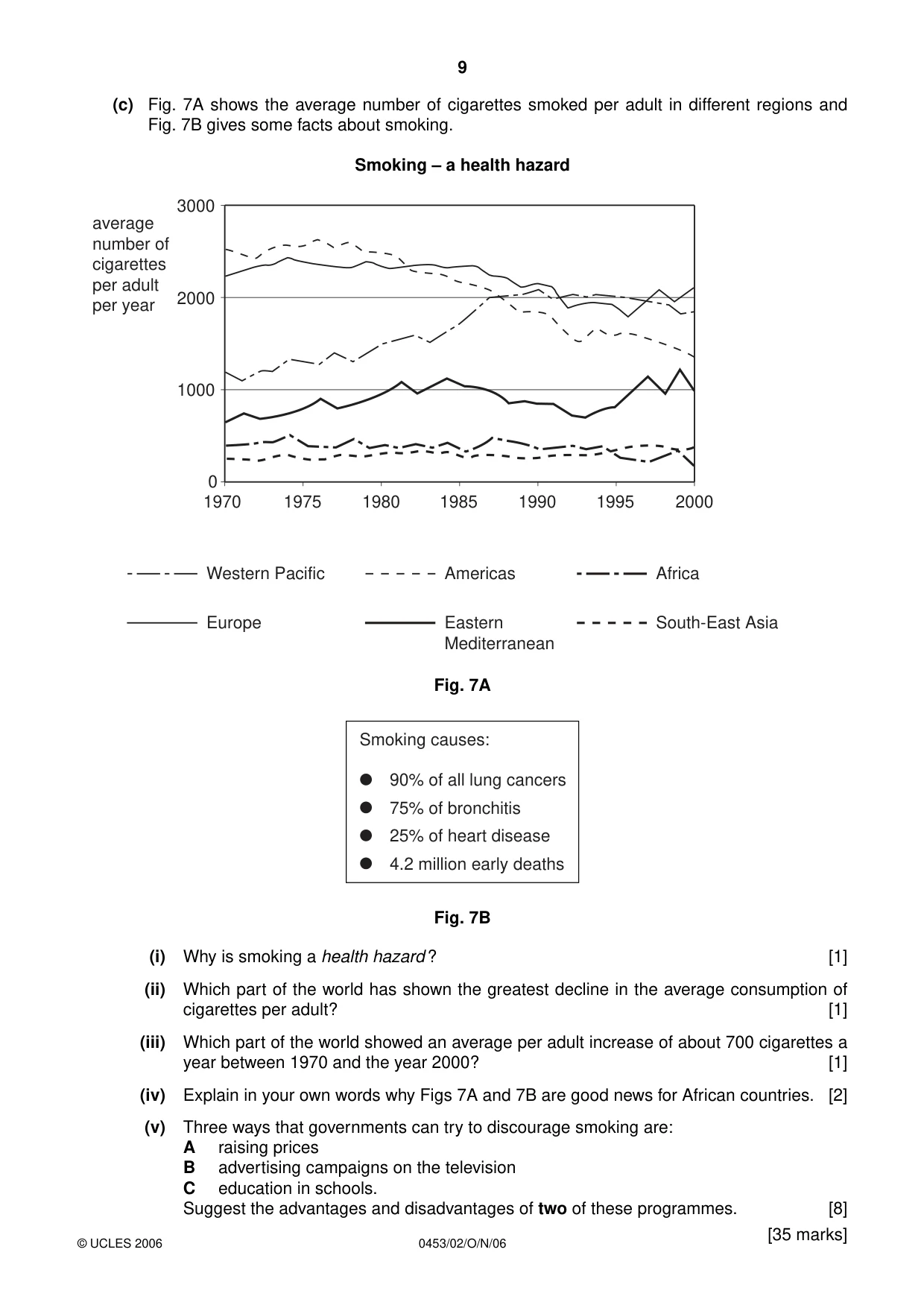
9 0453/02/O/N/06 (c) Fig. 7A shows the average number of cigarettes smoked per adult in different regions and Fig. 7B gives some facts about smoking. Smoking – a health hazard Fig. 7A Fig. 7B (i) Why is smoking a health hazard ? [1] (ii) Which part of the world has shown the greatest decline in the average consumption of cigarettes per adult? [1] (iii) Which part of the world showed an average per adult increase of about 700 cigarettes a year between 1970 and the year 2000? [1] (iv) Explain in your own words why Figs 7A and 7B are good news for African countries. [2] (v) Three ways that governments can try to discourage smoking are: A raising prices B advertising campaigns on the television C education in schools. Suggest the advantages and disadvantages of two of these programmes. [8] [35 marks] Smoking causes: 90% of all lung cancers 75% of bronchitis 25% of heart disease 4.2 million early deaths © UCLES 2006 1970 0 1000 2000 average number of cigarettes per adult per year 3000 1975 1980 1985 1990 1995 2000 The Americas E. Mediterranean Western Pacific Americas Africa Europe Eastern Mediterranean South-East Asia
Question paper, page 12
12 0453/02/O/N/06 BLANK PAGE Copyright Acknowledgements: Question 1. Fig. 3 © Reprinted by kind permission of the New Internationalist. Copyright New Internationalist www.newint.org Question 2. Fig. 7A © Reprinted by kind permission of the New Internationalist. Copyright New Internationalist www.newint.org Permission to reproduce items where third-party owned material protected by copyright is included has been sought and cleared where possible. Every reasonable effort has been made by the publisher (UCLES) to trace copyright holders, but if any items requiring clearance have unwittingly been included, the publisher will be pleased to make amends at the earliest possible opportunity. University of Cambridge International Examinations is part of the University of Cambridge Local Examinations Syndicate (UCLES), which is itself a department of the University of Cambridge.
Mark scheme, page 1
UNIVERSITY OF CAMBRIDGE INTERNATIONAL EXAMINATIONS International General Certificate of Secondary Education MARK SCHEME for the October/November 2006 question paper 0453 DEVELOPMENT STUDIES 0453/02 Paper 2, maximum raw mark 70 This mark scheme is published as an aid to teachers and students, to indicate the requirements of the examination. It shows the basis on which Examiners were instructed to award marks. It does not indicate the details of the discussions that took place at an Examiners’ meeting before marking began. All Examiners are instructed that alternative correct answers and unexpected approaches in candidates’ scripts must be given marks that fairly reflect the relevant knowledge and skills demonstrated. Mark schemes must be read in conjunction with the question papers and the report on the examination. The grade thresholds for various grades are published in the report on the examination for most IGCSE, GCE Advanced Level and Advanced Subsidiary Level syllabuses. • CIE will not enter into discussions or correspondence in connection with these mark schemes. CIE is publishing the mark schemes for the October/November 2006 question papers for most IGCSE, GCE Advanced Level and Advanced Subsidiary Level syllabuses and some Ordinary Level syllabuses. www.XtremePapers.com
Mark scheme, page 2
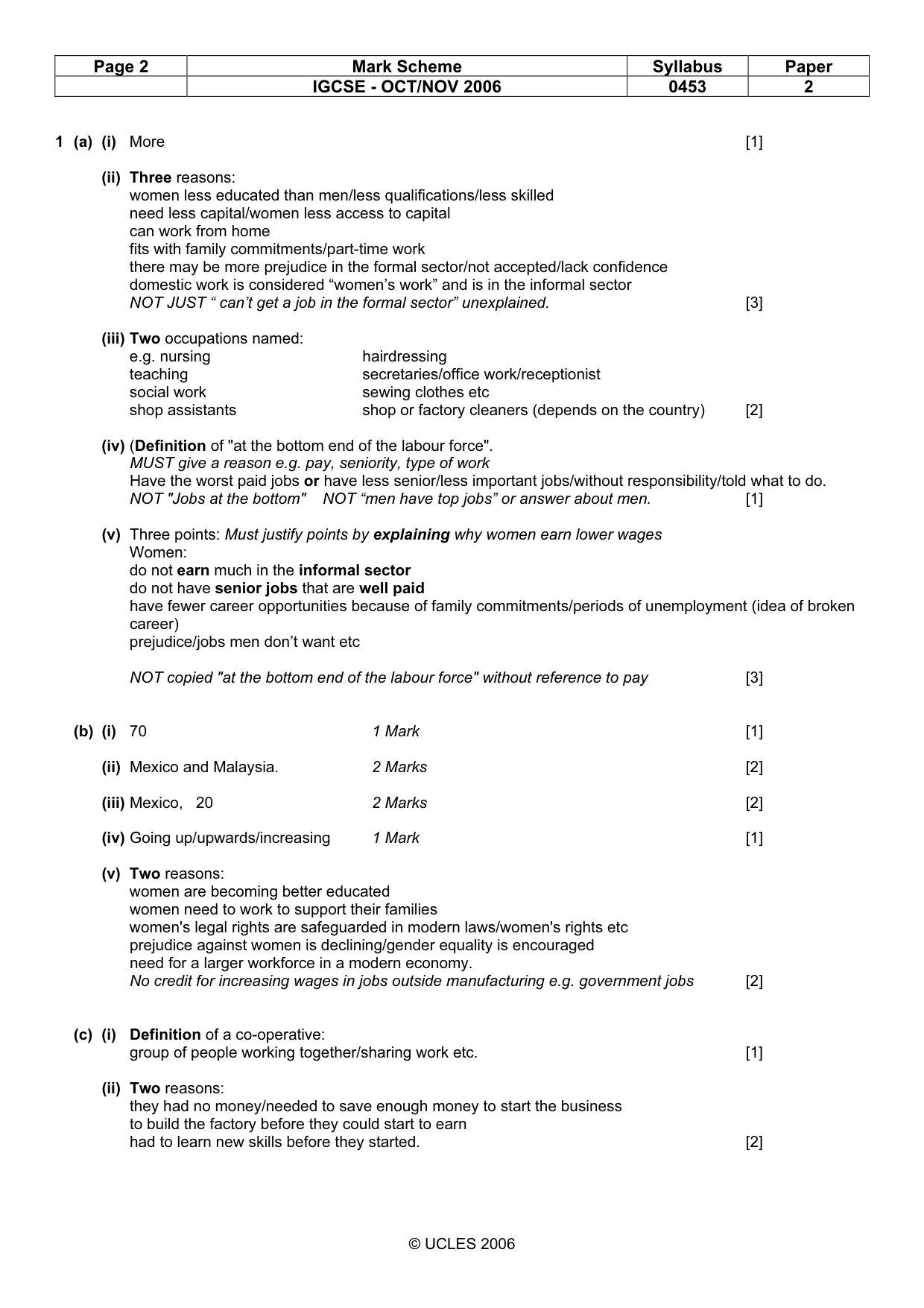
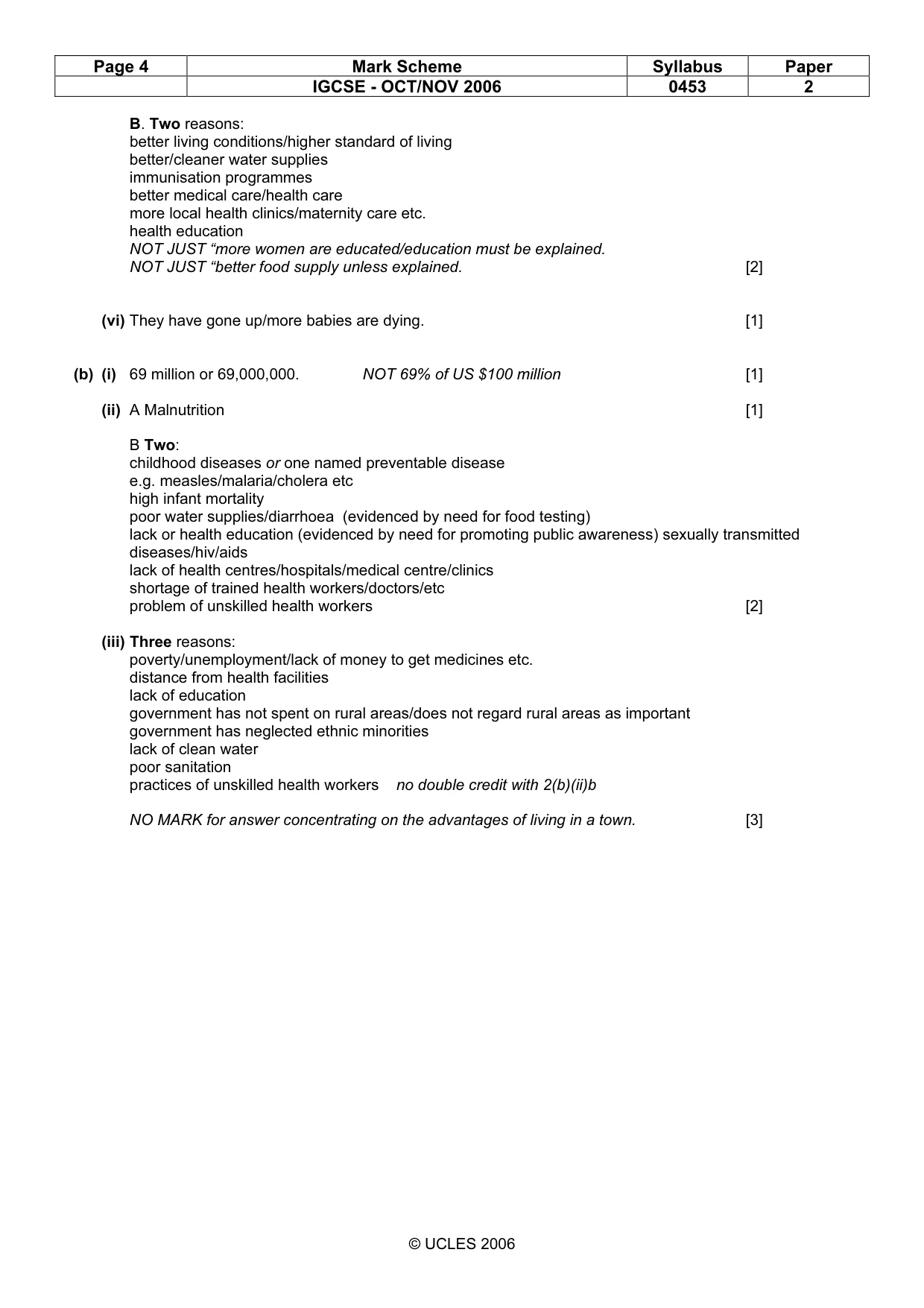
Page 2 Mark Scheme Syllabus Paper IGCSE - OCT/NOV 2006 0453 2 © UCLES 2006 1 (a) (i) More [1] (ii) Three reasons: women less educated than men/less qualifications/less skilled need less capital/women less access to capital can work from home fits with family commitments/part-time work there may be more prejudice in the formal sector/not accepted/lack confidence domestic work is considered “women’s work” and is in the informal sector NOT JUST “ can’t get a job in the formal sector” unexplained. [3] (iii) Two occupations named: e.g. nursing hairdressing teaching secretaries/office work/receptionist social work sewing clothes etc shop assistants shop or factory cleaners (depends on the country) [2] (iv) (Definition of "at the bottom end of the labour force". MUST give a reason e.g. pay, seniority, type of work Have the worst paid jobs or have less senior/less important jobs/without responsibility/told what to do. NOT "Jobs at the bottom" NOT “men have top jobs” or answer about men. [1] (v) Three points: Must justify points by explaining why women earn lower wages Women: do not earn much in the informal sector do not have senior jobs that are well paid have fewer career opportunities because of family commitments/periods of unemployment (idea of broken career) prejudice/jobs men don’t want etc NOT copied "at the bottom end of the labour force" without reference to pay [3] (b) (i) 70 1 Mark [1] (ii) Mexico and Malaysia. 2 Marks [2] (iii) Mexico, 20 2 Marks [2] (iv) Going up/upwards/increasing 1 Mark [1] (v) Two reasons: women are becoming better educated women need to work to support their families women's legal rights are safeguarded in modern laws/women's rights etc prejudice against women is declining/gender equality is encouraged need for a larger workforce in a modern economy. No credit for increasing wages in jobs outside manufacturing e.g. government jobs [2] (c) (i) Definition of a co-operative: group of people working together/sharing work etc. [1] (ii) Two reasons: they had no money/needed to save enough money to start the business to build the factory before they could start to earn had to learn new skills before they started. [2]
Mark scheme, page 3
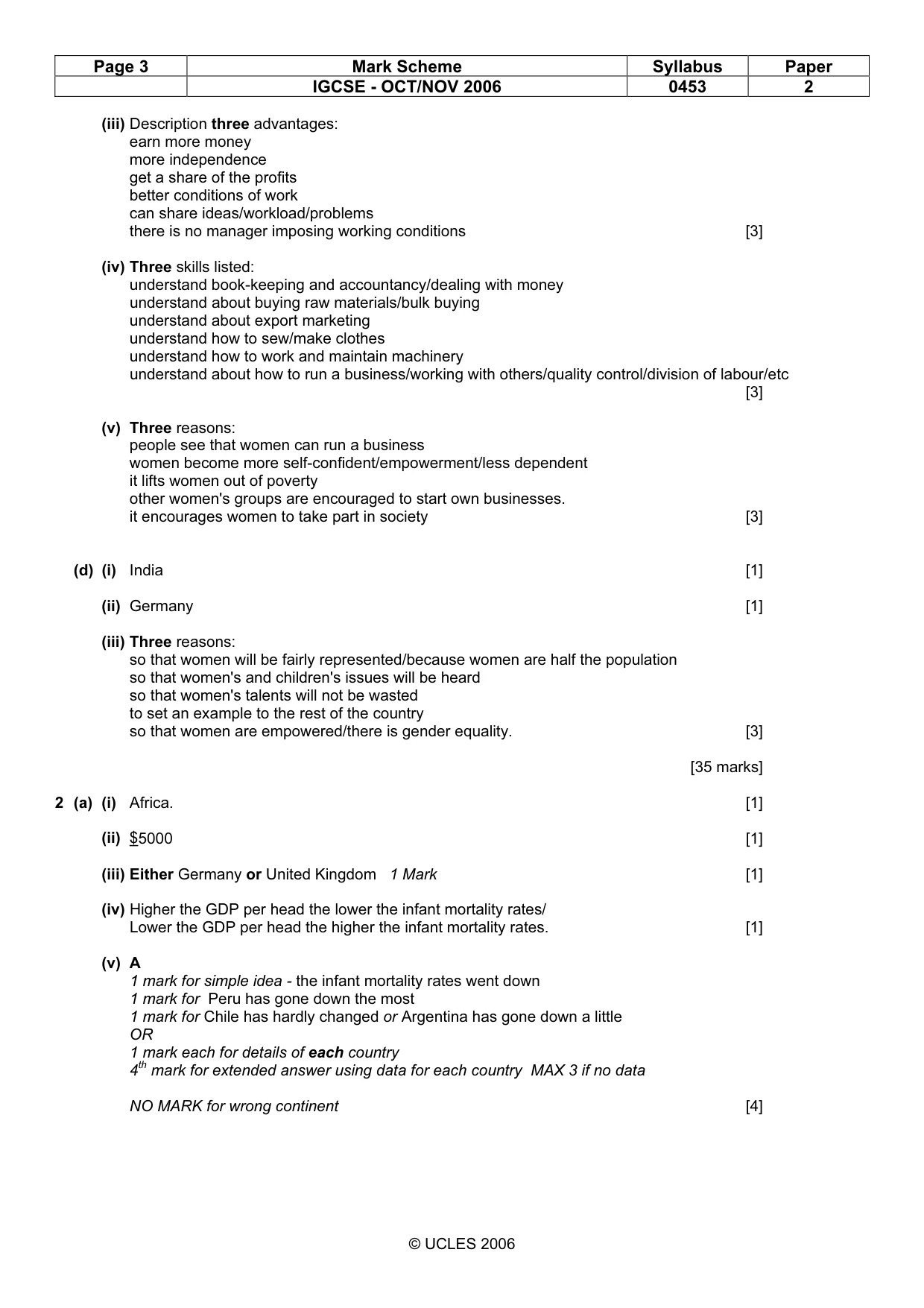
Page 3 Mark Scheme Syllabus Paper IGCSE - OCT/NOV 2006 0453 2 © UCLES 2006 (iii) Description three advantages: earn more money more independence get a share of the profits better conditions of work can share ideas/workload/problems there is no manager imposing working conditions [3] (iv) Three skills listed: understand book-keeping and accountancy/dealing with money understand about buying raw materials/bulk buying understand about export marketing understand how to sew/make clothes understand how to work and maintain machinery understand about how to run a business/working with others/quality control/division of labour/etc [3] (v) Three reasons: people see that women can run a business women become more self-confident/empowerment/less dependent it lifts women out of poverty other women's groups are encouraged to start own businesses. it encourages women to take part in society [3] (d) (i) India [1] (ii) Germany [1] (iii) Three reasons: so that women will be fairly represented/because women are half the population so that women's and children's issues will be heard so that women's talents will not be wasted to set an example to the rest of the country so that women are empowered/there is gender equality. [3] [35 marks] 2 (a) (i) Africa. [1] (ii) $5000 [1] (iii) Either Germany or United Kingdom 1 Mark [1] (iv) Higher the GDP per head the lower the infant mortality rates/ Lower the GDP per head the higher the infant mortality rates. [1] (v) A 1 mark for simple idea - the infant mortality rates went down 1 mark for Peru has gone down the most 1 mark for Chile has hardly changed or Argentina has gone down a little OR 1 mark each for details of each country 4th mark for extended answer using data for each country MAX 3 if no data NO MARK for wrong continent [4]
Mark scheme, page 4
Page 4 Mark Scheme Syllabus Paper IGCSE - OCT/NOV 2006 0453 2 © UCLES 2006 B. Two reasons: better living conditions/higher standard of living better/cleaner water supplies immunisation programmes better medical care/health care more local health clinics/maternity care etc. health education NOT JUST “more women are educated/education must be explained. NOT JUST “better food supply unless explained. [2] (vi) They have gone up/more babies are dying. [1] (b) (i) 69 million or 69,000,000. NOT 69% of US $100 million [1] (ii) A Malnutrition [1] B Two: childhood diseases or one named preventable disease e.g. measles/malaria/cholera etc high infant mortality poor water supplies/diarrhoea (evidenced by need for food testing) lack or health education (evidenced by need for promoting public awareness) sexually transmitted diseases/hiv/aids lack of health centres/hospitals/medical centre/clinics shortage of trained health workers/doctors/etc problem of unskilled health workers [2] (iii) Three reasons: poverty/unemployment/lack of money to get medicines etc. distance from health facilities lack of education government has not spent on rural areas/does not regard rural areas as important government has neglected ethnic minorities lack of clean water poor sanitation practices of unskilled health workers no double credit with 2(b)(ii)b NO MARK for answer concentrating on the advantages of living in a town. [3]
Mark scheme, page 5
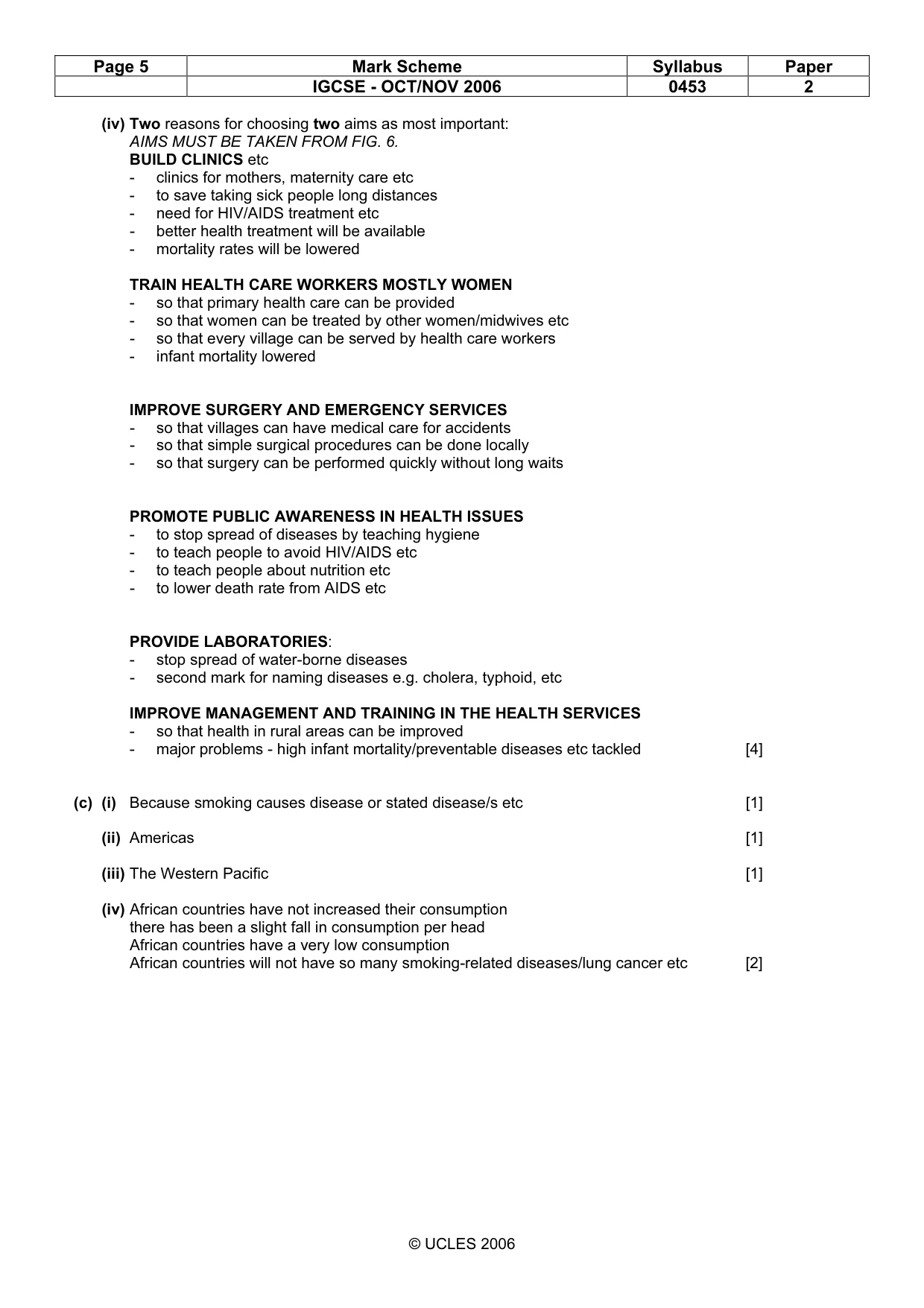
Page 5 Mark Scheme Syllabus Paper IGCSE - OCT/NOV 2006 0453 2 © UCLES 2006 (iv) Two reasons for choosing two aims as most important: AIMS MUST BE TAKEN FROM FIG. 6. BUILD CLINICS etc - clinics for mothers, maternity care etc - to save taking sick people long distances - need for HIV/AIDS treatment etc - better health treatment will be available - mortality rates will be lowered TRAIN HEALTH CARE WORKERS MOSTLY WOMEN - so that primary health care can be provided - so that women can be treated by other women/midwives etc - so that every village can be served by health care workers - infant mortality lowered IMPROVE SURGERY AND EMERGENCY SERVICES - so that villages can have medical care for accidents - so that simple surgical procedures can be done locally - so that surgery can be performed quickly without long waits PROMOTE PUBLIC AWARENESS IN HEALTH ISSUES - to stop spread of diseases by teaching hygiene - to teach people to avoid HIV/AIDS etc - to teach people about nutrition etc - to lower death rate from AIDS etc PROVIDE LABORATORIES: - stop spread of water-borne diseases - second mark for naming diseases e.g. cholera, typhoid, etc IMPROVE MANAGEMENT AND TRAINING IN THE HEALTH SERVICES - so that health in rural areas can be improved - major problems - high infant mortality/preventable diseases etc tackled [4] (c) (i) Because smoking causes disease or stated disease/s etc [1] (ii) Americas [1] (iii) The Western Pacific [1] (iv) African countries have not increased their consumption there has been a slight fall in consumption per head African countries have a very low consumption African countries will not have so many smoking-related diseases/lung cancer etc [2]
Mark scheme, page 6
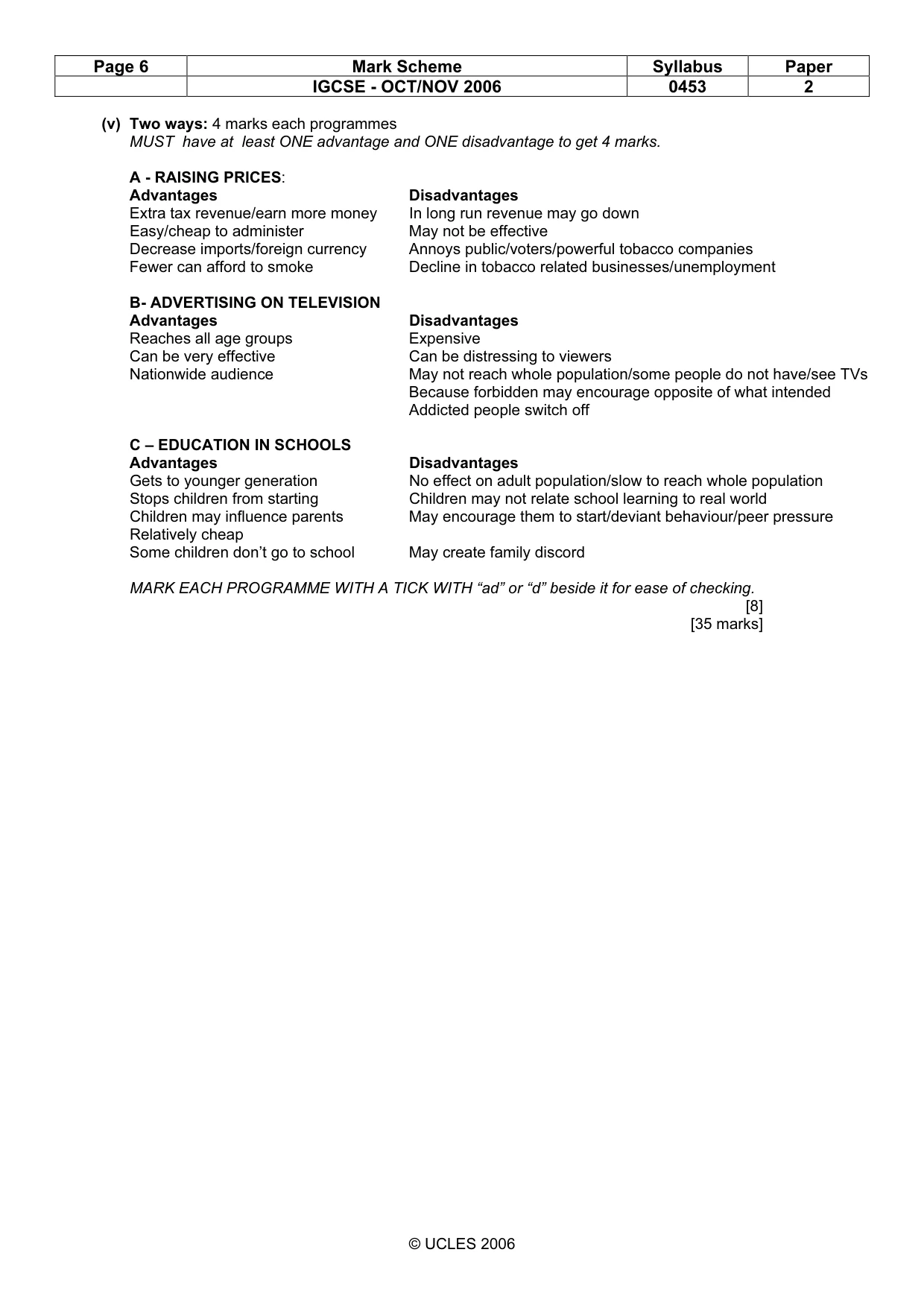
Page 6 Mark Scheme Syllabus Paper IGCSE - OCT/NOV 2006 0453 2 © UCLES 2006 (v) Two ways: 4 marks each programmes MUST have at least ONE advantage and ONE disadvantage to get 4 marks. A - RAISING PRICES: Advantages Disadvantages Extra tax revenue/earn more money In long run revenue may go down Easy/cheap to administer May not be effective Decrease imports/foreign currency Annoys public/voters/powerful tobacco companies Fewer can afford to smoke Decline in tobacco related businesses/unemployment B- ADVERTISING ON TELEVISION Advantages Disadvantages Reaches all age groups Expensive Can be very effective Can be distressing to viewers Nationwide audience May not reach whole population/some people do not have/see TVs Because forbidden may encourage opposite of what intended Addicted people switch off C – EDUCATION IN SCHOOLS Advantages Disadvantages Gets to younger generation No effect on adult population/slow to reach whole population Stops children from starting Children may not relate school learning to real world Children may influence parents May encourage them to start/deviant behaviour/peer pressure Relatively cheap Some children don’t go to school May create family discord MARK EACH PROGRAMME WITH A TICK WITH “ad” or “d” beside it for ease of checking. [8] [35 marks]
What you needed in this session
Cambridge’s own grade thresholds for 2006 Oct/Nov, Paper 2 · Variant 1. A higher threshold means an easier paper — the bar moves with how the cohort did.